Spock: Mr Scott, there was no deity involved. It was my cross-circuiting to B that recovered them.
McCoy: Then thank pitchforks and pointed ears.
Star Trek, “Obsession” (s2:ep13), stardate 3620.7
In the host of world religions, Buddhism occupies a strange place. In one sense, it is a world religion because it is followed by many different peoples, cultures, and languages throughout its 2,500 year history.
But unlike other world religions there is no central deity, no creator.
Hold on, you might be thinking, what about the Buddha?
The Buddha is the central figure of Buddhism. He is the teacher, but in the Buddhist tradition he was once a person, just like you and me, who through countless lifetimes as a bodhisattva fully accomplished the path and awakened to the Dharma: the principles of existence. He taught the Dharma to his disciples, and they became the first generation of the Sangha, the community.
Thus, these comprise the Three Treasures of Buddhism.
But why do people pray to the Buddha?
Because the Buddha and all other such figures in Buddhism are not passive. The Buddha taught the Dharma out of compassion and goodwill for all beings, and the countless Bodhisattvas such as Kannon guide any sentient beings who take up the Buddhist path. Amida Buddha provides a refuge for all beings who wish to be reborn there.
Kannon (観音) Bodhisattva in her more motherly form.
The underlying theme isn’t Enlightenment for Enlightenment’s sake. It is to help beings who suffer so that eventually they too may reach Buddhahood (a.k.a. Enlightenment).
One does not have to pray to the Buddhas and Bodhisattvas. The most important thing is to put the Buddhist teachings into practice as one can. But in times of unease, uncertainty or crisis it’s perfectly fine to pray to a Buddha or Bodhisattva that you revere. I do it from time to time myself when I am worried about my kids, on plane flights, before surgery, etc.
But also, in the end, I am responsible for my choices, my words, and my thoughts.
When you plant melon seeds you get melons, and when you plant beans you get beans. [Effect follows causes] like a shadow follows a physical shape, like an echo responds to a sound. Nothing is sown in vain. This is called “believing in the result”.
Ou-yi’s Mind Seal of the Buddhas, translation by J. C. Clearly
I alone bear the fruits of my choices, words and thoughts.
A few months ago, I made this post about how the Obaku Zen sect interprets Amida Buddha and the Pure Land. To my surprise, I keep reflecting on this phrase from time to time, almost like a Zen koan:
This mind is the Pure Land, this body is Amida Buddha
This idea of merging Zen and Pure Land ideas is somewhat rare in Japanese Buddhism, but it’s surprisingly common in Chinese-Buddhist thought. Originally, I thought it was limited to later Ming-Dynasty Buddhism (which Obaku descends from), but similar strands of thought exist much further back.
A famous Chinese monk named Yongming Yanshou (永明延壽. 904 – 976) once wrote a poem titled the “Four Alternatives” (sì liào jiǎn 四料揀):1
Lacking both Chan and the Pure Land, it will be the iron beds and bronze pillars [of hell] for ten thousand kalpas [eons] and a thousand lives with no one to turn to.
Having Chan but lacking the Pure Land, nine out of ten will stray from the path; when the realm of the aggregates appears before them, they will instantly follow it.
Lacking Chan but having the Pure Land, ten thousand out of ten thousand who practice it will go [to rebirth]. Having seen Amitābha, why worry that one might not attain enlightenment?
Having both Chan and Pure Land, one is like a tiger with horns [i.e., doubly capable]. Such a person will be a teacher in the present life, and a buddha or patriarch in future lives.
translation by Charles B. Jones, “Chinese Pure Land Buddhism, Understanding a Tradition of Practice”, pg 210
Yongming is advocating a supportive model where both Zen practice and Pure Land practice work in concert. The Pure Land path is the “safer” path to follow, due to the vows of Amida Buddha, but if supported by Zen practice here and now, one is really making progress on the Buddhist path.
Further, a later writer named Yunqi Zhuhong2 (雲棲袾宏, 1535 – 1615) explained that these things were not mutually exclusive (Chinese added by me):3
To contemplate the Buddha (nianfo 念佛) is to contemplate the mind (nian-xin 念心). Birth there (in the Pure Land) does not entail birth away from here. Mind, Buddha, and sentient beings are all of one substance; the middle stream (non-duality) does not abide on the two banks (this world and the Pure Land).
Similarly, Ouyi Zhixu (蕅益智旭, 1599 – 1655) in his excellent work “Mind Seal of Buddhas” makes a similar argument: Zen and Pure Land practice are the same thing, just operating at different levels. You’re not forced to chose one or the other in your practice.
But such ideas aren’t limited to medieval Chinese-Buddhist monks. You can find such sentiments in Pure Land sutras themselves! In the Immeasurable Life Sutra is this passage (emphasis added):
“In this world, you should extensively plant roots of virtue, be benevolent, give generously, abstain from breaking the precepts, be patient and diligent, teach people with sincerity and wisdom, do virtuous deeds, and practice good. If you strictly observe the precepts of abstinence with upright thought and mindfulness even for a day and a night, the merit acquired will surpass that of practicing good in the land of Amitāyus [a.k.a. the Pure Land] for a hundred years. The reason is that in that buddha land of effortless spontaneity all the inhabitants do good without committing even a hair’s breadth of evil. If in this world you do good for ten days and nights, the merit acquired will surpass that of practicing good in the buddha lands of other directions for a thousand years.
Translation by Rev. Hisao Inagaki
In this passage, the Buddha is clearly advocating both bending your efforts toward rebirth in the Pure Land, but also making the most of the time you have here to undergo traditional Buddhist practices too because even a modest effort here is a great benefit in the future (both for yourself and others).
As I often tell my kids: “go nuts”!4
What I mean is: recite the nembutsu, meditate, uphold the precepts, or some combination thereof. You have nowhere to go but up.
But what if you can’t decide or don’t have the time?
In my opinion, start with the nembutsu. Begin just as you are, and recite it just 10 times daily. From there, add the Five Precepts when you are ready, and once you have that foundation, and are ready to branch out, then look into Zen practices. This make take months or even years. Take your time, go slow, and don’t be afraid to explore.
When I talk about the flexibility of Tendai Buddhism in Japan as well, this is what I am alluding to: start with something simple and small at first (such as a devotional practice), and gradually building upon it as you gain confidence and see the positive transformation in your life. Buddhism is kind of a SLOW, gradual religion, but like a glacier, once it starts moving, it has a wonderful momentum all its own even if you can’t see it.
Namu Shakumuni Butsu Namu Amida Butsu
P.S. Featured blog image is another famous “Dynamic Duo”: Batman and Robin from the 1960’s series.
P.P.S. Posting kind of off-schedule just because it is fun. 😊
1 I found this on Wikipedia actually and I thought to myself “wow, this person quoted exactly the same way that I would do!”, then I realized that I had put this on Wikipedia a few years ago. 🤦🏼♂️
2 Pronounced like “yoon-chee joo-hong”.
3 Again, I managed to pull a quote from Wikipedia that I had unwittingly added years ago and then promptly forgot.
4 My kids ask me if they can watch TV, play Switch or whatever, and my frequent answer is “go nuts” [go crazy, have fun].
Sometimes when you travel in Japan, especially outside of Tokyo, you may come across like this:
A large sacred tree at Kasuga shrine in Nara, Japan. Taken by me in July 2023.
This is a large tree that has been growing for centuries within the precincts of Kasuga Grand Shrine in Nara, Japan. The tree, as you can see, has a large rope tied around it with small paper streamers. If you ever saw the Studio Gibhli movie Totoro, you can see a big camphor tree with a similar rope around it.
Sometimes you also find rocks and other natural things with ropes around them too.
A “shimenawa” around an “iwakura” (sacred rock) at Meigetsuin, Buddhist temple in Kamakura, Japan, courtesy of Wikipedia.
This is a Shinto-religious custom using a special sacred, hempen rope called Shimenawa (注連縄). The little paper streamers called called Shidé (紙垂).
Shimenawa are sometimes used to section off a sacred space, but they’re also used to enshrine places thought to house a local kami, such as a tree or rock thought to be sacred. Sometimes you also see them hanging over home Shinto shrines (kamidana, 神棚). The idea is the same: the paper streamers help deliniate a sacred space (the inner sanctum of your home shrine in this case).
Interestingly, I discovered that a separate, but parallel tradition exists in Korea too. This blog shows that in Korean traditional culture, people would enshrine local guardian spirits by tying a rope (금줄, Geumjul) around them, and decorating with colored cloths (오색천, Osaekcheon) or white strips of paper. Such sacred trees (당산나무, Dangsan-namu) and sacred rocks (누석단, Nuseokdan), are collectively called Seonangdang. They are very similar in appearance to the ones in Japan, so it’s not hard to guess that there’s some common religious tradition between both cultures, though the Wikipedia article linked above also suggests a potential link to Mongol culture too.
Shinto as a religion exists only in Japan1 but it’s not hard to imagine that Shinto tradition drew from something much older that was shared across the Korean peninsula and Japan. Further, since it’s known that in early Japanese history that many Korean families migrated to Japan (the Imperial court sought their skills and technology), it’s quite possible the tradition was imported from Korea to Japan. Further, as this early Yamato court actively allied with the Korean kingdom of Baekche, it’s possible the cultural exchange went in that direction too.
Anyhow, it’s a fascinating example of how the two (or more) cultures have shared religious traditions for millenia, but few would notice.
1 Barring colonial efforts in the early 20th century to introduce it to other Asian countries, but these did not have a lasting impact culturally.
One thing that really annoys me as a long-time Buddhist is the tendency for self-help and spritual seminars to cost so much money. I saw this advertised locally in my area for weeks, and the starting price for a seat is $250 for a backrow seat, which to me is totally bonkers.
The Dharma, as taught by Shakyamuni Buddha was freely given, and required nothing.
Having said that, as a counter to pricey spiritual seminars, I wanted to promote a concept: the Art of Dying.
DYING?!
It is a simple concept: you are going to die. You cannot necessarily choose the hour or manner of your death. But it will occur inevitably occur.
You do not have to take my word for it. Here’s a Buddhist sutra (freely given I might add) from the words of the Buddha:
There is no bargaining with Mortality & his mighty horde.
Whoever lives thus ardently, relentlessly both day & night, has truly had an auspicious day:
But, to summarize the Parable, the Buddha Shakyamuni asks us, the reader, to imagine a great, big mansion that’s old, rickey, and so on. Then, imagine the house is burning. Deep inside, some kids are playing in a room, unaware the house is on fire. The father, having just returned from a trip, sees his kids in danger and calls out to them to leave the house at once. The kids, engrossed in their games, fail to see their situation. Finally, the father offers them great rewards if they leave (specifically carts of goods), and the kids finally come out.
The father, Shakyamuni Buddha, has left the burning house and stands outside. He calls to those in danger, namely the “kids”, to see their peril and to come out too.
What about the burning house itself? That is the world we live in, with strife, conflict, disease, chaos, aging, and death.
The late Thich Nhat Hanh wrote about this too:
“Imagine two hens about to be slaughtered, but they do not know it. One hen says to the other, “The rice is much tastier than the corn. The corn is slightly off.” She is talking about relative joy. She does not realize that the real joy of this moment is the joy of not being slaughtered, the joy of being alive.”
This gets to the heart of the Buddha’s teachings: do not squander the time you have on this Earth. It doesn’t mean you can’t enjoy life and your loved ones, but remember: Death will not wait for it to be convenient for you.
When you hear this, your instinct might be the “live, laugh, and love”, indulge in all the fun things in life before it’s too late. But that’s not what the Buddha intended. When you look back at the Parable of the Burning House, the father wasn’t asking the kids to play more, he was telling them to get out before it’s too late.
Further, in the Mahayana tradition, one can get themselves out of the burning house, but helping and guide others to get out of the burning house is even better. One can call such people bodhisattvas.
But you can’t help others (let alone yourself) until you :
Recognize the situation
Put down your own toys and find the way out before you can help others.
This is part of the progression of the Buddhist path: get your foundations in order, increasing confidence in the Dharma (which you can see in your own life), and turning outward to help other beings.
But starting at the beginning, how does one establish a foundation?
Everyone is different, but generally it starts with some simple things:
Taking the Buddha, Dharma and Sangha as one’s chosen refuge (you can do this by yourself or in a community). You can setup a small shrine too.
Taking up an ethical life, such as undertaking the Five Precepts
If all five are too hard, start with one, and work your way up over the months and years.
Say to yourself (yes, you): May I be well, may I be free from harm.
Now think of loved ones: may they be well, may they be free from harm.
Now think of all living beings (even the awful ones): may they be well, may they be free from harm.
Setup a reasonable daily practice. Think of it like exercise or stretching: if you start too aggressively, you’ll injure yourself and set yourself back. So start small, and build up.
What does a daily practice look like? Some examples here.
A small meditation practice can be beneficial too, but intention matters.
Study the sutras. Not self-help books, but the sutras. Commentaries on the sutras, such as those provided by Thich Nhat Hanh are quite good and easy to find in used and independent bookstores such as Powell’s City of Books.
Find worthy teachers and communities, not slick, overpriced seminars or cults. Caveat emptor.
Repeat. Buddhism is a long-term practice. “Play the long game“, but also remember you are on the clock. Time is short.
So, that’s your free teaching for today. Thanks for attending this seminar. Want to support the blog? Pay it forward or something. This is “Buddhism on a Budget”, and I strongly feel this is how Buddhism should be.
VIR: I believe there are currents in the universe. Eddies and tides that pull us one way or the other. Some we have to fight, some we have to embrace.
Babylon 5, “The Geometry of Shadows”, s2:ep3
I really liked this quote from the science-fiction classic Babylon 5 (which I’ve been re-watching lately)1 because it speaks to the sense that many things happen outside our control. Instead, we’re constantly pulled along by other forces, and some of these can be beneficial, others can be harmful, and simply just pull us in unexpected directions. Some of these currents are very strong and difficult to resist, some are barely noticeable until we look back.
Further, we don’t always know where these currents will take us. So, there’s always danger in choosing one course or another.
DRAAL: What’s the third principle of sentient life? It is the capacity for self-sacrifice. The ability to override evolution and self-preservation…
Babylon 5, “A Voice in the Wilderness (part 1)”, s1:ep18
I think intuition is not enough to navigate this mess. One also needs a set of independent principles to help guide one, and that’s where things like the five precepts of Buddhism really come in handy. It’s not a list of “don’t do” things, it is a list of training rules to help strengthen the mind, and benefit others.
Also, clarity of mind.
Rather than giving in to self-doubt, stay cool, and take things one step at a time, navigate eddies and currents, but also don’t lose your goodwill towards others.
G’KAR: Too easy an answer. We all believe in something… greater than ourselves. Even if it’s just the blind forces of chance.
NA’TOTH: Chance favours the warrior.
Babylon 5, “By Any Means Necessary” (s1ep12)
I have been re-watching the classic science-fiction series, Babylon 5, and I found this neat dialogue between two of the Narn characters. G’Kar is a devout follower of the Narn religion, while his attaché Na’Toth is not.
G’Kar makes a good point: everyone believes in something. Even an atheist believes in something: science and reason instead of faith. Even someone who is agnostic believes in a higher power even if they can’t define it for themselves. Or people believe in chance, or the natural world or whatever. All of these are beliefs.
But then, I wonder: is belief (even Buddhist belief) just an extension of oneself? Is it a way to make sense of the world outside ourselves?
By the way, I think there’s nothing wrong with having beliefs (Buddhist or otherwise), but I think one’s beliefs are a good indicator of one’s inner fears and anxieties. Two people might sincerely believe in the God of the Bible, but each one emphasizes something different, or interprets God differently. So, how much of this is real, and how much is this just a projection of oneself onto the world?
So, then back to the top of the post: what do you believe in, and what does it say about you? 😏 You can learn a lot just by exploring this question.
Namu Shakamuni Butsu
P.S. Featured photo is “best buddies” Londo and G’kar from Babylon 5. RIP Andreas Katsulas (G’kar).
P.P.S. If you remember Mr Morden from Babylon 5, and his question “what do you want?”, that too is very instructive.
Notice the dates of each holiday: odd-numbered month with matching odd-numbered day. Turns out that there’s a reason for this.
In Chinese Taoist numerology, numbers are divided into “yang” and “yin” numbers: odd numbers are yang (陽) because they are considered unstable and dynamic, while even numbers are stable and static, thus yin (陰). But because yin and yang depend on one another, and change into one another, if you add yang and yang together, you get yin. If you add yin and yin together, you get yang.
Thus, it was thought that dates on the calendar with double-yang numbers (7 and 7, 5 and 5, etc) would become yin and thus were inauspicious. Holidays were developed to counteract the yin effect, and that’s why seasonal holidays were held on double-odd dates.
Taoism is not a major influence in Japanese culture (at least in modern times), but it’s interesting so see how it still influences traditions, especially those from antiquity.
M’BENGA: Prejudice has kept people from helping each other for centuries with no scientific justification. And after we met our neighbours in the galaxy, we found new bigotries….In any case, they’re meaningless to me. I am a physician.
Star Trek: Strange New Worlds, “Ghost of Illyria” (s1ep3), Stardate 1224.3
Prejudice is something far more insidious than simple racism, and something we all face on some level. We discriminate based on all kinds of criteria: race, ethnicity, religion, gender, politics, sports teams, departments at work, etc. If someone is somehow different, we are inclined to see them as an outsider. It’s subtle and tough to resist without conscious effort.
My personal belief is that prejudice is born from some kind primitive instinct of self-preservation, by making discerning choices with only limited information. Sometimes this might keep us alive, other times, it causes hostility and animosity.
But I am not the only one who seems to think this way…
But I digress.
In the famous Star Trek episode “Arena”, Kirk is compelled to fight a Gorn to the death in single combat:
The episode emphasizes how repulsive and cruel the reptilian Gorn are, and yet at the end when Kirk finally defeats the Gorn, he spares its life. This earns him the respect of the Metrons, the highly-advanced aliens who instigated the duel.
METRON: By sparing your helpless enemy who surely would have destroyed you, you demonstrated the advanced trait of mercy, something we hardly expected…. There is hope for you. Perhaps in several thousand years, your people and mine shall meet to reach an agreement. You are still half savage, but there is hope. We will contact you when we are ready.
Star Trek, “Arena” (s1ep18), Stardate 3045.6
The Metrons knew that violence and hatred were primitive and hardly distinguish a species, but mercy and goodwill do. It requires thought and mental discipline to override one’s basic instincts, but it is almost always the right choice.
Namu Shakamuni Butsu
P.S. The Gorn play a much more prominent role in Strange New Worlds than original Star Trek … with mixed results.
Recently, I found myself stuck in one of my usual nerd “rabbit holes” of trying to make sense of Zen lineages in Japanese Buddhism, but this led to a more complicated rabbit hole of making sense of the source “Chan” (Zen) lineages in China. This started after reading my new book on Rinzai Zen, which included a nice chart. At first, I tried to emulate and translate that chart in Canva, but then I realized it was missing some critical details, so I kept adding more. This is the result (click on the image for more detail):
Let’s go over this a bit so it makes more sense.
The premise behind all Zen sects regardless of country and lineage is that Zen started when the historical Buddha, Shakyamuni, supposedly held a flower up to his disciples and said nothing. Everyone was confused except his disciple Maha-Kashyapa who smiled in understanding. From here, according to tradition, the teachings were passed down from teacher to disciples for 28 generations in India, culminating in a monk named Bodhidharma who came to China.
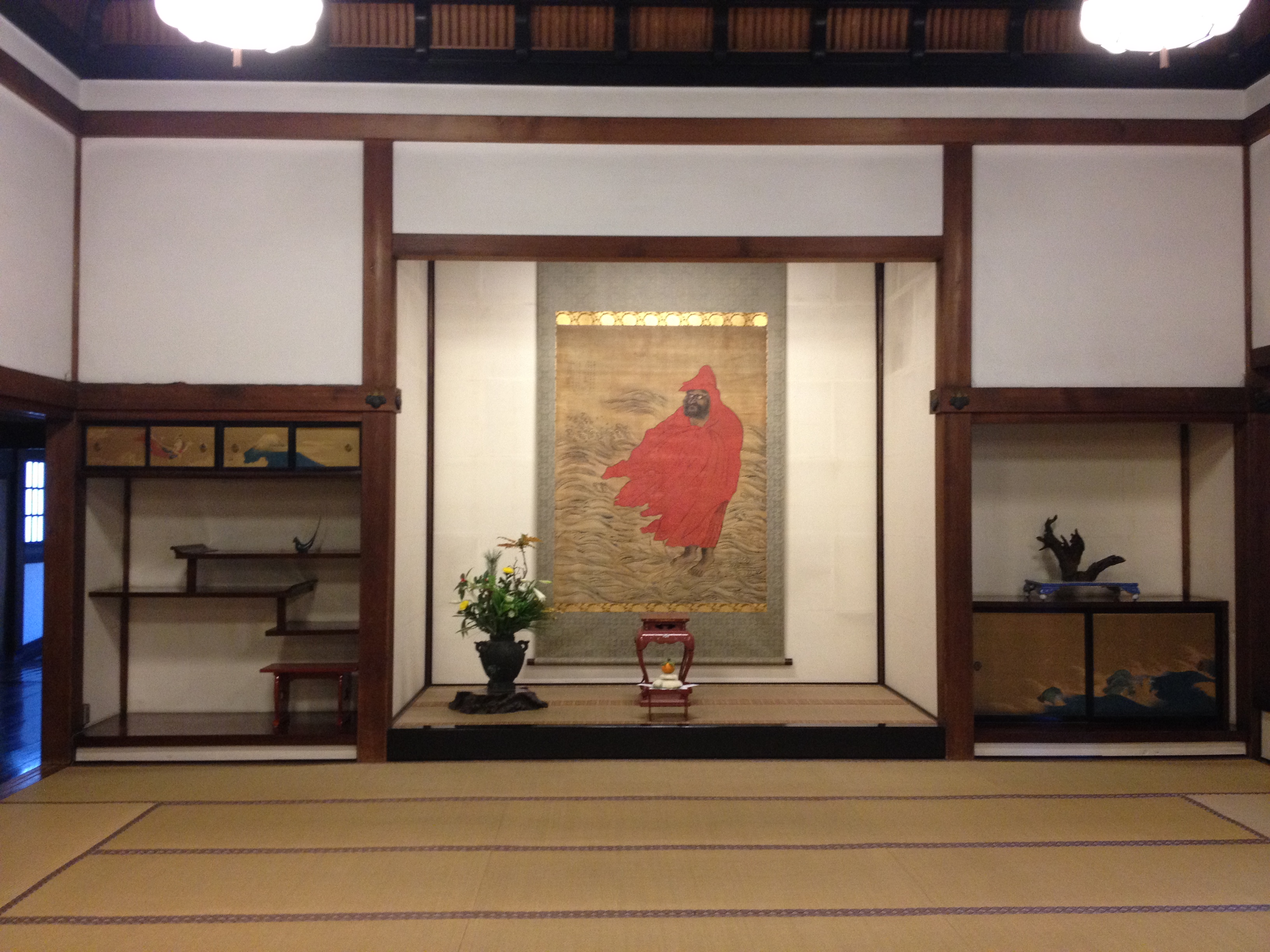
A painting of Bodhidharma at Sojiji temple (head of Soto Zen sect) in Kawasaki, Japan. Taken by me in 2010 (?).
The history up to this point is somewhat vague, and possibly apochryphal, but easy to follow.
This continues for a few more generations in China, until you get to a monk named Hui-Neng (Enō in Japanese)1 who is the supposed author of the Platform Sutra, a Chinese text. As the 6th “patriarch” of the lineage in China, he establishes what we know today as “Chan Buddhism” or Chinese Zen.
Things become more complicated a couple generations later as two descendants: Mazu Daoyi2 and Shitou Xiqian3 directly or indirectly found different schools of Chan Buddhism. This is known as the Five Houses of Chan period during the Tang Dynasty. Thus, the entire Chan/Zen tradition as we know it today is derived from Hui-neng and transmitted through these two men.
Out of the five houses, the Hongzhou,4Lin-ji and Cao-dong5 all survive in some form. The others are gradually absorbed into the Lin-ji school, which in the long-run is what becomes the most widespread form of Chan Buddhism in China. The Cao-dong school is the one exception, while the Hongzhou school’s success in Korea helps establish 8 out of 9 of the “Nine Schools of Seon (Chan)”6 in Korea. It through Bojo Jinul’s efforts in Korea that these nine schools are unified into the Jogye Order (homepage) which absorbed other Buddhist traditions in Korea into a single, cohesive one.
Meanwhile, in Japan, the Lin-ji and Cao-dong schools find their way to Japan where the names are preserved, but pronounced different: Rinzai and Soto respectively. Rinzai’s history is particularly complicated because they were multiple, unrelated transmissions to Japan often spurred by the Mongol conquest of China. Of these various Rinzai lineages, the two that survive are the “Otokan” Rinzai lineage through Hakuin, and the “Obaku” lineage through Ingen, but eventually the Otokan lineage absorbed the Obaku lineage. Today, Rinzai Zen is more formally called Rinzai-Obaku, or Rinnou (臨黄) for short. This is a bit confusing because Rinzai came to Japan under a monk named Eisai, and his lineage did continue for a while in Japan especially in Kyoto, but the lineage from the rival city of Kamakura ultimately prevailed and absorbed other Rinzai lineages. Obaku Zen arrived pretty late in Japanese-Buddhist history, and as you can see from the chart has some common ancestry with Rinzai, but also some differences due to cultural divergence and history.
Soto Zen’s history is quite a bit more streamlined as it had only one founder (Dogen), and although it did grow to have rival sects for a time, Keizan was credited for ultimately unifying these though not without some controversy even into the 19th century.
Anyhow, to summarize, the entire tradition started from a legendary sermon by the Buddha to Maha-Kashyapa, and was passed on over successive generations in India to a legendary figure who came to China and starting with Hui-neng became a tree with many branches. Yet, the roots are all the same. Speaking as someone who’s relatively new to the tradition, I realize while specific liturgy and practices differ, the general teachings and intent remain the surprisingly consistent regardless of culture or label.
Hope this information helps!
P.S. I had trouble deciding which term to use here: Zen or Chan or Seon since they all literally mean the same thing, but are oriented toward one culture or another. If this all seems confusing, the key to remember is that the entire tradition of Zen/Chan/Seon (and Thien in Vietnam) is all one and the same tree.
P.P.S. I realized that I never covered the Vietnamese (Thien, “tee-ehn”) tradition, but there’s so little information on it in English (and I cannot read Vietnamese), that I will have to differ that to another day.
1 Pronounced like “hwey-nung” in English.
2 Pronounced like “ma-tsoo dow-ee” in English.
3 Pronounced like “shih-tow shee-chee-yen” in English.
4 Pronounced like “hohng-joe” in English.
5 Pronounced like “tsow-dohng” in English.7
6 The Korean word “Seon” is pronounced like “sawn” in English. It is how the Chinese character for Chan/Zen () is pronounced in Korean Language.
7 If you made it this far in the post, congrats! I had to put so many footnotes in here because the Pinyin system of Romanizing Chinese words is a little less intuitive than the old Wade-Giles system. Pinyin is not hard to learn. In fact, I think Pinyin is better than the old Wade-Giles system (more “what you see is what you get”), but if you don’t learn Pinyin it can be confusing.better This is always a challenge with a writing system that strictly uses ideograms (e.g. Chinese characters). How do you write 慧能 into an alphabetic system that foreigners can intuitively understand. Also, which foreigners? (English-speaking, French-speaking, Spanish-speaking, etc). Anyhow, if you are interested in learning Chinese, I highly recommend learning Pinyin anyway because it’s quick and easy to pick up. BTW, since I posted about Hokkien recently it also has two different Rominzation systems: Pe̍h-ōe-jī (old, but widespread) and Tâi-lô (Taiwan’s official revised system).
I intentionally left this post in my blog draft folder for months, but now I am ready to post.
After a small revelation back in early May, I wanted to give it time and ensure that this change in Buddhist path wasn’t a spur of the moment decision.
After that little experience in May, I realized that I had misunderstood Zen Buddhism. Some of this is due to mixed experiences at local (Western) Zen communities,1 and in my opinion, systemic issues with Buddhist publications in English.3 Once I had better access to Japanese-language resources, and based on things I had sort of rediscovered, I decided to try to and go heads down for a few months and do my best to practice Zen as a lay person and parent.
My daily reminder list on my smartphone. A mix of mundane and Buddhist practice. 坐禅 means “zazen” and お勤め means “otsutome” (home service).
It took a lot of trial and error to get this right. At first, I had a tendency to succumb to self-doubt and start doing zazen meditation longer and longer, but then I would burn out, or have a busy day and skip. So, eventually I forced myself to keep it to five minutes, and I found I was able to sustain the practice more. Also, if I missee a day somehow, I would not punish myself over it.
Second, I struggled with how to do a Zen-style home service, so I had to do some research and this led to posts like this and this (these are for my own benefit as much to readers 😏 ). This home service underwent a few updates and changes over time, but I gradually settled on things over time, thanks to an old service I forgot I had.
Finally, I wanted to ensure I focused on Buddhist conduct as a foundational practice, and in particularly by upholding the Ten Bodhisattva Precepts. It’s also emphasized by such pastZenmonks as a foundation for other aspects of Zen, but compared to the basic Five Precepts, I found myself struggling both to remember what the Ten Precepts were, and also remembering to avoid things like not bring up the past faults of others, or harboring ill-will towards others. This is still a work in progress, but I assumed it would be. It took me many years of following the Five Precepts before it became second-nature.
Anyhow, since I started this little project four months ago, I am happy to say that I have mostly stuck with it. I can count the days I missed practice on my two hands, which over four months is pretty good. I realized that small, realistic, daily practice is much more effective than trying to focus on big retreats. So, in a sense, it’s been a big win and a learning lesson for myself.
But also I realized that I also really missed some aspects of the Pure Land practice that I had been doing up until this point. For me, I found that Pure Land Buddhism tends to appeal to the heart, while Zen appeals to the mind.
Dr. Janet Wallace: “The heart is not a logical organ.”
Star Trek, “The Deadly Years” (s2ep12), stardate 3479.4
So, my practice has continued to evolve to mostly Rinzai-Zen style practice, but also with a few Pure Land elements too. I suppose this is more inline with mainland Chinese Buddhism where such distinctions are less important than Japanese Buddhism, which tends to be sectarian. Also, if it works for Obaku Zen, it works for me.
So, that’s my update. Am I Zen Buddhist now? I don’t know. I am hesitant to use that label because I am hesitant to associate myself with that community. On the other hand, I’ve found it very beneficial so far, but I haven’t forgotten what I learned from Pure Land Buddhism either. So, I guess I am both, neither, whatever. At this point, taking inspiration from Chinese Buddhism: I uphold the precepts, meditate a bit each day, dedicate merit to loved ones and those suffering in the world, praise Amida Buddha, Shakyamuni Buddha, Kannon and the Lotus Sutra. Whatever label fits that is what I am these days. 🤷🏼♂️
Frankly, I stopped caring. I like how my practice has evolved these past months, and happy to continue.
P.S. Posting a little off-schedule, but oh well. Enjoy!
1 Not all experiences have been negative, but I have run into more than a few “Bushido Bros” and Japan nerds2 that soured my experience.
2 Yes, I am a Japan nerd too. I fully admit this, but nerds can be kind of intense and exhausting to talk to, so I don’t like to hang out too much with other Japan nerds.
3 It’s hard to quantify, but English books about Buddhism are either very dry, bland, and scholarly, or read like psychology self-help books, or just too mystical. When I read books in Japanese on similar subjects, I find them more down-to-earth and engaging. I know different people have different preferences, but I don’t like most English publications I find at the local bookstore. It is also why I try to share information (or translate if necessary) whenever I find it.









 Gleanings in Buddha-Fields

You must be logged in to post a comment.