Recently, I was watching an excellent video by Extra History on the history of Buddhism, and I was happy to see that they used the term “the Buddha”, not just “Buddha”. This might not seem like a big deal, but it helps to know the difference.
The word Buddha comes from Sanskrit, and means “an Awakened One”, someone who has accomplished Enlightenment and is fully unbound (e.g. Nirvana).
In any case, “Buddha” is a title, not a name. A person who accomplishes Enlightenment is a Buddha.
Further, in Buddhism, it is thought there is not just one Buddha, but many Buddhas.
Buddhism thinks in terms of verylongtime, as in countless eons that span a near infinite flow of time. Within that time, when ignorance prevails, a Buddha arises. It works like a cycle.
Think of the teachings (a.k.a. the Dharma) of Buddhism, as something like the laws of physics. The laws of physics pervade the Universe, whether anyone notices or not. Along comes someone like Newton who observes them, articulates them, and teachers others. In the same way, a Buddha is one who discovers the Dharma, articulates it and teachers others. After that Buddha passes away, eventually the Dharma is forgotten again, and in time a new Buddha arises to repeat the cycle.
Thus, the historical Buddha, the one who founded Buddhism as an organized religion around 5th century BCE, is thought to one of a long line of Buddhas that span those countless eons. He is one Buddha of many. And since he was born from the ancient Shakya clan in northern India, he is called Shakyamuni Buddha, or “the Buddha from the Shakya clan”. His birth name was Siddhartha Gautama (sometimes Gotama), but his title in Buddhism is Shakyamuni Buddha.
You, Priest in your mufti, you are a chaplain to the self-satisfied. I come not to challenge Muad’Dib but to challenge you! Is your religion real when it costs you nothing and carries no risk? Is your religion real when you fatten upon it? Is your religion real when you commit atrocities in its name? Whence comes your downward degeneration from the original revelation? Answer me, Priest!
Frank Herbert, Children of Dune
A great quote I stumbled upon recently. It pretty much says it all. Also, this is not limited to priests, lay people can benefit from some level of austerity as well. This is how one can enjoy a life well-lived, instead of one of regret.
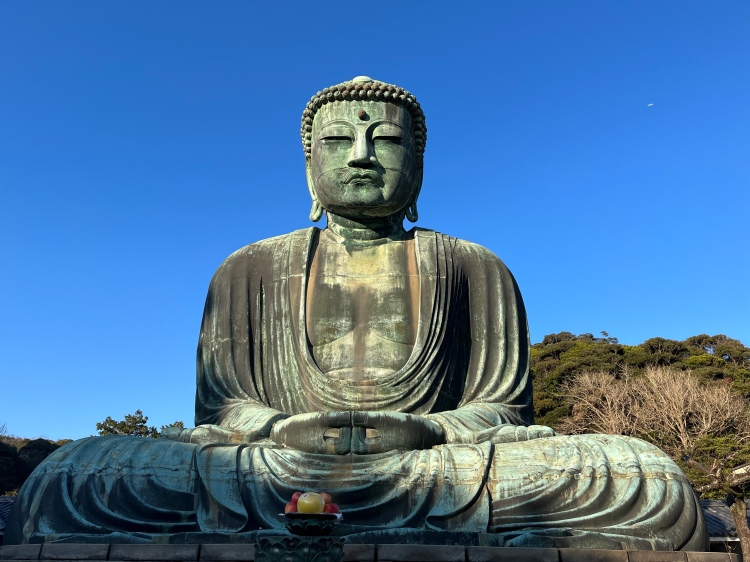
Recently, archaeologists have uncovered a statue of the Buddha, not in India or Asia, but in ancient Egypt! The statue, according to the Egyptian government, was uncovered as part of a temple dedicated to Isis, and crafted by a local Indian Buddhist community during the early Roman Imperial age, the Principate.
The cult of Isis was a fascinating example of religion in the Hellenistic Period, and inherited later when the Romans took over the eastern Mediterranean. During the Hellenistic Period, a period of constant political rivalries, and large movements of Greek people, and expansion of Greek culture through colonies, the old Olympian religion had increasingly proved unable to help people through difficult times. The old Olympian religion was focused on public cults in a kind of “contractual” religion where people of a city-state publicly worship a particular god, and get something out of it. For more personal needs, there just wasn’t much substance.
Thus, mystery religions such as the Cult of Demeter and others arose. These provided more personal relationships with the gods, and clearer undersetanding of the afterlife, and how one might secure a better fate than just being an empty shade wandering in Hades (cf. Homer’s Odyssey).
When the Macedonian Ptolemy family took over Egypt, they had to reform Greco-Egyptian society into something they could rule legitimately, so certain gods were reinvented or elevated. Egyptians had done this too, but the Ptolemies tapped into this and elevated two gods in particular:
Serapis – a kind of hybrid god based loosely on Osiris, but also Zeus.
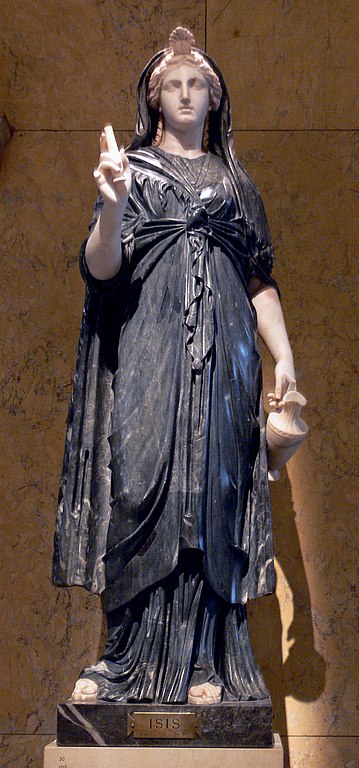
Isis’s role in particular grew far beyond the original Egyptian religion and her cults spread across the Roman world. Her status also grew in that she wasn’t just a mother goddess, but the mother goddess: embodying wisdom, magic, maternal love and so on. Other goddess figures from disparate cults were sometimes viewed as just more manifestations of Isis. There are even
A statue of Isis, from the 2nd century CE. Photo: Andreas Praefcke, Public domain, via Wikimedia Commons
Isis’s religion wasn’t organized according to the kind of doctrine or dogma we associate with modern religions, it was still very much a form of personal, devotional worship,1 rather than an “one-size fits all” religion to explain everything. Roman society at large was still a marketplace of religions, but the religions had changed from mostly public ritual (e.g. the Olympian gods) to more internal, personal religion.
So, how does the Buddha fit into all this? That part is still being researched, but given Isis’s status as a goddess of wisdom, putting a statue of the Buddha, a figure also associated with wisdom, in her temple was probably a useful cultural prop. Indian merchants, had a trade colony in Egypt at the time, and the Buddhist religion in India reached a high-water mark at the time, so at least some of the Indian people living in Egypt would know of it, or might even be devotees.
Does that mean that there were Buddhist communities in Roman Egypt? Evidence is very scant. Even if there were, their presence was likely limited to the Indian expat community.
Still, the cultural cross-over is pretty fascinating.
P.S. This is the last post before the family and I head to Japan. When next we meet, I’ll post updates from
1 Similarly, worship of Mithra, a Zoroastrian deity imported into Roman culture, enjoyed widespread devotion among soldiers and other figures. People worshipped the god or goddess they tended to feel most affinity with.
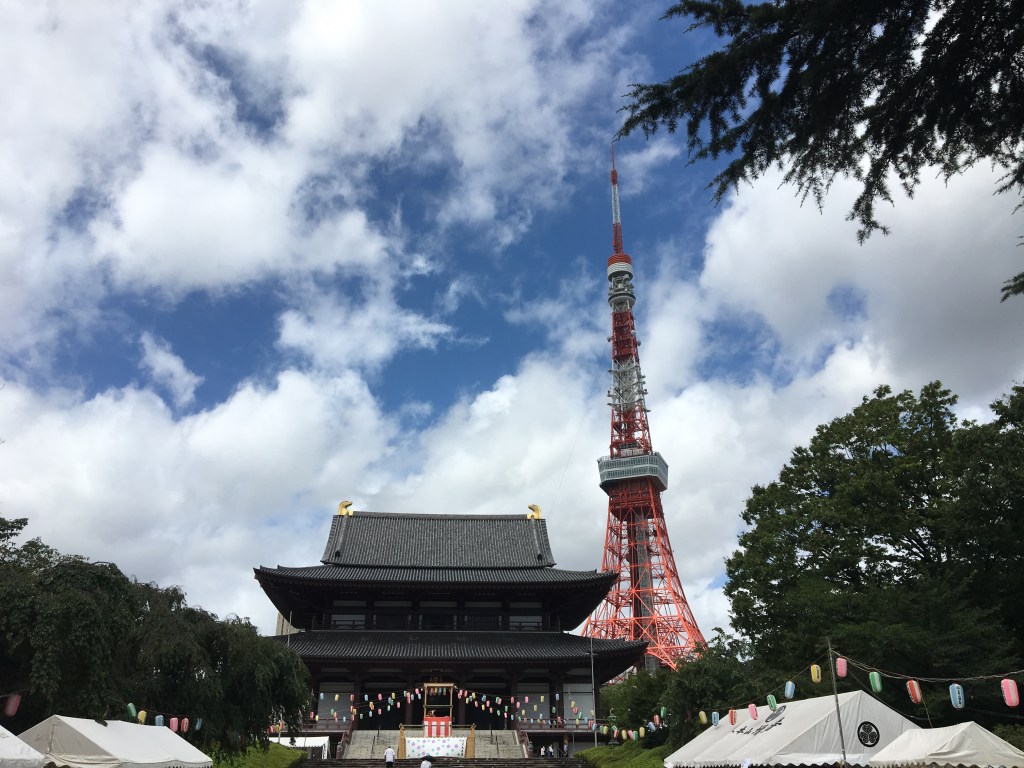
A few years ago, during our last trip to Japan before the Pandemic, we came to the famous Buddhist temple of Zojoji: one of two head temples of the Jodo Shu sect.
My wife and I like Zojoji in particular, and since it is right next to the famous Tokyo Tower, it is always worth a visit.
Taken in 2019, Tower Tower is in the back, about 2-3 blocks away.
Along its famous treasures is a “black Amida [Buddha]” statue which has a separate altar room, in the annex room to the right of the main hall:
Taken in 2019
Anyhow, on that visit, I picked up a neat little portable altar/image of Amida Buddha: it is normally wrapped in a small brocade envelope:
Inside you can see an image of Amida Buddha:
The writing on the left is a verse from the Shiseige (aka Juseige) a devotional set of verses, which is in turn an excerpt from a Buddhist text, the Immeasurable Life Sutra. The verse above reads:
神力演大光 Jin riki en dai ko 普照無際土 Fu sho mu sai do 消除三垢冥 Sho jo san ku myo 広済衆厄難 Ko sai shu yaku nan
With my divine power I [Amida Buddha] will display great light,
Illuminating the worlds without limit,
And dispel the darkness of the three defilements [greed, anger, delusion];
Thus I will deliver all beings from misery.
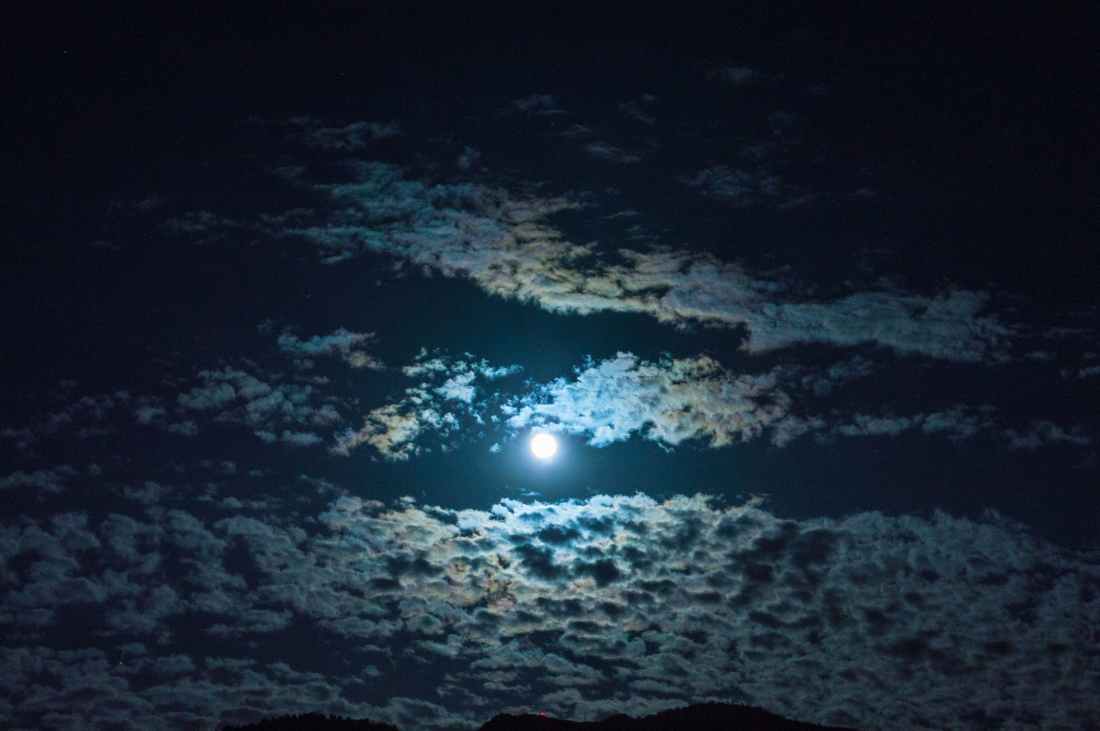
On the right is a poem by Honen (法然, 1133-1212), founder of Jodo Shu, called “Moonlight”. I talked about the poem here.
This folds out like a mini triptych, though it doesn’t stand up very well on its own.
Because it’s so small, yet very beautiful, it is a nice thing to carry with you sometimes for those moments of inspiration or private devotion.
Recently, I took some personal time to delve deep into Pure Land Buddhist teachings, re-reading some old books, but also some new ones. In particular, I was very impressed by Charles B Jones’s latest book, an excellent survey of the entire Pure Land tradition in Mahayana Buddhism.
If you’re not familiar with Pure Land Buddhism, this is a broad, broad tradition in East Asia, focused on a single Buddha named Amitabha, not the historical Buddha (Shakyamuni). There are way more devotees of the Pure Land path in many Buddhist countries versus, say, Zen practitioners. It is said that Amitabha, according to the Buddhist canon (a.k.a. the sutras), made a great series of vows to provide a refuge for all beings if they with to be reborn there. In this refuge, one will unfailingly become an enlightened being, by virtue of being so close to a living Buddha.
This might seem weird at first glance, since Shakyamuni Buddha started the whole religion in the first place, right? It’s a long story of how we got to something like Four Noble Truths to something like an ethereal paradise where people can go simply by reciting his name.
Charles B Jones’s book actually does walk through how this tradition evolved from an advanced meditative practice in India to the forms we see today, so that alone is worth reading the book. However, there’s another side to this issue that Jones’s book also covers: sectarian bias.
Way back in 2005, shortly after I married my Japanese girlfriend (now wife), we made our first trip to Japan to visit her extended family. The culture shock hit hard: I hardly knew the language, the customs and food weren’t what I expected, and the Buddhist religion that I was so interested in made no sense to me. I remember seeing Amitabha Buddha at Chion-in temple in Kyoto, and while it was very beautiful, it felt like weird superstition to me. This wasn’t mentioned in any of my books about Buddhism! Someone in Japan even asked me what I thought about it all, and I made some stupid, arrogant comment about superstition, etc.
But it was still nagging me when I got home later, and that’s when I discovered the Jodo Shu homepage in English. I slowly started to unravel things, and eventually became a devoted follower (still am in many ways), but at the time, this was very niche Buddhist teachings outside of some Western organizations like the Buddhist Churches of America (also a wonderful org, highly recommend).
Since then, there have been a lot of books published in the last 20 years about Pure Land Buddhism, but they are almost always sectarian, and obfuscate the variety of practices in favor of one single approach. I learned Pure Land Buddhism through Jodo Shu/Jodo Shinshu sectarian sources, including one overtly nationalist book by D T Suzuki (don’t get me started on that guy…), and it colored my understanding for a long time.
For all the increased information on Pure Land Buddhism in the West, it’s still based on very biased, sectarian sources, namely Japanese sects such as Jodo Shu and Jodo Shinshu. This isn’t necessarily wrong, and as a long-time follower of these traditions, they really helped me a lot when I was first getting on my feet.
However, long time readers may note that I’ve danced aroundotheraspects of Pure Land Buddhism, but until recently I had no idea how broad the tradition was, and the many ways people have tackled the theological questions behind it.
Through Jones’s book, I realized that the tradition is huge, and varied in its approach. It’s not just a “Japanese Buddhism versus Chinese Buddhism” comparison either. Many thinkers over the centuries in many countries and eras have grappled with these questions:
What is the nature of Amitabha Buddha and the Pure Land? Is it mind-only? Does it literally exist X yojanas to the West? Or is it right here?
Similarly, is Amitabha Buddha the embodiment of the Dharma or a literal Buddha who excels at reaching out to people?
What is the point of striving for rebirth into the Pure Land? Is it to awaken one’s mind here and now, or is it to reach a refuge in which one can progress along the Buddhist path more easily?
How does one do it? Do they rely on Amitabha Buddha’s compassion (e.g. other power) or does one strive to be reborn there? Is it a “meet in the middle” situation?
What is the nianfo/nembutsu (念佛/念仏), and is the nianfo/nembutsu sufficient on its own to accomplish rebirth in the Pure Land, or are other practices required?
Charles B Jones covers all the ways people have interpreted these questions, in India, in China and in Japan and the variety of responses and interpretations is surprising.
For example, if we only consider the questions of whether the Pure Land and Amitabha arises from one’s own mind, a Zen-style interpretation, or a more literal savior to that exists elsewhere reaching out to others, we get a spectrum of interpretations. However even if you have two different teachers both advocate for a literal interpretation of Amitabha Buddha, they will differ on whether reciting the nianfo/nembutsu alone is enough, or what practices one should do to strive there.
Even when two teachers agree on a set of practices leading to rebirth in the Pure Land, they might differ on how much of it is due to one’s own efforts versus Amitabha’s compassion and power of his vows.
Thus, what you get is a really complicated, three-dimensional matrix of views.
For example, the Chinese Buddhist teacher, Yunqi Zhuhong (雲棲袾, 1535–1615),1 advocated a very sophisticated approach that tried to reconcile both the mind-only or “principle” interpretation of Amitabha Buddha with the more literal or “phenomenal” one often used by lay people. In his mind, both were essentially correct, and it was perfectly fine to approach from either mentality, so long as one kept up the essential practices: reciting the nianfo (nembutsu in Japanese), reciting sutras, devotional acts, etc. It confirms what I suspected for a long time: that there is more to Pure Land Buddhism than just the nembutsu.
I never even knew about Yunqi Zhuhong until a few weeks ago (I pretty much rewrote the entire Wikipedia article linked above using more sources), and this shows how sectarian views, even when benign, obscure aspects of the tradition and make it hard to understand Pure Land Buddhism at large. One can easily apply this to other Buddhist traditions such as Zen, or Theravada, etc.
Another challenge in Buddhism has always been accessibility, and Charles B Jones shows how the Jodo Shu and especially Jodo Shinshu sects in Japan really excelled at outreach to common people instead of the aristocratic Buddhist followers who focused on esoteric Buddhist practices.2 However, in order to make Buddhism very accessible to large segments of the population, it’s clear they also took some liberties in how they interpret some of the issue above, and these are issues that they have to continuously defend, theologically, to this day.
Anyhow, there’s no clear answer here on who’s right or not. Jones’s book does a great job showing all the different approaches, arguments, and the virtues and challenges of each one, and thus the reader is welcome to decide for themselves. It’s so rare to find such a balanced and thorough overview of the entire tradition. For my part, I haven’t fully decided for myself what the right approach is (hence all the book reading lately), but it really helped give me a broader picture, and plenty of food for thought.
Namu Amida Butsu
1 Pronounced as “yoon-chee joo-hong”
2 Another interesting contrast that Jones’s book shows between Chinese Buddhist history versus Japanese: Japanese Buddhist history starts with the Imperial Court patronage and over generations gradually filtered down to the general population, thus it required patronage, sects, etc. Chinese Buddhism by contrast “percolated” up from small communities, often influenced by foreign merchant communities, and thus never had to organize sects, schools and such; Buddhist communities just sprang up organically.
I stumbled upon this great quotation by Oscar Wilde and somehow it reminded of a much, much older poem but a Japanese-Buddhist monk named Hōnen (法然, 1133 – 1212). The poem is titled “Moonlight” which I covered here.
What Oscar Wilde says here is very profound.
In Mahayana Buddhism, the Parable of Burning House from the Lotus Sutra famously describes a similar state of affairs, and in that parable the Buddha is calling people to escape the flames to safety. Like the Moonlight poem, the Buddha calls all of us and leads us to refuge if we listen. You can also see this in the Parable of the Two Rivers.
In the Jodo Shinshu sect of Pure Land Buddhism, this moment of listening to the Buddha is called shinjin (信心, “true entrusting”). I like to think of it as a “come to Jesus Amida” moment: we become starkly aware of our plight, we recall Amida Buddha’s promise to rescue all beings, and respond with the nembutsu.
All of us are in the gutter in some sense or another, but we don’t have to be. As the Third Noble Truth of Buddhism states: there is a way out.
A while back, I talked about something in Japanese culture called a goshuinchō (ご朱印帳), or pilgrimage book. This is a tradition that started in the late-medieval Edo period, when life in Japan finally stabilized and people could afford to travel the countryside on Buddhist pilgrimages, or just sight-seeing. People would get a “seal” (shuin 朱印) at the site to prove they were there, brag to friends, build up merit for the afterlife, etc. The tradition of collecting stamps still carries on today in various forms.
When I last wrote about it, I had a single book for all my visits to both Buddhist temples and Shinto shrines. I learned later that these are traditionally kept in separate books. Since mine had filled up anyway, I had planned to buy two new books on my next visit, but then the Pandemic happened and I couldn’t visit Japan for 3 years.
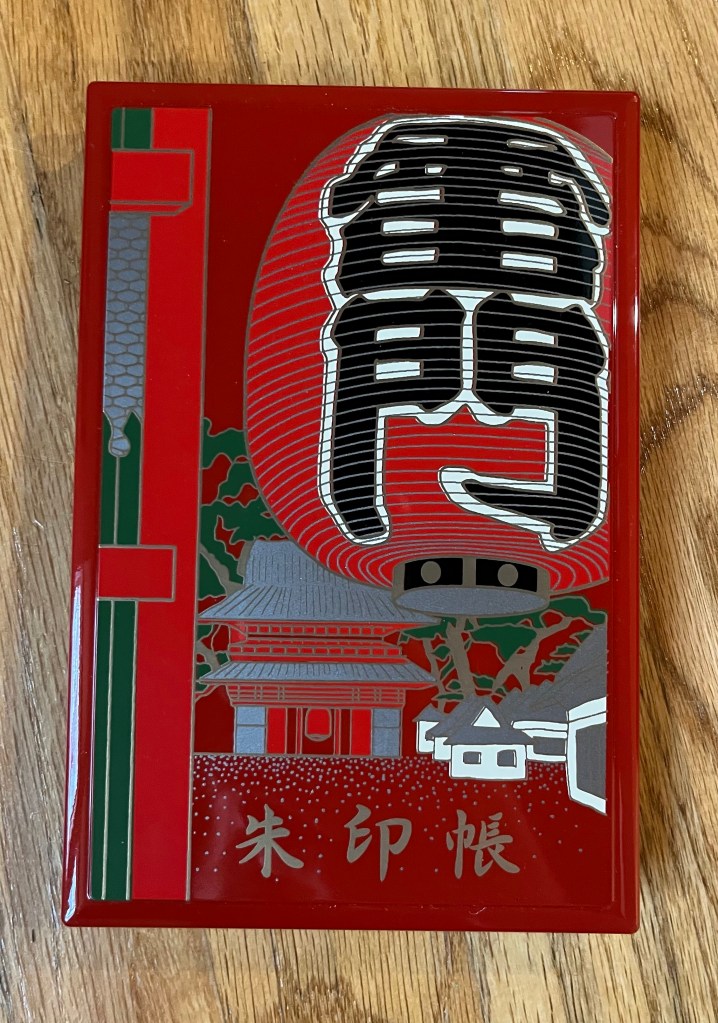
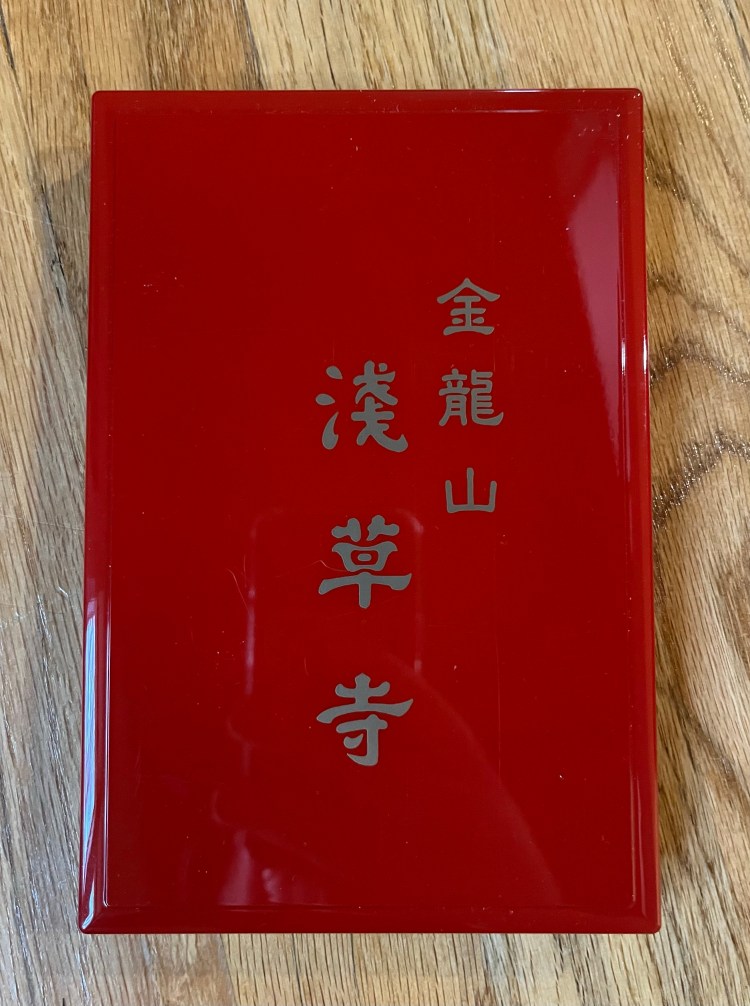
Finally, on our latest trip, I was able to get some fresh, new books. This first one comes from the famous Buddhist temple of Asakusa (a major tourist spot in Tokyo), also known as Sensōji:
Sensoji sold two pilgrimage books: the basic option, and the deluxe book. I went with the deluxe option which was about ¥1000. It came with a fresh, new seal from Sensoji as well (the one on the right):
Later, when I visited the Great Buddha in Kamakura, I also got a second seal (on the left).
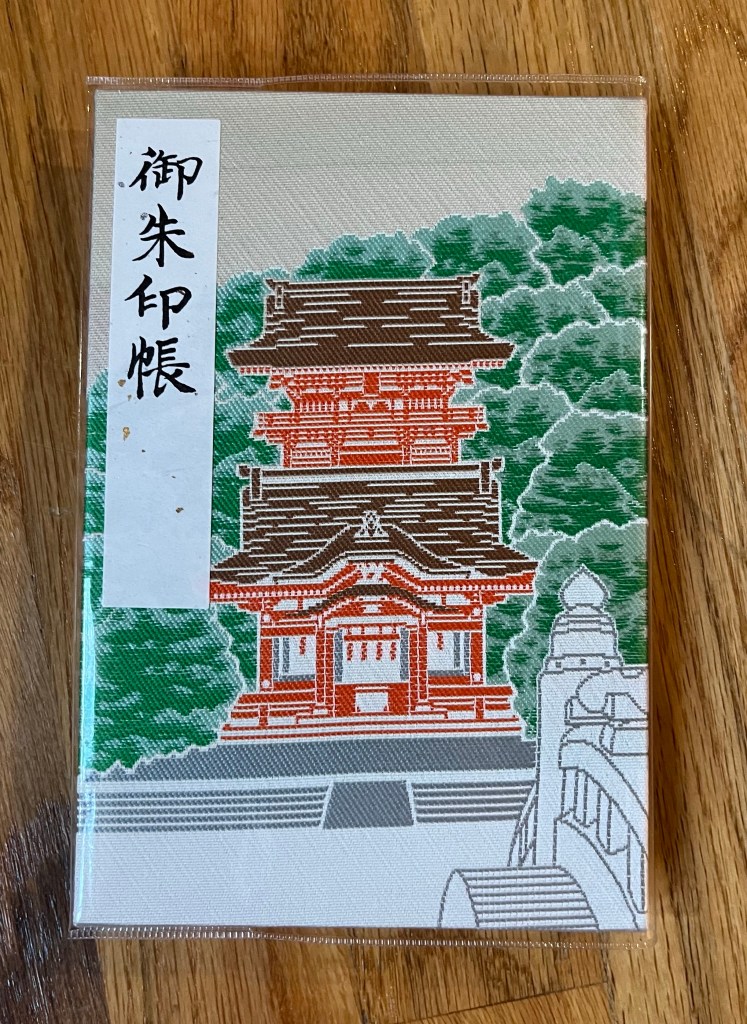
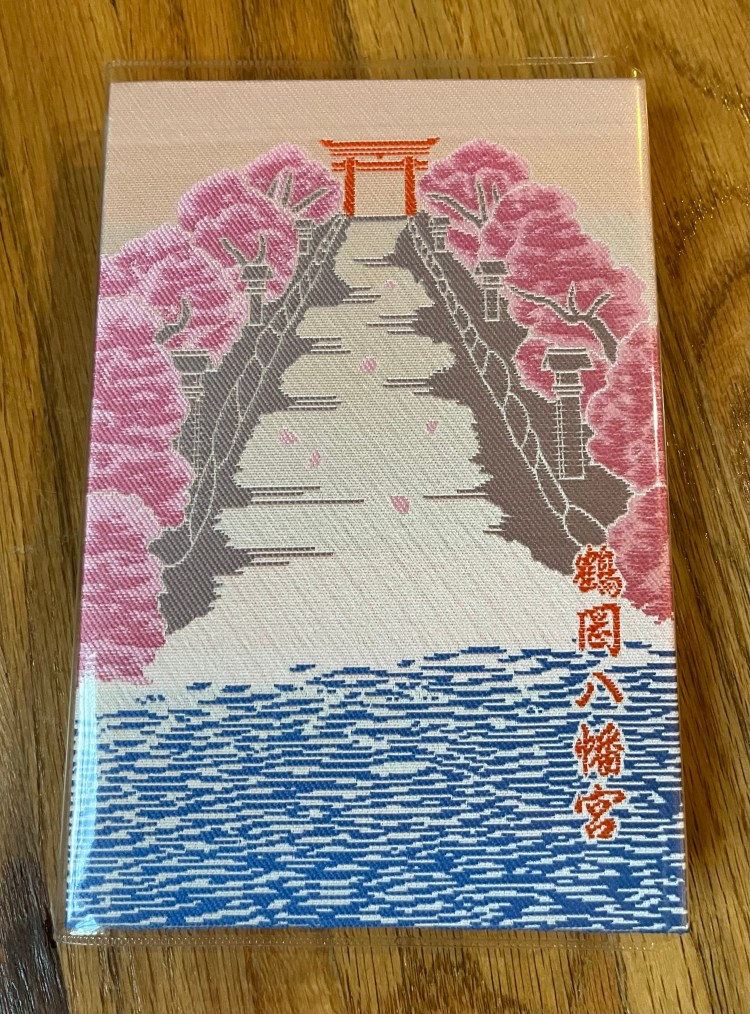
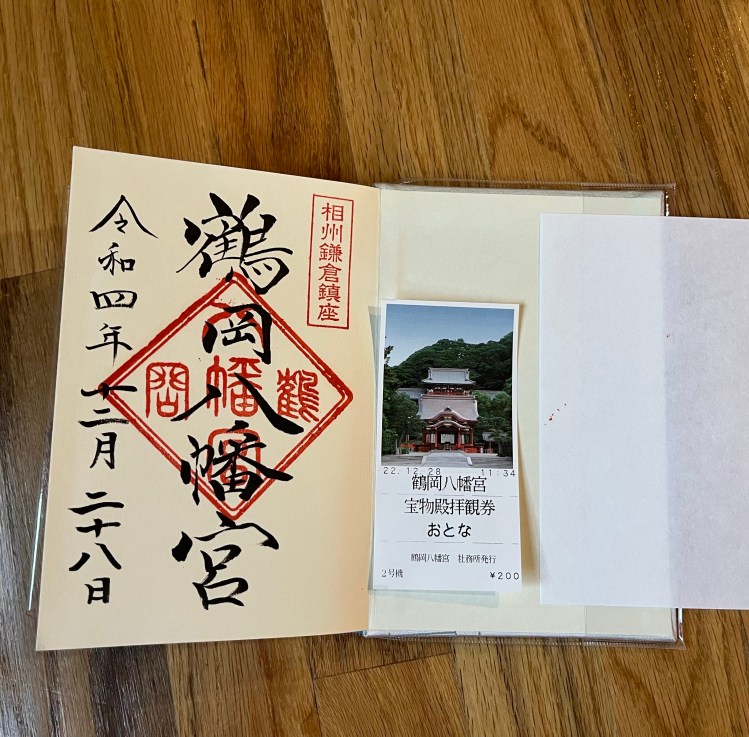
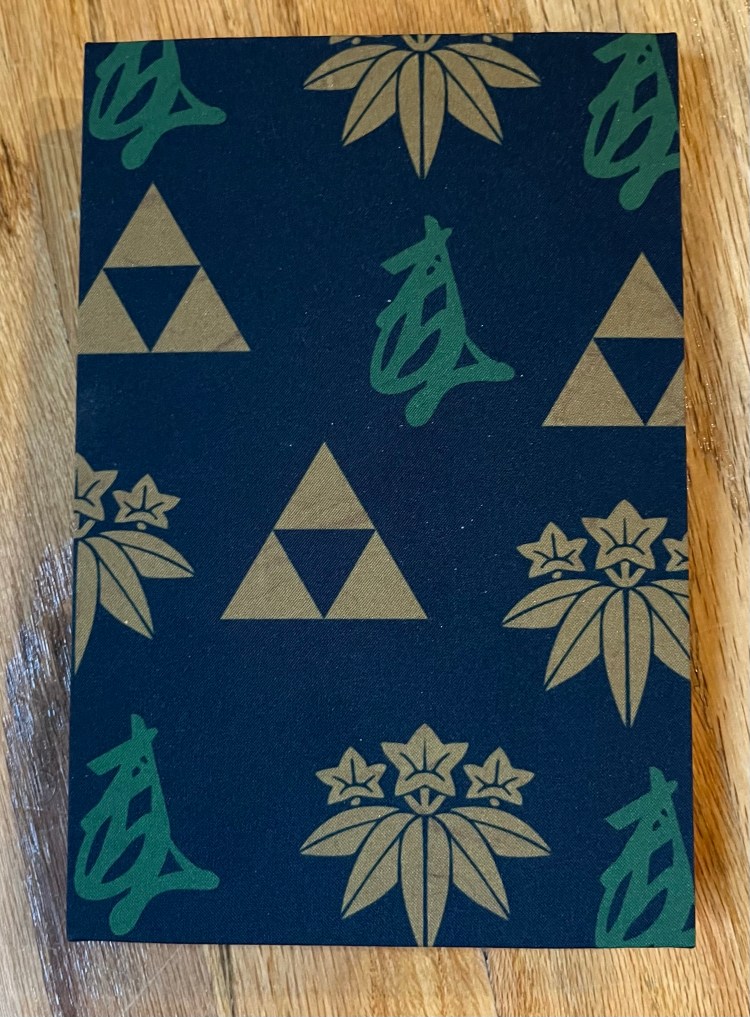
During that same trip to Kamakura, I also got a pilgrimage book for Shinto shrines as well from the famous Tsurugaoka-Hachimangū Shrine, which also had a really neat custom cover:
Tsurugaoka-Hachimangū Shrine has major historical significance due to its association with the old Kamakura Shogunate (mentioned here, here and here), as well as the death of Minamoto no Sanetomo. It’s a gorgeous cover, and I got a seal for this book as well:
The ticket shown here is from the museum which the family and I visited. It was neat to see real relics from the Shogunate, but that is a story for another day.
However, it turns out two books wasn’t quite enough. So, when we visited the NHK museum for the Thirteen Lords of the Shogun, the historical drama I loved to watch, I got a third book:
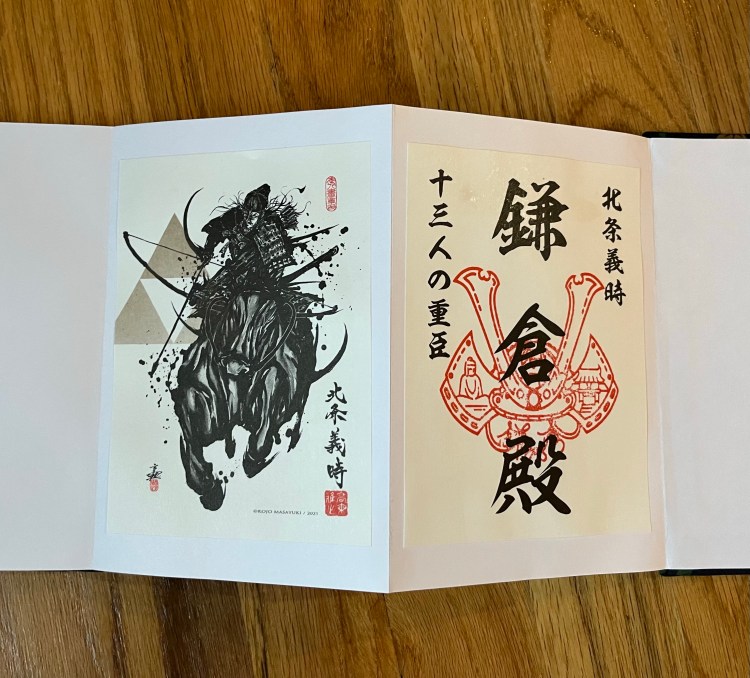
This one features the famous “triforce” logo of the Hojo family crest. I have noticed that pilgrimage books aren’t limited to just religious sites, people get stamps for all kinds of places they visit (many cities will have campaigns for kids to visit sites and get stamps too), so I decided to use this one for miscellaneous touristy sites I visit. At the gift shop, I got a couple stamps related to the Hojo clan and Hojo no Yoshitoki in particular:
Sometimes, when you visit a site, they will have pre-made “seals” rather than hand-written ones. The Great Buddha of Kamakura sold pre-made ones to avoid contact due to Covid-19, as did the gift shop. When you get such seals, you can simply glue them on. I use my kids’ Elmer’s glue sticks which do a nice job of adhering to the page without wrinkling the paper due to moisture.
Since I have three books, not one, I expected it to take much longer to fill them out. The last book I had, purchased at Todaiji Temple in Nara, took about 14 years (2005-2019) to fill out since I could only visit Japan on a sporadic basis. However, I remember my late mother-in-law carrying a well-worn book around whenever we visited Buddhist temples together. A pilgrimage is something very personal, and may last a long time if taken care of.
So, if you visit a famous site in Japan, especially temples or shrines, look for a ご朱印帳 sign nearby, and chances are you can pick up a pilgrimage book for a reasonable price and start collecting seals.
Recently, my wife was talking with an extended relative she hadn’t talked to in a while. This relative also lives overseas, albeit in a different English-speaking country, and when we last spoke a year ago, she had been talking about mundane things like taking the kids out for picnics, etc.
This time around, the same relative was spouting incoherent ramblings about weather-control machines, forest fires caused by human agents, and all sorts of things she had found on Youtube and on the Internet. Since the last time we spoke with her, she had gone down some kind of rabbit hole of conspiracy theories, and it had changed her for the worse.
The number one reason why I hate conspiracy theories, and all they represent, is that they are inherently irrational, narcissistic, and antithetical to the Buddha-Dharma.
In the original Star Trek series, in the episode Journey to Babel (2×10), Spock speaks with his mother and says the following (emphasis added):
It [being a Vulcan] means to adopt a philosophy, a way of life, which is logical and beneficial. We cannot disregard that philosophy merely for personal gain, no matter how important that gain might be.
To me, this is the essence of the Buddhist way of life: a way of life that is meant to be logical, rational, and of benefit to all sentient beings. Consider such liturgy as the Four Bodhisattva Vows:
Sentient beings are innumerable, and yet I vow to save them all. My mental defilements (lit. bonnō) are innumerable, I vow to extinguish them all. The gates of the dharma are without measure, I vow to master them all. The path to Buddhahood is peerless, I vow to fulfill it.
Similarly, in the famous liturgy, the Heart Sutra, there is the following verse (emphasis added):
Because there is no attainment, bodhisattvas rely on Prajñāpāramitā [the perfection, or culmination, of wisdom], and their minds have no obstructions. Since there are no obstructions, they have no fears.
translation by Lapis Lazuli texts
Wisdom leads to freedom from fear. This is not wisdom as in the sense of knowing more than other people, which is just empty narcissism, but rather seeing outside your self-centered viewpoint.
Take for example a famous Buddhist story about the monk and the snake. It is said that a long time ago there was a monk in India who, one night, had to step out into the woods to use the restroom. As a monk, he has no possessions, and thus has to walk out into the dark by himself. Since India has many poisonous snakes, this can be a risky business. In any case, as the monk was carefully treading through the grass, he steps on a snake and faints in terror. The following morning, he wakes up, and realizes that the “snake” he stepped on, was in fact an old piece of rope.
This is how the mind works, and why its important not to blindly rely on your own logic and viewpoint too much. People can be certain that X is true, and yet the facts say otherwise. The greater one’s faith, the more they cut themselves off from reality. The more rational approach is to look at the data, look at facts, make observations, and then make informed decisions, not what one feels or one is sure is the truth.
A ‘position,’ Vaccha, is something that a Tathagata [the Buddha] has done away with. What a Tathagata sees is this: ‘Such is form, such its origination, such its disappearance; such is feeling, such its origination, such its disappearance; such is perception…such are fabrications…such is consciousness, such its origination, such its disappearance.’ [e.g. the Twelvefold of Causation]
Aggi-Vacchagotta Sutta (MN 72), translated from the Pali by Ven. Thanissaro Bhikkhu
Or as Mr. Spock would say:
Insufficient facts always invites danger
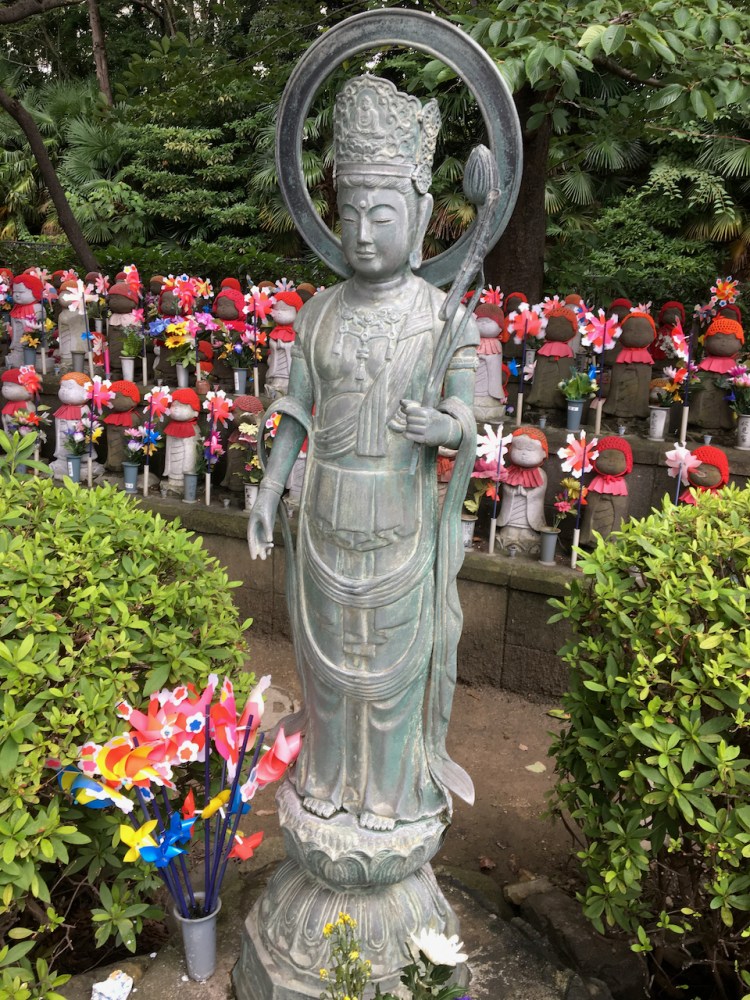
Thus, the Buddhist path is one that relies on rational thinking, not narcissistic beliefs. However, it is not limited to just rational thinking, and that’s why Mr Spock’s quote about “rational and beneficial” is so important. Consider the following Buddhist statue that I photographed in Japan in 2019 at Zojoji Temple (one of my favorites):
Here, the bodhisattva Kannon, is holding a lotus flower in one hand, while the other hand is down with two finger-tips touching. Buddhists statuary is replete with meanings and non-verbal symbols. The lotus symbolizes wisdom, and the potential for all beings to awaken, just as a lotus blooms from mud. The fingertips touching is another mudra meaning the “turning of the Wheel of the Dharma”, meaning to teach others and keep Buddhism going. The latter action, teaching the Dharma, helps sentient beings achieve awakening (i.e. the lotus), freedom from fear and wellbeing.
Hence, Kannon’s image here is a balance of both rational wisdom and compassion for all beings. Compassion not tempered by wisdom is irrational and can sometimes do more harm than good, while wisdom not compelled by concern for others is just dry scholasticism.
All of this is encapsulated in the 16th chapter of the Lotus Sutra where the Buddha says in verse:
My pure land is not destroyed, yet the multitude see it as consumed in fire, with anxiety, fear and other sufferings filling it everywhere. […] But those who practice meritorious ways, who are gentle, peaceful, honest and upright, all of them will see me here in person, preaching the Law [the Dharma].
translation by Burton Watson
Part of the freedom from fear that comes from wisdom is the ability to see past the ups and downs of life, and see the bigger picture, to live a life that is gentle and peaceful towards others, and to maintain an upright life out of compassion for oneself.
None of this is easy, and requires years and years of practice, emotional growth, introspection, and willingness to take one’s own beliefs with a small grain of salt. It is a path that is not limited to Buddhists either, and there are plenty of Buddhists who don’t follow this path. What matters is not one’s affiliation to a religious org, but one’s willingness to live a life rooted in rationality and benefit for others. None of this can be accomplished by living in the paranoia and hostility, misinformation and sense of superiority that it brings from “not being a sheep” that comes with immersion in conspiracy theories
If you find yourself lost, scared, and confused with all the things going on in the world, take a moment and breathe. Turn off social media, go outside. Ground yourself in the world around you. If it helps, maybe recite the Heart Sutra a couple times (it is short enough you can chant it in about 1-minute) or the nembutsu. The life you live now, warts and all, is sustained by the goodwill of others around you, even if you don’t know who they are. Take a moment, and consider this, and maybe give something back to the world.
Box Log Falls, Lamington National Park, Queensland, Australia. Part of a remnant rainforest that once spanned across Antarctica and neighboring lands.Malcolm Jacobson, CC BY-SA 2.0, via Wikimedia Commons
Recently, the family and I went on the first vacation since the Pandemic to Victoria, British Columbia. I keep forgetting to post photos and talk about the trip due to time, but needless to say it was a great trip and we had a much needed break after 3 years.
On the final day, we visited the Royal British Columbia Museum and saw many great exhibits. The Museum is excellent, and I definitely recommend a visit.
The prehistoric mammoth exhibit at RBCM was amazing.
The RBCM also had great exhibits depicting native fauna including elk.
You could also see exhibits of different habitats around Vancouver Island.
Among its features that day was an IMAX movie about prehistoric Antarctica titled “Dinosaurs Of Antarctica 3D”. As of 2025, it is now available on Youtube:
The IMAX movie provides a visual tour of Antarctica across various points in time, when it was a lush rainforest, how it survived the catastrophic Permian-Triassic mass-extinction, and much later when the Chicxulub asteroid struck the earth, leading to the end of the dinosaurs. Now, the entire continent is a frozen waste, with only remnants left in Australia, but it was not always so.
The Gondwana Supercontinent, 420 million years ago. Fama Clamosa, CC BY-SA 4.0, via Wikimedia Commons
It’s sad to imagine a vibrant world like that is now long dead, buried under ice, but it’s also fascinating to think of how much time has passed, and how much the world changes. Even when Antarctica was warmer and sustained a vast array of life, that life changed and evolved over eons as well. In the earliest era, there were primitive lizard-like creatures that eventually evolved into mammals, huge predatory amphibians, and later the classic dinosaurs. They, like us, would not be able to mark such a long, vast passage of time.
Thinking about it puts all our efforts and beliefs into perspective. The earth, and its changing climate (man-made or otherwise) doesn’t really care whether you believe in it or not, or whether it might lead to extinction of some species while allowing others to thrive. This world belongs to the Earth, and we’re just living in it. Even on a small, more generational level, change occurs. When my family and I visited Leavenworth, WA earlier this summer we visited a local man-made island that had been created a hundred years ago. A plaque at the entrance pointed out that over time due to natural processes, certain species of trees had sprung up, but after another 100 years those trees would die off and different species would be ascendant. Any human alive today will likely not be around to see the change, but in a few generations the island will have different flora and fauna simply due to natural process.
Example fauna and flora we saw at the park just outside Leavenworth.
Example fauna and flora we saw at the park just outside Leavenworth.
Faced with this reality, it makes us naturally worry about what our place in the world is, and how we can live in it. Many of our solutions, philosophical, religious and such are, if you scratch the surface, made by humans for humans. Even the Buddhist religion, of which I’ve been a follower since 20051 often feels like it has a lot human-centric window-dressing. Many aspects of Buddhist “lore” (think Star Wars expanded universe) seem somewhat silly in the face of science. It’s not necessarily “wrong” though, and I strongly disagree the Western-Buddhist tendency to write it off as “cultural accretions”, either.2 However, at the end of the day, it’s just a form of human expression grappling with the world around us.
And yet, there are certain fundamental truths that all Buddhists know (or ought to), that not only conform to science, but also give it some sense of meaning beyond the raw, materialistic one:
All things arise due to external causes and conditions. As such, their existence is contingent and fluid, not static.
Similarly, change is the only true constant of the universe, and much of it happens outside our control. Some if it is induced by our own shortsightedness though.
In the same way, conduct matters. What we do affects others, what others do affects us.
For this reason, many different approaches, or “dharma gates“, arose in the Buddhist tradition in order to actualize these truths. But sometimes, you also need something bland and neutral like natural science to kick you in the pants, ground yourself, and remind you what matters.
Namu Amida Butsu Namu Kanzeon Bosatsu
P.S. Title of this post is a nod to famous song from the Chrono Trigger soundtrack: toki no kairō (時の回廊)
1 Arguably even further back, if you count dabbling in high school, but it’s a hassle to explain.
2 One researcher’s description of Western Buddhism as “Protestant Buddhism” is pretty spot-on, I think. Oh hey, look, more cultural accretions! Highly recommend the linked book, by the way.
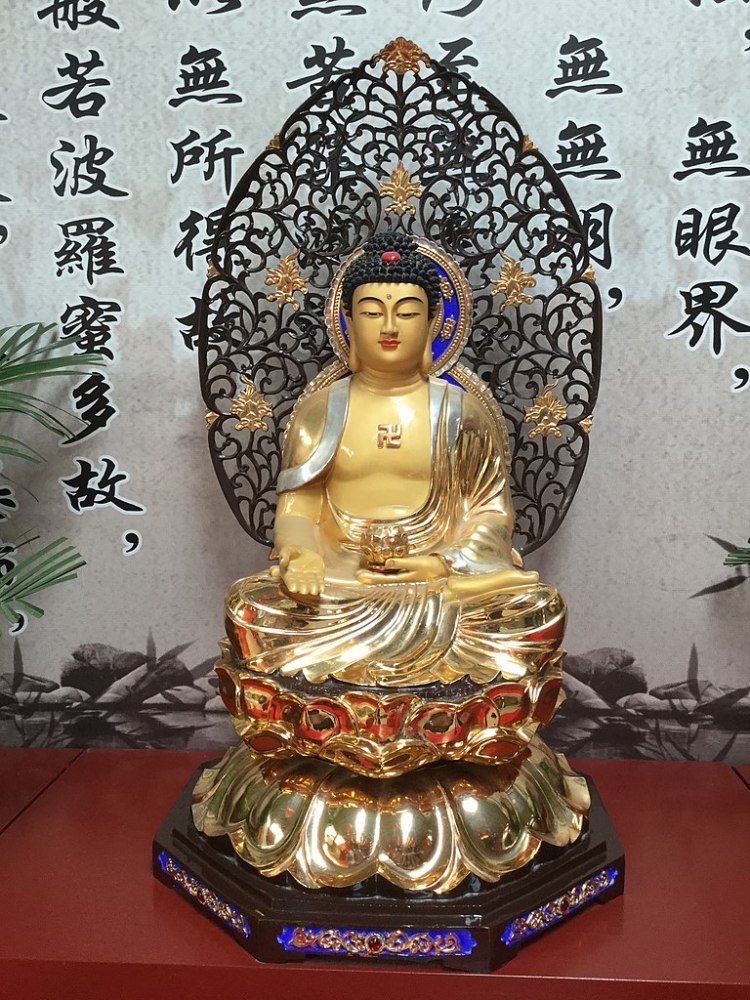
In places like Japan and China, Buddhist statues and buildings often use a symbol, like so on the Buddha’s chest:
A statue depicting Amitabha Buddha, taken at Shuang Feng Si (双峰寺) Temple. The Heart Sutra is depicted in the background on the wall. Thyj, CC BY-SA 4.0, via Wikimedia Commons
This symbol, a swastika, has NO RELATION to the Nazi Germany symbol in any way. However, at first glance this can be very confusing: why do Buddhist statues have swastika on them?
These symbols can be found across many pre-modern cultures both east and west and usually have a positive, auspicious connotation. Think four-leaf clovers in modern times. So, when you see a Buddhist statue with such a symbol it’s usually meant in a wholesome, auspicious connotation. In Japanese Buddhism these are often called manji (万字). Unlike the German swastikas, they are not tilted at 45-degrees.
However, it’s hard to avoid the association with the Holocaust and the Nazis, so these symbols are gradually falling out of use. Swastika symbols used in Japanese maps to depict temples are being replaced with other, less controversial symbols, for example.
However, older iconography will still use them. It’s too hard to change a cultural heritage building that was made in the 1700’s, for example
So, if you are in a Buddhist temple and you see something like this, don’t panic. These symbols predate those goose-stepping numbskulls and point to another, more auspicious heritage.












 Gleanings in Buddha-Fields


You must be logged in to post a comment.