One of my favorite series to watch on Youtube is the Extra Credit series, which covers fascinating, butlesser–knownaspectsofworldhistory. I’ve touched on the series in a few recent blog posts.
Anyhow, one mini-series covers the rise of militarism in Japan from the 1910’s to 1940’s. As the series points out, most people fixate on Germany and the rise of Hitler, but Japan’s case was notably different in that there was never a central figure, and still retained a multi-party system (albeit barely). And yet, the results speak for themselves.
Episode four in the series in particular shows how things spiraled out of control:
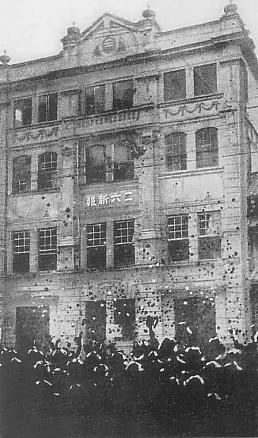
The Meiji-era constitution, adopted from the Prussians in 1890, gave the Emperor control of the military, not the civilian government. As things worsened in the early 1930’s, military factions polarized and started taking matters into their own hands, then claiming patriotism. Sympathetic elements of civilian society then attacked anyone in the government who tried to punish them. Further, racist international policies gave them fuel to justify going it alone.
Vandalism of Niroku Shinpo Sha (Pro-government newspaper office) in 1913. Published by Asahi Shimbun Company, Public domain, via Wikimedia Commons
But the problem wasn’t just the political structure. As you can see starting at 4:08 or so, few people got a full education, and thus were vulnerable to conspiracy theories, leading to support for violent solutions.
So, now we have a toxic mix of rampant conspiracy theories, poor education, weak civilian government, rampant nationalism, and factional strife. A dangerous mix.
If you’re interested in Japanese history, definitely watch the whole mini-series. Even though I studied much of this in college for my major, I learned a lot anyway.
P.S. Heading overseas soon, wanted to clear the backlog of blog posts I had.
In Charles B Jones’s overview of the Pure Land Buddhist tradition, he talks about a sect called the Yuzu Nembutsu sect (which I explored here), but in particular, he delves into the Buddhist concept of interdepedence, which the sect relies upon:1
Suppose you lay a row of ten coins on a table, and then move the tenth coin in front of the first, shifting the rest over one position. You probably assume that changing the order does not affet what they are in any way. However, from the Huayan point of view, they are not independent of one another; the first is coin one of ten, the second is two of ten, the third is three of ten, and so on. Their relationship with the other coins in the row is part of their identity and figure into the way we conceptualize them. When you take the last coin and move it to the first position, it changes from ten of ten to one of ten. At the same time, since the relation of the other coins to the one you moved has changed, they are no longer the same coins as before either, even though you did not move them.
Charles B Jones, “Pure Land: History, Tradition, and Practice“, page 120
It’s not enough to simply exist, things exist in relation to one another, and what affects one thing affects others. Taken in total, this is the Buddhist-Sanskrit concept of shunyata.
So, what does this have to do with Juneteenth?
The enslavement of Africans, generation after generation didn’t just traumatize and dehumanize black Americans, it dragged all of society down with it. Everyone was adversely impacted by it in one way or another, even those who profited from it. American society was poorer for it, directly contradicting its own high ideals of human rights, and forcing some to use mental gymnastics to justify such a barbaric enterprise, even resorting to organized violence to deflect their own festering guilt and paranoia. This spilled over into such conflicts as the infamous Bleeding Kansas, and then again later in the Civil War, to say nothing of the tragic deaths of countless Black Americans.
Thus, while Juneteenth wasn’t a holiday that I grew up with as a white kid of the 80’s and 90’s, I am glad to see we celebrate it now. Or rather, I am glad we have more awareness now and the holiday has the widespread acceptance it deserves. The emancipation of Black Americans wasn’t the end of discrimination, especially since the Jim Crow laws persisted even as late as the 1960’s, but as soon as slavery ended, America as a whole was that much better for it.
When we see the entire struggle for freedom and equal rights through the lens of Buddhism, it’s not just a problem for Black Americans, it poisons the well for us all. Where one suffers, we all suffer in some way. Where one person is treated with goodwill and dignity, we all benefit. When one black man in this country is unfairly persecuted by the law, or killed by police violence, it wounds us all. Where Americans of different backgrounds come together in a spirit of community, family and so on, we all benefit.
The struggle of Black America, as is struggle of Native Americans, LBGTQ people and so on is everyone’s struggle too. The little things we do on a daily basis to listen to these struggles,2 or to be an ally for others, or even just be kind on a person-by-person basis do affect others, including those we never see. This is a fundamental Buddhist truth, whether we see it or not.
Let us each leave this world a little better than the one we entered.
Namu Amida Butsu
1 The example above was originally composed by Fa-zang (法藏; 643–712), a proponent of the Chinese Huayan school centered around shunyata.
2 Sometimes this can be as simple as letting other people speak about their experiences, and not sucking all the oxygen out of the room with your own thoughts and opinions.
Recently, I was re-reading an old book in my personal library about the life of the Shogun Ashikaga Yoshimasa (also mentioned here). The Ashikaga Shogunate, that is the military government in Japan from 14th to 16th centuries,1 started out fairly strong, but quickly ran into a series of succession crises and bad governance that culminated in a very disastrous Onin War. The Onin War was a 10-year urban battle in the heart of Kyoto over a succession crisis that basically flattened the city and caused unimaginable death and starvation there and in the provinces.
In Donald Keene’s book, he talks about the utterly ridiculous income disparity between the typical peasant and the aristocrats in Kyoto, as if they lived in two different worlds. Even as the war was raging, Shogun Ashikaga Yoshimasa’s exorbitant taxes to pay for this vanity projects further exacerbated this.
One chronicler at the time, a Zen priest residing in Kyoto named Unsen Taikyoku (雲泉大極, 1421 – ??), recounts in his personal diary:2
When the sun went down I set out for home, and as I was passing Rokujo I saw an old woman with a child in her arms. She called the child’s name repeatedly, then began to wail. I looked and saw that the child was already dead. The mother, still wailing, collapsed on the ground. People standing nearby asked her where she came from. She said, “I’ve come all the way from Kawachi. We’ve had a terrible drought for three years, and the rice plants didn’t so much as sprout. The district officials are cruel and greedy. They demand a lot of money in taxes and show no mercy. If you don’t pay, they kill you. That’s why I had to run away to another province. I was hoping to earn food by begging. But I couldn’t get anything to give my baby. I’m starving and I’m worn out, heart and soul. I can’t take any more.”
When she had finished speaking, she again choked with great sobs. I took from my wallet what spare money I had and gave it to her, saying, “Take this money and hire a man to bury the child. I’m going back to my cell where, with help from the Three Treasures [the Buddha, the Dharma and the Sangha] and the Five Commandments, I shall choose a Buddhist name for the child and offer prayers for his salvation.” The child’s mother was greatly comforted.
While I was still humbly mulling over her sad story, I encountered a group of noblemen out to admire the blossoms. They were escorted by several thousand mounted men, and servants and followers swarmed around them. These gentlemen acted as if they were so superior that nobody could compare with them. Some sneered at the people in the streets; others swore at the menials in the path of their horses; others laughingly stole blossoms; others, drunkenly singing, drew their swords; others still, having vomited food and drink and being unable to walk, lay on the roadside. There were many such sights, and whoever saw them was appalled. Anyone who happened to run into these people was terrified and ran away, intimidated by their high rank.
Yoshimasa and the Silver Pavilion: The Creation of the Soul of Japan, pages 51-52, translation by Donald Keene
It’s not hard to imagine such things happening in a place like Los Angeles, Silicon Valley, London, Paris and so on. It’s not a question of a particular political faction, it’s a tendency of any society to gradually concentrate wealth over time to a smaller and smaller group, further exacerbating the income disparity. Marx spoke of this in the context of capitalism…
But even as far back as the last days of the Roman Republic, we could see a similar pattern (jump to about 19:30 or so):
In any case, unless this trend is addressed in a sustainable way, it never portends anything good.
1 The Ashikaga military government is unrelated to the earlier Kamakura shogunate which I spoke about elsewhere. Since Japan had a succession of military-samurai governments after the Imperial aristocracy was sidelined, and you can think of them like Chinese imperial dynasties in a historical sense.
2 Criticizing such things openly would have incurred the wrath of the Shogunate of course.
Recently, my wife was talking with an extended relative she hadn’t talked to in a while. This relative also lives overseas, albeit in a different English-speaking country, and when we last spoke a year ago, she had been talking about mundane things like taking the kids out for picnics, etc.
This time around, the same relative was spouting incoherent ramblings about weather-control machines, forest fires caused by human agents, and all sorts of things she had found on Youtube and on the Internet. Since the last time we spoke with her, she had gone down some kind of rabbit hole of conspiracy theories, and it had changed her for the worse.
The number one reason why I hate conspiracy theories, and all they represent, is that they are inherently irrational, narcissistic, and antithetical to the Buddha-Dharma.
In the original Star Trek series, in the episode Journey to Babel (2×10), Spock speaks with his mother and says the following (emphasis added):
It [being a Vulcan] means to adopt a philosophy, a way of life, which is logical and beneficial. We cannot disregard that philosophy merely for personal gain, no matter how important that gain might be.
To me, this is the essence of the Buddhist way of life: a way of life that is meant to be logical, rational, and of benefit to all sentient beings. Consider such liturgy as the Four Bodhisattva Vows:
Sentient beings are innumerable, and yet I vow to save them all. My mental defilements (lit. bonnō) are innumerable, I vow to extinguish them all. The gates of the dharma are without measure, I vow to master them all. The path to Buddhahood is peerless, I vow to fulfill it.
Similarly, in the famous liturgy, the Heart Sutra, there is the following verse (emphasis added):
Because there is no attainment, bodhisattvas rely on Prajñāpāramitā [the perfection, or culmination, of wisdom], and their minds have no obstructions. Since there are no obstructions, they have no fears.
translation by Lapis Lazuli texts
Wisdom leads to freedom from fear. This is not wisdom as in the sense of knowing more than other people, which is just empty narcissism, but rather seeing outside your self-centered viewpoint.
Take for example a famous Buddhist story about the monk and the snake. It is said that a long time ago there was a monk in India who, one night, had to step out into the woods to use the restroom. As a monk, he has no possessions, and thus has to walk out into the dark by himself. Since India has many poisonous snakes, this can be a risky business. In any case, as the monk was carefully treading through the grass, he steps on a snake and faints in terror. The following morning, he wakes up, and realizes that the “snake” he stepped on, was in fact an old piece of rope.
This is how the mind works, and why its important not to blindly rely on your own logic and viewpoint too much. People can be certain that X is true, and yet the facts say otherwise. The greater one’s faith, the more they cut themselves off from reality. The more rational approach is to look at the data, look at facts, make observations, and then make informed decisions, not what one feels or one is sure is the truth.
A ‘position,’ Vaccha, is something that a Tathagata [the Buddha] has done away with. What a Tathagata sees is this: ‘Such is form, such its origination, such its disappearance; such is feeling, such its origination, such its disappearance; such is perception…such are fabrications…such is consciousness, such its origination, such its disappearance.’ [e.g. the Twelvefold of Causation]
Aggi-Vacchagotta Sutta (MN 72), translated from the Pali by Ven. Thanissaro Bhikkhu
Or as Mr. Spock would say:
Insufficient facts always invites danger
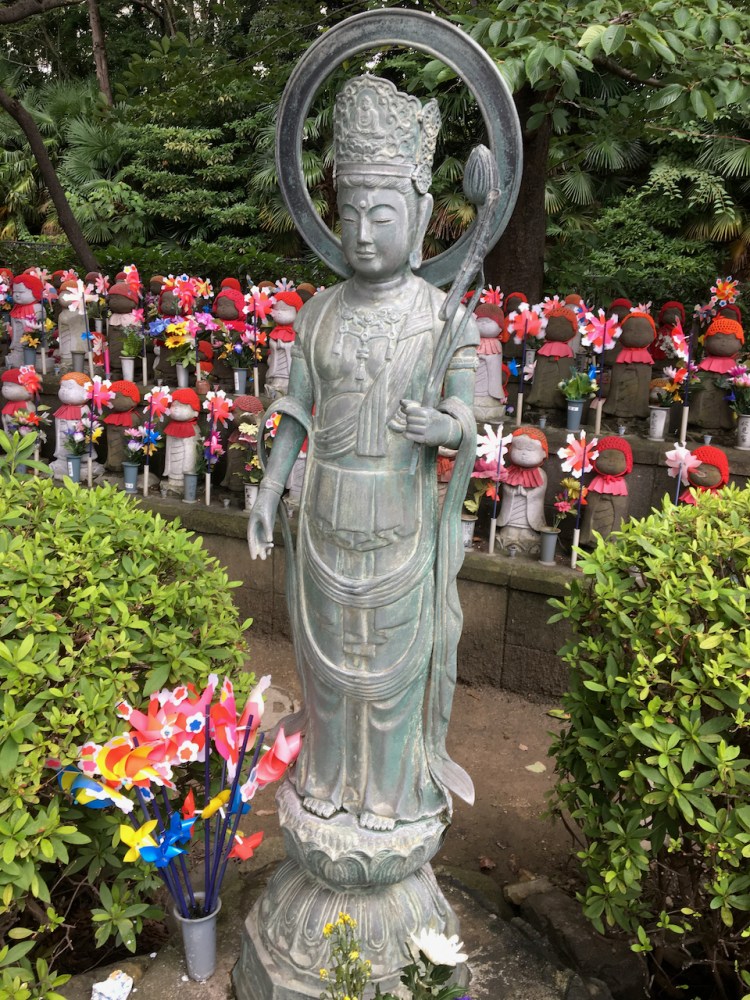
Thus, the Buddhist path is one that relies on rational thinking, not narcissistic beliefs. However, it is not limited to just rational thinking, and that’s why Mr Spock’s quote about “rational and beneficial” is so important. Consider the following Buddhist statue that I photographed in Japan in 2019 at Zojoji Temple (one of my favorites):
Here, the bodhisattva Kannon, is holding a lotus flower in one hand, while the other hand is down with two finger-tips touching. Buddhists statuary is replete with meanings and non-verbal symbols. The lotus symbolizes wisdom, and the potential for all beings to awaken, just as a lotus blooms from mud. The fingertips touching is another mudra meaning the “turning of the Wheel of the Dharma”, meaning to teach others and keep Buddhism going. The latter action, teaching the Dharma, helps sentient beings achieve awakening (i.e. the lotus), freedom from fear and wellbeing.
Hence, Kannon’s image here is a balance of both rational wisdom and compassion for all beings. Compassion not tempered by wisdom is irrational and can sometimes do more harm than good, while wisdom not compelled by concern for others is just dry scholasticism.
All of this is encapsulated in the 16th chapter of the Lotus Sutra where the Buddha says in verse:
My pure land is not destroyed, yet the multitude see it as consumed in fire, with anxiety, fear and other sufferings filling it everywhere. […] But those who practice meritorious ways, who are gentle, peaceful, honest and upright, all of them will see me here in person, preaching the Law [the Dharma].
translation by Burton Watson
Part of the freedom from fear that comes from wisdom is the ability to see past the ups and downs of life, and see the bigger picture, to live a life that is gentle and peaceful towards others, and to maintain an upright life out of compassion for oneself.
None of this is easy, and requires years and years of practice, emotional growth, introspection, and willingness to take one’s own beliefs with a small grain of salt. It is a path that is not limited to Buddhists either, and there are plenty of Buddhists who don’t follow this path. What matters is not one’s affiliation to a religious org, but one’s willingness to live a life rooted in rationality and benefit for others. None of this can be accomplished by living in the paranoia and hostility, misinformation and sense of superiority that it brings from “not being a sheep” that comes with immersion in conspiracy theories
If you find yourself lost, scared, and confused with all the things going on in the world, take a moment and breathe. Turn off social media, go outside. Ground yourself in the world around you. If it helps, maybe recite the Heart Sutra a couple times (it is short enough you can chant it in about 1-minute) or the nembutsu. The life you live now, warts and all, is sustained by the goodwill of others around you, even if you don’t know who they are. Take a moment, and consider this, and maybe give something back to the world.
For those of you who are competing somewhere, consider the following the advice from Kenko in the 13th century Japanese text, the Essays in Idleness:
I once asked someone skilled at the board game of sugoroku for hints on how to play. “Don’t play to win,” he said. “Play not to lose. Consider what moves would make you lose most quickly, and avoid them. Choose a method that will make you lose after your opponent, even if only by a single square.
This lesson from one who knows his art equally applies to the arts of governing both self and nation.
This week, I’ve been posting lots of interesting quotations from the 14th Century Japanese text, the Essays in Idleness, or tsurézurégusa (徒然草). Kenkō, the author, covered a lot of subjects from idle to spiritual to political. In this excerpt, he covers some important social issues that affected his time as much as it affects ours.
142) It is wrong for anyone who has abandoned the world1 and is without attachments to despise other men burdened with many encumbrances for their deep-seated greed and constant fawning on others. If he could put himself in the place of the men he despises, he would see that, for the sake of their parents, wives and children, whom they truly love, they forget all sense of shame and will even steal. I believe therefore it would be better, instead of imprisoning thieves and concerning ourselves only with punishing crimes, to run the country in such a way that no man would ever be hungry or cold. When a man lacks steady employment, is heart is not steady, and in extremity he will steal. As long as the country is not properly governed and people suffer from cold and hunger, there will never be an end to crime. It is pitiful to make people suffer, to force them to break the law, and then to punish them.
How then may we help people? If those at the top would give up their luxury and wastefulness, protect the people and encourage agriculture, those below would unquestionably benefit greatly. The real criminal is the man who commits a crime even though he has a normal share of food and clothing.
Translation by Donald Keene
I imagine that Kenkō is drawing inspiration (consciously or not) from the Confucian idea of the government’s responsibility toward the people. Compare this passage from the Analects of Confucius:
[12:9] Duke Ai asked Youruo: “It has been a year of famine and there are not enough revenues to run the state. What should I do?”
Ruo said, “Why can’t you use a 10% tax?”
The Duke answered: “I can’t even get by on a 20% tax, how am I going to do it on 10%?”
Ruo said, “If the people have enough, what prince can be in want? If the people are in want, how can the prince be satisfied?”
Translation by A. Charles Muller
Or from similar statements in the Chinese Taoist classic, the Dao De Jing:
75) The reason people starve
Is because their rulers tax them excessively.
They are difficult to govern
Because their rulers have their own ends in mind.
Translation by A. Charles Muller
But Kenkō’s inspiration might also come from Buddhist compassion and wisdom. It’s easy to punish, governments do it all the time, but Kenkō is asking people to stop and consider whether the problem is the people, or the conditions they are forced to endure due to government mismanagement. A leader who knows when enough is enough, can be benefit the country greatly, but of course, in Kenkō’s era, when society was still highly stratified by rank and aristocracy, this was rarely the case. Maybe they could have taken inspiration from the famous Edo-period daimyo, Uesugi Yozan, a few centuries later. 🙂
1 In Japanese, this is a Buddhist term or shukke (出家), meaning to go forth and become a monk or nun, in other words, a fully dedicated disciple of the Buddha. This is a time-honored tradition from the days of the Buddha himself in 5th century BCE India.
It’s hard to avoid lingering sense of dread, sadness, or fear of the future these days. Of all the problems in the world, climate change is the one that truly worries me the most. I really can’t help but wonder what kind of world I’ll be leaving my kids and (possible) grandkids someday. 😔
We live in a dangerous world, one that basically owes us nothing. Our lives are contingent on those things around us that help support and sustain us, even if they aren’t necessarily good things. Similarly, by our actions and our choices we sustain and help others too. It’s a contingent existence, but we sustain one another in the process.
All of this can be swept aside, though, in a moment of warfare, disease or natural disasters. The human race has done much to overcome the challenges that earlier generations faced, but we are still one species on this planet, and if things turn against us (or we shoot ourselves in the foot), well, that’s it folks. But that’s not necessarily the end, either. If life can survive something like the Permian-Triassic event, it can survive just about anything.
As a thinking human being on this world, a homo sapiens, there’s very little that you have personal, direct control over. Many other things can be influenced by you, while still others are simply outside your control. And yet, in spite of this, those things which you can control or influence are important and worthy of attention.
In the 16th chapter of the Lotus Sutra the Buddha says in verse:
My pure land is not destroyed, yet the multitude see it as consumed in fire, with anxiety, fear and other sufferings filling it everywhere. These living beings with their various offenses, through causes arising from their evil actions, spend asamkhya kalpas [vast eons] without hearing the name of the Three Treasures [the Buddha, the Dharma, and the Sangha]. But those who practice meritorious ways, who are gentle, peaceful, honest and upright, all of them will see me here in person, preaching the Law [the Dharma].
— Translation by Burton Watson
Here, the Buddha of the Lotus Sutra is preaching that regardless of the state of the world, the Dharma is still the Dharma, and so the Buddha is always here. It may be obscured, or forgotten by some, but it never truly goes away. Even when the world is in a state of calamity, things like wisdom, goodwill towards others, a cool head, and an upright life still matter.
As I said earlier, while our existence is contingent on external causes and conditions, it is also true that through our own actions and conduct we sustain others. This latter point is important. Every little thing we do to light one corner of the world, from recycling that plastic container, to helping refugees or the homeless in your community, matters to others, including people we may never meet. The Four Bodhisattva Vows are a lofty reminder not to give up.
Even as I worry for the future of my kids, who knows what my great, great, great grandchildren will look like, or what circumstances they will live in. Hopefully some of the joy and love I have tried to share with my kids will find its way to my descendants into the far future as well.
Lastly, be kind to yourself. If need be, turn the world off and take time for a retreat even if it is just a few hours or half a day. Recharge, and stop to look at the world around you and what you can do to make it a better place, a little bit at a time. ☺️
Recently I was reading this great blog post by the blog Sententiae Antiquae which translates some text from 14th-centry Italian scholar Petrarch:
Portrait of Petrarch, late 14th century, courtesy of Wikipedia
…Thus, almost no one is free. Everywhere there is servitude, the prison, the noose, unless some rare person somehow dissolves the knots of the world with the aid of some heavenly virtue.
Just turn your attention wherever you’d like: no place is free of tyranny. Wherever there are no tyrants, the people tyrannize. When you seem to have escaped the iron fist of one, you fall into the tyranny of the many, unless you can show me some place ruled by a just and merciful king…
From Invective Against a Man of High Rank, translated by Sententiae Antiquae blog
This reminds me of certain Buddhist texts, in particular the Larger Sutra on the Buddha of Immeasurable Life wherein Shakyamuni Buddha describes at length the challenges of living in this world:
“The poor and the underprivileged are constantly destitute. If, for example, they have no fields, they are unhappy and want them. If they have no houses, they are unhappy and want them. If they have none of the six kinds of domestic animals, such as cows and horses, or if they have no male and female servants, or lack money, wealth, clothes, food, or furnishings, they are unhappy and want those as well. If they possess some of them, others may be lacking. If they have this, they do not have that, and so they wish to possess all. But, even if by some chance they come to possess everything, it will soon be destroyed or lost. Then, dejected and sorrowful, they strive to obtain such things again, but it may be impossible. Brooding over this is to no avail. Exhausted in mind and body, they become restless in all their doings, and anxieties follow on their heels. Such are the troubles they must endure. Breaking out in cold sweats or fevers, they suffer unremitting pain. Such conditions may result in the sudden end of their lives or an early death. Since they have not done any good in particular, nor followed the Way [e.g. the Buddha-Dharma], nor acted virtuously, when they die, they will depart alone to an inferior world. Although they are destined to different states of existence, none of them understands the law of karma that sends them there.
translation by Rev. Hisao Inagaki
Thus, going back to Petrarch, he writes in Latin:
Humani generis mores tibi nosse volenti, sufficit una domus.
“To one who wishes to know the ways of all the human race, One house alone should do the trick.“
From Invective Against a Man of High Rank, translated by Sententiae Antiquae blog
Being able to see the ways of man through one’s house (or even homō unus, one person) is the beginning of wisdom and the foundation of Buddhist metta.
Hey folks, I found this random article on ABC News recently on a mom’s obsession with QAnon and how it gradually consumed her life. This article was really interesting to me because it shows how the slow progression of an idea can become all-consuming to the point that it consumes a person, cutting them off from reality, to their detriment.
This kind of death-spiral isn’t limited to stupid conspiracy theories either. It can be all kinds of things, both fun and terrifying that can occupy your mind so much that they increasingly cut you off from reality into your own little world.
In fact, the entire notion of the venerable Yogacara tradition of Buddhism was that (paraphrasing here) every one of us lives in their own perceptual “bubble” and that our thoughts, actions and choices further color this perception more and more in a kind of feedback loop. The English translation of Reverend Shun’ei Tagawa’s book, Living Yogacara, is an excellent primer on the subject and worth a good read. I need to bring back some of my old posts on Yogacara Buddhism as it is a fascinating tradition.
In any case, as Yogacara Buddhism teaches this constant, mental cycle is a kind of feedback loop whereby your thoughts, actions and choices color your future perceptions, which in turn lead to further thoughts, actions and choices, etc. Thus, a mountain climber and a painter will look at the same mountain differently because of how they color reality based on their ongoing mental “loop”. The upshot though means that if you don’t stop to evaluate your mind from time to time, you can really go off the rails, even when what you’re thinking and doing seems totally reasonable to you.
Thus, from the Buddhist standpoint, it’s OK and healthy to stop from time to time and ask yourself: what am I thinking about now? How do I feel now? Why do I feel this way? and so on.
Even doing that for a few moments can save you countless hours (or more) of pain, anguish and misery that you didn’t have to undergo.
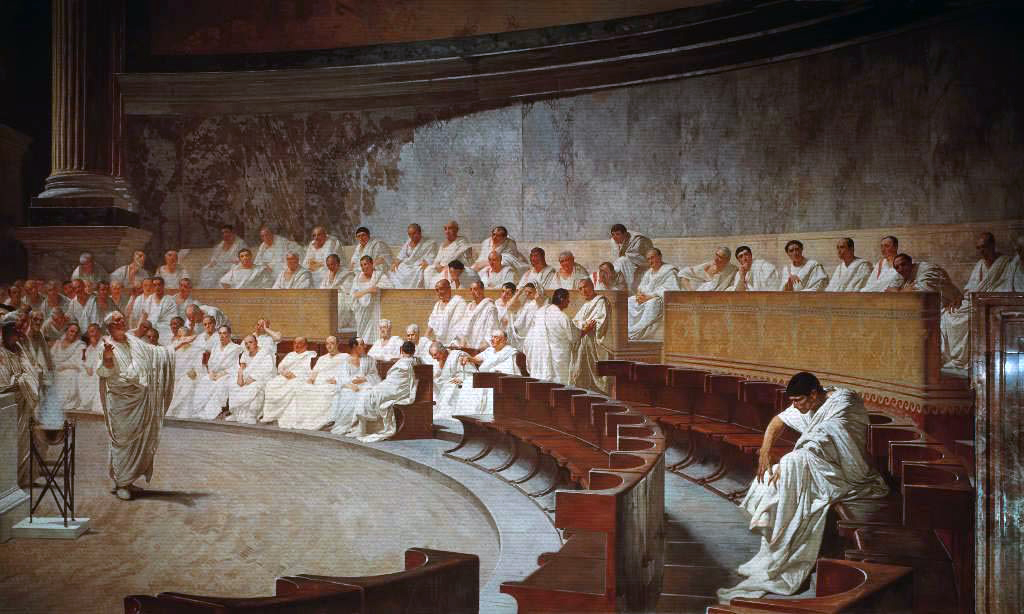
“Cicero denouncing Catiline in the Roman Senate”, by Cesare Maccari (and painted many centuries after the real incident). Courtesy of Wikipedia.
In light of the terrible events this past week, I felt like looking to the past for similar events in history, and the Catiline Conspiracy came to mind. This was an attempt by Lucius Sergius Catilina, who lost the consular election that year, to (quite literally) overthrow the Republican government. One fo the two consuls that year, Marcus Tullius Cicero (a.k.a. “Cicero”), was given legal authority to snuff out the conspiracy by any means necessary.
The awesome Youtube channel Historia Civilis, does a really nice video on this, so rather than hear me rehash this (poorly), I recommend the video instead:
It’s important to point out that just because recent events might have similarities to ancient Roman politics, that doesn’t mean they are always the same, nor should the same solution necessarily be applied. But it is fascinating how human history tends to fall into certain patterns across the centuries.







 Gleanings in Buddha-Fields


You must be logged in to post a comment.