The Joseon Dynasty of Korea: death by factions

If political gridlock, government shutdowns due to budget fights, and rabid factionalism get you down, consider the case of the Joseon Dynasty of Korea (1392–1894). The Joseon Dynasty, also known as Joseon-guk in Korean (朝鮮國, 조선국) was the last and longest of royal dynasties of Korea. At 502 years long, it is also among the longest dynasties in world history.

After the rise of Buddhism in East Asia, Confucian teachings took a backseat for a time, until it re-emerged centuries later under a doctrine called Neo-Confucianism. Neo-Confucianism is a fascinating subject all by itself, but it’s a hard one to describe to Western audiences. It’s enough to know that it was an effort to reinforce early Confucian ethics with more philosophy and metaphysics, while avoiding mysticism.

This is important because Neo-Confucianism became the official state doctrine early the foundation the Joseon Dynasty, just as it had become Ming-Dynasty China and Tokugawa-era Japan. Schools of Confucian scholars would staff the elaborate bureaucracies used by each sovereign, and provide advice on policies, or criticism if the sovereign’s conduct was deemed inappropriate or immoral. As the beacon of a rational and orderly society, the sovereign was held to a very high standard, but also (in theory) commanded unwavering loyalty from his subjects. Because orderly and rational societies were valued by Confucian thinking, there was heavy emphasis on ritual, etc. Everyone had their place, and everyone was expected to carry out their moral obligations, putting the needs of society over their own profit.

On paper, this was how it all worked.

In reality, the Confucian bureaucracy (the yangban) of Korea grew very powerful, and different schools of Confucian thought began to compete with one another for dominance in the Joseon bureaucracy. Over generations, these rivalries grew very cutthroat, and worse they splintered into sub-factions, and sub-sub-factions, all vying with one another. Further, sons of bureaucrats had the wealth and resources necessary to ensure they’d pass the civil service exams and become bureaucrats themselves. The Iron Law of Oligarchy comes to mind.

Source: https://xkcd.com/1095

This might seem kind of silly at first glance, since it obviously contradicted basic Confucian ethics.

However, this all began when bureaucrats in the court would debate how to address policy issues at the time, or question certain political appointments. Inevitably reform and conservative wings developed with different views of how to address such issues, and the leading figures of each wing would try to then pack the bureaucracy with their own men.

Is this starting to sound familiar?

The back and forth by factions, starting with the Easterners (dong-in, 동인 or 東人) and Westerners (seo-in, 서인 or 西人) began over subtle ideological disagreements. Then, each of these factions broke up into different factions. The Westerns faction alone broke up into the Noron (노론, 老論) and Soron (소론, 少論) depending on whether you supported Confucian scholar Song Si-yeol‘s reformist policies (the Noron) or not (the Soron). The Easterner faction similarly split up into Buk-in (“northerners”, 북인, 北人) and Nam-in (“southerners”, 남인, 南人) factions.

The king’s response to each of these factions varied by sovereign. In some cases, a king would support one faction over another. But if that faction got too powerful or out of line, the losing faction could sometimes convince the king to purge them from the bureaucracy. Sometimes the purges became extremely violent, with many faction members executed such as the one in 1589.

Inevitably, once a faction was crushed or purged, another would take its place in the court and consoldiate power, requiring yet another purge. By 1545 there had already been four blood purges.

Portrait of King Yeongjo of Joseon, source

By the time of King Yeongjo (1694 – 1776, 영종, 英宗) the fighting between factions and the bloody purges had gotten so out of hand, that Yeongjo survived an assassination attempt in his youth.

Yeongjo tried to take the high-ground in the conflict, implementing a policy of Tangpyeong (탕평, 蕩平) or “great harmony”. Yeongjo tried to stay above the fray and remained somewhat successful. Barely. By the reign of the next king, his grandson Jeongjo, the bureaucrats were at it again and King Jeongjo fought off a coup by the Noron faction.

In spite of the coup, the Noron dominates the court after Jeongjo’s later (and mysterious) death until they were ousted for good, but by this time the functions of government were locked in by certain powerful families and from the 1800’s onward the Joseon became isolationist and dysfunctional at a time when Western and Japanese powers grew in strength and aggression. The reforms of 1895 were simply too little too late to save the Dynasty and Korea was annexed by Iapan in 1905.

Much like the Eastern Roman Empire (i.e. the Byzantines), the Joseon Dynasty survived and thrived at times when there was a powerful ruler who could push for reforms, and keep interests in check. But there were always sharks circling the water, and as soon as they smelled weakness there would be bloody infighting and this would reset the clock on any meaningful reforms. Paralyzed by internal strife, other more dynamic, external powers eventually pulled ahead and defeated them.

Portrait of Kim Yuk (1570 – 1658), source.

It also should be noted that were plenty of good, sincere Confucian scholars who made a genuine effort at good governance, such as Kim Yuk, but in the end, powerful men always felt they could do it better when they sensed an opportunity.

P.S. astute readers may have noticed that I keep posting the names using both Hangeul script and Chinese characters (Hanja). Until the modern era, both were used together in a kind of mixed fashion, especially when a person wanted to avoid ambiguity (the Chinese characters are more distinct). Compared to neighbors like Japan or China, Chinese characters were used comparatively less (Hangeul was usually sufficient and simpler), but remain an important part of the language and culture.

Towards a Modern Buddhism, Sort Of

In my limited spare time, I often follow the amazing Youtube series: Extra History, which covers a lot of unspoken, or lesser-known aspects of world history in the form of short mini-series. One mini-series covers the history of Indonesia through the maritime empire of Majapahit. The last video covers the conversion of Indonesian culture from Hinduism/Buddhism to Islam:

One of the points raised was that Islam was a much more portable religion since it only required books (namely the holy Qur’an), and Arabic religious-cultural practices. In contrast, Buddhism has typically required elaborate monasteries and temples. This is not always the case however, as Buddhism arrived in China as a merchant’s religion as well, and gradually “percolated up” through Chinese society (quoting Charles B Jones in this excellent book, which I’ll cover in another post soon) but it suffered greatly when Buddhism was persecuted around 845, destroying many of the great monastic centers of learning that had sprung up over the centuries.

Setting aside the virtues of one religion versus another (which is definitely not my point here), it shows how religion is healthiest when it is portable, flexible, and adds value to the society at large, rather than stifling it. I would term this “heavy religion” versus “lightweight religion”.

One can easily look at any religion and finds examples where religious institutions meshed with politics, or became bloated with doctrine, dogma and philosophy after an initial period of innovation. One can easily find examples where religion catered to the well-educated elite, and became aloof to the problems of people on the ground.

This is the problem I think that faces Buddhism in the West.

Buddhism began as an ascetics religion, since this was very commonplace at the time in India (5th c. BCE), hence it prioritized the monastic community, and the monastic community has in turn provided an important element of stability and continuity across the ages. But also, that was a particular time, place and culture. Even when Buddhism circulated in Chinese culture, they ran into cultural clashes with the native Confucian literati that found the monk’s begging for alms, and living celibate in monasteries (instead of fulfilling filial duties to parents) grating and disgraceful. This forced Chinese Buddhist communities to adapt and disregard some practices from India while defending against Confucian criticism.

Similarly, the import of Asian Buddhism to the West has hit plenty of culture clashes, too many to list here. Some of this comes in the form of shady teachers, who abuse the teacher-disciple relationship, monastic communities that demand excessive alms and funding, or cults that can’t “make it” back home, but find fertile ground in the West preying upon naïve people. Finally, speaking from personal experience, many Buddhist converts in the West can behave elitist, even when well-intentioned, thus conflating bad stereotypes about “liberal, elitist culture”.

People have tried to solve this culture clash in a number of ways, either reinventing Buddhism to fit a “hip, new Western society” (groan…), or double-down on traditional Buddhist culture, either becoming insular or making well-meaning, but flawed attempts to translate traditional culture to a different culture. Or, they’re just shady guru cults.

None of these approaches are wrong, by the way (except the cults), but it underscores challenges for religions in crossing one culture to another.

But put yourself in the shoes of a working-class person in small town in rural America, with a demanding, minimum-wage job trying to support their kids. Expecting such a person to master the subtleties of Tibetan culture, or to learn Sanskrit mantras, or to find a reliable Zen meditation teacher is asking a lot. Some people make it work, most simply can’t.

It’s not their fault either; these Buddhist practices are all luxuries that the vast majority of society can’t realistically invest time in. Most people spend most of their time just making ends meet. It was true in medieval Asian society as much as it is today. While people in Silicon Valley can afford comfy desk jobs and trips to the next door coffee shop in between meetings, the people working in that coffee shop have to work annoying day jobs serving their coffee, and take a long commute home with 2-3 buses. And don’t forget the unseen people cleaning up the tech office overnight, scrubbing toilets, etc.

The point is is that all of these people are important to society, and if religious teachings aren’t relevant, useful, and meaningful to all of them, it will never spread beyond niche communities.

This is the problem that Buddhism faces, I think. I don’t have a good solution for this either. In Asia, similar problems have been dealt through lay-oriented Buddhist communities, both modern and medieval, gradually developed over decades or even generations, where monastic institutions are minimal or non-existent, and practices are straightforward and portable, yet steeped in deeper meaning in line with mainstream Mahayana Buddhism. Such communities have yet to fully take root in the West, and until they do, Buddhism will remain a tiny niche in the West and doomed to wither on the vine.

Why Buddhism? A Brief Response

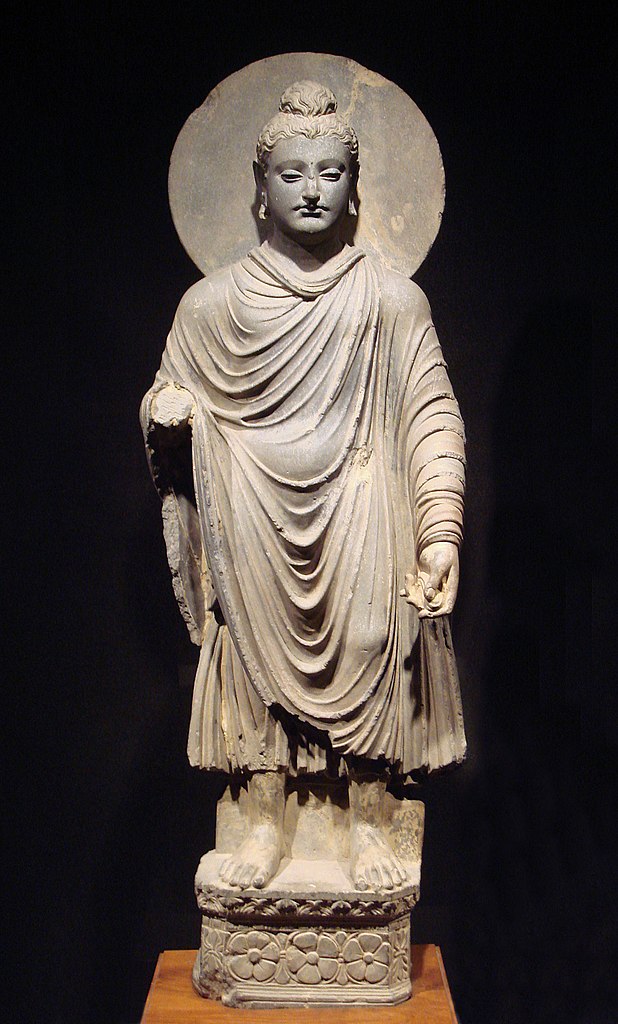
Gandhara Buddha statue. 1st-2nd century AD. Tokyo National Museum. 2004. Released in the Public Domain.

Buddhism is a religion that, while widespread in terms of numbers and influence on world cultures,1 is not well-understood in the West. Chances are you, you’ve probably heard of it, or seen something like the Happy Buddha in gardens or Chinese restaurants. You’ve probably have an idea of what “Zen” is, and so on.

Buddhism as a religion that focuses on wisdom, self-discipline, and goodwill toward all beings.

Buddhism is a religion that does not elevate a god of any sort, and is not concerned with gods one way or another.1 So, in this sense, people get confused about whether it’s even a religion at all. But it isn’t some dry philosophy either for people to debate in coffee shops or college campuses. The Buddha intended for his teachings to be applied in daily life, regardless of who you were, or what your background was.

In the Buddha’s own time, he described it as the “holy life”. It is a path that, if carried to fruition, is said to be praiseworthy and free from guilt, and hassles. But the holy life is also a people-centered religion in that the focus of its teachings is on daily life, and on people, not external deities. A person who adopts the Five Precepts of Buddhism, even if they make mistakes and struggle with some precepts, has made great progress.

Finally, the Buddhist path is something that is easy to take up, and you can begin just you are. It’s a long, slow path, with many discoveries, but you learn many things about yourself and others.

1 the Buddha is venerated as a peerless teacher, and the other Buddhas you find in Buddhism are expressions of the teachings. Buddhism has layers and layers of meaning, so it’s one of those things that takes time to sink in.

Western Buddhism Is Not A Thing

Recently I picked up a book on the Thirty Verses on Yogacara (in Sanskrit, the Triṃśikā-vijñaptimātratā). This is a famous Buddhist poem by Indian monk Vasubandhu that has been the subject of many commentaries of the centuries in China, and now in the West. While it contains only 30 verses total, it is an effort to summarize the deeper meanings of the Yogacara school of Buddhism (discussed here and here among other places).

While the book looks promising, I was immediately struck by the forward by Rev. Norman Fischer a venerable Zen monk of the San Francisco Zen Center:

I think of original Buddhism, in all its many manifestations in the many countries where it arose, as Buddhism’s great “first wave.” It rose up out of the deep waters of our first great cultures, when monarchs rules the world in feudalistic agrarian societies, and writing was new. Developing in midst of such social arrangements, Buddhist teaching could not help but be influenced by them.

….Historically, the second wave began in the mid-nineteenth century, with the West’s “discovery” of Buddhism….

….And now we have a “third wave” [of Buddhism]….In this third wave, Buddhism is fairly well-established as a spiritual practice everywhere in the contemporary world….

[Later] …. While first-wave Buddhism was clearly an Asian religion, third-wave Buddhism erases the boundary between religion and spirituality, faith and praxis.

Inside Vasubandhu’s Yogacara, A Practitioner’s Guide, By Ben Connelly, foreward

I was really quite shocked at the cultural arrogance of this foreward, lumping all of existing Buddhism in Asian society, its generations of monks, innovations, schools and so on under a single “feudalistic, agrarian” umbrella, as compared to “contemporary” (e.g. Western Buddhism).

And the comments are not limited to Rev. Fischer. The author also write a bit later:

In America today we are creating new and distinct forms of Buddhism informed by the many strains of Asian Buddhist and yogic thought that have come to our shores….

Inside Vasubandhu’s Yogacara, A Practitioner’s Guide, By Ben Connelly, pg 17

This claptrap about “American Buddhism” as a distinct, new innovation shows up on a lot of Buddhist publications targeted toward educated whites, especially in IT. I feels part of a trend described by Professors Reader and Tanabe as “protestant Buddhism”:

From its beginnings in the nineteenth century, the Western study of Buddhism in India has had what Gregory Schopen calls a Protestant bias in having to find “true religion” located in scripture. So long as Buddhist studies scholars insist that “real Buddhism is textual Buddhism,” then what is written in the texts as ideals must be understood as having taken place in actual practice — and, conversely, any idea or practice that cannot be found in scripture must be rejected as a historical impossibility.

Practically Religious: Worldly Benefits and the Common Religion of Japan, pages 3-4

and further:

Strictly speaking, then, our contention here is not that sutra Buddhism is a folk religion but that it takes its place along with folk religion within the common religion, which is entirely comfortable with and embraces both Buddhist scriptures and the popular practices of this-worldly benefits. The conflict, as noted earlier, is between these popular practices and sectarian orthodox doctrines based on notions of true and false religions….What is remarkable about sectarian interpretations is their adamant refusal to accept what the sutras say about practical benefits.

Practically Religious: Worldly Benefits and the Common Religion of Japan, page 101

This trend toward creating a new, modern, rational Buddhism isn’t limited to just one book, but even so, the whole thing just feels like a solution no one really asked for, for a problem that doesn’t really exist.

Further, the process of Buddhism as a religion being adapted to new cultures is nothing new. When Buddhism was imported into China, it came in layers. Key sutras were translated multiple times, with translations gradually becoming more refined and readable and as new terminology flourished natively in Chinese. Further, adaptations were made over time to the monastic culture to better suit the culture, and to counter criticism from Confucian scholars (e.g. begging for alms fell out of trend, clothing styles changed, etc). Finally, Chinese Buddhism developed its own methods for categorizing and organizing Buddhist literature from India (cf. Tiantai sect), spurring new modes of thought.

Keep in mind that all this happened over centuries. At no point (as far as I am aware) did Chinese Buddhists tout their practice of Buddhism as “new”, “modern” and so on. They paid deference to the countless generations of Indian Buddhists who made it all possible, while developing local innovations in a continuous tradition. When Buddhism spread from China to Korea, Japan and Vietnam, the same trend continued.

Thus, as Buddhism takes hold in the US, primarily around Asian-American communities, the same trend is happening. Asian-American Buddhists are transitioning across generations from purely immigrant communities to fully American ones, just like every other immigrant community. It just takes time. Further, from personal experience, many non-Asian Buddhists are also taking part in such communities, and helping to carry to torch as well. In short, existing Buddhist communities are flourishing amidst Western culture without having to reinvent anything.

Thus, “American Buddhism” or “new Buddhism” or anything in this vein is just a pointless label for something no one asked for. It might appeal to people who are adverse to organized religion, but as Reader and Tanabe demonstrate, you can’t have one (orthodoxy) without the other (popular religion). They are two sides of the same coin. It’s just how people are, and its why the tradition has flourished as long as it has across as many countries as it has: countless people from countless backgrounds and from all walks of life find a way to put it into practice, however “imperfectly” it might look on paper.

We Westerners are just one of many who have done the same thing.

Namu Shakyamuni Buddha

Wisdom, And Freedom From Fear

Recently, my wife was talking with an extended relative she hadn’t talked to in a while. This relative also lives overseas, albeit in a different English-speaking country, and when we last spoke a year ago, she had been talking about mundane things like taking the kids out for picnics, etc.

This time around, the same relative was spouting incoherent ramblings about weather-control machines, forest fires caused by human agents, and all sorts of things she had found on Youtube and on the Internet. Since the last time we spoke with her, she had gone down some kind of rabbit hole of conspiracy theories, and it had changed her for the worse.

The number one reason why I hate conspiracy theories, and all they represent, is that they are inherently irrational, narcissistic, and antithetical to the Buddha-Dharma.

In the original Star Trek series, in the episode Journey to Babel (2×10), Spock speaks with his mother and says the following (emphasis added):

It [being a Vulcan] means to adopt a philosophy, a way of life, which is logical and beneficial. We cannot disregard that philosophy merely for personal gain, no matter how important that gain might be.

To me, this is the essence of the Buddhist way of life: a way of life that is meant to be logical, rational, and of benefit to all sentient beings. Consider such liturgy as the Four Bodhisattva Vows:

Sentient beings are innumerable, and yet I vow to save them all.
My mental defilements (lit. bonnō) are innumerable, I vow to extinguish them all.
The gates of the dharma are without measure, I vow to master them all.
The path to Buddhahood is peerless, I vow to fulfill it.

Similarly, in the famous liturgy, the Heart Sutra, there is the following verse (emphasis added):

Because there is no attainment, bodhisattvas rely on Prajñāpāramitā [the perfection, or culmination, of wisdom], and their minds have no obstructions. Since there are no obstructions, they have no fears.

translation by Lapis Lazuli texts

Wisdom leads to freedom from fear. This is not wisdom as in the sense of knowing more than other people, which is just empty narcissism, but rather seeing outside your self-centered viewpoint.

Take for example a famous Buddhist story about the monk and the snake. It is said that a long time ago there was a monk in India who, one night, had to step out into the woods to use the restroom. As a monk, he has no possessions, and thus has to walk out into the dark by himself. Since India has many poisonous snakes, this can be a risky business. In any case, as the monk was carefully treading through the grass, he steps on a snake and faints in terror. The following morning, he wakes up, and realizes that the “snake” he stepped on, was in fact an old piece of rope.

This is how the mind works, and why its important not to blindly rely on your own logic and viewpoint too much. People can be certain that X is true, and yet the facts say otherwise. The greater one’s faith, the more they cut themselves off from reality. The more rational approach is to look at the data, look at facts, make observations, and then make informed decisions, not what one feels or one is sure is the truth.

A ‘position,’ Vaccha, is something that a Tathagata [the Buddha] has done away with. What a Tathagata sees is this: ‘Such is form, such its origination, such its disappearance; such is feeling, such its origination, such its disappearance; such is perception…such are fabrications…such is consciousness, such its origination, such its disappearance.’ [e.g. the Twelvefold of Causation]

Aggi-Vacchagotta Sutta (MN 72), translated from the Pali by Ven. Thanissaro Bhikkhu

Or as Mr. Spock would say:

Insufficient facts always invites danger

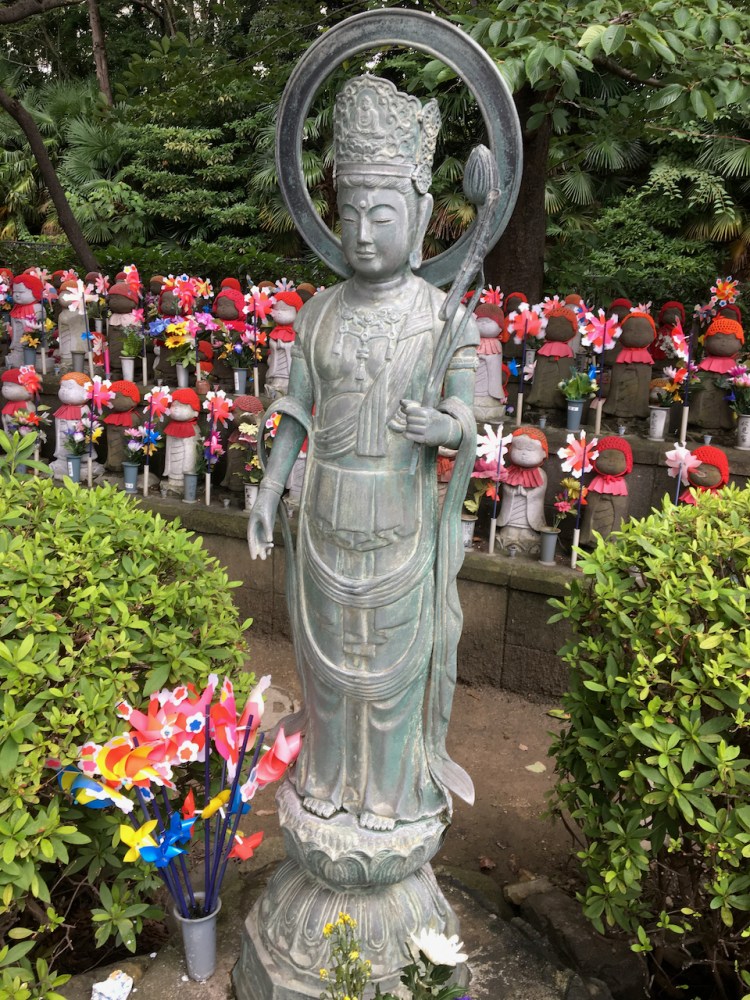
Thus, the Buddhist path is one that relies on rational thinking, not narcissistic beliefs. However, it is not limited to just rational thinking, and that’s why Mr Spock’s quote about “rational and beneficial” is so important. Consider the following Buddhist statue that I photographed in Japan in 2019 at Zojoji Temple (one of my favorites):

Here, the bodhisattva Kannon, is holding a lotus flower in one hand, while the other hand is down with two finger-tips touching. Buddhists statuary is replete with meanings and non-verbal symbols. The lotus symbolizes wisdom, and the potential for all beings to awaken, just as a lotus blooms from mud. The fingertips touching is another mudra meaning the “turning of the Wheel of the Dharma”, meaning to teach others and keep Buddhism going. The latter action, teaching the Dharma, helps sentient beings achieve awakening (i.e. the lotus), freedom from fear and wellbeing.

Hence, Kannon’s image here is a balance of both rational wisdom and compassion for all beings. Compassion not tempered by wisdom is irrational and can sometimes do more harm than good, while wisdom not compelled by concern for others is just dry scholasticism.

All of this is encapsulated in the 16th chapter of the Lotus Sutra where the Buddha says in verse:

My pure land is not destroyed,
yet the multitude see it as consumed in fire,
with anxiety, fear and other sufferings
filling it everywhere.
[…]
But those who practice meritorious ways,
who are gentle, peaceful, honest and upright,
all of them will see me
here in person, preaching the Law [the Dharma].

translation by Burton Watson

Part of the freedom from fear that comes from wisdom is the ability to see past the ups and downs of life, and see the bigger picture, to live a life that is gentle and peaceful towards others, and to maintain an upright life out of compassion for oneself.

None of this is easy, and requires years and years of practice, emotional growth, introspection, and willingness to take one’s own beliefs with a small grain of salt. It is a path that is not limited to Buddhists either, and there are plenty of Buddhists who don’t follow this path. What matters is not one’s affiliation to a religious org, but one’s willingness to live a life rooted in rationality and benefit for others. None of this can be accomplished by living in the paranoia and hostility, misinformation and sense of superiority that it brings from “not being a sheep” that comes with immersion in conspiracy theories

If you find yourself lost, scared, and confused with all the things going on in the world, take a moment and breathe. Turn off social media, go outside. Ground yourself in the world around you. If it helps, maybe recite the Heart Sutra a couple times (it is short enough you can chant it in about 1-minute) or the nembutsu. The life you live now, warts and all, is sustained by the goodwill of others around you, even if you don’t know who they are. Take a moment, and consider this, and maybe give something back to the world.

This is a long post, but I hope it helps others.

Namu Amida Butsu
Namu Kannon Bosatsu
Namu Shaka Nyorai

IDIC, Yo!

In the original Star Trek series (a.k.a. TOS), there’s an infamous episode1 in season 3 where Spock wears a new pin to symbolize the Vulcan philosophy of I.D.I.C., or “infinite diversity [in] infinite combinations”. Evidentially, it was Gene Roddenberry’s attempt at a cash grab by promoting a new product, but the catch phrase has taken on a life of its own in the Star Trek universe. You can see references to it in other Star Trek series, especially in the classic Star Trek: Deep Space Nine episode featuring a Vulcan baseball team.

To its credit, you get to see Spock sport a neat visor though…

The interesting thing about this philosophy, isn’t just the contribution it makes to the Star Trek universe, it has some interesting groundings in Buddhism as well.

Consider this phrase by the famous Indian Buddhist Nagarjuna (c. 150 – c. 250 CE):

sarvaṃ ca yujyate tasya śūnyatā yasya yujyate
sarvaṃ na yujyate tasya śūnyaṃ yasya na yujyate

All is possible when emptiness is possible.
Nothing is possible when emptiness is impossible.

Quoted from the book, Nagarjuna’s Middle Way, translated by Mark Siderits and Shoryu Katsura 

Much of Buddhism, especially Mahayana Buddhism, is grounded in the notion that all things, both concrete and abstract, arise through outside causes and conditions, and thus have a contingent existence. This is why all things are fluid, and constantly in flux. It’s also why, as Nagarjuna notes, that all things are possible.

Infinite diversity in infinite combinations, in other words.

1 Among the episode’s many other problems was the creepy way the male cast of the Enterprise are constantly talking about Diana Muldaur’s character’s beauty. TOS always had a problem with sexism, but this was over the top and creepy. It’s not a fault of the actors, just the terrible writing and direction that plagued season 3.

The Real Treasure Was Inside Us All Along

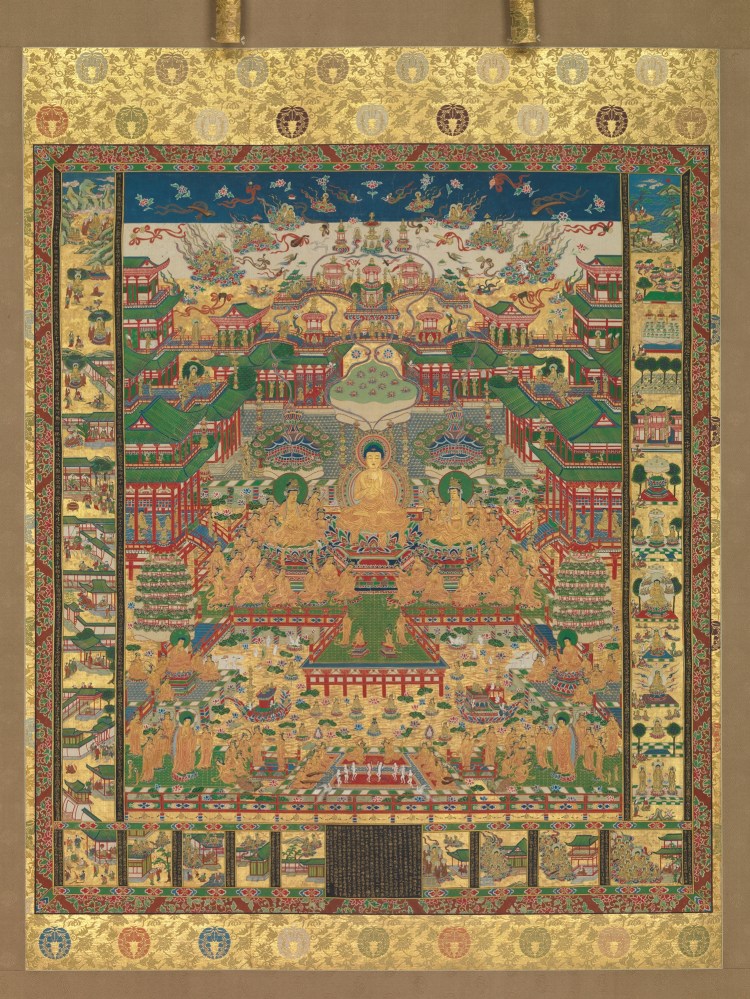
A reprint of the Taima Mandala, one of my favorite works of Buddhist art, with the Jodo Shinshu-sect crest at the top and bottom, Metropolitan Museum of Art, CC0, via Wikimedia Commons

Recently, I have been reading up on the Obaku sect (Ōbaku-shū, 黄檗宗) of Japanese Zen Buddhism: the same sect that Tetsugen was a disciple of. Obaku Zen is the third and last Zen sect to come to Japan to China, centuries after Rinzai and Soto were imported. Rinzai and Soto were both imported from China during the Song Dynasty. Obaku had the same lineage as Rinzai Zen, but was imported at the end of the Ming Dynasty, and had evolved over time to include some elements of Pure Land Buddhism, but with distinctly Chinese-Zen flavor.

In Japan, due to the Obaku sect’s common ancestry with the Rinzai sect, it was gradually absorbed administratively by the latter, but it’s arrival in Japan also reinvigorated Zen-monastic discipline. Soto and Rinzai sects frequently studied for a time at Obaku temple communities.

Obaku Zen, though small, still retains its more Sinified liturgy (sutra recitation is pronounced in a more more Chinese, less Japanese, style) and integration of Pure Land teachings.

For example their temple homepage lists an interesting excerpt from an earlier publication about the meaning of the Pure Land of Amitabha Buddha in a Zen context. What follows is the original excerpt, plus my rough translation:

この世で実在するのは心だけであり、総ての事物、現象は心の働きによって仮に現れたものであるとする「唯心」という考え方に基づけば、「浄土」も心の中にある。即ち自分自身の身こそが阿弥陀仏なのである。

If we take this world that exists as none other than Mind only, such that all of its affairs, its phenomenon, and such all depend on the movements of the Mind, and thus are “Conscious-only”, then the “Pure Land” is that which dwells in the heart. That is to say, Amitabha Buddha is this very self.

from「己身」の「弥陀」 (“Amitabha Buddha of the self”) from 黄檗宗青年僧の会発行「黄檗」(“Obaku Zen young monk’s periodical ‘Obaku'”)

To borrow that 1980’s cliché found in every Saturday morning cartoon: the real treasure was inside us all along.

The term “Conscious-only” or yuishin (唯心) is the Buddhist term for the Yogacara Buddhist school of philosophy, which taught that all things we perceive, think and feel are ultimately projections of the mind itself. It’s a subject that is super fascinating and far beyond the scope of this post, but important to understand that the Yogacara tradition of Buddhism has had a huge influence on Buddhism at large. I highly, highly recommend the book Living Yogacara: An Introduction to Consciousness-Only Buddhism if you’d like a general overview of Conscious-only Buddhism. It is a book that I come back to every now and then.

In any case, this concept of the Pure Land as the mind only might seem far-fetched given the overall trend, especially in Japanese Buddhist history, to focus on Amitabha Buddha and the Pure Land as separate, external entities. However if you’ll recall, the Chinese monk Ouyi who also lived in Ming Dynasty promoted a similar outlook:1 that in the end the real Pure Land was our Mind, and yet it’s perfectly fine to continue practicing Pure Land Buddhism as if it were external.

You might even say that the real bodhisattvas we encountered were the friends we made along the way. 🤪

Namu Amida Butsu

1 It’s tempting to argue that the Zen traditions of Soto and Rinzai that came to Japan earlier are more “pristine” than the later Obaku tradition, but I think that’s it’s a highly romanticized view of the past. Further, it’s important for religious traditions to “till the soil” from time to time, innovate and such. We can’t recreate the original 5th Century BCE community of the Buddha and his direct disciples, nor can we recreate the early Zen traditions in China and so on. We can learn from them, and keep innovating as time goes on. Later Zen tradition in China probably reflected continuous innovation as it vied with other schools of thought: Confucian, Taoist, other Buddhist schools, etc.

Corridors of Time

Box Log Falls, Lamington National Park, Queensland, Australia. Part of a remnant rainforest that once spanned across Antarctica and neighboring lands.Malcolm Jacobson, CC BY-SA 2.0, via Wikimedia Commons

Recently, the family and I went on the first vacation since the Pandemic to Victoria, British Columbia. I keep forgetting to post photos and talk about the trip due to time, but needless to say it was a great trip and we had a much needed break after 3 years.

On the final day, we visited the Royal British Columbia Museum and saw many great exhibits. The Museum is excellent, and I definitely recommend a visit.

Mammoth exhibit
The prehistoric mammoth exhibit at RBCM was amazing.
Elk exhibit
The RBCM also had great exhibits depicting native fauna including elk.
Seashore exhibit
You could also see exhibits of different habitats around Vancouver Island.

Among its features that day was an IMAX movie about prehistoric Antarctica titled “Dinosaurs Of Antarctica 3D”. As of 2025, it is now available on Youtube:

The IMAX movie provides a visual tour of Antarctica across various points in time, when it was a lush rainforest, how it survived the catastrophic Permian-Triassic mass-extinction, and much later when the Chicxulub asteroid struck the earth, leading to the end of the dinosaurs. Now, the entire continent is a frozen waste, with only remnants left in Australia, but it was not always so.

The Gondwana Supercontinent, 420 million years ago. Fama Clamosa, CC BY-SA 4.0, via Wikimedia Commons

It’s sad to imagine a vibrant world like that is now long dead, buried under ice, but it’s also fascinating to think of how much time has passed, and how much the world changes. Even when Antarctica was warmer and sustained a vast array of life, that life changed and evolved over eons as well. In the earliest era, there were primitive lizard-like creatures that eventually evolved into mammals, huge predatory amphibians, and later the classic dinosaurs. They, like us, would not be able to mark such a long, vast passage of time.

Thinking about it puts all our efforts and beliefs into perspective. The earth, and its changing climate (man-made or otherwise) doesn’t really care whether you believe in it or not, or whether it might lead to extinction of some species while allowing others to thrive. This world belongs to the Earth, and we’re just living in it. Even on a small, more generational level, change occurs. When my family and I visited Leavenworth, WA earlier this summer we visited a local man-made island that had been created a hundred years ago. A plaque at the entrance pointed out that over time due to natural processes, certain species of trees had sprung up, but after another 100 years those trees would die off and different species would be ascendant. Any human alive today will likely not be around to see the change, but in a few generations the island will have different flora and fauna simply due to natural process.

Example fauna and flora we saw at the park just outside Leavenworth.

Faced with this reality, it makes us naturally worry about what our place in the world is, and how we can live in it. Many of our solutions, philosophical, religious and such are, if you scratch the surface, made by humans for humans. Even the Buddhist religion, of which I’ve been a follower since 20051 often feels like it has a lot human-centric window-dressing. Many aspects of Buddhist “lore” (think Star Wars expanded universe) seem somewhat silly in the face of science. It’s not necessarily “wrong” though, and I strongly disagree the Western-Buddhist tendency to write it off as “cultural accretions”, either.2 However, at the end of the day, it’s just a form of human expression grappling with the world around us.

And yet, there are certain fundamental truths that all Buddhists know (or ought to), that not only conform to science, but also give it some sense of meaning beyond the raw, materialistic one:

  • All things arise due to external causes and conditions. As such, their existence is contingent and fluid, not static.
  • Therefore, life is both precious and fragile.
  • Similarly, change is the only true constant of the universe, and much of it happens outside our control. Some if it is induced by our own shortsightedness though.
  • Thus, one’s mind is what truly matters.
  • In the same way, conduct matters. What we do affects others, what others do affects us.

For this reason, many different approaches, or “dharma gates“, arose in the Buddhist tradition in order to actualize these truths. But sometimes, you also need something bland and neutral like natural science to kick you in the pants, ground yourself, and remind you what matters.

Namu Amida Butsu
Namu Kanzeon Bosatsu

P.S. Title of this post is a nod to famous song from the Chrono Trigger soundtrack: toki no kairō (時の回廊)

1 Arguably even further back, if you count dabbling in high school, but it’s a hassle to explain.

2 One researcher’s description of Western Buddhism as “Protestant Buddhism” is pretty spot-on, I think. Oh hey, look, more cultural accretions! Highly recommend the linked book, by the way.

At Last, I Have A Shot at Passing the N1

While I’ve been blogging a lot recently about Buddhism, Japanese history and Ukrainian language, etc, I have been quietly studying for the JLPT exam in the background. 😎

As of writing, the 2022 JLPT exam in the US will be held in early December (as is usually the case), and so with only 4 and one-half months left, I’ve decided to switch gears and focus on taking practice tests instead. The two most difficult sections of the JLPT are (depending on your background) reading comprehension (dokkai 読解) and listening (chōkai 聴解).

The last time I tried the N1 level of the exam, I wanted to see if I could pass without practicing. I wanted to see if I had attained enough exposure to Japanese language by then to simply pass it naturally. I didn’t. The JLPT exam, starting with N2 and especially the N1 aren’t normal conversational Japanese. You’re being tested on various subjects such your comprehension of business, government, education, even philosophy.1 Day to day exposure to Japanese language helps to some degree, but you as these are specialty topics you need to also practice and study them.

In any case, I broke out my practice exams for reading and listening, both available from OMGJapan and other fine Japanese goods stores, and started taking practice tests.

My mind initially panicked when tyring to read the Japanese essays. Some of the words that I had studied had been forgotten, some words were unfamiliar. However, I fought my initial panic, and worked my way through the practice essays one after another. To my surprise, when I checked my answers, I got 75% correct, which is a passing score.

I was thrilled. I realized that with further practice, I have a genuine shot at passing the JLPT exam, level N1. The reading that I have been doing over the year almost certainly helped, as did the vocabulary study (even if I haven’t even finished half the study book).

However, I also realized that I still have further preparation to do: learn the words I didn’t know, get smoother at reading, and learn NOT TO PANIC. That will come with repeated practice, I believe.

1 I was surprised to find an essay on what defines a peaceful death in the mock exam (I doubt this is in the real exam, btw). Clearly the author hadn’t watched Conan the Barbarian:

Learning, Not Parroting

Photo by Pixabay on Pexels.com

This is why I look on people like this as a spiritless lot — the people who are forever acting as interpreters and never as creators, always lurking in someone else’s shadow….It is one thing, however, to remember, another to know. To remember is to safeguard something entrusted to your memory, whereas to know, by contrast, is to actually make each item your own, and not to be dependent on some original and be constantly looking to see what the master said. “Zeno said this, Cleanthes that.” …. Besides, a man who follows someone else not only does not find anything, he is not even looking. “But surely you are going to walk in your predecessors’ footsteps?” Yes indeed, I shall use the old road, but if I find a shorter and easier one I shall open it up. The men who pioneered the old routes are leaders, not our masters.

The Epistulae Morales ad Lucilium of Seneca the Younger, letter XXXIII (33), translation by Robin Campbell