Think of this as “part two” of yesterday’s post. Some other quotes I found that I felt expressed the same sentiment, both from Star Trek, and from Dune.
Spock: Change is the essential process of all existence.
Star Trek, “Let That Be Your Last Battlefield”, Stardate 5730.2
“Deep in the human unconscious is a pervasive need for a logical universe that makes sense. But the real universe is always one step beyond logic.”
Frank Herbert, Dune
“When things change, your absolute universe vanishes, no longer accessible to your self-limiting perceptions. The universe has moved beyond you.”
I used to be an avid Dune reader in my younger years, and posted quotes from it all the time in earlier iterations of the blog. Anyhow, I found this quote from the third book:
The universe is just there; that’s the only way a Fedaykin can view it and remain the master of his senses. The universe neither threatens nor promises. It holds things beyond our sway: the fall of a meteor, the eruption of a spiceblow, growing old and dying. These are the realities of this universe and they must be faced regardless of how you feel about them. You cannot fend off such realities with words. They will come at you in their own wordless way and then, then you will understand what is meant by “life and death.” Understanding this, you will be filled with joy.
Muad’Dib to his Fedaykin, from Frank Herbert’s “Children of Dune”
I have probably said this a few times recently, but like it or not wearenotthecenter of the Universe, no matter how much we like to think we are. The universe will carry on without or without us, and sometimes it’s capable of really wondrous moments, and sometimes it will unleash some really shitty realities on us. And there’s only so much we can do to control that. Like a raft navigating treacherous waters, we have to carefully row and pay attention to the currents.
In spite of all this, though, it doesn’t mean we have to sit and be passive either.
Speaking of old science-fiction quotes…I am an avid Roger Zelazny reader, and Isle of the Dead is among my favorite books ever. I always like this quote because of its cosmic feel, but also its unintentional Buddhist message which resembles Saicho’s famous quote about “lighting one corner of the world”:
“Earth-son, I greet you by the twenty-seven Names that still remain, praying the while that you have cast more jewels into the darkness and given them to glow with the colors of life.”
My pure land is not destroyed, yet the multitude see it as consumed in fire, with anxiety, fear and other sufferings filling it everywhere….But those who practice meritorious ways, who are gentle, peaceful, honest and upright, all of them will see me here in person, preaching the Law [a.k.a. The Dharma]
Thus, even in the midst of crisis, or madness, or despair the light of the Dharma still shines even when it seems obfuscated. It is always there for those willing to look, and for those willing to cast a few jewels into the darkness.
SPOCK: To expect sense from two mentalities of such extreme viewpoints is not logical.
Star Trek, “Let That Be Your Last Battlefield” (s3ep15), Stardate: 5730.2
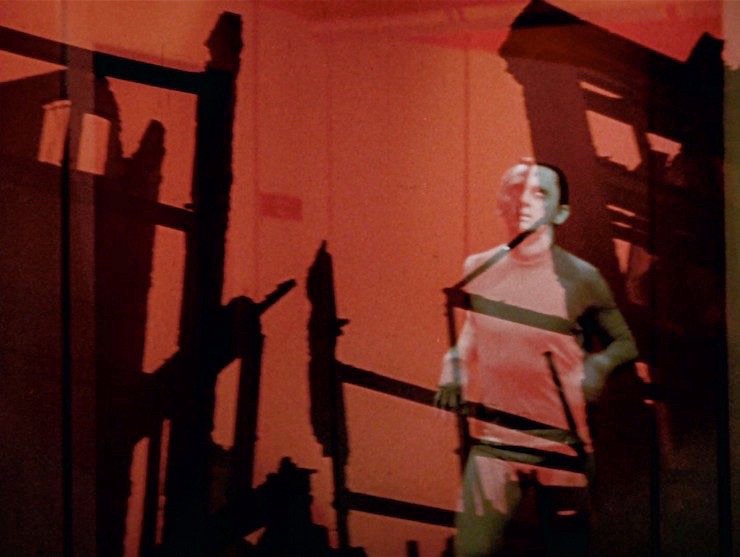
In the infamous episode of Star Trek, season three, Let That Be Your Last Battlefield, we see two aliens who have been chasing and attempting to defeat one another for “50,000 standard years” because the patterns on their faces are different.
“Bele” (L), played by Frank Gorshin, and “Lokai” (R), played by Lou Antonio
In the big climax at the end, they commandeer the Enterprise and return to their home world which is now a dead, lifeless world: their people have annihilated one another in Bele and Lokai’s absence. Rather than giving up, Bele and Lokai beam down to the surface (after an awkward running scene through the hallways) and continue their battle for all eternity.
This scene included stock footage from the Second World War, iirc. Because the war was only a generation earlier, the message was not lost on viewers.
The final dialogue of the episode between the crew is:
SULU: But their planet’s dead. Does it matter now which one’s right?
SPOCK: Not to Lokai and Bele. All that matters to them is their hate.
UHURA: Do you suppose that’s all they ever had, sir?
KIRK: No, but that’s all they have left.
While the episode exaggerates the topic, it does beg the question: how can people get into such a death spiral of conflict and hatred?
The single most important thing in Buddhism is the mind. Not a god or deity, but the mind. We see the world through our mind, we shape our view of the world through our mind, etc, etc. In a sense, even the gods are a product of the mind.1
The implications of this are really profound, but on a practical level it also helps explain why two seemingly rational adults can have such profoundly different views, to the point of being entirely hostile to one another.
When the Buddha spoke to a wandering ascetic named Vaccha, the Buddha called this need to assert a view-point “I-Making”. In the Aggi-Vacchagotta Sutta(MN 72 of the Pali Canon), Vaccha is trying to pin down the Buddha’s stance on this philosophical debate or that. But the Buddha is having none of that:
“A ‘position,’ Vaccha, is something that a Tathāgata [a Buddha] has done away with. What a Tathāgata sees is this: ‘Such is form, such its origination, such its disappearance….Because of this, I say, a Tathāgata—with the ending, fading away, cessation, renunciation, & relinquishment of all suppositions, all excogitations, all I-making & mine-making & obsessions with conceit—is, through lack of clinging/sustenance, released.”
Translation by Ven. Thanissaro Bhikkhu
In modern English, the Buddha is saying that holding onto views and beliefs just “feeds the ego”. By feeding the ego, it also imprisons us.
It’s hard to see this, because we naturally piece together the world around us through our experiences, but no matter who we are, the picture is incomplete and we fill in the rest based on conjecture, belief and hearsay. Nonetheless, if someone attacks our beliefs, it is an attack on our deepest sense of self too. This leads to the death spiral I alluded to earlier: the stronger we try to assert our beliefs (even if they are logical and sound), the more we stir conflict, forcing us to push even harder against perceived resistance.
But, like the honey badger, the Buddha don’t care. And because he has stopped clinging, he has no ego to bruise. Without an ego to bruise, he no longer suffers and is fully liberated.
This sounds far easier than it is, but that’s the gist. Sometimes it’s just better to shut up, don’t assume you know the answer, and just pay attention to the world around you. Imagine a blade of grass bending in the wind.
Afterall, what is the alternative?
P.S. as with the previous post, I started this months ago, and just now catching up.
1 put another way: we create our god by projecting our own ego.
Another post in my backlog that I wanted to share. I really didn’t intend this to relate to any recent events or anything, I just think it’s an evergreen quote by Captain Kirk.
KIRK: [War] is instinctive. But the instinct can be fought. We’re human beings with the blood of a million savage years on our hands! But we can stop it. We can admit that we’re killers… but we’re not going to kill today. That’s all it takes! Knowing that we’re not going to kill – today!
Star Trek, “A Taste of Armageddon”, stardate 3192.1
The Buddha was also very clear about the need for disciples to give up violence. This is not always easy, but the cost of war is rarely small.
Author’s note:I wrote this a couple months ago, but have been so backed up, I am finally posting it now. It was not intended to relate to current events. Just Star Trek nerdism, and me philosophizing.
The third-season episode of Star Trek titled Plato’s Children is often criticized as one of the worst episodes of the series. It actually has a really interesting premise, but suffers from poor execution.1
The Enterprise comes to planet populated by a self-styled republic,2 modeled after ancient Greek poleis, comprised of aliens who each have tremendous psychic powers. They live in great comfort, and spend their days pursuing whatever they want, but members of this republic have become so lazy, and have atrophied so much that they can’t manage even basic first-aid. When the leader suffers from a cut, he fails to do anything about it until it becomes seriously infected.
Further, one member of the community suffers from dwarfism, and no psychokinetic powers, and the other members of the republic bully him for entertainment and menial tasks. Michael Dunn’s performance as the “dwarf” character was excellent by the way. The same members also torment the Enterprise crew for an extended period of time to get what they want.3
By the end of the episode, it’s clear that the members of this republic are perpetually bored, and half-mad from having terrific power, but nothing constructive to use it for.
Without any struggle in life, or a way to stay grounded, I think the tendency is for one to gradually go mad. People’s minds, even when satisfied with basic needs, have a tendency to create more and more subtle problems for themselves. These problems nest fractally, there is no bottom.
Further, the other major point of the episode is said by the villain Patronius when he is defeated by Kirk:
Patronius: “Uncontrolled, power will turn even saints into savages. And we can all be counted on to live down to our lowest impulses.”
Star Trek, “Plato’s Stepchildren” (s3ep10), Stardate 5784.2
This is a very unintentionally Buddhist thing to say too. The mind is capable of the heights of sainthood (or bodhisattva-hood in Buddhism), as well as the depths of depravity, and everything in between. Under the right conditions any person can become a tyrant, or a saintbodhisattva. It’s not so much a question of personal will-power, environment matters more than one might think.
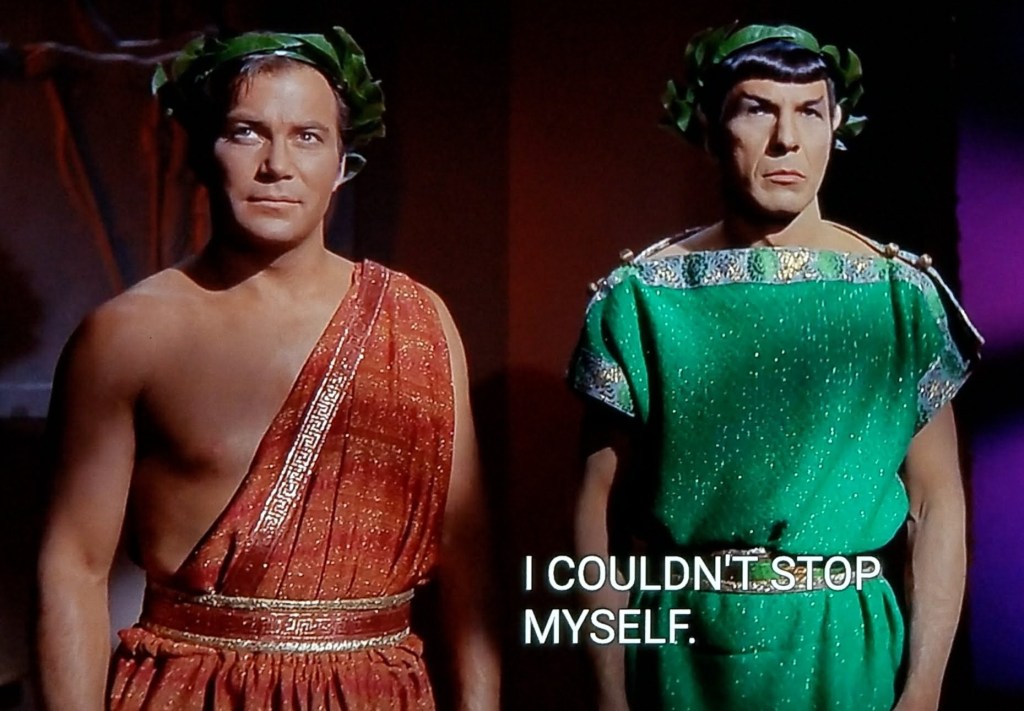
Under the right circumstances, you might even wear a toga….
It is always important to stay just a little vigilant toward one’s own mind. Perfectly rational people can easily go off the rails under the right circumstances. Further, you can’t control what others think and do (nor should you), but you can control how you react to them, or how you choose to conduct yourself. A mind unrestrained will inevitably run into disaster.
Namu Shaka Nyorai
1 Like many season 3 episodes.
2 The use of “republic” as modern people think it, is pretty different than the “res publica” as understood by Romans. It was more closer to a commonwealth, than a particular political structure, so even after Octavian took over as the princeps (the first “Emperor” in all but name), the res publica kept going well into the Easter Roman Byzantine era and beyond. By then, the Latin term was gradually replaced with the Greek equivalent: Politeia (πολιτεία).
3 This is why this episode is so unpopular. The script is pretty thin, so i guess the idea was to stretch out the time by adding more of these torment scenes.
Spock : “… I have noted that the healthy release of emotion is frequently very unhealthy for those closest to you.”
Star Trek, “Plato’s Stepchildren” (s3ep10), Stardate 5784.2
Meditation, specifically mindfulness meditation, is touted as a stress-relief exercise. Busy people believe that if they can block out the time to meditate for X minutes a day, or when stressed, this will make more happy and productive. It has been all the rage in Silicon Valley too.
But it doesn’t work.
It will calm your mind while you are sitting, but as soon as you are back to work, your blood pressure will quickly rise again. Old habits will quickly resurface. Self-help, in short, does not help.
How do I know this?
I tried the same trick in my late 20’s. My first child was born, and I was working at Amazon (yes, that Amazon) for a few years in a technical support role. The environment was stressful, demanding, constantly on the move, the on-call rotation gave little time to decompress because something was always broken,1 and I had to drive into work at all hours of the night to try and fix it.
Since I had recently converted to Buddhism at the time, and listened to a lot of Ajahn Brahm dharma talks, I wanted to try meditation. We had a spare office that no one used, so I would go in there once or twice a day, turn off the lights, dutifully sit, chant certain Buddhist mantras, meditate for 20 minutes or more, and then return to work.
As soon as I was back at my desk, the stress would rise all over again. I kept at the meditation for months, almost a year, before I finally gave up.
The stress, constant sense of inadequacy measuring myself to hyper-competitive co-workers who graduated from Stanford, unrealistic work performance goals, fear of losing my job, and so on simply didn’t go away until I QUIT MY JOB AND TOOK A LESS DEMANDING ONE.2
It took me years as a Buddhist to finally realize that stress-relief is not what mindfulness meditation was intended for.
Mindfulness meditation is a tool to develop insight, not stress relief. It is necessary in the early stages of meditation to quiet the chatter in the mind, but that is just the first stage. It is to remove barriers to insight by develop a focused mind, and a quiet mind, a mind that can perceive things in a more balanced way. Consider this quote from the Buddha in a very early text, the Dhammapada:
There is no meditative concentration for him who lacks insight, and no insight for him who lacks meditative concentration. He in whom are found both meditative concentration and insight, indeed, is close to Nibbana.
The monk who has retired to a solitary abode and calmed his mind, who comprehends the Dhamma with insight, in him there arises a delight that transcends all human delights. …
Control of the senses, contentment, restraint according to the code of monastic discipline — these form the basis of holy life here for the wise monk.
The emphasis is on focus, insight, and contemplation NOT relaxation or stress-relief. Mindfulness meditation has been repackaged and sold to naive Westerners with false promises. Meditation really does provide excellent benefits, but it has to be done as part of a much larger, holistic lifestyle change and with wholesome intentions. This is the “holy life” as described by the Buddha: a life of wholesome, guilt-free conduct, goodwill towards others, and a desire to pursue the Dharma (the teachings of the Buddha).
First, one should take up the Five Precepts of Buddhism. As we see in verse 374 above, the Buddha openly encourages that we curb our worst behaviors first as a foundation for other Buddhist practice. One will gain no lasting benefit from meditation until this is done. Full stop.
Second, one must approach meditation with the mindset of a monk. It is not necessary for lay-people to give up everything and go live in the woods. Buddhism accommodates both the “house-holder” lifestyle and that of a true renunciant (a.k.a. a monk or nun). But both the renunciant and the house-holder are expected to live a life of moderation and restraint.3 Easier said than done (speaking as a gamer and foodie), but it’s a goal to sincerely aspire to.
Speaking of restraint, one should always guard one’s speech. A long time ago, a Buddhist minister I admired once told me that speech was like toothpaste: once it was out of the tube, you couldn’t put it back. One has to learn to carefully monitor what one says both in person and online (and yes, at work). Again, easier said than done, but the alternative will only make your life miserable.
Finally, when such good foundations are established, meditation will help you learn more about yourself, and the world around you.4 It’s incredibly helpful, and life-changing when carried to fruition. I have my own little private insights that have stayed with me through the years, and I hope you will find yours too.
Namu Amida Butsu
Namu Shakamuni Butsu
P.S. if you feel the need to calm yourself right away, try something much simpler. You can recite the nembutsu, the Heart Sutra, a mantra, whatever. Try that for a minute, and see if that works. It is a band-aid fix though, and you still need to approach things from a holisitic standpoint, or you will gain no long-term benefit. Alternatively, just go for a walk.
1 Years later, the sound of a pager going off still triggers me a little bit. No joke.
2 Another ex-Amazonian who had joined the same company years earlier confided in me that after leaving Amazon, he drank himself stupid for months to decompress. I noticed that I was still on a hair-trigger for months after leaving Amazon, and it took me a while to unlearn those habits too. My wife noted that my posture improved after leaving, and that I grumbled about work less. Some jobs are simply not worth staying in.
3 The Buddha was pretty flexible about what exactly this meant, citing whatever cultural standards applied at the time as a benchmark. In short, a lot of it is rooted in common courtesy and good sense. If you cannot act toward others using common courtesy, meditation ain’t gonna fix your issue.
4 You may learn that your whole problem is that your job sucks, for example, and that the burn-out is not worth the money. Of course, if you’re a single mom caring for three kids, you have a lot fewer options available to you, and in such cases I recommend the nembutsu as a starting point.
Something that’s been on my mind lately is this quote from the original Star Trek series:
Dr. McCoy: Spock, I’ve found that evil usually triumphs – unless good is very, very careful.
Star Trek, “The Omega Glory” (1968)
These days, pretty much the entirety of the 2020’s in particular, it really feels like good has to extra vigilant, doesn’t it? Like wherever one turns, evil seems to always get the upper hand.
Different episode (“Bread and Circuses”), but same energy. RIP DeForrest Kelley …
This isn’t even just a statement of politics. We are definitely living through some pretty difficult times, and it brings out the worst in others.
Consider this iconic quote from the Buddhist text, the Dhammapada:
183. To avoid all evil, to cultivate good, and to cleanse one’s mind — this is the teaching of the Buddhas.
Trans. Acharya Buddharakkhita
The statement is pretty vague, but to me it feels like there’s an order and logic to this statement.
Avoiding all evil begins with things like the Five Precepts and is probably the first step as a Buddhist. It doesn’t solve everything, but it’s a good starting point. You’re stemming the worst instincts at least.
Next, one cultivates good through Buddhist practice such as dedication of merit, the four bodhisattva vows, and just good old-fashioned metta. The idea being that cultivating wholesome states of mind gradually sinks in and reinforces itself. Presumably.
Finally, cleansing the mind. This is where practices like meditation, mindfulness and such really come in handy. Having a good heart is not enough: one needs to balance it with wisdom and clarity.
In another episode of Star Trek, titled “The Savage Curtain” (the one with Space Lincoln), the founder of Vulcan philosophy Surak heedlessly goes alone to try and negotiate peace. His stubbornness costs him his life. Lincoln also tries to save him but gets killed as well.
“Space Lincoln” was awesome.
This theme repeats across multiple episodes: striving to do good not enough, one needs to vigilant. On the other hand, being passive and intellectual doesn’t accomplish much good either.
So, you need both.
Even in these difficult times, it’s helpful to maintain goodwill towards all beings (even the really awful jerks who might not deserve it), have realistic expectations, meet evil with good, but also meet ignorance with wisdom including your own.
In part one of the journey, Xuan-zang braved the Gobi desert and contended with the overbearing monarch of Turpan, but also beheld many wonderful sites at that venerable city before moving on to Yanqi. After leaving Yanqi, Xuan-zang moved onto the city of Kucha, also called Kuchar in Uyghur (كۇچار) or Kùchē (庫車) in Chinese.
The Buddhist Kingdom of Kucha
Out of all the cities of the northern Silk Road surrounding the Tarim Basin, Kucha was the largest and most prosperous. As a powerful Buddhist kingdom, Kucha dominated the Silk Road trade in the area since at least the 4th century. Xuan-zang’s description of the city was as follows:
The soil is suitable for rice and grain…it produces grapes, pomegranates and numerous species of plums, pears, peaches, and almonds…The ground is rich in minerals-gold, copper, iron, and lead and tin. The air is soft, and the manners of the people honest. The style of writing is Indian, with some differences. They excel other countries in their skill in playing on the lute and pipe. They clothe themselves with ornamental garments of silk and embroidery….
There are about one hundred convents in this country, with five thousand and more disciples. These belong to the Little Vehicle [Hinayana]1 of the school of the Sarvastivadas. Their doctrine and their rules of discipline are like those of India, and those who read them use the same originals….About 40 li to the north of this desert city there are two convents close together on the slope of a mountain…Outside the western gate of the chief city, on the right and left side of the road, there are erect figures of Buddha, about 90 feet high.
As with prior cities, Xuan-zang’s reputation had proceeded him, and he was greeted by the local ruler, which described as having “red hair and blue eyes”. The king of Kucha at the time was likely either ethnically Sogdian or Tokharian. We saw similar figures depicted in Buddhist art when we looked at the Bezeklik Caves in episode one. The Silk Road north of the Tarim Basin was a fascinating mix of different peoples and ethnicities and it could change from city to city. The Tokharians were distant relatives of other Indo-European people, and their language had some common elements to European languages such as English. Yet, the link between the Tokharians and Westerners is frankly pretty tenuous, but that did not stop researchers in the 19th century who had certain … racial theories, from hyping up their contribution to the Silk Road. It’s important to be cautious and not to draw too many conclusions. Hidden agendas make for bad research.
What’s more interesting to me is how the Tokharians lived alongside totally disparate groups such as Chinese, Turks, Uyghurs, Sogdians and so on, and at times they had friednly co-existence (the Tokharians evidentially revered the Sogdians in particular and tried to emulate them), and at other times they clashed. In other words, pretty typical human stuff. This intermix of cultures and people is what makes the Silk Road so fascinating.
But I digress…
Kucha had a lively material culture, thanks to runoff from the Tian Shan mountains providing plenty of water, and thus a wealth of food and agriculture grew here. It’s place on the Silk Road also ensured plenty of goods and materials were traded here too. Further, Kucha was famed for its music, and musicians from Kucha were highly sought after. A Kuchean orchestra was staffed at the court of Great Tang throughout the dynasty, and played for official ceremonies and celebrations. My book on Xuan-zang points out that famous songs they played included titles like “The Jade Woman Hands the Cup Around”, “Meeting on the Seventh Evening”, and “The Game of Hide the Buckle”.
Yet, for the Buddhist tradition as we now practice it today, Kucha was even more important for another reason: it was the hometown of Kumārajīva (344–413 CE) the translator.
Kumarajiva the Great Translator
Kumarajiva was the son of an Kashimiri-Indian father and a Kuchean mother, and was raised in Kucha. He studied Sarvastivadan-branch Buddhism, an influential pre-Mahayana Buddhist school whose monastic code was adopted by Mahayana Buddhist communities in China onward. However, at some point Kumarajiva converted to Mahayana Buddhism and by age 20 ordained as a Buddhist monk. His fame as a scholar reached China at the time, and he was sought out by the emperor. Our homeboy, Kumarajiva, was imprisoned at one point by a local warlord, but eventually was released by the Chinese emperor, and brought to the capitol of Chang-an (see prologue episode), and was feted.
Kumarajiva proved to be an excellent translator, and helped bring many Indian-Buddhists texts to mainsteam China. Because the Sanskrit originals were mostly lost in India, but preserved in Classical Chinese, these works, now core texts in many modern Buddhist traditions, help maintain the tradition today. To name a few that you probably already familiar with, Kumarajiva translated these sutras:3
The Shurangama Sutra, important in Chinese Buddhism, especially Zen
The Sutra of the Ten Stages (chapter 26 of the Flower Garland Sutra)2
…. among many others.
To reiterate this point: the English translations of these texts we use today come from the Classical Chinese editions that were originally translated from Sanskrit and prakrits by Kumarajiva.
Having said all that, let’s return, centuries later to Xuan-zang…
Staying at Kucha
From Kucha, Xuan-zang would have to pass through Aksu before crossing over the Tian Shan mountains, but heavy snows in the passes mean that Xuan-zang had to stay in Kucha for two months. During this time Xuan-zang stayed out of trouble, and spent many days discussing Buddhist philosophy with the local community. This included the famous Kizil Caves:
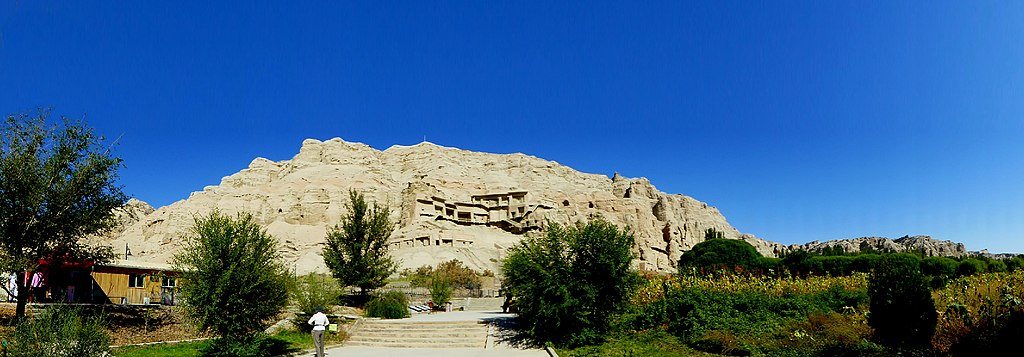
The Kizil Caves (in Uyghur قىزىل مىڭ ئۆي) or Kèzī’ěr Qiānfú Dòng (克孜尔千佛洞, lit “1000 Buddhist Caves of Kizil”) are a massive cave complex and probably one of the earliest along the northern Silk Road used for Buddhist monasticism. The artwork here often shows strong influence from Buddhist-India, or more precisely, the Greco-Bactrian art of Gandhara. However, like the Bezeklik Caves we saw earlier, a combination of local religious iconoclasm, looting by European researchers,4 and subsequent tourism have greatly disturbed the artwork in the Kizil Caves. Here’s an example reconstruction from the so-called Peacock Room:
A representation of the Peacock Room layout, and what remains. Photo in public domain, courtesy of Wikimedia Commons
In any case, check out the Wikipedia article I linked above on the Kizil Caves. There’s simply too much to add here, but needless to say, Xuan-zang must’ve beheld some amazing art in his time, which we will sadly never see again.
Side note: the red haired, blue-eye ruler of Kucha that I mentioned earlier ran afoul of the Chinese emperor, Taizong, a few years later by pretending fealty, while also declaring his loyalty to the Western Turkic Khaganate (more on that soon). Needless to say, China did not take this lying down and soon conquered Kucha just as it did with Turpan. Xuan-zang would be long gone by this point though.
The Tian Shan Mountains
Once it was safer to travel, Xuan-zang’s caravan moved onto the city of Aksu, which in his time was called Baluka (跋祿迦, Bolujia in Chinese). Xuan-zang’s caravan was again ambushed by bandits along the way, but once again the bandits were full from another attack and quickly lost interest in Xuan-zang’s group. I’d say Xuan-zang was lucky, or the bandits were just lazy. 🤷🏼♂️
Anyhow, Xuan-zang stated that Aksu was very similar to Kucha in many respects, though according to Wikipedia, Xuan-zang noticed that the people of Aksu seemed to speak a different kind of Tokharian language. The Wikipedia article on Tokharian mentions that there were several dialects, all of them pretty different from one another. In any case, it doesn’t seem that Xuan-zang stayed at Aksu too long though and set out for the mountain passes over the Tian Shan mountains to reach Tokmok. There things took a dangerous turn.
The Tian Shan mountains, with Khan Tengri in the middle. Photo by Chen Zhao, CC BY 2.0, via Wikimedia Commons
The Tian Shan mountains are huge, cold and dangerous to traverse. The Khan Tengri mountain is more than 23,000 feet high, and the Bedel Pass near it is one of the few ways to cross over to the other side. Of the mountain, Xuan-zang wrote:
This mountain is steep and dangerous, and reaches to the clouds (lit. “heaven”). From creation the perpetual snow which has collected here in piles, as been changed into glaciers which melt neither in the winter nor summer; the hard-frozen and cold sheets of water rise mingling with the cloudes; looking at them the eye is blinded with the glare, so that it cannot long gaze at them. The icy peaks fall down sometimes and lie athwart the road, some of them a hundred feet high, and others several tens of feet wide.
The Silk Road Journey with Xuan-zang, page 31
It took eight days to traverse the pass, and Xuan-zang lost up to 30-40% of his men and countless horses and oxen. Imagine that famous scene from the movie Fellowship of the Ring when the good guys braved the mountain pass, but instead of turning back almost half the party freezes to death. That’s how serious it was.
Nonetheless, the survivors did reach the gorgeous lake of Issyk Kul, now in modern Kyrgyzstan. From here, the caravan would soon reach Tokmok and with it enter the lands of the powerful Western Turkic Khaganate….
Stay tuned!
1 Explained also in part one, the term Hinayana Buddhism is not related to Theravada Buddhism (it’s seems unlikely to me that they interacted with one another due to geography), but instead is a broad term for all pre-Mayahana Indian Buddhism. It’s still a somewhat pejorative term, but the relationship between early Hinayana Buddhism and Mahayana Buddhism is … complicated and not necessarily antagonistic.
2 I would love to talk about the Flower Garland Sutra some time, but it is a TOME, and I’ve only read very small parts of it. The Sutra of the Ten Stages deserves special attention though, and I have read it, but it’s challenge all by itself to explain in a blog post. Maybe some day.
3 one notable omission in this list is the Heart Sutra. The Heart Sutra is thought to have been compiled in China, not India, as a clever summary of much longer sutras. It gets to the “heart” of the matter, if you take my meaning. Xuan-zang, as we’ll see later, brings it back to India where it’s translated to Sanskrit, not from it.
4 The story of Albert Grünwedel is an interesting example of someone who was a dedicated archeologist, but also kind of unhinged too.
In a couple recentposts, I touched upon the misdeeds of one 12th century warlord named Minamoto no Yoritomo in the excellent Japanese historical drama, the Thirteen Lords of the Shogun. Huge credit to Japanese actor Oizumi Yo (大泉洋) for his brilliant performance by the way.
There’s one particularly heart-breaking scene halfway thorugh the drama series: Yoritomo bullies his retainer, Hojo no Yoshitoki, to carry out a series of bloody purges (partly as a test of loyalty). Yoshitoki hesitates, seekingly ready to stand up to Yoritomo at last, but in the end he backs down. Later in the episode after the purges have taken place, Yoshitoki is at home holding his infant baby, but quietly cries to himself. He says to his child, “please forgive your dad” as the episode ends. 😭
While some of this is dramatic fiction, Yoritomo really was a ruthless man, just one of many in history who exerts power and does whatever is necessary to keep it. They exploit others and toss them aside when they are done. Such men are so hopelessly self-absorbed that they pull everyone in orbit down with them, and even then it’s not enough. Like a bucket with a big hole at the bottom, the more they try to fill it and appease their ego, the more they need to fill it again.
For you science types you can also compare them to a singularity (e.g. a black hole): something that has collapsed in on itself and now pulls everything in destroying them in the process.
Sagittarius A*, the black hole at the center of our galaxy.
For simplicity, we’ll call these people “super assholes”. It’s a pseudo-Buddhist term. 😉
Even in modern times, such powerful assholes still exist. They merely changed jobs. Some run major corporations, some rule dictatorships, others are just obnoxious politicians, lawyers, priests, media influencers and so on. Yet in spite of their obvious misdeeds and harm to others, they seem invulnerable, able to evade justice through wealth, power and just being enough of an asshole.
Worse, even if you manage to take down one asshole, another one inevitably arises.
All governments suffer a recurring problem: Power attracts pathological personalities. It is not that power corrupts but that it is magnetic to the corruptible.
When I think about this issue, I sometimes consider a passage from the Earth Store Bodhisattva Sutra, chapter five:
The power of karma is extremely great. It rivals Mount Sumeru in its heights. It surpasses the great oceans in its depths. It obstructs the path leading to sagehood. For that reason, beings should never think that minor bad deeds are unimportant or assume that they do not count as offenses. After death, there will be retributions to undergo that reflect all those details.
This is, admittedly, a pretty small comfort to the countless people whose lives have been destroyed, literally and figuratively, by such powerful men. Sure, they may self-destruct someday, and face some kind of karmic retribution in the future, but what about the people who are suffering or dead now?
Make no mistake, though, time does go on, awful people wither and die, and their legacies are forgotten. Remember the ancient Assyrian king, Ashurbanipal? His was a reign of terror. But soon after he died, the dreaded Assyrian Empire fell and its legacy is now just dust. Small comfort to people at the time, but still.
Screenshot from the game Fire Emblem: Three Houses.
If you compare these “super assholes” to black holes in space, I find the best thing to do is steer clear of their orbit. If you’re far away, you can still escape with minimal effort, but get too close and you may get sucked in further no matter what you do, just like Hojo no Yoshitoki. Sometimes it’s better to just lay low and let things pass.
Sometimes, though, it feels unavoidable, and that becomes the true test of one’s character.
Namu Amida Butsu
P.S. I coincidentally wrote most of this before a certain asshole was convicted (you know who). I fear he will somehow escape justice though, but he will be dead in time anyway.
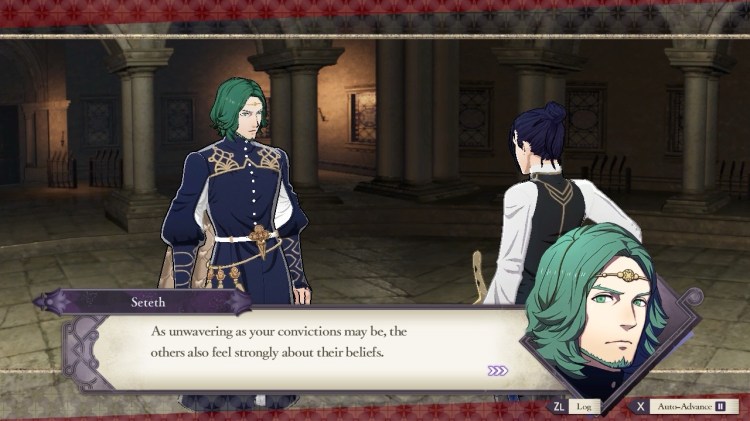
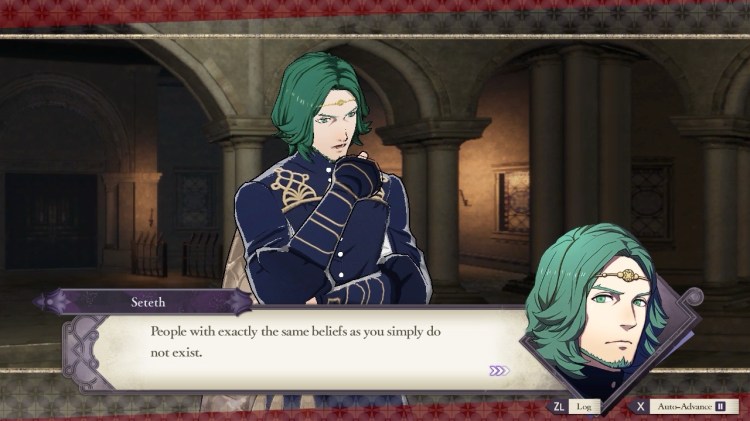
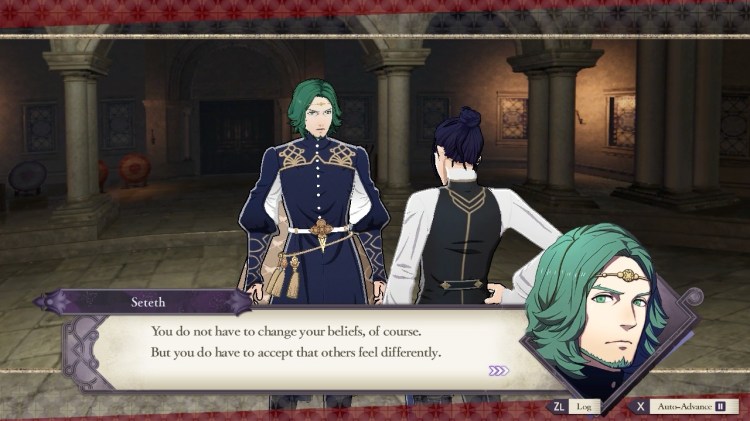
I thought this was a neat dialogue between two of the characters in the game Fire Emblem: Three Houses. The older Seteth (green hair) is offering some advice to the young and prickly Felix:
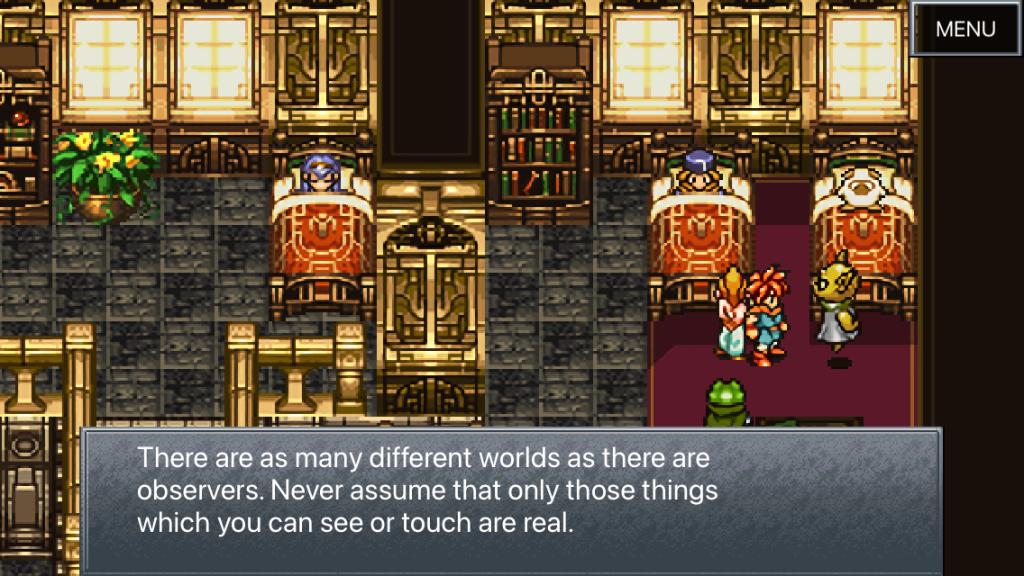
This might seem self-evident, but because we only see the world through our own viewpoint, our own thoughts and experiences, it’s easy to forget that other people have other viewpoints and other experiences, and come to their own conclusions, right or wrong.
Different game, but I hope the sentiment makes sense. 😆 It’s also why Buddhism emphasizes unconditional goodwill so much.









 Gleanings in Buddha-Fields
You must be logged in to post a comment.