I couldn’t resist starting this post with some click-bait text. 😬 Recently I saw this post on Twitter:
Ancient Greek and Latin are not hard / difficult / impossible languages to learn or languages. Every single Athenian (etc.) and Roman baby learned to speak, read, write, and understand the language(s). The issue is not the difficulty; it's the way we teach them. (1/?)
— Kelly MacFarlane (@KellyMacFarlane) May 29, 2021
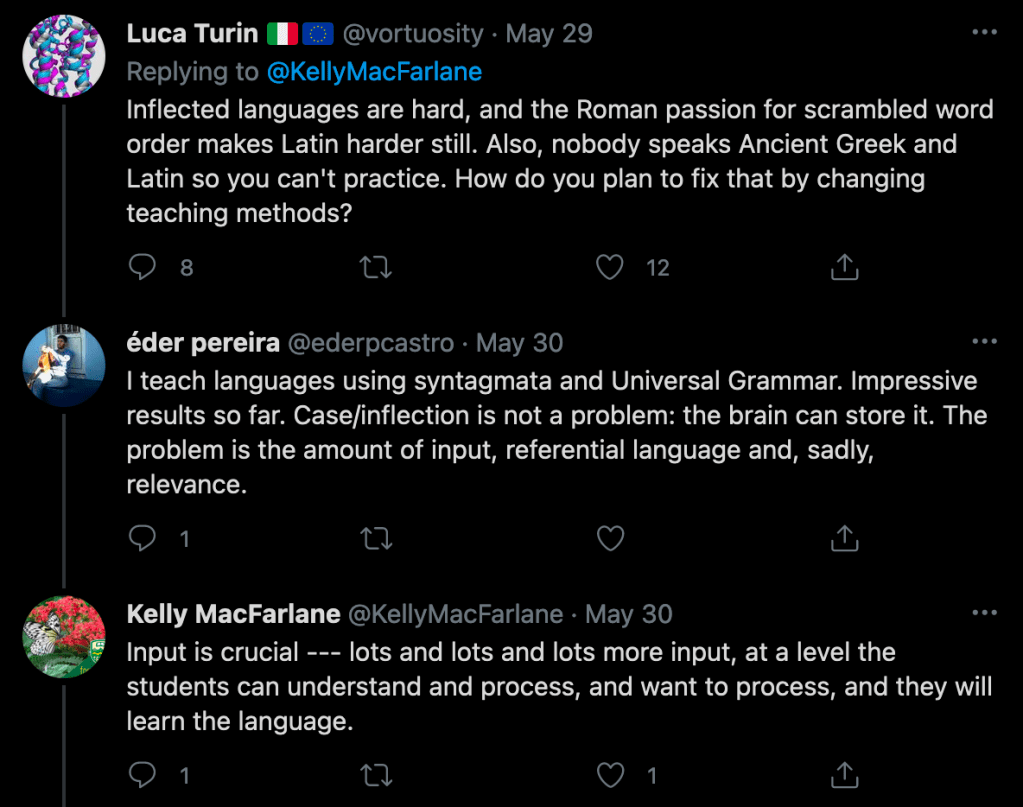
This leads to a heated exchange on Twitter, including the following:
“Input! More input!”
Basically, the point here is is that if you want to learn a language and communicate smoothly, you need A LOT OF INPUT. Like, a sustained, overwhelming amount of input. It will not make sense at first, but gradually you’ll start to piece together the ineffable patterns in a language, and without thinking, you’ll know how to correctly speak your mind, or respond to someone else’s words.
It took me a long time to realize this, after I had wasted countless hours cramming and studying. The studying does serve a purpose, in so far as it helps get you on your feet, but if you’re starting out on a language, the sooner you prioritize input, the easier you will pick it up and improve. It’s not only stimulating for your mind (great for old folks like me), but also it helps bridge the gap between the “textbook” examples you first learn and real life ones, and the real life ones are the ones you should be imitating the most.
What does input mean here? Any kind of exposure you can find: movies, podcasts (my personal favorite), TV shows, just listening to other people speak in real life, etc. Soak it up like a sponge, and don’t get discouraged if none of it makes any sense even after 3 months, or 6 months. If you are learning classic languages like Latin and ancient Greek, just keep reading. Bit by bit, it’ll all become second nature.
I realized that comprehending adult conversation in real time is like catching a school of fish. If you try to reach out and catch it with your bare hands, the fish will swim away, but if you relax and just let the fish swim around you, they’ll get closer and closer and you can easily catch them. Language comprehension works an awful lot like that.
Hard to explain, but if you’ve ever learned another language well, you’ll realize that you’re mind has somehow transitioned to a state where it fluently comprehends it without having to mentally translate from your own native language, which is what a lot of new students tend to do. No conscious thought here, just comprehension.
Recently while stuck at the dealership waiting for my car to get fixed (flat tire), I got into a weird thought exercise about how to learn Japanese language. I started learning Japanese on my own way back in the late 1980’s (back when Japan Inc was super cool to impressionable teenagers) and then in college in a formal setting, and later again when I studied for the JLPT exam on my own (reached JLPT N2 in 2012).
Needless to say, I’ve learned Japanese a number of ways over the years, and I’ve never quite liked any of them. Japanese as a language is pretty fun and interesting, but I have come to dislike most approaches to explain Japanese grammar because either they weren’t very clear (explaining the differences between particles は and が supposedly can fill a book, I was once told), or they they just didn’t produce good results. I still get the conjugations of 切る and 着る, both read as “kiru” but conjugate different, mixed up on a regular basis, and I don’t want to even mention the Heisig Method of learning kanji.
Thankfully, there are some really nice, modern approaches to Japanese. I really like Tae Kim’s excellent Guide to Japanese and I can say that it helped me to fix some old, bad habits, while also explaining grammar concepts in new, fresh ways. I just wish it had existed when I was learning Japanese.
Meanwhile, as a fun personal exercise under lockdown, I’ve been (re)studying Latin through the Great Courses class taught by Hans-Friedrich Mueller. Learning Latin, probably the most studied language in Western culture since antiquity, made me realize that Latin’s approach to learning is pretty effective in some ways. The way things are categorized, dissected and studied means that if you learn Latin properly, you can learn Latin surprisingly quick. It’s a fair amount of work upfront, but once you get past that first hill, it’s actually not that bad.
As with Japanese, I had learned a bit of Latin before ages ago, but while the books were well-respected (and fun), they were not always effective. I would quickly get bogged down by the time I got to the third-declension nouns, and I never quite recovered. Trying again with a fresh, different approach through the Great Courses really helped me get past the old hurdles, and now Latin makes a lot more sense. The issue was never the language (just as with Japanese), but how it’s conveyed, and how people build foundations.
So, while at the dealership, I got to thinking, can the same approach be applied to a totally different language like Japanese? Is there better ways to build solid foundations in Japanese to avoid future headaches and frustrations? I think “yes”. We can’t always rely on tradition to teach a fascinating language like Japanese, we as language students (and educators) should be tilling the soil over and over to find better and better ways. Latin has had the benefit of this for 2,000 years in the West and there’s no reason why we can’t do the same for other languages.
This post is a first-attempt at applying a Classics-style language course to Japanese. It’s far from perfect, but if you’re studying Japanese and have even a basic Classics education, hopefully this will make sense. And if you have never learned Latin or Greek, I highly recommend Professor Muller’s courses. They’re terrific.
Nouns and Particles
Nouns are particularly easy in Japanese because there’s no conjugation at all. What you see is what you get. The tricky issue comes with how they interact with particles. Particles have no direct analogy in Latin or English, but nevertheless, they can still be translated the same way.
For example in Latin there are five conjugations to express which part of the sentence a noun belongs to (major credit to Professor Muller for this explanation):
nominative (the subject) – mīles, a soldier
genitive (of the noun) – mīlitis, of the soldier
dative (to or for the noun, indirect object) – mīlitī, to or for the soldier
accusative (noun as the direct object) – mīlitem, something done to the soldier
ablative (by, with or from the noun) – mīlite, by with or for the soldier.
Ancient Greek has the first four, for what it’s worth. Plus both Greek and Latin have plural versions of these conjugations too.
Japanese particles fulfill the same roles, though, even if expressed differently. Instead of changing the ending of the noun as shown above, you take on an extra syllable:
nominative: use は (wa) or が (ga, more on this below) – 犬は・が, the dog …
genitive: use の (no) – 犬の, the dog’s, of the dog
dative: use に (ni) – 犬に, to or for the dog
accusative: use を (wo) – 犬を, something done to the dog.
ablative: で (de) or と (to) depending on context: 犬で, by the dog or with the dog (instrumental case), 犬と with the dog (accompanying).
As you can see, Japanese particles do not map 1:1 in usage and context as Latin/Greek cases, but you can see that between them all the essential grammatical bases are covered.
The whole は (wa) or が (ga) issue was hopelessly complicated to me when I was in Japanese language classes in college, but Tae Kim’s Guide to Japanese does a really good job of clarifying this. The particular が in particular is really just there to address three possible questions: who, which and where. By contrast, は just marks the topic, or is used for contrasting with other topics/subjects.
Verbs
Verbs are important in Japanese, especially since you can have a whole conversation in Japanese with verbs only (everything else is implied by context):
A: tabeta? (from context, “did you eat”?)
B: nn, tabeta. (“yup, I did.”)
Verbs in Japanese have their own inflections that don’t exist in Western languages, and remembering the conjugations can be tricky, especially because there are two types:
ichidan (一段) verbs, sometimes called “ru-verbs”.
godan (五段) verbs, which also include some “ru-verbs” (such as “kiru” above).
Example inflections for 切る (godan) and 着る (ichidan), both read as “kiru”, are as follows:
切る (kiru)
着る (kiru)
dictionary form
kiru
kiru
te-form
kitte
kite
potential form
kireru
kirareru
causative form
kiraseru
kisaseru
polite (masu) form
kirimasu
kimasu
You can see how the subtle differences can throw of a student in Japanese.
So, in Latin (and Greek), verbs are usually expressed as a series of principal parts. The verb “to read” is expressed fully as legō, legere, lēgī, lēctum whereby legō is present active (“I read”), legere is the active infinitive (“to read”), lēgī is the past tense (“I read”) and lēctum is the perfect passive participle (“the X who’s reading”). By memorizing the entire set of principal parts up front, the rest of that Latin verb can be conjugated quick and easy.
To me, the same approach can be applied to Japanese verbs, just with different principal parts. By knowing both the dictionary form, and the te-form of a verb you can quickly identify if it is a ichidan verb or a godan verb and conjugate accordingly. I would probably also throw in the “masu” polite form and maybe something like passive form too for completeness.
So, for 着る, the principal parts in my mind are 着る、着て、着ます (kiru, kite, kimasu). The “ru” stem in dictionary form + the te-form with no small “tsu” tells me that this is an ichidan verb.
Similarly, for 切る: 切る、切って、切ります (kiru, kitte, kirimasu). The “ru” ending in the dictionary form, plus a small “tsu” in the te-form tells me that this is a godan verb, so I can conjugate accordingly.
For other verbs, for example 飲む (nomu): 飲む、飲んで、飲みます (nomu, nonde, nomimasu).
…and so on. The key here is that by memorizing a verb by its principal parts, you can easily intuit what type of verb it is, and know how to form the rest. The te-form is used in many ways, so memorizing it upfront, even you don’t know how to use it yet, saves a lot of headache.
In the case of Japanese this is less crucial in some ways than Latin/Greek because you can easily figure out the rest by converting the verb ending to the right ending for the right conjugation, but knowing the “root forms” that the other conjugations are based off of is a time-saver, especially when dealing with ichidan verbs and godan verbs with “ru” endings. There are quite a few.
Adjectives and Adverbs
Since Japanese doesn’t use grammatical gender like Latin and Greek verbs (no masculine, feminine, etc) they are fairly straightforward to conjugate. Unlike Latin, Greek or English, Japanese adjectives can express negative (not) and past-tense, but again the grammar is very consistent and easy to use.
In place of learning grammatical gender for adjectives (as in Latin/Greek), I think it would be sufficient to teach adjectives simply as their dictionary form + dictionary-negative form. For example:
安い: “cheap” which has forms 安い、安くない
静かな: “quiet” which has 静かな、静かじゃない
For the “na” adjectives, such as “quiet”, I don’t know if it’s proper to include the な at the end of the adjective or not, but since it’s not used in some forms, it seemed proper to leave it out but then again, as with the verbs and principal parts, knowing up front that it has a な will tell you how to apply it to modifying nouns and such based on established grammar rules. The key here is treating these as teaching aids, I think.
This whole mental exercise in expressing Japanese with Classics-style teaching aids needs a lot of work, and folks who are much better at Japanese than me will understandably disagree. What I wanted to do is to stimulate thinking about how to teach Japanese more effectively, more concisely so people can establish good foundations. Japanese is different than English, a lot different, but when you come to grips with its own internal logic and structure, it’s really not that hard. The trouble is how its conveyed in language education, and I hope people will continue finding newer, better ways to overcome that hurdle.
Recently I was reading this great blog post by the blog Sententiae Antiquae which translates some text from 14th-centry Italian scholar Petrarch:
Portrait of Petrarch, late 14th century, courtesy of Wikipedia
…Thus, almost no one is free. Everywhere there is servitude, the prison, the noose, unless some rare person somehow dissolves the knots of the world with the aid of some heavenly virtue.
Just turn your attention wherever you’d like: no place is free of tyranny. Wherever there are no tyrants, the people tyrannize. When you seem to have escaped the iron fist of one, you fall into the tyranny of the many, unless you can show me some place ruled by a just and merciful king…
From Invective Against a Man of High Rank, translated by Sententiae Antiquae blog
This reminds me of certain Buddhist texts, in particular the Larger Sutra on the Buddha of Immeasurable Life wherein Shakyamuni Buddha describes at length the challenges of living in this world:
“The poor and the underprivileged are constantly destitute. If, for example, they have no fields, they are unhappy and want them. If they have no houses, they are unhappy and want them. If they have none of the six kinds of domestic animals, such as cows and horses, or if they have no male and female servants, or lack money, wealth, clothes, food, or furnishings, they are unhappy and want those as well. If they possess some of them, others may be lacking. If they have this, they do not have that, and so they wish to possess all. But, even if by some chance they come to possess everything, it will soon be destroyed or lost. Then, dejected and sorrowful, they strive to obtain such things again, but it may be impossible. Brooding over this is to no avail. Exhausted in mind and body, they become restless in all their doings, and anxieties follow on their heels. Such are the troubles they must endure. Breaking out in cold sweats or fevers, they suffer unremitting pain. Such conditions may result in the sudden end of their lives or an early death. Since they have not done any good in particular, nor followed the Way [e.g. the Buddha-Dharma], nor acted virtuously, when they die, they will depart alone to an inferior world. Although they are destined to different states of existence, none of them understands the law of karma that sends them there.
translation by Rev. Hisao Inagaki
Thus, going back to Petrarch, he writes in Latin:
Humani generis mores tibi nosse volenti, sufficit una domus.
“To one who wishes to know the ways of all the human race, One house alone should do the trick.“
From Invective Against a Man of High Rank, translated by Sententiae Antiquae blog
Being able to see the ways of man through one’s house (or even homō unus, one person) is the beginning of wisdom and the foundation of Buddhist metta.
A Rennaisance-era depiction of the Roman god Saturn, complete with scythe. Note the lack of olive oil. Courtesy of Wikipedia
December 17th was formerly the start of an ancient Roman holiday called Saturnalia. To celebrate, let me post this awesome video by Historia Civilia about it:
Contrary to popular belief, Christmas is not directly derived from Saturnalia, but did adopt some aspects such as gift giving and festivities. Christmas derives its date more from a later Roman holiday named Sol Invictus. Early Christians at that time likened Jesus to the Sun which was venerated in Sol Invictus, hence the connection.
As a Classics nerd, though, I will be celebrating Saturnalia.
Io Saturnalia, one and all.
P.S. I find the Roman god Saturn really fascinating for some reason due to his unusual portfolio, ancient traditions that predate Greek influence, symbolism and such. I keep thinking what a cleric in Dungeons and Dragons would look like worshipping Saturn.




 Gleanings in Buddha-Fields

.jpg)
You must be logged in to post a comment.