Everybody Wants to Rule the World

MCCOY: What he’s saying, Spock, is that a man who holds that much power, even with the best intentions, just can’t resist the urge to play God.

Star Trek, “Patterns of Force” (s2ep21), Stardate 2534.0

Since the beginning of time, powerful men have risen and then fallen. Doesn’t matter which culture, or which time period, sooner or later someone wants to be the Alpha, King of Kings, Pharoah, Shogun, President for Life, etc etc. It happens over and over again, and more often than not they self-destruct or their legacy crumbles after their death.

Take the case of Marcus Licinius Crassus, better known in history as simply “Crassus”. Crassus was absurdly rich. His wealth, and the political influence he bought with it, would make many hotshot-CEO’s today look like chumps.

And yet, Crassus died in 53 BCE with molten gold poured down his throat by Parthian warriors. His hated rival, Gnaeus Pompeius Magnus (“Pompey”) was murdered on the beaches of Egypt a few years later. And of course the final member of this “gang of three”, Julius Caesar, didn’t last much longer.

We can look at examples and think to ourselves “what fools!”, but I think an even bigger lesson from this is that it can happen to any of us given the right circumstances. When we have power and authority, it is almost inevitable that we start to play god. In the Star Trek episode “Patterns of Force”, a historian tampered with an alien planet and (inadvertently) turned them into space Nazis.

The Ring of Power from J.R.R, Tolkien’s Lord of the Rings series illustrates this. Any person who gets a hold of the Ring, whether they be wizards, kings or elf-lords or even just hobbits, inevitably become corrupted.

Even Galadriel, one of the last of the mighty Noldor Elves on Middle-Earth and among the wisest of the elf-lords, was briefly tempted when Frodo offered her the ring, asking him if he wanted her to be a queen “terrible and fair”. Yet unlike her kin, she was able to resist and avoided a more terrible fate.

I feel I would be tempted too. This week I am filling in for my boss who’s on vacation, and even with this small dose of authority, I feel tempted to throw my weight around. How much more so if I was a world leader.

Why are we prone to this behavior?

I suspect it’s simply ego: our desire to mold the world in our own image. Even if we believe we are doing the right thing for others, our own ego blinds us to realities on the ground. If I had such power, I would probably fall into the same trap. People with strong egos are even more blind because they want so badly to project themselves onto the world while choosing to ignore the suffering it causes.

Of course someone has to be in charge. There has to be some form of authority for societies (or offices) to function. But it has to be treated as a radioactive, hot potato: something to be handled very carefully.

Anyhow, rambling thoughts here from the “Ozymandius” of my workplace.

Something fun to end this post though (direct link).

Enjoy!

Ukrainian-Ukrainian, Russian-Ukrainian and Polish-Ukrainian: language and cultural influences

In recent weeks, as my study of Ukrainian language continues, I was fortunate to find a coworker at my company who is a native Ukrainian speaker, and happy to help me. As we’ve been talking, I’ve come to learn some interesting things about how various cultural influences have affected it.

The Saint Sophia Cathedral, in Kyiv, modeled after the Hagia Sophia cathedral in Constantinople at a time when Kyivan Rus and the Byzantine Empire had close relations. Rbrechko, CC BY-SA 4.0, via Wikimedia Commons

For example, the greeting I learned in Duolingo for “good morning” was добрий ранок (sounds like “dobree ranohk”), but then my Ukrainian co-worker explained that there are actually two common greetings. The first one is the aforementioned добрий ранок, and the other is доброго ранку (“dobroho ranku”). What’s the difference? The first one (добрий ранок) is a more Russian-style greeting, while the second (доброго ранку) is more native Ukrainian. Similarly, добрий день vs. доброго дня

To clarify, both are very common greetings in Ukraine, and no one would look at you weird for using either one. It’s just that one shows considerable Russian influence, while the other doesn’t. Also, since Ukraine is a relatively big country in Europe, it has some regional variation, so you might hear one more commonly in one regions versus another.

It turns out there’s a lot of this Ukrainian. There’s a lot of words and phrases that come from Russian, but not actually Russian-language, while other similar words and phrases show a more native Ukrainian background.

Another example my friend explained to me is how Ukrainian language frequently derives words from Russian, especially when translating from Russian sources. For the ongoing war, a common term is понесли втрати (ponesly vtraty, “suffered loses”), which derives from the similar Russian term понесли потери (poniesli potieri). However, in a more native Ukrainian way, you can also say зазнали втрат (zaznaly vtrat). The native, Ukrainian way is noticeably different than Russian, but it’s sometimes more expedient to use Russian-derived terms instead.

Sometimes this difference in phrasing reflects generational gaps too, with older generations often using more Russian-influenced terminology and phrasing versus the younger, post-Soviet generation more keen on using native Ukrainian more, to say nothing of the politics behind it all.

However, I didn’t want to just talk about Ukraine and Russia, another interesting thing that I found is that I noticed a lot of words that sounded vaguely like Latin to me, or Latin-derived. A prime example is Вино (sounds like vih-noh) for “wine”. This sounds fairly close to the Latin “vinum”, and not the Ancient Greek term οἶνος (“oinos”), which is surprising given how much closer Greece is to Ukraine. This may be due to influence from nearby Polish, a Catholic culture, despite its Orthodox heritage which derived from the Byzantine Empire.

Numbers, too, reflect some interesting patterns:

No.UkrainianLatinGreekRussianPolish
1один (odin)unusένα (ena)один (odin)jeden (ye-den)
2два (dva)duoδύο (duo)две (dve)dwa (dva)
3три (trih)tresτρία (tria)три (tri)trzy (tshih)
4чотири (chotihrih)quattuorτέσσερα (tessera)четыре (četyre)cztery (chte-rih)

The number four in Ukrainian, Russian and Polish more closely resembles Latin than Greek. Could this reflect some kind of eastward influence from the West? Honestly, I wish I knew more about the subject, but it’s fascinating how various cultural centers in Europe, both near and far, converged in places like Kyiv, and how the language reflects these layers of influence.

Ukrainian, By The Numbers

My studies of Ukrainian language continues, alongside my efforts for the JLPT exam, and lately I have been in the weeds with numbers.

  1. один (odin)
  2. два (dva)
  3. три (trih)
  4. чотири (chotihrih)
  5. п’ять (pyach), etc.

An observant person may notice that they’re clearly similar to more familiar languages, including Latin and ancient Greek. Definitely a close relation, or mutual influence, who knows?

But the way things are counted in Ukrainian is interesting. Take the following example:

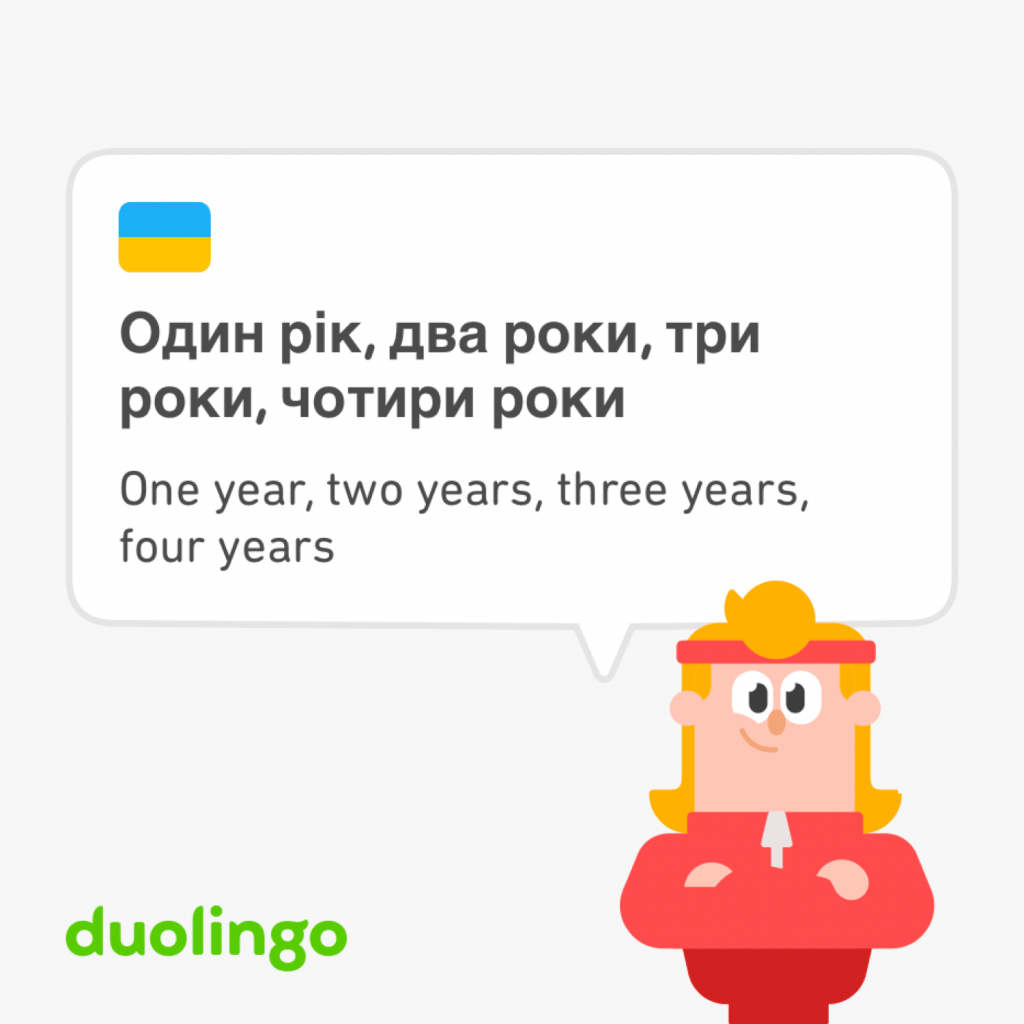
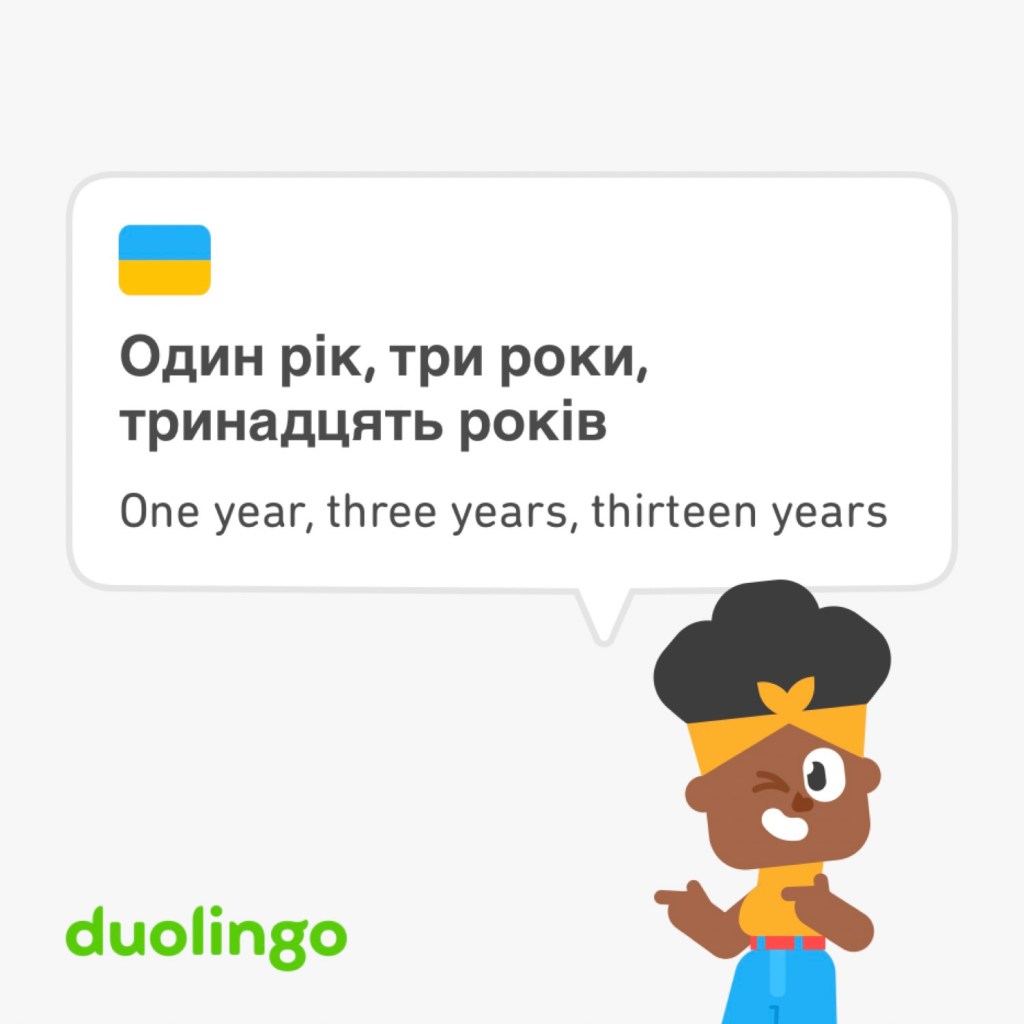
English has “singular” and “plural” endings for nouns, but Ukrainian appears to have three endings for singular, between 2 and 4, and 5 or more. One year (рік, “rik”), two years (роки, “rokih”) and thirteen years (років, “rokil”).

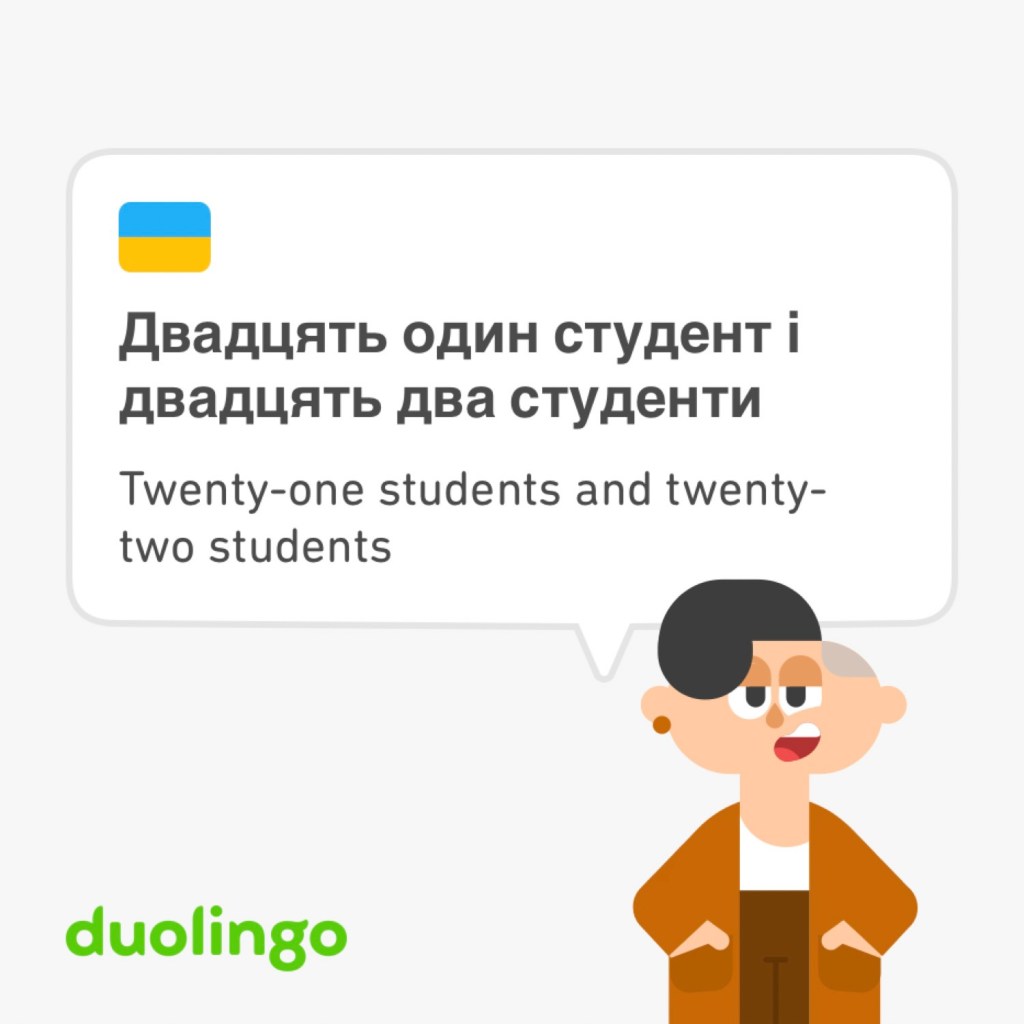
Interestingly, the conjugation from twenty onward seems to depend on the last number. In the below example, the word for student changes depending on whether it’s twenty one (i.e. “singular”) vs. twenty two (i.e. “between 2 and 4”). The twenty doesn’t factor into this.

Finally, like other inflected European languages (again, Latin is a great example), the numbers when used to count something will conjugate to match the object in terms of case and gender. The number one, depending on the grammatical gender of the word, will either be :

  • Один кіт (odin kit, “one cat”), masculine
  • Одна машина (odna mashina, “one car”),1 feminine
  • Одне місто (odneh misto, “one city”), neuter

That’s a brief look at Ukrainian numbers, and what I’ve figured out so far. Enjoy!

1 I really love the fact that the word for car is “mashina”, because it reminds me of the word machine. Are they related? I would like to know.

Gender in Ukrainian Language

As my studies of Ukrainian continues, one pattern that definitely appears over and over is the clear presence of grammatical gender. I’ve touched on this a bit in a recent post on how it relates to classical languages, but wanted to provide more context here.

Screenshot from my Duolingo session

The concept of grammatical gender is something that’s endemic to Indo-European languages (as far as I know),1 and is not related to the actual gender of a word. In Latin, the word miles means solider and is masculine (makes sense), but the Roman legion, legiō, had a feminine grammatical gender.

Modern western European languages such as Spanish and French tend to have shed and streamlined some aspects of grammatical gender. Neuter words no longer exist, so there’s only masculine and feminine genders left. Languages like English barely have any grammatical gender at all, even though it still exists in German to some degree.

Ukrainian language keeps the three classic genders: masculine, feminine and neuter, and like Spanish, French and Latin, nouns and adjectives have to agree with case (nominative, genitive, etc), number (singular and plural) and gender.

Here are three words:

Ukrainian (Romanization)MeaningGender
Кіт (kit)A male cat
(more on this later)
Masculine
машина (mashyna)A carFeminine
місто (misto)A cityNeuter

As far as I can tell, there is no definitely article like “the” or “a” in Ukrainian, but let’s use the word for “my/mine” in front of these and you can see how grammatical gender:

Ukrainian (Romanization)Meaning
Мий кіт (miy kit)My cat
Моя машина (moya mashyna)My car
Моє місто (moye misto)My city

You can see how in all three cases the same word, “my”, changes according to grammar, and it’s not a small change. In the screenshot above from my Duolingo session, you can see that the adjective “older” changes the same way depending on whether it’s a sister (feminine) or brother (masculine).

Another example of gender in Ukrainian where all the words in the sentence end in “а” because the word for daughter, донька (donka), is feminine.

Further, I was surprised that there are many words for living beings that are also divided by gender. For example кіт above means “cat”, but implies a male cat. The word for a female cat is кішка (kishka). For “friend” there are separate words for a male friend (друг, “druh”) and a female friend (подруга, “podruha”). Note that these are platonic friends, not boyfriend and girlfriend. There are separate words for those.

Also, from what I can tell, the plural friend has only one gender: друзі (druzi) means “friends” for example, though I am pretty fuzzy so far.

So far, I think I have only learned the nominative case (e.g. nouns as the subjects of sentences), so I suspect that these forms will also change depending on what part of the sentence a word is. This makes conjugation pretty tricky (just like Latin and Greek), but also means that you can upfront glean many details quickly once you get familiar with it.

Another example is in describing people. Ukrainian frequently identifies gender in a person through endings such as ець (ets) for masculine and ка (ka) for feminine. Thus, українець means a Ukrainian person, masculine, while українка means a Ukrainian person, feminine. Even words like “vegetarian person” have different endings: вегетаріанець (vegetarian, masculine) versus вегетаріанка (feminine).

P.S. I had my first actual conversation in Ukrainian recently, and I did a pretty lousy job. My mind blanked on words, and I mispronounced things. It’s been a long while since I learned a new language, and it’s easy to forget how little you actually know at first. But it also is a reminder to focus on fundamentals and nail those down before getting too hung up on the finer details. Easier said than done, but it’s been an interesting journey so far.

1 I have practically never seen any examples of it in languages like Japanese, Korean or Chinese or Vietnamese. Of course, there are gender-specific words, but inflections based on grammatical gender definitely do not exist. Bear in mind that the above Asian languages are in separate language families (despite being geographically next to one another).

How Not To Teach Japanese Language

In addition to using Duolingo for learning Ukrainian, I went back and dabbled in using it for learning Japanese. My Japanese is somewhere in an intermediate area where I can have conversations and read books, but I don’t do either one particularly well. So, any effort to shore up those skills is help, and Duolingo is frankly a pretty fun app to use. It doesn’t really help with my efforts toward the JLPT, but there’s no reason why I can’t do both (time permitting).

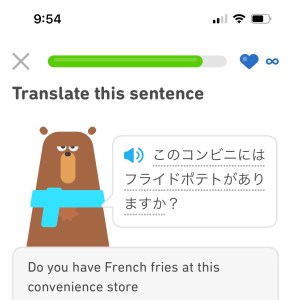
However, at times using Duolingo for Japanese has been a little frustrating, such as this question:

which I got wrong for (in my opinion) nitpicky reasons:

The problem is, in my opinion, not with Duolingo. It’s a terrific service and app, and I would recommend it to anyone. The trouble is how Japanese is taught, and by extension non-European languages are taught.

The way that Duolingo teaches Japanese strongly resembles the same college courses I took way back in college in the late 1990’s, when we memorized similarly staid phrases, and textbook-style sentences that aren’t really used. It’s grammatically correct to say このコンビニにはフライドポテトがありますか, but it’s not how it’s naturally used.

Japanese has a tendency to be very contextual compared to English. This drove me nuts for a long time until my listening skills caught up just enough to know what the gist of the conversation was, and I didn’t hvae to explicitly know who did what and where.

For example, using the sentence above, if the context is known, it’s perfectly fine to say ありますか which would mean “[this convenience store] are there [french fries] [here]?”.

But suppose the person at the counter didn’t know which item you were asking about. Is what thing here? In such a case, use the particle が (ga) to specify who, what, which or where. Is what thing here? French fries, are they here (e.g. do you carry french fries)? Hence フライドポテトありますか If you’re talking to an employee at the convenience store, this would be sufficient because you’re obviously standing in the convenience store, and obviously not talking about some other store.

Suppose the listener doesn’t know which store you’re talking about. Then, you’d have to clarify what store you’re talking about, hence use the particles に (the target particle) and は (the subject of your sentence) together コンビニにはフライドポテトありますか。Depending on context this can mean either “do convenience stores carry french fries” in general or “does the (mutually understood) convenience store carry french fries?”

Maybe you’re standing outside with a buddy and you’re wondering if this Lawson convenience store has fries, vs. that 7-11 across the street. Then after all we’ve discussed so far, you’d have to specify THIS store, to the exclusion of others, is the one you’re inquiring about. Hence このコンビニにはフライドポテトありますか

You can see why a textbook sentence like this can feel really wordy to Japanese speakers. It makes sense in English, and probably other European languages as well,1 but feels pretty unnatural in Japanese.

Similarly, a normal conversation that I literally just had with my wife as I was typing this is:

Mrs: 今日は寒いね。
(today, compared to other days, is cold, isn’t it?)

Me: でも、暑くなると思う。
(but, [I] think it will get hot)

My wife did specify a topic (today’s weather), but if you notice I never said “I” anywhere in reply. Simply by context, using the word 思う (omou, “to think”), it’s obvious that i am stating my opinion.

It’s not limited to casual conversation either between spouses. A similar sentence in a more formal setting, such as with one’s boss might sound something like:

Boss: 今日は寒いね。
(today, compared to other days, is cold, isn’t it?)

Underling: でも、暑くなると思いますね。
(but, [I] think it will get hot)

The boss, being of higher social rank, is free to use more casual speech to his/her underlings, but the underling would reply back using more polite speech (思います, not 思う), and yet still would not need to specify “I” such as 私は or whatever.

This is the sort of thing that I really, really wish I had learned in Japanese classes ages ago, but hard to learn the hard way. Again, this isn’t informal, casual Japanese necessarily, it’s common-place skills you have to learn to speak Japanese and unlearn habits that happen with European languages: not specifying things you don’t know need (i.e. context matters), and being sensitive to social rank and politeness.

P.S. I’ve dabbled in Korean ages ago during the “KPop wave” a few years back, and I believe what I said above also applies to Korean as well.

1 I don’t know enough Ukrainian yet to know how accurately the “textbook” Ukrainian matches real life conversation, but thanks to Duolingo, I know more about “Auntie Toma” and her family than I ever wanted to know. 😅

Ukrainian Language: a Link To The Past

Lately, I started taking up the Ukrainian language, which is something very outside my comfort zone. In my younger years, I’ve studied Mandarin Chinese, Vietnamese for 2 years in college, and of course Japanese, so Asian languages tend to be familiar even if I am not fluent. I have also dabbled in Latin, Sanskrit and Ancient Greek over the years, but I am not particularly good at either one.1 Even so, I have zero experience with Slavic languages, so it’s been a totally new experience for me, and yet, to my surprise an oddly familiar one.

Having spent weeks on DuoLingo practicing basic, basic Ukrainian I started to notice some patterns.

For example, the phrase моя мати (moya matih) and мій кіт (miy kit). The first means “my mother” and the second means “my cat”. After a bit of sleuthing, I figured out that “my” will conjugate depending on the gramamtical gender of the noun. In this case мати is a feminine gender word, and кіт is masculine. There are “neuter” gender nouns as well.

Side note: the Ukrainian word for “samurai” is самураї (samurayi)

Grammatical gender? Ancient Greek,2 Latin, and Sanskrit all had masculine, feminine and neuter genders for nouns. Modern Western languages tended to drop the neuter gender (e.g. modern Spanish or French), but it’s fascinating to see that Ukrainian, and Russian evidentially, retain all three. You can also see grammatical gender with words like студент (“student”, male student) vs. студентка (“student”, feminine student).

But even more fascinating is that Ukrainian nouns have seven grammatical declensions:

  • nominative (“the student”)
  • genitive (“of the student”)
  • dative (“to or for the student”?)
  • accusative (“verb the student”)
  • instrumental (“with or by means of the student”)
  • locative (“on the student”?)
  • vocative (“hey, student!”)

Seven declensions? The only language I know that had that many was ancient Sanskrit (eight total, including ablative)! Latin had five, and Ancient Greek only had four. Adjectives also behave like Latin, Greek and Sanskrit in that they agree with the noun in case, number and gender.

I haven’t really gotten into verbs much yet, but I do notice that they inflect too, depending on who speaks it (I eat vs. you eat), so I wouldn’t be surprised if it fits a similar pattern to other European languages.

All this is to say is that Ukrainian language, and much of the eastern European Slavic language family represents a linguistic “cousin”, with fascinating relics from much earlier Indo-European languages, and yet full of innovations and adaptations as well.

1 I confess I dabble in language study a lot, but not very good at follow-through. Japanese is the only language I’ve really committed too long enough to develop any skill, but since I married into the culture, it’s been a worthwhile experience. I suppose that’s what really keeps one going: personal value in learning a language more so than just idle intellectual curiosity. On the other hand, even learning another language a little bit is a worthwhile experience. I dabbled in Korean at one point due to the KPop craze at the time, and it’s nice to still be able to real Hangeul, and to encounter the only other language I know that has any grammatical similarity to Japanese (through convergence, not genetic origin). Similarly, my time spent learning Vietnamese, which I don’t get to use much anymore, was a fascinating time when I got to study abroad in Hanoi, Vietnam. Plus it was fascinating to see how Chinese influenced Vietnamese in the same way that Chinese influenced Korean and Japanese even though they were all unrelated languages! In that sense, any foreign language study is a worthwhile investment.

2 The term “Ancient Greek” is kind of vague and nebulous. There’s Homeric Greek (e.g. the Greek of the Iliad), Classical Greek (e.g. Attic dialect), Koine Greek (e.g. the Hellenistic Period and the New Testament), Byzantine-era Greek and so on. There’s even Archaic Greek, which is poorly attested due to lack of sources. So, when people talk about “ancient Greek” it’s important to be clear which one. Greek as a language is a fascinating continuum from the archaic period all the way to modern times. One of my co-workers is Greek American and she loves to swap tips with me as she is also learning both ancient and modern Greek.

Finding Refuge Amidst Anxiety, Lots of Anxiety

This tweet from the awesome Sententiae Antiquae blog had me thinking lately:

When life feels overwhelming, I tend to think about a Buddhist text called the Immeasurable Life Sutra1 which is a highly influential in Mahayana Buddhism. It is one of my personal favorites. The first half of the sutra is the most extensive introduction to Amitabha Buddha, the Buddha of Infinite Light, in the Buddhist canon, but the second half tends to be a repackaging of general Buddhist teachings at the time. The second half often gets overshadowed by the story of Amitabha Buddha, but is worth a read.

In one section, the Buddha paints a rather dim picture of life in the mundane world:

“The poor and the underprivileged are constantly destitute. If, for example, they have no fields, they are unhappy and want them. If they have no houses, they are unhappy and want them. If they have none of the six kinds of domestic animals, such as cows and horses, or if they have no male and female servants, or lack money, wealth, clothes, food, or furnishings, they are unhappy and want those as well. If they possess some of them, others may be lacking. If they have this, they do not have that, and so they wish to possess all. But, even if by some chance they come to possess everything, it will soon be destroyed or lost. Then, dejected and sorrowful, they strive to obtain such things again, but it may be impossible. Brooding over this is to no avail. Exhausted in mind and body, they become restless in all their doings, and anxieties follow on their heels….Since they have not done any good in particular, nor followed the Way, nor acted virtuously, when they die, they will depart alone to an inferior world. Although they are destined to different states of existence, none of them understands the law of karma that sends them there.

translation by Hisao Inagaki

…then reiterates that this is par for the course because all is impermanent anyway:

“The reality of birth-and-death is such that the sorrow of parting is mutually felt by all generations. A father cries over the death of his children; children cry over the death of their father. Brothers, sisters, husbands and wives mourn each other’s death. According to the basic law of impermanence, whether death will occur in order of seniority or in the reverse is unpredictable. All things must pass. Nothing stays forever. Few believe this, even if someone teaches and exhorts them. And so the stream of birth-and-death continues everlastingly.

translation by Hisao Inagaki

The Buddha then uses this to remind readers that one should pursue the Buddhist path while they are still healthy and lucid:

“Why do they not abandon all worldly involvements and strive, while they are strong and healthy, to pursue the good and diligently seek deliverance from Samsara? If they do, they will be able to attain infinite life. Why do they not seek the Way? What is there in this world that should be longed for? What pleasure is there that ought to be sought after?

translation by Hisao Inagaki

“Infinite life” here, I would contend, isn’t the kind of immortality that we might associate with the Olympian Gods, but more like something you see in the Heart Sutra:

This is because in emptiness there is no form, sensation, conception, synthesis, or discrimination….There is no ignorance nor elimination of ignorance, even up to and including no old age and death, nor elimination of old age and death. There is no suffering, its accumulation, its elimination, or a path. There is no understanding and no attaining….Because there is no attainment, bodhisattvas rely on Prajñāpāramitā [the perfection of wisdom], and their minds have no obstructions. Since there are no obstructions, they have no fears.

Translation by Lapis Lazuli Texts, retrieved here: https://lapislazulitexts.com/tripitaka/T0251-LL-prajnaparamita-hrdaya/

In any case, the Buddha is pointing out that one shouldn’t get caught up in the big Cosmic Rat Race and maintain a healthy perspective.

1 Nerd moment: copies of this sutra have been found composed in the Karoshthi script in China.

Happiness

Courtesy of Sententiae Antiquae:

Enjoy!

Learning, Not Parroting

Photo by Pixabay on Pexels.com

This is why I look on people like this as a spiritless lot — the people who are forever acting as interpreters and never as creators, always lurking in someone else’s shadow….It is one thing, however, to remember, another to know. To remember is to safeguard something entrusted to your memory, whereas to know, by contrast, is to actually make each item your own, and not to be dependent on some original and be constantly looking to see what the master said. “Zeno said this, Cleanthes that.” …. Besides, a man who follows someone else not only does not find anything, he is not even looking. “But surely you are going to walk in your predecessors’ footsteps?” Yes indeed, I shall use the old road, but if I find a shorter and easier one I shall open it up. The men who pioneered the old routes are leaders, not our masters.

The Epistulae Morales ad Lucilium of Seneca the Younger, letter XXXIII (33), translation by Robin Campbell

Samsara: the Great Cosmic Rat Race

Samsara, the “aimless wandering” of Buddhism is a difficult concept to grasp, but also pretty fundamental to understanding the Dharma.

Buddhism as a religion sees the Universe in terms of huge time and huge space. This is a contrast to Western religions which tend to see the Universe in a smaller, fixed time (i.e. several thousand years, maybe some more). The gist of saṃsāra is that the Universe has existed for a near-infinite amount of time, and that beings have been migrating here and there, from one lifetime to another, in it. Not a dozen past lives, or even a hundred, more like a near-infinite number of past lives.

Further, the breadth of the past lives also varies quite a bit. In the traditional Buddhist cosmology, there were 6 broad categories of states of rebirth:

  • Devas or gods (or divine beings in general). They live in varying states of bliss, and can live very long lifespans, endowed with great powers, among other benefits. But even they must die and be reborn someday.
  • Humans.
  • Asuras or titans (another category of divine beings). The Asuras are at war with the devas, not unlike the wars between the Olympian gods and the Titans, and are prone to war, anger and violence.
  • Animals. They live in a constant state of eat or be eaten. Their existence is limited to the basic needs of survival.
  • Preta or hungry ghosts. These beings live a miserable existence marked by constant hunger and agony, slinking in the shadows, eating scraps of refuse, etc.
  • Hell. Vaguely similar to Dante’s Inferno, Hell is a many-realmed place with many different forms of torment, suited to different transgressions. As with the Devas and other realms, this is a finite torment that lasts until one’s karma is exhausted. However, depending on the severity, one can be there a very, very long time.

The nature of the six realms of rebirth is subject to many forms of interpretation, too many to go into here, but the point is that sentient beings migrating across one lifetime to another across such a long, long period of time eventually have lived all these states at least once.

This leads to a sense of malaise. One has probably been rich and famous in the past, one has probably been ugly and poor in the past, one has lost loved ones, one has fallen in love countless times, etc, etc. It’s all been done before, and there’s no sense of long-term “direction”, hence it is described as aimless wandering. Another way of describing samsara might be the “Great Cosmic Rat-Race”.

In a old, old sutra from the Pali Canon, the Buddha describes it like so:

“This is the greater: the tears you have shed while transmigrating & wandering this long, long time—crying & weeping from being joined with what is displeasing, being separated from what is pleasing—not the water in the four great oceans.

Translation by Ven. Thanissaro Bhikkhu, from the Assu Sutta (SN 15:3)
Photo by Sebastian Voortman on Pexels.com

In light of all this, this is why the Buddha teaches liberation as a means of breaking this ad nauseum cycle of rebirth. Initially, this is liberation of oneself, but as one progresses on the path, this turns outward toward liberation of others as well. Mahayana literature in particular greatly idealizes this notion of liberation of all beings, as epitomized in the Lotus Sutra and its Parable of the Burning House (chapter 3), and the vows of Dharmakara bodhisattva in the Sutra of the Buddha of Immeasurable Life, among other places.

The concept of the “bodhisattva” evolved along with it: a being who vows to rescue all beings before completing their own vows to achieve enlightenment (buddhahood).

Photo by Oleg Magni on Pexels.com

Another way to describe samsara, and also the process of liberation was to cross a river from one shore, symbolizing ignorance and strife, to the other, symbolizing wisdom, insight and peace of mind.

Anyhow, all this is to say that the Buddha perceived the rat race of life long ago, but the Dharma sees this rat race as not limited to a single lifetime, and central to the challenges of life, and the need for a long-term direction to one’s life beyond meeting basic needs.