This proverb, literally means that the owner doesn’t know the stench of their own breath. Obviously this is not meant to be literal, instead it is about people being unaware of their own bad habits.
Another way of explaining it is that the eye cannot see itself. The eye needs a mirror. In the same way, we need to see the world around us, in order to see ourselves.
A little while back, I wrote an article about Ukrainian verbs and was going to write a similar one about Japanese verbs. But halfway through writing that article, I realized that I really needed to explain Japanese sentence structure first.
Japanese sentence structure is quite different than European languages, and so when I use something like Duolingo, I found that the textbook style presentation of Japanese isn’t very natural at all. The trouble is that trying to apply European language teaching methods to Japanese is like trying to find a square peg through a round hole.
That said, Japanese, on its own merits, isn’t that hard to learn, but it is different, so you have to learn it from the ground up. As human beings, the feelings and sentiments are the same across languages, but it’s fascinating how people have developed different methods (i.e. grammar) to express them.
Note: this page will use hiragana script in places to correctly convey the meaning. If you are unfamiliar with hiragana, check out my page on learning Hiragana script, parts one, two and three.
And with that, here we go.
Context Matters
One of the particular challenges to learning Japanese is its heavy reliance on context. This used to really throw me off when I was dating my wife and first learning the language because I couldn’t figure out who did what. Gradually as I got used to the language and could mentally “take it all in”, I could follow along more easily and pick up on context clues.
For example, unlike English or other European languages, the subject isn’t specified unless you explicitly need to. Let’s look at a typical example.
In English, I might write something like this:
Today, I went for a walk. It was sunny outside. Then I ran into my neighbor, Mr Wilson.
A similar sentence in Japanese would likely be:
Today, went for a walk. Outside, was sunny. Then, the neighbor, Mr Wilson, ran into.
Notice there is no explicit subject. It’s often implied. And, once you get used to it, it’s usually pretty obvious (Japanese people will ask if unclear, naturally). That doesn’t mean that Japanese never uses it, but usually only to address specific topics or questions:
A: Who ate the last sandwich?
B: Mr Wilson ate the last sandwich.
In any case, this is why Japanese language textbooks in English (including Duolingo) often teach it wrong: they teach students to still specify every part of the sentence even though it’s not necessary to do so in Japanese, reinforcing bad habits. Yes, this works in European languages, but it’s unnatural in Japanese.
This use of context leads into the next aspect of Japanese grammar…
Less Is More
Compared to English, Japanese can sound more curt or pithy, and at other times more flowery and wordy. Tae Kim’s excellent Guide to Japanese points out that rather than a SOV (subject-object-verb) sentence structure, Japanese’s grammar can be reduced to just V and still be fine.
Here’s a perfectly valid conversation in Japanese:
A: たべる? (are you going to eat?)
B: たべた。(I ate [already])
This conversation usually has some context that both speakers know about, so to them it would make sense, even if it seems vague to us.
Another example my wife and I often use is:
Mrs: ごはんをたいた? (Did you cook rice?)
Me: ん、たいた。(Yup, I cooked [rice])
Here, my wife is asking if I cooked (たく、past tense: たいた) rice (ごはん). We’ll get to the を in a moment. It’s super important. When she asks the question, she uses a rising tone for たいた, and she needs to specify what I cooked. In this case, the rice. I answered in the affirmative using ん (the non-casual, polite form is はい) and specified that I did indeed cook it (e.g. the rice).
Since my wife did have to specify other parts of the sentence that’s where particles really become important. They are little sound markers you put after the parts of speech, and help determine who’s doing what to whom. By using を (wo), it means the rice is the direct object. I am doing something to it.
Particle Man, Particle Man…
Particles don’t really have a 1:1 equivalent in English, so I won’t attempt to map them out, but they are really important in languages like Japanese or Korean where you have to give parts of speech. Sometimes particles come at the of the sentence to help give it more nuance (not required, but often used), while others are put at the end of the parts of speech you need to clarify.
This would accomplish the same thing as using inflection in languages like Latin, Greek, or modern European languages like Spanish, Italian and Ukrainian. However, instead of changing the ending to fit the part of speech, you tack on a particle.
Here’s an example that you might find in a textbook:
わたしはスーパーにいって、カレイパンをかいました。
I went to the supermarket, and bought curry bread.
This is an exaggerated example, and clunky in regular, spoken Japanese, but textbooks often teach like this in order to help reinforce parts of speech and particles.
I’ve highlighted the particles, like so:
Particle
Meaning
What it marks
は (wa)
The subject of the sentence
わたし (polite, formal “I”)
に (ni)
The target of something (e.g. where you’re going to)
スーパー (the supermarket), as in the target of where you’re going (いって)
を
The direct object (the thing you’re doing something to)
カレイパン (curry bread), the thing you bought (かいました).
But again, remember in more natural Japanese you only specify the things you need to specify. So, for example if the listener already knew that you went to the supermarket, it’s perfectly valid and correct Japanese to just say カレイパンをかいました. You could even shorten it by dropping the particle + verb and say カレイパンです. Yet another particle!
Or, if the listener wanted to know where you went to buy the curry bread, it would be perfectly fine to just answer with スーパーに, or just drop the particle and use スーパーです to substitute for both the particle and verb.
Similarly, when introducing yourself, this is how textbooks usually teach self introduction:
わたしのなまえはダグです。エンジニアです。
or…
わたしはダグです。エンジニアです。
My name is Doug. I am an engineer.
A more natural sounding version in Japanese that’s used in polite situations would be:
エンジニアのダグです。
[I am] Doug, the engineer.
The の particle here is super-handy because it modifies Doug. Doug isn’t just Doug, Doug is an engineer. Also, notice I don’t specify the subject, わたし, as it’s wordy and unnecessary (i.e. “who else would you be doing a self-introduction for?”). Simply using my name, and what I do with the polite particle です is sufficient.1
Conclusion
The key to forming good Japanese sentences is, in my opinion, learning how to start with just the verb and tack on whatever additional information you need (using particles to help specify which, what, where and who) as necessary.
Similarly, learning to recognize particles and such in other people’s sentences will help you pick up nuances and details more easily.
Good luck!
1 We aren’t going into this in this lesson, but if you want to express a more humble nuance, you could replace です with と申しましす (to mōshimasu) where と is another particle for subordinate clauses and 申しましす is a humble version of the regular verb 言う (iu, “to say”). But that’s beyond the scope of this lesson. Using です will almost always work. と申しましす will simply add a bit more flare (or, more accurately, a bit more humility).
Japanese, as a language, is somewhat unusual in that it has many, many homophones. Many of these are originally Chinese-compound words that were imported into Japanese, and subsequently lost their kind of intonation found in modern Chinese languages that would help to distinguish them. Their sound became flat and mostly indistinguishable from other similar words. Yet their Chinese characters (kanji) are different, and they still convey different meanings:
I don’t entirely agree with the rant in this video, plus his lack of understanding of the Heart Sutra, but it’s still a good explanation for how kanji were gradually imported into Japanese from a great Youtube channel.
For example, there are three different words are all pronounced igi:
意義 – Meaning, significance of something.
異議 – Objection, dissent
異義 – A homonym (ironically)
However, many native Japanese words also tend to sound like one another, and their meanings can be similarly hair-splitting. A classic example is the verb ageru:
上げる – To raise something up
揚げる – To deep fry something
挙げる- To use something as an example (e.g. to praise it)
With the verbs, you can see that stem of the verb, which doesn’t change in conjugation, will be represented by the appropriate kanji, and help you distinguish which ageru in written form you’re talking about. But even that isn’t always the case.
The verb awaseru can be written as:
合わせる – To match (or to synchronize)
併せる – To merge, or put disparate things together.
The example above gets pretty different, even for native Japanese speakers, hence there are books that help explain when to use one kanji versus another.
The good news is that for a language student, with plenty of reading practice, and the patience to build vocabulary rather than wasting time memorizing kanji, one gradually picks up these nuances and eventually gets an intuitive sense. The organic growth of the writing system, with waves of imported Chinese characters makes Japanese a difficult written system. On the other hand, despite what some Westerners assert, it is logical, definitely not impossible, and simply requires patience and practice.
Despite some early signs of success, it’s become rapidly clear that if I take the N1 level of the JLPT exam this year, I will get crushed. My scores in taking the mock shorter-length essays were pretty good (hence my earlier confidence), but my scores in middle-length essays were not very good, and I got nearly 0 points when testing myself on the long essays. Coupled with continued difficulties with listening, it’s obvious that I would most likely get a poor score. Even if I did manage to pass, it would be a just barely, and hardly something to be proud of.
As you get to the higher levels of the JLPT exam, the amount of preparation time greatly increases, as the complexity of the language being tested also increases. In my past experience, I could pass the N3 with about 6-12 months of study, reading manga, etc. I passed the N2 in about a year after that, but just barely (it wasn’t a great score). By the time you get to the N1, you need about 3000 hours if starting from scratch, but even if you have prior language experience, it’s safe to assume you need a subset of this depending on your background.
For a working parent not living in Japan, I cannot always get 1 hour a day consistently, so that means my progress is slow. I have definitely made progress this year, as I can see that all the new vocabulary I learned is paying off, however, what really matters is whether you can read adult material at a near-natural speed, and if you can follow adult conversations without too much headache. The essays, especially the longer ones, require you to read a lengthy essay, sometimes philosophical, sometimes business related, and pick up the main points, and answer the questions in roughly 5-8 minutes. Doing this in your native language is hard enough, now do it in a foreign language.
Similarly, if you’re not able to keep up with adult conversation, adult podcasts or TV shows, you’ll have trouble keeping up with elaborate (sometimes artificial) dialog in the JLPT exams.
You cannot really cram for these things. Memorizing vocabulary is one thing, but actually comprehending a foreign language takes considerable time, and it’s obvious that for the N1, it will take years. I am proud of the progress I made, and I am proud for keeping my focus all these months, but unfortunately, it’s just not enough. I need more time.
So, regretfully, I will not be taking the N1 exam this year. Instead, I have a stack of Japanese books at home: manga, essays, history books, computer books, etc, that I plan to slowly read through over the next year, and I have a long list of Japanese language podcasts I use to keep up with my listening. If I don’t build up natural reading skills and listening skills, there’s just no point in taking the exam at this level.
Maybe next year will be a different story. I am worried about losing focus over the coming year, especially since I still dabble in learning Ukrainian, plus other projects, but I’ve been wanting to pass the JLPT for a long time, so I think that desire will carry me through. If not, I guess we’ll find out.
P.S. My supposed retreat hasn’t been going all that well in general either. More on that later. So much for taking a break from blogging.
Listening in general is one of the most arduous skills to learn for a foreign language. After I started studying Ukrainian for fun, I soon found out how little I could actually follow in actual conversation. It has been pretty demoralizing.1
On the other hand, I have been studying Japanese for since the late 2000’s, and married into the culture, so I do have some conversational skills, but for level N1 of the JLPT exam that’s still not quite enough.
Case in point: in the months leading up to the 2022 exam, I have started using mock exams and other study guides, but to my horror I have so far been getting about 40% – 45% correct on the listening sections which is just barely a passing score. So while I may have a shot at passing the JLPT, it’s far from certain.
There’s no rational way to cram listening skills either: you either grasp the conversation, or you don’t. And the only way to improve your grasp of Japanese conversation is to get used to it through constant, constant exposure.
It’s like stretching a muscle. You can’t force it or rush it, you have to ease into it over time. Stretching a little at a time, until looking back you can stretch it much more than you used to.
Another way to look at is is from a classic Roger Zelazny story, Doorways in the Sand.2 At one point, the main character Fred, is listening to two aliens having a conversation about him in their native language:
At some earlier time I had slowly realized that the thing that would most have surprised them probably surprised me more. This was the discovery that, when I gave it a piece of my divided attention, I could understand what they were saying.
A difficult phenomenon to describe, but I’ll try: If I listened to their words, they swam away from me, as elusive as individual fish in a school of thousands. If I simply regarded the waters, however, I could follow the changing outline, the drift, pick out the splashes and sparklings. Similarly, I could tell what they were saying. Why this should be, I had no idea.
Language is weird, but I definitely have the same experience when listening to Japanese language podcasts: if I focus my mental energy on trying to discern one sentence, I lose track of the rest of the conversation. So, it’s more about getting used to the conversation as a whole, and as any music student will probably tell you, it takes time to tune your ear.
1 I haven’t stopped learning Ukrainian, but it has forced me to re-evaluate my methods a little.
2 Out of all his books, this one is definitely in my top 5 favorites.
While I’ve been blogging a lot recently about Buddhism, Japanese history and Ukrainian language, etc, I have been quietly studying for the JLPT exam in the background. 😎
As of writing, the 2022 JLPT exam in the US will be held in early December (as is usually the case), and so with only 4 and one-half months left, I’ve decided to switch gears and focus on taking practice tests instead. The two most difficult sections of the JLPT are (depending on your background) reading comprehension (dokkai 読解) and listening (chōkai 聴解).
The last time I tried the N1 level of the exam, I wanted to see if I could pass without practicing. I wanted to see if I had attained enough exposure to Japanese language by then to simply pass it naturally. I didn’t. The JLPT exam, starting with N2 and especially the N1 aren’t normal conversational Japanese. You’re being tested on various subjects such your comprehension of business, government, education, even philosophy.1 Day to day exposure to Japanese language helps to some degree, but you as these are specialty topics you need to also practice and study them.
In any case, I broke out my practice exams for reading and listening, both available from OMGJapan and other fine Japanese goods stores, and started taking practice tests.
My mind initially panicked when tyring to read the Japanese essays. Some of the words that I had studied had been forgotten, some words were unfamiliar. However, I fought my initial panic, and worked my way through the practice essays one after another. To my surprise, when I checked my answers, I got 75% correct, which is a passing score.
I was thrilled. I realized that with further practice, I have a genuine shot at passing the JLPT exam, level N1. The reading that I have been doing over the year almost certainly helped, as did the vocabulary study (even if I haven’t even finished half the study book).
However, I also realized that I still have further preparation to do: learn the words I didn’t know, get smoother at reading, and learn NOT TO PANIC. That will come with repeated practice, I believe.
1 I was surprised to find an essay on what defines a peaceful death in the mock exam (I doubt this is in the real exam, btw). Clearly the author hadn’t watched Conan the Barbarian:
My studies of Ukrainian continue, albeit slowly, and as part of this, I’ve been working hard to learn the cursive script which differs from printed Cyrillic on some key ways, but also differs from American cursive (obviously). My approach has been to write out new sentences I encounter in Duolingo in my little notebook:
I decided to also use the opportunity to re-learn American cursive after decades of neglect, and found a great example video here:
Since I’ve been practicing handwriting for both Ukrainian and English, I figured maybe I should practice Japanese as well. However, it’s a bit different with Japanese. There is no cursive in the sense that European languages have, though older Japanese writing had a loose system called hentaigana (not to be confused with hentai … this isn’t that kind of blog). Tofugu has a nice write-up here.
Japanese does have a pretty sophisticated calligraphy tradition both inherited from Chinese culture, plus local innovations. Typically, when writing calligraphy in Japanese, there’s three broad styles to choose from:
Regular script (楷書 kaisho) – based on Chinese calligraphic tradition, this is just the standard way of writing Chinese characters.
Cursive (草書 sōsho) – as the name implies, this is the cursive form of Chinese characters, often done to abbreviate and write things more easily, while keeping the brush (wet with ink) on the paper. Just like Western cursive.
Semi-cursive (行書 gyōsho) – this was a particular style that flourished in Heian Period Japan onward, but also has its roots in Chinese tradition, and represents a halfway point between regular script and cursive.
You can also see a nice comparison of the three here:
My wife has training in Japanese calligraphy, and knows how to write in all three styles, but I can’t even write standard Japanese well:
Me practicing a sentence from my son’s Japanese textbook
But the point is is that as with any handwriting, practice makes perfect. Find a pen you like writing with, and don’t be afraid to practice a little every day. You’d be surprised how much easier it gets within a few days, weeks, etc. When I was self-studying Ancient greek, I kept writing sentences out, and after a time, my handwriting got pretty good:
The weird thing was that I wasn’t even trying to improve. I was so focused on studying and writing things out in my notes, that after a while it got easier, smoother, etc. Plus, it’s good stimulation for the mind, which is handy as you get older. 😏
So, whatever language interests you, pick up a pen and start writing out interesting sentences and see where it takes you.
As I wrote about recently, the end of the Heian Period in Japan (8th century to 12th century) represented a seismic shift in Japanese culture from a cultured aristocracy to a military society led by the samurai class. This finally stabilized Japan from decades of strife, but there was also a palpable sense of loss reflected in such works as the Hojoki (Ten Foot Hut) and other works of the time.
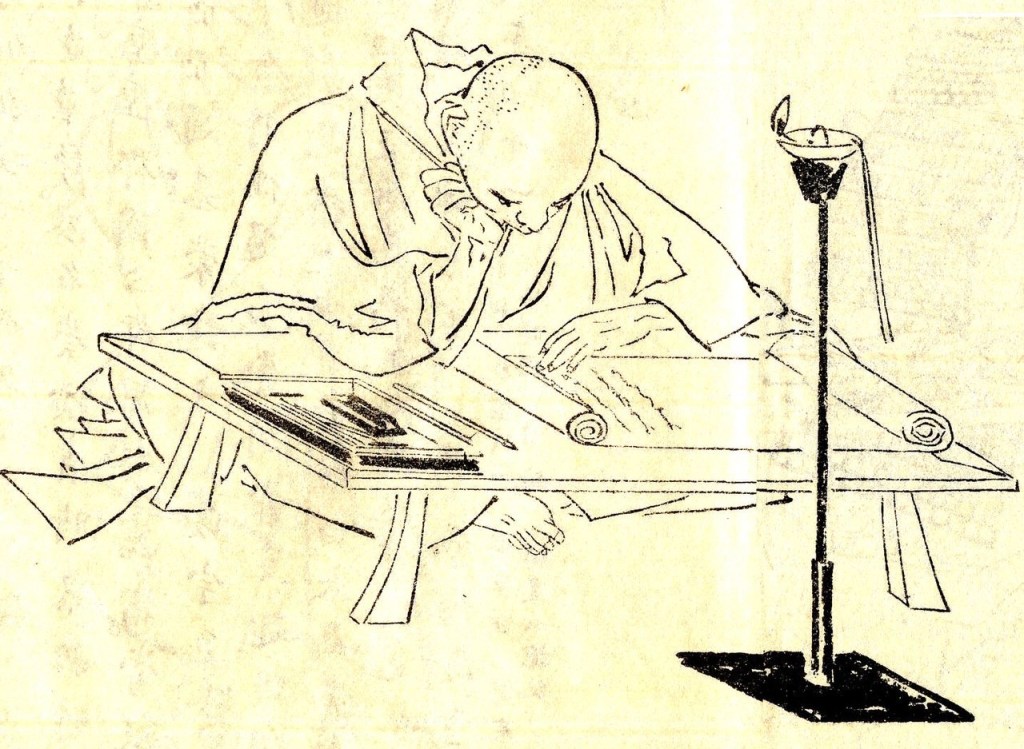
One of my favorite, and the best known from this era is a work called the Tsure-zure-gusa (徒然草) which is hard to translate in English.1 The most accepted translation of the title is “Essays in Idleness”, but this not the only one. It’s a classic that every kid in Japan studies in school, just as American kids might read Ivanhoe or something.2
A depiction of Kenkō, drawn centuries later by Kikuchi Yōsai. Courtesy of Wikipedia Commons.
The Tsure-zure-gusa was written by a Buddhist monk of the Jodo-shu sect named Yoshida Kenkō (吉田兼好, 1283?–1350?). The text was composed between 1330 and 1332, and is a form of free-form writing. Kenko would just write down what he was thinking. Sometimes it was old anecdotes, or stories he had heard. At other times, he wrote deeper thoughts about life. Sometimes, he would just point out social faux-pas committed by others. There is no overarching messages in the text, but it covers many aspects of life, so it’s a fascinating look at Japan during the Kamakura Period (12th-14th century) as well as food for thought.
For example, here’s a commentary on fish:
119) The fish called katsuo is unequaled among those caught in the sea off Kamakura, and of late has been much in demand. An old gentleman of Kamakura told me, “When we were young, this fish was never served to persons of quality. Even the servants refused to eat the head. They cut it off and threw it away. It is typical of these degenerate times that such fish have become accepted.
Translation by Donald Keene
Interestingly, katsuo (known in English as bonito) is pretty universal in Japanese cuisine now as it is the most common ingredient of dashi (fish broth), as well as numerous dishes.
Another amusing example:
57) It is exasperating when discussions of poetry are devoted to bad poems. How, one wonders, could anyone with the smallest knowledge of the art have supposed such verses were worthy of discussion?
Even to an outsider, it is both embarrassing and painful to listen to someone discuss a subject — whatever it may be — that he doesn’t really know.
Translation by Donald Keene
One can imagine a bad TED Talk the same way too.
The text is at times surprisingly relevant to people living in the 21st century, though:
29) When I sit down in quiet meditation, the one emotion hardest to fight against is a longing in all things for the past. After the others have gone to bed, I pass the time on a long autumn’s night by putting in order whatever belongings are at hand. As I tear up old correspondence I should prefer not to leave behind, I sometimes find among them samples of calligraphy of a friend who has died, or pictures he drew for his own amusement, and I feel exactly as I did at the time. Even with letters written by friends who are still alive I try, when it has been long since we met, to remember the circumstances, the year. What a moving experience that is! It is sad to think that a man’s familiar possessions, indifferent to his death, should remain unaltered long after he is gone.
Translation by Donald Keene
It’s a pretty moving book to read, with all its random quips, reflections on an age now gone, plus deeper thoughts. The Donald Keene copy is hard to find now, but I have seen other good translations too, so don’t hesitate to pick one up if you can find it.
1 The phrase つれづれ (徒然 tsure-zure), pronounced as “tsoo-ray zoo-ray”, often appears in modern blogs or diaries as well in Japanese as a kind of introduction.
2 My wife recalls learning it, but just as reading Shakespeare without some guidance is hard for English speakers, reading the Tsure-zure-gusa to a native Japanese speaker is difficult since so many centuries have passed and the language has changed.
The challenge with learning a language is less about the grammar, which you can learn in a matter of months, but gobs and gobs of vocabulary which you must learn, and internalize. This is especially hard when you have to consider nuances: when things are said, how word X differs slightly from word Y and so on.
Courtesy of Pexels.com
However, if you’re studying for a language exam, such as the JLPT certification exam for Japanese, this means you have to learn a lot of vocabulary in a shorter, more compressed span of time, and chances are you’ll be rushed and unable to really learn the word properly, in context.
For example, while building up my flash cards for the N1 JLPT exam, I learned the word 迫力 (hakuryoku) meaning force or impact. That kind of makes sense, but even in English that’s a bit vague.
Then, later, while watching a certain Japanese documentary on Buddhist temples, the host said in Japanese while visiting the famous Nio-mon Gate (仁王門) at one temple: 「迫力のある仁王門ですね」
This sentence is pretty basic, but shows a nice native example, in context no less, how the word 迫力 is used. I then looked up the word in my favorite Japanese dictionary, and sure enough other sentences used the same pattern: 迫力のあるX (“X has a lot of impact, or intensity”).
The point here is that if I had not seen an actual example of this being used, I would not have learned the proper usage and context of this word. So, memorizing just isn’t enough. Even though it takes longer, you will not really master a language, including Japanese, if you don’t take the time to absorb words through media and most important in context. Then, you can make flash cards using the sentences you saw, in order to properly practice new information.
A photo of the Ten Verse Kannon Sutra from my sutra book, purchased as Asakusa Temple (a.k.a. Sensoji) in Tokyo Japan
In medieval Japanese Buddhism, you can find many interesting little innovations. One example is a popular liturgy called the jikku kan’on gyō (十句觀音經), or the “10 Verse Kannon Sutra”.
It is a popular, devotional chant in Japanese Buddhism toward Kannon Bodhisattva. You can find it in various Buddhist sects, Zen, Tendai, etc. My sutra book from Asakusa Temple (a.k.a. Sensoji) includes it since the temple’s deity is Kannon. The origin of the text is not entirely known, though it’s speculated that is was composed by a Tendai priest as a summation of the 25th chapter of the Lotus Sutra. The 25th chapter is sometimes chanted or recited in devotional services because it is dedicated entirely to Kannon Bodhisattva. However, it is challenging to recite due to its length, even if you just recite the verse section.
Assuming this is really was formulated as a summary, a lay person could recite this with the same intention as reciting the full chapter, but this would be a lot easier for someone of humble background who maybe cannot read all the complex Chinese characters in the original, let alone someone who has to work the fields all day. It is also short enough for someone to easily memorize and chant in its entirety.
It’s not technically a sutra in the sense that it does not purport to speak on behalf of the Buddha, but there are other examples in of sutras (such as the Platform Sutra in Zen) that fit this awkward category as well.
So, for those interested, I present the Ten Verse Kannon Sutra, with translation below:
Can’t read the characters?
If you’re having trouble reading the Kanji characters, you might have one or two problems with your computer:
Your computer may not have Asian fonts installed. In Windows you have to enable UTF8 and East Asian fonts under the Control Panel. Modern Mac computers are fully compatible already.
Your browser may be assuming the wrong character set. If you use a relatively modern browser and use UTF8 as character set, you should be able to read fine. IE, Firefox and Safari all read this fine as far as I can tell.
Even if not, then you can still use the romanized characters, and the (terrible) English translation.
Disclaimer and Legal Info
I hereby release this into the public domain. Please use it as you see fit, but if you attribute it to this site, greatly appreciated. Also, please bear in mind this is an amateur translation, and should not be taken too seriously, nor is it of academic quality.
Dedication
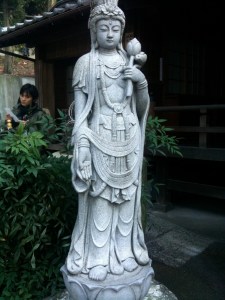
Kannon Bodhisattva. Taken at Daienji Temple in Meguro Ward, Tokyo, Japan in 2010
I dedicate this effort to all sentient beings everywhere. May all beings be well, and may they all attain perfect peace.
Namu Kanzeon Bosatsu
The 10 Verse Kannon Sutra
Japanese Text
Romanization
Кирилицею (in Cyrillic)
觀世音
Kan ze on
кан дзе он
南無佛
namu butsu
наму буцу
與佛有因
yo butsu u in
йо вуцу у ін
與佛有縁
yo butsu u en
йо вуцу у ен
佛法相縁
bup po so en
вуппо со ен
常樂我淨
jo raku ga jo
джьо раку ґа джьо
朝念觀世音
cho nen kan ze on
шьо нен кан дзе он
暮念觀世音
bo nen kan ze on
бо нен кан дзе он
念念從心起
nen nen ju shin ki
нен нен джю шін кі
念念不離心
nen nen fu ri shin
нен нен фу рі шін
Chanting Example
You can find examples of chanting of the Ten Verse Kannon Sutra on Youtube such as this one:
My Translation
At its heart, the Ten Verse Kannon Sutra is both a praise of Kannon Bodhsattva, but also gratitude for the karmic bond between oneself and Kannon (explanation here, albeit different Buddhist deity).
This translation below is something I made a while back, and is a rough translation only. Other translations is here and here. Big thanks to Reverend “E” for his excellent scholarship and assistance in this endeavor.
Kanzeon [Bodhisattva]!
Praise to the Buddha!
With the Buddha as cause,
With the Buddha as condition,
Through the Buddha, the Dharma and the Sangha
I attain eternal, blissful, self, purified of all defilements [nirvana].
In the morning, I recite “Kanzeon”.
In the evening, I recite “Kanzeon”.
Reciting and reciting arises from the awakened mind.
Reciting and reciting is not separate from [awakened] mind.
Enjoy and happy reciting!
P.S. The “Buddha” here I believe is the eternal Buddha, the Dharmakaya, not the historical Buddha, Shakyamuni






 Gleanings in Buddha-Fields

You must be logged in to post a comment.