The family and I staying with family again, and boy I forgot how hot and humid the summers are. It’s currently the monsoon season (梅雨, tsuyu) so it rains a lot, and even indoors it’s hot and sticky without A/C. This is also the season of the Rains Retreat in Buddhist Japan in the olden days.
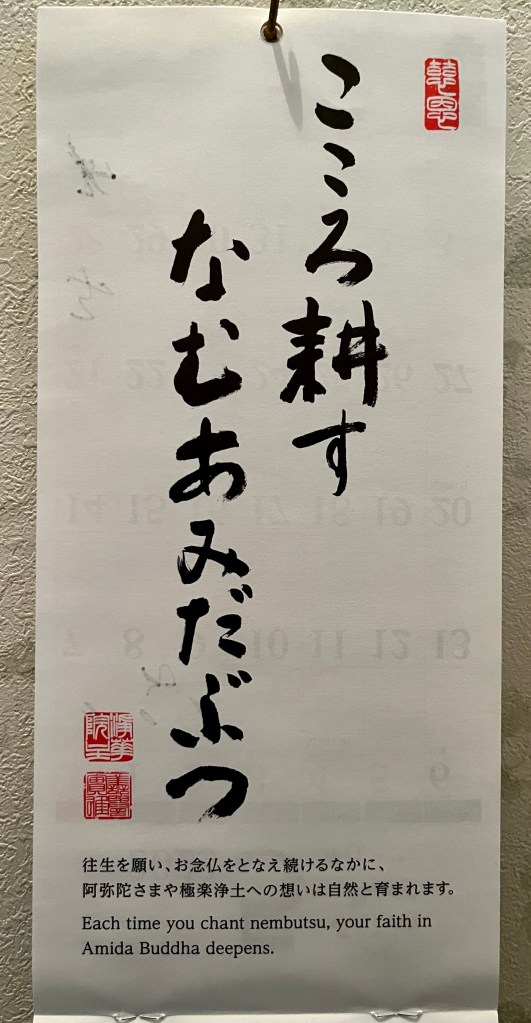
Anyhow, recently I saw this Jodo-Shu Buddhist-themed calendar around the house:
The English translation is very close, but the Japanese has some extra nuance that’s noteworthy.
In Japanese is written:
こころ耕す kokoro tagayasu
南無阿弥陀仏 namu amida butsu
The first line, means to cultivate the heart using the verb tagayasu (耕す), which implies tilling a field, or plowing a field.
So, it’s not just an academic exercise in reciting the nenbutsu, it cultivates the heart like a field. If you let the field go fallow, nothing grows except maybe some weeds. Buddhist practice is much like this, whether it be the nenbutsu or some other practice.
Much has been discussed over the years about how difficult Japanese language is to learn, especially the writing system.
That’s how I felt for a long time, but I eventually had a moment of clarity and realized that Japanese grammar is internally consistent and straightforward, like Latin. However, those grammar rules are considerably different than English or other European languages, which is where people often get hung up.
So, what follows are, in my opinion, the basic rules that govern Japanese grammar. My hope for you is that in understanding these rules, Japanese language doesn’t seem so hard to comprehend. I call these the Golden Rules of Japanese Grammar.
Note: knowing how to read hiragana is a big help, worth doing anyway if you’re serious about learning Japanese. This article assumes you know how. If you want to study Japanese, but still don’t know hiragana, please stop and review first.
The main verb comes at the very end. No matter how long, or how short, a sentence is, the main verb is always last.
The copula です (polite) or だ (informal) can be a placeholder for the final particle + verb, where appropriate.
The final verb/copula determines the tense (past, present, ongoing, etc) of the whole sentence.
Verbs modify nouns directly: 食べている犬 (the dog that’s eating)
Adjectives modify nouns directly, or with a な in the case of “na-adjectives”: 可愛い犬 (a cute dog), or 静かな犬 (a quiet dog).
Nouns can modify other nouns using the の particle: ジムの本 (Jim’s book)
Adverbs always come just before the verb. Amounts count as adverbs, too. ウサギが3羽見える。(I see three rabbits)
Verbs usually come in pairs: a transitive one (that does something to something) and an intransitive one (something is). The transitive one usually uses the direct-object を marker, the intransitive verb uses either に or が particles.
Intransitive verbs describe things, describe ongoing state. コップが落ちている。(the cup fell down/ has fallen down, not “is falling down”).
Many things are expressed as nouns, including grammar points.
This is definitely not a comprehensive list, and like any language, grammar is complex and varied, but if you remember the patterns above, you’ll be surprised how often you see they reappear over and over.
Using the example above from my old Anki flashcards, the grammar point わけ behaves like a noun, with the verb 返す directly modifying it. Even if you are learning this grammar point for the first time, you can see how it fits into the rules described above.
Good luck and happy studying!
P.S. this is how you write furigana in WordPress, if curious.
The kanji poster hanging in my son’s room since he was a little boy, product by Kumon.
The Japanese writing system is … complicated.
Japanese as a language isn’t particularly difficult, no more or less than other languages, but its writing system demands considerable time and investment to really get comfortable with. Written Japanese comprises of a mix of a few different things:
Hiragana syllabary1 – This is the default way of writing Japanese, and what most people, including kids in Japan, learn first. Note that hiragana characters are “syllables” not letters. One sound equals one hiragana character.
Katakana syllabary1 – The katakana is a 1:1 analogue to hiragana. In other words, every hiragana character has a corresponding character in katakana, but katakana looks more “blockey”, less flowing, than hiragana. It is most often used with foreign words, Buddhist mantras, or just for impact (e.g. sound-effect words in manga).
Chinese characters – Also known as kanji.
A typical sentence might look like: 今日はズボンを買った。Everything in blue is kanji, everything in red is katakana, while everything else is hiragana. I’ve spoken about the hiragana syllabary (part 1, 2 and 3) already, and katakana is similar enough that it does not require a separate article. So, today we’re just covering the use of Chinese characters or kanji.
Historically, China’s neighbors, such as Korea, Japan and Vietnam spoke languages that are both very different than Chinese, yet they wanted to import Chinese technology and culture. When they imported the Chinese writing system, however, it wasn’t an simple fit. Native words sound very different than Chinese, and sounds in Chinese language don’t always exist in the native language. Thus, Chinese characters’ sounds change when they’re imported.
Returning to Japanese language, the word for Japan in Chinese characters is 日本. In modern, Mandarin Chinese this is pronounced as rì běn, but in Japanese it’s pronounced as either nippon or nihon.2 This YouTube video helps illustrate the process:
You can see how the process of importing Chinese characters into Japanese was very organic. The result is that there are often many ways to read a Japanese kanji character, depending on whether it’s read in a native Japanese way, in a Sinified (Chinese) way.
The native way, or kun-yomi, is most often used for standalone words (not compound words), people’s names, place names, and verbs. For example, the kanji山 is read as yama in the native way. When talking about a mountain, or in someone’s name such as Sugiyama, you would most likely see this native pronunciation.
However, the Sinified reading of this kanji is san or zan . This is the on-yomi reading, which you might see in a compound word like 登山 (tozan) for mountain climbing. It’s the same kanji character, but now it’s read as “zan” instead of native “yama”.
If you look at my son’s kanji poster above, you can see for each kanji there is a mix of kun-yomi readings and on-yomi readings. Some kanji (夕) have maybe only one reading. Some (下) have seven or more! It all depends on how it was imported into Japanese, and how it’s applied in the language over the centuries.
So, inevitably the Japanese language student asks: how am I going to learn all this kanji?!
Short answer is: you don’t.
Beyond maybe the first 100 kanji, the amount of time and effort to memorize the kanji rapidly becomes untenable, and you get diminishing returns. How many kanji have an on-yomi of shō ? A lot, too many to remember which is which. Also, the further along you go, the more obscure and specific kanji get, so the returns worsen over time. They’re important, but show up in increasingly specific contexts.
Further, using mnemonics or pictures to learn the kanji is only useful when the kanji actually looks like something, which is mostly the basic kanji only. The aforementioned 夕does look like a moon at evening, so mnemonics work. But what about 優?3
Don’t get me started on the Heisig method. It’s a useful way for learning how to break down Kanji into discrete bits, but beyond that it doesn’t provide much value for the amount of work required.
No, the only way to learn kanji is to not learn them individually.
Instead, focus on building your vocabulary, and learn the kanji as they come up. I talked about this a while back as the “convergence method” but there’s no magic here. As you learn more vocabulary words, certain kanji come up often, and you’ll learn to anticipate their readings in future words. Sometimes you get it wrong, and that’s OK, other times you nail it perfectly.
But there is one other feature of Japanese you should leverage often: furigana.
Furigana is a reading aid often used for younger readers, and for language students by putting reading hints just above the kanji characters. For example lets look at the sentence above now using furigana: 今日はズボンを買った。
This is much easier to read. It still flows nicely in Japanese, but now we have the pronunciation hints (written in hiragana) right above each kanji.
If you find yourself embarrassed for relying on furigana, don’t be. This is how grade-school kids in Japan learn to read. This is how my kids (bi-racial Japanese-American) here in the US learned to read Japanese. In time, after seeing the same word 50 times, the reader doesn’t even need the furigana anymore, and can read without it, but it helps smooth the transition. When I was learning to ride a bike as a kid, I relied on training wheels, but as my confidence grew, I could ride without using them. The training wheels were still there, but I was riding more and more steady, so I hardly noticed when my dad took them off.
So, the key to reading Japanese well, including kanji, is to read native media that uses furigana. Many manga for younger audiences (including my favorite Splatoon manga), use furigana for all kanji characters and it makes the process of reading, plus looking up unfamiliar words, much easier. Even adult media uses furigana to help with more advanced, obscure words.
The point of all this is that learning kanji isn’t a slog of memorizing hundreds or thousands of characters, it’s more about learning to read vocabulary, preferably using native media. The latter approach is way more fun, and actually provides value in the long-run versus memorizing a bunch of kanji in isolation, then forgetting everything.
Chinese characters are great, and convey a lot of things that alphabetic systems can’t, but they are also pretty complicated and require considerably more ramp-up time.
P.S. if you use WordPress, this is how you add furigana to your Japanese text.
1 These are syllabary, not alphabets, because each character represents a full syllable, not a single consonant or vowel.
2 Side note, 日本 was used in other countries, like Korea and Vietnam, and their pronunciation differed too. Korean language pronounces it as Ilbon, while in Vietnam it’s Nhật Bản.
3 Confusingly enough, same pronunciation as 夕, by the way.
Soon after I wrote this post, I was reminded of a certain Zen aphorism in Japanese: 日日是好日 which is read as nichi nichi kore kō nichi.
This usually translates as “every day is a good day”, or “each day is a good day” or other such things. It is originally attributed to a Chinese Zen monk named Yunmen Wenyan from the 9th and 10th centuries.
At first glance, this seems like a positive affirmation of life. This is the sort of thing you might see from life-coaches, self-help gurus, posters, daily affirmations, songs, and so on. Live, laugh, love and all that.
But that kind of attitude and outlook is only useful for financially stable, healthy, affluent people living in stable countries. It’s pretty useless for people who live in difficult circumstances, working thankless, dead-end jobs, dying from pneumonia, or suffering from abuse. If you’re a child in Syria who has lost their parents during the recent earthquakes, the “live, laugh, love” phrase rings pretty hollow.
A while back, I wrote about similar issues with Seneca’s philosophical teachings. The Stoic teachings which Seneca espoused basically amounted to “suck it up” and “don’t be sad”, which is fine when you’re a Roman senator, but not too useful for the Roman slave working the fields.
In fact, for most people in the world, most days are varying degrees of shitty.
Life is a slog; First Noble Truth of Buddhism right there.
So, is there any value or meaning to Yunmen Wenyan’s famous phrase? I think so.
This is strictly my own interpretation, so please take with it a grain of salt. This morning, I had to step outside in the early morning and I beheld the sunrise. It is cold, it is early March, it is still dark outside, yet I saw the sun rising, and birds flying past it. I was glad to see it, to be breathing and savoring that moment.
Life is bittersweet. It is full of pain, loss, frustrations, and unfulfilled needs. It doesn’t necessarily get better, but it does carry on. Each moment of breath is still worth it. If you can share it with others, so much the better. But even if not, each moment is still worth something.
This is, I believe, what Yunmen Wenyan might have been saying to us, even when it gets lost in translation.
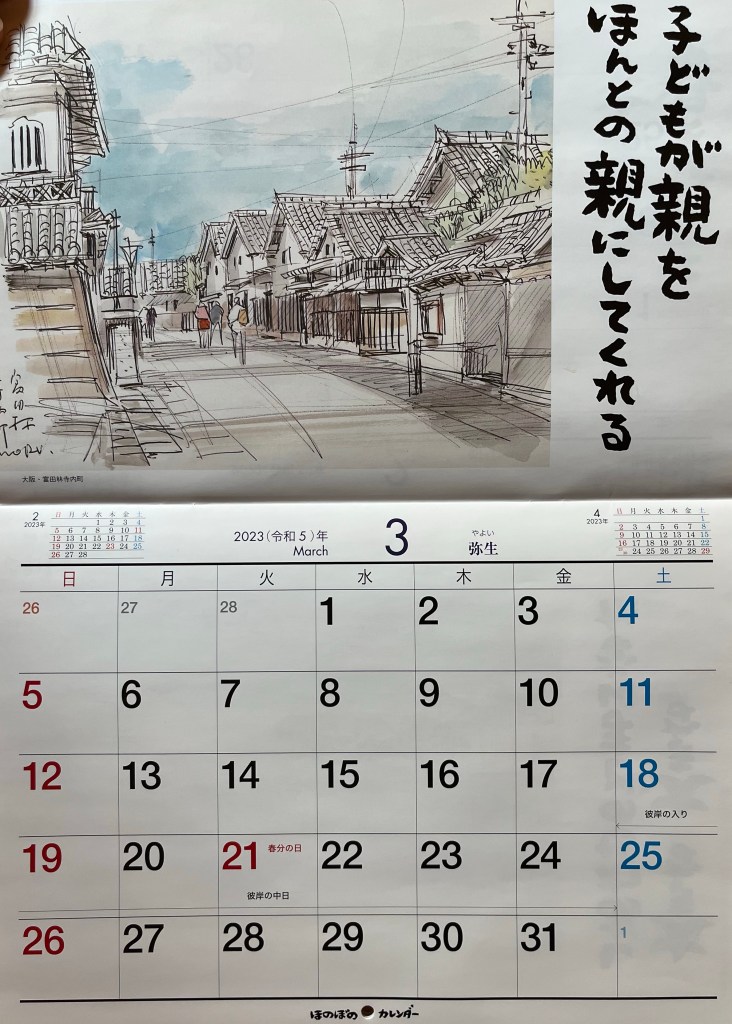
As of writing it is the month of March, or in the traditional calendar of Japan, the month of Yayoi (弥生, “new life”). We frequently get certain Buddhist-themed calendars from Japan every year due to my wife’s family’s connections, in particular the Honobono calendar series.
In addition to the terrific artwork, each month has some bit of Buddhist wisdom on the right hand side. This month’s is the following text:
子どもが親をほんと の親にしてくれる Kodomo ga oya wo honto no oya ni shite kureru.
What this is basically saying is that through their children, parents learn to be parents. In a positive sense, this means that both parent and child grow together.
Parents can learn a lot about themselves from their kids, even when this is not always pleasant. It forces us to confront some petty and selfish aspects of ourselves, but if we reflect on it, we can grow too, just like our kids. I know from personal experience, when my firstborn daughter was 3 months old, I made a resolution to uphold the Buddhist teachings a lot more, especially the Five Precepts, and stop being such an immature, man-child. This process for growth took many twists and turns, but I like to think that I did grow as a person through my own kids.
Compare this to a well-known proverb in Japanese: kodomo wa oya no kagami (子供は親の鏡) meaning that children are a mirror of their parents. The latter though, tends to have a more practical, negative explanation why some kids are just poorly raised: it reflects their parents’ lack of maturity and poor personalities.
Recently, I alluded to joining a local Soto Zen group and deepening my practice there. I am happy to report that after several weeks, I finally decided to formally join the community as a member. Thus, I guess I am now a student of Soto Zen.1 It is kind of exciting to be part of a Buddhist community again after years of isolation, but also a bit of an adjustment since I’ve been doing things a different way for a very, very long time.
As part of this I wanted to get familiar with the yearly liturgy of the Soto Zen tradition. To my surprise, the local community seemed to not follow this yearly calendar, but I guess it’s up to each follower, and each community to apply this calendar as much possible.2
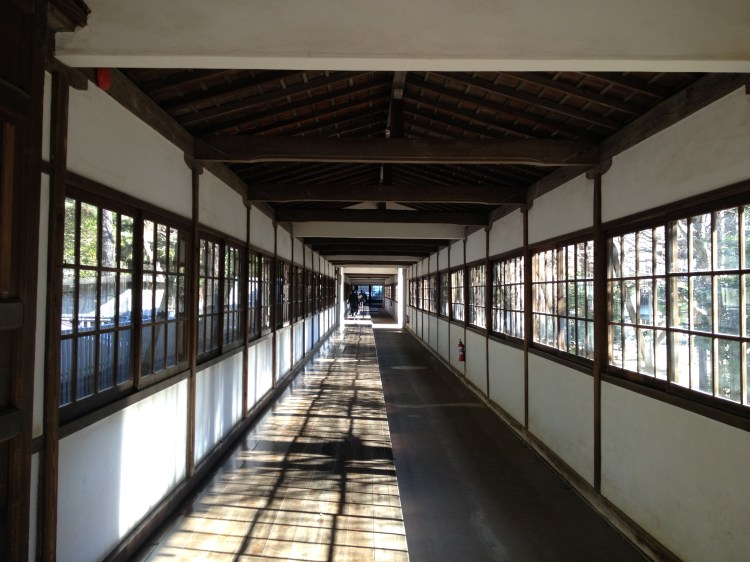
This was taken near the famous Chujakumon (中雀門) Gate at Sojiji Temple, looking westward. Photo from 2012.
Anyhow, I think it’s helpful to get familiar with the calendar of events not just to have a foundation in one’s life and practice, but also to stay connected with the much larger community. So, for that reason I’m posting the yearly event calendar here for readers. Many of these holidays line up with other Buddhist traditions in Japan, and I’ve already talked about them in other blog posts, while a few are exclusive to Soto Zen only.
The Great Perfection of Wisdom Sutra requires some explanation. The Sutra is not one Buddhist text, but a collection of sutras that appeared in India starting in the 1st century CE. Each of these “great perfection of wisdom” sutras (a.k.a. prajña-paramita in Sanskrit) basically teaches the same message, but each version was composed in varying sizes: 8,000 verses, 15,000 verses, 25,000 verses, etc. The trend happens in reverse too: some versions get shorter and shorter until you get to the famous Diamond Sutra and Heart Sutra. Due to their slimmer size and easier recitation, these two sutras have retained more popularity over time.
Nevertheless, regardless of which version we’re talking about, the Great Perfection of Wisdom Sutra is a powerful foundation for Mahayana Buddhist traditions everywhere, including the Zen tradition. Thus, many traditions have some kind of “sutra reading” ceremony.
Because the Perfection of Wisdom Sutra is so large, it’s impractical to read/recite the entire sutra in a single session, so the ceremony usually involves Buddhist monks opening each fascicle and fanning through the pages to symbolize reading it. It’s a very formal ceremony. You can see an example of this below, though I am unclear which Buddhist sect this is:
If you want to the ceremony itself, skip to 11:30 or later, until about 16:00
English-language copies of the Great Perfection of Wisdom Sutra are very hard to find, by the way. I consider myself very lucky to find a copy of the 8,000-verse sutra at Powell’s City of Books some years back (that bookstore is amazing by the way):
Most Zen communities in the West can’t be expected to have such a copy. In any case, since the Heart Sutra is a summation of the Great Perfection of Wisdom Sutra anyway, it makes sense for most Zen practitioners to simply recite the Heart Sutra as appropriate. In the Youtube video above, the monks even recite the Heart Sutra at one point too.
Dual Founders Memorial
Soto Zen is somewhat unusual in Japan for having two founders, not one. The sect-founder-practice dynamic is something unique to Japanese Buddhism,3 usually each recognized Buddhist sect in Japan has one founder, not two.
Normally, when Westerners think of Soto Zen in Japan, they think of Dogen as the founder since he was the one who traveled to Song-Dynasty China, studied Caodong-sect Zen teachings, and brought those back to Japan.4 The challenge is that during this time, Soto Zen was a strictly monastic institution that had minimal appeal to the wider Japanese society.
Keizan, who came a few generations later, reformed Soto Zen as an institution that had more broad appeal. It was still centered around the monastic institution, but also included more community connections to the warrior samurai class and the peasantry as well. Soto Zen flourished in a way that other Zen sects in Japan simply never did. For this reason, Keizan is considered the second founder.
Thus, during formal ceremonies, a Soto Zen text, the ryōsokisho (両祖忌疏) is read aloud, which describes the virtuous life of both founders through the use of Chinese-style poetry.
Bodhidharma Memorial
Bodhidharma, unusually depicted standing. Taken at Sojiji Temple in 2012.
Within the world of Zen, Bodhidharma is a guy who needs no introduction. This semi-legendary monk from India supposedly came to China in the 4th century, and helped establish the lineage there, and subsequently all such lineages through East Asia.
The historicity of Bodhidharma though is pretty suspect, and some historians contend that he was made up in order to refute criticism that Zen had no prior connection to Buddhism in India. I don’t know which is true.
Regardless of whether Bodhidharma was real or not, he is the embodiment of Buddhism (particularly Zen) passing the torch from the community in India to the community in China and beyond.
End Of Year Temple Bell Ringing
The “joya” tradition is found across all Buddhist sects in Japan, and is a way of ringing in the new year. I took part in it once myself at a local Jodo Shu temple thanks to my father-in-laws connections.
The temple bell, or bonshō (梵鐘), is run 108 times, to signify the 108 forms of mental delusions (kleshas in Sanskrit, bonnō in Japanese) that all sentient beings carry with them. Things like anger, jealousy, covetousness, envy, ill-will, etc. In other words, the stupid petty shit we all do.
When I participated ages ago, this particular temple lined 108 volunteers up, and one by one we proceeded to the temple bell and rang it. As the temple bell is very large, and the striker is a large wooden log suspended by rope, this wasn’t easy, but it was cool.
Obviously, many communities in the West don’t have huge temple bells, and only tiny ones at home at their home altar. Still, one can relive the experience using a small bell, such as one found on your Buddhist altar, and ringing it 108 times (Buddhist rosaries can help keep count, by the way; that’s literally what they’re for), or some division of 108 if that’s not easy: 54, 27, etc.
Conclusion
The liturgical calendar of Soto Zen, as promulgated by the home temples in Japan, includes a lot of holidays that are practiced by the wider Mahayana Buddhist tradition anyway, plus a few novelties found only in Japan, or even just in Soto Zen itself.
Outside of Japan, how one incorporates this into one’s own community, or just in one’s personal life is entirely up to them. Personally, I like having some structure, including a set calendar like this to keep me from getting too idle, but also as a way to tie in to the larger Buddhist community as a whole. However, other people may differ.
Good luck and happy practicing!
Namu Amida Butsu
1 I should clarify that I haven’t stopped reciting the nembutsu and such, I just feel I moved onto the next phase of my Buddhist practice.
2 I have noticed over the years that communities here in the West are more or less connected to the home temple overseas. Some strive to stay in lock-step, some go the opposite route. I have mixed feelings on the subject.
3 TL;DR – The Edo Period government decided to divide-and-conquer previously militarized Buddhist establishments into distinct sects, where each one required to define their founder, their particular practice, and key sutras they base their teachings around. This led to the parochial style Buddhist institutions that still exist today, but also bucked the trend in continental East Asia where Buddhist sects tended to synthesize into a single “super-Buddhist” tradition.
4 Fun fact: the “Soto” is just the Japanese-style reading of Cao-dong: 曹洞. For a look at how Japan imported Chinese characters, and why they sound so different, you can watch this Youtube video. I have personal quibbles about some details, but it’s otherwise a great historical overview.
The Amida Nyorai Konpon Dharani (阿弥陀如来根本陀羅尼) or “Amitabha Root Dharani” is a dharani used in some Japanese Buddhist sects, typically only on the Segaki ritual used to feed the hungry ghosts in Buddhism, or possibly funerals and other similar services. It is typically only found in esoteric rituals in Shingon and Tendai Buddhism, but can be found in Jodo Shu and Zen as well. The dharani is typically of very, very limited use, and not part of normal liturgy.
This page is intended to post the dharani for reference purposes only. Esoteric practices such as mantras and dharani should only be used as recommended by one’s teacher, under a guided training program. I found reference material on this dharani to be almost non-existent in English, hence my decision to post it here.
This page will provide both the Sino-Japanese reading follow by the Sanskrit reading. There are multiple versions of the dharani in Japanese, so pronunciation may vary slightly between them, so for this reason the Sanskrit is provided as well. No translation will be provided as this is part of the esoteric training one should undergo when learning the dharani. Any translation you see online of this, or any mantra/dharani, should be treated as suspect.
Can’t read the characters?
If you’re having trouble reading the Kanji characters, you might have one or two problems with your computer:
Your computer may not have Asian fonts installed. In Windows you have to enable UTF8 and East Asian fonts under the Control Panel. Modern Mac computers are fully compatible already.
Your browser may be assuming the wrong character set. If you use a relatively modern browser and use UTF8 as character set, you should be able to read fine. IE, Firefox and Safari all read this fine as far as I can tell.
Even if not, then you can still use the romanized characters, and the (terrible) English translation.
Disclaimer and Legal Info
I hereby release this into the public domain. Please use it as you see fit, but if you attribute it to this site, greatly appreciated. Also, please bear in mind this is an amateur work, and should not be taken too seriously.
Dedication
I dedicate this effort to all sentient beings everywhere. May all beings be well, and may they all attain perfect peace.
P.S. This is an old post from my former blog that I thought I had lost, but recently recovered. Reposting here with better blog formatting. Otherwise, I haven’t changed the contents.
Japanese language, on its own terms, isn’t that difficult a language to learn I believe, but it does have some things that are pretty different from English, and require re-learning. One of them, surprisingly, is rhythm and lack of stress accents. I’ve talked about the “flat” sound of Japanese, but I haven’t really talked about its rhythm before.
Since Japanese is usually written using hiragana syllabary, it’s important to note that each kana “letter” is actually a self-contained syllable, and represents one “beat”. So, if you take a word like the city of Yokohama, it has four beats:
よ
こ
は
ま
Yo
ko
ha
ma
Once you grasp this concept, and get familiar with hiragana, Japanese is fairly easy to spell. However, there is one wrinkle that’s really important to pay attention to.
In Japanese the letters ō and o are not the same. They both sound like “oh”, but one of them is two beats, and the other is a single beat. In Romanization, the sound ō is actually two beats, comprising of o, followed by u “ooh”. Many words in Japanese use this combination. For example, the city of Tokyo, is actually Tōkyō. If pronounced correctly, it actually has 4 beats, not 2:
と
う
きょ
う
To
u
kyo
u
It really helps if you clap to the beat to help you adjust to this. For a native English speaker, it’s really hard to tell the difference between ō and o in conversation, but a native Japanese speaker can and does. A good example is the word ryokō (旅行, “travel”) which has both:
りょ
こ
う
ryo
ko
u
The “ryo” is pronounced as a single beat (not 2, as in English), while the kō is pronounced as two beats.
In Japanese, the ū and u, both pronounced as “ooh” as in “soup” similarly are distinguished by two beats vs. one. The word for shumi (趣味, “hobby”) has only two beats:
しゅ
み
shu
mi
But compare with shūmatsu (週末, “weekend”) which has two beats for shū (4 total):
しゅ
う
ま
つ
shu
u
ma
tsu
This is also why relying on Romanization of Japanese is a bad idea: it’s hard to convey this. IF you can read hiragana, then the pronunciation is super obvious because it’s a WYSIWYG writing system: what you see is what you get. Take this book cover for example (which I talk about in my other blog):
I’ve highlighted in green the interesting characters. The word 百 is pronounced as ひゃく which is two beats:
ひゃ
く
hya
ku
And the word 道 in this context is pronounced as しゅ (shu) which is a single beat, like English “shoe”. Romanization can convey this, but if you can read hiragana, it is just so much easier.
Slight tangent, but Korean Hangeul works much the same way: Romanization doesn’t convey the sounds very well, but like Japanese hiragana, native Hangeul is also a WYSIWYG system. My wife and I have a children’s book in Korean from a friend:
I’ve highlighted each Hangeul syllable, but as you can see, Hangeul neatly divides each syllable by blocks anyway. Thus, you can easily tell who to read each one:
선
래
동
화
seon
rae
dong
hwa
If you try to write the title in Romanized Korean: seonraedonghwa, it’s hard to distinguish syllables. Is “seon” actually “se” and “on”, or is it one syllable? If you write with spaces in between words, it’s still hard to tell what’s what.
Also, this need to learn the native script isn’t limited to Asian languages. Ukrainian is much easier to read and learn once you grasp the Cyrillic alphabet. It is a pain upfront due to overlap with English, but it also makes it much easier to read words like the surname of the current president: Зеленський. In Ukrainian, there is only one way to read/pronounce Зеленський, but in Romanized Ukrainian it is written as Zelenskyy, ZelenskyorZelenskiy. Close, but not quite. The same goes with reading Greek (both modern and ancient), and so on.
Think of learning Hiragana, Hangeul, Cyrillic, Devanagari, or Greek as a one-time investment. It seems like a hassle upfront, but once you get past that barrier, a whole new world opens up.
Anyhow, back to the original point of this post. When it comes to learning Japanese, it’s important to pay attention to rhythm, because your pronunciation will sound much better, and you’re likely to reduce your foreign “stress” accent in the process. It’s perfectly fine to have some lingering accent (that’s life as a foreigner in any country), but your ability to clearly convey what you want to say to native speakers will go a lot smoother, and be less tiring to the listener.
A set of figurines for the Japanese zodiac we purchased in our recent trip.
Hello Readers and Happy New Year! In Japanese, people greet each other for the first time using the stock phrase akemashite omedetō gozaimasu (明けましておめでとうございます) which means something like “congrats on the opening of a new year”.
Note that Japanese New Year is based on Chinese New Year, but since early industrialization period, the Meiji Period, Japan moved away from the lunar calendar to the Western solar calendar.
The traditions inherited from Chinese culture still persist, even if the calendar changed, thus the original zodiac is still in place, and the new year is still frequently referred to as “spring” even if it is no longer anywhere close to meteorological spring.
In any case, it might sound a bit early but Happy Year of the Rabbit!
Usually when people think of Japanese food, they think of sushi, or ramen, but these are luxury foods that aren’t normally eaten at home. There is one food though that’s very popular in Japan, eaten on special occasions at home, and truly a wonderful food for winter: Oden (おでん).1
Oden is hard to explain, but it’s basically a kind of hot pot or stew where you cook various foods in there, and the family eats out of the same pot. We only cook 2-3 times a year, usually winter, since it requires a fair amount of preparation to make. I’ve also had it with my wife’s relatives in Japan during cold months.
Here’s my wife’s pot, with the oden having stewed for hours:
Inside, you can see may different foods, some skewered with bamboo sticks, others just cooking in the pot.
Oden always has a strongly brownish color due to the soy sauce and fish broth (dashi) based that’s used, similar to Udon and other foods. The items in our pot include Japanese radish (daikon), boiled and peeled eggs (yudé-tamago), fried tofu, Korean fish cakes (odeng-tang), Japanese fish cakes, noodles (harusamé) among many other things.
What’s fun is that there’s a large variety of things you can put into the pot and cook up. When you go to a convenience store in Japan, especially in Winter, they often have take-home oden, where you pick the foods you want to put in, they provide the broth, and you just carry it home. Alternatively, if you manage to find a traditional yataifood-cart,2 you can also enjoy oden there. As with the convenience store, just pick your ingredients, and enjoy. You can also mix in some Chinese hot mustard (karashii), too, but like wasabi that stuff can hurt if you add too much.
Oden sets are also available, both overseas and in Japan. These are usually frozen, and come with all basic items, but my wife likes to further embellish with boiled eggs, daikon radish. My wife doesn’t make from scratch (it would be too difficult), so using the frozen sets as a base works well for her.
Oden is a heavy comfort food, but is great on a cold winter’s evening, and well worth the opportunity if you can get it.
P.S. The Korean word odeng for the equivalent dish may be a loanword from Japan, probably during the colonial era (1910-1945), but beyond that, I am not sure.
1 I’ve never seen “oden” written in Kanji (Chinese Characters). If there’s kanji for it, it’s definitely not widely used. Shops that serve oden also write using hiragana script, not kanji.
2 I’ve been to Japan many times, but have never see one. They definitely seem to be a dwindling tradition / business model.






 Gleanings in Buddha-Fields
You must be logged in to post a comment.