I found this nice excerpt from the 25th chapter of the Lotus Sutra, better known as the “Kannon Sutra” for some, and just wanted to share:
All darkness is dispelled by the light of his wisdom As spotless and as pure as the light of the sun. The light destroys the dangers of wind and fire, And illumines the whole world brightly.
His precepts out of his loving-kindess brace us up as thunderbolts. His wishes out of his compassion are as wonderful as large clouds. He pours the rain of the Dharma as sweet as nectar, And extinguishes the fire of illusions.
Chapter Twenty-five of the Lotus Sutra, the “Kannon Sutra”, by Rev. Senchu Murano. You can find an alternate translation by Dr Burton Watson.
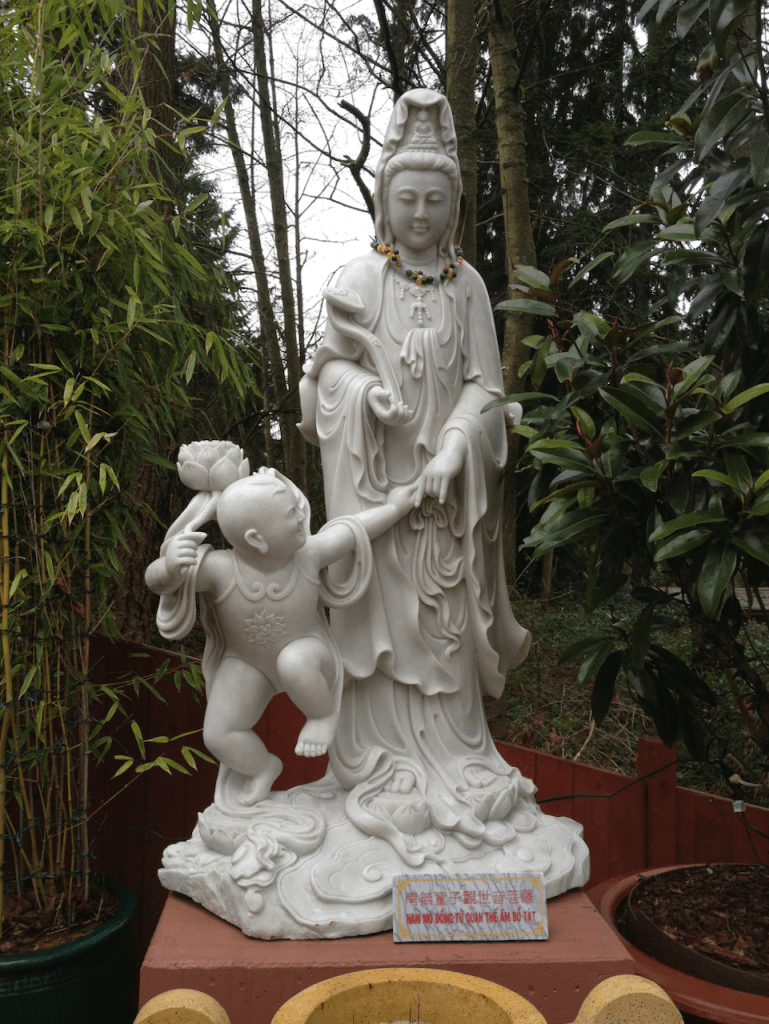
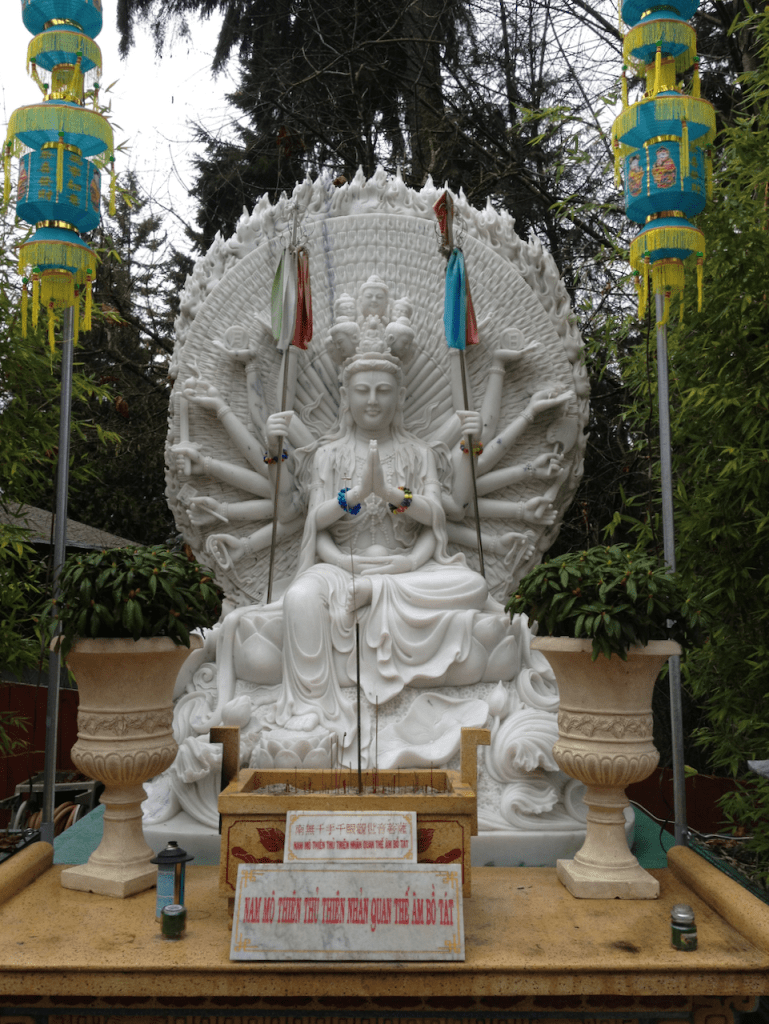
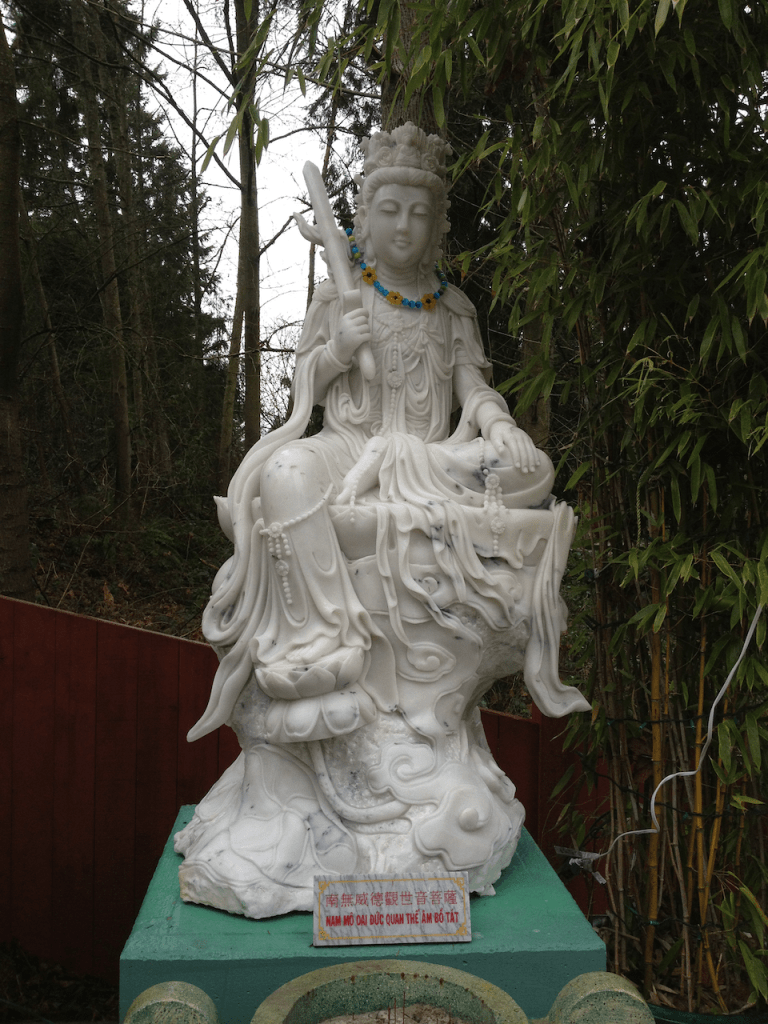
By the way, fun language-nerd fact: I noticed that my two books on the Lotus Sutra (Watson and Murano translations) both translate this passage using “he/him/his” pronoun, but both in the Lotus Sutra, and in popular culture, Avalokitesvara1 is frequently described as both male or female: a princely figure (male), a loving mother figure (female), etc. Here are just some examples from a Vietnamese-Buddhist temple in Lynnwood, WA:
In East-Asian Buddhism, the sutra is preserved in Classical Chinese, so I looked at the translated section above and it shows neither pronoun. Instead, the Chinese Character 観 is used which is the first character of Avalokitesvara’s name: 観世音.
This is hard to do in English: a pronoun is usually required, but in many languages, it’s not. In this case, the original text just abbreviated “Avalokitesvara” into a single character into the passage above.
Clever.
Namu Kanzeon Bosatsu
1 a.k.a. Guan-yin, Kannon, Gwan-seum, Chenrezig, etc. To confuse matters, how the Sanskrit name is spelled in English varies. The most phonetic spelling is Avalokiteshvara, but it’s often spelled the more Sanskrit-ey way Avalokiteśvara, expect that ś is hard to print sometimes. Thus, confusingly it becomes Avalokitesvara (no “sh” sound). Transliterating one language to another, especially languages so different like Sanskrit and Chinese is really tough…… but it’s also fun to see how different generations approached it.
In terms of demographics, Zen in Japan never reached the mass appeal that the Pure Land and Shingon sects ever did,1 but it has had an unusually large influence on the culture. When people think of this, they usually think of things like sand gardens, tea ceremonies, or certaintemplesinKyoto, but the language includes many words originally borrowed from Chinese-Zen (a.k.a. Chan) terminology imported into Japan.
This is not unusual, as it happens in English and other languages too: religious terminology gradually become increasingly widespread and lose their original religious context. The English word “goodbye” evidentially derived from “god be with ye”, for example.
So, let’s look at a few examples in Japanese.
The word aisatsu (挨拶), meaning customary greetings, was originally from the back and forth questions a Zen teacher would ask a student to test their grasp of the Dharma. Back then it was called ichiai-issatsu (一挨一拶), so the word has shortened over time.
The verb ganbaru (頑張る), which you see all the time in Japanese and means to “hang in there” had a somewhat different meaning in the past. It’s original meaning was the tendency for people to cling to their egos and assert their viewpoint even in the face of reality. The word has changed to a more positive meaning over time.
The word shujinkō (主人公) meaning the main character of a story (or drama) originally comes from a famous collection of Zen koan called the Mumonkan, wherein a certain monk would talk to himself and say things like “hey you, stay awake [don’t be fooled]”. The “you” here is where shujinkō comes from.
The phrase ichi-go-ichi-é (一期一会) normally means a once-in-a-lifetime experience, but in a Zen or tea ceremony context it means that this moment is like no other, never to be repeated.
The word kanben (勘弁) which my wife sometimes yells at me (kanben shite yo! “use your head”, “be reasonable!”) originally described a teacher thoroughly investigating a student’s grasp of the Dharma.
Finally, the word genkan (玄関) is a very common word in Japanese, meaning the front entry way, where you take off your shoes, etc. Originally this was limited to the area near a temple’s gate, but during the Edo Period the usage became more popularized to mean the entryway of a home.
There are other, more obscure terms as well, often in the form of phrases and idioms.
The phrase nichi nichi kore kō nichi (日日是好日) means “every day is a good day”, and I talked about it in this older post. This is directly taken from Chinese, but pronounced in a Japanese way.
Similarly, another famous Chinese-Zen phrase is kyakka shōko (脚下照顧) which loosely translated means something like “watch your feet!”. More specifically, it means to observe one’s self carefully, using the example of your feet. If your shoelaces are untied, your walking gets sloppy, or your shoes get messy, or you trip and fall. So, if you notice this, and tie your shoelaces, then you are catching the problem early, and avoiding future issues.
So, that’s a look at Zen-Buddhist words in Japanese language. Thanks for reading!
1 According to one of my books, the Rinzai Zen sect has about 1.1 million registered followers, while the Jodo Shinshu sect has 11 million (10 times that number) and Shingon sect about 7 million. Soto Zen has about 3.5 registered followers, so somewhat larger, but not that much.
In the past, I’ve written about a certain obscure holiday in Japanese culture called Nanakusa (七草, “seven herbs”)1, which takes place every January 7th, just after the New Year.
While reading about the Diary of Lady Murasaki (discussed on my other blog) I discovered that there is a parallel Nanakusa tradition in Autumn as well. There is no designated holiday, but since antiquity, these flowers and herbs were prized during the season of Autumn.
This page shows some really nice visuals of each flower.
Some of these plants aren’t necessarily well-known today, but even as a foreigner, I recoginize a few of them. Susuki grass (a.k.a. Chinese silver grass) is an important part of Otsukimi, and Nadeshiko flowers are frequently used as a symbol of femininity in Japan. The national soccer/football team is named Nadeshiko Japan in fact. Hagi is used in Ohagi treats as well.
Regarding the reference in Lady Murasaki’s diary near the beginning is written the following text:
I look out from my room at the head of the corridor into the light morning mist. Dew is still on the ground, but His Excellency [Fujiwara no Michinaga, her benefactor] is already out in the garden ordering his attends to clear the stream of some obstruction. Plucking a sprig from a large cluster of maiden-flowers that blooms there on the south side of the bridge, he peers in over the top of the curtain frame…
The “maiden flowers” according to the Japanese text are ominaeshi (golden lace) flowers. So, even in the 11th century, a thousand years ago, these flowers were prized among the aristocracy of Japan. Immediately after, Michinaga challenges her to compose a poem about the ominaeshi he plucked (a common practice back then), and she composes the following:
Japanese
Romanization
Translation
女郎花
Ominaeshi
Now I see the
さかりの色を
Sakari no iro wo
color of this maiden-flower
見るからに
Miru kara ni
in bloom,
露のわきける
Tsuyu no wakikeru
I know how much the dew
身こそ知らるれ
Mikoso shirarure
discriminates against me.
Translation by Dr Richard Bowring
Michinaga is impressed by her quick wit (it’s basically why he hired her as a handmaiden to his daughter), he responds with:
Japanese
Romanization
Translation
白露は
Shiratsuyu wa
It is not the dew
わきてもおかじ
Wakitemo okaji
that chooses where
女郎花
Ominaeshi
to fall;
こころからにや
Kokoro kara ni ya
does not the flower choose
色の染むらむ
Iro no somu ran
the color it desires?
Translation by Dr Richard Bowring
Such a poetic exchange for a single flower.
In fact, the Autumn list of flowers dates much further back than the 11th century. Take a look at these two poems from the Manyoshu anthology, poem 1537:
… as you can see, these two poems are linked. It’s interesting that even as far back as the 7th century, these seven flowers were celebrated in poetry, and this tradition still persists in Japan today, the 21st.
Wishing you all a happy Nanakusa!
1 Not to be confused with the Colonel’s “eleven herbs and spices”. 😉 I have enjoyed Kentucky Fried Chicken in Japan, and we try to try to enjoy it for Christmas every year even in the US, per Japanese tradition.
2 Manyogana was an early Japanese script that used Chinese characters in a very phonetic way. This was eventually replaced by the simpler, short-hand form called hiragana. Only very early works of Japanese are recorded in Manyogana, but that does include the Manyoshu anthology.
3 A couple quick notes from the referenced website: the name Fujihakama has gradually changed pronunciation to Fujibakama. Also, apparently the Asagao flower referenced in the Manyoshu isn’t the same as the modern Asagao “morning glory” flower. It’s not clear what flower this referred to at the time. Finally, this flower isn’t the same as the kikyou flower that is now part of the seven flowers of Autumn Nanakusa.
The nianfo (念佛) is widely recited across many cultures and languages by people who follow the Pure Land Buddhist tradition. In Japanese it is called the nembutsu (念仏), and that is the name I most often use on this blog. In Korean it is the yeombul (염불), and in Vietnamese it is the niệm phật. Just as the name differs by language, the phrase itself has changed pronunciation as it is adopted in other cultures and languages, just like the sutras did.
Let’s look at examples.
The original form of the nianfo (as far as I can tell) comes from Sanskrit language in India. In Sanskrit, “nianfo” was buddhānusmṛti (buddhānussati in Pāli language). The venerable site Visible Mantra states that it was recited like so:1
namo’mitābhāyabuddhāya
In the Siddham script, still used in some esoteric practices, this is written as:
𑖡𑖦𑖺𑖦𑖰𑖝𑖯𑖥𑖯𑖧𑖤𑖲𑖟𑖿𑖠𑖯𑖧
From here, Buddhism was gradually imported into China from India (a fascinating story in and of itself), and because Chinese language and Sanskrit are so different, this was no easy task. Nevertheless, the buddhānusmṛti was translated as nianfo (念佛) and written as:
南無阿彌陀佛
This was how the Chinese at the time approximated the sound of the Sanskrit phrase. In modern, Simplified Chinese characters this looks like:
南无阿弥陀佛
But how does one read these characteres? That’s a fun question to answer.
You see, Chinese has many dialects because of geography, regional differences, and migration of people. Thus, even though Chinese characters are written the same (with only modest regional differences), the way they are read and pronounced varies. Thanks to Wiktionary, I found a helpful list to illustrate:
Of these dialects, I am only familiar with Mandarin and (to a much lesser extent) Hokkien, so I can only trust the others based on Wikipedia.
Anyhow, China was a powerful, dynamic culture at the time, and it had a profound influence on its smaller neighbors such as the Korean peninsula, Japan, and northern Vietnam (a.k.a. Dai Viet). Just as the neighbors of the Romans (including the Byzantines) absorbed Roman culture, the neighbors of China did the same even though the languages were very different.
What about Tibetan Buddhism? I am really unfamiliar with that tradition, so I might be wrong here, but my understanding is that Tibetan veneration of Amida Buddha stems from a different tradition, so instead of the nianfo, they recite appropriate mantras instead. Beyond that, I don’t know.
Anyhow, this is a brief look at how a simple Sanskrit phrase has evolved into so many traditions and ways to express veneration to the Buddha of Infinite Light. Thanks for reading!
𑖡𑖦𑖺𑖦𑖰𑖝𑖯𑖥𑖯𑖧𑖤𑖲𑖟𑖿𑖠𑖯𑖧 南無阿彌陀佛 Namu Amida Butsu
P.S. Another post despite my intended rest. The time off really has helped, so it’s been well worth it, but now I am eager to write again. 😌
1 As I’ve written before, writing Sanskrit in the more modern Devanagari script is kind of pointless since Sanskrit was never written in that until late in history, long after Buddhism in India was gone. Sanskrit does not have a native script either, so the Roman Alphabet is as god as any.
2 Brushing off my college Vietnamese, this is pronounced as “Nam-moe Ah-zee-dah-fut”.
My guide book on Japanese culture talks about a concept called sahō (作法), which in a mundane sense just means “instructions” for doing stuff. But the book explains that it also describes how things are done culturally:
… for example, in the case of the tea ceremony, every act is carefully choreographed, from where people sit, to how the water is boiled, to how the ea is prepared and so on.
Again, in the business world, one can observe sahō in action as the seller employs polite language and bows often as he shows various forms of respect to the buyer. Another case would be the social setting of a company, where a subordinate will use particular sahō with his boss.
Page 156
The book further explains:
For most Japanese, sahō is an ingrained pattern of behavior that affects their day-to-day actions without them even being aware of it. However, for people who come from overseas, some of these practices may appear puzzling. Why is someone bowing so many times in a particular setting? Or at another time, why is someone sitting ramrod straight? But for the Japanese, they are simply following the sahō that is appropriate for that place and circumstance.
I definitely experienced some of this confusion in the early years when I visited Japan with my wife. My in-laws kindly took me to a local Takashimaya department store and paid to get me a tailored suit. As a poor white kid in America, the experience was kind of awkward on a few levels: I wasn’t used to getting measured for a tailored suit, I wasn’t used to the very polite speech and mannerisms of the store employee, I wasn’t very good at speaking Japanese, and I wasn’t even used to owning my own suit.1
This concept of sahō isn’t limited to Japanese culture, of course. It is true, based on limited experience, that things can feel really choreographed in Japanese culture compared to American culture, but the idea of “how people do things” is universal. The American handshake is on example, the tendency for Russians not to smile during formal settings, the “pub culture” in Ireland and so on. There’s countless examples unique to each culture.
Even for a culture like Japan, where everything really is kind of choreographed, you do get used to it. The extra flourishes at the bookstore (wrapping the books, extra bowing, etc) were a bit confusing at first, but after a while, I don’t even really mind it anymore. Similarly, certain habits became ingrained more and more each time I visit.
So, when you encounter another culture, the important to bear in mind is that each culture has its own sahō, and it will be different than yours. Be observant, be flexible. If you do, you’ll quickly adapt and will succeed. People who stand like tall trees in the wind get blown down, but those who bend like grass prosper.
Food for thought.
P.S. Fun bonus post before Thanksgiving weekend! Happy Thanksgiving Day and Native American Heritage Day to readers in the US.
1 It is still the only suit I own, but I save it for important occasions only, such as my mother-in-law’s funeral. Speaking of sahō, funerals in Japan are very formal compared to American ones.
Garibaldi: This isn’t gonna be easy. G’kar: Nothing worthwhile ever is.
Babylon 5, “And the Rock Cried Out, No Hiding Place”, s3:ep20
Recently, I talked about the key to practicing Zen (or Buddhism in general) is training while incorporating other things in your life toward that same goal. Like Rocky Balboa training in Rocky, or Li Fong in the excellent movie Karate Kid: Legends, or someone working hard to learn a language by making other aspects of life conducive toward language learning.
In most cases, we go through a some stages when we take up a project like this.
New thing – “this is fun, I can see the benefits already!”
Steady practice – “gotta keep this up”
Boredom – “ugh, I gotta do this again”
Skipped days – “I’ll make up for it tomorrow”
More skipped days – “No, really, I’ll make up it up tomorrow.”
Guilt – “I suck”
Despair – “I’ll never succeed.”
Quitting.
My usual pattern with new projects, or dieting and exercise, is to eventually feel guilty, despair, and quit. It happens to me a lot over the years, admittedly.
But also, there are a few things that surprisingly I have managed to stick with for years, decades even. I’ve been actively studying Japanese since 2008, for example. I realized though that the way I’ve studied Japanese has changed and shifted many times. Some experiments succeeded, others failed immediately. But the goal was important enough to me, that even when I failed I just shifted tactics and tried again. I failed the N1 JLPT twice in the last five years, and to my surprise, I am still at it, but now trying a new tactic.
Put another way: when I hit a roadblock, instead of hitting my head on the wall harder and harder, I tried another route. I knew where I wanted to go (language fluency) and just kept trying methods until I found something that stuck.
I realized too that my pursuit of the Buddhist path has been much the same way. I started out in 2005 with very little understanding, but I really liked reciting the nembutsu, and I loved the simple, down-to-earth, and highly approachable Jodo Shu sect as taught by Honen (still do!). But while I’ve had the same basic goal, my understanding of Buddhism has grown over time, and like language learning, has gone through many false-starts, projects that soon ended, or things that just didn’t work. So, I just shifted, tried another route, backtracked, and so on. This what I think happened to me, and why I took up Zen practice since May.
My current Zen practice is, I suppose, just another track toward my goal.
So, I think the point of all this is that the goal is more important than the particular approach. If the goal is something you really care about you’ll find a way. In fact, you’ll probably bend other aspects of your life toward it. If not, then the goal maybe wasn’t that important to begin with. That’s OK. Better to acknowledge it, cut your losses, and move on.
But if the goal is worthwhile to you, then like G’Kar says, you’ll find a way.
Lately, my exploration of the Hokkien language of Chinese, in particular as it is spoken in Taiwan, continues. The amount of educational resources for Taiwanese Hokkien is far less than Mandarin since it is more of a “street language” than an official language, but I have been able to find some excellentmaterial thanks to my Taiwanese-speaking friend.
One of the first challenges of learning Taiwanese Hokkien is how to read it. Taiwanese Chinese uses traditional Chinese characters compared to mainland China which uses a simplified character set.1 So the word for “doctor” in mainland, simplified Chinese is 医生, while in Taiwan it’s 醫生.
But even the Romanized form of Taiwanese, meaning Taiwanese expressed using the Roman alphabet, is complicated and has some history.
The original Romanization system and still popular today is Pe̍h-ōe-jī (白話字, “pay-way-jee”) which is also “church Romanization” because it was developed by Christian missionaries in the 19th century. Having studied Vietnamese in college for two years, another writing system that was originally developed by Western missionaries, Peh-oe-ji and Vietnamese script look pretty similar to me. You can see how the missionaries were thinking at the time, and how their own language influenced their Romanization efforts.
Anyhow, Peh-oe-ji is still widely used, and many text books still use it. However, it also shows its age, and can be hard for modern 21st century English speakers to learn. Plus, has some obvious cultural baggage, so the government of Taiwan has tried to develop a different Romanization system.
The first effort, Taiwanese Language Phonetic Alphabet (TLPA) tried to modernize the system and replace some of the complicated diacritics and spellings to something easier. This made TLPA far easier to type, but it never quite caught on. People were so used to Peh-oe-ji that they stuck with it.
A second effort, called Tâi-lô (臺羅, “dye-luh”) represents a compromise between the two: streamlined like TLPA, but retains some older spellings like Peh-oe-ji.
For example, let’s look at the character 平 meaning “flat”. In Peh-oe-ji, it’s written as pên while in Tai-lo it’s pênn. The first one, with the tiny “n” superscript, means that it’s a nasal vowel sound. So, it sounds like English word “buh”, but more nasally. In the Tai-lo system, it’s expressed with a double-n.
Another example is 錢 meaning “money”. In Peh-oe-ji, it’s written as chîn while in Tai-lo it’s written as tsînn. The second one feels more “what you see is what you get” to me, even if the nasal ending takes some getting used to.
Plus, there are eight different tones used in Taiwanese Hokkien compared to four in Mandarin (or five in Vietnamese). Thus, you can get different words from just saying “i” differently:
醫 i
與 í
衣 ì
台 î
易 ī
To help illustrate this more, let’s compare the first 10 numbers in Taiwanese and how they’re romanized in one system or another. If you want to hear how they are pronounced, check out this podcast episode. I also included Mandarin Chinese and Japanese for fun comparison.
Number
Chinese
Peh-oe-ji
Tai-lo
Mandarin
Japanese
1
一
chi̍t
tsi̍t
yī
ichi
2
二
nn̄g
nn̄g
èr
ni
3
三
san
sann
sān
san
4
四
sì
sì
sì
shi
5
五
gō’
gōo
wǔ
go
6
六
la̍k
la̍k
liù
roku
7
七
cchit
tshit
qī
shichi
8
八
peh
peh
bā
hachi
9
九
káu
káu
jiǔ
kyu
10
十
cha̍p
tsa̍p
shí
ju
Interestingly, the podcast I listen to uses Tai-lo, but the textbook I bought uses Peh-oe-ji, so there really is no clear-cut consensus for Romanizing Taiwanese.
What’s really interesting is how native Taiwan people manage all this. Taiwanese people natively use Chinese characters of course, but they juggle the Mandarin reads of those characters with other dialects (Hokkien, Hakka, etc). To help with this, Taiwan developed its own syllabary system called Bopomofo to help young students learn how to pronounce Chinese characters. Additionally, Romanized words are often used alongside this in a system called Hàn-lô (漢羅, lit. “Chinese-Roman”). My textbook explains that it’s not unusual to see a sentence like so:
聽–leh! 我 kā 你 ê 錢 khǹg tī hia.
Listen! I put the money over there.
Page 29, “Taiwense Grammar” by Phillip T. Lin
According to the book this is often used in situations where certain Chinese characters are used by Taiwanese (not Mandarin) and might be a hassle to look up or type.
Anyhow that’s a brief look at Taiwanese and how people have tried to express Taiwanese language using the Roman Alphabet. Thanks for reading!
P.S. featured photo for this post is the skyline of Taipei, capital of Taiwan. Photo by 毛貓大少爺, CC BY-SA 2.0, via Wikimedia Commons.
P.P.S. Today will also be a double-post. Hope you enjoy!
1 Modern Japanese kanji is somewhere in the middle: some characters are simplified, some not. I am unclear why it developed this way.
MCCOY: What he’s saying, Spock, is that a man who holds that much power, even with the best intentions, just can’t resist the urge to play God.
Star Trek, “Patterns of Force” (s2ep21), Stardate 2534.0
Since the beginning of time, powerful men have risen and then fallen. Doesn’t matter which culture, or which time period, sooner or later someone wants to be the Alpha, King of Kings, Pharoah, Shogun, President for Life, etc etc. It happens over and over again, and more often than not they self-destruct or their legacy crumbles after their death.
Take the case of Marcus Licinius Crassus, better known in history as simply “Crassus”. Crassus was absurdly rich. His wealth, and the political influence he bought with it, would make many hotshot-CEO’s today look like chumps.
We can look at examples and think to ourselves “what fools!”, but I think an even bigger lesson from this is that it can happen to any of us given the right circumstances. When we have power and authority, it is almost inevitable that we start to play god. In the Star Trek episode “Patterns of Force”, a historian tampered with an alien planet and (inadvertently) turned them into space Nazis.
The Ring of Power from J.R.R, Tolkien’s Lord of the Rings series illustrates this. Any person who gets a hold of the Ring, whether they be wizards, kings or elf-lords or even just hobbits, inevitably become corrupted.
Even Galadriel, one of the last of the mighty Noldor Elves on Middle-Earth and among the wisest of the elf-lords, was briefly tempted when Frodo offered her the ring, asking him if he wanted her to be a queen “terrible and fair”. Yet unlike her kin, she was able to resist and avoided a more terrible fate.
I feel I would be tempted too. This week I am filling in for my boss who’s on vacation, and even with this small dose of authority, I feel tempted to throw my weight around. How much more so if I was a world leader.
Why are we prone to this behavior?
I suspect it’s simply ego: our desire to mold the world in our own image. Even if we believe we are doing the right thing for others, our own ego blinds us to realities on the ground. If I had such power, I would probably fall into the same trap. People with strong egos are even more blind because they want so badly to project themselves onto the world while choosing to ignore the suffering it causes.
Of course someone has to be in charge. There has to be some form of authority for societies (or offices) to function. But it has to be treated as a radioactive, hot potato: something to be handled very carefully.
Anyhow, rambling thoughts here from the “Ozymandius” of my workplace.
Something fun to end this post though (direct link).
This is not something I usually post about, but after my recent post about Ando Momofuku, I learned some fascinating things about Chinese language and wanted to share with a wider audience. In high school, I took two years of Chinese language and was an enthusiastic student. We learned the Mandarin dialect, though our teacher was from Taiwan, and we never really explored other dialetcs.
However, over the years, I’ve met various overseas Chinese who don’t speak Mandarin-dialect Chinese as a first language, and instead know Cantonese, Toisan, Taiwanese and so on. The history of Chinese languages and its various dialects is complicated. Fascinating, but far too much to cover here and I am not expert. In fact, it’s fair to say that all these dialects aren’t really dialects, but more like a language family, in the same was as Latin to French, Italian and Spanish, or Sanskrit to Hindi, Bengali, and Marathi, etc.
But I did want to cover a particular dialect that’s actually pretty widespread and influential, but not well-known: Hokkien (福建話, hoh-kee-en), sometimes also called Minnan or Bân-lâm (閩南) among other names. In Mandarin, this dialect is called Fújiànhuà (“Fujian speech”). So, we might think of Hokkien as Fujian-dialect Chinese, although as this video explains, that’s not 100% accurate:
It helps to think of Hokkien as one form of “Southern Chinese” vs. Mandarin “Northern Chinese”. This is a very rough comparison, but helps illustrate the history behind the two dialects. Hokkien is one of many, many dialects in southern China, where mountainous geography kept many communities isolated from one another over time. Meanwhile, Mandarin has its origins in northern plains of China, which also happens to be where most Imperial capitals resided in Chinese history, hence it had more influence and prestige.
Another thing to note is that the vast majority of the Chinese characters used are the same regardless of dialect, but they are read and pronounced differently depending on the dialect:
But out of all the fascinating dialects in Southern China, why am I writing about Hokkien? Two reasons.
The first reason is that the influence of Hokkien is surprisingly wide. It’s a very common dialect spoken across Southeast Asia. One of my long-time friends is Indonesian Chinese, and he told me that many people use it in Indonesia, and explained how Hokkien terms often get mixed in Indonesian conversational speech (which is natively Malay, not Chinese). This video below is a fascinating explanation of how Hokkien spread, and has continued to thrive across Southeast Asia.
Hokkien is also an important language in Taiwan. Mandarin became one of the national languages after the Nationalists fled there after 1950, but Hokkien (via Taiwanese) is very widespread too. I have a childhood friend who’s a second-generation Taiwanese-American, and he grew up learning both Mandarin (for practical reasons, every Chinese person knows at least some Mandarin), but also Taiwanese language. When his father passed away last year, I attended the funeral,1 and it was the first time I ever heard Hokkien spoken since most of the attendees were fellow Taiwanese people, and the eulogy was spoken in Taiwanese. Taiwanese is a form of Hokkien, probably the most widely spoken.
So, it’s used far more often than one might expect. But if you didn’t know how to distinguish Hokkien from Mandarain from Cantonese, you might easily miss it.
The second reason I am talking about this might surprise you.
Hokkien has a big influence on Japanese language, because that’s where all the on-yomi (“Chinese readings”) of Kanji come from, not Mandarin.
It’s easier to see when you actually compare words in Japanese, Hokkien, and Mandarin.
A common word in Japanese is 感謝 (かんしゃ, kansha) meaning “gratitude” or to be thankful. In Mandarin this is pronounced as gǎn xiè. That sounds fairly close. But in Hokkien it’s gam sia, (“gum shyah”) which sounds even closer.
Another example is the character 我 (“wa” or “ga”) in Japanese and is used for things like “self”, “mine”, “our”, etc. In Mandarin this is pronounced as wǒ, but in Hokkien it’s wa or gwá. Again, this sounds closer to Japanese than Mandarin does.
If you are curious to learn some basic Hokkien words, this is a nice video below, though it does not include Chinese characters (Romanization only):
This video is a fun, light-hearted comparison between Hokkien and other dialects by someone trying to learn Hokkien but who grew up learning Cantonese instead.
Side note, I asked my Taiwanese friend about how well he could understand other southern dialects. To him, Teochew was fairly easy to follow, but Cantonese was 50-50 for him: sometimes he could pick up what was being said, other times he could not.
Anyhow, that’s a very brief look at Hokkien by someone who’s obviously not Chinese, but fascinating by its influence across Asia. I hope to write more about Hokkien as I learn more, but I am quickly discovering how limited resources are. The only dictionary I could find was from 1922 and used for missionary work. Clearly, more research needs to be done, but I am happy to see younger generation Chinese making all these helpful Youtube videos to share information rather than Westerners doing it.
P.S. Featured photo is the city of Quanzhou (“chwan-joe”, 泉州), birthplace of Hokkien.
1 His parents had always been kind to me in school, and patient when I practiced my Chinese language skills with them.
In the past, I talked about the four-character phrases, or yojijukugo, popular in Japanese culture. Recently, I learned about a new phrase that I hadn’t heard before: kachō-fūgetsu (花鳥風月). This phrase describes the beauty of nature, literally the Kanji characters for “flower”, “bird”, “wind” and “moon”.
The meaning here is various aspects of nature, but also in a positive healing sense.
Spock: Indeed, gentlemen. May I point out that I had an opportunity to observe your counterparts here quite closely. They were brutal, savage, unprincipled, uncivilized, treacherous; in every way, splendid examples of homo sapiens, the very flower of humanity. I found them quite refreshing. [he returns to the science station]
Kirk: I’m not sure, but I think we’ve just been insulted.
McCoy: I’m sure.
Star Trek, “Mirror Mirror” (s2ep4), stardate unknown
For all our veneer of civilization and advancement, we are still deep down biological creatures. We come from nature, and we need nature. Nature heals us and sustains us.
A small patch of grass in my yard, taken in April of 2025.
These days, it’s not hard to feel stressed by all the things that are going on, but I also found solace knowing that nature continues on regardless of what humans do or become. That doesn’t mean the future of humanity will necessarily be positive or negative, but it does remind me that life goes on nonetheless.






 Gleanings in Buddha-Fields

You must be logged in to post a comment.