Four Months Practicing Zen

I intentionally left this post in my blog draft folder for months, but now I am ready to post.

After a small revelation back in early May, I wanted to give it time and ensure that this change in Buddhist path wasn’t a spur of the moment decision.

After that little experience in May, I realized that I had misunderstood Zen Buddhism. Some of this is due to mixed experiences at local (Western) Zen communities,1 and in my opinion, systemic issues with Buddhist publications in English.3 Once I had better access to Japanese-language resources, and based on things I had sort of rediscovered, I decided to try to and go heads down for a few months and do my best to practice Zen as a lay person and parent.

My daily reminder list on my smartphone. A mix of mundane and Buddhist practice. 坐禅 means “zazen” and お勤め means “otsutome” (home service).

It took a lot of trial and error to get this right. At first, I had a tendency to succumb to self-doubt and start doing zazen meditation longer and longer, but then I would burn out, or have a busy day and skip. So, eventually I forced myself to keep it to five minutes, and I found I was able to sustain the practice more. Also, if I missee a day somehow, I would not punish myself over it.

Second, I struggled with how to do a Zen-style home service, so I had to do some research and this led to posts like this and this (these are for my own benefit as much to readers 😏 ). This home service underwent a few updates and changes over time, but I gradually settled on things over time, thanks to an old service I forgot I had.

Finally, I wanted to ensure I focused on Buddhist conduct as a foundational practice, and in particularly by upholding the Ten Bodhisattva Precepts. It’s also emphasized by such past Zen monks as a foundation for other aspects of Zen, but compared to the basic Five Precepts, I found myself struggling both to remember what the Ten Precepts were, and also remembering to avoid things like not bring up the past faults of others, or harboring ill-will towards others. This is still a work in progress, but I assumed it would be. It took me many years of following the Five Precepts before it became second-nature.

Anyhow, since I started this little project four months ago, I am happy to say that I have mostly stuck with it. I can count the days I missed practice on my two hands, which over four months is pretty good. I realized that small, realistic, daily practice is much more effective than trying to focus on big retreats. So, in a sense, it’s been a big win and a learning lesson for myself.

But also I realized that I also really missed some aspects of the Pure Land practice that I had been doing up until this point. For me, I found that Pure Land Buddhism tends to appeal to the heart, while Zen appeals to the mind.

Dr. Janet Wallace: “The heart is not a logical organ.”

Star Trek, “The Deadly Years” (s2ep12), stardate 3479.4

So, my practice has continued to evolve to mostly Rinzai-Zen style practice, but also with a few Pure Land elements too. I suppose this is more inline with mainland Chinese Buddhism where such distinctions are less important than Japanese Buddhism, which tends to be sectarian. Also, if it works for Obaku Zen, it works for me.

So, that’s my update. Am I Zen Buddhist now? I don’t know. I am hesitant to use that label because I am hesitant to associate myself with that community. On the other hand, I’ve found it very beneficial so far, but I haven’t forgotten what I learned from Pure Land Buddhism either. So, I guess I am both, neither, whatever. At this point, taking inspiration from Chinese Buddhism: I uphold the precepts, meditate a bit each day, dedicate merit to loved ones and those suffering in the world, praise Amida Buddha, Shakyamuni Buddha, Kannon and the Lotus Sutra. Whatever label fits that is what I am these days. 🤷🏼‍♂️

Frankly, I stopped caring. I like how my practice has evolved these past months, and happy to continue.

Namu Shakamuni Butsu
Namu Amida Butsu
Namu Kanzeon Bosatsu

P.S. Posting a little off-schedule, but oh well. Enjoy!

1 Not all experiences have been negative, but I have run into more than a few “Bushido Bros” and Japan nerds2 that soured my experience.

2 Yes, I am a Japan nerd too. I fully admit this, but nerds can be kind of intense and exhausting to talk to, so I don’t like to hang out too much with other Japan nerds.

3 It’s hard to quantify, but English books about Buddhism are either very dry, bland, and scholarly, or read like psychology self-help books, or just too mystical. When I read books in Japanese on similar subjects, I find them more down-to-earth and engaging. I know different people have different preferences, but I don’t like most English publications I find at the local bookstore. It is also why I try to share information (or translate if necessary) whenever I find it.

Jodo Shu Home Liturgy

Hello dear readers, I realized recently that after posting I home liturgy examples for Soto Zen, Rinzai Zen, and Tendai sect Buddhism, I had never posted about Jodo Shu sect home liturgy despite being a follower for many years. There are a couple reasons for this.

Sutra book for Jodo Shu followers. I think this might be the first such book I have ever owned.

First, as someone who came to Jodo Shu Buddhism many years ago, I tended to rely on English sources only, and such sources tend follow Honen’s teachings, but nothing beyond that. Thus, through such books I followed Honen’s simple advice that focusing on the nembutsu is all that mattered. So, in my early efforts to learn Buddhist practice, I focused on reciting just the nembutsu. More on why the liturgy has expanded over time later in this post.

The second reason is that the Jodo Shu home liturgy is particularly long. My book on Jodo Shu explains that this usually takes about 20 minutes.

My limited experience confirms this. I have an old Jodo Shu sutra book from many years ago, which I received during one of our earliest family trips to Japan. That particular winter, we celebrated New Year in Japan, I got to participate in a local Joya-no-kané (“ringing of the temple bell”) ceremony, thanks to my father-in-law, and generally had a great time. It might even be the first sutra book I ever owned.

A photo of Honen, founder of Jodo Shu Buddhism, with his famous poem “Moonlight” below. A copy of his handwriting is to the right depicting the Nembutsu.

The book, needless to say, has some sentimental value for me.

But I digress.

You can find example Jodo Shu liturgy here on the official Jodo Shu homepage in Japanese. There is even a translated one on the Jodo Shu North American mission website. The format of the liturgy is:

  1. Kōgé – verse for offering incense
  2. Sanbōrai – taking refuge in the Buddha, Dharma and Sangha
  3. Shibujō or Sanbujō – both are verses of praise to the Buddhas
  4. Sangege – verses of repentance
  5. Junenreciting the nembutsu ten times.
  6. Kaikyōgé – verses for opening the sutra
  7. Shiseigé – an excerpt of the Sutra on the Buddha of Immeasurable Life, which I posted here.
  8. Honzeigé – dedicating the good merit to all beings
  9. Junenreciting the nembutsu ten times.
  10. Ichimai-kishōmon – Honen’s One-sheet Document, essentially his last will and testimony.
  11. (optional) Hotsuganmon – a verse attributed to Chinese Pure Land master Shan-dao, expressing a desire to be reborn in the Pure Land, become a bodhisattva and help others.1
  12. Shōyakumon – a verse for expressing the light of Amida Buddha.
  13. Nembutsu-ichi-éreciting the nembutsu as much as one likes.
  14. Sō-e-kō-gé – Another verse for transferring the good merit to all beings.
  15. Junenreciting the nembutsu ten times.
  16. Sōgangé – a variation of the Four Bodhisattva vows.
  17. Sanshōrai or Sanjinrai – three adorations or prostrations toward Amida Buddha
  18. Sōbutsu-gé – verses of praise to the Buddhas, but also a kind of warm sendoff too.
  19. Junenreciting the nembutsu ten times.

As you can see, it has many components, with the nembutsu sprinkled throughout. Many of these verses are very short too, so once you get used to the format, it is not that hard. It can feel a bit daunting upfront if you’re new to Pure Land Buddhism, though.

Thankfully, the Japanese site also has a couple example videos showing slightly different versions of the liturgy. Version one below with uses the Shibujo and Sanshorai:

and version two, which recites the Sanbujo and Sanshinrai instead:

The North America sites uses a little of both: the Sanbujo from version two, and the Sanshorai from version one. By contrast, my sutra book has all the verses, so you presumably pick which version you want to recite. It seems like they are basically interchangeable.

Since there is already an official English translation available online, I won’t repost here. Please refer to the links above for more details.

Instead, I wanted to address the question of liturgy versus just saying the nembutsu, and I found a good explanation in this article.

The author reiterates that Jodo Shu Buddhism begins and ends with the nembutsu and doesn’t need other verses to effect rebirth in the Pure Land. So, pretty consistent so far.

And yet, the author cites Honen who encouraged people to cultivate the “five right practices” (五種正行, goshushōgyō) which includes:

  • Recitation of verses
  • Observation
  • Paying homage
  • Reciting the nembutsu [lit. Amida Buddha’s sacred name]
  • Praise

Thus as a liturgy, it is meant to cultivate all five, with the nembutsu as the peak or the climax of a movie. From a general Mahayana-Buddhist standpoint, it covers all the important points: taking refuge, repentance, reciting a Buddhist sutra, sharing the good merit, and vows toward becoming a Bodhisattva.

My personal opinion is that if you’re new to Pure Land Buddhism, it’s perfectly fine to just recite the nembutsu, but as you become more comfortable with Buddhism, you can expand to include the whole liturgy. I have no doubt that it’s a wonderful experience once you do it from start-to-finish, but without context it can seem a bit difficult.

In any case, good luck and happy chanting!

1 My sutra book puts the Hotsuganmon at the very end, while the Jodo Shu site in Japanese puts it just after the One Sheet Document. The North America Jodo Shu site doens’t include it at all. I am not sure why there is a difference in format. I assume it is optional.

Buddhas of the Three Time Periods

Something cool I learned about while watching a Japanese documentary of Eiheiji temple, one of the two core temples in the Soto Zen tradition. Evidentially there is a small Buddhist altar there that features three Buddha statues. You can see photos of it here, the building (called the butsuden 仏殿) is here. This is posted on a separate blog too. You can see a photo of the three buddhas at the very bottom of this page here.

But who are these three Buddhas? In Japanese this is called the Sanzebutsu (三世仏), or “Buddhas of the Three Time Periods”.

In order these are:

  • Amida Buddha – the Buddha of the Past (he accomplished his vows eons ago), and thus the Pure Land was established.
  • Shakyamuni Buddha – the Buddha of the Present (the current eon of history), the historical founder of Buddhism. Also known as Siddhartha Gautama, Shakyamuni, etc.
  • Maitreya Buddha – Buddha of the Future (he has not accomplished his vows yet, but will eons later). For now he dwells in the heaven realm of Tushita.

This “trinity” of Buddhas is not limited to Eiheiji Temple. You can find similar works of art in other temples as well.

Anyhow, it’s an intriguing idea that the Dharma has always existed across space and time, but simply represented by different Buddhas as appropriate.

Namu Amida Butsu
Namu Shakamuni Butsu
Namu Miroku Bosatsu

Made to Become So

Speaking of the Tannisho recently, here’s another interesting quote worth exploring:

6. 自然のことわりにあひいかなはわば、仏恩をもしり、また師の恩をもしるべきなりと云々。

“When we live according to the truth of ‘made to become so by itself’, we shall know gratitude to the Buddha and to our teachers.”

Translation by Dr Taitetsu Unno

“Made to become so by itself…” what does he mean by that? Let’s look at another example.

In an separate Jodo Shinshu work, Shinran’s Notes on Essentials of Faith Alone (唯信鈔文意, yuishinshō mon’i) which we explored recently, he explains this “made to become so by itself” in greater detail:

Ji also means of itself. “Of itself” is a synonym for jinen, which means to be made to become so. “To be made to become so” means that without the practicer’s calculating in any way whatsoever, all that practicer’s past, present, and future evil karma is transformed into the highest good, just as all waters, upon entering the great ocean, immediately become ocean water. We are made to acquire the Tathagata’s [Buddha’s] virtues through entrusting ourselves to the Vow-power; hence the expression, “made to become so.” Since there is no contriving in any way to gain such virtues, it is called jinen. Those persons who have attained true and real shinjin are taken into and protected by this Vow that grasps never to abandon; therefore, they realize the diamond-like mind without any calculation on their own part, and thus dwell in the stage of the truly settled. Because of this, constant mindfulness of the Primal Vow arises in them naturally (by jinen). Even with the arising of this shinjin, it is written that supreme shinjin is made to awaken in us through the compassionate guidance of Sakyamuni, the kind father, and Amida, the mother of loving care. Know that this is the benefit of the working of jinen.

Source: https://shinranworks.com/commentaries/notes-on-essentials-of-faith-alone/

The specific phrase Shinran uses is jinen hōni (自然法爾), which is tricky to translate into English. As the Notes explains above, “jinen” means to be become so, naturally, not through contrivance. The term “hōni” (法爾), alternatively hōnen (法然),1 means something like “by virtue of the Dharma”, but in Jodo Shinshu lingo specifically it means through the power of Amida Buddha’s vows to rescue all beings.

Here, Shinran is strongly advocating a sense of total reliance on Amida Buddha, with the belief that by fully entrusting oneself to Amida Buddha’s compassionate vows (as depicted in the Three Pure Land Sutras), called shinjin (信心), rather than through calculation or conscious effort (i.e. a “weekend warrior”), then one is transformed by Amida gradually without realizing it. So, rather than trying to reborn in the Pure Land, Shinran is saying that one should trust in Amida to guide you to the Pure Land.

I’ve always found this concept very interesting.

While I might quibble with Shinran’s interpretations of things (especially since other Pure Land teachers in the past did not have such a one-sided view), I do think there’s merit in the idea of transformation without one realizing it. This is accomplished simply by exposure to the Dharma, what Jodo Shinshu Buddhists like to call “deep listening” or monpō (聞法), which I also mentioned here.

1 Not to be confused with Honen (same kanji).

Finding Oneself

Years ago, my wife and I bought a book from Japan titled 禅の言葉とジブリ meaning “Zen Words and Studio Ghibli” (publisher link here). This book was written by a Rinzai Zen monk named Hosokawa Shinsuke (細川晋輔) who was born into a priest family in Japan, and later ordained as a priest. Chapter by chapter, he relates life lessons to Studio Ghibli movies. To be honest, the book sat on our shelf for a long time, until recently, when I finally reached a level where I can follow along (with a good dictionary, of course).

Anyway, a quick divergence to talk about “priest families” in Japan. For historical reasons that are too complicated to go here, many Buddhist priests in Japan live not in monasteries, but in local parishes and raise families. Frequently, one of the kids inherits responsibility of that parish. If you think of a local Protestant pastor, it’s the same idea. Mr Hosokawa was born into such a family, and was expected to take on the family role, so after college he trained at a Rinzai Zen monastery for three years.

In his words, these first three years were a slog. He describes how he woke up every morning at 2 – 3am, meditate long stretches, followed by incessant chores around the temple all day. Day in and day out, this continued with no free time, and no privacy. Eventually, he adapted to monastic life, but he kept counting down the days when his three year term would end.

Then, abruptly, someone close to him died, and it changed his view. He was close to this person, but they often quarreled, yet now he would never see them again. Suddenly, the issue of life and death became very important to him, and he went from “having to practicing Zen” to “choosing to practice Zen”.

Thus he stayed at the monastery another several years (nine total). Yet in spite of all this training, he writes that he never really had any great awakening or sudden burst of insight. Instead, in his own words (roughly translated by me):

禅の道場での修行に取り組めば取り組むほど、自分の中で凝り固まっていた価値観が、崩れていったのです。。。。つまりは今まで築いてきた知識や経験というものを、自然に手放せてくれたのです。 大切なものを手放して、捨てて去って辿り着いた私の目の前には、当たり前の風景しかありませんでした。

The more I struggled with ascetic practices in the Zen dojo, the more my firmly-held sense of values crumbled….simply put, the knowledge and experiences that I had built up so far I was allowed to let them go naturally. Having let go of such important things, having finally left it all behind, there was nothing left but the natural scenery that was right in front of my face.

Page 67

Later, he likens this experience to Totoro, the main character (monster, spirit, kami?) of the Ghibli movie My Neighbor Totoro. In the movie, many people in the village are totally oblivious that Totoro and his friends are there among them, because they are too caught up in their lives.

In the same way, the Dharma can be utterly hidden before your eyes, unless you take time to see it. In Mr Hosokawa’s case, it took nine years of intense monastic practice, the death of someone close to him, and gradually letting go of his ego. I can’t say whether this is the same for others (I haven’t learned to let go myself), but I think it’s an important lesson. I think the key word Mr Hosokawa uses is atarimae (当たり前), which in American English is like saying “duh, obviously”.

Chinese characters seem strange and mysterious until you learn them. Sex is strange and mysterious until you’ve experienced it. And so on and so forth. In the same way, for many the Dharma feels ethereal or mysterious until it finally clicks, and then its somewhat anti-climatic (“duh, obviously”).

Or so I believe. 😉

Namu Shakamuni Butsu

Hungry Ghosts are Among Us?

The Obon Season in Japan approaches, and so do ghost stories, and ceremonies around hungry ghosts. But what are Hungry Ghosts?

This is one of the traditional states of rebirth within Buddhism, on the never-ending cycle of people migrating from one life to the next. Rebirth as a hungry ghosts is seen as only one rung up from being in Hell, as it is a state of great suffering and hardship. Unlike hell, though, hungry ghosts are seen as beings that live among us, but only in the darkest shadows, living a precarious existence, constantly starving and thirsty, with no way to gain sustenance. They are often cursed to eat something awful, like garbage, or excrement, as punishment, or they are depicted in art as having emaciated bodies, with bloated bodies, and tiny throats that can’t swallow anything.

Although they are called preta1 in Indian Sanskrit language, in Japanese they are called gaki (餓鬼), which in modern slang is a rude expression for kids that means “a punk” (the Japanese meaning is harsher than the English one).

References to hungry ghosts go all the way back to early Buddhist texts such as the Pali Canon where the Buddha warns that among the hungry ghosts are probably some of your ancestors and kin:

Outside the walls they stand, & at crossroads.
At door posts they stand, returning to their old homes.
But when a meal with plentiful food & drink is served, no one remembers them:
Such is the kamma [karma] of living beings.

Tirokudda Kanda (Petavatthu 1.5), translation by Ven. Thanissaro Bhikkhu

Later, stories of hungry ghosts appear in Sanskrit anthologies such as the Avadanasataka, including the story of Mogallana and his mother (source of the Obon holiday), before a similar version of the story appears in the Mahayana text, the Ullambana Sutra, for which there is a handy translation here. In the Ullambana Sutra, you can see how Mogallana’s mother suffers in her state as a hungry ghost:

Mahamaudgalyayana [Mogallana] felt deep pity and sadness, filled a bowl with food, and went to provide for his mother. She got the bowl, screened it with her left hand, and with her right hand made a fist of food. But before it entered her mouth, it turned into burning coals which could not be eaten….

Source: https://www.cttbusa.org/ullambana/ullambana.asp, Buddhist Text Translation Society, part of City of Ten Thousand Buddhas

Scenes of hungry ghosts appear in old Buddhist art too:

A picture from the Gaki zōshi 餓鬼草紙 “Scroll of Hungry Ghosts”, circa 12th century, courtesy of the Kyoto National Museum, Public domain, via Wikimedia Commons

In this famous image, you can see emaciated hungry ghosts living among us, unseen, scrounging remains from human refuse and so on. Early Buddhist texts never described what hungry ghosts looked like, but this is how they are depicted in medieval artwork.

Because the hungry ghosts wander aimlessly through life endlessly starving, and some of them may include past ancestors and loved ones, Buddhism has developed certain ceremonies thought to help relieve the suffering of one’s ancestors, and by extension other hungry ghosts. In Chinese culture, this is exemplified in the Ghost Festival (中元節, zhōngyuánjié) of Chinese culture, Obon (お盆) in Japanese culture and the Segaki ritual in some Buddhist traditions.

It’s a fascinating example of how Buddhist teachings have suffused cultures, and how cultures have responded to concerns over family and the afterlife.

1 Alternatively peta in Pali language.

Zen for Everyone

Myoshinji Temple (English homepage) in Kyoto is one of the central temples of the Rinzai Zen tradition, especially after the reforms by Hakuin in the 18th century. Although I’ve never been there, it is a very scenic and seems like a worthwhile place to visit.

The website in Japanese lists a number of activities that one can partake in for experience Zen:

  • Learning zazen meditation
  • Sutra copying
  • Listening to a sermon
  • Singing Rinzai-Zen hymns1
  • Monastic training

What struck me is that Myoshinji Temple provides a variety of activities to suit different people. Not everyone is ready for Zen training or meditation, yet they can still get something wholesome out of the experience. I like this kind of inclusive Zen Buddhism.

In my limited experiences with western Zen temples, the focus is solely on meditation and practicing as monks do. This approach only works for certain lifestyles and certain temperaments. It’s not wrong, but through my experiences in Pure Land Buddhism, especially through immigrant communities, I feel that a more inclusive, more approachable Buddhism is really beneficial.

Just sitting around enjoying donuts and coffee with congregants after service, and talk about stuff, is really nice. This only works when new people don’t feel intimidated, and people aren’t trying to one-up each other.

So to me, Buddhism works best when it accommodates people as they are now, with a variety of practices and options, rather than being written off as “cultural accretions“. Just let people be people, come as they are, and soak in the Dharma at their own pace.

Someone who only listens to sermons today, prays to Kannon, or copy a sutra, may be inspired to pick up deeper practices later at the right time. You never know.

P.S. Happy Tanabata to readers!

1 Similar to Jodo Shinshu sect Buddhism, Rinzai Zen, at least at Myoshinji temple, has a lot of hymns. I don’t know much about these, and there is no information in English.

Soto Zen Service Book

Something I haven’t really covered before, but worth talking about lately is a Soto Zen service book I picked up some years ago at Sojiji Temple which is not too far from my wife’s home in Japan.

Back then, we’d visit Japan yearly to see relatives, and let the kids get much-needed language exposure. Also, I was in touch with an expat1 who lived there for 20 years and shared a passion for Buddhist temples. He and I would go “temple hopping” together around the Tokyo area whenever I was in town, and as my firstborn daughter got older, she would come with us.

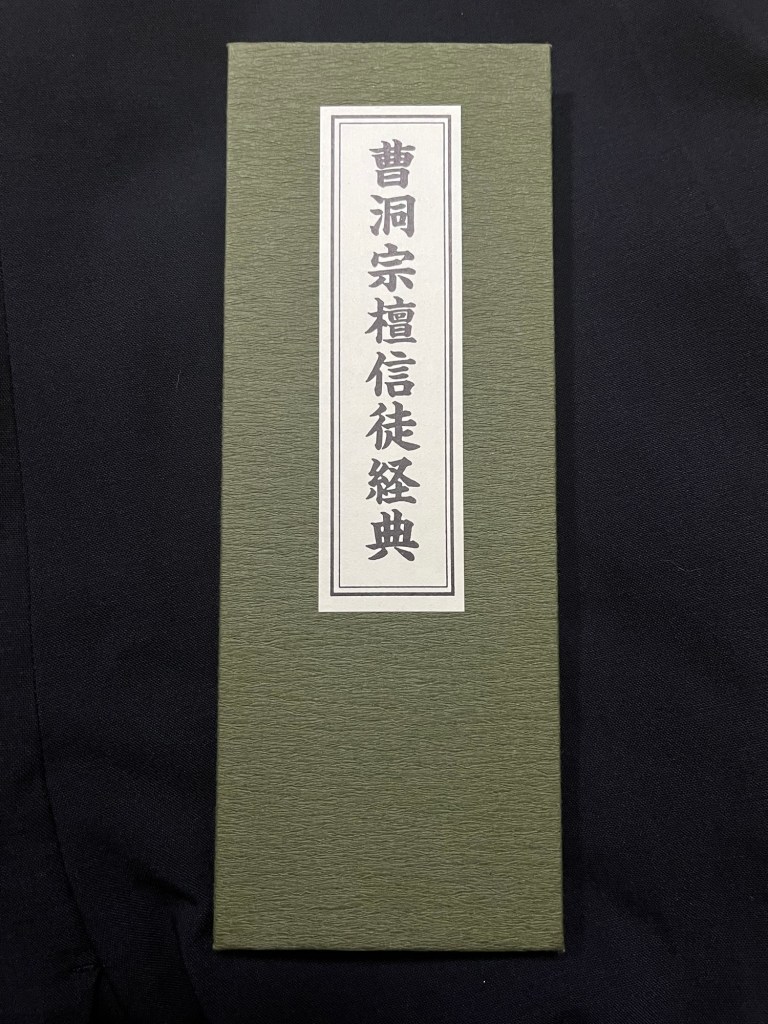
In any case here is the cover of the service book for Soto Zen home liturgy:

Cover of Soto Zen service book, purchased at Sojiji temple. Title roughly translates as “Soto Zen scriptures for parishioners”.

Inside, you can see the table of contents on the right side. Japanese text is tradtionally written right to left, and vertically (not horizontal):

Table of contents of sutra service book for Soto Zen. Purchased at Sojiji temple.

On the left-hand side is the Kaikyoge, a verse recited traditionally when starting a service. The gist of the verse is that encountering the Dharma is quite rare, and yet we are privileged to read and recite it now. Thus, may we all attain the Buddha way. During my years with the Buddhist Churches of America, we read a very similar liturgy in English. The concept is almost universal in Buddhist services.

Also, notice that the text in the Kaikyoge is Chinese characters (kanji), but with hiragana text to the side as a pronunciation aid. This is because most liturgy in Japanese Buddhism was originally adopted from China, and thus requires pronunciation guides (same is true with Korean Buddhism too, iirc). At the very bottom-left is smaller text helping to explain the meaning of this verses.

The photo below is the first part of the verse section of the Kannon Sutra (a.k.a. chapter twenty-five of the Lotus Sutra). Again, we see vertical lines of Chinese characters since the original edition was recorded in old literary (not modern) Chinese, and phonetic hiragana script beside each character. The large circle mark indicates a ring of the bell if you have one. As with above, it is read from right to left, vertically.

A copy of the Kannon Sutra, version section, from a Soto Zen service book, from Sojiji temple.

What I really like about this particular sutra book is how clear and readable the hiragana text is. Some books use a font that’s hard to read if you are a foreigner (or even Japanese possibly). This makes reciting difficult. But here, if you can read hiragana script, it’s easy to follow along.

A close up of the Kannon Sutra as printed in a Soto Zen service book, purchased at Sojiji Temple.

By the way, below is an example of verses that are not recorded in Classical Chinese: an excerpt of the Shushogi, chapters three and four. Since the Shushogi was recorded natively in Japanese, there are fewer Chinese characters, and the style of language is more readable to a native speaker. To me, as a language student, it’s still pretty difficult since the source text by Dogen was composed in the 13th century. The grammar is quite different 800 years ago. This section also includes explanations at the bottom for modern native speakers.

Because of the popularity of the Shushogi among laity in the Soto Zen tradition, all five chapters are recorded in this sutra book.

The rest of the content is pretty typical, and I explained the full contents in an older post, but what I liked about this particular sutra book was the quality, readability, and thorough content.

Side note: it turns out that there is also an eBook version of the service book (originally linked here) available in both Apple Books and Google Play formats. The eBook version is a lot nicer than I expected, and closely follows the physical book (the subject of this post), with a few slight differences:

  • The kaikyōge (verses on opening of the sutra) uses Sino-Japanese, the service book uses a mixture of native Japanese and Sino-Japanese
  • Similarly, the Sankiraimon uses native Japanese in tbe eBook version, but Sino-Japanese in the physical book.
  • the eBook version has a really nice altar image (gohonzon). A person who can’t access Buddhist altar goods could print it out, and install in a Buddhist altar (obutsudan).

But I digress.

For some reason I find sutra books fascinating, and if readers enjoyed this post, please let me know. I might try to make more posts on the various books I’ve collected over the years. I have service books from practically every sect in Japan.

P.S. Happy 4th of July to readers in the US. Also, happy (belated) Canada Day to readers there. To my ancient roman readers happy … (checks notes) … Battle of Adrianople?

1 via online Buddhist circles, namely the long-dead E-Sangha forum. IYKYK.

Other Power and the Nembutsu

The saying of nembutsu is neither a religious practice nor a good act. Since it is practiced without any calculation, it is “non-practice.” Since it is also not a good created by my calculation, it is “non-good.” Since it is nothing but Other Power, completely free of self-power, it is neither a religious practice nor a good act on the part of the practicer.

The Tannisho, section eight, translation by Dr Taitetsu Unno

This quote comes from a 13th century Japanese text called The Tannisho, a record of conversations between an aging Shinran, the founder of Jōdo Shinshu-sect Buddhism, and his disciple Yui-en.

It’s a strange quote, and many aspects of the Tannisho are also strange at first glance. But the details are important and worth exploring.

Shinran is basically deflating the idea, still common today, that the nembutsu (reciting the name of Amida Buddha) is a practice in the traditional Buddhist sense. Shinran says the recitation of the nembutsu isn’t a magic spell, mantra, or anything that could accomplish a desired result. From Shinran’s perspective, the nembutsu doesn’t do anything.

So, why recite it? From the Jodo Shinshu perspective,1 the nembutsu is simply means calling out to Amida in our hour of deep need. That’s why it’s not a good act nor a practice. Further, Amida Buddha hears all beings and shines his light upon them, a combination of wisdom to illuminate our ignorance, and compassion to embrace us.

The Other-Power described here is called tariki (他力) in Japanese. The idea is that Amida Buddha’s light (i.e. wisdom and compassion) is what transform us. There’s nothing we do that adds or subtracts from this.

Sometimes when I reflect on this, it feels a little bit like sophistry to me, but then I remember an anecdote about Shinran’s teacher, Honen, that helps illustrates this.

One time, someone asked whose nembutsu was better: Honen himself, or Awanosuke, a former-fortune teller who was not well-regarded by others in the community. Honen scoffed at this question and said that there was no difference between his nembutsu and Awanosuke’s because neither skill, nor style, nor conduct, nor grasp of the Buddhist doctrines mattered. It was all through Amida Buddha and not through one’s own efforts.

The whole idea is that in spite of who we are, Amida Buddha’s compassion shines on us all. It is simply that many people may be unaware of this.

Namu Amida Butsu

P.S. Just to clarify, the concept of Other Power wasn’t invented by Shinran and his teacher Honen. It was alreaady prevalent in earlier generations of Chinese Pure Land Buddhists such as Tan-luan and Dao-chuo, but I suppose that Shinran/Honen took it to its logical conclusion centuries later.

P.P.S. I have a backlog of fun things I wanted to share with readers, but the backlog is growing, so I am posting three a week or now just to help catch up.

1 … and arguably the Jodo Shu sect, too. The emphasis of both sects is on Amida Buddha’s compassion, rather than one’s own efforts as depicted in other Pure Land traditions. Sometimes, this feels like a case of “tomayto vs. tomahtoe” to this old Buddhist, but it’s how the various sects of Pure Land Buddhism sometimes define themselves.

The Pure Land Within

唯心の浄土 己身の弥陀
yuishin no jōdo, koshin no mida

“This mind is the Pure Land, this body is Amida Buddha

source: https://www.oubaku.org/oubaku.html

I’ve always been fascinated when Zen and Pure Land teachings overlap, and recently I was poking around the Internet looking at some websites related to the Obaku sect of Japanese Zen. I’ve mentioned this sect before in the context of its most famous monk Tetsugen (older post here).

Ōbaku Zen (黄檗宗, ōbaku-shū) is a lesser-known sect of Zen in Japan because it arrived much later (17th century) from the Chinese mainland than Rinzai and Soto Zen (13th century) did. Obaku Zen and Rinzai actually have the same source lineage in China, but by the Ming Dynasty in China (when Obaku came to Japan), the Buddhist culture there had largely reconciled Pure Land and Zen thinking and so Obaku contains a lot of Pure Land influences not found in Rinzai, though in all other respects they are basically the same.1 They even share a homepage together.

The quote above comes from a youth periodical for Obaku Zen monks, and I have read similar teachings before from Zen sources. I even quoted the same website in a past post, but after recent events, for some reason this makes a lot more sense than it used to.

If you look at the Hymn of Zazen by Hakuin (a Rinzai monk), he teaches something similar: people are inclined to look for the truth elsewhere, but it’s right under our noses. The last verse of the Hymn even says explicitly:

当所即ち蓮華国此身即ち仏なり
Tōsho sunawachi rengekoku,
kono mi sunawachi hotoke nari

This very place is the Lotus Land,
this very body the Buddha.

translation by Robert Aitken Roshi

The only difference between these two quotes is that Obaku Zen uses the imagery of the Pure Land of Amida Buddha, while Hakuin uses the Pure Land of Shakyamuni Buddha from chapter sixteen of the Lotus Sutra. But as we saw in the Shushogi recently,2 one Buddha’s the same as another. You can call it what you want, the teaching is the same.

It’s easy to understand all this on an intellectual level, but to really “get it”, can take a lifetime or many lifetimes. Or, perhaps I am just thick-headed. 😅

In any case, twenty years as a Buddhist, and yet the Dharma never ceases to surprise me…

Namu Shakamuni Butsu
Namu Amida Butsu

P.S. Translating the Japanese-Buddhist term 唯心 (yuishin) is tricky. This is actually the term “Consciousness Only” as in the Chinese-Buddhist term for the Yogacara school of Buddhism, wherein there is no reality outside of one’s own consciousness (mind). But that’s hard to write in full, so I translated, perhaps clumsily, as this mind (as in one’s own mind, one’s own perception).

1 It’s tempting to think that Rinzai is a more “pure” form of Zen, or that conversely Obaku is a more “polished” version than Rinzai. I leave that to people’s own interpretations. I used to assume that older sects equaled more pristine teachings, but these days I am not so sure.

2 Other sources include the “Parable of the Magic City” in the Lotus Sutra, and the opening paragraphs of the Sutra of the Buddha of Immeasurable Life among other places. Although Mahayana Buddhism isn’t alwys internally consistent, there are certain overarching themes throughout its history and they show up in unexpected places.