Hosso Yogacara Buddhism and the Five Natures Doctrine

Throughout the history of the Hossō Buddhist sect in Japan, descended from the Yogacara school of thought from India, no one doctrine has caused more controversy or sparked debate with other schools than the Five-Natures Doctrine, or goshō kakubetsu (五姓各別). I don’t necessarily endorse nor criticize this doctrine myself, but I am a big believer that a little healthy competition is good for everyone, and the Japanese Buddhist discourse in the West is dominated by sects descended from Tendai Buddhism in particular (Zen, Pure Land, Nichiren), which tends to make things lop-sided. And so I think it’s good to provide alternate views to get people thinking. This post is one such effort. 🙂

This teaching, unique to Yogacara Buddhism and its offshoots only, states that there are in fact three “vehicles” of Buddhism (三乗, sanjō), not one as contended by the Lotus Sutra:

  1. The Bodhisattva vehicle
  2. The Pratyeka or “private Buddha” vehicle
  3. The Śrāvaka or “voice hearer/disciple” vehicle.

All three of these “vehicles” are defined in the earliest sutra scriptures, but not necessarily in a straightforward, textbook fashion. This page by Buddhanet provides an excellent summary if you’re not already familiar with the concept.

Now the Five Natures Doctrine in Hossō / Yogacara Buddhism states that due to innate natures of beings (lit. innate seeds), people will ultimately follow only one of these nature to fruition, or none at all. One does not feed into the other, so to speak. The Five Natures are:

  1. Beings with a predisposition toward the Bodhisattva Path
  2. Beings with a predisposition toward the Private Buddha Path
  3. Beings with a predisposition toward the Voice Hearer Path
  4. Beings with an indeterminate predisposition (they could go a few different ways)
  5. Beings lacking the predisposition at all for reaching Enlightenment (e.g. icchantikas)

The last class of beings is the one that draws the most fire. The notion of Icchantikas or beings who can never attain Enlightenment has some precedence in the Buddhist teachings, where it’s mentioned in the Mahayana Nirvana Sutra, and also mentioned at length in the Lankavatara Sutra. The Lankavatara also happens to be one of the two central texts in Hossō Buddhism.1 Anyway, the Sutra defines the Icchantikas as follows (explanations added by D.T. Suzuki):

Again, Mahamati, how is it that the Icchantika never awaken the desire for emancipation? Because they have abandoned all the stock of merit, and because they cherish certain vows for all beings since beginningless time. What is meant by abandoning all the stock of merit? It refers to [those Buddhists] who have abandoned the Bodhisattva collection [of the canonical texts], making the false accusation that they are not in conformity with the sutras, the codes of morality, and the emancipation. By this they have forsaken all the stock of merit and will not enter into Nirvana. Secondly again, Mahamati, there are Bodhisattva-Mahasattvas who, on account of their original vows made for all beings, saying, “So long as they do not attain Nirvana, I will not attain it myself,” keep themselves away from Nirvana. This, Mahamati, is the reason of their not entering into Nirvana, and because of this they go on the way of the Icchantika. (Section XXII)

So there are actually two types of icchantikas, or those who will never attain Enlightenment: those who have utterly abandoned merit and good works, and those Bodhisattvas who voluntarily stay and liberate all beings, rather than reach Enlightenment. But even in the case of those who have abandoned merit, the Buddha then states in the Sutra:

Those Icchantikas, Mahamati, who have forsaken all the stock of merit might some day be influenced by the power of the Tathagatas and be induced at any moment to foster the stock of merit. Why? Because, Mahamati, no beings are left aside by the Tathagatas. For this reason, Mahamati, it is [only] the Bodhisattva-Icchantika who never enters into Nirvana.

As Rev. Tagawa in his book, Living Yogacara, explains the doctrine like so:

When we consider the broad range of sentient beings, even without their variations in external form and appearance, we must acknowledge that they internally contain a wide variety of differences in terms of ability of character. In roughly defining a Buddhist lifestyle, I would like to think of it as the lifestyle of consistent application toward the elimination of of evil and cultivation of good, which the ultimate aim of liberating our mind, while simultaneous caring for others. But we certainly cannot say that all sentient beings are endowed with the same capacity for the elimination of evil and cultivation of good. Beyond these very general differences, the Yogācāras understood that all living beings do not uniformly become buddhas in the same way, and furthermore, that the state that they attain differs according to their predilection. (pg. 104)

This teaching drew intense criticism from the Tendai school of Buddhism in particular, which held the Lotus Sutra and its One Vehicle teaching as the ultimate. Indeed, Saichō, the founder of Tendai, traded harsh words with Tokuitsu, the leading Hossō scholar of his time. Later, debates such as the Ōwa Debate in 963, pitted both sides against each other with inconclusive results, followed by more and more debates until the time of Jōkei in the 13th century, who according to James L. Ford’s book, Jōkei and Buddhist Devotion in Early Medieval Japan, attempted to reconcile the differences with a “middle way” approach: reiterating the Lankavatara Sutra’s point that even Icchantikas will be saved by Buddhas and Bodhisattvas, rather than their own effort (or lack thereof). At the same time, he uses the Lotus Sutra, namely chapter five, and the parable of medicinal herbs, to assert the view that there are indeed different natures ultimately for all beings.

Rev. Tagawa writes regarding the whole debate and controversy:

This disparity in view between all sentient beings becoming Buddha and distinction in five natures is grounded in the differences between an idealistic point of view [the Tendai One Vehicle doctrine] and a realistic point of view [the Hossō Five-Natures doctrine]. To the extent that members of each side attach their own positions, they will accomplish nothing more than continuing to traverse along parallel lines, and we can never expect any satisfactory resolution of the controversy. However, those of us who are trying to follow the Buddhist path should, regardless of the standpoint, be willing to give serious consideration to the perspectives of the others. (pg. 108)

And lastly Rev. Tagawa provides one last warning with regard to the Five-Natures Doctrine:

…we should remember to never take the division into five-natures as either a standard by which others are measured in the Buddha-path, or as a teaching that coldly divides practitioners into classes. The theory of the distinction if five natures is something that should be taken up only in the context of one’s own self-examination regarding one’s own qualities. (pg. 109)

Rev. Tagawa’s point about realism vs. idealism is something for Buddhists to bear in mind, as Buddhism has an abundance of very poetic and beautiful imagery and concepts, but sometimes it’s important to take stock of what we have, compare it to reality, and try to understand where they agree and disagree. I do find myself sympathetic to the Five Natures Doctrine, but also willing to consider the Lotus Sutra view of universal Buddhahood if indeed it’s possible.

Definitely open to hear other thoughts, if you have them. 🙂

Namu Amida Butsu

P.S. this is a re-post from the old blog. It’s handy information to have on the Web. 😎

1 The other is the Samdhinirmocana Sutra, which I can’t find a copy of online anymore. 😦 A third critical text, at least for East Asian Yogacara/Hossō Buddhism is the Jō yuishiki ron, better known as the Chéng wéishì lùn (成唯識論) by Xuanzang.

The Lost “Iranian” Buddhism: A Brief History of the Silk Road

Hello Everyone,

I recently finished two related books this week: the Xuan-zang book I wrote about before and a new book by Richard Foltz titled Religions of the Silk Road: Premodern Patterns of Globalization. The latter book was fairly short, but it was well-written and I finished it in about 4 days. I highly recommend it.

One of the reasons why I enjoyed these books so much is that they helped explain an important question about Buddhist history: how did Buddhism go from India to China?

Anyone who’s studied a little history about Buddhism knows it travelled the Silk Road from India to China, where it flourished and influenced other East Asian countries (Korea, Japan, Vietnam, etc). But this glosses over a lot. So these two books helped explain what exactly happened, and historical research was actually kind of surprising.

Bas relief nagsh-e-rostam couronnement.jpg

Different kingdoms and people “ruled” the Silk Road at different points of time, but many of them had a common “Iranian” origin. This is not the same as the modern country of Iran, but rather a common ancestry, which included such people as the Persians, the Sogdians, the Parthians and the Indo-Aryans such as Siddhartha Gautama. They had a common ancestry, spoke related Iranian-languages, and had common religious traditions that helped influence the new religions they encountered.1

What Is the Silk Road?

Silk route

The Silk Road was actually a network of trade routes that connected China with India, Persia and beyond Persia to the Near East. There were multiple routes, not a single road, and it was not common for a single merchant to travel the entire length. Instead, merchants would often use a “relay system” to bring goods to a major city along the road and trade there. The same goods might be carried by another merchant elsewhere, and so on.

For example, between Indian and China there were three major roads, two passing through Central Asia: the “north” road which was longer but somewhat safer and passed north of the Taklamakan Desert, and the shorter “southern” road which was quicker but was riskier due to mountains, flooding rivers and the Desert. Xuan-zang, in his famous journey, took the northern route from China to India, and was relatively safe, but on his return, he took the southern route and nearly drowned twice, lost his elephant and many important items he brought back from India. Meanwhile, in the ancient city of Palmyra in Syria, mummies have been found wrapped in Chinese silk.

Anyhow, the constant trade back and forth also brought other people who were not in business. Monks, priests and people seeking their fortune would sometimes accompany merchant caravans. Cities and kingdoms on the Road often welcomed such people because they helped connect them with important cultures like Persia, India and China, and would help improve their prestige. With greater prestige and culture, such a kingdom might prosper over rivals.

Why Did Buddhism Spread Along the Silk Road?

The original reason was probably trade. Rulers along the Silk Road would patronize traveling monks by building monasteries and establishing new Buddhist communities. This would help generate donations for the local economy, and enhance the culture and prestige of the city helping the economy further. For example, at the city of Balkh (now Afghanistan), Xuan-zang found 100 monasteries and a 3000 monks there in the 7th Century.

In reality, the local population probably didn’t convert to Buddhism en masse, but instead it may have blended with existing religious traditions. Further, as Buddhism declined, later religions such as Nestorian Christianity, Manichaeism and Islam spread the same way. It was a recurring pattern: whoever controlled the trade influenced the religious tendencies of the region.

What Kind of Buddhism Did They Spread

Three schools of Buddhism, out of the original 18, that spread along the Silk Road were:

  • Mahasangikas – Who tended to downplay the importance of the enlightened arhats, and emphasize intuition. They helped build the famous giant statues at Bamiyan, now destroyed.
  • Dharmaguptakas – Who elevated the importance of the Buddha, such that only he was worthy of offerings, and not the monks. They were the most important school early on, but gradually declined. The Agama Sutta in the Chinese Canon (equivalent to the Pali Canon in Theravada) is partly from Dharmaguptaka sources, as well as the Chinese monastic code of discipline.
  • Sarvastivadins – Who believed that past, present and future all existed simultaneously and were thus considered heretical according to the 3rd Council of Buddhism. Otherwise they were similar to other schools. Much of the Agama Sutta above derives from Sarvastivadin sources as well.

Finally of course was Mahayana Buddhism, which is what we see now in East Asian Buddhism. Mahayana Buddhism was not a distinct school at this time, but had members from each of the various Indian schools, interacted closely with them, and was thus influenced by them. Mahayana Buddhism and its “bodhisattva practices” was a kind of extra-curricular activity monks and nuns could participate in, on top of their usual monastic discipline.

Research shows that much of imagery and sutras used in Mahayana Buddhism may have been composed outside of India in Central Asia. Iranian culture already had a diverse pool of beliefs and imagery, including but not limited to Zoroastrianism, and this may have helped shape what we now know as East Asian Buddhism. More on that in another post.

Who Spread Buddhism?

There were four major peoples that help spread Buddhism along the Silk Road, three of whom were ethnically Iranian:

  • The Bactrians, who blended Indian Buddhism with Greek culture.
  • The Kushans, who learned form Bactrians and spread it further.
  • The Sogdians, master traders and translators
  • The Parthians, the last and most powerful group who brought many texts and translators to China.

Buddhism began to spread from India to the Greco-Iranian kingdom of Bactria first. It was close to Kashmir, which was a major center of Buddhist learning, and the Bactrian kings were tolerant of all religious traditions. The people and language were a mix of Greek setters, Indian and Bactrian (Iranian). The Bactrian language even used Greek letters. As an example of diversity and tolerance, King Menandros patronized Buddhism, though he was not a follower. His dialogues are preserved in a Buddhist text called the Questions of King Menander.

But the Bactrian kingdom didn’t last long, and was soon conquered by an Iranian people called the Sakas, then the Kushans. The Kushans are possibly a mixed-ethnic group (Iranian and Tocharian) who revived the Greco-Bactrian culture and helped spread Buddhism further than before. It was under the Kushan Empire that Buddhist statues, which resembled Greek statues in some ways, began to appear. This is the “Gandhara-style” of Buddhist art, named after a famous region of the Kushan Empire.

Gandhara Buddha (tnm).jpeg

King Kanishka of the Kushan Empire, was considered a great patron of Buddhism, though he wasn’t a follower (he patronized Greek gods and Hindu deities as well). He organized a new Buddhist council in Kashmir to rewrite old Buddhist texts from obscure local “Prakrit” dialects into more standard Sanskrit, for example. Kanishka also helped build monasteries and communities throughout his empire. He is often called the “Second King Ashoka” for this reason.

But the group that helped spread Buddhism the most wasn’t the Kushans, it was the Sogdians. The Sogdians were a small Iranian people who lived around modern Uzbekistan and Tajikistan, and were master translators and traders.

Sogdian artwork of Rostam

Their location along the Silk Road meant that they interacted with many different cultures, and thus they were able to carry ideas and goods to other major cultures easily. After Buddhism, the Sogdians helped spread other religions such as Nestorian Christianity and Manichaeism as well as Islam. The Sogdians frequently translated texts from one language to another: for example Prakrit to Bactrian, Aramaic to Turkish, Parthian to Chinese, etc. Ironically the Sogdians did not translate much Buddhist texts into their own language until much later (mainly from Chinese) and this may help explain why Buddhism didn’t take root in Sogdian culture. There were definitely examples of devout Sogdian monks and communities but not wide-scale devotion.

Finally, the last major group to bring Buddhism to China were the Parthians. The Parthians were another major Iranian group that eventually conquered the Kushans and establaished the Parthian Empire. it was during this time that Buddhism probably spread the furthest into Central Asia. For example in the famous city of Merv (now in Turkmenistan), researchers have found extensive Buddhist texts from the 1st-5th centuries and Buddhist communities in Shash (modern Tashkent) show that Buddhism had spread northwest of India before it turned east toward China.

The Parthians also contributed many famous translators into Chinese.2 The most famous was An Shigao (安世高) who translated a lot of basic Buddhists texts along with his student An Xuan (安玄). The surname ān (安) was frequently used for Parthians at the time. Some of these texts are still used in the East-Asian (and Western) Buddhist canon.

Why Did Buddhism Decline on the Silk Road?

As mentioned earlier, whoever controlled the trade of the Silk Road influenced religion there. After Buddhism was established, newer religions such as Nestorian Christianity and Manichaeism gradually dominated. The Persian merchants patronized both religions, as well as the state religion of Zoroastrianism and soon the Silk Road became very religiously diverse.

The final religion to appear was Islam. By the time that Islam reached Central Asia, Arab traders dominated the trade, and local kings and merchants found it advantageous to convert in order to build closer ties. In the countryside and the remote steppes, people tended to follow Nestorian Christianity and Buddhism for much longer, but in the cities, Islam and Arab culture were the new rising star and people tended to convert. Buddhism was already declining in India, so there wasn’t much incentive to maintain cultural ties with the Buddhist world. People simply lost interest.

Foltz’s book shows how the history of “Islamic conquest” at this time was often greatly exaggerated too. Writings at the time depicting local kings and warlords conquering other lands in the name of Islam were often a cover to simply expand control of trade, not religion. Research shows that the “convert or die” policies of these kings were often unsuccessful and limited in scope. What actually persuaded Central Asian people to convert to Islam were oftentimes charismatic Sufi preachers who helped fulfill the role of “shaman” that previous religions had done generations earlier. To this day, Islam in Central Asia is often syncretic and blends elements of earlier religions with canonical Islam. Meanwhile, the Nestorian Church ironically survived in the heart of the Islamic world in the form of the Syriac Church in northern Iraq and other places.

SyriacChurch-Mosul

Between the change in economy, decline of Buddhism in India and role Sufi preachers played in spreading the new dynamic faith, Buddhism naturally declined and faded entirely as did Nestorianism and Manichaeism.

Conclusion

The Iranian peoples of Central Asia were critical to bringing Buddhism out of India to Central Asia, China and now the modern world. We wouldn’t have things like Zen and Pure Land Buddhism if it weren’t for the Sogdians, Kushans and Parthians among others. Ironically many of these cultures no longer exist, yet their legacy lives on in many others.

The books mentioned at the beginning of this post were a lot of fun to read and I can’t recommend them enough for those interested in Buddhist history.

P.S. another blog repost, but with many fixed and updated links.

1 Even the modern Islamic Republic of Iran is just the latest in a very long series of dynasties and rulers that stretches back to the earliest civilizations of Man. See for example the Safavid Dynasty and Achaemenid Dynasty.

2 Other famous translators were not Parthian though: Lokaksema was Kushan while Kumarajiva had ancestry from both Kashmir and Kucha, another major Buddhist center at the time.

Of Famine and Excess

Recently, I was re-reading an old book in my personal library about the life of the Shogun Ashikaga Yoshimasa (also mentioned here). The Ashikaga Shogunate, that is the military government in Japan from 14th to 16th centuries,1 started out fairly strong, but quickly ran into a series of succession crises and bad governance that culminated in a very disastrous Onin War. The Onin War was a 10-year urban battle in the heart of Kyoto over a succession crisis that basically flattened the city and caused unimaginable death and starvation there and in the provinces.

In Donald Keene’s book, he talks about the utterly ridiculous income disparity between the typical peasant and the aristocrats in Kyoto, as if they lived in two different worlds. Even as the war was raging, Shogun Ashikaga Yoshimasa’s exorbitant taxes to pay for this vanity projects further exacerbated this.

One chronicler at the time, a Zen priest residing in Kyoto named Unsen Taikyoku (雲泉大極, 1421 – ??), recounts in his personal diary:2

When the sun went down I set out for home, and as I was passing Rokujo I saw an old woman with a child in her arms. She called the child’s name repeatedly, then began to wail. I looked and saw that the child was already dead. The mother, still wailing, collapsed on the ground. People standing nearby asked her where she came from. She said, “I’ve come all the way from Kawachi. We’ve had a terrible drought for three years, and the rice plants didn’t so much as sprout. The district officials are cruel and greedy. They demand a lot of money in taxes and show no mercy. If you don’t pay, they kill you. That’s why I had to run away to another province. I was hoping to earn food by begging. But I couldn’t get anything to give my baby. I’m starving and I’m worn out, heart and soul. I can’t take any more.”

When she had finished speaking, she again choked with great sobs. I took from my wallet what spare money I had and gave it to her, saying, “Take this money and hire a man to bury the child. I’m going back to my cell where, with help from the Three Treasures [the Buddha, the Dharma and the Sangha] and the Five Commandments, I shall choose a Buddhist name for the child and offer prayers for his salvation.” The child’s mother was greatly comforted.

While I was still humbly mulling over her sad story, I encountered a group of noblemen out to admire the blossoms. They were escorted by several thousand mounted men, and servants and followers swarmed around them. These gentlemen acted as if they were so superior that nobody could compare with them. Some sneered at the people in the streets; others swore at the menials in the path of their horses; others laughingly stole blossoms; others, drunkenly singing, drew their swords; others still, having vomited food and drink and being unable to walk, lay on the roadside. There were many such sights, and whoever saw them was appalled. Anyone who happened to run into these people was terrified and ran away, intimidated by their high rank.

Yoshimasa and the Silver Pavilion: The Creation of the Soul of Japan, pages 51-52, translation by Donald Keene

It’s not hard to imagine such things happening in a place like Los Angeles, Silicon Valley, London, Paris and so on. It’s not a question of a particular political faction, it’s a tendency of any society to gradually concentrate wealth over time to a smaller and smaller group, further exacerbating the income disparity. Marx spoke of this in the context of capitalism…

But even as far back as the last days of the Roman Republic, we could see a similar pattern (jump to about 19:30 or so):

In any case, unless this trend is addressed in a sustainable way, it never portends anything good.

1 The Ashikaga military government is unrelated to the earlier Kamakura shogunate which I spoke about elsewhere. Since Japan had a succession of military-samurai governments after the Imperial aristocracy was sidelined, and you can think of them like Chinese imperial dynasties in a historical sense.

2 Criticizing such things openly would have incurred the wrath of the Shogunate of course.

Happy Birthday, Honen!

Today, April 7th in the Japanese-Buddhist calendar, is a holiday called Shūso Gōtan-e (宗祖降誕会) which celebrates the birthday of a monk named Honen (法然, April 7, 1133 – February 29, 1212). Ostensibly, Honen was a monk of the Tendai sect in Japan, but went on to be a founder of the Jodo-Shu or “Pure Land” Buddhist sect, as well as many other spin-offs. You can read more about his biography here.

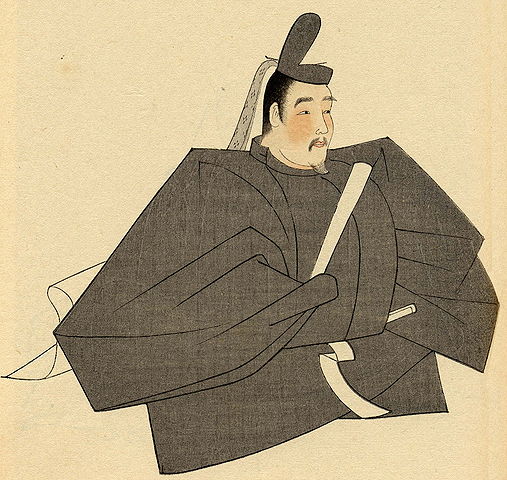
Portrait of Honen by Shinkai (忍海), courtesy of Wikimedia Commons.

Honen didn’t invent Pure Land Buddhist as a practice and tradition. We can see earlier examples such as Genshin who were already practicing it avidly, and indeed, Pure Land Buddhism had been popular for centuries, especially when the social order was breaking down in the 12th century.

However, what Honen did and why he’s still revered today is his efforts to make the Pure Land practices as utterly accessible as possible through recitation of the nembutsu. Where many career monks were concerned with politics, or were seemingly aloof with the plight of people outside the Heian-period aristocracy, Honen really went out of his way to help others, and teach them a simple, straight-forward Buddhist practice, without discriminating by social class or gender.

Honen’s encounter with the woman of the night has always been one of my favorite stories about him, and underscores his easy-going manner, and his commitment to helping anyway he could. Even after his exile from the capitol, he maintained his monastic vows, and taught the Pure Land even to his dying breath.

Admittedly, I do have some quibbles about Honen’s approach to Pure Land Buddhism, and James L Ford’s book on Jokei, a critic of Honen, rightly points out how Honen cherry-picked teachings from earlier Pure Land masters to suit his own viewpoint. However, one thing is certain: Honen was very sincere in his efforts even if one might questions his methods. He did not get delusions of grandeur the way some contemporaries did, and he did not retreat to monasteries in pursuit of the truth. He was out among the masses all the time, teaching fellow monks, nuns, and lay people everything he knew.

So, happy birthday Honen! Thank you for teaching this American, 800 years later, about the nembutsu, and helping me get started on the Buddhist path when I needed it most.

P.S. another contemporary critic of Honen, Myōe, tried to do something similar by promoting the Mantra of Light, but for whatever reason it never quite caught on. Similarly, Nichiren promoted the odaimoku a couple generations later.

All of these monks, Jokei, Myoe, Honen and Nichiren were all talented teachers and sincerely sought to help others, but for whatever reason, perhaps because Honen was the first, or something dynamic in his teachings, achieved an impact on Japanese Buddhism not seen since.

Through the Ages

Been reading the Lord of the Rings with my son, and I stumbled upon this quote that I had never noticed before.

‘But it is not your own Shire,’ said Gildor. Others dwelt here before Hobbits were; and others will dwell here again when hobbits are no more. The wide world is all about you: you can fence yourselves in, but you cannot for ever fence it out.

J.R.R. Tolkien, “The Fellowship of the Ring”

Just some food for thought…

The Amazing Adventures of Xuanzang

One of the most important figures in Buddhism and East Asian history is, arguably, also one of the least known outside of some cultural circles. I am talking about a famous Chinese monk named Xuan-zang (玄奘, 602 – 664).1 Recently, I found an old, but fascinating book on my shelf I had forgotten about, titled The Silk Road Journey With Xuanzang by Sally Wriggins. This book tells the story of Xuanzang as a young monk, who decided to journey to India to see historical land of the Buddha.

The “Flaming Mountains” near the city of Turpan on the Silk Road. Photo by es:User:Colegota, CC BY-SA 2.5 ES, via Wikimedia Commons

He is also celebrated in this video from Extra History:

Why would he do this? In his own words:

The purpose of my journey is not to obtain personal offerings. It is because I regretted, in my country, the Buddhist doctrine was imperfect and the scriptures were incomplete. Having many doubts, I wish to go and find out the truth, and so I decided to travel to the West at the risk of my life in order to seek for the teachings of which I have not yet heard, so that the Dew of the Mahayana [Buddhist] sutras would have not only been sprinkled at Kapilavastu, but the sublime truth may also be known in the eastern country.

Translation by Li Yung-hsi in The Life of Hsuan Tsang by Huili (Translated). Chinese Buddhist Association, Beijing, 1959

But journeying from China to India can’t be all that hard, right?

In fact, it was extremely difficult and dangerous, and a big reason why even getting Buddhism to China was such a big deal in the first place. First, one has to…

A 14th century Japanese painting of Xuanzang journeying to India. Courtesy of the Tokyo National Museum, Public domain, via Wikimedia Commons
  • Cross the Taklamakan Desert, then
  • Journey through the Kingdom of the Western Turks, hopefully unscathed, then
  • Follow the Tian-Shan mountains for weeks, then
  • Cross over the Oxus River (modern-day Afghanistan), then
  • Pass over a small mountain range that you might have heard of: the Himalaya mountains, meanwhile
  • Avoid getting robbed by bandits (Xuan-zang did encounter a few)
  • Avoid thirst and starvation, and
  • Avoid exposure to the elements (extreme heat and cold), and finally once India
  • Follow the Ganges River for thousands of miles downstream to the city of Benares.

The so-called “silk road” between China and India was not a simple road that people could just traverse, but a series of inter-connected trade routes, and due to the harsh climate and difficult environments, also a very dangerous one. Powerful steppe warrior tribes of Uyghurs and Turks, not unlike the Scythians, dominated much of these no-mans-lands, and were fickle with whom they protected and supported.

The revered remains of the Buddha’s hut in the Jeta Grove, modern-day Shravasti, myself, CC BY-SA 2.5, via Wikimedia Commons

While in India, Xuanzang journeyed to many areas. Among other things, he beheld the giant Buddhist statues in Bamiyan, Afghanistan (now destroyed), visited the Jeta Grove where the Buddha frequently resided with his followers, and many of the great cities along the Ganges River before residing at Nalanda University for some time.

Xuanzang’s residence in China, photo by Gisling, CC BY-SA 3.0, via Wikimedia Commons

Technically Xuanzang wasn’t the first Chinese monk to accomplish this. Another monk named Faxian (法顯, 337 – 422)2 was the first of several. Faxian stayed only in the northern part of India, then took a ship back to China. Xuanzang journeyed all over India, studied at the famous Nalanda University (coincidentally mentioned in the BBC recently) and then walked all the way back too. The trip took a total of 11 years.

When Xuanzang returned to China, he was feted by the Emperor and was given a team of translators and scholars to help translate and compile all the texts he brought back. This led to an explosion of information for the Chinese Buddhist community and helped the Yogacara school gain deeper roots in East Asian Buddhism which we still benefit from today. Much of these records were gradually lost in India, but preserved in China thanks to people like Xuanzang.

One other historical note here, when Faxian came to India, Buddhism was still a prosperous religion, but when Xuanzang visited centuries later, it was clearly declining in some areas, and slowly being replaced with the Hindu religion we know today.3 Some Buddhist monasteries he encountered still maintained certain practices but no longer understood why. Other monasteries still survived as great centers of learning, with others were completely deserted. It’s not surprising then, centuries later, when Turko-Afghan warriors invaded India and established a Sultanate, Buddhist institutions were easily swept aside.

One thing that’s often overlooked is the language barrier. Chinese language and Sanskrit (as well as spoken Prakrits) are miles apart. They have no common linguistic ancestry. The effort to translate old Buddhist texts from Sanskrit to Chinese during the Tang Dynasty had been a major undertaking and required multiple efforts to properly refine the translation. But Chinese Buddhist monks who could actually speak Sanskrit or any Indian language would have been very rare indeed. Xuanzang must have relied on translators, or somehow learned to speak it well enough to survive so long in India. That invaluable ability to speak it fluently would have been very helpful on his return trip when he translated the volumes of texts he brought back to China.

Also, keep in mind that translating concepts such as the “phenomena of the mind” is much, much harder than translating, say, a shopping list. This was an extremely challenging undertaking.

Xuanzang’s adventure became the inspiration for a 16th-century Chinese novel called “Journey to the West” (西遊記). This Chinese novel was hugely popular, and you can often see movies and dramas about it both in China and Japan. In Japan, it’s called saiyūki. When my wife and I were first married, we enjoyed watching the 2006 drama with SMAP’s Kattori Shingo as the lead actor. We also have an kid’s manga version Japanese for our son. Even the image of Goku from Dragon Ball takes some influences from Journey to the West (a simian-like being riding a cloud, for example).

The book is a fantastic overview of many places along the Silk Road, Afghanistan, Pakistan, Kashmir, and India that Xuanzang saw and wrote about, and are only dimly understood by Westerners. In many places where the US has been involved in overseas conflicts, it’s simply amazing how much history has been there, and how many different feet have tread upon that ground, including monks like Xuanzang and earlier by the Bactrian Greeks of Alexandar the Great.

In any case, I’ve always been a big fan of Xuanzang, and I feel he deserves a lot more recognition in history. So, to help readers remember who he was, I made a song about him based on the original Spiderman theme song ( original lyrics):

♫ Xuanzang-man, Xuanzang-man.

Does whatever a Buddhist can

Goes around, anywhere,

Catches sutras just like flies.

Look out!

Here comes the Xuanzang-man.

Is he tough?

Listen bud—

He walked the entire way there.

Can he cross a de-sert?

Take a look over there.

Hey bro!

There goes the Xuanzang-man.

In the chill of the night,

At the Roof of the World,

He crossed a ravine,

With only a rope bridge!

Xuanzang-man, Xuanzang-man,

Friendly neighborhood Xuanzang-man.

Wealth and fame, he’s ignored— Wisdom is his reward.

To him, Life is a great illusion—

Wherever there’s a stupa,

You’ll find the Xuanzang-man!♫

Try it out a few times. A few parts of the wording are a bit awkward, so I probably need to work on it some more.

P.S. Featured image is a photo of the Taklamakan Desert, photo by Pravit, CC BY-SA 4.0, via Wikimedia Commons

1 Pronounced like “Shwan Tsahng”. In Japanese, the same name is pronounced as Genjō.

2 Pronounced like “Fa Shien”.

3 A common misconception is that Buddhism arose from Hinduism, but this is inaccurate. Buddhism and Hinduism both have a common cultural ancestor in the ancient religion of the Vedas. Buddhism ultimately rejected the deistic religion of the Vedas and its veneration of the early gods, relegating them to secondary status, but Hinduism embraced it and gave it much more philosophical weight. Hinduism as we know it simply didn’t exist, and the religion of the Vedas was more similar to, say, ancient Greek religion around the Olympian gods.

Awesome Historical Totebag

Speaking of the famous “nun warlord” Hojo no Masako, I wanted to share something really great that I picked up in Japan in Kamakura (still uploading pics from that trip, blog post coming later):

This totebag features the famous speech by Hojo no Masako shortly before the Jokyu War of 1221, when the retainers of the new Kamakura government (shown above) balked at taking up arms against Emperor Gotoba:

その恩[故右大将軍, 源頼朝に]はすでに山よりも高く、海よりも深い。

“The obligation we bear to the late Udaishogun (Minamoto no Yoritomo, Masako’s husband) is higher than a mountain, and deeper than the sea.”

from the “Azuma Kagami” (吾妻鏡, “Mirror of the East”), dated to , made in the 19th day of 5th month of the 3rd year of JOKYU era

The totebag is really cute, and represents a really great moment in Japanese history. I have been proudly using it for shopping and such since I came back to the US. The bag is made by Samurai Kibun (homepage here), which makes a lot of great products featuring famous figures in Japanese history. It appears they are focused on domestic, Japanese audiences, so there is no English site, and it states that it cannot ship overseas. So, chances are, you’re more likely to see Samurai Kibun goods in local shops in Japan.

So, if you are in Japan and you do find some of their goods, definitely show some support and pick something up!

The Man Who Held It All Together: Hojo no Yoshitoki

I’ve talked about several aspects (and people) of a fascinating by tumultuous period of Japanese history from the late 12th to the early 13th centuries. The climatic battle between the Genji (Minamoto) and Heike (Taira) clans led to the establishment of Japan’s first military government (a Shogunate) away from the aristocratic Imperial court. This new “Kamakura Shogunate” was a fragile set of alliances, punctuated by more than a few shady murders by rivals.

So for today, I wanted to focus on the one man who, in spite of everything, managed to hold this house of cards together: Hōjō no Yoshitoki (北条義時, 1163 – 1224).1

Cover for “北条義時 歴史を変えた人物伝” (“Yoshitoki: Biographies of Figures Who Changed History”), available through Kodansha Press. I happened to buy this book early in 2022 and have been reading it from time to time.

Hojo no Yoshitoki was the younger brother of the famous “Nun Warlord” Hojo no Masako, and later became head of the Hojo clan after his older brother died in war, and his father was exiled by Masako.

Yoshitoki served as the “regent” of the Shoguns, eventually becoming the de facto ruler. I watched the NHK “Taiga Drama” series, The 13 Lords of the Shogun,2 and was super excited to visit the city of Kamakura once again (more on that in a later post) when we visited in December. One of the first things I noticed was how prominent the drama, and in particular Hojo no Yoshitoki were. His visage was everywhere:

Hojo no Yoshitoki in the center, surrounded by the other 13 lords on a box of chocolate mochi. The mochi was excellent, by the way.
A billboard in Kamakura featuring the museum exhibit for the show. Note the “triforce” in the background, the symbol of the Hojo clan.

The drama portrays Hojo no Yoshitoki as a somewhat tragic, but stalwart figure. He serves the new Shoguns as their close advisor and ally, but also they force his hand sometimes to do the dirty work necessary to keep the Shogunate functioning. As he gets older, and the subsequent Shoguns are increasingly ineffective, he steps in his role as shikken (執権) and asserts control along with his sister Masako. Thus, the Shogunate centered in the city of Kamakura was effectively run by the Hojo clan and Yoshitoki in particular.

A poster for The 13 Lords of the Shogun, portraying Hojo no Yoshitoki (played by Oguri Shun). All rights held by NHK.

Yoshitoki’s story, like his sister Masako’s, is pretty dramatic. His father, Hojo no Tokimasa, allied himself with Minamoto no Yoritomo who later led the Genji clan as they rallied back and destroyed the Heike. This was a big deal since the Hojo were descended from the Heike, but for various reasons had fallen out with them. The Hojo’s alliance also convinced other local warlords to side with the Genji as well. The Hojo were the glue that made it all happen.

The trouble was was that after the war was over, the shoguns weren’t particularly great rulers. Yoritomo, the first shogun, was mercurial and had many of his rivals killed including his various half-brothers (often forcing Yoshitoki to get involved). He also slept around a lot, infuriating his wife Hojo no Masako. The second shogun, Yoriie,3 was combative and had little patience for the subtleties of government, and was eventually stripped of his power by his retainers. He plotted to overthrow the Hojo, but failed. Yoriie’s younger brother Minamoto no Sanetomo was a more gentle figure, but had little power or force of will, and by this point the shogun’s power was so diminished that it was little more than a fancy title. Then, Sanetomo was killed by his nephew (Yoriie’s second son) Kugyo, ending the Minamoto line.

And that was all before the Emperor Gotoba attempted to restore the power of the Imperial Court through the Jokyu War. Hojo no Masako’s role in rallying the troops has been covered in other posts, but Yoshitoki had a strong hand in this too.

In fact, while brother and sister frequently clashed with one another, they still worked together to keep everything functioning. Yoshitoki often functioned as the administrator, while Masako was the “spirit” behind everything, especially after her husband died, and especially when they had to exile their own father Hojo no Tokimasa for his autocratic tendencies.

Sadly, due to holiday schedule, and traveling, I missed the final episodes of the NHK drama, so I don’t know how it ended (I have already pre-ordered the DVDs), but it’s clear that Yoshitoki and his sister Masako held the government together under very difficult circumstances.

The manga above is just one of several published over the years that I found covering the life of Hojo no Yoshitoki. He is a figure regarded in Japanese history as an able leader, a loyal retainer to the Shogun, and while his hands weren’t clean, he still came out of it all with a good reputation. Given how much backstabbing and plotting went on by his family, his allies, and his enemies, that no small feat.

Yoshitoki was, to put it mildly, the man who held it all together.

P.S. Japanese family names precede given names, hence Hojo the family name comes first. Also, in Japanese antiquity, the “no” was used by people of pedigree, implying they were from an important clan or house. Hence, Minamoto no Yoritomo would, roughly translated into English, mean “Yoritomo of the House of Minamoto”.

1 In Japanese ō and o are pronounced the same (e.g. as “oh”), but ō is two beats, while o is just one beat. This may seem odd to English speakers, and to us it sounds the same, but it makes a big difference in pronouncing Japanese correctly. More on that in a latter post. For the purposes of this post, Hojo and Hōjō are basically the same.

2 I originally mistranslated 鎌倉殿の13人 as The 13 Lords of Kamakura in earlier posts … oops.

3 Pronounced like Yo-ri-i-e (it’s easier to parse in Japanese than in Romanized script).

Lonely At The Top: Minamoto no Sanetomo

I’m still keeping up with the Japanese historical drama the Thirteen Lords of Kamakura, discussed here, which is based primarily on the Azuma Kagami (吾妻鏡) a historical text about the period, and a fascinating look at how the Shogunate, or samurai military government, of the Kamakura Period rose and fell.

The rise of the Kamakura Shogunate began with the climactic battle between the Heiki (Taira) clan and the Genji (Minamoto). In order to topple their rivals, the Genji had to enlist a complex web of alliances with other samurai clans in the eastern regions of Japan, with Kamakura as their capitol, most crucially the Hojo Clan (the source of the Triforce in the Legend of Zelda series). This alliance overwhelmed the Heike and led to downfall.

However, once the Heike were wiped out, and the old Imperial political order ended, the various clans including the Minamoto themselves turned on one another to sort out who the Shogun would be, and would be pulling the strings behind the throne. The first Shogun, Minamoto no Yoritomo, turned on his half brothers and killed them one by one using flimsy legal pretexts, while his firstborn son Yoriie, the second Shogun, vied with his council (the aforementioned 13 Lords above) until he was driven into permanent exile. Hojo Masako, the so-called “Warlord Nun” contended with her father Hojo Tokimasa when he tried to assert a dominant hand, and had him exiled too. As all this was going on, the various allied clans took sides with members of the Hojo and Minamoto. Generation after generation, people kept stabbing each other in the back in order to advance their faction in the new military government.

Sanetomo in court clothing, painting by the priest Goshin. Photo courtesy of Hannah, Public domain, via Wikimedia Commons

This left Yoritomo’s younger son, Minamoto no Sanetomo (源 実朝, 1192 – 1219), to assume the position as Shogun, the 3rd in line. Sanetomo was doomed from the beginning.

Sanetomo was a puppet of his maternal family, the Hojo Clan, who surrounded him as advisors and ministers, but also carried out the real functions of government. Sanetomo knew from early on that he was essentially a figurehead, and could easily be toppled by whatever faction wanted to replace him with a more amenable candidate for Shogun. It is said that Sanetomo retreated into drinking and composing poetry, of which one of them is included in the Hyakunin Isshu anthology:

JapaneseRomanizationTranslation by Joshua Mostow
世の中はYo no naka waIf only this world
つねにもがもなTsune ni mo ga mo nacould always remain the same!
なぎさこぐNagisa koguThe sight of them towing
あまの小舟のAma no obune nothe small boats of the fishermen
who row in the tide
綱手かなしもTsuna de kanashi mois touching indeed!
Also posted in the other blog…

Sanetomo evidentially composed the poem after watching some fishermen at work on the shore, envying their simple lives in contrast to the constant political infighting and manipulation that surrounded his.

Sadly, things never got better.

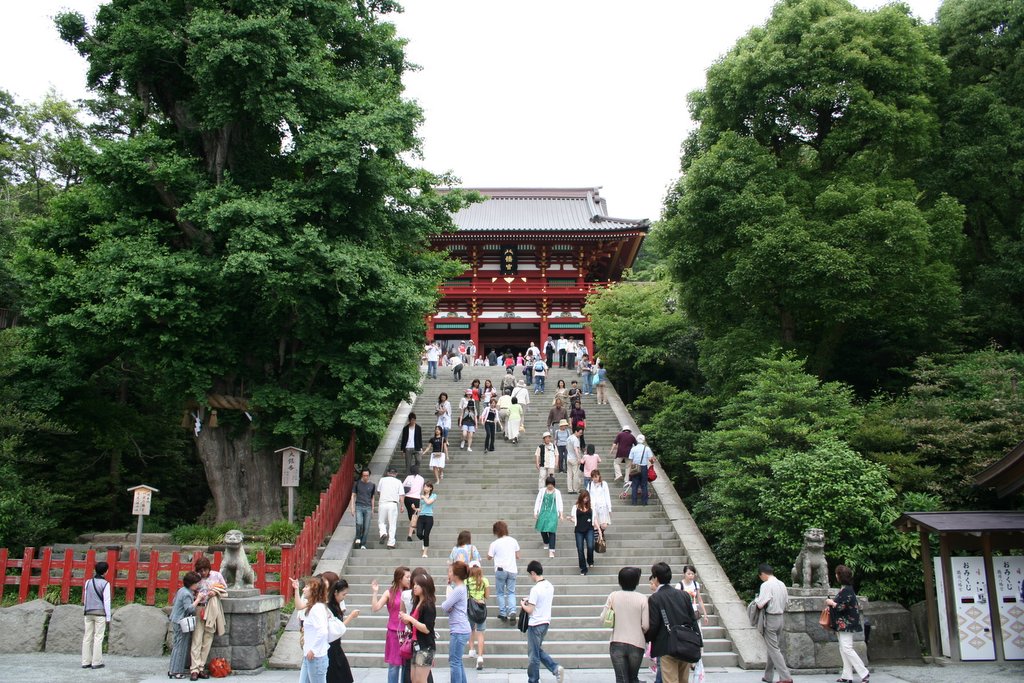
Sanetomo’s life ended at the age of 28, when he was assassinated by his nephew at the footsteps of the famous Tsurugaoka Hachimangu Shrine (visual tour here) in Kamakura. It is said his nephew hid behind the ginkgo tree there, and as Sanetomo descended the steps, leapt out and ran him through with a sword.

The gingko tree where Sanetomo’s assassin hid is shown here on the left. In 2010, the tree now many hundreds of years old, fell over in a powerful wind storm, and has been partially rehabilitated from a shoot. No machine-readable author provided. Abrahami assumed (based on copyright claims)., CC BY-SA 2.5, via Wikimedia Commons

Further, the Kamakura Shogunate only spiraled further. With Sanetomo’s death, the Minamoto line ended, and the Hojo Clan promoted various relations of the Minamoto (often drawn from the Fujiwara clan) as the subsequent Shoguns. Each one of these shoguns was simply another figurehead, while the Hojo tightened their grip on power as “regents”. Once Hojo Masako died, there was no one left savvy enough to hold it together, and the Mongol invasions further drained away any remaining resources until the government was finally toppled by a rival warlord.

Sanetomo’s life, the ignominious circumstances that surrounded his family (both his father’s line and his mother’s family’s scheming) ensured that even with the powerful title of Sei-i Taishōgun (征夷大将軍, “Commander-in-Chief of the Expeditionary Force Against the Barbarians”) he lived alone and apart from everyone, constantly in fear of his life, and powerless to do anything about it.

Amitabha Buddha and Gandhara

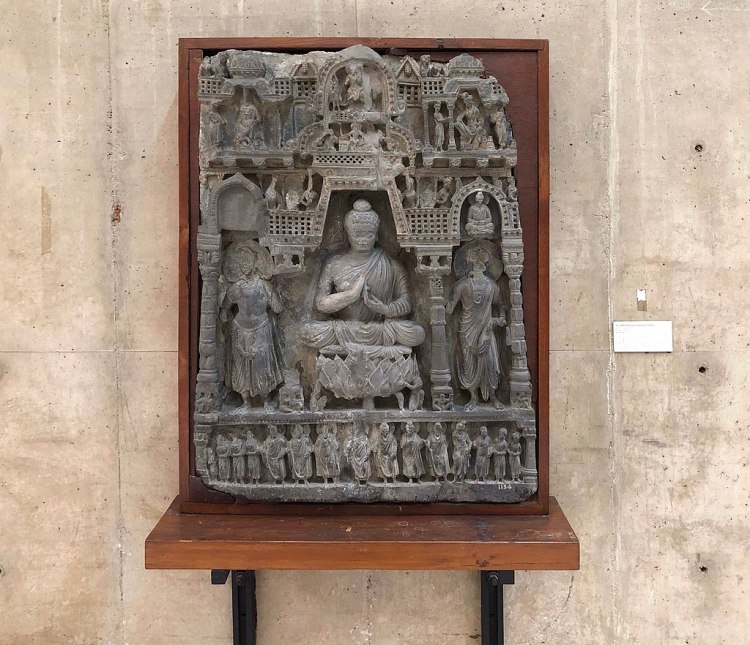
Recently, while bumbling around Wikipedia (as one does), I came upon this random but very fascinating example of Buddhist art from the Gandhara region. This is a depiction of Amitabha Buddha preaching upon a lotus throne in the Pure Land (Sukhāvatī in Sanskrit).

A 2nd-century Gandharan sculpture depicting Amitabha Buddha preaching from the Pure Land, UnpetitproleX, CC BY-SA 4.0, via Wikimedia Commons

This picture dates from the Kushan Empire, which inherited the earlier Greco-Bactrian and Indo-Greek kingdoms, who in turn arose from the empire of Alexander the Great. I’ve talked about the interaction between India and Greeks before, but the cultural interactions were even deeper than I originally hinted at. The Hellenistic Age Podcast recently posted a fascinating interview with Dr. Osmund Bopearachchi (website) that explored this cultural interaction even further. Highly recommend if you can.

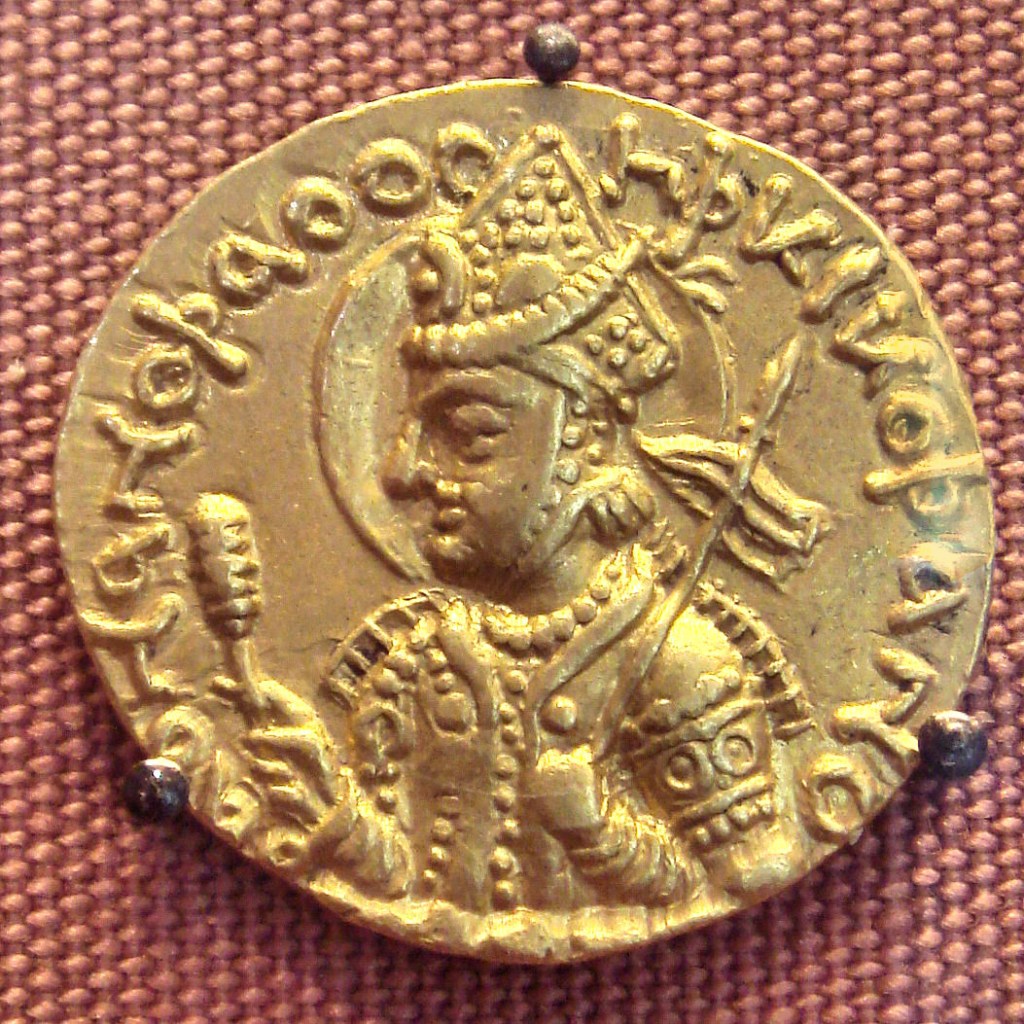
But this picture of Amitabha Buddha got me thinking about a more specific question: where does Amitabha Buddha come from? Amitabha is not mentioned in the earliest Buddhist texts at all, and the earliest statuary appears in the Kushan Empire under the reign of King Huvishka, while other artwork dates back to the Gandhara period of northwest India.

King Huvishka depicting in coinage from the era. Notice the halo behind his head. Public domain, via Wikimedia Commons

A number of interesting theories have arisen over time, some of which have been encapsulated in an essay from 1988 by Soho Machida titled Life and Light, the Infinite: A Historical and Philological Analysis of the Amida Cult. Machida points out some interesting facts:

  • No statuary of Amitabha Buddha have ever been found in India’s interior, only in northwest India.
  • Chinese monks who later visited India never mentioned Amitabha Buddha.
  • Luminosity as an Buddhist symbol is never described in early Buddhist texts, but does appear in later Mahayana ones.
  • Similarly, Buddhist statues that feature a luminous “halo”, known in Sanskrit as śiraś-cakra (Chinese: 光背), do not appear until the 1st century CE.
Late 4th-century Sasanian Persian relief of Mithra, by dynamosquito from France, CC BY-SA 2.0, via Wikimedia Commons

The people of Gandhara interacted not just with India, but also with the Scythians (who conquered the Indo-Greeks) as well as the Parthians. The Parthian Empire in particular did have a Buddhist presence, albeit small, and yet the state religion was Zoroastrianism, which frequently uses light as religious symbolism, especially in the royal symbolism of khvarenah. For example, the god Mithra, who also had a cult-following in the Roman Empire, symbolized light, justice, and the sun.

It’s conceivable that the neighboring people of Gandhara in creating new Buddhist art borrowed elements and styles from their neighbors and contemporaries:

  • from the Greek descendants of Bactria and Indo-Greek kingdoms, they learned to depicted the Buddha in an anthropromorphic way (i.e. similar to Greek statues) as Dr. Osmund Bopearachchi attests to
  • from the Parthians, they may have learned to depict wisdom, truth and compassion through the imagery of light, using the religious imagery of Zoroastrianism.
  • from India, they would have imported Buddhist teachings and concepts in an abstract sense, in addition to the literary tradition of the sutras.

If that is the case, then Amitabha Buddha represents a fusion of Indian-Buddhist thought, especially Mahayana Buddhism, with Parthian religious symbolism and Greek artistic methods.

The preamble of the Sutra of Immeasurable Life, one of the three core Pure Land sutras, depicts the gradual progression of a being to becoming a fully enlightened Buddha:

After attaining the Buddha-garland samādhi, he [the prospective bodhisattva] proclaims and expounds all the sutras. While dwelling deep in meditation, he visualizes all the innumerable Buddhas and in an instant visits every one of them. By elucidating and teaching the ultimate truth to sentient beings, he delivers them from the state of extreme pains, from the conditions in which suffering is so great as to prevent people from finding time for Buddhist practices, and also from the conditions in which suffering is not so great as to prevent them from doing so. Having attained the Tathāgata’s thorough knowledge and eloquence, he has fluent command of languages, with which he enlightens all beings. He is above all worldly affairs and his mind, always serene, dwells on the path of emancipation; this gives him complete control over all dharmas.

Translation by Rev. Hisao Inagaki

The Sutra, as one of the founding texts of Pure Land Buddhism epitomizes the path to Buddhahood, using the story of the historical Shakyamuni Buddha as the template, and through this sutra, Amitabha is clearly meant to be the epitome of Buddhas. What better way to epitomize a Buddha than to use infinite light as symbolism?

Fascinating stuff.

Update: posted some additional content I forgot add with the initial draft. Enjoy!