I’ve been sitting on this post for a little while, trying to decide how best to put things into words. I don’t like delving into contemporary issues, or politics. But it’s hard to ignore the many problems going on right now.
In particular, I keep thinking about the above quote, and the related Ship of Theseus for us Westerners. Even in peaceful times, it’s hard not to look back and see how things have changed, and won’t go back to the way things were before. Even more so in dramatic times.
But this year, I feel we’ve definitely crossed some kind of threshold, not just in a nostalgic sense.
Even after the Roman general Sulla retired in 78 BCE as dictator, the Roman Republic didn’t carry on as it did before. Instead, rapid decline continued as other men such as Cicero, Pompey, Caesar, and Augustus seized on the precedent to push their own vision of rulership. If one powerful man can break precedent, then what’s to stop others from doing the same?
Of course, this decline of the Republic1 had other precedents too. Bit by bit, across generations, things changed and the effects weren’t always clear until too late. Sulla opposed the populist, reformist Gracchi brothers, and the Gracchi Brothers in turn were opposed to increased centralization of land-wealth, which in turn had been caused by Rome’s increasing power and influence across the Italian Peninsula, etc, etc. Where one issue begins and another ends is hard to fathom. Instead, bit by bit, like the wooden planks on the Ship of Theseus, small changes gradually add up until something is no longer recognizable.
If we look at other societies, such as the fall of Heian Period aristocracy in 12th century Japan, it is the same thing: small changesbuiltup, followed by a dramatic shift in power, and then the aristocracy was then permanently diminished in power, replaced by military governments. Once the threshold was crossed, it was never the same, and that’s why the author of the Hojoki wrote what he did.
“How did you go bankrupt?” “Two ways. Gradually, then suddenly.”
Ernest Hemingway, The Sun Also Rises
Thus, here I sit, an armchair philosopher watching everything I took for granted in my youth change around me, often abruptly, until it’s no longer recognizable. I don’t know how things will resolve, though somehow they will. Yet, countless changes that will only make sense in hindsight have led to this moment in history that I am forced to live in, and I have to accept that in a sense it’s already over.
1 Technically speaking, the Republic (a.k.a. res publica in Latin, or politeia in Greek) never ended until 1453 with the fall of Constantinople. The way that modern historians define a republic is different than how Romans thought of it. The imperial era from Augustus onward was still seen as the res publica/politeia, it just gradually changed and evolved … like the Ship of Theseus … from one system of administration or another. But Romans never really viewed a “break” between the senatorial style of government and the later imperial one as a change in historical period.
This post is part four of four exploring the Ikko-Ikki Rebellions in 15th and 16th century Japan. You can find part one, part two and part three here.
The Ikko-Ikki Rebellions are remarkable as being the one time in pre-modern Japanese history where a peasant uprising not only succeeded, but successfully carved out a region of Japan that was ruled by the masses, and not by military samurai, nor the old aristocracy from Kyoto. The binding influence of the uprising was a strong affinity to a certain Buddhist sect, the Jodo Shinshu (浄土真宗, “True Pure Land Sect”), but there was more to the ikko-Ikki than a “rebel cult” as some labeled them.
Information in English about the Ikko-Ikki is sparse, and often misinformed. I am happy though to have obtained a copy of Dr Carol Tsang’s excellent book War and Faith: Ikko Ikki in Late Muromachi Japan (publisher link), covers the Ikko-Ikki, who they were, and their relation to the Jodo Shinshu sect. It’s been a fascinating read even for an old “history nerd” like myself.
This is the final part of this series. I wanted to go into more depth on some parts, but I wanted to keep a good, easy pace, so summarized some parts a little, while focusing on others. The history Ikko-Ikki was far more extensive and complicated than I expected originally, and I didn’t want to turn this into an eight part series. 😙
If you want to know, please Dr Carol Tsang’s good. It’s quite a good read.
Simmering Tensions after 1488
The defeat of Togashi Masachika in 1488 by a coalition of rebellious retainers and ikko-ikki armies of Jodo Shinshu-sect followers was a watershed for the rebellions, but things settled for a time in a tense balance of powers in the province of Kaga. This balance of powers meant that there was no sole ruler of Kaga, and whenever trouble arose, the central Shogunate authorities had to rely on whomever might be able to help settle a dispute locally. Sometimes ikko-ikki were enlisted to help keep the peace, other times, local samurai were tasked with defeating an ikko-ikki army.
As stated in part three the reputation of Rennyo, the 8th Caretaker of the Honganji Mausoleum, suffered even though he was not part of the rebellions, and was not even in the province. By 1489, he resigned as Caretaker (monshu, 門主) and Rennyo spent his final years proselytizing while his son Jitsunyo (実如, 1458 – 1525) carried on as the 9th Caretaker. Rennyo passed away at Yamashina Honganji temple in 1499.
Dr Tsang shows that Jitsunyo was pretty quiet and conservative for his first decade as Caretaker, carefully compiling Rennyo’s notes and letters, maintaining his reforms to liturgy and so on. Primarily ecclesiastical affairs, in other words.
Then 1506 happened.
Uprisings and Crackdowns
Without getting too embroiled in politics at the time, let me summarize. The Ashikaga shogunate by 1506 was getting weaker and weaker after the Onin War, and their deputy shoguns, the Hosokawa and Hatakeyama clans, were increasingly manipulating the succession process for the Ashikaga.1 This led to disputes by other retainers, and a power struggle increasingly spilled over to the provinces.
Jitsunyo, the ninth Caretaker (monshu, 門主) of the Honganji was forcefully approached by deputy-shogun Hosokawa Masamoto who strong-armed Jitsunyo (literally) to lend him ikko-ikki troops to help his cause. Jitsunyo refused saying he was only a peaceful monk, and tried to escape Masamoto, but Masamoto caught up to him and he finally relented.
It’s noteworthy that this was the first time in Jodo Shinshu history that the monshu directly ordered his followers to battle (even if hesitatingly), but it set the pattern for the next few generations.
This also proved to be a huge problems for the Ikko-ikki . Different Jodo Shinshu communities owed allegiance to members of the Hatakeyama, others the Hosokawa. Some refused Jitsunyo, others came flocking to his banner, but in the end, enough Ikko-ikki came to Masamoto’s assistance to turn the tide of battle. This also set a pattern that continued in later generations when Jitsunyo’s grandson Shōnyo (証如, 1516 – 1554)2 became the tenth monshu.
The Tenbun War
Unlike Jitsunyo, Shōnyo was much less hesitant to mobilize Jodo Shinshu followers into fighting forces to accomplish aims. During a civil between temples in Kaga province in 1531, Dai-shō (大小) Ikki War, Shōnyo decisively defeated the rebel temples and their armies, reasserting Honganji control.
The following year, the Tenbun War (天分の乱, 1532-1536) involved yet another generation of Hosokawa clan members fighting for control of Japan, and Shōnyo actively helped Hosokawa Harumoto (Masamoto’s grandson). The Honganji armies carried the day with Ikko-ikki members turning their wrath on Kōfukuji Temple and burning it down, while also looting Kasuga Shrine next door. This really shocked the establishment.
In the constantly switching alliances of the time, Harumoto turned on them and enlisted NichirenIkki for help. Yes, Nichiren Buddhism had it’s own ikki societes, that destroyed Yamashina Honganji in 1532, and briefly administered the capitol of Kyoto for a time. Despite the series of losses, the Honganji’s mobilization efforts meant that they were more firmly in control of Kaga Province and could muster future armies if needed.
Further, in other provinces, Jodo Shinshu temples in the Hongaji hierarchy created by Jitsunyo wielded considerable influence throughout Japan. Starting with Rennyo, many temples organized jinaichō (寺内町, “temple towns”) that were fortified and exempt from taxation to military authorities. Samurai were not even allowed in these towns, a policy called funyū (不入, “no entry”). This was a problem for local warlords who needed revenue, but also had to constantly deal with fortified temple towns in their own province. A young Tokugawa Ieyasu (future Shogun of Japan) had to contend with his local Ikko-ikki garrisons in order to assert dominance over his domain in the early 1560’s.
But finally, the Ikko-Ikki met their match. Sort of.
War with Oda Nobunaga and Downfall
(A screenshot of the classic strategy game Nobunaga’s Ambition (taken from Nintendo Switch). This shows the Kaga province in the hands of the “Honganji”, more correctly the Ikko-Ikki. Western kids like me who grew up playing this game had no idea who “Honganji” was. 😝)
For the last 100 years, the Ikko-Ikki had gradually grown from disparate, rag-tag bands of rebels to mass-armies mobilized by the Honganji (and its lineage of monshu Caretakers) that warlords would court for military favors. However, the Ikko-Ikki finally met their match with Oda Nobunaga (織田 信長, 1534 – 1582). Nobunaga, star of the Nintendo game Nobunaga’s Ambition (screenshot above), would briefly unify Japan by the 1580’s, but he did so through brutal warfare and centralizing power. This meant destroying any opposition: not just the Ikko-Ikki, but other religious powers such as the sohei warrior-monks of the Tendai Sect. There could be only one sun in the sky, and Nobunaga wanted tl be it.
Despite some initial friendly overtures by the 11th monshu Caretaker of the Honganji, Kennyo (顕如, 1543 – 1592), son of Shōnyo, Oda held a low opinion of the Honganji and it soon became clear that war was inevitable. The Honganji authorities rallied the Ikko-Ikki and fortified their position at temple complex of Ishiyama Honganji. According to one tradition, partially debunked by Dr Carol Tsang, the Ikko-Ikki by this era carried a banner that read:3
進者往生極楽 Advance and be reborn in the Pure Land 退者無間地獄 Retreat and be immediately reborn in Hell.
Nobunaga underestimated the Ikko-Ikki and sent a token force that was soon crushed. A similar, second attempt met the same fate. Finally, Nobunaga had enough and sent a much larger force, with his best generals, but the Ikko-Ikki were well-supplied and well-fortified. Thus began the 10-year long Siege of Ishiyama Honganji.
The end result of this massive and complicated siege was that eventually both sides tired, and ended in a truce, but the Honganji was definitely on the losing side of this truce. Nobunaga agreed to not execute its leadership, but the Honganji was totally burned down and later replaced with Osaka Castle. The Honganji also submitted to Nobunaga’s authority, though grudgingly. Some diehards tried to keep fighting but were destroyed.
Final Thoughts
Once Oda Nobunaga gained authority over all of Japan, the Ikko-Ikki as a phenomenon rapidly wound down and never appeared again. But, who were they?
The usual assumption in English was they they were religious fanatics, willing to die at the command of the monshu. And yet, Dr Tsang shows many examples where they disregarded the the monshu, and either didn’t fight, or sometimes they fight without the monshu’s approval. On the other hand, they had elements of millenarianism too: a deep desire not just to get better taxation, but as seen in Kaga province, to transform society.
Further complicating this was the widespread belief at the time that the monshu, in particular Shōnyo and Kennyo, did have the power to grant or deny rebirth in the Pure Land of Amida Buddha, vaguely similar to indulgences in medieval Christianity. Neither monshu promoted this idea, but they didn’t explicitly deny it either.
Thus, they were not just another peasant rebellion either. The shared religious identity that was Jodo Shinshu-sect Buddhism, in particular the Honganji lineage, gave them a sense of community that transcended the usual shifting alliances of the Warring States period. They weren’t just peasants either. Many urban merchants, artisans, rural jizamurai warriors, and others comprised the Ikko-Ikki in large numbers.
Were the rebellions a form of pre-modern democratic or Marxist revolution? No, they still submitted to authorities (secular and religious) and never reformed the local government in any way we would recognize as a democracy.
Thus, as Dr Tsang writes, the Ikko-Ikki defy easy explanation, but their impact on Japanese politics for the next few centuries, including how military authorities handled the arrival of Christian Europeans (i.e. zero-tolerance) and how the Edo Period reformed and brought all religious groups to heel, is undeniable.
P.S. posting this as a Friday bonus. Enjoy!
1 A pattern similar to previous eras of Japanese history, such as the Fujiwara manipulating the Imperial family, or the Hojo manipulating the succession of the Minamoto/Kamakura shoguns. Of course, this is not limited to Japanese history either, or even Asian history. Anytime there was a non-optimal family succession, it didn’t take long for retainers and advisors to weigh in…
2 Rennyo’s great-great-grandson, in other words.
3 The ikko-ikki at the Siege of Ishiyama did not carry this banner, but rather the allied Mōri clan in western Honshu, according to Dr Tsang.
Violence in reality is quite different from theory.
Spock, “The Cloud Minders” (s3ep21), stardate 5818.4
The fantastic history podcast, Grey History, had an episode covering a dark period of the French Revolution: the September Massacres of 1792. When I listened to this episode recently, I was struck by how barbaric and senseless the violence was. The people of Paris were gripped with paranoia and fear over the arrival of the Prussian army, and whipped themselves up into a frenzy which then unleashed itself on prisoners of Paris who were all assumed to be part of a counter-revolutionary conspiracy. The eyewitness accounts of the event were horrifying.
What led up to the September Massacres was, from my limited understanding, a kind of death-spiral of paranoia and factional fighting among the Revolutionaries. This paranoia had some basis, in that there were some French counter-revolutionaries, but most of it was just imagined conspiracies of “fifth column” elements in society that got more and more outrageous and dire. As different factions accused one another more and more of conspiracy with the counter-revolution the violent rhetoric ratcheted up until someone decided to take matters in their own hands….
Rhetoric is one thing but once the first blow lands, or the weapon is drawn, a point of no return is crossed and many will needlessly die.
“Trouble can be purchased cheaply, though the refund may be more than you can bear.”
Roger Zelazny, Creatures of Light and Darkness
You speak of courage. Obviously you do not know the difference between courage and foolhardiness. Always it is the brave ones who die, the soldiers.
Kor, the Klingon Commander, “Errand of Mercy”, (s1ep26), stardate 3201.7
In short, small comments can have lasting consequences. That’s why the Buddha taught that right speech should be timely, true, and worthwhile. If not, best to simply keep quiet.
Further, studies have shown that non-violent demonstrations are statistically more effective in bringing about social change.
So, while social justice is a worthy goal, the means of achieving it, and how one expresses dissastisfaction can have lasting effects.
This post is part three of three four exploring the Ikko Ikki. You can find part one and part two here. We have seen in part two Rennyo’s involvement in the rapidly growing Jodo Shinshu community, and how the seeds of conflict first began as a succession dispute between local samurai warlords. In this post we’ll see how things go off the rails…
The Ikko-Ikki rebellions are remarkable as being the one time in pre-modern Japanese history where a peasant uprising not only succeeded, but successfully carved out a region of Japan that was ruled by the masses, and not by military samurai, nor the old aristocracy from Kyoto. The binding influence of the uprising was a strong affinity to a certain Buddhist sect, the Jodo Shinshu (浄土真宗, “True Pure Land Sect”), but there was more to the Ikko-Ikki than a “rebel cult” as some labeled them.
Information in English about the Ikko-Ikki is sparse, and often misinformed. I am happy though to have obtained a copy of Dr Carol Tsang’s excellent book War and Faith: Ikko Ikki in Late Muromachi Japan (publisher link), covers the Ikko Ikki, who they were, and their relation to the Jodo Shinshu sect. It’s been a fascinating read even for an old “history nerd” like myself.
Now on with the show…
Succession Crises and Retirement
The beginnings of organized conflict by the Ikko-Ikki began when the succession crisis between the Togashi brothers began in part two. As neither side could decisively destroy the other, and began to enlist more and more locals to help.
Masachika, as we saw previously, recruited from the Jodo Shinshu followers (a.k.a. the Honganji sect) of Yoshizaki, while his brother, Kōchiyo, recruited elements of the local rival Takada sect of Jodo Shinshu. Both communities formed ikki societies vowing to fight and help their preferred claimant to succeed.
Needless to say, in 1474 Masachika was ultimately victorious, but as Dr Carol Tsang notes, he did little to reward the Honganji ikko-ikki for their support. This did not go well with the Honganji followers. Dr Tsang shows that documents while somewhat scarce, and confusing, demonstrate how Honganji followers protested the ungrateful military rule, but were then brutally suppressed in 1475. It’s unclear if the uprising had any approval, let alone knowledge, by Rennyo the 8th Caretaker. There is evidence however, that his advisor Rensō had some involvement, and was expelled by the Honganji later. Being expelled or shunned by the sect was a virtual death-sentence for such a person because of the loss of community support.
Rennyo had worked hard to avoid a violent image to the Jodo Shinshu sect, yet the uprising in 1475 cemented the image of the ikko-Ikki as violent religious fanatics. Rennyo for his part left Yoshizaki that same year, reportedly under the cover of night, and travelled to nearby provinces such as the town of Deguchi in Kawachi Province, and then later returning to Ōmi Province of his youth at a place called Yamashina. By 1480 he settled at Yamashina and lodging was built there for him. Soon after a new Honganji temple, called Yamashina Honganji (official homepage here) was built and completed by 1483. It is noteworthy that this temple was designed to be militarily secure, with earthworks, moats and so on. Such where the times they lived in.
While this happened Rennyo chose his firstborn son by his second wife, Jitsunyo (実如, 1458-1525), as the next Caretaker of the mausoleum after his firstborn son (Junnyo) by his first wife had died that year. We will meet Jitsunyo again in a later post.
Overthrow
Meanwhile, after 1475 the ikko-ikki of Kaga Province not only rebelled and refused to send tax revenues, other neighboring communities started doing the same. In Etchū and Hida Provinces next door, refugees from the 1475 uprising had setup communities, and several uprisings are recorded at this time, though documents are pretty thin on what happened. The Honganji followers were able to resist crackdowns by samurai overlords because the local ikko-ikki groups formed powerful alliances that assisted one another in times of need. The sense of shared religious identity, plus religious belief they were only doing what was right, set them apart from other mundane peasant uprisings.
As the ikko-ikki groups took over and divided up territory amongst themselves, they took on increasing administrative responsibility, often county (gun 群) by county. Until the year 1530, these ikko-ikki groups did not answer to the Honganji, and acted semi-autonomously. One of these ikko-ikki might seize land from the landowners in Kyoto, another neighboring ikko-ikki might settle tax disputes between its landowner and local peasants. It was all over the map. The military establishment would sometimes lean on the Honganji leadership (i.e. Rennyo then later Caretakers) to exert pressure on these groups if needed, but otherwise the local ikko-ikki groups ruled as they pleased, independent of one another, sometimes they even threatened the Honganji for interfering. There was essentially no functional central authority in Kaga Province.
In any case, the conflict in Kaga came to a head by 1488, Togashi Masachika had burned enough bridges with supporters that they rose up and overthrew him. This included members of the Jodo Shinshu Honganji sect (ikko-ikki), but also his samurai retainers and other non-religious ikki groups. He was widely unpopular, and people had enough. Masachika had been away for a time helping the Ashikaga shoguns on a campaign (i.e. currying favor with the central authorities), when a full-blown rebellion erupted. Masachika, hurried home, but was besieged at Takao (高尾城, takōjō) Castle.1 Try as he might, Masachika was unable break the siege, and within days, Masachika’s remaining forces were overwhelmed and destroyed. Masachika was no more.
Once the dust settled, Masachika’s uncle, Togashi Yasutaka, was installed as the governor.
Dr Tsang explains that there are two noteworthy things about the downfall of Togashi Masachika:
The rebel army wasn’t comprised of peasants, but large section of the province’s population, from lowly social outcast communities (tanners and such), to Masachika’s own family and retainers. It wasn’t a “peasant rebellion”, but a broad coalition.
During the wars in 1473 and in 1488, the Ikko-Ikki played a major influence in deciding who would govern the province. This kind of popular sovereignty (or at least popular influence on sovereignty) had never really existed in Japan before. In the classical period (aka the Heian Period) it was a bureaucratic aristocracy. Under military rule of the Shoguns, it was a feudal system based on grants and titles. Now, for the first time lower class people in the province were actively weighing in on who should govern.
However, this was only the first phase of the Ikko-Ikki. As we’ll see in part four (yes, series keeps growing…), the ragtag groups would grow even stronger in later generations.
Aftermath
Something to note here is that Rennyo had very little to do with these uprisings in Kaga province. Although his proselytizing efforts greatly increased the popularity of Jodo Shinshu-sect Buddhism in the countryside, and in so doing, helped forge a common identity that allowed the ikko-ikki to form such large communities, he was never involved in these uprisings, and would find out about it later since he was in a different province. Further, when chastised by Rennyo, the ikko-ikki paid little heed. They were fed up, and going to rebel anyway. The genie was out of the bottle, in other words, and Rennyo couldn’t put it back.
Nevertheless, the central authorities in Kyoto didn’t see it that way. Rennyo took a lot of blame for his “unruly followers” and was pressured to write a letter castigating them for their actions. The letter did little to change the situation, and by 1489, Rennyo retired as the Caretaker of the Honganji mausoleum, allowing his son Jitsunyo to take over. It was an ignominious ending for someone who had otherwise made huge contributions to Jodo Shinshu Buddhism and Japanese Buddhism as a whole.
P.S. I couldn’t find any cool historical photos from this particular era. Historical documents and evidence seem to be pretty thin based on Dr Carol Tsang’s book, so there isn’t much media or art. There would be plenty of artwork depicting the Ikko-Ikki in later generations.
1 The castle is no more, but you can see photos of the park here. I am also a bit confused by the name as it should be read as Takao (高尾), but the pronunciation, as listed in Japanese sources is Takō. Call it a quirk of Japanese language, I guess.
Speaking of sutras, while reading about the Heart Sutra in Japanese, I learned about an interesting trend in the late-medieval “Edo Period” (17th through 19th century) called eshin-kyō (絵心経), or “picture Heart Sutra”).
An example of a “picture Heart Sutra” from 1795 (photo taken in 1922), composed by physician Tachibana Nankei in his travelogue Tōyūki (東遊記, “Journey to the East”), Public domain, via Wikimedia Commons
The idea was to make the Heart Sutra, a brief, but important and very popular Buddhist text, readable by illiterate peasants using a kind of rebus. The pictures above, to a native Japanese speaker of the time, would evoke certain words, which matched syllables of the sutra. For example, a few I can pick out:
The demon-looking character is a Hannya (mentioned here), hence hannya.
The pregnant woman with a baby is hara, as in a the torso.
The five vertical lines is go as in the number five.
The upright sword is ken.
This is just one example. It turns out that there’s many different versions, using slightly different pictures and styles. According to this blog, the origin of these picture sutras was a man named Zenpachi (善八). During the Genroku Period (mentioned here and on the other blog), a high-water mark of Japanese (especially Tokyo) culture, Zenpachi wanted to make Buddhist teachings easier for kids to understand and helped devise these pictures.
What’s interesting is that the tradition continues to this day, as seen in my Heart Sutra totebag my wife picked up.
This version is very cute, and of course has hiragana pronunciation guides just in case, but I think it’s a clever way to keep the Buddhist tradition alive.
P.S. moved this to Friday to make up for the accidental double-post on Tuesday and space the content out. We’ll be back to Monday-Thursday schedule starting next week.
Lately, I’ve been enjoying a fantastic history podcast called Grey History, covering the French Revolution in detail. While enjoying this show I started thinking about a famous peasant uprising in medieval Japanese history called the Ikko-Ikki rebellions of the 16th century.
The Ikko-Ikki rebellions are remarkable as being the one time in pre-modern Japanese history where a peasant uprising not only succeeded, but successfully carved out a region of Japan that was ruled by the masses, not by military samurai, nor the old aristocracy from Kyoto. The binding influence of the uprising was a strong affinity to a certain Buddhist sect, the Jodo Shinshu (浄土真宗, “True Pure Land Sect”), but there was more to the Ikko-Ikki than a “rebel cult” as some labeled them.
Information in English about the Ikko-Ikki is sparse, and often misinformed. I am happy though to have obtained a copy of Dr Carol Tsang’s excellent book War and Faith: Ikko Ikki in Late Muromachi Japan (publisher link), covers the Ikko Ikki, who they were, and their relation to the Jodo Shinshu sect. It’s been a fascinating read even for an old “history nerd” like myself.
This post is part two of three exploring the Ikko Ikki, of which part one is here. We can’t talk about the Ikko-Ikki until we cover the life of the 8th-generation Caretaker (monshu, 門主) of the Honganji mausoleum: Rennyo.
I originally intended to do only two posts, but as I wrote this one I realized there was too much interesting detail, and now it has split into three.
Enter Rennyo
As we saw in part one, Jodo Shinshu had somewhat unorthodox origins as a fully lay-oriented sect of Buddhism, through the work of Shinran in the 12th century. Shinran like many disciples of Honen, had been exiled and defrocked. Shinran took this in stride, married, and continued to spread the Pure Land Buddhist teachings he had learned from Honen to provincial people until we returned from exile and died in Kyoto.
His mausoleum (later called the Honganji temple) was managed by his descendants for generations. Like other families in medieval Japan (and other medieval societies), marriages by Shinran’s descendants were arranged to help benefit the family political, economically, etc. These descendants managed the mausoleum, while also building powerful alliances with samurai clans, or influential disciple families in the provinces. Some even married into the aristocracy in Kyoto. Shinran’s various disciples in the provinces went on to found various sects of Jodo Shinshu, while the Honganji remained significant, but not very influential.
By the time of the disastrous Onin War in the 15th century, Rennyo (蓮如, 1415–1499) had been born to the 7th generation caretaker Zonnyō (存如, 1396–1457).1 His mother was of unknown origin, but it is thought that she was a maidservant of Zonnyō, and thus politically risky. She was sent away, and Zonnyō married a woman named Nyoen from an influential family. Rennyo and his step mother did not get along well, and suffice to say, there was a succession struggle between him and Nyoen’s son, but Rennyo won out in the end thanks to the powerful Hino clan (the same clan that married into the reigning Ashikaga Shoguns). Rennyo had also, as per tradition in the family, spent time training at Kofukuji temple in Nara, and could claim some tenuous connections to the prestigious Fujiwara clan through the Kujō cadet branch.
As Jodo Shinshu grew in influence, problems between the community in his native province of Ōmi, near Kyoto, and the powerful Tendai sect arose. Ostensibly, this was due to perceived heresies by the Jodo Shinshu sect, but there’s plenty of evidence that the Tendai sect viewed the growth of Jodo Shinshu as an impact to their fiefdom revenue. Before long, armed conflict with the Tendai sects warrior-monks arose, and the Jodo Shinshu community suffered greatly. The community attempted to fight back, organizing defenses (a forerunner to later Ikko-Ikki armies), bribing the Tendai sect to back off, etc, but the Tendai persisted.
Ministry At Yoshizaki
Bronze statue of Rennyo at the remains of Yoshizaki Gobō temple. Photo by 藤谷良秀, courtesy of Wikipedia.
Rennyo decided it was safer for everyone involved for him to leave, and eventually he retreated to a remote village named Yoshizaki (吉崎) in the province of Echizen in the year 1471. Yoshizaki had a number of advantages, including a large, existent community of Jodo Shinshu followers, distance from Tendai-sect centers of power, and political remoteness, and yet it was on a coastal trade route so it was prosperous too. Soon a temple, now known as Yoshizaki Gobō (吉崎御坊) was founded the same year. The official website (Japanese only) for Yoshizaki Gobō has some neat photos and illustrations, though bear in mind that the original temple was destroyed 1506, and reconstructed centuries later.
It was here that Rennyo and his proselytizing work really took off.
For context, Shinran the founder (and Rennyo’s ancestor) had lived in exile in the eastern provinces and spent much time there teaching the Pure Land am faith as he understood it. Even after he was pardoned and returned to Kyoto in his final years, the communities out in the principles (i.e. his disciples) continued for generations, each in isolated pockets. These communities grew and diverged gradually, but were always more numerous and influential than the Honganji branch under Rennyo’s ancestors.
Thus, when Rennyo showed up, things were a little tense. A major regional sect was the Takada sect (shinshū takadaha, 真宗高田派) which still exists today. I spent a weekend trying to figure out how the Takada sect’s version of Jodo Shinshu differed from the Honganji sect, but couldn’t really find any “ah ha” moments. They both revere Shinran, both recite the nembutsu, both revere Amida Buddha, etc., so the differences feel like they are mostly administrative and liturgical. Jodo Shinshu without the Honganji, in other words. The question, it seems, was basically who had the final say on doctrinal matters.
Rennyo’s Letters
Rennyo was a very active letter writer and these letters (ofumi, 御文) were instrumental in helping to strengthen and clarify the message and build relationships with local communities. I’ve talked about the most famous letter, the Letter on White Ashes, before, but I can say with personal experience that Rennyo’s letters overall are quite good and helpful in clarifying Jodo Shinshu teachings. You can find a collection of them here. I highly recommend reading the letter On Pilgrimage in the Snow (number 6 in the link above).
Side note: these letters (formally called the gobunsho 御文書), were compiled by later generations and are now an important part of Jodo Shinshu liturgy. When my mother-in-law passed away, and we attended her first year memorial in Japan, our local priest (a family friend) recited the Letter on White Ashes, after we recited Shinran’s hymn, the Shoshinge. That’s how important they are. You can see an excellent example of this here on Youtube:2
Within years, Yoshizaki grew to a much larger community, and Rennyo clashed with other existing Jodo Shinshu sects, while also reforming liturgy and standardizing aspects of the faith. Much of these power struggles at the time had as much to do with politics as they did doctrine.
For example, the aforementioned Takada-sect was allied with one Togashi Kōchiyo warlord who was in a bitter feud with his brother Togashi Masachika. The battles for rulership of Echizen and Kaga provinces spilled over into Yoshizaki when the defeated Masachika showed up to recruit members and rebuild his forces. Thus a local ikkō-ikki was formed to assist him.
As we’ll see, this was only the beginning …
P.S. I posted this too early on accident. Please enjoy, and apologies for any typos.
1 random and useless factoid – Rennyo was alive during the final days of the Eastern Roman Empire, and roughly contemporary with its final ruler, Emperor Constantine XI Palaiologos. Of course, Japan and Constantinople didn’t really know of one another. Still, it’s weird to think how both historical events were going on roughly at the same time.
2 The language of the gobunsho letters feels archaic now to a native Japanese speaker (or a language nerd like me), but at the time, this was how people spoke, and thus it was very accessible compared to more formal texts that monks in monasteries wrote.
April 8th in the Japanese-Buddhist tradition is the birthday of Shakyamuni Buddha, also known as “the Buddha”, “Siddhartha Gautama”, and so on. Many other countries celebrate on the 8th day of the 4th lunar month, so traditions vary.1
But I digress.
In Buddhism, a Buddha is a being who, across many lifetimes of hard work, religious discipline, and great compassion towards others fulfills the quest for Enlightenment. Not only that, a Buddha then teaches and awakens others rather than hoarding the joys all to themselves.
This altar, which is in the basement of Zojoji Temple in Tokyo, Japan, contains a tiny relic of the historical Buddha, Shakyamuni. It was donated in the 1950’s by India as a goodwill gesture after being discovered in an archeological site after countless centuries. Pretty neat story, actually, though not available in English.
So, within our tradition Shakyamuni Buddha (i.e. “the Buddha of the Shakya clan”) is what we call the historical Buddha who around 500 BCE fulfilled his path and taught others the Dharma: the principle of existence (think: “Law of Gravity” kind of stuff).
Thus, today is his 🙏🏼 birthday. Was he really born on the 8th day of the 4th month? Who knows.
The message of the story is more important than historical details: any sentient being, given enough time and dedication can fully liberate themselves, and then through awakened compassion, liberate others as well. Even someone who is totally rotten now can, given enough time and the right circumstances, accomplish great good.
The Dharma taught by the Buddha is for all. The Dharma is free, beneficial, and illuminating.
A joyous Buddha’s Birthday to you all! 🙏🏼
Namu Shakamuni Butsu (南無釈迦牟尼仏)
P.S. April 7th is the birthday of my favorite Japanese-Buddhist monk, Honen.
1 The Theravada tradition of South East Asia celebrates Buddhist holidays according to an entirely different calendar than the Mahayana tradition described here. As far as I am concerned, none of these holidays have reliable historicity, so just like Jesus’s birthday not actually taking place in December (taxes were not collected that time of year), the date is kind of artificial, and frankly doesn’t really matter. One date is as good as another.
Lately, I’ve been enjoying a fantastic history podcast called Grey History, covering the French Revolution in detail. While enjoying this show I started thinking about a famous peasant uprising in medieval Japanese history called the Ikko-Ikki rebellions of the 16th century.
The Ikko-Ikki rebellions are remarkable as being the one time in pre-modern Japanese history where a peasant uprising not only succeeded, but successfully carved out a region of Japan that was ruled by the masses, and not by military samurai, nor the old aristocracy from Kyoto. The binding influence of the uprising was a strong affinity to a certain Buddhist sect, the Jodo Shinshu (浄土真宗, “True Pure Land Sect”), but there was more to the Ikko-Ikki than a “rebel cult” as some labeled them.
Information in English about the Ikko-Ikki is sparse, and often misinformed. I am happy though to have obtained a copy of Dr Carol Tsang’s excellent book War and Faith: Ikko Ikki in Late Muromachi Japan (publisher link), covers the Ikko Ikki, who they were, and their relation to the Jodo Shinshu sect. It’s been a fascinating read even for an old “history nerd” like myself.
This post is part one of two three exploring the Ikko Ikki, but before we talk about the rebellions, we need to cover some Jodo Shinshu history. Speaking as someone who was part of the Jodo Shinshu community for a long time, and also a history nerd, Jodo Shinshu’s history is … different.
The Jodo Shinshu Sect
The Jodo Shinshu sect was one of several Buddhist sects that arose during the Kamakura Period of Japanese history (12th-14th centuries) as a kind of backlash to the Buddhist establishment at the time, and their close association with the ruling aristocracy. Starting with my favorite monk, Honen (法然, 1133 – 1212), a populist Pure Land Buddhist movement took shape, filling a gap that was missing in Japanese society at the time. To be clear, Pure Land Buddhism was not the only new Buddhist movement at the time: we see Nichiren Buddhism and new Zen sects imported from China as well. However, the Pure Land movement was much more widespread in comparison.1 Under Honen this movement was diverse, widespread, and loose-knit comprising of peasants, nobility, and clergy.
However, it was not to last.
The Pure Land Buddhist movement was punished by the Emperor in the Jogen Persecution of 1207 (承元の法難, jōgen no hōnan), and the community was scattered across many parts of Japan and its monks defrocked. Not unlike the many disciples of Socrates in classical Greece,2 these disciples each had their own recollection of Honen’s teachings, and since they were now living different provinces of Japan, individual sects and communities arose.
Jodo Shinshu – started by Shinran and the subject is this post.
“Single Nembutsu” teaching – started by Kosai (who was later denounced by Honen), but quickly faded.
“Many Nembutsu” teaching – started by Ryukan, but also petered out later.
Ji-shū – started by Ippen, who was not a direct discipled of Honen, but a disciple of Shoku’s disciple.
…. among other groups.
As we can see, Shinran (親鸞, 1173 – 1263) was one of these disciples.
A portrait of Shinran, founder of Jodo Shinshu, from the 13th century. Public domain via Wikimedia Commons.
According to some scholars, Shinran had been a mid-level disciple of Honen. When he was defrocked and sent to Echigo province he broke precedence, famously declaring that he was neither priest nor laymen. He then took a wife, and fathered children.
Shiran was not idle though. He was a prolific writer and teacher, spreading Honen’s message (as he understood it) to people in his province. After the exiles were pardoned, Shinran returned to Kyoto with his daughter Kakushin-ni (覚信尼, 1224-1281?) who cared for Shiran until his last days. Shinran spent his time in the capital still teaching, writing hymns and letters. When he passed, he left behind a large community of disciples in the provinces, and Kakushin-ni helped establish a mausoleum for her father in Kyoto. The ownership and maintenance of this mausoleum (later called the Honganji temple) was complicated, but it seems to have been a shared model between the disciples and supporters in the provinces, and Shinran’s descendants.
In time, Shinran’s grandson Kakué (覚恵, 1239 – 1307) assumed the role as caretaker of the mausoleum, the monshu (門首), after Kakushi-ni. Kakue passed on this hereditary role to his son Kakunyo (覚如, 1271 – 1351) and from here the role of Caretaker/Patriarch fell to successive descendants of Shinran even to this day. However at the time, the Honganji mausoleum was not very influential, compared to provincial communities. In time, that would change.
The “Karamon” gate of Nishi-Honganji (West Honganji) Temple in Kyoto, Japan. In the Edo Period, well after events here, the Honganji temple split into two separate temples and lineages due to strife between two brothers: east and west. Photo taken by me in 2010, hence the graininess (old camera phone). The Nishi Honganji temple website has excellent photos.
In any case, Jodo Shinshu from its outset was a firmly lay-Buddhist sect, the first in Japanese history. It was somewhat decentralized and had no monastic institution whatsoever. Other competing Pure Land sects listed above, were founded by monks, and still maintained some form of monastic institutions (some more than others) by contrast.
In the case of Jodo Shinshu, its local communities were organized by lay priests, peasants and craftsman who like Shinran worked and raised families. They organized religious gatherings in small dōjō (道場) rather than formal temples. A dojo in this context could be a room in someone’s home, or a communal space. A network of temples arose over the generations to oversee the various dojo, but early Shinshu communities started out small and informal.
This remained the state of the community for generations up through the Ikko Ikki rebellion.
The Warrings States Period and the Ikki Rebellions
Fast-forward about 200 years since Shinran and Honen. By this point in Japanese history, the reigning Ashikaga Shoguns have become permanently weakened by the disastrous Onin War, and social order was rapidly breaking down as rival warlords who had nominally supported the Ashikaga family, now fought one another for control of Japan. Technically, the Ashikaga still ruled a small region around Kyoto the capital, but the rest of Japan was rapidly descending into all-out war which lasted for another 100 years: the Sengoku or Warring States period (mid-15th through 17th centuries).3
A mural depicting a battle during the Onin War, by Utagawa Yoshitora, Public domain, via Wikimedia Commons
Japanese society at this time had been a feudal, militaristic society. The various domains and provinces had been managed by the Ashikaga Shogunate through a complex web of grants, appointments, and negotiations. Much like medieval society in Europe, the feudal order of Japan was complicated and full of political tension between the Church (i.e. the old Buddhist orders), local land-owning warlords, and peasants who were compelled to work the land in various arrangements. Similar to medieval England at the time, peasants were not all one social class. Many were modestly successful like the English yeoman, while others were saddled with ancestral debt and had to work the land they rented from their landlords (military or Buddhist temples) like European serfs. Other peasants were part of artisan communities that formed associations that might be vaguely compared to European guilds.
A portrait of Toyotomi Hideyoshi, formerly a peasant soldier, now the overlord of Japan and regent of the Emperor in 1598. Painting by Kanō Mitsunobu (狩野 光信, 1565–1608), Public domain, via Wikimedia Commons
Further, the distinction between samurai and peasant wasn’t so clear-cut as it would be in later generations. A low-ranking, provincial samurai or jizamurai (地侍) worked the land and sold goods just as peasants did, though they also had certain obligations to their liege lord, and enjoyed patronage and influence as a result. Even the famous Hojo no Yoshitoki worked his own land (at least some of the time).
Meanwhile, wealthy and powerful land-holding peasants could command local military resources when the needs for mutual defense arose, or lend them to the local warlord if needed, in return for some arrangement. Such peasant soldiers were often called up by local samurai as ashigaru (足軽) foot soldiers. Even the great Toyotomi Hideyoshi once started this way before eventually claiming dominion over all of Japan.
So, while there were social classes, they were fluid, and the boundaries were vague. A low-level jizamurai and a powerful peasant weren’t all that different. In the end, it was a “might makes right” environment.
Thus, in this fast, fluid and shifting environment, communities or like-minded people would form an ikki (一揆), which was a society founded for one single purpose. According to Dr Tsang, ikki were often formed in a ceremony where the participants would gather at a religious site, sign a contract vowing to accomplish their stated aim, burn the contract, mix the ashes into water, and drink it together. The pact was thus sealed in the most solemn of manners.
But why form a society like this?
Local samurai, especially if they had familial ties, might found an ikki promising one another mutual aid and defense. Peasants of a village might form an ikki to push the government for tax relief. An ikki formed in 1428 was large enough to march on Kyoto and burned down debt owners and tax-collecting tolls, for example.
The Ikko ikki (一向一揆) specifically were formed by those who subscribed to the Jodo Shinshu sect, which was also called the Ikkō (一向) sect at the time. The term ikkō referred to their singular reliance on Amida Buddha (lit. all facing one direction: toward Amida and the Pure Land). Ostensibly these followers formed an ikki for mutual defense but soon grew to challenge the most powerful warlords of the era.
With the rise of Shinran’s descendant Rennyo, the ragtag societies grew into a powerful army that even warlords like Oda Nobunaga were unable to defeat. We’ll see more of this in part two.
Stay tuned!
P.S. These longer historical posts take some time to write (let alone proofread), so I may be delayed in posted part two.
1 The rise of the opposing Nichiren sect is an interesting aspect of Japanese-Buddhist history, but it’s out of scope here, and was somewhat smaller in scale. Dr Tsang’s book does point out that there were Nichiren Ikki groups, too, in later ages.
2 Socrates left behind no writing (unlike Honen who was a prolific writer), but his disciples such as Plato and Xenophon described
3 The “sengoku” name was borrowed from a much earlier, though equally fascinating, period of Chinese history. The Warring States Period of Chinese history should not be underestimated in terms of influence too, because many strands of Chinese political philosophy arise from this period, as various thinkers tried to grapple with the collapse of social order, and the debauchery and degradation of the times. These same ideas later had a profound influence on later Asian culture, and the world at large.
As a history nerd, I’ve spent a lot of time blogging about old Japanese history, but I wanted to talk about an oft-ignored yet fascinating period in Japanese history: the Meiji Restoration of 1868. This is called the meiji-ishin in Japanese (明治維新).
I was thinking about this lately while enjoying the excellent historical podcast Grey History, covering the French Revolution. The French Revolution of 1789 was a violent upheaval, with many unexpected twists and turns, of the old social order, but in the end led to the modern French republic we know today.
In some ways, the Meiji Restoration had similarities to the French Revolution, but also stark differences. Both were started by widespread dissatisfaction with a static, old order, both led to revolutionary changes that overthrew the old order and modernization of a feudal nation, but they had different conditions and led to different outcomes.
I am no expert on French history, but let me at least cover a bit of background on pre-Meiji history of Japan before the Restoration.
The Edo Period
After a century of warfare that tore Japan apart, the conflict finally ended under a single warlord: Tokugawa Ieyasu (德川家康, 1543 – 1616). Japan was unified around the year 1600, and the new Shogun established a new regime, a bakufu (幕府), based in the town of Edo (江戸). Edo eventually became Tokyo later, but at the time it was a provincial castle town.
Ieyasu wasn’t the first to unite Japan, but he made unification stick because he developed a better, more effective administration. Rival warlords were reduced to fiefdoms with only one castle each, and required to abide in Edo every other year. To avoid succession issues, Ieyasu created three cadet branch families (the gosanké 御三家) to provide heirs as a backup, in order of seniority:
Owari (尾張)
Kii (紀伊)
Mito (水戸)
In addition to suppressing and regulating the warlords, politically powerful Buddhist temple complexes were brought to heel and regulated, while everyone in Japan was ordered to register with one temple or another. This helped the Tokugawa Bakufu to regulate temples, and keep an eye on followers by extension.
Outsiders were locked out of Japan (sakoku鎖国) except for some very limited contact with the Dutch, and only at one port (Deshima) and only once a year. Every one else, especially Christian missionaries were banned from entry upon pain of death.
And finally, society itself. Using Confucian principles, most of society was organized into four general castes (士農工商, shinōkōshō):
Samurai – both as administrators and warriors
Peasants
Artisans
Merchants
Of note, the ancient aristocracy of the Fujiwara family, and the Emperor were above this hierarchy, but also sidelined by military government to be pure figureheads. It was a repressive military government by any definition, but it also kept Japan from tearing itself apart for 260+ years.
The problem is that it didn’t adapt to changing conditions.
Over two centuries worth of critical changes happened, both within Japan and outside, that made the regime increasingly unstable.
First, despite the caste system, real wealth and power gradually changed hands. The samurai class, despite being at the top of the hierarchy, were locked into the same pay structure for two centuries, while the merchant class in Japan profited off the stability and economic prosperity. Many samurai families spiraled into debt, and unable to increase their income because their families were doing the same hereditary roles they had generations earlier. Some low-ranking samurai worked menial jobs on the side just to survive, including peasant work.
Second, while Japan was stable, and isolated from Western colonial powers, those same colonial powers grew from being ragtag explorers to powerful maritime empires in two centuries. Science and technology rapidly developed, while Japan fell further and further behind. While some scholars in Japan imported such learnings through Dutch-imported books (rangaku, 蘭学), it wasn’t nearly enough to keep up.
The Tokugawa system prioritized stability, and it succeeded, but the price was centuries of enforced isolation and stagnation.
The Fall of the Tokugawa Bakufu
The last Shogun, Tokugawa Yoshinobu, abdicating his role at Nijo castle in 1867. You can see a really cool recreation of this moment at Nijo Castle in Kyoto. I highly recommend visiting. Photo by 邨田丹陵, Tanryō Murata, Public domain, via Wikimedia Commons
The downfall of the Tokugawa bakufu, to quote Hemingway, came slowly, then suddenly.
Due to prolonged economic depression, followed by encroachment by increasingly assertive Western powers, as well as old rivarlies from centuries before, the Tokugawa grip on power rapidly weakened. The infamous “black ships” of US Commodore Perry who strode nearly unchallenged by Shogunate forces, and demanded treaty rights in 1854 proved damaged the Tokugawa Shogunate’s reputation among rival warlords.
Before long, domains in western Japan such as Choshu, Satsuma and Tosa were sharpening their knives and working to overthrow the Shogunate. They wanted to accomplish two things:
Restore the Emperor back to power after being sidelined by the Tokugawa Shoguns for centuries.
Expel the foreigners who were increasingly encroaching on Japan.
This final period of Tokugawa history, the so-called Bakumatsu Period (幕末, “end of the Bakufu) is pretty fascinating, but complicated, and too much to go into here. Suffice to say, the Tokugawa forces were unable to contain unrest, and eventually civil war broke out between the Tokugawa and the enemy fiefdoms. The war was swift and Tokugawa forces fought bravely, but ultimately failed. The last Shogun, Tokugawa Yoshinobu wanted to end further bloodshed and abdicated, allowing the rebel forces to take control.
From here, the young Emperor Meiji was escorted to the new capitol of Tokyo (東京, lit. “Eastern Capital”) and a new era began which we now call the Meiji Era.
How the Meiji Era Unfolded
Compared to the isolated Edo Period, the Meiji Period was very different. The new oligarchs of the Meiji regime, those former warlords of Choshu, Satsuma and Tosa fiefdoms, recognized that against Western powers, the Japanese military had no chance. They were just too far behind technologically. So, they dropped the “expel the foreigners” slogan and adopted a new one: strengthen the nation.
This led to an intense, rapid Westernization of the country. The old feudal order was abolished, and old samurai were compelled to give up their titles and swords. Most did this eagerly, because it allowed them the freedom to invest in modern businesses and get lucrative positions in the new government. Some did not. The old fiefdoms were reorganized into “prefectures” along the French model, and the army was reorganized into a modern military. Japan adopted a constitution based on the Prussian model, which had a strong, central monarchy. Problems with this constitution arose decades later,1 but this was the first constitution that Japan ever had.
Like monarchies in the West, Japan was now a modern, constitutional monarchy, and sought to renegotiate trade arrangements on equal terms. In this respect, Japan was successful.
The Meiji Consitution, written using old-style Chinese characters and katakana script, a common practice in the Meiji period. Photo by Kantei, CC BY 4.0, via Wikimedia Commons
In addition to changes in government, the entire country went through a rapid modernization. Western technology such as railroads, telegraphs, and steam technology proliferated the country. Modern, forward-thinking Japanese chose to adopt Western dress and actively sought to learn English (Dutch was no longer a prestige language).
In the same way, Western words were actively adopted into Japanese and are now standard vocabulary now. For example:
Arubaito (アルバイト) – From German “arbeit” to work. Means a part-time job. Shortened to baito in modern slang (バイト).
Zubon (ズボン) – from French jabon (pants). Also means pants, especially slacks, in Japanese.
Kōhī (コーヒー) – from Dutch/Flemish koffie. Means coffee, obviously.2
Gasorin (ガソリン) – from English “gasoline”.
Speaking of words written in katakana script, the Meiji Period also shows an unusual trend in writing everything in katakana. The Constitution shown above is a mix of katakana script and older-style kanji. You can see similar patterns in books fo the time, or even signs, such as this sign found at the Great Buddha of Kamakura:
Notice the archaic English too, heavily borrowing Christian-style vocabulary to unfamiliar visitors.
Finally, a lot of old traditional Japanese practices were frowned upon at this time as Japan sought to project an image of modernity and Western-style culture.
How Does This Relate to the French Revolution?
I realize that comparing two different historical events a century apart, across two very different cultures is a tricky subject, but it is worth noting a few things.
First, the old order in both societies was based on a backward, feudal system with a hierarchical social structure. The French, similar to other European states, had the Three Estates of the Ancien Régime, and Japan had the four social orders of Shinōkōshō.
Both societies experienced widespread frustration at regime, not just by poor peasants, but also by middle-class intellectuals, and powerful declarations to modernize the country along enlightened principles. In France, you can see examples of this in the Declaration of the Rights of Man and of the Citizen by men such as Marquis de Lafayette and Abbé Sieyès, and in the case of Japan great writers such as Sakamoto Ryoma and Fukuzawa Yukichi. Ryoma in particular was inspired by the United States Declaration of Independence.3
Both changes ushered in a rapid era of modernization as well as a violent but doomed conservative reaction, and both introduced constitutions to countries that didn’t have them previously, as well as a more heightened awareness of national identity that didn’t exist previously.
But there are also big differences. The French Revolution was, among other reasons, driven by primarily internal challenges (starvation, taxation, etc), while the Meiji Restoration was due in part as an effort to protect Japan from foreign aggression in addition to internal issues. The French Revolution faced no such external threat until at least a year or two after it unfolded.
Finally, another interesting contrast is that France increasingly diminished the power of the sovereign (Louis XVI), while in Japan, the sovereign (Emperor Meiji) started with little power during the Edo Period but had his power restored by loyalists. France became a Republic, but Japan is a constitutional Monarchy.
This is a really quick overview, but it’s fascinating how these two events in history overlap and also differ.
1 Basically, the army answered to the Emperor, not to the civilian government. This worked well enough until the army decided to do what it wanted in mainland Asia, with no civilian oversight.
2 When I first met remember my in-laws, I remember trying to explain (in my poor Japanese at the time) that coffee was correct pronounced “Kah-fee”, not “koh-hee” as in Japanese. Thinking back, I didn’t realize that the Japanese word descended, not from English, but from Dutch. I always kind of felt bad about that.
3 A century later, after Vietnam became independent from French colonial power in 1945, Ho Chi Minh famously read aloud the Declaration of Independence of Vietnam, but observers at the time noted its similarities to the US Declaration. Similarly, French Revolutionaries often drew inspiration from the American Revolution as well. As an American, it’s sometimes easy forget what a significant moment in history the American Revolution was, and its message of revolution and Enlightenment thinking at a time of backwards, feudal thinking…. or reactionary thinking in the modern era.
Q: The redoubtable Commander Riker, whom I noticed before. You seem to find this all very amusing. RIKER: I might, if we weren’t on our way to help some suffering and dying humans who– Q: Your species is always suffering and dying.
Star Trek: The Next Generation, “Hide and Q” (s1ep10), Stardate: 41590.5
Something a little embarrassing I want to confess: sometimes, when I am uneasy or stressed, I go back and read some of my own posts. I don’t do this because of vanity (hopefully) or conceit, but I like to remind myself of certain things I might forget amidst daily turmoil. I suppose I write some of these blog posts as for myself to sort out what’s bothering me, as I do for the dear readers who follow the blog.1
One of my favorite posts of all time is this one. After visiting the Royal British Columbia Museum in 2022, and watching the excellent documentary about the different geologic ages of Antarctica, I walked away deeply impressed. These experiences help give a larger perspective about the world around us, and show how change is a constant of the universe whether we see it or not.
Change happens on the micro-level in our daily lives: one day to the next, we get older, our hobbies change, things at work happen, hairstyles change, etc. When I look at old photos of me and the kids, I am amazed at how much skinner I was, and no grey hear. 🤣
The world around us changes too: political, economically, and so on. The neighborhood you live in will look different 10 years from now, or looking back it’s probably changed in the past 10 years. Thinking about my life as a college kid in the early 2000’s, the Dot-com Era, it’s amazing how much has changed in a mere 20 years. Some things got better, some things got worse.
But if we step back even further, we can see with the benefit of hindsight slow-moving, multi-generational historical changes. From following the excellent History of Byzantium podcast, it’s amazing how much changes in the Eastern Roman (a.k.a. Byzantine) empire across generations. During the time of emperor Justinian the Great, chariot races were still hugely important in Byzantium, the empire had tenuous toeholds in North Africa and Spain, and many people still actively spoke Latin. By the time of emperor Manuel Komnenos, the Eastern Roman empire was far smaller, Greek language had long since replaced Latin, and the single universal church had long since split between Roman Catholic and Orthodox faiths. Between the 6th and 12th centuries, many changes happened, but because they stretch across many generations, it’s not possible for someone living within the city of Byzantium to fully grasp the scale of the changes. It was still the same Eastern Roman empire, and would continue for another 200+ years, but it had changed and evolved as external circumstances changed.
But let’s step even further back. An Egyptian peasant working the fields, or helping to build the Great Pyramid of Khufu, would be utterly stunned at the world today. Such a world would feel totally alien to him or her. It’s not just the level of technology we enjoy today, or the quality of our medicine, but also the way we view the world. Things that seem like common sense to such a peasant would feel strange or silly to us. Things that we inherently believe as 21st century adults would feel strange or bizarre to that peasant. We can’t really pin down when or how such things changed, but it’s series of gradual changes, each one piling on top of the rest.
And yet we can step even further back. If we look at the human race, it is new to the planet Earth. People can deny this using specious reasoning, but science doesn’t care what people believe or don’t believe. The natural world just works the way it does. We humans are just here, living on the Earth, but the Earth does not belong to us. We are its stewards. If not us, perhaps the Apes or Squids will be its stewards. 😏
Which I think brings me to my point: of all the craziness and turmoil going, I think there are two things to take away from all this:
We may lament how things have taken for the worse, but in a dispassionate sense, this is just more change unfolding due to causes and conditions that until now we may not have ever noticed. It doesn’t necessarily mean they are good changes, or harmless, but change is change. Also, by extension, the way things are now won’t always be this way in the future. Change is still happening, even if we can’t see it.
Of all the things to concern ourselves with most, in my humble opinion, the Environment (with a big “E”) is the most important. If we want to benefit Mankind, the Earth, and all life on it in ways that we’ll never see in our lifetime, if we want to get the most “bang for our buck”, then anything we can do to help the Environment works towards that end. Small changes and efforts now will ripple across generations we will never see, and help shape the Earth, hopefully in a positive way.
At times like this, I truly believe my old minister Rev. Don Castro of Seattle Buddhist Church was onto something when he described Buddhism, including Pure Land Buddhism, as an eco-religion. Amida Buddha, the Buddha of Infinite Light, embodies many things:
As an embodiment of the Dharma, Amida sheds light on the continuous nature of all things: impermanent, fluid, changing.
Also as an embodiment of the Dharma, Amida doesn’t require praise or devotion. The Dharma is just there, whether people notice it or not, whether they believe it or not. But as a Buddha, Amida tirelessly works to help all beings, to awaken them, to provide peace of mind.
Also as an embodiment of the Dharma, Amida embodies how all things relate to one another. The small things that we do day to day to help improve, or degrade, life around us affect others even if they are far removed.
Finally, Amida Buddha as the Dharma teaches rational, not selfish, thinking and non-fear. In a sense, WWTD: What Would Tuvok do?
All this is to say, I suppose, even amidst crazy times, do not fear. Take inspiration from the Buddha, make rational, wholesome choices, yet never assume things will stay a certain way forever. Do not be complacent, nor take things for granted.
Namu Amida Butsu
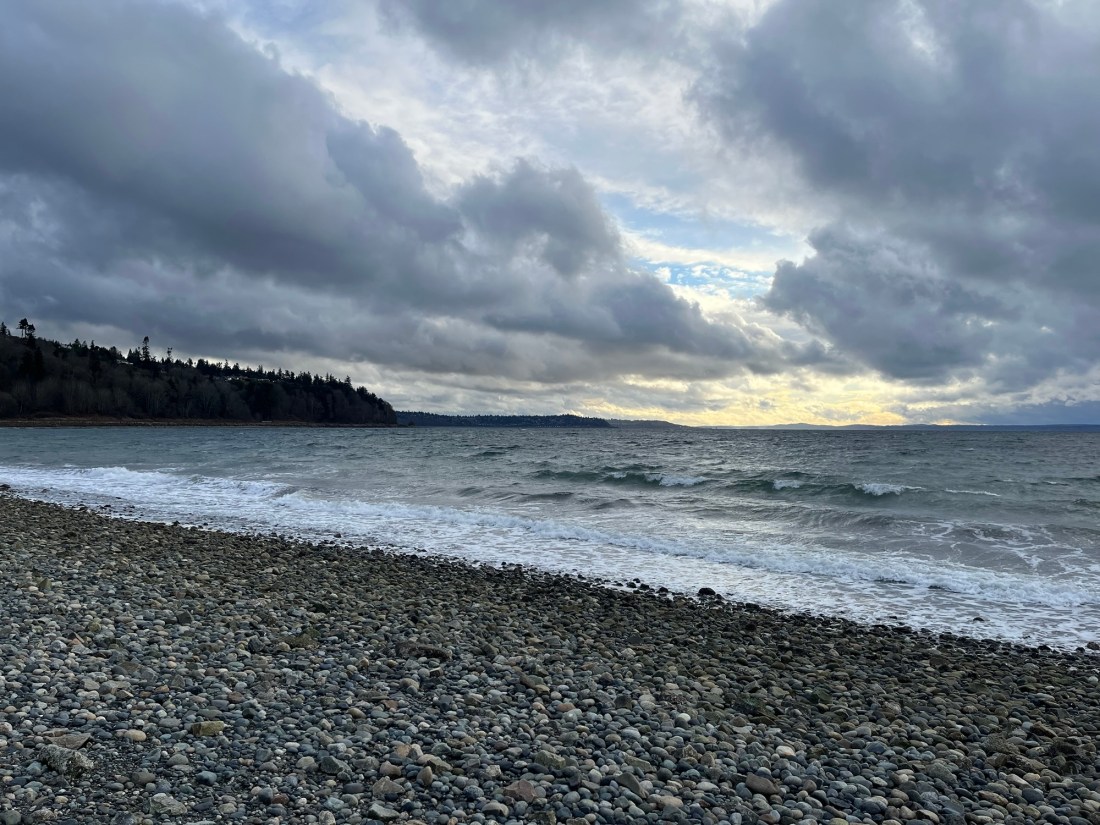
P.S. featured photo taken at Richmond Beach in Shoreline, WA earlier this year.
1 This blog is small-time, but it’s a labor of love, and I genuinely appreciate each and every reader.


 Gleanings in Buddha-Fields
.jpg)


.jpg)


You must be logged in to post a comment.