MCCOY: What he’s saying, Spock, is that a man who holds that much power, even with the best intentions, just can’t resist the urge to play God.
Star Trek, “Patterns of Force” (s2ep21), Stardate 2534.0
Since the beginning of time, powerful men have risen and then fallen. Doesn’t matter which culture, or which time period, sooner or later someone wants to be the Alpha, King of Kings, Pharoah, Shogun, President for Life, etc etc. It happens over and over again, and more often than not they self-destruct or their legacy crumbles after their death.
Take the case of Marcus Licinius Crassus, better known in history as simply “Crassus”. Crassus was absurdly rich. His wealth, and the political influence he bought with it, would make many hotshot-CEO’s today look like chumps.
We can look at examples and think to ourselves “what fools!”, but I think an even bigger lesson from this is that it can happen to any of us given the right circumstances. When we have power and authority, it is almost inevitable that we start to play god. In the Star Trek episode “Patterns of Force”, a historian tampered with an alien planet and (inadvertently) turned them into space Nazis.
The Ring of Power from J.R.R, Tolkien’s Lord of the Rings series illustrates this. Any person who gets a hold of the Ring, whether they be wizards, kings or elf-lords or even just hobbits, inevitably become corrupted.
Even Galadriel, one of the last of the mighty Noldor Elves on Middle-Earth and among the wisest of the elf-lords, was briefly tempted when Frodo offered her the ring, asking him if he wanted her to be a queen “terrible and fair”. Yet unlike her kin, she was able to resist and avoided a more terrible fate.
I feel I would be tempted too. This week I am filling in for my boss who’s on vacation, and even with this small dose of authority, I feel tempted to throw my weight around. How much more so if I was a world leader.
Why are we prone to this behavior?
I suspect it’s simply ego: our desire to mold the world in our own image. Even if we believe we are doing the right thing for others, our own ego blinds us to realities on the ground. If I had such power, I would probably fall into the same trap. People with strong egos are even more blind because they want so badly to project themselves onto the world while choosing to ignore the suffering it causes.
Of course someone has to be in charge. There has to be some form of authority for societies (or offices) to function. But it has to be treated as a radioactive, hot potato: something to be handled very carefully.
Anyhow, rambling thoughts here from the “Ozymandius” of my workplace.
Something fun to end this post though (direct link).
Recently, I found myself stuck in one of my usual nerd “rabbit holes” of trying to make sense of Zen lineages in Japanese Buddhism, but this led to a more complicated rabbit hole of making sense of the source “Chan” (Zen) lineages in China. This started after reading my new book on Rinzai Zen, which included a nice chart. At first, I tried to emulate and translate that chart in Canva, but then I realized it was missing some critical details, so I kept adding more. This is the result (click on the image for more detail):
Let’s go over this a bit so it makes more sense.
The premise behind all Zen sects regardless of country and lineage is that Zen started when the historical Buddha, Shakyamuni, supposedly held a flower up to his disciples and said nothing. Everyone was confused except his disciple Maha-Kashyapa who smiled in understanding. From here, according to tradition, the teachings were passed down from teacher to disciples for 28 generations in India, culminating in a monk named Bodhidharma who came to China.
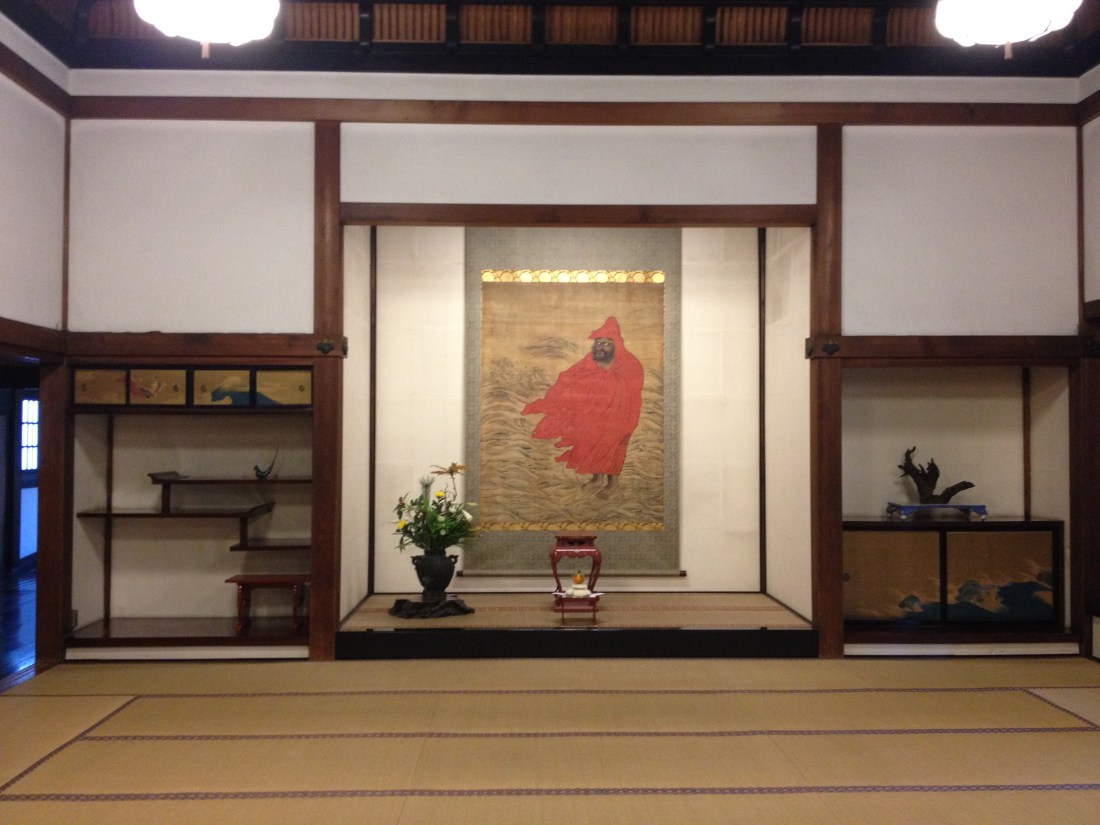
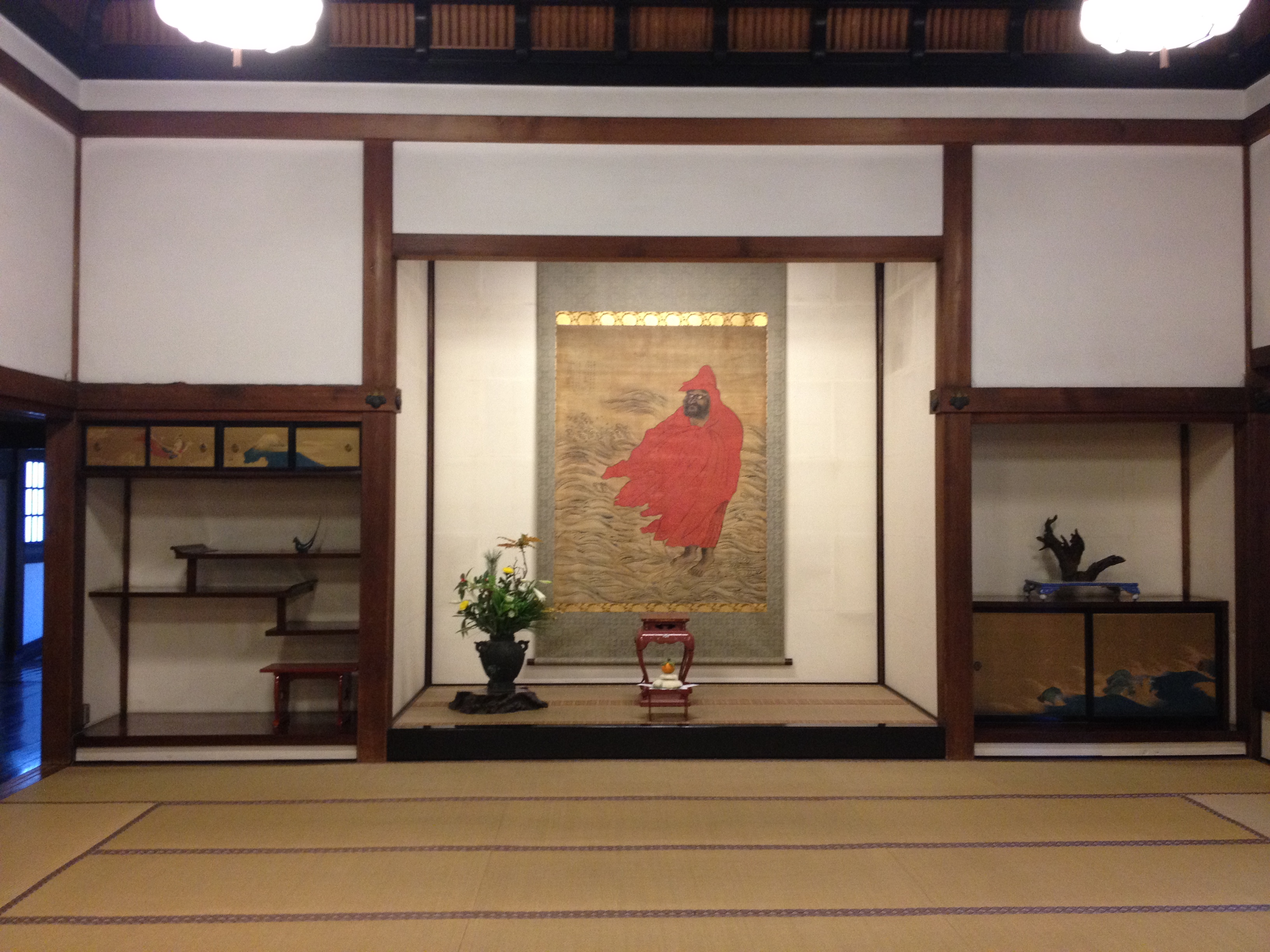
A painting of Bodhidharma at Sojiji temple (head of Soto Zen sect) in Kawasaki, Japan. Taken by me in 2010 (?).
The history up to this point is somewhat vague, and possibly apochryphal, but easy to follow.
This continues for a few more generations in China, until you get to a monk named Hui-Neng (Enō in Japanese)1 who is the supposed author of the Platform Sutra, a Chinese text. As the 6th “patriarch” of the lineage in China, he establishes what we know today as “Chan Buddhism” or Chinese Zen.
Things become more complicated a couple generations later as two descendants: Mazu Daoyi2 and Shitou Xiqian3 directly or indirectly found different schools of Chan Buddhism. This is known as the Five Houses of Chan period during the Tang Dynasty. Thus, the entire Chan/Zen tradition as we know it today is derived from Hui-neng and transmitted through these two men.
Out of the five houses, the Hongzhou,4Lin-ji and Cao-dong5 all survive in some form. The others are gradually absorbed into the Lin-ji school, which in the long-run is what becomes the most widespread form of Chan Buddhism in China. The Cao-dong school is the one exception, while the Hongzhou school’s success in Korea helps establish 8 out of 9 of the “Nine Schools of Seon (Chan)”6 in Korea. It through Bojo Jinul’s efforts in Korea that these nine schools are unified into the Jogye Order (homepage) which absorbed other Buddhist traditions in Korea into a single, cohesive one.
Meanwhile, in Japan, the Lin-ji and Cao-dong schools find their way to Japan where the names are preserved, but pronounced different: Rinzai and Soto respectively. Rinzai’s history is particularly complicated because they were multiple, unrelated transmissions to Japan often spurred by the Mongol conquest of China. Of these various Rinzai lineages, the two that survive are the “Otokan” Rinzai lineage through Hakuin, and the “Obaku” lineage through Ingen, but eventually the Otokan lineage absorbed the Obaku lineage. Today, Rinzai Zen is more formally called Rinzai-Obaku, or Rinnou (臨黄) for short. This is a bit confusing because Rinzai came to Japan under a monk named Eisai, and his lineage did continue for a while in Japan especially in Kyoto, but the lineage from the rival city of Kamakura ultimately prevailed and absorbed other Rinzai lineages. Obaku Zen arrived pretty late in Japanese-Buddhist history, and as you can see from the chart has some common ancestry with Rinzai, but also some differences due to cultural divergence and history.
Soto Zen’s history is quite a bit more streamlined as it had only one founder (Dogen), and although it did grow to have rival sects for a time, Keizan was credited for ultimately unifying these though not without some controversy even into the 19th century.
Anyhow, to summarize, the entire tradition started from a legendary sermon by the Buddha to Maha-Kashyapa, and was passed on over successive generations in India to a legendary figure who came to China and starting with Hui-neng became a tree with many branches. Yet, the roots are all the same. Speaking as someone who’s relatively new to the tradition, I realize while specific liturgy and practices differ, the general teachings and intent remain the surprisingly consistent regardless of culture or label.
Hope this information helps!
P.S. I had trouble deciding which term to use here: Zen or Chan or Seon since they all literally mean the same thing, but are oriented toward one culture or another. If this all seems confusing, the key to remember is that the entire tradition of Zen/Chan/Seon (and Thien in Vietnam) is all one and the same tree.
P.P.S. I realized that I never covered the Vietnamese (Thien, “tee-ehn”) tradition, but there’s so little information on it in English (and I cannot read Vietnamese), that I will have to differ that to another day.
1 Pronounced like “hwey-nung” in English.
2 Pronounced like “ma-tsoo dow-ee” in English.
3 Pronounced like “shih-tow shee-chee-yen” in English.
4 Pronounced like “hohng-joe” in English.
5 Pronounced like “tsow-dohng” in English.7
6 The Korean word “Seon” is pronounced like “sawn” in English. It is how the Chinese character for Chan/Zen () is pronounced in Korean Language.
7 If you made it this far in the post, congrats! I had to put so many footnotes in here because the Pinyin system of Romanizing Chinese words is a little less intuitive than the old Wade-Giles system. Pinyin is not hard to learn. In fact, I think Pinyin is better than the old Wade-Giles system (more “what you see is what you get”), but if you don’t learn Pinyin it can be confusing.better This is always a challenge with a writing system that strictly uses ideograms (e.g. Chinese characters). How do you write 慧能 into an alphabetic system that foreigners can intuitively understand. Also, which foreigners? (English-speaking, French-speaking, Spanish-speaking, etc). Anyhow, if you are interested in learning Chinese, I highly recommend learning Pinyin anyway because it’s quick and easy to pick up. BTW, since I posted about Hokkien recently it also has two different Rominzation systems: Pe̍h-ōe-jī (old, but widespread) and Tâi-lô (Taiwan’s official revised system).
While reading my introduction book in Japanese about Rinzai Zen, I came across a famous set of paintings that I had totally forgotten about for thirty years.
Me at the age of 17 demonstrating the “Lion Roar Yoga” pose (?) at my world religions class in high school with my teacher. The Burger King crown was something I got from the nearby restaurant because my friends and I would race there during lunch break, eat for 5 minutes, and run back to class. Ah, teenage life….
Many, many moons ago, I was a cocky 17-year old first learning about Buddhism, and Mr Pierini was my World Religions teacher in high school. Mr Pierini was a charming, older Italian-American gentleman who had a lovely opera voice, and loved sharing cool ideas with us kids. This is how I first started to explore Buddhism beyond reading books at home.1
There were a number of things I learned about Zen then that seemed really cool and mystical. Looking back they made no sense to me, but they were fascinating. It sounded “cool” to be Zen, but admittedly, I was young, clueless, showing off, and knew nothing. Among the things I read about at the time were the Mumonkan and the Ten Oxen, texts that (I realize now) are both related to the Rinzai Zen tradition.
The Ten Oxen (shíniú 十牛 in Chinese) is a famous set of ten paintings, with poetic captions that were composed in the Southern Song Dynasty of China. The powerful Song Dynasty lost the northern half of China to the barbarian Jin Dynasty,2 and retreated to the south beyond the Yangtze River, where it held on for another 150 years. Despite having their back to a wall, the southern Song Dynasty oversaw a wonderful flowering of Chinese culture, including Buddhism, and especially Chinese “Chan” (Zen) Buddhism. This is also noteworthy, because historically this is the time when such monks as Eisai and Dogen both came to China from Japan to study Zen.3
The use of oxen as a symbol for taming the mind in Buddhism, according to Wikipedia, dates way back to early India including such texts in the Pali Canon as the Maha-gopalaka Sutta, but the Ten Oxen were a way to visually explain the Buddhist path (as described in the Chan/Zen tradition) to readers as a nice easy introduction. There were, evidentially several versions in circulation, but in Japan the version by one Kakuan (Chinese: Kuòān Shīyuǎn, 廓庵師遠) from the 12th century was all the rage during the Five Mountains Period of Japanese-Buddhist history. It is since known as the jūgyūzu (十牛図).
My book has a nice, down to earth explanation of the ten oxen and what they mean, so rather than posting the images with poetry, I wanted to share the simple explanations here. The illustrations are from Wikimedia Commons, and were originally painted by one Tenshō Shūbun (天章周文; died c. 1444–50).
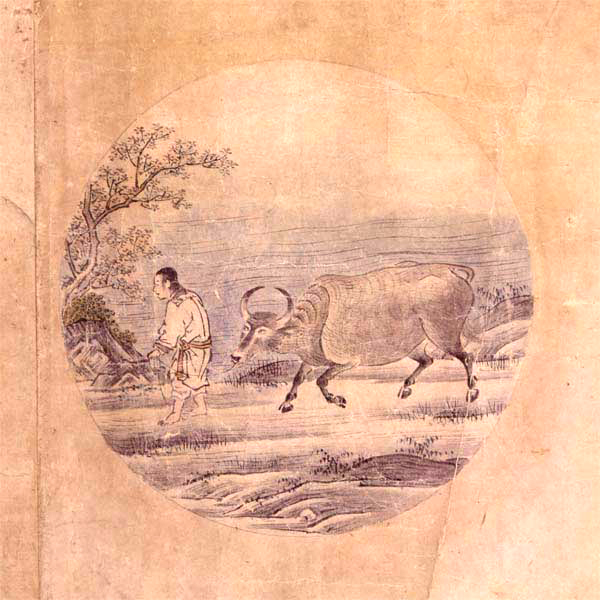
Searching for the ox
The cowherd is searching for his lost ox. The book explains that this is like someone looking for their lost Buddha-nature: that potential within us to awaken to full Buddha-hood (a.k.a. “Enlightenment”).
Footprints sighted
The cowherd now finds the footprints of his missing ox. This is like the Buddhist disciple who studies the Dharma (e.g. “Buddhism”), and gets the first hints at the true nature of things.
Ox sighted
Just as the cowherd sees his lost ox at last, the disciple of the Buddha grasps the point of the Dharma is (i.e. what’s it all about).
Grasping the Ox
One moment the cowherd has grasped the ox, another moment he is about to lose it. In the same way, my book explains that a person may perceived their true nature one moment, but lose sight of it again. The Buddhist disciple is still inexperienced and lacks certainty.
Taming the Ox
The wayward ox is now under control and lassoed, so the cowherd escorts it back home. For the Buddhist disciple, my book explains that through self-discipline such as the precepts, one’s delusions and conduct are brought to heel. This doesn’t mean they have resolved things, and one can still backslide, but at least they are under control now.
Riding the Ox
The cowherd is now confidently riding atop the ox, playing a flute. This means that one’s Buddha-nature is expressed through one’s form and behavior.
Forgetting the ox
Now that the cowherd is safely home with the ox, the ox is no longer a concern. My book explains that this symbolizes Enlightenment as one attains peace of mind.
Forgetting the distinction between self and ox
Here this empty circle expresses the Zen ideal that all is empty, and that there’s no distinction between oneself and the ox, or anything else for that matter; this is the Heart Sutra in a nutshell.
Back to basics
Having awakening to the nature of all things, things “return to the source” in a sense, or put another way, one sees mountains and mountains, trees as trees, etc. No more, no less.
Returning to society
My book explains that the cowherd now appears like Hotei (Chinese: Budai), the famous, jolly-looking figure in Chinese Buddhism and is in turn sharing the Dharma with another young cowherd. This cowherd will undergo the same quest, starting at picture one above.
In other words, everything comes full-circle.
In the same way, I don’t think teenage me imagined myself blogging about this 30 years later, and a bit more experienced, but life is funny that way.
Namu Shakamuni Butsu
1 Mr Pierini, thank you. 🙏🏼
2 Both would ultimately be destroyed by the Mongols especially under Kublai Khan who formed the Yuan Dynasty. This period of time is important to Japanese Zen history too because the influx of Chinese monks, especially Rinzai monks, to Kamakura-period Japan helped fuel a rise in Zen there. In the same way, the Fall of Constantinople in 1453 helped fuel the Renaissance in the West as refugees from the Eastern Roman Empire brought lost knowledge and know-how to the West. If there was any proof that we’re all connected in some way, look no further.
3 Earlier generations of Buddhist monks like Kukai (founder of Shingon) and Saicho (founder of Tendai) came to China during the Tang Dynasty, when connections to India were still flourishing. Hence, in Kukai’s case, he could study esoteric doctrine and Sanskrit directly from Indian-Buddhist monks. Centuries later, when Dogen and Eisai came to China, Buddhism had declined in India, and had gradually taken root in China in a more Chinese way. Of course, the Dharma is the Dharma, regardless of which culture and time it is taught, but it’s noteworthy that the Buddhism Dogen and Eisai was different: esoteric and scholarly Indian Buddhism had fallen out of favor, and a growing Zen (Chan in Chinese) community had largely replaced them.
The study of history is the best medicine for a sick mind; for in history you have a record of the infinite variety of human experience plainly set out for all to see; and in that record you can find for yourself and your country both examples and warnings; fine things to take as models, base things, rotten through and through, to avoid.
The author writes about why he believes that the Mongol invasions, which were so devastating and so unstoppable at first, stalled and then fell apart.
Bust of Ibn Khaldoun in the entrance of the Kasbah of Bejaia, Algeria. Courtesy of Wikimedia Commons.
He cites a famous Islamic historian named Ibn Khaldun (1332 – 1406) who had examined past empires and nations and developed a concept called “Group Solidarity“. The idea is that when a group is united in purpose, they can accomplish a lot, but over generations people in that group gradually develop diverging purposes, and they lose group solidarity. By this point, they compete with one another, or even sabotage or openly fight one another.
In the early decades of the 13th century, when the Mongol hordes expanded to the West, they smashed countless kingdoms and empires carving an empire from China to Eastern Europe. Under Chingis Khan (a.k.a. Genghis Khan), they fought under a single banner, but after his death, the territory began to fracture. The north-western part of the Empire was bequeathed to Batu Khan (one of Genghis’s grandsons) as the new Golden Horde, while the southwestern part of the Empire became the Ilkhanate under Hülegü, another grandson of Genghis, and finally China founded a dynasty, the Yuan Dynasty, under Kublai, yet another grandson of Genghis, and so on.
In time, the Ilkhanate advancee stalled when they lost s small battle to the Egyptian Mamluks, then the Ilkhanate and the Golden Horde gradually started to clash with one another, Even within the Ilkhanate dynastic disputes meant that different factions of the Khanate family (and their noyan allies) fought with each other.
As Ibn Khaldun rightly explains, the Mongol nation had a strong sense of group solidarity in the early generations, but as the sense of solidarity faded, people began to think of their own interests, causing the empire to fracture. Each khan and vassal noyan was fabulously rich, and had plenty of land and wives, but they were not content, and kept looking out for their own interests.
Of course, it’s not hard to find other examples of this in history, both ancient and modern history. It’s a pattern we all know, but Ibn Khaldun gives it a name, and that’s important. It’s not hard to see the powers of today falling apart in when they too lose their group solidarity and each leading figure begins to think of their own self-interest.
Anyhow, I don’t know much about Islamic history, but I think Ibn Khaldun deserves recognition for his analysis of history, and for coining this pattern of human behavior that keeps shooting us in the foot over and over again.
P.S. been on family vacation this week, but I have more fun stuff coming next week and onward.
The Ramen Museum in Yokohama is a great way to spend an afternoon, and I have visited a couple times in recent years. I even bought the manga biography about Ando Momofuku (安藤 百福, 1910 – 2007), the creator of “instant ramen”:1
I’ve had a long fascination with instant ramen, and with Ando Momofuku. As a poor kid with a single mom, we ate a lot of “Top Ramen” when times were tough. To be honest, I loved it. I would cook my ramen with an egg, and some frozen peas. In college, my roommate would cook with spam (salty, but tasty).
The story of Ando Momofuku and of instant ramen is pretty interesting. Momofuku was born in Taiwan, at a time when it was still part of the Empire of Japan (1895 – 1945), and thus while he is Taiwanese Chinese, he was also a Japanese citizen. He was born into a merchant family, and from an early age showed an aptitude for business. He took part in knitted textiles (meriyasu in Japanese, メリヤス), and in time was able to expand his business into Osaka since it all belonged to the same empire. From Osaka, the business grew, but then WWII came and many resources were increasingly rationed. His factory was destroyed in the air raids.
Rice production was carefully rationed as the war turned against Japan, and after the war, food supplies were still very limited. During the postwar period, people ate a lot soba noodles and ramen, since they are not made from rice. Ando Momofuku started a partnership business, but this collapsed due to some sketchy financial schemes, and he was jailed for a couple years due to tax evasion (supposedly helping provide scholarships for local students). Bankrupt, but inspired by the idea of making ramen noodles more accessible, he learned how to make ramen, and how to make it more portable and easier cook.
After considerable trial and error, he determined that flash-frying ramen noodles dries them out in a way that’s easy to rehydrate later with hot water. Thus, by August 25th 1958, the first instant ramen was made. Momofuku’s new company, Nissin Foods (Nisshin Shokuhin in Japanese, 日清食品) quickly sold the instant ramen to great success.
Early examples of “Chicken Ramen” sold in 1958, courtesy of the Cup Ramen Museum in Yokohama. Taken by me in 2023.
The “cup style” ramen came later in the 1970’s after Nissin realized that people outside of Asia didn’t eat ramen the traditional way (ramen bowls, chopsticks, etc). After some research, a styrofoam cup was invented, and carefully engineered to keep the brittle noodles safe from crumbling, and also keep the sauce and seasoning together. This allowed people to simply add water, and eat from a fork.
Examples of both packaged “top ramen” and “cup ramen” from the 1990s. Taken at the Cup Ramen Museum in Yokohama.
One of the things, in my opinion, that makes Ando Momofuku more than just a clever businessman is that as the instant ramen business succeeded, and copycat products flooded the market, Momofuku didn’t punish other companies, but instead started a industry-wide standard for instant ramen, and sold licenses to others companies to ensure consistent quality. For Momofuku, the most important thing was that instant ramen help contribute to food availability, and not just pure profit.
Starting with the Great Hanshin Earthquake in 1995, Nissin was responsible for distributing food aid to many sites around the world, and Momofuku often famously said the phrase 食足世界 (shoku tarite yo wa taira ka) which means something like “if there’s enough food, the world will be at peace”.
Speaking as a poor white kid in the 80’s and 90’s, I am grateful to Ando Momofuku for his innovation, and for his commitment to humanity. 🍜
My designed cup at the Cup Ramen Museum in Yokohama. Reads “thank you Ando Momofuku” with my poor handwriting. Taken in 2023.
1 I am using Asian-style naming convention, so family name then given name. Thus, Ando Momofuku’s family name is Ando, which he adopted from his Japanese wife, and his personal name is Momofuku. This is a Japanese name, not his family birth name. In his native Taiwanese-Chinese (aka Hokkien), his name was Go Pek-Hok (吳百福). Taiwanese Pek-Hok (百福) is read as “Momofuku” in Japanese. I want to do a side-post about Hokkien language sometime because I realize lately that it’s pretty underrated but influential, but research will take time.
This is just another small, bonus post. A little while back, I was looking into the Obaku school of Zen, but even in Japanese information is pretty hard to find. However, I was able to find this sound clip from the NHK. This is a sound clip of a morning service at Manpuku-ji Temple, the head temple of the sect.
What distinguishes Obaku Zen (ōbaku-shū, 黄檗宗) from other Zen sects, and Japanese Buddhism in general is how late it was imported into Japan from China. Most sects imported during the Tang or Song dynasties, namely 8th or 11th centuries. But Obaku Zen came to Japan during the Ming Dynasty (14th century). It shares the same common lineage as Japanese Rinzai Zen, so they’re sibling sects. Yet, across centuries some things had diverged, and Obaku imports a lot more Ming-era Buddhist aspects, such as a fusion of Pure Land and Zen teachings (which came later in Chinese-Buddhist history), and changes to liturgy and pronunciation.1
So, if you ever see Obaku Zen liturgy (I’ve only seen a few screenshots), it sounds somewhat different even when it’s the same liturgy, because pronunciation changed over time in China.
Anyhow, just a minor nerd moment. Please enjoy!
1 Languages change and shift, including Chinese. Chinese-Buddhist liturgy imported to Japan from the Tang Dynasty would sound different than the same imported into Japan during the Ming. If that seems far-fetched, look at English language.
It’s been a while since I discussed anything that relates to Tendai Buddhism, but I was doing a bit of nerd-reading with my free time, and thought this was interesting to share.
As Buddhism spread from India via the Silk Road, transmitted by such peoples as the Kushans, Sogdians, and Parthians (the same Parthians who contended with Rome from to time), the vast wealth of Buddhist texts, teachings and information flooded into China in waves.
This import of information was kind of haphazard at first, but as translations improved and information continued to come, China developed its own schools of thought to help make sense of it all.
One of the first successful efforts was by a Chinese monk named Zhi-yi (智顗, 538–597 CE)1 who founded the Tiantai school. He, or possibly by later patriarch Zhan-ran (湛然, c. 711-782 CE),2 analyzed the various teachings and Buddhist texts and developed a chronology called the Five Time Periods and Eight Teachings (五時八教, wǔshí bājiào).3 This chronology looks like so:
The Buddha (Shakyamuni) taught the Flower Garland Sutra first, but it was incomprehensible to disciples.
The Buddha stepped back and taught Agama sutras next. The Agamas are equivalent to the Pali Canon in the Theravada tradition, and nearly the same in terms of content. The Agama sutras were more grounded and practical and thus easier for his community to understand.
Next, the Buddha taught sutras such as the Vimalakirti Sutra as an introduction to Mahayana teachings, and thus higher than the Agamas.
Next, the Buddha taught the Perfection of Wisdom sutras, such as the Heart Sutra, as a more complete teachings.
Finally, the Buddha taughy his ultimate teachings: the Lotus Sutra and Nirvana Sutra because the disciples were now ready.
Thus, out of all the Buddhist texts, Zhi-yi argued that the Lotus Sutra was the complete and ultimate teaching (円教). In Japanese Tendai Buddhism, 円教 is pronounced as engyō, or is sometimes more formally called hokke engyō (法華円教, “the complete teaching that is the Lotus Sutra”). Much of Tendai Buddhism is thus about putting the Lotus Sutra teachings into practice. From the Tendai perspective, things like meditation, venerating Amida Buddha, esoteric practices like mantras, and upholding the precepts are all ways to put the Lotus Sutra into practice, and Zhi-yi wrote quite a bit about this subject.4 The idea, expressed through the phrase shi-shū-yū-gō (四宗融合) or “Four Integrated Schools”.
The historicity of Zhi-yi’s textual analysis is unfortunately pretty dubious. Modern archeology and Buddhology show that the very earliest texts, historically, were the Agamas / Pali Canon (the Dhammapada and Jataka Tales probably came even earlier), but even those were not recorded in writing until three to four centuries after the Buddha. So, even with the earliest texts, we have a gap from when the early disciples passed everything down orally before committing to writing generations later. Granted, Indian oral tradition was quite sophisticated and designed to minimize errors and corruptions in recitation, but the Agamas and Pali Canon do slightly diverge from one another, mostly in ways that are interesting to scholars only.
The Mahayana Sutras such as the Vimalakirti Sutra, Lotus Sutra and Perfection of Wisdom sutras were written down even later. One could argue that they were passed down orally5 and just recorded later for some reason, but textual analysis casts this into doubt. The Mahayana sutras are more like “reboots” or compilations of earlier teachings, more polished and such.
Which is where the Lotus Sutra comes in, I think.
This is personal bias, admittedly, but I do believe that the Lotus Sutra is a capstone of the Buddhist tradition, not because the Buddha saved it for last. Instead, the authors of the sutra did a really nice job of synthesizing earlier teachings into a single narrative, and devised clever parables to bring the teachings to readers in a fresh, new way. The Lotus Sutra doesn’t necessarily introduce a lot of new teachings so much as it brings it all together. Like a capstone or keystone. There’s something in there for everyone, in other words.
So, to me the Five Time Periods and Eight Teachings isn’t very useful in a literal, historical sense, but it is useful for showing how some sutras synthesize other sutras into increasing comprehensive narratives.
P.S. featured photo is the capstone of the main entrance of Giusti’s Palace, photo by Paolo Villa, CC BY-SA 4.0, via Wikimedia Commons
1 Pronounced like “Jer-yee” in English. The “zhi” in pinyin sounds like English “jerk” without the “k” at the end. His name in Japanese is read as Chigi, by the way.
2 Pronounced like “John-ron” in English. In Japanese, his name is read as Tannen.
3 This is read in Japanese language as gojihakkõ.
4 Pure Land practices as we recognize them do not seem to be prominent in Zhiyi’s time and were adopted into Tiantai later, and thus Japanese Tendai even later through such figures as Genshin.
5 The Lotus Sutra, for example is a mix of verse sections with narrative text around them. It’s argued that the verse sections came first, and then authors composed the narrative sections around them. When the verse sections were first composed is anyone’s guess.
Another Roman history nerd moment, if you will indulge me….
By 45 BCE, Gaius Julius Caesar (aka Julius Caesar) had defeated his rival Gnaeus Pompeius Magnus (aka Pompey the Great) in a lengthy civil war and returned to Rome.
From here, Julius Caesar kept pushing the limits of power, with no one pushing back, inching closer and closer to a king. Special thanks to Historia Civilis for these fun, awesome history videos:
His power grab was crass and violated centuries of tradition and laws, yet the Senate was packed with loyalists who just went along with it for personal gain, while opposition was uncoordinated and ineffective (special nod to Tribune of the Plebs, Pontius Aquila, though).
Even after Caesar’s demise, nothing really got better.
Instead, the facade of government was no longer there and lacked any real legitimacy, so men just grabbed power.
In time the Second Triumvirate (aka “rule by three men”) formed under:
Through a combination of purges, rivals were eliminated until eventually the Triumvirate turned on one another with only Octavian left standing.
Contrary to popular belief, the Roman Senate and other functions of state continued to exist. The res publica that is Rome never stopped being the res publica until 1453 CE with the Fall of Constantinople. Octavian didn’t even declare himself Emperor. He adopted the title princeps (“first among many”) as the leader of the Senate.
However, real power rested with Octavian and his descendants, the Julio-Claudian dynasty, and the Senate just kept getting weaker and weaker over the generations until by the time of the Eastern Romans (aka the Byzantines), it was pretty much ceremonial: honorific titles to confer on allied and friends. Even the title princeps kept going until Diocletian in the third century dropped the act and just called himself Emperor.
Speaking of the Eastern Romans, the line of Emperors continuing all the way to Konstatinos (“Constatine”) XI Palailogos in 1453 had its ups and downs. During a time of succession crisis, someone would once again fill the power vacuum and rule with blatant power, rather than legitimate rule. Emperor Konstatinos VII Porphyrogenitus in the 10th century had legitimacy, but he practically did nothing because his father-in-law Romanos Lekapenos held real power, and just propped his son-in-law up for legitimacy. Centuries later, when Constantinople was on the brink, Ioannes (“John VI”) Kantakouzenos in the late 13th launched a civil, and hired tons of Turkish mercenaries to fight for him. Needless say these, these Ottoman Turks didn’t leave, and, the Eastern Romans lasted only another 100 years.
This, by the way, is not limited to Western political history. In fact, centuries before the Roman Republic, if you look the famous Spring and Autumn Period in Chinese history, you see many examples of this too. Local nobility gradually morphed into warlords as the central Zhou (pronounced “Joe”) Dynasty lost its central grip on power. Kǒngzǐ (aka “Confucius”), living generations later when the system has practically collapsed, laments how local warlords perform religious rites that used to be accorded to the Emperor, and not someone of their station. These were gross power grabs, and Confucius criticized their lack of propriety and respect for the traditions and rites of the times.
Why do I mention all this?
It seems there is a pattern in history and politics than when governments are weak, someone with ambition fills the vacuum and just pushes things over. Such strongmen rule with power, not laws. As Frank Herbert wrote in the Dune series:
“All governments suffer a recurring problem: Power attracts pathological personalities. It is not that power corrupts but that it is magnetic to the corruptible.”
Frank Herbert, Chapterhouse: Dune
Going all the way back to Pompey the Great, there is a famous quote attributed to him by Plutarch which in Greek said:1
‘οὐ παύσεσθε,’ εἶπεν, ‘ἡμῖν ὑπεζωσμένοις ξίφη νόμους ἀναγινώσκοντες;’ “…at which Pompey said: “Cease quoting laws to us that have swords girt about us!””
This quote has been on my mind a lot lately, and is what spurred this lengthy diatribe, I suppose.
Laws and rules are only effective when people respect them. When people stop respecting them, they cease to be effective. In such times, political principles and theory hardly matter anymore. Power becomes the only true constant.
And of course, as we all know, power is a fickle thing, and easilylost.
A while back, I talked about the history of Zen [particularly Rinzai Zen] and the samurai class in pre-modern Japan. Rinzai has a particularly convoluted history compared to other Buddhist sects in Japan due to its multiple waves of immigration from China, each unrelated to one another. Soto Zen’s history is notably different, but fairly convoluted in its own way, since it has two founders.
This concept of two founders started in the 19th century, after certain Soto Zen temples got into a spat about who was the actual founder of Soto Zen. If you’re reading this and know something about Japanese Buddhism, you might think that the answer is obvious: duh, it’s Dogen since he was the one who went to Song-dynasty China, and brought the tradition back. That was Eiheiji temple’s position at the time.
Conversely, Sojiji Temple took the position that it was Keizan’s influence a couple generations later that actually allowed it to flourish in Japan, establishing it as a proper sect, and not just an isolated temple. Further, until the 19th century, Dogen’s writings were kept secret, so very few Soto priests and students ever read it. So Dogen’s actual influence in the sect would be thus smaller than expected. Or so the argument goes.
Needless to say, eventually the two groups came to a compromise and agreed that both monks contributed to the growth of Soto Zen in Japan, each in their own way. Thus, in the Soto Zen tradition since, they are known as:
Dogen – “high founder” (高祖, kōsō)
Keizan – “great founder” (太祖, taisō)
Thus every 29th of September the Soto Zen liturgical calendar holds a memorial service for both founders known as Ryōsoki (両祖忌, lit. “dual founders memorial).
Even today, if you look at a Soto Zen obutsudan in Japan, you often see altar images like the ones linked here and here: namely an image of Shakyamuni Buddha in the middle, and Keizan on the left (facing right), and Dogen on the right (facing left). This is not an entirely unusual arrangement, by the way: in the Jodo Shinshu tradition, the Buddha Amida is in the middle, and often flanked by Shinran the founder, and Rennyo the restorer. Sometimes in Tendai Buddhism, you also see Shakyamuni Buddha flanked by Saicho the Japanese founder, and Zhi-yi the original Chinese founder.
The concept of “trinities” often appear in Buddhism, though not in the Western-Christian sense.
In any case, I am glad to see that Soto Zen was able to reconcile this dispute in a way that feels harmonious to me. I have visited Sojiji a couple times over the years (since it is thankfully pretty close to my wife’s house),1 and it is a pretty neat temple. I haven’t visited Eiheiji yet as it is in a remote prefecture in Japan, but I am sure it’s quite a nice place to visit. Just like Keizan and Dogen, each temple enriches the Soto Zen community in its own way, and this helps broaden the community and make it more inclusive.
It is tempting to look at Japanese-Buddhist history and assign one sect to one founder, etc, but both Soto Zen and Rinzai Zen have histories that tend to defy this mold, and it’s important to recognize that religious history is organic and complicated, but also quite fascinating.
Namu Shakamuni Butsu
P.S. Moving back to two posts a week, now that the backlog is caught up.
P.P.S. Posting late, sorry! Made a scheduling mistake. 😅
1 The present location of Sojiji is actually fairly recent. It was in Fukui Prefecture (same as Eiheiji) for many centuries, and was a branch temple of Keizan’s main temple of Yōkōji (永光寺). Ironically, as Yokoji declined, Sojiji gained in prominence. But, history is funny this way.
I have been following the excellent Hellenistic Age Podcast as far back as the beginning of the Pandemic, and I always enjoy when Buddhist history overlaps with the Hellenistic Age of history.
Recently, the podcast featured a fascinating episode that covers the interaction between Buddhist India and the Roman Empire, particularly Roman Egypt.
Dr William Dalrymple shows how Roman and Indian cultural interaction was much more broad and influenced Buddhist art and culture, and vice-versa. It covers a lot of details that I definitely was unaware.
The podcast in general is great, but for readers here, definitely recommend.






 Gleanings in Buddha-Fields
.jpg&oldid=1011456203)
-testo_e_photo_Paolo_Villa-nA2-tesi_Accademia_Belle_Arti_Bologna-portone_di_Palazzo_Giusti.jpg)
You must be logged in to post a comment.