What separates countries and empires from civilizations is not size or wealth, or military power. It is their cultural significance, their contribution to Humanity.
Cultures might conquer others, but also ascend above raw power and economic exploitation, and contribute to science, art, philosophy, literature, and so on. Such contributions leave a lasting mark on Humankind for the better, not worse.
Conquering other nations, exploiting other people’s resources, and such contributes nothing useful. No one will remember you when you are gone someday, except maybe historians.
Instead, if a nation is going to be remembered, it will be remembered for leaving violence behind, and embracing reason and goodwill. By lifting people up, not trampling them By elevating science and reason, not superstition and religion. This is true for empires long ago, but also for police-states now.
At least that’s my opinion… 🖖🏼
1 Quoted from both Star Trek IV: The Voyage Home, and the Star Trek: Enterprise episode “The Forge” (s4:ep7)
The Heian Period of Japanese history is a really fascinating period, both culturally and historically to me. I even made a whole side-blog devoted to it (15th anniversary this week!). When you read books like the Diary of Lady Murasaki or the Pillow Book, there are a lot of cultural allusions that are hard to translate into English, or even contemporary Japanese culture, and that includes the role of professional diviners called the Onmyōji (陰陽師).
The Onmyoji were not mere soothsayers, but were trained to read various signs and calculations, and compile calendars for the coming year to determine the movements of the gods, moon, stars, etc. This was then used by the aristocracy to make decisions, where to travel and so on.
Much of these calculations were based on practices imported from China: the Five Elements Theory, Yin-Yang philosophy, geomancy,1 and so on. When we think of elements: we think of earth, wind, fire and water,2 but in Chinese philosophy it was earth, wood, metal, fire and water. In the traditional calendar used today across Asia, these philosophies are still preserved. For example, this year (2026) is the yang-fire-horse: (丙午, hi-no-e-uma in Japanese)
The Crest of the famous Onmyoji, Abe no Seimei. The five points alluded to the Five Elements. Courtesy of Wikipedia.
But let’s look at a concrete example.
Onmyoji often calculated inauspicious directions of travel. The idea was that a certain Taoist god named Ten-ichi-ji (天一神) would wander in various cardinal directions. If you traveled in the direction that Ten-ichi-ji was dwelling on that particular day, you would suffer the wrath of that god and be cursed. Therefore, people had to avoid traveling certain directions on certain days. This would lead to convoluted efforts to reach your destination from another direction, a practice called katatagae (方違え). People would travel the night before (before it became inauspicious), or travel in a roundabout direction to get there.
In the Pillow Book, Sei Shonagon discusses the hassles of inauspicious directions:
[154] When Her Majesty [Empress Teishi] was in mourning for the previous Regent, she was required to leave the palace at the time of the Great Purification at the end of the sixth month. However, the Office of the Empress’s Household happened to be in a forbidden direction at the time, so she moved instead to the Aitadokoro [residence], which belonged to the Council of State.
Our first night there was hot and extraordinarily dark, and we spent it feeling cramped and rather anxious as we waited for the dawn.
Another example were abstinence days. Onmyoji calculated days that were highly inauspicious, called monoimi (物忌み), which required people to undergo a day of abstinence. People who were stuck at home on an abstinence days had to avoid anything impure: sex, travel, talking too loud, important work, certain foods, etc. They even had to wear special talisman in their hair or hat.
In the Pillow Book, Sei Shonagon recalls an incident with her lover Yukinari:3
[129] One evening, Secretary Controller Yukinari visited the Office of the Empress’s Household, and stayed talking far into the night. He finally left as dawn was approaching, remarking that he must return by the Hour of the Ox since he was obliged to stay at the palace all day owing to an Imperial abstinence.
Translation by Meredith McKinney
By the way, the passage above also contains Sei Shonagon’s famous poem which was later used in the Hyakunin Isshu (poem 62).
Further, she remarks how annoying abstinence days were:
[22] …. You’ve taken special care to send off a beautiful, carefully written letter, and you’re eagerly awaiting the reply — time passes, it seems awfully long in coming, and then finally your own elegantly folded or knotted letter is brought back, now horribly soiled and crumpled and with no signs reminaing of the brush stroke that sealed it. “There was no one in”, you’re told, or “They couldn’t accept it on account of an abstinence”. This is dreadfully dispiriting.
Onmyoji didn’t just make calendars, they also performed various purification rituals, and exorcisms that Buddhist or Shinto priests would not do. In the Diary of Lady Murasaki, the eponymous author4 writes about the commotion and rituals the Onmyoji would use to protect Empress Shoshi WHILE SHE WAS IN LABOR:
At the moment of birth what awful wails of anguish came from the evil spirits! Preceptor Shin’yo had been assigned to Gen no Kurõdo, a priest called Myoso to Hye no Kurõdo, and the Master of Discipline from the Hojüji to Ukon no Kurodo. Miya no Naishi’s enclosure was being overseen by Preceptor Chisan; he was thrown to the ground by the spirits and was in such distress that Preceptor Nengaku had to come to his aid with loud spells. Not that his powers were on the wane, it was just that the evil proved so very persistent. The priest Eiko, brought in to help Lady Saisho’s exorcist, became hoarse from shouting spells all night.
This mixture of Buddhist monks (trained in esoteric Buddhism) pairing with exorcists and mediums (Onmyoji) loud in yelling and chanting during a woman’s birth feels weird by today’s standards, but Shoshi’s father, the regent Fujiwara no Michinaga had everything riding on his daughter safely giving birth to a male who could inherit the Imperial Throne, so he spared no expense. Lucky for him, it worked.
Onmyoji gradually lost influence during later centuries of Japanese history, but never quite faded altogether. Technically, they were banned in the early-modern Meiji Period, but gradually reformed as a particular sect of Shinto to this day.
Title art for the anime Onmyoji on Netflix. I’ve watched a few episodes so far.
Next time, we’ll talk about a certain legendary Onmyoji named Abe no Seimei (shown above), who is a popular subject of Japanese movies, anime, manga, etc.
1 Geomancy (lit. “earth divination”) in Chinese culture today can be seen in practices like Feng Shui, the Ba Gua and so on. My wife is Japanese, not Chinese, but she does take an active interest in Feng Shui (called fūsui in Japanese). I am more ambivalent, but in spite of my “logical mind”, I am curious.
Long, long ago, I wrote about the struggles in the Late Roman Republic between its version of progressives versus conservatives. The Roman Republic did not have political parties as we would know them, but the factions and disagreements on how to solve changing political issues did exist in its Senate, much as happens in the modern world.
But that’s not something limited to ancient Rome.
In the late 6th century CE Japan was still limited to a small kingdom called Yamato (大和) which had conquered most of its rival kingdoms. At this time, the ruler of Yamato was still little more than a “chieftain” of the largest territory called an ō-kimi (大君) meaning “big king”, not even emperor (tennō, 天皇) as they are called now. Further, the authority of the king depended on powerful clans who had strong influence on the government.
For example, during Emperor Yōmei’s short and problematic reign there rose a power struggle between two opposing factions, the Soga (蘇我) clan, and the Mononobe (物部), and during the interregnum after he died. One one side of the struggle was a reform faaction that wanted to modernize the government based on the based on Sui-Dynasty Chinese government models, away from the older, clan-based kingship. This faction included:
Soga no Umako – head of the once powerful Soga clan, who had ties to the Korean peninsula
If the Soga were a progressive, reform faction wanting to modernize the country using the latest imported culture from China, the Mononobe were the exact opposite. The Mononobe Clan was a conservative, traditional clan that distrusted the new imported Chinese culture, and especially the foreign-imported religion of Buddhism. They supported the more native Shinto traditions, and were on the more xenophobic side of the political spectrum. Their current head, Mononobe no Moriya, actively skirmished with Soga no Umako during Yomei’s reign.
According to a historical text from the time, the Nihon Shoki (also discussed here and here), these conflicts came to a head in the year 587 after Emperor died, and a successor had to be chosen. In Japanese this is called the Teibi Conflict (teibi no ran, 丁未の乱) of 587. The Soga Clan and Prince Shotoku supported one successor, the Mononobe, the other. During the battle for succession, Mononobe no Moriya attacked Buddhist temples, and burned some of the images (often imported from the Korean kingdom of Baekje).
Finally, the battle came to a head at Mount Shigi (shigisan, 信貴山) in July of 587. The Soga lost multiple engagements at first and retreated. Then, according to tradition, Prince Shotoku, who was related to the Imperial family, fashioned a sacred branch of sumac, prayed to the Four Heavenly Kings (四天王) of Buddhism,1 promising to build a temple if they could help him trounce the Mononobe.
The subsequent battle was a complete rout for the Mononobe clan, and their leader Moriya was shot with an arrow. The rest was history: Shitenno-ji Temple, one of the oldest in Japan.
Under the reign of Empress Suiko, one of the few, powerful female monarchs in Japanese history,2 Japan further prospered under the triad of Suiko, Soga no Umako and Prince Shotoku, her advisors. Prince Shotoku in particular was said to have introduced:
Japan’s first ever Buddhist-influenced constitution: the Seventeen-article Constitution (jūshichijō kenpō, 十七条憲法 ). It’s not a modern, legal document, but it was meant to provide a spiritual framework for governing the country.3
Reorganized the bureaucracy into a meritocratic system based on the Chinese model, the Twelve Level Cap and Rank System (kan’i jūnikai, 冠位十二階).
The first use of the title “Emperor” (tennō, 天皇), when Prince Shotoku addressed the Emperor of China from the “Emperor” of Japan. This was a bit of a diplomatic coup by placing Japan as a co-equal to Imperial China.
What I always find interesting about this period of Japanese history was the overtly progressive nature and forward-thinking of the government at the time, not to mention a powerful female sovereign, and how it triumphed over conservative, xenophobic thinking. Of course, by today’s standards, it doesn’t seem that progressive, and some of these reforms eventually petered out,4 or were abandoned for various reasons, but some aspects persisted up until modern times. It is also the subject of various manga over the years.
But also, what I really like about this period is that the old order wasn’t totally destroyed either. The two sides eventually just learned to co-exist for many generations (e.g. the Nara and Heian periods of Japanese history). It wasn’t a smooth transition, but the forces of history marched on nonetheless.
P.S. Fun fact, one of the supporters of the conservative Mononobe faction was a small clan called the Nakatomi. Later, the Nakatomi would become the Fujiwara, and would eventually dominate political life in Japan. History is weird.
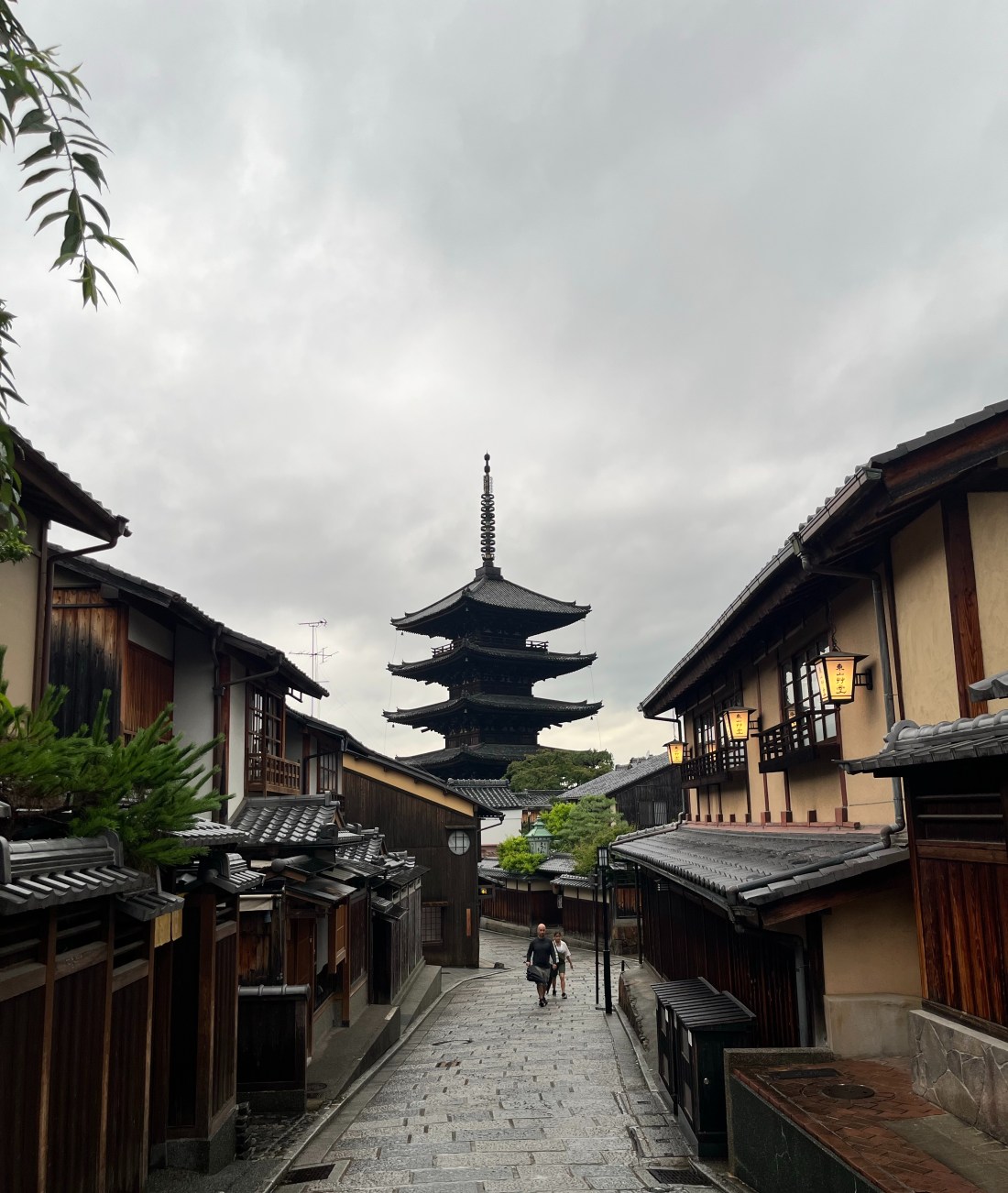
P.P.S. Featured photo is one of many pagodas (Buddhist stupa) promulgated by Shotoku, this one in Kyoto.
1 In Sanskrit, these were the Caturmahārājakayikas or Caturmahārāja. For example, if you visit Todaiji, you see some of the Four Guardian Kings around the giant statue of the Buddha, plus many other, older temples. I liked their adaptation in Roger Zelazny’s “Lord of Light” as well.
2 There were other Empresses who reigned as well, some powerful, but many remained as temporary regents until someone else could assume the throne.
3 The modern constitution of Japan adopted in 1947, at the instigation of US Occupation Forces, is ironically significantly more progressive and modern than the US Constitution. To be fair, they were written almost 200 years apart, but the Japanese Constitution explicitly grants suffrage to women and abolishes slavery. Even now, with its amendments, the US Constitution grants neither. In college, I met the lady (a US army secretary at the time) who helped write the clause on women’s suffrage. She was a very fascinating person, though she’s probably passed away by now.
4 Many generations later, this was still largely true: powerful clans ruled many parts of Japan outside the capital, gradually evolving into a feudal system over the centuries, until the Meiji Restoration of 1868,
It’s hard to believe but in some places Plum Blossom season is already here! My wife sent me this post from Dazaifu Tenmangu Shrine in western Japan showing the first blooms of the year:
This is a famous Shinto shrine (homepage here) that venerates the God of Learning, Tenjin (天神), better known in history as Sugawara no Michizane.1 I have visited Kitano Tenmangu Shrine in Kyoto, and Yushima Tenmangu Shrine in Tokyo, but Dazaifu is in western Japan where Michizane died in exile and not easily accessible for me, though my sister-in-law somehow got me a charm from there last year. I’ve always liked Tenjin/Michizane, so if I had to pick a Shinto deity, he gets my vote.
Plum blossoms, which imported from China (unlike native cherry blossoms), were trendy among the elite of Japanese society as far back as the Manyoshu anthology (7th century):
Original Manyogana
Modern Japanese
Romanization
Rough Translation1
和何則能尓
我が園に
Waga sono ni
Perhaps
宇米能波奈知流
梅の花散る
Ume no hana chiru
the plum blossoms will
比佐可多能
ひさかたの
Hisakata no
scatter in my garden
阿米欲里由吉能
天より雪の
Ama yori yuki no
like falling snow
那何久流加母
流れ来るかも
Nagarekuru kamo
from the gleaming heavens
1 Amateur translation, apologies for any mistakes
Later, because of Michizane’s devotion to his old plum tree while in exile, plum blossoms became associated with his deified form of Tenjin, and thus Tenmangu shrines typically have some on the sacred grounds.
My own tree2 blooms in early-to-mid February and I look forward to it every year.
I hope you all get a chance to see some plum blossoms in your area too!
1 Elevating historical figures to the status of kami is not that unusual in Shinto religion.
2 Mine are more typical Thundercloud Plum trees (Prunus cerasifera), common here in the US, while Japanese umé (梅) are a somewhat different variety (Prunus mume). But I am happy with what I have.
In the past, I’ve written about a certain obscure holiday in Japanese culture called Nanakusa (七草, “seven herbs”)1, which takes place every January 7th, just after the New Year.
While reading about the Diary of Lady Murasaki (discussed on my other blog) I discovered that there is a parallel Nanakusa tradition in Autumn as well. There is no designated holiday, but since antiquity, these flowers and herbs were prized during the season of Autumn.
This page shows some really nice visuals of each flower.
Some of these plants aren’t necessarily well-known today, but even as a foreigner, I recoginize a few of them. Susuki grass (a.k.a. Chinese silver grass) is an important part of Otsukimi, and Nadeshiko flowers are frequently used as a symbol of femininity in Japan. The national soccer/football team is named Nadeshiko Japan in fact. Hagi is used in Ohagi treats as well.
Regarding the reference in Lady Murasaki’s diary near the beginning is written the following text:
I look out from my room at the head of the corridor into the light morning mist. Dew is still on the ground, but His Excellency [Fujiwara no Michinaga, her benefactor] is already out in the garden ordering his attends to clear the stream of some obstruction. Plucking a sprig from a large cluster of maiden-flowers that blooms there on the south side of the bridge, he peers in over the top of the curtain frame…
The “maiden flowers” according to the Japanese text are ominaeshi (golden lace) flowers. So, even in the 11th century, a thousand years ago, these flowers were prized among the aristocracy of Japan. Immediately after, Michinaga challenges her to compose a poem about the ominaeshi he plucked (a common practice back then), and she composes the following:
Japanese
Romanization
Translation
女郎花
Ominaeshi
Now I see the
さかりの色を
Sakari no iro wo
color of this maiden-flower
見るからに
Miru kara ni
in bloom,
露のわきける
Tsuyu no wakikeru
I know how much the dew
身こそ知らるれ
Mikoso shirarure
discriminates against me.
Translation by Dr Richard Bowring
Michinaga is impressed by her quick wit (it’s basically why he hired her as a handmaiden to his daughter), he responds with:
Japanese
Romanization
Translation
白露は
Shiratsuyu wa
It is not the dew
わきてもおかじ
Wakitemo okaji
that chooses where
女郎花
Ominaeshi
to fall;
こころからにや
Kokoro kara ni ya
does not the flower choose
色の染むらむ
Iro no somu ran
the color it desires?
Translation by Dr Richard Bowring
Such a poetic exchange for a single flower.
In fact, the Autumn list of flowers dates much further back than the 11th century. Take a look at these two poems from the Manyoshu anthology, poem 1537:
… as you can see, these two poems are linked. It’s interesting that even as far back as the 7th century, these seven flowers were celebrated in poetry, and this tradition still persists in Japan today, the 21st.
Wishing you all a happy Nanakusa!
1 Not to be confused with the Colonel’s “eleven herbs and spices”. 😉 I have enjoyed Kentucky Fried Chicken in Japan, and we try to try to enjoy it for Christmas every year even in the US, per Japanese tradition.
2 Manyogana was an early Japanese script that used Chinese characters in a very phonetic way. This was eventually replaced by the simpler, short-hand form called hiragana. Only very early works of Japanese are recorded in Manyogana, but that does include the Manyoshu anthology.
3 A couple quick notes from the referenced website: the name Fujihakama has gradually changed pronunciation to Fujibakama. Also, apparently the Asagao flower referenced in the Manyoshu isn’t the same as the modern Asagao “morning glory” flower. It’s not clear what flower this referred to at the time. Finally, this flower isn’t the same as the kikyou flower that is now part of the seven flowers of Autumn Nanakusa.
Some years ago, I received a tenugui (手ぬぐい), a kind of cotton cloth traditdionally used in Japan, with the following calligraphy on it:
我逢人 gahōjin
“self meets person”
I have briefly mentioned here this notion, but today I wanted to delve into it more. I have struggled to find a clear reference, but according to one story I found, these were the words uttered by founder of Soto Zen in Japan, Dogen, after first encountering his new teacher Rújìng (如淨, 1163–1228) in China.1 Dogen had studied under the Tendai sect in Japan for years, but he was dissatisfied with the lack of rigor, and journeyed with his mentor to Song-dynasty China to learn more there. At the Tiantong Temple (天童寺, Tiāntóngsì) he met Rujing, and after their first meeting, Dogen was said to have uttered these words meaning “At last, I have met someone”.
The sentiment here is that even though we might be physically in a room full of people, we may not really connect with them. We all go through this feeling. In modern society, that sense of isolation in a crowded room may feel even more acute. It is indeed a noisy yet lonely world we live in, and as the Buddha described it, a world of aimless wandering.
Only when you connect with someone does it really feel like you meet them. This could be someone romantic, or someone like a mentor, or just a really good friend. When you connect with that person, you can speak your mind 100%, and they will understand you. Such encounters are indeed rare (I can probably think of maybe 10-15 people in my own life), but it’s an example of how karma can work in mysterious ways, maybe across many lifetimes.
It is also why, in my opinion, when one encounters the light of Amida Buddha, or the Dharma in general, it subtly alters one’s aimless trajectory. Imagine an asteroid hurtling through the void of space for eons, then one day it’s finally caught within the gravity of a star. It’s still moving, but now its trajectory gradually bends more and more toward the star. I like to think of encountering the Dharma like that.
It’s also a great example of how Zen phrases and idioms proliferate Japanese language.
Namu Shakamuni Butsu
P.S. Please enjoy the Maha Santa Claus Sutra, an old classic I wrote 6 years old (!). Happy Holidays!
1 In Chinese, he is known better is Tiāntóng Rújìng (天童如净, “Rujing of Tiantong [temple]”).
The Hellenistic Age in history is the period after Alexander the Great died in 323 BCE, when his soldiers scrambled for power over the vast conquered empire, and ruling the known world for three centuries until they were toppled one by one by the Roman Republic.
These dynasties, descended from Alexander’s generals and philoi (trusted companions), were all Greco-Macedonian in culture and language, yet because each dynasty ruled over a different culture: Egyptian, Persian, Babylonian, and so on, they took on their own unique characteristics. These Hellenistic kings exemplified masculine warrior king ideology as they competed for legitimacy through warfare and conquest, with no overarching political ideology.
The Seleucid Empire, descended from former general Seleukos I Nikator (“the victor”). The Seleucid Dynasty had by far the largest chunk of Alexander’s conquests, but also the most difficult to maintain. The diversity of people of people from the Levant, including the Hebrews, the Babylonians, the Parthians, and peoples in northwest India required constant vigilance to rule by a tiny Greco-Macedonian minority.
To assist with their rule, the Seleucids wisely adopted Babylonian customs and religious ceremonies, while their patron god Apollo synthesized with eastern Persian (and Parthian) cultures who venerated archery. The Seleucid kings had to go on campaign constantly to maintain control over such a large empire, while maintaining religious functions in Babylon. The satraps (local kings ruling each province in Persian tradition) required constant discipline because they were prone to set themselves up as rivals. The early Seleucid rulers also established or augmented Greek colonies across the empire to help maintain rule.
The powerful Antiochus III Megas, (a.k.a. Antiochus the Great) made a famous Anabasis campaign that took him all the way to Kabul, Afghanistan to crush rebel satrap Euthydemus I, in Bactria, before swinging back around and crushing then re-subjugating Persia, and Coele Syria (the lands around modern Israel). Antiochus III Megas, the most successful of the Seleucid rulers, only keep it all together through sheer force of will and constant warfare, and many later rulers were simply not as capable or successful.
After Antiochus III, the empire began to unravel as his sons Seleucus IV Philopator and Antiochus IV Epiphanes, and their progeny gradually split the ruling family, as one side would usurp the throne, while the other would eventually reclaim it. All this happened, as enemies gradually increased on their borders, and the territory they ruled over got smaller and smaller.
Antiochus IV Epiphanes is particularly infamous in the biblical tradition, namely in the Old Testament, for his Abomination of Desolation (defiling the Temple of Jerusalem and replacing worship of G*d with pagan idols) and became the archetypal antichrist figure later. The Hellenistic Age podcast has a really nice series of episodes about this period:
Definitely check them out if interested. By the way, the Jewish holiday of Hanukkah dates from the time of Antiochus IV, and his (failed) efforts to crush the Maccabean revolt, though according to the Hellenistic Age Podcast, the tradition of the Menorah seems to date some time later. (Happy Hanukah to Jewish readers, btw!)
Ptolemaic Egypt
The Ptolemies, by contrast, ruled a somewhat smaller empire, but it was more culturally unified, and incredibly rich. By the time Alexander the Great came to Egypt, Egypt as a nation-state had already existed for 2500-3000 years. So, Egyptian culture was OLD even by the standards of the ancient Greeks.
To rule such a state, the Ptolemies adopted rulership as another Pharonic dynasty, technically the 33rd such dynasty if you are counting. Unlike the traditional dynasts of Egypt, who ruled from either Memphis (Old Kingdom) or Thebes (New Kingdom), the Ptolemies settled in the northwest city of Alexandria, and ruled over a small but powerful Greek aristocracy. Much like the Seleucids, this ethnically Greek minority had certain privileges and rights that the rest of the population did not, and frequently filled key positions of the powerful bureaucracy. Their phalanx armies were, until relatively late, ethnically Greek in composition, while the Egyptian mostly fielded armies of archers and sailors. The Ptolemies were filthy rich, because the bureaucratic system they inherited from Egyptian society was so effective at regulating taxation and exploiting the farm labor for maximum profit.
Alexandria itself grew to a powerful center of learning and culture in the Mediterranean (rivaled only by Antioch in the Seleucid Empire) under Ptolemy II Philadelphus, and Greek religion synthesized with Egyptian leading to gods such as Sarapis with Greek deities, leading to an explosion of popularity in Egyptian deities (particularly Isis) outside of Egypt. These “refurbished” Egyptian deities didn’t always resemble their original Egyptian form, but represented a fascinating synthesis of Greek thought and Egyptian religion.
Edit: Extra History happened to put out a nice video about the Ptolemies in Egypt here:
Confusingly, every single king from Ptolemy I Soter to Ptolemy XIV Philopator was named Ptolemy. Every one of them. Further, brother-sister marriages were practiced with each generation per Egyptian custom, so after so many generations, you can guess what happened. The truth is, Hellenistic kings frequently married their sisters, not just the Ptolemies, since the available pool of “eligible” women of sufficient pedigree (ethnically Macedonian-Greek, from one of the elite families) were pretty small. So, after a few generations, every Hellenistic monarch was marrying a relative in some form of another, much like the Hapsburgs many centuries later.
Corruption was a chronic problem in the Ptolemy court, especially after Ptolemy IV Philopator, who lived a reckless and decadent life, then died, leaving the kingdom a mess for sycophants and corrupt officials to run into the ground. Things unravelled and got so bad that at one point, there were two Ptolemy kings (VI and VIII) who were rivals, one of them married to his sister Cleopatra III at some point, each fighting over Egypt as the Seleucid rule Antiochus IV above nearly overran Egypt until the Romans stepped into tell him to go home.
Out of all Hellenistic kingdoms, Egypt under the Ptolemies lasted the longest, but by the time that Cleopatra (yes that famous Cleopatra, the VII) died with her lover Marcus Antonius (Marc Antony) after the Battle of Actium, Egypt was a flailing, second-rate power that had greatly diminished through the centuries.
Problems with the Hellenistic Kingdoms
Although each kingdom, including the Ptolemies and Seleucids, was diverse in how Greek culture interacted with local cultures, there were some functional problems that affected each one until the Romans eventually crushed them one by one.
First, as you might have guessed, they fought each other a lot. The Hellenistic dynasts were constantly warring with one another. This required tremendeous funds to raise armies, but Hellenistic warfare relied upon Greco-Macedonian phalanxes, which were difficult to raise and train. So, with their vast wealth, they would often just buy their way out of the problem and hire huge mercenary armies. However, once you lost your army in battle, it was hard to raise another one quickly. By contrast, the Romans raised large citizen armies quickly and cheaply, so when an army was lost, they’d just raise more of them and replace their numbers. When Antiochus III lost to the Romans at the Battle of Magnesia, the empire never quite recovered.
Second, each royal family was constantly fighting with itself. The Antigonids who ruled Macedon proper were the exception, in that they faithfully supported one another until near the end, but the Seleucids and especially the Ptolemies were constantly murdering other family members. The strong central power of the king, with little or no shared power, meant that absolute power was very attractive and “there could only be one”.
Third, because monarchs often died relatively young, eunuchs and powerful ministers often filled in as regents (again the Antigonids were a happy exception), and many of them did not rule justly or honestly, leading to further conflicts and revolts.
Finally, because they were ethnic minorities ruling over much larger territories, mismanagement led to revolts that required even more resources to suppress. Very few Ptolemies, for example, learned the Egyptian language fluently, preferring to use Greek. Some monarchs tried to “Hellenize” subject cultures through organizing Greek-style poleis cities, gymnasiums and other features. Further, subject people often found it handy to take on Greek-style names, and style in order to find work in the government. Many famous Jewish people at the time spoke and wrote in fluent Greek while still maintaining traditions handed down from their Hebrew forefathers.
Across the Hellenistic world, the once powerful kingdoms, descendents of Alexander the Great and his famed army, collectively faded in power through squabbles, unstable regimes, and failure to adapt to new threats, and some whims of Fate, until they either were crushed by other, newer powers (Rome in the West, Parthians in the East). That being the case, the cultural legacy of the Hellenistic kingdoms, and the (often bumpy) synthesis of cultures is super fascinating, and its echoes still lives on with us today in such things as Hanukkah, Buddhist statuary, famous philosophers, the Library of Alexandria, and many more.
P.S. featured photo is a reconstruction of the Pergamon Temple in Berlin, Germany, a famous Hellenistic Age monument. Photo by Lestat (Jan Mehlich), CC BY-SA 3.0, via Wikimedia Commons.
More than any other year in recent history, it seems like 2025 is a year where we are suffering more than before. It is frustrating to watch all this unfold, frustrating to know that even when you try to help, it feels like it makes no difference, and frustrating to see no light at the end of the tunnel. I feel a combination of denial, passivity, frustration, anger, despair, and everything in between, over and over.
IVANOVA: Damn it, John, there’s always too many of them and not enough of us. What am I supposed to do?
SHERIDAN: Fight them without becoming them.
Babylon 5, “Dust to Dust”, s3:ep06
But I’ve also been thinking about this a lot, and I realized that the forces of History are always in motion, even if we don’t see them. It can take years, or in some cases decades to see the bigger picture.
Claude from Fire Emblem: Three Houses saying “…but even while you’re standing still, the world keeps on moving. I always find that oddly comforting.”
But also, the little things we are doing here and now still matter. What happens to others who are suffering affects us, even if we are not consciously aware of it.
G’KAR: If we deny the other, we deny ourselves and we will cease to exist.
Babylon 5, “Point of No Return”, s3:ep9
Even those whom we oppose are suffering, even if we do not comprehend it:
If both sides are dead, no one will care which side deserves the blame. It no longer matters who started it, G’Kar. It only matters who is suffering.
Babylon 5, “Dust to Dust”, s3:ep6
So, simply standing back and letting history unfold isn’t enough. On the other hand it is just not possible to save the whole world. Even if I gave away everything I have here and now, it would be a drop in the bucket.
Instead, each one of us needs to find one small thing that we can dedicate ourselves to, for the good of others. In a Pure Land Buddhist text, The Larger Sutra of Immeasurable Life, the Buddha Amitabha started as a king, then a bodhisattva, and through tireless efforts over eons transformed his realm into the Pure Land through countless good acts, accumulated merit, and so on. This process was glacial, but it came to fruition nonetheless.
In the same way, each one of us when we dedicate ourselves to a cause, however small, it feels glacial. Nothing changes. But change does happen. As with the forces of History, things do unfold, but our actions help shift the currents of the “river of History” ever so little.
But even so, not every one will see this and understand. In the immense Buddhist tome, the Avatamsaka Sutra (a.k.a. the “Flower Garland Sutra”), is a famous quote:
On seeing a bodhisattva Perform various practices, Some give rise to a good mind and others a mind of evil, But the bodhisattva embraces them all.
During my wife’s latest trip to Japan (I stayed home this year for various reasons), she found this delightful patch/sticker:
This is an image of Amida Buddha, welcoming the deceased to the Pure Land. This is called raigō amida (来迎阿弥陀, “Amida welcoming the dead”). I talked about this before a little while ago, becuase it was a common artistic motif in medieval Japanese Buddhism, especially at a time where disease, warfare and death would often cut people’s lives short.
The imagery of Amida Buddha coming to greet the dead is found primarily in the Contemplation of Amitabha Sutra (a.k.a. “the Contemplation Sutra”). The last section of the sutra lists the nine grades of people who are reborn in the Pure Land, and the fourth grade (“highest level of the middle grade”) gives the following description, for example:
“When such a person is about to die, Amitayus [Amida] appears before him, surrounded by a host of monks and radiating a golden light. He then expounds the truth of suffering, emptiness, impermanence and no-self, and praises renunciation of the world as the way to escape from suffering.
“Seeing this, the aspirant greatly rejoices and finds himself seated upon a lotus-flower. He kneels down, joins his palms and worships the Buddha. Before he raises his head, he attains birth in the Land of Utmost Bliss, where his lotus-bud soon opens.
Translation by Rev. Hisao Inagaki
Depending on the grade of the aspirant, this welcome may be more or less elaborate, but all of them are reborn in the Pure Land somehow.
So, I like this patch because it’s a reminder of the goodwill Amida Buddha extends to all beings, and how everyone can be born in the Pure Land if they want to.
Namu Amida Butsu
P.S. I kept the patch in its wrapper for a long time, but finally decided to put it in a sutra book I’ve been making.
Recently I talked about the human tendency to grab power, and the tendency to self-destruct as a result. I wanted to look at a very fascinating, but often forgotten, period of Western history: the Wars of the Diadochoi, probably one of the most clear expressions of this tendency.
The Greek term diadochos (διάδοχος) means “successor”, or in plural diadochoi (διάδοχοι). These were the troops of Alexander the Great, who had marched with him all the way to India, battle after battle, and were present when he died in the city of Babylon on June 10th, in 323 BC.
Alexander’s premature death left the small Greek kingdom of Macedon ruling a vast empire stretching all the way from Macedon and Greece, down to Egypt, and east to central Asia and northwestern India. Much of this territory had been administered under the Achaemenid Persians as “Satrapies” each with their own king. The Achaemenid emperor ruled these local kings as the “king of kings”.
But as soon as Alexander the Great died, this empire unravelled.
Alexander, in true fashion, had rushed headlong in one invasion after another, with no clear plan how to rule the newly acquired territory. Alexander was a military genius who never lost a battle, and was genuinely convinced he was the son of a god. Yet, he was also extremely impetuous and didn’t really have a long-term plan other than a vague notion of Greco-Persian empire.
Upon his sudden death, his close confidants (philoi, φίλοι), generals, and various troops quickly divided into factions who rallied behind one successor of Alexander or another, while also scrambling for territory (satraps).
Update: Extra History put out a really nice video summarizing these early years of conflict:
Anyhow, to put it mildly, this scramble for power, territory, and regency of the heirs unleashed one war after another, from Greece to Central Asia, from Egypt to Asia Minor:
First War of the Diadochoi (321–319 BCE) – an alliance against general Perdiccas who sought to expand his regency by marrying Alexander’s daughter, resulted in the death of Perdiccas who was betrayed by his men who worked out a deal with the opposing faction. During this time, Ptolemy stole Alexander’s body and escaped to Egypt. Seleucus (one of Perdiccas’s murderers) made a deal with Ptolemy. Remember these two men.
Second War of the Diadochoi (318–316 BCE) – the new preeminent power, Antigonus, went to war against a faction challenging his authority in Mesopotamia. By the end of this long, complex war of shifting alliances, Ptolemy was now firmly in control of Egypt as Ptolemy I Soter (“savior”), and Antigonus was still the strongest power who reigned as Antigonus I Monopthalmus (“the one-eyed”). Macedon was ruled by Cassander who also instrumented the death of Alexander the Great’s primary heir, Alexander the IV. By this point the empire had broken up into massive dynasties, with no more pretense of ruling in Alexander’s stead.
Third War of the Diadochoi (315–311 BCE) – continued wars by Antigonus against an increasingly powerful Seleucus who built a power-base from the eastern Satraps, and also with Ptolemy I in Egypt. Antigonus was unable to decisively defeat either, and things devolved into a detente.
Babylonian War (311–309 BCE) – the war between Antigonus and Seleucus resumes, and ultimately Antigonus is later defeated by Seleucus and a coalition of other Diadochoi at the Battle of Ipsus in 301 BCE. Seleucus now rules the remnants of the Persian empire as Seleucus I Nicator (“the victorious”).
Fourth War of the Diadochi (307–301 BCE) – This was a prolonged four-way battle between Antigonus I, who now ruled Macedon with his son Demetrius I Poliorcetes (“besieger of cities”), Ptomley I in Egypt, Seleucus I in Mesopotamia, and Lysimachus (another successor) who ruled Asia Minor. By this point, the various dynasties were mostly stable now, but further battles continued:
A prolonged three-way war from 298–285 BCE between Demetrius I Polircetes, Phyrrus of Epirus, and Cassander’s sons, resulting ultimately in Demetrius’s death, but succession by his son Antigonus II Gonatas and thus establishment of the Antigonid Dynasty.
Meanwhile, Seleucus I and Lysimachus battled for a long time (285–281 BCE) until Lysimachus was killed in battle in 281 BCE. It should be noted that Seleucus’s victory was as close to reunification of Alexander’s empire as the Diadochoi ever came. However, Seleucus I was murdered while marching to Europe by his ally, Ptolemy Ceraunus, an ousted son of Ptolemy I, for reasons unknown. Seleucus’s son, Antiochus I Soter, established the Seleucid Empire in Mesopotamia, Persia, and the east.
The last struggle was Ptolemy Ceraunus’s brief seizure of power in 281 BCE in Macedon, but his reign was unexpectedly cut short due to a massive invasion of Celtic tribes into Macedon, Greece, and even Asian minor. These Celts later came to rule a territory known as Galatia for centuries. With Ceraunus dead, the Antogonid’s reclaimed power in Macedon and ruled for centuries.
Thus, by 280 or so, the various successors and powers had finally settled into three great dynasties:
the Antigonid Dynasty (Greece/Macedon),
the Ptolemaic Dynasty (Egypt, eastern Mediterranean), and
A fourth Hellenstic dynasty, the Attalids, came to rule a small, but powerful state in western Asia Minor, and were a close ally of Rome for generations, while a fifth dynasty (a hybrid Greco-Persian one), ruled the Black Sea as the Mithridatic or Pontic Dynasty until they too were annexed by Rome. And then we have the Bactrian-Greeks far to the east as well.
Aside from the Bactrian Greeks, each of these dynasties ruled their respective lands for the next three centuries, a period known in history as the Hellenistic Period, until the rise of the Roman Republic who destroyed them oneat atime.
The four wars of the Diadochoi make Game of Thrones look mild. There was so much switching of sides, backstabbings, intritrigue, scandals, and of course constant warfare. The excellent Hellenistic Age Podcast spends the first twenty episodes alone covering this conflict. And even after the wars had settled down, the constant struggles between the Antigonids, Ptolemies and Seleucids never really ended. They fought dynastic battles within their own families, but also constant battles with one another. The Ptolemies and Seleucids in particular fought six wars over a territory called Coele-Syria (modern Lebanon and Syria, sometimes included modern Israel and Palestine) until the Ptolemies finally lost it for good. The Book of Daniel in the Old Testament even alludes to this war between the “king of the north” and “king of the south”.
Next time, we’ll look more into how these different dynasties thrived and survived (until the Romans came), and how each took on different personalities.









 Gleanings in Buddha-Fields


You must be logged in to post a comment.