I finished watching the Netflix spinoff series Castlevania: Nocturne, season 2 last week, and I wanted to share this great quote:
Alucard: Your mother and I never met. But when you’ve lived as long as I have, you start to understand. We’re all part of the same story somehow. And these connections run very deep.
Castlevania: Nocturne, season 2, episode 6, “Ancestors”
This inter-connectivity of all beings, all being part of the same story, is a very Buddhist notion.
In Buddhism, especially the Mahanaya tradition (i.e. pretty much all of east Asia, and beyond), there is a famous analogy of the Jeweled Net of Indra (sometimes Brahma). The idea is that within the celestial palace of Indra (or Brahma), there is treasure room, and within that room is a great net woven with jewels at each node.
Now, imagine this great net of jewels, and how each jewel reflects the light of every other jewel. That’s how interdependence works. Shatter, remove, or replace one jewel and the light from the others diminishes as well. So it is with all sentient beings. The effect may not be noticeable, but it does happen.
The entire series of Perfection of Wisdom sutras, including the Heart Sutra, covers this in great detail. The Buddha Vairocana also embodies this truth (especially as described in the massive Flower Garland Sutra); alternatively Amida Buddha does too in some interpretations.
P.S. Castlevania: Nocturne is great. It covers a lot of characters from later Castlevania games that I didn’t play (Richter, Juste, Maria, etc), which confused me at first, but season 2 builds really nicely on season 1. Great series and worthy spinoff to the original.
It’s 2025, and I am happy to be back. The break wasn’t as restful as hoped (too many holiday obligations), but I did accomplish most of my goals, and got to celebrate my firstborn’s 18th birthday which was an important milestone for us parents. I also played lots of Fire Emblem: Engage,1 and watched plenty of old Star Trek episodes.
Anyhow, for the first temple visit of the year, the priest stated that according to the traditional 60-year Chinese calendar 2025 was the sign ki-no-to-mi (乙巳), which can be roughly translated as “yin wood snake”, which implied change coming to fruition, like a tree growing its branches. For context, last year was “yang wood dragon” (ki-no-é-tatsu, 甲辰). Which implied much turmoil, like a baby dragon bursting from its shell.
While I might be speaking from confirmation bias, I cannot help but feel recent events in the last few years reflect this. But, I suppose it’s up to individual interpretation.2
Anyhow, I have some fun posts coming up that I finally finished while on break.
Hoping you all have a great year, or at least stay out of trouble. 😅
1 Engage doesn’t have the emotional depth of Fire Emblem: Three Houses (I doubt few games would), but it has grown on me, and I enjoy many aspects about it, and will likely play through it again.
2 I consulted the Yi Jing for the year, and my own personal fortune wasn’t great either. Warnings of not “stepping on a tiger’s tail” and such.
I saw this post recently on BlueSky, the hip new social media platform all the kids are talking about,1 and I had to share it with readers 🤣:
Speed-running is a fascinating sub-culture of gamers who finish games in impossibly short times through a combination of intense practice, manipulating errors in game code, and pre-planned strategy. My son and I like to watch speed-run world-records on YouTube for games I used to play as a kid. For example, this is a speed-run video where someone beats the classic NES game Mike Tyson’s Punch-Out in 22 minutes!
And this video shows someone attaining the world record for finishing the original Super Mario Brothers in 4:57. You can see multiple sneaky glitches and exploits here, plus lots of careful jump timing:
Finally, in this video, someone cleverly exploits an obscure glitch in Super Mario 3 to beat the game in 3:32!!!
But what does this have to do with Buddhism?
Buddhism is a 2,500-year old religion, adopted by many cultures and many times. The Buddha Shakyamuni (i.e. our historical founder), laid out the basic premise and trained his disciples on how to liberate themselves from the endless cycle of Samsara, and especially in the Mahayana-Buddhist tradition, to liberate others. We can see in early texts that this was a regimen of meditation training, self-restraint and living a humble, monastic lifestyle, as well as observation into one’s own mind. In video game terms, you can think of this as “grinding” level after level, building your skills, taking countless hours of gameplay.
The Buddhist path is a slow process, and requires a lifetime of dedication. Periodic visits to your favorite “meditation center” are fine, but Buddhism traditionally sees the path to awakening as a multi-lifetime endeavor for all but the truly talented (who may have already cultivated these qualities in previous lifetimes).
The actual length of time it normally took to accomplish awakening in Buddhism was hotly debated across Buddhist history. Early Buddhist texts implied that monks who were well-trained, or even lay-people who assiduously followed the basic code of conduct, could expect to reach awakening in one more lifetime, or may be a few lifetimes. But in Mahayana Buddhism, the length of time got longer and longer times as the bar of difficulty got higher and higher, well beyond what one could reasonably accomplish. A text called the Sutra of the Ten Stages in the Flower Garland Sutra describes the “Ten Stages of a Bodhisattva” over dozens of pages, and what’s required to complete each one before even getting to awakening. But each stage is a huge, huge endeavor by itself. Lifetimes of effort were not measured in eons of lifetimes.
As the road to awakening became longer and more remote, many Buddhist methods were developed to compensate for this and help people achieve the fruition of the Buddhist path much sooner, often through devotion to on Buddhist deity or another, or through specific samadhi methods, meditations and so on. The Pure Land path is by far the most popular and well-known due to its accessibility.
But in particular the Esoteric or Vajrayana traditions developed in the first centuries CE, hundreds of years after the Buddha. Historically speaking, the trend toward a longer and longer Buddhist path reversed and using this or that series of rituals, mantra chants, and mandala visual aids, one could “hack” the code of Buddhism and accomplish awakening in this very lifetime. Of course, the secrets behind such Buddhist speed-running techniques require a guru and a lineage.2 Vajrayana Buddhism is most prevalent in Tibet, but also in Japan through both Shingon and Tendai Buddhism.
But this does beg the question: is it really possible to speed-run the Buddhist path? Further, is the Buddhist path really eons and eons long as Mahayana Buddhism tends to assert, or is the length of time over-inflated?
Frankly, I don’t know.
Esoteric teachings and practices were definitely not part of the early Buddhist tradition (I definitely do not buy the idea of “secrets transmissions”, either). The Buddha’s advice in the early texts is generally pretty straightforward, one might say a little bland and anti-climactic, but also challenging because it gets to the root of who we are. It is definitely a lifetime effort.
But as much as I love the Mahayana tradition, it did have a tendency to out-do itself over and over. Waves and waves of Mahayana texts get increasingly dramatic, increasingly grandiose, and describe the Buddha path (namely through the Bodhisattva path) increasingly challenging terms. A backlash was inevitable, and so I can’t say I’m surprised that anti-intellectual movements such as Zen and Pure Land Buddhism, or “speed-run” methods such as Vajrayana arose in response.
Then there’s inevitable backlash from modern Buddhists who look at this convoluted history and complain, “none of this is real Buddhism anymore, it just cultural accretions”.
Every religion changes and evolves. Christianity as we know it didn’t have Christmas trees, and used Jewish-style liturgy in its early years. It adapted as it moved into new cultures. Islam grew into two different traditions, and as it became more urbanized some of the desert-nomadic traditions of the early community had to be adapted. Even obscure religions such as Zoroastrianism, whose early texts were composed amidst a steppe-nomadic culture, evolved to a more urbane and worldly culture until the Persian Empire.3
Zealous people love to go on a quest to find the “pristine” religious teachings, but you’ll never really find it. At best, you’re just reconstructing from pieces of the ancient past. At worst, you and your community just goes off the rails. It’s a fruitless quest.
So what to make of all this history and breadth of practice in Buddhism? Again, I just don’t know.
I do think that the old Kalama Sutta of the Pali Canon (AN 3.65) does provide some help though (slightly edited for readbility):
“It is proper for you, Kalamas, to doubt, to be uncertain; uncertainty has arisen in you about what is doubtful. Come, Kalamas. Do not go upon what has been acquired by repeated hearing; nor upon tradition; nor upon rumor; nor upon what is in a scripture; nor upon surmise; nor upon an axiom; nor upon specious reasoning; nor upon a bias toward a notion that has been pondered over; nor upon another’s seeming ability; nor upon the consideration, ‘The monk is our teacher.’
Kalamas, when you yourselves know: ‘These things are bad; these things are blamable; these things are censured by the wise; undertaken and observed, these things lead to harm and ill,’ abandon them.
Translation by Soma Thera
Followed by:4
…Kalamas, when you yourselves know: “These things are good; these things are not blamable; these things are praised by the wise; undertaken and observed, these things lead to benefit and happiness,” enter on and abide in them.’
Translation by Soma Thera
or the Buddha preaching to his stepmom in the Gotami Sutta of the Pali Canon (AN 8.53) :
“Gotamī, the qualities of which you may know, ‘These qualities lead to passion, not to dispassion; to being fettered, not to being unfettered; to accumulating, not to shedding; to self-aggrandizement, not to modesty; to discontent, not to contentment; to entanglement, not to reclusiveness; to laziness, not to aroused persistence; to being burdensome, not to being unburdensome’: You may categorically hold, ‘This is not the Dhamma, this is not the Vinaya, this is not the Teacher’s instruction.’
Translation by Thanissaro Bhikkhu
To summarize, if your Buddhist is leading to negative qualities described here, you should probably stop. If it is leading to wholesome qualities described here, keep going.
Namo Shakyamuni Buddha
Edit: I forgot to mention that the ultimate speed-runner in Buddhism is the Dragon Princess from the 12th chapter of the Lotus Sutra:
At that time the members of the assembly all saw the dragon girl in the space of an instant change into a man and carry out all the practices of a bodhisattva, immediately proceeding to the Spotless World of the south, taking a seat on a jeweled lotus, and attaining impartial and correct enlightenment. With the thirty-two features and the eighty characteristics, he expounded the wonderful Law for all living beings everywhere in the ten directions.
Translation by Burton Watson
1 I have a couple BlueSky feeds on there, but nothing related to the blog.
2 The Zen tradition is often compared to the Esoteric tradition since it also has ineffable teachings that can only be conveyed by a proper teacher.
3 I only know this because of the History of Persia podcast, by the way.
4 Because early Buddhist texts (sutras) were memorized and recited, they tended to be very repetitious. Later sutras, those in the Mahayana-Buddhist canon, used a more narrative style and thus longer and less repetitive, but also much more epic in tone.
Most players of Dungeons and Dragons within the last couple of years are probably aware that an updated ruleset was on the horizon, to coincide with the 50th anniversary of the game. This new ruleset has included names such as “One D&D”, or jokingly “5.5 edition” and so on. Nonetheless, the new Player’s Handbook came out, and I got a limited edition copy at my local game store a couple weeks ago. My kids and I hadn’t really played any TTRPG in many months, both due to demanding schoolwork for the oldest, busy schedule for the family, malaise with Pathfinder Second Edition1 and just unhappiness with Hasbro shenanigans.
But we all agreed that we missed our old family D&D sessions during the early Pandemic, and my oldest child’s school schedule this year is much lighter now. So, we agreed to block out a time on weekends and start playing again.
We bought the alt-cover 2024 Player’s Handbook early, since FLGS’s were allowed to sell it a week before online release.
Further, my kids wanted to try the new rules, so I went to the local FLGS (friendly local gaming store), skimmed over the new 2024 Player’s Handbook, felt it was intuitive enough that I could adapt, and within a couple weeks, we were running a basic Forgotten Realms campaign, borrowing elements from R.A. Salvatore’s original Icewind Dale trilogy.2
I have my old copy of the Sword Coast Adventurer’s Guide to help with the world-building. old resource books for the Sword Coast. Also, before the game, I tested the new rules by creating a couple characters using 2024 rules to help provide sidekicks to our small party.
Our “session zero” with the new 2024 campaign.
The kids, having experience with 2014 5th Edition D&D quickly picked up the new rules and were able to get a couple fun characters created in an hour:
a dragonborn paladin (my son)
a tiefling cleric (daughter)
plus sidekicks I made: dwarf druid of the sea, and drow eldritch knight.
From there we’re back on familiar turf, having a good time, enjoying a classic bar fight opening and subsequently getting thrown out. Wulfgar and Regis from the Icewind Dale trilogy made a cameo too.
In short, getting up to speed with the 2024 rules was easier than expected. The character creation processed has definitely changed in a couple essential ways :
Character race no longer determines stats, it’s based on chosen background now. The result doesn’t really change the process all that much, but it is a philosophical shift.
The racial subclasses get net abilities to help with “flavor” more: elves for example are still divided by wood, high, and drow elves, but each one gets different innate spells at certain levels. Same with Tieflings, and so on. I found this change more fun than expected.
Many character class paths are homogenized to match other class paths. This means that clerics now choose their domain at level three, not level one for example. Wizards similarly choose school on wizardly later than before. However, even at level one there are choices you can make with character creation, so this isn’t as limiting as one might expect. However, clerics and wizards as of writing only have 4 subclasses only versus 8 previously.
Because classes and backgrounds are so strongly emphasized, these sections comprise most of the book by a long shot. The book covers species (character races), spells and equipment toward the end which is different from the classes 2014 PHB. The intro includes a nice, updated walkthrough of how a typical D&D session looks like so if you’re new to D&D, this is a good read.
Most of the other rules have not drastically changed, so in most cases they will feel familiar. There is a comprehensive list here as well.
Spells have often changed and take some careful reading to get re-acquainted. Many of these updates provide much-needed fixes and balance updates. For example the 3rd level Daylight spell now actually counts as sunlight for mechanics purposes (handy for vampires). The classic Cure Wounds spell heals 2d8 damage, not 1d8.
In short, some spells are weaker or more limited now than before. Spells that were seldom used such as Barkskin now have a new life. Again, if you played fifth edition before, you should definitely reread your spell list and familiarize yourself with the new spells.
All in all, despite my personal misgivings toward Hasbro, I must admit that the 2024 Player’s Handbook is a welcome update. It fixes a number of oddities, balance issues and deficiencies of the original while keeping its essence more than I expected. I can still use my old resource books without much effort to convert, which is greatly appreciated. Meanwhile, new players will have enough to get started with the PHB without needing to refer to older material.
I am eager to see what the 2024 Dungeon Master’s Guide brings as well.
Edit: I “butt-published” this too early. I had to write the last third of the post in a hurry. Apologies for the rushed effort. 🤦🏼♂️
P.S. another reason for investing in the 2024 PHB is that Adventurer’s League requires rebuilding characters to conform to 2024 rules anyway. I don’t play AL too often these days but I don’t want to get left behind.
1 While we did have a goodtime initially, especially with character creation, the biggest challenges with maintaining the Pathfinder campaign was a lack of coherent fantasy settings. Most of the research and prep I did as a DM was to pore over Wiki fan pages, which inevitably referred to modules I never bought (and weren’t interested in purchasing). There just wasn’t enough compelling lore, characters or story modules to get immersed in to replace classic D&D lore, plus they are scattered across so many books anyway that it was impossible to find anything. Plus the fatigue in keeping up with the constant stream of new classes, new ancestries, and so on. A TTRPG hobbyist has the time to keep up with this, but not a working parent who just wants to spend a weekend with the kids. Pathfinder 2e Remaster has good rules, and good design, but outside of this and the Beginner Box there is not enough support for more casual players especially those who have some nostalgia about classic TTRPG lore.
2 I’ve been reading the Icewind Daletrilogy shard to my son at night, after we finished the Lord of the Rings Trilogy, the Hobbit, and the original Dragonlance chronicles. LOtR was great, the Hobbit was great, Dragonlance wasn’t as good as I remember, but the Crystal Shard has been a solid read, though I have to skim over certain scenes that are inappropriate for younger audiences. He loves the main cast, even more so in teh second book Streams of Silver. It does feel like a D&D adventure for him, and he enjoys listening to the story, and (in his opinion), my voice acting.
A long, long time ago in college, I studied abroad in Hanoi, Vietnam for a summer for preparation for grad-school. I was, frankly, a pretty terrible student, skipped classes a lot and then dropped out of grad school in the US before I even took a single class.1
While there, I spent a lot of time goofing around in Hanoi, hanging out at Internet cafes, and talking with the local rickshaw drivers who played Chinese Chess during their downtime.
My Chinese Chess set, courtesy of Yellow Mountain Imports. The pieces are not quite arrange properly; I just snapped this photo for fun.
Two years of college-level Vietnamese courses meant that I could do basic communication but was certainly not fluent. Still, the drivers were happy to let me join in and play. Playing against the young American probably was something to break up the routine. Of course, I lost handily. They had been playing one another for years and were quite good, and I was getting a crash course in the game. Even though I was terrible, Chinese Chess was something I really enjoyed, and played as much as I could.
That was more than twenty years ago.
Sadly, I never played Chinese Chess since returning from Vietnam. Later, I learned to play Japanese Chess (shogi), but the two games are fairly different, each with their own virtues. I always kind of missed playing Chinese Chess, and I was happy to discover that one can buy good, quality sites online at places like Yellow Mountain Imports.
Yellow Mountain Imports includes some excellent instructions for non-native players to learn quickly. Chinese Chess, more properly called Xiang-qi (象棋)2, is another variant of Chess, in the same family as Western Chess, or Japanese Shogi. The basic premises is the same for all three: move your pieces, capture opponents pieces and defeat the opponent by trapping their king/general into an attack that they cannot escape from.
But each game has notable differences. In Shogi, you can replay pieces you capture, plus it includes multiple kinds of generals, each with unique moves. In xiangqi, the pieces have some unusual moves, but also terrain is more prominent: some pieces change their moves after cross the “river” in the middle, and some are unable to move outside their own “palace”.
Xiangqi, based on my limited experience, is a leaner, faster game than Chess or Shogi, because it has comparatively fewer pieces, and the many pieces have large movesets. Some pieces are strictly defensive too, so the actual pieces you use to attack are comparatively few. This makes for a game where every move really starts to count. So while the endgame is faster, there’s lots of “head games” about where to put your pieces, especially when you consider tricky combinations with the cannon. Using one or both cannons, you can do some complicated combinations to attack your opponent’s general. And since the general can’t move very far, you have to be extra careful where you put yours because a checkmate can happen surprisingly easy if you are careless in guessing your opponents moves.
I enjoy Chess, Xiangqi and Shogi each in their own way (honestly, I am probably best at Shogi, but even then I am a lousy player). Each one has its own vibe, but Xiangqi is especially nostalgic for me because I played it so much in Vietnam.
I taught my daughter to play a bit of Xiangqi with me, and I was surprised to see that she enjoyed it too. So I am glad to put this set to use.
Even for Westerners who can’t read Chinese characters, everything is simple enough, and visual enough that you can quickly learn the game, and begin playing.3 Like all good games, it’s simple enough to learn, but complex enough to keep you playing for a long time.
P.S. the Vietnamese name for Xiangqi is cờ tướng, or in old Hán-Nôm style: 碁將
1 Needless to say, I was immature, cocky and unprepared for life outside the US. There were many positives too, but plenty of regrets too. If I could still speak Vietnamese well, I would like to go back and visit, now older and wiser. But I doubt I will have the opportunity any more. I should post some of my old photos one of these days, though.
2 Pronounced like Shyong-chee.
3 I do find it fascinating that the Chinese characters on each side are not always the same. For example the elephant on the red side is 相 and the green side is 象, or the advisor is 士 (red) and 仕 (green). I am unclear why these are different, while other characters such as 車 are the same.
I have been avidly playing the game Fire Emblem: Three Houses since fall of last year. Yes, the game is that good. But also the game makes you think about things too, including religion.
One of my favorite characters in the game, is the leader of the Golden Deer House, Claude von Riegan (also mentioned here and here), voiced in English by Joe Zieja. Claude’s background is unusual for the game’s cast, and he keeps his identity close to his vest, but needless to say he’s had a very worldly upbringing, and sees things different than the other students who mostly grew up in Fódlan. He is just as ambitious as Edelgard, but prefers to meet his goals in a more hands-off, less forceful way.1
Unlike most of his fellow students, who grew up within the Church of Seiros, Claude tends to be pretty cynical about Fódlan’s only religious organization, and regularly questions it (this is also important to certain elements of the plot, but that’s beside the point).
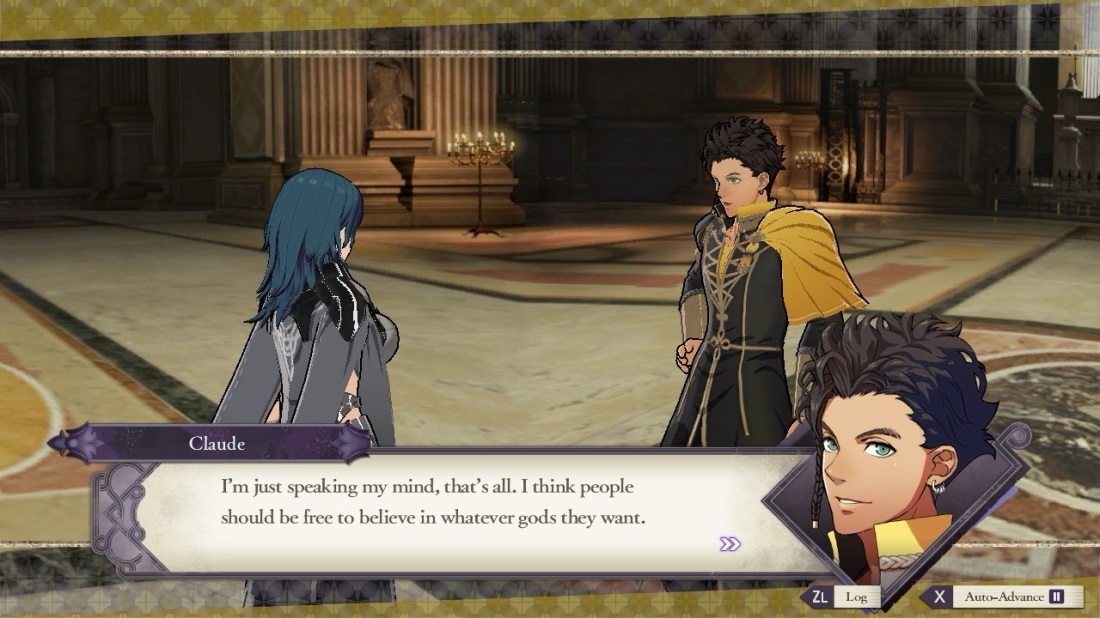
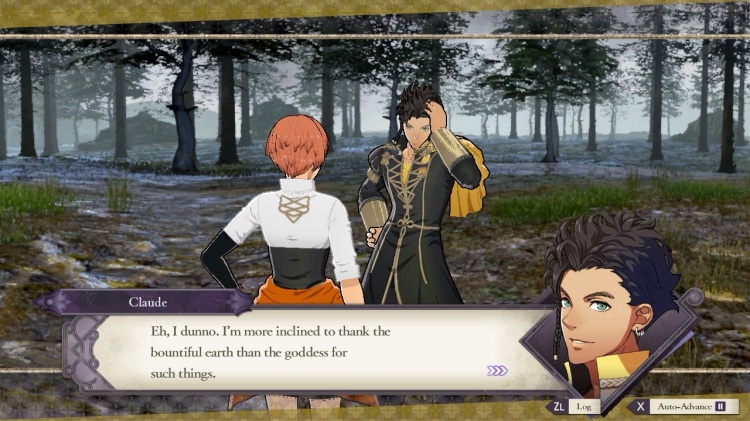
Anyhow, I wanted to share something he said that I think is worth considering (possibly out of order, I lost track of which is which):
Even though I tend to be an ardent Buddhist, I think what Claude is saying here is a healthy to look at the world and its religions. If you consider religions past and present, there have been countless gods and goddesses, rituals, liturgical languages, and so on. Even in in the same religions, practices and views diverge over time. This may offend purists, but it’s impossible to avoid, let alone manage.
Further, Buddhism has never been a particularly evangelical religion. It’s not in a race to win converts (minus a few cults), for a variety of reasons. First, this is in keeping with the Buddhist notion of metta (“goodwill”) that as long as other people have a belief system that helps them, not hinders or makes them feel bad, then that is fine. Second, the danger of imposing one’s beliefs on others is that it’s almost always fueled by ego and one’s own delusion anyway. A person’s religious beliefs, even Buddhist ones, are almost always a reflection of one’s own mind, and have to be taken with a grain of salt. Third, the Buddha clearly wanted people to take refuge in the Dharma of their own volition, and not by coercion. Even the Five Precepts are phrased as “I undertake” not as a command. Similarly with the practice of the nembutsu in Pure Land Buddhism. There’s nothing in the Buddhist canon that tells people to recite, or not recite it. It’s up to each individual to work with the tools offered in the Buddhist toolkit and apply them as best as they can. Like Claude says above, if you find a support system that works, great. This is no less true within Buddhism and its many traditions as well.
It’s generally better, and healthier for one’s own mental state, to let others be who they are, believe what they will, as long as its helpful, not harmful. The tighter one grasps, the more exhaustion and grief they inflict upon themselves, and others.
There are almost as many as variations on religious beliefs as there are people, so like the analogy of the Blind Men and the Elephant, each person is trying to feel their way through life using what resources, background and knowledge they have. Even within Buddhism, each person has their own “spin” on what the Buddha was, or what his teachings were.
It’s imperfect, but we all have to start from somewhere.
P.S. If you own a Switch, try Fire Emblem: Three Houses. 😋
1 Bit of a tangent, but of the three lords in Three Houses, I feel that Dmitri plays the role of the “conservative”, trying to restore his kingdom and the Church the way it was. Claude is the “liberal” trying to open things up and hoping it will change Fódlan, while Edelgard is the “revolutionary” who wants to change things directly (i.e. through force).
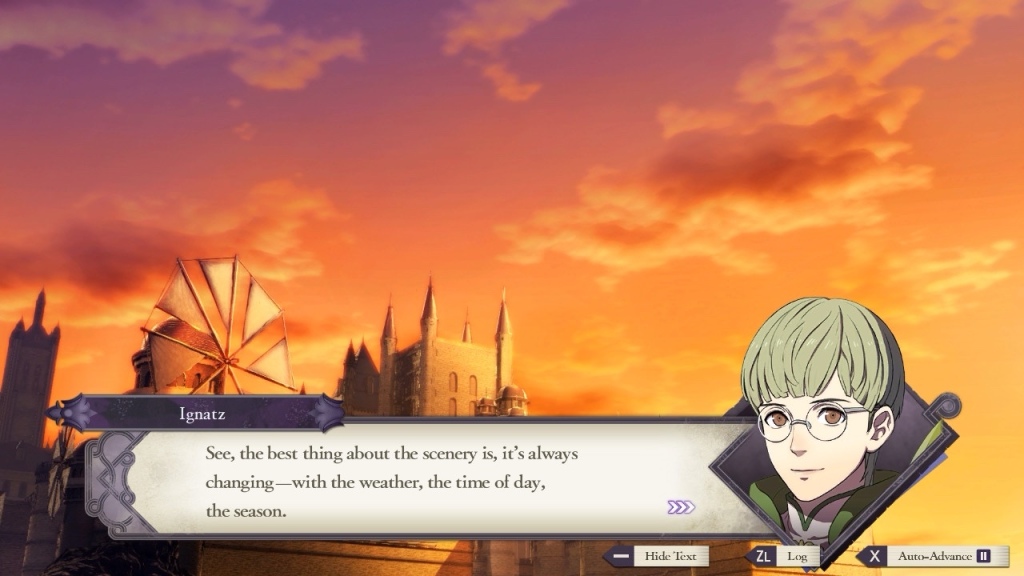
This was a neat dialogue between two of the characters in Fire Emblem: Three Houses that I wanted to post here.1 It’s very Buddhist in my opinion.
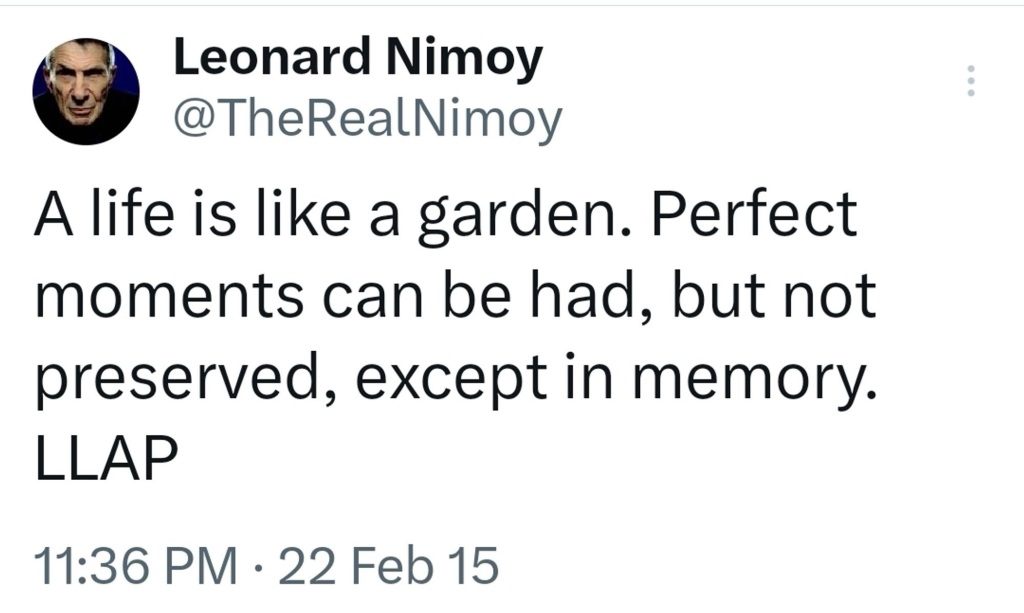
Or as Leonard Nimoy said before his passing…
I am one of those people who likes to take lots of photos of scenery on my phone, but I admit whenever I do this, the photos just aren’t the same as the original experience. I never could fully explain this to myself until I saw the dialogue above.
1 I haven’t talked about it as much lately, but I’ve been playing FE3H pretty much non-stop since last August, and am on my fifth play-through. I can confidently say this is one of my favorite all-time games.
This post was inspired by a recent play-through of Fire Emblem: Three Houses and contains spoilers to the game.
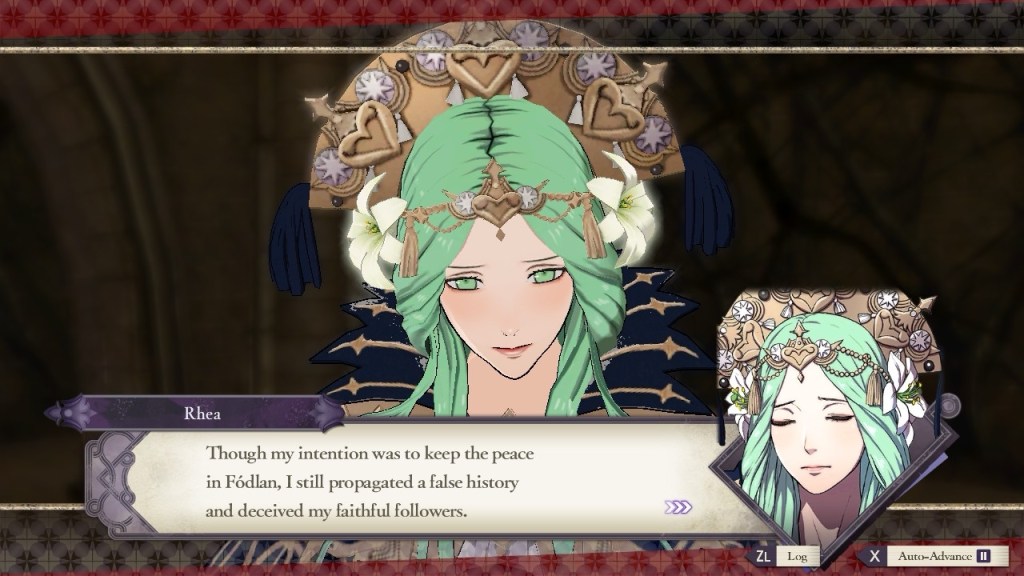
In addition to the main plot, Three Houses contains a lot of subtle side-stories and hidden lore that players discover as they explore the monastery. For example, the game strongly hints that the official history of the Church of Seiros is a fabrication used to obfuscate the real history of Lady Rhea the archbishop.
Lady Rhea doesn’t just venerate Saint Seiros (pictured above); she is Saint Seiros disguised for countless eons. The game, especially in the Silver Snow route, also reveals her divine dragon ancestry, the real source of the holy relics (remains of her siblings), and hints that other saints, namely Seteth (Saint Cichol) and Flayn (Saint Cethleann) are still alive after all these centuries, hiding their identities even as they manage the church.
Rhea/Seiros fears a repeat of a terrible massacre of her loved ones by humans centuries ago. Thus, she uses the Church to keep the peace, obfuscate the past with false narratives, suppress dissent, manipulate the governments of Fódlan, and (in a less cynical sense) gives the masses something positive to believe in: the goddess Sothis, her mother.
Rhea’s actions, like Lady Edelgard‘s, are morally grey in that they are driven by sincere desires to address the evils of society, but through questionable means.1 Good intentions lead to controversial decisions that nevertheless become church canon over the centuries.
It’s not hard to see the relevance of this toward real-world organized religions.
Organized religion is not, of course, being manipulated by divine dragon beings (presumably). However, seeing as how church official history can obfuscate unpleasant aspects of the past, one can’t help but wonder how many such inconvenient truths that we’ll never know about have been smoothed over and polished for the sake of unity and peace.
Further, is an inconvenient truth better than a convenient lie? This answer isn’t so easy.
This is where the inherent contradictions of organized religion come into play: humans tend to manipulate and corrupt religious teachings in order to further an agenda, often with well-meaning (or at least benign) intentions. And yet, in spite of this cynical view, organized religion is necessary to preserve and carry on teachings across generations. Thus, followers often have to make the best of an awkward situation.
Everyone in their own personal religious path has to try to resolve these contradictions and try to put teachings into practice as best they can. Or, like Edelgard, throw them out completely and expose the hypocrisy. This latter choice entails conflict, and worse: the risk of simply replacing one convenient lie with another more suited to one’s preferences if they are not careful.
Anyone who says religion is easy is either wrong or trying to sell you something.
1 Further in Three Houses, Rhea and Edelgard’s intentions are irreconcilable, mutually exclusive, and in the end one of them must destroy the other, hence the tragedy of the whole story.
Edit:I wrote this post almost a year ago and my thoughts have changed somewhat in that time. While we did have a good time initially, especially with character creation, the biggest challenges with maintaining the Pathfinder campaign was a lack of coherent fantasy settings. Most of the research and prep I did as a DM was to pore over Wiki fan pages, which inevitably referred to modules I never bought (and weren’t interested in purchasing). There just wasn’t enough compelling lore, characters or story modules to get immersed in to replace classic D&D lore, plus they are scattered across so many books anyway that it was impossible to find anything. Plus the fatigue in keeping up with the constant stream of new classes, new ancestries, and so on. A TTRPG hobbyist has the time to keep up with this, but not a working parent who just wants to spend a weekend with the kids. Pathfinder 2e Remaster has good rules, and good design, but outside of this and the Beginner Box there is not enough support for more casual players especially those who have some nostalgia about classic TTRPG lore.
The debacle in January 2023 with the OGL license and Wizards of the Coast pushed a lot of people away from Dungeons and Dragons, towards other role-playing games, particularly Pathfinder 2nd edition. I reviewed PF2e here and here. Recently, I also picked up the new Remastered edition:
The Remastered edition is Paizo’s clean break from the OGL license and anything related to Dungeons and Dragons mechanics. Classic staples such as alignment, and ability scores, are simply gone, and with it some aspects of Pathfinder 2e have been streamlined. The old ability scores (0-18) are simply replaced with ability bonuses, starting at 0. This actually makes a lot of sense. The only thing we care about are the bonuses anyway, and the old numerical ability scores were more relevant in older versions of D&D where the number didn’t just dictate a bonus, but also dictated other factors (ability to be resurrected, chance of failure to cast a spell, avoid traps, etc).
Removing alignment also makes sense, since it’s been 40+ years, and still no one can agree on how to interpret alignment anyway. 😁 But it also removes some of the artificial guardrails placed on characters and allows greater diversity in motivations and personalities.
With the removal of alignment, this also affects religiously-inclined character classes such as clerics, and focuses on the particular anathemas and religious edicts of each deity. As with character motivation, this does breathe more life into each deity and religious characters path, but it’s also a bit of an adjustment for old-school players like myself.
Further, these changes also mean that some aspects of the Pathfinder character sheets have been streamlined. Previously, my kids character sheets were up to 6 pages long, but the newly designed sheets are 4 pages at most. This is on par with D&D 5th edition.
Finally, let’s talk about the book formats.
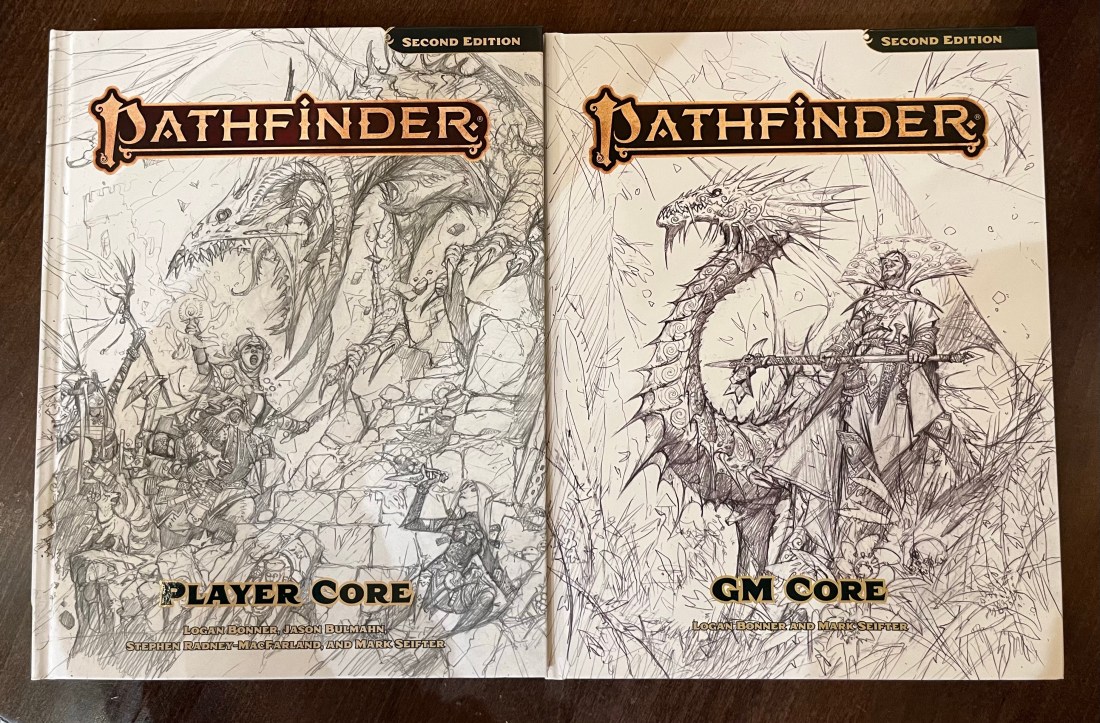
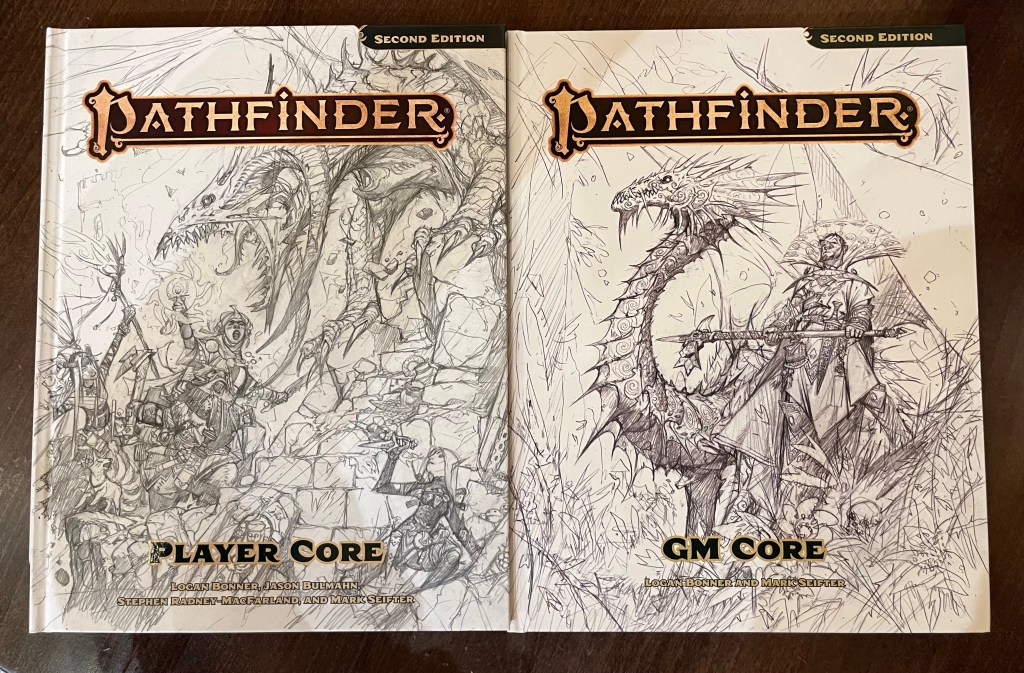
The old Core Rulebook, Advanced Player’s Guide, and GameMastery Guide have been all sliced up and recombined into different books. For example, the new Player Core book (special edition cover shown above), combines elements of the old Core Rulebook and Advanced Player’s Guide. By default, one can play a Witch for example, but remastered Champions (paladins) aren’t available yet, pending further remastered publications. The GM aspects of the old Core Rulebook have been combined with the GameMaster Guide to form the new GM Core book.
What you get is a more logical division between the two books: a player-centric handbook and a GM-centric one. The old tome, the Core Rulebook, thus has been broken up into two logical divisions with newer content added into them.
Further, the format of the books themselves is way more readable than before. Much of the content will look familiar, but is significantly easier to find thanks to book structure, and also due to the handy sidebar on each page. Some rules have been slightly modified to address inconsistencies that have arisen. Other rules have been simply rewritten for better clarity. I can’t tell you how much easier it is to find things on the fly as a GM now rather than stopping the game to flip through a book for 10 minutes then give up and search online. The GM Core in particular does provide more helpful content for planning and designing campaigns, and I found this part particular fun to read. It was previously scattered elsewhere (and similar tough to find), but now I know exactly where to turn to.
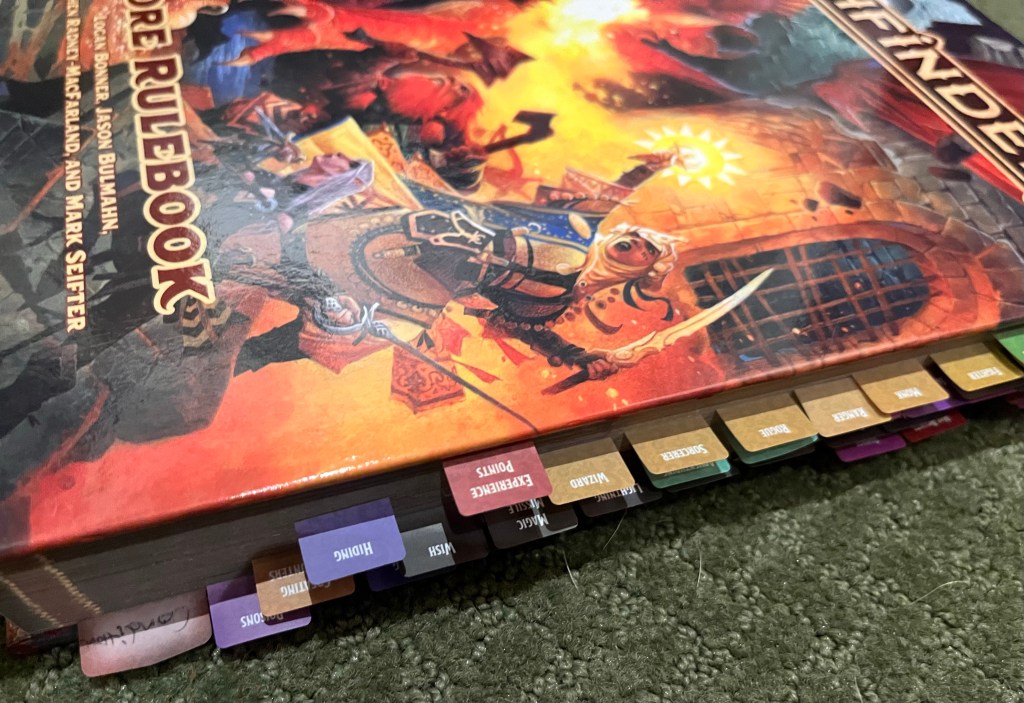
No joke, I struggled a lot with the old Core Rulebook to find things so I had to buy some tabs at a game store to mark the chapter out:
The updated books make this task a lot easier.
Finally, the spell list. In order to make a clean break from the OGL, many classic D&D spells have been renamed to non-OGL ones. For example, the iconic Magic Missile is now Force Barrage. Magic Weapon is given a cooler name of Runic Weapon, and some spells are given names that are more intuitive such as Gentle Repose becoming Peaceful Rest. Mechanically, very little if anything changes, but having to remember a new set of names is probably the biggest challenge for both GMs and magic-using players.
In any case, part of me misses the Pathfinder tie-back to old D&D, so it’s bittersweet that this connection is finally severed at last, but on the other hand, the remastered Pathfinder 2e is a significant improvement over the original 2e in terms of streamlined mechanics and streamlined publications.
On the other hand, it does feel like Pathfinder is finally getting out of the shadow of D&D and maturing as a role-playing game in its own right, and I salute these updates, and will be looking forward to more games with the kids (or maybe finally getting off my seat to check out the local Pathfinder Society).
Since I started playing Fire Emblem: Three Houses, I have been continuously impressed with how well-written and relatable the cast of characters is. But there’s more to it.
Early in the story, when you first meet the other characters and students, many come off as quirky, annoying or just mean. However, as you progress in the game and get to know them through dialogues (e.g. “supports”), you learn more about why they are the way they are. Why is Dorothea such a good-digger? Why is Felix such a jerk? Why is Marianne so gloomy, Lysithea a workaholic, Sylvain a womanizer, and so on.
What you learn over time is that many of these characters, even the more stable ones, have some kind of personal trauma or persistent fear that’s driving their lives. Some characters have more crippling mental health issues, while some just hide their pain better than others.
After playing through a game like this, it’s not hard to see that many people around you are almost certainly suffering from some past traumas or persistent mental health problems. The degree or nature of that problem is different for each person, and some people hide it better than others, but I bet if you scratch the surface you will see it.
Of course, this applies to ourselves too. Past traumas, emotional pain and lingering, persistent mental habits color our behavior on a daily basis.
I grew up as the eldest son of a single mom in a conservative community in the 1980’s, and experienced plenty of bullying and ostracism as a result, while trying to grow up fast and help the family.1 I have no doubt this colors my behavior today. Seeing my grandmother dead from cancer at age 57 on the hospital bed two days after Thanksgiving in 1990 still comes back to me every November.
But there’s more to this.
As the game progresses, and through increased interaction, many of the characters open up about their pain and trauma to others and from this they find kindred spirits, or they gain new perspectives. It doesn’t erase the past, but oftentimes it helps them find closure, or get the support they needed.
In Buddhism, we revere the Sangha (the community) as one of the three treasures, along with the Buddha (teacher) and the Dharma (the teachings). The Sangha is essential in Buddhism because people can’t do it alone. The Buddha recognized from the beginning that people need one another, and can support one another.
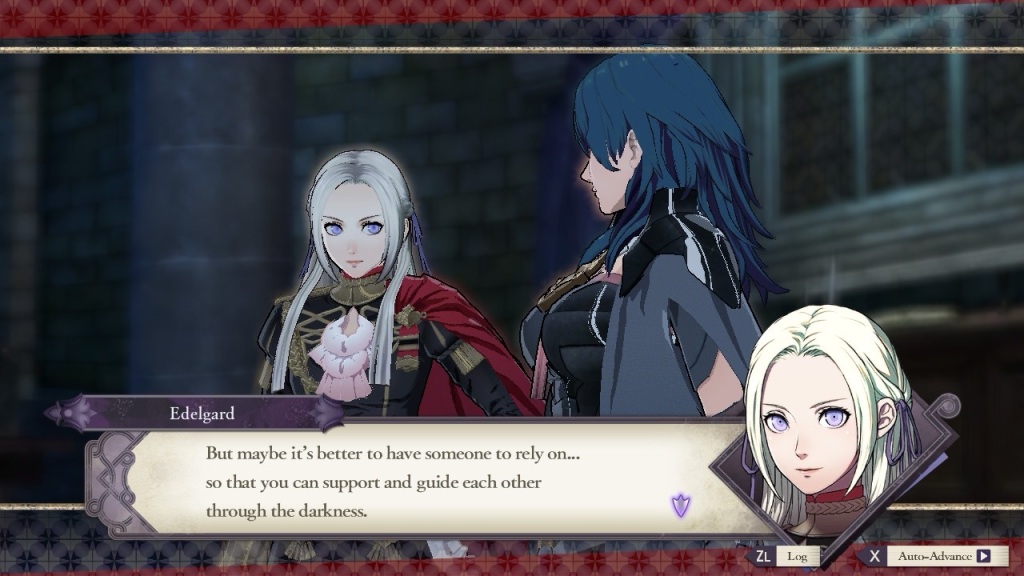
I love how Edelgard may appear as a villain at first glance, but then there are moments like these…
Even when the Sangha has its fair share of dickheads and scallywags, the mutual support people offer one another is part of the therapy that Buddhism offers. This isn’t limited to Buddhism, by the way; one can find solace in any religious community. My other grandmother was a devout Lutheran and would go to her local church every Sunday for many years.
It’s just that Buddhism overtly recognizes that everyone suffers from mental health problems on some level, which are given fancy terms like kleshas in Sanskrit, or bonnō in Japanese, but also that there aren’t easy solutions. It’s a long slow process, and it requires a mutual support network.
It’s scary to share one’s pain with others, or even with yourself,2 but it can really take a heavy load off you, and help provide new perspectives. You don’t have to force it either. As you spend time with others, people naturally start to open up over time. There’s no magic here, it’s just simply that people need one another, and this is how we find peace and wellbeing.
Namu Amida Butsu
1 a little bit like Jonathan Byers in Stranger Things, minus all the weird extra-dimensional stuff. Maybe. 😋
2 sometimes a personal journal or an anonymous blog can really work wonders.










 Gleanings in Buddha-Fields
You must be logged in to post a comment.