In these times of uncertainty, I’ve been trying various ways to help causes I care about: donating more,1 making better environmental choices at home, and trying to be a better person, but even then, it feels like it’s never enough. Like Ashe from Fire Emblem: Three Houses, I feel like in spite of my efforts, I’ve accomplished nothing.
A conversation with “Ashe”, one of my favorite characters in FE3H.
Being able to start small and focus on helping someone is a great start. From there, you might branch out and help others too.
Yet in the big picture, this still doesn’t feel like it is enough sometimes.
Mahayana Buddhism, which is everything you see from Tibet to Japan and between, tends think very big picture. Thus, it often holds up the bodhisattva as the archtype for Buddhism: a being who lifetime after lifetime helps others, fulfilling very grandiose vows. The idea is that you can’t help everyone in one lifetime, but on the grand scale of time, it is possible to help everyone eventually. But of course, because time and space are so vast, it is a kind of never-ending story. The Buddha, Amitabha (aka Amida) completed his vows in 10 kalpas (aeons), roughly 160 million years.3
Meme from Return of the King 🤣
Anyhow, point being: if we look at it from a Mahayana-Buddhist endpoint, every little thing we do now does add up, but it happens on a scale of time that we can’t fully grasp. Nonetheless, it does add up in the long-run.
But maybe that’s small comfort here and now.
In truth, I don’t have a good answer here. I still try to help where I can while not burning myself out in the process, but I can only hope it makes a difference someday, even if I can’t see it.
1 I used to have a donations page on the blog pointing to various causes, but I’ve had to take it down temporarily to update some broken links, change some charities, and revise the content a little. The page is now back online!
2 I used to watch the original cartoon “He-Man and the Masters of the Universe” as a little kid, so this takes me back. I remember one Christmas I received the Castle Greyskull playset, which was really neat, but then fell apart later. Ah, the impermanence of all phenomena and kids’ toys.
3Kalpas are interpreted differently in different texts, so I am just using the more conservative estimate of 16 million years. Kalpas are meant to convey astronomical amounts of time, not literal ones.
SPOCK: There are many who are uncomfortable with what we have created. It is almost a biological rebellion. A profound revulsion against the planned communities, the programming, the sterilised, artfully balanced atmospheres. They hunger for an Eden where spring comes.
Star Trek, “The Way to Eden” (s3e20), Stardate 5832.3
As I write this, the family is in Japan (sadly, I was unable to go this year) visiting relatives, and I am home with the dog, Cherry.
Since I have a couple weeks to myself, I thought it would be a great time to put in a little extra Buddhist practice, catch up on some personal projects, go offline for a bit, etc. Basically, try to live like a monk for a few days. I carefully planned it out, decided what I would do and not do, took a three days off from work, and then got ready for the “mini home retreat”.
I lasted eight hours.
The first few hours were great. It was peaceful, quiet, and I did finish reading a couple books on my to-do list, meditated extra, recited more sutras than usual, and so on. But then, as the hours progressed, isolation and boredom set in. I started worrying if I was missing a text from my family (in case of emergencies), and I discovered that it’s hard to read Japanese books without a dictionary which I only have on my phone.
Embarrassingly by early afternoon I gave up and turned on my phone. Then I went and played Fire Emblem: Three Houses for a few hours,1 watched Star Trek V: The Final Frontier2 for some crazy reason, got bored and played more Fire Emblem until 11pm.
Day two, I didn’t even really bother to try again. I realized that I had hyped up this time off too much, and without any support or contact with others, I quickly started to get a little stir-crazy. That’s not to say the time wasn’t unproductive either. Even today (day two), I still got some extra stuff done around the house, and did a little more Buddhist stuff than usual. But I also played Fire Emblem: Three Houses for three hours.
τὸ μὲν πνεῦμα πρόθυμον, ἡ δὲ σὰρξ ἀσθενής. “Indeed the spirit is willing, but the flesh is weak.”
Indeed, in the Sutra on the Buddha of Immeasurable Life, one of the Three Pure Land sutras, the Buddha Shakyamuni laments that:
“People of the world, being weak in virtue, engage in strife over matters which are not urgent….Since they have not done any good in particular, nor followed the Way, nor acted virtuously, when they die, they will depart alone to an inferior world. Although they are destined to different states of existence, none of them understands the law of karma3 that sends them there.”
Translation by the late Hisao Inagaki, hosted here.
So, the problem of laziness and lack of follow-through in religious practices (or personal projects) is nothing new. Even in Japanese, there is a phrase: mikka bōzu (三日坊主) meaning “three day monk”. It’s a tongue-in-cheek phrase about how most endeavors last three days at most.
In my case, I think my failure was a combination of over-zealousness and perfectionism which set the bar too high for something I am not really used to doing day to day. The idea of a religious personal retreat is still worth it, but I should have set the bar lower the first time, and tried to be a bit more realistic.
The point isn’t to give up and just play more Fire Emblem (but then again, I might anyway), but reflect on what worked, and what didn’t and focus on something realistic and sustainable. As Dogen reminds us, it can be done, but expecting it to work overnight if I just push through hard enough is maybe a bit silly.
Namu Shakamuni Butsu Namu Amida Butsu
P.S. Bonus post. Apologies for any typos, I wrote this one quickly while it was still fresh in my mind, so probably more editing mistakes than usual.
P.P.S. On the plus side, I also had some time to practice vegetarian cooking and made a large batch of Mapo Tofu, Pasta Mama (in honor of Captain Pike in Star Trek: Strange New Worlds), and some Thai curry. This photo is the Mapo Tofu:
… I also harvested the scallions I’ve been growing since Spring:
1 I am on my eighth play-through I think. I am finally going back and replaying my first route, Crimson Flower route (i.e. with Edelgard) and doing things I missed on my first play-through. It’s been nearly two years, and I still enjoy this game very much. The story, dialogue, characters and world-building never cease to amaze me.
2 I think I watched it to remember why this movie is so unpopular. It has some good qualities to it, but yeah, it’s not very good. As a teenager, I watched it in the theaters and thought it a bit odd, but it’s not aged well for me.
3 For similar teaching, see the first chapter of the Soto Zen text, the Shushogi.
Years ago, my wife and I bought a book from Japan titled 禅の言葉とジブリ meaning “Zen Words and Studio Ghibli” (publisher link here). This book was written by a Rinzai Zen monk named Hosokawa Shinsuke (細川晋輔) who was born into a priest family in Japan, and later ordained as a priest. Chapter by chapter, he relates life lessons to Studio Ghibli movies. To be honest, the book sat on our shelf for a long time, until recently, when I finally reached a level where I can follow along (with a good dictionary, of course).
Anyway, a quick divergence to talk about “priest families” in Japan. For historical reasons that are too complicated to go here, many Buddhist priests in Japan live not in monasteries, but in local parishes and raise families. Frequently, one of the kids inherits responsibility of that parish. If you think of a local Protestant pastor, it’s the same idea. Mr Hosokawa was born into such a family, and was expected to take on the family role, so after college he trained at a Rinzai Zen monastery for three years.
In his words, these first three years were a slog. He describes how he woke up every morning at 2 – 3am, meditate long stretches, followed by incessant chores around the temple all day. Day in and day out, this continued with no free time, and no privacy. Eventually, he adapted to monastic life, but he kept counting down the days when his three year term would end.
Then, abruptly, someone close to him died, and it changed his view. He was close to this person, but they often quarreled, yet now he would never see them again. Suddenly, the issue of life and death became very important to him, and he went from “having to practicing Zen” to “choosing to practice Zen”.
Thus he stayed at the monastery another several years (nine total). Yet in spite of all this training, he writes that he never really had any great awakening or sudden burst of insight. Instead, in his own words (roughly translated by me):
The more I struggled with ascetic practices in the Zen dojo, the more my firmly-held sense of values crumbled….simply put, the knowledge and experiences that I had built up so far I was allowed to let them go naturally. Having let go of such important things, having finally left it all behind, there was nothing left but the natural scenery that was right in front of my face.
Page 67
Later, he likens this experience to Totoro, the main character (monster, spirit, kami?) of the Ghibli movie My Neighbor Totoro. In the movie, many people in the village are totally oblivious that Totoro and his friends are there among them, because they are too caught up in their lives.
In the same way, the Dharma can be utterly hidden before your eyes, unless you take time to see it. In Mr Hosokawa’s case, it took nine years of intense monastic practice, the death of someone close to him, and gradually letting go of his ego. I can’t say whether this is the same for others (I haven’t learned to let go myself), but I think it’s an important lesson. I think the key word Mr Hosokawa uses is atarimae (当たり前), which in American English is like saying “duh, obviously”.
Chinese characters seem strange and mysterious until you learn them. Sex is strange and mysterious until you’ve experienced it. And so on and so forth. In the same way, for many the Dharma feels ethereal or mysterious until it finally clicks, and then its somewhat anti-climatic (“duh, obviously”).
The Obon Season in Japan approaches, and so do ghoststories, and ceremonies around hungry ghosts. But what are Hungry Ghosts?
This is one of the traditional states of rebirth within Buddhism, on the never-ending cycle of people migrating from one life to the next. Rebirth as a hungry ghosts is seen as only one rung up from being in Hell, as it is a state of great suffering and hardship. Unlike hell, though, hungry ghosts are seen as beings that live among us, but only in the darkest shadows, living a precarious existence, constantly starving and thirsty, with no way to gain sustenance. They are often cursed to eat something awful, like garbage, or excrement, as punishment, or they are depicted in art as having emaciated bodies, with bloated bodies, and tiny throats that can’t swallow anything.
Although they are called preta1 in Indian Sanskrit language, in Japanese they are called gaki (餓鬼), which in modern slang is a rude expression for kids that means “a punk” (the Japanese meaning is harsher than the English one).
References to hungry ghosts go all the way back to early Buddhist texts such as the Pali Canon where the Buddha warns that among the hungry ghosts are probably some of your ancestors and kin:
Outside the walls they stand, & at crossroads. At door posts they stand, returning to their old homes. But when a meal with plentiful food & drink is served, no one remembers them: Such is the kamma [karma] of living beings.
Tirokudda Kanda (Petavatthu 1.5), translation by Ven. Thanissaro Bhikkhu
Later, stories of hungry ghosts appear in Sanskrit anthologies such as the Avadanasataka, including the story of Mogallana and his mother (source of the Obon holiday), before a similar version of the story appears in the Mahayana text, the Ullambana Sutra, for which there is a handy translation here. In the Ullambana Sutra, you can see how Mogallana’s mother suffers in her state as a hungry ghost:
Mahamaudgalyayana [Mogallana] felt deep pity and sadness, filled a bowl with food, and went to provide for his mother. She got the bowl, screened it with her left hand, and with her right hand made a fist of food. But before it entered her mouth, it turned into burning coals which could not be eaten….
Scenes of hungry ghosts appear in old Buddhist art too:
A picture from the Gaki zōshi 餓鬼草紙 “Scroll of Hungry Ghosts”, circa 12th century, courtesy of the Kyoto National Museum, Public domain, via Wikimedia Commons
In this famous image, you can see emaciated hungry ghosts living among us, unseen, scrounging remains from human refuse and so on. Early Buddhist texts never described what hungry ghosts looked like, but this is how they are depicted in medieval artwork.
Because the hungry ghosts wander aimlessly through life endlessly starving, and some of them may include past ancestors and loved ones, Buddhism has developed certain ceremonies thought to help relieve the suffering of one’s ancestors, and by extension other hungry ghosts. In Chinese culture, this is exemplified in the Ghost Festival (中元節, zhōngyuánjié) of Chinese culture, Obon (お盆) in Japanese culture and the Segaki ritual in some Buddhist traditions.
It’s a fascinating example of how Buddhist teachings have suffused cultures, and how cultures have responded to concerns over family and the afterlife.
The saying of nembutsu is neither a religious practice nor a good act. Since it is practiced without any calculation, it is “non-practice.” Since it is also not a good created by my calculation, it is “non-good.” Since it is nothing but Other Power, completely free of self-power, it is neither a religious practice nor a good act on the part of the practicer.
The Tannisho, section eight, translation by Dr Taitetsu Unno
This quote comes from a 13th century Japanese text called The Tannisho, a record of conversations between an aging Shinran, the founder of Jōdo Shinshu-sect Buddhism, and his disciple Yui-en.
It’s a strange quote, and many aspects of the Tannisho are also strange at first glance. But the details are important and worth exploring.
Shinran is basically deflating the idea, still common today, that the nembutsu (reciting the name of Amida Buddha) is a practice in the traditional Buddhist sense. Shinran says the recitation of the nembutsu isn’t a magic spell, mantra, or anything that could accomplish a desired result. From Shinran’s perspective, the nembutsu doesn’t do anything.
So, why recite it? From the Jodo Shinshu perspective,1 the nembutsu is simply means calling out to Amida in our hour of deep need. That’s why it’s not a good act nor a practice. Further, Amida Buddha hears all beings and shines his light upon them, a combination of wisdom to illuminate our ignorance, and compassion to embrace us.
The Other-Power described here is called tariki (他力) in Japanese. The idea is that Amida Buddha’s light (i.e. wisdom and compassion) is what transform us. There’s nothing we do that adds or subtracts from this.
Sometimes when I reflect on this, it feels a little bit like sophistry to me, but then I remember an anecdote about Shinran’s teacher, Honen, that helps illustrates this.
One time, someone asked whose nembutsu was better: Honen himself, or Awanosuke, a former-fortune teller who was not well-regarded by others in the community. Honen scoffed at this question and said that there was no difference between his nembutsu and Awanosuke’s because neither skill, nor style, nor conduct, nor grasp of the Buddhist doctrines mattered. It was all through Amida Buddha and not through one’s own efforts.
The whole idea is that in spite of who we are, Amida Buddha’s compassion shines on us all. It is simply that many people may be unaware of this.
Namu Amida Butsu
P.S. Just to clarify, the concept of Other Power wasn’t invented by Shinran and his teacher Honen. It was alreaady prevalent in earlier generations of Chinese Pure Land Buddhists such as Tan-luan and Dao-chuo, but I suppose that Shinran/Honen took it to its logical conclusion centuries later.
P.P.S. I have a backlog of fun things I wanted to share with readers, but the backlog is growing, so I am posting three a week or now just to help catch up.
1 … and arguably the Jodo Shu sect, too. The emphasis of both sects is on Amida Buddha’s compassion, rather than one’s own efforts as depicted in other Pure Land traditions. Sometimes, this feels like a case of “tomayto vs. tomahtoe” to this old Buddhist, but it’s how the various sects of Pure Land Buddhism sometimes define themselves.
Lately, I have been re-reading some old Jodo Shinshu Buddhist books that I read many years ago when I first encountered Buddhism. Now that 15-20 years have passed it’s interesting to look back and see things with a more experienced eye. In particular, I am enjoying an old classic titled River of Fire, River of Water, by the late Rev. Taitetsu Unno. Of his books, I think this is the best one.
Midway through the book he quotes the following:
“As long as man lives, he must work and plan for a thousand years. Even this Genza plants persimmon and chestnut trees. I have lots of work to do in this world. But we must listen to the teaching [of the Buddha], as if there’s no tomorrow.”
Inaba no Genza (因幡の源左, 1842-1930)
Inaba no Genza (often just called “Genza” in English) was an example of an archetypal Pure Land follower called a myōkōnin (妙好人), a humble, very pious lay-follower, who becomes an inspiration to others. Myokonin are rarely discussed outside of Jodo Shinshu discourse, but I bet if you look around enough, you’d find examples of such pious followers in many Buddhist countries and cultures. I can even think of a certain American myokonin I once knew.
But I digress.
I like this quote a lot because it acknowledges two things.
First, Buddhist practice in the traditional sense requires considerable time, dedication and energy. An illiterate guy working the fields, just trying to scrape by, couldn’t be expected to take up Zen practice, or to learn the finer points of esoteric doctrine. If you really wanted to take up Buddhist practice, not as a “weekend warrior”, but as a dedicated practitioner, this required renouncing the world and ordaining as a monk or nun. Not so with the Pure Land path (Nichiren Buddhism, too).
So, this helps to explain why certain Buddhist sects struggled to gain mass popularity over the centuries, while Pure Land which relies on the guidance of Amida Buddha, did not.
The reality, I think, is that little has changed even in modern times. We enjoy a material culture far surpassing what 19th century Japanese field workers might have enjoyed, but our modern capitalist culture keeps us as busy and overworked as anyone, and still struggling to survive. We may not die from dysentery these days, but may of us will still die stressed out and broke.
Second, time is short. I’ve used the example of the Parable of the Burning House to help illustrate as well as the Liturgy on White Ashes, but to reiterate, the Buddha taught that life is short, and death can come at any time. So it’s important not to squander it. One should carefully settle one’s affairs, and not lose sight of the big picture. Easier said than done, but what Inaba no Genza says is important: listen to the Dharma1 and heed it well. It may be your last chance.
Namu Amida Butsu
P.S. other than Dr Unno’s translation, I struggled to find the actual source of this quote with Japanese text. I found some limited information about a text called the kaki no ki no hanashi (柿の木の話) written by his son, Saichi, but couldn’t find anything much beyond that. It’s kind of frustrating when Western authors quote Buddhist texts, but do not cite their sources.
P.P.S. Speaking of daily grind, posting again…
1 In Jodo Shinshu, this kind of “deep hearing” of the Dharma is called monpō (聞法) which means “hearing the Dharma”. The nuance here is that you’re not just listening to the sound and words of the Dharma, but you hearing it in a deeper, more spiritual sense. This requires humility and willingness to learn, and challenge your own assumptions.
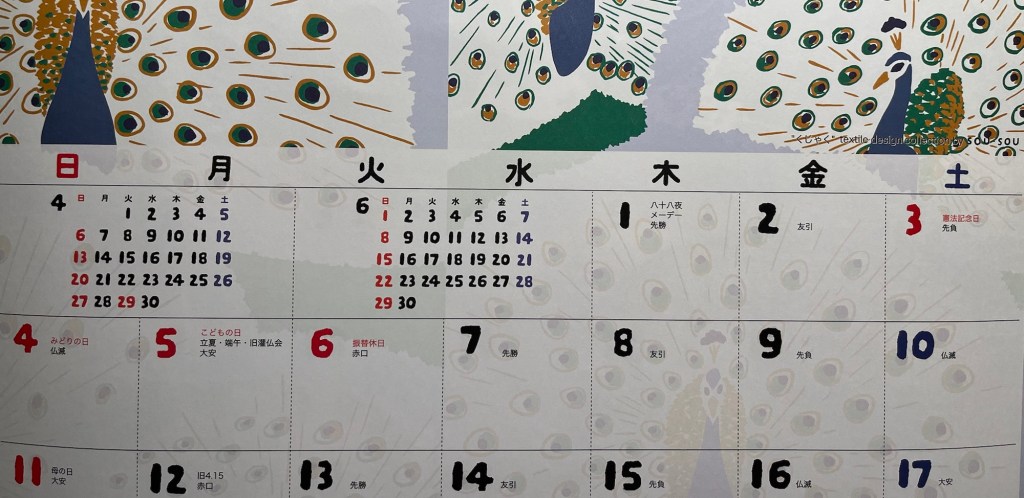
The first week of May in Japan has an interesting phenomenon in the modern calendar called Golden Week (gōruden uīku, ゴールデンウィーク): a series of national holidays that line up very closely. Thus, people often take vacations at this time (a rarity in Japanese business culture), and enjoy the fine weather before the monsoon comes. I wrote about Golden Week in more detail here.
You can see on our home calendar how the holidays (in red) line up:
My sister-in-law in Japan often takes this time off, as do many other Japanese business and white-collar workers. It may be the longest vacation they take in the year, apart from Japanese New Year.
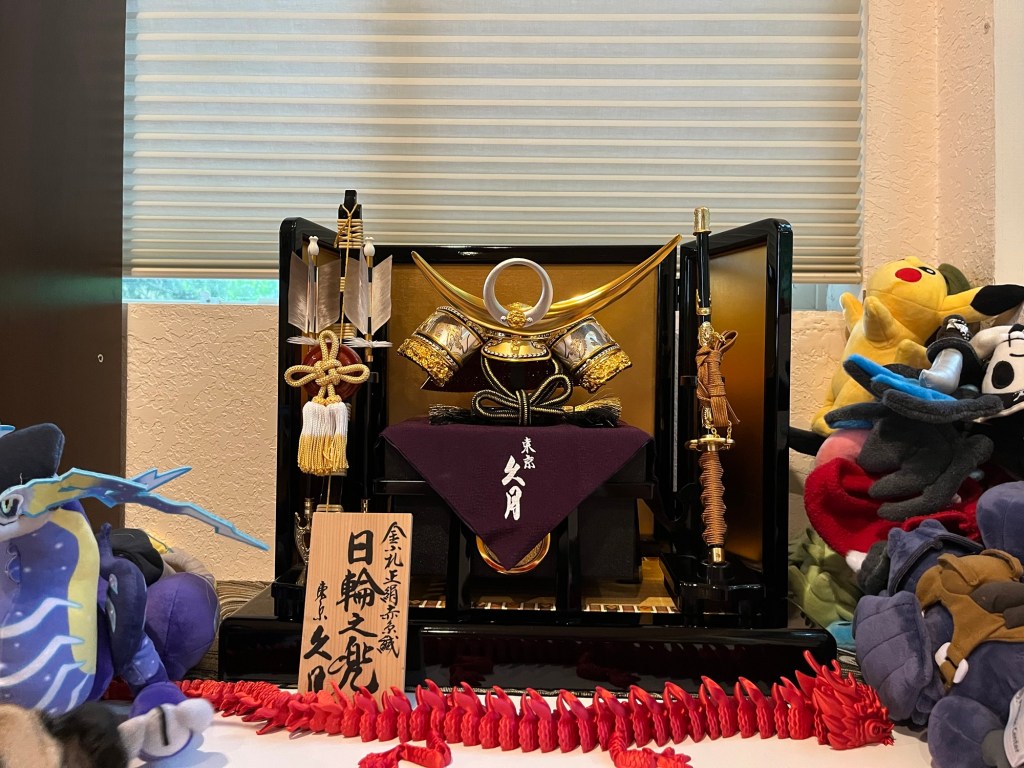
As part of Golden Week, Childrens Day, or Kodomo no Hi (子供の日) also takes place every May 5th. I’ve written about that as well. We have taken out our usual yoroi armor display:
The Pokemon toys and dragons are just my son’s toys (he should clean up more 😋).
I am not sure if we can get kashiwa-mochi this year, as Japanese goods are getting harder and harder to obtain lately, and our schedule is chaotic this week anyway, so I am not sure exactly how we will celebrate. I do know that we will go see the Minecraft movie for a third time in theaters, though. My son and I really enjoy it, and it’s nice to see all the kids yelling certain parts of the dialogue in unison.
I wish I could post more, but as alluded to earlier, I will be away for about a week, and haven’t been able to write more due to work and other competing priorities. However, I hope you all have a terrific Golden Week, and can enjoy the weather in some way. I have other great content coming up, both historical and Buddhist, so please stay tuned, and take care!
P.S. Golden Week also serves as a reminder that what many modern workers need isn’t just equitable pay, but also time off. Happy May Day! ✊🏼
April 8th in the Japanese-Buddhist tradition is the birthday of Shakyamuni Buddha, also known as “the Buddha”, “Siddhartha Gautama”, and so on. Many other countries celebrate on the 8th day of the 4th lunar month, so traditions vary.1
But I digress.
In Buddhism, a Buddha is a being who, across many lifetimes of hard work, religious discipline, and great compassion towards others fulfills the quest for Enlightenment. Not only that, a Buddha then teaches and awakens others rather than hoarding the joys all to themselves.
This altar, which is in the basement of Zojoji Temple in Tokyo, Japan, contains a tiny relic of the historical Buddha, Shakyamuni. It was donated in the 1950’s by India as a goodwill gesture after being discovered in an archeological site after countless centuries. Pretty neat story, actually, though not available in English.
So, within our tradition Shakyamuni Buddha (i.e. “the Buddha of the Shakya clan”) is what we call the historical Buddha who around 500 BCE fulfilled his path and taught others the Dharma: the principle of existence (think: “Law of Gravity” kind of stuff).
Thus, today is his 🙏🏼 birthday. Was he really born on the 8th day of the 4th month? Who knows.
The message of the story is more important than historical details: any sentient being, given enough time and dedication can fully liberate themselves, and then through awakened compassion, liberate others as well. Even someone who is totally rotten now can, given enough time and the right circumstances, accomplish great good.
The Dharma taught by the Buddha is for all. The Dharma is free, beneficial, and illuminating.
A joyous Buddha’s Birthday to you all! 🙏🏼
Namu Shakamuni Butsu (南無釈迦牟尼仏)
P.S. April 7th is the birthday of my favorite Japanese-Buddhist monk, Honen.
1 The Theravada tradition of South East Asia celebrates Buddhist holidays according to an entirely different calendar than the Mahayana tradition described here. As far as I am concerned, none of these holidays have reliable historicity, so just like Jesus’s birthday not actually taking place in December (taxes were not collected that time of year), the date is kind of artificial, and frankly doesn’t really matter. One date is as good as another.
The day is finally upon us: my firstborn, my daughter, is now an adult and looking toward college. Ever since she was a tiny baby, we have celebrated the Japanese festival of Girls Day or Hinamatsuri (ひな祭り) yearly on March 3rd. Her grandparents (my in-laws) brought this doll set from Japan 18 years ago.1 I did my research and figured out how to assemble it, and have been doing it every year since.
My daughter is an adult this year, and so she isn’t really a little girl anymore. Thus, in a sense the tradition comes to and end. We discussed it, and we will probably keep celebrating anyway until she is married,2 but it still feels like a threshold has been crossed.
Of course, it all feels a little bittersweet. Our daughter is happy, healthy and looking forward to the next chapter in her life. We, her parents, of course will miss her. And we’re looking forward to grandkids someday.
Perhaps in time I will be assembling the dolls for a future granddaughter, and my wife will keep making chirashi-zushi. Time will tell.
As for all the other ladies out there, happy Girls Day!! 🎎
1 Normally, the doll set has up to 5 tiers, but as two elderly grandparents they could only bring the top tier and since they were only bringing one tier anyway, they splurged and got a nice set from Kyoto. Or, so I recall.
2 in those days girls married far younger than they do now, so people probably didn’t celebrate this far along.
True story, I had some spare time one day recently to sit and meditate,1 first time in a while. I set the app to 10 minutes, and sat on the ol’ cushion. About five minutes into this, my youngest child walked in and asked me to unlock the parental control on his tablet.
Concentration broken, oh well.
This is a frequent issue with being a parent and being a Buddhist, but it’s not a new one.
In the Buddha’s time, he distinguished the “householder” followers with the “renunciant” ones. This wasn’t meant to denigrate one versus the other, but it was intended to differentiate those who fully could devote themselves to the Dharma (the “renunciants”), to those who had other, competing obligations (the “householders”). Because the renunciants could, in theory, devote themselves full time to practice, and had cut loose any personal obligations and bonds, they could progress a lot further along the Buddhist path. The lay followers (householders) could still progress, but they would be hampered by their mundane obligations, social “entanglements”, and such.
However, because the Buddhist path was intended to help all, the renunciants would set aside certain days of the lunar month for outreach, helping lay followers through teaching and shared practice. This is known as Uposattha in the earliest Buddhist communities.
In later centuries, especially through the Mahayana tradition, Buddhist thinkers and communities sought to expand Buddhist practice to be more engaging toward lay Buddhist followers. The goal of such practices was not intended to replace the traditional monastic establishment, but (I believe) to help fill in the gaps. By expanding the available gates of Buddhist practice, people from all walks of life could find a place to start, and progress. In other words, an even more inclusive Buddhism.
Which comes back to my situation.
If we think of daily life as a box, there are only so many Lego bricks we can fit in there. Most of those Lego bricks, as a parent, are already spoken for, so that leaves only a bit of space left for “me time”. Within that spare time, self-help can be time-consuming, impractical. Or, one is just too mentally exhausted to do anything else but space out. In some ways, life as a “householder” hasn’t changed all that much since the Buddha’s time. We suffer less from hazards like dysentery and Viking raids, but the distractions and obligations are still there.
In any case, until the kids leave the nest, and especially after retirement, I have to be realistic in my own expectations. Simple practices such as the nembutsu, the odaimoku (a la Nichiren Buddhism), the Mantra of Light, or the Heart Sutra, combined with upholding the Five Precepts amidst daily life, are a helpful way to keep up one’s training while being realistic about time and energy. Even reciting something as simple as the nembutsu deepens the karmic bond with the Buddha and hopefully makes the world a slightly better place.
Also even a bit of forward momentum is better than to squander one’s life staring at a screen. 😉
1 my meditation routine has always been very … inconsistent.




 Gleanings in Buddha-Fields

You must be logged in to post a comment.