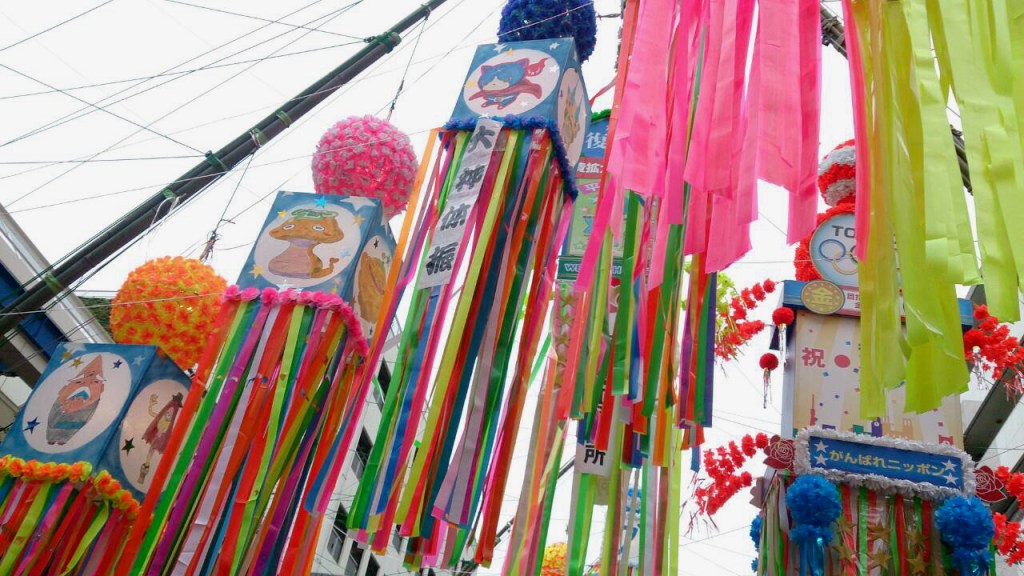
Taken at a local festival near Hiratsuka, Japan in 2015
Tanabata (七夕) is the fourth of five sekku or “seasonal” holidays that happen every year in Japan,1 and has been a big summer festival since antiquity. The origin story of Tanabata is based on a Chinese legend about two young, celestial lovers named Hikoboshi and Orihime who were later forcibly separated by Orihime’s father except for one night each year: the seventh day of the seventh month. On that day, a flock of magpies form a bridge so the two can meet for that evening. Thus, Tanabata in the modern calendar is always July 7th.
There’s even a famous poem referring to Tanabata in the ancient Hyakunin Isshu anthology:
The reference to the Magpie’s Bridge is from two places: the Imperial Palace at the time had a set of stairs called Magpie’s Bridge, but also the famous legend of Tanabata. Although the poem takes place in the dead of winter, even as far back as the 8th century, the story of the magpie bridge was culturally significant.
The story of Tanabata makes a good theme for a summer night, and not surprisingly, it’s a great excuse to get out, dress up in traditional robes (yukata) and enjoy local festivals, food and people watching. My wife and kids are usually in Japan during this time, but due to work, I tend to arrive later in July, so I often miss the Tanabata, but when I do go, it’s a good time for the family.
One popular tradition is to write one’s wishes on a small piece of paper called tanzaku (短冊)2 and hang it on a designated bamboo tree:
Sasa no ha sara-sara Nokiba ni yureru Ohoshi-sama kira-kira Kingin sunago Goshiki no tanzaku watashi ga kaita Ohoshi-sama kirakira sora kara miteru
The bamboo leaves rustle, And sway under the eaves. The stars twinkle Like gold and silver grains of sand. The five-color paper strips I have written them. The stars twinkle, Watching from above.
My wife usually only sings the first four verses if I recall correctly, but I can still hear her singing this song in my mind to our newborn kids before they go to sleep. 🥰
Anyhow, Tanabata is a nice summer holiday that young and old can enjoy, and well worth seeing if you happen to be in Japan in the summer.
I have a small fascination with calendars,1 including the traditional Japanese calendar (online example here), which has a lot of interesting cultural tidbits that aren’t obvious to Westerners.
On many Japanese calendars are small words like 大安, 仏滅, and 先勝 that repeat over and over in a cycle each month. These are known as the rokuyō (六曜) or “six days” and are related to a superstition that has persisted since the Edo Period (16th – 19th century).
Here is an old example I took many years ago at my in-laws house in Japan. I use to stare at this calendar all the time, trying to puzzle out what these words meant…
A more contemporary example here is from a calendar we got in 2025:
Prior to the early-industrial Meiji Period (late 19th century), Japan still used a lunar calendar based on the Chinese model which is now called kyūreki (旧暦) or “the old calendar”. As a lunar calendar, it had twelve months, 30 days each, to reflect the cycles of the moon. Japanese New Year thus originally coincided with Chinese New Year, though the first day of the new lunar year is now relegated to kyūshōgatsu (旧正月, “old New Year”). Modern new year is observed on January 1st instead to coincide with Western calendar.
Anyhow, since the months were all exactly 30 days, the rokuyō were six days that reflected good or bad fortune on that day, mainly related to public events like weddings, funerals, new undertakings, etc. Though, it’s thought that the six days were also used to determine one’s fortune in gambling, too. The six days are, in order are:
Japanese
Romanization
Meaning
Notes
先勝
senshō
Winning first/before
Mornings were thought to be auspicious, but afternoons unlucky.
友引
tomobiki
Pulling friends
Funerals were avoided this day, but private gathering of friends were considered OK.
先負
senbu
Losing first/before
Mornings were thought to be unlucky, but afternoons auspicious.
仏滅
butsumetsu
Death of the Buddha
Inauspicious all day. Social events avoided.
大安
taian
Great Luck
Very auspicious day.
赤口
shakkō
Red Mouth
Though 11am to 1pm was thought to be OK, the rest is dangerous, especially handling knives.
The six days simply repeat over and over throughout the old Chinese calendar, but there’s a twist:
The first day of the 1st and 7th lunar months is always 先勝 (senshō).
The first day of the 2nd and 8th lunar months is always 友引 (tomobiki).
The first day of the 3rd and 9th lunar months is always 先負 (senbu).
…and so on.
So this cycle of six days actually resets at the beginning of a new month. This leads to some interesting outcomes for certain traditional Japanese holidays, particularly the 5 seasonal holidays or sekku, some of which we’ve talked about here in the blog. For example:
Girls Day is always 大安 (taian). Girls rock, what can I say? 😎
Childrens Day (originally Boys Day) is always 先負 (senbu). Maybe boys start out awkward, but mature into their own later? 💪🏼
Tanabata (July 7th), one of my other favorite Japanese holidays, is always 先勝 (senshō). The star-crossed lovers that feature in the story of Tanabata were separated later, so perhaps they were only lucky at first. 💔 (just kidding)
Day of the Chrysanthemum (Sept. 9th, another holiday we haven’t gone over yet) is always 大安 (taian). Mathematically this makes sense since it is exactly 6 months away from Girls Day.
Further, a couple other traditional holidays such as jūgoya (十五夜, “harvest moon-viewing day”) is always 仏滅 (butsumetsu) and the lesser-known jūsanya (十三夜, “the full moon after harvest moon”) is always 先負 (senbu).
Finally, there are intercalary or “leap months” (uruuzuki, 閏月) that are inserted about every 3 years to help re-align the calendar with the seasons. Lunar cycles don’t match solar ones very well, so in antiquity, lunar calendars frequently fell out of alignment. In the case of the Japanese calendar, this is done about every 3 years after the risshun season from what I can see.
A while back before I had all this figured out, I wrote a small computer program that would execute every time I would log into my computer terminal. Sometimes, I written program this in Python language, sometimes in Ruby, and then Golang. The screenshot below is from the Ruby version which worked reasonably well:
The current incarnation I use was written in Golang language and doesn’t yet include Imperial reign name, nor leap months. I have taken the existing version and moved it to Gitlab for public usage, though it is far from complete. You can find the repo here.
Anyhow, that’s a brief look at the rokuyo in the Japanese calendar. If you’re technically-inclined, feel free to try out the program above, make improvements, send feedback, whatever.
For everyone else, the six days are a bit of a cultural relic from an earlier time in Japan, and apart from planning weddings and funerals, most people give it no real thought. Me? I like to check it from time to time and see if my day’s experiences matched the day’s fortune (spoiler: it usually doesn’t).
Edit: turns out my Ruby code had a silly bug in it all these years. It is now fixed.
Edit 2: turns out 2023 in the Chinese lunar calendar had a leapmonth, which throws off this entire script. I hadn’t expected this. Will think about this for a while and try to solve for leap months too.
1 Historia Civilis has a fun video on Youtube about the origin of the Julian Calendar and why 44 BCE was the “longest” year in history.
2 The idea of the Buddha’s death and the concept of Nirvana (lit. “unbinding”) is a lengthy subject in Buddhism. Enjoy!
A “koinobori” display made by my wife and son while under living under COVID-19 lockdown. The upper hand pattern is mine, while the bottom one is my son’s. 🥰
May 5th in Japan every year is a holiday called Children’s Day or Kodomo no Hi (子供の日). This holiday was originally the third of five sekku (節句) or seasonal holidays in ancient Japan and a counterpart to Hinamatsuri or Girl’s Day. The 5/5 date, along with Hinamatsuri’s 3/3 date is no coincidence. Most of the sekku holidays have traditional dates like that: Tanabata is 7/7 and the Day of the Chrysanthemum is 9/9, and many of them have Chinese origin as well. May 5th is also a holiday in China as well.
According to an old cultural guidebook that I previously owned, Children’s Day used to be called the Day of the Iris (ayamé no hi, 菖蒲の日) in traditional times. The term for Iris is usually called ayame (菖蒲), but the Chinese characters can also be read as shōbu, which happens to be a homophone of another word that meant warlike spirit, or martial prowess (尚武), which sounded manly and hence it became a festival for boys. By 1948, the holiday was broadened to Children’s Day and has remained that way since. It is also known by an alternate name, tango no sekku (端午の節句) which still retains the nuance of “boy’s day”.
One of the most common displays you’ll see on Children’s Day are the koinobori (鯉のぼり) wind-socks. These wind socks intentionally look like Japanese koi fish, and are usually displayed in groups of 2 to 4. My kids used to make them out of paper each year in Japanese preschool.
The other common tradition is to see samurai armor displayed. If a household has boys in the home, then families setup miniature display of armor, or in our case just the helmet (kabuto 兜) and weapons, some time in April until shortly after Children’s Day. However, schools and preschools also make kabuto helmets and armor out of construction paper for kids to dress up in too. Everyone gets into the spirit that way.
The family “kabuto” display we put up every year for Children’s Day. Other displays depict a full samurai armor (yoroi 鎧), but the one we have is just the helmet, bow and arrow, and katana.
My son, who was born several years after his big sister, is really excited about Children’s Day because he knows he will be spoiled extra, even in these trying times.
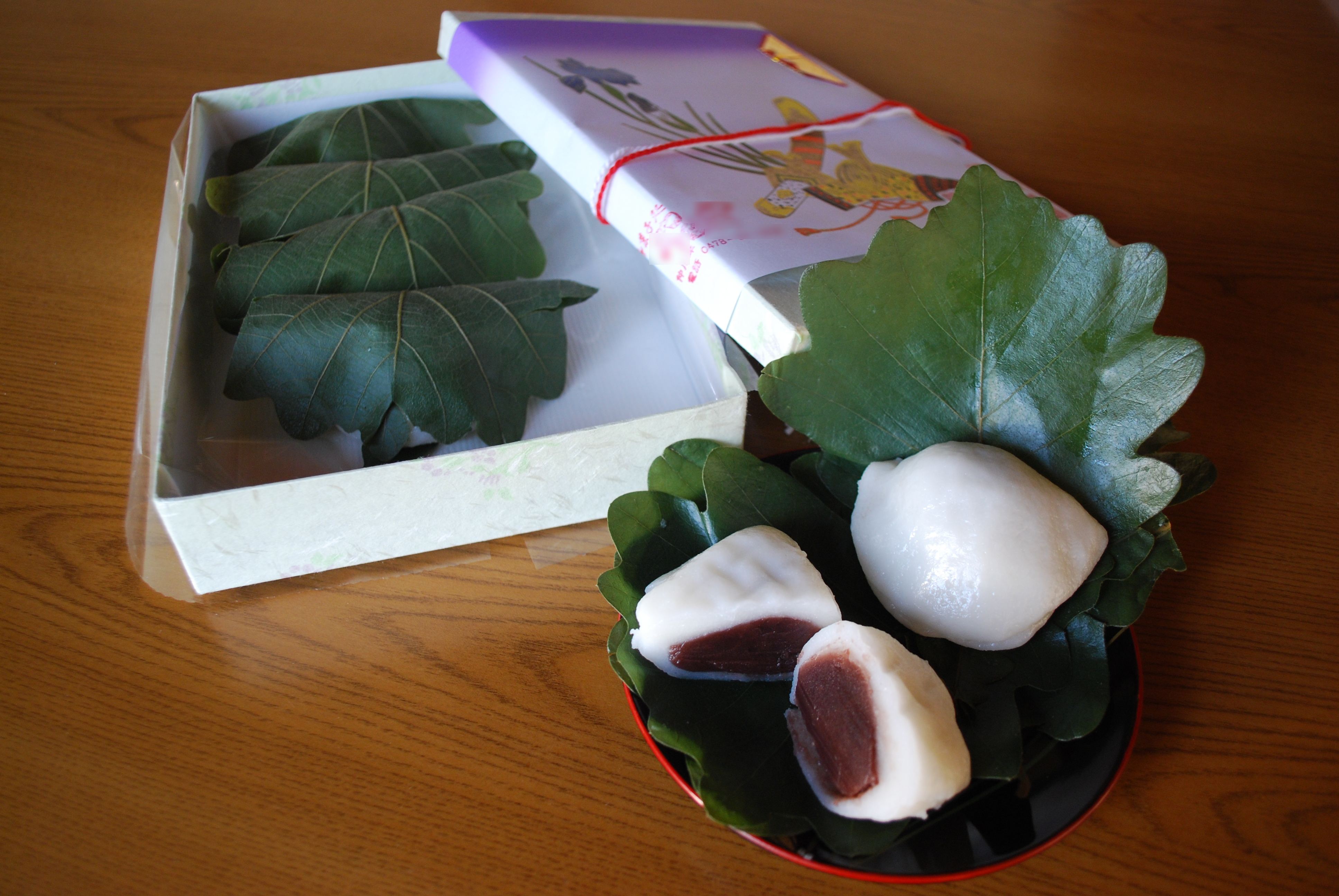
Among other things, my wife was able to get kashiwa-mochi (柏餅), which is a special treat made of soft rice-cakes wrapped in White Oak leaves. The leaves are tough and inedible2 (unlike sakura-mochi for Girl’s Day) so unwrap the mochi first and enjoy.
2020 under lockdown is an especially tough year for everyone, especially kids. But I sincerely hope kids everywhere have a terrific Children’s Day and feel loved and appreciated. 🧑🧑🧒🧒
1 One other holiday worth nothing is Nanakusa, which doesn’t follow the usual dating convention, but is considered another sekku holiday.
Photo of my two Thundercloud plum trees currently in bloom
Shinto religion in Japan is a loose network of diverse traditions and local deities (kami), and one of the most unusual, and popular, kami is Tenjin, the god of learning. Tenjin is unusual because he is a deified version of an actual historical figure named Sugawara no Michizane who lived in the 9th and 10th centuries. Sugawara no Michizane (and his deification as Tenjin) are considered an archetypal scholar, poet and Confucian.
Sugawara no Michizane was a scholar from a middle-ranked noble family in the Heian Period (9th-12th c.), but under Emperor Uda, he unexpectedly rose to a high rank as a close advisor. This drew of the wrath of the rival, powerful Fujiwara family, who engineered Michizane’s downfall and exile to the remote town of Dazaifu. It was on parting his home, that Michizane reputedly wrote this poem (his most famous):
東風吹かば Kochi fukaba 匂ひおこせよ Nioi okoseyo 梅の花 Ume no hana 主なしとて Aruji nashi tote 春を忘るな Haru wo wasuruna
When the east wind blows, let it send your fragrance, oh plum blossoms. Although your master is gone, do not forget the spring.
Translation by Robert Borgen in “Sugawara no Michizane and the Early Heian Court”
For this reason, plum blossoms are closely associated with Michizane and Tenjin. Another story relates how after Michizane died in Dazaifu, the ox pulling his funeral cart stopped at one point, and refused to go any further. Thus, that site became the site of his burial and later the Dazaifu Tenman-gū shrine. For this reason, oxen are also associated with Michizane.
But how did Michizane go from a talented (though perhaps not necessarily a genius) scholar and poet into a deity? The answer lies in Sugawara no Michizane’s exile. Soon after Michizane’s death in exile a series of natural disasters and untimely deaths befell the capitol, and people began to attribute these to Michizane’s wrathful spirit.1 To placate this vengeful spirit, the Imperial Court reinstated his original rank, promoted him, and instituted elaborate rituals and offerings. But this took on a life of its own and over time, worship of “Tenjin” became popular across all of Japan.
These days, Tenmangū (天満宮) shrines devoted to Tenjin are particularly popular around entrance-exam season. People will pile on supplications to Tenjin in hopes of success.
Votive tablets or ema (絵馬) taken by author at Yushima Tenmangu shrine in 2010.
I have visited Yushima Tenmangu shrine in Tokyo some years back when I was studying for the JLPT N3 exam (spoiler alert: I passed), and it was one of my favorite Shinto shrines.
Inner-sanctum of Yushima Tenmangu shrine, taken by author in 2010.
As a nerd and amateur scholar, I’ve always felt a special connection to Michizane and the concept of a “scholar god”, so coming there was a fun experience. In 2023, I visited the Kitano Tenmangū shrine in Kyoto as well. Sadly, I failed the JLPT N1 exam this time around.
Sugawara no Michizane / Tenjin is a curious but fascinating figure in Japanese cultural history. In Robert Borgen’s excellent book Sugawara no Michizane and the Early Heian Court, he points out that in the end Sugawara no Michizane wasn’t that extraordinary a poet, scholar or teacher, but through a somewhat lucky (or unlucky) series of events, he rose to become the archetypal deity of learning and education. In the Muromachi Period of Japanese history, he was the archetypal Zen scholar-monk, in the Edo Period, he was the archetypal Confucian scholar, while in the early-modern Meiji Period, which reasserted the primacy of Shinto religion, his worship as a full-fledged Shinto deity matured.
Sugawara no Michizane, the historical figure, was an interesting man, faults and all. But as Tenjin, the god of learning, he came to embody all the ideals of Japanese culture, suitable for each time and period, which persist today.
1 This was not entirely unusual at the time (cf. Prince Sawara a couple centuries earlier). Also, the Shinto kami, Susano-o, is another example of a deity that required placation, but is now seen more as a benevolent deity these days. Time heals all wounds, I guess. ;p
Taken by author at a local park while flying kites with the kids. 🥰
Japanese has a nice yojijukugo phrase for this: sankan shion (三寒四温) which means “three days cold, four days warm”. This just expresses the common experience where the early Spring weather flip-flops back and forth between cold, cloudy days and sunny ones until the cold days get fewer and fewer.
Or if you live in the Pacific Northwest:
At any rate, nice to see the days getting longer, and (slightly) warmer.
One of the more interesting, and still commonly-used practices, in Japanese culture is the use of imperial reigns in place of years in the Gregorian calendar. This is most often used now when talking about generations or one’s birth year, whereas the Gregorian calendar is often used for other historical discussions or other such situations.
Prior to the Meiji Emperor, Japan used since antiquity a system where eras were frequently proclaimed especially after major events, disasters, etc. For example, Emperor Juntoku reigned from 1210 to 1221, but within that reign he proclaimed 4 eras:
Jōgen (承元, 1207–1211)
Kenryaku (建暦, 1211–1213)
Kempō (建保, 1213–1219)
Jōkyū (承久, 1219–1222)
The founder of Jodo Shu Buddhism, Honen was said to have died in the 2nd year of Kenryaku which maps to 1212 in the Western calendar. The 260+ year late-medieval Edo Period had more than 40 different era names within it (see Wikipedia for details).
However, this system completely changed with the reign of the Meiji Emperor ō (reign 1867 – 1912). The system was simplified such that each emperor had a *single* reign name, starting with the Meiji Emperor. Since then, there have 5 emperors total, and 5 reigns accordingly:
So, nowadays, when people in Japan talk about what year they were born, they might say “the 52nd year of Shōwa” or in Japanese shōwa go-jū-ni nen.
This also comes up a lot when people joke about different Japanese generations. My wife and I are born in the 1970’s, so we are “Showa” generation kids, by my kids who are half-Japanese are “Heisei” kids. Nowadays, there are even “Reiwa” generation kids now.
On TV documentaries and other sources, reign years are also frequently used alongside the Western calendar, so you get used to doing the math like so:
The first year of an Emperor is year 1, not year 0.
So, for example Heisei 3 is 1991 (1989 + 3 – first year of reign).
Shōwa 47 would be 1926 + 47 – first year of reign, or 1972.
Interestingly, Japan is not the only culture to have novel calendar systems based on the dates of rulers. Rome during the Republic had its own system. The ancient Roman calendar was confusing and imprecise until Julius Caesar fixed it in 46 BCE. However, in popular Roman culture, people told dates based on who the two elected consuls were that year. Just as Japanese know who the line of Emperors are in recent times (see above), Romans in those days remembered each year.
One might say something like “April 4th in the year that Pompey and Crassus were consuls” or “when Caesar and Bibulus were consuls” or something like that.
I often find these little cultural oddities interesting because they add “flavor” to a culture even if they’re not entirely practical. The Julian Calendar introduced by Caesar was a huge improvement over the old system, but I wonder if a little something also got lost in the process too. 😀
¹ Emperor Meiji reigned starting in 1867, but due to radical changes in Japan at the time, it wasn’t technically formalized until 1868.
Girls Day in Japan, better known as hinamatsuri (雛祭り) is the third of 5 sekku (節句) or seasonal holidays in the traditional calendar, but it used to be called momo no sekku (桃の節句) or Peach Day, Peach Festival, etc. In the old lunar calendar, it fell every year on the 3rd day of the 3rd month, which then became March 3rd in the modern era. The biggest tradition by far is to put together a special doll set as soon after Setsubun as possible. My wife’s parents brought a nice doll set from Kyoto when our daughter was a baby and every year in February, I bring it out and assemble it:
This is what is looks like when assembled:
The display shows the prince (o-dairi-sama お内裏さま) wedding his bride¹ in traditional style all the way back to the golden era of the Heian Period. Normally such displays can get very elaborate with multiple tiers on them representing the prince’s entourage:
My wife’s parents couldn’t bring over a full doll-set, so we just setup the top tier. However, in my visits to Japan, I have sometimes seen the extended family setup displays similar to this one above. It’s a nice father-daughter activity too. My kindergarten-aged son also likes to help out.
Girls Day and these doll displays are a way of praying for the well-being of the daughters in the family, which traditionally meant starting a new family, prosperity, happiness. It might seem a bit old-fashioned in the 21st century, but even in this modern era, parents still hope for their daughters’ happiness and well-being and it’s a chance for young ladies to be a princess for a day. 🥰 My wife always makes a nice dinner for our daughter using sashimi and other nice treats. I’ll post more on that later.
P.S. The emoji 🎎 is actually from Hinamatsuri, though few outside Japan would normally recognize this.
¹ Notice the bride is also wearing many layers of kimono robes. This style, called jūni-hito-é (十二単) or “twelve layers”, was a gorgeous style worn by noblewomen and their ladies in waiting during the Heian Period, and even used these days in very, very limited situations such as those presided by the Imperial Family. Suffice to say the twelve-layers were very heavy and required help to get in and out of. Lady Murasaki was one such celebrity (herself a lady in waiting) who wore jūnihitoe during formal occasions.
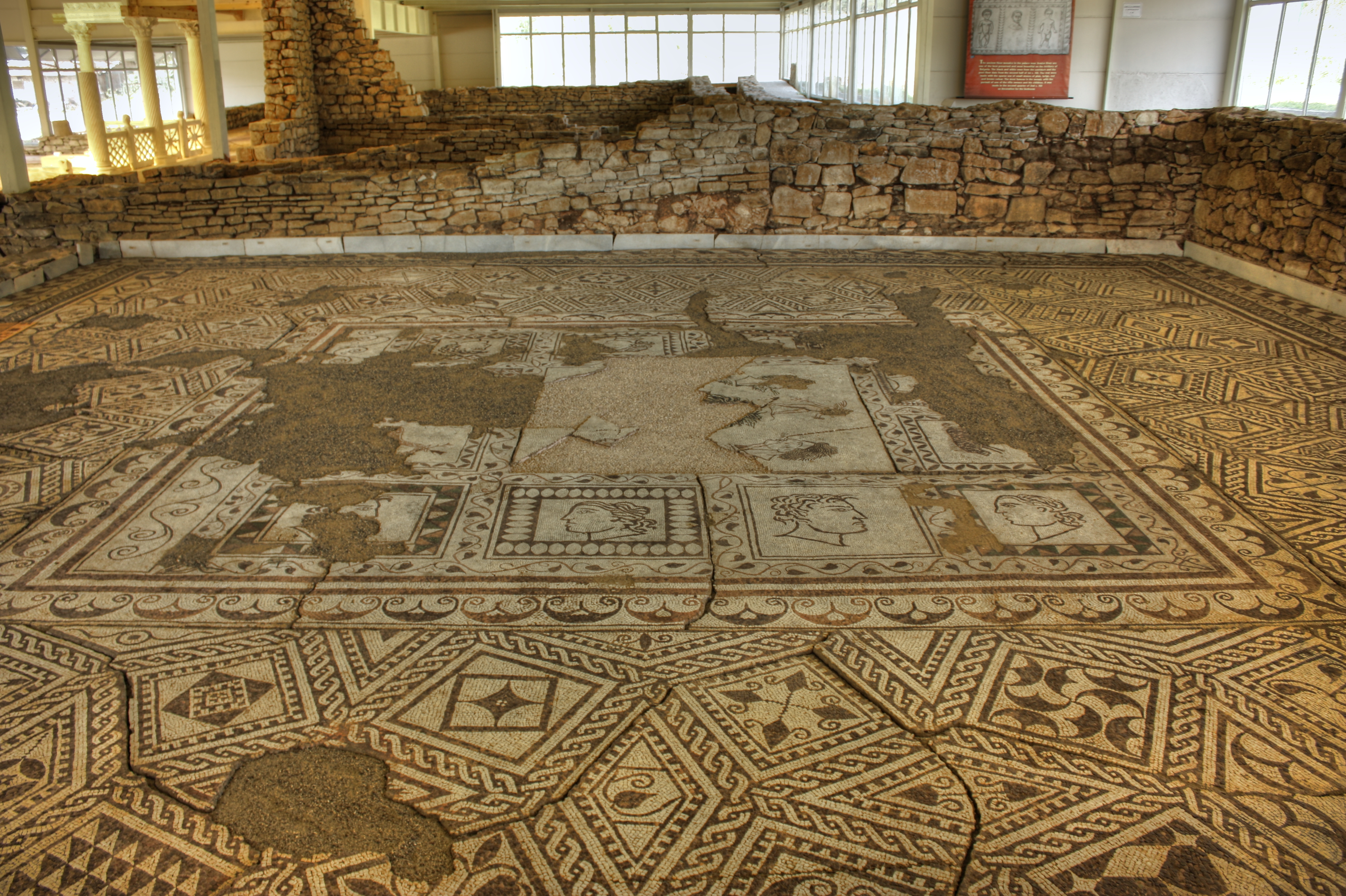
Villas, as Wikipedia shows, were a kind of country housing complex owned by wealthy, rural landowners. It was also commonplace for wealthy citizens in Rome to own country villas in addition to their elite properties in the city. Cicero had a property close to the Roman Forum (unfortunately right next to his hated rival Clodius), as well as a villa in Pompeii, and one out in Formia which was eventually caught by Octavian’s troops and executed.
Villas in Roman culture vaguely remind me of Japanese shinden-zukuri(寝殿造) which were villas for the wealthy class too:
The Higashi-Sanjo Dono villa (東三条殿) owned by various members of the Fujiwara family, including Fujiwara no Kaneie. Located in the suburbs of Kyoto.
The cultural similarities are probably only surface-level, but it’s interesting when totally different cultures tend to arrive at similar patterns. 🙂
Back to the article, I do have similar legos at home, so I wonder if might be able to build something similar someday. If so, I’ll post here.
One of my favorite holidays in Japan is Setsubun which in the modern calendar is always February 3rd. We celebrate it every year with the kids because it’s a fun way to bring the family together, maybe bring in a little extra good luck, and is pretty low-key.
Setsubun (節分) is the second of 5 “seasonal events” (sekku, 節句) and traditionally marked the beginning of Spring in the Old Chinese calendar. In the traditional 24-period division in the old calendar the beginning of Spring was called risshun (立春). There are technically other Setsubun days, but really the only one anyone knows anymore is “spring Setsubun” which is was on the 3rd day of the second month of the Lunar Calendar, which was converted to February 3rd in the Gregorian calendar.
Since (spring) Setsubun marks the beginning of Spring, which in turn marked the beginning of the new year in the old lunar calendar, Setsubun is a time to “reset” the home, get a fresh start, and so on.
The most important tradition is the mamemaki (豆まき) in which the head of the household usually dresses up as an oni (鬼, Japanese ogre) and knocks on the front door. The kids throw roasted soybeans at him and yell:
鬼は外! 福は内! Oni wa soto! Fuku wa uchi!
“ogre out! good luck in!”
I have some old videos of my misadventures with mamemaki. One year, as I pretended to fall down from the soy beans, I hit my head really hard on the handle of the bbq grill. Hurt like hell.
Also, since we live in the US, we use roasted peanuts instead of soybeans since they’re easier to get a hold of. Further, after driving away the Oni, one is supposed to eat a number of beans equal to one’s age.
The local Buddhist temple here also has a mamemaki event we do with the kids. I might post something about that soon.
The other big tradition is eating a special sushi roll called ehōmaki (恵方巻), while facing a particular “auspicious” tradition based on Japanese geomancy. The direction changes every year, and according to tradition, your wish will come true if you can eat the entire ehōmaki roll while facing that direction and not saying a single word. Ehōmaki rolls are more of a Kansai area (Osaka, Kyoto) thing than the Kanto area (Tokyo), but the tradition has spread to much of Japan and overseas communities as well.
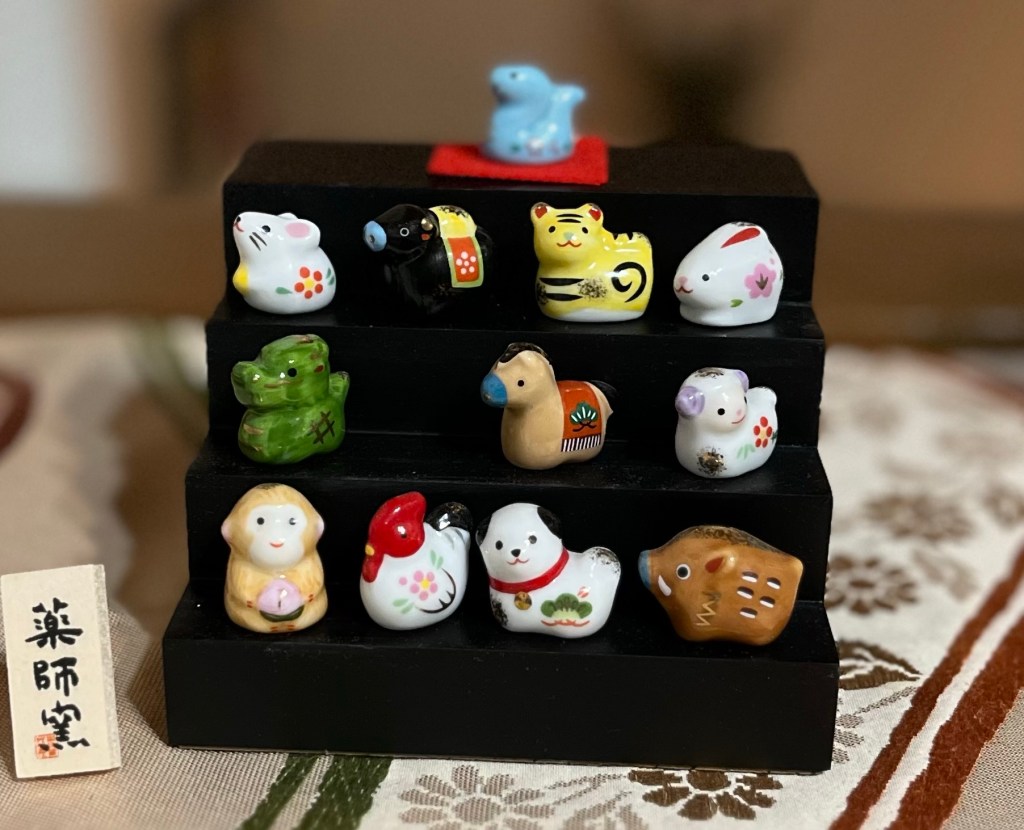
This year, 2020, is in the Japanese (extended) zodiac the year of 庚子 (kano-é-ne). The Japanese zodiac was originally based off the Chinese Lunar calendar, though this changed in the late 19th century when Japan moved toward rapid Westernization and industrialization. However, the 12-animal zodiac, or jūnishi (十二支), is still an important part of the culture. In Japanese culture, like Chinese culture, the calendar is divided into a 12-animal cycle that rotates year after year. Even hours of the day were divided by these same animals, with the time starting at midnight, the hour of the rat, and noon being the hour of the horse.
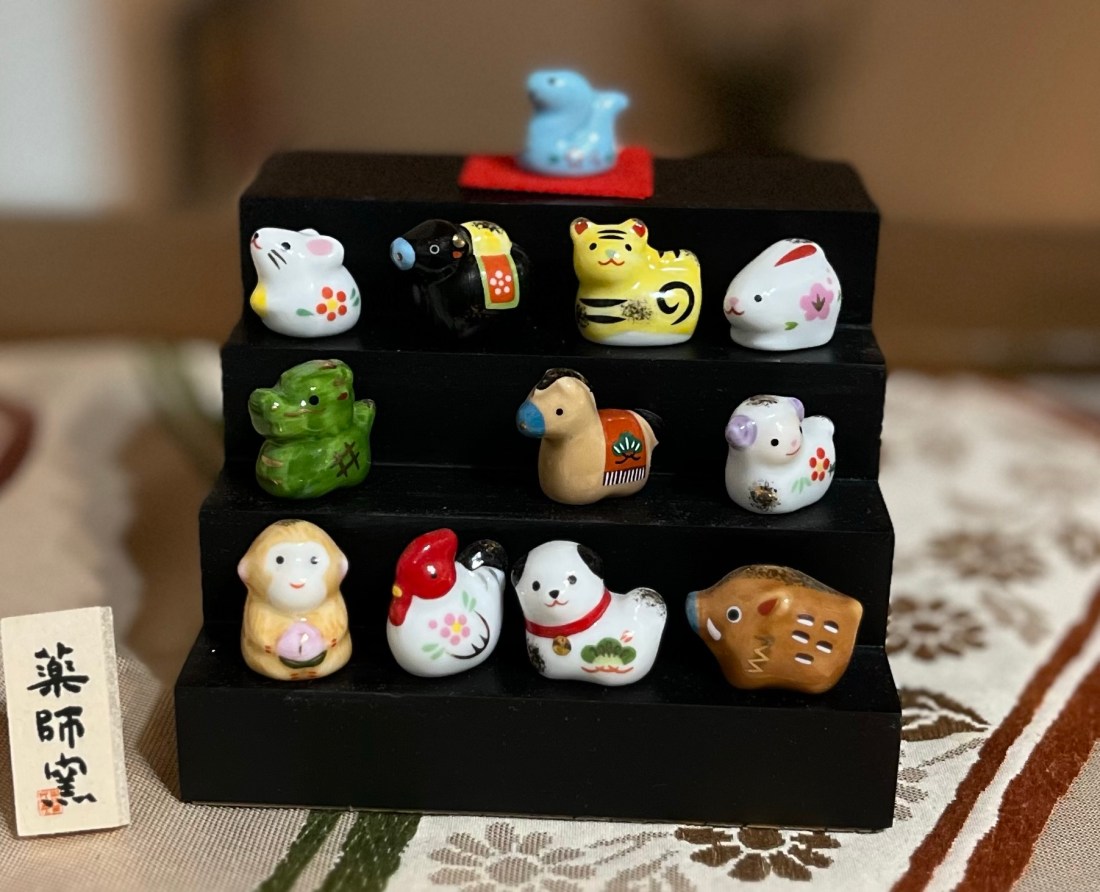
The twelve animals of the zodiac. My wife found this display in Japan a couple years ago, and we change it each year when the zodiac changes. (As of writing 2025, year of the snake)
The animals, their names and kanji are listed as follows:
Unlike the Chinese calendar, the “pig” has been replaced by a “boar”, which are more common in the mountainous areas of Japan, even today.
The Kanji (Chinese characters) for these animals are quite different than the ones in daily use. The regular Kanji for Dog is 犬 but in the zodiac it’s 戌.
Some of the animals also have different readings in the Zodiac than daily usage. Compare the snake, hebi in daily use, but mi in the zodiac.
However, what many Westerners (and Japanese) don’t know is that these 12 animals signs can be sub-divided further and further. Traditionally the 12 animals of the zodiac were also interwove with the five elements: earth, fire, water, air and metal. The cycle of the five elements is divided even further into a pair of “stems”, for a total of ten stems. The stems related to the notion of yin/yang, or inyō in Japanese (陰陽) with in (陰) being “yin”, and yō (陽) for “yang”. Often times these are referred to as big brother, or é (兄), and little brother, or to (弟), as well. Taken together, the five elements plus the yin and yang stems are called jikkan (十干) and are organized like so, with pronunciations added:
Element
Yin vs. Yang
Stem
Wood: 木 (ki)
Yang (e)
甲 (ki no é)
Yin (to)
乙 (ki no to)
Fire: 火 (hi)
Yang (e)
丙 (hi no é)
Yin (to)
丁 (hi no to)
Earth: 土 (tsuchi)
Yang (e)
戊 (tsuchi no é)
Yin (to)
己 (tsuchi no to)
Metal: 金 (kane)
Yang (e)
庚 (ka no é)
Yin (to)
辛 (ka no to)
Water: 水 (mizu)
Yang (e)
壬 (mizu no é)
Yin (to)
癸 (mizu no to)
A few notes here as well:
The character on the right represents both the yin/yang and the element, so they’re not written separately as one would expect. One character is sufficient to express both.
All the stems are kanji that show up elsewhere in Japanese, but here they take on different meanings, readings.
So, how do you read this? If someone is born as the element wood, or “ki” and the yin stem, this is read as ki no to. If yang stem, then ki no é. That’s why I mentioned “e” and “to” above under yang and yin. The only exception to this rule is “metal” which sounds awkward if you say kane-no-e or kane-no-to, so it gets shortened to ka-no-e or ka-no-to.
Now, putting this altogether. If you consult the chart here, you can figure out for your birth year, what stem and animal is associated with it. So, for me, being born in late 1977, I am a “yin fire snake”, since “丁” is the yin stem for fire (see above). Thus, in Japanese, I could say I am hi-no-to-mi, or “fire yin snake”: 丁巳. The year 2025 is ki-no-to-mi (乙巳), or “wood yin snake”.
Going back to the beginning of this post this year, 2020, is kano-é-né (庚子) which translates as “mental yang mouse”.
While I don’t believe in the zodiac at all, it does come up in conversation a lot in Japan, so it’s a good subject to get familiar with. You will also see the same formula used in Japanese calendars, which the 10 stems and 12 animals cycling through the days as well. Also, people often like to ask what year you were born: nani doshi desu ka? For such questions, it’s enough to just say “(animal)-doshi“.
But as interesting as horoscopes are, I am reminded that the Buddha said in the opening lines of the Dhammapada (trans. Acharya Buddharakkhita):
Mind precedes all mental states. Mind is their chief; they are all mind-wrought. If with an impure mind a person speaks or acts suffering follows him like the wheel that follows the foot of the ox.
Mind precedes all mental states. Mind is their chief; they are all mind-wrought. If with a pure mind a person speaks or acts happiness follows him like his never-departing shadow.
Seems a lot more practical than horoscopes anyway, if you ask me. 🙂
Namu Amida Butsu Namu Kanzeon Bosatsu
1 Or, Water Buffalo or Bull depending on who’s doing the translation.









 Gleanings in Buddha-Fields
.jpg)


You must be logged in to post a comment.