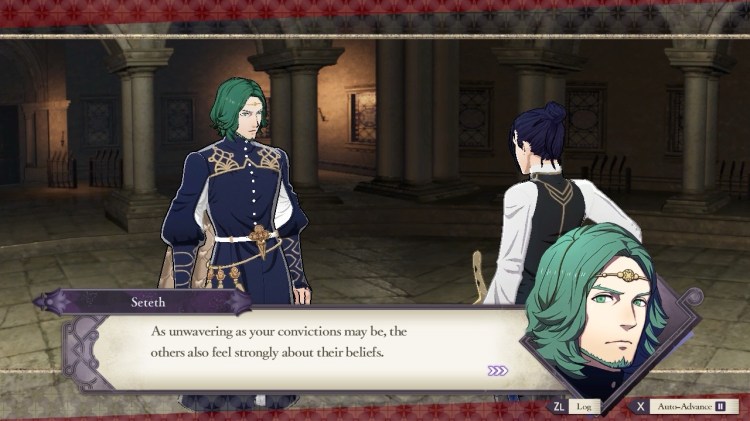
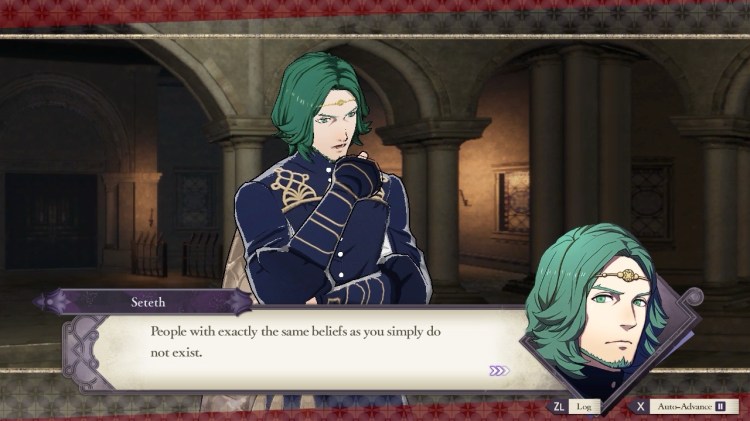
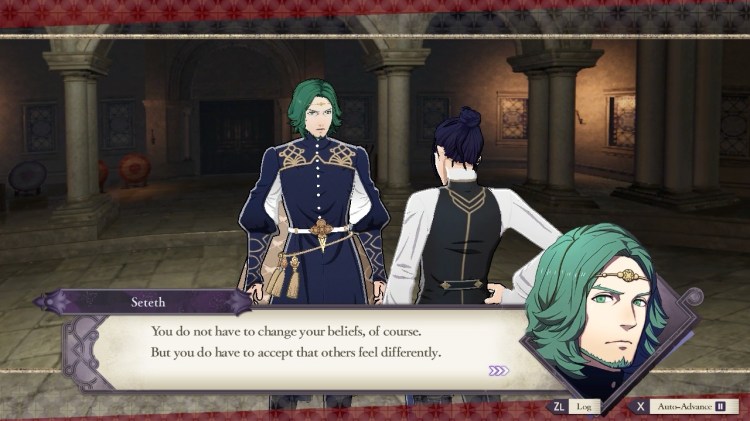
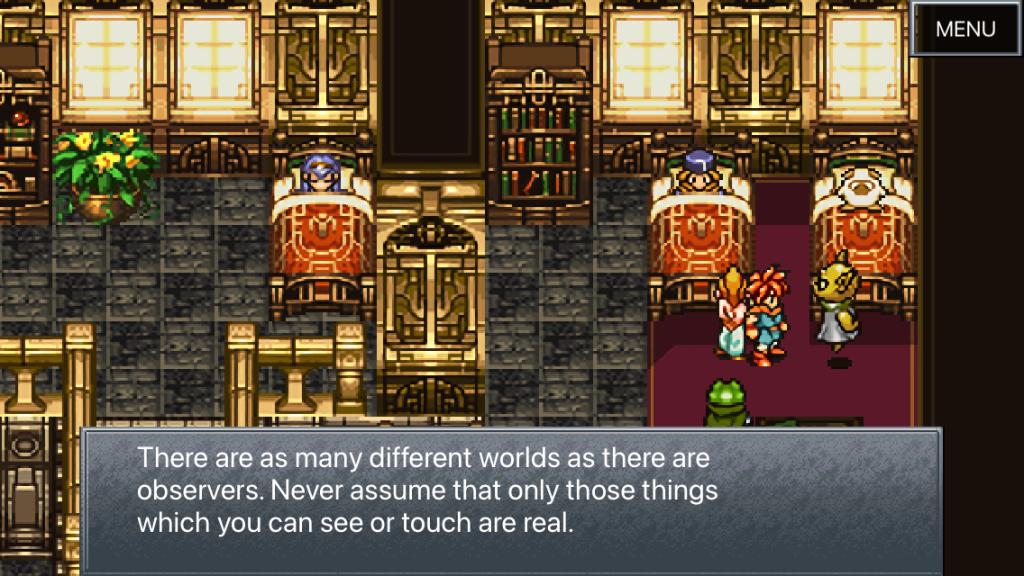
I thought this was a neat dialogue between two of the characters in the game Fire Emblem: Three Houses. The older Seteth (green hair) is offering some advice to the young and prickly Felix:
This might seem self-evident, but because we only see the world through our own viewpoint, our own thoughts and experiences, it’s easy to forget that other people have other viewpoints and other experiences, and come to their own conclusions, right or wrong.
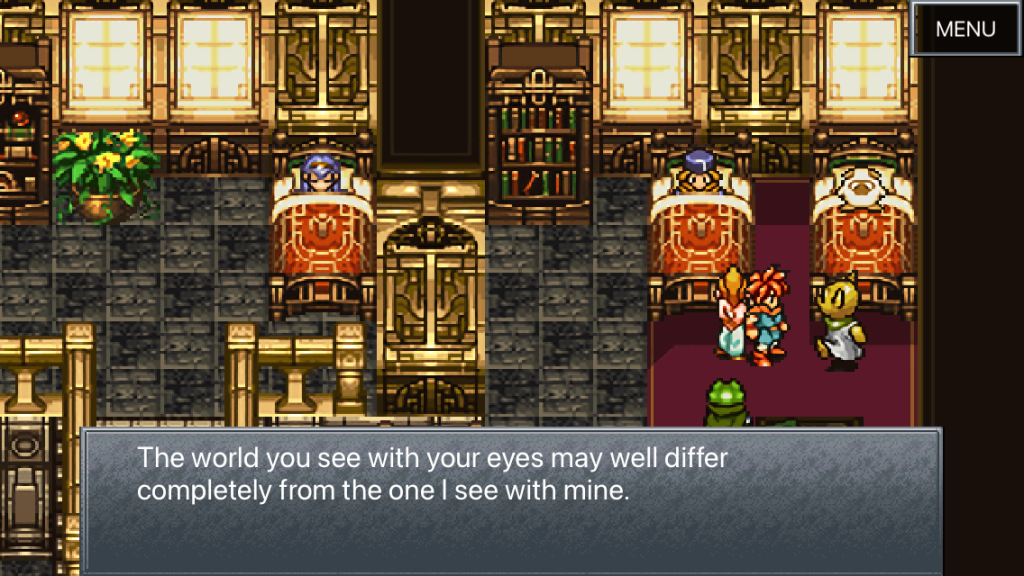
Different game, but I hope the sentiment makes sense. 😆 It’s also why Buddhism emphasizes unconditional goodwill so much.
With Obon Season coming to Japan in late July and August, this is also the time of the Segaki (施餓鬼) ceremony in many Buddhist temples.
In Buddhism, one of the six (sometimes five or ten) realms of rebirth that brings undergo based on accumulated karma is the realm of the Hungry Ghosts, called preta in India, or gaki (餓鬼) in Japanese.
From a 12th century scroll depicting hungry ghosts living among us unseen, feeding on refuse, feces, water, etc. Courtesy of Wikipedia.
Hungry Ghosts are those whose past lives were defined by extreme vice and craving. This could be alcohol, drugs, women, money, etc. The usual. This craving carries over and they lived as hungry shades, unseen by the living, surviving off of scraps in the shadows. Further, the foods they are forced to eat, garbage, feces, blood, etc, are never enough, so such ghosts are constantly hungry and living in misery. It is the second-worst realm of rebirth apart from the hell realms in the Buddhist cosmology.
Thus, the segaki ritual, practiced in all Buddhist sects except Jodo Shinshu, is meant to help alleviate their craving, at least for a short while, also in hopes (depending on sect) that they can be reborn in the Pure Land of Amitabha Buddha next.
Like so many others, I am enjoying The Legend of Zelda: Tears of the Kingdom, but I am not just enjoying the game-play, I am subtly enjoying how certain Japanese cultural concepts shine through even in a medieval fantasy adventure. In a previous post, I talked about Japanese-religious influences in Breath of the Wild, and today, I wanted to revisit the subject for Tears of the Kingdom (hereafter TotK), since one aspect really stands out: the sky realm and the world below.
In early Indian Buddhism, the world was described in a complex cosmology involving devas (forerunners of the Hindu gods), and various hell realms not unlike Dante’s Inferno, plus many other states of rebirth such as hungry ghosts, asuras (titans) and so on. Many of these were inherent to Indian culture, but as Buddhism moved to other cultures, China and beyond, things gradually shifted in emphasis, or merged with native religious traditions. I don’t mean this in a sense of corruption, or loss of authenticity though. Just simply changing times, changing places.
In any case, by the time of late 12th century, medieval Japan, and especially through the writings of monks like Genshin, the cosmology from India had gradually streamlined in popular culture to essentially two realms of rebirth: Hell and the Pure Land. Other realms still existed on paper (i.e. religion tradition), but in the minds of most Japanese at the time, either you were destined to Hell or through the Buddha’s compassion you might be get fortunate to be reborn in the Pure Land.
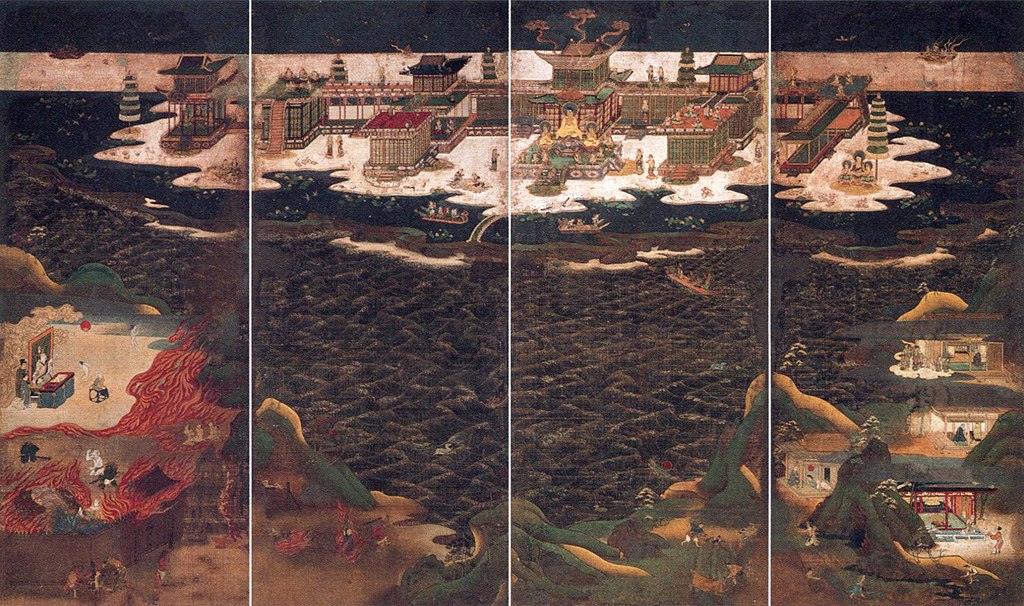
A 14th century painting depicting the Buddha’s Pure Land (top), Hell (bottom-left) and the mundane world (right). Painting courtesy of Konkaikōmyō-ji Temple, Public domain, via Wikimedia Commons
As Pure Land Buddhism gained in popularity during the Heian Period (8th-12th centuries), you see an increase of artwork depicting Amida Buddha welcoming the deceased to paradise,1 sometimes juxtaposed with images of Hell.2 Years ago I attended a local art exhibit in Kamakura, Japan, next to Tsurugaoka-Hachimangu shrine which displayed a gallery of such art from local temples and it was fascinating to see such a stark world-view, much like medieval Christianity, yet also very different under the hood, theologically.
Anyhow, getting back to the Legend of Zelda: TotK, the kingdom of Hyrule has expanded to include a sky realm, and a dark world underground. This is imagery that’s pretty universal in many cultures, but the details reflect Japanese-religious traditions.
Let’s look at the sky world first.
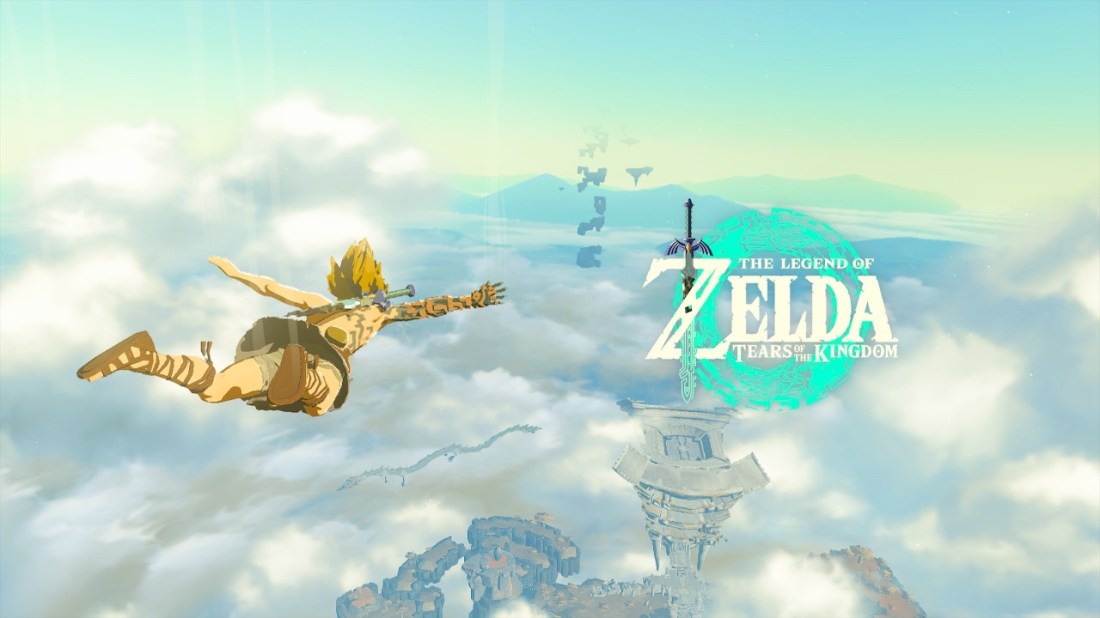
The sky world has placid ponds with lotus blossoms, and frequently uses a gentle golden color.
Compare with this passage from a Buddhist text, the Amitabha Sutra (阿弥陀経, amida-kyō in Japanese):
“In the pools [of the Pure Land] are lotuses as large as carriage wheels: green colored of green light, yellow colored of yellow light, red colored of red light, white colored of white light, subtly, wonderfully fragrant and pure….Moreover, Shāriputra, in that Buddhaland there is always heavenly music and the ground is yellow gold.”
The beautiful and rare birds also reflect another passage in the same sutra:
“Moreover Shāriputra, in this country there are always rare and wonderful varicolored birds: white cranes, peacocks, parrots, and egrets, kalavinkas, and two-headed birds.
Thus, we can see that sky world in TotK reflects imagery associated with Buddhism, especially the Pure Land of Amida Buddha. This may be entirely an arsthetic choice, but it still reflects Japanese-religious culture.
Now, let’s look at the world below:
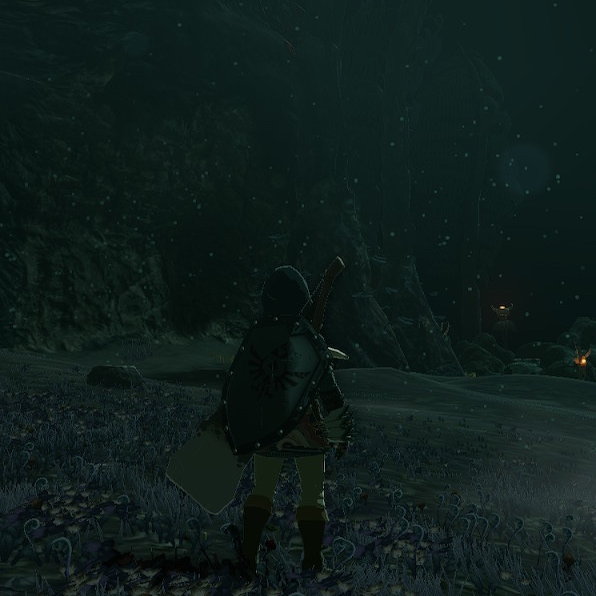
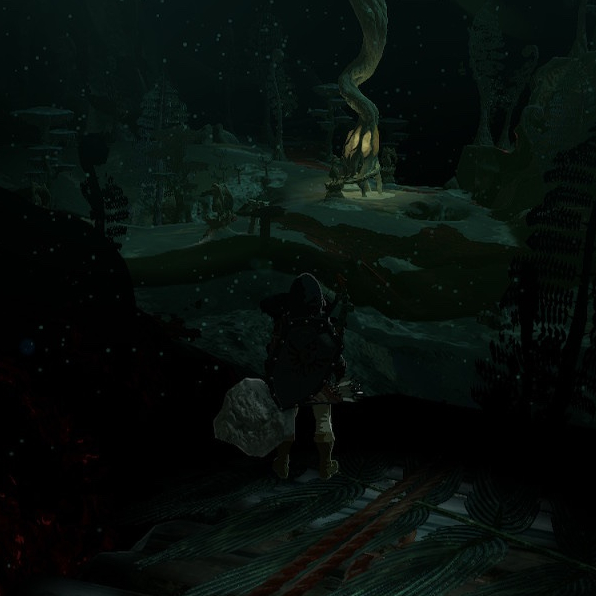
The world below is a world of darkness and misery. There is little life here, primarily predatory life, or creatures toiling away mining Zonaite minerals, and the air is stifling with spores (or ash?) in the air.
The imagery here does not fit neatly into the elaborate Buddhist hells as described in a Buddhist text such as the Earth Store Bodhisattva Sutra.
Instead, it more neatly fits a more Shinto (not Buddhist) depiction of the Land of Yomi, the Land of the Dead. Yomi, like the world below in TotK, is also accessible from the mundane world through various entrances, and similar to the Greek concept of Hades, it includes shades and shadows of former lives.
But again, in popular religious tradition, the Buddhist concept of Hell, and the native Shinto concept of Yomi blend together. This was very common in pre-modern Japanese culture where the two religions blended, and were virtually indistinguishable. In medieval Europe, Christianity blended with pagan and local folk traditions in the same way to the point where it was hard to see where one ended, and the other began.
And it’s fascinating to see the imagery applied to modern gaming as well.
A screenshot from the sky world. The image of a setting sun, by the way, is used to represent Amida Buddha in the first meditation in the Contemplation Sutra among other places.
Namu Amida Butsu
P.S. All Zelda screenshots here are by me.
1 Called amida shōju raigōzu (阿弥陀聖衆来迎図) in Japanese.
In Japanese culture there is a phrase, gogatsu-byō (5月病), which means “May Illness”. It’s a tongue-in-cheek saying that describes the feeling of haziness or lethargy that many people experience in late April/early May.
In Japan’s case, this is keenly felt by students whose school year ends in April (not June),1 and new office workers who often start their careers in May. People are burned out in April and by the time May rolls around, they get tired plus the weather is warm and pleasant.
Another phrase you hear around this time is:
春眠暁を覚えず
shunmin akatsuki wo oboezu
I’ve talked about this phrase before, and its origin in a Tang-Dynasty Chinese poem, titled “Spring Dawn” (春曉 Chūn Xiǎo) composed by poet Mèng Hàorán (689/691–740, 孟浩然). In Japanese he was called mōkōnen. The original poem was translated into Japanese at some point, and the first verse became a phrase all its own. Here’s a side by side comparison of the original Chinese with the Japanese translation plus English:
Chinese
Romanization
Japanese
Romanization
Translation1
春眠不覺曉
Chūn mián bù jué xiǎo
春眠暁を覚えず
Shunmin akatsuki wo oboezu
I slumbered this spring morning, and missed the dawn,
Even if you don’t live in Japan, that sense of late spring haziness is something we can all appreciate.
1 If I recall correctly, Japanese students don’t have a long summer break, like kids i, the US. Instead they have more breaks scattered throughout the year, and so summer break in Japan only lasts a few weeks.
We all need a break sometimes. My coworkers in the EU often take time off in August, while I usually take part of the summer of with the family to see relatives in Japan. My company is a Japanese company so per tradition we also get the last week of the year off, ostensibly for New Year’s.
Japan is a place not known for vacations though. Office workers take long hours, and often shy away from taking personal time. Sure, they have personal time by law, but pressure from office culture tends to limit this.1
Thus, many people take time off during Golden Week (gōruden uīku, ゴールデンウィーク). Golden Week is a series of small nations holidays, each minor on its own, but appear on the same week, so people often use this as a reason to take time off.
Showa Day (昭和の日, shōwa no hi) – a memorial to the late Showa Emperor (Hirohito). This holiday is observed on April 29th.
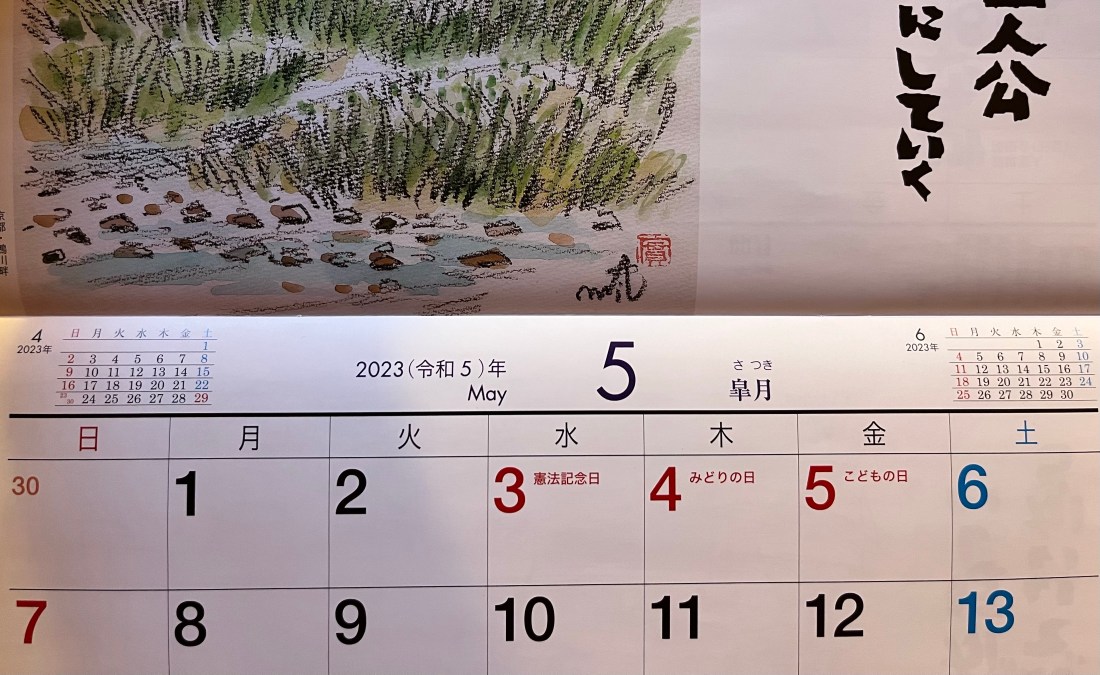
Constitution Day (憲法記念日, kenpō kinenbi) – a day to commemorate the modern constitution (kenpō) of Japan, which was original designed by US Occupation forces in 1946, but includes some novelties and innovations that the US Constitution lacks (explicit rights for women) as well as its renunciation of war.2 Observed on May 3rd.
Greenery Day (みどりの日, midori no hi) – this holiday ostensibly is a day to reflect on nature and such, but originally was celebrated as the birthday of the aforementioned Showa Emperor, who also happened to love plants as a hobby. It was also renamed following the ascension of his son, the Heisei Emperor. The significance of the late Showa emperor’s birthday has lessened over time anyway and the general appreciation of nature has taken over. Observed on May 4th.3
Children’s Day (子供の日, kodomo no hi) – I’ve touched on this holiday before. It is observed on May 5th, and is probably the most important.
You can see three of them listed on the calendar above, which we have at home.
Vacation travel soars this week, and congestion is everywhere. Sometimes other holidays which float around can further extend Golden Week up to 10 days long. It is for many Japanese workers, the longest week off they will enjoy in the year.
Whether you are in Japan, or overseas, hopefully you can catch some rest this time of year and enjoy the weather!
1 My sister in law, who is unmarried and works in the banking sector, had to take a lot of time off to care for her mother before she passed away. So people do take time off, but not always for leisure.
2 It replaces the 19th century, militaristic Constitution based on the Prussian model, which gave considerable power to the Emperor and made him sole authority of the military (they didn’t answer to the Cabinet). Check out this fun video series to learn more about Prussia, especially under Frederick the Great. While in college, I attended a lecture by the US Army secretary who helped draft the part of the constitution granting equal rights to women. She was a pretty amazing lady who dealt with a monumental task.
3 Of course, May the Fourth is important around here too. 😉
If you, or a loved one, are celebrating Japanese New Year, Oshōgatsu (お正月), you may need to do some shopping. During the December in 2021, we got snowed in really bad, and my wife couldn’t go to the local Japanese supermarket to buy goods and ingredients herself. So, I went on her behalf using public transportation to downtown, got the goods, and came back.
To save other husbands (or anyone else who likes to celebrate) some uncertainty, here’s a recommended list of things to get and why. I purposely took photos of my own at the local Asian grocery store, rather than stock photos, because I felt this would help readers on the ground more, especially if they can’t read Japanese.
New Year Altar
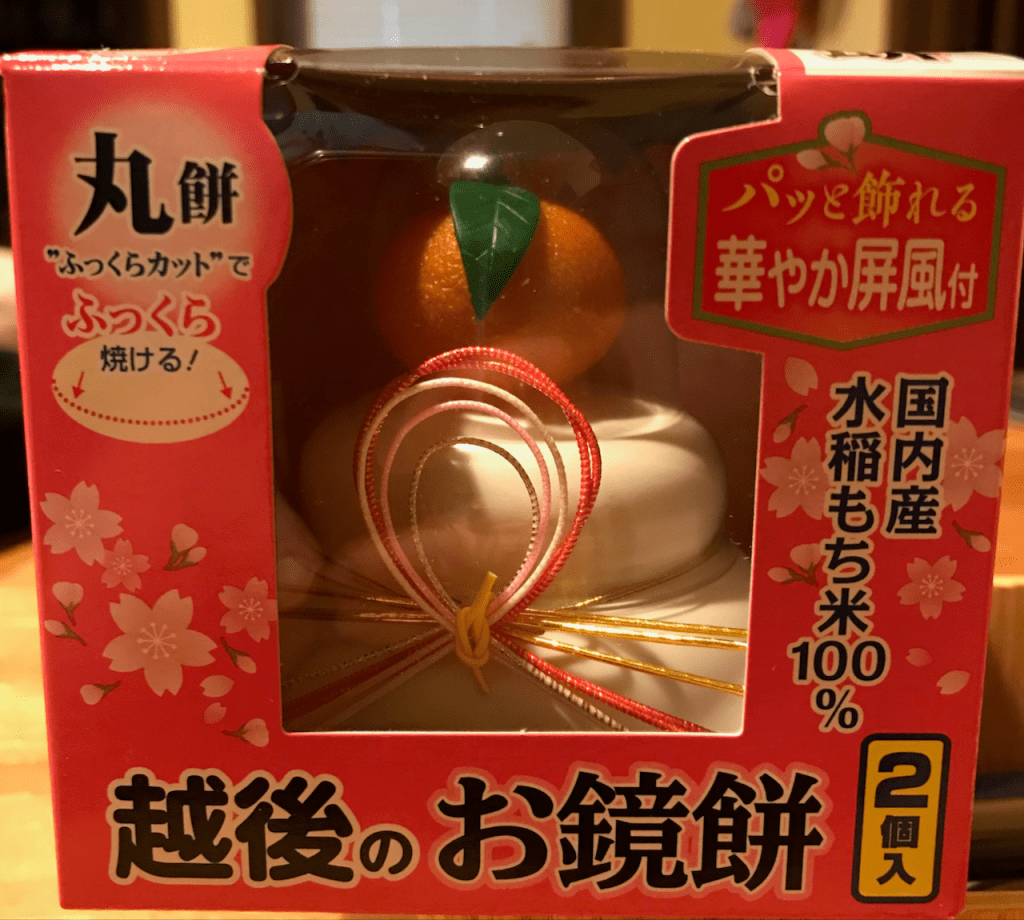
A common tradition in Japan is to get a kagami-mochi, kind of like so:
Kagami-mochi are a pair of mochi (rice cakes) stacked one on top of the other, usually with a ribbon around it, and a bitter orange or other decoration on top. I’ve talked more about it here. These are often available at any Japanese grocery store, and include instructions on how to set it up. Remember, on January 11th, there’s a separate ceremony to break open the mochi and cook it for good luck.
Soup Ingredients
There are several items, often available in your local Asian food store, that are essentials for Japanese cooking during New Years.
This is not to be confused with the manga series. Naruto is a food that usually comes in a long roll and is sliced thin and added as a topping to soups and ramen during New Years. A similar food, shown on the right, is kamaboko. Kamaboko often comes frozen, and has to be thawed out first, then sliced and added to soup, including toshi-koshi soba which is eaten the night before New Years.
Another food often used, especially in ozoni soup (eaten on New Year’s morning) are mochi rice cakes:
There are many kinds, and cuts, so just find something that’s suitable for your needs. Out of the package, they are hard little bricks but when added to warm soup or baked in a toaster oven, they have a taffy-like consistency. Keep in mind that it’s possible to choke on mochi if you don’t chew thoroughly. They’re delicious but consider yourself warned.
Osechi
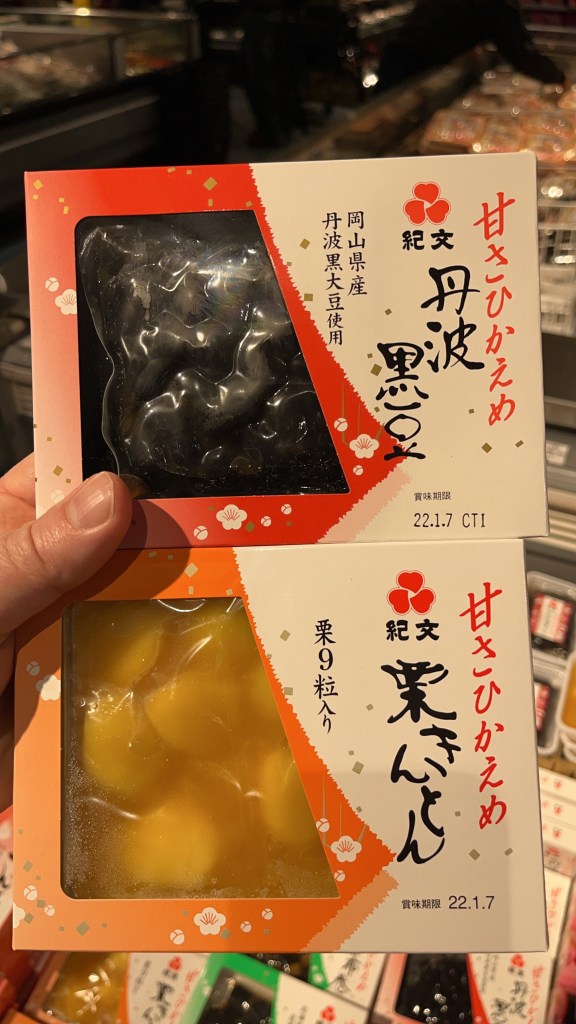
During New Year’s day, it is considered auspicious to eat certain foods on the first day. These are collectively known as osechi-ryōri, or just osechi. There are many possible foods to use in osechi, but one common one is kuro-mamé:
These are just sweetened black beans, and something I enjoy eating in particular. In the same picture, shown below are yellow kuri-kinton which is a kind of walnut paste.
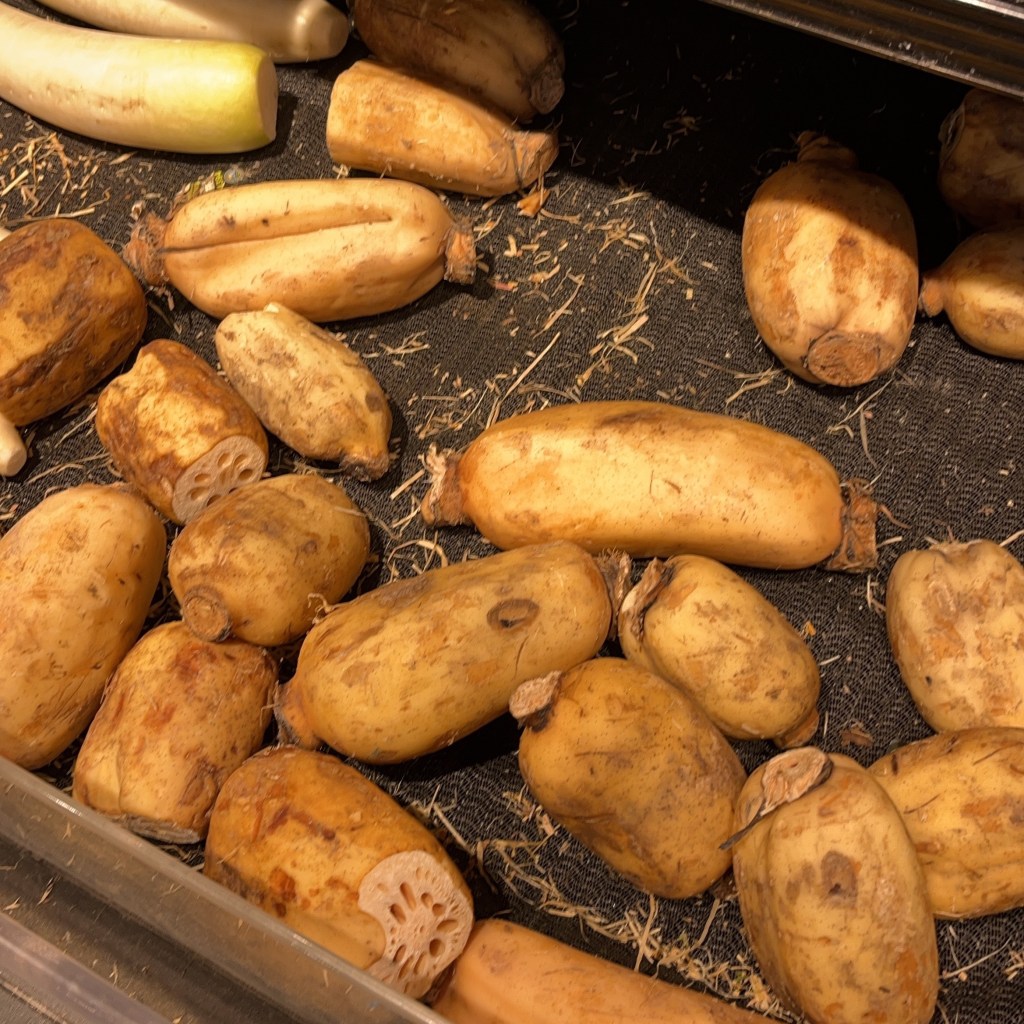
Another great choice are lotus root, or renkon. They look like huge tubers at the store…
But when peeled, sliced thin and cooked in broth they look more like this:
They have a nice consistency like potato and are delicious to eat. Highly recommend.
Finally there are special chopsticks you should pick up for osechi:
The chopsticks themselves are nothing special, but using bright, clean chopsticks with auspicious decorations on them, I believe that this helps symbolizes a fresh (and positive) start for the new year.
Conclusion
This not an exhaustive list of goods for Japanese New Year, but I hope this helps cover basic foods and goods you might need to enjoy New Year. Your mileage may vary. I will also try to update and polish this up as time goes on.
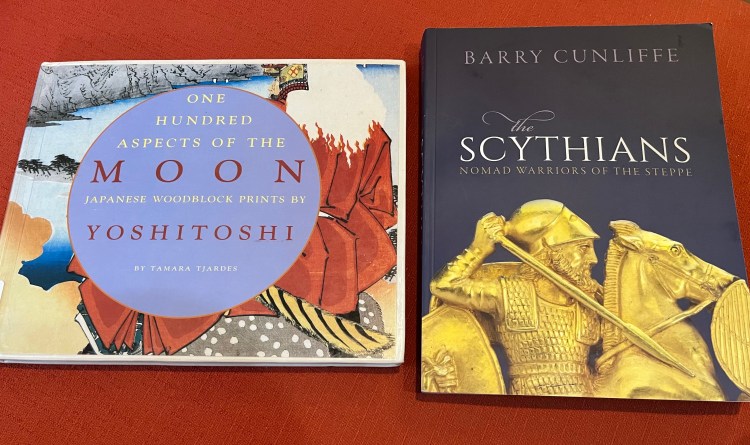
A couple books that I have been excited about have arrived in the mail:
The first book is a look at a famous collection of Japanese woodblock prints called the One Hundred Aspects of the Moon, which I will be covering in a new post in the near future. This collection of woodblock prints has popped up here on the blog a bit, and has become a major obsession of mine lately.
The second is about a famous, yet underrated, nomadic group of people called the Scythians, who seem to be everywhere in some way tied to various historical events in Asia and in Europe. The eastern Scythians, the Saka, were involved in spread of Buddhism along the Silk Road, and the western Scythians, the Srubnaya, are part of the rich ancestry of the Ukrainian people.
Thanks, as always, for reading and stay tuned for more content! 🥰
Hell is an interesting subject in Buddhism, though not a particularly important one. It differs from the more Western notion of hell in a number of key ways.
First, the Buddhist “model of existence” is based on ancient Indian cosmology which viewed the universe not a single world, but many different worlds that intertwine, and with living beings trans-migrating between worlds: first one world, then another, all based on one’s karmawithout end. Buddhism differed from other Indian religions at the time due to its teaching of anātman (roughly “no self”, or “no soul”), but otherwise the basic model was still the same:
These realms collectively were things such as the realm of animals (i.e. pure survival and instinct), the deva realms (realms of heavenly bliss), the human realm, the hell realms and so on. Imagine Dante’s Inferno, in all its agony and dismal torment, but many more layers, and each one is a disparate “world” or “realm” rather than just one layer among several. That is the hell realms (plural) in Buddhism. Some more severe than others, various ironic punishments, etc.
The hell realms, as with the other realms, are all temporary states. One may suffer horrific torment for a long time until one’s karma related to it is exhausted, but eventually it does exhaust and one moves onto another rebirth in some other realm.
However, there’s even more to this story. Another way that Buddhists tend to look at these realms, hell, deva, animal, and so on, is that they are states of mind, just as they are potential destinations for rebirth. The Tiantai (Tendai in Japan) Buddhists first posited an idea that within a single moment of thought, one might dwell in any number of realms. This was called the 3,000 realms in a single thought, to cover all possibilities: past, present or future, and within them, the hell realms, deva realms, basic instinctive survival (animals), and so on. The mind jumps from one state to another, from time period to another, without end.
A person lives in terrible, abusive environment may be said to be living in the hell realms here and now, even if there are breaks of relief in between. A person suffering from a terrible addiction may be living like a hungry ghost.
This notion of the mental realms vs. actual realms of rebirth aren’t necessarily mutually exclusive either. What matters is that there are people around us living in various states, some blissful (even if only temporarily) and others are suffering terrible torment, and everything in between. The Buddhist learns to be aware of this migration from one state to another within their own mind, but also extend this awareness outward towards others around them who may need help or relief.
Recently I was chatting with some folks in my PBP group about mandalas, starting with the famous sand mandalas that the Tibetan community drew for President Obama, then mandala in Japanese Buddhism. This conversation woke up some old memories of mine, including an obscure mandala that I wanted to share: the Taima Mandala.
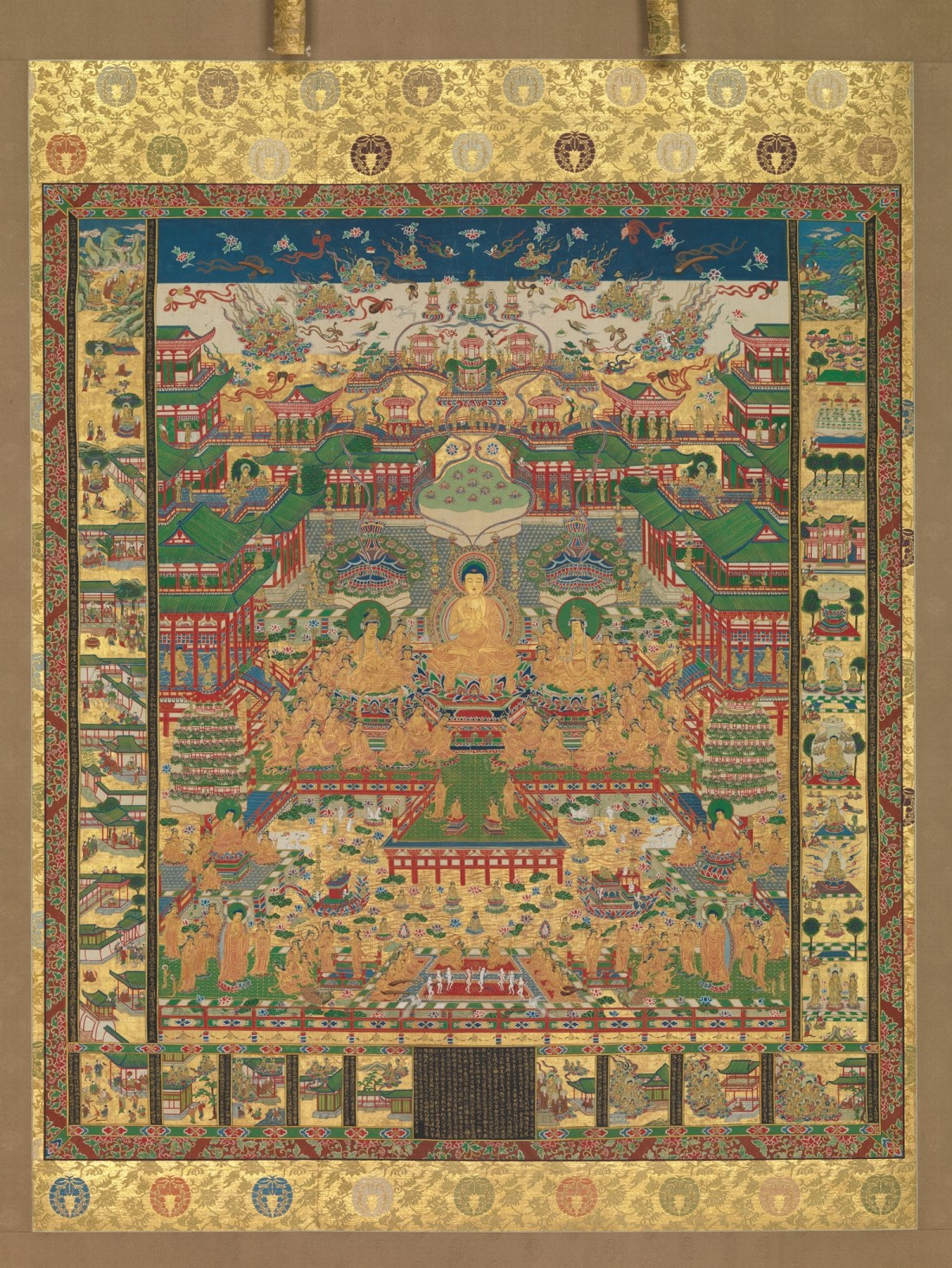
The Taima Mandala (taima mandara, 当麻曼荼羅) is a tapestry that was created in the year 763 and currently stored in the temple of Taima-dera in the city of Nara, Japan although many reproductions exist. You can see the original here. In spite of the name “mandala” it is not technically a mandala, nor is related to the esoteric traditions of Buddhism. Instead, it is part of genre of Buddhist art called hensōzu (変相図) in Japanese, graphic illustrations of the Pure Land of the Buddha or of the Buddhist hell realms.1
The Taima Mandala is a visual depiction of the Pure Land of Amitabha Buddha, the Buddha of Infinite Light. It is in the Pure Land (jōdo 浄土 in Japanese) that the Buddha provides refuge for all beings, and there that they can dwell in an environment that is very conducive to the Buddhist path and ultimately Buddhahood of their own. Part of the appeal of the Pure Land as a Buddhist practice or “dharma gate” is its accessibility. The Buddha, in order to create this refuge for all beings, vowed to make it so accessible that one need only recite his name as little as 10 times, or more if you wish.
Think of it as the ultimate Buddhist retreat, but far more affordable. 😉
If you click on the picture above you can see many details. In the center sits the Buddha Amitabha himself attended by his two attendant bodhisattvas Kannon (right) and Seishi (left).3 They are surrounded by many disciples of all kinds, who eager listen to the Dharma4 and toward the lower central area, you can see new beings being reborn in the Pure Land from the buds of lotus blossoms. Around the edges are smaller pictures, depicting various scenes of the Pure Land, adapted from existing Buddhist sutras, and the bottom depicts the nine grades of followers who are reborn in the Pure Land. The primary source for all this is the Contemplation of Amitabha Sutra, if I recall correctly.
The creation of the Taima Mandala is attributed to a Buddhist nun named Chūjō-himé (中将姫), daughter of one Fujiwara no Toyonari. She was deeply devoted to the Bodhisattva Kannon (Guan-yin). According to the origin story, she finished transcribing a copy of a Buddhist sutra called the shōsanjōdokyō (称讃浄土経, “Sutra on Praises of the Pure Land”?),2 and that same evening, from the western direction of the setting sun, she beheld a vision of the Pure Land in its splendid detail. She was so amazed that she took tonsure as a nun at Taima-dera Temple, and with Kannon’s guidance was able to craft the mandala based on what she saw.
As an example of hensōzu art, the Taima Mandala is simply amazing. It is one of those “often imitated, but never surpassed” works of art. While it is not a mandala in the strict sense, it has been called one for many generations because it does provide a very visual representation of the Pure Land that can’t be fully expressed in written form, hence it has a religious impact all its own.
Very little information about the Taima Mandala or this artistic genre exists in English unfortunately, and I have only scratched the surface, but I hope this helps inspire readers and other Buddhists in some way.
Namu Amida Butsu
P.S. Featured photo is a reprint of the Taima Mandala with the Jodo Shinshu-sect crest at the top and bottom, Metropolitan Museum of Art, CC0, via Wikimedia Commons
1 Ages ago, I attended a museum exhibition in Kamakura which displayed many such medieval hensōzu artwork from local temples, and it was simply amazing. It had a big impression on me, and how I understand Pure Land Buddhism.
2 There is very little information about this sutra in English or Japanese, but it appears to be an alternate translation of the more famous Amida Sutra, brought by the famous Chinese monk, Xuanzang, from India during his journeys. It is also called the shōsan jōdo butsu shōju-kyō (称讃浄土仏摂受経). There’s no translation at all in English, so the above title is my best guess.
3 Buddhas were often depicted in “trinities” with two attendant Bodhisattvas. Shakyamuni, the historical founder of Buddhism, was often depicted with Monju (Manjushri) and Fugen (Samantabhadra) for example.
4 The Buddhist law of existence, or “how things work”. Buddhism at its heart is not a dogma but a way of expressing how reality works, not how we want it to work, with the aim to awaken and enlighten others.
I was cleaning out old photos from my phone’s camera roll, when I realized that I still had photos left over from this post, including a photo of my omamori charm that I got from Enoshima Shrine way back in 2019. Sadly that was my last trip to Japan, and I haven’t been able to return my omamori since.
One thing a careful observer might notice the three triangles at the top. This is probably the most famous family crest (kamon 家紋) in the history of Japan because it’s also the inspiration for the Triforce of the Legend of Zelda series!
An example of the Hojo Family crest on a stone lantern, which I took in 2010 at Ueno Park in Tokyo, Japan. Clearly the Hojo family influence extended beyond the borders of Kamakura.
The Hojo Clan was a powerful clan during the Kamakura Period of Japanese history, and has an interesting history. Originally, the Hojo Clan was an offshoot of the Heike (Taira) Clan, but during the famous Genpei War, they openly sided with the Taira’s enemy, the Genji (Minamoto) Clan after being snubbed by the Heike due to a succession issue. The Genpei War ended with the total destruction of the Heike Clan, and the Genji Clan under Minamono no Yoritomo became the ascendant power. The power of the Emperor and his Court in Kyoto effectively ended and was now in the hands of Genji Clan’s samurai forces, who were based in Kamakura far to the east.
What’s interesting is that while Minamoto no Yoritomo was the clear victor and the first Shogun of the new government in Kamakura, he was surrounded by Hojo Clan allies, and before long married into the family through Hojo Masako. Within a generation, the Kamakura Shogunate was entirely controlled and managed by the Hojo Clan, and the Minamoto clan whom they nominally served was relegated to mere figureheads.
The historical drama (Japanese: 大河ドラマ. taiga dorama), 鎌倉殿の13人 or “The 13 Lords of the [Kamakura] Shogun” is about the struggle for power by several Hojo family members, and their rivals, after the death of Minamoto no Yoritomo. It’s been fun to watch so far.
So, the next time you see the Triforce in a Zelda game, don’t forget the powerful clan that was behind it all.













 Gleanings in Buddha-Fields


You must be logged in to post a comment.