HEMMER: … I will not fight for Starfleet, but I will defend its ideals. Pacifism is not passivity. It is the active protection of all living things in the natural universe.
Star Trek: Strange New Worlds, “Momento Mori” (s1ep4), Stardate 3177.3
I love Star Trek: Strange New Worlds, and I love this quote.
The first precept of Buddhism, regardless of whichlist you talk about, starts with a vow not to destroy life. Further, in such texts as the venerable Dhammapada (collected sayings of the Buddha), you can see quotations like so:
129. All tremble at violence; all fear death. Putting oneself in the place of another, one should not kill nor cause another to kill.
and:
142. Even though he be well-attired, yet if he is poised, calm, controlled and established in the holy life, having set aside violence towards all beings — he, truly, is a holy man, a renunciate, a monk
Per tradition, monks in the Buddhist tradition are often strictly vegetarian and why some devout lay Buddhists choose to be vegetarian, either full-time or on specific holidays.
But, I think Hemmer’s quote goes a step further, peace, goodwill, and pacifism are not simply refraining from violence; it is also respect for all life (even the Gollums in life). This requires empathy, putting yourself in their shoes. You see this expressed in such popular liturgy as the Four Bodhisattva Vows, dedication of merit, and so on.
But like many things in Buddhism, such a lofty goal is hard to uphold at first. So, the precepts more narrowly focus on simple training rules (not to do X, not to do Y), and overtime, as basic training rules become second-nature, and your understanding of the Buddha-Dharma deepens, one’s practice refines more and more over time. So, if you feel you can’t live up to such an ideal, don’t worry. It’s important to know that the ideal exists, and that every starts from somewhere.
Namu Shakamuni Butsu Namu Kanzeon Bosatsu
P.S. Double post today to celebrate Strange New Worlds, season three. I cancelled my subscription of Paramount Plus some months ago (no regrets), but I enjoy the first two seasons on BluRay, and waiting to get the subsequent seasons on BluRay as well.
In these times of uncertainty, I’ve been trying various ways to help causes I care about: donating more,1 making better environmental choices at home, and trying to be a better person, but even then, it feels like it’s never enough. Like Ashe from Fire Emblem: Three Houses, I feel like in spite of my efforts, I’ve accomplished nothing.
A conversation with “Ashe”, one of my favorite characters in FE3H.
Being able to start small and focus on helping someone is a great start. From there, you might branch out and help others too.
Yet in the big picture, this still doesn’t feel like it is enough sometimes.
Mahayana Buddhism, which is everything you see from Tibet to Japan and between, tends think very big picture. Thus, it often holds up the bodhisattva as the archtype for Buddhism: a being who lifetime after lifetime helps others, fulfilling very grandiose vows. The idea is that you can’t help everyone in one lifetime, but on the grand scale of time, it is possible to help everyone eventually. But of course, because time and space are so vast, it is a kind of never-ending story. The Buddha, Amitabha (aka Amida) completed his vows in 10 kalpas (aeons), roughly 160 million years.3
Meme from Return of the King 🤣
Anyhow, point being: if we look at it from a Mahayana-Buddhist endpoint, every little thing we do now does add up, but it happens on a scale of time that we can’t fully grasp. Nonetheless, it does add up in the long-run.
But maybe that’s small comfort here and now.
In truth, I don’t have a good answer here. I still try to help where I can while not burning myself out in the process, but I can only hope it makes a difference someday, even if I can’t see it.
1 I used to have a donations page on the blog pointing to various causes, but I’ve had to take it down temporarily to update some broken links, change some charities, and revise the content a little. The page is now back online!
2 I used to watch the original cartoon “He-Man and the Masters of the Universe” as a little kid, so this takes me back. I remember one Christmas I received the Castle Greyskull playset, which was really neat, but then fell apart later. Ah, the impermanence of all phenomena and kids’ toys.
3Kalpas are interpreted differently in different texts, so I am just using the more conservative estimate of 16 million years. Kalpas are meant to convey astronomical amounts of time, not literal ones.
As I talked about in a recent post, the main core idea of the venerable Tendai (天台) sect in Japanese Buddhism, including its parent Tiantai sect in China, is that the Lotus Sutra is the most important text in the Buddhist canon, a kind of capstone (lit. “complete teaching”, engyō 円教) for the rest of Buddhist literature up to that point. Because the Lotus Sutra is pretty long (equivalent to a modern book), I tried to summarize its teachings here.
Anyhow, Tendai/Tiantai focuses on how to put the Lotus Sutra into practice. For Japanese Tendai in particular, this is encapsulated in a phrase called shishū yūgō (四宗融合) meaning “Four Integrated Practices”. According to my book, these are listed as follows:
Different people under the umbrella represent different Buddhist followers, with different practices and inclinations, but the umbrella itself represents the concept of upāya (“expedient means”) or hōben (方便) in Japanese. This is one the main themes of the Lotus Sutra, and expresses that all Buddhist teachings and practices lead toward the same end goal, and thus whatever works for a person at that time is perfectly fine for that person.
This is encapsulated in the 25th chapter of the Lotus Sutra, the so-called Kannon Sutra, because the Bodhisattva Kannon (a.k.a. Guan-Yin, Avalokiteshvara, Chenrezig, Quan Âm, etc) according to this chapter takes on whatever form is most beneficial for that person and teaches the Dharma to them. Thus, Kannon can appear as a man, woman, monk, rich person, etc. It’s also why statues of Kannon often depict them as having 1,000 arms, each holding a different object. Similarly, many of the early Buddhist monks who were Tendai followers practiced it differently from one another. On the one hand, you have monks like Eisai, who focused on meditation and precepts (and would later found the first Rinzai Zen temples), you also had monks like Genshin who focused a lot more on Pure Land practices, as well as esoteric experts such as Ennin.
Tendai as a sect in Japan was almost universal in the 9th through 12th centuries, but for a variety of historical (often self-inflicted) reasons, it has diminished in size and influence. Yet when you visit historical temples in Japan such as Asakusa Temple in Tokyo, Kiyomizudera Temple in Kyoto, and Sanjusangendo in Kyoto, these are all Tendai temples. Further, its influence lives on in newer sects that we know well: Zen, Pure Land, Nichiren and such, which all inherited practices and concepts even if they apply them in differing ways.
But while Tendai as an organized sect is somewhat diminished,3 its teachings of “umbrella” or “universal” Buddhism continue to live on. Rather than insisting there’s only one way to practice Buddhism, it gives a large, spacious framework for people to figure out their own path and use the vast toolkit available to work it out, all under the Lotus Sutra concept of expedient means. Use what works for you, and do not be afraid to adapt, change, or expand your practice as you go.
P.S. Publishing off-schedule just for fun. Happy Sunday!
1 Tendai/Tiantai has the same meditation tradition as Zen, but tends to call it shikan (止観) not zazen (座禅) meditation. The founder, Zhi-yi, in China wrote multiples treatises, the Mohe Zhiguan, that provides a comprehensive manual about meditation. I have a copy of the The Essentials for Practicing Calming-and-Insight & Dhyana Meditation, but have only read parts of it. It is a nice training manual for those interested, but it is a little dense since the intended audience was the monastic community.
2 In the time of Zhi-yi, the founder of Tiantai, Pure Land Buddhism was approach more as a meditation tradition than a separate set of practices that what we see today. By the time it came to Japan, this had changed somewhat, and we see through the writings of Genshin that there were a variety of approaches both devotional and meditation-focused.
3 According to my book, as of 2015, the number of registered followers in Japan was around 1.5 million give or take. This makes it the second smallest of the major sects in Japan, and one-eighth the size of Jodo Shinshu-sect Buddhism. Only Rinzai Zen is smaller (1.1 million).
It’s been a while since I discussed anything that relates to Tendai Buddhism, but I was doing a bit of nerd-reading with my free time, and thought this was interesting to share.
As Buddhism spread from India via the Silk Road, transmitted by such peoples as the Kushans, Sogdians, and Parthians (the same Parthians who contended with Rome from to time), the vast wealth of Buddhist texts, teachings and information flooded into China in waves.
This import of information was kind of haphazard at first, but as translations improved and information continued to come, China developed its own schools of thought to help make sense of it all.
One of the first successful efforts was by a Chinese monk named Zhi-yi (智顗, 538–597 CE)1 who founded the Tiantai school. He, or possibly by later patriarch Zhan-ran (湛然, c. 711-782 CE),2 analyzed the various teachings and Buddhist texts and developed a chronology called the Five Time Periods and Eight Teachings (五時八教, wǔshí bājiào).3 This chronology looks like so:
The Buddha (Shakyamuni) taught the Flower Garland Sutra first, but it was incomprehensible to disciples.
The Buddha stepped back and taught Agama sutras next. The Agamas are equivalent to the Pali Canon in the Theravada tradition, and nearly the same in terms of content. The Agama sutras were more grounded and practical and thus easier for his community to understand.
Next, the Buddha taught sutras such as the Vimalakirti Sutra as an introduction to Mahayana teachings, and thus higher than the Agamas.
Next, the Buddha taught the Perfection of Wisdom sutras, such as the Heart Sutra, as a more complete teachings.
Finally, the Buddha taughy his ultimate teachings: the Lotus Sutra and Nirvana Sutra because the disciples were now ready.
Thus, out of all the Buddhist texts, Zhi-yi argued that the Lotus Sutra was the complete and ultimate teaching (円教). In Japanese Tendai Buddhism, 円教 is pronounced as engyō, or is sometimes more formally called hokke engyō (法華円教, “the complete teaching that is the Lotus Sutra”). Much of Tendai Buddhism is thus about putting the Lotus Sutra teachings into practice. From the Tendai perspective, things like meditation, venerating Amida Buddha, esoteric practices like mantras, and upholding the precepts are all ways to put the Lotus Sutra into practice, and Zhi-yi wrote quite a bit about this subject.4 The idea, expressed through the phrase shi-shū-yū-gō (四宗融合) or “Four Integrated Schools”.
The historicity of Zhi-yi’s textual analysis is unfortunately pretty dubious. Modern archeology and Buddhology show that the very earliest texts, historically, were the Agamas / Pali Canon (the Dhammapada and Jataka Tales probably came even earlier), but even those were not recorded in writing until three to four centuries after the Buddha. So, even with the earliest texts, we have a gap from when the early disciples passed everything down orally before committing to writing generations later. Granted, Indian oral tradition was quite sophisticated and designed to minimize errors and corruptions in recitation, but the Agamas and Pali Canon do slightly diverge from one another, mostly in ways that are interesting to scholars only.
The Mahayana Sutras such as the Vimalakirti Sutra, Lotus Sutra and Perfection of Wisdom sutras were written down even later. One could argue that they were passed down orally5 and just recorded later for some reason, but textual analysis casts this into doubt. The Mahayana sutras are more like “reboots” or compilations of earlier teachings, more polished and such.
Which is where the Lotus Sutra comes in, I think.
This is personal bias, admittedly, but I do believe that the Lotus Sutra is a capstone of the Buddhist tradition, not because the Buddha saved it for last. Instead, the authors of the sutra did a really nice job of synthesizing earlier teachings into a single narrative, and devised clever parables to bring the teachings to readers in a fresh, new way. The Lotus Sutra doesn’t necessarily introduce a lot of new teachings so much as it brings it all together. Like a capstone or keystone. There’s something in there for everyone, in other words.
So, to me the Five Time Periods and Eight Teachings isn’t very useful in a literal, historical sense, but it is useful for showing how some sutras synthesize other sutras into increasing comprehensive narratives.
P.S. featured photo is the capstone of the main entrance of Giusti’s Palace, photo by Paolo Villa, CC BY-SA 4.0, via Wikimedia Commons
1 Pronounced like “Jer-yee” in English. The “zhi” in pinyin sounds like English “jerk” without the “k” at the end. His name in Japanese is read as Chigi, by the way.
2 Pronounced like “John-ron” in English. In Japanese, his name is read as Tannen.
3 This is read in Japanese language as gojihakkõ.
4 Pure Land practices as we recognize them do not seem to be prominent in Zhiyi’s time and were adopted into Tiantai later, and thus Japanese Tendai even later through such figures as Genshin.
5 The Lotus Sutra, for example is a mix of verse sections with narrative text around them. It’s argued that the verse sections came first, and then authors composed the narrative sections around them. When the verse sections were first composed is anyone’s guess.
Speaking of the Tannisho recently, here’s another interesting quote worth exploring:
6. 自然のことわりにあひいかなはわば、仏恩をもしり、また師の恩をもしるべきなりと云々。
“When we live according to the truth of ‘made to become so by itself’, we shall know gratitude to the Buddha and to our teachers.”
Translation by Dr Taitetsu Unno
“Made to become so by itself…” what does he mean by that? Let’s look at another example.
In an separate Jodo Shinshu work, Shinran’s Notes on Essentials of Faith Alone (唯信鈔文意, yuishinshō mon’i) which we explored recently, he explains this “made to become so by itself” in greater detail:
Ji also means of itself. “Of itself” is a synonym for jinen, which means to be made to become so. “To be made to become so” means that without the practicer’s calculating in any way whatsoever, all that practicer’s past, present, and future evil karma is transformed into the highest good, just as all waters, upon entering the great ocean, immediately become ocean water. We are made to acquire the Tathagata’s [Buddha’s] virtues through entrusting ourselves to the Vow-power; hence the expression, “made to become so.” Since there is no contriving in any way to gain such virtues, it is called jinen. Those persons who have attained true and real shinjin are taken into and protected by this Vow that grasps never to abandon; therefore, they realize the diamond-like mind without any calculation on their own part, and thus dwell in the stage of the truly settled. Because of this, constant mindfulness of the Primal Vow arises in them naturally (by jinen). Even with the arising of this shinjin, it is written that supreme shinjin is made to awaken in us through the compassionate guidance of Sakyamuni, the kind father, and Amida, the mother of loving care. Know that this is the benefit of the working of jinen.
The specific phrase Shinran uses is jinen hōni (自然法爾), which is tricky to translate into English. As the Notes explains above, “jinen” means to be become so, naturally, not through contrivance. The term “hōni” (法爾), alternatively hōnen (法然),1 means something like “by virtue of the Dharma”, but in Jodo Shinshu lingo specifically it means through the power of Amida Buddha’s vows to rescue all beings.
Here, Shinran is strongly advocating a sense of total reliance on Amida Buddha, with the belief that by fully entrusting oneself to Amida Buddha’s compassionate vows (as depicted in the Three Pure Land Sutras), called shinjin (信心), rather than through calculation or conscious effort (i.e. a “weekend warrior”), then one is transformed by Amida gradually without realizing it. So, rather than trying to reborn in the Pure Land, Shinran is saying that one should trust in Amida to guide you to the Pure Land.
I’ve always found this concept very interesting.
While I might quibble with Shinran’s interpretations of things (especially since other Pure Land teachers in thepast did not have such a one-sided view), I do think there’s merit in the idea of transformation without one realizing it. This is accomplished simply by exposure to the Dharma, what Jodo Shinshu Buddhists like to call “deep listening” or monpō (聞法), which I also mentioned here.
SPOCK: There are many who are uncomfortable with what we have created. It is almost a biological rebellion. A profound revulsion against the planned communities, the programming, the sterilised, artfully balanced atmospheres. They hunger for an Eden where spring comes.
Star Trek, “The Way to Eden” (s3e20), Stardate 5832.3
As I write this, the family is in Japan (sadly, I was unable to go this year) visiting relatives, and I am home with the dog, Cherry.
Since I have a couple weeks to myself, I thought it would be a great time to put in a little extra Buddhist practice, catch up on some personal projects, go offline for a bit, etc. Basically, try to live like a monk for a few days. I carefully planned it out, decided what I would do and not do, took a three days off from work, and then got ready for the “mini home retreat”.
I lasted eight hours.
The first few hours were great. It was peaceful, quiet, and I did finish reading a couple books on my to-do list, meditated extra, recited more sutras than usual, and so on. But then, as the hours progressed, isolation and boredom set in. I started worrying if I was missing a text from my family (in case of emergencies), and I discovered that it’s hard to read Japanese books without a dictionary which I only have on my phone.
Embarrassingly by early afternoon I gave up and turned on my phone. Then I went and played Fire Emblem: Three Houses for a few hours,1 watched Star Trek V: The Final Frontier2 for some crazy reason, got bored and played more Fire Emblem until 11pm.
Day two, I didn’t even really bother to try again. I realized that I had hyped up this time off too much, and without any support or contact with others, I quickly started to get a little stir-crazy. That’s not to say the time wasn’t unproductive either. Even today (day two), I still got some extra stuff done around the house, and did a little more Buddhist stuff than usual. But I also played Fire Emblem: Three Houses for three hours.
τὸ μὲν πνεῦμα πρόθυμον, ἡ δὲ σὰρξ ἀσθενής. “Indeed the spirit is willing, but the flesh is weak.”
Indeed, in the Sutra on the Buddha of Immeasurable Life, one of the Three Pure Land sutras, the Buddha Shakyamuni laments that:
“People of the world, being weak in virtue, engage in strife over matters which are not urgent….Since they have not done any good in particular, nor followed the Way, nor acted virtuously, when they die, they will depart alone to an inferior world. Although they are destined to different states of existence, none of them understands the law of karma3 that sends them there.”
Translation by the late Hisao Inagaki, hosted here.
So, the problem of laziness and lack of follow-through in religious practices (or personal projects) is nothing new. Even in Japanese, there is a phrase: mikka bōzu (三日坊主) meaning “three day monk”. It’s a tongue-in-cheek phrase about how most endeavors last three days at most.
In my case, I think my failure was a combination of over-zealousness and perfectionism which set the bar too high for something I am not really used to doing day to day. The idea of a religious personal retreat is still worth it, but I should have set the bar lower the first time, and tried to be a bit more realistic.
The point isn’t to give up and just play more Fire Emblem (but then again, I might anyway), but reflect on what worked, and what didn’t and focus on something realistic and sustainable. As Dogen reminds us, it can be done, but expecting it to work overnight if I just push through hard enough is maybe a bit silly.
Namu Shakamuni Butsu Namu Amida Butsu
P.S. Bonus post. Apologies for any typos, I wrote this one quickly while it was still fresh in my mind, so probably more editing mistakes than usual.
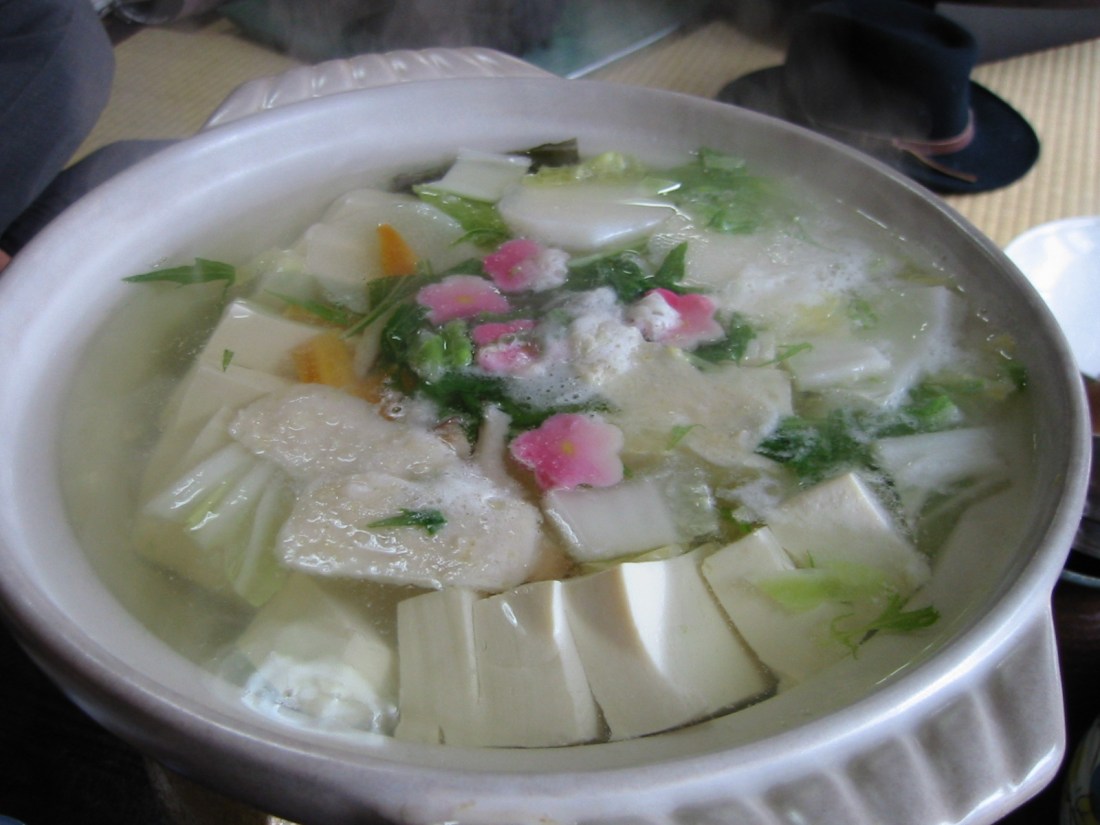
P.P.S. On the plus side, I also had some time to practice vegetarian cooking and made a large batch of Mapo Tofu, Pasta Mama (in honor of Captain Pike in Star Trek: Strange New Worlds), and some Thai curry. This photo is the Mapo Tofu:
… I also harvested the scallions I’ve been growing since Spring:
1 I am on my eighth play-through I think. I am finally going back and replaying my first route, Crimson Flower route (i.e. with Edelgard) and doing things I missed on my first play-through. It’s been nearly two years, and I still enjoy this game very much. The story, dialogue, characters and world-building never cease to amaze me.
2 I think I watched it to remember why this movie is so unpopular. It has some good qualities to it, but yeah, it’s not very good. As a teenager, I watched it in the theaters and thought it a bit odd, but it’s not aged well for me.
3 For similar teaching, see the first chapter of the Soto Zen text, the Shushogi.
Years ago, my wife and I bought a book from Japan titled 禅の言葉とジブリ meaning “Zen Words and Studio Ghibli” (publisher link here). This book was written by a Rinzai Zen monk named Hosokawa Shinsuke (細川晋輔) who was born into a priest family in Japan, and later ordained as a priest. Chapter by chapter, he relates life lessons to Studio Ghibli movies. To be honest, the book sat on our shelf for a long time, until recently, when I finally reached a level where I can follow along (with a good dictionary, of course).
Anyway, a quick divergence to talk about “priest families” in Japan. For historical reasons that are too complicated to go here, many Buddhist priests in Japan live not in monasteries, but in local parishes and raise families. Frequently, one of the kids inherits responsibility of that parish. If you think of a local Protestant pastor, it’s the same idea. Mr Hosokawa was born into such a family, and was expected to take on the family role, so after college he trained at a Rinzai Zen monastery for three years.
In his words, these first three years were a slog. He describes how he woke up every morning at 2 – 3am, meditate long stretches, followed by incessant chores around the temple all day. Day in and day out, this continued with no free time, and no privacy. Eventually, he adapted to monastic life, but he kept counting down the days when his three year term would end.
Then, abruptly, someone close to him died, and it changed his view. He was close to this person, but they often quarreled, yet now he would never see them again. Suddenly, the issue of life and death became very important to him, and he went from “having to practicing Zen” to “choosing to practice Zen”.
Thus he stayed at the monastery another several years (nine total). Yet in spite of all this training, he writes that he never really had any great awakening or sudden burst of insight. Instead, in his own words (roughly translated by me):
The more I struggled with ascetic practices in the Zen dojo, the more my firmly-held sense of values crumbled….simply put, the knowledge and experiences that I had built up so far I was allowed to let them go naturally. Having let go of such important things, having finally left it all behind, there was nothing left but the natural scenery that was right in front of my face.
Page 67
Later, he likens this experience to Totoro, the main character (monster, spirit, kami?) of the Ghibli movie My Neighbor Totoro. In the movie, many people in the village are totally oblivious that Totoro and his friends are there among them, because they are too caught up in their lives.
In the same way, the Dharma can be utterly hidden before your eyes, unless you take time to see it. In Mr Hosokawa’s case, it took nine years of intense monastic practice, the death of someone close to him, and gradually letting go of his ego. I can’t say whether this is the same for others (I haven’t learned to let go myself), but I think it’s an important lesson. I think the key word Mr Hosokawa uses is atarimae (当たり前), which in American English is like saying “duh, obviously”.
Chinese characters seem strange and mysterious until you learn them. Sex is strange and mysterious until you’ve experienced it. And so on and so forth. In the same way, for many the Dharma feels ethereal or mysterious until it finally clicks, and then its somewhat anti-climatic (“duh, obviously”).
The Obon Season in Japan approaches, and so do ghoststories, and ceremonies around hungry ghosts. But what are Hungry Ghosts?
This is one of the traditional states of rebirth within Buddhism, on the never-ending cycle of people migrating from one life to the next. Rebirth as a hungry ghosts is seen as only one rung up from being in Hell, as it is a state of great suffering and hardship. Unlike hell, though, hungry ghosts are seen as beings that live among us, but only in the darkest shadows, living a precarious existence, constantly starving and thirsty, with no way to gain sustenance. They are often cursed to eat something awful, like garbage, or excrement, as punishment, or they are depicted in art as having emaciated bodies, with bloated bodies, and tiny throats that can’t swallow anything.
Although they are called preta1 in Indian Sanskrit language, in Japanese they are called gaki (餓鬼), which in modern slang is a rude expression for kids that means “a punk” (the Japanese meaning is harsher than the English one).
References to hungry ghosts go all the way back to early Buddhist texts such as the Pali Canon where the Buddha warns that among the hungry ghosts are probably some of your ancestors and kin:
Outside the walls they stand, & at crossroads. At door posts they stand, returning to their old homes. But when a meal with plentiful food & drink is served, no one remembers them: Such is the kamma [karma] of living beings.
Tirokudda Kanda (Petavatthu 1.5), translation by Ven. Thanissaro Bhikkhu
Later, stories of hungry ghosts appear in Sanskrit anthologies such as the Avadanasataka, including the story of Mogallana and his mother (source of the Obon holiday), before a similar version of the story appears in the Mahayana text, the Ullambana Sutra, for which there is a handy translation here. In the Ullambana Sutra, you can see how Mogallana’s mother suffers in her state as a hungry ghost:
Mahamaudgalyayana [Mogallana] felt deep pity and sadness, filled a bowl with food, and went to provide for his mother. She got the bowl, screened it with her left hand, and with her right hand made a fist of food. But before it entered her mouth, it turned into burning coals which could not be eaten….
Scenes of hungry ghosts appear in old Buddhist art too:
A picture from the Gaki zōshi 餓鬼草紙 “Scroll of Hungry Ghosts”, circa 12th century, courtesy of the Kyoto National Museum, Public domain, via Wikimedia Commons
In this famous image, you can see emaciated hungry ghosts living among us, unseen, scrounging remains from human refuse and so on. Early Buddhist texts never described what hungry ghosts looked like, but this is how they are depicted in medieval artwork.
Because the hungry ghosts wander aimlessly through life endlessly starving, and some of them may include past ancestors and loved ones, Buddhism has developed certain ceremonies thought to help relieve the suffering of one’s ancestors, and by extension other hungry ghosts. In Chinese culture, this is exemplified in the Ghost Festival (中元節, zhōngyuánjié) of Chinese culture, Obon (お盆) in Japanese culture and the Segaki ritual in some Buddhist traditions.
It’s a fascinating example of how Buddhist teachings have suffused cultures, and how cultures have responded to concerns over family and the afterlife.
Myoshinji Temple (English homepage) in Kyoto is one of the central temples of the Rinzai Zen tradition, especially after the reforms by Hakuin in the 18th century. Although I’ve never been there, it is a very scenic and seems like a worthwhile place to visit.
The website in Japanese lists a number of activities that one can partake in for experience Zen:
What struck me is that Myoshinji Temple provides a variety of activities to suit different people. Not everyone is ready for Zen training or meditation, yet they can still get something wholesome out of the experience. I like this kind of inclusive Zen Buddhism.
In my limited experiences with western Zen temples, the focus is solely on meditation and practicing as monks do. This approach only works for certain lifestyles and certain temperaments. It’s not wrong, but through my experiences in Pure Land Buddhism, especially through immigrant communities, I feel that a more inclusive, more approachable Buddhism is really beneficial.
Just sitting around enjoying donuts and coffee with congregants after service, and talk about stuff, is really nice. This only works when new people don’t feel intimidated, and people aren’t trying to one-up each other.
So to me, Buddhism works best when it accommodates people as they are now, with a variety of practices and options, rather than being written off as “cultural accretions“. Just let people be people, come as they are, and soak in the Dharma at their own pace.
Someone who only listens to sermons today, prays to Kannon, or copy a sutra, may be inspired to pick up deeper practices later at the right time. You never know.
1 Similar to Jodo Shinshu sect Buddhism, Rinzai Zen, at least at Myoshinji temple, has a lot of hymns. I don’t know much about these, and there is no information in English.
“Always keep the noble spirit of goodwill and mercy in your heart, and dedicate the limitless merits of meditation to all beings. Do not allow pride, conceit, or sanctimony to dwell, lest this becomes the Dharma of heretics and fools.”
Keizan’s Zazen Yojinki (坐禅用心記, “A Guide to Zazen”), amateur translation by me.
The Zazen Yojinki of Keizan (1268–1325) is a text I have never encountered before and I was unable to find any English translations or information on. Japanese sources say that it is similar to, and inherits from, Dogen’s Fukan Zazengi but tends to emphasize more practical matters by comparison.
Anyhow, I thought this was a great quote.
There are many reasons why one starts Buddhist practice, including meditation, but Keizan emphasizes that it’s not about personal benefit. In fact, chances are you’ll not feel any personal benefit at first, at least not in the way you’re expecting. In a sense, meditation is useless.
But that’s not the point.
You do not live in isolation with others. We depend on one another, even when we can’t stand each other. What we do affects others, what others do affects us. No matter how you try to come out ahead, you will always depend on others, and even when others come out ahead, they still need you.
So, like it or not, we’re all in this together. Thus, the only way to find peace and well-being is to stop being a dick. The only way to stop being a dick is to take up training rules such as the precepts, to quiet the mind through meditation, and finally to dedicate any good merit you accumulate for the sake of others even when you feel they don’t deserve it.




 Gleanings in Buddha-Fields
-testo_e_photo_Paolo_Villa-nA2-tesi_Accademia_Belle_Arti_Bologna-portone_di_Palazzo_Giusti.jpg)

You must be logged in to post a comment.