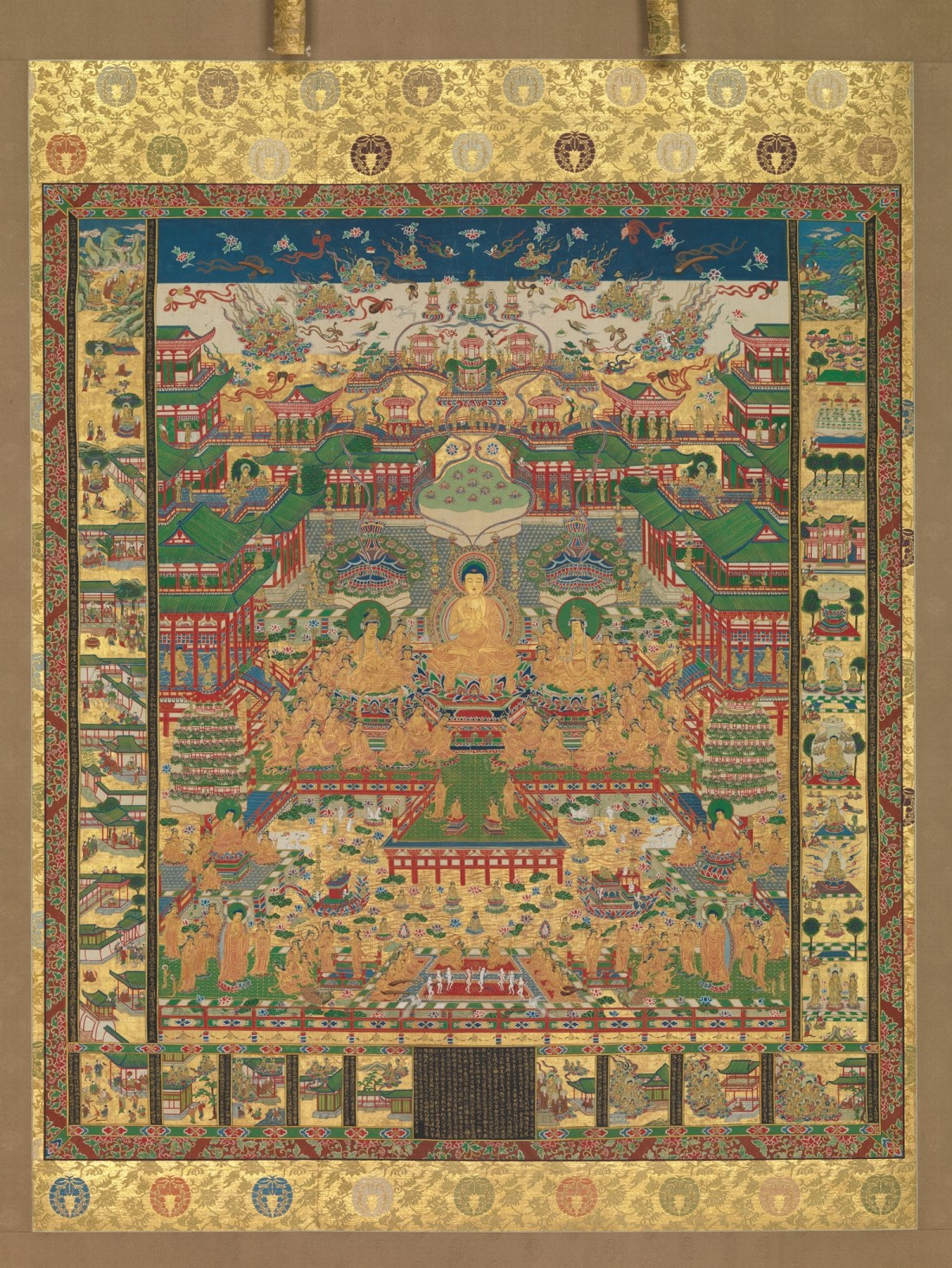
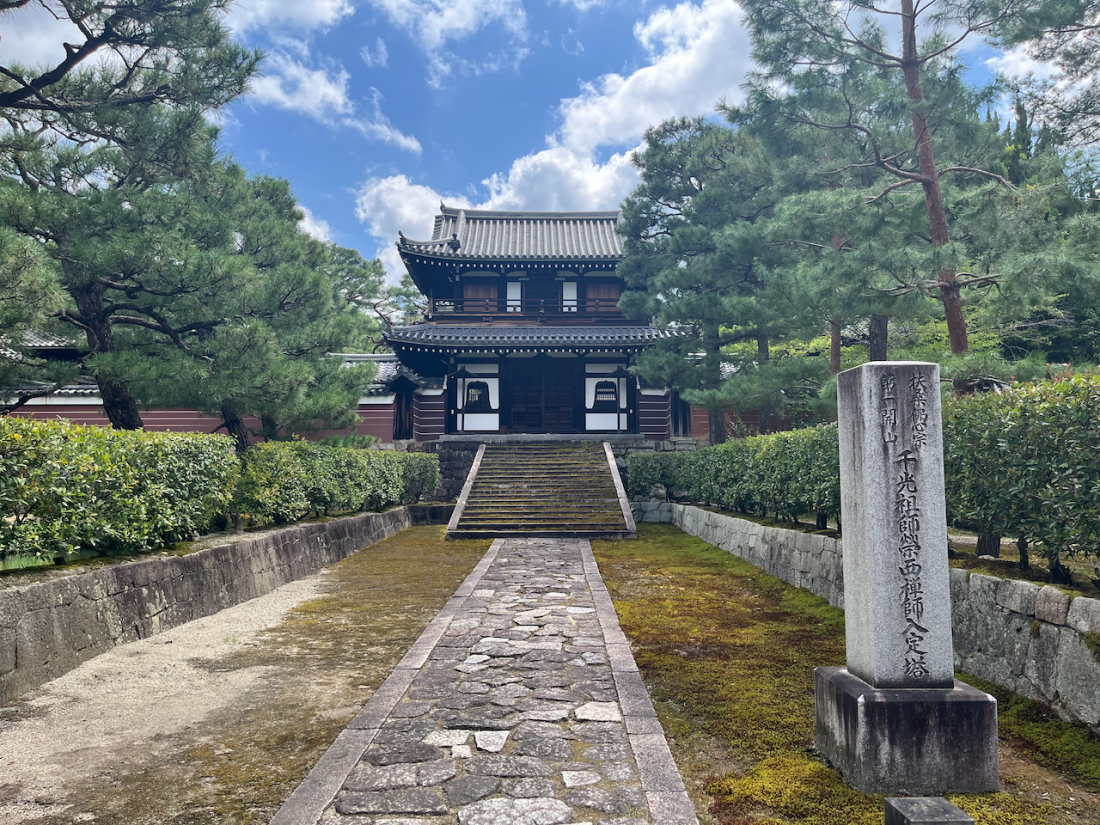
Buddhist Iconography and Iconoclasm

G’Kar: Despite my best efforts, I’ve become an icon. I didn’t understand why or how until I saw this [holding a small statue]. I realized it’s simpler to make a statue to someone who you believe embodies all your better qualities than it is to actually improve yourself.

Garibaldi: And this saves you from having to think.

Babylon 5, “Wheel of Fire”, s5:ep19

The question of Buddhist images and icons in Buddhism has many twists in turns in its long history. In early, early Buddhism, the Buddha was represented simply as a set of footprints, and Buddhist statuary did not exist until the Greek-influenced Gandharan culture centuries later. Since then, Buddhist iconography (religious images) has become very elaborate, depicting many buddhas and bodhisattvas, using a variety of gestures and symbols to convey meaning.

I own a book in Japanese that goes into great detail about the different types of statuary, the meaning of each gesture, and other terminology.

The central image of Kannon Bodhisattva at Sanjusangendo temple in Kyoto Japan, for example, shows 1,000 arms, each holding a different item, in order to convey the myriad ways that Kannon helps living beings.

When you look at esoteric (a.k.a. Vajrayana) Buddhism, the symbols, images and statuary become even more elaborate because they are central to the teaching method. Mandala alone can be very complex and require years of study.

On the other end of the spectrum is the archetypal Zen master who smashes statues, or burns Buddhist sutras in order to teach a lesson. Zen has a reputation for iconoclasm,1 even if that reputation is almost certainly exaggerated.

This quote from Babylon 5 gives me mixed feelings. Buddhism runs the gamut between intense usage of icons and ardent iconoclasm, so that begs the question: which approach is right? The Babylon 5 quote sounds like it favors the more Zen-like iconoclasm, and I do think there is some truth to this.

The Buddha did seem downplay the need to venerate the Buddha, and instead encouraged people to put the teachings, the Dharma, into practice. Yet he never discouraged it either. In the Maha-parinibbana Sutta in the Pali Canon is this excerpt:

And the Blessed One spoke to the Venerable Ananda, saying: “Ananda, the twin sala trees are in full bloom, though it is not the season of flowering. And the blossoms rain upon the body of the Tathagata and drop and scatter and are strewn upon it in worship of the Tathagata. And celestial coral flowers and heavenly sandalwood powder from the sky rain down upon the body of the Tathagata, and drop and scatter and are strewn upon it in worship of the Tathagata. And the sound of heavenly voices and heavenly instruments makes music in the air out of reverence for the Tathagata.

“Yet it is not thus, Ananda, that the Tathagata is respected, venerated, esteemed, worshipped, and honored in the highest degree. But, Ananda, whatever bhikkhu or bhikkhuni, layman or laywoman, abides by the Dhamma, lives uprightly in the Dhamma, walks in the way of the Dhamma, it is by such a one that the Tathagata is respected, venerated, esteemed, worshipped, and honored in the highest degree. Therefore, Ananda, thus should you train yourselves: ‘We shall abide by the Dhamma, live uprightly in the Dhamma, walk in the way of the Dhamma.'”

Translation by Sister Vajira & Francis Story

No “crazy wisdom”, smashing shrines, or anything, but also no heavy reliance on veneration either. Some people will venerate the Buddha after his death, which is fine, but better still to honor the Buddha by putting the teachings into practice.

Further, in the Lotus Sutra, the capstone of the Mahayana-Buddhist tradition, the sutra emphasizes the importance of expedient means (“upaya” in Sanskrit), meaning different tools for different people at different stages of their life. Buddhism in general, and especially Mahayana Buddhism, is like a toolbox equipped with lots of tools.

Photo by Pixabay on Pexels.com

So, at the beginning, it makes sense to find what resonates with you and make that a point of veneration, a sutra to recite, a practice to undergo, etc. In the Lotus Sutra, specifically chapter seven, he compares this to a “magic city”, a temporary refuge on a much longer journey:

When the leader knew they were rested, he called them together and announced, “Now you must push forward– this is nothing more than a phantom city. I saw that you were weary and exhausted and wanted to turn back in mid-journey. Therefore I used the power of expedient means to conjure up this city for the moment. Now you must press forward diligently so that together you may reach the place where the treasure is.”

Translation by Dr Burton Watson

Yet, over the years, one’s practice and one’s understanding of Buddhism might change and evolve. In such a case, the original tool, deity, whatever isn’t needed any more, like a map of Paris versus going there. You are in Paris now, and can explore and continue your adventure there.

But I think what G’Kar and Garibaldi are getting at is that some people don’t do this. They seem stuck in their ways, and always seem to want the teacher to solve the problem for them, or for their beloved Buddhist figure to embody all their needs and such. In such cases, it does become more of a hindrance than a tool, like holding onto a raft after you are done. I vaguely remember that the late Thich Nhat Hanh mentioned in one of this books (I couldn’t find the quote) that some members of his temple community never seemed to grow beyond their need of a teacher. I am sure other modern teachers can attest to this as well.

So, if something in Buddhism helps you, hold on to it and cherish it, but remember that (like the Lotus Sutra teaching) it is only a phantom and at some point you will need to let it go.

Namu Shakamuni Butsu

1 The term iconoclasm, by the way, dates from a period in the Eastern Roman (Byzantine) Empire when a small movement in Constantinople sought to reduce reliance on religious icons, believing that such “idolatry” would invite further punishment from God.

It’s not clear if this was instituted willingly by Emperor Leo III and his son Constantine V, or a response to public sentiment, but many religious icons were taken down or destroyed at this time, though many were restored later. Byzantium experienced a few other waves of iconoclasm after this, and all of this is tangential to the Protestant tendency toward iconoclasm.

Above Reproach

Recently, while cleaning out old notes from my mobile phone, I found this quote from the massive Buddhist text, the Avatamsaka Sutra (a.k.a. “The Flower Garland Sutra”) which I apparently saved in 2022 (!). I cannot remember where in the sutra this quote comes from, but I probably meant to post about it sooner than later. So… three years later I am finally posting this quote:

The peaceful nature of the buddhas cannot be known

By the covetous or the malevolent,

Or by those shrouded in the darkness of delusion,

Of those whose minds are defiled by hypocrisy and conceit.

Translation by J.C. Cleary

As we’ve seen with the Yogacara school of Buddhism, what we think and do helps “color” the world we also perceive, and thus becomes a feedback loop. Thus, someone who is prone to lying assumes others lie too. Someone who is aggressive or domineering fears others will dominate him, and so on. This is the world they perceive because their minds harbor such thoughts. In the Pali Canon is a sutra wherein the usurper king Ajātasattu visits the Buddha for some spiritual advice. Later, the Buddha laments that due to Ajātasattu’s prior patricide, his spiritual progress will be limited at best.

Thus, the Flower Garland Sutra says that evil men cannot “see” the Buddha because their minds are too clouded by greed, anger and arrogance. Of course, they can physically see a statue or image, but they may learn little or nothing from it. They may as well be living on another planet. It does not resonate with them, and so they miss out on learning the Dharma. They will fall into evil rebirths, and may not gain another opportunity for generations, centuries, possibly longer.

Conversely, one who lives a clean life, and avoids harboring greed, anger, and arrogance will see the Buddhas. I don’t necessarily mean in terms of visions and such,1 but they will see the Buddha-Dharma everywhere (even in awful places and situations), and learn from it. From there, their perception will only continue to grow and mature, leading to greater wisdom.

This idea isn’t limited to the Flower Garland Sutra. The famous sixteenth chapter of the Lotus Sutra basically says the same thing: those who live upright see the Buddha and his Pure Land here and now.

So, take heart. If you strive to keep your “house in order”, and avoid harboring ill-will and such, you will not fail to see the Buddha someday.

Namu Shakamuni Butsu
Namu Amida Butsu
Namu Kanzeon Bosatsu

1 True story: in my 20’s, when my oldest daughter was a baby, and I was first exploring Pure Land Buddhism, I once had a really vivid dream, where I was offering armfuls of incense sticks at the feet of a statue of Kannon Bodhisattva. It’s the one and only time I’ve had a “Buddhist dream”, but I suppose it can happen to anyone.

Confronting a Suffering World

More than any other year in recent history, it seems like 2025 is a year where we are suffering more than before. It is frustrating to watch all this unfold, frustrating to know that even when you try to help, it feels like it makes no difference, and frustrating to see no light at the end of the tunnel. I feel a combination of denial, passivity, frustration, anger, despair, and everything in between, over and over.

IVANOVA: Damn it, John, there’s always too many of them and not enough of us. What am I supposed to do?

SHERIDAN: Fight them without becoming them.

Babylon 5, “Dust to Dust”, s3:ep06

But I’ve also been thinking about this a lot, and I realized that the forces of History are always in motion, even if we don’t see them. It can take years, or in some cases decades to see the bigger picture.

Claude from Fire Emblem: Three Houses saying “…but even while you’re standing still, the world keeps on moving. I always find that oddly comforting.”

But also, the little things we are doing here and now still matter. What happens to others who are suffering affects us, even if we are not consciously aware of it.

G’KAR: If we deny the other, we deny ourselves and we will cease to exist.

Babylon 5, “Point of No Return”, s3:ep9

Even those whom we oppose are suffering, even if we do not comprehend it:

If both sides are dead, no one will care which side deserves the blame. It no longer matters who started it, G’Kar. It only matters who is suffering.

Babylon 5, “Dust to Dust”, s3:ep6

So, simply standing back and letting history unfold isn’t enough. On the other hand it is just not possible to save the whole world. Even if I gave away everything I have here and now, it would be a drop in the bucket.

Instead, each one of us needs to find one small thing that we can dedicate ourselves to, for the good of others. In a Pure Land Buddhist text, The Larger Sutra of Immeasurable Life, the Buddha Amitabha started as a king, then a bodhisattva, and through tireless efforts over eons transformed his realm into the Pure Land through countless good acts, accumulated merit, and so on. This process was glacial, but it came to fruition nonetheless.

In the same way, each one of us when we dedicate ourselves to a cause, however small, it feels glacial. Nothing changes. But change does happen. As with the forces of History, things do unfold, but our actions help shift the currents of the “river of History” ever so little.

But even so, not every one will see this and understand. In the immense Buddhist tome, the Avatamsaka Sutra (a.k.a. the “Flower Garland Sutra”), is a famous quote:

On seeing a bodhisattva
Perform various practices,
Some give rise to a good mind and others a mind of evil,
But the bodhisattva embraces them all.

Original translation from the Collected Works of Shinran, courtesy of the Jōdo Shinshū Hongwanji-ha

This is the Mahayana Buddhist in a nutshell.

Namu Shakamuni Butsu

Namu Amida Butsu

P.S. Thanks to a bug in my blogging app I posted two posts at the same time last week. Apologies for any confusion.

Also, I am still resting a little from burnout, so no blog schedule for now. I wanted to at least finish some mostly-complete drafts for now.

Amitabha: The Welcoming Buddha

During my wife’s latest trip to Japan (I stayed home this year for various reasons), she found this delightful patch/sticker:

This is an image of Amida Buddha, welcoming the deceased to the Pure Land. This is called raigō amida (来迎阿弥陀, “Amida welcoming the dead”). I talked about this before a little while ago, becuase it was a common artistic motif in medieval Japanese Buddhism, especially at a time where disease, warfare and death would often cut people’s lives short.

The imagery of Amida Buddha coming to greet the dead is found primarily in the Contemplation of Amitabha Sutra (a.k.a. “the Contemplation Sutra”). The last section of the sutra lists the nine grades of people who are reborn in the Pure Land, and the fourth grade (“highest level of the middle grade”) gives the following description, for example:

“When such a person is about to die, Amitayus [Amida] appears before him, surrounded by a host of monks and radiating a golden light. He then expounds the truth of suffering, emptiness, impermanence and no-self, and praises renunciation of the world as the way to escape from suffering.

“Seeing this, the aspirant greatly rejoices and finds himself seated upon a lotus-flower. He kneels down, joins his palms and worships the Buddha. Before he raises his head, he attains birth in the Land of Utmost Bliss, where his lotus-bud soon opens.

Translation by Rev. Hisao Inagaki

Depending on the grade of the aspirant, this welcome may be more or less elaborate, but all of them are reborn in the Pure Land somehow.

So, I like this patch because it’s a reminder of the goodwill Amida Buddha extends to all beings, and how everyone can be born in the Pure Land if they want to.

Namu Amida Butsu

P.S. I kept the patch in its wrapper for a long time, but finally decided to put it in a sutra book I’ve been making.

P.P.S. Accidental double-post. 🤦🏼‍♂️

Divine Intervention, Or Lack Thereof

Scotty: Thank heaven!

Spock: Mr Scott, there was no deity involved. It was my cross-circuiting to B that recovered them.

McCoy: Then thank pitchforks and pointed ears.

Star Trek, “Obsession” (s2:ep13), stardate 3620.7

In the host of world religions, Buddhism occupies a strange place. In one sense, it is a world religion because it is followed by many different peoples, cultures, and languages throughout its 2,500 year history.

But unlike other world religions there is no central deity, no creator.

Hold on, you might be thinking, what about the Buddha?

The Buddha is the central figure of Buddhism. He is the teacher, but in the Buddhist tradition he was once a person, just like you and me, who through countless lifetimes as a bodhisattva fully accomplished the path and awakened to the Dharma: the principles of existence. He taught the Dharma to his disciples, and they became the first generation of the Sangha, the community.

Thus, these comprise the Three Treasures of Buddhism.

But why do people pray to the Buddha?

Because the Buddha and all other such figures in Buddhism are not passive. The Buddha taught the Dharma out of compassion and goodwill for all beings, and the countless Bodhisattvas such as Kannon guide any sentient beings who take up the Buddhist path. Amida Buddha provides a refuge for all beings who wish to be reborn there.

Kannon (観音) Bodhisattva in her more motherly form.

The underlying theme isn’t Enlightenment for Enlightenment’s sake. It is to help beings who suffer so that eventually they too may reach Buddhahood (a.k.a. Enlightenment).

One does not have to pray to the Buddhas and Bodhisattvas. The most important thing is to put the Buddhist teachings into practice as one can. But in times of unease, uncertainty or crisis it’s perfectly fine to pray to a Buddha or Bodhisattva that you revere. I do it from time to time myself when I am worried about my kids, on plane flights, before surgery, etc.

But also, in the end, I am responsible for my choices, my words, and my thoughts.

When you plant melon seeds you get melons, and when you plant beans you get beans. [Effect follows causes] like a shadow follows a physical shape, like an echo responds to a sound. Nothing is sown in vain. This is called “believing in the result”.

Ou-yi’s Mind Seal of the Buddhas, translation by J. C. Clearly

I alone bear the fruits of my choices, words and thoughts.

Namu Shakamuni Butsu

Namu Amida Butsu

Namu Kanzeon Bosatsu

Meditation and Back Pain

Since May when I started taking up Zen practice more actively, I’ve been meditating more or less pretty regularly since then. Not quite daily, but several times a week usually. This has highlighted something I didn’t expect: back pain.

Back pain is nothing new to me. I have worked a desk job for many years, so my back often hurts, and I don’t get enough exercise. My back problems are not severe, and don’t require surgery or anything, and I have tried a few things to solve them: new office chairs, Tiger Balm, Chinese medicine pads, yoga, acupuncture, ibuprofen, etc. Each of these helps a little bit, but the problem recurs over and over again. Simply bending down to take out something from the refrigerator can trigger it, but so did Zen meditation.

Meditation sometimes triggers lower back pain for me if I sat incorrectly. But also posture. I tried doing a half-lotus posture, but that quickly caused too much discomfort (full lotus posture is right out), so I usually sit in the “Burmese posture“. This is usually good enough, but even so, if I posture isn’t good, my back hurts more and more. If I already had back pain, it aggravates it. In such cases, I usually have to stop meditation for a few days while my back recovers.

I started to despair that I would never find relief.

Finally, I decided to try some physical-therapy exercises to strengthen my core muscles. I found this helpful website that provides a routine that a person should do once or twice a day (twice if possible). I started this about four weeks ago, sometimes once a day, sometimes twice a day. I also added 15 squats as part of this routine to make my knees stronger.1 After the first week, the pain in my back had noticeably diminished. By the end of the second week, my posture and back pain greatly improved. I felt much more sturdy when going up and down stairs.

Meditation too hurts a lot less. Sometimes I still get back pain, but both the severity and duration are much shorter now.

Again, to emphasize, my back problems are pretty minor and don’t require surgery or anything, but simply doing about 10 minutes daily of physical therapy type exercises to strengthen my core has had many little benefits, both for meditation and for general quality of life.

But don’t ask this old man to do half-lotus position… 😋

P.S. Taking a break next week on blogging. I need to catch up on some drafts, do some reading, etc. Plus it’s my birthday. 🥳 See you next time!

1 I have also been dieting more actively to help reduce physical weight of my body on my bones and back.

The Dynamic Duo of Zen and Pure Land

A few months ago, I made this post about how the Obaku Zen sect interprets Amida Buddha and the Pure Land. To my surprise, I keep reflecting on this phrase from time to time, almost like a Zen koan:

This mind is the Pure Land,
this body is Amida Buddha

This idea of merging Zen and Pure Land ideas is somewhat rare in Japanese Buddhism, but it’s surprisingly common in Chinese-Buddhist thought. Originally, I thought it was limited to later Ming-Dynasty Buddhism (which Obaku descends from), but similar strands of thought exist much further back.

A famous Chinese monk named Yongming Yanshou (永明延壽. 904 – 976) once wrote a poem titled the “Four Alternatives” (sì liào jiǎn 四料揀):1

Lacking both Chan and the Pure Land, it will be the iron beds and bronze pillars [of hell] for ten thousand kalpas [eons] and a thousand lives with no one to turn to.

Having Chan but lacking the Pure Land, nine out of ten will stray from the path; when the realm of the aggregates appears before them, they will instantly follow it.

Lacking Chan but having the Pure Land, ten thousand out of ten thousand who practice it will go [to rebirth]. Having seen Amitābha, why worry that one might not attain enlightenment?

Having both Chan and Pure Land, one is like a tiger with horns [i.e., doubly capable]. Such a person will be a teacher in the present life, and a buddha or patriarch in future lives.

translation by Charles B. Jones, “Chinese Pure Land Buddhism, Understanding a Tradition of Practice”, pg 210

Yongming is advocating a supportive model where both Zen practice and Pure Land practice work in concert. The Pure Land path is the “safer” path to follow, due to the vows of Amida Buddha, but if supported by Zen practice here and now, one is really making progress on the Buddhist path.

Further, a later writer named Yunqi Zhuhong2 (雲棲袾宏, 1535 – 1615) explained that these things were not mutually exclusive (Chinese added by me):3

To contemplate the Buddha (nianfo 念佛) is to contemplate the mind (nian-xin 念心). Birth there (in the Pure Land) does not entail birth away from here. Mind, Buddha, and sentient beings are all of one substance; the middle stream (non-duality) does not abide on the two banks (this world and the Pure Land).

Similarly, Ouyi Zhixu (蕅益智旭, 1599 – 1655) in his excellent work “Mind Seal of Buddhas” makes a similar argument: Zen and Pure Land practice are the same thing, just operating at different levels. You’re not forced to chose one or the other in your practice.

But such ideas aren’t limited to medieval Chinese-Buddhist monks. You can find such sentiments in Pure Land sutras themselves! In the Immeasurable Life Sutra is this passage (emphasis added):

“In this world, you should extensively plant roots of virtue, be benevolent, give generously, abstain from breaking the precepts, be patient and diligent, teach people with sincerity and wisdom, do virtuous deeds, and practice good. If you strictly observe the precepts of abstinence with upright thought and mindfulness even for a day and a night, the merit acquired will surpass that of practicing good in the land of Amitāyus [a.k.a. the Pure Land] for a hundred years. The reason is that in that buddha land of effortless spontaneity all the inhabitants do good without committing even a hair’s breadth of evil. If in this world you do good for ten days and nights, the merit acquired will surpass that of practicing good in the buddha lands of other directions for a thousand years.

Translation by Rev. Hisao Inagaki

In this passage, the Buddha is clearly advocating both bending your efforts toward rebirth in the Pure Land, but also making the most of the time you have here to undergo traditional Buddhist practices too because even a modest effort here is a great benefit in the future (both for yourself and others).

As I often tell my kids: “go nuts”!4

What I mean is: recite the nembutsu, meditate, uphold the precepts, or some combination thereof. You have nowhere to go but up.

But what if you can’t decide or don’t have the time?

In my opinion, start with the nembutsu. Begin just as you are, and recite it just 10 times daily. From there, add the Five Precepts when you are ready, and once you have that foundation, and are ready to branch out, then look into Zen practices. This make take months or even years. Take your time, go slow, and don’t be afraid to explore.

When I talk about the flexibility of Tendai Buddhism in Japan as well, this is what I am alluding to: start with something simple and small at first (such as a devotional practice), and gradually building upon it as you gain confidence and see the positive transformation in your life. Buddhism is kind of a SLOW, gradual religion, but like a glacier, once it starts moving, it has a wonderful momentum all its own even if you can’t see it.

Namu Shakumuni Butsu
Namu Amida Butsu

P.S. Featured blog image is another famous “Dynamic Duo”: Batman and Robin from the 1960’s series.

P.P.S. Posting kind of off-schedule just because it is fun. 😊

1 I found this on Wikipedia actually and I thought to myself “wow, this person quoted exactly the same way that I would do!”, then I realized that I had put this on Wikipedia a few years ago. 🤦🏼‍♂️

2 Pronounced like “yoon-chee joo-hong”.

3 Again, I managed to pull a quote from Wikipedia that I had unwittingly added years ago and then promptly forgot.

4 My kids ask me if they can watch TV, play Switch or whatever, and my frequent answer is “go nuts” [go crazy, have fun].

Understanding Koans in Zen

My son and I visited our neighborhood bookstore recently (shop at local, independent bookstores!) and I found this neat book worth mentioning called The Blue Cliff Record, translated by David Hinton.

The Blue Cliff Record, known in Chinese as the Bìyán Lù (碧巖錄) is actually a pretty old text in the Chinese Chan (Zen) tradition, and is a collection of Koans compiled in the year 1125 by Yuanwu Keqin (圓悟克勤, 1063–1135).1 Obviously, the koans themselves were older and handed down over time, and appear in other collections, but the Blue Cliff Record is a kind of “selected wine list” of koans. The Blue Cliff Record was compiled during the Song Dynasty in China, which while politically unstable due to the Mongols, was a cultural high-water mark of Chinese Buddhism and especially the Chan tradition. Not surprisingly, Japan’s Zen tradition imported much from this time period as well.

This is not the first time I’ve studied koans, though.

In my youth, when I first explored Zen, I had a copy of the Gateless Gate by Mumonkan, and my religion studies teacher in high school assigned us each a koan to solve in class. Of course, none of us actually solved them, but it was a fun exercise. But as with my studies in Zen, I gradually forgot about it until recently, so it’s like coming back full circle after more than 30 years (!).

But what the heck are koans?

“Koans” are more properly called Gōng-àn (公案) in Chinese. The word “kōan” is how those Chinese characters are pronounced in Japanese, and this term is more widely known to Westerners.2 Koans are cryptic dialogues, often between a master and student, and widely used in the Lin-ji school of Chan Buddhism. As we saw in my recent post, Lin-ji is predominant in China, but also spread to neighboring countries, and in Japan’s case it became both the Rinzai and Obaku sects (albeit different centuries). Temples such as Kenninji and Ryoanji are examples of famous Rinzai temples in Japan. The Soto Zen tradition doesn’t rely on them as much, but inherits the same collections, as it is desecnded from the Cao-dong (not Lin-ji) school in China.

David Hinton in his foreword on the Blue Cliff Record explains that the key to understanding a Koan is to see it like a kind of public law case. When law students review famous court cases, they have to review the nature of the complaint, evidence presented, the judge’s decision, past precedence, etc. If you’re not a law student, this is hard. But if you’ve been practicing law for a long time, immersed yourself in it, then you see it with a different eye.

In the same way, Mr Hinton writes, a Koan is like a “public sangha case”. The “sangha” is one of the Three Treasures of Buddhism, and means the Buddhist community at large. So, these are public sangha cases for students to review, contemplate, and so on.

The truth is, when you read a Koan for the first time, it basically makes no sense whatsoever. You might think you get it, then you gradually realize that you really don’t. Then it gets under your skin, and bothers you enough that you might stick with it, until maybe one day, you look at it and you think “duh, of course!”

But also, some “public sangha cases” will resonate with you more than others, or at different times in your life.

Since I don’t participate in any Zen communities at present, I decided to do a little experiment. The Blue Cliff Record has exactly 100 cases in it, and being a giant nerd, I decided to pick one at random as my koan to contemplate. I took 2d10 dice from my Dungeons and Dragons set. Then, I briefly prayed to Kannon Bodhisattva and Shakyamuni Buddha and rolled the dice. I got koan #20 which David Hinton translates as “Dragon-Fang Meditation Clapper”:

When he was a monk traveling, Dragon-Fang Mountain asked Kingfisher Shadowed-Emergence: “What is the ch’i-weave mind [意] Bodhidharma brought from the West?”

“Pass me the clapper to announce meditation,” said Shadowed-Emergence.

Dragon-Fang passed the wooden clapper to Shadowed-Emergence, who swung it and struck Fang a blow.

“You can strike me all you want,” hissed Dragon-Fang, “But there’s still no ch’i-weave mind for Bodhidharma to bring from the West.”

Traveling years later, after his awakening under Fathom Mountain, Dragon-Fang asked Purport Dark-Enigma: “What is the ch’i-weave mind Bodhidharma brought from the West?”

“Pass me the meditation cushion,” replied Dark-Enigma, who swung it and struck Fang a blow.

“You can strike me all you want,” hissed Dragon-Fang, “But there’s still no ch’i-weave mind for Bodhidharma to bring from the West.”

Translation by David Hinton

Confusing? Yes. Mr Hinton takes the unusual approach of translating the monks’ names into English, hence “Dragon-Fang” and “Shadowed-Emergence”, etc. so it takes a bit of getting used to. The term “ch’i-weave mind” (意)3 takes 2 pages to explain at the end of the book, and I can’t do it justice, but for simplicity here I will crudely summarize it as the Big Mind, as opposed to one’s normal everyday mind.

Even so, this koan doesn’t make a whole lot of sense. I think I get it, but do I really get it?

I suppose time will tell…

Namu Shakamuni Buddha
Namu Amida Buddha
Namu Kanzeon Bosatsu

1 Pronounced like “yuen-wu kuh-cheen”

2 Many Buddhist terms in Japanese are just local pronunciations of Chinese-Buddhist words (often from Hokkien dialect, not Mandarin, due to its proximity to the Japan islands). This same trend happens with Korean-Buddhist words, Vietnamese-Buddhist words, and so on. If this sounds strange, consider religious words in English. They are often derived from Latin, for obvious reasons, but the pronunciation gets muddled over many generations, especially since they were often filtered through Middle-French (via conquering Normans). This is how religious ideas and words spread.

3 This Chinese-character is used in such Japanese words as:

  • 意味 – imi or “meaning”
  • 意識 – ishiki or “consciousness”
  • 注意 – chūi or “caution”
  • 用意 – yōi or “to prepare or provision something”

…. you get the idea. It’s used a lot, but kind of abstract too.

Effort

Garibaldi: This isn’t gonna be easy.
G’kar: Nothing worthwhile ever is.

Babylon 5, “And the Rock Cried Out, No Hiding Place”, s3:ep20

Recently, I talked about the key to practicing Zen (or Buddhism in general) is training while incorporating other things in your life toward that same goal. Like Rocky Balboa training in Rocky, or Li Fong in the excellent movie Karate Kid: Legends, or someone working hard to learn a language by making other aspects of life conducive toward language learning.

In most cases, we go through a some stages when we take up a project like this.

  1. New thing – “this is fun, I can see the benefits already!”
  2. Steady practice – “gotta keep this up”
  3. Boredom – “ugh, I gotta do this again”
  4. Skipped days – “I’ll make up for it tomorrow”
  5. More skipped days – “No, really, I’ll make up it up tomorrow.”
  6. Guilt – “I suck”
  7. Despair – “I’ll never succeed.”
  8. Quitting.

My usual pattern with new projects, or dieting and exercise, is to eventually feel guilty, despair, and quit. It happens to me a lot over the years, admittedly.

But also, there are a few things that surprisingly I have managed to stick with for years, decades even. I’ve been actively studying Japanese since 2008, for example. I realized though that the way I’ve studied Japanese has changed and shifted many times. Some experiments succeeded, others failed immediately. But the goal was important enough to me, that even when I failed I just shifted tactics and tried again. I failed the N1 JLPT twice in the last five years, and to my surprise, I am still at it, but now trying a new tactic.

Put another way: when I hit a roadblock, instead of hitting my head on the wall harder and harder, I tried another route. I knew where I wanted to go (language fluency) and just kept trying methods until I found something that stuck.

I realized too that my pursuit of the Buddhist path has been much the same way. I started out in 2005 with very little understanding, but I really liked reciting the nembutsu, and I loved the simple, down-to-earth, and highly approachable Jodo Shu sect as taught by Honen (still do!). But while I’ve had the same basic goal, my understanding of Buddhism has grown over time, and like language learning, has gone through many false-starts, projects that soon ended, or things that just didn’t work. So, I just shifted, tried another route, backtracked, and so on. This what I think happened to me, and why I took up Zen practice since May.

My current Zen practice is, I suppose, just another track toward my goal.

So, I think the point of all this is that the goal is more important than the particular approach. If the goal is something you really care about you’ll find a way. In fact, you’ll probably bend other aspects of your life toward it. If not, then the goal maybe wasn’t that important to begin with. That’s OK. Better to acknowledge it, cut your losses, and move on.

But if the goal is worthwhile to you, then like G’Kar says, you’ll find a way.

Namu Shakamuni Butsu
Namu Amida Butsu

Make Everything Zen

My family and I really enjoyed the latest installment of the Karate Kid series: Karate Kid Legends.1

In one part of the story, our protagonist Li Fong (played by Ben Wang), is teaching a local, washed-up boxer in New York how to train in kung-fu. He tells the boxer that in order to train in kung-fu everything you do should be geared toward kung-fu. So, through a fun montage, the boxer, who owns a local pizzeria, learns to punch olive oil cans with proper form, carry bags of flour for strength training, etc. Everything he does in his daily work is geared toward his kung-fu training.

As soon as I saw this in the theater, my first thought was “that’s how Zen works”.

When people think of Zen they think of Japanese-style dojos with soft flute music playing in the background, and maybe a cherry blossom tree or two.

This is an ideal, though. A fantasy.

I have literally been to genuine Zen temples in Japan, seen the very best of the best, and they are wonderful, but you can’t take that experience home with you. Zen is a lot more than just sitting at meditation before a sane garden.

Zen, as with Buddhism in general, is about being engaged in your life as it is.2 Make everything in your life about the practicing the Dharma somehow. When you need to clean house, or cook for the kids, etc., think of it as training: training to uphold the precepts, training to pay attention to what you’re thinking and doing, training to live an upright, honest life, etc. I realize that it’s not possible to think this way all the time; I spend my downtime usually playing Fire Emblem or playing The One Ring RPG. But, if you keep your long-term goal in the back of your mind, whether that be kung-fu or the Dharma, the more you will bend your life in that direction, and thus the more you accomplish along the way.

Having a long-term goal, regardless of the ups and downs of life, is essential with the time you have left.

Namu Shakamuni Butsu

P.S. Featured photo is Bruce Lee at age 18 practicing with his teacher, Ip Man. Courtesy of 搜房网电影人生, Public domain, via Wikimedia Commons.

P.P.S. I’ve been on WordPress for 15 years as of this week. 🥳

P.P.P.S. Happy Diwali to my Indian/Hindu readers!

1 Growing up in Japan, my wife had never seen the earlier Karate Kid movies (which in Japan were called ベスト・キッド (“Besuto Kiddo”, meaning Best Kid). After watching Legends, she and the kids wanted to see the original for some context, but weren’t super impressed. Looking back, the movie definitely appeals to a 1980’s fascination with Japanese culture, and thus mysticizes some things, and awkwardly stereotypes others. I loved them as a kid, but I admit now that they were a product of their time. That said, I am glad to see Legends really freshen up the franchise.

2 On can easily make the case for Pure Land Buddhism teaching the same thing, especially Jodo Shinshu-sect Buddhism.