Medieval Japan and Amitabha Buddha

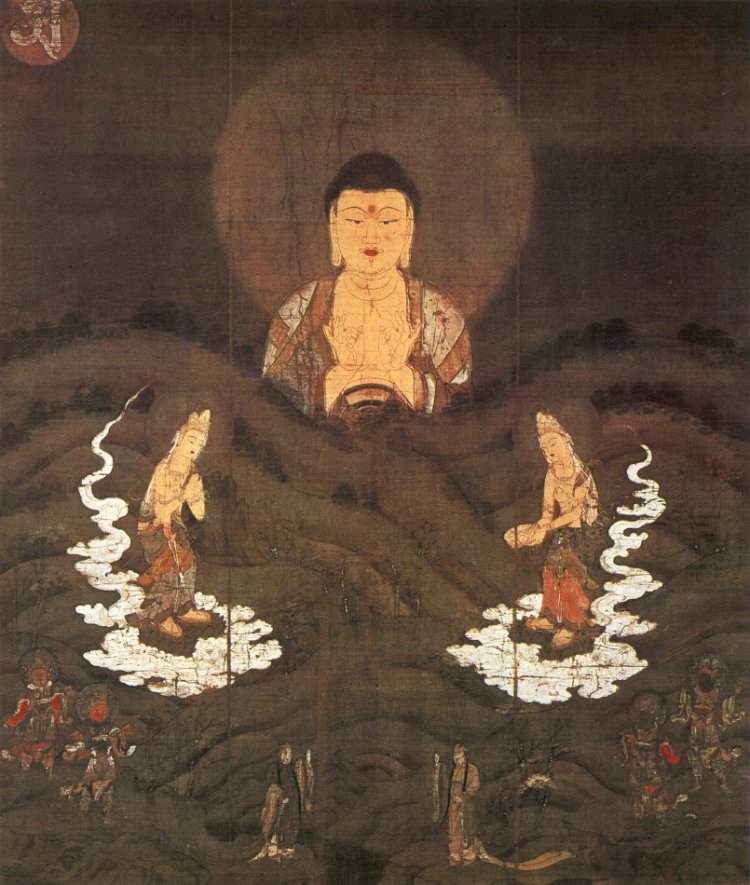
「山越えあの阿弥陀」, or “Amida crossing over the mountain”. Courtesy of Eikando Temple in Kyoto, Japan, and the Museum of Nara. Public domain, via Wikimedia Commons

On the same Japanese documentary as here, I saw a great segment on the famous Eikandō Temple, more formally known as Eikan-dō Zenrin-ji (永観堂禅林寺). Homepage here in Japanese and English. The temple is iconic for several reasons, including its very picturesque fall scenery, and also its vast collection of Buddhist artwork listed here. The most famous is the central figure of Amida Buddha looking back (more on that in a future post).

The picture above, called yamagoé amida-zu (山越阿弥陀図, “Amida Buddha Crossing Over the Mountain”) is a pretty famous work of art that I’ve seen even on English books related to Pure Land Buddhism and especially Jodo-Shu Buddhism.1

It also exemplifies how Amida Buddha was venerated in medieval Japanese culture.

The picture depicts Amida Buddha, a very popular figure in Mahayana Buddhism who vowed to lead all beings to his Pure Land after death so that they may escape the endless cycle of birth and death, and accelerate along the Buddhist path much more readily.2 Amida Buddha is frequently depicted in artwork flanked by two bodhisattvas: Kannon (観音, Avalokitesvara) and Seishi (勢至, Mahasthamaprapta).

As the figure was imported into early Japanese history, he gradually increased in popularity, and many medieval practices were used to help ensure that devout followers would be reborn in his Pure Land. As the situation in medieval Japan gradually worsened, this became even more prominent. If you look carefully, Amida Buddha’s fingertips in each hand touch together in a mudra, a form of Buddhist iconography. What you don’t see is that traditionally, where the fingertips touch, there are usually five strings of different colors hanging down, and there was a common deathbed practice where the dying individual would hold on the other end of those strings as much as they could. This was believed to help ensure that the dying person would not fall through Amida Buddha’s grasp in being reborn to the Pure Land.

Another noteworthy thing about this painting is the Siddham (Sanskrit) syllable written on the upper-left: 𑖀 (“ah”). It is not the “seed syllable” for Amitabha, which is hrīḥ (𑖮𑖿𑖨𑖱𑖾), but is frequently used in esoteric Buddhism (e.g. Vajrayana). This shows that at this time, Amitabha Buddha was still closely associated with earlier esoteric practices found in both Tendai and Shingon-sect Buddhism. For some reason, English-language books on Japanese Pure Land Buddhism frequently seem to crop out the syllable when including this painting.

One rival practice to reciting the nembutsu at this time was reciting an esoteric mantra called the Mantra of Light, promulgated by Pure Land critic Myōe.3 You can see from this picture that pairing devotion to Amitabha Buddha with a popular esoteric mantra wasn’t such a leap either.

Many of these practices gradually faded as Buddhism in Japan evolved and replaced with other practices, but it’s interesting how this one painting can encapsulate so many things in the 11th-12th century Buddhist-Japanese culture.

P.S. I might have messed up the “hrih” siddham syllable. Unicode, Sanskrit and HTML are not easy. 😉

1 Eikando converted from a Shingon-sect temple to a Jodo Shu-sect temple in the late 12th century when it was administered by a disciple of Honen’s named Johen (1166-1224), and then more fully under Shoku. Interestingly, the “Amida Looking Back” statue was crafted a century earlier, in 1082, by Eikan (also known as Yōkan, 永観, 1033-1111) who saw Amida in a dream, and also later founded a hospital on the temple grounds.

2 The assumption that the Pure Land is the Buddhist version of “heaven” (i.e. in a western sense) will require a separate post to explain. TL;DR they have little in common.

3 I actually recite both in my home practice: the nembutsu and the mantra of light. First one, then the other. I first learned about it not from esoteric sources, but actually from Rinzai-Zen Buddhist liturgy, where it is often recited. It’s interesting how certain practices kind of persist in unexpected places.

A Brief Look At One Hundred Aspects Of the Moon

Astute readers may have noticed lately that I’ve been frequently referencing certain artwork from something called One Hundred Aspects of the Moon. It has been a kind of become an artistic obsession of mine for weeks.

Called the tsuki no hyakushi (月百姿) in Japanese, this collection of woodblock prints was published in the early-modern period of Japanese history, the Meiji Period, over a series of years until it was later compiled. It was created by one of the very last woodblock print artists Tsukioka Yoshitoshi (月岡 芳年, 1839 – 1892) as the art was dying out in the face of Western industry and mass-production.

The One Hundred Aspects of the Moon depicts the moon in various historical or literary scenes, covering a wide range of emotions, situations and people, both Japanese and some from China. It’s a kind of who’s-who of Japanese culture and history. I was surprised to discover that there was no dedicated Wikipedia page about it in English, so I shamelessly copied over the contents from the Japanese page to here, and started filling in translations for each print. It was a lot of work, and I was relieved to see that others jumped in to help. Collaboration at its finest.

Part of the challenge of appreciating the One Hundred Aspects in English is that many of the pictures aren’t just beautiful, but have a fascinating backstory to them that even everyday Japanese wouldn’t necessarily know, let alone foreigners.

Let’s look at our first example:

This picture, number 40, features the famous star-crossed lovers Orihime and Hikoboshi who are the subject of the Tanabata festival in July, and their story is popular not just in Japan, but also in China and other related cultures.

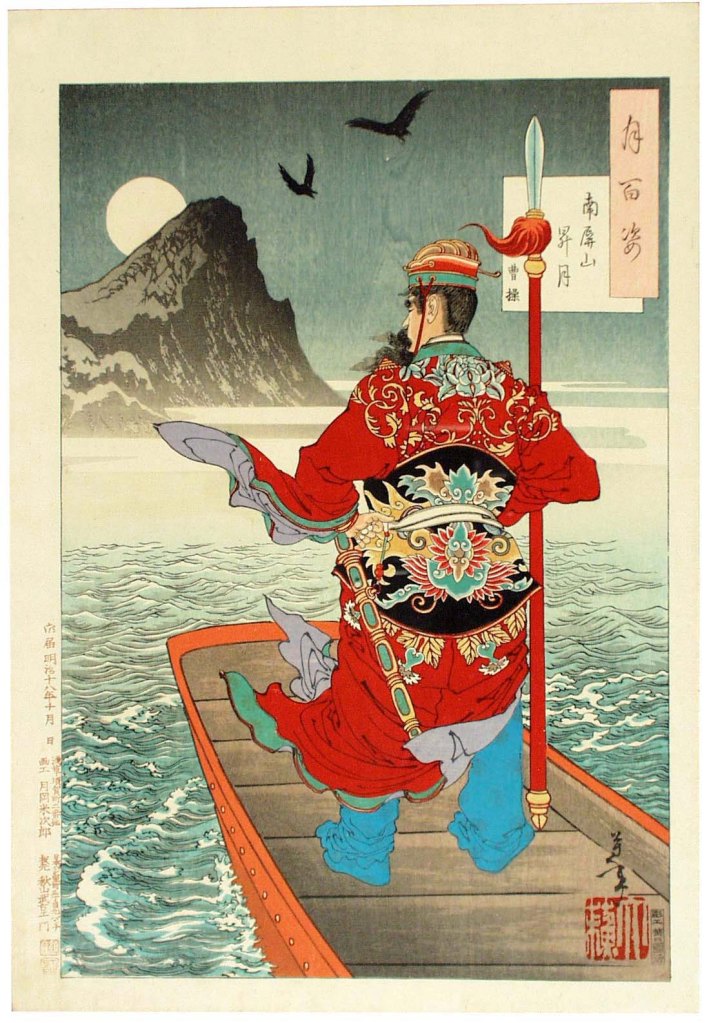
This picture, number 3, is the famous Chinese warlord Cao Cao (曹操, pronounced tsao-tsao) crossing a river toward the famous Red Cliffs, the site of one of the battles that took place toward the end of the Han Dynasty. If you ever played any Romance of the Three Kingdoms games, or even read the English translation of the famous 16th epic novel (highly recommend), you probably know Cao Cao.

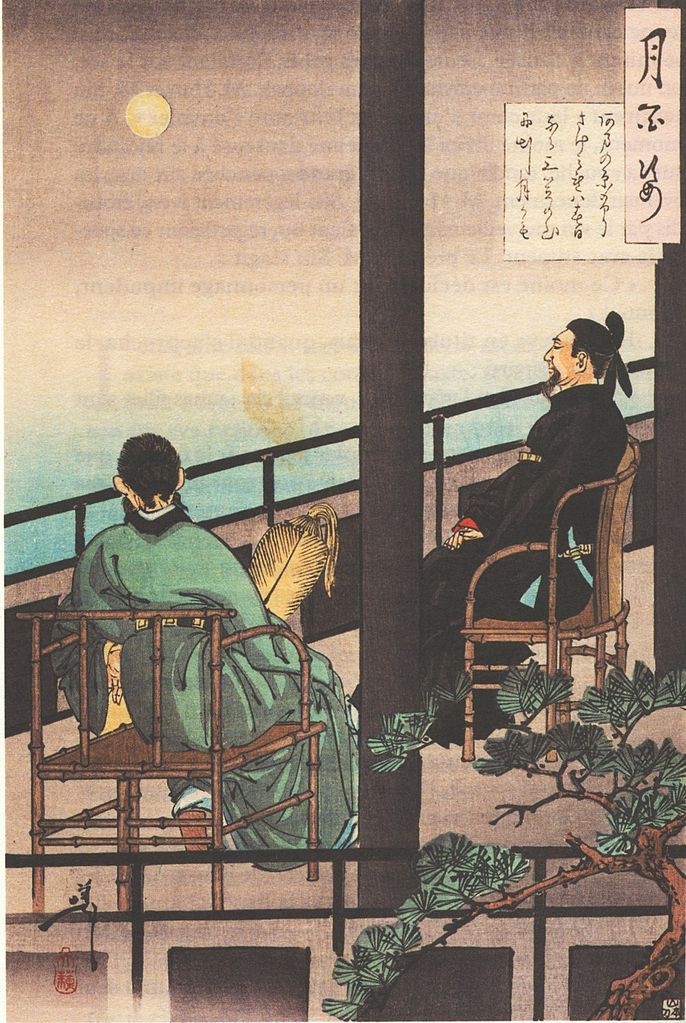
Moving toward Japanese figures, here is the court nobleman Fujiwara no Kinto, picture 47. Fujiwara no Kinto lived during the Heian Period (8th-12th century) and was part of preeminent aristocratic culture at the time. He was a very talented calligrapher and poetry critic. In his official capacity, he was responsible for compiling some of the poetry anthologies people enjoy today.

Speaking of courtiers and such, picture 64 features a man named Abé no Nakamaro, who was part of a delegation to China and stayed for 10 years. His viewing of the moon here while in China alludes to his poem in the Hyakunin Isshu anthology, poem 7, and longing for home.

Finally, let’s look another print from legend:

This scene is from the well-known Japanese tale of Kaguya-himé, the bamboo-cutter’s daughter. Here in the final scene, she is escorted back to her home on the moon, reluctantly leaving her adoptive parents behind. This story is dear to me, as I read it to both my kids (in English) when they were little, and as a dad I’ve always enjoyed it.

Anyhow, that’s a brief look at the One Hundred Aspects of the Moon. Yoshitoshi’s work is highly underrated in Western culture, and some of the challenge is being able to convey the backstory of each print, not just the prints themselves. I might post more about it in the near future.

P.S. Books about the One Hundred Aspects are few and far between but I bought a book titled One Hundred Aspects of the Moon: Japanese Woodblock Prints by Yoshitoshi recently and it was a great read.

New Books!

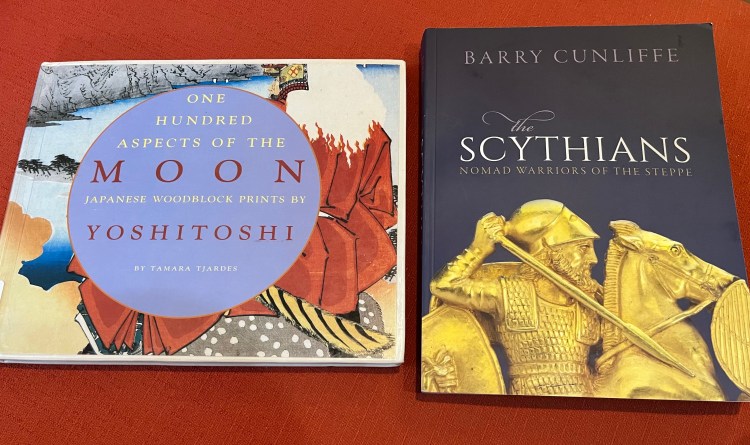
A couple books that I have been excited about have arrived in the mail:

The first book is a look at a famous collection of Japanese woodblock prints called the One Hundred Aspects of the Moon, which I will be covering in a new post in the near future. This collection of woodblock prints has popped up here on the blog a bit, and has become a major obsession of mine lately.

The second is about a famous, yet underrated, nomadic group of people called the Scythians, who seem to be everywhere in some way tied to various historical events in Asia and in Europe. The eastern Scythians, the Saka, were involved in spread of Buddhism along the Silk Road, and the western Scythians, the Srubnaya, are part of the rich ancestry of the Ukrainian people.

Thanks, as always, for reading and stay tuned for more content! 🥰

The Seven Luck Gods in Art

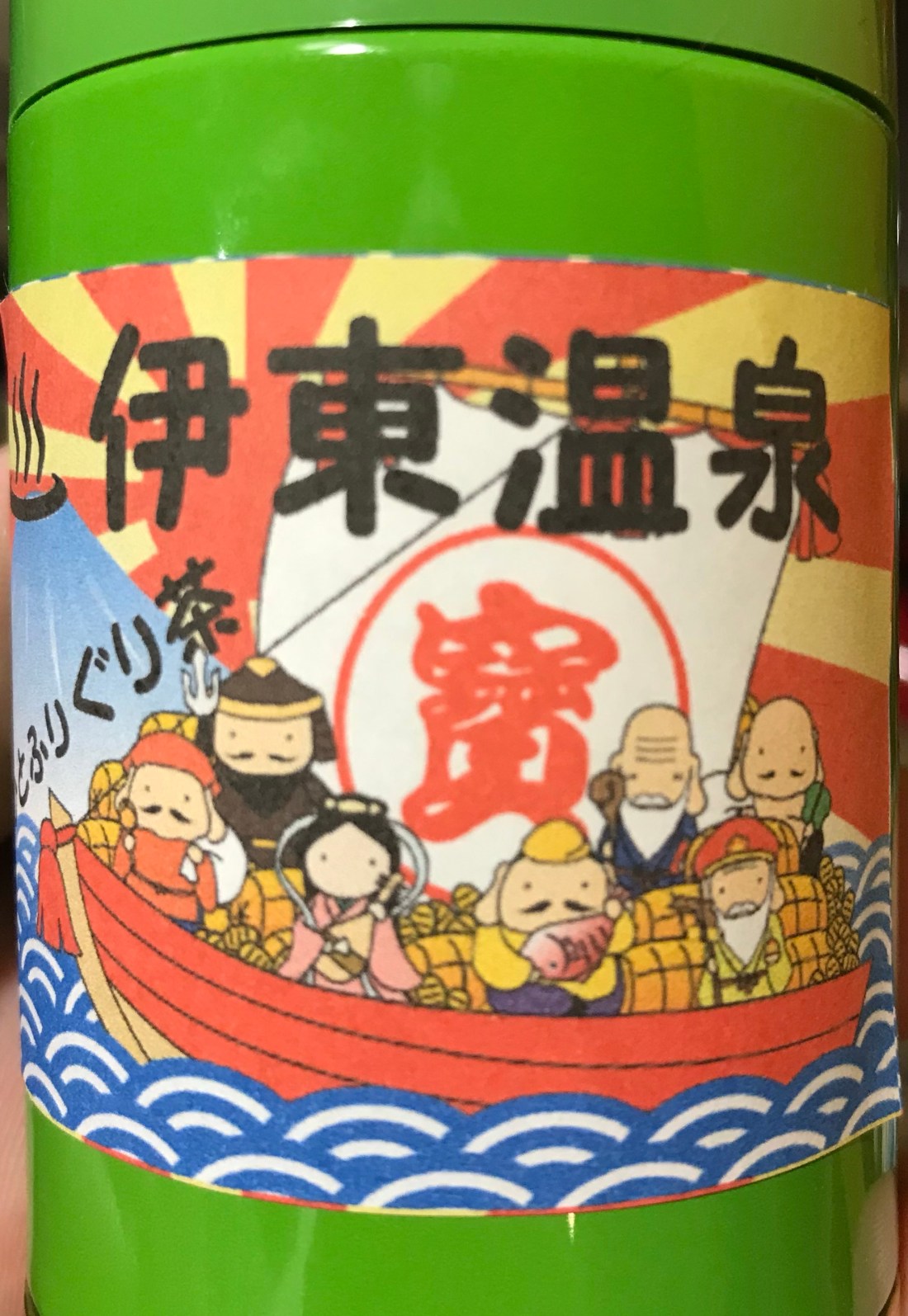
The seven luck gods as depicted on a Japanese tea tin.

Hello Dear Readers, I recently wrote about the Seven Luck Gods in Japanese culture, and shortly after that, I stumbled upon this awesome fan art here (direct link to Instagram here):

If you prefer Twitter, here’s their post here:

It’s amazing when people take something traditional and give it new life with such amazing artwork. Enjoy!

Buddhism and the Parthian Empire

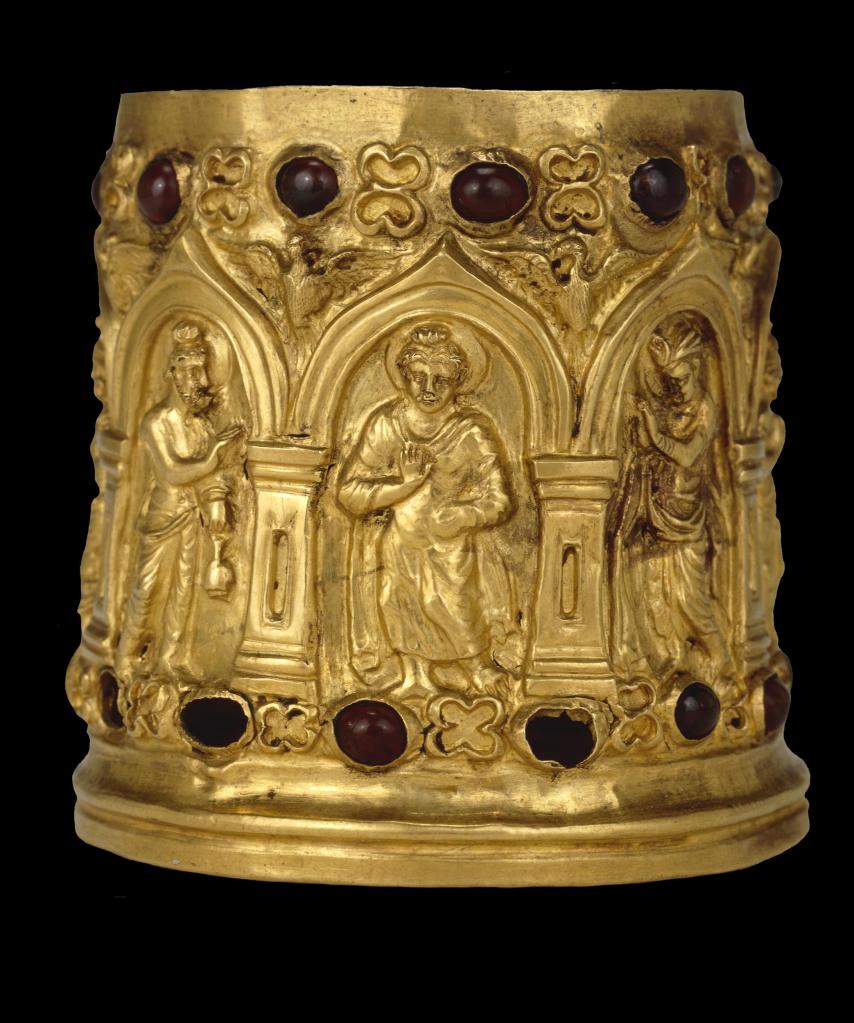
Courtesy of the British Museum (direct link here) under a Creative Commons Attribution-NonCommercial-ShareAlike 4.0 International (CC BY-NC-SA 4.0).

Speaking of the Parthians, let’s talk about Buddhism. As mentioned in the previous post, the Parthians primary religion was Zoroastrianism, a fascinating subject by itself. However, they were quite tolerant of other religions and faiths, including the Greek colonists, Babylonians and their venerable pantheon, but also faiths that arose in the eastern parts of the Empire.

Buddhism at this time had firmly begun to move outside of the Indian subcontinent: to the northwest in modern Pakistan and Afghanistan, and to the south in Sri Lanka and Southeast Asia. The former gave rise to the Mahayana tradition, the latter the Theravada tradition.

The Greek colonists leftover from Alexander the Great’s conquests had many positive interactions with India under Ashoka the Great, and in a previous post we saw how Ashoka sent Buddhist inscriptions to places like Kandahar and so on. But Buddhism spread even further into the Parthian Empire, if only a little.

The city of Merv, in modern Iran, was probably the Western-most outpost of Buddhism until the modern era. Here, monasteries existed, and people studied the Buddhist doctrine. Later, Mani the founder of Manichaeism also borrowed elements of Buddhism (among other sources) for this teachings.

This influence of Buddhism (however minor) on the Parthian Empire was because the Parthians had a close connection with, and positive relation with their neighbors the Kushan Empire. The Kushans were a major patron of Mahayana Buddhism at this time as it spread on the Silk Road, and had inherited the earlier Bactrian-Greek artistic styles (such as those shown above), and Gandhari-language Buddhist literature. It’s fair to say that Buddhism as we know it today wouldn’t have been the same without the Kushans.

The artwork above shows the Buddha flanked by the Indian gods Indra and Brahman, both mentioned frequently in old Buddhist literature. The style definitely shows some Greek influence as well.

Anyhow, it’s fascinating how this one work of art can show such a confluence of cultures and influences. As for the Parthians, the eastern frontier hasn’t been explored archaeologically as much as the western half, but I wouldn’t be surprised if we see more of this in the coming years. 🙂

One Of These Buddhas Is Not Like The Other…

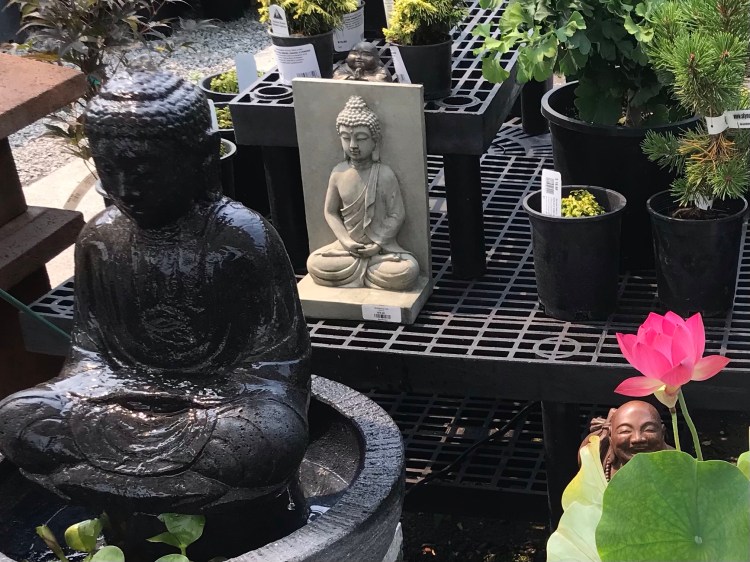
At a local gardening store, I saw a collection of Buddhist states like so:

Of these four statues, only two of them are actually statues of the Buddha, but people (including many Buddhists) frequently confuse which ones are the Buddha and which ones aren’t.

The Buddha,1 that is the historical figure and founder of Buddhism religion, was, if nothing else, an ascetic, meaning that he lived a strict, spartan lifestyle devoted to meditation, training his mind, and personal conduct to avoid harming others in speech, thought and deed. This is why he is often depicted like so:

The Buddha is depicted as:

  • lean
  • seated in meditation
  • possessing a “third eye” on his forehead signifying wisdom
  • having curly hair (explained in detail here)
  • having a lump on his head (signifying enlightenment)
  • wearing simple hand-me-down robes.

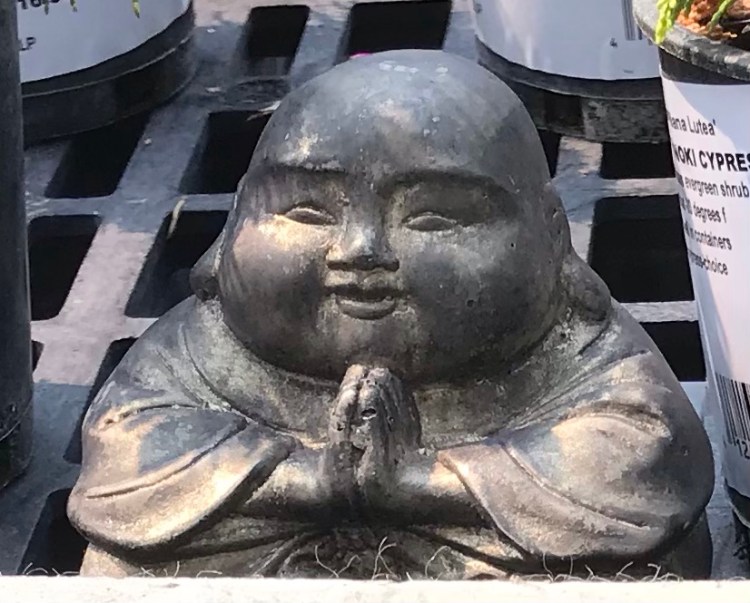
By contrast there is the “fat Buddha”:

Despite the name, the “fat Buddha” or “chubby Buddha” isn’t actually a Buddha. It’s a local folk legend from Chinese culture named Budai (Hotai in Japanese), where he like a Santa Claus type figure. From a purely artistic standpoint, notice that he does not have the same features as the other Buddha statue: no curly hair, no lump on his head, no third eye, etc. Buddhist art tends to be heavy in symbolism, similar to Orthodox Christian artwork, so the differences can mean a lot.

Further, the fact that he is called the “laughing buddha” in Chinese as well has probably lent further confusion in translation. Further this use of “buddha” as a loaded-term for any saintly figure isn’t limited to just Chinese language. In Japan, anyone who has passed away is also referred to as a buddha (hotoké 仏), presumably due to the assumption that they will be reborn in the Buddha’s Pure Land (and therefore will inevitably become a fully-enlightened buddha at some point). So even in Buddhist cultures, the term “buddha” gets applied to many popular culture usages that aren’t strictly “Buddhist”.2

All of this is hard to explain in translation, especially to a culture that isn’t historically Buddhist. Also, any Buddhist art that inspires people or brings peace of mind is still something positive, but for clarity the fat buddha is not actually a buddha.

1 Another thing lost in translation. “Buddha” is a title, not a name, like the Pope, the President, etc.

2 The term “Zen” is another overloaded term that gets misused all the time in English-speaking cultures.

The Gold and Silver Pavilions of Kyoto

One of the achievements of the short-lived Ashikaga Shogunate of Japan (14th to 16th century) were a pair of villas, later converted to Rinzai Zen Buddhist temple, called Kinkaku-ji (金閣寺) and Ginkaku-ji (銀閣寺). These are known as the Gold and Silver Pavilions in English respectively.

Despite the similar names and origins, both pavilions are interesting because they are surprisingly different from one another. Both were created by shoguns for their personal use, but they definitely reflect different tastes. The Gold Pavilion was built by the first shogun of the Ashikaga Shogunate, Ashikaga Yoshimitsu, in 1397, while the Silver Pavilion was completed in 1490 by the eighth shogun, Ashikaga Yoshimasa.

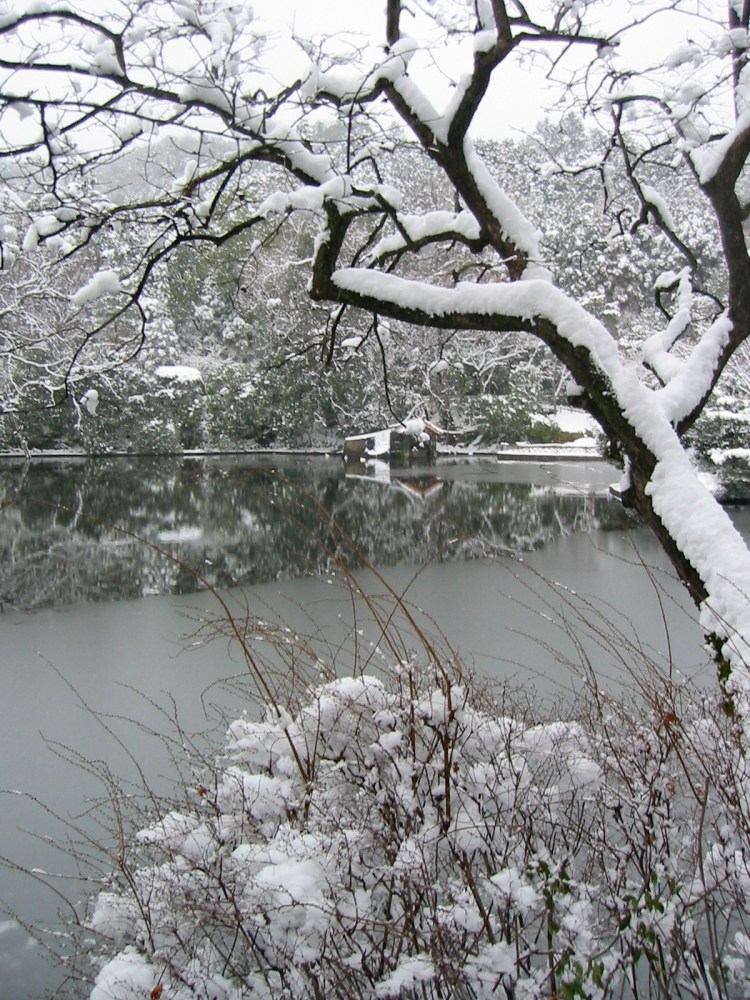
I visited the Gold Pavilion way back in 2005, the same trip where I saw the temples of Kiyomizu-dera and Ryoan-ji (this was a kind of honeymoon for us since we got married the previous year). The day we came to Kyoto there was a rare snow flurry, making the Gold Pavilion was extra beautiful that day:

The path around the Golden Pavilion allows you to peruse the grounds and see the pavilion from all sides:

Something I failed to notice at the time, but noticed while digging up these photos, is this altar site with calligraphy that says namu amida butsu (南無阿弥陀仏) which is better known in Japanese Buddhism as the nembutsu. According to the homepage, this hut was known as the sekkatei (夕佳亭) and was built centuries later for the benefit of Emperor Go-Mizu-No-O as a scenic tea room. Due to it’s scenic view at sunset, perhaps it was associated with Amida Buddha, who is said to preside over the Pure Land to the West, hence the calligraphy. But that is just my conjecture.

Now, turning to the Silver Pavilion, we visited there in April 2010, five years after seeing the Golden Pavilion:

The style of the Silver Pavilion is noticeably different than the Golden Pavilion, more closely associated with what we would think of as “Zen” style art and architecture.

In particular, the Silver Pavilion epitomizes the famous Higashiyama culture that flourished under Shogun Yoshimasa, and became the inspiration of Japanese culture even up to the modern era. Compare this with the more “Chinese style” adopted for the Golden Pavilion, reflecting Ashikaga Yoshimitsu who was a confirmed Sinophile.

Anyhow, someday I would like to visit both temples on the same trip, and preferably with a more experienced eye. 😆

P.S. Featured photo was taken by me in 2024.

Remembering Ryoanji Temple

Hello readers, this post is another in a mini series of posts I am making about past Buddhist temple visits I made in Japan. During my first visit to Japan in January 2005, where I saw Kiyomizu-dera Temple, my wife, in-laws and I also visited another famous temple named Ryoanji (official homepage) a famous temple of the Rinzai Zen sect. Fair warning, these photos are old, and I have forgotten most of the details from that visit. 😅

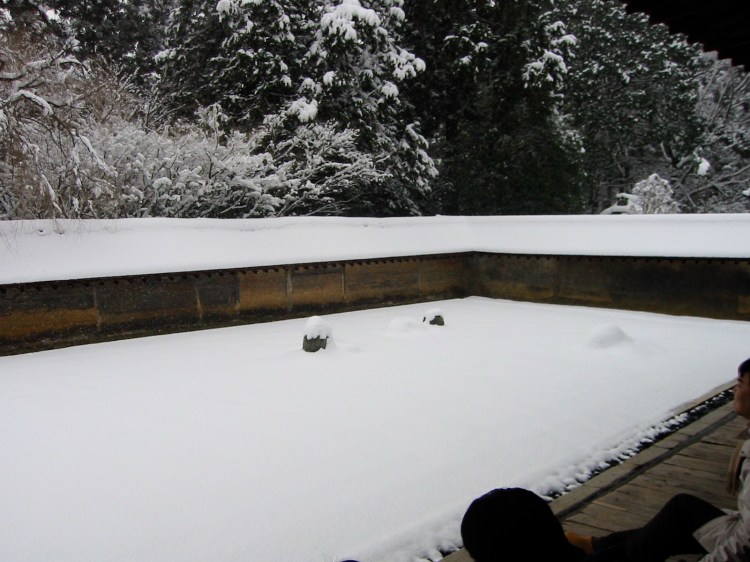
This is the famous “rock garden” of Ryoanji, which was buried under show that day.

…that didn’t stop a young, know-it-all me from pretending to be “zen” for a moment.

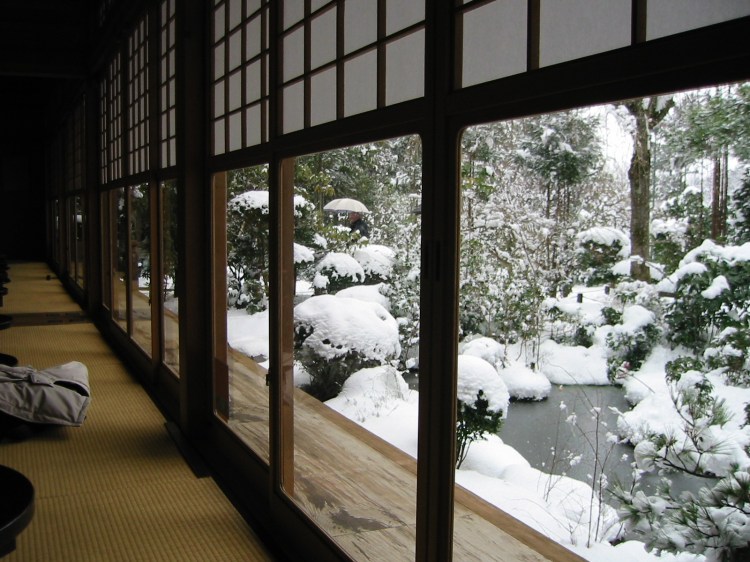
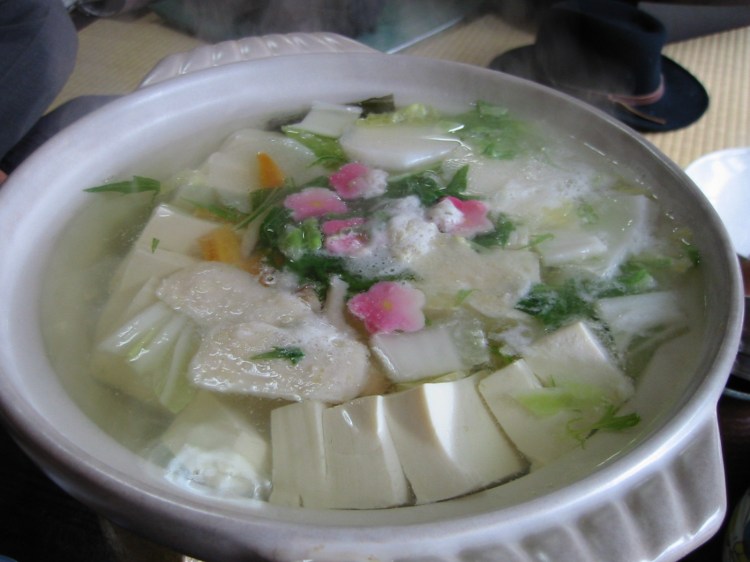
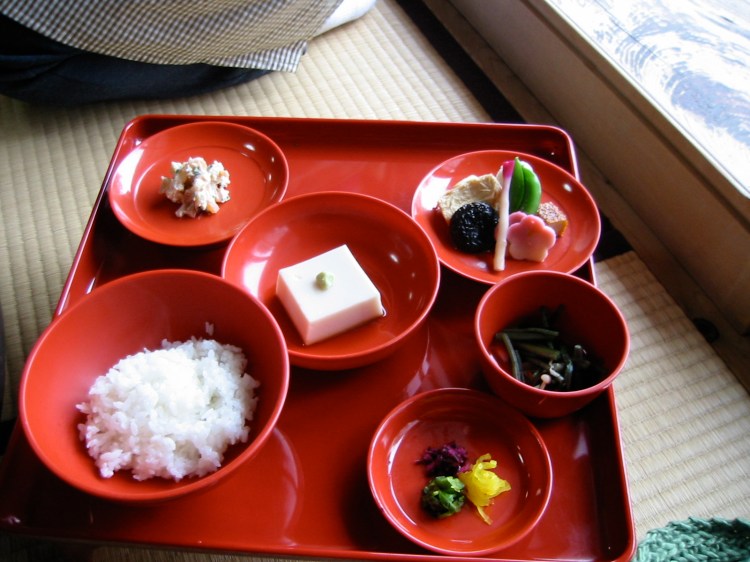
I, unfortunately, didn’t take any pictures of the interior of the temple (I may not have been allowed to, I don’t recall), but we were treated to a very nice meal featuring Buddhist monastic food or shōjin-ryōri (精進料理) which is very similar to vegan food, as well as a nice view:

Taken by me in 2005, at Ryoanji Temple. This is a vegetarian tofu stew, with turnips artfully sculpted to look like lotus flowers.

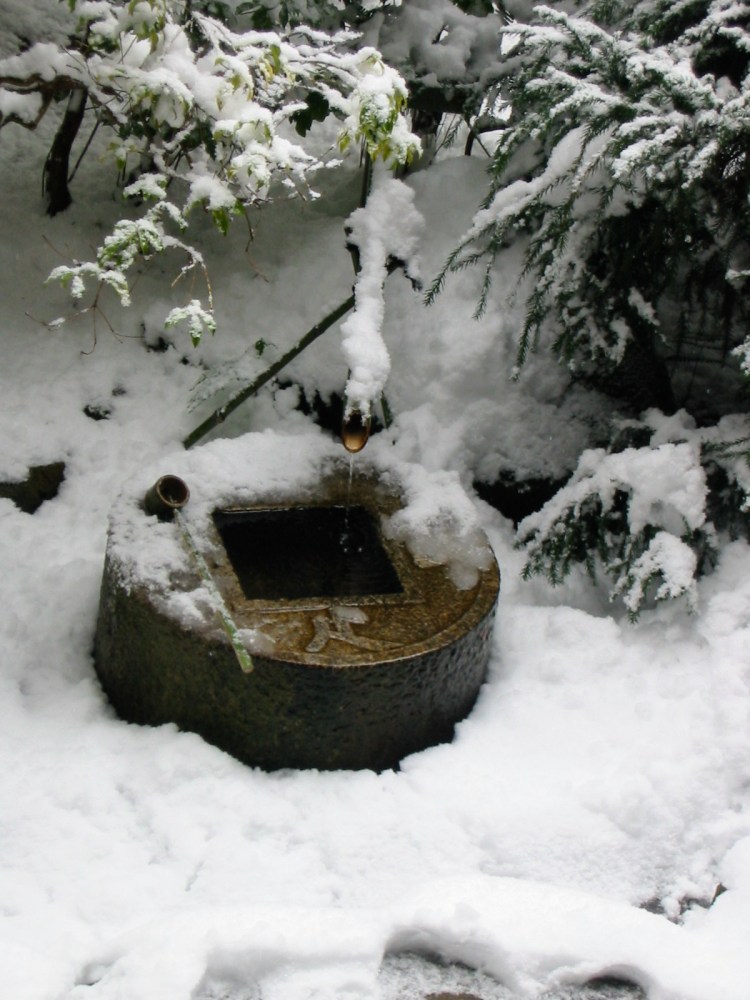
Ryoanji Temple is a place that has a lot of history and culture dating back to the Muromachi Period, even though it’s less active Zen monastery than before. For example, this water basin below, called the tsukubai (蹲踞) is a famous attraction:

It’s not clear from the picture, but there are 4 Chinese characters around it: 吾唯知足 which in Japanese is read as ware tada taru (wo) shiru. The meaning is that we are sufficient as we are (even as we are often unaware of this).

Lastly, the snow-covered scenery of Ryoanji had many other great views such as this one near the end:

I wish I could talk about this one more, and I would love to go back someday, but this is all I can share. Still, as an experience, it was a pretty neat one. 🙂

Nirvana Day: The Death of the Buddha

There are arguably 3 major holidays in Buddhism, particularly Mahayana Buddhism, all centered around the life of the historical Buddha, Shakyamuni (e.g. Siddhartha Gautama): his birth, awakening, and death.

February 15th in the solar calendar marks the death of the Buddha, though many traditions still rely on any number of lunar calendars to track this date (e.g. the 15th day of the 2nd month).  In English, we call this day Nirvana Day.  Ostensibly, it is a day of mourning since the appearance of a fully-awakened Buddha who can teach others is extremely rare.¹

However, like all Buddhist holidays, it is also a time of reflection.

The Buddha is said to have lived countless, countless past lives, just as all beings are said to have:

“This is the greater: the tears you have shed while transmigrating & wandering this long, long time — crying & weeping from being joined with what is displeasing, being separated from what is pleasing — not the water in the four great oceans.

“Long have you (repeatedly) experienced the death of a mother. The tears you have shed over the death of a mother while transmigrating & wandering this long, long time — crying & weeping from being joined with what is displeasing, being separated from what is pleasing — are greater than the water in the four great oceans.

quoted from the Assu Sutta, translation by Ven. Thanissaro Bhikkhu

But according to tradition, the Buddha awakened to the truth and resolved to become a fully enlightened Buddha some day, and bent his efforts, lifetime after lifetime toward that end, finally culminating in the life and ministry of Siddhartha Gautama, known more widely as Shakyamuni Buddha.²  This is encapsulated in the Jataka Tales (one of the oldest, extant Buddhist texts), but also became a template for other Buddhas such as described in the opening lines of Larger Sutra of Immeasurable Life.

Detail of Butsu nehan-zu (1812), in the possession of Kōryū-ji (高龍寺) in Hakodate,. Painting by Kakizaki Hakyō (1764-1826), Public domain, via Wikimedia Commons

So, the death of the Buddha also reminds us of the Buddha’s accomplishments, and also that the Buddha finally achieved his aim and became fully unbound (e.g. pari-nirvana, hence the name Nirvana Day).

That said, the holiday tends to be somewhat solemn by comparison, which is saying something given how solemn Buddhist holidays typically are.  😏  Per some funeral traditions, people who normally would not eat vegetarian diets might choose to abstain from meat on this day, while some use the opportunity to renew one’s commitment to the Dharma.

It’s also frequently cited in various ways in Asian-Buddhist culture.  Among the six days of the traditional Japanese calendar, butsumetsu (仏滅, “extinction of the Buddha”) is considered the unluckiest, and many traditional temples feature nehan-zu (涅槃図) or images of the Buddha’s death/unbinding.

Let me quote a line from a Japanese epic from the 12th century called the Tales of the Heike:

祇園精舎の鐘の聲、諸行無常の響き有り。 沙羅雙樹の花の色、盛者必衰の理を顯す。 驕れる者も久しからず、唯春の夜の夢の如し。 猛き者も遂には滅びぬ、偏に風の前の塵に同じ。

Gionshōja no kane no koe, Shogyōmujō no hibiki ari. Sarasōju no hana no iro, Jōshahissui no kotowari wo arawasu. Ogoreru mono mo hisashikarazu, tada haru no yo no yume no gotoshi. Takeki mono mo tsui ni wa horobin(u), hitoeni kaze no mae no chiri ni onaji.

The sound of the Gion Shōja bells echoes the impermanence of all things; the color of the sāla flowers reveals the truth that the prosperous must decline. The proud do not endure, they are like a dream on a spring night; the mighty fall at last, they are as dust before the wind.

Chapter 1, translation by Helen Craig McCullough, cited from Wikipedia

The sāla trees cited here are native to India, not Japan, but it was said that when the Buddha was dying from illness, he laid down down facing west between two sāla trees before he breathed his last just as the nehan-zu above depicts.

For Buddhists everywhere, may the passing of the Buddha be a time for reflection, peace and renewed effort. ☺️

¹ the next Buddha to appear, Maitreya, is traditionally not said to come for another few million years if that gives you any clue.  Also, anyone claiming to be Maitreya now, or using that term, is obviously a phony.  Caveat Emptor.

² there is an interesting trend where non-Buddhists call the historical Buddha by his birth name, Siddhartha Gautama, while Buddhists use the title Shakyamuni Buddha (e.g. “the Awakened One from the Sakya tribe”).  Also, small nit-pick, but “Buddha” is not his name, it is a title like “the Pope” or “the President” or “the O.G.”, etc.

The Joys of D&D Figurine Painting

img_3993

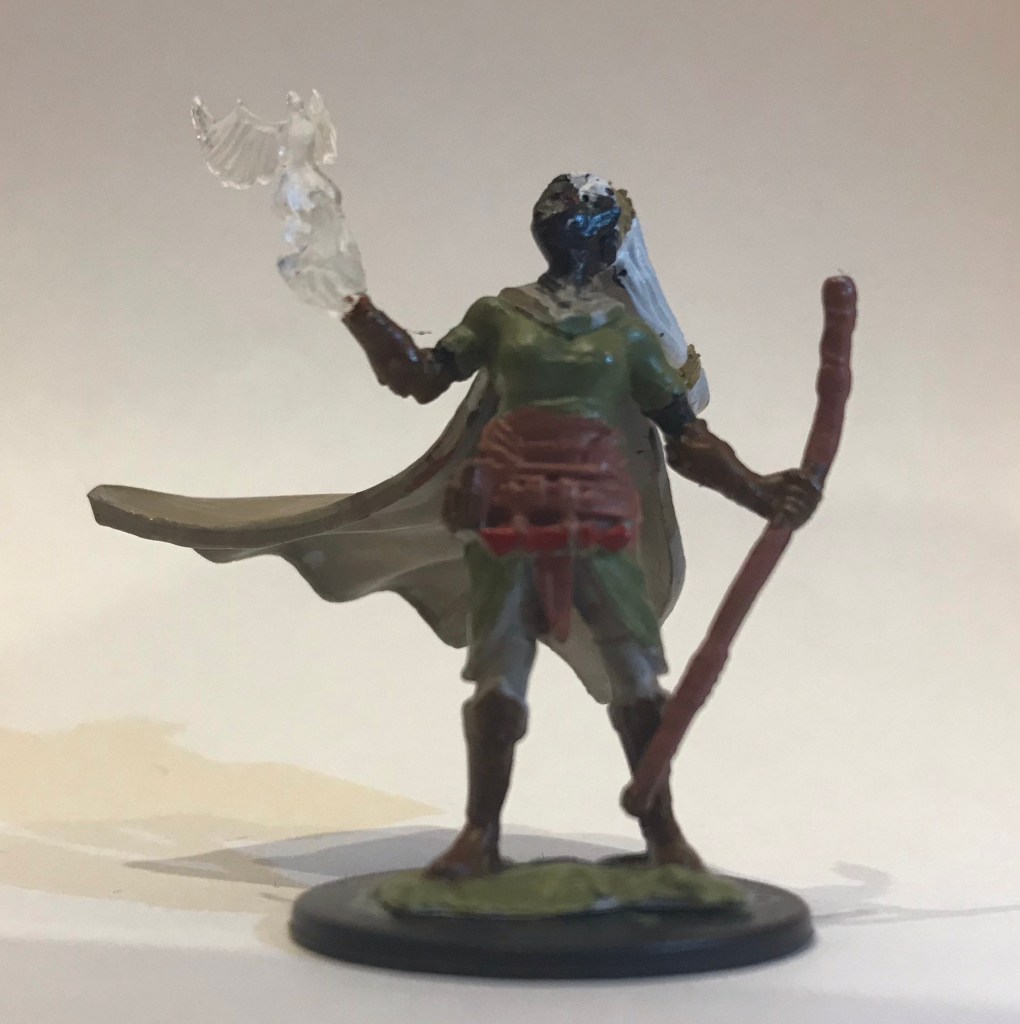
I have been playing Dungeons and Dragons Adventurers League at my local game shop fairly regularly since last July, and as a result, I have started to accumulate a number of figurines.  These plastic figurines come in all shapes and sizes, but I’ve been hesitant to paint them because I was not confident in my art skills (translation: I suck at art¹).

Until now.

I couldn’t bear to look at those poor, grey figurines with their bland, grew tone anymore, so I finally bought a very minimal set of Citadel brand figurine paints and gave it a try.  My first few figures turned out OK, but not great.  However, by and by I’ve gotten somewhat better at painting and more importantly I really enjoy it.  The figurine above is one of my primary characters I play in Adventurers League.  Since she is a drow (dark elf), her skin is ebony-black and eyes red.  Painting two tiny red eyes took a lot of hand-eye coordination.  😅

I’ve also painted a few monsters too, such as these orcs:

img_3981

Thanks to tips from friends, and helpful articles like this one, I’ve learned how to mix and match paints to get the color and consistency I wanted too.  That allowed me to make various shades of green, such as in this figurine:

img_3974

and:

img_3986

But, by far the best tip I’ve learned so far is to take a dollop of paint and put it on a “palette” which in my case is just a paper plate covered in plastic wrap.  From there, add enough water that the paint has the consistency of milk.  This really helps keep the tiny features of the figurine visible, and not “pasty” looking.  You can also mix two different colors on the same palette (after diluting both with water) to make interesting combinations.  It took me a few tries, but I was able to get a decent “skin” color for faces.

One of my friends who has more experience painting also suggested that “less is more” since you can always add more layers of paint if you need to, rather than taking away.

One thing that I do need to work on is shading.  I have a wash to provide shading, but somehow it doesn’t come out right.  As with normal paints, I’ve been told that it works better when watered down and then allowed to seep naturally into crevices and such.  I kind of got it to work on this Minotaur, particularly the shading on his muscles:

img_3997

Anyhow, as my painting skills (and photography skills) improve, I’ll try to post more.

The point though of this post is that despite having no real art skills, it was something fun worthwhile to delve into, and I am glad I did it. It’s good to break out of one’s comfort-zone from time to time.

¹ And photography, too.