I found this nice excerpt from the 25th chapter of the Lotus Sutra, better known as the “Kannon Sutra” for some, and just wanted to share:
All darkness is dispelled by the light of his wisdom As spotless and as pure as the light of the sun. The light destroys the dangers of wind and fire, And illumines the whole world brightly.
His precepts out of his loving-kindess brace us up as thunderbolts. His wishes out of his compassion are as wonderful as large clouds. He pours the rain of the Dharma as sweet as nectar, And extinguishes the fire of illusions.
Chapter Twenty-five of the Lotus Sutra, the “Kannon Sutra”, by Rev. Senchu Murano. You can find an alternate translation by Dr Burton Watson.
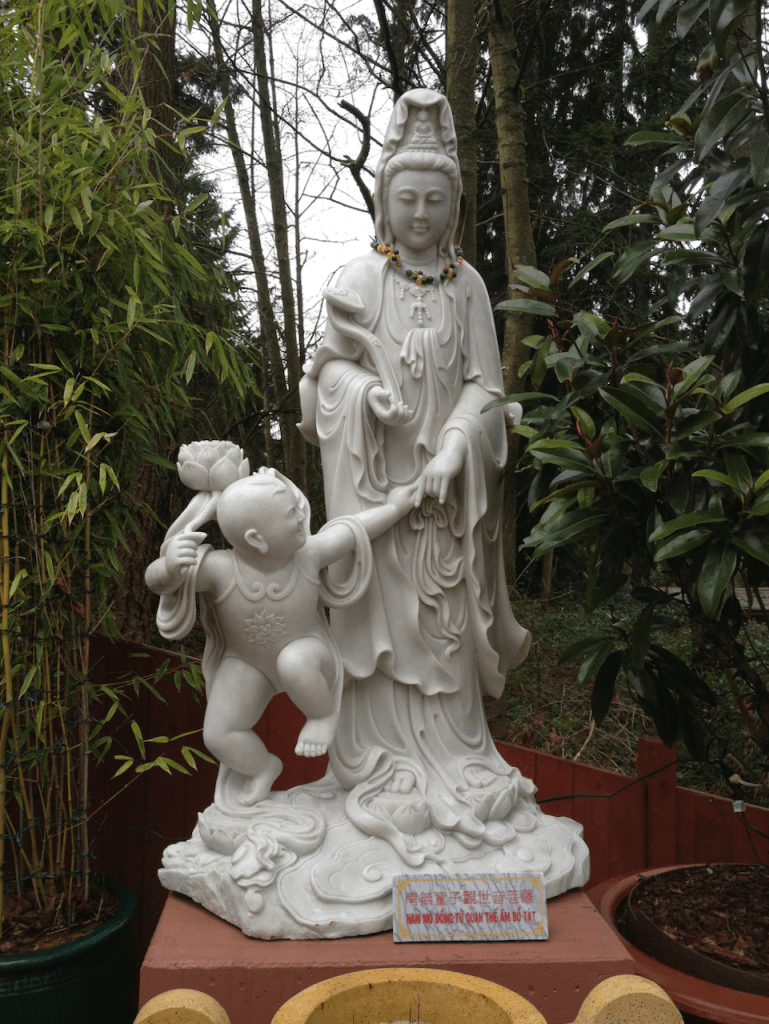
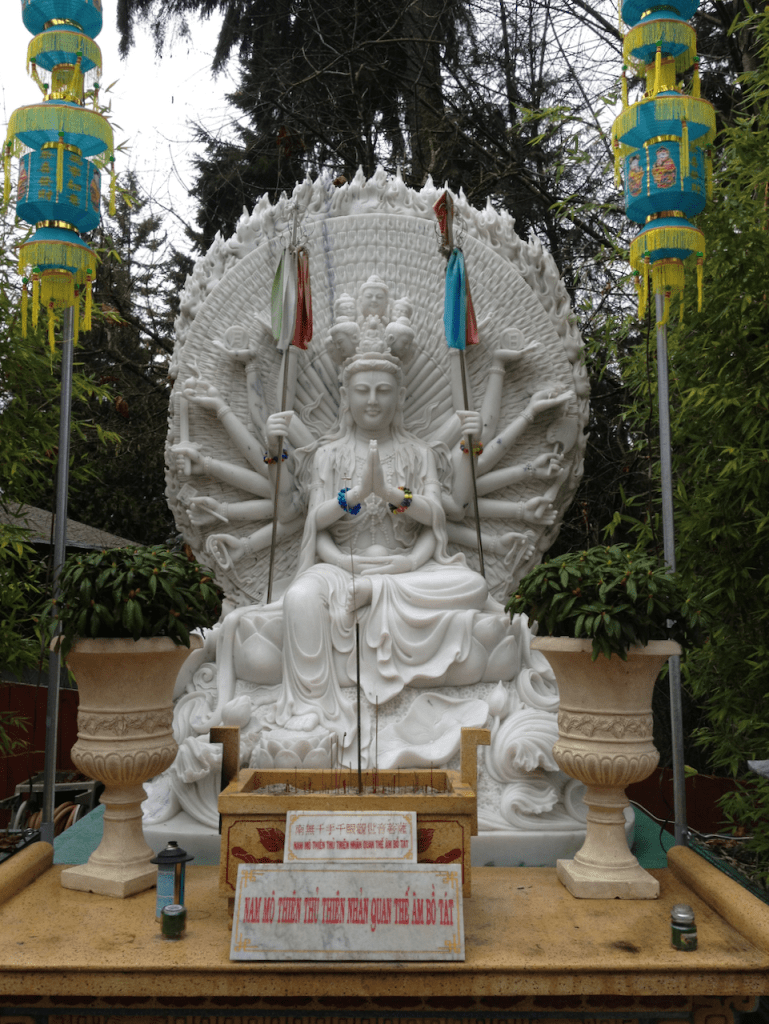
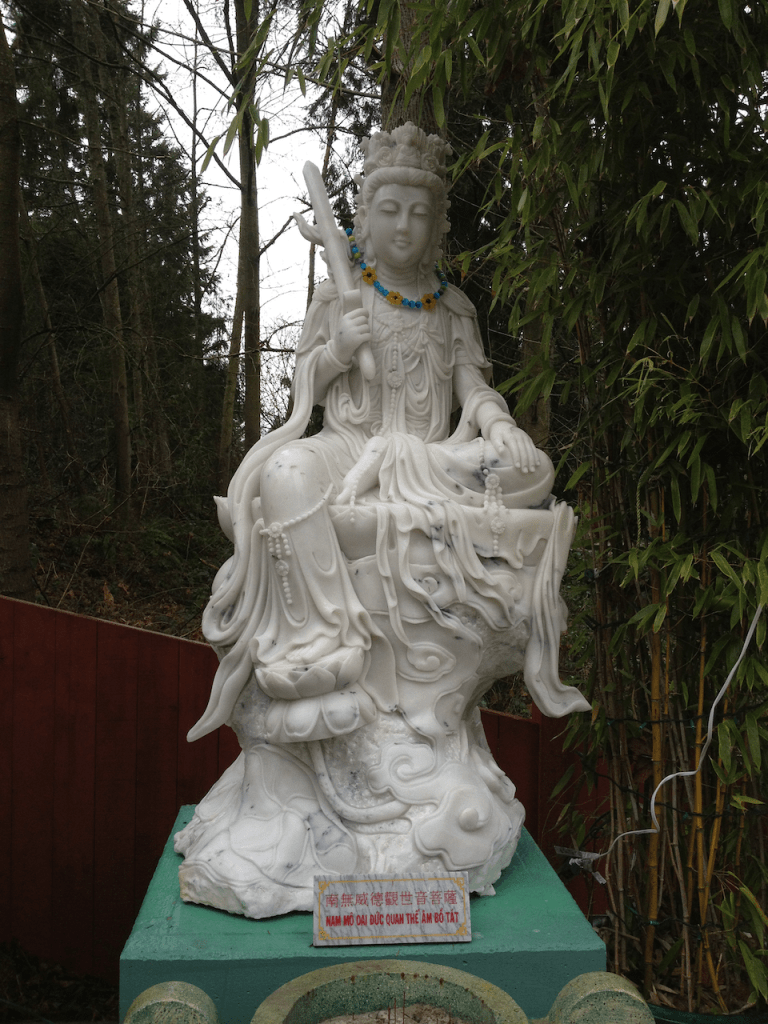
By the way, fun language-nerd fact: I noticed that my two books on the Lotus Sutra (Watson and Murano translations) both translate this passage using “he/him/his” pronoun, but both in the Lotus Sutra, and in popular culture, Avalokitesvara1 is frequently described as both male or female: a princely figure (male), a loving mother figure (female), etc. Here are just some examples from a Vietnamese-Buddhist temple in Lynnwood, WA:
In East-Asian Buddhism, the sutra is preserved in Classical Chinese, so I looked at the translated section above and it shows neither pronoun. Instead, the Chinese Character 観 is used which is the first character of Avalokitesvara’s name: 観世音.
This is hard to do in English: a pronoun is usually required, but in many languages, it’s not. In this case, the original text just abbreviated “Avalokitesvara” into a single character into the passage above.
Clever.
Namu Kanzeon Bosatsu
1 a.k.a. Guan-yin, Kannon, Gwan-seum, Chenrezig, etc. To confuse matters, how the Sanskrit name is spelled in English varies. The most phonetic spelling is Avalokiteshvara, but it’s often spelled the more Sanskrit-ey way Avalokiteśvara, expect that ś is hard to print sometimes. Thus, confusingly it becomes Avalokitesvara (no “sh” sound). Transliterating one language to another, especially languages so different like Sanskrit and Chinese is really tough…… but it’s also fun to see how different generations approached it.
The Hellenistic Age in history is the period after Alexander the Great died in 323 BCE, when his soldiers scrambled for power over the vast conquered empire, and ruling the known world for three centuries until they were toppled one by one by the Roman Republic.
These dynasties, descended from Alexander’s generals and philoi (trusted companions), were all Greco-Macedonian in culture and language, yet because each dynasty ruled over a different culture: Egyptian, Persian, Babylonian, and so on, they took on their own unique characteristics. These Hellenistic kings exemplified masculine warrior king ideology as they competed for legitimacy through warfare and conquest, with no overarching political ideology.
The Seleucid Empire, descended from former general Seleukos I Nikator (“the victor”). The Seleucid Dynasty had by far the largest chunk of Alexander’s conquests, but also the most difficult to maintain. The diversity of people of people from the Levant, including the Hebrews, the Babylonians, the Parthians, and peoples in northwest India required constant vigilance to rule by a tiny Greco-Macedonian minority.
To assist with their rule, the Seleucids wisely adopted Babylonian customs and religious ceremonies, while their patron god Apollo synthesized with eastern Persian (and Parthian) cultures who venerated archery. The Seleucid kings had to go on campaign constantly to maintain control over such a large empire, while maintaining religious functions in Babylon. The satraps (local kings ruling each province in Persian tradition) required constant discipline because they were prone to set themselves up as rivals. The early Seleucid rulers also established or augmented Greek colonies across the empire to help maintain rule.
The powerful Antiochus III Megas, (a.k.a. Antiochus the Great) made a famous Anabasis campaign that took him all the way to Kabul, Afghanistan to crush rebel satrap Euthydemus I, in Bactria, before swinging back around and crushing then re-subjugating Persia, and Coele Syria (the lands around modern Israel). Antiochus III Megas, the most successful of the Seleucid rulers, only keep it all together through sheer force of will and constant warfare, and many later rulers were simply not as capable or successful.
After Antiochus III, the empire began to unravel as his sons Seleucus IV Philopator and Antiochus IV Epiphanes, and their progeny gradually split the ruling family, as one side would usurp the throne, while the other would eventually reclaim it. All this happened, as enemies gradually increased on their borders, and the territory they ruled over got smaller and smaller.
Antiochus IV Epiphanes is particularly infamous in the biblical tradition, namely in the Old Testament, for his Abomination of Desolation (defiling the Temple of Jerusalem and replacing worship of G*d with pagan idols) and became the archetypal antichrist figure later. The Hellenistic Age podcast has a really nice series of episodes about this period:
Definitely check them out if interested. By the way, the Jewish holiday of Hanukkah dates from the time of Antiochus IV, and his (failed) efforts to crush the Maccabean revolt, though according to the Hellenistic Age Podcast, the tradition of the Menorah seems to date some time later. (Happy Hanukah to Jewish readers, btw!)
Ptolemaic Egypt
The Ptolemies, by contrast, ruled a somewhat smaller empire, but it was more culturally unified, and incredibly rich. By the time Alexander the Great came to Egypt, Egypt as a nation-state had already existed for 2500-3000 years. So, Egyptian culture was OLD even by the standards of the ancient Greeks.
To rule such a state, the Ptolemies adopted rulership as another Pharonic dynasty, technically the 33rd such dynasty if you are counting. Unlike the traditional dynasts of Egypt, who ruled from either Memphis (Old Kingdom) or Thebes (New Kingdom), the Ptolemies settled in the northwest city of Alexandria, and ruled over a small but powerful Greek aristocracy. Much like the Seleucids, this ethnically Greek minority had certain privileges and rights that the rest of the population did not, and frequently filled key positions of the powerful bureaucracy. Their phalanx armies were, until relatively late, ethnically Greek in composition, while the Egyptian mostly fielded armies of archers and sailors. The Ptolemies were filthy rich, because the bureaucratic system they inherited from Egyptian society was so effective at regulating taxation and exploiting the farm labor for maximum profit.
Alexandria itself grew to a powerful center of learning and culture in the Mediterranean (rivaled only by Antioch in the Seleucid Empire) under Ptolemy II Philadelphus, and Greek religion synthesized with Egyptian leading to gods such as Sarapis with Greek deities, leading to an explosion of popularity in Egyptian deities (particularly Isis) outside of Egypt. These “refurbished” Egyptian deities didn’t always resemble their original Egyptian form, but represented a fascinating synthesis of Greek thought and Egyptian religion.
Edit: Extra History happened to put out a nice video about the Ptolemies in Egypt here:
Confusingly, every single king from Ptolemy I Soter to Ptolemy XIV Philopator was named Ptolemy. Every one of them. Further, brother-sister marriages were practiced with each generation per Egyptian custom, so after so many generations, you can guess what happened. The truth is, Hellenistic kings frequently married their sisters, not just the Ptolemies, since the available pool of “eligible” women of sufficient pedigree (ethnically Macedonian-Greek, from one of the elite families) were pretty small. So, after a few generations, every Hellenistic monarch was marrying a relative in some form of another, much like the Hapsburgs many centuries later.
Corruption was a chronic problem in the Ptolemy court, especially after Ptolemy IV Philopator, who lived a reckless and decadent life, then died, leaving the kingdom a mess for sycophants and corrupt officials to run into the ground. Things unravelled and got so bad that at one point, there were two Ptolemy kings (VI and VIII) who were rivals, one of them married to his sister Cleopatra III at some point, each fighting over Egypt as the Seleucid rule Antiochus IV above nearly overran Egypt until the Romans stepped into tell him to go home.
Out of all Hellenistic kingdoms, Egypt under the Ptolemies lasted the longest, but by the time that Cleopatra (yes that famous Cleopatra, the VII) died with her lover Marcus Antonius (Marc Antony) after the Battle of Actium, Egypt was a flailing, second-rate power that had greatly diminished through the centuries.
Problems with the Hellenistic Kingdoms
Although each kingdom, including the Ptolemies and Seleucids, was diverse in how Greek culture interacted with local cultures, there were some functional problems that affected each one until the Romans eventually crushed them one by one.
First, as you might have guessed, they fought each other a lot. The Hellenistic dynasts were constantly warring with one another. This required tremendeous funds to raise armies, but Hellenistic warfare relied upon Greco-Macedonian phalanxes, which were difficult to raise and train. So, with their vast wealth, they would often just buy their way out of the problem and hire huge mercenary armies. However, once you lost your army in battle, it was hard to raise another one quickly. By contrast, the Romans raised large citizen armies quickly and cheaply, so when an army was lost, they’d just raise more of them and replace their numbers. When Antiochus III lost to the Romans at the Battle of Magnesia, the empire never quite recovered.
Second, each royal family was constantly fighting with itself. The Antigonids who ruled Macedon proper were the exception, in that they faithfully supported one another until near the end, but the Seleucids and especially the Ptolemies were constantly murdering other family members. The strong central power of the king, with little or no shared power, meant that absolute power was very attractive and “there could only be one”.
Third, because monarchs often died relatively young, eunuchs and powerful ministers often filled in as regents (again the Antigonids were a happy exception), and many of them did not rule justly or honestly, leading to further conflicts and revolts.
Finally, because they were ethnic minorities ruling over much larger territories, mismanagement led to revolts that required even more resources to suppress. Very few Ptolemies, for example, learned the Egyptian language fluently, preferring to use Greek. Some monarchs tried to “Hellenize” subject cultures through organizing Greek-style poleis cities, gymnasiums and other features. Further, subject people often found it handy to take on Greek-style names, and style in order to find work in the government. Many famous Jewish people at the time spoke and wrote in fluent Greek while still maintaining traditions handed down from their Hebrew forefathers.
Across the Hellenistic world, the once powerful kingdoms, descendents of Alexander the Great and his famed army, collectively faded in power through squabbles, unstable regimes, and failure to adapt to new threats, and some whims of Fate, until they either were crushed by other, newer powers (Rome in the West, Parthians in the East). That being the case, the cultural legacy of the Hellenistic kingdoms, and the (often bumpy) synthesis of cultures is super fascinating, and its echoes still lives on with us today in such things as Hanukkah, Buddhist statuary, famous philosophers, the Library of Alexandria, and many more.
P.S. featured photo is a reconstruction of the Pergamon Temple in Berlin, Germany, a famous Hellenistic Age monument. Photo by Lestat (Jan Mehlich), CC BY-SA 3.0, via Wikimedia Commons.
While reading my introduction book in Japanese about Rinzai Zen, I came across a famous set of paintings that I had totally forgotten about for thirty years.
Me at the age of 17 demonstrating the “Lion Roar Yoga” pose (?) at my world religions class in high school with my teacher. The Burger King crown was something I got from the nearby restaurant because my friends and I would race there during lunch break, eat for 5 minutes, and run back to class. Ah, teenage life….
Many, many moons ago, I was a cocky 17-year old first learning about Buddhism, and Mr Pierini was my World Religions teacher in high school. Mr Pierini was a charming, older Italian-American gentleman who had a lovely opera voice, and loved sharing cool ideas with us kids. This is how I first started to explore Buddhism beyond reading books at home.1
There were a number of things I learned about Zen then that seemed really cool and mystical. Looking back they made no sense to me, but they were fascinating. It sounded “cool” to be Zen, but admittedly, I was young, clueless, showing off, and knew nothing. Among the things I read about at the time were the Mumonkan and the Ten Oxen, texts that (I realize now) are both related to the Rinzai Zen tradition.
The Ten Oxen (shíniú 十牛 in Chinese) is a famous set of ten paintings, with poetic captions that were composed in the Southern Song Dynasty of China. The powerful Song Dynasty lost the northern half of China to the barbarian Jin Dynasty,2 and retreated to the south beyond the Yangtze River, where it held on for another 150 years. Despite having their back to a wall, the southern Song Dynasty oversaw a wonderful flowering of Chinese culture, including Buddhism, and especially Chinese “Chan” (Zen) Buddhism. This is also noteworthy, because historically this is the time when such monks as Eisai and Dogen both came to China from Japan to study Zen.3
The use of oxen as a symbol for taming the mind in Buddhism, according to Wikipedia, dates way back to early India including such texts in the Pali Canon as the Maha-gopalaka Sutta, but the Ten Oxen were a way to visually explain the Buddhist path (as described in the Chan/Zen tradition) to readers as a nice easy introduction. There were, evidentially several versions in circulation, but in Japan the version by one Kakuan (Chinese: Kuòān Shīyuǎn, 廓庵師遠) from the 12th century was all the rage during the Five Mountains Period of Japanese-Buddhist history. It is since known as the jūgyūzu (十牛図).
My book has a nice, down to earth explanation of the ten oxen and what they mean, so rather than posting the images with poetry, I wanted to share the simple explanations here. The illustrations are from Wikimedia Commons, and were originally painted by one Tenshō Shūbun (天章周文; died c. 1444–50).
Searching for the ox
The cowherd is searching for his lost ox. The book explains that this is like someone looking for their lost Buddha-nature: that potential within us to awaken to full Buddha-hood (a.k.a. “Enlightenment”).
Footprints sighted
The cowherd now finds the footprints of his missing ox. This is like the Buddhist disciple who studies the Dharma (e.g. “Buddhism”), and gets the first hints at the true nature of things.
Ox sighted
Just as the cowherd sees his lost ox at last, the disciple of the Buddha grasps the point of the Dharma is (i.e. what’s it all about).
Grasping the Ox
One moment the cowherd has grasped the ox, another moment he is about to lose it. In the same way, my book explains that a person may perceived their true nature one moment, but lose sight of it again. The Buddhist disciple is still inexperienced and lacks certainty.
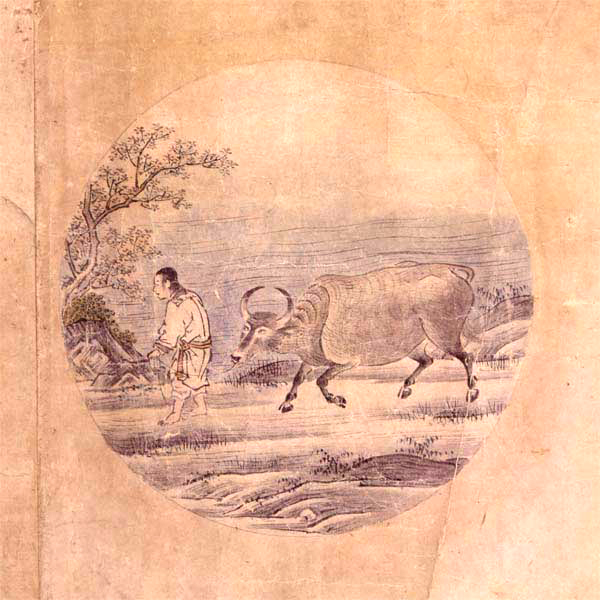
Taming the Ox
The wayward ox is now under control and lassoed, so the cowherd escorts it back home. For the Buddhist disciple, my book explains that through self-discipline such as the precepts, one’s delusions and conduct are brought to heel. This doesn’t mean they have resolved things, and one can still backslide, but at least they are under control now.
Riding the Ox
The cowherd is now confidently riding atop the ox, playing a flute. This means that one’s Buddha-nature is expressed through one’s form and behavior.
Forgetting the ox
Now that the cowherd is safely home with the ox, the ox is no longer a concern. My book explains that this symbolizes Enlightenment as one attains peace of mind.
Forgetting the distinction between self and ox
Here this empty circle expresses the Zen ideal that all is empty, and that there’s no distinction between oneself and the ox, or anything else for that matter; this is the Heart Sutra in a nutshell.
Back to basics
Having awakening to the nature of all things, things “return to the source” in a sense, or put another way, one sees mountains and mountains, trees as trees, etc. No more, no less.
Returning to society
My book explains that the cowherd now appears like Hotei (Chinese: Budai), the famous, jolly-looking figure in Chinese Buddhism and is in turn sharing the Dharma with another young cowherd. This cowherd will undergo the same quest, starting at picture one above.
In other words, everything comes full-circle.
In the same way, I don’t think teenage me imagined myself blogging about this 30 years later, and a bit more experienced, but life is funny that way.
Namu Shakamuni Butsu
1 Mr Pierini, thank you. 🙏🏼
2 Both would ultimately be destroyed by the Mongols especially under Kublai Khan who formed the Yuan Dynasty. This period of time is important to Japanese Zen history too because the influx of Chinese monks, especially Rinzai monks, to Kamakura-period Japan helped fuel a rise in Zen there. In the same way, the Fall of Constantinople in 1453 helped fuel the Renaissance in the West as refugees from the Eastern Roman Empire brought lost knowledge and know-how to the West. If there was any proof that we’re all connected in some way, look no further.
3 Earlier generations of Buddhist monks like Kukai (founder of Shingon) and Saicho (founder of Tendai) came to China during the Tang Dynasty, when connections to India were still flourishing. Hence, in Kukai’s case, he could study esoteric doctrine and Sanskrit directly from Indian-Buddhist monks. Centuries later, when Dogen and Eisai came to China, Buddhism had declined in India, and had gradually taken root in China in a more Chinese way. Of course, the Dharma is the Dharma, regardless of which culture and time it is taught, but it’s noteworthy that the Buddhism Dogen and Eisai was different: esoteric and scholarly Indian Buddhism had fallen out of favor, and a growing Zen (Chan in Chinese) community had largely replaced them.
A few years ago, when the family and I visited Japan for my mother-in-law’s funeral, we had a long visit with the temple family who presided over the funeral. Their family and my wife’s have known each other for generations; their kids have grown up with my kids and so on. We are pretty close.
The father, who runs this small parochial Jodo Shinshu-sect temple,1 enjoys sharing Buddhist insights and discussions with me, and in spite of my language limitations, I always look forward to the conversation. He also makes excellent homemade umeboshi in his spare time.
Anyhow, he mentioned that many families in Japan have leftover Buddhist altar goods after grandparents pass away, and so he entrusted us with a statue of Amida Buddha shown below. It had been sitting in storage for a long time, and since such goods are far less common in the West, I think he wanted to help deal with surplus, but also help Buddhism overseas. Needless to say, we were grateful.
The challenge after we came home was that we didn’t know where to put it. It was too big for our altar, so we put it on top of a bookshelf, but the bookshelf was remote so we didn’t see it much. But then, my wife decided to put it near the front door mezzanine like so:
Once we did this I noticed a change in pattern. Because we pass by it constantly, I started reciting the nembutsu more. Since we go up and down the stairs all day, having the Amida Buddha statue there is a nice reminder, and it’s easy to find 30 seconds in the day to recite the nembutsu. Plus we sometimes light incense, and so on.
This is a long-winded post, but this experience made me realize that Buddhist practice doesn’t just depend on willpower and self-discipline, environment matters too. Simple changes in environment or routine can go a long way.
Namu Amida Butsu
1 it might surprise some readers to learn that many Buddhist priests in Japan marry and have kids. There’s a lot of complex, historical reasons that I can’t go into here. Plus, Jodo Shinshu has, since inception, been an exclusively lay-oriented sect anyway. I neither condone nor condemn it, it’s just how Buddhism is practiced there.
I alluded in recent posts about my visits to the temple of Sanjūsangendō (三十三間堂, San-ju-san-gen-do) in Kyoto, Japan, but I’ve never really talked about it.
My experiences with Sanjusangendo go all the way back to our first trip to Japan together in 2005. My wife (whose Japanese) and I had married the previous year,1 and we came to Japan to meet the extended family, but also take in many sites. That first trip through Kyoto was a whirlwind, and I have very fuzzy memories of most of it. I couldn’t remember much about Sanjusangendo, and since we couldn’t take photos, I had very little to remind me either.
And yet, something about Sanjusangendo drew us back in recent years. My late mother-in-law really liked Sanjusangendo, and my wife wanted visit again for her mother’s sake, and now with 20 years of experience in Buddhism, the temple made a lot more sense to me. The fact that it’s a Tendai temple (and I like Tendai Buddhism) was icing on the cake. My wife was really inspired by it too, so the following year we visited it again.
…. so, what is Sanjusangendo?
Sanjusangendo is a Buddhist temple, which venerates the bodhisattva Kannon, also known as Avalokiteshvara, Guan-yin, etc. It was founded in the 12th century by the infamous warlord Taira no Kiyomori as a way to impress Emperor Go-Shirakawa (tl;dr it didn’t work). What makes Sanjusangendo so famous is two things:
It’s very long, narrow main hall (本堂, hondō). This is different than most temples which have a more square-shaped main hall. The hondō of Sanjusangendo is a very long rectangle, but there’s a reason for this. The featured photo above is something I took in 2023, and shows the scale of the building. The website also has a nice photo.
The temple’s main attraction is the 1,000 statues of Kannon bodhisattva, centering around a much larger statue of Kannon. These statues are lined up in rows along the main hall, and in front of them are other statues featuring various gods and other divine beings protecting the temple. More on that below.
Since Sanjusangendo doesn’t allow photography inside the main hall,2 you should check out the official website instead. You can see the main hall, and the row upon row of Kannons here. The official website also has photos of each figure.
The main figure of devotion, as i said above, is the bodhisattva Kannon, but since Kannon has many forms, this form is the 1,000-armed Kannon called Senju Kannon (千手観音). This form of Kannon isn’t limited to Japanese Buddhism; I have seen this form expressed at Vietnamese Buddhist temples as well. The idea is that Kannon, according to the Lotus Sutra, uses many different means and methods to help people, and the 1,000 arms, each holding different objects, symbolizes the diverse ways that Kannon helps others.
Something you might also note is that the Kannon statue has 11 heads. Just as the 1,000 arms show Kannon’s efforts to help all beings in a variety of ways, the 11 heads show Kannon’s vigilance in watching out over people.
Not shown in the photos is a small display which teaches a particular mantra associated with the 1,000-armed Kannon:
You can recite this mantra in Japanese or Sanskrit. I am unclear what the translation is, but I’ve been told before that translating mantras is kind of pointless, like giving answers to a Zen koan. So, I left out the translation.
Anyhow, flanking the great big statue of Kannon on either side are 10 rows of smaller, standing statues of Kannon, each with 1,000 arms, which you can see here. The website says that of the one-thousand statues, they were built over time: 124 were from the late Heian period (12th century) and the rest were constructed during the Kamakura period (13th-15th century). There are a total of 1,000 statues, each one slightly different, but generally the same form.
Finally, in front of these statues is a series of mythical figures. Some are originally from India, and traveled the Silk Road, gradually transforming into what we see today. Others are more native Japanese deities who’ve also become Buddhist guardians. You can see the full catalog here.
To give an example of the eclectic nature of these figures, one figure is a Buddhist guardian deity named Vajrapani (Naraenkengō 那羅延堅固 in Japanese), whose imagery was influenced by the Greek hero Herakles at a time when places like Bactria and Gandhara were still part of the Greek world.
On the other hand, you can also see the famous figures of Raijin and Fūjin who are Thunder and Wind gods respectively. As far as I know, these are native deities and did not originate from the Silk Road.
The quality of the artwork is really excellent. When you see any of these figures, Kannon, Vajrapani, Raijin, etc, the life-like quality is really impressive. And, like many examples of Buddhist art, they are full of symbolism and visual meaning beyond words. They impress and inspire those who see them. Since I have now seen Sanjusangendo three times, I found that it continues to impress me every time I see it.
Speaking from experience, Sanjusangendo is a place that requires some context to really appreciate. If you are unfamiliar with Kannon and why they have one-thousand arms, or with the strange but beautiful figures guarding the front row, then some of it will feel like a mystery. It’s a beautiful mystery, but still a mystery. But, hopefully after reading this, you will get a chance to see it someday and really get a feel for why this place is special.
As someone who has an affinity for Kannon since I first became a Buddhist, it is a special place for me. 😊
Edit: fixed a number of typos. Three-day weekend drowsiness. 😅
P.S. Again, apologies for the lack of photos. I know sometimes foreigners will take photos anyway (I have seen people do this), despite the signs clearly saying “photography prohibited”, but I don’t want to be one of those tourists. So, if you want to see more, check out the excellent website.
1 Twenty-year anniversary as of early 2024. 🎉
2 A lot of temples in Japan do this. I don’t fully understand why, and it is frankly a little frustrating.
3 Katakana script is often used to write foreign-imported words in Japanese, as opposed to hiragana script. Since mantras are originally derived from Sanskrit, using katakana makes sense in this context. Sometimes katakana is also used for visual impact (like in manga), so that might explain things too. NHK has a nice website explaining how to read katakana.
In part one of the journey, Xuan-zang braved the Gobi desert and contended with the overbearing monarch of Turpan, but also beheld many wonderful sites at that venerable city before moving on to Yanqi. After leaving Yanqi, Xuan-zang moved onto the city of Kucha, also called Kuchar in Uyghur (كۇچار) or Kùchē (庫車) in Chinese.
The Buddhist Kingdom of Kucha
Out of all the cities of the northern Silk Road surrounding the Tarim Basin, Kucha was the largest and most prosperous. As a powerful Buddhist kingdom, Kucha dominated the Silk Road trade in the area since at least the 4th century. Xuan-zang’s description of the city was as follows:
The soil is suitable for rice and grain…it produces grapes, pomegranates and numerous species of plums, pears, peaches, and almonds…The ground is rich in minerals-gold, copper, iron, and lead and tin. The air is soft, and the manners of the people honest. The style of writing is Indian, with some differences. They excel other countries in their skill in playing on the lute and pipe. They clothe themselves with ornamental garments of silk and embroidery….
There are about one hundred convents in this country, with five thousand and more disciples. These belong to the Little Vehicle [Hinayana]1 of the school of the Sarvastivadas. Their doctrine and their rules of discipline are like those of India, and those who read them use the same originals….About 40 li to the north of this desert city there are two convents close together on the slope of a mountain…Outside the western gate of the chief city, on the right and left side of the road, there are erect figures of Buddha, about 90 feet high.
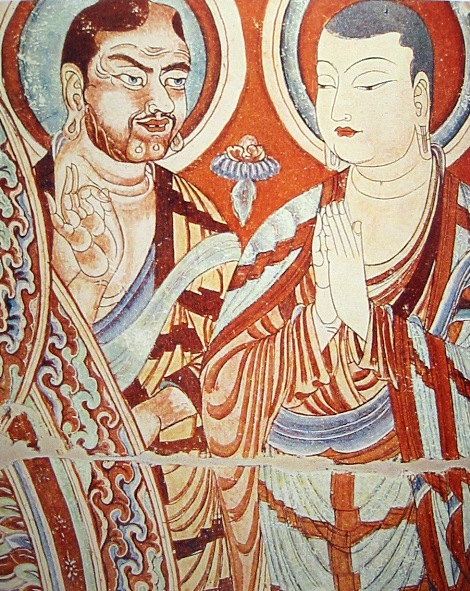
As with prior cities, Xuan-zang’s reputation had proceeded him, and he was greeted by the local ruler, which described as having “red hair and blue eyes”. The king of Kucha at the time was likely either ethnically Sogdian or Tokharian. We saw similar figures depicted in Buddhist art when we looked at the Bezeklik Caves in episode one. The Silk Road north of the Tarim Basin was a fascinating mix of different peoples and ethnicities and it could change from city to city. The Tokharians were distant relatives of other Indo-European people, and their language had some common elements to European languages such as English. Yet, the link between the Tokharians and Westerners is frankly pretty tenuous, but that did not stop researchers in the 19th century who had certain … racial theories, from hyping up their contribution to the Silk Road. It’s important to be cautious and not to draw too many conclusions. Hidden agendas make for bad research.
What’s more interesting to me is how the Tokharians lived alongside totally disparate groups such as Chinese, Turks, Uyghurs, Sogdians and so on, and at times they had friednly co-existence (the Tokharians evidentially revered the Sogdians in particular and tried to emulate them), and at other times they clashed. In other words, pretty typical human stuff. This intermix of cultures and people is what makes the Silk Road so fascinating.
But I digress…
Kucha had a lively material culture, thanks to runoff from the Tian Shan mountains providing plenty of water, and thus a wealth of food and agriculture grew here. It’s place on the Silk Road also ensured plenty of goods and materials were traded here too. Further, Kucha was famed for its music, and musicians from Kucha were highly sought after. A Kuchean orchestra was staffed at the court of Great Tang throughout the dynasty, and played for official ceremonies and celebrations. My book on Xuan-zang points out that famous songs they played included titles like “The Jade Woman Hands the Cup Around”, “Meeting on the Seventh Evening”, and “The Game of Hide the Buckle”.
Yet, for the Buddhist tradition as we now practice it today, Kucha was even more important for another reason: it was the hometown of Kumārajīva (344–413 CE) the translator.
Kumarajiva the Great Translator
Kumarajiva was the son of an Kashimiri-Indian father and a Kuchean mother, and was raised in Kucha. He studied Sarvastivadan-branch Buddhism, an influential pre-Mahayana Buddhist school whose monastic code was adopted by Mahayana Buddhist communities in China onward. However, at some point Kumarajiva converted to Mahayana Buddhism and by age 20 ordained as a Buddhist monk. His fame as a scholar reached China at the time, and he was sought out by the emperor. Our homeboy, Kumarajiva, was imprisoned at one point by a local warlord, but eventually was released by the Chinese emperor, and brought to the capitol of Chang-an (see prologue episode), and was feted.
Kumarajiva proved to be an excellent translator, and helped bring many Indian-Buddhists texts to mainsteam China. Because the Sanskrit originals were mostly lost in India, but preserved in Classical Chinese, these works, now core texts in many modern Buddhist traditions, help maintain the tradition today. To name a few that you probably already familiar with, Kumarajiva translated these sutras:3
The Shurangama Sutra, important in Chinese Buddhism, especially Zen
The Sutra of the Ten Stages (chapter 26 of the Flower Garland Sutra)2
…. among many others.
To reiterate this point: the English translations of these texts we use today come from the Classical Chinese editions that were originally translated from Sanskrit and prakrits by Kumarajiva.
Having said all that, let’s return, centuries later to Xuan-zang…
Staying at Kucha
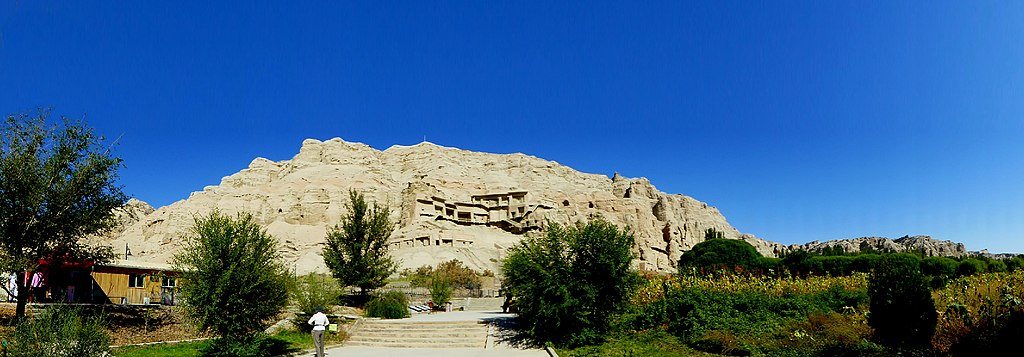
From Kucha, Xuan-zang would have to pass through Aksu before crossing over the Tian Shan mountains, but heavy snows in the passes mean that Xuan-zang had to stay in Kucha for two months. During this time Xuan-zang stayed out of trouble, and spent many days discussing Buddhist philosophy with the local community. This included the famous Kizil Caves:
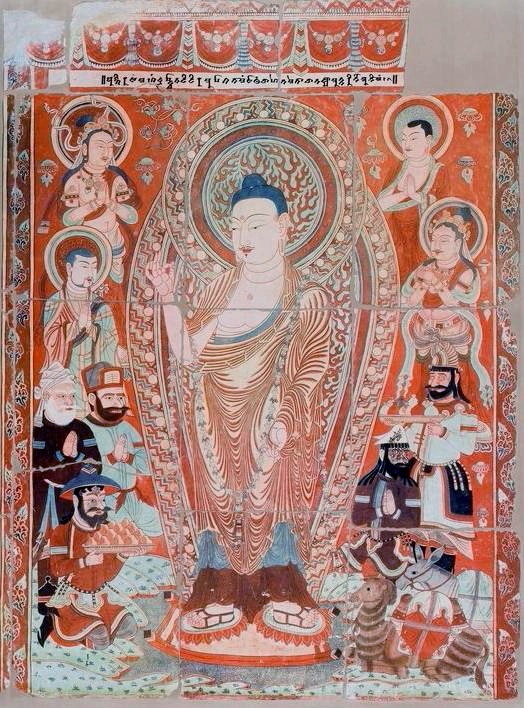
The Kizil Caves (in Uyghur قىزىل مىڭ ئۆي) or Kèzī’ěr Qiānfú Dòng (克孜尔千佛洞, lit “1000 Buddhist Caves of Kizil”) are a massive cave complex and probably one of the earliest along the northern Silk Road used for Buddhist monasticism. The artwork here often shows strong influence from Buddhist-India, or more precisely, the Greco-Bactrian art of Gandhara. However, like the Bezeklik Caves we saw earlier, a combination of local religious iconoclasm, looting by European researchers,4 and subsequent tourism have greatly disturbed the artwork in the Kizil Caves. Here’s an example reconstruction from the so-called Peacock Room:
A representation of the Peacock Room layout, and what remains. Photo in public domain, courtesy of Wikimedia Commons
In any case, check out the Wikipedia article I linked above on the Kizil Caves. There’s simply too much to add here, but needless to say, Xuan-zang must’ve beheld some amazing art in his time, which we will sadly never see again.
Side note: the red haired, blue-eye ruler of Kucha that I mentioned earlier ran afoul of the Chinese emperor, Taizong, a few years later by pretending fealty, while also declaring his loyalty to the Western Turkic Khaganate (more on that soon). Needless to say, China did not take this lying down and soon conquered Kucha just as it did with Turpan. Xuan-zang would be long gone by this point though.
The Tian Shan Mountains
Once it was safer to travel, Xuan-zang’s caravan moved onto the city of Aksu, which in his time was called Baluka (跋祿迦, Bolujia in Chinese). Xuan-zang’s caravan was again ambushed by bandits along the way, but once again the bandits were full from another attack and quickly lost interest in Xuan-zang’s group. I’d say Xuan-zang was lucky, or the bandits were just lazy. 🤷🏼♂️
Anyhow, Xuan-zang stated that Aksu was very similar to Kucha in many respects, though according to Wikipedia, Xuan-zang noticed that the people of Aksu seemed to speak a different kind of Tokharian language. The Wikipedia article on Tokharian mentions that there were several dialects, all of them pretty different from one another. In any case, it doesn’t seem that Xuan-zang stayed at Aksu too long though and set out for the mountain passes over the Tian Shan mountains to reach Tokmok. There things took a dangerous turn.
The Tian Shan mountains, with Khan Tengri in the middle. Photo by Chen Zhao, CC BY 2.0, via Wikimedia Commons
The Tian Shan mountains are huge, cold and dangerous to traverse. The Khan Tengri mountain is more than 23,000 feet high, and the Bedel Pass near it is one of the few ways to cross over to the other side. Of the mountain, Xuan-zang wrote:
This mountain is steep and dangerous, and reaches to the clouds (lit. “heaven”). From creation the perpetual snow which has collected here in piles, as been changed into glaciers which melt neither in the winter nor summer; the hard-frozen and cold sheets of water rise mingling with the cloudes; looking at them the eye is blinded with the glare, so that it cannot long gaze at them. The icy peaks fall down sometimes and lie athwart the road, some of them a hundred feet high, and others several tens of feet wide.
The Silk Road Journey with Xuan-zang, page 31
It took eight days to traverse the pass, and Xuan-zang lost up to 30-40% of his men and countless horses and oxen. Imagine that famous scene from the movie Fellowship of the Ring when the good guys braved the mountain pass, but instead of turning back almost half the party freezes to death. That’s how serious it was.
Nonetheless, the survivors did reach the gorgeous lake of Issyk Kul, now in modern Kyrgyzstan. From here, the caravan would soon reach Tokmok and with it enter the lands of the powerful Western Turkic Khaganate….
Stay tuned!
1 Explained also in part one, the term Hinayana Buddhism is not related to Theravada Buddhism (it’s seems unlikely to me that they interacted with one another due to geography), but instead is a broad term for all pre-Mayahana Indian Buddhism. It’s still a somewhat pejorative term, but the relationship between early Hinayana Buddhism and Mahayana Buddhism is … complicated and not necessarily antagonistic.
2 I would love to talk about the Flower Garland Sutra some time, but it is a TOME, and I’ve only read very small parts of it. The Sutra of the Ten Stages deserves special attention though, and I have read it, but it’s challenge all by itself to explain in a blog post. Maybe some day.
3 one notable omission in this list is the Heart Sutra. The Heart Sutra is thought to have been compiled in China, not India, as a clever summary of much longer sutras. It gets to the “heart” of the matter, if you take my meaning. Xuan-zang, as we’ll see later, brings it back to India where it’s translated to Sanskrit, not from it.
4 The story of Albert Grünwedel is an interesting example of someone who was a dedicated archeologist, but also kind of unhinged too.
In the prologue, we introduced the Buddhist monk Xuan-zang and explored the world of Tang-dynasty China. Xuan-zang left this world behind, contravening imperial decree about leaving the country without a permit, to pursue Buddhist teachings in India.
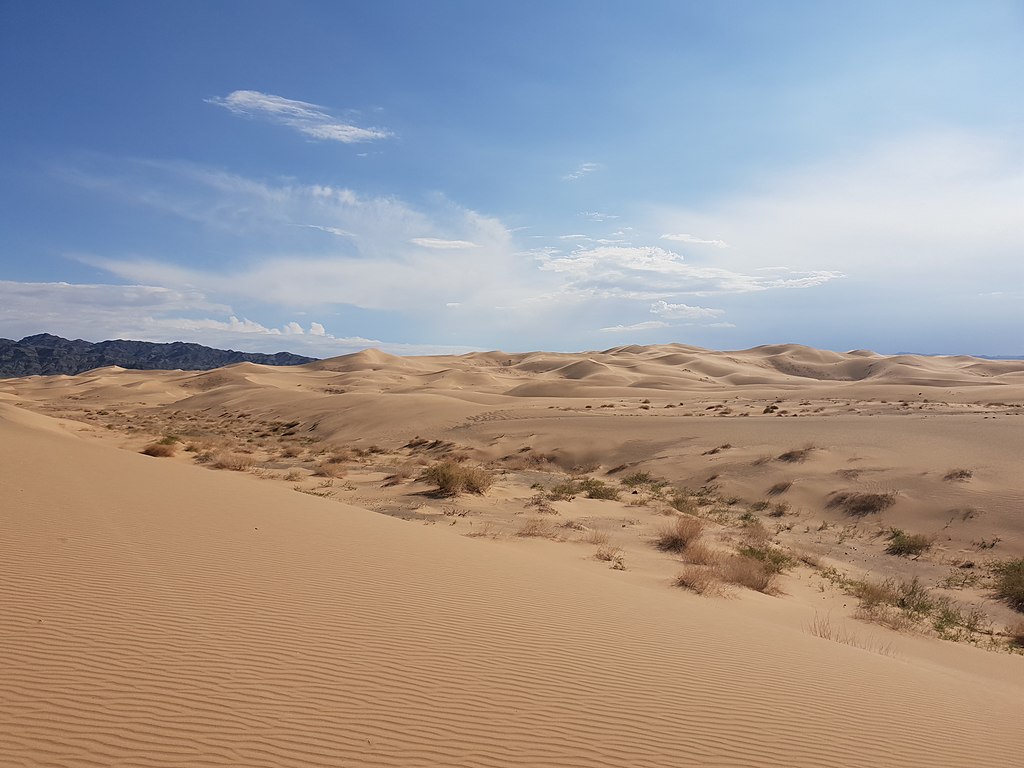
However, once he left the Yumen Pass, he immediately ran into a major issue: the Gobi Desert.
The road from the Yuman Pass to the next stop, the oasis at Hami, was barren, dry, with extreme heat and cold, and not well marked. Xuan-zang, who had little experience with this kind of travel, at one point lost his waterskin, became lost, and collapsed due to exhaustion. It is said that the bodhisattva Guan-yin guided him in his darkest hour to Hami.
The Hami Oasis
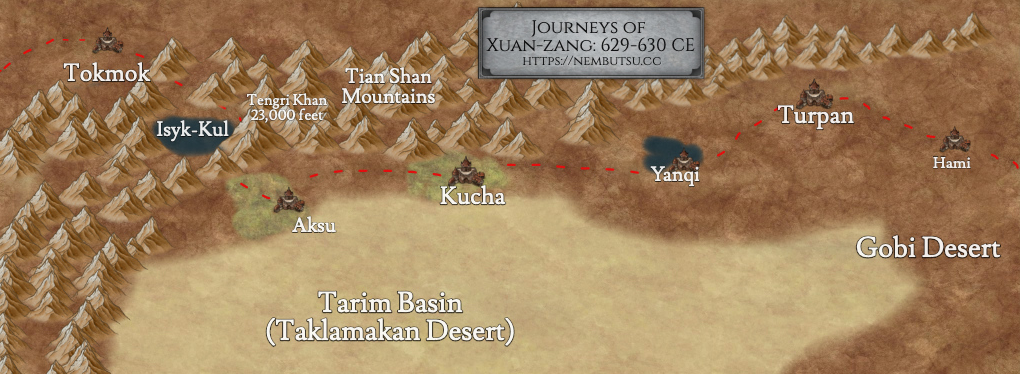
A map of the first part of Xuanzang’s journey. I made this using Inkarnate (a great online map tool). Apologies for any geographical mistakes. Free for non-commercial use.
The town of Hāmì (哈密), also known as Kumul (قۇمۇل) in Uyghur, was populated by a Chinese military colony since the Sui Dynasty, but had been cut off from China during turbulent times. At Xuan-zang’s time, it pledged loyalty to the regional Turk rulers while still maintaining diplomatic relations with the new Tang Dynasty. Some months after Xuan-zang left, Great Tang’s expansion absorbed Hami into its empire.
Here in Hami, Xuan-zang stayed at a Buddhist monastery where three Chinese monks lived. They were overjoyed to see a fellow monk, and offered him lodging. Xuan-zang did not stay too long here, and moved onto the larger city of Turpan.
The King of Turpan
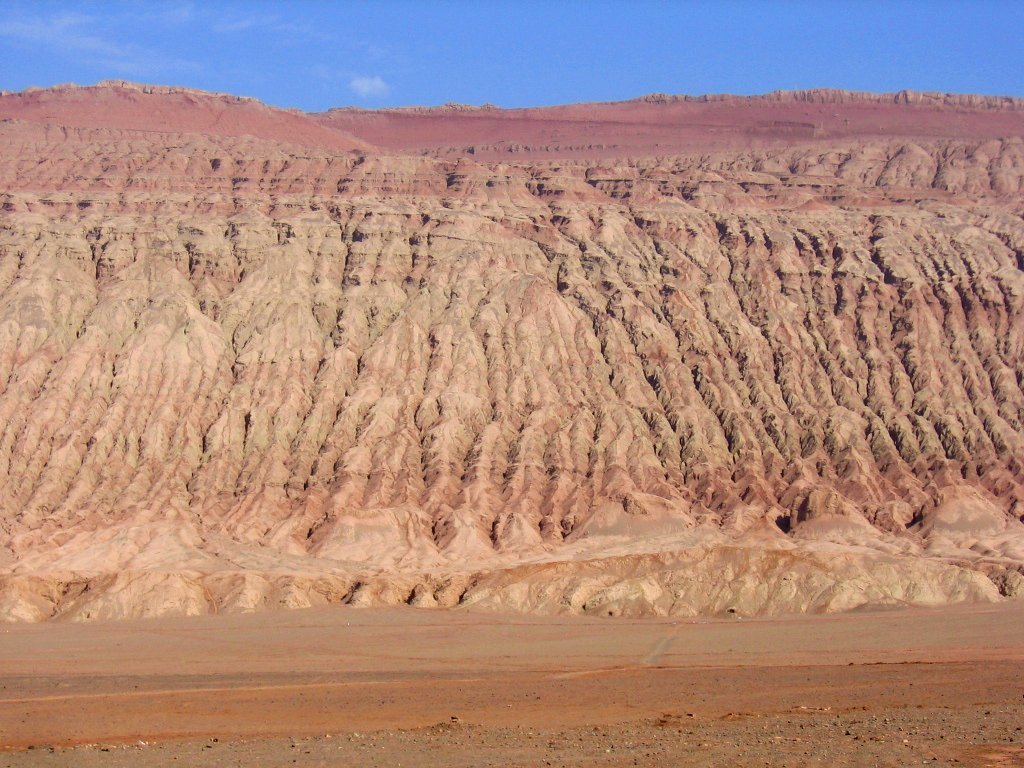
The “Flaming Mountains” near the city of Turpan on the Silk Road. Photo by es:User:Colegota, CC BY-SA 2.5 ES, via Wikimedia Commons
The city of Turpan (Uyghur: تۇرپان) also called Tǔlǔfān (吐鲁番) in Chinese was a prosperous city since ancient times, and changed hands often, but since antiquity had a large Chinese community, and considerable Chinese cultural influence, especially compared to cities further west.
The King of Turpan at this time was a devout Buddhist, and gave Xuan-zang a warm welcome upon his arrival, but also pressured him to stay rather than continue his journey. When Xuan-zang politely refused, the King of Turpan begged, cajoled, and threatened him. Xuan-zang was not allowed to leave, and he resorted to fasting to make his point. The king relented, and got Xuan-zang’s promise that he would stay for a month to preach to the people of Turpan, and would return later upon his return trip.
Once this agreement was reached, Xuan-zang stayed as promised. He used this time to explore the area, including the ancient city of Gāochāng (高昌), also known as Qocho, which was the former capital of a once-powerful kingdom, where he gave sermons to audiences there. Archeological excavations have show plenty of evidence of a vibrant Buddhist community at the time.
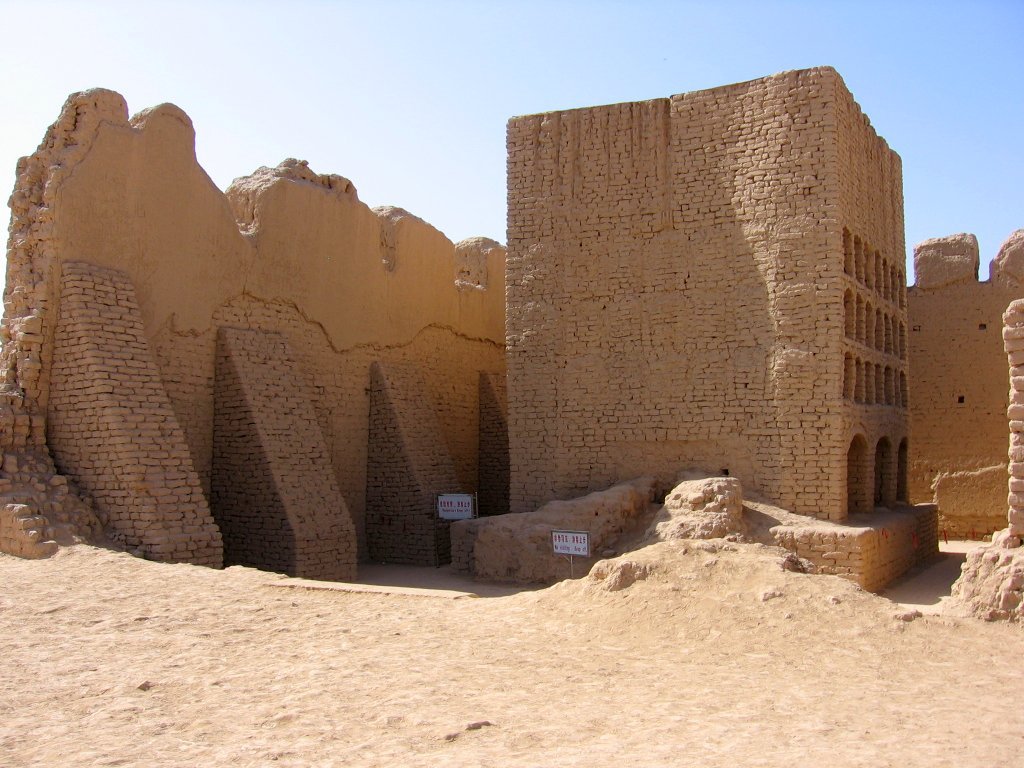
Remnants of a Buddhist stupa at Gaochang. Photo by Colegota, CC BY-SA 2.5 ES, via Wikimedia Commons
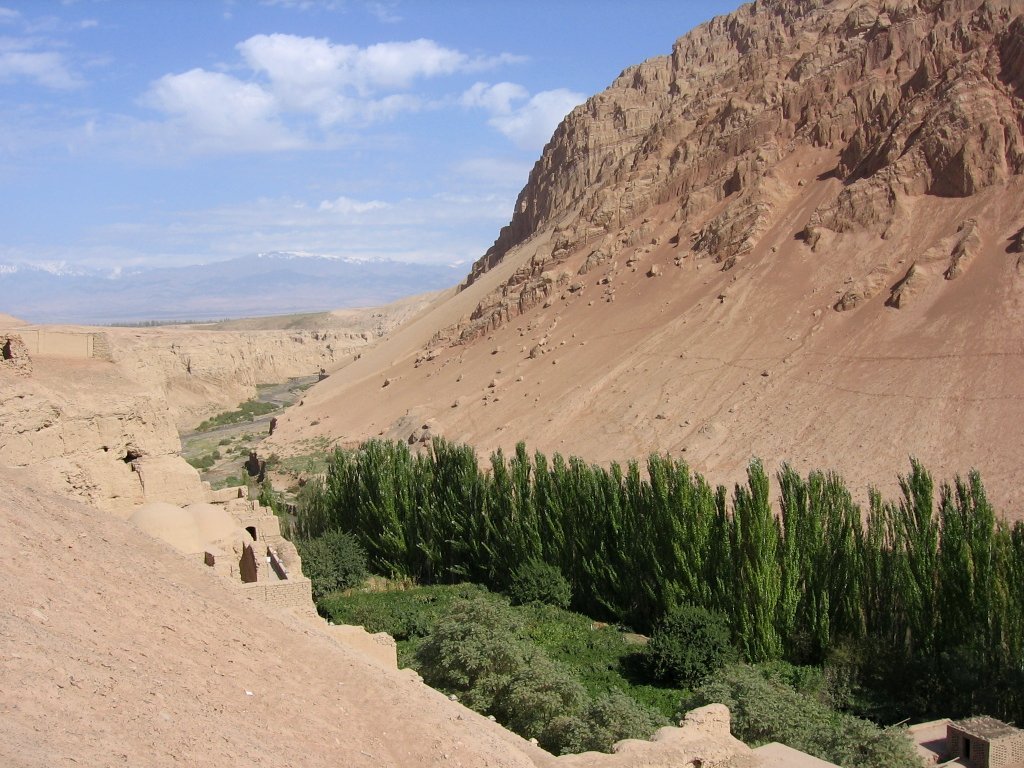
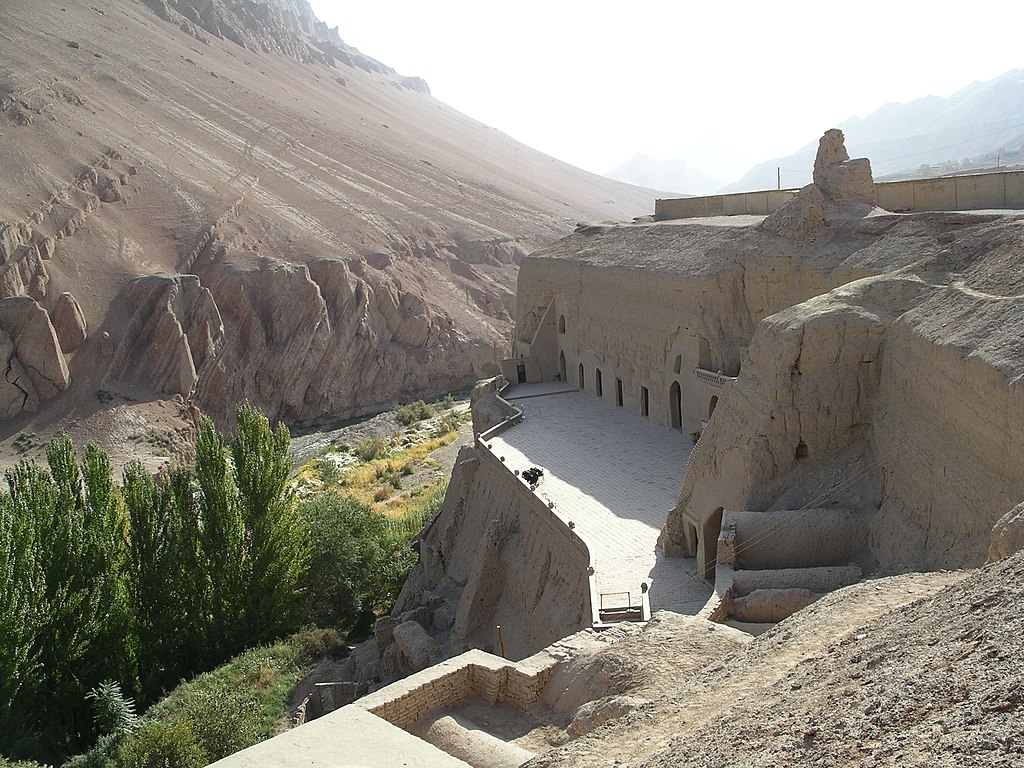
Xuan-zang also likely visted the nearby Bezeklik caves as well:
The Bezeklik Caves as seen from above. Photo courtesy of Wikimedia Commons.Photo by T Chu, CC BY 2.0, via Wikimedia Commons
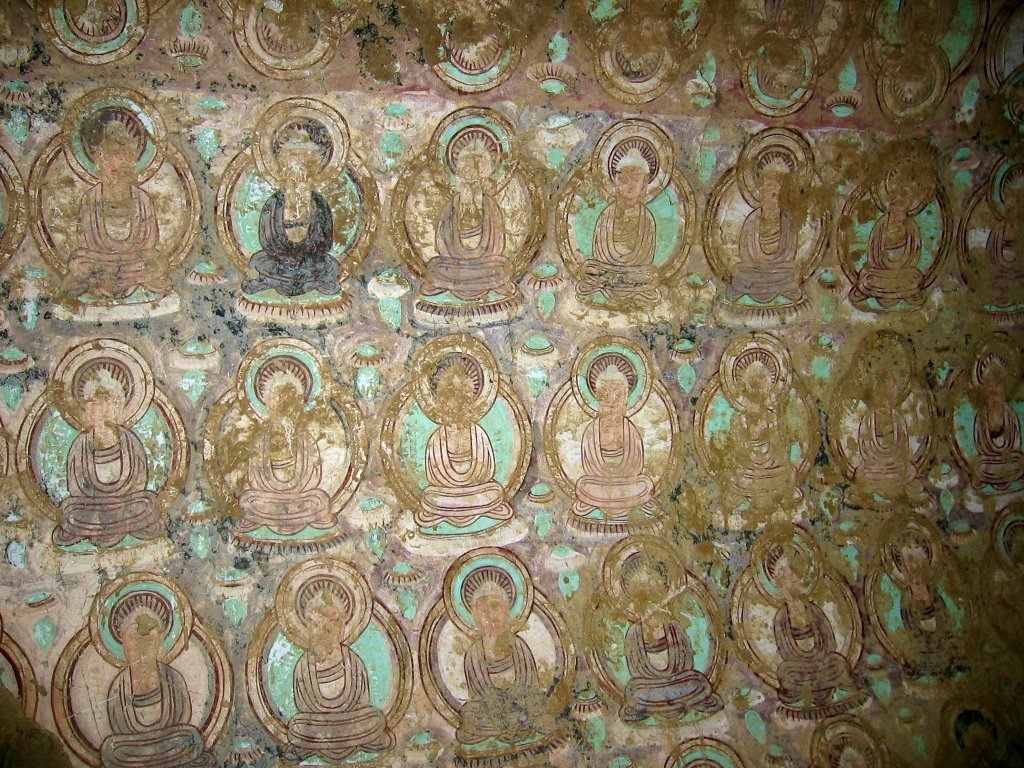
The Bezeklik caves are a massive grotto that served as a monastery for the local Buddhist monastic community. Many of the walls and ceilings were painted with frescoes of the Buddha, or other famous imagery, though in later generations, these were often defaced or damaged by locals for one reason or another (superstition, religious prohibition against human imagery, or simply raw materials).
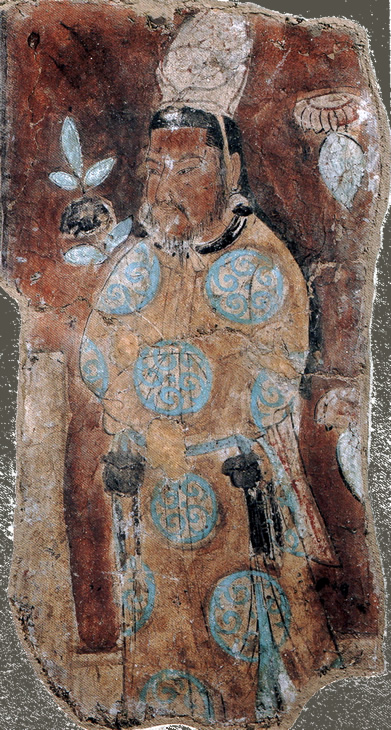
Further, European archeologists looted the caves and brought many works of art back to Europe, only for them to be destroyed later in World War II. Thus, very little remains of the artwork now, but what does remain is simply spectacular, and a shining example of the fusion of cultures along the Silk Road at this time.
Bezeklik caves, Pranidhi scene 14, temple 9. Note the Sogdian men depicted in reverence of the Buddha. See page for author, Public domain, via Wikimedia Commons
Two Buddhist monks, one Eurasian (possibly Sogdian or Tokharian), and one East Asian. Public domain, via Wikimedia Commons
Once Xuan-zang’s month was completed, the King of Turpan made good on his word. He provided Xuan-zang with many goods, supplies and letters of introduction to the kings further along the road. He now traveled with a caravan toward the next city Yānqí (焉耆) known by many other names, including Karasahr (قاراشەھەر in Uyghur) or Agni from the old Tokharian name, but not before being robbed by bandits! Evidentially, the bandits had already killed and robbed an earlier caravan, and were content to be bribed by Xuan-zang’s party and left with no further violence.
Upon reaching the city of Yanqi/Karasahr/Agni, Xuan-zang was said to have received a warm welcome, and described a city with ten different monasteries, and with two thousand monks practicing Hinayana Buddhism.1 He did not have flattering things to say about the king of Yanqi though, and later in 643 when the king broke his allegiance with Great Tang, the emperor Taizong, whom we met in the prologue episode, steamrolled Yanqi’s army and took the king prisoner.
Xuan-zang for his part only stayed for one night and moved on toward the city of Kucha. Kucha is an important city in early Buddhist history, but as we’ll see in our next episode, it was caught in a game of political tug-of-war…
Until the next episode: the Western Turks!
1 The term Hinayana is a loaded term in Buddhism, and frequently misunderstood. It has also been used as a pejorative by Mahayana Buddhists too. Without getting lost in the weeds, think of “Hinayana” Buddhism as any pre-Mahayana Indian-Buddhist school. It is not the same as Theravada Buddhism (the other major branch of Buddhism) since both branches were geographically separate and had little interaction with one another.
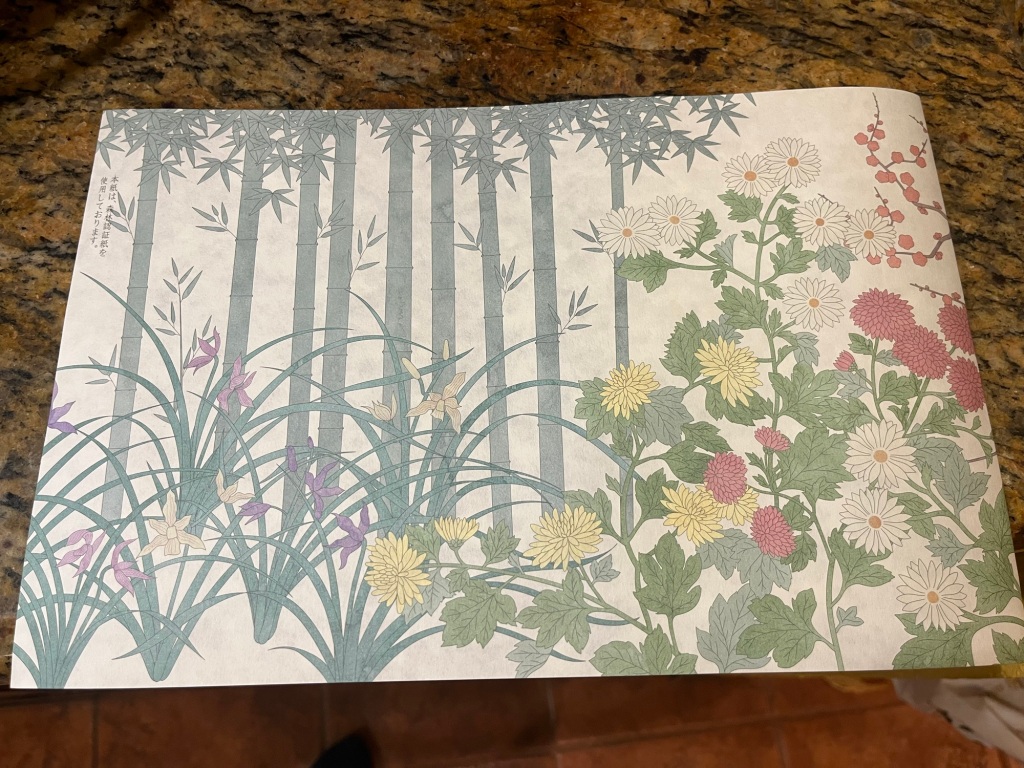
When you buy books in Japan, you are often asked if you would like a book cover. If so, the staff will kindly fold some brown wrapping paper for your books, with just the proper fit. Because people often read on crowded trains where there is little privacy, it is a handy way to keep your reading habits private. It is also a nice way to prevent your book from being scuffed in a backpack or purse.1
Similarly, you find many nice premade book covers in Japanese stores, or online. But I think making your own is the best way to do it. If done correctly, it is guaranteed to fit the book properly, and you can personalize it with whatever paper or design you choose.
Recently, I purchased some Japanese book covers from a local antique store, but I was disappointed to find some of them didn’t fit any of my books. Coincidentally, I received some nice wrapping paper, so I decided to put it to good use.
Following these handy instructions, I was able to make a book cover out of it:
The instructions, essentially, require fitting the book to a corner of the paper or fabric, and leave a margin of 5cm on each side. When folding the paper, it’s important to make it flush with the top and bottom of the book. After that, it should fit like a glove.
My book cover above required a couple tries to get it right. I didn’t properly measure the first time, and it was a bit too small. So I had to fold a second time, this time reading the instructions more carefully, and got a satisfying fit. I’ve really enjoyed this book cover once it was complete. Once you learn the technique, I realized that it’s easy enough to make one using any sturdy, foldable paper, or soft fabric. Plus, if you are artistically inclined, you can probably make book-covers that are suitable for the books you are covering. I wish I had that talent. 😅
Anyhow, enjoy!
1 I have an old, used Star Trek novel whose corner broke off recently, so I can safely say that protecting books, especially legacy used books, is important.
Recently I talked about the Pure Land Buddhist tradition, and in particular the Three Pure Land Sutras that are central to the tradition.
But then I realized that I’ve never really explained who Amida (Amitabha) Buddha is. Now that the English language site for Jodo Shu has been retired, I wanted to fill in some gaps in information, and explain Amida Buddha’s significance to the Buddhist religion at large.
Who Is Amida?
Amida (阿弥陀) Buddha is short for Amitabha Buddha: the Buddha of Infinite Light. Sometimes he is alternatively called Amitayus: the Buddha of Infinite Life too.
Amida Buddha is a cosmic, almost timeless Buddha who is said to dwell “very far” to the west in a realm called Sukhavati in Sanskrit, which means “Land of Bliss [or Joy]”. Over time, people just call it the Pure Land.
A reproduction of the Taima Mandala, an 8th century tapestry in Japan depicting the Pure Land
The Pure Land should not be confused with Heaven. It is a peaceful, safe refuge. In the Pure Land, people can escape difficult circumstances and be surrounded by many excellent Buddhist teachers. Even the very air and animals preach the Buddha-Dharma. Best of all, the sutras emphasize that one can be reborn there easily … if they so choose. It is not required in Buddhism, but it is available
The vast light of Amida Buddha (hence “Buddha of Infinite Light”) reaches out in all directions of the cosmos:
“The light of Amitāyus shines brilliantly, illuminating all the buddha lands of the ten directions. There is no place where it is not perceived. I am not the only one who now praises his light….”
The Sutra of the Buddha of Immeasurable Life, translation by Rev. Hisao Inagaki
and provides comfort to those who encounter it, inviting them to be reborn in the Pure Land:
“….If, sentient beings encounter his light, their three defilements are removed; they feel tenderness, joy and pleasure; and good thoughts arise. If sentient beings in the three realms of suffering see his light, they will all be relieved and freed from affliction. At the end of their lives, they all reach emancipation.”
The Sutra of the Buddha of Immeasurable Life, translation by Rev. Hisao Inagaki
This Buddha’s promise to rescue all beings, regardless of who they are, has been very attractive to people in difficult social circumstances: women (who were thought spiritually inferior in those days), the poor, and illiterate who toiled all day with no chance to invest in other spiritual development.
However many monks devote at least part of their time and effort toward Amida as well. As a Buddhist tradition, devotion to Amida is very broad and inclusive.
Further, everyone has a slightly different idea on who Amida Buddha is, what the Pure Land is, and so on. This is fine. There is no orthodox interpretation. Buddhism is more concerned with practice, so how one interprets this tradition up to them.
Some people devote themselves fully to Amida Buddha, others venerate Amida Buddha as one among a larger tradition. Again, it is up to the individual.
What Does Amida Look Like?
Amida Buddha is often depicted with gold color imagery, sometimes red. Compare with someone like the Medicine Buddha who is often depicted with lapis lazuli color (deep blue).
The gold color is based on the Pure Land Sutras that describe every person there, including the Buddha, as having gold-colored skin. Further, gold shines, so it fits the Buddha’s symbolism as a Buddha of light.
In some art, Amida is seated in meditation.
Amida Buddha statue at Sensoji (Asakusa Temple) in Tokyo, JapanAmida Buddha statue at Kamakura, Japan, also known as the Great Buddha (daibutsu) of Kamakura
In some art, Amida is standing, with his hands in specific gestures.
Amida Buddha welcoming the deceased, with his attendants, to the Pure Land. A medieval Japanese painting. A small home altar I purchased from Tsukiji Honganji in Tokyo about 10 years ago. A tiny, pocket image of Amida Buddha I purchased at Zojoji Temple near Tokyo Tower in Japan.
Buddhist statues are full of symbolism, they are not intended to be accurate portrayals. They convey meaning. The double-“OK” hand gestures used by Amida, one hand up, one hand down with palm up, means something like all beings are welcome.
Why Amida?
Someone learning about Buddhism will probably find this very confusing: why is there a “Buddhist Jesus” when the religion is supposed to be about meditation and finding enlightenment? Is this a sign of Buddhism’s decadence and decline?
Buddhism can be a tough religion to explain because it is really broad. Much broader than a “Buddhism for Dummies” book can explain.
The historical founder, Shakyamuni Buddha, was like a doctor describing the state of things (e.g. the Dharma), and providing a “prescription” (e.g. Buddhist practice) to help cure the “ills” of the world.
But within that, Shakyamuni Buddha gave people a lot of autonomy. He described the world as like a river with two shores: one shore full of strife and dissatisfaction, the other peace and wellbeing. He described the need to build a raft to cross from one shore to the other. But how exactly to build that raft is up to you.
He held students, especially monks, to high standards of conduct, but as for putting teachings into practice he tailored different practices to different audiences, or to suit the person. Contrary to popular conception there are various forms of meditation taught even in the earliest traditions, not just mindfulness.
Mahayana Buddhism, one of two major branches of Buddhism, really emphasizes this diversity of practices because it recognizes the concept of upaya (expedient means): whatever works at that time for that person and helps them stay in the Buddhist path is right for them.
It’s partly why there are so many Buddhist figures, so many chants and sutras, and so many different sects. Each of these represent a different “gate” for entering the Buddhist path.
Anyhow, the existence of Amida Buddha, along with other figures such as Kannon, helps fill in a gap where some Buddhist practices and regiments just aren’t practical for most people, and also provides a sense of assurance in an uncertain world (speaking from experience). Those who find the “mind-only” interpretation of Amida attractive can also take comfort that nurturing Amida Buddha in one’s own mind helps awaken the Buddha within. Further, a timeless Buddha like Amida avoids the challenges of the interpreting the historical Buddha, Shakyamuni, through various layers of culture and history.2
As Amida Buddha is a tradition within the larger tradition, some Buddhists gravitate toward Amida, and some do not. Each person according to their own path. Mahayana Buddhism is large enough to embrace them all.
Namu Amida Butsu
P.S. Featured photo is the famous “Black Amida” statue at Zojoji Temple near Tokyo Tower in Japan. This was the statue that was venerated by the Tokugawa Shoguns back in the day.
1 The use of light symbolism in Amida Buddha is thought to possibly borrow from Zoroastrianism, which is possible given the contacts between the Parthians and the Buddhist community. Light is central to Zoroastrianism, but not mentioned in early Buddhist culture. The concept of Amida Buddha is definitely Indian-Buddhist, but Buddhists in the northwest of India often borrowed artistic concepts from neighboring cultures. Another example is Greco-Buddhist art.
2 Early Mahayana Buddhism was a critic of the “pilgrimage” culture at the time in India, where there was increasing importance of the holy sites, and the holy relics of the historical Buddha. Mahayana shifted the emphasis toward the timeless Dharma, and Buddhas as embodying this Dharma.
It’s similar to how people in other religions split hairs over what the religious founder said, based on layers in interpretation, or how people try in vain to recreate the original community (again through layers and layers of interpretation).
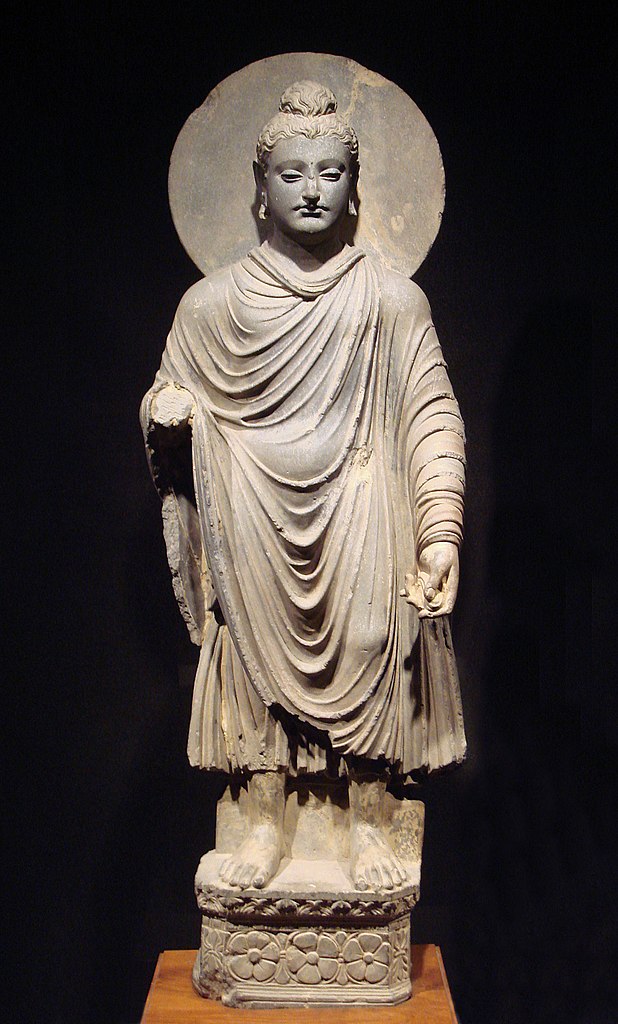
Gandhara Buddha statue. 1st-2nd century AD. Tokyo National Museum. 2004. Released in the Public Domain.
Buddhism is a religion that, while widespread in terms of numbers and influence on world cultures,1 is not well-understood in the West. Chances are you, you’ve probably heard of it, or seen something like the Happy Buddha in gardens or Chinese restaurants. You’ve probably have an idea of what “Zen” is, and so on.
Buddhism as a religion that focuses on wisdom, self-discipline, and goodwill toward all beings.
Buddhism is a religion that does not elevate a god of any sort, and is not concerned with gods one way or another.1 So, in this sense, people get confused about whether it’s even a religion at all. But it isn’t some dry philosophy either for people to debate in coffee shops or college campuses. The Buddha intended for his teachings to be applied in daily life, regardless of who you were, or what your background was.
In the Buddha’s own time, he described it as the “holy life”. It is a path that, if carried to fruition, is said to be praiseworthy and free from guilt, and hassles. But the holy life is also a people-centered religion in that the focus of its teachings is on daily life, and on people, not external deities. A person who adopts the Five Precepts of Buddhism, even if they make mistakes and struggle with some precepts, has made great progress.
Finally, the Buddhist path is something that is easy to take up, and you can begin just you are. It’s a long, slow path, with many discoveries, but you learn many things about yourself and others.
1 the Buddha is venerated as a peerless teacher, and the other Buddhas you find in Buddhism are expressions of the teachings. Buddhism has layers and layers of meaning, so it’s one of those things that takes time to sink in.












 Gleanings in Buddha-Fields


You must be logged in to post a comment.