
When people ask me about Japanese New Year (o-shōgatsu, お正月), I like to describe it as melding both Christmas and American Thanksgiving into one three-day holiday. It has its origins in Chinese Lunar New Year, but because of the change in calendar, it now takes place on January 1st through 3rd.
But New Year’s Eve, called Omisoka (大晦日), also has lots of traditions of its own. One of them is a tradition called Joya no Kané (除夜の鐘) which means ringing of the large temple bell, the bonshō (梵鐘). You can see an example of a Bonsho here from my last visit to Zojoji:
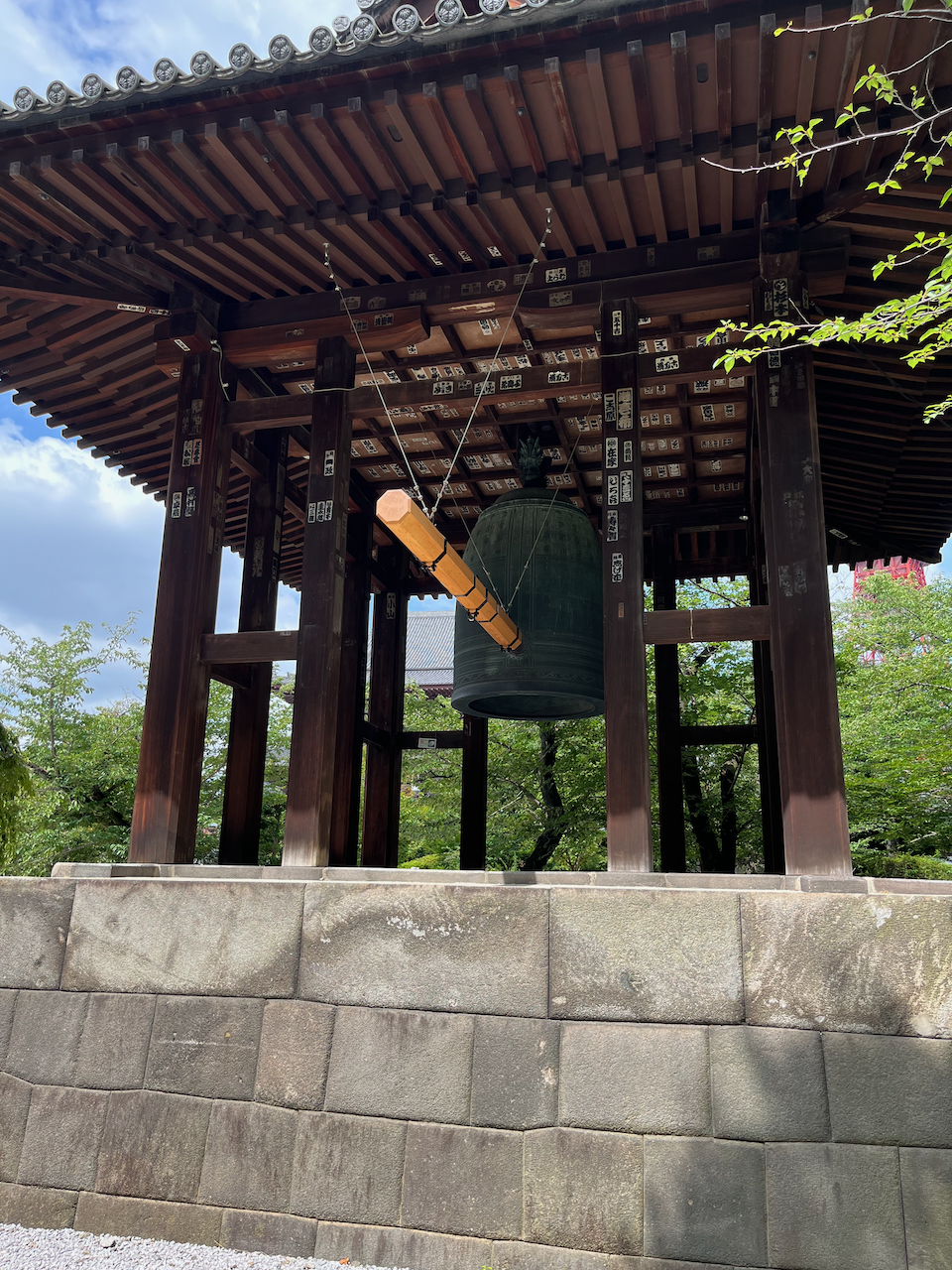
The tradition is that the bell is run 108 times before midnight. Why 108 times? This reflects the Buddhist concept that the mind has 108 defilements (bonnō, 煩悩). According to Wikipedia, the tradition actually began in China in the Chan (Zen) monasteries there, and there is a parallel tradition in Korea too, though they ring the bell 33 times.
Typically the ringing of the bell starts around 11pm, the local temple members line up, and each one takes turns rining the bell once, but pulling on the large beam that strikes the bell using a rope tied to it. Many temples will save the very last (108th) ringing until just after midnight. For this reason, the ceremony is often also called ni-nen mairi (二年参り, “two year crossing”).
This is a news clip from 2023 showing the ringing of the bell at Zojoji temple:
The temple of Chion-in (another favorite of mine) also has a dramatic bell-ringing ceremony too:
As for me, I’ve only attended one Joya no Kane in Japan in 2007, back when we used to visit family for New Years,1 my second visit there. My father in law owns a business that makes gravestones in Japan, so while he is not part of a particular Buddhist temple, he has many business partners that are Buddhist temples.

That particular year, he was invited to attend the Joya no Kane ceremony at a certain Jodo Shu-sect temple in the city. Because I was newly introduced to Jodo Shu Buddhism a few years earlier, I was excited to go. My father in law gave me this sutra book for Jodo Shu Buddhism, which I wrote about here. It was the first sutra book I ever owned, as far as I can recall.
I don’t remember which temple it was, but it was fairly large temple, and there were many people in attendance. The rest of the family wasn’t interested and stayed home to watch Japanese TV. My father-in-law and I sat for a brief Buddhist service, and a small sermon, then we started to line up for the temple bell ringing. I remember being somewhere near the middle of the line, maybe second half. The process took nearly an hour. It was late, cold, and waiting in line so long was a little tiring. When it was finally my turn, the moment went super fast so I barely remember what happened. The hanging beam was heavier than I expected, so I didn’t get a very good swing. Just enough to hit the bell and that was it.
We drove home after that, where my wife, daughter, and in-laws were all watching Kohaku Uta Gassen. All in all, it was a good night.
So, that’s my only memory of Joya no Kane, but I think it’s a near tradition and well worth attending if you ever get the opportunity.
Happy 2026 everyone and wishing you a wonderful new year.

1 When our firstborn was a little girl, we liked visiting in winter because there’s lots of fun things to do, but once she started grade school, we moved to summers. In either case, the winters in Japan are very cold, and the summers are extremely hot and humid.
Discover more from Gleanings in Buddha-Fields
Subscribe to get the latest posts sent to your email.
 Gleanings in Buddha-Fields
Looking through your blog posts, I’m amazed at how similar our wanderings have been. From the various flavors of Buddhism to the parts of Japan visited. Even some of the photo spots are nearly identical! Anyway, I’ve enjoyed reading. One of your other posts sent me down a Tendai rabbit hole, for which I’m very grateful. I’ve been quietly ignoring my personal issues with western Zen, my conflicting tendencies toward both rigor and inclusivity, questions about how Pure Land fits, etc., and reading these posts helps me see that I’m not the only weirdo thinking about these things! Happy New Year! Namu Amida Butsu!
LikeLiked by 2 people
Hi Charles, thank you for posting a comment. I am always happy to hear from kindred spirits, and it certainly sounds like we have the same tastes in vacation spots. 🙂 I am also glad to hear that you found the blog useful, as you navigate the path. I really like Tendai’s approach where its grounded in the Lotus Sutra, but applied in many ways to suit different people.
BTW, you may find the Shushogi, a Soto-Zen text very helpful. It provides a much needed perspective on Zen that isn’t normally discussed in Western circles, but very mainstream with Mahayana Buddhism.
LikeLike