
One of the most iconic episodes of the original Star Trek series is the episode “City on the Edge of Forever” (season 1, episode 28), where Kirk and Spock have to travel back in time through the Guardian of Forever, in order to correct a change in the timeline that drastically affects their future. The climatic ending involves a tragic moment where Kirk has to let someone they love die in order to correct the timeline.
During my last watch-through of this episode with the Saturday Night Star Trek team, I started thinking about the time-travel implications of this episode. If you haven’t seen the episode, please stop here and watch the episode (or save this post for another time). I think this episode is even trippier than you night believe at first.
Warning: spoilers.
Canonical Story
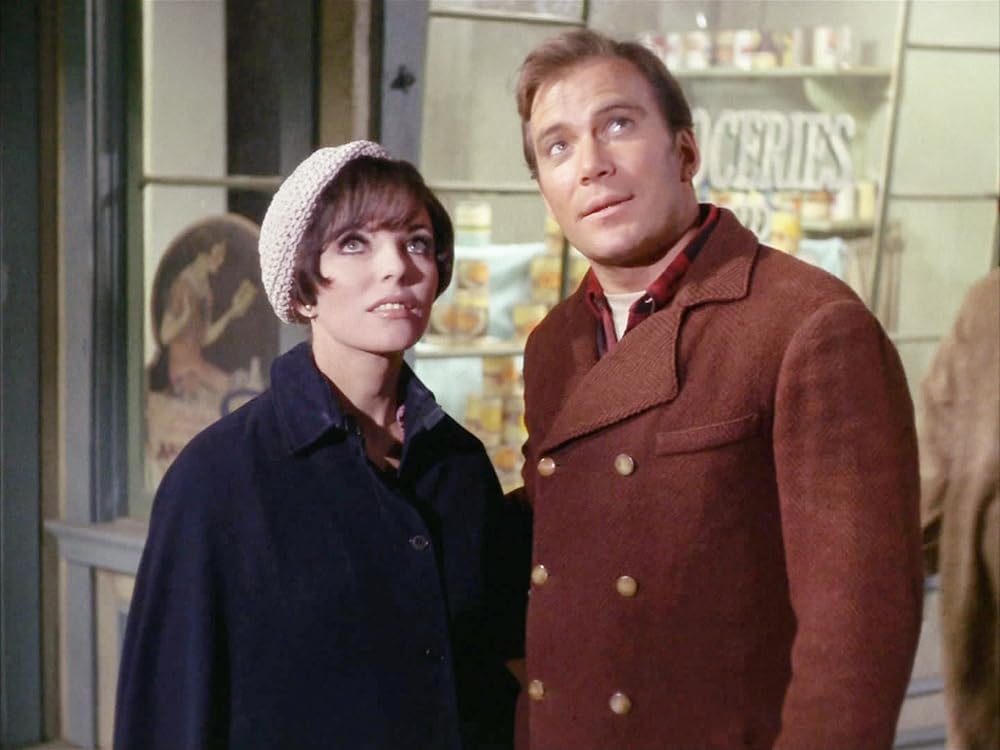
This episode treats time travel in the following order:
- McCoy (deluded by overdose of medication) travels back in time to 1930’s and somehow saves Edith Keeler.
- Edith Keeler’s existence helps trigger a pacifist movement that delays US entry into World War II (Spock: “the right idea, but the wrong time”) leading to catastrophic consequences. The alternate (correct) history is that she dies in a car accident.
- Kirk and McCoy travel back in time to stop this.
- Kirk saves Edith Keeler from a fall down the stairs that might have killed her.
- After being admonished by Spock, Kirk chooses not to save Edith Keeler when she is struck by a car, ending her life. This restores the timeline to the way it was.
- Kirk, Spock, and McCoy return to the 23rd century, all is well (minus Kirk’s poor heart).
This is the canonical story.
My Fan Theory: Kirk is the Source of the Timeline not Restorer
My personal theory is that James Kirk didn’t restore the timeline as such; he caused it. The future we see now in Star Trek universe was a direct result of, not saved by, James T Kirk.
If you think about it for a moment, the canonical history is that Edith Keeler dies by a car accident before the start of World War II, but in the story, the reason why she gets into a car accident in the first place is because she crosses the street to see Jim Kirk. If both Jim and McCoy hadn’t travelled back, would Edith Keller still die by a car accident?
This is where causality in time travel gets weird. Assuming Jim Kirk is the cause of the canonical timeline, then presumably he was predestined at some point to find the Guardian of Forever, go back in time, interact with Edith Keeler in such a way that she dies by car accident.
The implication is that Jim Kirk was always going to travel back in time at the set date (barring further time travel shenanigans), which implies predestiny.
But what if Kirk and the Enterprise somehow never found the Guardian of Forever? Then Edith’s particular death shouldn’t happen, causing a paradox.
Or, if as Spock implies, time flows like river with “currents and eddies” and thus Edith Keeler would have still died by a traffic accident, but not this particular one, thus the timeline stays more or less unchanged.
Which one is true? Who knows.
The Weight of the Decision
The other aspect of this episode is that the timeline of Earth drastically changes due to the death (or life) of Edith Keeler. This means that following these events in the 1930’s countless people are drastically affected. Depending on the timeline, Person A might be killed in WWII, or they might live. If they live, Person A might have kids that otherwise might not exist.
Thus when Kirk restores (or causes) the timeline, his action causes the life or death of countless humans he will never know about. Similarly, McCoy’s initial interference.
So, regardless of which timeline is correct, Kirk and/or McCoy will be responsible for the countless deaths and lives that come after. A weighty decision indeed.
Another Timeline Change: Death by Phaser
Another aspect that’s often missed is McCoy’s first arrival in the 1930’s. He is robbed by a local homeless guy (the same guy who makes lewd comments about Edith Keeler earlier in the episode), who takes his hand-phaser and accidentally vaporizes himself. This seems to prevent any Federation technology from leaking back to the past (good), but the death of the homeless guy may have additional timeline consequences that we don’t know about, and never see the results of.
Granted, as Spock said in his “currents and eddies” comment, the timeline may resist change, and so the death of the man may not change all that much. But it’s also possible that his absence triggers events that the subtly alter the future in ways we don’t know about, even if they are not as dramatic as Edith Keeler’s.
So, when the Enterprise crew return to the ship, I wonder if they noticed any subtle oddities…
Conclusion
Time travel is weird, and the causality of time travel is even weirder. Since no one has actually travelled in time (as far as we know), the implications of changing the past are entirely theoretical, but it’s fun to imagine.
And, not surprisingly, “City on the Edge of Forever” remains one of the most iconic episodes in Star Trek. 🖖🏼
P.S. The Star Trek novel Yesterday’s Son by A.C. Crispin explores the Guardian of Time, and a certain other Star Trek episode involving Spock and a woman, and the implications of both. Quite a fun read if you find it.
P.P.S. An accidental double-post today. I made a scheduling error. 😅
Discover more from Gleanings in Buddha-Fields
Subscribe to get the latest posts sent to your email.
 Gleanings in Buddha-Fields