
Author’s note: I wrote this a couple months ago, but have been so backed up, I am finally posting it now. It was not intended to relate to current events. Just Star Trek nerdism, and me philosophizing.
The third-season episode of Star Trek titled Plato’s Children is often criticized as one of the worst episodes of the series. It actually has a really interesting premise, but suffers from poor execution.1
The Enterprise comes to planet populated by a self-styled republic,2 modeled after ancient Greek poleis, comprised of aliens who each have tremendous psychic powers. They live in great comfort, and spend their days pursuing whatever they want, but members of this republic have become so lazy, and have atrophied so much that they can’t manage even basic first-aid. When the leader suffers from a cut, he fails to do anything about it until it becomes seriously infected.

Further, one member of the community suffers from dwarfism, and no psychokinetic powers, and the other members of the republic bully him for entertainment and menial tasks. Michael Dunn’s performance as the “dwarf” character was excellent by the way. The same members also torment the Enterprise crew for an extended period of time to get what they want.3
By the end of the episode, it’s clear that the members of this republic are perpetually bored, and half-mad from having terrific power, but nothing constructive to use it for.
Without any struggle in life, or a way to stay grounded, I think the tendency is for one to gradually go mad. People’s minds, even when satisfied with basic needs, have a tendency to create more and more subtle problems for themselves. These problems nest fractally, there is no bottom.
Further, the other major point of the episode is said by the villain Patronius when he is defeated by Kirk:
Patronius: “Uncontrolled, power will turn even saints into savages. And we can all be counted on to live down to our lowest impulses.”
Star Trek, “Plato’s Stepchildren” (s3ep10), Stardate 5784.2
This is a very unintentionally Buddhist thing to say too. The mind is capable of the heights of sainthood (or bodhisattva-hood in Buddhism), as well as the depths of depravity, and everything in between. Under the right conditions any person can become a tyrant, or a saint bodhisattva. It’s not so much a question of personal will-power, environment matters more than one might think.
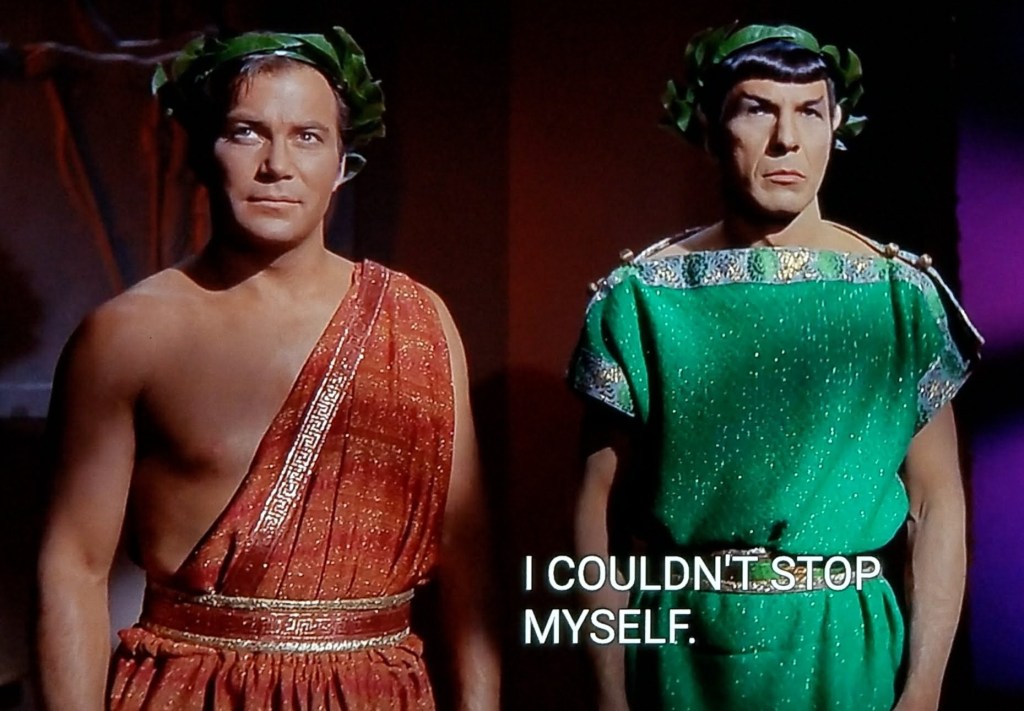
It is always important to stay just a little vigilant toward one’s own mind. Perfectly rational people can easily go off the rails under the right circumstances. Further, you can’t control what others think and do (nor should you), but you can control how you react to them, or how you choose to conduct yourself. A mind unrestrained will inevitably run into disaster.
Namu Shaka Nyorai
1 Like many season 3 episodes.
2 The use of “republic” as modern people think it, is pretty different than the “res publica” as understood by Romans. It was more closer to a commonwealth, than a particular political structure, so even after Octavian took over as the princeps (the first “Emperor” in all but name), the res publica kept going well into the Easter Roman Byzantine era and beyond. By then, the Latin term was gradually replaced with the Greek equivalent: Politeia (πολιτεία).
3 This is why this episode is so unpopular. The script is pretty thin, so i guess the idea was to stretch out the time by adding more of these torment scenes.
Discover more from Gleanings in Buddha-Fields
Subscribe to get the latest posts sent to your email.
 Gleanings in Buddha-Fields