
As readers may have noticed from past posts, I have posted about certain traditional Japanese holidays, called sekku (節句). Examples included Girls Day (March 3rd), Children’s Day (May 5th), Tanabata (July 7th) and Day of the Chrysanthemum (September 9th). The last holiday on my list is actually the first on the calendar: Nanakusa (七草) which literally just means “seven grasses / herbs”. More formally it’s called jinjitsu no sekku (人日の節句, “day of the human”) as we’ll see shortly.
This holiday is surprisingly old, with origins in ancient custom in southern China whereby people would cook seven herbs as a porridge on the 7th day after the Chinese new year. It also relates to the Chinese lunar calendar, where the first seven days of the year were designated as rooster, dog, boar, sheep, ox, horse and human, the first six being animals of the zodiac. Since the seventh day was (for some reason) marked as the day of the human, criminal punishments were not executed on this day.
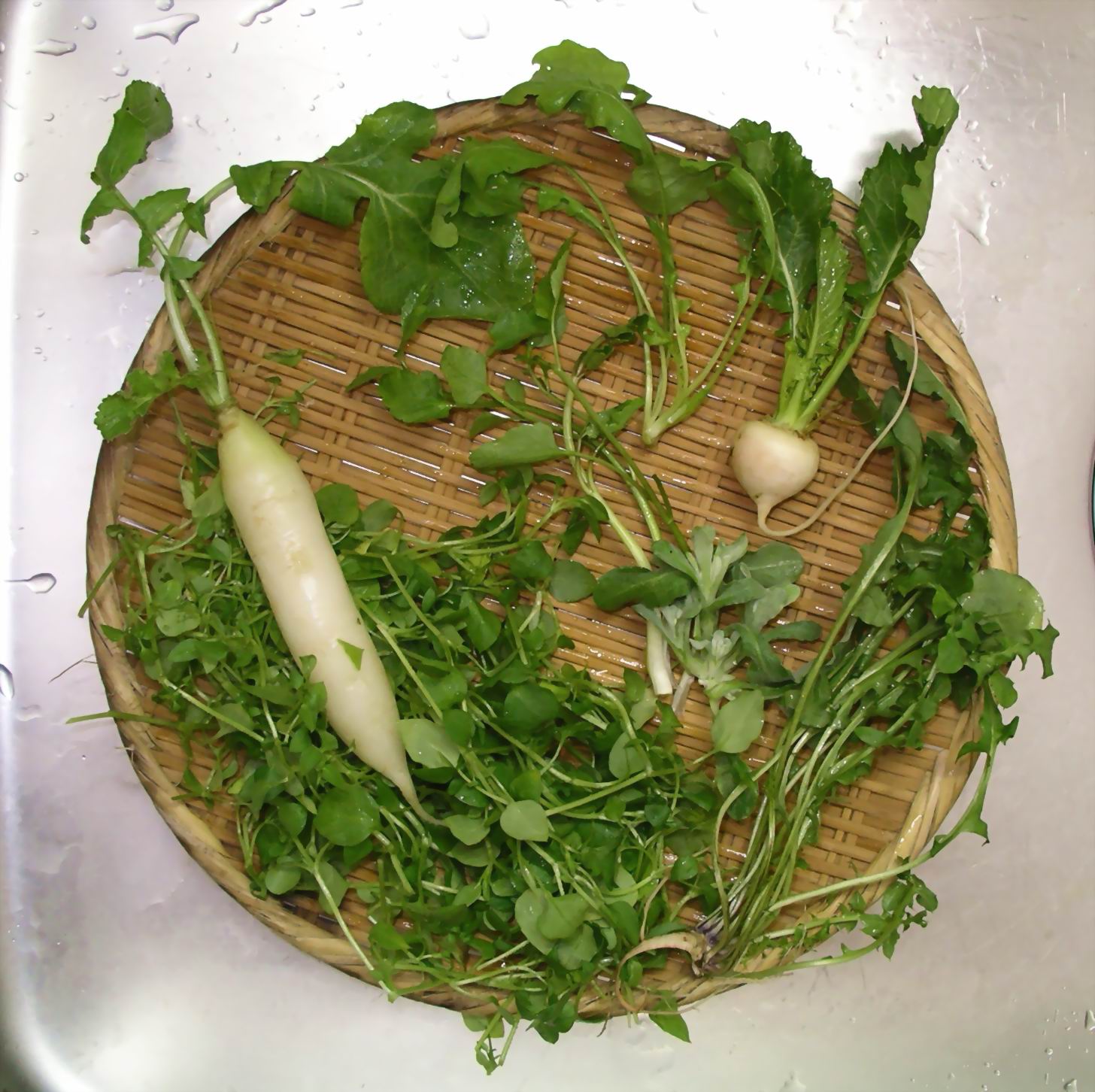
The custom of eating a seven-herb porridge carried over to Japan as nanakusa-gayu (七草がゆ), though in some households more than others. I had it once many years ago when we were first married, and visited my wife’s family home in December-January. I saw a bunch of roots and herbs in the kitchen, like the ones shown above, but didn’t give it much thought. The next day, we were served nanakusa-gayu porridge for breakfast. It has a pretty bland in taste, but that was how I learned about Nanakusa.

According to the Wikipedia article, the seven herbs are:
| Old Japanese Name | Modern Name | English | Scientific |
|---|---|---|---|
| 芹 (せり) seri | セリ seri | Japanese parsley | Oenanthe javanica |
| 薺 (なずな) nazuna | ナズナ nazuna | Shepherd’s purse | Capsella bursa-pastoris |
| 御形 (ごぎょう) gogyō | ハハコグサ (母子草) hahakogusa | Cudweed | Pseudognaphalium affine |
| 繁縷 (はこべら) hakobera | コハコベ (小蘩蔞) kohakobe | Chickweed | Stellaria media |
| 仏の座 (ほとけのざ) hotokénoza | コオニタビラコ (小鬼田子) koonitabirako | Nipplewort | Lapsanastrum apogonoides |
| 菘 (すずな) suzuna | カブ (蕪) kabu | Turnip leaves | Brassica rapa |
| 蘿蔔 (すずしろ) suzushiro | ダイコン (大根) daikon | daikon radish | Raphanus sativus var. longipinnatus |
Of these seven herbs, I’ve eaten turnips and Japanese daikon radish regularly, but the other five are pretty obscure to me. I doubt most Japanese would easily remember them off-hand either. Supposedly there is a song that is sometimes sung while facing the auspicious direction that year (same direction as for Setsubun, I suspect), but no one in my wife’s house sang it, or at least while I wasn’t around.
Edit: I found the song in a book recently:
せり Seri
なずな Nanazu
ごぎょう Gogyou
はこべら Hakobera
ほとけのざ Hotoke-no-za
すずな Suzuna
すずしろ Suzushiro
それは七草 Sore wa nanakusa (“That’s Nanakusa”)
Anyhow, that’s a look at Nanakusa. I joked with my wife if she’d make it this year, and she flatly refused. While it is a very traditional holiday, the porridge takes a lot of work, especially here in the US where the herbs might be hard to gather, and frankly isn’t great tasting. It’s a medicinal porridge more than comfort food. That said, it is a fascinating window into some very old Chinese traditions that still persist in Japan.
1 The adolescent in me giggles whenever I read this plant name. 😂
Discover more from Gleanings in Buddha-Fields
Subscribe to get the latest posts sent to your email.
 Gleanings in Buddha-Fields

