A Look Back at Kiyomizudera Temple

Lately, I’ve been reminiscing on old visits I made to Japan, since I haven’t been there in about two years (and with vaccination rollout being slow, I probably won’t visit this year either). It started when I showed the kids some old photos, and that’s when I decided it would be fun to share with the blog too. These are often old photos, and details and layout are kind of fuzzy now to me, so I might get some things wrong. But, I hope you enjoy!

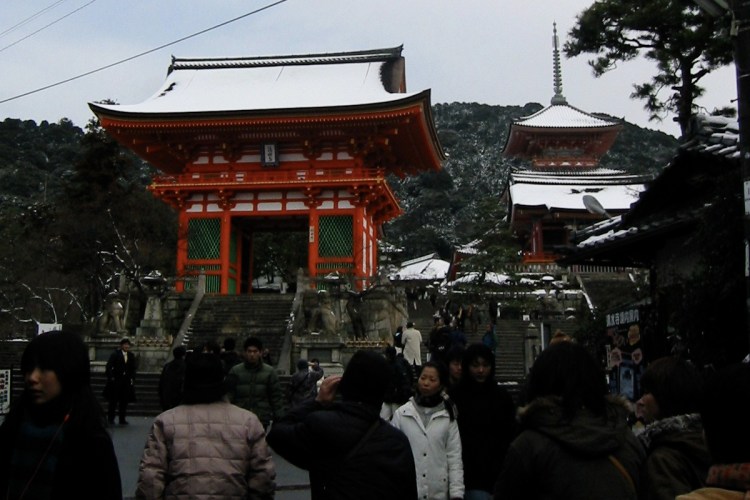
In any case, my first trip to Japan was way back in January 2005 shortly after my wife and I got married, and we went to visit her family, and see take a tour of Japan. The first Buddhist temple I visited was the venerable Kiyomizu-dera (清水寺), a very old temple of the once-powerful Hossō (Yogacara) sect in Kyoto, Japan. This is the front entrance as I recall it:

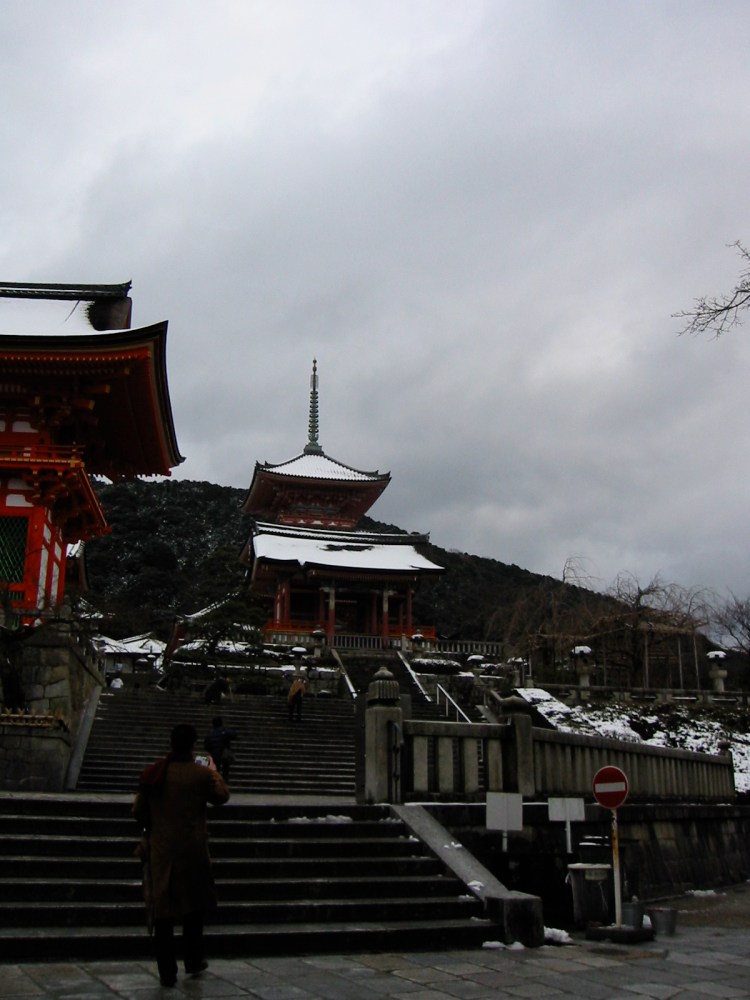
Another view from the front entrance. I believe past that second entrance is the inner compound.

The highlight of Kiyomizudera, is it’s famous drop-off. Wikipedia has a much better photo than the one I took:

Courtesy of Wikipedia.

Here’s touristy, newlywed me at the drop-off.

It’s pretty far to the bottom of the temple complex, as you can see:

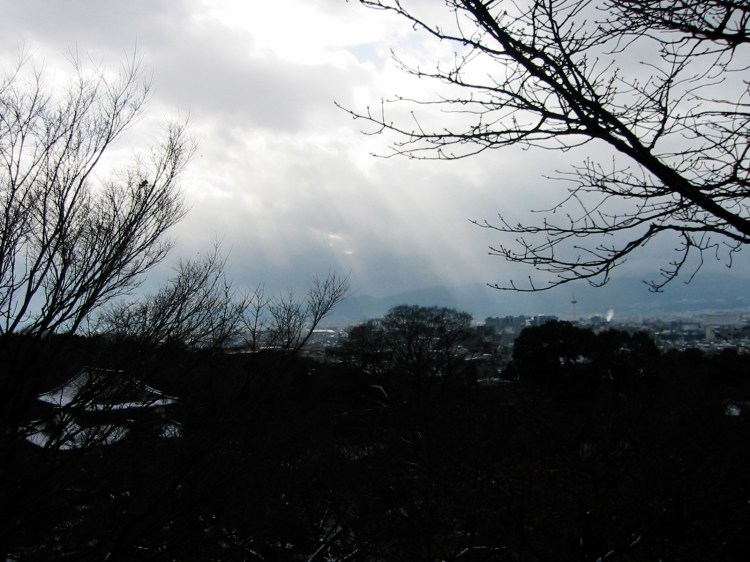
As this was January, Japan was pretty cold (definitely colder than the PNW where I live), and cloudy, but somehow I got this nice sunbeam photo.

The main Buddhist deity of worship at Kiyomizu-dera is the Bodhisattva Kannon. The English language page for Kannon has a very nice overview and well worth a read if you’re curious to learn more. At that time, I wasn’t clear who Kannon was, but I took this photo of a small wood-carving in the ceiling. I believe this is Kannon depicted with 1,000 arms, a common motif to express the many ways and efforts that Kannon does to assist all living beings.

Personally, even after 16 years, I still like this photo very much, and for a variety of reasons, I’ve felt a connection to the Bodhisattva Kannon through most of my adult Buddhist life, even when I didn’t always pay attention to it. Even now, this photo kind of brings me some warm fuzzies even if the quality was terrible.

Anyhow, Kiyomizudera is a temple that I would very much like to visit again next time I ever go to Kyoto. Knowing what i know now about Japanese Buddhism, I feel like I’d get a lot more out of it than I would have at the time. Like many of the old Japanese-Buddhist temples, there’s layers of history and meaning that are not readily obvious, but many treasures await those willing to explore.

P.S. I have a few other photos besides this, but editing out family members and in-laws is just too hard with would negatively impact the photos. All the more reason to just go again sometime. 😀

Spring Ohigan

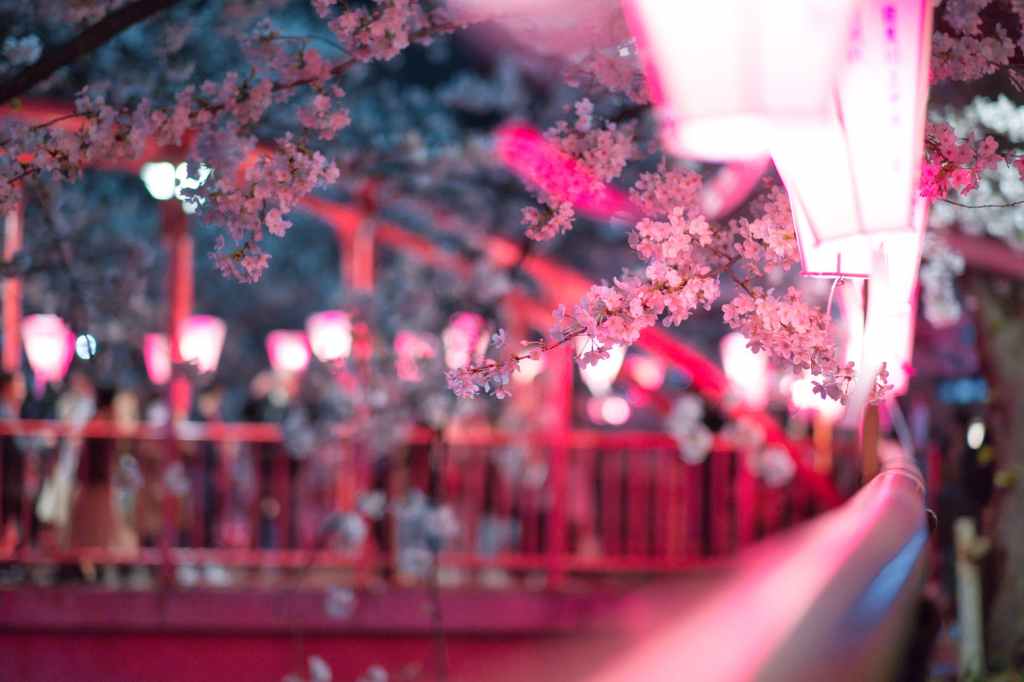
Photo by Evgeny Tchebotarev on Pexels.com

In Japanese culture, the spring and fall equinoxes both mark a special time called Ohigan (お彼岸) which means “the Other Shore”. The holiday was originally promulgated by the pious Emperor Shōmu as the weather at the time was very pleasant, neither too hot nor too cold, and so it was a time to reflect and renew one’s Buddhist faith. In practice, it is also a time when Japanese people frequently return to their hometowns (jimoto, 地元) to pay respects to ancestral graves (ohakamairi, お墓参り), cleaning them and making offerings.

The term “Other Shore” refers to a Buddhist concept, first elucidated in an old sutra in the Pali Canon, of crossing a river from one shore to another. This analogy took on increasing importance in later generations, and even appears in Buddhist art, such as the famous Parable of the Two Rivers.

This analogy of the river and the other shore describes our current state versus the state of awakening, and the need to “cross over” from one to another. This shore we are on is marked by strife, unease, and various challenges in life, while the other shore represents liberation, peace and awakening. The Dharma,1 the teachings of the Buddha, is like a proverbial raft that helps one cross.

In the spirit of Spring Ohigan (you can read the Fall Ohigan post here) and self-reflection, I’d like to share this passage from the book Living Yogacara by Rev. Shun’ei Tagawa (translated by the awesome Professor A. Charles Muller):

Buddhist practice must be based on the repeated examination of one’s past activities. But if this examination is not carried out through a clearly defined principle, then it will end up being nothing more than a bit of indulgence in one’s memories, which does no one any good. Instead, without falling into self-recrimination, we should strive to examine ourselves using knowledge learned in the teachings of Buddhist scriptures. It will be at that time that we first experience a Buddhist form of self-reflection….while taking this kind of sincere reflection, we create and develop a way of living our lives henceforth, remembering the Buddhist teachings and committing to them as a way of bettering ourselves. (pg 109)

Further, he says:

But the number of Buddhist teachings is vast, and the content and meaning of each has a wide range of varieties and permutations. By focusing on a consolidated set of practices, such as the six pāramitās2 (donation, observance of the precepts, forbearance, zeal, meditative concentration, and wisdom) and the four methods of winning people over (donation, kind words, altruistic activity, and working together with others), we find a stimulating engaging method of self-examination and Buddhist practice. (pg. 110)

To reemphasize, self-reflection is about examining one’s own conduct against some objective standard, and in Japanese Buddhist culture the Six Paramitas tend to be associated with Ohigan. They set a pretty high bar, but they also exemplify Buddhism at its best. Self-reflection should neither fall info self-indulgence, nor self-criticism. It’s more about stepping back and looking at your actions scientifically, rationally, and comparing them against a known standard (the paramitas for example).

But why bother? Most people just want to have a good time, enjoy the cherry blossom season with friends and maybe a little drinking.

Cherry blossom season in Japan is no better time to observe the impermanence of life. As Rev. Tagawa writes:

To restate the truth taught by Śākyamuni [Buddha], all things are brought into existence based on a wide range of causes and conditions. All things (all dharmas),1 whether they be psychic or material phenomena, occur because various elements harmonize temporarily in specific conditions. Not being established for more than an instant, they absolutely do not exist as fixed, unchanging substances. Therefore, once the provisional combination disintegrates, all phenomena disappear at once. In this way, all dharmas are in a continual state of flux. (pg. 117)

Even in my own yard, the two thundercloud plum trees quickly sprout blossoms, and within a few weeks, the blossoms rain down, giving way to leaves. There’s no fixed point, it’s just a constant state of transition. This becomes more and more apparent as one gets older because you can afford to look back and see how much has changed around you.

Thus, there is no lasting refuge. Try as you might, you will not find it. Being aware of this, through self-reflection and observing the world around you, is the first step. The paramitas then provide a goal to aspire to in your quest for peace of mind.

Ohigan is a good time to reflect, reset and get your mental “house in back in order”.

A blessed Ohigan to you all! 🌸🖖

1 The Buddhist term dharma takes on multiple meanings, even in this blog post! The Dharma (capital “D”) usually refers to the Buddha’s teachings or in a general sense “the way things are”, while dharma (small “d”) usually refers to all phenomena, both abstract and concrete. Buddhism did not invent these terms, they were appropriated from the existing religious culture at the time.

2 The six pāramitās or six perfections tend to be a more Mahayana-specific teaching, but they are found in Theravada Buddhism as well.

I KNOW NOTHING!!11

Recently, I was having a conversation with someone about Socrates (or “So-crates” for those who remember Bill & Ted), and I went back and watched this old video by 8-Bit Philosophy.

Socrates was a pretty interesting figure if even half of the stuff said about him was true. Socrates was highly influential and responsible for deflating the egos of other philosophers at the time, which is of course how he ended up persecuted. But his life (and death) illustrate how powerfully people cling to beliefs even when their beliefs are just a house of cards.

Consider this old sutra from the Pali Canon where a wandering mendicant named Vacchagotta queries the Buddha on a long list of philosophical questions:

As he was sitting there he asked the Blessed One: “How is it, Master Gotama, does Master Gotama hold the view: ‘The cosmos is eternal: only this is true, anything otherwise is worthless’?”
“…no…”

“Then does Master Gotama hold the view: ‘The cosmos is not eternal: only this is true, anything otherwise is worthless’?”
“…no…”
“Then does Master Gotama hold the view: ‘The cosmos is finite: only this is true, anything otherwise is worthless’?”
“…no…”
“Then does Master Gotama hold the view: ‘The cosmos is infinite: only this is true, anything otherwise is worthless’?”
“…no…”
“Then does Master Gotama hold the view: ‘The soul & the body are the same: only this is true, anything otherwise is worthless’?”
“…no…”

translation by Venerable Thanissaro Bhikkhu

Over and over, Vacchagotta asks the Buddha on his position regarding certain, pressing philosophical concerns, and each time the Buddha simply replies “no”. Finally, the Buddha explains:

V: “Does Master Gotama have any position at all?”

The Buddha: “A ‘position,’ Vaccha, is something that a Tathagata [Buddha] has done away with. What a Tathagata sees is this: ‘Such is form, such its origination, such its disappearance; such is feeling, such its origination, such its disappearance; such is perception…such are fabrications…such is consciousness, such its origination, such its disappearance.’ Because of this, I say, a Tathagata — with the ending, fading away, cessation, renunciation, & relinquishment of all construings, all excogitations, all I-making & mine-making & obsessions with conceit — is, through lack of clinging/sustenance, released.”

translation by Venerable Thanissaro Bhikkhu

The Buddha isn’t trying to play mind-games with Vacchagotta, but pointing out that all these different philosophical positions are just speculation and hubris (e.g. “I-making”). Instead, he falls back on the simple, empirical observation that all things both physical and abstract arise from other external causes and conditions, and ultimately fade. By making this the foundation of one’s beliefs, the rest eventually falls into place.

Later Mahayana Buddhism really explores this further especially through the writings of Nagarjuna who started the Madhyamika (“Middle-Way”) school in India, and beyond. In his famous shastra or Buddhist treatise, the Mulamadhyamakakarika, he writes:

sarvaṃ ca yujyate tasya śūnyatā yasya yujyatesarvaṃ na yujyate tasya śūnyaṃ yasya na yujyate

All is possible when emptiness is possible.
Nothing is possible when emptiness is impossible.

Mark Siderits and Shoryu Katsura, source: Nagarjuna’s Middle Way: Mulamadhyamakakarika

In other words, because nothing is static, because everything is “empty”, everything is possible.

This is even further expanded upon in a series of sutras called the Perfection of Wisdom Sutras, which include the Heart Sutra and the more expansive Diamond Sutra. In the Diamond Sutra, the Buddha is deflating conceptions and notions over and over:

“What do you think, Subhuti? Can someone meditate on the Tathagata [Buddha] by means of the thirty-two marks?”

Subhuti said, “Yes, World-Honored One. We should use the thirty-two marks to meditate on the Tathagata.”

The Buddha said, “If you say that you can use the thirty-two marks to see the Tathagata, then the Cakravartin [ideal Buddhist king] is also a Tathagata?”

….

Then the World-Honored One spoke this verse:

“Someone who looks for me in form
or seeks me in sound
is on a mistaken path
and cannot see the Tathagata.”

translation by Thich Nhat Hanh in The Diamond That Cuts Through Illusion

The point is, I believe, is that like Socrates, it’s better not to rely on one’s own hubris and beliefs and calmly observe things as they are, rather than chasing after validation of one’s beliefs. That’s a very hard thing to do, and even when you think you’re doing it right, it’s possible you’re not.

Or, as Rev. Shun’ei Tagawa wrote in Living Yogacara: An Introduction to Consciousness-Only Buddhism:

Despite the lack of evidence to support this case, we tend to feel rather stubbornly that our own view of things is undistorted.

translation by Professor Charles Muller

If anything else, remember the words of Socrates during his trial:

ὁ δὲ ἀνεξέταστος βίος οὐ βιωτὸς ἀνθρώπῳ

[and] the unexamined life is not worth living.

Plato’s “Apology”, 38α, source

In other words: get over yourself. 😋

Buddhist Sophistry

In the famous Chinese-Buddhist treatise, Mind Seal of the Buddhas (linked here and here), written in the 17th Century by a monk named Ouyi is the following quotation:

The Pure Land [Buddhist] teaching is profound and wondrous. It destroys all sophistry and cuts off all delusive views….Those of worldly intelligence, the followers of Confucianism and the devotees of Zen, may try to figure it out to the limit of their powers, but the more they think about it, the farther off they get. In terms of being able to reach the wisdom of the Buddhas and mesh with the wonders of the Path, such intellectuals are not as good as simple men and women who recite the Buddha-name in all sincerity.

Buddhism tends to be a pretty cerebral religion. It begins, first and foremost with the mind, after-all.

Furthermore, the intellectual history of Buddhism is long, and at times pretty torturous. In places where Buddhism flourished, such as India (until the 12th century) and China, numerous schools would spring up and scholarly debates were the norm. Debates between the Yogacara and Tiantai schools in China (and by extension Japan) were heated, convoluted and involved some theological hair-splitting at times. This was not even limited to the “scholastic” schools of Buddhism either. For anti-intellectual, more empirical schools such as Zen, debates and schisms happened more often than we’d care to admit. The image of the Zen master who is aloof from the world and one with everything was more often romanticism than actual reality.

Ouyi’s comment about “sophistry”, meaning logical arguments that seem sound but have no substance, is interesting because it acknowledges this tendency, and the need to get to the heart of Buddhist teaching and practice. Ouyi seems to be making a jibe against the scholastic debates of his time (17th Century China) and asserts that Pure Land Buddhism is somehow above all this because it relies on simple, straightforward practices but with a profound underpinning. However, is Ouyi correct?

My experiences with Pure Land Buddhism has been mixed. It’s emphasis on faith definitely side-steps a lot of intellectual posturing and arguments. It appeals to the heart and not the brain. Its practice of reciting the Buddha’s name is very portable and easy to get started on, even for the “worst” Buddhist disciple. And yet even in Pure Land Buddhism, people can and do take things too far and get caught up so much in defending their particular doctrine that they are not above sophistry. Some of the teachings by certain Pure Land schools are perplexing, confusing and elaborate justifications for doctrines that are outmoded or don’t make sense in the wider Buddhist context. But such people have invested in them for so long that they can’t give them up. For me, Pure Land Buddhism has been no better or worse than other Buddhist schools.

So how does one make sense of it all?

The sutras are a good starting point, but they can’t be 100% trusted because they were composed so long after the Buddha, and often by different authors at different times. So even the sutras, the closest things we have to the Buddha’s authentic teachings, require a grain of salt.

Similarly, one cannot rely on one’s own intuition because there are many hidden biases we can’t see. The Buddha even warned against this in the Kalama Sutta (more on this later).

Teachers and doctrinal traditions similarly have to be viewed with a respectful, but critical eye. Like the sutras, they are formed from specific times, place and people.

Interestingly, the Buddha addressed all this and more in a famous (and often misquoted) sutra called the Kalama Sutta (AN 3.66). He was approached by a village of the Kalama people who were concerned about the abundance (glut?) of teachers and teachings in the area and couldn’t make sense of it all. The Buddha advised:

So in this case, Kālāmas, don’t go by reports, by legends, by traditions, by scripture, by logical conjecture, by inference, by analogies, by agreement through pondering views, by probability, or by the thought, ‘This contemplative is our teacher.’ When you know for yourselves that, ‘These qualities are unskillful; these qualities are blameworthy; these qualities are criticized by the observant; these qualities, when adopted & carried out, lead to harm & to suffering’—then you should abandon them.

But, the translator, Ven. Thanissaro Bhikku, also warns that this is not a blank check to do whatever you feel is right:

Although this discourse is often cited as the Buddha’s carte blanche for following one’s own sense of right and wrong, it actually sets a standard much more rigorous than that. Traditions are not to be followed simply because they are traditions. Reports (such as historical accounts or news) are not to be followed simply because the source seems reliable. One’s own preferences are not to be followed simply because they seem logical or resonate with one’s feelings. Instead, any view or belief must be tested by the results it yields when put into practice; and—to guard against the possibility of any bias or limitations in one’s understanding of those results—they must further be checked against the experience of people who are observant and wise. The ability to question and test one’s beliefs in an appropriate way is called appropriate attention. The ability to recognize and chose wise people as mentors is called having admirable friends.

The point of all this, I think, is that the key to getting past sophistry in Buddhism (or anything, really) is to use your head. Judge a Buddhist teaching or practice by its results in your life, and others, and not by how it sounds or feels to you or how rational it sounds.

If you look at the sutras more holistically, it’s clear the Buddha repeatedly advocated things like:

  • A wholesome, clean lifestyle that is free from blame, and respectable in the eyes of the community.1
  • A life of modesty and moderation.
  • Non-violence and goodwill towards all beings.
  • A life based on wisdom and insight, not irrational beliefs.

So, Buddhist teachings that work toward this end are obviously the ones you want to adopt, emulate, and practice. On the other hand, teachings that encourage the opposite, even if they are part of the Buddhist tradition and otherwise make sense, should be avoided. Even if they make you feel good or are somehow pleasing, in the long run, they are like a bag of chips in that give a short-term thrill, but no lasting substance.2

And, like Forrest Gump, that’s all I have to say about that.

1 This goes double for Buddhist monastics, as shown in the Dhammapada:

Restraint with the eye is good,
good is restraint with the ear.
Restraint with the nose is good,
good is restraint with the tongue.
Restraint with the body is good,
good is restraint with speech.
Restraint with the heart is good,
good is restraint everywhere.
A monk everywhere restrained
is released from all suffering & stress.

Hands restrained,
feet restrained
speech restrained,
supremely restrained–
delighting in what is inward,
content, centered, alone:
he’s what they call
a monk.

Verses 360-362, translation by Ven. Ṭhānissaro Bhikkhu

But even for laypeople, he encouraged the same basic lifestyle (cf. the Sigalovada Sutta):

Killing, stealing, lying and adultery, These four evils the wise never praise.

translation by Ven. Narada Thera

2 A long time ago, when I was a teenager, I used to attend a certain Christian church, and I remember we had revivals and other faith-based gatherings. I had a lot of happy memories of those, and feeling very energized in my faith at the time, but inevitably when it was over, I would feel a sense of loss or withdrawal. I think I was just there for a sense of community and belonging, but despite my best efforts I was not a sincere believer. Eventually, I did come to this conclusion and left it being for good. Later, I started to adopt the Buddhist path in earnest.