In his famous “Dharma Lesson in Japanese” or tetsugen zenji kana hōgo (鉄眼禅師仮名法語), the Japanese Zen-Buddhist monk Tetsugen (mentioned here in earlier post), wrote in the fourth section:
When you see images reflected in a bright mirror all day long, it reflects the sky, the land, flowers, willow trees, people, animals and birds. All the colors change and the types of things [reflected] change without a moment’s rest, but the true form of the mirror is not the birds and animals, or the people, or the willows, flowers, the land, or the sky. It is just the shining and unclouded mirror itself. Our original minds reflect and illuminate the ten thousand dharmas, but have no connection to their distinctions.
This is based on earlier Yogacara-Buddhist teachings, and can be pretty hard to grasp beyond a surface-level intellectual standpoint. It takes considerable time, practice and introspection to finally “get it”.
Dr. Helen J. Baroni, comments elsewhere in the book:
The mind, like the mirror, is independent of the images it reflects and remains unchanged by them. Therefore, there is no need to purify it of them. While it is possible to quiet the flow of psychic constructions in meditation, there remains a dualism inherent in the practice. For the enlightened mind, the mirror should be visible “even if images of blossoms and willows are reflected.”
In part one, we talked about the evolution of the “bodhisattva” from the original meaning to the broader definition found in Mahayana Buddhism, that is Buddhism from Tibet through China to Korea and Japan. In this post, we’ll explore how Mahayana Buddhism defines a bodhisattva through the sutras and other crucial writings. Just to recap, I used the following sources:
Edward Conze – Buddhist Thought in India (ISBN 0472061291)
Robert E. Buswell Jr., Donald S. Lopez Jr. – Princeton Dictionary of Buddhism (ISBN: 0691157863)
Tagawa Shun’ei, translation by Charles Muller – Living Yogacara: An Introduction to Consciousness-Only Buddhism (ISBN: 0861715896)
Asvaghosha, translation by Yoshito S. Hakeda – The Awakening of Faith (In the Mahayana) (ISBN: 0231030258)
And the following sutras (or collections of sutras):
To summarize from part one: a bodhisattva is one who seeks achieve full Buddhahood, specifically in order to liberate others from the aimless wandering of Samsara, and the endless frustrations it brings.
The Buddha-Tathāgatas, while in the stages of Bodhisattva-hood, exercised great compassion, practiced pāramitās, and accepted and transformed sentient beings. They took great vows, desiring to liberate all sentient beings through countless aeons until the end of future time, for they regarded all sentient beings as they regarded themselves.
pg. 67, trans. Yoshito Hakeda
Let’s take a look at each one of these traits:
The Bodhi Mind
As stated above, the “bodhi mind” is what marks the turning point in one’s path as a Buddhist away from a self-centered practice toward liberation into aspiration to rescue all beings and become an enlightened Buddha. As the Sutra of the Ten Stages (chapter 26 of the Flower Garland Sutra) explains:
“Now then, in beings who have well-developed roots of goodness, who have done their tasks well, who have accumulated provisions for the Path, who have attended buddhas in the world, who have consolidated pure practices, who are in the care of spiritual friends, who have thoroughly purified their intentions, who have great determination, who are endowed with supreme zeal, and who actualize pity and compassion, the aspiration for enlightenment is aroused….for the salvation of all beings, for the purification of great mercy and compassion, for the attainment of knowledge of all in the ten directions, for the unobstructed purification of all buddha-lands, for awareness of past, present, and future in a single instant, and for expertise in turning the wheel of the great Teaching [the Dharma].
pg. 703, Cleary
Thus, the awakening of the Bodhi Mind isn’t something a person decides so much, as a kind of maturation of one’s progress along the path. In the Lotus Sutra starting in chapter five, the Buddha’s chief disciples including Shariputra and Maha-kashyapa have a change of heart and resolved to achieve full buddhahood. Thus they are examples of disciples who have crossed the threshold from being a noble disciple or arhat, to the Bodhisattva path.
Fulfillment of the Six Perfections
The six perfections, or pāramitās in Sanskrit, are six virtues that a bodhisattva must master to become a Buddha. For example in the first chapter of the Lotus Sutra, it states:
For the sake of the bodhisattvas he [the Buddha, Sun Moon Bright] responded by expounding the six paramitas, causing them to gain supreme perfect enlightenment and to acquire the wisdom that embraces all species.
Gene Reeves translation
The list, in summary is:
generosity
moral conduct
patience/forbearance
effort
contemplation
wisdom
Here, the idea is more than just being generous and living a clean life; it implies total commitment. Even when one is normally acting generous, typically there is a trace of selfish intent behind it, or one’s ego relishes in one’s own accomplishments in moral conduct. Therefore, while this kind of generosity or moral conduct is good, and encouraged for Buddhists, it is not the “complete”. One has not mastered these virtues. As Professor Conze explains:
When giving, for instance, one [who has perfected the virtue of generosity] gives without grasping at any ideas concerning the gift, its recipient, or the reward which may accrue to oneself. Likewise one is patient without any idea of patience, or of oneself as being patient, or of the one who gives an opportunity to be patient.
pg. 215, Buddhist Thought in India
In the Sutra of the Ten Stages, which is chapter 26 of the Flower Garland Sutra, the stages that a bodhisattva accomplishes are called bhūmi (“grounds”) in Sanskrit. Professor Conze points out in Buddhist Thought in India how the first six stages are described in very elaborate terms similar to the six perfections, plus four more:
Joy – Generosity
Purity – Moral Conduct
Refulgence – Patience/forbearance
Blazing – Effort
Difficult to Conquer – Contemplation
Presence – Wisdom
Far-Going – Skillful Means
Immovable – Resolution
Good Mind – Spiritual Powers
Cloud of Teaching – Knowledge/Teaching of the Buddhas
In either case though, the perfection of even one virtue, let alone all of them, is implied to take eons. Along the way, the bodhisattva accumulates countless, overwhelming good merit while assisting and teaching the Dharma to others people, but the actual completion of one stage to the next (i.e. completing one virtue, moving onto the next) is described as VERY long: three asaṃkhyeya kalpas, or three massive eons. In a literal interpretation, this would take trillions of years of time.2
This is why later Buddhist sects, particularly the esoteric schools, tried to tackle this issue by finding a shorter path. Also, as the Awakening of Faith points out, the Buddhas and Bodhisattvas often try to help people along the way too:
…for the sake of weak-willed men, they [the Bodhisattvas] show how to attain perfect enlightenment quickly by skipping over the stages [of the Bodhisattva]. And sometimes, for the sake of indolent men, they say that men may attain enlightenment at the end of numberless aeons
pg. 87, trans Yoshito Hakeda
Thus, how long or how short the Bodhisattva Path takes may depend on the individual, as well as on the grace of the Buddhas and Bodhisattvas.
Vows to Save All Beings
Probably the most widely-known feature of the bodhisattva is their determination to assist all beings. As the Golden Light Sutra epitomizes:
“Until I am capable of freeing them all From countless oceans of suffering, For ten million eons I shall strive For the sake of even one sentient being.”
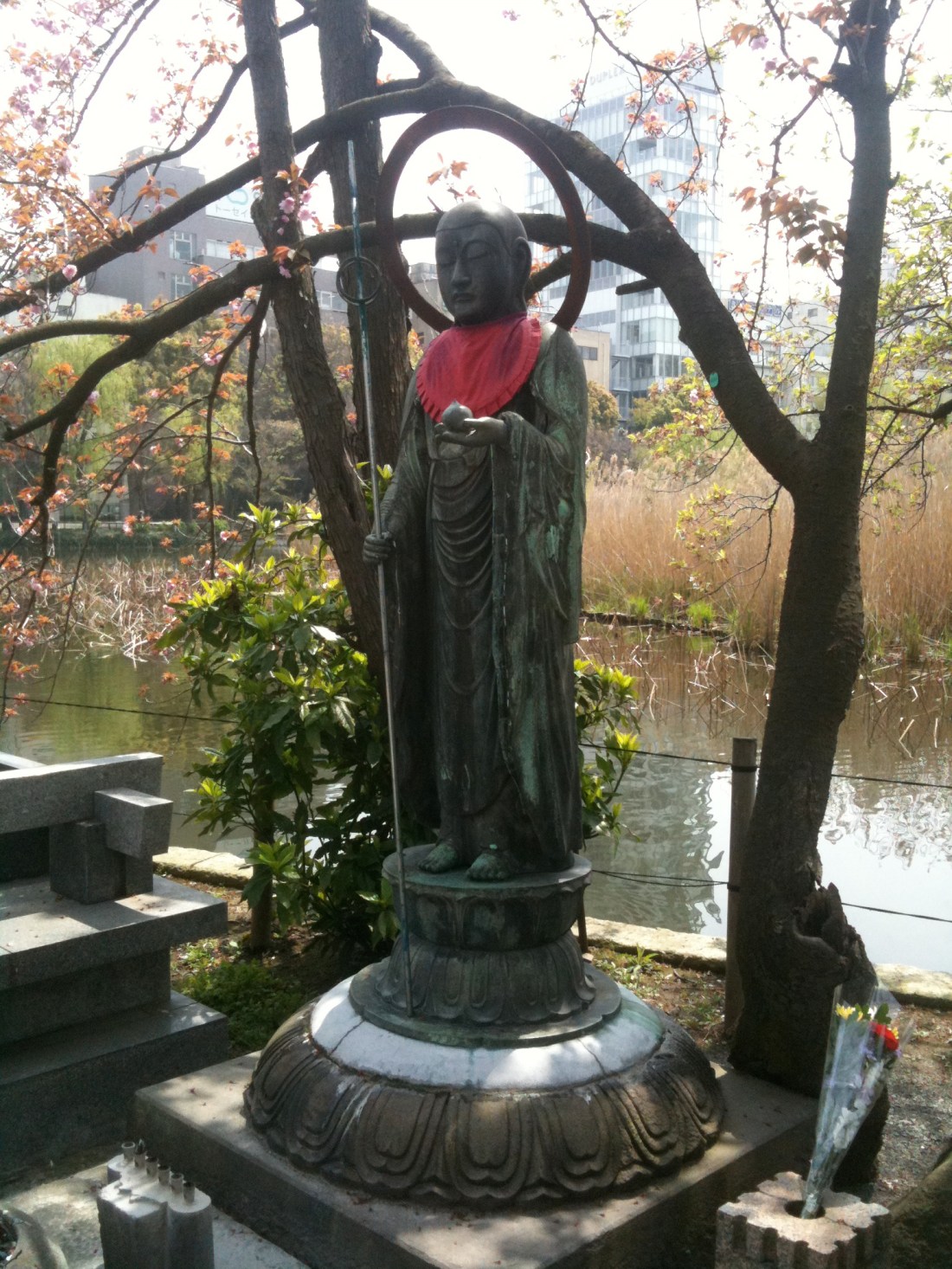
Some of the most well-known Bodhisattvas in traditional Buddhism are paragons of this sentiment to help others. For example, Ksitigarbha Bodhisattva (a.k.a. “Jizō”, shown in featured image in this post), made the following vow in the Earth-store Bodhisattva Sutra:
The Brahman woman returned swiftly as if from a dream, understood what had happened, and then made a profound and far-reaching vow before the stupas and images of Enlightenment-Flower Samadhi Self-Mastery King Thus Come One, saying, ‘I vow that until the end of future eons I will respond to beings suffering for their offenses by using many expedient devices to bring about their liberation.’
Later, Shakyamuni Buddha entrusts Ksitigarbha Bodhisattva with the care and salvation of all sentient beings until the coming of the next Buddha: Maitreya.
Further, well-known Buddhas such as the Medicine Buddha and Amitabha Buddha, the Buddha of Infinite Light, made great vows to assist others during their stage as a Bodhisattva. In the Medicine Buddha Sutra is the following quote:
Manjushri, when the World-Honored Medicine Buddha was treading the Bodhisattva path, he solemnly made Twelve Great Vows to grant sentient beings whatever they desired.
Translation by Minh Thành & P.D. Leigh
These vows included not just material things like health and goods, but also confidence in the Dharma, strength to maintain the precepts, and encouragement to seek rebirth in Amitabha’s Pure Land.
Similarly, when Amitabha Buddha was a Bodhisattva, he made 48 vows before a Buddha named Lokesvararaja to create a refuge for all beings (i.e. the Pure Land), and to allow beings to be reborn there even if they merely uttered his name, as described in the Immeasurable Life Sutra:
I have made vows, unrivaled in all the world; I will certainly reach the unsurpassed Way. If these vows should not be fulfilled, May I not attain perfect Enlightenment. If I should not become a great benefactor In lives to come for immeasurable kalpas To save the poor and the afflicted everywhere, May I not attain perfect Enlightenment.
Translation by Hisao Inagaki
Shakyamuni Buddha then explains to Ananda that Amitabha Buddha fulfilled his vows 10 eons (kalpas) ago, and thus the Pure Land was established as a refuge for all beings.
In Conclusion
As we can see from traditional Mahayana Buddhist literature, the story of Shakyamuni Buddha’s long quest for enlightenment became the archetypal story behind many other Buddhist figures. Whether Amitabha Buddha really did exist 10 kalpas ago or not is less important than the repeated themes found among all bodhisattvas, including Shakyamuni. These are the quest for enlightenment, the resolution to help others along the way, and the perfection of Buddhist virtues.
1 The Awakening of Faith is probably the best example of a pre-modern “text-book” on Mahayana Buddhism. While it reflects mid-to-late Mahayana Thought, and is likely of Chinese, not Indian origin, it does a great job synthesizing various concepts in Mahayana Buddhism into a more straightforward, succinct text. Sadly, the text is not well known in modern Buddhism, and few translations exist. Hakeda’s translation is the best, in my humble opinion.
2 The Known Universe is about 15 billion years if that gives you any idea of the scale. Granted, ancient Indians were not aware of modern astronomy, but clearly they wanted to convey a overwhelming sense of scale in there undertaking of the Bodhisattva Path.
Author’s note: this is a post from the old blog that I am reposting as a handy reference, with some extra updates and polish. Enjoy! 😄
One concept that often frustrated me in my early years as a Buddhist was the bodhisattva. Bodhisattvas are central to Mahayana Buddhism, that is all Buddhism from Tibet to Japan (and now overseas), and it seems like everyone had a different idea what a bodhisattva is.
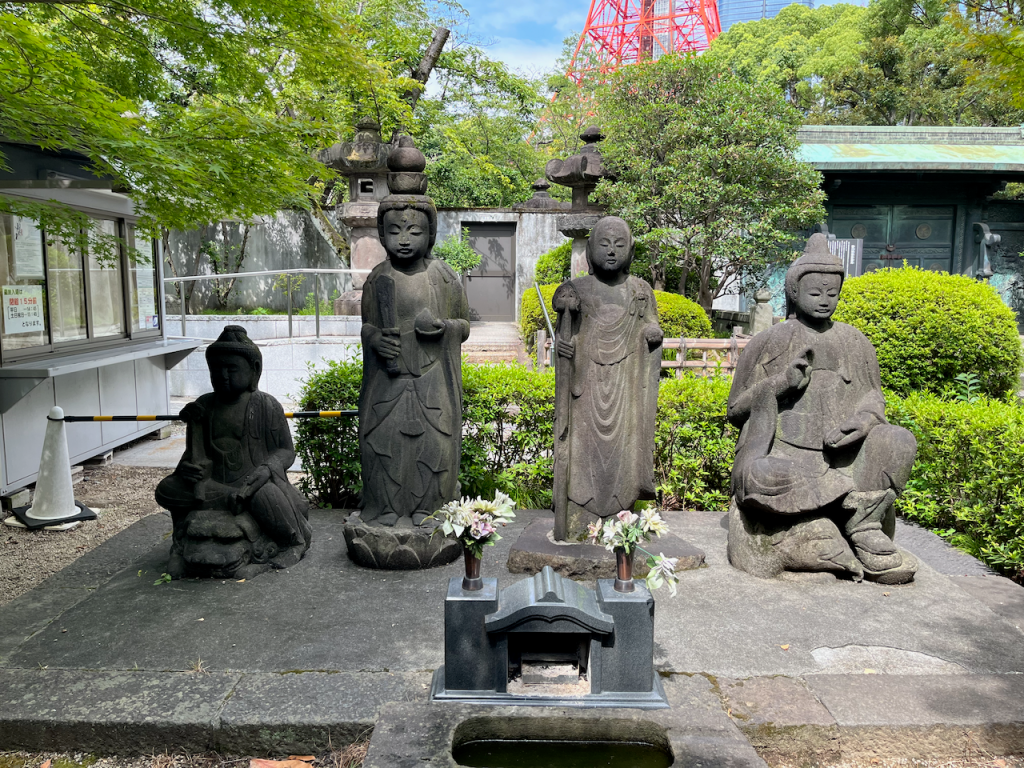
A series of statues at Zojoji Temple in Tokyo, Japan depicting four famous bodhisattvas in the Mahayana tradition. From left to right Manjushri (Monju), Avalokitesvara (Kannon), Ksitigarbha (Jizo), and Samanthabhadra (Fugen).
So, one time I decided to research this and hopefully provide a more comprehensive answer. This is still one man’s explanation, so take it with a grain of salt, but I did use the following sources:
Edward Conze – Buddhist Thought in India (ISBN 0472061291)
Robert E. Buswell Jr., Donald S. Lopez Jr. – Princeton Dictionary of Buddhism (ISBN: 0691157863)
Access to Insight – one of the best sources on Theravada Buddhism, and a great Buddhist resource in general.
Tagawa Shun’ei, translation by Charles Muller – Living Yogacara: An Introduction to Consciousness-Only Buddhism (ISBN: 0861715896)
Asvaghosha, translation by Yoshito S. Hakeda – The Awakening of Faith (In the Mahayana) (ISBN: 0231030258)
And the following sutras (or collections of sutras) were used:
In simplest terms a bodhisattva in Sanskrit, or bodhisatta in Pāli, means a “seeker of enlightnment”. In the earliest scriptures, the Buddha would talk to his disciples about his own past lives as a bodhisattva, such as this sutra in the Pali Canon:
“Bhikkhus [monks], before my enlightenment, when I was still only an unenlightened Bodhisatta, I too, being myself subject to birth, sought what was also subject to birth; being myself subject to aging, sickness, death, sorrow, and defilement, I sought what was also subject to aging, sickness, death, sorrow and defilement….”
In this context, the term bodhisattva mainly referred to the past lives of the historical Buddha, Shakyamuni. In his past lives, when he dwelt in the heavenly realm called Tuṣita (Tushita) and then was born as a prince in India, he was on the cusp of Enlightenment, and only needed that final push. Further, early texts, such as the Jatakas Tales, also imply that this Enlightenment was actually the culmination of many previous lifetimes of searching, effort, and noble deeds. Thus the path of the Bodhisatta who became the historical Buddha was thought to imply an extraordinary, lengthy journey across many lives culminating in final enlightenment.
Later Teachings
In later generations, the role of the Bodhisattva expanded beyond the historical Buddha, and appears more and more often in Buddhist literature. However, it is not the case though that Bodhisattvas are found in Mahayana Buddhism only though. For an excellent treatment of the subject, I highly recommend reading this article by Bhikkhu Bodhi.1 It was just that the path seemed too remote and arduous for most disciples, especially since the presence of a living Buddha allowed them to reach enlightenment much more quickly as Śrāvaka (shravaka) or “hearer-disciple”.
Anyway, in the classic Buddhist model, the historical Buddha was something like a “first among equals”, in that the quality of enlightenment experienced by Arhats (e.g. “noble ones”) was the same as the Buddha. However, Buddhas were distinguished from Arhats by additional qualities that made them almost suprahuman. A Buddha is one who, among other things, gains insight into the truth at a time when the Dharma is unknown (i.e. no other Buddha to teach them), which requires extraordinary spiritual insights and qualities, not to mention their capacity to teach others in such a way that they become enlightened too, and can carry the Dharma onward for generations. This was the contrast between a Buddha and an Arhat.
Over time, the Buddhist community began to explore more and more the notion of becoming a Buddha too (e.g. Buddhahood), and thus the role of the Bodhisattva became increasingly important. As a result, the status of a bodhisattva was elevated over arhats, such that arhats were considered noble, but somewhat inferior to Buddhas and Bodhisattvas.
How Do Arhats, Bodhisattvas and Buddhas relate?
A number of models to explain the relationship between buddhas, bodhisattvas and arhats developed over the course of Buddhist history. As we saw earlier, the original model really only included arhats and buddhas. However, the influential Yogacara school of Mahayana Buddhism (of which the Hossō school in Japan is one of the few independent remnants) taught that different beings had different, inherent natures that would incline them toward the Buddhist path of an arhat, bodhisattva (and thus a Buddha), indeterminate or even those whom enlightenment was impossible.
However, the most popular model in Mahayana Buddhism became the Ekayāna or “One-Vehicle” model. This was popularized by the Lotus Sutra which taught that all disciples would inevitably follow the same path, even if they appeared different at first. Each path (arhat, bodhisattva, etc) were part of the same natural progression and would ultimately converge. In the famous “Parable of the Burning House” in Chapter Three, the father says to his children in the burning house:
“Such a variety of goat carts, deer carts, and bullock carts is now outside the gate to play with. All of you must come quickly out of this burning house, and I will give you whatever you want.”
This parable, the Buddha explains, is meant to show that all followers seem to be following different trajectories, yet ultimately they all converge on the (Mahayana) Buddhist path and become bodhisattvas and then ultimately Buddhas.
Later, starting in the sixth chapter, the Buddha then predicts that his senior monks and nuns, all presumed to be arhats, will eventually become Buddhas. This again emphasizes that the arhat stage is not separate, but a kind of prepartory stage before the “real” Buddhist path begins. Again though, we see that arhat is considered a noble but somewhat inferior status to the bodhisattva, and that their enlightenment is somehow incomplete when compared to the enlightenment of a Buddha. Nevertheless, the arhat is still revered and respected in Mahayana Buddhism. For example, in the Amitabha Sutra, the historical Buddha describes the Pure Land of Amitabha Buddha like so:
Moreover, Śāriputra, he [the Buddha Amitabha] has an innumerable and unlimited number of śrāvaka disciples, all of them arhats, whose number cannot be reckoned by any means. His assembly of bodhisattvas is similarly vast …. Śāriputra, those sentient beings who hear of that land should aspire to be born there. Why? Because they will be able to meet such sages of supreme virtue.
Translation by Rev. Hisao Inagaki
Anyhow, we have talked quite a bit about the history of the bodhisattva, but in part two we’ll discuss how the sutras describe and define a bodhisattva, and how they relate to the buddhas. Stay tuned!
1 Please repeat after me: Bodhisattvas are not found in Mahayana Buddhism only. Many elements of the bodhisattva that we do see in Mahayana Buddhism have their roots in the earlier Mahāsāṃghika school of early Buddhism, which Mahayana drew many ideas and inspirations from. However, the Mahayana also drew from other schools such as Sarvastivada and Dharmagupta among others. The ideas were already there, the early Mahayana Buddhists simply synthesized them.
Lately, I have been posting old nostalgia posts from visits made to Japan and its famous Buddhist temples, such as Kiyomizudera, Ryoanji and the two Pavilions. Today, I wanted to share one more famous temple that, in particular, is often overlooked by visitors, yet really worth a visit for its historical value and amazing cultural treasures. That is the temple of Kofukuji (homepage here), the head of the once-powerful Hosso or Yogacara sect.1
Anyone who’s dabbled in Japanese Buddhism has probably never heard of the Hosso/Yogacara, but in early-medieval Japan it was once the most powerful, if not the de facto state religion. The fortunes of the Hosso school were so great that they were closely allied with the powerful Fujiwara family, and fielded vast armies of sohei soldier-monks to combat their rivals, the upstart Tendai sect. Now, it is a very diminished school in Japan, mostly centered around Nara, Japan, and closely affiliated with Shingon Buddhism. For more on Hosso/Yogacara teachings, I highly recommend the book Living Yogacara: An Introduction to Consciousness-Only Buddhism by Rev. Tagawa Shun’ei.
Anyhow, I have been to Nara, Japan twice: once in 2005 during my very first trip to Japan, and again in 2010 when my duaghter was still a little girl.
Because of warfare, accidents and other reasons, Kofukuji has been greatly reduced, and not all buildings have been restored. Currently there are three main “halls”. I believe this is the Eastern Golden Hall (tōkondō 東金堂):
Inside the Eastern Golden Hall, I recall that there was a beautiful altar with man deities lined up, with the Medicine Buddha as the central figure.
Side note: what is called a pagoda in English, is really just an East Asian form of a Buddhist stupa. Stupas are special reliquaries from India, that gradually evolved into the pagodas you see in Japan today.
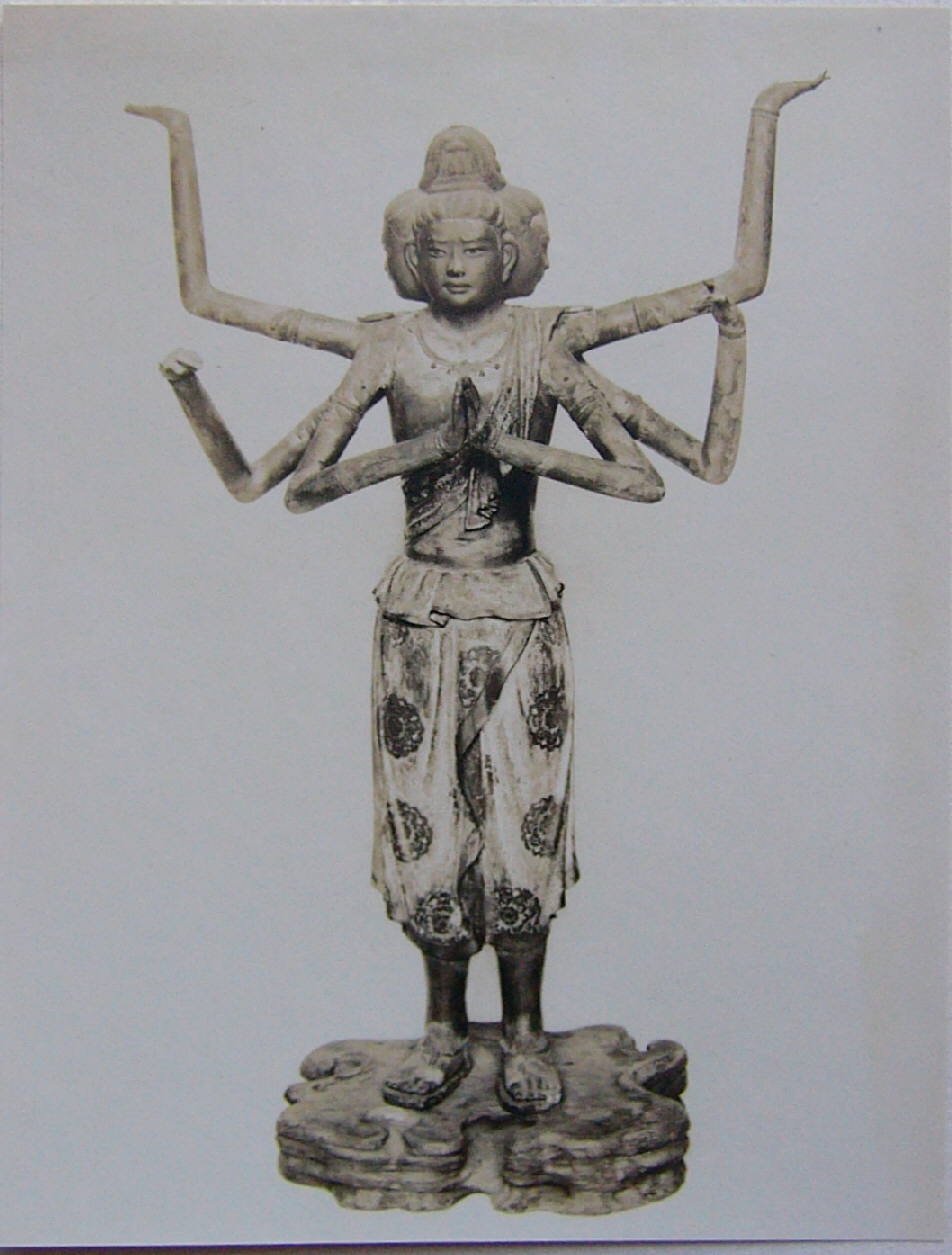
Finally, we visited the museum in the central hall. The museum is huge and contains many relics from Kofukuji’s history, including the famous Asura statue:
Seeing the Asura statue in a picture is one thing, but seeing it in real life was simply amazing (though it was smaller than I expected 😋). Kofukuji has a long, rich history and the museum really shows it.
Nara is the early capital of Japan, and reflects a time when it was closely modeled after Chinese (specifically Tang-dynasty) culture and religion, with a blend of Indian influences as well. It’s a fascinating blend that is not found in later Japanese history. I highly recommend visiting Nara and Kofukuji in particular if you can.
1 The Japanese word hossō (法相) is a transliteration of the Chinese translation of the Sanskrit term yogācāra. Buddhist terminology has a long, fascinating history.
Lately, I’ve been playing the classic RPG game Chrono Trigger on my mobile phone, and it’s been a lot of fun to relive this game on a modern platform. I am amazed that this game even fits on a mobile phone, but that shows how much times has changed.
Anyhow, these screenshots are from my favorite part of the game where the players travel in time to an enlightened Ice Age / Atlantis-like civilization. One of the residents of this realm says to the players (as shown in the screenshots above):
The world you see with your eyes may well differ completely from the one I see with me. There are as many different worlds as there are observers. Never assume that only those things which you can see or touch are real.
This is a surprisingly Buddhist message (even if not intended that way). Allow me to explain.
Of the most fundamental Buddhist teachings (i.e. the Dharma) is the concept of no-self called anātman in Sanskrit. Sentient beings from the moment they’re born or conceived, they begin to experience senses, feelings and thoughts in a interdependent phenomena that Buddha calls the Five Skandhas (aggregates). The details aren’t super important, but what matters is that from all these sense experiences, feelings and thoughts, sentient beings reify this into a sense of self, even though it has no permanent substance (i.e. it “has no leg to stand on”).
Because we create this sense of self out of our past experiences, thoughts, etc, it also colors our future thoughts and impressions as well. The experiences and sense of self of a person born in a rural family will differ from a family born in the city, a person born in one country vs. another, a person raised in a large family vs. a small one, a religious family vs. a non-religious one, etc. In short, there are almost as many possible ways to look at the world as there are people because each person is coming with their own personal baggage, and each one assumes their perspective is reality because that’s all they’ve ever known. It’s like a fish who only knows the lake waters they have grown up in, unaware of a much larger ocean, let alone the air above, and space beyond that.
Further, in the end, these perspectives, views, etc are all just a bunch of hot air. They have no substance apart from what is in people’s minds. Hence no-self / anātman.
The Buddha really brings this home when he talked with a wandering ascetic named Vaccha:
“A ‘position,’ Vaccha, is something that a Tathagata [i.e. a Buddha] has “A ‘position,’ Vaccha, is something that a Tathāgata has done away with. What a Tathāgata sees is this: ‘Such is form, such its origination, such its disappearance; such is feeling, such its origination, such its disappearance; such is perception… such are fabrications… such is consciousness, such its origination, such its disappearance.’ Because of this, I say, a Tathāgata—with the ending, fading away, cessation, renunciation, & relinquishment of all suppositions, all excogitations, all I-making & mine-making & obsessions with conceit—is, through lack of clinging/sustenance, released.”
So, while we need to rely on our senses and thoughts for practical, day-to-day living, it’s important to take our own thoughts with a grain of salt, and not assume we have a pristine understanding of things. The results may surprise you.
P.S. The venerable Yogacara school of Buddhist philosophy really explored this in excruciating detail by mapping the mind, how it takes in new experiences, the many possible feelings one might experience, etc, and how these drive new thoughts based on past experience in a kind of feedback loop which they called “perfuming the seeds [of the mind]”. Reverend Tagawa’s excellent book, translated into English by Professor Charles Muller, Living Yogacara is an excellent overview of the Yogacara school of philosophy as it exists in Japan as the Hossō school. One of my favorite Buddhist books to read.
Lately, I have been following a fascinating history podcast called the Hellenistic Age Podcast, a detailed look at a very fascinating and often overlooked period of world history. In particular, I am listening to the set of episodes regarding Hellenistic-era philosophy:
It’s a great show, and lots of fun to delve into so many different, fascinating schools of thought. But, then inevitably, you have to come down. Enjoying ancient philosophy is great until you realize that sooner or later, you need put it down in order to eat, shit, sleep, work, deal with getting sick, etc.
Much of this applies to many other aspects of life. Sooner or later, we have to come down and deal with mundane hassles of life, no matter how much we try to escape from them. This applies to any kind of escape we do.
I think this is why the Zen tradition in Buddhism adopted such a strongly anti-intellectual streak, a reaction to the high-minded Buddhist-philosophical traditions from India: the Madhyamika, the Yogacara, and the native Chinese traditions of Hua-yan and Tian-Tai.
For example, a famous story attributed to a Chinese Zen master named Baizhang (百丈, 720–814, pronounced bye-jong):
When asked what the secret of Zen was, he told one disciple, “When hungry, eat – when tired, sleep.”
The anti-intellectual streak in Zen, especially modern Zen (and in some strains of Pure Land Buddhism), tends to rub me the wrong way. Maybe it’s just the nerd in me. But at the same time, I can’t deny that as much fun as philosophy is, including Buddhist religion, it is all just mental games compared with the reality of life itself. Life intrudes on us, and keeps us grounded, for better or for worse. 🤷🏽♂️
It also illustrates that the mind isn’t entirely reliable either. High-minded ideals will go right out the window when we are tired, hungry, etc.
All the more reason to stay grounded, and keep a watchful eye on one’s own mind.
Recently, I re-posted an old polemic article I wrote 8 years ago (!) in a former blog at a time when I was on my out the door from the local Jodo Shinshu Buddhist community, citing references to one of Honen’s biggest critics, Jokei, an influential monk of the influential Hosso (Yogacara) school. Many of the points that Jokei criticized are common complaints that even today people level against the Pure Land path, specifically Jodo Shu and Jodo Shinshu Buddhism. I have even made these criticisms myself from time to time.
However, in the book Traversing the Pure Land Path, the author makes an interesting point that I did not fully grasp back then:
…Honen’s single-minded focus on the nenbutsu (senju nenbutsu) is not a narrow-minded or exclusivist practice. Rather, it is prioritization or “selection” (senchaku) of a practice that Honen felt was the most beneficial. In other words, the nenbutsu is an essential competence which needs to be thoroughly understood and experience.
Page 77
Jodo Shu Buddhism takes the nenbutsu practice as its bedrock. This is not unusual in Japanese Buddhism, where many of the Kamakura-era Buddhist schools (Zen, Pure Land, Nichiren) tended to build around a single practice first, and build the teachings around it for support.
However, the book doesn’t stop there:
Honen’s senchaku process also includes reintegration. After realizing the mind is firmly established towards Birth [in the Pure Land] (ketsujo ojo-shin), the four other right practices (sho-gyo) of Amida’s Pure Land can be readopted as similar kinds of auxiliary practices (dorui-no-jogo)….With the transformation of one’s heart through single-minded nenbutsu practice, these auxiliary practices go beyond being merely helpful to nenbutsu practice. Subsumed within nenbutsu practice, they become practices corresponding to Amida’s Original Vow.
Page 77
This idea of reintegration of other practices within the dedicated nenbutsu practice is something I didn’t fully appreciate in my younger years, but makes more sense now with the benefit of experience. Basically, Honen’s concept of senchaku (選択) is to establish a solid foundation first, then reintegrate other Buddhist practices as your confidence grows. Over time, it becomes a comprehensive practice.
Anyone who sincerely desires birth in the Land of Peace and Bliss is able to attain purity of wisdom and supremacy in virtue. You should not follow the urges of passions, break the precepts, or fall behind others in the practice of the Way.
trans. Hisao Inagaki
Even in the fundamental sutras of Pure Land Buddhism, disciples are encouraged to do good works, maintain wholesome conduct, etc, so it doesn’t differ from the rest of mainstream Buddhism, but Honen’s senchaku approach represents a shift in mindset. Instead of doing the practices just for practices sake, they are rely on Amida’s vow to help all beings, and to prepare for one’s rebirth in the Pure Land.
In my experience, some people I have met who are Pure Land Buddhists tend to take a strictly nenbutsu-only, exclusivist approach, which Honen clearly didn’t agree with, and even in Honen’s time, some of his disciples, such as Kosai, really went of the deep-end.
I feel like Honen’s approach was “never stop, and never get complacent”, but at the same time, he wanted to prioritize a straightforward simple practice first as the bedrock that other things could be built upon. Thus, laypeople and monks, could both start the same way and take it as far as they want.
Author’s Note: this was another post I found recently from my old blog, possibly something I wrote in 2013 or 2014. It was shortly after this that I decided to leave the local Jodo Shinshu Buddhist community, give up the prospect of ordination, and strike out on my own. My feelings on the subject have changed somewhat, but I still agree with the general sentiment. I do miss many of my old friends at the local temple, but these days I am kind of done with Jodo Shinshu Buddhism. Apart from minor edits, and fixing broken links, this is posted as-is. Oh, and I added a cover image from that time and updated the title slightly for clarity. 😋
An old altar we setup years ago while living in Ireland. The central image was purchased from Tsukiji Honganji in Japan and venerates Amitabha Buddha, the Buddha of Infinite Light.
Lately, as I have been able to enjoy a small break in life, work and so on, I delved into some books I haven’t finished reading in a long while, including an excellent study on the life of Hossō Buddhist scholar, Jōkei. The book, titled Jokei and Buddhist Devotion in Early Medieval Japan by James L. Ford, is both a biography, but also a critical look at the late Heian, early Kamakura periods from a Buddhist perspective, and an effort to shed new light on this oft-studied and oft-misunderstood period.
In a way, I feel like I am betraying friends I have had the privilege of encountering over the years who are devout Jodo Shu and Shinshu Buddhists, but at the same time, I think Buddhism should be able to stand on its own two feet and take the acid test of criticism sometimes.1 To my friends on the Pure Land path, please forgive this post. It is not a personal attack, and I know many people in Jodo Shu and Jodo Shinshu who are admirable Buddhists in their own right. It’s just that while reading Ford’s book, I really felt he hit the nail on the head with certain things about Honen and Shinran’s teachings that made me uneasy, particularly the “exclusive” Pure Land approach that orthodox Jodo Shu and Jodo Shinshu followers adopt. Until recently though, I couldn’t quite articulate it myself.
This uneasiness came about back when I first started reading Rev. Tagawa’s book on Yogacara Buddhism, and on my recent trip to Kyoto and Nara, this old uneasiness arose in me moreso as I stood at the feet of great temples such in Kyoto and Nara. When I stood in the Treasure House of Kofukuji, beheld all the amazing artwork there, and the vast corpus of teachings they represented, I knew something was still amiss in my Buddhist path and it’s been gnawing on my mind for a while now.
Jōkei is best known as a sharp critic of Hōnen and the exclusive Pure Land movement, or senju nembutsu (専修念仏). As such, he was the primary author in 1205 of the Kōfukuji Sōjō (興福寺奏状), or the “Kofukuji Petition” to the Emperor which sought to suppress the “exclusive nembutsu” Pure Land school started by Honen. History has not been kind to Jokei, and Professor Ford argues that the study of Kamakura Buddhism is flawed because of some underlying biases and assumptions about “old” vs. “new” Buddhism. Meiji-era and later studies tend to apply a kind of “Buddhist revolution” to Honen and Shinran, and paint traditional Buddhist sects as elitist or oppressive. Sometimes, parallels between Shinran and Martin Luther have been drawn in scholarly circles, though more modern research has refuted this analogy as superficial at best.
A while back, after reading Dr. Richard Payne’s collection of essays on the subject of Kamakura-era Buddhism, I started to question these assumptions, but more so after reading Ford’s book. He explores the Petition toward the last-half of the book and Jokei’s relationship with Honen to show how history has normally written about the incident, and carefully dissects it to show another viewpoint. In essence, he argues that Jokei’s criticism of Honen isn’t an “old-guard” or “elitist” perspective, but more accurately reflects a “normative” Buddhist doctrinal stance.
Ford explores at length about the content of Jokei’s Kofukuji Petition and its nine articles faulting the new senju nembutsu (専修念仏) or “exclusive nembutsu” movement, which are Ford summarizes in four points (I am quoting verbatim here):
[According to Jokei,] Honen abandoned all traditional Buddhist practices other than verbal recitation of the nembutsu.
Honen rejected the importance of karmic causality and moral behavior in pursuit of birth in the Pure Land.
Honen false appropriated and misinterpreted Shan-tao with respect to nembutsu practice.
Honen’s teachings had negative social and political implications.
To bolster his stance in the Petition, Jokei uses the same textual sources as Honen to demonstrate that Honen only selectively drew certain teachings from Chinese Pure Land patriarchs, Shan-Tao, Tao-ch’o and T’an-luan to prove his beliefs concerning the verbal nembutsu, while ignoring the whole of their teachings and writings, which included a more comprehensive Pure Land Buddhist path. Ford then turns to modern scholars to show that in China, the nembutsu (nian-fo) was never seen as a verbal-only practice even in Shan-tao’s time, but was interpreted as a well-developed meditation system. This is reflected even in modern day Chinese Buddhist writings, such as those of the late Ven. Yin-Shun.
As Ford then concludes:
Thus Jōkei’s claim that the Pure Land schools had no precedence in China is probably true. All in all, Jōkei’s critique of Honen’s construction of an independent Pure Land sect based on exclusive practice of the oral nembutsu is generally well grounded both doctrinally and historically. (pg. 178)
Jokei’s accusation that Honen abandoned the karmic law of causality and undermined the Buddhist teachings for upholding moral conduct, also weighs heavily. Jokei asserts the traditional Buddhist view2 of time as infinite, and that people are responsible for their own karma and the pursuit of wisdom. From Jokei’s perspective, one’s poor conduct can forestall one’s rebirth in the Pure Land, or reduce the conditions of rebirth itself. He notes the Nine Grades of Rebirth in the Contemplation of Amitabha Sutra, but I am personally also reminded of the proviso in Amida Buddha’s 18th Vow in the Immeasurable Life Sutra:
Excluded, however, are those who commit the five gravest offences and abuse the right Dharma.
Or Shakyamuni’s admonition in the same Immeasurable Life Sutra:
Anyone who sincerely desires birth in the Land of Peace and Bliss is able to attain purity of wisdom and supremacy in virtue. You should not follow the urges of passions, break the precepts, or fall behind others in the practice of the Way. If you have doubts and are not clear about my teaching, ask me, the Buddha, about anything and I shall explain it to you.”
One’s poor conduct doesn’t prevent the Vow of Amitabha Buddha from being fulfilled, but delayed and hindered for a time, Jokei argues. Either way, Jokei reinforces a traditional Buddhist view of the importance of karmic causality as central to Buddhism, inline with the teachings of Shakyamuni Buddha himself in countless, countless, countless sutras. As evinced elsewhere in the book, Jokei like many Buddhists believes in the power of Amitabha and his Vows to bring people to the Pure Land, but also asserts that one is still responsible for their karma, so one has to meet Amitabha Buddha half-way in a sense. Jokei’s many sermons and devotions to Kannon, Maitreya and others show that he often advocated this “middle” approach between devotion and personal practice/responsibility and Ford argues that this was the normative approach to Buddhism taken through out Asian Buddhist history.
Indeed, in Jokei’s words describing himself:
[My opinion] is not like the doubt of scholars concerning nature and marks, nor is it like the single-minded faith of people in the world. (pg. 179)
Meanwhile, later Ford shows how Jokei by contrast:
…represents a ‘middle-way’ between the extremes of ‘self-power’ and ‘other-power.’ He was not unique in this respect, since this perspective, though perhaps unarticulated, predominated within traditional Buddhism — despite the rhetorical efforts of figures like Honen and Shinran to paint the established schools as jiriki (self-power) extremists. (pg. 202)”.
But nevertheless, Ford shows how modern scholars in Japan and in the West have skewed this view of history with the belief that the politics of medieval Japan were reactionary, and stifling Buddhism in Japan at the time, leading to the Pure Land movement. Here, I quote Ford directly (emphasis added):
Hōnen’s response to the apparent social inequity and underlying monastic/lay tension — always a feature of Buddhism — was, in effect, to abolish the traditional lay-monastic framework. I am not convinced that he meant to destroy the system, particularly given his devotion to the monastic life, but the effect of his message, as revealed in the Senchakushū, was to undermine the practices and doctrines that sustained the monastic ideal. Pronouncing them obsolete because of the limitations of the age, he concluded that salvation was no longer contingent upon precept adherence, meditative practice, or diligent effort toward realization. Realization was now deemed a secondary goal, since it could not be attained in this world; it could only be attained in Amida’s Pure Land. Although others before Hōnen had devised “simple” practices to address the needs of lay practitioners and lessen the tension noted above, an implicit contradiction remained. If these practices could deliver as promised, why go through the arduous training of a monk? The monastic ideal could be interpreted as an ever-present source of doubt with respect to the efficacy of the “simple” practices. Hōnen can be seen, at least in terms of effect, as one who address this doubt directly, but Shinran appears much more explicitly conscious of this issue. (pg. 183)
Ford then adds:
We certainly cannot fault Hōnen and Shinran for creatively adapting these well-established labels [self-power/other-power, “easy” and “difficult” practices] for their own proselytizing ends. However, we must dismiss these sectarian rhetorical categories as legitimate analytical categories in the study of Kamakura Buddhism. (pg. 202)
Summing up here, I think Ford gets at two critical points here. First, in mainland Asia, historically Pure Land teachings have never been divided along exclusive or sectarian lines, and such was even the case for early medieval Japanese Buddhism:
Scholars generally agree that the tradition of the Pure Land in China represented more of a “scriptural tradition” than a “doctrinal school” and that people of many different schools practiced the nien-fo [nembutsu]. Thus, Jōkei’s claim that the Pure Land schools had no precedence in China is probably true.
A sectarian, exclusive Pure Land Buddhism quite literally did not arise until Honen and later Shinran’s time. Ford is right in crediting them with adapting teaching to suit a need, and I write this with a heavy heart because I actually like both Honen and Shinran, but I agree that the effect, perhaps unintended, was to foster a kind of narrow sectarianism that didn’t exist in Pure Land Buddhist teachings and practices before. I guess it was the sign of the times.
And yet in the modern world, there are many Buddhists in Asia, Japan and the mainland, who are devoted to Amitabha Buddha and still follow traditional Buddhist practices in some form or another. Such people have not forgotten the important balance of sila (moral conduct), samadhi (practice) and paññā (wisdom) even as they strive for rebirth in the Pure Land. Indeed the late Ven. Yin-Shun in his book The Way to Buddhahood, taught a comprehensive approach not unlike that which Shan-tao and Tao-ch’o offered many centuries ago:
The chanting of “Amitabha Buddha” should also be accompanied by prostrations, praise, repententance, the making of sincere requests, rejoicing, and the transference of merit. According to the five sequences in the “Jing tu lun” (Pure Land Treatise),3 one should start with prostrations and praise and then move into practicing cessation [meditation], contemplation [more meditation], and skillful means. One can thereby quickly reach the stage of not retreating from the supreme bodhi. As Nāgārjuna’s Śāstra puts it “those aiming for the stage of avivartin [non-retrogression] should not just be mindful, chant names and prostrate.
It’s a well-established trend, and works for many people in the world, but only in Japan is there a separate trend toward exclusivity and the idea of traditional Buddhism being invalidated. The sense of Dharma Decline so critical to Japanese Pure Land in today’s climate seems like a subjective anachronism now, and difficult to base a doctrine on with so great a diversity of sanghas and teachings in the world.
Second, what I believe to be the stronger refutation of Japanese Pure Land Buddhism as traditionally practiced in Jodo Shinshu and Jodo Shu is summed up in the following passage which deals with the issue of hōben (方便) or “expedient means” (again, emphasis added):
Both in his religious practice and, specifically, the Sōjō, Jōkei’s articulation of the normative voice of inclusivism and diversity within Buddhism is again instructive. The content of this vision of Buddhism, grounded in the tradition’s emphasis on karmic causality, appears almost boundless at times. Hōnen’s exclusive claims of efficacy, resonating with much of the contemporary Tendai hongaku discourse and effectively undermining the moral implications of karma and its ramifications for Buddhist soteriolology, was a wholesale rejection of Buddhist tradition. It invalidated not only the devotion to the variety of Buddhas and Bodhisattvas that manifest different qualities of wisdom and compassion but also the importance of various kinds of ascetic practices, long the centerpiece of monastic life. In short, Hōnen’s teaching “delocated” Buddhist sacrality from its traditional broad manifestations — temporal and spatial — to one single exclusive manifestation. (pg. 203)
Again, I think back to my experiences in Nara, Japan in particular. At Todaiji alone, I saw six or seven temples on the temple grounds devoted to various figures of Buddhism. The plurality was amazing, and welcoming in a way. It felt inclusive, not exclusive, and there was no sense of guilt in praying to Jizo Bodhisattva, or the Lotus Sutra, one might feel in a Jodo Shinshu temple for example4 While there, if all I wanted to do was see Kannon, I could do so, but if I wanted to see other figures too, no problem. In other words, the broad, inclusive nature of Nara-style Buddhism allows Buddhists to offer as much or as little devotion to their heart’s content. No need to worry about doctrinal clashes or implicit guilt.
Thus, my faith in Amitabha Buddha and the Pure Land is no less than it once was, but Ford’s and Jokei’s writings and my experiences in Nara and Kyoto remind me that Buddhism is strongest in diversity, and later Kamakura schools of Buddhism have a tendency toward exclusivity. Japanese Pure Land Buddhists, along with some Zen and Nichiren Buddhists, argue that exclusive approach is simpler and more accessible, but given what other Buddhists faiths I’ve seen, I believe the exclusive approach is ironically less simple and less accessible by virtue of their exclusivity. Too much rationalization, cutting off, and justification while the rest of the Buddhist world quietly hums along to a relatively consistent tune, even with all its own faults.
The inclusive approach exemplified by Jokei, and Ford’s argument that it’s the normative Buddhist approach for most of the Buddhist world, allows considerable flexibility to follow an approach that works for you, without having to deny other paths as too difficult, elitist or only valid during a “better era” of Buddhism. Just follow which aspect you tend to have a karmic connection toward, whether it be Amitabha Buddha, Shakyamuni Buddha, Kannon, zazen, tantra, or some combination.
First and foremost, I guess I consider myself a Mahayana Buddhist and second a Pure Land follower, not the other way around. So, what does this mean for me? I think I already know the answer, but I’m holding off for now to think further. Jokei’s “middle of the road” approach to Buddhist devotion and practice, and inclusiveness, provides a lot of inspiration right now, along with my experiences in Japan, and I hope to explore this more as time goes on.
Namo Shaka Nyorai Namo Amida Butsu
P.S. More regarding the critical role karmic causality plays in Buddhism from Ven. Thanissaro Bhikkhu
1 This would normally be the time to bring up the classic Kalama Sutta text, an awesome, though often quoted out of context in Buddhist writings. Instead, I’ll encourage you to read it yourself in full. It really is one of the best sutras in Buddhism. 🙂
2 Exemplified in the Yogacara/Hossō school in particular amongst the Nara Buddhist schools, and in opposition to Tendai “hongaku” or “innate enlightenment” teachings, and Shingon teachings regarding the “womb of Buddhahood”. It was one of the most tense and long-standing doctrinal feuds in Japanese Buddhism all the way until after Jokei’s time when some reconciliation was made. Ford does not elaborate on how this was done.
3 To be precise the Pure Land Treatise is: 淨土論, Ching-t’u-lun (Wade-Giles) or Jìngtǔ lùn (Pinyin), composed by Jiacai (迦才, ca.620-680).
4 Some Shinshu Buddhists I’ve met have explained it’s OK, as long as it’s an expression of gratitude but again there’s that subtle “if” in there.
Hey folks, I found this random article on ABC News recently on a mom’s obsession with QAnon and how it gradually consumed her life. This article was really interesting to me because it shows how the slow progression of an idea can become all-consuming to the point that it consumes a person, cutting them off from reality, to their detriment.
This kind of death-spiral isn’t limited to stupid conspiracy theories either. It can be all kinds of things, both fun and terrifying that can occupy your mind so much that they increasingly cut you off from reality into your own little world.
In fact, the entire notion of the venerable Yogacara tradition of Buddhism was that (paraphrasing here) every one of us lives in their own perceptual “bubble” and that our thoughts, actions and choices further color this perception more and more in a kind of feedback loop. The English translation of Reverend Shun’ei Tagawa’s book, Living Yogacara, is an excellent primer on the subject and worth a good read. I need to bring back some of my old posts on Yogacara Buddhism as it is a fascinating tradition.
In any case, as Yogacara Buddhism teaches this constant, mental cycle is a kind of feedback loop whereby your thoughts, actions and choices color your future perceptions, which in turn lead to further thoughts, actions and choices, etc. Thus, a mountain climber and a painter will look at the same mountain differently because of how they color reality based on their ongoing mental “loop”. The upshot though means that if you don’t stop to evaluate your mind from time to time, you can really go off the rails, even when what you’re thinking and doing seems totally reasonable to you.
Thus, from the Buddhist standpoint, it’s OK and healthy to stop from time to time and ask yourself: what am I thinking about now? How do I feel now? Why do I feel this way? and so on.
Even doing that for a few moments can save you countless hours (or more) of pain, anguish and misery that you didn’t have to undergo.
Hi folks, as Ohigan season has arrived once more, I revisited an old post I made ages ago in a past incarnation1 of this blog, now updated and expanded from the original. So old it’s new again! 😄
A long time ago, while walking to work one day, I got to thinking about a certain, Buddhist text, called the Lotus Sutra, or hokkekyō (法華経) in Japanese. The Lotus Sutra is probably the most important Buddhist text in all of Mahayana Buddhism, that is Buddhism across east Asia including China, Japan, Korea, Vietnam and so on. The Lotus Sutra is so important that it pretty much defines what Mahayana Buddhism is. Even though the Lotus Sutra is nearly 2,000 years old, composed in waves starting in the 1st century CE, it is still actively studied, chanted, and revered by countless Buddhists.
In spite of its importance, the Lotus Sutra is a tough sutra to read, especially for new Buddhists who aren’t used to “sutra language” and style. An old Buddhist friend of mine described it as the “prologue without a story”. At other times, its powerful imagery and use of (sometimes) convoluted parables can bewilder, confuse or turn some people off.2
But that particular day, I got to thinking what the entire sutra means, given its length, and how this applies to life now. Once you get used to its archaic style and language,3 I believe it is still very relevant today to Buddhists and non-Buddhists because it introduces many ideas that have since become a part of mainstream Buddhism tradition:
In spite of the various schools, practices and regional/cultural differences, there is only one Buddhism, and all of them are included. (chapter 2)
No effort is wasted. If kids offer a pile of sand to the Buddha, or a person says “Hail Buddha” even once, they are on the Buddhist path and will someday reach Enlightenment. (chapter 2)
There is only one truth, but each person understands it as best they can. (chapter 5)
In true Buddhism, there is no discrimination between men and women, young and old. All can attain Buddhahood if they have the noble intention of doing so. (chapter 6, 8, 9, 10).
Also intention, not form or background, is what matters. (chapter 12’s story of the Dragon Princess)
The Buddhist lifestyle is one of peace, goodwill, and wholesome restraint. A person should refrain from criticizing other people’s beliefs, nor withhold teachings either when asked. (chapter 14)
Anyone who upholds these truths can be a “Bodhisattva of the Earth”, a guardian of the Buddhist teachings. (chapter 15).
The Buddha is more than just a physical/historical person. In other words the Dharma embodies the Buddha, the Buddha embodies the Dharma. (chapter 16)
Delighting in the truth, in the Dharma, changes one for the better (ch. 18)
The epitome of Buddhist character is patience (ch. 20), commitment (ch. 23), humility (ch. 24) and compassion (ch. 25)
Friends and good companions are important on the Buddhist path. (ch. 27)
Never give up. (ch. 28)
All of these teachings can be found scattered here and there in earlier Buddhist texts, but the Lotus Sutra functions as a kind of “reboot” or “capstone” text that synthesizes all these ideas and presents them in a more cohesive narrative.
So, happy and peaceful Ohigan to readers, party on Wayne, and Nam-myoho Renge Kyo!
1 See what I did there? Huh? Huh? I’ll see myself out.
2 The first time I read it, it made little sense, and I put it down and forgot about it for years. Later, I found Thich Nhat Hanh’s excellent commentaries on the Lotus Sutra, titled Opening the Heart of the Cosmos. Reading that side-by-side with a copy of the Lotus Sutra helped me appreciate it a lot more.
3 To be fair, the Lotus is roughly contemporaneous to the New Testament, and both have to be read through translations, and the quality of the translations can vary. However, by comparison the New Testament is significantly shorter than the Lotus Sutra, and is mostly in the form of letters by Paul, while the Lotus Sutra is a series of sermons by the Buddha, heavy with symbolism and parable. Based on my limited (not to mention biased) personal experience I find the New Testament more approachable at first (Revelations notwithstanding), but I find the Lotus Sutra more profound. Since they were both composed at very different parts of the world, with different cultures, and religions traditions, it’s probably not a fair comparison. Still, having grown up in US going to Sunday School every week, that’s my thoughts on the two texts.













 Gleanings in Buddha-Fields

You must be logged in to post a comment.