It’s hard to believe but in some places Plum Blossom season is already here! My wife sent me this post from Dazaifu Tenmangu Shrine in western Japan showing the first blooms of the year:
This is a famous Shinto shrine (homepage here) that venerates the God of Learning, Tenjin (天神), better known in history as Sugawara no Michizane.1 I have visited Kitano Tenmangu Shrine in Kyoto, and Yushima Tenmangu Shrine in Tokyo, but Dazaifu is in western Japan where Michizane died in exile and not easily accessible for me, though my sister-in-law somehow got me a charm from there last year. I’ve always liked Tenjin/Michizane, so if I had to pick a Shinto deity, he gets my vote.
Plum blossoms, which imported from China (unlike native cherry blossoms), were trendy among the elite of Japanese society as far back as the Manyoshu anthology (7th century):
Original Manyogana
Modern Japanese
Romanization
Rough Translation1
和何則能尓
我が園に
Waga sono ni
Perhaps
宇米能波奈知流
梅の花散る
Ume no hana chiru
the plum blossoms will
比佐可多能
ひさかたの
Hisakata no
scatter in my garden
阿米欲里由吉能
天より雪の
Ama yori yuki no
like falling snow
那何久流加母
流れ来るかも
Nagarekuru kamo
from the gleaming heavens
1 Amateur translation, apologies for any mistakes
Later, because of Michizane’s devotion to his old plum tree while in exile, plum blossoms became associated with his deified form of Tenjin, and thus Tenmangu shrines typically have some on the sacred grounds.
My own tree2 blooms in early-to-mid February and I look forward to it every year.
I hope you all get a chance to see some plum blossoms in your area too!
1 Elevating historical figures to the status of kami is not that unusual in Shinto religion.
2 Mine are more typical Thundercloud Plum trees (Prunus cerasifera), common here in the US, while Japanese umé (梅) are a somewhat different variety (Prunus mume). But I am happy with what I have.
When people ask me about Japanese New Year (o-shōgatsu, お正月), I like to describe it as melding both Christmas and American Thanksgiving into one three-day holiday. It has its origins in Chinese Lunar New Year, but because of the change in calendar, it now takes place on January 1st through 3rd.
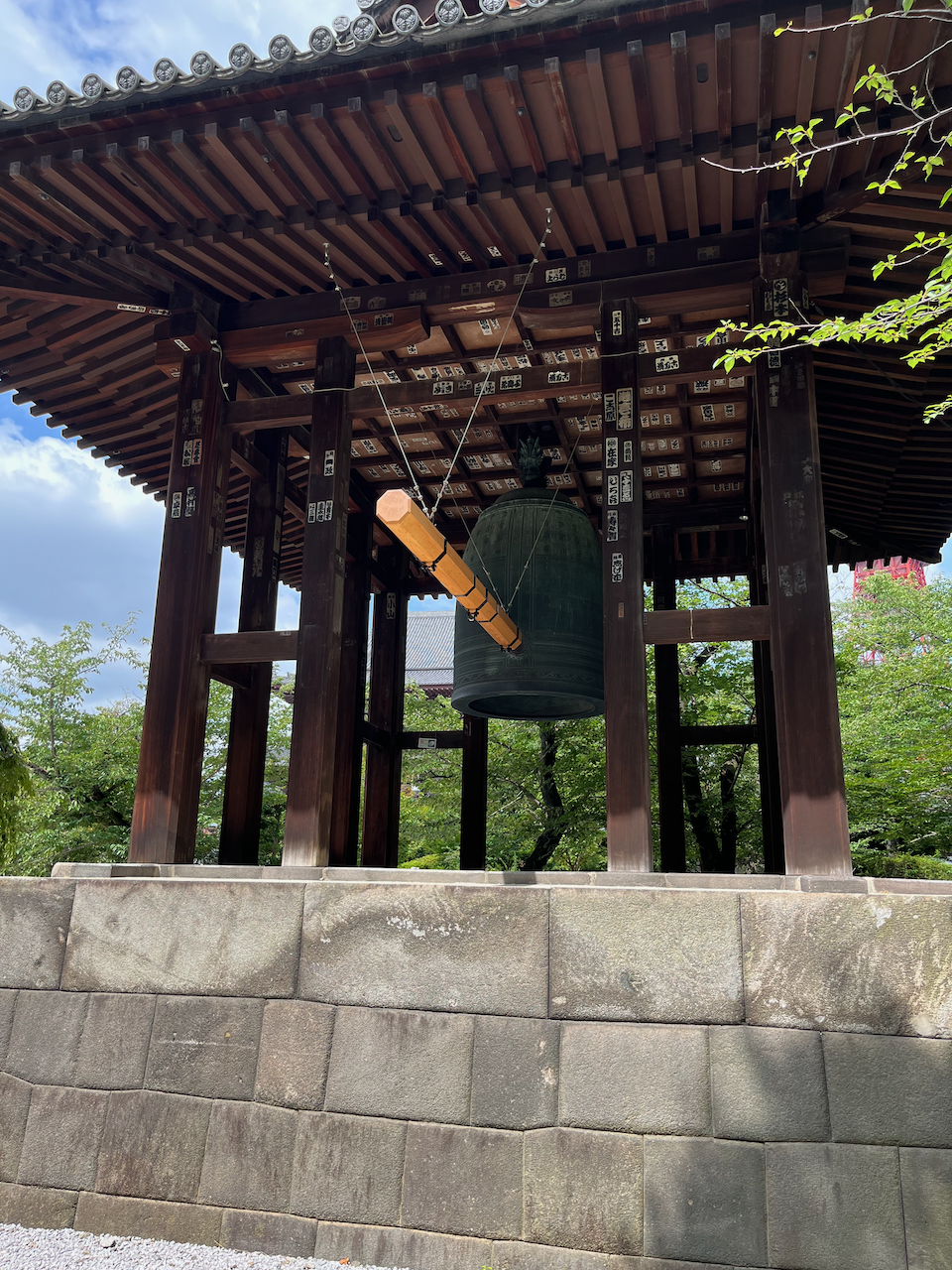
But New Year’s Eve, called Omisoka (大晦日), also has lots of traditions of its own. One of them is a tradition called Joya no Kané (除夜の鐘) which means ringing of the large temple bell, the bonshō (梵鐘). You can see an example of a Bonsho here from my last visit to Zojoji:
The tradition is that the bell is run 108 times before midnight. Why 108 times? This reflects the Buddhist concept that the mind has 108 defilements (bonnō, 煩悩). According to Wikipedia, the tradition actually began in China in the Chan (Zen) monasteries there, and there is a parallel tradition in Korea too, though they ring the bell 33 times.
Typically the ringing of the bell starts around 11pm, the local temple members line up, and each one takes turns rining the bell once, but pulling on the large beam that strikes the bell using a rope tied to it. Many temples will save the very last (108th) ringing until just after midnight. For this reason, the ceremony is often also called ni-nen mairi (二年参り, “two year crossing”).
This is a news clip from 2023 showing the ringing of the bell at Zojoji temple:
The temple of Chion-in (another favorite of mine) also has a dramatic bell-ringing ceremony too:
As for me, I’ve only attended one Joya no Kane in Japan in 2007, back when we used to visit family for New Years,1 my second visit there. My father in law owns a business that makes gravestones in Japan, so while he is not part of a particular Buddhist temple, he has many business partners that are Buddhist temples.
That particular year, he was invited to attend the Joya no Kane ceremony at a certain Jodo Shu-sect temple in the city. Because I was newly introduced to Jodo Shu Buddhism a few years earlier, I was excited to go. My father in law gave me this sutra book for Jodo Shu Buddhism, which I wrote about here. It was the first sutra book I ever owned, as far as I can recall.
I don’t remember which temple it was, but it was fairly large temple, and there were many people in attendance. The rest of the family wasn’t interested and stayed home to watch Japanese TV. My father-in-law and I sat for a brief Buddhist service, and a small sermon, then we started to line up for the temple bell ringing. I remember being somewhere near the middle of the line, maybe second half. The process took nearly an hour. It was late, cold, and waiting in line so long was a little tiring. When it was finally my turn, the moment went super fast so I barely remember what happened. The hanging beam was heavier than I expected, so I didn’t get a very good swing. Just enough to hit the bell and that was it.
We drove home after that, where my wife, daughter, and in-laws were all watching Kohaku Uta Gassen. All in all, it was a good night.
So, that’s my only memory of Joya no Kane, but I think it’s a near tradition and well worth attending if you ever get the opportunity.
Happy 2026 everyone and wishing you a wonderful new year.
1 When our firstborn was a little girl, we liked visiting in winter because there’s lots of fun things to do, but once she started grade school, we moved to summers. In either case, the winters in Japan are very cold, and the summers are extremely hot and humid.
Sometimes when you travel in Japan, especially outside of Tokyo, you may come across like this:
A large sacred tree at Kasuga shrine in Nara, Japan. Taken by me in July 2023.
This is a large tree that has been growing for centuries within the precincts of Kasuga Grand Shrine in Nara, Japan. The tree, as you can see, has a large rope tied around it with small paper streamers. If you ever saw the Studio Gibhli movie Totoro, you can see a big camphor tree with a similar rope around it.
Sometimes you also find rocks and other natural things with ropes around them too.
A “shimenawa” around an “iwakura” (sacred rock) at Meigetsuin, Buddhist temple in Kamakura, Japan, courtesy of Wikipedia.
This is a Shinto-religious custom using a special sacred, hempen rope called Shimenawa (注連縄). The little paper streamers called called Shidé (紙垂).
Shimenawa are sometimes used to section off a sacred space, but they’re also used to enshrine places thought to house a local kami, such as a tree or rock thought to be sacred. Sometimes you also see them hanging over home Shinto shrines (kamidana, 神棚). The idea is the same: the paper streamers help deliniate a sacred space (the inner sanctum of your home shrine in this case).
Interestingly, I discovered that a separate, but parallel tradition exists in Korea too. This blog shows that in Korean traditional culture, people would enshrine local guardian spirits by tying a rope (금줄, Geumjul) around them, and decorating with colored cloths (오색천, Osaekcheon) or white strips of paper. Such sacred trees (당산나무, Dangsan-namu) and sacred rocks (누석단, Nuseokdan), are collectively called Seonangdang. They are very similar in appearance to the ones in Japan, so it’s not hard to guess that there’s some common religious tradition between both cultures, though the Wikipedia article linked above also suggests a potential link to Mongol culture too.
Shinto as a religion exists only in Japan1 but it’s not hard to imagine that Shinto tradition drew from something much older that was shared across the Korean peninsula and Japan. Further, since it’s known that in early Japanese history that many Korean families migrated to Japan (the Imperial court sought their skills and technology), it’s quite possible the tradition was imported from Korea to Japan. Further, as this early Yamato court actively allied with the Korean kingdom of Baekche, it’s possible the cultural exchange went in that direction too.
Anyhow, it’s a fascinating example of how the two (or more) cultures have shared religious traditions for millenia, but few would notice.
1 Barring colonial efforts in the early 20th century to introduce it to other Asian countries, but these did not have a lasting impact culturally.
This is the last in a series of Japanese-Buddhist sutra books that I wanted to share. I talked about this Soto Zen sutra book, a Rinzai Zen book and a Jodo Shu sutra book. Today, I wanted to share the sutra book I purchased at Asakusa Temple in Tokyo, Japan.
Asakusa Temple (more properly Sensoji Temple, 浅草寺)1 is super famous, and chances are if you have visited Tokyo, you probably went to Asakusa Temple. Asakusa is technically its own Buddhist-sect now, but for much of its history it was a Tendai Buddhist temple that enshrined a legendary statue of Kannon Bodhisattva that supposedly washed up on shore and enshrined in the year 645. This is called the Yanagi no Miei (柳御影, roughly translated “the [sacred] willow image”). The featured photo above shows where it is enshrined at Asakusa Temple.
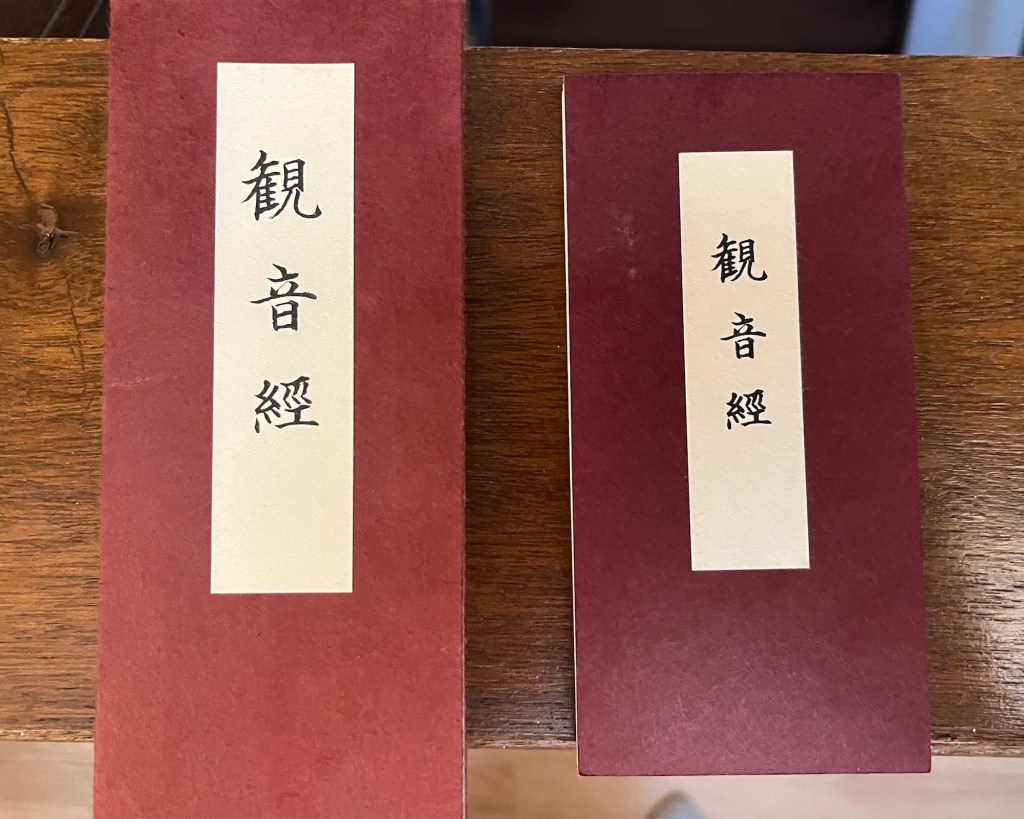
Not surprisingly, the sutra book’s liturgy focuses on Kannon-related chants. This sutra book is sold in two sizes, but the contents are the same:
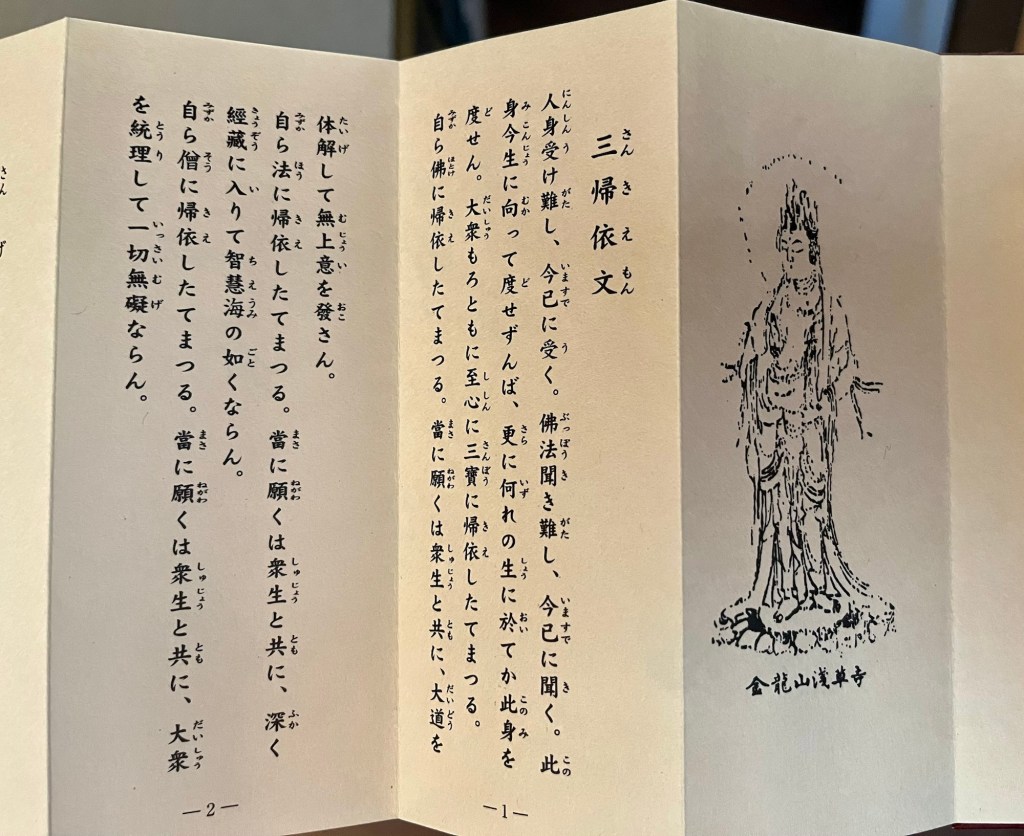
The illustration inside the cover depicts the legendary statue :
The liturgy to the left of the illustration is a form of Taking Refuge in the Three Treasures (san-ki-é-mon, 三帰依文) done in a more native-Japanese style, than the Sino-Japanese version I posted here. Both versions are perfectly valid and are chanted.
More examples below are chants that we’ve seen in older posts in right to left order:
the Sangémon (repentance) on the right,
Kaikyoge (verses for opening the sutra) second page from right, and
Unlike other examples I’ve seen, this sutra book posts the entire Kannon sutra, not just the verse section. It’s about 3 times as longer than usual.
Next, we see a classic: the Heart Sutra. This makes sense since the Heart Sutra was spoken by Kannon Bodhisattva, not Shakyamuni Buddha. So. it fits the theme.
Finally on the far left page is a simple recitation chant of devotion to Kannon Bodhisattva: namu kanzeon bosatsu (南無観世音菩薩). I’ve often used that to sign off blog posts, and unlike more esoteric mantras, this is a very common statement of devotion, much like the nembutsu for Amida Buddha. Feel free to chant it in your Buddhist practice!
Anyhow, this sutra book is something visitors to Asakusa Temple would probably overlook without the necessary background (or religious inclination), but it’s a fascinating look at Tendai Buddhist liturgy, but in a way that’s adapted to a particular temple, and to a particular deity.
Namu Kanzeon Bosatsu
P.S. That covers all the sutra books I wanted to cover here in the blog. I own a few more, but they’re not interesting or unique enough to justify another blog post. If I pick up another sutra book, I’ll post again. But if you did enjoy this mini-series, thank you for reading!
1 The words “asakusa” and “senso” are literally just two different ways to read the same Chinese characters.
This past week, I have been in Dublin, Ireland. The purpose of this trip was (among other things) to help my daughter settle in to your her new life in Trinity College Dublin.
She graduated high school this year, and it’s been a slow-moving, emotional roller coaster as we come face to face to with the fact that our firstborn is leaving the nest. Of course, logically this was always going to happen, but actually facing it is harder than expected. As a father, she has been an important part of our life for the last 18 years, and the thought of letting her go especially in a place where I cannot protect her became increasingly stressful.
Dublin itself, is a great city: very walkable, safe in a way you don’t find in US cities,1 friendly people, and lots of awesome European food you can’t really find here in the West Coast.
A view of Dublin from my daughter’s accomadation
And yet, when my daughter and I arrived in Dublin, we had only five days to get setup with things like:
Apartment (student housing)
Bank account (since it’s a different country)
Mobile phone (same reason)
Figure out food sources
Figure out public transportation
Get some basic home goods since we couldn’t possibly bring it all from the States.
Meet some local friends we know to help my daughter establish a local support network, etc.
Out of those five days, I had to some work in Dublin as well (I couldn’t take five full days off), so it was more like three days.
The good news is that we quickly got many of these things sorted out. We found a good mobile service, found some groceries and good restaurants nearby, and her student accommodation is very close to the Luas tram, and the Luas runs often and is easy to get tickets for. If you visit Dublin, definitely learn to use the Luas.
However, during this time my stress and depression was very intense. As soon as my daughter was out of sight, I was full of fear of something bad happening to her (being a lone, young woman), and also really depressed to let her go. I remember a couple nights alone in the hotel where I hardly slept, partly due to jetlag, and partly due to sheer emotional stress.
But I thought about it, and I realized that beyond practical concerns, I was deeply clinging to my daughter. I like to think I was a pretty involved parent, and that I did my best to be both a good father and a friend, and suddenly 18 years of this was ripped away the moment that we set foot in Ireland, and my mind couldn’t handle the abrupt change. In short, I think part of my panic was grounded in ego as a parent. Once I realized my selfish ego was driving this panic, I paused.
Me having breakfast at a local Cafe Nerro in Temple Bar, while reading about the Heart Sutra.
Thinking about this further, the only way she would prosper was to let her get on her feet, help when she needs help, but otherwise, give her space to grown and learn. In short, I had to trust her.
This was hard at first, but I kept reminding myself “trust her, trust her” and by and by I learned to let go. Instead of constantly trying to protect her, I encouraged her, provided any advice I could, and let her explore the city herself. She got lost a couple times on the Luas (got off at the wrong stop), but soon she started finding shops she liked, and could get to and from Dublin city centre without issue.
So, by the end, things were looking up: my daughter was getting on her feet, and we had met a few friends who all happily wanted to help her, and we enjoyed some pub visits, and good European food.
The point of all this, I guess, is that if you are a parent, and you are dreading your children leaving the nest, ask yourself how much of this is concern for your kids, and how much of this is concern for yourself. My job, as a parent, is to provide a safe, loving environment as they grow, but I don’t own my kids. That’s just ego.
Namu Shakamuni Butsu
Update: After I wrote this post, my daughter texted us to let us know she had made some friends already. 🥰
P.S. Unrelated, but September 9th is the Day of the Chrysanthemum holiday in Japan. If you can, maybe decorate the house with a few chrysanthemums, or enjoy the weather with a friend. Happy Day of the Chrysanthemum to you all.
P.P.S. Happy Star Trek Day (September 8th)! Live long and prosper. 🖖🏼
1 It’s hard to explain: when I am in the US, there’s always a subtle feeling of tension. Not just recently, but even 15 years ago when I first came back to the US. When I am Ireland, everything feels more relaxed. The way people talk to one another, even when they tease each other, etc. Dublin city centre at night has plenty of drunks stumbling about, racial tension toward immigrants, and fist fights, but somehow everything feels less …. contentious. Since many Americans don’t travel, we don’t realize how wound up we are.
As I write this post, I am in Dublin, Ireland on a short trip (business, not pleasure), helping my daughter get settled in for college. Thanks to timezone differences my daughter and I were awake at 11:30pm on a Friday and starving.
Taken near Trinity College and the main Bank of Ireland building (right).
Since a lot of pubs close their kitchens early, we went over to the local Supermac’s1 :
My daughter took this photo of her food. Mine is at the far end of the table (upper right corner).
It’s Friday night, so as we’re seated, people are stumbling in drunk looking for some cheap food, and there’s a steady stream of food delivery guys picking up orders. Still, even here, as I open my bag and eat my food, I try to still take a moment and appreciate the food, so I discreetly did gassho.
In Japanese culture, people will usually say itadakimasu before eating food, and gochisōsama deshita after finishing. The word itadakimasu is just the humble form of the verb “I receive”, and gochisōsama deshita means “It was a wonderful meal”.
But there’s also a set of verses that in the Zen tradition are recited before meals called the Shokuji Gokan (食事五観, “five observations at mealtime”). When I was watching a documentary recently, during mealtime, one of the Eiheiji monks walked the documentary host through the five verses. The five verses in Japanese for the Rinzaitradition are:
一つには、功の多少を計り、彼の来処を量る。 hitotsu ni wa, kō no tashō wo hakari, kano raisho wo hakaru
二つには、己が徳行の全闕を忖って供に応ず。 futatsu ni wa, onore ga tokugyō no zenketsu wo hakatte, ku ni ōzu
三つには、心を防ぎ、過貪等を離るるを宗とす。 mitsu ni wa, shin wo fusegi, togatontō wo hanaruru wo shū to su
四つには、正に良薬を事とするは形枯を療ぜんが為なり。 yotsu ni wa, masa ni ryōyaku wo koto to suru wa gyōko wo ryōzen ga tame nari
五つには、道業を成ぜんが為に、応にこの食を受くべし。 Itsutsu ni wa, dōgyō wo jōzen ga tame ni, ō ni kono jiki wo uku beshi.
The verses in Soto Zen appear to be slightly different. I am fairly certain, these are descended from Chinese Chan Buddhism, but I wasn’t able to find much information.
There are a lot of fine English translations available, though for now I am using the one from Sotozen.net:
We reflect on the effort that brought us this food and consider how it comes to us.
We reflect on our virtue and practice, and whether we are worthy of this offering.
We regard it as essential to free ourselves of excesses such as greed.
We regard this food as good medicine to sustain our life.
For the sake of enlightenment, we now receive this food.
In either case, the meaning is the same: before we take in the food, we should first reflect where it came from (and the countless people who made it possible),2 and whether we are living up to the practice or not. Finally, the verses remind us that food is essentially medicine (hence don’t be a pig), and that it helps us along the path toward Enlightenment. Even some chips (fries) at Supermac’s is something to be grateful for.
So, hello from Ireland, and will post more soon! 🇮🇪🖖🏼
1 The local version of McDonald’s, but ten times better.
2 The Jodo Shinshu tradition focuses on the concept of “gratitude“, so there’s a lot of overlaphere.
I found this video on Youtube recently by a native Laotian tour guide:
I’ve seen bad behavior in Japan too, not toward Buddhist monks, but toward local Geisha. I remember at Asakusa Temple, a trio of geisha were walking, and a horde of male photographers (Japanese and foreign) ran after them. It was… weird.
I also remember one time at Zojo-ji Temple seeing a foreign couple (European maybe), who were doing yoga poses in front of the mausoleum of the Tokugawa shoguns. I don’t think they understood what they were standing in front of, but it looked really stupid, and Buddhist temples have nothing to do with Yoga anyway.
I doubt readers here are the kind of people to get in monks’ faces for a camera shot, or harass geisha, or make stupid photos at temples, but hopefully readers can help raise awareness about such awful behavior. Tourists might act normal at home because they are bound by social conventions, but some people forget that they are guests in other people’s countries and flaunt common courtesy. Tour companies will gloss over this in the name of profit. In the end, it’s the locals who suffer.
If you are traveling, think of yourself as a guest in someone else’s house. In other words, don’t be a dick.
Myoshinji Temple (English homepage) in Kyoto is one of the central temples of the Rinzai Zen tradition, especially after the reforms by Hakuin in the 18th century. Although I’ve never been there, it is a very scenic and seems like a worthwhile place to visit.
The website in Japanese lists a number of activities that one can partake in for experience Zen:
What struck me is that Myoshinji Temple provides a variety of activities to suit different people. Not everyone is ready for Zen training or meditation, yet they can still get something wholesome out of the experience. I like this kind of inclusive Zen Buddhism.
In my limited experiences with western Zen temples, the focus is solely on meditation and practicing as monks do. This approach only works for certain lifestyles and certain temperaments. It’s not wrong, but through my experiences in Pure Land Buddhism, especially through immigrant communities, I feel that a more inclusive, more approachable Buddhism is really beneficial.
Just sitting around enjoying donuts and coffee with congregants after service, and talk about stuff, is really nice. This only works when new people don’t feel intimidated, and people aren’t trying to one-up each other.
So to me, Buddhism works best when it accommodates people as they are now, with a variety of practices and options, rather than being written off as “cultural accretions“. Just let people be people, come as they are, and soak in the Dharma at their own pace.
Someone who only listens to sermons today, prays to Kannon, or copy a sutra, may be inspired to pick up deeper practices later at the right time. You never know.
1 Similar to Jodo Shinshu sect Buddhism, Rinzai Zen, at least at Myoshinji temple, has a lot of hymns. I don’t know much about these, and there is no information in English.
McCoy: “It might eventually cure the common cold, but lengthen lives? Poppycock. I can do more for you if you just eat right and exercise regularly”
Star Trek, “The Omega Glory” (s2ep23), Stardate unknown
Healthy eating is not difficult, at least in theory.
Of course if it were that easy, how come many of us are overweight? Myself included.
I talked about this recently, but I do not have very good self-control. I work a desk job, so I don’t move around much, and I snack a lot. I don’t eat particularly unhealthy: no alcohol, no soft drinks, etc., and I eat minimal red meat. But I tend to just eat too much junk food, or too many portions.
Recently, I dug out an old book of mine from many, many years ago,1 titled What Is Zen? 禅ってなんだろう. It’s a bilingual book I bought in Japan that explores Rinzai Zen life as a monk, but also includes some general thoughts about the tradition for lay followers. My copy has been covered in stickers when my daughter was a little girl, so I kept it both for nostalgia, and because such down-to-earth books on Zen are hard to find in the West.
This is what happens when little girls get a hold of daddy’s books… 😅
Anyhow, this book shows things like daily routines for monks, how they eat and so on. I wish I could repost the photographs because they’re really neat, but obviously that’s inappropriate. Instead, let me shiw you a different example:
An example of shōjin-ryōri (monastic food) at Tenryuji temple in Kyoto, Japan. Photo by 663highland, CC BY-SA 3.0, via Wikimedia Commons
This photo, shows a meal served at Tenryuji Temple, which I coincidentally visited last year. This kind of monastic food is called shōjin-ryōri (精進料理, “ascetic food”) in Japanese, but is a common part of Buddhist cuisine across East Asia. It’s not limited to monks and nuns only, devout lay followers can eat such a lifestyle if they wish. The photos from my book show that the monastic version of this meal is somewhat simpler in presentation (they are monks after all), but essentially the same.
Similarly, when we visited Ryoanji Temple (another Rinzai temple) waaay back in 2005, we enjoyed their version of tofu stew:
Taken by me in 2005, at Ryoanji Temple. This is a vegetarian tofu stew, with turnips artfully sculpted to look like lotus flowers.
This kind of diet is similar to a vegan diet in that it contains no animal products, even the dashi broth is vegetarian. Certain flavors like curry and onions are not used either.
But as with any diet changes, this is not something that should be done hastily or without consulting a physician. The key I wanted to convey here is that (partly as a reminder to myself when I read this six months later….) is that a healthy diet consists of the following:
More vegetables than protein
Minimal processed starches
Little or no animal protein
Small portions per meal2
Little or no snacking.
But I’ve been inspired by these examples of good Buddhist eating, and so I have been gradually trying to “eat like a monk” lately: smaller portions, avoiding or minimizing animal protein, limit starches, and eating more veggies.
Will it work for a Western desk-jockey like myself? We’ll see.
1 I mentioned this book on my old blog, that’s how long I’ve owned it.
2 My doctor had previous suggested intermittent fasting as a potential solution, or alternatively eating four small meals per day, instead of three big ones. Say, portions the size of two-three fists. The issue hasn’t been the diet, but my lack of diligence especially during the holidays. So, that may be the bigger issue.
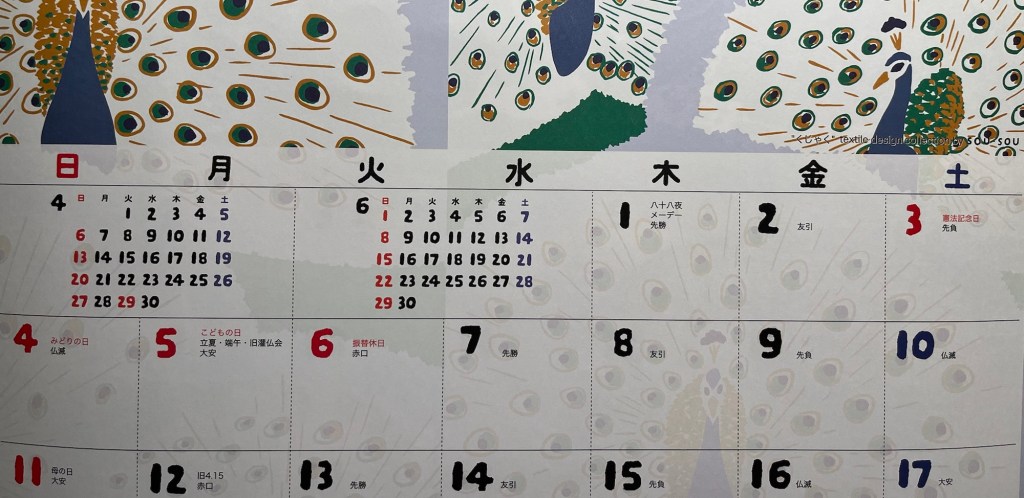
The first week of May in Japan has an interesting phenomenon in the modern calendar called Golden Week (gōruden uīku, ゴールデンウィーク): a series of national holidays that line up very closely. Thus, people often take vacations at this time (a rarity in Japanese business culture), and enjoy the fine weather before the monsoon comes. I wrote about Golden Week in more detail here.
You can see on our home calendar how the holidays (in red) line up:
My sister-in-law in Japan often takes this time off, as do many other Japanese business and white-collar workers. It may be the longest vacation they take in the year, apart from Japanese New Year.
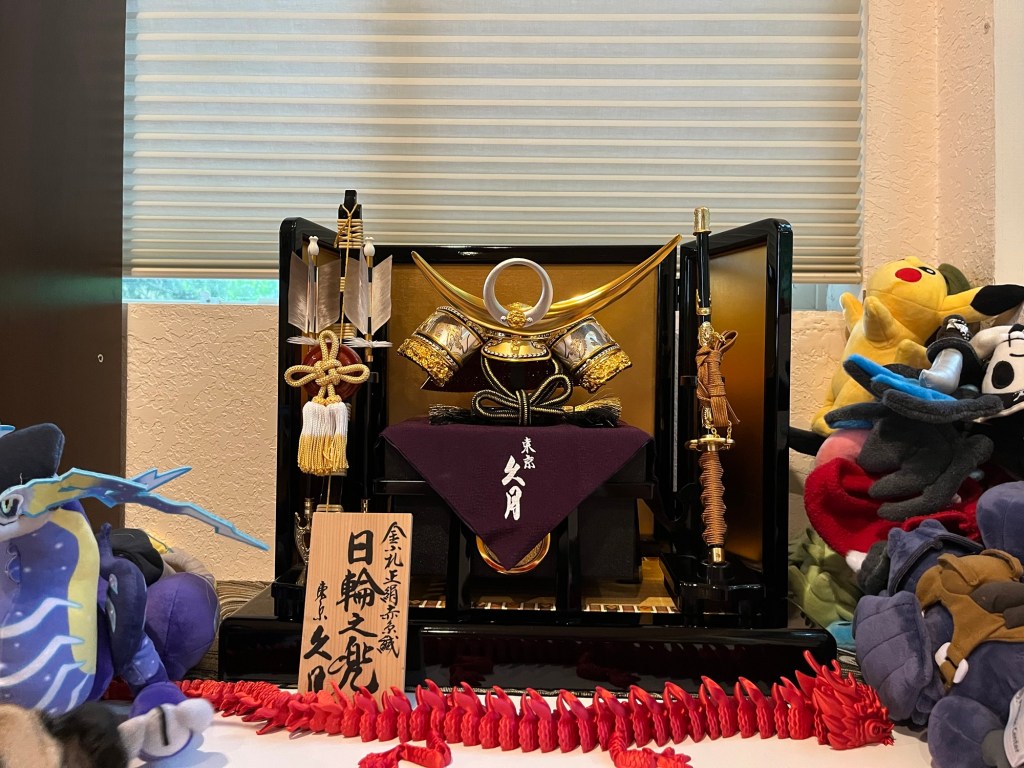
As part of Golden Week, Childrens Day, or Kodomo no Hi (子供の日) also takes place every May 5th. I’ve written about that as well. We have taken out our usual yoroi armor display:
The Pokemon toys and dragons are just my son’s toys (he should clean up more 😋).
I am not sure if we can get kashiwa-mochi this year, as Japanese goods are getting harder and harder to obtain lately, and our schedule is chaotic this week anyway, so I am not sure exactly how we will celebrate. I do know that we will go see the Minecraft movie for a third time in theaters, though. My son and I really enjoy it, and it’s nice to see all the kids yelling certain parts of the dialogue in unison.
I wish I could post more, but as alluded to earlier, I will be away for about a week, and haven’t been able to write more due to work and other competing priorities. However, I hope you all have a terrific Golden Week, and can enjoy the weather in some way. I have other great content coming up, both historical and Buddhist, so please stay tuned, and take care!
P.S. Golden Week also serves as a reminder that what many modern workers need isn’t just equitable pay, but also time off. Happy May Day! ✊🏼










 Gleanings in Buddha-Fields


You must be logged in to post a comment.