This is the last in a series of Japanese-Buddhist sutra books that I wanted to share. I talked about this Soto Zen sutra book, a Rinzai Zen book and a Jodo Shu sutra book. Today, I wanted to share the sutra book I purchased at Asakusa Temple in Tokyo, Japan.
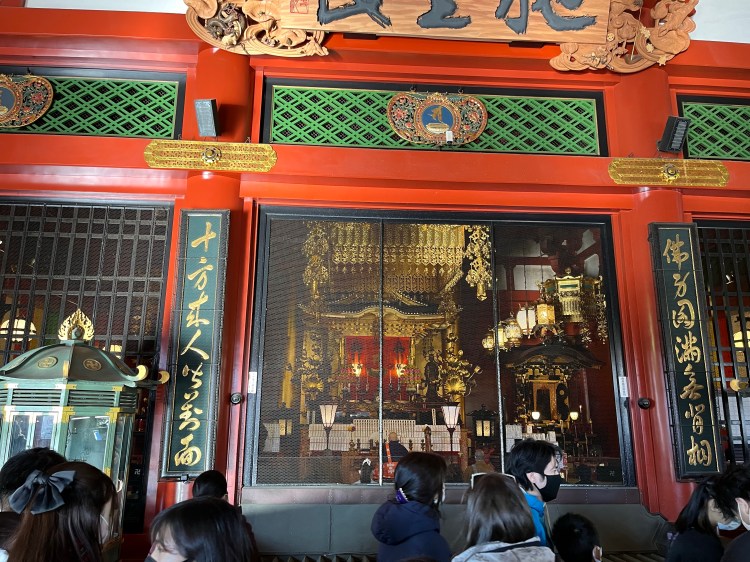
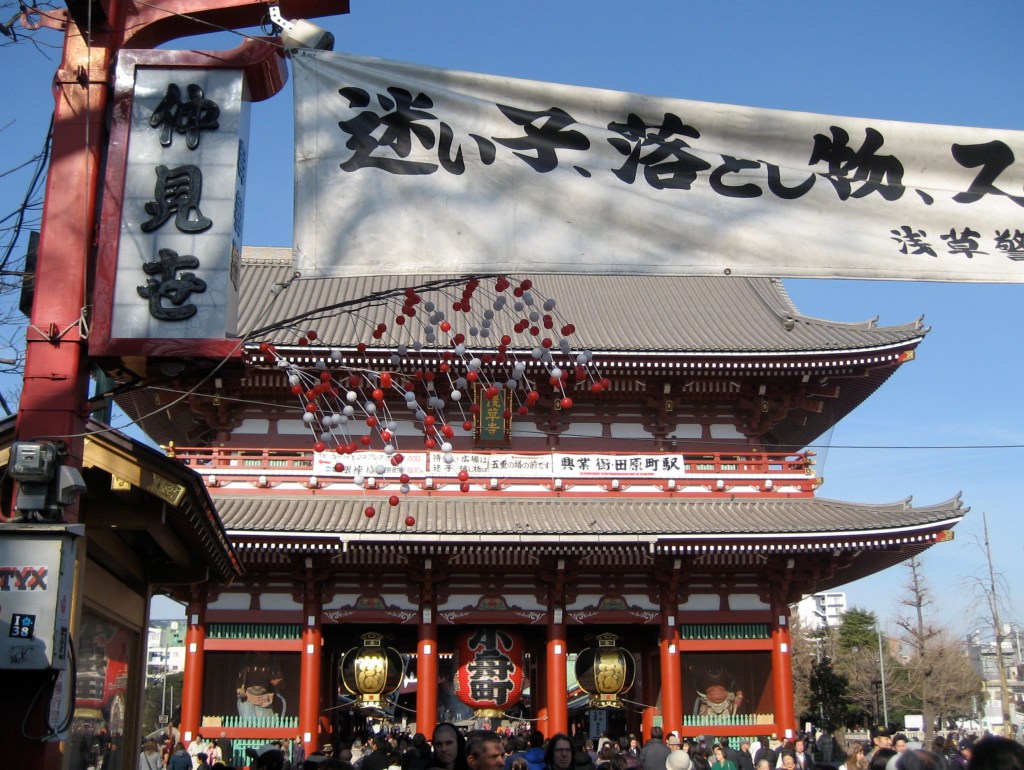
Asakusa Temple (more properly Sensoji Temple, 浅草寺)1 is super famous, and chances are if you have visited Tokyo, you probably went to Asakusa Temple. Asakusa is technically its own Buddhist-sect now, but for much of its history it was a Tendai Buddhist temple that enshrined a legendary statue of Kannon Bodhisattva that supposedly washed up on shore and enshrined in the year 645. This is called the Yanagi no Miei (柳御影, roughly translated “the [sacred] willow image”). The featured photo above shows where it is enshrined at Asakusa Temple.
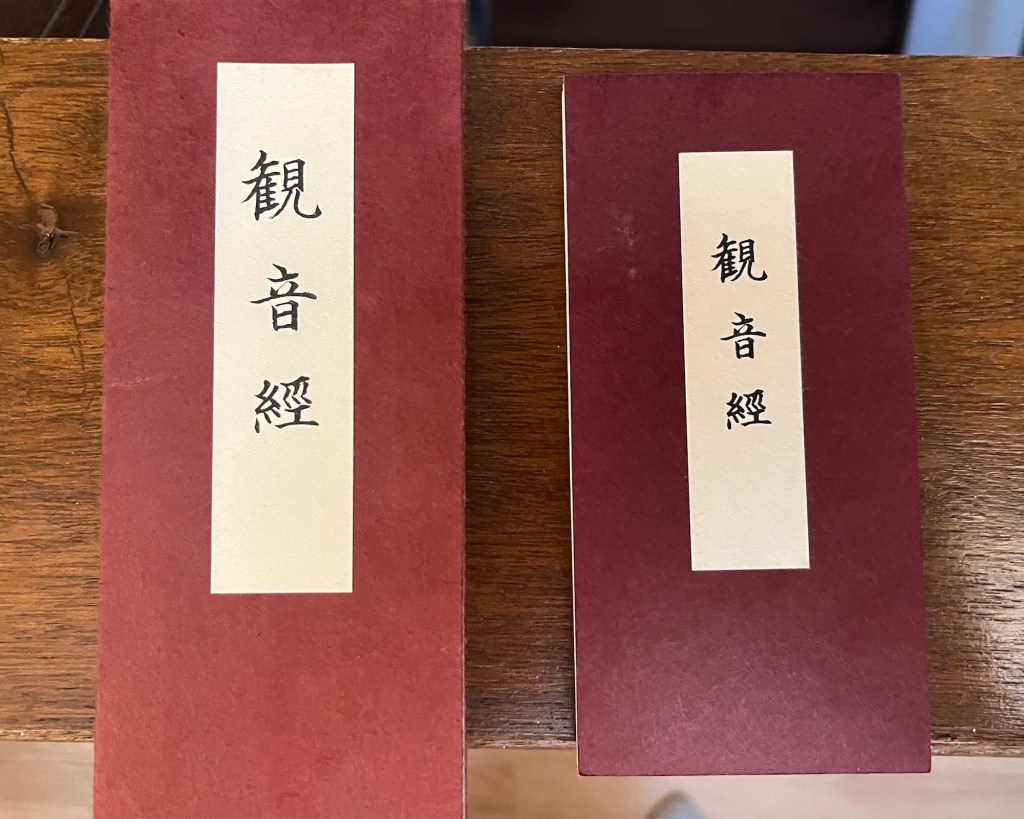
Not surprisingly, the sutra book’s liturgy focuses on Kannon-related chants. This sutra book is sold in two sizes, but the contents are the same:
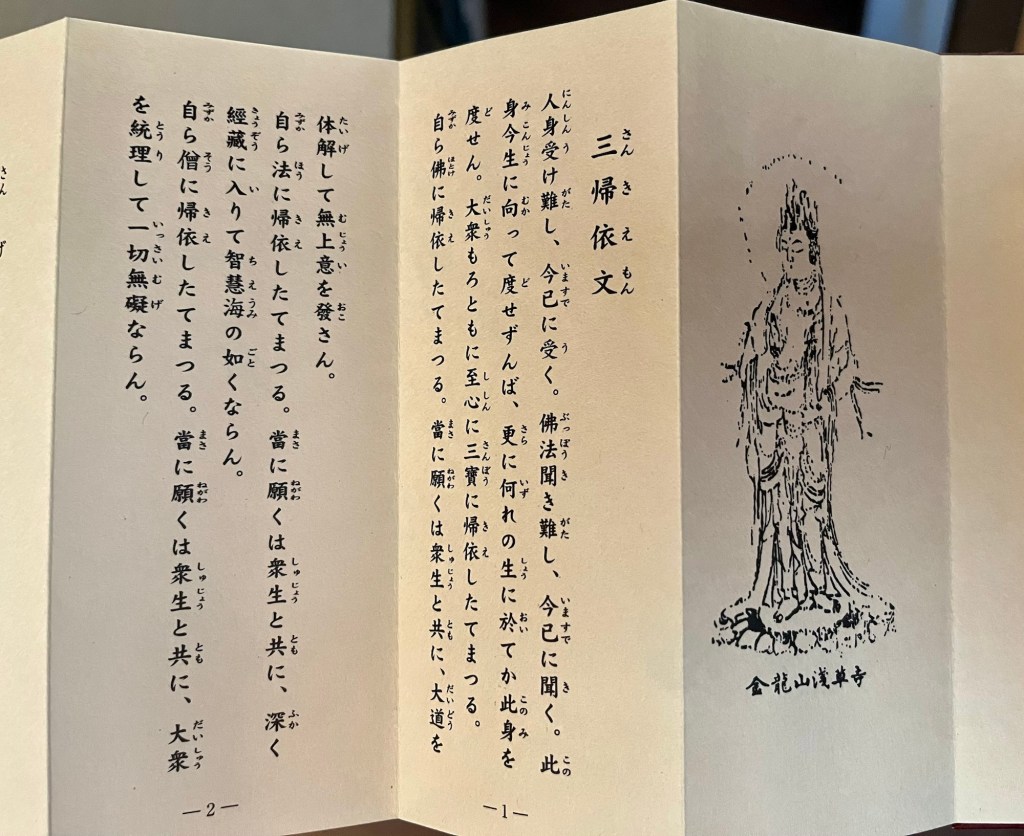
The illustration inside the cover depicts the legendary statue :
The liturgy to the left of the illustration is a form of Taking Refuge in the Three Treasures (san-ki-é-mon, 三帰依文) done in a more native-Japanese style, than the Sino-Japanese version I posted here. Both versions are perfectly valid and are chanted.
More examples below are chants that we’ve seen in older posts in right to left order:
the Sangémon (repentance) on the right,
Kaikyoge (verses for opening the sutra) second page from right, and
Unlike other examples I’ve seen, this sutra book posts the entire Kannon sutra, not just the verse section. It’s about 3 times as longer than usual.
Next, we see a classic: the Heart Sutra. This makes sense since the Heart Sutra was spoken by Kannon Bodhisattva, not Shakyamuni Buddha. So. it fits the theme.
Finally on the far left page is a simple recitation chant of devotion to Kannon Bodhisattva: namu kanzeon bosatsu (南無観世音菩薩). I’ve often used that to sign off blog posts, and unlike more esoteric mantras, this is a very common statement of devotion, much like the nembutsu for Amida Buddha. Feel free to chant it in your Buddhist practice!
Anyhow, this sutra book is something visitors to Asakusa Temple would probably overlook without the necessary background (or religious inclination), but it’s a fascinating look at Tendai Buddhist liturgy, but in a way that’s adapted to a particular temple, and to a particular deity.
Namu Kanzeon Bosatsu
P.S. That covers all the sutra books I wanted to cover here in the blog. I own a few more, but they’re not interesting or unique enough to justify another blog post. If I pick up another sutra book, I’ll post again. But if you did enjoy this mini-series, thank you for reading!
1 The words “asakusa” and “senso” are literally just two different ways to read the same Chinese characters.
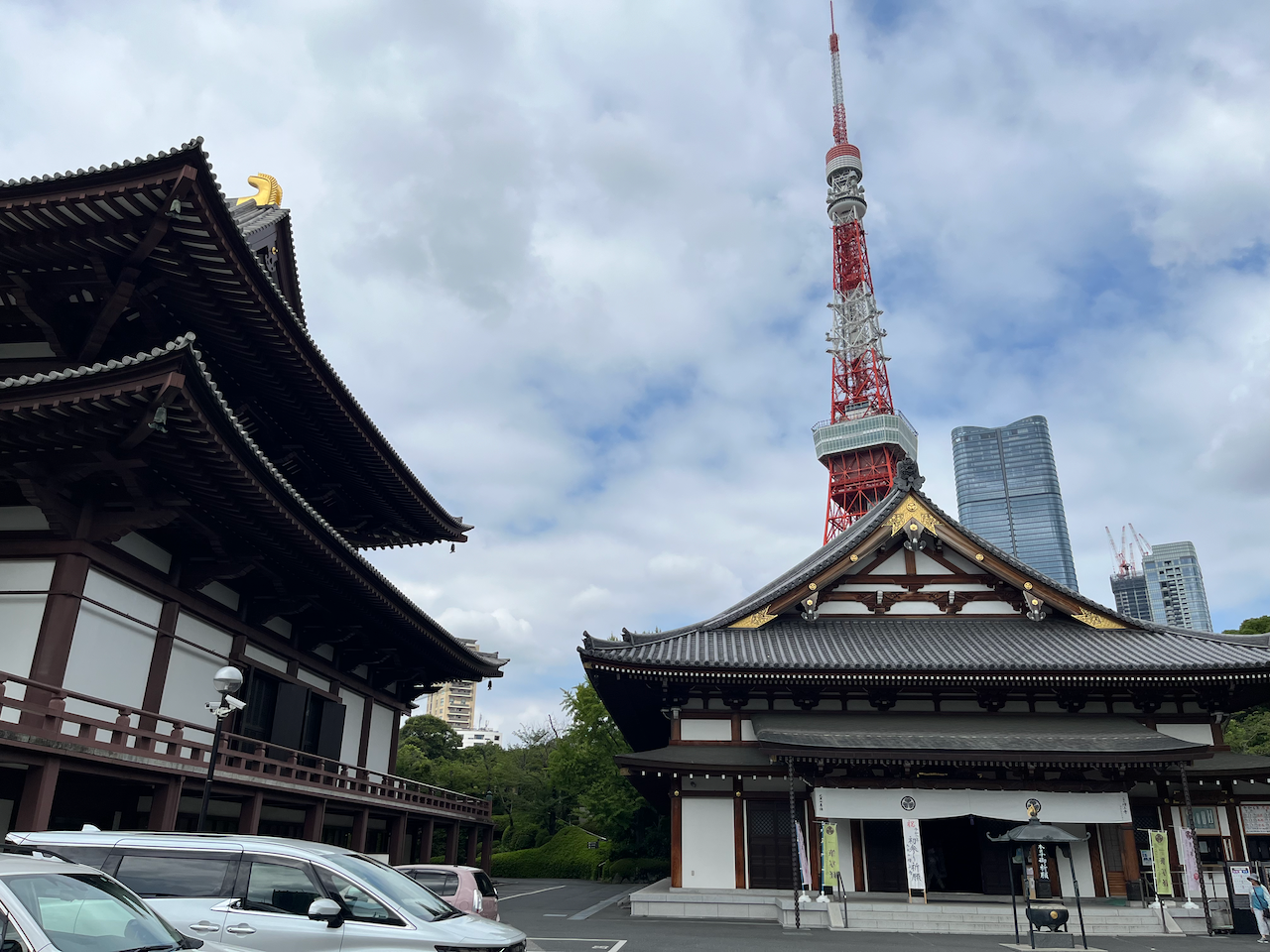
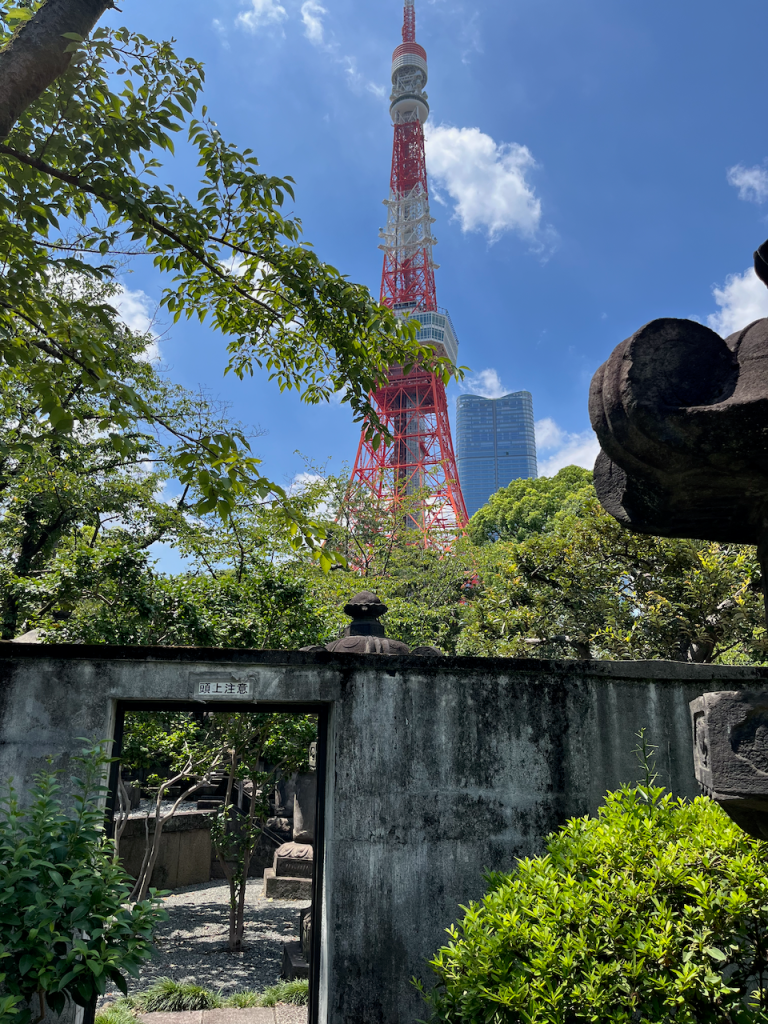
Visiting the city of Tokyo is not complete without taking a stop at the iconic Tokyo Tower. But what a lot of visitors might not know is that right next to Tokyo Tower is a Buddhist temple of great historical and cultural value: Zojoji
The temple of Zōjō-ji (増上寺) was the family temple for the Tokugawa shoguns who ruled Japan from 1600 to 1868 (e.g. the Edo Period), and many of the shoguns are interred here. The temple is also one of two main temples of the Jodo-shu sect of Buddhism. Jodo-shu Buddhism really helped me find my foundation back in the day, so I am more than a little fond of it. I have also visited the other main temple, Chion-in, in Kyoto a couple times. My first visit in 2005 is what really started me on the path to Buddhism back in the day. So, it’s no exaggeration that without the Honen the founder and Jodo Shu sect, I wouldn’t have found my path. I am always grateful.
In any case, wife (who’s Japanese) and I both like to come to Zojoji whenever we can. We joke it’s our “power spot”.1
The prestige and political power of Zojoji meant that it has been a very important temple in the Tokyo area for centuries, probably more so than Sensoji / Asakusa Temple (which I am also quite fond of).
The English website for Zojoji is actually pretty good, but it leaves out some details found in the Japanese version. Every time I go, I see foreign tourists dropping by, but I suspect some of them are unaware of the history and teachings of the temple, which is a shame because it’s actually a pretty neat place. So, this post is a lengthy tour of Zojoji. If you are reading this through email, you may want to visit the link instead. This post is VERY picture-heavy.
The Japanese site has a nice map of temple. I started at the bottom-center, at the Sangédatsu-mon (三解脱門), which might translate into something like the Three Gates of Liberation:
To the left of the gate is a sign that posts a monthly Buddhist teaching.
This month’s (August 2024) teaching is a quote from the very early Buddhist text, the Dhammapada, verse 54:
Not the sweet smell of flowers, not even the fragrance of sandal, tagara, or jasmine blows against the wind. But the fragrance of the virtuous blows against the wind. Truly the virtuous man pervades all directions with the fragrance of his virtue.
From here, I passed through the gate and took a photo of this statue of the Bodhisattva Kannon:
Next, based on the map linked above, I went clockwise around the perimeter of the temple. The next thing I saw was this pagoda (gojū-no-tō 五重塔 in Japanese) which seems to have been built in 1938:
It sits next to the other gate to Zojoji, the Kuro-mon (黒門, “black gate”) which was built in the 1700’s.
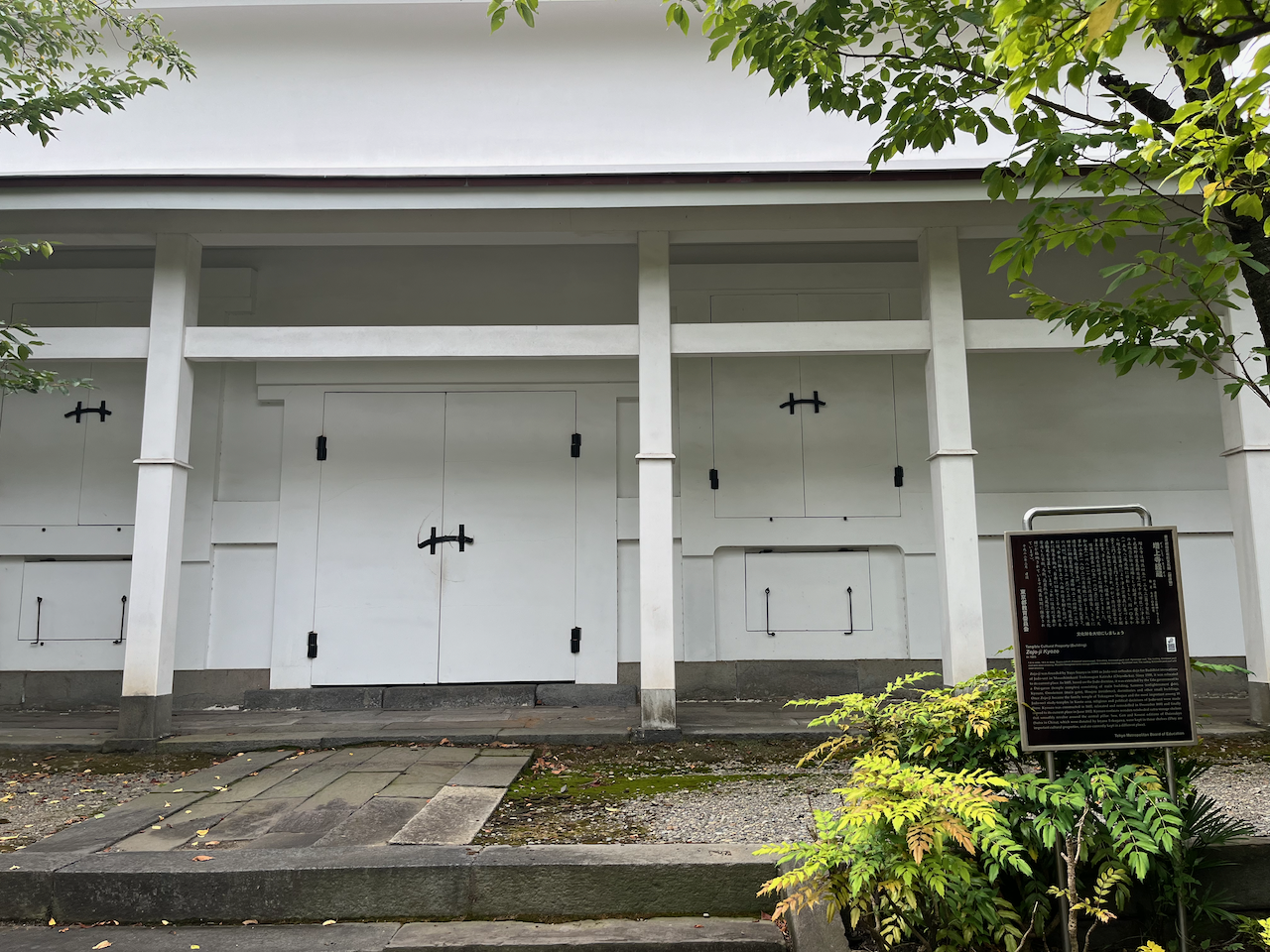
Just north of this (still going clockwise), you can see the Sutra Storehouse (kyōzō 経蔵):
This is something major temples often have: a large store house that contains the vast corpus of Buddhist literature (sutras): the Tripitaka. Sadly, I came too early in the day, and so the doors were closed. If you click on the map above, and look in the bottom left for 経蔵 you can see photo of the interior. It contains a full copy of the Taisho Tripitaka, in three different versions, in a rotating shelf.
The left area of the map mostly contained meeting halls and offices, so I kind of skipped past this quickly, and headed toward the main hall (hondō 本堂). This is in the very center of the map. Just to the left of the stairs is a nice statue of the 12th century founder of the Jodo-shu sect, Honen, in his youth:
There are some famous stories about his life (somewhat embellished, I believe), including his piousness at a young age. Hence, you often see Jodo-shu temples with status of young Honen. That said, Honen is a cool guy, and he gets my respect any day.
Next is the main hall itself:
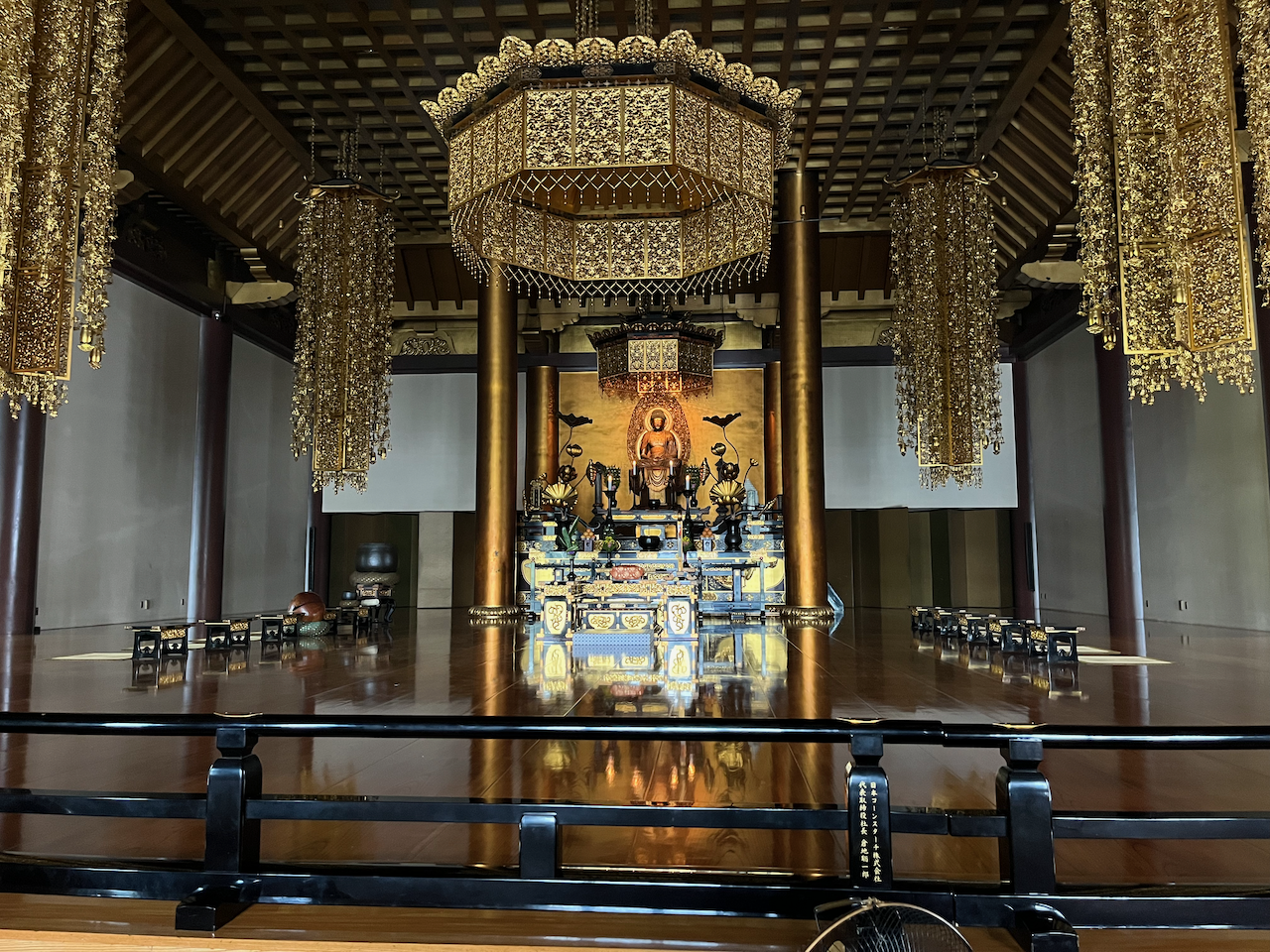
This place is pretty amazing inside. Also, unlike many temples, you do not need to remove your shoes at the door and you are welcome to take photos (except during funeral services, obviously):
The main altar is to Amida Buddha, the Buddha of Infinite Light, and the devotion of all Pure Land Buddhists across traditions. The gold color and lotus artwork are all taken from descriptions of the Pure Land, as described in the Sutras. It is said all beings reborn in the Pure Land will have the color of gold, just like Amida, and will be born from lotus buds. The Taima Mandala, not related to Zojoji, provides a nice visual representation.
To the left and right of the main altar are Honen, mentioned above, and Shan-dao the Chinese Pure Land master who inspired Honen back in the day, respectively. They lived centuries apart, but both are revered for their contributions to the tradition.
To the right of the main hall you have two choices: one you go down the stairs to the Museum. Or go to the Ankokuden Hall:
We’ll talk about the museum a bit later. For now let’s focus on the hall. Inside is both a gift shop and another altar to Amida Buddha:
This statue of Amida Buddha is historically significant though: it was the same statue venerated long ago by Tokugawa Ieyasu, the first Shogun of the Edo Period, and final unifier of Japan. This black-colored Amida statue had been a central devotional figure of the Tokugawa Shoguns for generations, so while it’s not the “main attraction” for tourists, from a historical standpoint, it is. I’ve seen it multiple times, and I never get tired of being here.
As alluded to earlier, there are shrines to the left and right of the Amida Buddha. The one on the left is of the founder of the Tokugawa shoguns,2 Tokugawa Ieyasu described above. The one on the right is less clear. It enshrines someone named Princess Kazunomiya. I had to do a bit of research and it turns out that Kazunomiya was a member of the Imperial family (not the Tokugawa family), but had been wed to Tokugawa Iemochi the 14th Shogun as a political marriage intended to heal the centuries old breach between the two families. The arranged marriage had a rocky start, but in the end proved to be a surprisingly happy and successful marriage at a time when Japan was in the waning days of the Shogunate. So, within the Tokugawa family temple, she is enshrined as an important matriarch.
We’ll see more monuments to Princess Kazunomiya shortly, so remember the name.
Anyhow, after picking up some nice incense and another seal in my pilgrimage book, I left the Ankokuden Hall. To its right is a line of statues.
The statue in the front is Bodhisattva Kannon, similar to what we saw earlier.3 There is a small altar to the right as well with another statue of Kannon that is often overlooked:
This is the “Western-facing Kannon”. The western-direction in Mahayana Buddhism is strongly associated with the Pure Land of Amida Buddha (by contrast, the eastern direction is associated with the Medicine Buddha’s own Lapis Lazuli Pure Land), and since Kannon is an attendant of Amida Buddha, this tracks.
But what about the little statues with red bibs?
These statues represent another Bodhisattva named Jizō. I haven’t talked about Jizo as much in this blog, but he’s very important in Japanese religion as a kind of protector deity, especially of children. Each statue adorned with a bib represent a child that was lost in pregnancy or in childbirth, and so the grieving parents pray to Jizo to protect their child in the life beyond. The clothing is an offering to Jizo, perhaps to pass on to the child?
While the statues are very cute, there is a tragic meaning behind them as well.
The line of statues continues back behind the Ankokuden and Hondo (main hall). It is here that you come upon the mausoleum of the Tokugawa Shoguns.
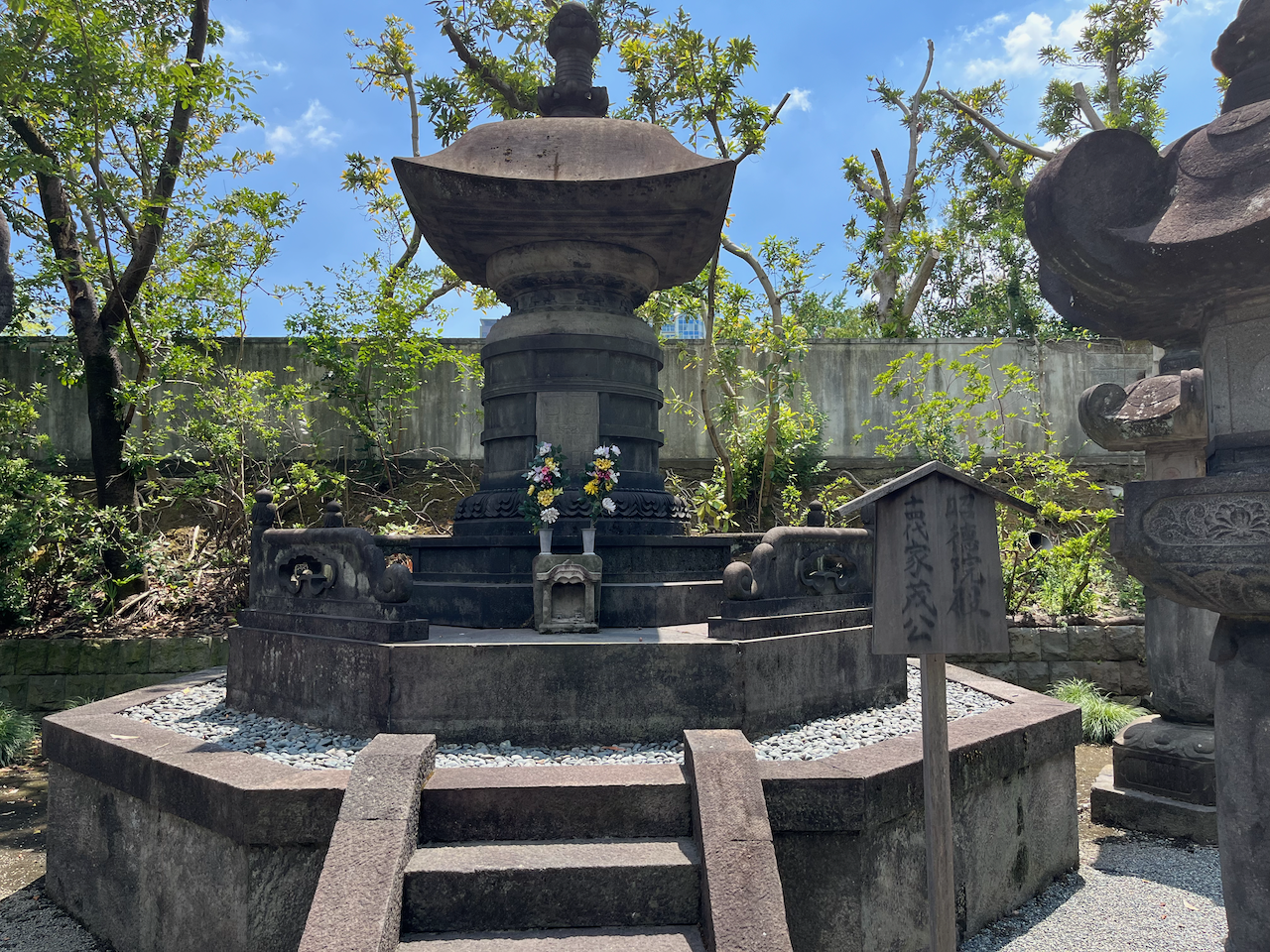
Not all shoguns are interred here. Some are interred in a shrine called Toshogu up north in Nikko. I would estimate that roughly half of the shoguns are interred here. I won’t show them all, since the map and pamphlet you receive at the ticket booth shows a full list. But to give a few examples…
The second shogun, Tokugawa Hidetada and his wife are interred here. Edo (Tokyo) was greatly expanded during his administration from a tiny fishing village to the city we know today.
From the mausoleum entrance, if you were to go further left you will see this statue:
Without getting too bogged down in details, the four statues here represent four major Bodhisattvas in the Mahayana-Buddhist tradition. From left to right with Sanskrit (and Japanese) names:
Manjushri (Monju)
Avalokitesvara (Kannon)
Ksitigarbha (Jizo)
Samanthabhadra (Fugen)
It’s actually quite rare to see all four arrayed like this. I was kind of impressed. It is said these statues were created in the year 1258 according to the plaque.
Further left:
If you go up the stairs and turn right…
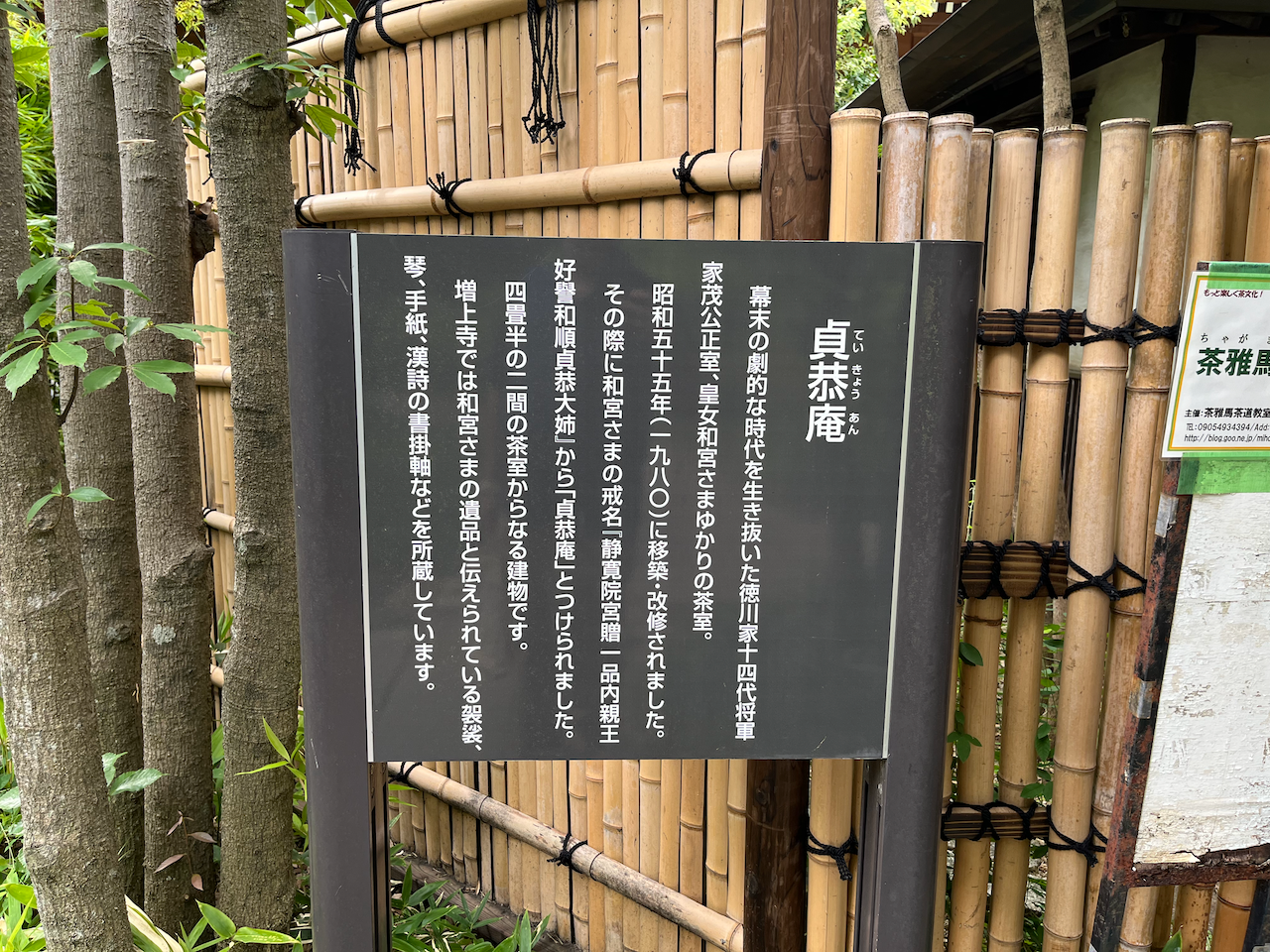
You can find the tea house of Princess Kazunomiya called the Teikyōan (貞恭庵):
Since Princess Kazunomiya took tonsure as a Buddhist nun in her final years, she took the ordination name Teikyo, so the name of the place is basically “Princess Kazunomiya’s hearth”. The sign said that it was refurbished in 1980 and is used for some public functions. It was closed when I came so I didn’t get to see much.
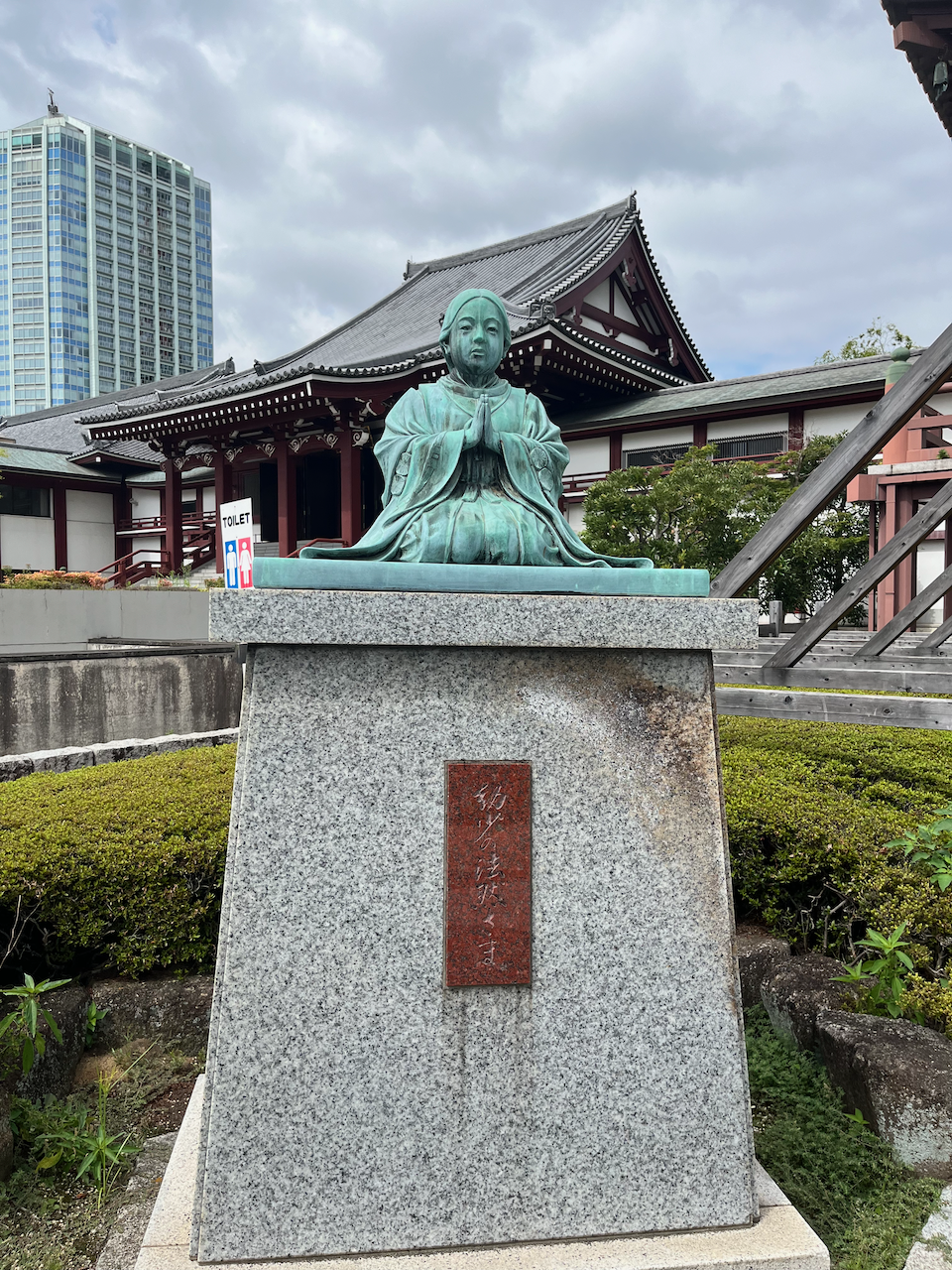
Facing the tea house is another statue of Kannon Bodhisattva in a more motherly form.
Past the tea house and up some stairs is this place, which is the upper part of the map:
It turns out that this is a columbarium: a storage house for the bones of the deceased after cremation. This is common in Buddhist temples. This columbarium in particular houses the bones of those who are somehow connected to the temple across the generations. Beyond that, the website didn’t provide an explanation.
By this point I wanted to see the museum but again I had arrived too early so I stopped by a local McDonald’s for brunch:
On the way out, I also took photos of the Buddhist bell (bonshō 梵鐘) as well:
And a small Shinto shrine to the right of the main entrance:
This Shinto shrine, called the Yuya (熊野) Shrine, was founded in 1624 by the 13th head priest of Zojoji, one Shoyo Kurayama, to protect the north-east corner of the temple from disasters. The north-east is seen as a particularly dangerous direction in Chinese geomancy (a.k.a. feng-shui), so the kami here provide protection. It is not unusual to see small Shinto shrines within Buddhist temples, and many Shinto deities are viewed as manifestations of Buddhist deities (gongen 権現) by Japanese in medieval times. The sign next to the shrine states that 3 kami reside here:
Ketsumiko-no-ōkami
Ōnamura-no-mikoto
Izanagi-no-mikoto (as in Izanagi from early Japanese mythology? I am not sure)
These three kami all seemed to have been imported from a trio of Shinto shrines called the Kumano shrines, which have a strongly syncretic Buddhist-Shinto worship. I didn’t even know the Kumano shrines existed until I wrote this article. Side note: the Chinese characters for Kumano (熊野) can be alternately read as “Yuya”, hence “Yuya Shrine”.
Anyhow, having satiated myself on McD’s, it was time to go back and visit the Museum…
Much of the museum doesn’t allow photography, but showed the history of Zojoji. As it is being restored from earlier destruction, there wasn’t actually that much in the museum.
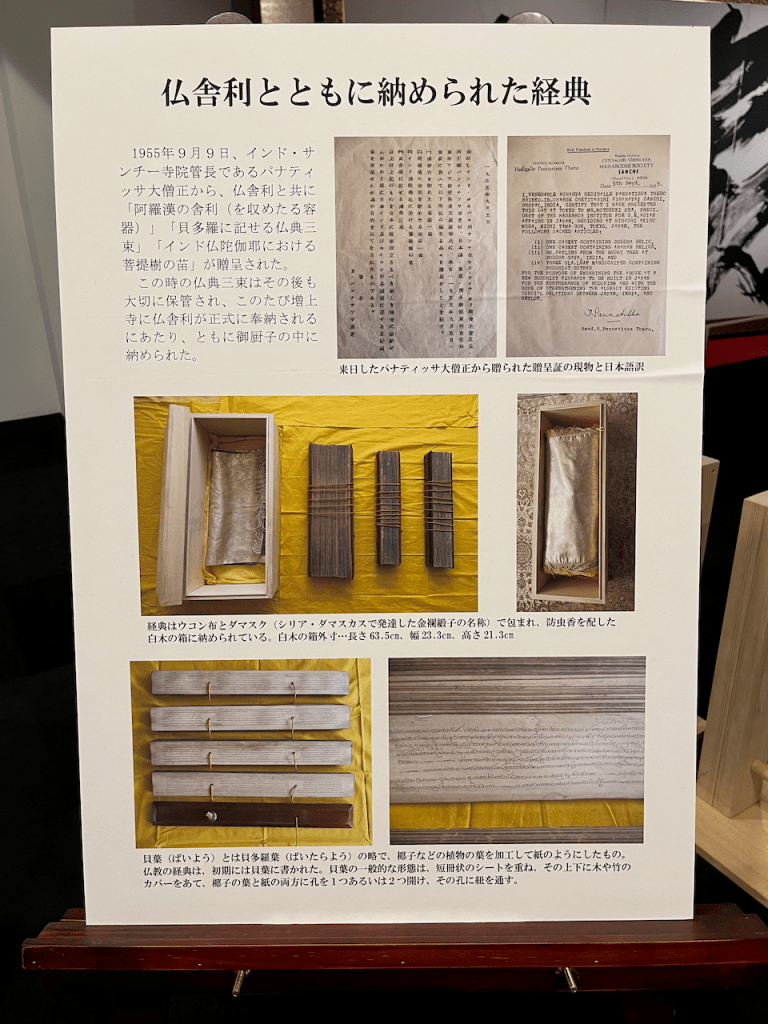
However, what the museum also had (and OK to photograph) was a genuine relic of the Buddha, as in Shakyamuni Buddha, the historical founder. It also contains relics of Rahula, the Buddha’s son before his enlightenment, and Ananda, his trusted retainer. As the sign shows above, the relics were uncovered at Sanchi, which is an important Buddhist archeological site. The relics were given to Japan as a gift in 1955 and enshrined right under Zojoji. You can see
A display to the right shows the contents, and the letter from India to Japan. In addition to fragments of the bones of Shakyamuni Buddha, Rahula and Ananda, the contents included recovered copies of Buddhist sutras that were inscribed on palm leaf at the time, and a seed descended from the original Bodhi Tree.
In my nearly 20-25 years as a Buddhist, I had never come face to face with a relic of the Buddha before, so I was kind of awestruck. The small wooden plaque just in front of the small statue of the Buddha contained a small prayer that reads:
Recite 3 times: namu shaka muni bu (praise to Shakyamuni Buddha)
I don’t have a translation of this hymn, but after a bit of late night sleuthing, I suspect it’s a verse from a Buddhist text called the Humane King Sutra. I don’t think there’s an English translation anyway.
In any case, I recited the verses of praise to Shakyamuni Buddha and finally went home.4
But that concluded the trip to Zojoji. Usually, I go with the family, and we can’t afford to spend half a day there, but this time I had some free time and was able to really take in all the sites of Zojoji. As a historical site, Zojoji is very dense and fascinating. It’s hard to imagine centuries of history, all closely tied to the Tokugawa shoguns and the Jodo-shu sect all in one place. The relic of the Buddha alone is pretty amazing too.
This post was pretty long, but I hope you enjoyed.
P.S. I didn’t really provide a lot of links to Jodo Shu Buddhism, since I talkaboutitquiteabit in the blog already, and many of the English sites have sadly atrophied or disappeared over time. I would definitely recommend various books such as A Raft from the Other Shore or Traversing the Pure Land Path, but these are mostly out of print now. I have done what I could over the years to distill many of these lost sources into an accessible format here, but there’s still plenty to find if you know where to look.
1 This is actually a slang phrase in Japanese too, taken from English: pawaa supotto (パワースポット), meaning any place that inspires you spiritually.
2 Without getting too bogged down in history, think of a shōgun (将軍) as the Imperial-appointed “General Commander of the Armed Forces”. The role has changed and evolved over generations, but suffice to say if you were the shogun, you were the real, not symbolic, authority in Japan.
3 The astute might be wondering why a temple devoted to Amida Buddha also contains so many statues to another figure like Kannon. In Mahayana Buddhism, the two share a close relationship. It is described in the sutras who Amida Buddha is attended to by two Bodhisattvas: Kannon and another named Seishi. Kannon has an outsized following of their own, but the two are frequently depicted together, as both embody the universal goodwill and compassion that are hallmarks of Mahayana Buddhism. Seishi, admittedly, isn’t described much in the Buddhist texts, and thus isn’t revered much on their own.
4 Actually, I stopped along the way at Akihabara because I had never been there. That place was … not for me. Nerdy, but in a very different way. I did have some good fries at a Turkish cafe in Akihabara for dinner, thanks to Mustafa the chef. Very nice fellow. If you are in Akihabara, stop by his cafe and get some good Turkish food.
While making some maps on Inkarnate for a new Japanese-themed Ravenloft-domain I published on DMS Guild, I was reminded how these kind of Japanese gates often show up in unusual places in Western media, including fantasy media:
Torii gate for Tsurugaoka Hachimangu shrine in Kamakura, Japan. Taken in 2022.
But these gates aren’t just for decoration, they’re an important part of Japanese Shinto religion, called a torii (鳥居). They’re a feature only found at Shinto shrines, not Buddhist temples. Similar structures exist in other Asian cultures, but the torii in particular serves a religious function.
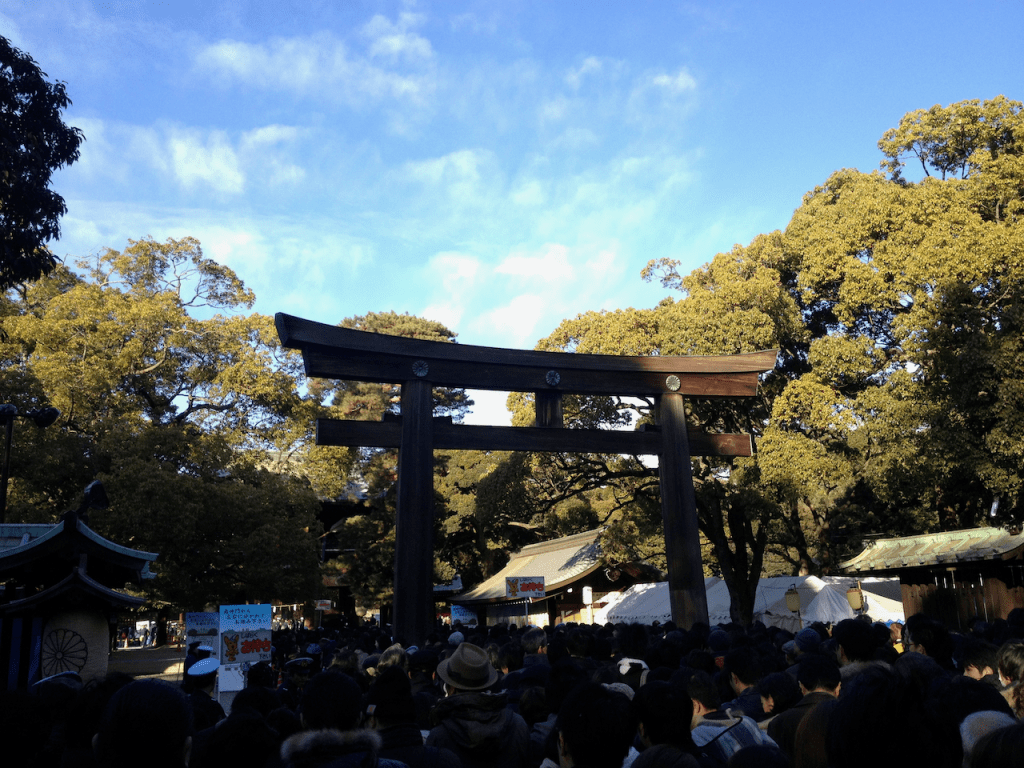
Shinto is a religion devoted to the kami, the native divinities of Japan, and in Shinto tradition ritual purity is important. The kami will not descend to ritually unclean places, nor hear the prayers of unclean people, so sacred places must be purified. A sacred space in this context can be as small as a tiny home shrine, a kamidana, or as large as the sanctum of a large shrine such as Meiji Shrine in Tokyo.
Torii gate for Meiji Shrine in Tokyo, taken in 2012 during Japanese New Year. The lines were amazingly long.
What matters is that there’s a sense of “boundary” between the mundane, outer world and the sacred, inner realm.
The torii thus acts as a gate between these two worlds. By passing through the gate you enter the sacred grounds of the shrine, or leave it. It’s also why taking away things from a shrine like pebbles or flowers is frowned upon.
Torii can be very small, or using the example of Meiji shrine, extremely large. There are many styles too. Some are bright red, others a more natural color. Sometimes a shrine will have a series of torii gates.
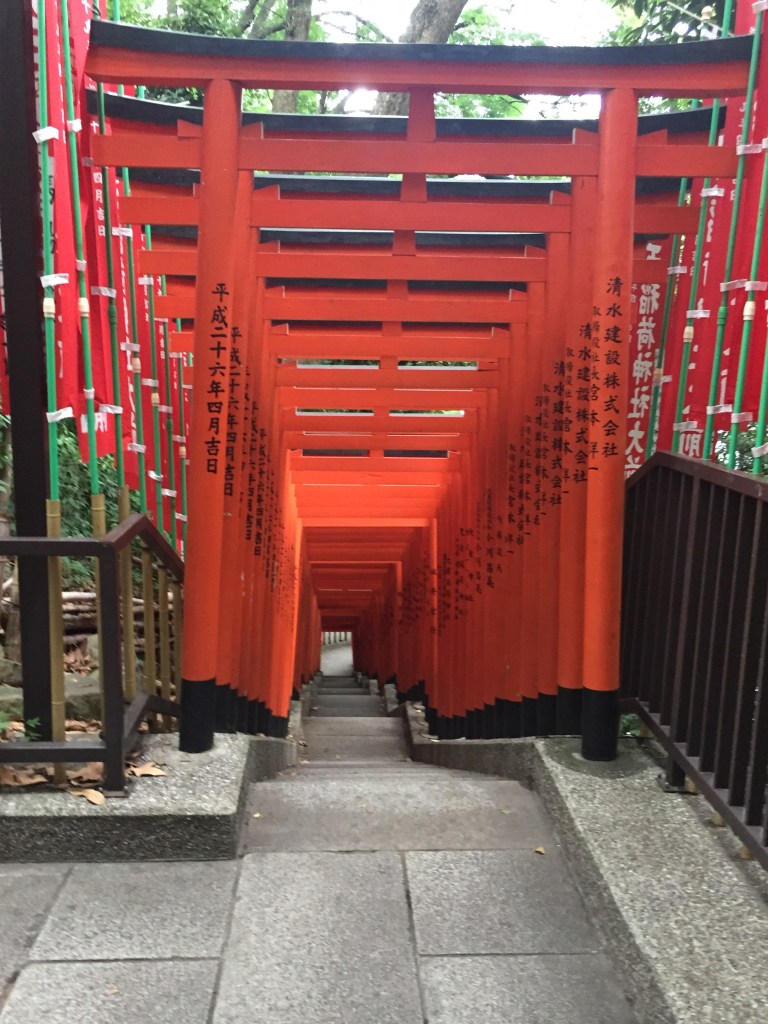
Torii gates at Hie Shrine in Tokyo, taken in 2017.
In the photo above, these gates were sponsored through donations by local businesses. As with many other aspects of Shinto, there’s a lot of local community involvement as well as give and take.
There’s a good chance that if you ever visited Tokyo, you’ve been to this place:
The kaminari-mon gate (雷門), taken in 2022
Same place, taken in 2009
This place is Asakusa Temple, or in Japanese Asakusa-dera, though more formally known as Sensōji. The Chinese characters 浅草寺 can be read either way. This is a temple formerly of the Tendai sect that has been a part of Tokyo since at least the 9th century and is centered around a statue of the BodhisattvaKannon said to have washed up on the shore one day. The homepage (English available) is here.
Asakusa Temple is simultaneously a giant tourist-trap and a great experience. I have visited the temple 3-4 times since 2009 and it is always worth it. I have included photos from various trips below.
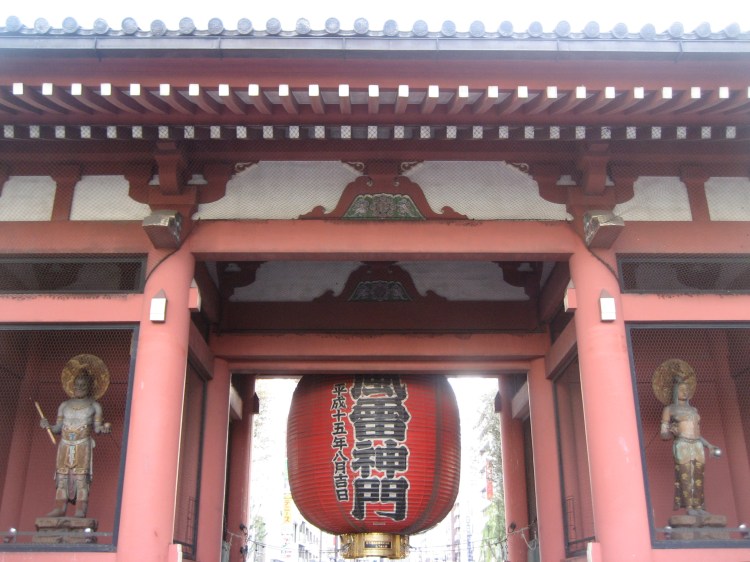
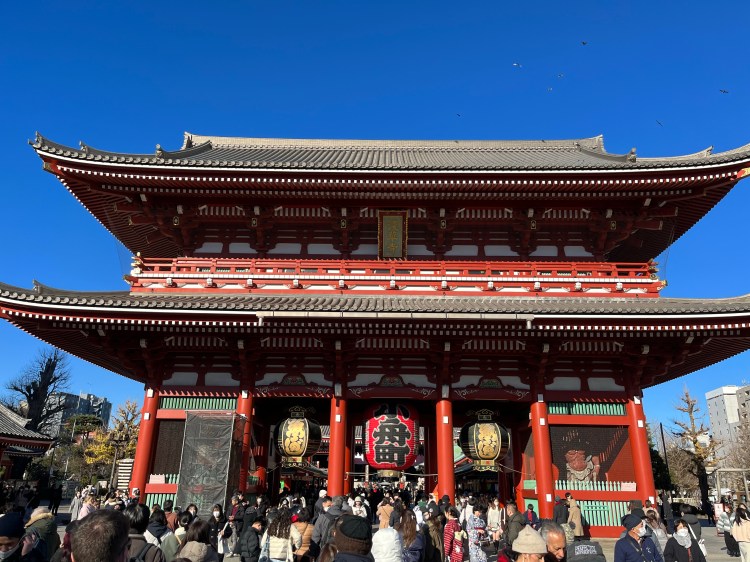
The first thing people will see is the famous Kaminari-mon Gate (雷門, “the lightning gate”) with its massive red lantern, flanked by two guardian Buddhist deities, the Niō. If you pass through the gate, or on your way out, you may notice the reverse:
Taken in 2009
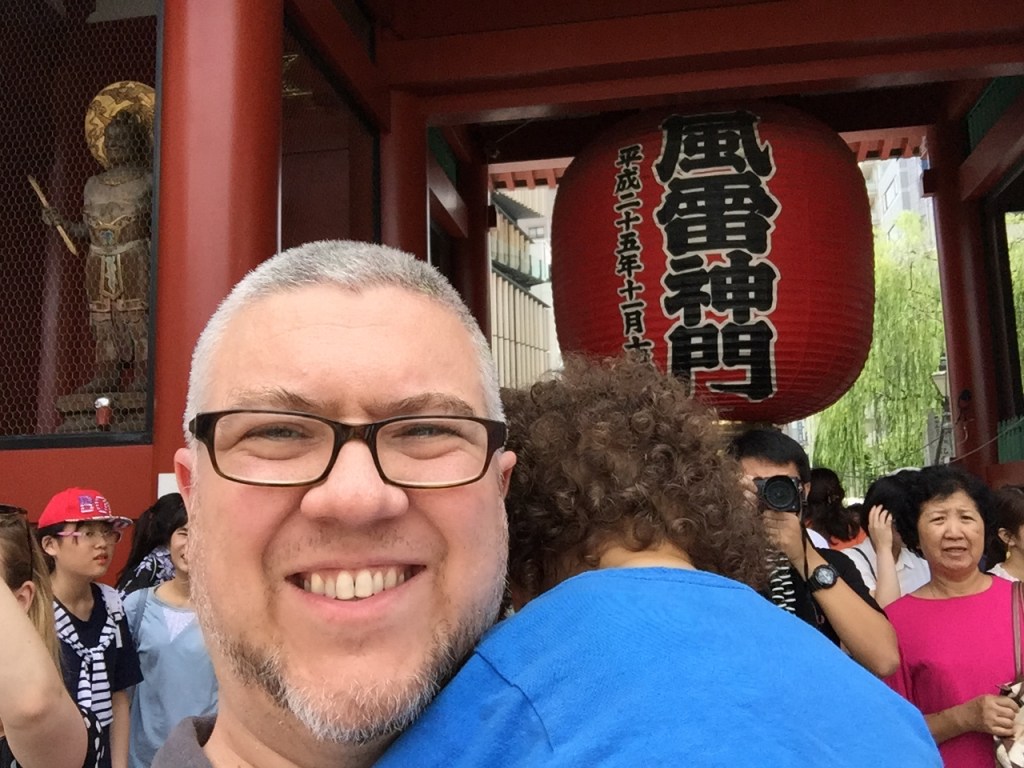
The lantern on the back instead reads Fūraijinmon (風雷神門) or the Gate of the Wind and Thunder god.
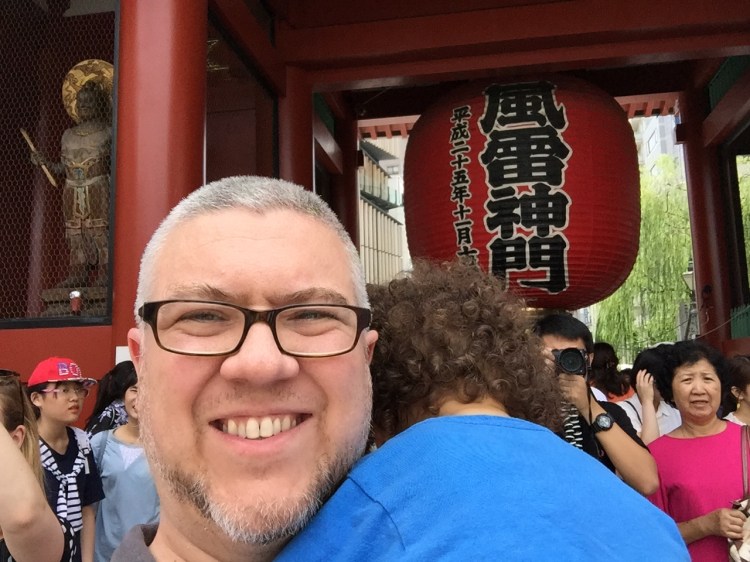
Me carrying a very tired little boy in the summer of 2014.
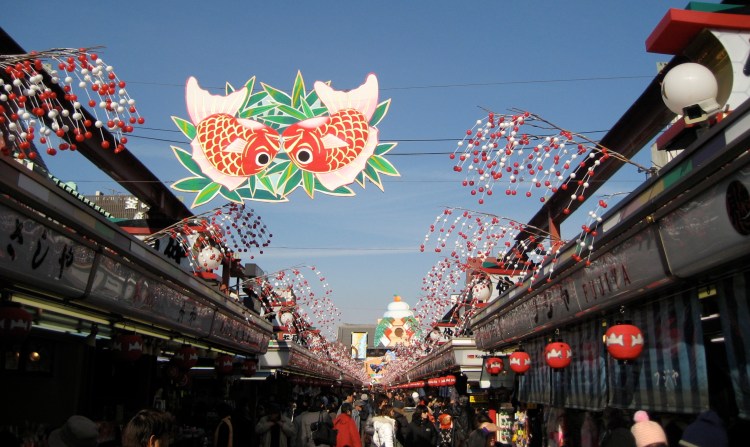
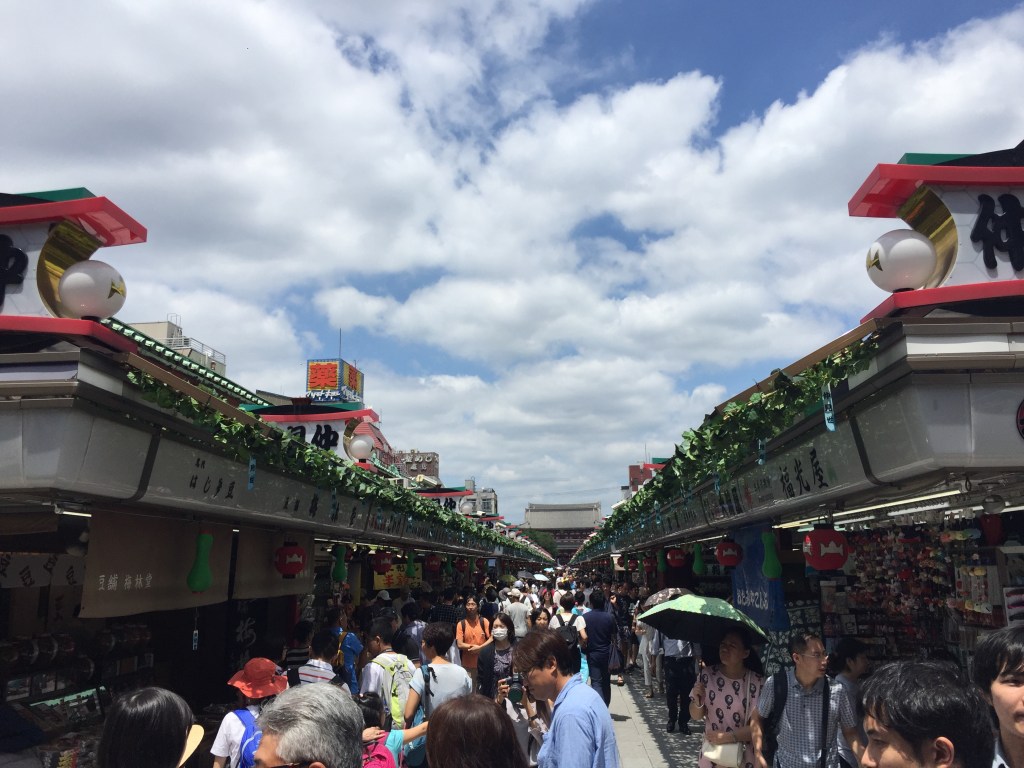
Once you pass through the gate, you will see a huge, long walkway: the Nakamise-dōri (中店通り):
December 2022
Summer of 2016
2009, just after New Year
This is not the temple proper. This is a large number of very crowded street stalls selling all kinds of wares: some focused on foreign tourists, and some focused more on native Japanese visitors. You can find all kinds of things here. In our most recent trip, we found some excellent shichimi spice with yuzu flavor added. Goes really well in soups. You can probably spend half a day here. Just beyond these shops, to the left and right, are various restaurants, against catered toward either native Japanese or foreign tourists. We ate at this place during our last trip:
In any case, once you go all the way past the shops, you can get to the temple proper:
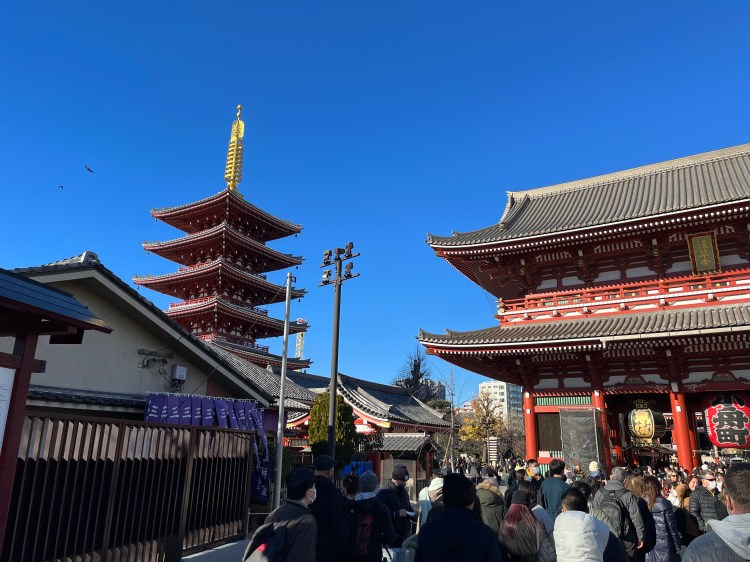
A pagoda, or gojū no tō (五重塔) in Japanese, is something adapted from Chinese culture and is meant to represent the ancient Buddhist stupas in India: storehouses for relics of the Buddha.
The temple gate itself, called the Hōzōmon (宝蔵門, “treasure [of the Dharma] storehouse gate”) sports a similarly large red lantern:
Me being a tourist in December 2022
Summer of 2016
Past this second gate you are now at the temple proper. There is a large, outdoor charcoal brazier with incense sticks burning here. Per Buddhist tradition, you can purify yourself (ablution) before seeing the Bodhisattva by waving some of the incense smoke over you. Once ready, you then proceed to the main hall (honden 本殿):
December 2022
January 2009
If you look up as you pass this lamp, you’ll also see the underside has a neat dragon pattern on it:
Since the temple itself is devoted to the Bodhisattva Kannon, you will see it enshrined at the central altar:
December 2022
January 2009
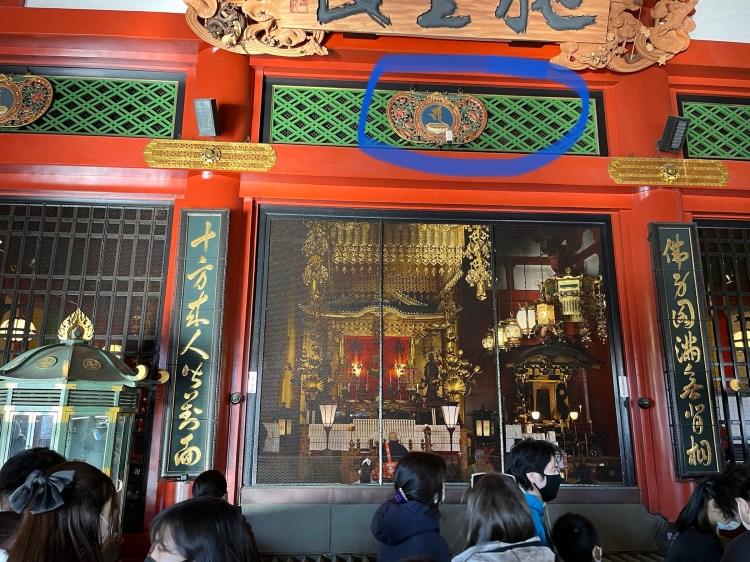
The statue itself is hidden behind the red screen, but is flanked by two other statues denoting the Indian gods Brahma and Indra as guardians. Also, if you pay attention, you’ll notice this mark both on the red screen and above:
This is the Sanskrit letter “sa” written in old Siddham script as 𑖭, and is used to represent Kannon. It also represents the Sanskrit word satya (“truth, virtue, etc”). There is also a really large grilled wooden box in front, and that is where you can put in a donation. Per tradition, people often put in a ¥5 yen coin (go-en-dama) due to word-play that implies fostering a karmic-bond with the bodhisattva.
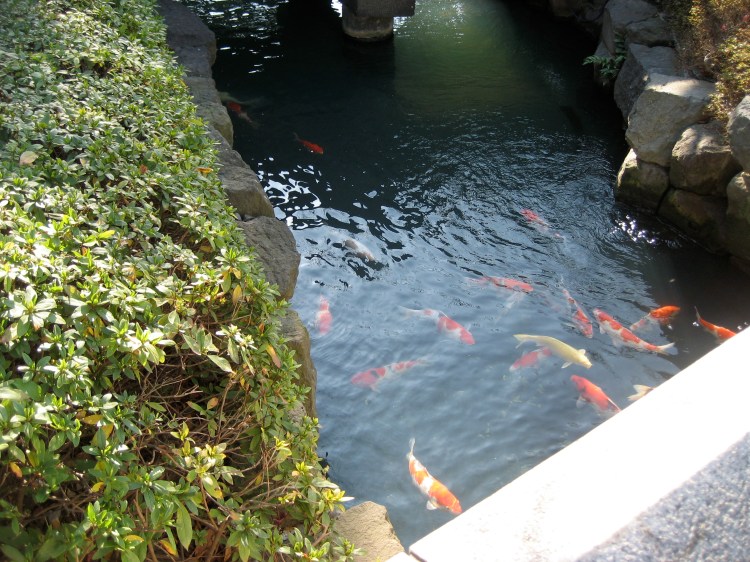
Note that if you go left of the main hall, there’s several other things to note. First is the koi pond and bridge:
January 2009
January 2009
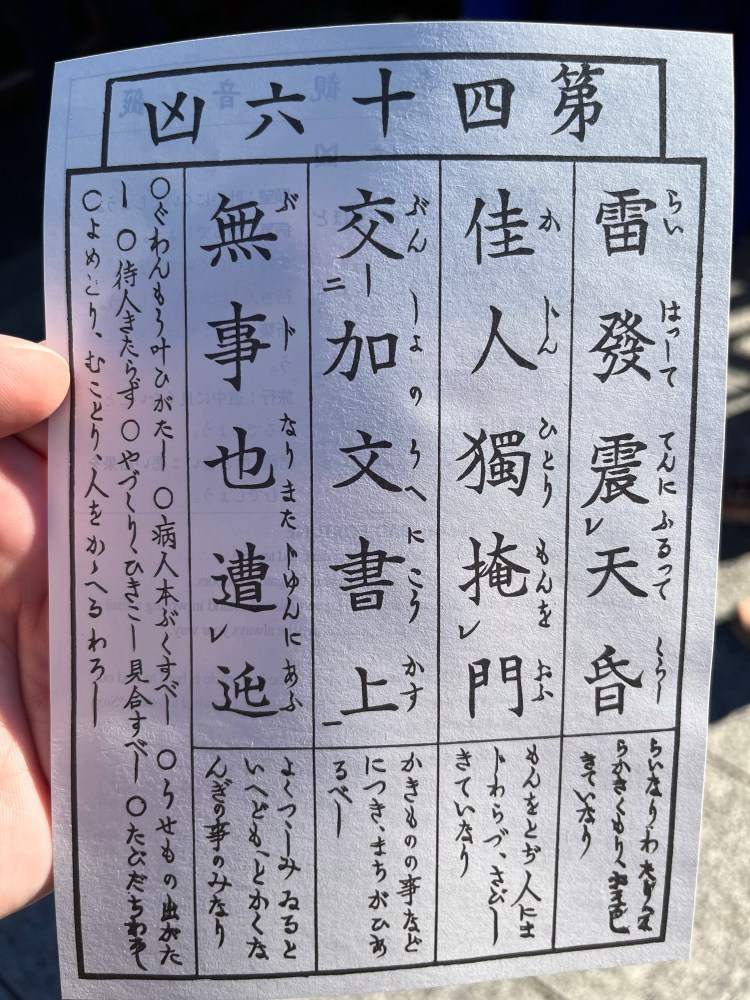
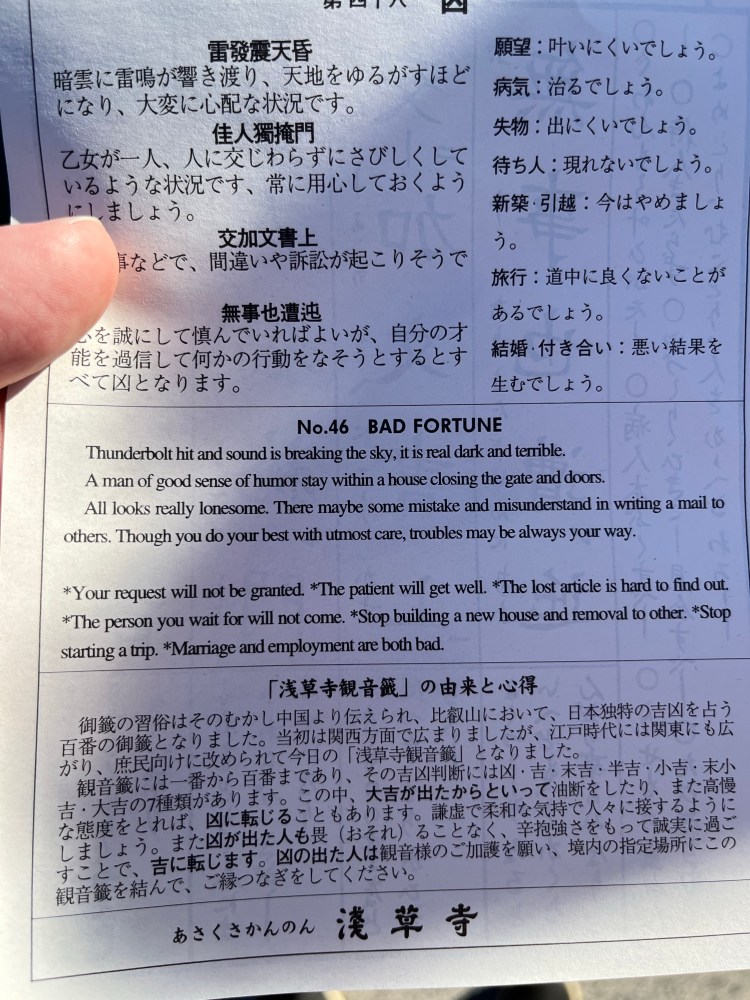
There’s also a place here where you can draw your fortune (omikuji). This year, I drew a bad fortune (凶 on the upper left):
Per tradition, if you get a bad fortune, you’re supposed to tie it up on a small wire fence nearby, so the bad luck “stays there”, and does not follow you.
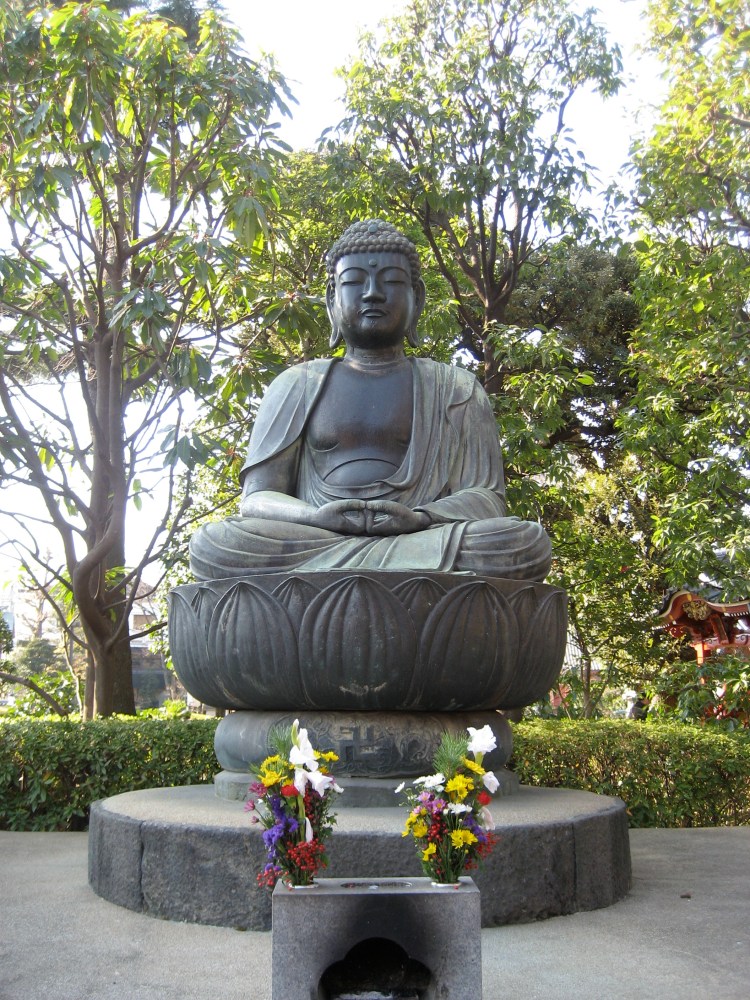
There is also a statue of Amitabha Buddha (阿弥陀如来, amida nyorai) nearby:
December 2022
Summer 2016
Finally, to the left of the main hall is one of several secondaries halls that compromise the temple complex. This hall is called the Yogodo Hall:
The Yogodo Hall is a commemorative hall to mark the 1,200th anniversary of the Tendai monk Ennin, who was a pivotal figure in the early Japanese Tendai tradition, and still crucial to the growth and development of the tradition. Side note, the term yōgō (影向) is a Buddhist term of the temporary manifestation of a Buddha or Bodhisattva or other divinity in the world for the benefit of beings. This is probably meant to be a form of praise to Ennin, implying that he had been a temporary manifestation of a Buddhist figure.
There are several other halls I’ve managed to overlook each time I visit, but a full map of the site in English can be found here.
In any case, it’s interesting to look back on my old photos and reflect on how much has changed (phone camera technology, for example 😉 ), and how much has remained the same at Sensoji…
This is a photo from a sutra book I frequently use for daily services. I bought this book years ago from the temple of Sensoji (a.k.a. Asakusa Temple) in Tokyo, Japan, a place that I have visited many times over the years.
A photo I took in 2016 of the famous market of nakamise-dōri. The actual temple is way in the back.
The temple just after New Year’s, taken in 2009.
Me carrying one tired little boy at the iconic kaminari-mon gate in 2016. Note the giant red lantern in the back.
It is still one of my favorite temples, even if a bit touristy, and of the Buddhist sutra books I own this is still one of my favorite to use.1 This sutra book uses the traditional Classical Chinese with Japanese pronunciation guides (furigana), which is pretty typical of Japanese-Buddhist sutra books. As you can see, it’s not a long sutra to recite. It is probably the shortest sutra in the entire Buddhist canon.
Chanting the Heart Sutra is something many Buddhists in the Mahayana tradition (everything you see from Tibet to Japan, and overseas) do both in group services and in home services. People chant it in many languages and styles. Its simplicity, and general message about the nature of reality means that it tends to cut across sectarian lines and is popular in many sects and communities. Its cryptic and profound nature also means that for a one-page sutra it is the subject of intense study and research.
The sutra, for reference, is shown below. I used the standard Japanese liturgical form, recited in Zen temples, Tendai temples, Shingon temples, and so on, with only very minor differences per tradition. However, there are many ways and languages to recite the Heart Sutra.
kan ji zai bo satsu gyo jin han nya ha ra mi ta ji
When Avalokiteśvara Bodhisattva was practicing the profound Prajñāpāramitā,
照見五蘊皆空。
sho ken go un kai ku
he illuminated the Five Skandhas and saw that they were all empty,
度一切苦厄。
do is-sai ku yaku
and crossed over all suffering and affliction.
舎利子。色不異空。
sha ri shi shiki fu i ku
Śāriputra, form is not different from emptiness, and
空不異色。
ku fu i shiki
emptiness is not different from form.
色即是空。
shiki zoku ze ku
Form itself is emptiness, and
空即是色。
ku zoku ze shiki
emptiness itself is form.
受想行識亦復如是。
ju so gyo shiki yaku bu nyo ze
Sensation, conception, synthesis, and discrimination are also such as this.
舎利子。是諸法空相。
sha ri shi ze sho ho ku so
Śāriputra, all dharmas are empty:
不生不滅。
fu sho fu metsu
they are neither created nor destroyed,
不垢不浄。
fu ku fu jo
neither defiled nor pure,
不増不減。
fu zo fu gen
and they neither increase nor diminish.
是故空中。
ze ko ku chu
This is because in emptiness
無色無受想行識。
mu shiki mu ju so gyo shiki
there is no form, sensation, conception, synthesis, or discrimination.
無眼耳鼻舌身意。
mu gen-ni bi zes-shin i
There are no eyes, ears, nose, tongue, body, or thoughts.
無色声香味触法。
mu shiki sho ko mi soku ho
There are no forms, sounds, scents, tastes, sensations, or dharmas.
無眼界。
mu gen kai
There is no field of vision and
乃至無意識界。
nai shi mu i shiki kai
there is no realm of thoughts.
無無明。
mu mu myo
There is no ignorance
亦無無明尽。
yaku mu mu myo jin
nor elimination of ignorance,
乃至無老死。
nai shi mu ro shi
even up to and including no old age and death,
亦無老死尽。
yaku mu ro shi jin
nor elimination of old age and death.
無苦集滅道。
mu ku shu metsu do
There is no suffering, its accumulation, its elimination, or a path.
無智亦無得。
mu chi yaku mu toku
There is no understanding and no attaining.
以無所得故。
i mu sho tok-ko
Because there is no attainment,
菩提薩埵。依般若波羅蜜多故。
bo dai sat-ta e han nya ha ra mi ta ko
bodhisattvas rely on Prajñāpāramitā,
心無罜礙。
shin mu kei ge
and their minds have no obstructions.
無罜礙故。
mu kei ge ko
Since there are no obstructions,
無有恐怖。
mu u ku fu
they have no fears.
遠離一切顛倒夢想。
on ri is-sai ten do mu so
Because they are detached from backwards dream-thinking,
究竟涅槃。
ku gyo ne han
their final result is Nirvāṇa.
三世諸仏。
san ze sho butsu
Because all buddhas of the past, present, and future
依般若波羅蜜多故。
e han nya ha ra mi ta ko
rely on Prajñāpāramitā,
得阿耨多羅三藐三菩提。
toku a noku ta ra sam myaku san bo dai
they attain Anuttarā Samyaksaṃbodhi.
故知。般若波羅蜜多。
ko chi han nya ha ra mi ta
Therefore, know that Prajñāpāramitā
是大神呪。是大明呪。
ze dai jin shu ze dai myo shu
is a great spiritual mantra, a great brilliant mantra,
是無上呪。是無等等呪。
ze mu jo shu ze mu to do shu
an unsurpassed mantra, and an unequalled mantra.
能除一切苦。真実不虚故。説般若波羅蜜多呪。
no jo is-sai ku shin jitsu fu ko ko setsu han nya ha ra mi ta shu
The Prajñāpāramitā Mantra is spoken because it can truly remove all afflictions.
即説呪曰。
soku setsu shu watsu:
The mantra is spoken thusly:
羯諦羯諦波羅羯諦波羅僧羯諦菩提薩婆訶。
gya tei gya tei ha ra gya tei hara so gya tei bo ji so wa ka
gate gate pāragate pārasaṃgate bodhi svāhā3
般若心経
han nya shin gyo
The Heart Sutra
You can see a really nice example of this chanted here, courtesy of Koyasan Temple in Japan:
I have been reading Tanahashi’s book about the Heart Sutra and learning a lot about its various interpretations, how it’s conveyed in various languages, and various theories about its origin. I was fascinated to learn that there is a Mongolian version sometimes transcribed in Cyrillic. None of this is strictly necessary for the purposes of Buddhist practice, but it is fascinating. The example I showed above uses what’s called “Sino-Japanese”: Japanese pronunciation of the original Chinese characters it was composed with.2
As for chanting the sutra, I’ve been doing it for years, so I can more or less recite the Sino-Japanese version from memory, and am pretty comfortable doing it that way. I study the meaning of the sutra in English of course. I also have a PDF file for chanting in Sino-Japanese available for those interested.
I have also attended Zen centers on rare occasions (I tend to lean toward Pure Land Buddhism, to be honest) and seen the Heart Sutra recited using English. Learning the English meaning is very useful, but English chanting sounds a bit awkward to me. So, I prefer chanting in the original, and study the meaning separately.
But regardless of what language you use, the Heart Sutra, like all Buddhist sutras, has a funny tendency to gradually “sink in” over time. The meaning may not make much sense at first, but over the course of months and years, it takes on new meaning as you go through life, and see the sutra in a new light. I believe that’s the real value of Buddhist chanting: to internalize key Buddhist teachings in a way that you can carry with you throughout life.
As for me, these days, I tend to recite a Tendai-style home service,4 and as part of that I rotate between chanting this and a certain, small excerpt of the Immeasurable Life Sutra called the shiseige (四誓偈) or juseige (重誓偈) in Japanese Buddhism. When I finish one, I put it under the other sutra book, so I don’t forget which sutra to recite next time as I might go a week or two before reciting again. As a short, traditional liturgy, I am pretty content.
As with any Buddhist practice done over a long period of time, I believe that it gradually polishes the mind, and dispels one self-centered viewpoint. It’s super simple to do, but its benefits last a lifetime. To paraphrase Nichiren, when dying cloth in indigo, the more you do it, the deeper the color becomes.
Namu Amida Butsu Namu Kanzeon Bosatsu
Edit: I discovered in May 2025 some egregious mistakes in the formatting of the sutra above. This was not a problem with the translation, but with mistakes in how I copy-pasted into the blog post. I have since corrected these mistakes. Apologies to anyone who used the flawed copy of the sutra.
P.S. It’s tempting for some to look for an original “Sanskrit” version of the sutra, but alas, the best we know today is that the sutra was compiled originally in China, using excerpts from the much, much larger Prajña-paramita sutras. The story of how exactly that came to be is a much-discussed subject in Tanahashi’s book.
P.P.S. Fun fact: the version of the Heart Sutra used in Japan differs very slightly from the popular version attributed to Xuanzang. The Japanese version, popularized by the Shingon esoteric tradition, is called the rufubon (流布本) version. It has two extra Chinese characters (262 total) from Xuanzang’s 260, and uses slightly different characters for pronouncing the mantra at the end: 揭諦 instead of original 揭帝 for Sanskrit gaté.
1 Because it is devoted to Kannon Bodhisattva, this sutra book also includes (left in photo) a certain Japanese-Buddhist verse called the Jikku Kannon-gyō (十句観音経, “ten verse Kannon sutra”) popularized in the middle ages. I made a post here about it.
A nice explanation of the meaning and history of the ten-verse sutra can be found here.
2 It’s sometimes assumed that the sutra’s earliest composition was in a language like Sanskrit or something else from India, but research has long since proven that the Heart Sutra was a Chinese innovation, a summary of the much longer Perfection Wisdom Sutras, distilled into a very compact, chantable essence. The monk Xuan-zang later brought it back to India, where it later came to Tibet. Pretty clever actually.
3 I decided to leave the Sanskrit mantra untranslated, per esoteric-Buddhist tradition.
4 I like the Tendai approach to Buddhism because it encompasses all the things that are important to me, but avoiding a narrow, dogmatic approach that I found in the past and ultimately rejected.


























 Gleanings in Buddha-Fields
You must be logged in to post a comment.