The Power of Goodwill and the Nembutsu

From time to time, I am reminded of the importance of goodwill, or metta, in Buddhism, and as an example of this the famous Circle of Hierocles, which I wrote about here. Lately, I’ve been inspired to recite the nembutsu1 not so much as a personal practice but for the sake of sharing a bit of goodwill toward the world.

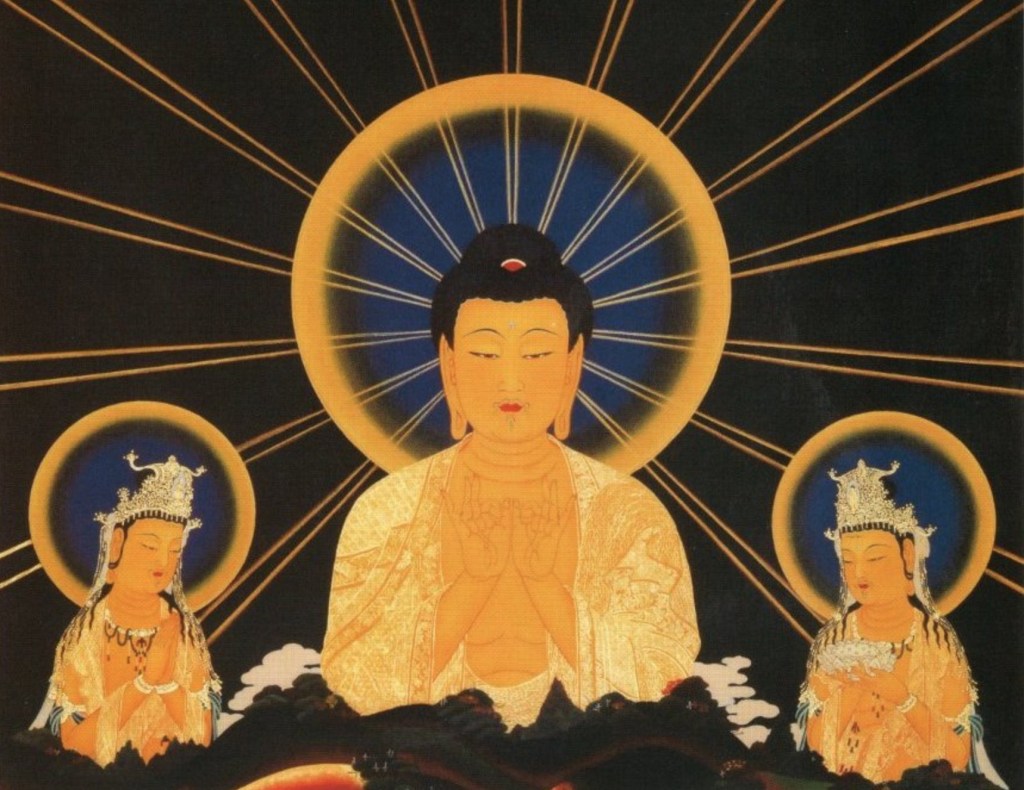
The practice of sharing goodwill or good karma with the world is a very common practice in Mahayana Buddhism, that is all Buddhism found in places like Japan, Tibet, China, etc. It is also mentioned in an number of sutras as a practice that bodhisattvas do, to say nothing about regular Buddhist disciples. However, the focus of Pure Land Buddhism, in particular, is typically to help one achieve rebirth in the Pure Land of Amitabha Buddha2 in order to progress along the Buddhist path more easily and eventually to help one another.

However, chanting the nembutsu as a means of helping others is not entirely unheard of either. About 100 years before the monk Honen started the Pure Land Buddhist movement in the late 12th century, there was another offshoot of Tendai Buddhism called the Yūzū Nembutsu-shū which I would translate as the “All-Inclusive Nembutsu Sect”.

This sect was started by a Tendai-Buddhist monk named Ryōgen (良忍, 1073-1132) while during a period of Pure Land ascetic training beheld a vision of Amitabha Buddha who was said to have uttered the following phrase (with my rough, rough translation):

一人一切人 One person in all beings
一切人一人 All beings in one person
一行一切行 One act in all acts
一切行一行 All acts in one act
十界一念 One nembutsu for all 10 realms3
融通念仏 The all-inclusive nembutsu
億百万編 encompasses countless (lit. 101,000,000)
功徳円満 tranquil merit

This concept of “all in one, one in all” is a core teaching of the massive tome, the Flower Garland Sutra, as well as Mahayana Buddhism in general and basically revolves around a concept that we’re all inter-connected one way or another. So what one does, thinks or wishes, ultimately affects others. In the same way, what they do also affects us in one way or another.

A classic Buddhist example of this is the parable of the Jeweled Net of Indra. Indra is one of the primary deities in Indian religion, and was roughly analogous to figures like Odin or Zeus in that he is the king of the other gods.4 In Indian mythology Indra (sometimes a different deity, Brahma) has a great net strung inside of his palace, and each node of the net has a great shining jewel inside. Thus, the light of each jewel shines the light of every other jewel.

The implication of this isn’t hard to imagine: when we think or do something wholesome, it affects others, improving the quality of life that much more. Conversely, when we think or do something rotten or selfish, it degrades the quality of life that much more.

So, the Yūzū Nembutsu sect takes this to its logical conclusion: when we recite the nembutsu, it benefits us, but also benefits countless other people as well. This is encompassed in the phrase: 一人の念仏が万人の念仏に通じる (hitori no nembutsu ga mannin no nembutsu ni tsūjiru) which means “the nembutsu of one person becomes (lit. “spreads to”) the nembutsu of 10,000 people”.

In reality, the Yūzū Nembutsu sect is very small and has never really had the mass-appeal that the later Jodo Shu and Jodo Shinshu sects have attained. Ryonin probably was a little ahead of his time, but the important thing is that concept of the nembutsu for the benefit of others has historical precedent.

Further, this is not limited to the nembutsu. Nichiren Buddhists frequently recite the odaimoku (namu myoho renge kyo) for similar reasons. And of course many Mahayana Buddhists include a “dedication of merit” whenever they complete a home service or a service at their local temple. One of the most famous and commonly-used verses used was composed by a Chinese monk named Shan-dao (善導, 613-681) and are:

Original ChineseJapanese RomanizationEnglish
願似此功德Gan ni shi ku do kuMay this merit I accumulate here
平等施一切Byo do se is-saiBe equally distributed to all beings
同發菩提心Do ho tsu bo dai shinSo that we may all awaken the Bodhi Mind
往生安樂國O jo an raku kokuAnd dwell together in the Pure Land

Anyhow, all this is to say that in these crazy, turbulent times of pandemics, petty politicians, protests and a pervading sense of powerlessness,5 you can leverage your Buddhist (or even non-Buddhist) practice, whatever it is, and send out goodwill and good thoughts to others and work for a better world. This isn’t just empty wishing either, because as far as Buddhism is concerned, all of it counts for something.

1 When I recite it, which is admittedly inconsistent… 😅

2 What exactly that means is often up to personal interpretation, not to mention the various schools of Buddhist thought.

3 The ten realms have nothing to do with the Thor Marvel comic universe. 😅 These are the ten realms of existence in classic Buddhism: the Hell realm, the realm of Hungry Ghost, the realm of animals, the realm of the Asuras (roughly analogous to Titans), the realm of humans, the realm of the Devas (lit. gods with a small “g”), the realm of the Buddhist monastic disciples (lit. “voice-hearers”), the realm of private Buddhas, the realm of the Bodhisattvas and the realm of the Buddhas. These are/were interpreted as both literally realms of existence, but also mental states which a person might transition to in the course of one’s life or even one day. It’s a lengthy subject and too large for this post.

4 The shared Indo-European linguistic and cultural ancestry of northern India with Europe probably implies more than just a casual similarity between these deities, but that’s a topic too large for this post.

5 The alliteration was unintentional, but I am kind of glad I did it. 😉🏆

Genshin, We Hardly Knew You

I am happy to report that I finally finished my book on Genshin (源信, 942 – 1017), a 9th century Japanese Buddhist monk who was a big influence on later Pure Land Buddhist thought. Genshin is often referred to as a “patriarch” in Japanese Pure Land Buddhism, but available information about Genshin in English (and even Japanese) is thin and circumspect and reflects later interpretation by Buddhist authors (and their Wikipedia editors). Weirdly, past authors and editors praise Genshin a lot, but frequently inject their own viewpoint. In other words, history is written by the winners.

Portrait of monk Genshin, d. 1017, attrib. to himself, property of Shōjūraigōji temple photo by Tani Bunchō et al.日本語: 谷文晁ほか / Public domain

Since it was surprisingly hard to find out what Genshin’s own teachings and viewpoints, the book proved super helpful in looking past the empty praise of later generations to the real Genshin. At least, the most we can glean from his writings and historical relics of the time.

Genshin, I learned, was first and foremost a Tendai Buddhist. He was ordained as a child and grew up training as a monk in a wholly Tendai-Buddhist environment on Mount Hiei. He never contradicted this either. His participation in debates with rival schools, his writings on various topics and even the writings that proved popular later about the Pure Land of Amida Buddha were all done from a fairly orthodox Tendai viewpoint.

To Genshin, the Pure Land path was always meant to be a holistic one. Later Pure Land authors tended to cherry-pick Genshin’s comments that the nembutsu (reciting the name of Amida Buddha) was an effective practice, but that was clearly not Genshin’s intention when you take his writings as a whole. As a Tendai Buddhist monk, Genshin’s primary focus was on meditation practices, and Tendai Buddhism has a ton of them, ranging from traditional “Zen-like” meditations to grueling 90-day retreats that involve walking all day around a statue. The original founder of Tiantai Buddhism in China (Tendai in Japan), named Zhi-yi, catalogued many kinds of meditation in his great work, the Mohe Zhiguan (摩訶止観, lit. “The Great Śamatha-Vipaśyanā Meditation”) in various categories. So, even when Genshin wrote about rebirth in the Pure Land as an endgoal, he was speaking from a Tendai-Buddhist standpoint which involved:

  • The primacy of meditation practices (in its various forms)
  • The Pure Land as one stop on the larger path toward full Buddhahood (as defined in the Lotus Sutra, which was central to Tendai thought).

Professor Rhodes is careful to point out in the book that later Buddhist writers, in discussing Genshin, were tackling unique challenges in their own era, so they looked for solutions where they could find them (hence their efforts were sincere if not a bit misguided), but after centuries and centuries, this has all gotten kind of muddled and the picture of Genshin is confusing and at times subtly misleading. Plus Tendai Buddhism today is greatly diminished from its heyday in the 10th century when it was practically the de facto state religion, so not a lot of people today would necessarily care what Genshin’s opinion was and wasn’t. For all intents and purposes he is a footnote in Japanese-Buddhist history now.

But Genshin was a highly respected scholar in his time who somehow managed to evade the growing collusion between politics and religion, and keep his reputation clean, while also providing important ideas and writings to the growing Pure Land Buddhist movement in Japan (and even sending his writings back to the mother temple in China on Mount Tiantai). He saw the ongoing breakdown of Japanese society as a sign of the coming Age of Dharma Decline and sought to help people as best he could by synthesizing the writings of past scholars in China and India into a comprehensive guide to seeking refuge in the Pure Land of Amitabha Buddha, the Buddha of Infinite Light. He was uniquely qualified due to his training and he carried out his goals like few others in his time did.

Thus even now, when Pure Land Buddhist followers (Jodo Shu, Jodo Shinshu, etc) in Japan and abroad recite the nembutsu, there is a small echo of Genshin’s influence still there.

A Guided Tour of Enryakuji Temple

Found this on Youtube recently: a guided tour of Enryakuji Temple in Japan, the home temple of the venerable Tendai sect of Buddhism. Enjoy!

For more on the (admittedly often sordid) history of Enryakuji, please see here.

Genshin and the Essentials of Pure Land Buddhist Practice

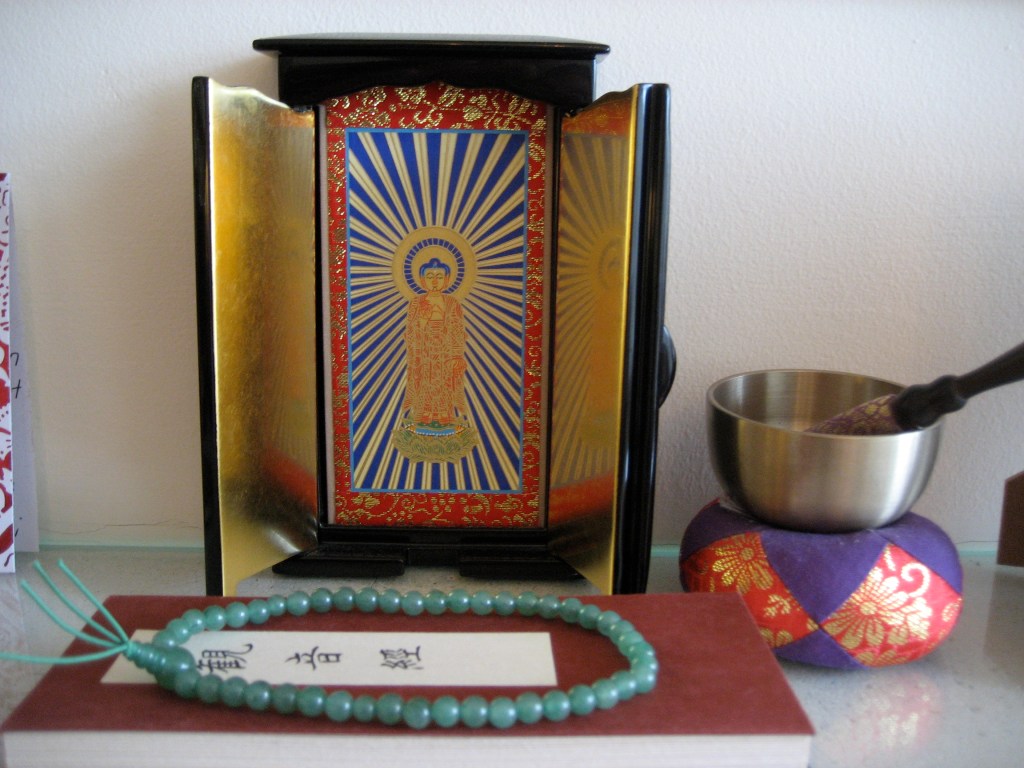
An old altar we setup years ago. The central image was purchased from Tsukiji Honganji in Japan and venerates Amitabha Buddha, the Buddha of Infinite Light.

I continue reading my new book on the eminent Buddhist scholar-monk Genshin (源信; 942 – 1017), and one part of the book summarizes Genshin’s approach to Pure Land Buddhism:

  1. Aspiration for enlightenment.
  2. Controlling one’s conduct.
  3. Having deep faith.
  4. Being sincere.
  5. Remaining constant in one’s practice.
  6. Remaining mindful of the Buddha.
  7. Arousing the vow to be reborn in the Pure Land.

Let’s look at each one of these briefly.

Aspiration for Enlightenment has historically been a common topic in Mahayana Buddhism, and just means that one perceives the nature of reality and realizes that life is hard not just for oneself, but also for others. In so doing, one resolves to pursue the Buddhist path and in time help teach and liberate others too.

Controlling one’s conduct means slightly different things to different Buddhist teachers, but in general it means living a wholesome, clean, upright life particularly with respect to how you treat other people. The Five Precepts are an excellent benchmark to follow.

Having deep faith is a bit different than the concept of “faith” in Western religious culture. It is a sense of increasing confidence in the teachings that grows as one explores them. One’s faith is shaky at first, and that’s fine, but as one explores the Dharma further and further it is like a shot in the arm that helps them through good times and bad.

Being sincere is pretty self-explanatory: don’t be an ass.

Remaining constant in one’s practice is probably one of the harder elements, but in practical terms it means riding the highs and lows of life and finding a sustainable approach to Buddhist practice according to one’s circumstances.

Remaining mindful of the Buddha can mean somewhat different things to different Buddhists but in general it means holding the Buddha in one’s thoughts as they go about their practice and their daily lives. In modern American English: WWBD (what would [the] Buddha do?)

Arousing the vow to be reborn in the Pure Land simply means that rather than simply dabbling in Pure Land Buddhist practices, one explicitly wants to go there. This is closely related to the aspiration for Enlightenment because the intention of the Pure Land is not a blissful, heavenly realm so much as a place that is highly conducive toward the pursuit of the Buddhist path.

Anyhow, hope this is helpful!

The Eternal Light of the Dharma

Something cool I wanted to share with readers: the Japanese Buddhist temple of Enryakuji (mentioned in a previous post) on Mount Hiei has a 24-hour livestream video of a special oil lamp called the fumetsu no hōtō (不滅の法灯) which means something like the “eternal Dharma lamp” :

link: https://www.youtube.com/live/BG9zyIuplyk?feature=shared

According to tradition, this small oil lamp has been burning for 1,200 years1 and symbolizes the founder, Saicho’s, famous quote:

一隅を照らす 此れ則ち国宝なり
Ichigū o terasu kore sunawachi kokuhōnari

Roughly translated, this means something like “light one corner of the world; in so doing one becomes a national treasure”.

I am told by a reliable source that one can use this livestream as an object of meditation if one is inclined to do so. Even if one does not wish to meditate, this flame is a nice reminder that even in dark times, the light of the Dharma still shines.

Mandarava blossoms rain down,
scattering over the Buddha and the great assembly.
My pure land is not destroyed,
yet the multitude see it as consumed in fire,
with anxiety, fear and other sufferings
filling it everywhere.
These living beings with their various offenses,
through causes arising from their evil actions,
spend asamkhya kalpas2
without hearing the name of the Three Treasures.
But those who practice meritorious ways,
who are gentle, peaceful, honest and upright,
all of them will see me
here in person, preaching the Law [the Dharma].

Lotus Sutra, chapter 16, Burton Watson translation

So, take heart even in these crazy times, and consider the flame in us all. 🖖🙏🏼

1 Technically, the lamp has been extinguished once during the Siege of Mount Hiei in 1571, when the entire monastery was razed to the ground.

2 The term asaṃkhyeya in Sanskrit literally means 10140 but as a literary device means “vast” or “huge” or in modern English, a “metric fuckton”. The term kalpa is a term meaning an aeon.

There Is More To Pure Land Buddhism Than Just The Nembutsu

(Warning: Buddhist rant)

Recently, I got into a debate online (that always ends well) about so-called “auxilliary” practices with some fellow Buddhists on an old, private discussion forum for Jodo Shu Buddhist teachings.

The debate started after someone on the forum asked about whether visualization of Amida Buddha was permitted in Jodo Shu, and I was not satisfied with the responses thus far which tended to strongly imply that it wasn’t worth doing, and that one should rely on the nembutsu only. I was somewhat annoyed by these replies, so I responded to the original poster like so (quoting almost verbatim here, minus some typographical editing):

In my experience, both Jodo Shu and the related Jodo Shinshu sects doctrinally focus on the spoken nembutsu only. I would argue though, that this “exclusive nembutsu teaching” is an idiosyncracy of Jodo Shu and does not always reflect the Pure Land tradition in general.

You are correct in that the Contemplation Sutra does teach an elaborate process for visualizing Amida Buddha, and this kind of visualization practice has been undertaken by monks, particularly in the Tiantai (Chinese) and Tendai (Japanese) sects among others. People tend to focus on a single passage toward the end of the sutra whereby reciting the name of Amida Buddha erases all karma, but in some monastic traditions, people have focused on visualization too.

It’s also true that there are parallel traditions for rebirth in the Pure Land that have nothing to do with the nembutsu, mostly in the esoteric tradition. Even today, Shingon Buddhism has visualization/chanting practices related to Amida Buddha that have little or anything to do with the nembutsu. Such parallel practices include such things as the Mantra of Light and various dharanis that sometimes appear in Zen traditions. Genshin, who was ironically a “patriarch” of the Jodo Shinshu tradition, listed many such methods in the Ojoyoshu, but in practice he recited the nembutsu like many other monks and nuns did during his time. Further, the 23rd chapter of the Lotus Sutra, clearly mentions rebirth in the Pure Land of Amitayus (Amida) Buddha through upholding the Lotus Sutra, not reciting the nembutsu.

I think most people would agree that the nembutsu tends to be the most simplest and straightforward, and thus people tend to treat it as the only viable solution in the so-called Latter Age of the Dharma. I think this is a bit of a leap, but if I were a priest and someone wanted to know more about the Pure Land, I would start by teaching the nembutsu too. It’s a great practice. On the other hand, I think it’s also important for people spiritually grow and if people want to branch out from the nembutsu, they should be able to do so without a sense of “guilt” caused by artificial, doctrinal orthodoxy. The reason, I think, is that the Pure Land tradition is more broad than the standard Jodo Shu/Shinshu narrative, and people who want to explore should feel free to do so.

Hope that makes sense,

Doug

Since my interest in Buddhism began in earnest in 2005, starting with Jodo Shu and Jodo Shinshu teachings, I have noticed a tendency for these two sects to dominate Pure Land Buddhist discussions among Western adherents. For a long time, I was also a fervent advocate, but I’ve since become wary of the exclusive approach taught by Jodo Shu/Jodo Shinshu Buddhism.

The heart of the issue, I believe, is the recitation of the nembutsu (念仏), the Buddha’s name, usually rendered as namu amida butsu (南無阿弥陀仏).

Jodo Shu and Jodo Shinshu sects treat this as the sole, exclusive practice and spend an inexhaustible amount of writing and research to assert this point. A cursory study of Jodo Shu/Shinshu literature will reveal that there isn’t much beyond this. The nembutsu is treated with an almost mystical reverence (which is especially amusing since such people are quick to reiterate that it’s not a mantra either). The “name” of Amida Buddha (myōgō 名号) is all-important and if you wish to reborn in the Pure Land of Amitabha Buddha, the only sure-fire method is to recite the nembutsu either as a practice (Jodo Shu) or as an expression of gratitude (Jodo Shinshu) for Amida Buddha’s grace already being extended to you. Beyond this, say adherents, nothing else really matters. Other practices in Buddhism may be conducive to you reciting the nembutsu, but have no merit or power beyond this. Even the Precepts aren’t particularly emphasized or important.

But, as I have learned from various sources, including my new book, this is a kind of revisionist history, and example of how prominent sects tend to dominate the conversation and cherry-pick only those things from the Buddhist sutras that bolster their view.

Further after some backlash, I explained further:

Within the context of Jodo Shu (and related sects), I agree that the position is that the nembutsu is the only essential practice. All other practices supplement it.

However, if you read the Three Pure Land sutras in their entirety, I believe that the authors suggested something slightly different. Take a look at this passage from the Larger Sutra (translation by Rev. Hisao Inagaki):

“For this reason, Ananda, sentient beings who wish to see Amitayus while in this world should awaken aspiration for the highest Enlightenment, do meritorious deeds, and aspire to be born in his land.”

and:

“Why do you not diligently practice good, reflect on the naturalness of the Way and realize that it is above all discriminations and is boundlessly pervasive? You should each make a great effort to attain it. Strive to escape from Samsara and be born in the Land of Peace and Provision. Then, the causes of the five evil realms having been destroyed, they will naturally cease to be, and so you will progress unhindered in your pursuit of the Way. The Pure Land is easy to reach, but very few actually go there. It rejects nobody, but naturally and unfailingly attracts beings. Why do you not abandon worldly matters and strive to enter the Way?”

I believe that the original authors of this sutra [were] advocating a more holistic approach toward rebirth in the Pure Land. It’s a similar message at the end of the Contemplation Sutra: spare no expense if you can.

The issue, I have observed, is that medieval Japanese monks had a tendency to read sutras literally and at face-value, because they were assumed to be the literal words of the Buddha (spoiler alert: they are not). It explains why they literally interpreted Dharma Decline as one of several 500-year periods, among other things. However, we’re living in the 21st century and have access to information they didn’t, so I believe it is beneficial to read the sutras critically, not literally.

Sure you can just recite the nembutsu, but why stop there? I believe that’s the message of both the Pure Land sutras and the Lotus Sutra ch. 2 when the Buddha says a person attains Buddhahood through a single nod to the Buddha or a single “hail Buddha”.

The intention of the Pure Land practices, I believe, isn’t just to get there; it’s part of the larger Mahayana-Buddhist theme of the potential of all beings to achieve Buddhahood and in turn help others still mired in Samsara. The Pure Land is one of many so-called “Dharma Gates” to accomplish this. The Pure Land “gate” just happens to be a particularly compelling one (full disclosure, I too recite the nembutsu).

But “the skies the limit” too, so don’t hesitate to adopt other practices if so inclined.

The danger of faithfully following a particular sect and its core beliefs is that you may well overlook obvious faults in logic, and may become complacent. You have to reassure yourself with “mental gymnastics” when faced by doubt or external criticism. My journey through Buddhism started as far back as 2005, and has taken plenty of twists and turns. At one point, I was even training for ordination as a lay priest in the Jodo Shinshu tradition. But in the end, I’ve become disillusioned by the narrow, sometimes dogmatic emphasis on the nembutsu to the exclusion of the larger Buddhist world and its array of practices and teachings. I can blame this doubt on my almost obsessive personal research at the time, but then again, changing your mind is the point of research. It’s OK to change your mind.

Looking back, I was kind of a fool in those days. I was so happy to have a Buddhist community around here like that, with a straightforward, accessible teaching, that I ignored the fact that it ran against the grain of my Buddhists beliefs. The desire to fit in was more important.

But it’s better to admit a sunk cost and move on, than to double-down. I left the community, somewhat abruptly, and floundered around for years (even deleted a blog or two at the time) until I eventually settled into the more holistic, Tendai-Buddhist practice I follow now, which includes the nembutsu, but a whole lot else too. I enjoy having a broader, not narrow, understanding of Mahayana Buddhism and its teachings, and the flexibility to practices various things in Buddhism without the guilt associated with “deviating” from the standard, orthodox teaching of the sect.

“Look, I already faced her once back when I believed in the throne, and it cost me everything. That’s what’s wrong with Asgard. The throne, the secrets, the whole golden sham.”

Valkyrie, “Thor: Ragnarok”

Much of the centuries of traditions, priesthoods, beautiful liturgy and the high quality books printed in English for budding Western communities are, if you scratch the surface and dig deeper, just a golden sham.1 That leaves any spiritual seeker with a dilemma: fall in line and find contentment, or learn what you can, apply what’s useful, and keep moving onward.

The Buddha warned the Kalamas in a famous old sutra long ago:

“Come, Kalamas. Do not go upon what has been acquired by repeated hearing; nor upon tradition; nor upon rumor; nor upon what is in a scripture; nor upon surmise; nor upon an axiom; nor upon specious reasoning; nor upon a bias towards a notion that has been pondered over; nor upon another’s seeming ability; nor upon the consideration, ‘The monk is our teacher.’ Kalamas, when you yourselves know: ‘These things are good; these things are not blamable; these things are praised by the wise; undertaken and observed, these things lead to benefit and happiness,’ enter on and abide in them.

trans by Soma Thera

The Kalama Sutta doesn’t mean you can just believe what you want, the Buddha is telling the Kalamas to think for themselves and weigh the teachings and traditions objectively against what they know to be good, right, beneficial and blameless. He is encouraging a kind of scientific observation.

So, if you ever feel pressure from your religious community to “toe the line” or that maybe you’re not a “good Buddhist (or whatever religion)”, stop and remember that the problem might not actually be you.

P. S. For the record, Jodo Shu Buddhism still holds a special place in my heart since it has been a long, and largely positive influence on my life. So I am grateful, but I’ve also moved on.

1 Of course, all of this could be just as easily said of many religious communities around the world.

The Lotus Sutra and the Pure Land: a Medieval Japanese Perspective

Page 56 of my new book highlights a common theme in early-medieval Japanese Buddhism (e.g. the Heian Period, 8th-12th c.) expressed in the writings of one Yoshihige no Yasutane (慶滋保胤, 931-1002):

“Truly now, nothing takes precedence over the Lotus Sutra in making all sentient beings enter into the buddha’s insight and wisdom.  For this reason, I arouse the aspiration (for enlightenment), place the palms of my hands together in prayer, and (hear) the lecture on on the verses (of the Lotus Sutra).  Nothing surpasses (the recitation of the name of) Amida Buddha in eradicating innumerable obstructions (to enlightenment created by my past) transgressions and (in leading me) to birth in the land of Supreme Bliss.  Therefore I open my mouth, raise my voice, and recite his name.

translation by Robert F. Rhodes

Interestingly, both the Lotus Sutra and the Pure Land remain central to Tendai Buddhism today even among its various teachings and practices.1  Sometimes in Tendai Buddhism you hear the phrase: asa daimoku, yū nembutsu (朝題目夕念仏) which means “In the morning, the daimoku, in the evening the nembutsu“.  This doesn’t necessarily mean that Tendai followers literally recite the Lotus Sutra and odaimoku in the morning, and the nembutsu at night, but it does get to the heart of the relationship between the two.

Another way of explaining it is with the following phrases used in Tendai Buddhism:

  • 法華懺法 (hokke-senpō)
  • 例時作法 (reiji-sahō)

According to the book うちのお寺は天台宗 (uchi no tera wa tendaishū, “my temple is Tendai-sect”), the phrase hokke-senpō means devotion to the Lotus Sutra, the promise of eventual Buddhahood and a spirit of repentance (sangé 懺悔) for past actions, which is a common-practice across all Mahayana Buddhist sects.  Meanwhile, reiji-sahō means to deepen one’s connection to Amitabha Buddha in hopes of being reborn in the Pure Land so one can advance toward Buddha-hood much more readily.  One aspect is reflection of one’s past and one’s innate potential for Enlightenment.  The other aspect looks toward the future and how to accomplish it.

1 I like this more holistic approach to Buddhism more than what you tend to see in some communities, who focus on a single practice or teaching to the exclusion of the rest.

Tiantai Buddhism and the Three Marks of Existence

Tiantai Buddhism was the first natively “East Asian” Buddhist school in Chinese history, and by extension the rest of East Asian Buddhism. Its founder, a monk named Zhiyi (538–597, pronounced “Jih-ee”), didn’t borrow existing Indian systems of understanding of the Buddhist teachings, but developed a system of his own to make sense of the massive amounts of content that had been imported from India, and to develop a system of understanding based around this new classification.

Among the most important innovations made by Zhiyi and early Tiantai thinkers was the Three Marks of Existence (三諦, san-di):

  • 空 – Existence is empty (lit. Śūnyatā in Sanskrit), that is to say they have no lasting, permanent substance.
  • 仮 – Have phenomena have a provisional existence, meaning they depend on external causes and conditions to sustain them.
  • 中 – All things exist as a middle ground between empty and provisional.

For Tiantai Buddhism (incl. Japanese Tendai Buddhism), being able to not just know this intellectually, but be able to perceive all this leads to the highest awakening.

Further, this lead to another related teaching call the “3,000 realms in a single thought”. Meaning, that within a single thought-moment, one can manifest any number of states, including:

  1. The ten paths of living: hell, hungry ghosts, animals, asuras, humans, devas, buddhist disciples, pratyeka-buddhas, bodhisattvas, and buddhas.
  2. The potential for transitioning to any of the other ten paths.
  3. The ten factors of life, which appears near the beginning of the second chapter of the Lotus Sutra:

    The true entity of all phenomena can only be understood and shared between Buddhas. This reality consists of the appearance, nature, entity, power, influence, inherent cause, relation, latent effect, manifest effect, and their consistency from beginning to end.translation by Burton Watson

  4. And finally (I promise) the three realms of existence: self, other and the greater environment.

So, according to Zhiyi 10 × 10 × 10 × 3 equals 3000 possibilities at any moment, all within one’s mind, constantly shifting and transitioning from one state to another, from one perspective to another, and so on.

If that gives you a headache, you’re not alone. Feel free to sit down and have a drink, I’ll wait.

What makes Zhiyi and the Tiantai school of thought so interesting is the powerful schema they used to describe the world, and how to apply it. These teachings aren’t just fun mental exercises for philosophers, they were meant to be applied. By grasping the three truths, even if only partially, one can avoid getting caught up in a lot of silly minutiae, and by practicing the Buddhist teachings (applying them to real life), one at least can grasp their own latent potential for being a buddha, even if only for a thought-moment.