Mantras are a strange beast within Buddhism. The tradition of mantras predates Buddhism and goes all the way back to the early “Vedic religion”, that is the ancient devotional practices around the Vedas (precursors to Hinduism as we know it), and they continue to occupy an awkward spot.
The Mantra of Light as shown in a Rinzai-Zen service book.
“Recitation” in Buddhism usually comes in the form of recitingsutras, which makes sense, because the tradition of passing down the teachings from teacher to student has existed from the beginning. Mantras do not fit this role since they are essentially obscure (not to mention mispronounced) Sanskrit phrases, with esoteric meanings. The esoteric traditions such as Vajrayana in Tibet, Shingon and Taimitsu (Tendai school) traditions in Japan all embrace them as a central practice,1 but in other non-esoteric traditions mantras are relegated to a backup “support” role, protecting the Buddhist disciple.
For example, here’s a certain mantra as found in a Rinzai Zen liturgy book I own. This is the famous Mantra of Light (kōmyō shingon, 光明真言), which reads in various languages like so:
Ǎn ā mó jiā wěi lú zuǒ nǎng mó hē mǔ nà luō me nǐ bō nà me rù mó luó bō luō wà duō yě hōng
Japanese:2
オン アボキャ ベイロシャノウ マカボダラ マニ ハンドマ ジンバラ ハラバリタヤ ウン
Japanese romanization
On abokya beiroshano makabodara mani handoma jinbara harabaritaya un
Here’s an example of how it’s chanted in Japan (notice the Siddham letters, too):
What makes the Mantra of Light somewhat unusual within the world of mantras and esoteric traditions in Buddhism is how widely it’s been adopted. You will find it in many Buddhist traditions, even ones that are otherwise not interested in esoteric practices.
In fact, for a time in the late Heian Period of Japan, the Mantra of Light was propped up as a rival practice to the nembutsu in the Pure Land tradition particularly by a monk named Myoe (明恵, 1173 – 1232).
At that time, there was an existing funerary practice of scattering sand blessed by the Mantra of Light on the deceased, but Myoe tried to popularize it further by playing up its benefits in helping one to be reborn in the Pure Land of Amitabha Buddha. This interpretation is largely Myoe’s, however.
It never quite worked as Myoe hoped, and the popularity of the nembutsu prevailed, but even today it’s common for Buddhist practitioners to chant both. I do this in my home service for example. I happen to like the Tendai-sect approach of “umbrella Buddhism” where meditation practices, Pure Land practices and esoteric practices are given roughly equal weight, with the Lotus Sutra as a kind of capstone.
Thus, reciting the nembutsu (pure land Buddhism) and the Mantra of Light (esoteric Buddhism) are both perfectly fine.3 For me at least, I chant the nembutsu for the benefit of others, and the Mantra of Light to reinforce my commitment to being a help to others (and be less of a dickhead). That may not be the correct approach, but it’s a start.
Speaking of which what does the Mantra of Light actually mean? Like all mantras, they’re infused with meaning in esoteric traditions, so a simple translation doesn’t tell the whole story. Furthermore, in esoteric traditions, mantras are supposed to be recited while visualizing a specific image and holding your hands in a specific “mudra”. This combination is thought to jar something deep inside, not at an intellectual level, but on an experiential level. Thus, the meaning of the mantra is something shared between teacher and student. So, I don’t have a good answer for this. If you really want to know, consult a trusted teacher in good-standing!
But it’s not necessary to know the exact meaning either. The act of recitation is more important, or so I have been told. So, if you chose to recite the nembutsu, Mantra of Light, both, neither, that’s fine. Buddhism has a large toolbox, so try what works, and enjoy!
1 Interestingly enough, the Japanese word “shingon” as in the Shingon school, literally just means “mantra”.
2 Mantras are usually written in Japanese using katakana, given that they’re technically foreign words, but for ease of readibility, hiragana is also used.
3 Meditation has always been my Achilles Heel, but I still meditate from time to time.
This is a photo from a sutra book I frequently use for daily services. I bought this book years ago from the temple of Sensoji (a.k.a. Asakusa Temple) in Tokyo, Japan, a place that I have visited many times over the years.
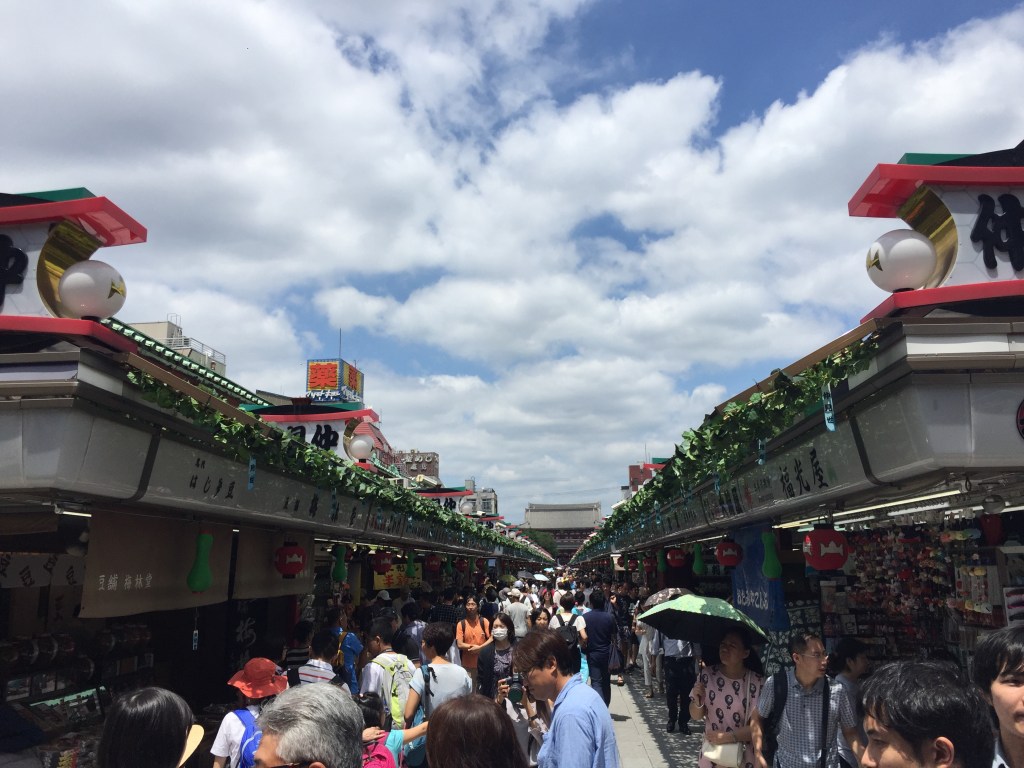
A photo I took in 2016 of the famous market of nakamise-dōri. The actual temple is way in the back.
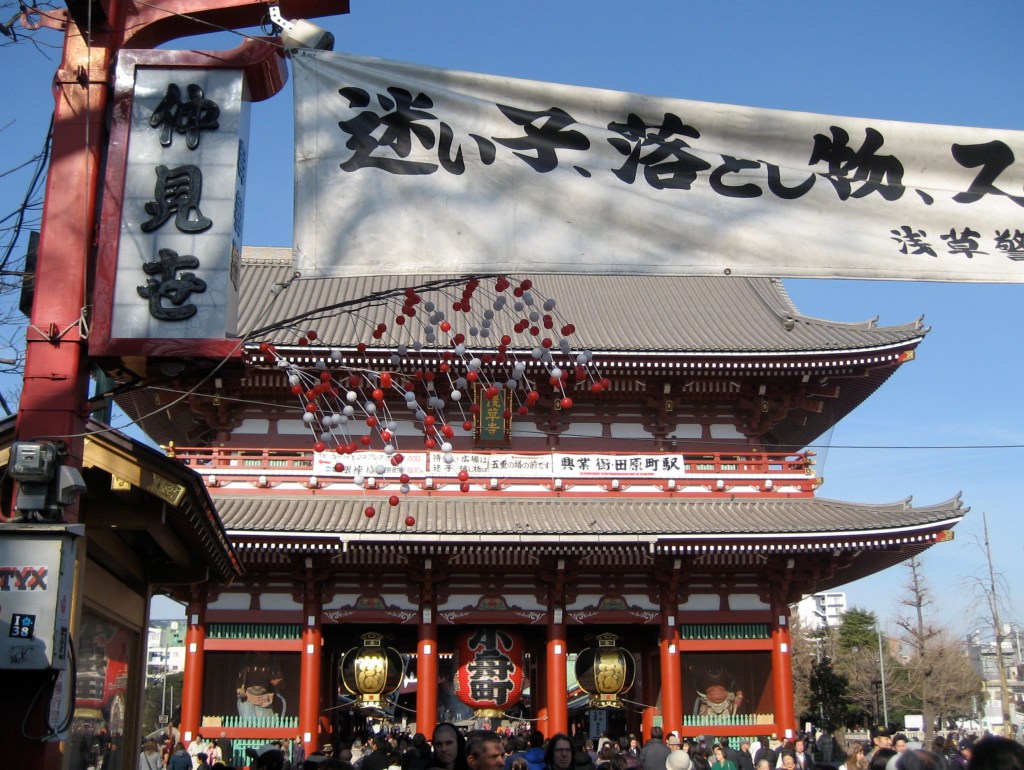
The temple just after New Year’s, taken in 2009.
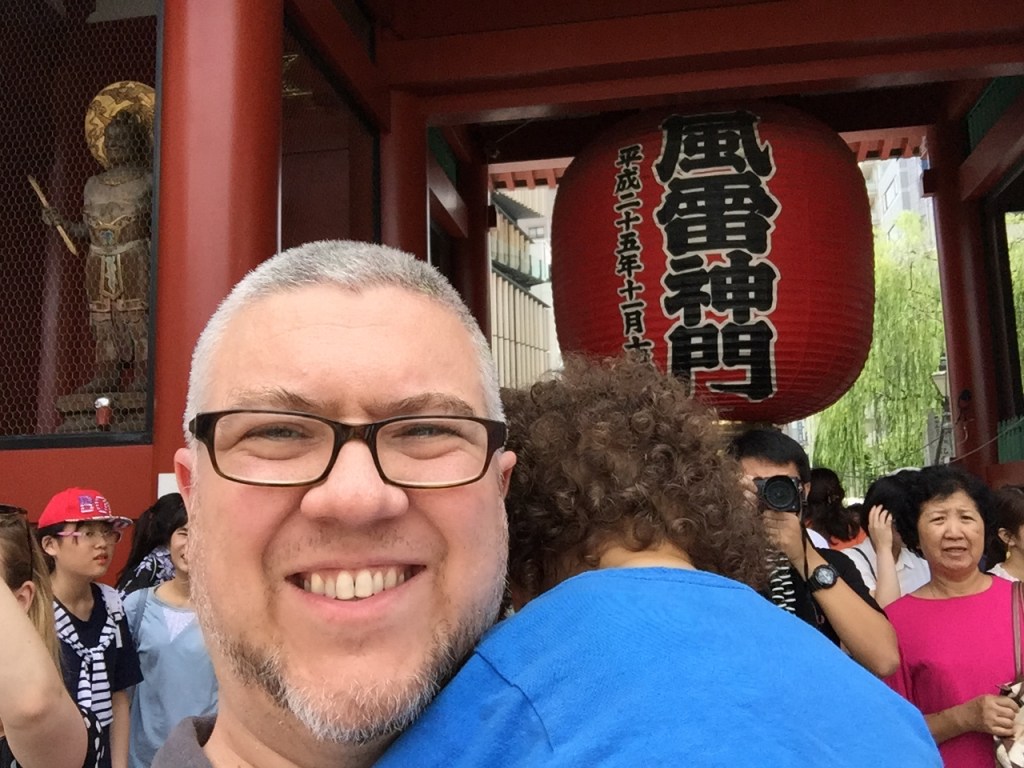
Me carrying one tired little boy at the iconic kaminari-mon gate in 2016. Note the giant red lantern in the back.
It is still one of my favorite temples, even if a bit touristy, and of the Buddhist sutra books I own this is still one of my favorite to use.1 This sutra book uses the traditional Classical Chinese with Japanese pronunciation guides (furigana), which is pretty typical of Japanese-Buddhist sutra books. As you can see, it’s not a long sutra to recite. It is probably the shortest sutra in the entire Buddhist canon.
Chanting the Heart Sutra is something many Buddhists in the Mahayana tradition (everything you see from Tibet to Japan, and overseas) do both in group services and in home services. People chant it in many languages and styles. Its simplicity, and general message about the nature of reality means that it tends to cut across sectarian lines and is popular in many sects and communities. Its cryptic and profound nature also means that for a one-page sutra it is the subject of intense study and research.
The sutra, for reference, is shown below. I used the standard Japanese liturgical form, recited in Zen temples, Tendai temples, Shingon temples, and so on, with only very minor differences per tradition. However, there are many ways and languages to recite the Heart Sutra.
kan ji zai bo satsu gyo jin han nya ha ra mi ta ji
When Avalokiteśvara Bodhisattva was practicing the profound Prajñāpāramitā,
照見五蘊皆空。
sho ken go un kai ku
he illuminated the Five Skandhas and saw that they were all empty,
度一切苦厄。
do is-sai ku yaku
and crossed over all suffering and affliction.
舎利子。色不異空。
sha ri shi shiki fu i ku
Śāriputra, form is not different from emptiness, and
空不異色。
ku fu i shiki
emptiness is not different from form.
色即是空。
shiki zoku ze ku
Form itself is emptiness, and
空即是色。
ku zoku ze shiki
emptiness itself is form.
受想行識亦復如是。
ju so gyo shiki yaku bu nyo ze
Sensation, conception, synthesis, and discrimination are also such as this.
舎利子。是諸法空相。
sha ri shi ze sho ho ku so
Śāriputra, all dharmas are empty:
不生不滅。
fu sho fu metsu
they are neither created nor destroyed,
不垢不浄。
fu ku fu jo
neither defiled nor pure,
不増不減。
fu zo fu gen
and they neither increase nor diminish.
是故空中。
ze ko ku chu
This is because in emptiness
無色無受想行識。
mu shiki mu ju so gyo shiki
there is no form, sensation, conception, synthesis, or discrimination.
無眼耳鼻舌身意。
mu gen-ni bi zes-shin i
There are no eyes, ears, nose, tongue, body, or thoughts.
無色声香味触法。
mu shiki sho ko mi soku ho
There are no forms, sounds, scents, tastes, sensations, or dharmas.
無眼界。
mu gen kai
There is no field of vision and
乃至無意識界。
nai shi mu i shiki kai
there is no realm of thoughts.
無無明。
mu mu myo
There is no ignorance
亦無無明尽。
yaku mu mu myo jin
nor elimination of ignorance,
乃至無老死。
nai shi mu ro shi
even up to and including no old age and death,
亦無老死尽。
yaku mu ro shi jin
nor elimination of old age and death.
無苦集滅道。
mu ku shu metsu do
There is no suffering, its accumulation, its elimination, or a path.
無智亦無得。
mu chi yaku mu toku
There is no understanding and no attaining.
以無所得故。
i mu sho tok-ko
Because there is no attainment,
菩提薩埵。依般若波羅蜜多故。
bo dai sat-ta e han nya ha ra mi ta ko
bodhisattvas rely on Prajñāpāramitā,
心無罜礙。
shin mu kei ge
and their minds have no obstructions.
無罜礙故。
mu kei ge ko
Since there are no obstructions,
無有恐怖。
mu u ku fu
they have no fears.
遠離一切顛倒夢想。
on ri is-sai ten do mu so
Because they are detached from backwards dream-thinking,
究竟涅槃。
ku gyo ne han
their final result is Nirvāṇa.
三世諸仏。
san ze sho butsu
Because all buddhas of the past, present, and future
依般若波羅蜜多故。
e han nya ha ra mi ta ko
rely on Prajñāpāramitā,
得阿耨多羅三藐三菩提。
toku a noku ta ra sam myaku san bo dai
they attain Anuttarā Samyaksaṃbodhi.
故知。般若波羅蜜多。
ko chi han nya ha ra mi ta
Therefore, know that Prajñāpāramitā
是大神呪。是大明呪。
ze dai jin shu ze dai myo shu
is a great spiritual mantra, a great brilliant mantra,
是無上呪。是無等等呪。
ze mu jo shu ze mu to do shu
an unsurpassed mantra, and an unequalled mantra.
能除一切苦。真実不虚故。説般若波羅蜜多呪。
no jo is-sai ku shin jitsu fu ko ko setsu han nya ha ra mi ta shu
The Prajñāpāramitā Mantra is spoken because it can truly remove all afflictions.
即説呪曰。
soku setsu shu watsu:
The mantra is spoken thusly:
羯諦羯諦波羅羯諦波羅僧羯諦菩提薩婆訶。
gya tei gya tei ha ra gya tei hara so gya tei bo ji so wa ka
gate gate pāragate pārasaṃgate bodhi svāhā3
般若心経
han nya shin gyo
The Heart Sutra
You can see a really nice example of this chanted here, courtesy of Koyasan Temple in Japan:
I have been reading Tanahashi’s book about the Heart Sutra and learning a lot about its various interpretations, how it’s conveyed in various languages, and various theories about its origin. I was fascinated to learn that there is a Mongolian version sometimes transcribed in Cyrillic. None of this is strictly necessary for the purposes of Buddhist practice, but it is fascinating. The example I showed above uses what’s called “Sino-Japanese”: Japanese pronunciation of the original Chinese characters it was composed with.2
As for chanting the sutra, I’ve been doing it for years, so I can more or less recite the Sino-Japanese version from memory, and am pretty comfortable doing it that way. I study the meaning of the sutra in English of course. I also have a PDF file for chanting in Sino-Japanese available for those interested.
I have also attended Zen centers on rare occasions (I tend to lean toward Pure Land Buddhism, to be honest) and seen the Heart Sutra recited using English. Learning the English meaning is very useful, but English chanting sounds a bit awkward to me. So, I prefer chanting in the original, and study the meaning separately.
But regardless of what language you use, the Heart Sutra, like all Buddhist sutras, has a funny tendency to gradually “sink in” over time. The meaning may not make much sense at first, but over the course of months and years, it takes on new meaning as you go through life, and see the sutra in a new light. I believe that’s the real value of Buddhist chanting: to internalize key Buddhist teachings in a way that you can carry with you throughout life.
As for me, these days, I tend to recite a Tendai-style home service,4 and as part of that I rotate between chanting this and a certain, small excerpt of the Immeasurable Life Sutra called the shiseige (四誓偈) or juseige (重誓偈) in Japanese Buddhism. When I finish one, I put it under the other sutra book, so I don’t forget which sutra to recite next time as I might go a week or two before reciting again. As a short, traditional liturgy, I am pretty content.
As with any Buddhist practice done over a long period of time, I believe that it gradually polishes the mind, and dispels one self-centered viewpoint. It’s super simple to do, but its benefits last a lifetime. To paraphrase Nichiren, when dying cloth in indigo, the more you do it, the deeper the color becomes.
Namu Amida Butsu Namu Kanzeon Bosatsu
Edit: I discovered in May 2025 some egregious mistakes in the formatting of the sutra above. This was not a problem with the translation, but with mistakes in how I copy-pasted into the blog post. I have since corrected these mistakes. Apologies to anyone who used the flawed copy of the sutra.
P.S. It’s tempting for some to look for an original “Sanskrit” version of the sutra, but alas, the best we know today is that the sutra was compiled originally in China, using excerpts from the much, much larger Prajña-paramita sutras. The story of how exactly that came to be is a much-discussed subject in Tanahashi’s book.
P.P.S. Fun fact: the version of the Heart Sutra used in Japan differs very slightly from the popular version attributed to Xuanzang. The Japanese version, popularized by the Shingon esoteric tradition, is called the rufubon (流布本) version. It has two extra Chinese characters (262 total) from Xuanzang’s 260, and uses slightly different characters for pronouncing the mantra at the end: 揭諦 instead of original 揭帝 for Sanskrit gaté.
1 Because it is devoted to Kannon Bodhisattva, this sutra book also includes (left in photo) a certain Japanese-Buddhist verse called the Jikku Kannon-gyō (十句観音経, “ten verse Kannon sutra”) popularized in the middle ages. I made a post here about it.
A nice explanation of the meaning and history of the ten-verse sutra can be found here.
2 It’s sometimes assumed that the sutra’s earliest composition was in a language like Sanskrit or something else from India, but research has long since proven that the Heart Sutra was a Chinese innovation, a summary of the much longer Perfection Wisdom Sutras, distilled into a very compact, chantable essence. The monk Xuan-zang later brought it back to India, where it later came to Tibet. Pretty clever actually.
3 I decided to leave the Sanskrit mantra untranslated, per esoteric-Buddhist tradition.
4 I like the Tendai approach to Buddhism because it encompasses all the things that are important to me, but avoiding a narrow, dogmatic approach that I found in the past and ultimately rejected.
In my recent free time last month, I caught up on an old DVD video tour of Buddhist temples in Japan that my in-laws had given me years back. I also discovered that I could turn on the subtitles, which helped a ton as the Japanese is kind of difficult for me, but the content is very interesting. 😋
One interesting thing I noticed is that a surprising number of temples in Japan, especially older ones, could somehow tie themselves back to a certain Buddhist monk posthumously named Jikaku Daishi (慈覚大師). He is better known in English by his ordination name Ennin.
Ennin (円仁, 794?-864) was one of several, talented monks that were crucial to the early rise and foundation of Tendai Buddhist order in Japan. Tendai in Japan, a branch of the venerable Tiantai Buddhist school in China,1 was founded by the monk Saicho in the year 806 after spending some time training in China.
However, the early Tendai sect ran into some problems namely due to gaps in training and teachings, especially with esoteric Buddhism. Saicho had spent about one year in China, which was unusually short, and during that time had undergone training in disparate aspects of Tiantai Buddhism. On the other hand, the rival Shingon sect founded by Kukai (who also had stayed for one year) had been singularly focused on esoteric training, and brought back a complete set of training in the Womb Realm and Diamond Realm mandalas imported from India. Saicho unfortunately didn’t and this led to some tension between the sects. Kukai did not want to lend esoteric documents to Saicho and his disciples unless they formally trained under him, and Saicho became worried about losing disciples to the Shingon sect (some indeed were poached). While the two were still alive, this tension was not resolved.
After Saicho, early Tendai leaders decided the best way to solve this issue was to go back to China and gain deeper training themselves. This is not as easy as it sounds:
China had a strict policy of allowing only certain ships from Japan (the kentōshi 遣唐使), on a set schedule. Just getting on one of these voyages was no small matter.
Japanese ship technology was poor, and a storm could easily sink a fleet of ships. In Saicho/Kukai’s trip, they lost 2 out of 4 ships to a storm.
Once in China, the monk in question had to learn Chinese and communicate. The two languages are very different, so this is not an easy thing to accomplish.
Finally, such a monk required official permission from the Chinese-Imperial bureaucracy to train at such-and-such temple.
Once all that was complete, the monk in question would start the actual training which could take years.
Monks were then required to then leave China at a certain time, and hopefully the next diplomatic ship from Japan would arrive, and than safely return.
Finally, the monk, now safely in Japan, had to submit an official petition to the Japanese Imperial Court to return to the capitol, detailing his accomplishments, and cataloging anything he brought back. Until then, he’d be stuck in some rural port town waiting a response, which usually wasn’t very quick.
Needless to say, Ennin managed to accomplish all this, just as Kukai and Saicho had done previously by journeying to Tang-Dynasty China in 838. Unlike Saicho and Kukai, Ennin stayed in China much longer (as expected) and was only booted out of China in 847 due to a catastrophic anti-Buddhist purge at the time.
When Ennin came back to Japan, he brought back several noteworthy things:
Ennin brought back training in the five-tone nembutsu, a wide-spread practice in the Pure Land tradition in China.
Ennin completed the esoteric training Womb Realm and Diamond Realm mandalas, just as Kukai had done, but also brought back a third esoteric training regime in the Susiddhikara Sūtra tantra.2 This helped formalize the Tendai version of esoteric Buddhism called taimitsu (台密), along with efforts by rival disciple Enchin who also traveled to China.
Ennin also wrote a lengthy account of his travels from day one in China. This journal, the Nittō Guhō Junrei Kōki (入唐求法巡礼行記, “The Record of a Pilgrimage to China in Search of the [Buddhist] Law”) has been a fascinating and valuable source of life in the Tang-Dynasty from a foreigner’s point of view.
Once back in Japan, Ennin eventually succeeded in becoming the 3rd zasu (座主) or head of the Tendai Order. He proved to be an active administrator, both in expanding and improving the training on Mount Hiei, but also in founding other temples in the provinces such as Yamadera (which was featured on my dvd tour). However, tensions between him and Enchin simmered for generations and eventually erupted in to a full-blown violent schism between their descendant lineages.
Nevertheless, Ennin’s contributions to both esoteric and Pure Land buddhist practices in Japan helped pave the way for many other great thinkers later, and many of the things followers take for granted today. 🙏🏼
P.S. I finished a draft of this post before the war in Ukraine, so I felt it was time to publishing rather than leave it languishing. However, since the war started I haven’t had much motivation to work on personal projects and such, so the blog might be a little quiet for a bit. We’ll see.
1 same Chinese characters (天台), different pronunciation
2 there was no information at all in English wikipedia on this sutra, so the linked article above was written by me, warts and all. ;p
Recently, I posted an example of Buddhist liturgy as found in the Japanese Tendai tradition, but I wanted to call out one aspect of that liturgy called the Four Bodhisattva Vows or shiguseigan (四弘誓願) among other names. According to my book on Genshin, the Four Bodhisattva Vows were formulated by the original founder of Tiantai (Tendai) Buddhism in China: Zhiyi. Zhiyi formulated these vows based on an earlier gatha verse from the fifth chapter of the Lotus Sutra:
Those who have not yet crossed over I will cause to cross over,
those not yet freed I will free,
those not yet at rest I will put to rest,
those not yet in nirvana I will cause to attain nirvana.
Translation by Burton Watson
The vows have since promulgated to other Buddhist cultures and sects. The liturgy text will vary slightly from Buddhist tradition to tradition, but like the dedication of merit, is remarkably consistent overall.
In the aforementioned Tendai tradition, one version of the vows is as follows:
Sino-Japanese1
Pronunciation
Translation by me (other, better translations exist 😉)
衆生無辺誓願度
Shu jo mu hen sei gan do
Sentient beings are innumerable, and yet I vow to save them all.
煩悩無尽誓願断
Bon no mu hen sei gan dan
My mental defilements (lit. bonnō) are innumerable, I vow to extinguish them all.
The path to Buddhahood is peerless, I vow to fulfill it.
1 Chinese liturgy with Japanese phonetic pronunciation 2 I’ve also seen the last character as 知 (chi), but more or less means the same thing
These vows cover something that we saw in previousarticles about the Mahayana-Buddhist notion of the Bodhisattva: that we’re all in this together, and so the Buddhist path is not truly fulfilled until one completes their vows to aid all beings no matter how long it takes. The Mahayana path of the Bodhisattva is lofty, heroic even, but as the last verse says, nothing less is enough.
On the other hand, the path of the bodhisattva begins with a single good act, or a good thought towards others. It’s about piling up grains of sand or pebbles time and time again. With enough time and dedication, one can move mountains. Don’t be afraid to think big, even if you come up short in this life. Even if you acted like a dickhead today, that doesn’t mean tomorrow you will be one. Every day is a rehearsal. The very notion of “buddha nature” means that each one of you has the capability for great things, even if you don’t think you can. That’s why in the 20th chapter of the Lotus Sutra, the Bodhisattva Never Disparaging bows to each person, even when they’re a total jerk: given the right conditions, any sentient being can become a bodhisattva or a fully-awakened buddha. Given enough time all of them will.
My best wishes to you all, dear readers. May all you be well, free from harm, and find what you are looking for.
P.S. Featured image from the story of Chujo-hime in the Taima Mandala Engi (当麻曼荼羅縁起)
The dedication of merit at the end of a Buddhist service (at the temple, or home services) is a time-honored tradition, and you’ll see it in almost every Buddhist community in one form or another. In Japanese Buddhism, this dedicated of merit called ekō (回向) and you’ll often see it recited in more or less the same way:
This hymn, called the ekōku (回向句, “verses on dedication of merit”), ekōmon (回向文, “text on dedication of merit”) or ekōgé (回向偈, “hymn of dedication of merit”), depending on the particular Buddhist tradition, is attributed to the 7th century Chinese-Buddhist master Shan-dao (善導 613-681) and goes like so:1
And be reborn in the Pure Land of Amitabha Buddha…
An example of how this is sung or recited is here:
There are other versions to within Japanese Buddhism. A version used in Tendai is:
Chinese characters
Romanization
Rough Translation1
願以此功徳
Gan ni shi ku do ku
May this good merit that I have accumulated…
普及於一切
Fu gyu o is-sai
Be distributed to all beings
我等與衆生
Ga to yo shu jo
So that we may all walk this path
皆共成佛道
Kai gu jo butsu do
And equally attain the Buddha Way.
1 Apologies for any mistakes in this translation.
Interestingly, in 2025, I found a similar version from Nanzenji Temple in Kyoto, Japan (a Rinzai Zen temple), that has a similar dedication of merit verse, but the pronunciation of the Chinese characters is much more Sinified (Chinese-style):2
Chinese characters
Romanization
Rough Translation1
願以此功徳
Gen ni su kun te
May this good merit that I have accumulated…
普及於一切
Fu gyu o i shii
Be distributed to all beings
我等與衆生
Go ten ni shun san
So that we may all walk this path
皆共成佛道
Kai kyu jin bu do
And equally attain the Buddha Way.
1 See above
Interestingly, you will also see hymns for the dedication of merit in Chinese Buddhism as well, though with more elaborate lyrics (I found multiple versions online) where it is called the Huí Xiàng Jì (回向偈):
Anyhow, the dedication of merit and its various hymns encompass the Mahayana-Buddhist notion that we’re all in this together. Just as one person awakens the bodhi mind and wishes to share with others, hopefully others will benefit from this too.
Namu Amida Butsu Namu Kanzeon Bosatsu
1 Some Buddhist traditions in Japan translate this into a more native text, using flowery liturgical language, but the meaning is basically the same.
2 It’s also possible that these are both Chinese pronunciations but from different eras of Chinese history. Tendai was imported during the Tang Dynasty and Zen during the Song and Yuan dynasties. A lot can change in 400-500 years.
Greetings readers! I have had a bit of extra time this week due to much-needed time off from work, and have been going through old projects, half-finished blog posts and such. One project I found today, which I decided to finish, was post a romaji (Romanized Japanese) version of the Tendai Buddhist home liturgy for anyone who needs it.
The Tendai sect in Japan has a nice homepage (Google Translated page), but almost nothing in English for doing the home service. Tendai information in English is pretty scattered (though there are some great websites),1 so I decided to go back to the source, and just translate it directly using romaji (romanized Japanese) for easy pronunciation.
Some quick notes:
I chose the shortest, simplest elements of the service, based on Tendai’s recommendation in the link above, and also through the book うちのお寺は天台宗 (双葉文庫) which I picked up some years ago. There’s a more extended version of the home service, but both the book and website explain that the essentials are the following elements that I am posting below.
Where possible, I chose to use the Sino-Japanese pronunciation. The website above lists both, and either option is fine (obviously English is fine too). The Sino-Japanese version, in my opinion, is the easiest to pronounce and chant, and ties back to the larger Buddhist tradition, so that’s my personal preference. The YouTube videos on the Tendai site sometimes provide an alternate native, liturgical Japanese version, and it’s perfectly fine to use this too.
Finally, traditions and liturgical styles vary, so don’t be surprised if another Tendai community does it differently. If in doubt, just do it like your local community does.
The webpage also lists some tips (roughly translated below):
First, before you begin, double-check the offerings at your home altar make sure everything is in order: flowers, water, a candle,2 and any other offerings you wanted to make.
Before the service, take a moment to freshen up, rinse your mouth and hands with water, etc. That way, you can sit before the altar in a more purified state.
Drape any rosary you have over your left hand, and if you are holding a sutra book, lift it up gently and bow ever so slightly.3
When you do gassho, put your hands together in front of your chest at a natural angle (45 degrees is common based on personal experience).
When chanting, use a mild, even chanting voice, enunciating each word equally. (If you feel like you don’t chant as well as the video links, don’t feel bad: these are professional monks chanting.)
If you have a bell, there are certain times to ring it: twice at the beginning, once after reading each part, and three times at the end. (I’ve added prompts to the liturgy below.)
When done, close the Buddhist altar (if possible), and place the sutra book back on its stand.
Lastly, the book in particular mentions that any Buddhist sutra is OK to recite. The most common one is obviously the Heart Sutra, but any other Buddhist sutra, or an excerpt of a sutra, is fine too. Find what you like, and feel free to recite that.
Minimal Tendai Buddhist Home Liturgy
The service provided below is given as an example home service, but my book on Tendai Buddhism also states that among these different bits of liturgy, you can add or reduce as many as you see fit. Even if you only recite one bit of liturgy per day, that’s enough. The important thing is to make it sustainable. You can always adjust later if it’s too simple or too difficult.
Sanrai: Gratitude Toward the Three Treasures
(ring twice)
Ish-shin cho rai jip-po ho kai jo ju san bo
(repeat 3 times, ring once)
“I reverently praise the Buddha, Dharma and Sangha, which permeate the cosmos”
Thanks everyone and I hope you find it useful. I will likely post updates and corrections as time goes on.
Namu amida butsu Namu kanzeon bosatsu
1 There are, from what I can see from a cursory search, a number of Tendai communities in both the US and the UK. If you’d like to know more, I encourage you to contact such communities. I have no affiliation with any of these groups, however. I am just DIY.
2 Japan also sells LED Buddhist altar candles. Halloween goods also offer LED candles. Great for avoiding fire hazards.
3 This custom is also found in other Japanese-Buddhist sects as a gesture of humility.
Demon: “So why do you consider my presence a pollution, a disease? Is it because there is that within you which is like unto myself? …If so, I mock you in your weakness, Binder.”
Sam: “It is because I am a man who occasionally aspires to things beyond the belly and the phallus.”
Roger Zelazny, Lord of Light (1967)
Recently, I wrote a post about the Five Precepts of Buddhism, which are a nearly universal code of conduct that lay disciples can choose to undertake both as a benefit for themselves (dignity, mental well-being) and towards others. In addition to the Five Precepts, the Mayahana branch of Buddhism1 gradually developed a second set of precept rules called the Ten Bodhisattva Precepts.
The history of the Ten Bodhisattva Precepts is a bit convoluted,2 but the primary source is a Buddhist text called the Brahma Net Sutra, specifically the Mahayana-Buddhist version. The sutra lists 10 major precepts, and 42 minor precepts a bodhisattva is meant to undertake as part of their training, but most focus only on the 10 major precepts.
The ten major precepts are (translating from this source):
Do not take life.
Do not steal.
Do not commit adultery or sexual abuse.
Do not lie.
Do not sell (or consume) liquor.
Do not bring up the faults of others.
Do not boast of oneself or disparage others.
Do not begrudge material and spiritual possessions.
Do not harbor ill-will.
Do not disparage the Three Treasures [the Buddha, the Dharma, and the Sangha].
Monastic followers, that is monks and nuns, in the Mahayana tradition often take up these Bodhisattva Precepts on top of the more traditional monastic rules. Japan is an exception, where monastics only take up the Bodhisattva Precepts these days. However lay people often undertake these precepts too.
These precepts are called the endonkai (円頓戒, “complete, perfect precepts”) in the Tendai tradition, and jūrokujōkai (十六条戒, “sixteen [bodhisattva] precepts”) in Soto Zen tradition, include six more “preamble” precepts:
I take refuge in the Buddha
I take refuge in the Dharma
I take refuge in the Sangha
I vow to abstain from all evil
I vow to strive to do good
I vow to devote myself toward other living beings
(the 10 bodhisattva precepts listed above then follow…)
This makes for 16 precepts total.
Lay followers typically take the original Five Precepts mentioned above, but may opt to undertake the Bodhisattva Precepts as a kind of “extra credit”, especially since they overlap quite a bit. Unlike the Five Precepts where one openly declares their vows to a monk, nun or a Buddhist statue (if alone), the Bodhisattva Precepts don’t always require a formal ceremony as such. It varies by tradition. Many traditions in Japan have a ceremony called jukai (受戒) where a lay followers undertakes these 10 (or 16) precepts and thus declares themselves an official follower of that tradition.
Even if you are not part of such a tradition, you are welcome to undertake them anyway preferably before a Buddhist image or altar, but it’s not strictly necessary. If you uphold them, great. If not, the Five Precepts alone are still a worthy undertaking.
In summary, the Bodhisattva Precepts are a way to extend one’s daily practice of Buddhism by not just avoiding more gross deeds, but also gradually polishing the mind by avoiding greed, ill-will and conceit and thereby removing the source of further suffering for yourself and others.
Namu Amida Butsu Namu Kanzeon Bosatsu
P.S. Happy Bodhi Day 2021!
1 The Mayahana Branch encompasses pretty much all of Buddhism you see in places like China, Korea, Japan, Vietnam, Tibet and so on. The other branch, Theravada, is found more in Southeast Asia: Thailand, Cambodia, Sri Lanka and so on.
2 In earlier Buddhism, the Buddha encouraged lay followers to not only take up the Five Precepts, but also practice something called the Ten Good Deeds. It’s likely, in my opinion, that these more nebulous Ten Good Deeds were eventually codified into the 10 major precepts of the Brahma Net Sutra above, and thus became the Bodhisattva Precepts.
I am not an old man yet. However, I am that point in my life where I am looking ahead and I have decided that rather than just indulging myself in my twilight years, I would focus on doing some good in the world instead. This quote from Roger Zelanzny’s novel Isle of the Dead is particularly inspiring to me:
Earth-son, I greet you by the twenty-seven Names that still remain, praying the while that you have cast more jewels into the darkness and given them to glow with the colors of life.
As Saicho, the Buddhist monk, famously said: ichigū wo terasu (一隅を照らす, “light one corner of the world”). Our thoughts and actions do matter towards others. A self-indulgent existence helps no one, and provides no value to the world, but on the other hand, a life devoted to others provides incalculable value for generations.
For my part, I would like to continue casting little jewels into the void as long as I can still raise an arm.
Japanese Tendai Buddhism, that is the Buddhist sect descended from the venerable Chinese Tiantai (天台) tradition started by Zhiyi (智顗, 538–597), has a number of interesting, not to mention pithy, teachings and phrases. Lately, I’ve been thinking about a particular phrase called asa daimoku ni yū nenbutsu (朝題目に夕念仏). In its most literal sense, it means “Odaimoku in the morning; Nenbutsu in the evening”.
This phrase is fascinating to me, because it summarizes two important facets of Tendai Buddhism.
First, the “odaimoku”. Tiantai Buddhism in China was the first serious effort at taking the vast corpus of teachings imported from India and the Silk Road and synthesizing them into a native school of thought, not just something lifted-and-shipped from abroad. In order to do this, Zhiyi analyzed the vast number of Buddhist sutras, shastras (essays) and commentaries and arranged them into a kind of hierarchy. At the very top, he felt the Lotus Sutra was the most important teaching, the summation of everything else. For this reason, the Tiantai/Tendai schools treat the Lotus Sutra as the core teaching. In devotional practices, this was expressed in something called the o-daimoku (お題目) attributed to famous Tendai monks such as Genshin, but popularized to a greater degree by Nichiren in the 13th century. The most common form of the o-daimoku chant is namu myoho renge kyo (南無妙法蓮華経)1 which means something like “Praise to the Wondrous (alternatively “Mystic”) Law of the Lotus [Sutra]”. This is also the central practice of the Nichiren Buddhist sets you see today: Nichiren-shu, etc.
However, over time, Japanese Tendai Buddhism began to strongly adopt Pure Land Buddhist teachings from mainland China as well.2 Zhiyi, when he synthesized the various Buddhist teachings and practices paid special attention to meditations on Amitabha Buddha, the Buddha of Infinite Light, in his magnum opus, the Great treatise on Concentration and Insight (摩訶止観, Móhē Zhǐguān), but these meditations were intended for serious monastic disciples only, and could be very physically demanding. While Tendai monks sometimes did undertake these practices, the popular practices related to Pure Land Buddhism gradually evolved into chanting practices (again, due to Genshin) similar to the odaimoku. This chanting, is called the nenbutsu (念仏) or “mindfulness of the Buddha [Amitabha]”. The most common form of the nenbutsu is namu amida butsu, and this is overwhelmingly what you find in Pure Land Buddhist schools in Japan today such as Jodo Shu and Jodo Shinshu. Since the 12th century, many Buddhists in Japan have focused on reciting the nenbutsu and aspiring to be born in the Pure Land of Amitabha Buddha as a refuge, but also as a means of progressing on the Buddhist path much faster: like taking the highway to get to your destination vs. taking the back roads.
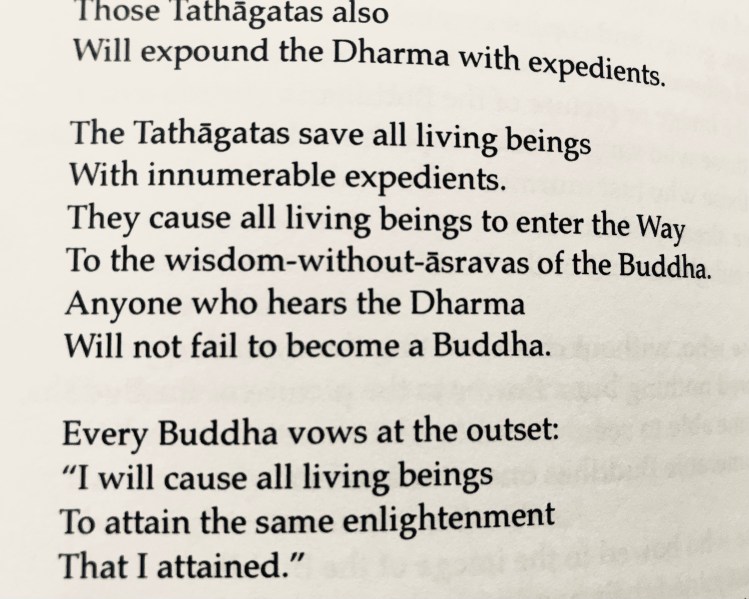
A verse from the second chapter of the Lotus Sutra, Murano translation.
These two things may sound contradictory, but they’re not. The second chapter of the Lotus Sutra introduces a couple important concepts to Mahayana Buddhism (that is Buddhism across all of East Asia): the One Vehicle and Expedient Means. The One Vehicle was a way of reconciling all the rival Buddhist schools in India by teaching that all of them were really just the same thing, and that sincere practioners were all heading in the same direction, towards Buddhahood, in the end. No need to argue over minutia. The Expedient Means teaching just recognizes that the various meditations, devotional chants, sutras, Buddhist schools, etc, were all just tools to get us there. The Buddha in the Lotus Sutra hammers his point over and over again in subsequent chapters: the various teachings and practices are all just temporary tools to suit a time, place, or need. All of them point to the truth, but must be put down when they are no longer needed.
In this sense, the Pure Land teachings, the chanting of the nenbutsu and so on is just another expedient means, albeit an especially popular and efficacious one. One could also lump Zen meditation, esoteric Vajrayana teachings and such under the same umbrella, and Tendai Buddhism pretty much does this. Unlike later Buddhist schools in Japan that center around “one practice, one teaching”, Tendai maintains the basic structure imported from China where all teachings and practices are kept under the same basic umbrella.
However, there’s more.
The whole asa daimoku ni yū nenbutsu phrase isn’t just limited to reciting the odaimoku in the morning, and the nembutsu at night. It also expresses a mindset, summarized by two other key concepts in Japanese Tendai Buddhism: hokke senpō and reiji sahõ.
In a Japanese book I own on basic Tendai Buddhist teachings, these are summed up as follows:
法華懺法は、すべての人を救う究極の教えである「法華経」に感謝して読経し、自らの罪を懺悔するのです。
“Hokke Senpo” means to show appreciation toward the Lotus Sutra, which contains the ultimate teaching of helping all beings, through reading of the sutras, and to reflect on one’s own faults.
例時作法は、念仏し、自身の心のなかに備わる仏性を呼び起こすものです。
“Reiji Saho” means to recite the nembutsu, and to awaken the Buddha nature within oneself.
Let’s discuss in more detail…
Hokke senpō (法華懺法) means to reflect on one’s actions in light of the Dharma, the teachings of the Buddha. This is a very time-honored practice across the entire Buddhist religion, and is why (in my opinion) Buddhism is so effective as a form of mental discipline and training. Unlike the Christian notion of “guilt”, the idea behind self-reflection is a kind of objective, scientific review of one’s actions and whether they have been wholesome or unwholesome. Here, the Dharma is used as a kind of yardstick to measure one’s actions, and in the case of Tendai Buddhism, the Lotus Sutra in particular. Upon reflection, many Buddhists will recite some kind of verse to acknowledge (not punish oneself) and resolve not to do it again. You’re giving yourself a fresh start and resolving to try again. Like rehearsing for a play: you’ll have good days and bad, but you just keep at it until it becomes second nature.
While hokke senpō reflects on the past, reiji sahõ (例時作法) is forward thinking, and expresses the desire to make the Pure Land of the Buddha not just a reality in the future, but here and now starting with oneself. The sixteenth chapter of the Lotus Sutra is meant to be a kind of bombshell teaching as the Buddha explains that, among other things, not only is the Dharma eternal (and thus the Buddha has always existed), but that his Pure Land has always existed on Vulture Peak (an important site in India), even if people can’t see it. This may sound strange, but what the Buddha is saying in chapter sixteen in my view is that the mind is the most important thing, and even when “living beings witness the end of a kalpa [an eon] and all is consumed in a great fire”, those whose minds are honest and sincere will see that the Pure Land of Buddha is still right there and available to anyone who seeks refuge. One need not pine for a glorious past, or a particular holy site, it’s all there when you need it. Further, the Pure Land isn’t just a place, it’s the embodiment of the Dharma, the Buddha’s teachings, at its finest, and through our actions, words and thoughts, we gradually make this world the Pure Land for others as well.
All this is to say that the pithy phrase asa daimoku ni yū nenbutsu expresses a lot of stuff, at a lot of levels. In my opinion, if one just adopts this phrase as a simple, daily practice guide (recite namu-myoho-renge-kyo in the morning, even a few times, then recite namu-amida-butsu in the evening, even a few times), then that’s more than enough. As I’ve saidbefore, better to do a small, sustainable Buddhist practice often than a big, elaborate one only occasionally. If you even chant one of these things as part of a small, sustainable practice, you’re doing great.
However, what’s interesting to me is that there is a whole lot more under the surface. As one explores this practice more, they realize that there’s a lot of meaning behind a few simple chants, enough for a lifetime of practice. ☺️
P.S. This article on the Tendai Buddhism homepage (Japanese language only) was a good source for this post. The article also points out that the two sides of Tendai Buddhism: exoteric teachings and esoteric (taimitsu or vajrayana) teachings are two separate things within Tendai. This entire blog post has been focused on the exoteric teachings, as I have no experience with the esoteric side and being esoteric, you would need to find a proper teacher anyway. 😉
1 Sometimes you see it pronounced as nam-myoho renge kyo (dropping the “u” in “mu”), but that gets into doctrinal differences among Nichiren Buddhist sects that I personally don’t want to get involved in.
2 This was, needless to say, a strong point of contention by Nichiren, who sought to restore the Tendai teachings to a more pristine form (with the Lotus Sutra as the essential teaching), but also to make it more accessible to people as well.
Hi folks, as Ohigan season has arrived once more, I revisited an old post I made ages ago in a past incarnation1 of this blog, now updated and expanded from the original. So old it’s new again! 😄
A long time ago, while walking to work one day, I got to thinking about a certain, Buddhist text, called the Lotus Sutra, or hokkekyō (法華経) in Japanese. The Lotus Sutra is probably the most important Buddhist text in all of Mahayana Buddhism, that is Buddhism across east Asia including China, Japan, Korea, Vietnam and so on. The Lotus Sutra is so important that it pretty much defines what Mahayana Buddhism is. Even though the Lotus Sutra is nearly 2,000 years old, composed in waves starting in the 1st century CE, it is still actively studied, chanted, and revered by countless Buddhists.
In spite of its importance, the Lotus Sutra is a tough sutra to read, especially for new Buddhists who aren’t used to “sutra language” and style. An old Buddhist friend of mine described it as the “prologue without a story”. At other times, its powerful imagery and use of (sometimes) convoluted parables can bewilder, confuse or turn some people off.2
But that particular day, I got to thinking what the entire sutra means, given its length, and how this applies to life now. Once you get used to its archaic style and language,3 I believe it is still very relevant today to Buddhists and non-Buddhists because it introduces many ideas that have since become a part of mainstream Buddhism tradition:
In spite of the various schools, practices and regional/cultural differences, there is only one Buddhism, and all of them are included. (chapter 2)
No effort is wasted. If kids offer a pile of sand to the Buddha, or a person says “Hail Buddha” even once, they are on the Buddhist path and will someday reach Enlightenment. (chapter 2)
There is only one truth, but each person understands it as best they can. (chapter 5)
In true Buddhism, there is no discrimination between men and women, young and old. All can attain Buddhahood if they have the noble intention of doing so. (chapter 6, 8, 9, 10).
Also intention, not form or background, is what matters. (chapter 12’s story of the Dragon Princess)
The Buddhist lifestyle is one of peace, goodwill, and wholesome restraint. A person should refrain from criticizing other people’s beliefs, nor withhold teachings either when asked. (chapter 14)
Anyone who upholds these truths can be a “Bodhisattva of the Earth”, a guardian of the Buddhist teachings. (chapter 15).
The Buddha is more than just a physical/historical person. In other words the Dharma embodies the Buddha, the Buddha embodies the Dharma. (chapter 16)
Delighting in the truth, in the Dharma, changes one for the better (ch. 18)
The epitome of Buddhist character is patience (ch. 20), commitment (ch. 23), humility (ch. 24) and compassion (ch. 25)
Friends and good companions are important on the Buddhist path. (ch. 27)
Never give up. (ch. 28)
All of these teachings can be found scattered here and there in earlier Buddhist texts, but the Lotus Sutra functions as a kind of “reboot” or “capstone” text that synthesizes all these ideas and presents them in a more cohesive narrative.
So, happy and peaceful Ohigan to readers, party on Wayne, and Nam-myoho Renge Kyo!
1 See what I did there? Huh? Huh? I’ll see myself out.
2 The first time I read it, it made little sense, and I put it down and forgot about it for years. Later, I found Thich Nhat Hanh’s excellent commentaries on the Lotus Sutra, titled Opening the Heart of the Cosmos. Reading that side-by-side with a copy of the Lotus Sutra helped me appreciate it a lot more.
3 To be fair, the Lotus is roughly contemporaneous to the New Testament, and both have to be read through translations, and the quality of the translations can vary. However, by comparison the New Testament is significantly shorter than the Lotus Sutra, and is mostly in the form of letters by Paul, while the Lotus Sutra is a series of sermons by the Buddha, heavy with symbolism and parable. Based on my limited (not to mention biased) personal experience I find the New Testament more approachable at first (Revelations notwithstanding), but I find the Lotus Sutra more profound. Since they were both composed at very different parts of the world, with different cultures, and religions traditions, it’s probably not a fair comparison. Still, having grown up in US going to Sunday School every week, that’s my thoughts on the two texts.








 Gleanings in Buddha-Fields
You must be logged in to post a comment.