Do The Right Thing

Today we explore the third chapter of five of the 19th-century Soto Zen text called the Shushōgi (修証義, “Meaning of Practice and Verification”), which I introduced here. Chapter three delves into the importance of conduct and the precepts. You can read chapter two here.

Next we should deeply respect the Three Treasures — the Buddha, the teaching, and the Buddhist community. They deserve our respect and offerings no matter where we wander from life to life. It was respect for the Buddha, the teaching, and the Buddhist community that was truly transmitted from India to China by the Buddhas and patriarchs.

Translation by Soto Zen Text Project of Stanford University, courtesy of sotozen.net

Westerners may find this a bit awkward. Why bow down and make offerings to a celestial being? Didn’t I leave my religious upbringing to avoid this kind of thing?

Buddhism is a religion that does not demand obedience or worship. People revere the Buddha because they appreciate his teachings, and find them helpful. They revere the Dharma because it is illuminating, and provides kind, objective guidance. People venerate the Sangha (the Buddhist community) because they are inspired by one teacher or another.

These Three Treasures (the Buddha, the Dharma and the Sangha) are the foundation of Buddhism.

If the unfortunate and virtueless cannot even hear of the Three Treasures, how can they take refuge in them. Do not take refuge in the spirits of the mountains or the ghosts of the dead, and worship not at heretical shrines. Such refuge-seeking leads us away from salvation. Let us instead quickly take refuge in the Buddha, the teaching, and the Buddhist community, seeking there not only release from pain but complete enlightenment.

This revisits something from chapter one: that human life is rare, and hearing the Dharma is even rarer, so it’s a precious opportunity.

Further, this passage warns us to be careful of messing around with occult stuff. It was written for a 19th-century Japanese audience from a 13th century source text, where syncretic folk religion and Shinto co-exist alongside Buddhism. But even now one can apply similar warnings toward mixing Buddhism with New Age practices and such. It might seem like a good idea, but better to thoroughly grasp the Dharma first before mixing with other stuff.

Again, this might feel weird to 21st century Buddhists, but in a much, much older text, the Sutra of the Simile of the Water Snake (MN22 of the Pali Canon), the Buddha described grasping the Dharma as similar to grasping a water snake (a.k.a. a viper): something to be done carefully. In modern parlance, one could also compare this to taking up a new exercise routine, a new diet, or a new sport: you should consult with a doctor first lest you risk injuring yourself, or making yourself miserable.

But I digress.

To take refuge in the Three Treasures we must come with pure heart. No matter when —  whether at the time of the Buddha’s appearance in the world or after his disappearance — we repeat with clasped hands and bowed head: “I take refuge in the Buddha. I take refuge in the teaching. I take refuge in the Buddhist community.” I take refuge in the Buddha because he is our great teacher. I take refuge in the teaching because of its curative effect. I take refuge in the Buddhist community because here we find wisdom and warmth. To become followers of Buddhism, we must uphold the Three Treasures. We must lay this foundation before receiving the moral precepts. 

This is pretty self-explanatory. A person can be a Buddhist (or reaffirm their faith), just as they are now, by taking refuge in the Three Treasures. In so doing, they have started on the Buddhist path and have nowhere to go but up. For most people, and most Buddhist services, this means reciting:

  1. I go to the Buddha for refuge.
  2. I go to the Dharma for refuge.
  3. I go to the Sangha for refuge.

Simple as that. (mic drop)

The merit of the Triple Refuge will always ripen when a responsive communion takes place between the trainee and the Buddha. Those who experience this communion — whether deva, dwellers in hell, or animals — will take this refuge. The embodied merit increases through the various stages of existence and ultimately leads to highest right enlightenment. The Buddha himself confirmed the merit of the Triple Refuge as supremely valuable and inconceivably profound. All living beings should therefore take this refuge.

Same as above: simply taking refuge in the Three Treasures (sincerely) is a great act, and has many benefits in the long-run.

Next we should accept the three collective pure precepts — that embracing good behavior, that embracing good deeds, and that embracing all beings and saving them. We should then accept the 10 grave prohibitions. First, do not kill; second, do not steal; third, do not engage in improper sexual conduct; fourth, do not lie; fifth, do not deal in intoxicants; sixth, do not criticize others; seventh, do not praise self and slander others; eighth, do not be stingy with the dharma or property; ninth, do not give way to anger; and tenth, do not disparage the three treasures. The Buddhas have received and kept the Triple Refuge, the three collective pure precepts, and the 10 grave prohibitions.

The three “pure precepts” are general injunctions for any Buddhist:

  1. Don’t do evil
  2. Embrace good
  3. Cleanse one’s mind.

The “ten grave prohibitions” above are just another way of saying the Ten Bodhisattva Precepts, which I covered here.

By accepting these precepts you will attain supreme enlightenment — the indestructible Buddhahood realized or to be realized by the Buddhas of the past, present, and future. Would any wise man reject this goal? To all living beings the Buddha has shown that when they accept the moral precepts, they attain Buddhahood — a rank equal to the Great Enlightened — and that they are truly the children of the Buddha.

People who first discover Buddhism may be put off. They wanted to learn how to meditate, not take up a bunch of rules, but two things to keep in mind:

First, the precepts above are training rules. As mentioned in chapter two, the rules are meant to be treated like rehearsing lines for a play. With diligence, time and effort you get better and better at it.

Second, an ethical lifestyle leads to many countless benefits, and makes a solid foundation for more advanced practices such as meditation, etc.

All the Buddhas dwell here and embrace everything in their infinite wisdom. All beings, when they make this their dwelling place, see no distinction between subject and object. When this happens, all things — whether earth, vegetation, fence post, brick or pebble — function as Buddhas. The resulting wind and fire, fanned by the profound influence of the Buddhas, drive us to intimate enlightenment. This is the merit of non-doing and non-striving — the awakening of the wisdom mind.

Remember from chapter two, that the difference between a Buddha and a mundane person is the degree of awakening. The Buddhas follow the precepts without fail because they all worked at it for countless lifetimes and eons, and through their conduct, and the awakening that helps arise from it, they see things differently than we do. But the message is: we can do the same. We just need to believe.

Tomorrow we’ll explore chapter four. If you made it this far, thanks for reading!

P.S. If you ever wanted to see how the third chapter is traditionally chanted, please enjoy this video:

Just Say Sorry

Lately, I have been avidly studying a Soto Zen text called the Shushōgi (修証義, “Meaning of Practice and Verification”), which I introduced here. It is a 19th century mashup of Dogen’s much longer Shobogenzo, but with an intended audience of lay followers, not monks.

This week, I wanted to mix up the usual schedule and post one chapter a day, Monday through Friday, five total. Each chapter is fairly short, but just long enough that each needs its own post.

Today, I wanted to explore the second chapter of five which delves into the importance of self-reflection and repentance. You find chapter one here.

As we saw in the first chapter we each have karmic burdens to carry. However, that is not the end of the story.

7. The buddhas and ancestors, because of their limitless sympathy, have opened the vast gates of compassion in order to lead all beings to awakening. Among humans and devas, who would not enter? Although karmic retribution for evil acts must come in one of the three times, repentance lessens the effects, or eliminates the bad karma and brings about purification.

translation provided by Soto Zen Text Project of Stanford University, courtesy of sotozen.net.

The idea, prevalent throughout Mahayana Buddhism, is that reflecting one your faults, and then confessing such transgressions is a way to diminish or prevent accumulated bad karma from coming to fruition. This isn’t like confession in a Western-Christian sense. It’s about weighing your conduct against a benchmark like the Dharma, and determining if you fell short anywhere. Of course, many Buddhists make mistakes regularly, but this self-reflection isn’t meant to instill shame. It’s about thinking rationally, almost scientifically. For you Star Trek fans: WWSD (What Would Spock [or Tuvok] Do?)

Captain Kirk and Spock wearing togas and laurels on their heads. From the episode “Plato’s Stepchildren”.

Joking aside, another way to look at it is rehearsing for a play. Even if you practice your lines 20 times, you’ll still make mistakes, but with time and diligence, you’ll get better and better at it, until you can recite your lines automatically. Then, you work in other acting skills, and so it becomes more than reciting lines, it becomes a performance. I find this helpful when trying to uphold the precepts in my own life. I mess up regularly, but I pick myself and try again until it sinks in and becomes a part of my life. Sometimes, this takes years.

8. Therefore, we should repent before [the] buddha in all sincerity. The power of the merit that results from repenting in this way before [the] buddha saves and purifies us. This merit encourages the growth of unobstructed faith and effort. When faith appears it transforms both self and other, and its benefits extend to beings both sentient and insentient.

Faith might seem like a strange word especially after talking about the importance of thinking rationally, but the two go hand in hand in Buddhism. Faith in Buddhism isn’t a “leap of faith” nor is it the Western-religious faith in a deity; it’s about confidence in the teacher and the teaching: the Buddha and the Dharma respectively. For new Buddhists, this faith is shaky at first, but through time and practice, one sees the fruit of living according to the Dharma, and one’s faith grows.

Further, Buddhist repentance isn’t done with a priest, it’s between yourself and the Buddha.

9. The gist of repentance is expressed as follows:”Although we have accumulated much bad karma in the past, producing causes and conditions that obstruct our practice of the way, may the buddhas and ancestors who have attained the way of the buddha take pity on us, liberate us from our karmic entanglements, and remove obstructions to our study of the way. May their merit fill up and hold sway over the inexhaustible dharma realm, so that they share with us their compassion.” Buddhas and ancestors were once like us; in the future we shall be like them.

The passage generally speaks for itself. But the final sentence is really important: what separates Buddhas from people is simply the degree of awakening. There is no separate divinity that separates us from them, and with diligent practice and good conduct, we can be assured that we will be Buddhas as well.

10. “All my past and harmful karma, born from beginningless greed, hate, and delusion, through body, speech, and mind, I now fully avow.” If we repent in this way, we will certainly receive the mysterious guidance of the buddhas and ancestors. Keeping this in mind and acting in the appropriate manner, we should openly confess before the buddha. The power of this confession will cut the roots of our bad karma.

This is a formula often used in many Buddhist services (translation variations notwithstanding). The specific words do not matter; it’s about reflecting that you have committed wrong acts rooted in the Three Poisons (a.k.a. craving, anger, and conceit), and to disavow your past conduct. In this way, you turn a new leaf and start anew.

Next, onto chapter three.

P.S. If you ever needed to know how the second chapter is traditionally recited, please enjoy this video:

Why We Practice

Lately, I have been avidly studying a Soto Zen text called the Shushōgi (修証義, “Meaning of Practice and Verification”), which I introduced here. It is a 19th century mashup of Dogen’s much longer Shobogenzo, but with an intended audience of lay followers, not monks.

This week, I wanted to mix up the usual schedule and post one chapter a day, Monday through Friday, five total. Each chapter is fairly short, but just long enough that each needs its own post.

Today I wanted to explore the first chapter which delves into fundamentals of Buddhism.

The opening paragraph starts off with a bang:

1. The most important issue of all for Buddhists is the thorough clarification of the meaning of birth and death. If the buddha is within birth and death, there is no birth and death. Simply understand that birth and death are in themselves nirvana; there is no birth and death to be hated nor nirvana to be desired. Then, for the first time, we will be freed from birth and death. To master this problem is of supreme importance.

translation by Soto Zen Text Project of Stanford University, courtesy of sotozen.net

This really gets to the heart of the point of Buddhism: squaring with one’s mortality. Some of this might sound cryptic, but if you look at the Heart Sutra, there’s much the same language there too.

2. It is difficult to be born as a human being; it is rare to encounter the buddha-dharma. Now, thanks to our good deeds in the past, not only have we been born as humans, we have also encountered the buddha-dharma. Within the realm of birth and death, this good birth is the best; let us not waste our precious human lives, irresponsibly abandoning them to the winds of impermanence.

The point here is not to compare one’s karmic background to another (some people will be tempted to look down on others, this is not OK). What matters is that you are here, thankfully born as a human. Yet, life is short, and the daily grind will get you down, so use the time you have and don’t squander it.

3. Impermanence is unreliable; we know not on what roadside grasses the dew of our transient life will fall. Our bodies are not our own; our lives shift with the passing days and cannot be stopped for even an instant. Once rosy-cheeked youth has gone, we cannot find even its traces. Careful reflection shows that most things, once gone by, will never be encountered again. In the face of impermanence, there is no help from kings, statesmen, relatives, servants, spouses, children, or wealth. We must enter the realm of death alone, accompanied only by our good and bad karma.

This message is found throughout Buddhism in such works as the Parable of the Burning House in the Lotus Sutra, Rennyo’s Letter on White Ashes, and so on. But also this is an important reminder that we must all face death, regardless of whether you’re a king (or a president), or a regular Joe. It is all but inevitable that you will grow old, face illnesses, and eventually die. Buddhism isn’t just therapy: these are facets of your life that you must confront and resolve before it’s too late. Whatever you’ve done up to this point is the karma you have to carry with you in the lives to come. So, it’s important to be diligent.

4. Avoid associating with deluded people in this world who are ignorant of the truth of causality and karmic retribution, who are heedless of past, present and future, and cannot distinguish good from evil. The principle of causality is obvious and impersonal; for inevitably those who do evil fall, and those who do good rise. If there were no causality, the buddhas would not have appeared in this world, nor would Bodhidharma have come from the west.

This first sentence might seem strange, but consider a much older sutra from the Pali Canon, where the Buddha emphasizes the importance of being surrounded by good, responsible people. We do not live in isolation, and we can’t do it alone, either.

As for the Dharma (the sum total of the Buddha’s teachings) it works like the laws of physics: it’s impersonal, pervasive, etc. It just works the way it does. In same way way, karma also just works the way it does.

5. The karmic consequences of good and evil occur at three different times. The first is retribution experienced in our present life; the second is retribution experienced in the life following this one; and the third is retribution experienced in subsequent lives. In practicing the way of the buddhas and ancestors, from the start we should study and clarify the principle of karmic retribution in these three times. Otherwise, we will often make mistakes and fall into false views. Not only will we fall into false views, we will fall into evil births and undergo long periods of suffering.

This is a further exposition on how the karma works. Even if we commit a deed in this life, the karma may not necessarily come to fruition until some later date, or even a later lifetime. It may affect how we are reborn in a future life. Of course, things done in past lives also came come to fruition in this life, whether we want them to or not.

In short, this passage reminds us that a healthy apprecation of karma helps reinforce the Buddhist teachings.

6. Understand that in this birth we have only one life, not two or three. How regrettable it is if, falling into false views, we are subject to the consequences of evil deeds. Because we think that it is not evil even as we do evil, and falsely imagine that there will be no consequences of evil, there is no way for us to avoid those consequences.

TL;DR consider your actions carefully.

I like this chapter because it covers a lot of basic Buddhism, teachings common to all traditions. Of course, there’s minor differences among traditions, but things like the preciousness of life, responsibility for one’s conduct, and the cycle of rebirth, are pretty universal.

Tomorrow, we’ll cover chapter two.

P.S. If you want to see how the first chapter is traditionally recited in a formal setting, please enjoy this video:

The Great Compassion Dharani

Another dharani I was reading about lately is the Great Compassion Dharani, also known as the Nīlakaṇṭha Dhāraṇī, or in Japanese Buddhism the daihishin darani (大悲心陀羅尼), also known more simply as the daihishu (大悲咒), among other names.

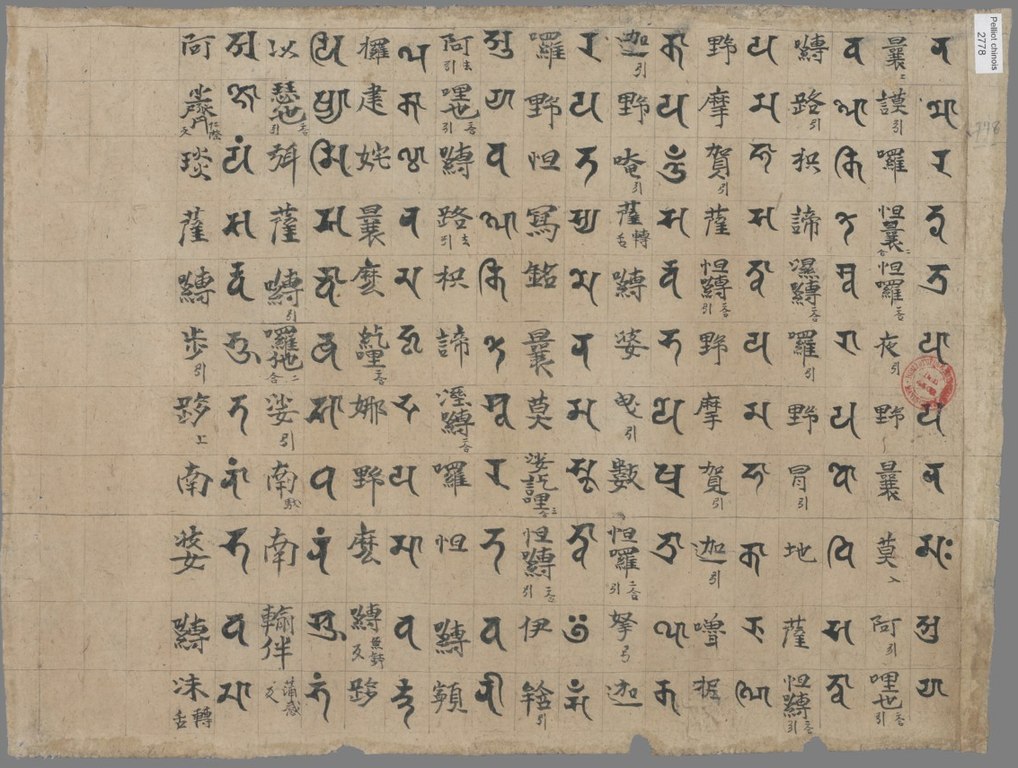
According to Wikipedia, this is one of widely recited dharani across the Buddhist tradition, and has undergone various changes over time, with a couple extant (though corrupted) versions. The featured photo above is an example found in the Dunhuang caves of China, showing the original text in Siddham script, with Chinese transliteration:

Fragment of the Nilaṇṭhanāmahṛdaya dhāraṇī both written in Siddhaṃ script and transliterated in Chinese characters. Bibliothèque nationale de France, Public domain, via Wikimedia Commons

You can see another example here, using both Siddham script, and the ancient Sogdian script:

Whereas the Dharani for the Prevention of Disaster (discussed in a previous post) is focused on practical matters, the Great Compassion Dharani is meant to be chanted in order to awaken goodwill towards others, using Kannon Bodhisattva as the archetype. It is taken from a longer Buddhist text, the Sutra on the Thousand-armed, Thousand-eyed Bodhisattva Avalokitesvara’s Sutra of Dharanis on the Vast, Perfect, and Unobstructed Mind of Great Compassion (千手千眼観世音菩薩広大円満無礙大悲心陀羅尼経).

This dharani is most closely associated the Zen traditions, but because it is pretty long, it’s probably not always practical for lay followers to recite in daily services. I have not seen it listed in service books for lay followers in either Soto Zen or Rinzai Zen. In any case, I am posting it here as a reference.

You can see an example of the Great Compassion Dharani being chanted in a formal Soto Zen service here:

There is a nice Chinese-language version here (starts at 1:07):

I have posted the dharani here in multiple languages, so that people can choose which version they prefer to recite. The main source was Wikipedia, but for the Chinese Pinyin, I had to check multiple websites as the pinyin varied slightly in some places, while for the Japanese version, I checked line by line in the video above.

Sanskrit
(Amoghavajra version)
Original Chinese Chinese Pinyin1Japanese Romaji
(Soto Zen)
namaḥ ratnatrayāya南無喝囉怛那哆囉夜耶Nā mo hē là dá nà duō là yè yéNa mu ka ra tan no to ra ya ya
nama āryā南無阿唎耶Ná mó ā lì yēNa mu o ri ya
valokite śvarāya婆盧羯帝爍缽囉耶Pó lú jié dì shuò bō là yēBo ryo ki chi shi fu ra ya
bodhi satvaya菩提薩埵婆耶Pú tí sà duǒ pó yēFu ji sa to bo ya
mahā satvaya摩訶薩埵婆耶Mó hē sà duǒ pó yēMo ko sa to bo ya
mahā kāruṇikāya摩訶迦盧尼迦耶Mó hē jiā lú ní jiā yēMo ko kya ru ni kya ya
oṃ sarvarbhaye sutnatasya唵薩皤囉罰曳數怛那怛寫Ǎn sà pó là fá yì shù dá nā dá xiàEn sa ha ra ha ei shu tan no ton sha
namo skṛtva imaṃ āryā南無悉吉慄埵伊蒙阿唎耶Ná mó xī jí lì duǒ yī méng ā lì yēNa mu shi ki ri to i mo o ri ya
valokite śvara raṃdhava婆盧吉帝室佛囉愣馱婆    Pó lú jí dì shì fó là léng tuó póBo ryo ki chi shi fu ra ri to bo
namo narakiṇḍi南無那囉謹墀Ná mó nā là jǐn chíNa mu no ra kin ji
hriḥ maha vadhasame醯利摩訶皤哆沙咩Xī lì mó hē pó duō shā miēKi ri mo ko ho do sha mi
sarva athadu yobhuṃ薩婆阿他豆輸朋Sà pó ā tuō·dòu shū péngSa bo o to jo shu ben
ajiyaṃ阿逝孕Ā shì yùnO shu in
sarvasatā nama vastya namabhāga薩婆薩哆那摩婆薩哆那摩婆伽Sà pó sà duō ná mó pó sà duō ná mó pó qiéSa bo sa to2 no mo bo gya
mārvdātuḥ摩罰特豆Mó fá tè dòuMo ha te cho
tadyathā 怛姪他Dá zhí tuōTo ji to
oṃ avalohe 唵阿婆盧醯Ān ā pó lú xīEn o bo ryo ki
lokāte盧迦帝Lú jiā dìRyo gya chi
karate ihriḥ迦羅帝夷醯唎Jiā luó dì yí xī lìKya rya chi i ki ri
mahā bodhisatva 摩訶菩提薩埵Mó hē pú tí sà duǒ Mo ko fu ji sa to
sarva sarva薩婆薩婆Sà pó sà póSa bo sa bo
mālā mala摩囉摩囉Mó là mó làMo ra mo ra
mahemahe ṛdayaṃ摩醯摩醯唎馱孕Mó xī mó xī lì tuó yùnMo ki mo ki ri to in
kuru kuru karmaṃ俱盧俱盧羯蒙Jù lú jù lú jié méngKu ryo ku ryo ke mo
dhuru dhuru vjayate度盧度盧罰闍耶帝Dù lú dù lú fá shé yē dìTo ryo to ryo ho ja ya chi
mahā vjayate摩訶罰闍耶帝Mó hē fá shé yē dìMo ko ho ja ya chi
dhara dhara陀囉陀囉Tuó là tuó làTo ra to ra
dhiriṇi地唎尼Dì lì níChi ri ni
śvarāya室佛囉耶Shì fó là yēShi fu ra ya
cala cala遮囉遮囉Zhē là zhē làSha ro sha ro
mama vmāra摩麼罰摩囉Mó mó fá mó làMo mo ha mo ra
muktele穆帝隸Mù dì lìHo chi ri
ihe īhe伊醯伊醯Yī xī yī xīYu ki yu ki
śina śina室那室那Shì nā shì nāShi no shi no
araṣaṃ phraśali阿囉參佛囉舍利Ā là shēn fó là shě lì. O ra san fu ra sha ri
vsa vsaṃ罰沙罰參Fá suō fá shēnHa za ha za
phraśaya佛囉舍耶Fó là shě yēFu ra sha ya
huru huru mara呼嚧呼嚧摩囉Hū lú hū lú mó làKu ryo ku ryo mo ra
hulu hulu hrīḥ呼嚧呼嚧醯利Hū lú hū lú xī lìKu ryo ku ryo ki ri
sara sara娑囉娑囉Suō là suō làSha ro sha ro
siri siri悉唎悉唎Xī lì xī lìShi ri shi ri
suru suru蘇嚧蘇嚧Sū lú sū lúSu ryo su ryo
bodhiya bodhiya菩提夜菩提夜Pú tí yè pú tí yèFu ji ya fu ji ya
bodhaya bodhaya菩馱夜菩馱夜Pú tuó yè pú tuó yè Fu do ya fu do ya
maiteriyā彌帝唎夜Mí dì lì yèMi chi ri ya
narakinḍi那囉謹墀Nā là jǐn chíNo ra kin ji
dhiriṣṇina地利瑟尼那Dì lì sè ní nāChi ri shu ni no
payāmāna波夜摩那Pō yè mó nā Ho ya mo no
svāhā siddhāyā 娑婆訶悉陀夜Suō pó hē xī tuó yèSo mo ko shi do ya so mo ko
svāhā mahā siddhāyā 娑婆訶摩訶悉陀夜Suō pó hē mó hē xī tuó yè So mo ko mo ko shi do ya
svāhā siddha yoge śvarāya 娑婆訶悉陀喻藝室皤囉耶Suō pó hē sī tuó yù yì shì pó là yē So mo ko shi do yu ki shi fu ra ya
svāhā narakiṇḍi娑婆訶那囉謹墀Suō pó hē nā là jǐn chí So mo ko no ra kin ji
svāhā māranara娑婆訶摩囉那囉Suō pó hē mó là nā là So mo ko mo ra no ra
svāhā sira siṃ amukhāya娑婆訶悉囉僧阿穆佉耶Suō pó hē xī là sēng ā mù qié yē So mo ko shi ra su o mo gya ya
svāhā sava maha asiddhāyā 娑婆訶娑婆摩訶阿悉陀夜Suō pó hē suō pó mó hē ā xī tuó yè suō pó hēSo mo ko so bo mo ko o shi do ya
svāhā cakra asiddhāyā娑婆訶者吉囉阿悉陀夜Suō pó hē zhě jí là ā xī tuó yè So mo ko sha ki ra o shi do ya
svāhā padma kastāyā娑婆訶波陀摩羯悉陀夜Suō pó hē bō tuó mó jié xī tuó yè So mo ko ho do mo gya shi do ya
svāhā narakiṇḍi vagaraya娑婆訶那囉謹墀皤伽囉耶Suō pó hē nā là jǐn chí pó qié là yē So mo ko no ra kin ji ha gya ra ya so mo ko
svāhā mavali śaṅkrayā娑婆訶摩婆利勝羯囉夜Suō pó hē mó pó lì shèng jié là yè So mo ko mo ho ri shin gya ra ya
svāhā namaḥ ratnatrayāya娑婆訶南無喝囉怛那哆囉夜耶Suō pó hē ná mó hé là dá nā duō là yè yēSo mo ko na mu ka ra tan no to ra ya ya
namo āryā南無阿唎耶Ná mó ā lì yēNa mu o ri ya
valokte 婆嚧吉帝Pó lú jí dìBo ryo ki chi
śva rāya svāhā爍皤囉夜娑婆訶Shuò pó là yè suō pó hēShi fu ra ya so mo ko
Oṃ sidhyantu mantra 唵悉殿都漫多囉Ān xī diàn dū màn duō làShi3 te do mo do ra
padāya svāhā跋陀耶娑婆訶Bá tuó yě suō pó hēHo do ya so mo ko

Side note, there is a different version in the Japanese Shingon-Buddhist tradition, but I am too lazy to post here, since the dharani is so long. You can find it here on the Japanese Wikipedia article under “真言宗の読み方”.

June 2025: Major rewrite of this page to make the text side-by-side, but also fixed several typos.

1 Sources used to validate the pinyin: here and here, plus Wikipedia article. Each one slightly disagreed with one another, and my Chinese language skills are very limited, so I had to make a best guess in a few cases where things seemingly contradicted. It’s also possible that certain Chinese characters just have multiple pronunciations.

2 For some reason, the Soto Zen version doesn’t have the words 那摩婆薩哆 (nama vastya / ná mó pó sà duō).

3 Similarly, the Soto Zen version doesn’t have the final “om” (唵, ān) in it.

The Best Buddhist Practice is the One You Are Already Doing

As a perfectionist, I am often plagued by self-doubt about my Buddhist practice and frequently question whether I am doing it right, whether I am doing the right practices to begin with, and so on. I’ve talked about the fundamentals of Buddhism, and how they apply to any sect or teaching on follows, but when you get into the finer details of how to put these into practice, it can feel daunting.

Recently I was reading an article in Japanese by the Soto Zen center in Kinki1 Region that I found very helpful. If you can use Google Translate to read it, I think it is well worth it. But the quote I really liked was:

おつとめの手順としては「信は荘厳(しょうごん)から」といわれるように、まず、お給仕からはじまります。

As for the process of doing a home Buddhist practice, It is said that “faith begins with solemnity” and in the same way Service [at a restaraunt] begins with waiter.

I think this is important because Buddhist home practice (otsutomé おつとめ, in Japanese) isn’t meant to be something you do to show off, because you are obligated to, to get relaxation from, or to get a spiritual thrill from either. The form of the practice isn’t so important as the spirit of solemnity.

As the article points out, we Buddhists (focus on Zen Buddhists in the article, but it applies to all of us) are trying our best to put the historical founder, Shakyamuni Buddha’s, teachings into practice according to our circumstances. We are not given much instruction in life, and each has our own partial understanding of things, not to mention the conditions we grow up under. So, we have to adapt the teachings of the Buddha accordingly. But if we do it in a spirit of solemnity, not frivolity, obligation, nor conceit, then we will make progress.

Thus, I realized that whatever Buddhist practice you are already doing is probably the right one, as long as you are doing it with the right attitude.

Similarly, I was watching a video in Japanese by a Soto Zen monk who often provides very practical advice, but also hides his identity:

Around 5:00 onward, he talks about how people who first get into Buddhism, or a particular teaching or sect are often very overeager and want to dive in and do a lot of practices. Or, they see the official liturgical format and feel that they have to do everything (I am one of those people).

Instead, he uses the analogy of a restaurant, with a menu of choices. All the choices are great, but can be overwhelming if you try to order everything, so he suggests you start small. In his example, reciting the Heart Sutra daily is a good foundation. If you do this for a while, and it feels like something is missing, you can add additional liturgy or practices based on what’s recommended. Or if it feels like too much, pare back a little.

The key is daily practice. It’s not super important how you do it, just consistency and right attitude. If you are already doing this, then keep it up, and don’t get bogged down in details.

Namu Shakamuni Butsu

1 The “Kinki” region in Japan is just another historical term for the Kansai region of Western Japan. The first time I heard this word in Japanese, I was very confused. 🤦🏼‍♂️

Toyokawa Inari Shrine: Syncretic Religion

A little while back, during my post on Fushimi Inari Shrine in Kyoto, Japan, I alluded to how the native Shinto religion often blended with Buddhism up until the early modern period (e.g. the Meiji Period) when they were more forcefully separated.

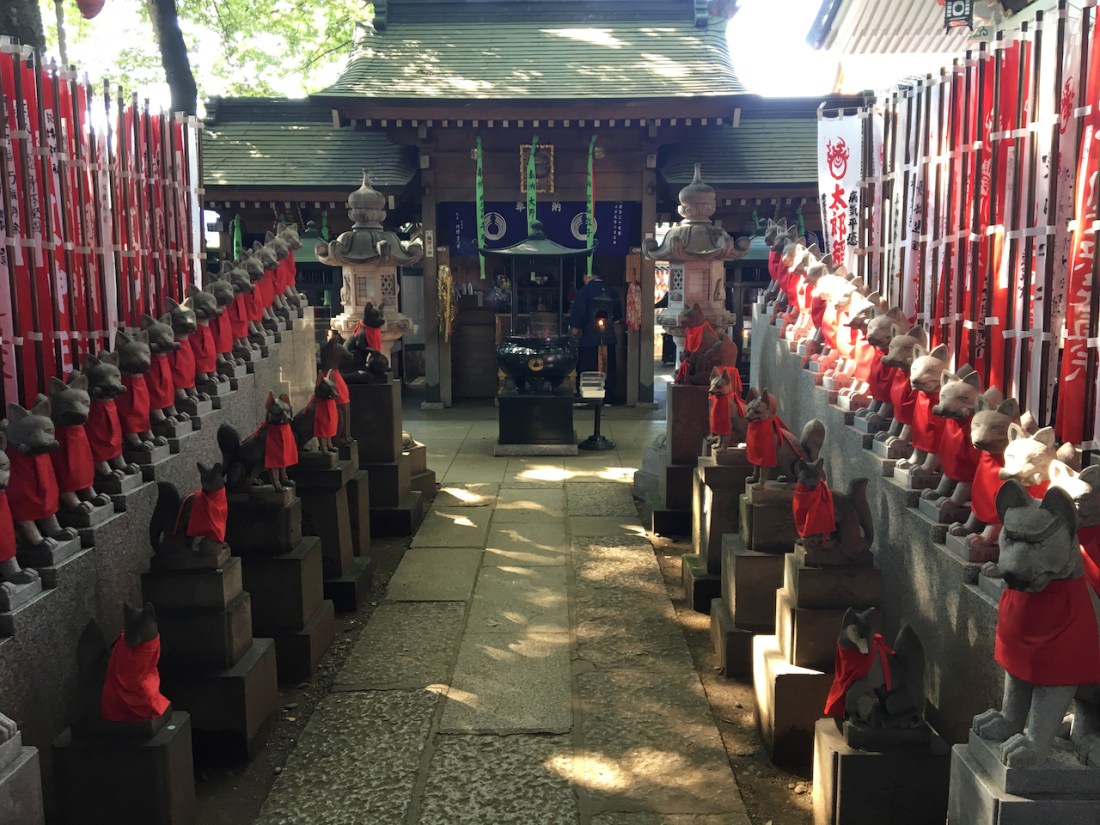
You can still see vestiges of this blending in some temples and shrines, but one great example is the Toyokawa Inari shrine right in the heart of Tokyo’s Minato Ward:

This Shinto shrine / Soto-Zen Buddhist temple venerates Dakini-ten (荼枳尼天), which is the Buddhist form of the Shinto kami Inari Ōkami.

Dakini-ten is based on the concept of Ḍākinī in esoteric (a.k.a. Vajrayana) Buddhism, but in Japan it blended with veneration of Shinto kami and thus took on a life of its own.

Inari Ōkami in his/her Buddhist form as Dakini-ten shining light upon a samurai warrior. Late medieval painting by Utagawa Kuniyoshi, source: Wikimedia

Anyhow, let’s talk about the temple itself. I visited the temple in 2018 and had little context back then, so I didn’t take as many good photos as I would have liked, but I will try to explain as best as I can.

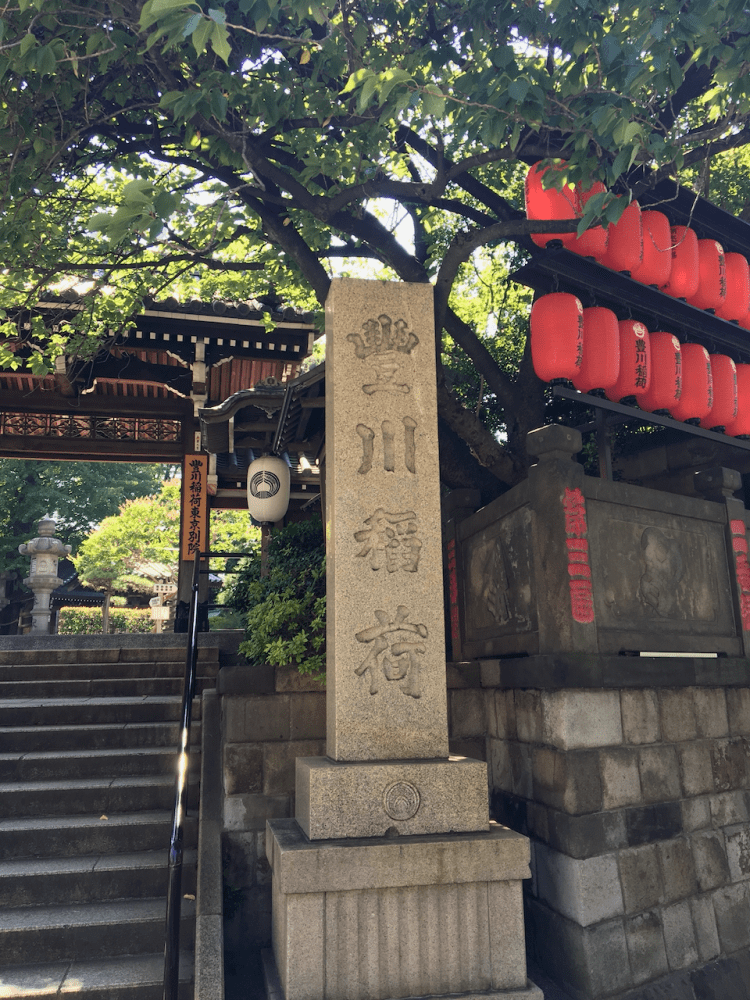
Once you go past the main gate…

You come upon the main shrine to Inari Ōkami (colloquially known as “O-Inari-san”):

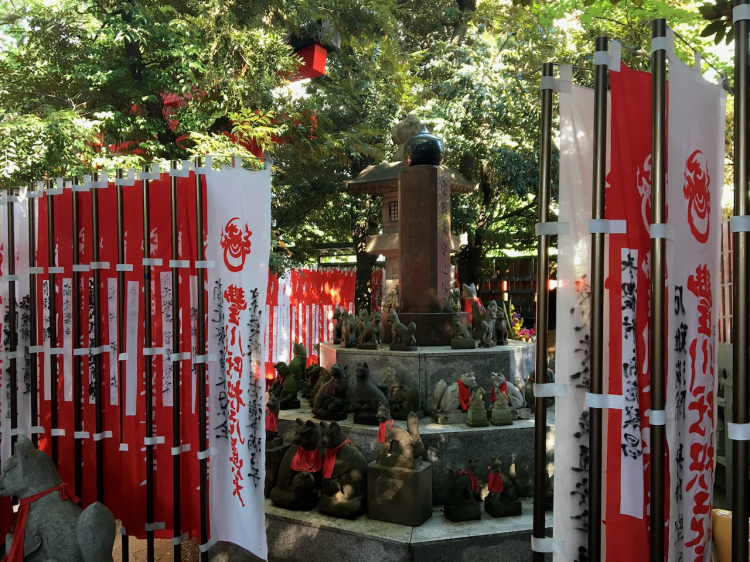
Another, small sub-shrine here:

You can see fox statues all over the complex, due to their close association with Inari Ōkami.

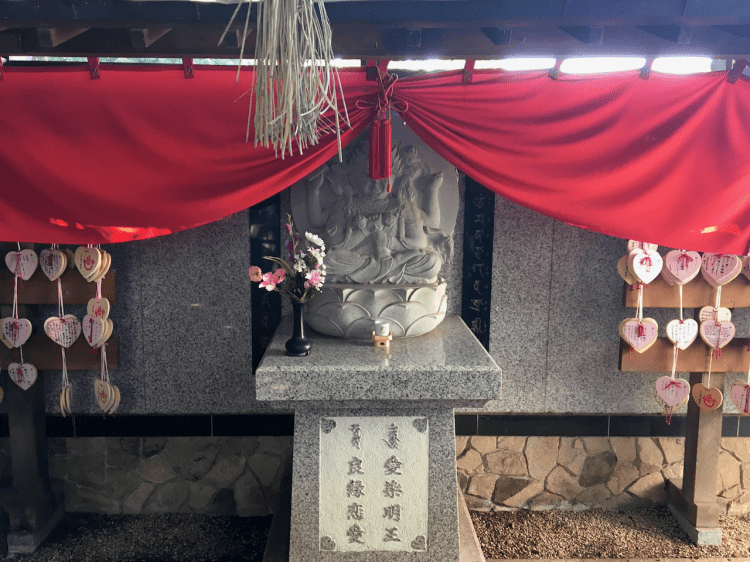
However, other deities, both Buddhist and Shinto are enshrined here too. For example, below is an esoteric-Buddhist (Vajrayana) deity named Aizen Myō-ō (愛染明王):

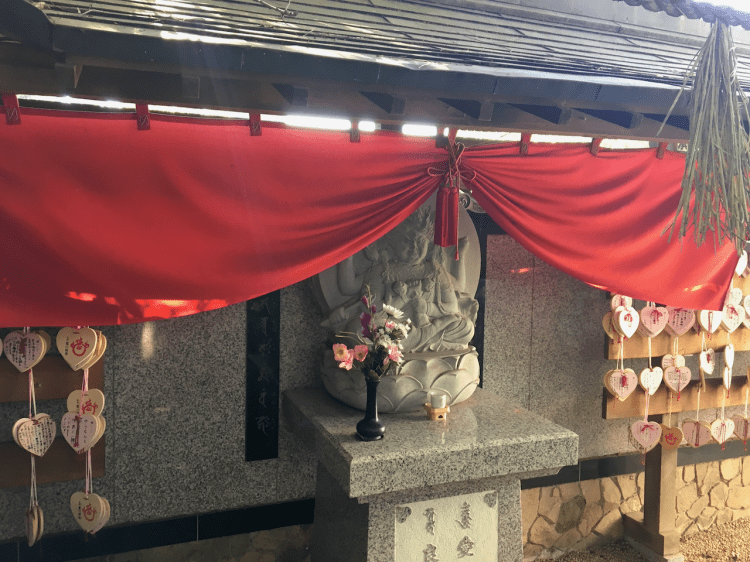
Also, Benzaiten, one of the Seven Luck Gods:

And Kannon Bodhisattva:

The fact that both Shinto deities like Benzaiten and Inari Ōkami reside in the same shrine as overtly Buddhist deities such as Kannon and Aizen Myō-ō is somewhat unusual, but really isn’t. This was normative for Japanese religion until the modern century. Japan has had two religions for a very long time, and they’ve co-existed for so long, that they often blended together.

If you look at American religion, pagan religion and Christianity co-existed for so long (even when paganism was officially repressed) that the two blended together. Things we take for granted such as Christmas trees, mistletoe, Easter eggs, and such are all examples where they have blended together to religion as we know it today. This might offend religious purists (to be fair everything annoys religious purists), but this is how societies absorb and adapt religions over generations. Japanese culture simply had different religions to work with.

Anyhow, fascinating stuff.

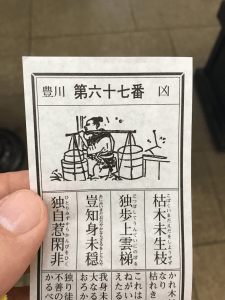
P.S. My omikuji fortune that visit was bad luck (kyō, 凶). I don’t remember having a particular bad year, especially compared to 2020 later, but it was surprising to get an overtly bad fortune for a change.

Every Day Is A Good Day, Kind Of

Soon after I wrote this post, I was reminded of a certain Zen aphorism in Japanese: 日日是好日 which is read as nichi nichi kore kō nichi.

This usually translates as “every day is a good day”, or “each day is a good day” or other such things. It is originally attributed to a Chinese Zen monk named Yunmen Wenyan from the 9th and 10th centuries.

At first glance, this seems like a positive affirmation of life. This is the sort of thing you might see from life-coaches, self-help gurus, posters, daily affirmations, songs, and so on. Live, laugh, love and all that.

But that kind of attitude and outlook is only useful for financially stable, healthy, affluent people living in stable countries. It’s pretty useless for people who live in difficult circumstances, working thankless, dead-end jobs, dying from pneumonia, or suffering from abuse. If you’re a child in Syria who has lost their parents during the recent earthquakes, the “live, laugh, love” phrase rings pretty hollow.

A while back, I wrote about similar issues with Seneca’s philosophical teachings. The Stoic teachings which Seneca espoused basically amounted to “suck it up” and “don’t be sad”, which is fine when you’re a Roman senator, but not too useful for the Roman slave working the fields.

In fact, for most people in the world, most days are varying degrees of shitty.

Life is a slog; First Noble Truth of Buddhism right there.

So, is there any value or meaning to Yunmen Wenyan’s famous phrase? I think so.

This is strictly my own interpretation, so please take with it a grain of salt. This morning, I had to step outside in the early morning and I beheld the sunrise. It is cold, it is early March, it is still dark outside, yet I saw the sun rising, and birds flying past it. I was glad to see it, to be breathing and savoring that moment.

Life is bittersweet. It is full of pain, loss, frustrations, and unfulfilled needs. It doesn’t necessarily get better, but it does carry on. Each moment of breath is still worth it. If you can share it with others, so much the better. But even if not, each moment is still worth something.

This is, I believe, what Yunmen Wenyan might have been saying to us, even when it gets lost in translation.

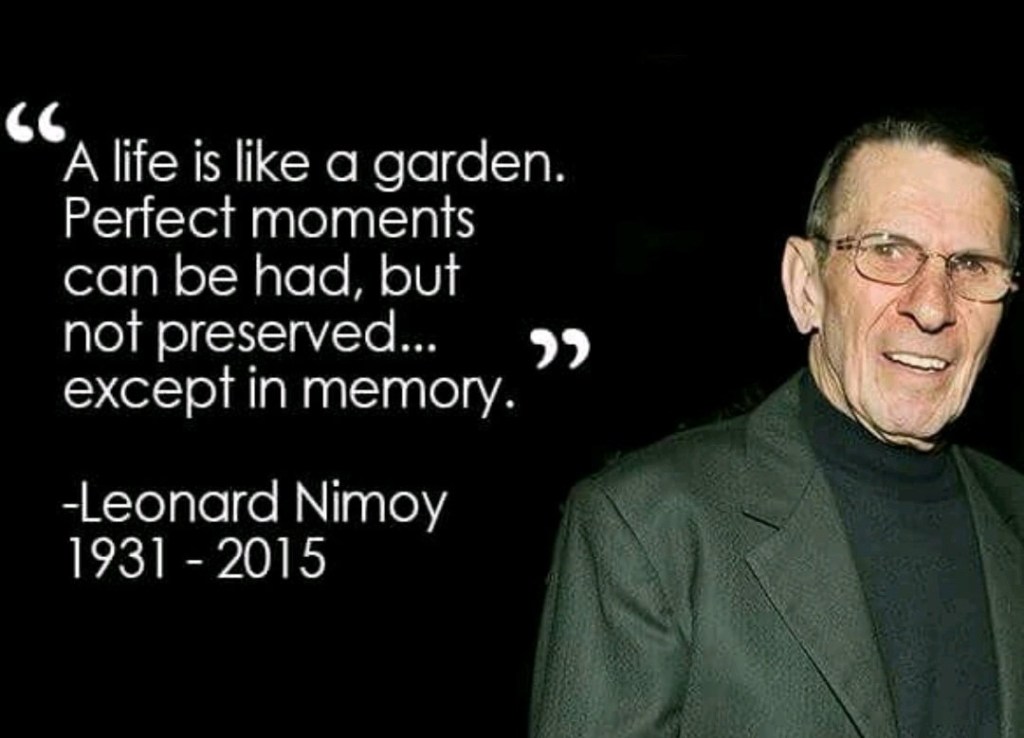
P.S. RIP Leonard Nimoy. LLAP. 🖖

Liturgical Language and Start-up Buddhism

Warning: this is a rant post.

Although I have happily taken up with a local Soto Zen group in my area, one of the first challenges I’ve noticed is that the group is probably 99% white, and have little or no knowledge of Japanese culture or language, despite the tradition they’ve inherited. This came into stark view when one the teachers, a very nice elderly man, proudly showed some Zen calligraphy that his teacher had composed for him. I could read it, but when I explained how it’s read in Japanese, he simply gave me a confused look.

Further, another peculiarity is that we almost always recite Buddhist liturgy in English. Hearing the Four Bodhisattva Vows chanted in English frankly feels a bit odd to me, though I have gotten used to it. Teachers also frequently mispronounce basic Japanese-Buddhist terms, which is a bit grating for a language student myself.

But then I started thinking about it: am I right to criticize the lack of grounded tradition, or am I just being a Japan-snob? Am I just nit-picking a bunch of minor things while ignoring the positives?

First, I admit I am a giant Buddhist-Japan nerd. I’ve devoted a significant chunk of my life to these two subjects, written more than one blog about it over the span of 15 years, read countless books and updated more than a few articles on Wikipedia. So, my perception of things may be rather skewed. It’s like one of those snobs in a sushi restaurant who insists that “it tasted better in Tokyo”. That’s me sometimes. I have to occasionally stop and remind myself “dude, you’re a huge nerd”.

Further, the Buddha in his own time, taught his disciples in the vernacular languages of the time (Pāli being a kind of lingua franca back then) and encouraged his disciples to continue teaching in whatever local languages were suitable. There was no “holy language” or “liturgical language” in the early Buddhist community. In fact the Buddhist teachings weren’t preserved in Sanskrit, by this point a literary language in India, until centuries later.

So, reciting Buddhist liturgy such as the Heart Sutra or the Four Bodhisattvas in English, even when it sounds a bit clunky, is both practical for disciples in the US, and less intimidating for new students. Expecting students especially new students, to know what Sino-Japanese (Classical Chinese preserved with Japanese pronunciation) is is admittedly unrealistic.

I suppose this is like liturgical language in Christianity. A pious person might wish to read the words of Jesus in the Bible in the original Koine Greek. A lot of Christians wouldn’t necessarily devote the time to do this, but they still go on to be pious, god-fearing Christians. Different people express their faith in different ways.

In the same way, I consider myself a pious Buddhist, so for me, studying and reciting the sutras as they are best preserved, in Classical Chinese, makes sense. Maybe it’s not for other people though. So, when you think about it, who am I judge other Buddhists based on their grasp of other languages?

Still, in spite of all this, the one thing that continues to bother me is the lack of appreciation for, and shallow understanding of, the tradition that we white Buddhists have inherited. When I read Xuanzang’s lament about the state of Buddhism in China at the time in the 8th century, and the need to go all the way India to bring more teachings and knowledge, I empathize with this.

From one shore to another. Speaking of shores

Buddhist immigrant communities here have maintained a continuous, unbroken tradition from the beginning, passing from generation to generation, in spite of discrimination and challenges adapting to a new culture. By contrast, a lot of start-up Buddhist communities in the US feel somehow half-baked: people trying to imitate “how things are done in Asia”, but there are just some things that can’t be transmitted through books sold at Barnes and Noble. Sometimes those “cultural accretions” that white Buddhists gripe about in their quest for “pristine Buddhism” exist for perfectly good reasons, and enrich the tradition, not detract from it. The problem is when white Buddhists don’t understand something and just write it off as unnecessary. I used to do this too when I first met my wife, now I see things pretty differently.

I was prompted to write about this after an acquaintance told me recently that they used to go to the same community “for the meditation”, and had since moved on to transcendental meditation. That was disappointing thing to hear, and makes me question her motives in the first place. It’s frustrating to hear things like this.

Then again, when I am in Japan and I visit a famous historical site, knowing the history of it, and the dramatic events that happened there, and yet others shrug it off, it frustrates me too. So, sometimes I really think this is just a bunch of snobbery and all in my head.

However, setting aside my self-centered and selfish feelings on the subject, I do think that’s important to keep sharing information, translating things as best as I can, and bridging the cultural gaps. If Buddhism continues to prosper in the West, and beyond, then things will look very different from now, and hopefully more mature (not to mention diverse) too. The little seeds we plant now can have big effects for others we will never see.

P.S. The second chapter of the Lotus Sutra has a verse related to this:

[Even] If persons with confused and distracted minds
should enter a memorial tower
and [only] once exclaim, “Hail to the Buddha!”
Then all have attained the Buddha way.

Translation by Burton Watson

Soto Zen Yearly Liturgical Calendar

Hello,

Recently, I alluded to joining a local Soto Zen group and deepening my practice there. I am happy to report that after several weeks, I finally decided to formally join the community as a member. Thus, I guess I am now a student of Soto Zen.1 It is kind of exciting to be part of a Buddhist community again after years of isolation, but also a bit of an adjustment since I’ve been doing things a different way for a very, very long time.

As part of this I wanted to get familiar with the yearly liturgy of the Soto Zen tradition. To my surprise, the local community seemed to not follow this yearly calendar, but I guess it’s up to each follower, and each community to apply this calendar as much possible.2

This was taken near the famous Chujakumon (中雀門) Gate at Sojiji Temple, looking westward. Photo from 2012.

Anyhow, I think it’s helpful to get familiar with the calendar of events not just to have a foundation in one’s life and practice, but also to stay connected with the much larger community. So, for that reason I’m posting the yearly event calendar here for readers. Many of these holidays line up with other Buddhist traditions in Japan, and I’ve already talked about them in other blog posts, while a few are exclusive to Soto Zen only.

DateJapaneseEvent
January 3rd転読大般若
Tendoku Dai-hannya
Reading of the Great Perfection of Wisdom Sutra
February 15th涅槃会
Nehan-e
The Death of the Historical Buddha, Shakyamuni
Late March彼岸会
Higan-e
Spring Equinox
April 8th花まつり
Hanamatsuri
The Birth of the Historical Buddha, Shakyamuni
Late July / Late August盂蘭盆会
Urabon-e
Obon Season
Late September彼岸会
Higan-e
Fall Equinox
September 29th両祖忌
Ryoso-ki
Memorial for both founders of Soto Zen: Dogen and Keizan
October 5th達磨忌
Daruma-ki
Memorial for Bodhidharma, the Indian monk who brought the Zen tradition to China.
December 8th成道会
Jodo-e
The Enlightenment of the Historical Buddha, Shakyamuni
December 31st除夜
Joya
End of the year temple bell ringing
Source: https://www.sotozen-net.or.jp/ceremony/annual

Let’s talk about some of these events below.

Reading of the Great Perfection of Wisdom Sutra

The Great Perfection of Wisdom Sutra requires some explanation. The Sutra is not one Buddhist text, but a collection of sutras that appeared in India starting in the 1st century CE. Each of these “great perfection of wisdom” sutras (a.k.a. prajña-paramita in Sanskrit) basically teaches the same message, but each version was composed in varying sizes: 8,000 verses, 15,000 verses, 25,000 verses, etc. The trend happens in reverse too: some versions get shorter and shorter until you get to the famous Diamond Sutra and Heart Sutra. Due to their slimmer size and easier recitation, these two sutras have retained more popularity over time.

Nevertheless, regardless of which version we’re talking about, the Great Perfection of Wisdom Sutra is a powerful foundation for Mahayana Buddhist traditions everywhere, including the Zen tradition. Thus, many traditions have some kind of “sutra reading” ceremony.

Because the Perfection of Wisdom Sutra is so large, it’s impractical to read/recite the entire sutra in a single session, so the ceremony usually involves Buddhist monks opening each fascicle and fanning through the pages to symbolize reading it. It’s a very formal ceremony. You can see an example of this below, though I am unclear which Buddhist sect this is:

If you want to the ceremony itself, skip to 11:30 or later, until about 16:00

English-language copies of the Great Perfection of Wisdom Sutra are very hard to find, by the way. I consider myself very lucky to find a copy of the 8,000-verse sutra at Powell’s City of Books some years back (that bookstore is amazing by the way):

Most Zen communities in the West can’t be expected to have such a copy. In any case, since the Heart Sutra is a summation of the Great Perfection of Wisdom Sutra anyway, it makes sense for most Zen practitioners to simply recite the Heart Sutra as appropriate. In the Youtube video above, the monks even recite the Heart Sutra at one point too.

Dual Founders Memorial

Soto Zen is somewhat unusual in Japan for having two founders, not one. The sect-founder-practice dynamic is something unique to Japanese Buddhism,3 usually each recognized Buddhist sect in Japan has one founder, not two.

Normally, when Westerners think of Soto Zen in Japan, they think of Dogen as the founder since he was the one who traveled to Song-Dynasty China, studied Caodong-sect Zen teachings, and brought those back to Japan.4 The challenge is that during this time, Soto Zen was a strictly monastic institution that had minimal appeal to the wider Japanese society.

Keizan, who came a few generations later, reformed Soto Zen as an institution that had more broad appeal. It was still centered around the monastic institution, but also included more community connections to the warrior samurai class and the peasantry as well. Soto Zen flourished in a way that other Zen sects in Japan simply never did. For this reason, Keizan is considered the second founder.

Thus, during formal ceremonies, a Soto Zen text, the ryōsokisho (両祖忌疏) is read aloud, which describes the virtuous life of both founders through the use of Chinese-style poetry.

Bodhidharma Memorial

Bodhidharma, unusually depicted standing. Taken at Sojiji Temple in 2012.

Within the world of Zen, Bodhidharma is a guy who needs no introduction. This semi-legendary monk from India supposedly came to China in the 4th century, and helped establish the lineage there, and subsequently all such lineages through East Asia.

The historicity of Bodhidharma though is pretty suspect, and some historians contend that he was made up in order to refute criticism that Zen had no prior connection to Buddhism in India. I don’t know which is true.

Regardless of whether Bodhidharma was real or not, he is the embodiment of Buddhism (particularly Zen) passing the torch from the community in India to the community in China and beyond.

End Of Year Temple Bell Ringing

The “joya” tradition is found across all Buddhist sects in Japan, and is a way of ringing in the new year. I took part in it once myself at a local Jodo Shu temple thanks to my father-in-laws connections.

The temple bell, or bonshō (梵鐘), is run 108 times, to signify the 108 forms of mental delusions (kleshas in Sanskrit, bonnō in Japanese) that all sentient beings carry with them. Things like anger, jealousy, covetousness, envy, ill-will, etc. In other words, the stupid petty shit we all do.

When I participated ages ago, this particular temple lined 108 volunteers up, and one by one we proceeded to the temple bell and rang it. As the temple bell is very large, and the striker is a large wooden log suspended by rope, this wasn’t easy, but it was cool.

Obviously, many communities in the West don’t have huge temple bells, and only tiny ones at home at their home altar. Still, one can relive the experience using a small bell, such as one found on your Buddhist altar, and ringing it 108 times (Buddhist rosaries can help keep count, by the way; that’s literally what they’re for), or some division of 108 if that’s not easy: 54, 27, etc.

Conclusion

The liturgical calendar of Soto Zen, as promulgated by the home temples in Japan, includes a lot of holidays that are practiced by the wider Mahayana Buddhist tradition anyway, plus a few novelties found only in Japan, or even just in Soto Zen itself.

Outside of Japan, how one incorporates this into one’s own community, or just in one’s personal life is entirely up to them. Personally, I like having some structure, including a set calendar like this to keep me from getting too idle, but also as a way to tie in to the larger Buddhist community as a whole. However, other people may differ.

Good luck and happy practicing!

Namu Amida Butsu

1 I should clarify that I haven’t stopped reciting the nembutsu and such, I just feel I moved onto the next phase of my Buddhist practice.

2 I have noticed over the years that communities here in the West are more or less connected to the home temple overseas. Some strive to stay in lock-step, some go the opposite route. I have mixed feelings on the subject.

3 TL;DR – The Edo Period government decided to divide-and-conquer previously militarized Buddhist establishments into distinct sects, where each one required to define their founder, their particular practice, and key sutras they base their teachings around. This led to the parochial style Buddhist institutions that still exist today, but also bucked the trend in continental East Asia where Buddhist sects tended to synthesize into a single “super-Buddhist” tradition.

4 Fun fact: the “Soto” is just the Japanese-style reading of Cao-dong: 曹洞. For a look at how Japan imported Chinese characters, and why they sound so different, you can watch this Youtube video. I have personal quibbles about some details, but it’s otherwise a great historical overview.

Inattention

Photo by Gleb Dolskiy on Pexels.com

A while back, I talked about a famous poetess from 11th century Japan named Lady Izumi, one of several famous ladies of the court at that time, but for some reason the one I find most fascinating.1 Lady Izumi was a prolific poet, and I have been reading samples of her poetry compiled in The Ink Dark Moon by Jane Hirshfield and Mariko Aratani. I found this poem the other day and wanted to share. The headline of the poem was that Lady Izumi was on retreat while on retreat at a mountain temple in autumn…

Original JapaneseRomanizationEnglish translation*
心にはKokoro niwaAlthough I try
ひとつみのりをHitotsu minori woto hold the single thought
思へどもOmoe domoof Buddha’s teaching in my heart,
蟲のこゑこゑMushi wa koegoeI cannot help but hear
聞ゆなるかなKikoyu naru kanathe many crickets’ voices calling as well.
* Translations by Jane Hirshfield and Mariko Aratani

I think this speaks to the classic frustration many Buddhists (among others) have: the willingness to undertake a practice, and the reality of not being able to stay focused. If it were easy, we’d probably all be doing it.

Lately, in an effort to reconnect to the local Buddhist community, and due to recent experiences in Victoria, BC, I decided to join a local Soto Zen group for remote meditation sessions. It’s been great actually: I have something in the week to look forward to besides more work meetings, and it provides a nice spiritual anchor in my life again. However, I noticed that while meditating for 25 minutes at a time, my mind rarely stays focused for long. Sometimes I can discipline myself for a few minutes, counting my breaths, etc. However, most of the time my mind is just wandering around for most of the session.

When I was younger and first encountered the nembutsu, I used to dedicate myself to reciting the nembutsu 1080 times (using my rosary to help count). Usually this takes about 15-20 depending on the speed of recitation. I (surprisingly) continued this practice for months. However, I also noticed a pattern: my mind would quickly grow bored from reciting, then anxious to hurry up and finish, and then relief when I got near the end. My mind would wander, just as it does with meditation.

So, the experience that Lady Izumi has is not unique to her, and even now, a thousand years later, I can empathize with her.

Further, I don’t think there’s an easy solution here: it’s something that every one has to work out for themselves.

Namu Amida Butsu

1 Speaking of fascinating, you might like to read my review of the Diary of Lady Murasaki, her contemporary on my other blog. Lady Murasaki evidentially didn’t think too highly of Lady Izumi.