I used to be an avid Dune reader in my younger years, and posted quotes from it all the time in earlier iterations of the blog. Anyhow, I found this quote from the third book:
The universe is just there; that’s the only way a Fedaykin can view it and remain the master of his senses. The universe neither threatens nor promises. It holds things beyond our sway: the fall of a meteor, the eruption of a spiceblow, growing old and dying. These are the realities of this universe and they must be faced regardless of how you feel about them. You cannot fend off such realities with words. They will come at you in their own wordless way and then, then you will understand what is meant by “life and death.” Understanding this, you will be filled with joy.
Muad’Dib to his Fedaykin, from Frank Herbert’s “Children of Dune”
I have probably said this a few times recently, but like it or not wearenotthecenter of the Universe, no matter how much we like to think we are. The universe will carry on without or without us, and sometimes it’s capable of really wondrous moments, and sometimes it will unleash some really shitty realities on us. And there’s only so much we can do to control that. Like a raft navigating treacherous waters, we have to carefully row and pay attention to the currents.
In spite of all this, though, it doesn’t mean we have to sit and be passive either.
Speaking of old science-fiction quotes…I am an avid Roger Zelazny reader, and Isle of the Dead is among my favorite books ever. I always like this quote because of its cosmic feel, but also its unintentional Buddhist message which resembles Saicho’s famous quote about “lighting one corner of the world”:
“Earth-son, I greet you by the twenty-seven Names that still remain, praying the while that you have cast more jewels into the darkness and given them to glow with the colors of life.”
My pure land is not destroyed, yet the multitude see it as consumed in fire, with anxiety, fear and other sufferings filling it everywhere….But those who practice meritorious ways, who are gentle, peaceful, honest and upright, all of them will see me here in person, preaching the Law [a.k.a. The Dharma]
Thus, even in the midst of crisis, or madness, or despair the light of the Dharma still shines even when it seems obfuscated. It is always there for those willing to look, and for those willing to cast a few jewels into the darkness.
Home services in Japanese Buddhism, known as otsutomé (お勤め) or more formally gongyō (勤行), have many different approaches. It often depends on sect, particular communities, and personal preference. Trouble is, English sources are often confusing or insufficient. So, I try to look up information in Japanese, which is sometimes harder than you might think.
Anyhow, something I’ve learned recently about Tendai Buddhism, is that at least in some Tendai traditions, home practice might be divided between a morning service and a night service. This is in keeping with the two concepts in Tendai (more on that here):
Hokké Senpō (法華懺法) – reverence for the Lotus Sutra, the foundation for Tendai Buddhism, and for much of Mahayana Buddhism.
Reiji Sahō (例時作法) – reliance on Amida Buddha to help deliver oneself (and others) from this world of frustration and fear.
Thus, in lay-Buddhist home services for Tendai Buddhism, some communities tend to divide the morning versus evening services to reflect these two concepts.
This page from the Jimon-branch of Tendai Buddhism, based in the famous Mii-dera Temple (as opposed to the Sanmon-branch based in Enryakuji atop Mount Hiei) shows example services for both morning and evening. I can’t translate everything word for word from the site, but let me try to summarize the basic format.
Morning Service
For the morning service, one pays homage to the Buddhas and Bodhisattvas “of the ten directions”1 and takes the Lotus Sutra as their basis. The morning service cited in the Jimon-sect page is based on a treatise by founder Saicho called the Hokke Sanmai Gyōhō (法華三昧行法), and for some reason is much shorter than the evening service.
The morning service is comparatively short, but includes liturgy such as:
I left out some of the liturgy from this list because I could not find details, or they were very specific to the Jimon sect (e.g. praises of Saicho’s disciple Enchin, who is the source of the Jimon branch), but hopefully you get the idea. This emphasizes the here and now, and seems rooted in the hokke senpo side of Tendai Buddhism to me.
Evening Service
The evening service by comparison uses the Amitabha Sutra as its basis and includes somewhat different liturgy.
Dedication of Merit for Rebirth in the Pure Land (this differs slightly from the morning service version).
It’s interesting to note that the evening service still includes verses from the Lotus Sutra, but also mixes the Nembutsu and Mantra of Light as well and definitely emphasizes the reiji saho side of Tendai.
Conclusion
As these are services associated with just one sub-sect of Tendai, and since people often add, subtract or adapt services to meet their needs, it’s perfectly fine to adjust this to whatever works in your situation. You could potentially reduce this all the way down to reciting the Heart Sutra in the morning, and the nembutsu at night. Or something similar. As long as it is sustainable, and captures the spirit of Hokke Senpo and Reiji Saho.
The themes of morning services expressing hokke senpo, and evening services expressing reiji saho, are a great way to apply Tendai teachings in one’s own life, or just Mahayana Buddhism in general.
P.S. features the gardens of Mii-dera temple, photo by E5894, CC BY-SA 3.0, via Wikimedia Commons
1 The eight cardinal directions, plus up and down.
I had an idea recently while flipping through my book on the journeys of the Buddhist monk Xuan-zang (pronounced like “Shwan-tsong”). Xuan-zang was the famous Buddhist monk who walked to India in order to bring back more information and texts in order to help develop Buddhism in his native China. In my old post, I covered some of the trials and tribulations of this amazing journey, and even made a fun song. However, looking back the post felt incomplete. I realized that many of these places that Xuan-zang traversed are obscure and forgotten now despite their central importance to Buddhist history, and the journey was so long that it’s too much to really explore in a single post.
So, this is the start of a series of posts meant to help retrace Xuan-zang’s journey, explore places of significance and how they tied into larger history. I don’t have a schedule yet (these posts take a while to write), but I am working on the next few drafts already.
Today’s post is the prologue episode, covering China at this time, and why Xuan-zang left.
Quick note: because this episode in particular uses a lot of Chinese names, for the sake of accuracy and modern readers, I am using the pinyin-style accent marks where relevant, and also using Simplified Chinese characters. I also put in lots of hyphens to help with pronunciation.
The Tang Dynasty
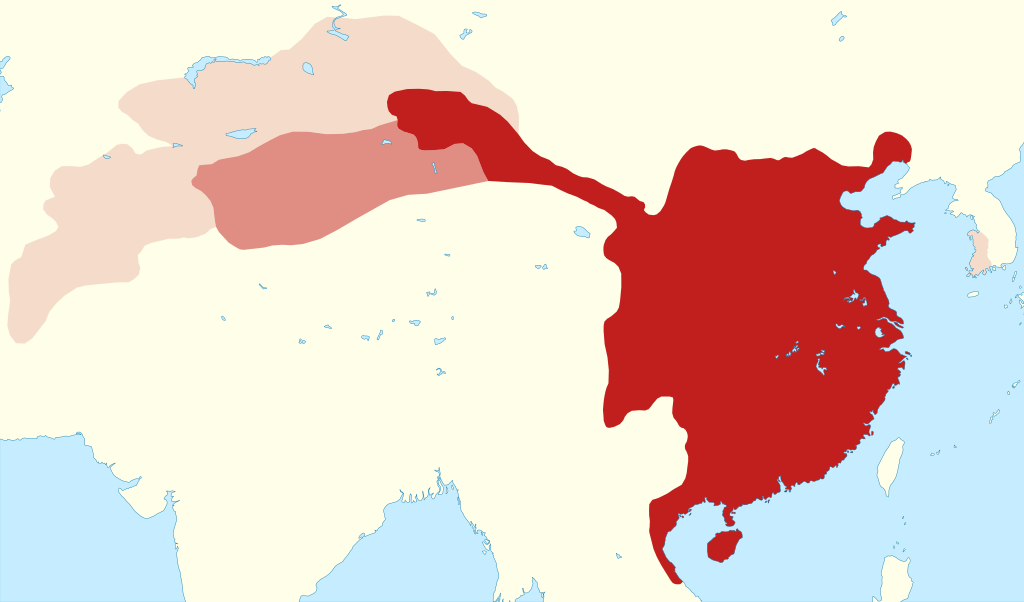
Great Tang at its largest extent in 661, map courtesy of Kanguole, CC BY-SA 4.0, via Wikimedia Commons
Chinese history, until the Republican era (1912 onward) had seen a series of kingships followed by imperial dynasties. Although, we usually call the country “China”, the name used by Chinese people in antiquity, and by their neighbors, was often taken from the current ruling dynasty.
Dynasties came and went. Some were fairly short-lived such as the Sui, others were incredibly powerful and long-lasting such as the Ming. Some were constantly fighting for their existence, such as the Song, others were fractured into a series of “mini-dynasties” that only exerted control over a region and were unable to unify China.
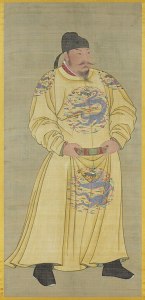
A portrait of Emperor Tai-zong, painted centuries later in the Ming Dynasty. National Palace Museum, Public domain, via Wikimedia Commons
Xuan-zang lived during the last days of the Suí Dynasty, and the early days of the Táng Dynasty (唐). “Great Tang” (大唐) as it called itself, lasted from 618 – 907, and was one of the high points of Chinese civilization. The empire expanded very far to the west, along the Silk Road (more on that in future posts) and actively imported all kinds of art, people, ideas, religions and material culture from Central Asia. Compared to earlier dynasties, Great Tang was much more cosmopolitan and less insular.
Xuan-zang lived primarily during the reign of the second Tang emperor Tài-zōng (太宗), who was an incredibly powerful, dynamic ruler. Chinese history still reveres him as of the greatest rulers. Tai-zong aided his father, the first emperor, in overthrowing the previous dynasty. Further, he was a powerful, expansionist ruler with a strong sense of administration, which helped provide stable foundations for Great Tang.
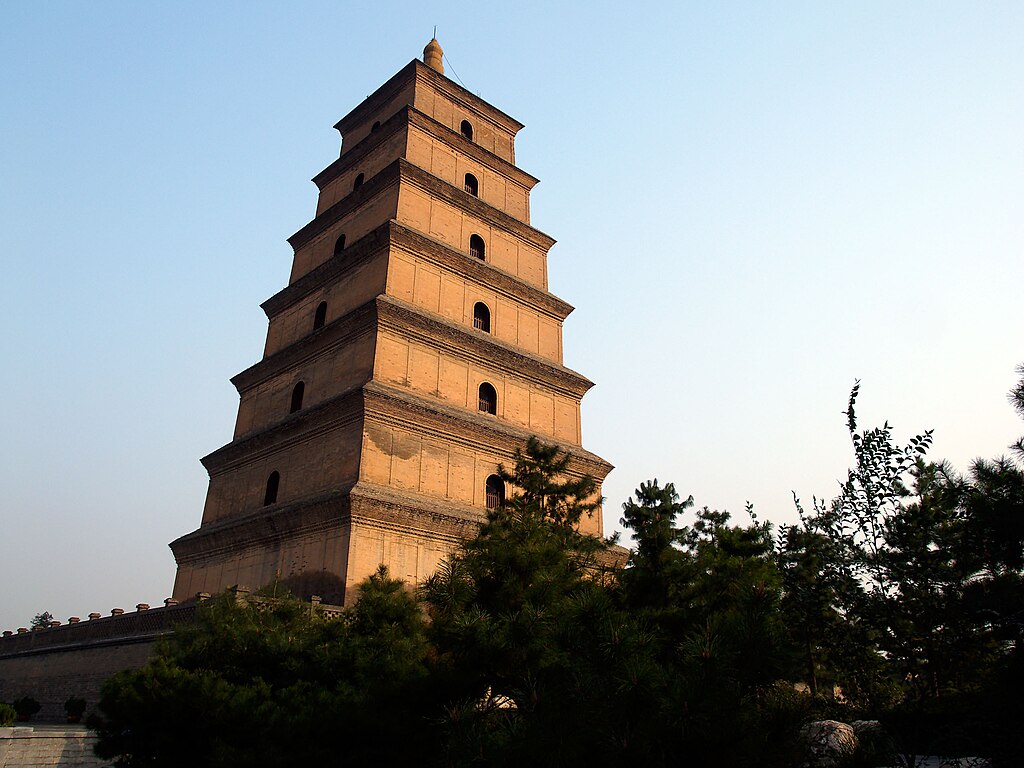
The capital of Great Tang was the city of Cháng-ān (长安) in the western part of China. The city was a massive, cosmopolitan center of administration, commerce and culture. Chang-an at its height grew to 30 square miles, which was massive compared to Rome which occupied only 5.2 square miles. The population by 742 was recorded as 2,000,000 residents and of these 5,000 foreigners.
Chang-an was easily one of the world’s greatest cities at the time, and it had a great influence on its neighbors as well: the layout for the capital of Japan, Kyoto, was intended to resemble Chang-an, and great Buddhist masters such as Saicho’s rival, Kukai, studied there extensively. It was here that many Buddhist texts that came from the Silk Road were translated here as well.
As the easternmost point of the Silk Road, it was here that many journeys began or ended…
Buddhism in Great Tang
The Tang Dynasty is often regarded as one of the high points of Chinese civilization, but also for Buddhism. Buddhism had emerged in China centuries earlier but its spread was slow at first. The native Confucian community particular resented the foreign Buddhist teachings as un-filial, unproductive (since monks did not work fields), and a drain on national resources.
In spite of the criticisms, it spread nonetheless. Wave and wave of teachings, newly translated texts, and schools of thought were imported from the Silk Road, allowing Buddhism to gradually take root, articulate its teachings better over successive generations, and develop natively Chinese schools of thought such as Tiān-tāi, Huá-yán, and Pure Land alongside imported schools of thought from India such as Fǎ-xiàng (Yogacara) and Sān-lùn (Madhyamika). By the time of the Tang Dynasty, massive temple complexes had arisen around Chang-an and other major cities.
This was a rare time when there was still a connection between Buddhist India and China, allowing a free flow of information. Later, when Buddhism fell in India, and the Silk Road was no longer safe to travel due to warfare, China was cut off.
Emperor Tai-zong himself had a distant relationship with Buddhism in his early reign. He kept it at arm’s length and strictly regulated. Further, travel in and out of China was tightly restricted, so that while there was commerce and trade, one could only do so with official permissions. More on this shortly.
Enter Xuan-Zang
Xuan-zang was the second son of his family. His older brother had ordained as a Buddhist monk, and Xuan-zang decided to follow in his footsteps at a young age. During the collapse of the Sui Dynasty, both brothers came to Chang-an where it was safe, and undertook further Buddhist studies. Since Xuan-zang proved to be a promising student, he was soon given access to advanced Buddhist texts and eventually ordained as a full monk in 622.
As to why Xuan-zang decided to journey all the way back to India, he is quoted as stating the following:
The purpose of my journey is not to obtain personal offerings. It is because I regretted, in my country, the Buddhist doctrine was imperfect and the scriptures were incomplete. Having many doubts, I wish to go and find out the truth, and so I decided to travel to the West at the risk of my life in order to seek for the teachings of which I have not yet heard, so that the Dew of the Mahayana sutras would have not only been sprinkled at Kapilavastu, but the sublime truth may also be known in the eastern country.
During his studies, Xuan-zang had noticed copyist errors, corruptions of texts, missing texts and other textual issues that prevented a thorough understanding. Thus, he resolved to journey to India, much like a monk named Fa-xian (法显) had done centuries earlier. He was particularly interested in the writings of Vasubandhu and his half-brother Asanga , who were crucial to the development of Mahayana Buddhism as we know it. Xuan-zang and some like-minded monks petitioned the Emperor Tai-zong to be allowed to journey to India, but never received an answer. He made his preparations, possibly learning some Tokharian language (commonly spoken along the Silk Road at that time) from the foreign quarters at Chang-an, then went west.
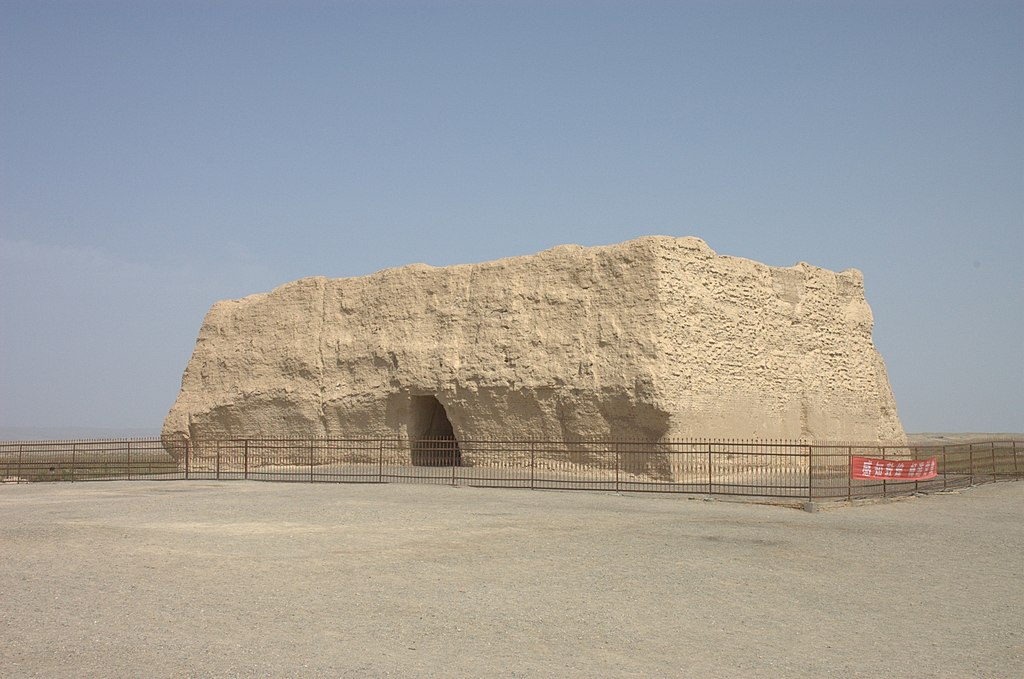
Ruins from the Yumen Pass, photo courtesy of 张骐, CC BY-SA 3.0, via Wikimedia Commons
By the time Xuan-zang reached the Yumen Pass (Yùmén Guān 玉门关) at the western end of Great Tang, he had attracted some unwanted scrutiny by authorities, and wasn’t permitted to leave. By this point, his companions had lost their nerve, but Xuan-zang was determined to continue. With some help from a sympathizer, Xuan-zang defied imperial orders and snuck around the Yumen Pass to leave China. He was now a criminal, and he was alone with a vast desert ahead of him.
June 4th is the yearly memorial service in Japan’s Tendai sect of Buddhism called Sangé-é (山家会) for its founder, Saichō (最澄, 767 – 822). I am writing this post a bit late this year, but I wanted to explore the life of Saicho a little bit and why he matters.
Saicho as depicted in a Heian-Period painting.
If you look at the history of Japanese Buddhism, Saicho doesn’t elicit much historical attention and discussion, even compared to contemporary rivals at the time like Kūkai, founder of Shingon-sect Buddhism. Yet, the sect he founded in Japan was overwhelmingly the largest and most influential for centuries (probably too much so), until it finally faded into the background in the late medieval period. This is why you rarely see mention of Saicho or Tendai these days: it’s far smaller now than it was in the past.
Also, to confuse matters further, Saicho is only the founder of the Japanese branch of Tendai. It was the Buddhist monk Zhi-yi (智顗, 538 – 597), who originally started the Tian-tai (天台) sect in China in the 7th century and it remains a very influential sect across many areas of mainland-Buddhist Asia (Korea, Vietnam, etc). Tian-tai in Japan (pronounced as Tendai) reveres Zhiyi as well.
Anyhow, Saicho was a monk at a time when Buddhism had already been established in Japan, primarily around the old capitol of Nara, yet was limited to a very tightly regulated number of schools and monks per school. Besides the Yogacara (Hossō) and Huayan (Kegon) schools, the rest are very obscure today. These schools had all been imported from Tang-Dynasty China, and represent “branch” schools to the mother temples there. The existing schools at that time were obligated to perform rituals on behalf of the Emperor to prevent calamities, cure diseases, bring prosperity to the nation and other political needs. In turn, the government allocated new acolyte monks every year, and allowed them to continue. However, beyond that, Buddhism had very little reach in the rest of Japanese society. This is very different than the bottom-up approach in China.
Saicho was ordained as an official monk, but soon left and retreated to Mount Hiei where he underwent ascetic practices, rather than stay in the urban temple complexes. In time, he attracted other like-minded disciples, and a small, informal monastic community developed there on the mountain. Further, he carved an image of the Medicine Buddha, and later lit an oil lamp in reverence to the Buddha, praying that the light would never be extinguished. This lamp, the Fumetsu no Hōtō (不滅の法灯) was the subject of a previous post. By this point, the foundations of the temple of Enryakuji were laid.
Later, by a lucky coincidence, the capitol of Japan was moved away from Nara to Kyoto (back then Heian-kyō) in 795. Since Mount Hiei happened to be to the northeast of Kyoto, and since the northeast was considered an inauspicious direction in classic Chinese geomancy, the presence of a Buddhist temple there (namely Enryakuji) helped protect the new capital from negative influences. The Emperor, for his part, saw this new Buddhist sect has a counterbalance to the old guard sects in Nara. Thus, Saicho’s star quickly rose.
The Eastern Pagoda (Buddhist stupa), of Enryakuji Temple, 663highland, CC BY-SA 3.0, via Wikimedia Commons
Now with sponsorship from the new Imperial court, Saicho was dispatched to sail back to China in 804, gather more resources and help bring Buddhism to a wider audience. On the same diplomatic mission, another promising young monk named Kūkai was also dispatched. More on him later. Of the four ships that sailed out to sea, only 2 survived a storm at sea (Saicho and Kukai were each aboard one of the surviving ships).
Saicho’s had mixed success in China. He did not speak Chinese (he could only read it), but was able to get official permission from the Chinese government to travel to Mount Tiantai. There he stayed for 135 days. Saicho later received limited training in esoteric Buddhism, which was all the rage in Tang-Dynasty China (and Japan at this time). It wasn’t until the second generation of Tendai monks who went to China (Ennin for example) that esoteric training really developed in the Tendai sect in Japan. Saicho also copied many sutras and texts in order to provide fresh copies back in Japan (printing did not come until much later, despite flourishing in China).
Guoqing Temple (guó qīng sì, 国清寺) on Mount Tiantai, head of the Tiantai Order. Photo by Joshtinho, courtesy of Wikimedia Commons.
Nonetheless, when Saicho returned to Japan 8 months later, he was feted for his accomplishments. He got to work using his newfound training, and his collection of sutras brought back from China to petition the Emperor to start a new sect derived from the Chinese Tiantai Buddhism he trained under. Saicho’s vision was slightly different than Tiantai Buddhism, particularly because he envisioned a purely “Mahayana” sect, not just a sect with Mahayana Buddhism on top of earlier Buddhist tradition. This meant different ordination platforms, different training, etc. It was a big controversy at the time, and the powerful Yogacara (Hossō in Japanese) school based in Nara really gave him grief over it.2
In Dr Paul Groner’s book on Saicho, he explains Saicho’s vision further:
In his works directed against Tokuitsu and the Hossō [Yogacara] School, Saichō argued that all people had the Buddha-nature [capacity for Enlightenment] and could attain Buddhahood. Receiving the Fan wang [Bodhisattva precepts] ordination and adhering to the precepts were religious practices open to anyone. Anyone could receive a Fan wang ordination and anyone who had been correctly ordained could in turn confer the Fan wang precepts on others….
Saichō envisaged a system in which Tendai monks would be trained for twelve years on Mount Hiei and then go to live in the princes in order to perform good works, to preach, and to confer Fan wang ordinations.
Page 179
Further, Saicho really took the idea of unifying different Buddhist practices and traditions into an “umbrella tradition” to a new level. It wasn’t enough that the Lotus Sutra was the highest teaching (per Tiantai tradition), he wanted to really absorb other practices and traditions toward that end, and diffuse them across the country in a religious community that blurred the traditional lines between monks and laity.
Saicho’s zeal, his rising status in the new Imperial court at Kyoto, and his fresh training gave him a lot of leeway, and the Emperor granted his request. Thus, Tendai Buddhism (the Japanese branch of Tiantai) was born. It has a deep connection with the mother sect in China, but Saicho also added some innovations to it as well.
Saicho’s star was soon eclipsed after the other monk from the same diplomatic mission, Kūkai, who returned some time later and brought an extensive training program in esoteric Buddhism (something Saicho had only a partial training of). Because esoteric Buddhism was all the rage (until the Purge of 845), Kukai’s training and religious material he imported outshone Saicho. Kukai and Saicho tried to maintain a cordial relationship, but Saicho wasn’t willing to train under Kukai, and Kukai kept poaching disciples of Saicho’s so the two groups became somewhat acrimonious over time.
Saicho proved throughout his life that he was dedicated to the Lotus Sutra and the Buddhist path. He was a sincere ascetic in his youth, rather than a “career monk” like many others of his time, and held himself to high standards. The fact that attracted like-minded people around him, shows that he “walked the talk” too. In China, he underwent many trainings, copied many sutras, and didn’t stop learning and improving. It should be noted that Kukai and Saicho were both pioneers for journeying to China to bring back more Buddhist teachings, rather than past schools that relied on foreign monks to make the journey to remote Japan.
If Saicho had any virtue, it was zeal.
If Saicho had any fault, it was that he was perhaps stubborn.
Personally, I like Saicho, flaws and all. Like, I would have loved to sit with him on those early days on Mount Hiei, swap practice tips, get his advice, etc. I really like his enthusiasm and positivity. Much like Honen centuries later, Saicho was bold and motivated by sincere conviction. The Tendai sect morphed into something that I don’t think he anticipated but personally I blame politics more than the founder.
But anyway, this is all just my opinion.
As for me, I did an extra long home service for Saicho this week in his honor.
1 Devout Buddhists in early Japanese history, such as Prince Shotoku, were devotees of the Lotus Sutra as well, but I don’t think there was any effort in those days to elevate it to the highest teachings, let alone make a new sect out of it. It was just there as part of the larger tradition.
2 Acrimony between Tendai and Hosso schools of Buddhism continued for centuries, starting with Saicho’s disagreements with one Tokuitsu of Hossō. Both sects frequently faced off during official Buddhist debates at the Imperial court as well.
In my recent free time last month, I caught up on an old DVD video tour of Buddhist temples in Japan that my in-laws had given me years back. I also discovered that I could turn on the subtitles, which helped a ton as the Japanese is kind of difficult for me, but the content is very interesting. 😋
One interesting thing I noticed is that a surprising number of temples in Japan, especially older ones, could somehow tie themselves back to a certain Buddhist monk posthumously named Jikaku Daishi (慈覚大師). He is better known in English by his ordination name Ennin.
Ennin (円仁, 794?-864) was one of several, talented monks that were crucial to the early rise and foundation of Tendai Buddhist order in Japan. Tendai in Japan, a branch of the venerable Tiantai Buddhist school in China,1 was founded by the monk Saicho in the year 806 after spending some time training in China.
However, the early Tendai sect ran into some problems namely due to gaps in training and teachings, especially with esoteric Buddhism. Saicho had spent about one year in China, which was unusually short, and during that time had undergone training in disparate aspects of Tiantai Buddhism. On the other hand, the rival Shingon sect founded by Kukai (who also had stayed for one year) had been singularly focused on esoteric training, and brought back a complete set of training in the Womb Realm and Diamond Realm mandalas imported from India. Saicho unfortunately didn’t and this led to some tension between the sects. Kukai did not want to lend esoteric documents to Saicho and his disciples unless they formally trained under him, and Saicho became worried about losing disciples to the Shingon sect (some indeed were poached). While the two were still alive, this tension was not resolved.
After Saicho, early Tendai leaders decided the best way to solve this issue was to go back to China and gain deeper training themselves. This is not as easy as it sounds:
China had a strict policy of allowing only certain ships from Japan (the kentōshi 遣唐使), on a set schedule. Just getting on one of these voyages was no small matter.
Japanese ship technology was poor, and a storm could easily sink a fleet of ships. In Saicho/Kukai’s trip, they lost 2 out of 4 ships to a storm.
Once in China, the monk in question had to learn Chinese and communicate. The two languages are very different, so this is not an easy thing to accomplish.
Finally, such a monk required official permission from the Chinese-Imperial bureaucracy to train at such-and-such temple.
Once all that was complete, the monk in question would start the actual training which could take years.
Monks were then required to then leave China at a certain time, and hopefully the next diplomatic ship from Japan would arrive, and than safely return.
Finally, the monk, now safely in Japan, had to submit an official petition to the Japanese Imperial Court to return to the capitol, detailing his accomplishments, and cataloging anything he brought back. Until then, he’d be stuck in some rural port town waiting a response, which usually wasn’t very quick.
Needless to say, Ennin managed to accomplish all this, just as Kukai and Saicho had done previously by journeying to Tang-Dynasty China in 838. Unlike Saicho and Kukai, Ennin stayed in China much longer (as expected) and was only booted out of China in 847 due to a catastrophic anti-Buddhist purge at the time.
When Ennin came back to Japan, he brought back several noteworthy things:
Ennin brought back training in the five-tone nembutsu, a wide-spread practice in the Pure Land tradition in China.
Ennin completed the esoteric training Womb Realm and Diamond Realm mandalas, just as Kukai had done, but also brought back a third esoteric training regime in the Susiddhikara Sūtra tantra.2 This helped formalize the Tendai version of esoteric Buddhism called taimitsu (台密), along with efforts by rival disciple Enchin who also traveled to China.
Ennin also wrote a lengthy account of his travels from day one in China. This journal, the Nittō Guhō Junrei Kōki (入唐求法巡礼行記, “The Record of a Pilgrimage to China in Search of the [Buddhist] Law”) has been a fascinating and valuable source of life in the Tang-Dynasty from a foreigner’s point of view.
Once back in Japan, Ennin eventually succeeded in becoming the 3rd zasu (座主) or head of the Tendai Order. He proved to be an active administrator, both in expanding and improving the training on Mount Hiei, but also in founding other temples in the provinces such as Yamadera (which was featured on my dvd tour). However, tensions between him and Enchin simmered for generations and eventually erupted in to a full-blown violent schism between their descendant lineages.
Nevertheless, Ennin’s contributions to both esoteric and Pure Land buddhist practices in Japan helped pave the way for many other great thinkers later, and many of the things followers take for granted today. 🙏🏼
P.S. I finished a draft of this post before the war in Ukraine, so I felt it was time to publishing rather than leave it languishing. However, since the war started I haven’t had much motivation to work on personal projects and such, so the blog might be a little quiet for a bit. We’ll see.
1 same Chinese characters (天台), different pronunciation
2 there was no information at all in English wikipedia on this sutra, so the linked article above was written by me, warts and all. ;p
Greetings readers! I have had a bit of extra time this week due to much-needed time off from work, and have been going through old projects, half-finished blog posts and such. One project I found today, which I decided to finish, was post a romaji (Romanized Japanese) version of the Tendai Buddhist home liturgy for anyone who needs it.
The Tendai sect in Japan has a nice homepage (Google Translated page), but almost nothing in English for doing the home service. Tendai information in English is pretty scattered (though there are some great websites),1 so I decided to go back to the source, and just translate it directly using romaji (romanized Japanese) for easy pronunciation.
Some quick notes:
I chose the shortest, simplest elements of the service, based on Tendai’s recommendation in the link above, and also through the book うちのお寺は天台宗 (双葉文庫) which I picked up some years ago. There’s a more extended version of the home service, but both the book and website explain that the essentials are the following elements that I am posting below.
Where possible, I chose to use the Sino-Japanese pronunciation. The website above lists both, and either option is fine (obviously English is fine too). The Sino-Japanese version, in my opinion, is the easiest to pronounce and chant, and ties back to the larger Buddhist tradition, so that’s my personal preference. The YouTube videos on the Tendai site sometimes provide an alternate native, liturgical Japanese version, and it’s perfectly fine to use this too.
Finally, traditions and liturgical styles vary, so don’t be surprised if another Tendai community does it differently. If in doubt, just do it like your local community does.
The webpage also lists some tips (roughly translated below):
First, before you begin, double-check the offerings at your home altar make sure everything is in order: flowers, water, a candle,2 and any other offerings you wanted to make.
Before the service, take a moment to freshen up, rinse your mouth and hands with water, etc. That way, you can sit before the altar in a more purified state.
Drape any rosary you have over your left hand, and if you are holding a sutra book, lift it up gently and bow ever so slightly.3
When you do gassho, put your hands together in front of your chest at a natural angle (45 degrees is common based on personal experience).
When chanting, use a mild, even chanting voice, enunciating each word equally. (If you feel like you don’t chant as well as the video links, don’t feel bad: these are professional monks chanting.)
If you have a bell, there are certain times to ring it: twice at the beginning, once after reading each part, and three times at the end. (I’ve added prompts to the liturgy below.)
When done, close the Buddhist altar (if possible), and place the sutra book back on its stand.
Lastly, the book in particular mentions that any Buddhist sutra is OK to recite. The most common one is obviously the Heart Sutra, but any other Buddhist sutra, or an excerpt of a sutra, is fine too. Find what you like, and feel free to recite that.
Minimal Tendai Buddhist Home Liturgy
The service provided below is given as an example home service, but my book on Tendai Buddhism also states that among these different bits of liturgy, you can add or reduce as many as you see fit. Even if you only recite one bit of liturgy per day, that’s enough. The important thing is to make it sustainable. You can always adjust later if it’s too simple or too difficult.
Sanrai: Gratitude Toward the Three Treasures
(ring twice)
Ish-shin cho rai jip-po ho kai jo ju san bo
(repeat 3 times, ring once)
“I reverently praise the Buddha, Dharma and Sangha, which permeate the cosmos”
Thanks everyone and I hope you find it useful. I will likely post updates and corrections as time goes on.
Namu amida butsu Namu kanzeon bosatsu
1 There are, from what I can see from a cursory search, a number of Tendai communities in both the US and the UK. If you’d like to know more, I encourage you to contact such communities. I have no affiliation with any of these groups, however. I am just DIY.
2 Japan also sells LED Buddhist altar candles. Halloween goods also offer LED candles. Great for avoiding fire hazards.
3 This custom is also found in other Japanese-Buddhist sects as a gesture of humility.
I am not an old man yet. However, I am that point in my life where I am looking ahead and I have decided that rather than just indulging myself in my twilight years, I would focus on doing some good in the world instead. This quote from Roger Zelanzny’s novel Isle of the Dead is particularly inspiring to me:
Earth-son, I greet you by the twenty-seven Names that still remain, praying the while that you have cast more jewels into the darkness and given them to glow with the colors of life.
As Saicho, the Buddhist monk, famously said: ichigū wo terasu (一隅を照らす, “light one corner of the world”). Our thoughts and actions do matter towards others. A self-indulgent existence helps no one, and provides no value to the world, but on the other hand, a life devoted to others provides incalculable value for generations.
For my part, I would like to continue casting little jewels into the void as long as I can still raise an arm.
Something cool I wanted to share with readers: the Japanese Buddhist temple of Enryakuji (mentioned in a previous post) on Mount Hiei has a 24-hour livestream video of a special oil lamp called the fumetsu no hōtō (不滅の法灯) which means something like the “eternal Dharma lamp” :
According to tradition, this small oil lamp has been burning for 1,200 years1 and symbolizes the founder, Saicho’s, famous quote:
一隅を照らす 此れ則ち国宝なり Ichigū o terasu kore sunawachi kokuhōnari
Roughly translated, this means something like “light one corner of the world; in so doing one becomes a national treasure”.
I am told by a reliable source that one can use this livestream as an object of meditation if one is inclined to do so. Even if one does not wish to meditate, this flame is a nice reminder that even in dark times, the light of the Dharma still shines.
Mandarava blossoms rain down, scattering over the Buddha and the great assembly. My pure land is not destroyed, yet the multitude see it as consumed in fire, with anxiety, fear and other sufferings filling it everywhere. These living beings with their various offenses, through causes arising from their evil actions, spend asamkhya kalpas2 without hearing the name of the Three Treasures. But those who practice meritorious ways, who are gentle, peaceful, honest and upright, all of them will see me here in person, preaching the Law [the Dharma].
So, take heart even in these crazy times, and consider the flame in us all. 🖖🙏🏼
1 Technically, the lamp has been extinguished once during the Siege of Mount Hiei in 1571, when the entire monastery was razed to the ground.
2 The term asaṃkhyeya in Sanskrit literally means 10140 but as a literary device means “vast” or “huge” or in modern English, a “metric fuckton”. The term kalpa is a term meaning an aeon.




 Gleanings in Buddha-Fields


You must be logged in to post a comment.