The Goma Fire Ritual

My family and I visit a certain Shingon-sect Buddhist temple in the area for New Years tradition, and also for Setsubun rituals (namely mamemaki bean-throwing, plus good luck). Neither my wife nor I follow the Shingon sect, but Japanese-buddhist temples for the Japanese community (not Westerners) are rare, so we are glad to visit despite the lengthy drive.

Shingon Buddhism, one of two “esoteric” (mikkyō, 密教) Buddhist traditions in Japan,1 relies on a complex array of ceremonies, rituals, symbolism, and mantra chants that help awaken one’s Buddha-nature not through words, but through a kind of non-verbal impact. This requires a trained teacher to guide one through it, hence it’s called “esoteric” Buddhism (a.k.a. Vajrayana Buddhism). Years ago, I attended a “moon meditation” sitting once where each one of us sat and meditated before a hanging scroll showing a full moon. It was an interesting experience.

Anyhow, one ceremony that’s very common in Shingon is called the Goma-taki (護摩炊き) ritual, or “fire ceremony”. This is often called Goma in English. This is a video provided by Koyasan Temple in Japan which shows a complete ceremony: a priest creates a pyre within a sacred space, often before a statue of Fudo-myo-o (不動明王). Throughout the ceremony, the priest recites certain chants and uses certain hand-gestures. The fire is thought to purify one’s mental defilements, burn away past karma too, and also certain sticks are added to the fire with people’s aspirations and wishes written on them.

At our temple here locally, the priest conducts the Goma ritual as well, and people receive blessings from the ceremony one by one, and we also receive small o-fuda talisman that we place next to our Buddhist altar at home for protection. These are larger than omamori charms, made of wood or cardboard, and usually enshrined, not carried on your person.

The origins of the Goma-taki ritual are taken from Indian religious practices of the past, but gradually underwent “Buddhification” (absorbing practices, and making them Buddhist) and this is why, I believe, that esoteric Buddhism arose in later generations of Buddhism in India.2 The deities portrayed in esoteric Buddhism also have origins in India, but transformed as they were brought through China to Japan.

Goma-taki rituals are frequently held for the public in larger Japanese temples, so you can easily drop and just observe, but be aware they can take up to an hour or more. But it is a pretty interesting experience and well worth observing.

Namu Daishi Henjo Kongo
(Praise to the Great Teacher Vairocana Vajra, a.k.a. Kukai / Kobo Daishi)3

1 the other is Tendai Buddhism, which calls it taimitsu (台密), not mikkyo. What are the differences? Not sure. Both lineages come from the same Chinese-Buddhist tradition of the time, but beyond that, no idea.

2 Seen from one perspective, the earliest texts and traditions in Buddhism did not feature any esoteric practices and rituals, so if you’re looking for “pristine” Buddhism then esoteric practices don’t fit this. From another point of view, Buddhism continued to innovate across generations, first Mahayana Buddhism, then esoteric practices, so in that light esoteric Buddhism solves problems of practice and teaching that earlier Buddhism struggled with. I don’t know which viewpoint is the right one, personally. I am a big proponent of easy, accessible Buddhist teachings and practices (hence the nembutsu, precepts, etc), and esoteric Buddhism doesn’t make this easy. And yet, it is surprisingly popular in Japan (2nd only to Pure Land Buddhism), so maybe there’s something there that I’ve failed to notice all this time? 🤷🏼‍♂️

3 This is often recited in Shingon tradition the way namu amida butsu is recited in Pure Land traditions in Japan.


The Onmyoji of the Heian Period

The Heian Period of Japanese history is a really fascinating period, both culturally and historically to me. I even made a whole side-blog devoted to it (15th anniversary this week!). When you read books like the Diary of Lady Murasaki or the Pillow Book, there are a lot of cultural allusions that are hard to translate into English, or even contemporary Japanese culture, and that includes the role of professional diviners called the Onmyōji (陰陽師).

The Onmyoji were not mere soothsayers, but were trained to read various signs and calculations, and compile calendars for the coming year to determine the movements of the gods, moon, stars, etc. This was then used by the aristocracy to make decisions, where to travel and so on.

Much of these calculations were based on practices imported from China: the Five Elements Theory, Yin-Yang philosophy, geomancy,1 and so on. When we think of elements: we think of earth, wind, fire and water,2 but in Chinese philosophy it was earth, wood, metal, fire and water. In the traditional calendar used today across Asia, these philosophies are still preserved. For example, this year (2026) is the yang-fire-horse: (丙午, hi-no-e-uma in Japanese)

The Crest of the famous Onmyoji, Abe no Seimei. The five points alluded to the Five Elements. Courtesy of Wikipedia.

But let’s look at a concrete example.

Onmyoji often calculated inauspicious directions of travel. The idea was that a certain Taoist god named Ten-ichi-ji (天一神) would wander in various cardinal directions. If you traveled in the direction that Ten-ichi-ji was dwelling on that particular day, you would suffer the wrath of that god and be cursed. Therefore, people had to avoid traveling certain directions on certain days. This would lead to convoluted efforts to reach your destination from another direction, a practice called katatagae (方違え). People would travel the night before (before it became inauspicious), or travel in a roundabout direction to get there.

In the Pillow Book, Sei Shonagon discusses the hassles of inauspicious directions:

[154] When Her Majesty [Empress Teishi] was in mourning for the previous Regent, she was required to leave the palace at the time of the Great Purification at the end of the sixth month. However, the Office of the Empress’s Household happened to be in a forbidden direction at the time, so she moved instead to the Aitadokoro [residence], which belonged to the Council of State.

Our first night there was hot and extraordinarily dark, and we spent it feeling cramped and rather anxious as we waited for the dawn.

Another example were abstinence days. Onmyoji calculated days that were highly inauspicious, called monoimi (物忌み), which required people to undergo a day of abstinence. People who were stuck at home on an abstinence days had to avoid anything impure: sex, travel, talking too loud, important work, certain foods, etc. They even had to wear special talisman in their hair or hat.

In the Pillow Book, Sei Shonagon recalls an incident with her lover Yukinari:3

[129] One evening, Secretary Controller Yukinari visited the Office of the Empress’s Household, and stayed talking far into the night. He finally left as dawn was approaching, remarking that he must return by the Hour of the Ox since he was obliged to stay at the palace all day owing to an Imperial abstinence.

Translation by Meredith McKinney

By the way, the passage above also contains Sei Shonagon’s famous poem which was later used in the Hyakunin Isshu (poem 62).

Further, she remarks how annoying abstinence days were:

[22] …. You’ve taken special care to send off a beautiful, carefully written letter, and you’re eagerly awaiting the reply — time passes, it seems awfully long in coming, and then finally your own elegantly folded or knotted letter is brought back, now horribly soiled and crumpled and with no signs reminaing of the brush stroke that sealed it. “There was no one in”, you’re told, or “They couldn’t accept it on account of an abstinence”. This is dreadfully dispiriting.

Onmyoji didn’t just make calendars, they also performed various purification rituals, and exorcisms that Buddhist or Shinto priests would not do. In the Diary of Lady Murasaki, the eponymous author4 writes about the commotion and rituals the Onmyoji would use to protect Empress Shoshi WHILE SHE WAS IN LABOR:

At the moment of birth what awful wails of anguish came from the evil spirits! Preceptor Shin’yo had been assigned to Gen no Kurõdo, a priest called Myoso to Hye no Kurõdo, and the Master of Discipline from the Hojüji to Ukon no Kurodo. Miya no Naishi’s enclosure was being overseen by Preceptor Chisan; he was thrown to the ground by the spirits and was in such distress that Preceptor Nengaku had to come to his aid with loud spells. Not that his powers were on the wane, it was just that the evil proved so very persistent. The priest Eiko, brought in to help Lady Saisho’s exorcist, became hoarse from shouting spells all night.

This mixture of Buddhist monks (trained in esoteric Buddhism) pairing with exorcists and mediums (Onmyoji) loud in yelling and chanting during a woman’s birth feels weird by today’s standards, but Shoshi’s father, the regent Fujiwara no Michinaga had everything riding on his daughter safely giving birth to a male who could inherit the Imperial Throne, so he spared no expense. Lucky for him, it worked.

Onmyoji gradually lost influence during later centuries of Japanese history, but never quite faded altogether. Technically, they were banned in the early-modern Meiji Period, but gradually reformed as a particular sect of Shinto to this day.

Title art for the anime Onmyoji on Netflix. I’ve watched a few episodes so far.

Next time, we’ll talk about a certain legendary Onmyoji named Abe no Seimei (shown above), who is a popular subject of Japanese movies, anime, manga, etc.

1 Geomancy (lit. “earth divination”) in Chinese culture today can be seen in practices like Feng Shui, the Ba Gua and so on. My wife is Japanese, not Chinese, but she does take an active interest in Feng Shui (called fūsui in Japanese). I am more ambivalent, but in spite of my “logical mind”, I am curious.

2 Or just Earth, Wind and Fire. 😁

3 See poem 62 of the Hyakunin Isshu.

4 See poem 57 of the Hyakunin Isshu.

Liberals and Conservatives: Ancient Japanese Style

Long, long ago, I wrote about the struggles in the Late Roman Republic between its version of progressives versus conservatives. The Roman Republic did not have political parties as we would know them, but the factions and disagreements on how to solve changing political issues did exist in its Senate, much as happens in the modern world.

But that’s not something limited to ancient Rome.

In the late 6th century CE Japan was still limited to a small kingdom called Yamato (大和) which had conquered most of its rival kingdoms. At this time, the ruler of Yamato was still little more than a “chieftain” of the largest territory called an ō-kimi (大君) meaning “big king”, not even emperor (tennō, 天皇) as they are called now. Further, the authority of the king depended on powerful clans who had strong influence on the government.

For example, during Emperor Yōmei’s short and problematic reign there rose a power struggle between two opposing factions, the Soga (蘇我) clan, and the Mononobe (物部), and during the interregnum after he died. One one side of the struggle was a reform faaction that wanted to modernize the government based on the based on Sui-Dynasty Chinese government models, away from the older, clan-based kingship. This faction included:

If the Soga were a progressive, reform faction wanting to modernize the country using the latest imported culture from China, the Mononobe were the exact opposite. The Mononobe Clan was a conservative, traditional clan that distrusted the new imported Chinese culture, and especially the foreign-imported religion of Buddhism. They supported the more native Shinto traditions, and were on the more xenophobic side of the political spectrum. Their current head, Mononobe no Moriya, actively skirmished with Soga no Umako during Yomei’s reign.

According to a historical text from the time, the Nihon Shoki (also discussed here and here), these conflicts came to a head in the year 587 after Emperor died, and a successor had to be chosen. In Japanese this is called the Teibi Conflict (teibi no ran, 丁未の乱) of 587. The Soga Clan and Prince Shotoku supported one successor, the Mononobe, the other. During the battle for succession, Mononobe no Moriya attacked Buddhist temples, and burned some of the images (often imported from the Korean kingdom of Baekje).

Finally, the battle came to a head at Mount Shigi (shigisan, 信貴山) in July of 587. The Soga lost multiple engagements at first and retreated. Then, according to tradition, Prince Shotoku, who was related to the Imperial family, fashioned a sacred branch of sumac, prayed to the Four Heavenly Kings (四天王) of Buddhism,1 promising to build a temple if they could help him trounce the Mononobe.

The subsequent battle was a complete rout for the Mononobe clan, and their leader Moriya was shot with an arrow. The rest was history: Shitenno-ji Temple, one of the oldest in Japan.

Under the reign of Empress Suiko, one of the few, powerful female monarchs in Japanese history,2 Japan further prospered under the triad of Suiko, Soga no Umako and Prince Shotoku, her advisors. Prince Shotoku in particular was said to have introduced:

  • Japan’s first ever Buddhist-influenced constitution: the Seventeen-article Constitution (jūshichijō kenpō, 十七条憲法 ). It’s not a modern, legal document, but it was meant to provide a spiritual framework for governing the country.3
  • Reorganized the bureaucracy into a meritocratic system based on the Chinese model, the Twelve Level Cap and Rank System (kan’i jūnikai, 冠位十二階).
  • The first use of the title “Emperor” (tennō, 天皇), when Prince Shotoku addressed the Emperor of China from the “Emperor” of Japan. This was a bit of a diplomatic coup by placing Japan as a co-equal to Imperial China.

What I always find interesting about this period of Japanese history was the overtly progressive nature and forward-thinking of the government at the time, not to mention a powerful female sovereign, and how it triumphed over conservative, xenophobic thinking. Of course, by today’s standards, it doesn’t seem that progressive, and some of these reforms eventually petered out,4 or were abandoned for various reasons, but some aspects persisted up until modern times. It is also the subject of various manga over the years.

But also, what I really like about this period is that the old order wasn’t totally destroyed either. The two sides eventually just learned to co-exist for many generations (e.g. the Nara and Heian periods of Japanese history). It wasn’t a smooth transition, but the forces of history marched on nonetheless.

P.S. Fun fact, one of the supporters of the conservative Mononobe faction was a small clan called the Nakatomi. Later, the Nakatomi would become the Fujiwara, and would eventually dominate political life in Japan. History is weird.

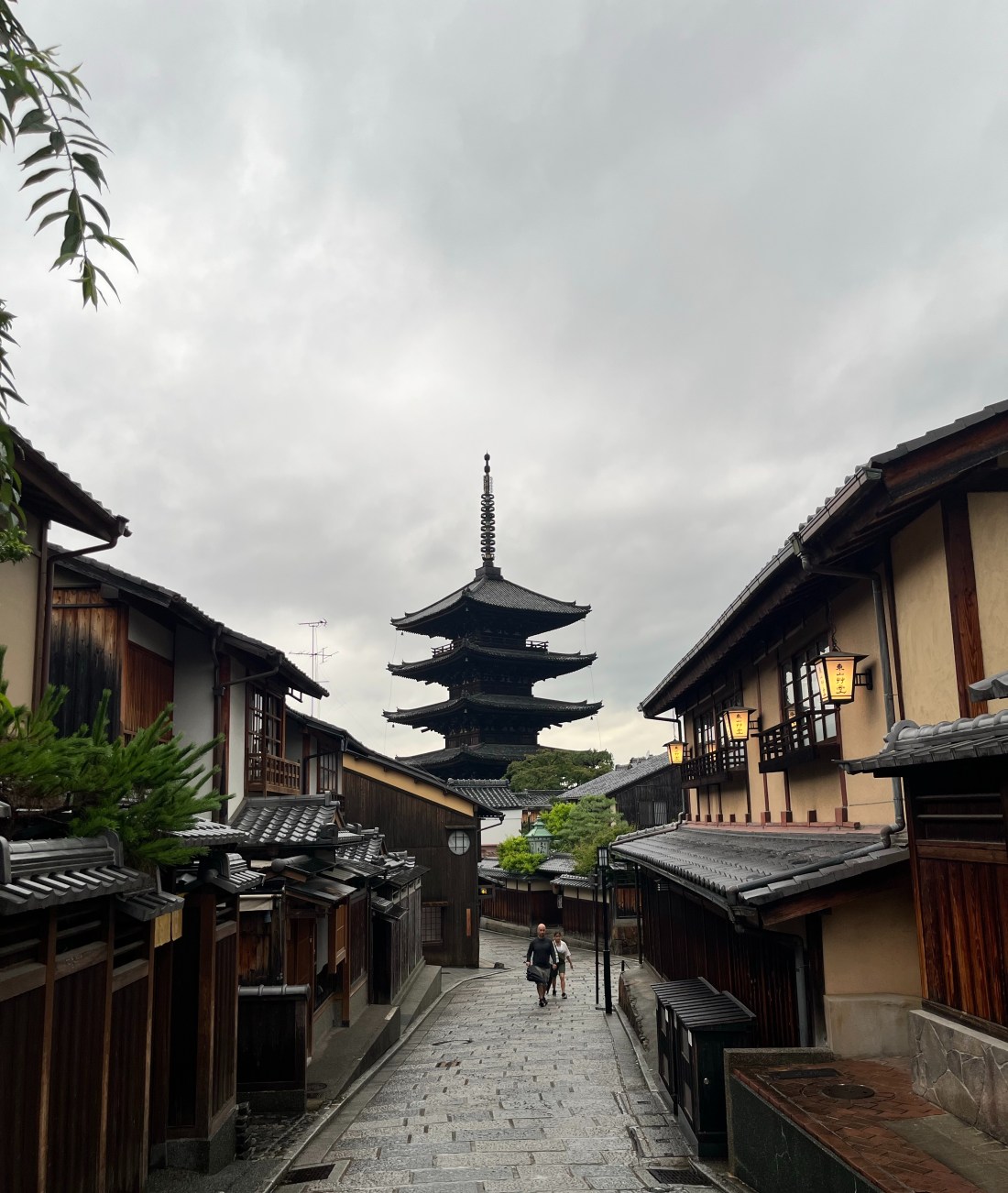
P.P.S. Featured photo is one of many pagodas (Buddhist stupa) promulgated by Shotoku, this one in Kyoto.

1 In Sanskrit, these were the Caturmahārājakayikas or Caturmahārāja. For example, if you visit Todaiji, you see some of the Four Guardian Kings around the giant statue of the Buddha, plus many other, older temples. I liked their adaptation in Roger Zelazny’s “Lord of Light” as well.

2 There were other Empresses who reigned as well, some powerful, but many remained as temporary regents until someone else could assume the throne.

3 The modern constitution of Japan adopted in 1947, at the instigation of US Occupation Forces, is ironically significantly more progressive and modern than the US Constitution. To be fair, they were written almost 200 years apart, but the Japanese Constitution explicitly grants suffrage to women and abolishes slavery. Even now, with its amendments, the US Constitution grants neither. In college, I met the lady (a US army secretary at the time) who helped write the clause on women’s suffrage. She was a very fascinating person, though she’s probably passed away by now.

4 Many generations later, this was still largely true: powerful clans ruled many parts of Japan outside the capital, gradually evolving into a feudal system over the centuries, until the Meiji Restoration of 1868,

Teaching the Dharma

This is a passage from the lesser-known tenth chapter of the Lotus Sutra, but it’s something I think about from time to time:

… if you wish to expound this sūtra
Enter the room of the Tathāgata,
Wear the robe of the Tathāgata,
Sit on the seat of the Tathāgata,
[And after doing these three things,]
Expound it to people without fear!

To enter the room of the Tathāgata means to have great compassion.

To wear his robe means to be gentle and patient.

To sit on his seat means to see the voidness of all things.

Expound the Dharma only after you do these [three] things!

Translation by Rev. Senchu Murano

The Lotus Sutra is interesting because it talks about itself a lot, but when the Lotus Sutra talks about the Lotus Sutra, it’s not necessarily talking about the literal text on the page. The text hints at a deeper, ineffable teaching that only becomes clear as one progresses through the Buddhist path. So, I believe, that there’s the “literal” Lotus Sutra on the page, and the deeper meaning behind it.

Anyhow, what really matters here is that the Buddha, Shakyamuni, is giving advice on how to properly teach the Dharma. I know that some readers have a background in teaching, or therapy, or other similar fields, so this probably applies some readers more than others. But the sixteenth chapter of the Lotus Sutra and its countless “Bodhisattvas of the Earth” strongly hints that anyone can be a teacher, and anyone can uphold the Lotus Sutra. You just have to believe in yourself and follow the Buddha’s advice.

This is important as a bad teacher, someone charismatic but drowning in their own ego, can really damage a community and the reputation of the Buddha-Dharma. If you decide to take on the role of a teacher,1 it’s super important that you understand the responsibility. Hence, the Buddha’s advice:

  • Goodwill towards all beings, which includes upholding your own personal conduct.
  • Patience towards all beings, because everyone starts from somewhere.
  • Appreciating the emptiness of it all: any fame, fortune (or babes), or power you get from being a teacher are temporary and futile anyway. You will still grow old, sick and die, so it is not a dignified pursuit.

On the other hand, one of the best things you can do to teach the Buddha-Dharma is to simply live it in your own life. Even if you don’t say a word, people will pick up on it, and in so doing, you’ll be following the Buddha’s advice anyway.

That, in my opinion, is a true Bodhisattva of the Earth.

Namu Shakamuni Butsu

1 I feel a pang of hypocrisy as I write this. I am not teacher, just a nerd, but I often like sharing things so I guess I am a teacher? I dunno. I have taught classes before in my old Buddhist temple, but only short, historical seminars, but even that feels like a big responsibility. I respect what real clergy do.

Plum Blossom Season 2026

It’s hard to believe but in some places Plum Blossom season is already here! My wife sent me this post from Dazaifu Tenmangu Shrine in western Japan showing the first blooms of the year:

This is a famous Shinto shrine (homepage here) that venerates the God of Learning, Tenjin (天神), better known in history as Sugawara no Michizane.1 I have visited Kitano Tenmangu Shrine in Kyoto, and Yushima Tenmangu Shrine in Tokyo, but Dazaifu is in western Japan where Michizane died in exile and not easily accessible for me, though my sister-in-law somehow got me a charm from there last year. I’ve always liked Tenjin/Michizane, so if I had to pick a Shinto deity, he gets my vote.

Plum blossoms, which imported from China (unlike native cherry blossoms), were trendy among the elite of Japanese society as far back as the Manyoshu anthology (7th century):

Original ManyoganaModern JapaneseRomanizationRough Translation1
和何則能尓  我が園にWaga sono niPerhaps
宇米能波奈知流梅の花散るUme no hana chiruthe plum blossoms will
比佐可多能ひさかたのHisakata noscatter in my garden
阿米欲里由吉能天より雪のAma yori yuki nolike falling snow
那何久流加母流れ来るかもNagarekuru kamofrom the gleaming heavens
1 Amateur translation, apologies for any mistakes

Later, because of Michizane’s devotion to his old plum tree while in exile, plum blossoms became associated with his deified form of Tenjin, and thus Tenmangu shrines typically have some on the sacred grounds.

My own tree2 blooms in early-to-mid February and I look forward to it every year.

I hope you all get a chance to see some plum blossoms in your area too!

1 Elevating historical figures to the status of kami is not that unusual in Shinto religion.

2 Mine are more typical Thundercloud Plum trees (Prunus cerasifera), common here in the US, while Japanese umé (梅) are a somewhat different variety (Prunus mume). But I am happy with what I have.

The Four Holy Verses of Chan and Zen Buddhism

Hello readers,

In late 2025, by chance, I found an interesting book at the local Japanese bookstore titled 眠れなくなるほど面白い図解禅の話, “An explanation of Zen so interesting you can’t sleep”, which provides a nice overview for Japanese readers about Zen. It covers a lot of little details like different sects, founders, historical bits, cultural stuff, and so on, that are hard to find in English publications.

Anyhow, the book talks about something I’ve never heard before called the Shiseiku (四聖句) which can be translated as “The Four Holy Verses [of Zen]”. This is a set of verses, imported from Chinese Chan Buddhism and attributed to Bodhidharma, and distill what Zen is all about:

Chinese /
Simplified1
PinyinSino-JapaneseEnglish2
不立文字 /
不立文字
bù lì wén zìfu ryū mon ji“Buddha-nature cannot be expressed in words.”
教外別傳 /
教外别传
jiào wài bié chuánkyō ge betsu den“The teachings of Buddha-nature exist outside scripture.”
直指人心 /
直指人心
zhí zhǐ rén xīnjiki shi nin shin“The heart of the Buddha’s teachings are transmitted directly, person to person.”
見性成佛 /
见性成佛
jiàn xìng chéng fóken shō jō butsu“A person who sees their own true nature is a buddha.”
1 Rough translation by me, apologies for any mistakes

Let’s break these down.

The gist is that the deeper teachings of Buddhism cannot be expressed in words, but must be experienced first-hand. This is not an exclusive concept to Zen, by the way. Take a look at an early sutra of the Buddhist tradition:

“This Dhamma that I have attained is deep, hard to see, hard to realize, peaceful, refined, beyond the scope of conjecture, subtle, to-be-experienced by the wise.

The Ayacana Sutta (SN 6.1), translation by Ven. Thanissaro Bhikkhu

… among other places:

36. “When a monk’s mind is thus freed, O monks, neither the gods with Indra, nor the gods with Brahma, nor the gods with the Lord of Creatures (Pajaapati), when searching will find on what the consciousness of one thus gone (tathaagata) is based. Why is that? One who has thus gone is no longer traceable here and now, so I say.

The Alagaddupama Sutta (MN 22), translation by Nyanaponika Thera

Buddhism provides signposts, maps, or guides through the sutras, through Dharma talks (sermons), and such. However, sooner or later one has to apply the teachings themselves to fully grasp it. This includes one’s own “Buddha nature”: that capacity we have toward becoming buddhas ourselves.

Although Zen tends to have an anti-intellectual image, it’s important to understand that there is a genuine need for scriptural texts and references, especially as one starts out. The Buddha even warns us about making bad assumptions before fully grasping the Dharma, like trying to grasp a poisonous viper incorrectly.

But over the years, through practice this become less essential. Life is something to experience, to live, and to learn from. Even the really ugly shit. In the same way, imagine a pilot training to fly. Reading the manual isn’t enough; they must put in enough hours of “flight time” before they get a license.

But I digress.

The final verse (a buddha is one who sees their own nature) needs some extra explanation. What separates a buddha from a mundane human being is a degree of awakening, not supernatural powers. Or as Dogen Zenji explains in the Genjō Kōan:

To study the Buddha-Way is to study the Self. To study the Self is to forget the Self. To forget the Self is to be enlightened by all things. To be enlightened by all things is to drop off the body and mind of self and others.

In other words, through Buddhism, you see your own nature. By seeing your own nature, you drop the delusions and gain clear insight. By gaining clear insight, you awaken as a Buddha.

Easy? NO.

Possible? Yes.

Namu Shakamuni Butsu

1 For those unfamiliar, Chinese characters come in the traditional form and simplified form. The traditional form is what you mainly see outside of the People’s Republic of China. The simplified form is mostly used within the PRC. Interestingly, Japanese uses halfway solution: some characters are simplified, some are not. Anyhow, in most cases, the characters are the same, but you can probably spot a few differences.

2 This is my own translation. Apologies in advance for any mistakes.

The Pure Land and the Lotus Sutra

Years ago, I used to write down sutra verses I’d find (in English) into my little sutra book, but after a while I often forget what I wrote down. Recently I found this really fascinating verse from the twenty-third chapter of the Lotus Sutra, which I had apparently written down:

The woman who hears and keeps this chapter of the Previous Life of Medicine-King Bodhisattva will not be a woman in her next life. The woman who hears this sutra and acts according to the teachings of it in the later five hundred years after my extinction, will be able to be reborn, after her life in this world, [as a man sitting] on the jeweled seat in the lotus flower blooming in the World of Happiness [the Pure Land] where Amitāyus Buddha lives surrounded by great Bodhisattvas. He [no more she] will not be troubled by greed, anger, ignorance, arrogance, jealousy, or any other impurity. He will be able to obtain the supernatural powers of a Bodhisattva and the truth of birthlessness. When he obtains this truth, his eyes will be purified. With his purified eyes, he will be able to see seven billion and two hundred thousand million nayuta Buddhas or Tathāgatas, that is, as many Buddhas as there are sands in the river Ganges.

Transalation by Rev. Sencho Murano

There is a lot to unpack here.

In Indian culture, it was felt that birth as a women was disadvantageous. This was probably due to the realities of the time: patriarchal society, extreme risks of childbirth in a pre-modern society with medical technology, dowry customs, etc.1 So, the idea was that rather than being reborn again as a woman in the next life, the sutra promises that such a woman could be reborn as a man by being reborn in the Pure Land of Amitāyus Buddha.

Amitāyus Buddha is one of the names of Amida Buddha. It is also used in the Immeasurable Life Sutra, where one of the vows of Amida Buddha is the following:

(35) If, when I attain Buddhahood, women in the immeasurable and inconceivable Buddha-lands of the ten quarters who, having heard my Name, rejoice in faith, awaken aspiration for Enlightenment and wish to renounce womanhood, should after death be reborn again as women, may I not attain perfect Enlightenment.

Translation by Rev. Hisao Inagaki

Here, we see essentially the same thing: if a woman is weary of the challenges of womanhood, she can choose to be reborn as a man in the Pure Land of Amida (Amitāyus) Buddha in accordance with his vow. Should his vow fail, the Pure Land would not be. Since it does exist, the vow is certain.

You can read this in two ways, I think:

  1. This reaffirms a patriarchal attitude that woman are inferior, and therefore being a man is better on the Buddhist path, or
  2. Buddhism was realistic about the challenges of woman in a patriarchal society of the time, and therefore offered something not found in other religious paths.

I think it is up to the reader to decide. To be honest, in light of other aspects of the Lotus Sutra, such as the Parable of the Dragon Princess, or Shakyamuni’s prophecy of Buddhahood to his nun disciples, I am inclined to think that the latter interpretation is what the authors of the Lotus Sutra intended. The Lotus Sutra reads as something (relatively) progressive for the time.

Separately, it’s interesting that the Pure Land of Amida Buddha is even referenced in the Lotus Sutra at all, and both sutras use the same name, Amitāyus, not the more common Amitābha. Typically, Buddhism tends to treat the Lotus Sutra and the Pure Land as separate traditions. They overlap because they are both Mahayana-Buddhist traditions, but often people focus on one or the other.

Further, the Pure Land of Amida Buddha is not prominent in the Lotus Sutra. Instead, the “pure land” of Shakyamuni Buddha in chapter sixteen is the big reveal. So, Amida Buddha’s Pure Land is more like a backup singer in the band, or a spinoff character.

But, having had some exposure to Tendai-Buddhist thought, and seeing overlapping texts like these, I feel it’s clear that they were meant to be one tradition, not two. From the Lotus Sutra perspective, the Pure Land path is part of the larger progression toward Buddhahood. From the Pure Land perspective, Buddhahood is all but assured if you are reborn there because of the radiance and magnetism of Amida Buddha. So, it feels like they are two sides of the same coin in a way. If you add the Zen perspective of the Pure Land, things get even more interesting.

How one approaches all this is up to you. If nothing else, the Lotus Sutra shows that there are many gates, and many ways to approach the Buddhist path, but they are like rivers all feeding into the same ocean.

Namu Shakamuni Butsu
Namu Amida Butsu

P.S. Despite my “break” in December, I decided not to wait on this one. 😅

1 One could make the argument that even now in 21st century modern society, life as a woman is still not an easy one. But imagine life when you were expected to have many children, and the average childbirth had a 10% chance of killing you each time, so many women did not live past their 20s and 30s. Further, if your husband was a terrible person, you had little if any recourse.

Countdown to Bodhi Day

Buddhist holidays are few and far between, especially in overseas (non-Buddhist cultures), but since we raise our kids both through Japanese and American culture, I try to give them a unique, memorable tradition for the holidays. So, when the kids were young, I borrowed the Japanese-Buddhist holiday of Jodo-é (成道会) and adapted it for American Christmas culture. This holiday is better known in English as Bodhi Day and is observed on December 8th every year.1

Bodhi Day, sometimes incorrectly called Rōhatsu (臘八) in Zen-specific contexts,2 celebrates the awakening of Shakyamuni Buddha, the historical founder of Buddhism. It is the day where the Buddha is said to have meditated under the Bodhi Tree, saw his past lives laid out before him, resisted the temptations of Mara, and in the early morning broke through the wall of ignorance to see things as they were. By awakening thus, he is called a buddha (lit. “an awakened one”).

So, at the time, I took inspiration from our local Japanese-American temple (which had a great kid’s program), and made a “Bodhi Tree”: a miniature Christmas tree that a statue of the Buddha sits under. After that, I setup a small Buddhist-style shrine with an offering plate, water, bell, LED candle, etc. You can see an example above from years ago.

Also, to make it fun for the kids, I always give a gift on Bodhi Day, usually books they like. Such gifts don’t have to be Buddhist books, just something they would enjoy reading.3 Also, we usually have a fun family dinner together, and I usually read the story of the Buddha from an old Japanese-manga I found years ago. These celebrations are not strictly “Buddhist”, but it’s something festive and wholesome with the family, while celebrating the enlightenment of Shakyamuni Buddha,4 in a way that blends American traditions with Japanese ones.

Anyhow, Bodhi Day is 8 days away, so until then, hoping you all have a great week!

Namu Shakamuni Butsu

1 Many other Buddhist traditions still use the lunar calendar, so the dates will vary. I like using the Japanese version with the solar calendar because it’s easier to predict and blends into holiday season more easily.

2 The problem with the term Rohatsu 臘八 is that is refers only to the Zen practice of sesshin or dedicated meditation practice (i.e. a kind of austere retreat). This is obviously unsuitable for kids, and even in Japanese Zen, the holiday is called generally called Jōdō-é (成道会) among lay followers. So, calling it Rohatsu is misleading, and too narrow to be useful anyway.

3 When you are a kid, the last thing you want is religious books. So, I give fun books, comic books, etc.

4 The enlightenment story of Shakyamuni Buddha also serves as a template for other Buddhas and their enlightenment stories in Buddhist literature, too. See the preamble for the Larger Sutra of the Buddha of Immeasurable Life as an example.

IDIC, Redux

Imagine a star in the sky, any star. It is a great big ball of hydrogen gas (some helium too). Its own mass is so great that it compresses its core with tremendous heat and pressure until it ignites a nuclear fusion reaction.

Photo by Pixabay on Pexels.com

Through nuclear fusion (not fission as we use), hydrogen molecules fuse into helium, releasing energy each time. If the star is heavy enough it will eventually also fuse helium into things like carbon and oxygen. If the star is exceptionally big, it will fuse even heavier elements.

Such stars, when they reach the end of their lives, billions of years later, explode in dramatic fashion scattering all their fused elements into space. In a few more billion years, this material coalesces into another star, some planets, etc.

DELENN: We are all born as molecules in the hearts of a billion stars molecules that do not understand politics or policies or differences.

Over a billion years we foolish molecules forget who we are and where we came from.

In desperate acts of ego we give ourselves names, fight over lines on maps and pretend that our light is better than everyone else’s.

Babylon 5, “And All My Dreams, Torn Asunder” (s5:ep16)

Thus when you look at your own hands, or the cup of coffee you are drinking it is literally, and scientifically speaking, made from material that was fused in a nuclear reaction by stars that were destroyed many billions of years ago. This generation of stars is all but gone (the Universe is quite old), but we are their legacy. From ancient chemical processes, a near-infinite number of things have arisen. As the Vulcans in Star Trek would say: infinite diversity in infinite combinations (IDIC).

And yet, it’s easy to forget this.

We take our bodies for granted, as well as the things around us. We also assume they are permanent. A coffee cup is a coffee cup. Always will be. This gives rise to thoughts of “me” and “my things”. Survival becomes our primary motive. We are homo sapiens after all.

Evolution teaches us that we must fight that which is different in order to secure land, food, and mates for ourselves. But we must reach a point where the nobility of intellect asserts itself and says no. We need not be afraid of those who are different. We can embrace that difference and learn from it.

G’Kar, Babylon 5, “The Ragged Edge” (s5:e12)

But none of this is permanent. As the Buddha taught, we do not own anything. We don’t even truly own ourselves:

Rahula, any form whatsoever that is past, future, or present; internal or external; blatant or subtle; common or sublime; far or near: every form is to be seen as it actually is with right discernment as: ‘This is not mine. This is not my self. This is not what I am.'”

Mahā Rāhulovāda Sutta (MN 62) of the Pali Canon, translation by Thanissaro Bhikkhu

Thus, that cup of coffee isn’t really your cup of coffee. Your body isn’t really yours either. At most, you are borrowing that body (a gift from your parents, the universe, etc). That cup is in your care, but it will fall apart or go in the bin someday. Your children are in your care; you do not own them.

In time, like the stars that once forged the elements in your body, such things will be long, long gone. Dust in grand scheme of time.

P.S. Original IDIC post.

Above Reproach

Recently, while cleaning out old notes from my mobile phone, I found this quote from the massive Buddhist text, the Avatamsaka Sutra (a.k.a. “The Flower Garland Sutra”) which I apparently saved in 2022 (!). I cannot remember where in the sutra this quote comes from, but I probably meant to post about it sooner than later. So… three years later I am finally posting this quote:

The peaceful nature of the buddhas cannot be known

By the covetous or the malevolent,

Or by those shrouded in the darkness of delusion,

Of those whose minds are defiled by hypocrisy and conceit.

Translation by J.C. Cleary

As we’ve seen with the Yogacara school of Buddhism, what we think and do helps “color” the world we also perceive, and thus becomes a feedback loop. Thus, someone who is prone to lying assumes others lie too. Someone who is aggressive or domineering fears others will dominate him, and so on. This is the world they perceive because their minds harbor such thoughts. In the Pali Canon is a sutra wherein the usurper king Ajātasattu visits the Buddha for some spiritual advice. Later, the Buddha laments that due to Ajātasattu’s prior patricide, his spiritual progress will be limited at best.

Thus, the Flower Garland Sutra says that evil men cannot “see” the Buddha because their minds are too clouded by greed, anger and arrogance. Of course, they can physically see a statue or image, but they may learn little or nothing from it. They may as well be living on another planet. It does not resonate with them, and so they miss out on learning the Dharma. They will fall into evil rebirths, and may not gain another opportunity for generations, centuries, possibly longer.

Conversely, one who lives a clean life, and avoids harboring greed, anger, and arrogance will see the Buddhas. I don’t necessarily mean in terms of visions and such,1 but they will see the Buddha-Dharma everywhere (even in awful places and situations), and learn from it. From there, their perception will only continue to grow and mature, leading to greater wisdom.

This idea isn’t limited to the Flower Garland Sutra. The famous sixteenth chapter of the Lotus Sutra basically says the same thing: those who live upright see the Buddha and his Pure Land here and now.

So, take heart. If you strive to keep your “house in order”, and avoid harboring ill-will and such, you will not fail to see the Buddha someday.

Namu Shakamuni Butsu
Namu Amida Butsu
Namu Kanzeon Bosatsu

1 True story: in my 20’s, when my oldest daughter was a baby, and I was first exploring Pure Land Buddhism, I once had a really vivid dream, where I was offering armfuls of incense sticks at the feet of a statue of Kannon Bodhisattva. It’s the one and only time I’ve had a “Buddhist dream”, but I suppose it can happen to anyone.