Done With Dungeons and Dragons

Well, it was finally time.

I’ve been playing 5th edition Dungeons and Dragons since 2016 off and on, first with co-workers, then with friends and family. Later, I branched out into Adventurer’s League, and wrote some modules online for fun.1

But now, I can confidently say that I am thoroughly tired of the game.

My kids and I played weekly during the Pandemic and had some great adventures together, and when the Pandemic finally subsided I was eager to resume Adventurer’s League with the local community.

But then starting in 2024 something happened: the game just wasn’t as fun as it used to be. The 2024 revised rules made things briefly interesting again, but left me with a soulless, corporate aftertaste. But even the fun of revised and updated rules quickly lost its luster. The revised versions feel very polished, and fixed some issues, but also feel homogenized and bland, with no character left.2

Playing D&D started feeling increasingly rote. My kids increasingly lost interest, especially my oldest who had one foot out the door towards college, and I didn’t have the drive to start up another group elsewhere. The final straw was returning to Adventurer’s League after a hiatus of 2-3 years. Adventurer’s League now feels hollowed out and running on fumes after WoTC stopped investing in it in favor of their new organized play setting. My local community is much smaller than before, with most of the old-timers having left, leaving only the die-hard players whom (speaking from experience) are hard to get along with.

Even the local gaming store I used to frequent has become so successful, that it is too crowded, too hard to find parking, and overpriced. Compared to five years ago, it is not fun to go there anymore.

Amazing how much the Pandemic changed everything.

I did briefly look into Pathfinder but quickly got tired of the rules-heavy and math-heavy gameplay. Plus, if you are an occasional player, you are forever chasing after new rules, classes and modules or will simply get left behind. The remaster didn’t help matters, because if you want to keep up you have to buy three new books at $60+ each, just to avoid some legal hassles with naming of spells and rules. In short, I did not find Pathfinder worth further investment.3

In spite of all this nay-saying, my son loves D&D, and reads the 2024 books avidly (I will probably give him the books at some point), and even enjoyed the new Dungeons and Dragons movie, Honor Among Thieves (it is a pretty fun movie, tbh). So, I won’t discourage him. I have personally grown sick of D&D and have no desire to play it (or Pathfinder) anytime in the near future. For me, the spark is totally gone.

And yet, I am also realizing that the TTRPG world is a lot more vast than I first thought. I stumbled recently upon an RPG system called The One Ring: a gaming system designed entirely for J.R.R. Tolkien’s Lord of the Rings series. I picked up a couple of the core rule books, including a Dungeons and Dragons-compatible version, and am reading through them now. The community, while not large as Dungeons and Dragons, is large enough that I can find the support I need to questions and people seem to be passionate without being obnoxious. As a lifelong Tolkien fan, the amount of love and attention put into the books is really impressive, and heart-warming. I probably will write a review of the core rules once I finish reading through the book.

There are many other RPG systems as well, by smaller publishers, who are passionate about their craft, and if you look enough, chances are you’ll find a system that’s right for you. My son loves D&D 2024 edition, so I am happy to let him continue reading, exploring, and designing adventures. For someone who enjoys Pathfinder, I hope they continue playing and exploring. I guess the point of all this is that if you are tired of the more corporate gaming systems, try exploring other smaller RPG systems, and see what’s there. You may find a hidden gem you didn’t know about.

For me, I am done with both D&D and Pathfinder systems, and instead enjoy exploring the rules of The One Ring. Whether I can find a local community to play with (the perennial challenge of TTRPG) is another matter entirely….

P.S. Featured photo is my bookshelf of TTRPG books: a mix of D&D 5th edition, 2nd edition (which I fondly remember from my teen years), and some The One Ring books. Most of the newer 5th edition books were sold off already, but I am keeping some older ones that I enjoyed.

1 Writing modules is fun, and I made a bit of money here and there, but nothing even remotely enough to raise a family with. I make enough per month to buy a cup of coffee or two. I gradually stopped as the effort per module exceeded what I felt I got out of it. I still have a few in draft I may finish someday, but in light of this post, I will likely keep them in draft for the foreseeable future. Also, the 50% cut that WoTC takes from my module sales is frankly kind of egregious.

2 The 2024 books have truly fantastic artwork, though.

3 I kept the remastered Player Core book (book 1, since now they’ve printed multiple versions) in case I ever join a group, but I admit it’s pretty unlikely at this point.
A Nerd Dad’s Review of Remastered Pathfinder 2e

Edit: I wrote this post almost a year ago and my thoughts have changed somewhat in that time. While we did have a good time initially, especially with character creation, the biggest challenges with maintaining the Pathfinder campaign was a lack of coherent fantasy settings. Most of the research and prep I did as a DM was to pore over Wiki fan pages, which inevitably referred to modules I never bought (and weren’t interested in purchasing). There just wasn’t enough compelling lore, characters or story modules to get immersed in to replace classic D&D lore, plus they are scattered across so many books anyway that it was impossible to find anything. Plus the fatigue in keeping up with the constant stream of new classes, new ancestries, and so on. A TTRPG hobbyist has the time to keep up with this, but not a working parent who just wants to spend a weekend with the kids. Pathfinder 2e Remaster has good rules, and good design, but outside of this and the Beginner Box there is not enough support for more casual players especially those who have some nostalgia about classic TTRPG lore.

The debacle in January 2023 with the OGL license and Wizards of the Coast pushed a lot of people away from Dungeons and Dragons, towards other role-playing games, particularly Pathfinder 2nd edition. I reviewed PF2e here and here. Recently, I also picked up the new Remastered edition:

The Remastered edition is Paizo’s clean break from the OGL license and anything related to Dungeons and Dragons mechanics. Classic staples such as alignment, and ability scores, are simply gone, and with it some aspects of Pathfinder 2e have been streamlined. The old ability scores (0-18) are simply replaced with ability bonuses, starting at 0. This actually makes a lot of sense. The only thing we care about are the bonuses anyway, and the old numerical ability scores were more relevant in older versions of D&D where the number didn’t just dictate a bonus, but also dictated other factors (ability to be resurrected, chance of failure to cast a spell, avoid traps, etc).

Removing alignment also makes sense, since it’s been 40+ years, and still no one can agree on how to interpret alignment anyway. 😁 But it also removes some of the artificial guardrails placed on characters and allows greater diversity in motivations and personalities.

With the removal of alignment, this also affects religiously-inclined character classes such as clerics, and focuses on the particular anathemas and religious edicts of each deity. As with character motivation, this does breathe more life into each deity and religious characters path, but it’s also a bit of an adjustment for old-school players like myself.

Further, these changes also mean that some aspects of the Pathfinder character sheets have been streamlined. Previously, my kids character sheets were up to 6 pages long, but the newly designed sheets are 4 pages at most. This is on par with D&D 5th edition.

Finally, let’s talk about the book formats.

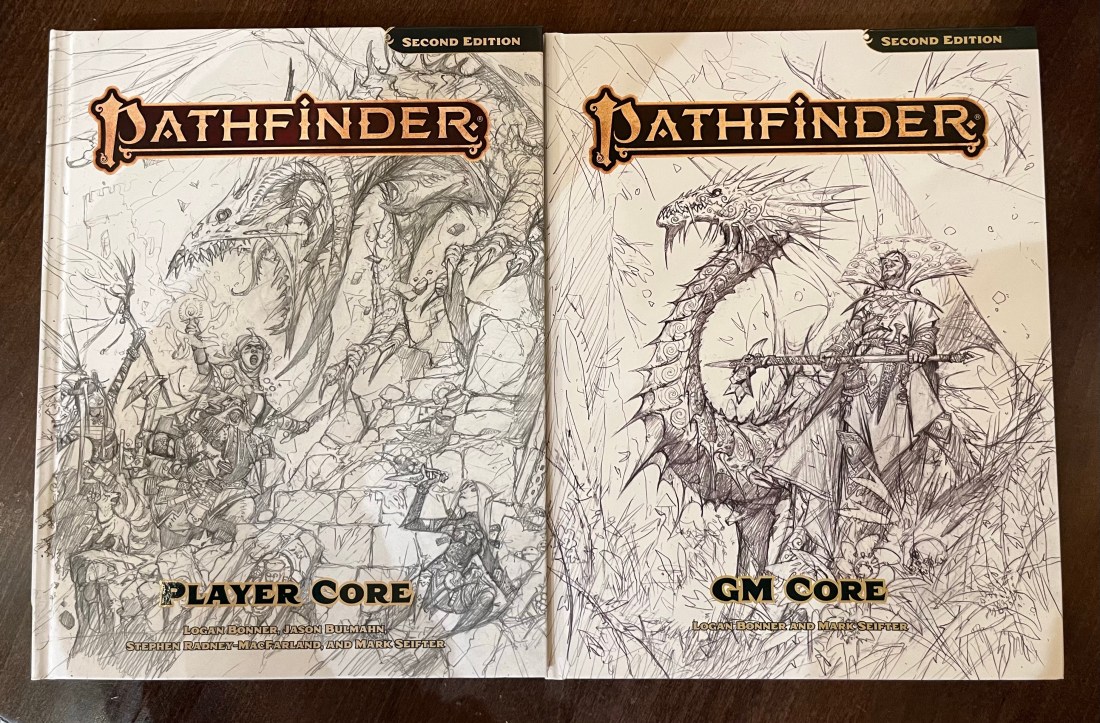
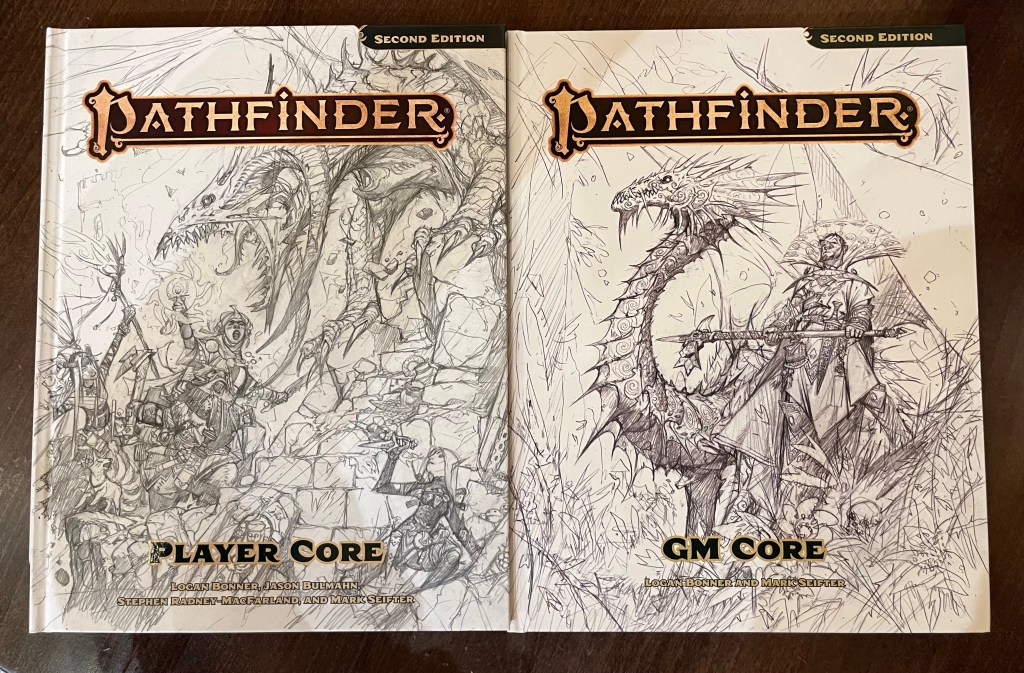
The old Core Rulebook, Advanced Player’s Guide, and GameMastery Guide have been all sliced up and recombined into different books. For example, the new Player Core book (special edition cover shown above), combines elements of the old Core Rulebook and Advanced Player’s Guide. By default, one can play a Witch for example, but remastered Champions (paladins) aren’t available yet, pending further remastered publications. The GM aspects of the old Core Rulebook have been combined with the GameMaster Guide to form the new GM Core book.

What you get is a more logical division between the two books: a player-centric handbook and a GM-centric one. The old tome, the Core Rulebook, thus has been broken up into two logical divisions with newer content added into them.

Further, the format of the books themselves is way more readable than before. Much of the content will look familiar, but is significantly easier to find thanks to book structure, and also due to the handy sidebar on each page. Some rules have been slightly modified to address inconsistencies that have arisen. Other rules have been simply rewritten for better clarity. I can’t tell you how much easier it is to find things on the fly as a GM now rather than stopping the game to flip through a book for 10 minutes then give up and search online. The GM Core in particular does provide more helpful content for planning and designing campaigns, and I found this part particular fun to read. It was previously scattered elsewhere (and similar tough to find), but now I know exactly where to turn to.

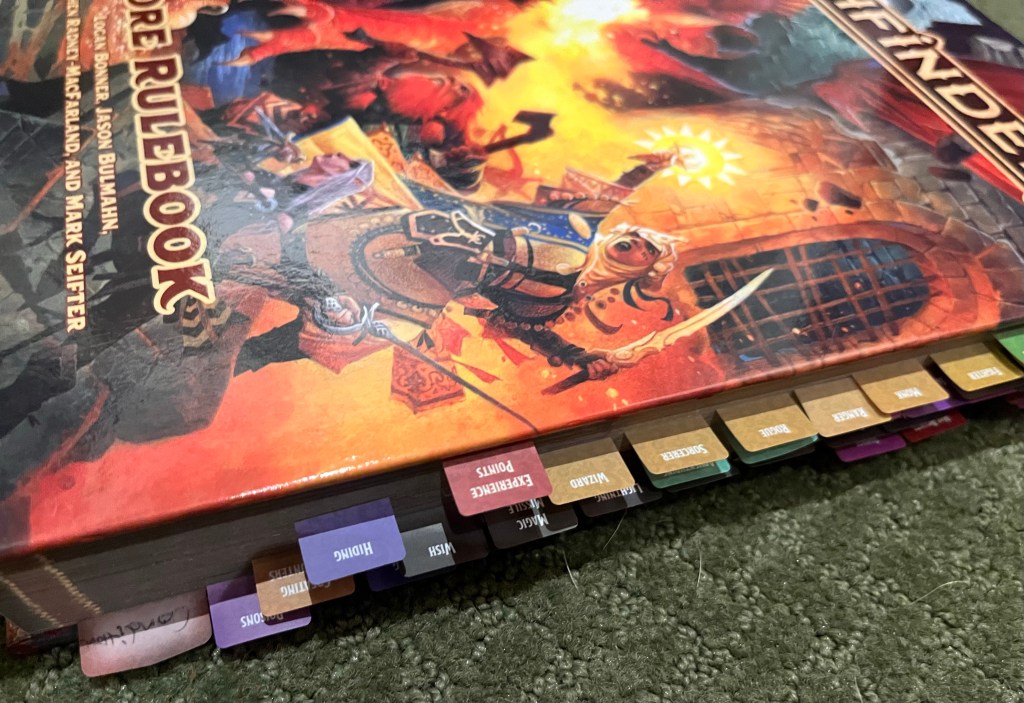
No joke, I struggled a lot with the old Core Rulebook to find things so I had to buy some tabs at a game store to mark the chapter out:

The updated books make this task a lot easier.

Finally, the spell list. In order to make a clean break from the OGL, many classic D&D spells have been renamed to non-OGL ones. For example, the iconic Magic Missile is now Force Barrage. Magic Weapon is given a cooler name of Runic Weapon, and some spells are given names that are more intuitive such as Gentle Repose becoming Peaceful Rest. Mechanically, very little if anything changes, but having to remember a new set of names is probably the biggest challenge for both GMs and magic-using players.

In any case, part of me misses the Pathfinder tie-back to old D&D, so it’s bittersweet that this connection is finally severed at last, but on the other hand, the remastered Pathfinder 2e is a significant improvement over the original 2e in terms of streamlined mechanics and streamlined publications.

On the other hand, it does feel like Pathfinder is finally getting out of the shadow of D&D and maturing as a role-playing game in its own right, and I salute these updates, and will be looking forward to more games with the kids (or maybe finally getting off my seat to check out the local Pathfinder Society).