Tetsugen Dōkō (鉄眼道光, 1630-1682), often called “Tetsugen” is a somewhat obscure but influential Buddhist monk of the similarly obscure Obaku Zen sect in Japan. Tetsugen was a prolific teacher and writer in his day, and today is best known for his efforts to provide a comprehensive, high-quality block-printed edition of the entire Buddhist canon (the “Obaku Edition” of the Tripitaka) in Japan. The life and teachings of Tetsugen are compiled in the excellent biography Iron Eyes: The Life And Teachings of Obaku Zen Master Tetsugen Doko.
One of his best known writings is a text called the Dharma Lesson in Japanese (鉄眼禅師仮名法語 , tetsugen zenji kana hōgo) which was written for a lay-devotee and is based on the Heart Sutra.
I had read the biography and the Dharma Lesson years ago, but suddenly recalled this quote:
Even though what we think of as painful or pleasant aren’t really pain and pleasure, because we are deluded, we end up thinking they are. The reason for this is that when a crow, a dog, or a fox sees a dead crow or horse rotting or a human corpse festering, they think it is a rare treat. First they enjoy looking at it, then their enjoyment increases as they smell it and grasp it. They think this is the greatest of pleasures. Seen from the human perspective, this seems immeasurably impure and repulsive. If we were forced by others to eat such putrid things, it would be incomparable suffering. What is worse than being forced to eat them is that crows devour such things greedily, and think it is pleasant…(pg. 99)
Translation by Helen J Baroni
Similarly, the Buddha, when observing moths attracted to a flame commented to his disciples:
Rushing up but then too far, they miss the point; Only causing ever newer bonds to grow. So obsessed are some by what is seen and heard, They fly just like these moths — straight into the flames.
Author’s note: this is a post from the old blog that I am reposting as a handy reference, with some extra updates and polish. Enjoy! 😄
One concept that often frustrated me in my early years as a Buddhist was the bodhisattva. Bodhisattvas are central to Mahayana Buddhism, that is all Buddhism from Tibet to Japan (and now overseas), and it seems like everyone had a different idea what a bodhisattva is.
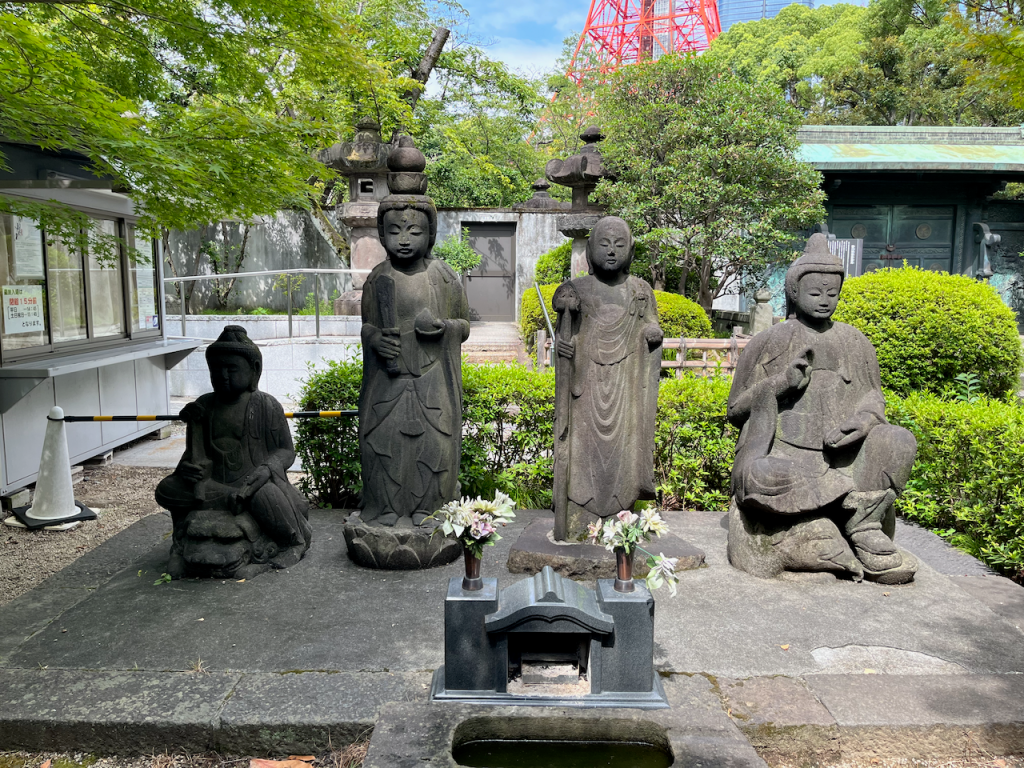
A series of statues at Zojoji Temple in Tokyo, Japan depicting four famous bodhisattvas in the Mahayana tradition. From left to right Manjushri (Monju), Avalokitesvara (Kannon), Ksitigarbha (Jizo), and Samanthabhadra (Fugen).
So, one time I decided to research this and hopefully provide a more comprehensive answer. This is still one man’s explanation, so take it with a grain of salt, but I did use the following sources:
Edward Conze – Buddhist Thought in India (ISBN 0472061291)
Robert E. Buswell Jr., Donald S. Lopez Jr. – Princeton Dictionary of Buddhism (ISBN: 0691157863)
Access to Insight – one of the best sources on Theravada Buddhism, and a great Buddhist resource in general.
Tagawa Shun’ei, translation by Charles Muller – Living Yogacara: An Introduction to Consciousness-Only Buddhism (ISBN: 0861715896)
Asvaghosha, translation by Yoshito S. Hakeda – The Awakening of Faith (In the Mahayana) (ISBN: 0231030258)
And the following sutras (or collections of sutras) were used:
In simplest terms a bodhisattva in Sanskrit, or bodhisatta in Pāli, means a “seeker of enlightnment”. In the earliest scriptures, the Buddha would talk to his disciples about his own past lives as a bodhisattva, such as this sutra in the Pali Canon:
“Bhikkhus [monks], before my enlightenment, when I was still only an unenlightened Bodhisatta, I too, being myself subject to birth, sought what was also subject to birth; being myself subject to aging, sickness, death, sorrow, and defilement, I sought what was also subject to aging, sickness, death, sorrow and defilement….”
In this context, the term bodhisattva mainly referred to the past lives of the historical Buddha, Shakyamuni. In his past lives, when he dwelt in the heavenly realm called Tuṣita (Tushita) and then was born as a prince in India, he was on the cusp of Enlightenment, and only needed that final push. Further, early texts, such as the Jatakas Tales, also imply that this Enlightenment was actually the culmination of many previous lifetimes of searching, effort, and noble deeds. Thus the path of the Bodhisatta who became the historical Buddha was thought to imply an extraordinary, lengthy journey across many lives culminating in final enlightenment.
Later Teachings
In later generations, the role of the Bodhisattva expanded beyond the historical Buddha, and appears more and more often in Buddhist literature. However, it is not the case though that Bodhisattvas are found in Mahayana Buddhism only though. For an excellent treatment of the subject, I highly recommend reading this article by Bhikkhu Bodhi.1 It was just that the path seemed too remote and arduous for most disciples, especially since the presence of a living Buddha allowed them to reach enlightenment much more quickly as Śrāvaka (shravaka) or “hearer-disciple”.
Anyway, in the classic Buddhist model, the historical Buddha was something like a “first among equals”, in that the quality of enlightenment experienced by Arhats (e.g. “noble ones”) was the same as the Buddha. However, Buddhas were distinguished from Arhats by additional qualities that made them almost suprahuman. A Buddha is one who, among other things, gains insight into the truth at a time when the Dharma is unknown (i.e. no other Buddha to teach them), which requires extraordinary spiritual insights and qualities, not to mention their capacity to teach others in such a way that they become enlightened too, and can carry the Dharma onward for generations. This was the contrast between a Buddha and an Arhat.
Over time, the Buddhist community began to explore more and more the notion of becoming a Buddha too (e.g. Buddhahood), and thus the role of the Bodhisattva became increasingly important. As a result, the status of a bodhisattva was elevated over arhats, such that arhats were considered noble, but somewhat inferior to Buddhas and Bodhisattvas.
How Do Arhats, Bodhisattvas and Buddhas relate?
A number of models to explain the relationship between buddhas, bodhisattvas and arhats developed over the course of Buddhist history. As we saw earlier, the original model really only included arhats and buddhas. However, the influential Yogacara school of Mahayana Buddhism (of which the Hossō school in Japan is one of the few independent remnants) taught that different beings had different, inherent natures that would incline them toward the Buddhist path of an arhat, bodhisattva (and thus a Buddha), indeterminate or even those whom enlightenment was impossible.
However, the most popular model in Mahayana Buddhism became the Ekayāna or “One-Vehicle” model. This was popularized by the Lotus Sutra which taught that all disciples would inevitably follow the same path, even if they appeared different at first. Each path (arhat, bodhisattva, etc) were part of the same natural progression and would ultimately converge. In the famous “Parable of the Burning House” in Chapter Three, the father says to his children in the burning house:
“Such a variety of goat carts, deer carts, and bullock carts is now outside the gate to play with. All of you must come quickly out of this burning house, and I will give you whatever you want.”
This parable, the Buddha explains, is meant to show that all followers seem to be following different trajectories, yet ultimately they all converge on the (Mahayana) Buddhist path and become bodhisattvas and then ultimately Buddhas.
Later, starting in the sixth chapter, the Buddha then predicts that his senior monks and nuns, all presumed to be arhats, will eventually become Buddhas. This again emphasizes that the arhat stage is not separate, but a kind of prepartory stage before the “real” Buddhist path begins. Again though, we see that arhat is considered a noble but somewhat inferior status to the bodhisattva, and that their enlightenment is somehow incomplete when compared to the enlightenment of a Buddha. Nevertheless, the arhat is still revered and respected in Mahayana Buddhism. For example, in the Amitabha Sutra, the historical Buddha describes the Pure Land of Amitabha Buddha like so:
Moreover, Śāriputra, he [the Buddha Amitabha] has an innumerable and unlimited number of śrāvaka disciples, all of them arhats, whose number cannot be reckoned by any means. His assembly of bodhisattvas is similarly vast …. Śāriputra, those sentient beings who hear of that land should aspire to be born there. Why? Because they will be able to meet such sages of supreme virtue.
Translation by Rev. Hisao Inagaki
Anyhow, we have talked quite a bit about the history of the bodhisattva, but in part two we’ll discuss how the sutras describe and define a bodhisattva, and how they relate to the buddhas. Stay tuned!
1 Please repeat after me: Bodhisattvas are not found in Mahayana Buddhism only. Many elements of the bodhisattva that we do see in Mahayana Buddhism have their roots in the earlier Mahāsāṃghika school of early Buddhism, which Mahayana drew many ideas and inspirations from. However, the Mahayana also drew from other schools such as Sarvastivada and Dharmagupta among others. The ideas were already there, the early Mahayana Buddhists simply synthesized them.
A while back, I wrote a small post on how to express Sanskrit and Pali using diacritics in HTML and the Roman alphabet. This is handy for expressing Buddhist terms accurately, since the standard 26 letters of the English alphabet don’t always tell the whole story.
Coin of Agathokles, king of Bactria (ca. 200–145 BC). British Museum. Personal photograph 2006, courtesy of Wikipedia. The coin shows inscriptions in Greek. Upper left: ΒΑΣΙΛΕΩΣ. Upper down: ΑΓΑΘΟΚΛΕΟΥΣ. The coin also shows a Buddhist lion and Lakshmi. Note the Brahmi script on the obverse, too.
While exploring Sanskrit writing systems recently, I dabbled in using HTML to express the ancient Brahmi script, which was used to write Sanskrit a long time ago, including some Buddhist scriptures, and the writings of Emperor Asoka.
Brahmi script is available through Unicode, like many other obscure symbols. The key is to know how to type a Unicode letter in browser:
& # x(number) ;
The numerical table for each Brahmi script letter is found here and on Wikipedia. The code for “ka” (क in modern Devanagari script) is 11013, so in HTML, it would be & # x 11013 ; without any spaces. This produces 𑀓. So far so good.
But Brahmi, like other similar scripts, is an abugida. The vowels don’t usually stand alone as separate letters. Instead, they modify the base consonant. This is true with modern Devanagari as it is with Brahmi. So, in the example above, “ki” would be “ka” but modified with an “i” extension: कि in Devanagari, or 𑀓𑀺 in Brahmi. For Brahmi, I put & # x 11013 ; without any spaces, then & # x 1103a ; the code for the “i” vowel extension.
One other thing we need to cover is the consonants without a vowel. For example, in the word Buddha (buddho in Pāli language) , it would be split up into three letters “bu” “d” and “dha” with an “o” extension. The “d” here normally needs vowel, by default “a”, but if you add a virama mark, then instead of “da”, it gets cut off as “d”. In the Brahmi script, this is a & # x 11046 ; which looks like 𑀓𑁆 (k), a small line above the letter. Using the example of Buddha above, this would be 𑀩𑀼𑀤𑁆𑀥𑁄 or letters “bu” “d with virama” and “dho”.
As a bonus, the nembutsu in Sanskrit, in its simplest form, is namo’mitābhāya1 which in Brahmi script might be:
𑀦𑀫𑁄𑀫𑀺𑀝𑀸𑀪𑀸𑀬
Typing each letter by its Unicode HTML number is not a quick and easy process, but if you do it enough, it becomes somewhat easier. Soon, you’ll be typing like Emperor Ashoka in no time. 𑁍2
P.S. If you prefer to type in Devanagari, by the way, the simplest approach is to simply use the Hindi keyboard setting if you have one. You won’t need to type each Unicode letter. 😉
1 This may be a Chinese phrase rendered back into Sanskrit, not the other way around, but it does appear in the extant version of the Larger Sutra of Immeasurable Life, and something called the Dhāraṇīsaṅgraha, a collection of Buddhist dhanaris.
Recently, I’ve been delving into both the Sanskrit and Pali languages, both used for Buddhist religious scripture, and just when I thought I had things figured out, I realize the situation is even more complicated and fascinating than I thought.
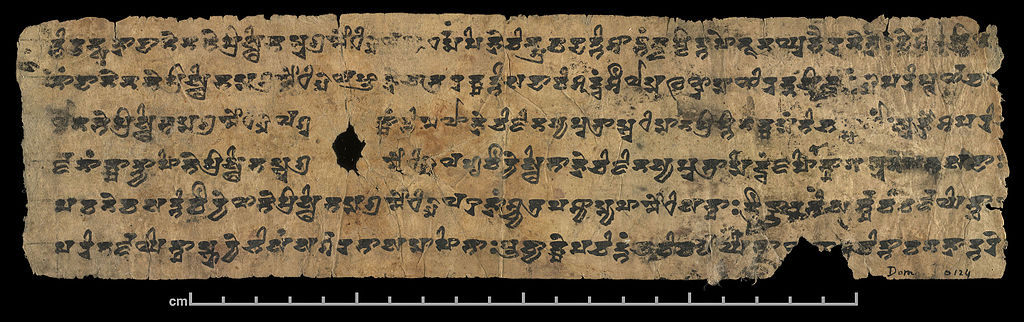
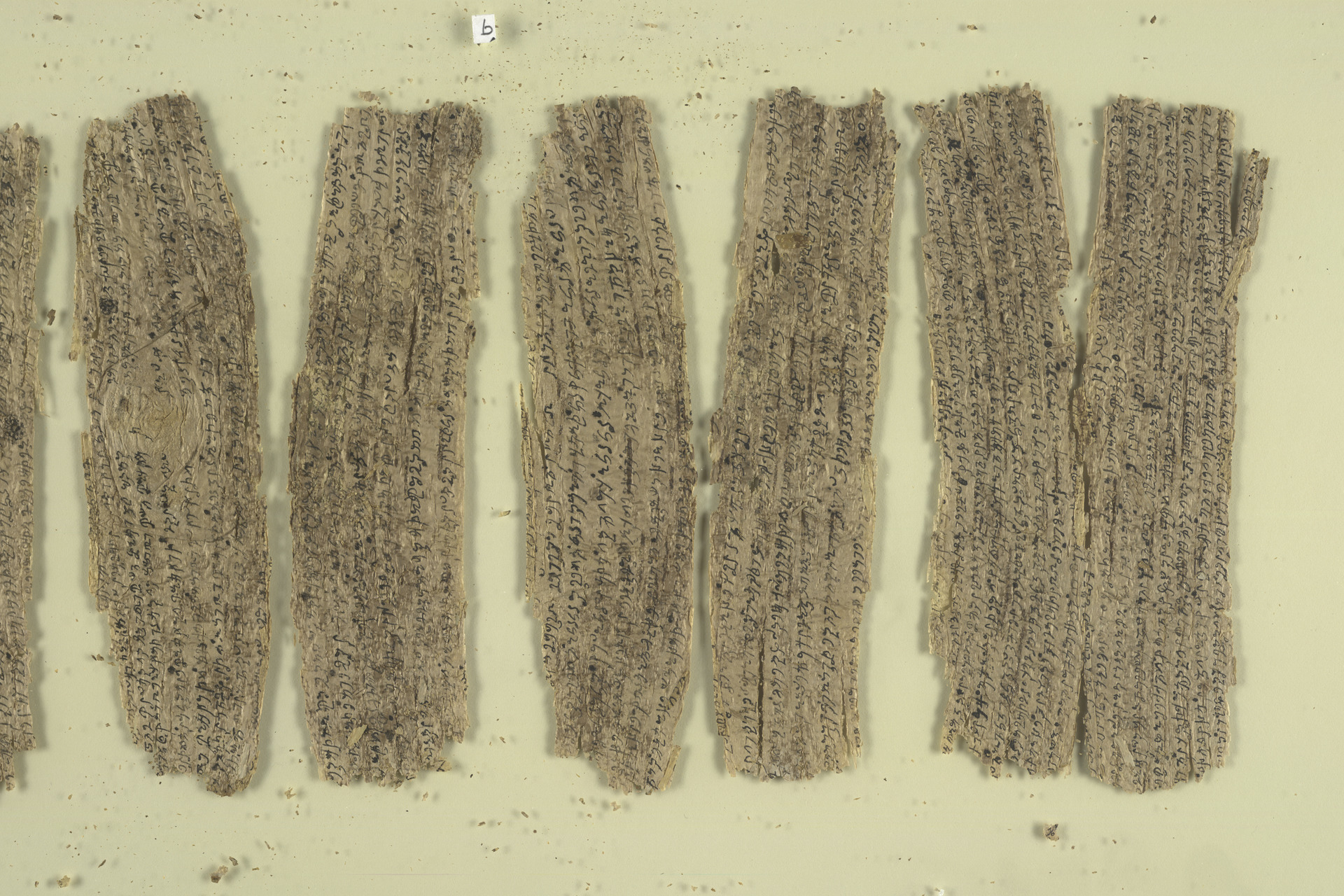
Fragmentary Kharosthi Buddhist text on birchbark (Part of a group of early manuscripts from Gandhara), first half of 1st century CE. Collection of the British Library, CC0, via Wikimedia Commons
Sanskrit is a language that was brought to India by invaders who called themselves the Arya (“the noble”), but had origins in what is now Iran. They came to India sometime after 2000 BCE and settled across northern India and surrounding areas, subjugating the native population, and bringing their religious values with them. From there, we see very early religious inscriptions such as the Rig Veda, composed in very old Sanskrit (e.g. “Vedic Sanskrit”).
But, gradually, Sanskrit and what was spoken informally “on the ground”, diverged. This diverged by regional variances, social classes, etc. They could probably understand each other’s regional dialects the same way that Americans can understand Australian English, and Australians understand American English, or Scottish English, etc, and all of them differ from “textbook English” also known as Standard English.
One might also draw an example from Latin. Classical Latin, such as the writings of Cicero, differed from “vulgar Latin” such as that spoken in the provinces. Further, vulgar Latin as spoken by the Celts in Gaul probably differed from vulgar Latin spoken by Berbers in north Africa or Egypt. Even Cicero’s spoken Latin probably differed than his writings.
Such regional dialects or variances of the original Sanskrit included:
Magadhi – A language spoken in the kingdom of Magadha, and quite likely the Buddha’s native language. It is spoken today in India as well, but like Ancient Greek has changed over time to its modern version.
Kosalan – A language spoken in the neighboring kingdom of Kosala, also mentioned in early Buddhist texts.
Arda-Magadhi – “Half-Magadhi”, a possible predecessor to Magadhi above, or at least closely related.
Paishachi – A popular, possibly literary-only language, though more research is needed.
Maharashtri – A language spoken more to the southwest of India and frequently used in poetry. Modern day Marathi and Konkani derive from it.
Gandhari – A prakrit spoken in north-west India, in the important region of Gandhara, and used in some Buddhist scriptures composed in the region, instead of Pāli. Examples of recoverd texts here.
Speaking of Pāli, what’s up with Pāli? The earliest Buddhist scriptures, or sutras, are recorded in Pāli language, but Pāli isn’t technically a Prakrit like those shown above. It seems to be a language that arose as a kind of lingua franca between Prakrits.1
It makes sense why early Buddhist sutras are recording in it then: rather than recording in each Prakrit for the benefit of local audiences, pick something that was generally understood, even if imperfectly.
Pāli may have arisen around the 3rd century BCE, two to three hundred years after the Buddha, so here’s a hypothetical (repeat: hypothetical) timeline:
The Buddha preached in his native language, Magadhi (assuming that’s what he spoke), probably around the 5th or 6th century BCE. It’s also possible he used other Prakrits as well depending on his audience, assuming they were mutually intelligible.
Disciples remembered his teachings, and per Buddhist tradition, recited them as beset as they could recollect after this death in the First Buddhist Council.
Per existing Indian tradition, the teachings were then passed down for centuries from teacher to students.
As Prakrits developed and diverged over time, it probably became harder to keep things consistent across Buddhist communities, and the communities relied on more. Since it was widely used anyway, this was probably a simple, practical move.
As Buddhist tradition changed from oral to written history, Pāli was the logical choice for some Buddhist schools, such as the Theravada. Other Buddhist school at the time stuck to local Prakrits (some of which became part of the Mahayana canon later), such as in the Gandhara region.
As Buddhism spread even further, and Pāli fell out of use in India, Sanskrit became the liturgical language of choice and Buddhist scriptures, notably in the Mahayana tradition were shoe-horned into Sanskrit in successive waves. Given the rise of Hindu religion, which relied on Sanskrit for scripture, Buddhist communities may have felt the need to “keep up”.
Anyhow, this is speculation, but seems to fit what I’ve learned so far, and shows a fascinating evolution where Sanskrit sets the foundation, but dialects flourish until a new lingua franca is needed (namely, Pāli), until things sort of come full-circle and return to Sanskrit again, at least for the Mahayana tradition.
However, a couple points should be emphasized:
The Buddha probably didn’t preach in Pāli language. We may never know exactly what the language was, but it is likely a local prakrit, or more than one.
Prakrit languages are neither Sanskrit nor Pāli, but possibly developed in this order (more research needed): Sanskrit at time of migration into India -> Prakrits -> Pāli -> Classical Sanskrit
Thanks for reading!
1 Speaking of “prakrit”, there is not a universally agreed upon standard as to which languages at the time are prakrits, and which ones aren’t. In some broader definitions, Pāli language is considered another prakrit. As an amateur, I have no opinion one way or another.
Recently, I made a lengthy rant on Twitter about my frustrations with learning Sanskrit in order to read Buddhist texts. The issue is a surprisingly complicated one, and something I wanted to explore here a bit more.
When you look at religions of the world, Buddhism is somewhat unusual in that it is not rooted in a single, sacred text. No Bible, No Quran, etc. Buddhism has many sacred texts, or sutras, all purportedly the words of the Buddha. These teachings where then passed down by his disciples, yet nothing was actually written down until centuries later. This is not as bad as it sounds. By the Buddha’s time, India already had developed a sophisticated tradition around memorizing sacred texts and teaching them disciples. Non-Buddhist examples include the Vedas (the forerunners to the Hindu religion). People believed at the time that writing sacred teachings down would put them on the same level as mundane receipts and political documents, and was thus considered profane.
Attitudes changed by 1st century CE, but by now those sermons of the Buddha that had been carefully passed down were scattered in various collections, and different Buddhist schools had slightly different collections from one another. Worse, the languages used to transmit the teachings had diverged.
Which Language?
The Buddha, in his time, warned against using the priestly Sanskrit language to transmit his teachings, preferring instead local dialects, but even at that time, India had many, many dialects. Pāli was a very popular one, and remains so for some Buddhist traditions, but as Buddhism grew, keeping track of Buddhist sermons via local dialects probably became less and less practical.
Thus, in the end, Buddhist texts began to be recorded in Sanskrit. Every educated person in India probably knew at least some Sanskrit, just like educated medieval Europeans knew at least some Latin or Greek.
This conversion to Sanskrit wasn’t an overnight swap, however. Research into “Buddhist Hybrid Sanskrit” shows that the transformation was a gradual one: Buddhists would first write things down in a way that looked “Sanskrit-ey” (but not actual Sanskrit), then later generations would write something down that actually used Sanskrit, but still peppered with local colloquialisms. Eventually, even later texts were composed in “true Sanskrit”, at least something that Pāṇini would hopefully approve of.
So, what we see is a kind of gradual spectrum from early texts being composed in local dialects (primarily Pāli) and then gradually transforming into Sanskrit.
The difference, by the way, between Pāli and Sanskrit isn’t as dramatic as it sounds by the way. Pāli, like many Prakrits, was a local languages that derived from Sanskrit, and still had much in common with it. Just like Italian, Spanish, French, etc., all derived from Latin in some way.
To illustrate this, let’s look at a basic word like “king”. In Sanskrit, it is rājaḥ, and conjugates like so (not a complete chart):
Case
Singular
Dual
Plural (more than 2)
Nominative
rājaḥ (rājo)
rājau
rājāḥ
Accusative
rājam
rājau
rājān
Instrumental (e.g. “with” or “by means of”)
rājena
rājābhyām
rājaiḥ
Dative (e.g. “to” or “for”)
rājāya
rājābhyām
rājebhyaḥ
Note: due to Sandhi rules, rājaḥ frequently becomes rājo to smooth things out. Sanskrit also has Genitive, Ablative, Locative and Vocative cases too., but I’ve omitted them for brevity.
…and so on. Pali is a bit more streamlined by comparison being a more colloquial language by nature, so one word for king is rāja (i.e. without the visarga ḥ sound at the end):
Case
Singular
Plural
Nominative
rāja (rājo)
rājā
Accusative
rājaṃ
rāje
Instrumental (e.g. “with” or “by means of”)
rājena
rājebhi or rājehi
Dative (e.g. “to” or “for”)
rājāya or rājassa1
rājānaṃ
This form appears to be more commonly used according to this Pali textbook written by Ven. Nerada Thera
At first glance, Pali kind of reads like the kinder, gentler version of Sanskrit. The dual form is almost entirely non-existent,2 and the sounds are softer, and lacking the ḥ (visarga) at the end. However, you can see they share similar grammatical structures, pronunciation, etc.
So, the first challenge with Buddhist text is this gradual transition from local dialects to literary Sanskrit, spanning hundreds of years. If you picked a particular Buddhist sutra, it might be somewhere in the middle of this transition: is it Pali? is it Sanskrit? Sanskrit with Pali terms, or Pali with a Sanskrit “polish” to it?
How Is It Written?
The second issue is the written script.
Some languages are closely tied with their script: Greek language is written in the Greek alphabet (obviously), while Korean is written in Hangeul. Other writing systems are not: the Roman alphabet is used in many languages: English, French, Vietnamese, etc. In medieval times, Chinese characters were used by a wide variety of disparate languages: Chinese, Japanese, Vietnamese, Khitan, etc.
So, languages are not always tied to a particular writing system. Also. some writing systems are not tied to a particular language.
Sanskrit (and Pali) have been written down using a wide variety of scripts across the ages. Early writings were done using Brahmi script, and Brahmi itself evolved into newer and better writings systems over time leading to the most common example today: Devanagari.3 Many, many modern languages in India and beyond are written in some script derived from Brahmi.
This includes Buddhist texts, too!
Inscriptions by Emperor Ashoka might be written in old Brahmi script:
…while texts written in palm leaf might also be written in Sanskrit, but using a derivative script:
The Lotus Sutra written in Sanskrit in an early form of South Turkestan Brahmi script, courtesy of Wikipedia.
You can see that while both are Buddhist (or Buddhist-historical) subjects, they are not necessarily written in the same script. Further examples include later Siddham script, often used in mantras and other esoteric practices by some schools:
The Heart Sutra as written in Siddham script, courtesy of Wikipedia
Then there’s other one-off, but important scripts like Karoshthi and so on.
This is not that unusual by the way when dealing with widely-used languages from antiquity, by the way. Although Greek was always written in the Greek alphabet, the style of writing could be vastly different depending on regional variations, such as those found on Egyptian papyrus vs. modern textbooks. Latin wasn’t always written in big block letters; it had its own cursive form that was more frequently used, and is pretty obtuse to modern Westerners without some training first.
Does Any Of This Matter?
For the average day-to-day practice of Buddhism? Nope.
Buddhism has always been at heart a religion of practice, not dogma. The Buddhist tripod of wisdom, conduct and practice (i.e. chanting, meditation, etc) has two “legs” which involve day to day action. Wisdom is important too but differs from dogma in that it’s not something you believe, but something you learn.
So, you could follow the Buddhist path perfectly fine if you focus on these things, and never bother with ancient languages, relying on acceptable translations instead. Studying the sutras is a helpful practice in Buddhism, but there are already plenty of good translations.
However, if you get into a more professional position either as a teacher, scholar, monk, nun, or priest, etc., knowing some command of Pali, Sanskrit, Classical Chinese, or Tibetan is really helpful. It won’t necessarily make you a better Buddhist, but may help you be a better teacher to others.
Back in 2019, I tried my hand at learning Sanskrit, with the intention of reading Buddhist texts natively, partly for fun, partly for curiosity, partly because I was frustrated by shoddy, overly sectarian translations. What I found is that modern Sanskrit courses and texts overwhelmingly focus on Hindu content, and insist on teaching Devanagari script, which makes sense, but neither of which is appropriate for the study of Buddhism.
Thus, my efforts to learn Sanskrit have languished for a long time.
These days, I would like to try again, but I believe that to effectively learn Sanskrit for the purposes of studying Buddhist texts, the following caveats might be helpful:
Learning Devanagari is not required. Buddhist texts are written in a wide variety of scripts but usually not Devanagari. There are some excellent resources for Buddhists texts preserved in Sanskrit, but using the Roman alphabet. This may sound weird, but as we discussed above, Sanskrit has never been tied to one writing system. One script is as good as another. Seriously.
Much of Buddhism’s corpus of sutras and sacred texts aren’t even “pure” Sanskrit anyway. Just as one might learn ancient Greek starting with Homeric Greek before moving onto Koine, the study of Buddhist texts may benefit by starting with Pāli and then migrating to Sanskrit as needed. Even learning a bit of Pāli might be a nice way to get back in touch with early Buddhism and as close to the Buddha’s words as we might ever get.
Alternatively, rather than trying to use a “one size fits all solution”, find a Buddhist text you are interested in, and determine how it was written, what language, etc, and start from there. Again, there are parallels to ancient Greek. The New Testament isn’t written the same way as Euripides, nor Hesiod. You have to accept that Buddhist texts are similarly written at different times by different people.
One thing I haven’t really talked about so far is Classical Chinese. Much of the Buddhist canon, now lost in India, is preserved in Chinese and epitomized in the Taisho Tripitaka formalized in Japan in the 1920’s. If you want to study ancient Buddhist texts, studying them in Classical Chinese might just be as useful, if not more useful, in some cases. The Heart Sutra, for example, was first written in Chinese and then back-ported into Sanskrit later when Xuan-zang journeyed to India.
Anyhow, this is one amateur’s look at the situation, something I’ve learned the hard way. Your mileage may vary, but if you wish to study ancient Buddhist texts, I hope this helps.
2 According to this textbook, only two words in Pāli have a dual form: dve or duve (two), and ubho (both).
3 Southern Indian languages also use scripts adapted from Brahmi, but through different evolutionary course, hence they look quite different than northern Indian languages.
While recently reading a certain Japanese-language introduction on the Soto school of Zen (the same book where I learned about the Shushōgi), I came across another teaching I wanted to share called the Four Bases of Community, also called the Four Grounds for Fellowship, and so on. This term is called shishōbō (四摂法) in Japanese Zen, but the term goes much further back, all the way to the Pāli Canon as cattāri saṅgahavatthūni,1 where it is the subject of a sutra called the Sangaha Sutta (AN 4.32).
But what are the Four Bases/Grounds for/of Community/Fellowship (of the Ring)?
The Soto Zen book lists them as (with my rough translations):
布施 (fuse) – offerings, generosity
愛護 (aigo) – kind words
利行 (rigyō) – empathy
同事 (dōji) – cooperation
A number of helpful articles in Japanese and English all point to the same thing: even small efforts toward kind words, empathy or generosity toward others have a knock-on effect that leads to both to own’s one happiness, but also happiness of others who are not directly involved. Six degrees of separation and all that.
Given how people are agitated and tense in the current climate, it may be a good opportunity to put the Four Grounds of Fellowship into practice as they may have effects that one can’t expect.
1 Sometimes seems to be abbreviated to saṅgaha-vatthu for you Pali nerds out there.
I started writing this post weeks before this and this, but now it seems strangely relevant. Recently Eidolon posted a great article about Seneca’s philosophy vs. his tragedies.
One of the many, great parts of this article is this one:
Once I started to confront my depression and anxiety, Seneca’s philosophy sounded even more like well-intentioned but bad advice: just don’t be sad. As a whole though, Seneca’s body of work shows a man split between the anxieties of his political position in Nero’s court, and the calm he sought from philosophy. I despised reading his philosophy because it portrayed what felt like an unattainable goal, but I think it was unattainable to him too.
Seneca was a major proponent of the Stoic school of philosophy, which advocates among other things, striving toward a sense of equanimity (ataraxia ἀταραξία) with regard to the changes in life, and maintaining one’s virtue in the process (eudaimonia εὐδαιμονία). The goal of equanimity resonates a lot with Buddhism too, such as in the Kakacupama Sutta (MN 21):
“Monks, even if bandits were to carve you up savagely, limb by limb, with a two-handled saw, he among you who let his heart get angered even at that would not be doing my bidding. Even then you should train yourselves: ‘Our minds will be unaffected and we will say no evil words. We will remain sympathetic, with a mind of good will, and with no inner hate. We will keep pervading these people with an awareness imbued with good will and, beginning with them, we will keep pervading the all-encompassing world with an awareness imbued with good will — abundant, expansive, immeasurable, free from hostility, free from ill will.’ That’s how you should train yourselves.
translated from the Pali by Thanissaro Bhikkhu
But at times like this, I find it hard to take such philosophy seriously. It’s not that I don’t discount the words of the Buddha, or the Stoics, but it’s kinda hard to pay bills with equanimity, and it’s hard to accept the nature of things when you’re worried about your kids and aging parents getting COVID-19. I am furious, frustrated, and sad at the same time. The author is right in expressing her frustration: these things aren’t just mental games, tools for philosophy; people lives and livelihood are at stake.
The author concludes:
Despair and dread are breathing, living things, following us around, and to get around the fear that things are hopeless is a hard enough task. We need to validate despair in order to get around it and act anyway.
That said, I have to remind myself that I am not the center of the Universe. It owes me nothing, and I can expect nothing from it either. I can hate life and complain it’s unfair all I want, but a lot of good that will do. I do have to accept that fact that my situation is far from stable for the coming months (Coronavirus notwithstanding) and that I will have to take things day by day, step up as a father and provider, and somehow get through this.
If you’re new to Buddhism, or if like me, you’ve studied it for a long time, you may be inclined to compare yourself to other Buddhists, either living or dead. Buddhism is not a passive religion1. Buddhists don’t sit around hoping to be saved, they are encouraged to apply the Buddha’s teachings (i.e. “The Dharma”) into practice. Consider the last words of the Buddha in the Mahā Parinibbāna Sutta (DN 16):
“Now, then, monks, I exhort you: All fabrications are subject to ending & decay. Reach consummation through heedfulness.”
trans. Ven. Thanissaro Bhikkhu
and shortly before that:
Then the Blessed One said to Ven. Ānanda, “Now, if the thought occurs to any of you—‘The teaching has lost its arbitrator; we are without a Teacher’—do not view it in that way. Whatever Dhamma & Vinaya I have pointed out & formulated for you, that will be your Teacher after my passing.
trans. Ven. Thanissaro Bhikkhu
It’s clear that the Buddha expected disciples, particularly monks/nuns since they explicitly gave up the “householder life” to pursue Buddhism full-time, to apply the teachings in their lives.
But most people who reads this blog are laypeople (a.k.a. “householders”), and this can often put us in a tricky spot. We can’t live the monastic lifestyle, but at the same time if we live a lifestyle entirely based on personal satisfaction then we’re not applying the Buddha’s teachings either. How do laypeople find the right balance?
I think this question is really important because failure to address it either leads to self-satisfaction (and thus no personal/emotional growth) or to constantly feel inferior about ourselves for not living up to an ideal in our minds.
The Buddha spoke about this to a monastic disciple named Sona one day in the Soṇa Sutta (AN 6.55 in the Pali Canon), where he compares effort in Buddhist practice to playing a lute in that the strings should neither be too tight, nor too slack:
“In the same way, Soṇa, over-aroused persistence leads to restlessness, overly slack persistence leads to laziness. Thus you should determine the right pitch for your persistence, attune [‘penetrate,’ ‘ferret out’] the pitch of the (five) faculties (to that), and there pick up your theme.”
trans. Ven. Thanissaro Bhikkhu
I think the key here is finding the “right pitch”. Just as instruments will vary slightly, people will also vary slightly based on their background and situation.
Further, for lay people in particular, the Buddha offered a ton of advice in the Sigalovada Sutta (DN 31 in the Pali Canon), among other things:
“Young man, by abandoning the four impure actions, a noble disciple refrains from harmful deeds rooted in four causes and avoids the six ways of squandering wealth….The noble disciple….has entered upon a path for conquering both worlds, firmly grounded in this world and the next. At the dissolution of the body after death, a good rebirth occurs in a heavenly world.
trans. by John Kelly, Sue Sawyer, and Victoria Yareham
These impure actions include:²
Harming living beings
Taking what is not given
False speech, and
Pursuing the loved one of another
Also, the six ways of squandering wealth in the sutra:
Intoxication
Roaming the streets at inappropriate times
Habitual partying
Compulsive gambling
Bad companionship, and
Laziness
If you can keep out of trouble, as the Buddha outlined above, you’re already doing great. The Buddha’s words can seem a bit of a bitter pill, but on the other hand, the responsibility in Buddhism lies solely with the individual. If you fritter your money away gambling, ultimately you have only yourself to blame. The Buddha warned, but it is up to you to apply the advice or not, with the consequences that come with it.
Interesting the sutra doesn’t mention meditation at all, since it was traditionally set aside for special days for laypeople who, back in the Olden Days, typically had to work daily for their food, and didn’t have much spare time for other pursuits. Simply living an honest livelihood and avoiding the pitfalls of temptation were a tangible award in themselves.
Of course, in the 21st century things are a tad different, and with better education and livelihood, we can afford to pursue additional Buddhist practices like chanting and meditation. But even so, having a healthy, wholesome lifestyle is still a good bedrock to found the rest of your Buddhist practice on. Again, it all depends on finding the right “pitch” in your life, and some of that may also depend on things that are dragging you down in the near-term. So, the Buddha’s advice on living a wholesome lifestyle isn’t just for the sake of moralising, it may also have a practical bent too with respect to Buddhist practices in general.
1 the one possible exception being the Jodo Shinshu school of Buddhism, but that’s a story for another day.
² For the perceptive, this is just another way of expressing the Five Precepts of Buddhism.






 Gleanings in Buddha-Fields

,_part_31_-_BL_Or._14915.jpg)
.png)


You must be logged in to post a comment.