Buddhist Sanskrit Basics

Hello Dear Readers,

This is another reference post. I noticed that one of my most popular posts is the entry on a Buddhist chant called the Mantra of Light, and there’s multiple ways to read and recite it depending on what language you choose. Anyhow, it made me realize that there’s a big knowledge gap about Sanskrit in a specifically Buddhist context. There’s plenty of Sanskrit language resources out there, but they’re focused on Hinduism, and Hindu-related literature. Even the writing system used in language textbooks, Devanagari, tends to assume certain things.

Sanskrit is a language that’s used in a variety of contexts, and religious traditions, including Buddhism, especially Mahayana Buddhism.

As a language, it is way too big to cover in this blog, and I am just a novice, but I wanted to provide some real, fundamental basics of how Sanskrit works, with an emphasis on Buddhism.

What is Sanskrit?

Sanskrit is a very old language still widely used in some contexts. It is related to Greek and Latin, among other things, but mostly as a distant cousin. The Arya people who come into northwest India spoke it natively, and then as they took over north India, they imposed their language on people there.

Just as Latin eventually morphed into languages like Spanish, French, and Italian (among others), or influenced languages such as English, German or Russian, Sanskrit followed a similar trajectory. Languages descended from Sanskrit are called Prakrits. Prakrits were the colloquial forms of Sanskrit, each with regional differences, while Sanskrit remained the “high” language, increasingly relegated to things like religious ceremonies or literature.

Why Sanskrit and Buddhism?

The historical Buddha, Shakyamuni, did not use Sanskrit when teaching his disciples. His native language was probably Magadhi (still spoken today), but he often used Pāli when speaking to others since it was so widely known. Both Magadhi and Pāli are prakrits, descended from Sanskrit.

Since Pāli was such a popular language, it was how most early Buddhist sermons were memorized and passed down to future generations. Some Buddhist traditions, especially Theravada Buddhism, preserve these sermons using Pāli.

However, as Buddhism spread northward along the Silk Road, it was recorded in yet more prakrits such as Gandhari (Pakistan area), and such, not Pāli. By this point, there were Buddhist texts preserved in all sorts of local prakrits, not necessarily Pāli, and it probably became unmanageable.

The early Mahayana Buddhists started converting texts and teachings to Sanskrit instead. While Sanskrit wasn’t a common, spoken language, it was something that everyone more or less knew, just as medieval writers in Europe all knew at least some Latin. Thus as the layers of literature built up over time, and especially outside the core areas of India, it made more and more sense to just use Sanskrit for everything. Their Sanskrit wasn’t always “pure” Sanskrit, but it was good enough.

The featured image above is of the temple of Sensoji, better known as Asakusa Temple, in Tokyo, Japan. The central altar has the Sanskrit letter “sa” for satyam (truth) prominently displayed using Siddham script. Thus, even in a place like Japan, Sanskrit is still being used.

What Writing System Does Sanskrit Use?

This is a surprisingly hard question to answer. Unlike some languages, like Greek or Chinese, it had no fixed writing system. Every knew at least some Sanskrit, but everyone wrote it down in their own way. The Pillars of Ashoka used the Brahmi script to convey Buddhist teachings to the masses, while Buddhist texts on the Silk Road were often recorded in Karoshthi, and Buddhist mantras were recorded in Siddham.

So, what writing system should Sanskrit be written in? Whatever conveys it best to the reader.

For the purposes of this blog article, we’ll stick with the Roman Alphabet, with extended diacritics. For Buddhists, there is no benefit to using modern Devanagari, since early Buddhists didn’t even use it, and it’s just an extra layer to learn. Just don’t bother. The Roman Alphabet is sufficient for Western audiences.

Sanskrit Alphabet

The Sanskrit alphabet (regardless of what script you use) is broader than English because each sound has its own letter (sometimes two), and thanks to the grammarian Pāṇini, it’s all carefully organized in a sensible system.

Many of these sounds exist in English, but do not have their own letter to distinguish them; we just pronounce them automatically. Some sounds definitely do not exist in English and require extra care.

 voicelessvoiced
openhaā
velarkkhggh
palatalścchjjhñyiīeai
retroflexṭhḍhr
dentalstthddhnl
labialpphbbhmvuūoau
consonantsvowels
Source: https://en.wikipedia.org/wiki/Sanskrit_grammar, but modified for simplicity

We can’t cover all these letters in detail here, especially pronunciation. There are some excellent pronunciation guides like the video series below. While it’s a Hare Krishna channel, not a Buddhist one, the explanations are excellent and clear.

A notes worth calling out here though:

  • – this is like a “breathy” h-sound that shows up at the end of certain words.
  • – although it looks like an “m”, it sounds more like an “ng” sound as in running. In the Buddhist tradition of praising the three treasures, the phrase Buddhaṃ Sarana Gacchāmi, it is pronounced like “boo-dang” not “boo-dam”.
  • Sanskrit distinguishes between letters like k and kh, g and gh, d and dh and so on. These are separate letters in Sanskrit. Letters with an “h” are pronounced with a puff of air. Think of the English word redhead. That’s a fairly close analogy to “dh”. Similarly, egghead, for “gh”, dickhead for “kh” and so on. Not very civilized, but it works. 😆. Thus, Buddha, can be broken down to letters bu-d-dh-a, where “dh” sounds like redhead.
    • Side note: the ph in Sanskrit is not an “f” sound. This confused me a lot when I looked at works like “phalam” (fruit). It’s a breathier “p” sound.
  • ś and are both like the English sound “sh”. A common example in Buddhism is the word Śastra, which is a kind of important treatise. This is pronounced like “shastra”, not “sastra”. I am not 100% sure how ś and differ, but for practical purposes they’re more or less the same.
  • ñ – Just like Spanish in words like El Niño.
  • The letters , ṭh, , ḍh and (the ones with a dot beneath them) are extra difficult to pronounce for English speakers since we don’t really have “retroflex” sounds (sounds where the tongue touches the roof of the mouth). Thankfully these don’t come up too often in Buddhist Sanskrit.
  • r – a nice rolled “r” sound like in Spanish, Latin, etc, not the American “r” sound.
  • v – This one is confusing, but the “v” is actually pronounced like a “w” sound. The aforementioned “Bodhisattva” is correctly pronounced like “Bodhisattwa”.

This not a complete summary, but will hopefully address some pitfalls. Let’s look at vowels too.

Vowels in Sanskrit are fairly straightforward, but with a few caveats worth noting:

  • Sanskrit vowels are distinguished by “short” and “long” sounds. As with the consonants, each one has its own letter to distinguish it, unlike English “o” which can be pronounced multiple ways. The video series I linked above shows vowel pronunciations as well. Just remembere that long and short vowels might look similar in the Roman alphabet, but they are distinct letters.
  • a is the default sound that’s used when there is no other vowel explicitly used. It sounds like “uh” as in “duh” not as in “father”; that’s the letter ā instead.
  • Sanskrit has a vowel that doesn’t really exist in English. Imagine the English word “rip”, remove the ending “p” and roll the “r”. That’s . Even the Sanskirt word for Sanskrit, saṃskṛta, uses instead of an i. Usually in English people transliterate this as “ri” instead of “ṛ”, but be aware that this is its own vowel. Also note that r is a consonant, and is a vowel. They are not the same.
  • The au sound is like English “ow”, not “aw”. Imagine hitting your head on the door-frame. That’s “au”.
  • The ai sound like the same as “yipe!”. Imagine touching a hot pan. That’s the “ai!” sound.

A Note on Pronunciation

The reality is is that, like Latin, there are few, if any native speakers today. Many people in India, and even abroad, learn Sanskrit (and for good reason), but each person colors their Sanskrit pronunciation with their own native language. That’s ok. It’s normal. So, nobody today pronounces it perfectly.

That said, even knowing a few basics rules, like the ones I highlighted above, will go a long way to really appreciating how beautiful Sanskrit is, and when reciting Buddhist mantras or prayers, it really brings them to life. Give it a try!

But also don’t worry: the Sanskrit Police will not arrest you if you make a mistake.

Sandhi Rules

Every language has at least some rules where sounds blend together or change sightly to make things smoother. Some languages have more rules than others. Sanskrit has a lot. These are called “Sandhi” rules (the grammatical term “sandhi” even comes from Sanskrit). While Sandhi rules for Sanskrit are a huge pain to learn, they are super important for making sense of Sanskrit, including Buddhist Sanskrit. Why? Let’s look at an example below.

The nembutsu, which I have discussed many many times in this blog, is sometimes written in Sanskrit as:

namo’mitābhabuddhāya

This phrase is long, and actually comprises of three words blended together, using Sandhi rules to further smooth things out.

  1. namaḥ – praise, especially reverent praise toward another
  2. amitābhaAmitabha Buddha
  3. buddhāya – Buddha, but with a dative-case ending: to the Buddha. We’ll get to conjugation soon.

Glomming words together like this is common in Sanskrit, and the Sandhi rules help “glue” them together. Of particular note is the final aḥ in the first word, followed by a vowel. According to Sandhi rules (very handy chart here), aḥ + vowel sound changes to o. So, namaḥ + amitābha becomes namo‘mitābha. The apostrophe is a visual tool to help with readability.

For Avalokiteśvara, the famous bodhisattva, if we were to praise them, the same Sandhi rule would apply: namo‘valokiteśvara.

On the other hand, if we were to praise Śariputra, the Buddha’s important monastic disciple, then according to Sandhi rules aḥ + ś would not actually change and simply be namaḥ śariputra written as two words.

Similarly, if a bunch of Buddhas (buddhāḥ) were going somewhere (gacchanti), the Sandhi rules would simply drop the : buddhā gacchanti

Anyhow, these are pretty basic examples, but Sandhi rules get complicated, and memorizing the entire Sandhi chart isn’t necessary for most people. The important thing to understand is that when two words abut one another, the final sound of the first word, and initial sound of the second often blend together to make pronunciation smoother. Further, Sanskrit often strings multiple words together in written form.

Conjugation

If you ever dealt with noun declensions in classic languages like Latin and Greek, guess what? Sanskrit has them too. Since they are distant cousins, this isn’t really all that surprising.

Modern languages have comparatively fewer conjugations because over the centuries languages become smoother and more streamlined. Modern Indian languages based off Sanskrit such as Hindi, Gujarati, and Bengali are relatively simple to learn, while Romance languages like Spanish, French and Italian are streamlined versions of Latin. In the same way, modern Greek is a simpler, more streamlined version of classic Koine Greek, which itself was a simpler, more standardized form of ancient dialects such as Homeric Greek.

Older Indo-European languages often had complicated conjugation and inflection systems, and since Sanskrit is among the oldest, it’s inflection system is quite complex.

Like every language, Sanskrit has to describe who does what to whom, and with what. Languages like English usually use prepositions like “to”, “from”, “with”, etc. Japanese and Korean uses particles. Sanskrit, Latin, and Greek use inflected endings. For example, let’s look at the word Buddha:

  • buddhaḥ , usually just written as buddha – this is the nominative form (e.g. “the Buddha”).
  • buddham, this is the accusative form (e.g. a verb does something to the Buddha)
  • buddhāya – this is the dative form meaning “to” or “for” someone. Or for indirect objects. (e.g. we give a direct object to the Buddha)
  • buddheṇa, this is the instrumental form (e.g. “with the Buddha”)
  • buddhe, this is the locative form (e.g. “on the Buddha”)
  • buddhāt, this is the ablative form (e.g. “away from the Buddha”)

And so on. You can convey a lot with inflection in just one word, but the drawback is that the rules are complicated to learn.

Further, Sanskrit divides nouns into the following declensions:

  • Masculine nouns with “a” endings – Buddhaḥ, bodhisattva, nṛpaḥ (king), etc.
  • Neuter nouns with “a” endings, satyam (truth), vanam (forest), śāstram (a Buddhist treatise)
  • Feminine nouns with “ā” endings – adityā (sun)
  • Feminine nouns with “ī” endings – bhikṣunī (a buddhist nun), nadī (river)
  • Masculine, neuter, and feminine “u” endings – bhikṣhu (a buddhist monk), Vasubandhu (the famous monk), dhenu (cow)
  • Masculine, neuter, and feminine “i” endings – Bodhi (wisdom), agniḥ (fire)
  • Nouns with “ṛ” endings – pitṛ (father), mātṛ (mother)

In short, it’s a lot. There are 12 different categories of noun declensions (Latin had 5, iirc, or slightly more if you count things like masculine first declension, etc).

Note that “grammatical gender” is not always the same as the actual gender of an object. It’s just how nouns are organized. The word for sun is “feminine”, but moon is “masculine”. There’s usually no logic to which gender a word fits, it is just what category it happens to fit.

Conclusion

Knowing Sanskrit is not required to be a devout Buddhist. Buddhism doesn’t really rely on the notion of a “holy language”, so Sanskrit is just as good as Pāli, which is just as good as Classical Chinese (a frequently underrated language), which is just as good as Korean, Japanese, English, French, Ukrainian, etc.

But Mahayana Buddhism does owe much to Sanskrit due to how the tradition grew and then consolidated along the Silk Road before coming to China. Thus, knowing even a little bit of Sanskrit is a really nice way to connect with the past, and appreciate what we’ve inherited thus far.

This page is pretty unpolished, and probably has a few errors, but I hope you find it useful.

Namo’mitābhabuddhāya

Edit: Somehow my blog app kept re-posting an old draft, making publishing difficult. This should all be cleaned up now, and other typos have been corrected as well.

P.S. Counting down to Bodhi Day

Liturgical Language and Start-up Buddhism

Warning: this is a rant post.

Although I have happily taken up with a local Soto Zen group in my area, one of the first challenges I’ve noticed is that the group is probably 99% white, and have little or no knowledge of Japanese culture or language, despite the tradition they’ve inherited. This came into stark view when one the teachers, a very nice elderly man, proudly showed some Zen calligraphy that his teacher had composed for him. I could read it, but when I explained how it’s read in Japanese, he simply gave me a confused look.

Further, another peculiarity is that we almost always recite Buddhist liturgy in English. Hearing the Four Bodhisattva Vows chanted in English frankly feels a bit odd to me, though I have gotten used to it. Teachers also frequently mispronounce basic Japanese-Buddhist terms, which is a bit grating for a language student myself.

But then I started thinking about it: am I right to criticize the lack of grounded tradition, or am I just being a Japan-snob? Am I just nit-picking a bunch of minor things while ignoring the positives?

First, I admit I am a giant Buddhist-Japan nerd. I’ve devoted a significant chunk of my life to these two subjects, written more than one blog about it over the span of 15 years, read countless books and updated more than a few articles on Wikipedia. So, my perception of things may be rather skewed. It’s like one of those snobs in a sushi restaurant who insists that “it tasted better in Tokyo”. That’s me sometimes. I have to occasionally stop and remind myself “dude, you’re a huge nerd”.

Further, the Buddha in his own time, taught his disciples in the vernacular languages of the time (Pāli being a kind of lingua franca back then) and encouraged his disciples to continue teaching in whatever local languages were suitable. There was no “holy language” or “liturgical language” in the early Buddhist community. In fact the Buddhist teachings weren’t preserved in Sanskrit, by this point a literary language in India, until centuries later.

So, reciting Buddhist liturgy such as the Heart Sutra or the Four Bodhisattvas in English, even when it sounds a bit clunky, is both practical for disciples in the US, and less intimidating for new students. Expecting students especially new students, to know what Sino-Japanese (Classical Chinese preserved with Japanese pronunciation) is is admittedly unrealistic.

I suppose this is like liturgical language in Christianity. A pious person might wish to read the words of Jesus in the Bible in the original Koine Greek. A lot of Christians wouldn’t necessarily devote the time to do this, but they still go on to be pious, god-fearing Christians. Different people express their faith in different ways.

In the same way, I consider myself a pious Buddhist, so for me, studying and reciting the sutras as they are best preserved, in Classical Chinese, makes sense. Maybe it’s not for other people though. So, when you think about it, who am I judge other Buddhists based on their grasp of other languages?

Still, in spite of all this, the one thing that continues to bother me is the lack of appreciation for, and shallow understanding of, the tradition that we white Buddhists have inherited. When I read Xuanzang’s lament about the state of Buddhism in China at the time in the 8th century, and the need to go all the way India to bring more teachings and knowledge, I empathize with this.

From one shore to another. Speaking of shores

Buddhist immigrant communities here have maintained a continuous, unbroken tradition from the beginning, passing from generation to generation, in spite of discrimination and challenges adapting to a new culture. By contrast, a lot of start-up Buddhist communities in the US feel somehow half-baked: people trying to imitate “how things are done in Asia”, but there are just some things that can’t be transmitted through books sold at Barnes and Noble. Sometimes those “cultural accretions” that white Buddhists gripe about in their quest for “pristine Buddhism” exist for perfectly good reasons, and enrich the tradition, not detract from it. The problem is when white Buddhists don’t understand something and just write it off as unnecessary. I used to do this too when I first met my wife, now I see things pretty differently.

I was prompted to write about this after an acquaintance told me recently that they used to go to the same community “for the meditation”, and had since moved on to transcendental meditation. That was disappointing thing to hear, and makes me question her motives in the first place. It’s frustrating to hear things like this.

Then again, when I am in Japan and I visit a famous historical site, knowing the history of it, and the dramatic events that happened there, and yet others shrug it off, it frustrates me too. So, sometimes I really think this is just a bunch of snobbery and all in my head.

However, setting aside my self-centered and selfish feelings on the subject, I do think that’s important to keep sharing information, translating things as best as I can, and bridging the cultural gaps. If Buddhism continues to prosper in the West, and beyond, then things will look very different from now, and hopefully more mature (not to mention diverse) too. The little seeds we plant now can have big effects for others we will never see.

P.S. The second chapter of the Lotus Sutra has a verse related to this:

[Even] If persons with confused and distracted minds
should enter a memorial tower
and [only] once exclaim, “Hail to the Buddha!”
Then all have attained the Buddha way.

Translation by Burton Watson

Sanskrit, Prakrits n’ Pali

Recently, I’ve been delving into both the Sanskrit and Pali languages, both used for Buddhist religious scripture, and just when I thought I had things figured out, I realize the situation is even more complicated and fascinating than I thought.

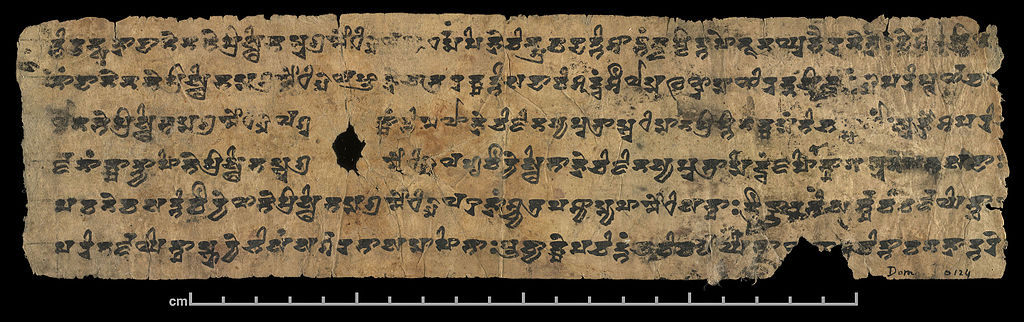
Fragmentary Kharosthi Buddhist text on birchbark (Part of a group of early manuscripts from Gandhara), first half of 1st century CE. Collection of the British Library, CC0, via Wikimedia Commons

Sanskrit is a language that was brought to India by invaders who called themselves the Arya (“the noble”), but had origins in what is now Iran. They came to India sometime after 2000 BCE and settled across northern India and surrounding areas, subjugating the native population, and bringing their religious values with them. From there, we see very early religious inscriptions such as the Rig Veda, composed in very old Sanskrit (e.g. “Vedic Sanskrit”).

But, gradually, Sanskrit and what was spoken informally “on the ground”, diverged. This diverged by regional variances, social classes, etc. They could probably understand each other’s regional dialects the same way that Americans can understand Australian English, and Australians understand American English, or Scottish English, etc, and all of them differ from “textbook English” also known as Standard English.

One might also draw an example from Latin. Classical Latin, such as the writings of Cicero, differed from “vulgar Latin” such as that spoken in the provinces. Further, vulgar Latin as spoken by the Celts in Gaul probably differed from vulgar Latin spoken by Berbers in north Africa or Egypt. Even Cicero’s spoken Latin probably differed than his writings.

A map of the kingdoms of north India roughly around the time of the Buddha. Avantiputra7, CC BY-SA 3.0, via Wikimedia Commons

Such regional dialects or variances of the original Sanskrit included:

  • Magadhi – A language spoken in the kingdom of Magadha, and quite likely the Buddha’s native language. It is spoken today in India as well, but like Ancient Greek has changed over time to its modern version.
  • Kosalan – A language spoken in the neighboring kingdom of Kosala, also mentioned in early Buddhist texts.
  • Arda-Magadhi – “Half-Magadhi”, a possible predecessor to Magadhi above, or at least closely related.
  • Paishachi – A popular, possibly literary-only language, though more research is needed.
  • Maharashtri – A language spoken more to the southwest of India and frequently used in poetry. Modern day Marathi and Konkani derive from it.
  • Gandhari – A prakrit spoken in north-west India, in the important region of Gandhara, and used in some Buddhist scriptures composed in the region, instead of Pāli. Examples of recoverd texts here.

Here’s an example I found on Wikipedia:

In Pali language (we’ll get to that shortly):

Yo sahassaṃ sahassena, saṅgāme mānuse jine;
Ekañca jeyyamattānaṃ, sa ve saṅgāmajuttamo.

Greater in battle than the man who would conquer a thousand-thousand men, is he who would conquer just one — himself.

The Dhammapada verse 103

…compare with Ardhamagadhi:

Jo sahassam sahassanam, samgame dujjae jine.
Egam jinejja appanam, esa se paramo jao.

One may conquer thousands and thousands of enemies in an invincible battle; but the supreme victory consists in conquest over one’s self.

Saman Suttam 125

Speaking of Pāli, what’s up with Pāli? The earliest Buddhist scriptures, or sutras, are recorded in Pāli language, but Pāli isn’t technically a Prakrit like those shown above. It seems to be a language that arose as a kind of lingua franca between Prakrits.1

It makes sense why early Buddhist sutras are recording in it then: rather than recording in each Prakrit for the benefit of local audiences, pick something that was generally understood, even if imperfectly.

Pāli may have arisen around the 3rd century BCE, two to three hundred years after the Buddha, so here’s a hypothetical (repeat: hypothetical) timeline:

  1. The Buddha preached in his native language, Magadhi (assuming that’s what he spoke), probably around the 5th or 6th century BCE. It’s also possible he used other Prakrits as well depending on his audience, assuming they were mutually intelligible.
  2. Disciples remembered his teachings, and per Buddhist tradition, recited them as beset as they could recollect after this death in the First Buddhist Council.
  3. Per existing Indian tradition, the teachings were then passed down for centuries from teacher to students.
  4. As Prakrits developed and diverged over time, it probably became harder to keep things consistent across Buddhist communities, and the communities relied on more. Since it was widely used anyway, this was probably a simple, practical move.
  5. As Buddhist tradition changed from oral to written history, Pāli was the logical choice for some Buddhist schools, such as the Theravada. Other Buddhist school at the time stuck to local Prakrits (some of which became part of the Mahayana canon later), such as in the Gandhara region.
  6. As Buddhism spread even further, and Pāli fell out of use in India, Sanskrit became the liturgical language of choice and Buddhist scriptures, notably in the Mahayana tradition were shoe-horned into Sanskrit in successive waves. Given the rise of Hindu religion, which relied on Sanskrit for scripture, Buddhist communities may have felt the need to “keep up”.

Anyhow, this is speculation, but seems to fit what I’ve learned so far, and shows a fascinating evolution where Sanskrit sets the foundation, but dialects flourish until a new lingua franca is needed (namely, Pāli), until things sort of come full-circle and return to Sanskrit again, at least for the Mahayana tradition.

However, a couple points should be emphasized:

  • The Buddha probably didn’t preach in Pāli language. We may never know exactly what the language was, but it is likely a local prakrit, or more than one.
  • Prakrit languages are neither Sanskrit nor Pāli, but possibly developed in this order (more research needed): Sanskrit at time of migration into India -> Prakrits -> Pāli -> Classical Sanskrit

Thanks for reading!

1 Speaking of “prakrit”, there is not a universally agreed upon standard as to which languages at the time are prakrits, and which ones aren’t. In some broader definitions, Pāli language is considered another prakrit. As an amateur, I have no opinion one way or another.

The Big Buddhist Headache: Language and Sacred Texts

Recently, I made a lengthy rant on Twitter about my frustrations with learning Sanskrit in order to read Buddhist texts. The issue is a surprisingly complicated one, and something I wanted to explore here a bit more.

When you look at religions of the world, Buddhism is somewhat unusual in that it is not rooted in a single, sacred text. No Bible, No Quran, etc. Buddhism has many sacred texts, or sutras, all purportedly the words of the Buddha. These teachings where then passed down by his disciples, yet nothing was actually written down until centuries later. This is not as bad as it sounds. By the Buddha’s time, India already had developed a sophisticated tradition around memorizing sacred texts and teaching them disciples. Non-Buddhist examples include the Vedas (the forerunners to the Hindu religion). People believed at the time that writing sacred teachings down would put them on the same level as mundane receipts and political documents, and was thus considered profane.

Attitudes changed by 1st century CE, but by now those sermons of the Buddha that had been carefully passed down were scattered in various collections, and different Buddhist schools had slightly different collections from one another. Worse, the languages used to transmit the teachings had diverged.

Which Language?

The Buddha, in his time, warned against using the priestly Sanskrit language to transmit his teachings, preferring instead local dialects, but even at that time, India had many, many dialects. Pāli was a very popular one, and remains so for some Buddhist traditions, but as Buddhism grew, keeping track of Buddhist sermons via local dialects probably became less and less practical.

Thus, in the end, Buddhist texts began to be recorded in Sanskrit. Every educated person in India probably knew at least some Sanskrit, just like educated medieval Europeans knew at least some Latin or Greek.

This conversion to Sanskrit wasn’t an overnight swap, however. Research into “Buddhist Hybrid Sanskrit” shows that the transformation was a gradual one: Buddhists would first write things down in a way that looked “Sanskrit-ey” (but not actual Sanskrit), then later generations would write something down that actually used Sanskrit, but still peppered with local colloquialisms. Eventually, even later texts were composed in “true Sanskrit”, at least something that Pāṇini would hopefully approve of.

So, what we see is a kind of gradual spectrum from early texts being composed in local dialects (primarily Pāli) and then gradually transforming into Sanskrit.

The difference, by the way, between Pāli and Sanskrit isn’t as dramatic as it sounds by the way. Pāli, like many Prakrits, was a local languages that derived from Sanskrit, and still had much in common with it. Just like Italian, Spanish, French, etc., all derived from Latin in some way.

To illustrate this, let’s look at a basic word like “king”. In Sanskrit, it is rājaḥ, and conjugates like so (not a complete chart):

CaseSingularDualPlural (more than 2)
Nominativerājaḥ (rājo)rājaurājāḥ
Accusativerājamrājaurājān
Instrumental
(e.g. “with” or
“by means of”)
rājenarājābhyāmrājaiḥ
Dative
(e.g. “to” or “for”)
rājāyarājābhyāmrājebhyaḥ
Note: due to Sandhi rules, rājaḥ frequently becomes rājo to smooth things out. Sanskrit also has Genitive, Ablative, Locative and Vocative cases too., but I’ve omitted them for brevity.

…and so on. Pali is a bit more streamlined by comparison being a more colloquial language by nature, so one word for king is rāja (i.e. without the visarga ḥ sound at the end):

CaseSingularPlural
Nominativerāja (rājo)rājā
Accusativerājaṃrāje
Instrumental
(e.g. “with” or
“by means of”)
rājenarājebhi or rājehi
Dative
(e.g. “to” or “for”)
rājāya or rājassa1rājānaṃ
This form appears to be more commonly used according to this Pali textbook written by Ven. Nerada Thera

At first glance, Pali kind of reads like the kinder, gentler version of Sanskrit. The dual form is almost entirely non-existent,2 and the sounds are softer, and lacking the ḥ (visarga) at the end. However, you can see they share similar grammatical structures, pronunciation, etc.

So, the first challenge with Buddhist text is this gradual transition from local dialects to literary Sanskrit, spanning hundreds of years. If you picked a particular Buddhist sutra, it might be somewhere in the middle of this transition: is it Pali? is it Sanskrit? Sanskrit with Pali terms, or Pali with a Sanskrit “polish” to it?

How Is It Written?

The second issue is the written script.

Some languages are closely tied with their script: Greek language is written in the Greek alphabet (obviously), while Korean is written in Hangeul. Other writing systems are not: the Roman alphabet is used in many languages: English, French, Vietnamese, etc. In medieval times, Chinese characters were used by a wide variety of disparate languages: Chinese, Japanese, Vietnamese, Khitan, etc.

So, languages are not always tied to a particular writing system. Also. some writing systems are not tied to a particular language.

Sanskrit (and Pali) have been written down using a wide variety of scripts across the ages. Early writings were done using Brahmi script, and Brahmi itself evolved into newer and better writings systems over time leading to the most common example today: Devanagari.3 Many, many modern languages in India and beyond are written in some script derived from Brahmi.

This includes Buddhist texts, too!

Inscriptions by Emperor Ashoka might be written in old Brahmi script:

An inscription from the Pillar of Ashoka at Sarnath, CC BY-SA 3.0 http://creativecommons.org/licenses/by-sa/3.0/, via Wikimedia Commons

…while texts written in palm leaf might also be written in Sanskrit, but using a derivative script:

The Lotus Sutra written in Sanskrit in an early form of South Turkestan Brahmi script, courtesy of Wikipedia.

You can see that while both are Buddhist (or Buddhist-historical) subjects, they are not necessarily written in the same script. Further examples include later Siddham script, often used in mantras and other esoteric practices by some schools:

The Heart Sutra as written in Siddham script, courtesy of Wikipedia

Then there’s other one-off, but important scripts like Karoshthi and so on.

This is not that unusual by the way when dealing with widely-used languages from antiquity, by the way. Although Greek was always written in the Greek alphabet, the style of writing could be vastly different depending on regional variations, such as those found on Egyptian papyrus vs. modern textbooks. Latin wasn’t always written in big block letters; it had its own cursive form that was more frequently used, and is pretty obtuse to modern Westerners without some training first.

Does Any Of This Matter?

For the average day-to-day practice of Buddhism? Nope.

Buddhism has always been at heart a religion of practice, not dogma. The Buddhist tripod of wisdom, conduct and practice (i.e. chanting, meditation, etc) has two “legs” which involve day to day action. Wisdom is important too but differs from dogma in that it’s not something you believe, but something you learn.

So, you could follow the Buddhist path perfectly fine if you focus on these things, and never bother with ancient languages, relying on acceptable translations instead. Studying the sutras is a helpful practice in Buddhism, but there are already plenty of good translations.

However, if you get into a more professional position either as a teacher, scholar, monk, nun, or priest, etc., knowing some command of Pali, Sanskrit, Classical Chinese, or Tibetan is really helpful. It won’t necessarily make you a better Buddhist, but may help you be a better teacher to others.

Back in 2019, I tried my hand at learning Sanskrit, with the intention of reading Buddhist texts natively, partly for fun, partly for curiosity, partly because I was frustrated by shoddy, overly sectarian translations. What I found is that modern Sanskrit courses and texts overwhelmingly focus on Hindu content, and insist on teaching Devanagari script, which makes sense, but neither of which is appropriate for the study of Buddhism.

Thus, my efforts to learn Sanskrit have languished for a long time.

These days, I would like to try again, but I believe that to effectively learn Sanskrit for the purposes of studying Buddhist texts, the following caveats might be helpful:

  1. Learning Devanagari is not required. Buddhist texts are written in a wide variety of scripts but usually not Devanagari. There are some excellent resources for Buddhists texts preserved in Sanskrit, but using the Roman alphabet. This may sound weird, but as we discussed above, Sanskrit has never been tied to one writing system. One script is as good as another. Seriously.
  2. Much of Buddhism’s corpus of sutras and sacred texts aren’t even “pure” Sanskrit anyway. Just as one might learn ancient Greek starting with Homeric Greek before moving onto Koine, the study of Buddhist texts may benefit by starting with Pāli and then migrating to Sanskrit as needed. Even learning a bit of Pāli might be a nice way to get back in touch with early Buddhism and as close to the Buddha’s words as we might ever get.
  3. Alternatively, rather than trying to use a “one size fits all solution”, find a Buddhist text you are interested in, and determine how it was written, what language, etc, and start from there. Again, there are parallels to ancient Greek. The New Testament isn’t written the same way as Euripides, nor Hesiod. You have to accept that Buddhist texts are similarly written at different times by different people.
  4. One thing I haven’t really talked about so far is Classical Chinese. Much of the Buddhist canon, now lost in India, is preserved in Chinese and epitomized in the Taisho Tripitaka formalized in Japan in the 1920’s. If you want to study ancient Buddhist texts, studying them in Classical Chinese might just be as useful, if not more useful, in some cases. The Heart Sutra, for example, was first written in Chinese and then back-ported into Sanskrit later when Xuan-zang journeyed to India.

Anyhow, this is one amateur’s look at the situation, something I’ve learned the hard way. Your mileage may vary, but if you wish to study ancient Buddhist texts, I hope this helps.

2 According to this textbook, only two words in Pāli have a dual form: dve or duve (two), and ubho (both).

3 Southern Indian languages also use scripts adapted from Brahmi, but through different evolutionary course, hence they look quite different than northern Indian languages.