The Dynamic Duo of Zen and Pure Land

A few months ago, I made this post about how the Obaku Zen sect interprets Amida Buddha and the Pure Land. To my surprise, I keep reflecting on this phrase from time to time, almost like a Zen koan:

This mind is the Pure Land,
this body is Amida Buddha

This idea of merging Zen and Pure Land ideas is somewhat rare in Japanese Buddhism, but it’s surprisingly common in Chinese-Buddhist thought. Originally, I thought it was limited to later Ming-Dynasty Buddhism (which Obaku descends from), but similar strands of thought exist much further back.

A famous Chinese monk named Yongming Yanshou (永明延壽. 904 – 976) once wrote a poem titled the “Four Alternatives” (sì liào jiǎn 四料揀):1

Lacking both Chan and the Pure Land, it will be the iron beds and bronze pillars [of hell] for ten thousand kalpas [eons] and a thousand lives with no one to turn to.

Having Chan but lacking the Pure Land, nine out of ten will stray from the path; when the realm of the aggregates appears before them, they will instantly follow it.

Lacking Chan but having the Pure Land, ten thousand out of ten thousand who practice it will go [to rebirth]. Having seen Amitābha, why worry that one might not attain enlightenment?

Having both Chan and Pure Land, one is like a tiger with horns [i.e., doubly capable]. Such a person will be a teacher in the present life, and a buddha or patriarch in future lives.

translation by Charles B. Jones, “Chinese Pure Land Buddhism, Understanding a Tradition of Practice”, pg 210

Yongming is advocating a supportive model where both Zen practice and Pure Land practice work in concert. The Pure Land path is the “safer” path to follow, due to the vows of Amida Buddha, but if supported by Zen practice here and now, one is really making progress on the Buddhist path.

Further, a later writer named Yunqi Zhuhong2 (雲棲袾宏, 1535 – 1615) explained that these things were not mutually exclusive (Chinese added by me):3

To contemplate the Buddha (nianfo 念佛) is to contemplate the mind (nian-xin 念心). Birth there (in the Pure Land) does not entail birth away from here. Mind, Buddha, and sentient beings are all of one substance; the middle stream (non-duality) does not abide on the two banks (this world and the Pure Land).

Similarly, Ouyi Zhixu (蕅益智旭, 1599 – 1655) in his excellent work “Mind Seal of Buddhas” makes a similar argument: Zen and Pure Land practice are the same thing, just operating at different levels. You’re not forced to chose one or the other in your practice.

But such ideas aren’t limited to medieval Chinese-Buddhist monks. You can find such sentiments in Pure Land sutras themselves! In the Immeasurable Life Sutra is this passage (emphasis added):

“In this world, you should extensively plant roots of virtue, be benevolent, give generously, abstain from breaking the precepts, be patient and diligent, teach people with sincerity and wisdom, do virtuous deeds, and practice good. If you strictly observe the precepts of abstinence with upright thought and mindfulness even for a day and a night, the merit acquired will surpass that of practicing good in the land of Amitāyus [a.k.a. the Pure Land] for a hundred years. The reason is that in that buddha land of effortless spontaneity all the inhabitants do good without committing even a hair’s breadth of evil. If in this world you do good for ten days and nights, the merit acquired will surpass that of practicing good in the buddha lands of other directions for a thousand years.

Translation by Rev. Hisao Inagaki

In this passage, the Buddha is clearly advocating both bending your efforts toward rebirth in the Pure Land, but also making the most of the time you have here to undergo traditional Buddhist practices too because even a modest effort here is a great benefit in the future (both for yourself and others).

As I often tell my kids: “go nuts”!4

What I mean is: recite the nembutsu, meditate, uphold the precepts, or some combination thereof. You have nowhere to go but up.

But what if you can’t decide or don’t have the time?

In my opinion, start with the nembutsu. Begin just as you are, and recite it just 10 times daily. From there, add the Five Precepts when you are ready, and once you have that foundation, and are ready to branch out, then look into Zen practices. This make take months or even years. Take your time, go slow, and don’t be afraid to explore.

When I talk about the flexibility of Tendai Buddhism in Japan as well, this is what I am alluding to: start with something simple and small at first (such as a devotional practice), and gradually building upon it as you gain confidence and see the positive transformation in your life. Buddhism is kind of a SLOW, gradual religion, but like a glacier, once it starts moving, it has a wonderful momentum all its own even if you can’t see it.

Namu Shakumuni Butsu
Namu Amida Butsu

P.S. Featured blog image is another famous “Dynamic Duo”: Batman and Robin from the 1960’s series.

P.P.S. Posting kind of off-schedule just because it is fun. 😊

1 I found this on Wikipedia actually and I thought to myself “wow, this person quoted exactly the same way that I would do!”, then I realized that I had put this on Wikipedia a few years ago. 🤦🏼‍♂️

2 Pronounced like “yoon-chee joo-hong”.

3 Again, I managed to pull a quote from Wikipedia that I had unwittingly added years ago and then promptly forgot.

4 My kids ask me if they can watch TV, play Switch or whatever, and my frequent answer is “go nuts” [go crazy, have fun].

Understanding Koans in Zen

My son and I visited our neighborhood bookstore recently (shop at local, independent bookstores!) and I found this neat book worth mentioning called The Blue Cliff Record, translated by David Hinton.

The Blue Cliff Record, known in Chinese as the Bìyán Lù (碧巖錄) is actually a pretty old text in the Chinese Chan (Zen) tradition, and is a collection of Koans compiled in the year 1125 by Yuanwu Keqin (圓悟克勤, 1063–1135).1 Obviously, the koans themselves were older and handed down over time, and appear in other collections, but the Blue Cliff Record is a kind of “selected wine list” of koans. The Blue Cliff Record was compiled during the Song Dynasty in China, which while politically unstable due to the Mongols, was a cultural high-water mark of Chinese Buddhism and especially the Chan tradition. Not surprisingly, Japan’s Zen tradition imported much from this time period as well.

This is not the first time I’ve studied koans, though.

In my youth, when I first explored Zen, I had a copy of the Gateless Gate by Mumonkan, and my religion studies teacher in high school assigned us each a koan to solve in class. Of course, none of us actually solved them, but it was a fun exercise. But as with my studies in Zen, I gradually forgot about it until recently, so it’s like coming back full circle after more than 30 years (!).

But what the heck are koans?

“Koans” are more properly called Gōng-àn (公案) in Chinese. The word “kōan” is how those Chinese characters are pronounced in Japanese, and this term is more widely known to Westerners.2 Koans are cryptic dialogues, often between a master and student, and widely used in the Lin-ji school of Chan Buddhism. As we saw in my recent post, Lin-ji is predominant in China, but also spread to neighboring countries, and in Japan’s case it became both the Rinzai and Obaku sects (albeit different centuries). Temples such as Kenninji and Ryoanji are examples of famous Rinzai temples in Japan. The Soto Zen tradition doesn’t rely on them as much, but inherits the same collections, as it is desecnded from the Cao-dong (not Lin-ji) school in China.

David Hinton in his foreword on the Blue Cliff Record explains that the key to understanding a Koan is to see it like a kind of public law case. When law students review famous court cases, they have to review the nature of the complaint, evidence presented, the judge’s decision, past precedence, etc. If you’re not a law student, this is hard. But if you’ve been practicing law for a long time, immersed yourself in it, then you see it with a different eye.

In the same way, Mr Hinton writes, a Koan is like a “public sangha case”. The “sangha” is one of the Three Treasures of Buddhism, and means the Buddhist community at large. So, these are public sangha cases for students to review, contemplate, and so on.

The truth is, when you read a Koan for the first time, it basically makes no sense whatsoever. You might think you get it, then you gradually realize that you really don’t. Then it gets under your skin, and bothers you enough that you might stick with it, until maybe one day, you look at it and you think “duh, of course!”

But also, some “public sangha cases” will resonate with you more than others, or at different times in your life.

Since I don’t participate in any Zen communities at present, I decided to do a little experiment. The Blue Cliff Record has exactly 100 cases in it, and being a giant nerd, I decided to pick one at random as my koan to contemplate. I took 2d10 dice from my Dungeons and Dragons set. Then, I briefly prayed to Kannon Bodhisattva and Shakyamuni Buddha and rolled the dice. I got koan #20 which David Hinton translates as “Dragon-Fang Meditation Clapper”:

When he was a monk traveling, Dragon-Fang Mountain asked Kingfisher Shadowed-Emergence: “What is the ch’i-weave mind [意] Bodhidharma brought from the West?”

“Pass me the clapper to announce meditation,” said Shadowed-Emergence.

Dragon-Fang passed the wooden clapper to Shadowed-Emergence, who swung it and struck Fang a blow.

“You can strike me all you want,” hissed Dragon-Fang, “But there’s still no ch’i-weave mind for Bodhidharma to bring from the West.”

Traveling years later, after his awakening under Fathom Mountain, Dragon-Fang asked Purport Dark-Enigma: “What is the ch’i-weave mind Bodhidharma brought from the West?”

“Pass me the meditation cushion,” replied Dark-Enigma, who swung it and struck Fang a blow.

“You can strike me all you want,” hissed Dragon-Fang, “But there’s still no ch’i-weave mind for Bodhidharma to bring from the West.”

Translation by David Hinton

Confusing? Yes. Mr Hinton takes the unusual approach of translating the monks’ names into English, hence “Dragon-Fang” and “Shadowed-Emergence”, etc. so it takes a bit of getting used to. The term “ch’i-weave mind” (意)3 takes 2 pages to explain at the end of the book, and I can’t do it justice, but for simplicity here I will crudely summarize it as the Big Mind, as opposed to one’s normal everyday mind.

Even so, this koan doesn’t make a whole lot of sense. I think I get it, but do I really get it?

I suppose time will tell…

Namu Shakamuni Buddha
Namu Amida Buddha
Namu Kanzeon Bosatsu

1 Pronounced like “yuen-wu kuh-cheen”

2 Many Buddhist terms in Japanese are just local pronunciations of Chinese-Buddhist words (often from Hokkien dialect, not Mandarin, due to its proximity to the Japan islands). This same trend happens with Korean-Buddhist words, Vietnamese-Buddhist words, and so on. If this sounds strange, consider religious words in English. They are often derived from Latin, for obvious reasons, but the pronunciation gets muddled over many generations, especially since they were often filtered through Middle-French (via conquering Normans). This is how religious ideas and words spread.

3 This Chinese-character is used in such Japanese words as:

  • 意味 – imi or “meaning”
  • 意識 – ishiki or “consciousness”
  • 注意 – chūi or “caution”
  • 用意 – yōi or “to prepare or provision something”

…. you get the idea. It’s used a lot, but kind of abstract too.

Conduct, Then Practice

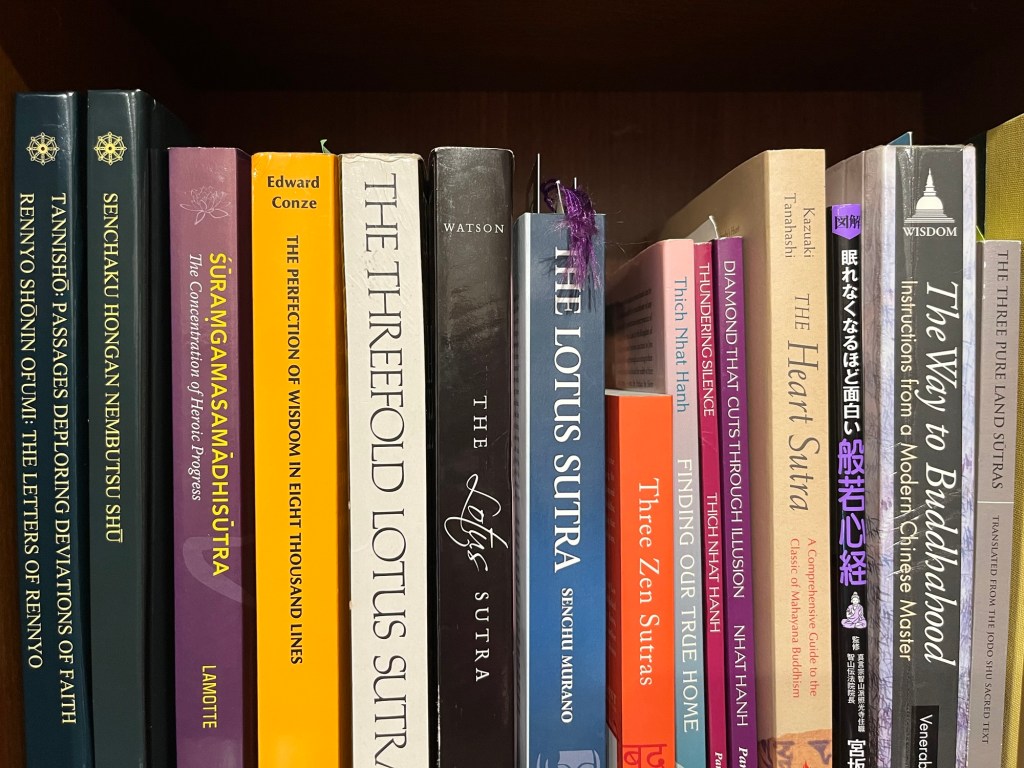
A photo of the Shurangama Sutra (the purple book on the left) from my personal collection. I purchased this years ago at Powell’s City of Books and haven’t found a copy since.

In my last post, I talked about Tetsugen Doko’s open-minded approach to Buddhist practice especially among his lay followers. But there was one thing that Tetsugen Doko did not compromise on.

In 1674 in the castle town of Mori (now Oita Prefecture), Tetsugen gave a controversial Buddhist lecture on the Shurangama Sutra, an influential Buddhist sutra in China not widely discussed in Japan. The lecture caused an uproar.

Tetsugen later summarized the lecture contents in an affadavit as follows (emphasis added):

I lectured first of all about the good and evil of the False Dharma and the True Dharma in the Final Age, which are referred to as the Three Absolutes in the Suramgama Sutra. Those who practice without keeping the precepts set out by the Buddha all represent the False Dharma. The reason for this [is as follows:]

Although practices such as chanting the Nembutsu, seated meditation, and reciting the sutras are each practiced differently depending on the abilities of the believer, the precepts against taking life, stealing, sexual misconduct, lying and the like are absolute, regardless of the sect. Not to keep them is unacceptable. Therefore these precepts are called “absolutes.”

This lecture earned him the ire of the local Jodo Shinshu community whose priests did not, by tradition, uphold any precepts. The local members rioted and multiple arrests were made by the authorities, who feared a return of the Ikko-Ikki riots, and Tetsugen quietly left town to avoid further trouble, especially for the feudal lord who had sponsored the lecture.

Nonetheless, more and more I believe that Tetsugen is correct: the basic lay precepts (a.k.a. the Five Precepts) should be front and center of one’s practice. Everything is grounded on that. Not the other way around, as I believed. What practices you choose to undertake are secondary to how you conduct your life the rest of the time.

I spent many years in my pursuit of the Buddhist path, fretting about doing the right practices, and chanting the right things, but these days I feel that the way to not be a dickhead is to simply stop acting like a dickhead. This is what the “training rules” of the precepts do: file away the sharper edges so that one’s Buddhist practice has a solid foundation.

Easier said than done? Oh yes.

Is it worth the effort anyway? Yes, definitely.

Namu Amida Butsu
Namu Shakamuni Butsu

Highs and Lows

Dr Helen J Baroni’s excellent book Iron Eyes covers the life and writings of Obaku Zen master Tetsugen Dōkō (鉄眼道光, 1630–1682). I’ve mentioned it in a few older posts, but I wanted to share a couple of Tetsugen’s poems really stood out to me:

41. MEETING AN OLD FRIEND

Separated east and west for twenty years.

You exclusively chant the Buddha’s [name, a.k.a. the nembutsu], while I practice meditation.

We meet together, why argue over high and low.

The wind and the moon originate in the same heaven.

Page 167

The “high and low” refers to the perception that the path of monastic self-discipline (as exemplified by the Zen tradition) is the “high road”, while the “low road” is instead relying Amida Buddha’s compassion to be reborn in the Pure Land. Here, Tetsugen argues that they both reach the same destination in the end, so the distinction doesn’t really matter.

Another poem he wrote is:

44. GIVEN TO THE FAITHFUL BELIEVER JONYU, WHO CHANTS THE BUDDHA’S NAME

The body is healthy, the years pour out; your ears and eyes are [still] clear.

Contented and unselfish, you reject personal glory.

Reflected light, in a single moment you penetrate the self.

For the first time you realize that practitioner and Dharma are complete in one body.1

Page 168

What really strikes me about these two poems is that Tetsugen openly acknowledges that his lay friends and followers recite the nembutsu and he’s totally fine with it.

It’s assumed in Japanese Buddhism that a sect practices meditation, or chanting, but not necessarily both. It’s also assumed that Zen people only hang out with Zen people, Pure Land Buddhists with Pure Land Buddhists, etc. There were exceptions: people like Ikkyu and Rennyo who were friends despite totally different practices and backgrounds, but you don’t hear about these often. Yet, in spite of this image, Tetsugen clearly was open to lay people practicing the Pure Land path and saw no conflict with this.

This makes more sense when you consider that Obaku Zen, a cousin of the Rinzai Zen sect, came to Japan from Ming-Dynasty China, when Zen and Pure Land thought had largely reconciled there. The excellent writings of Chinese monk Ouyi Zhixu (蕅益智旭, 1599–1655)2 and Yunqi Zhuhong (雲棲袾宏, 1535–1615)3 are typical of the thought at the time: both Zen and Pure Land Buddhism are different ways of approaching the same Dharma (e.g. Buddhism). One blends into the other.

Even modern Chan (Chinese Zen) teachers such as my favorite, Yin-shun (印順, 1906–2005), had no trouble recommending the nembutsu alongside other practices. In his book The Way to Buddhahood, he wrote:

If therefore, one is timid and finds it difficult to practice the bodhisattva-way, fearing that one will fall into the Two Vehicles or that following the karmic forces will cause one to drift apart from the Buddha Way, then chanting Amitabha Buddha is most secure! It is a wonderfully skillful means that can best embrace and protect those sentient beings who are beginners so that they do not lose their faith.

page 249

But I digress.

It should be noted that Tetsugen in particular was raised in the more native Jodo Shinshu-sect Buddhism and even went to Kyoto to train as a priest but eventually decided to pursue Obaku instead. So, perhaps he still had some connections toward his religious upbringing.

Nonetheless, all this is to say that Obaku Zen, having inherited such an outlook from Chinese Buddhism, takes Amida Buddha as its ideal, but sees Amida in more Zen terms. One is not required to see Amida that way upfront; it just comes in time with practice. Come as you are, and don’t worry if it doesn’t make sense. Someday, it will.

Namu Shakamuni Butsu
Namu Amida Butsu

1 According to Dr Baroni’s footnotes: Kihō, can also be translated as “opportunity and Dharma,” in Pure Land thought, it means that while the sentient beings believe in the Buddha, the Buddha’s power saves sentient beings. Personally, I like to think this relates to Shoku’s comment about the Three Karmic Bonds, too.

2 Pronounced like “Oh-ee Jih-shoo” in English

3 Pronounced like “Yoon-chee Joo-hohng” in English

Obaku Zen Morning Service

This is just another small, bonus post. A little while back, I was looking into the Obaku school of Zen, but even in Japanese information is pretty hard to find. However, I was able to find this sound clip from the NHK. This is a sound clip of a morning service at Manpuku-ji Temple, the head temple of the sect.

What distinguishes Obaku Zen (ōbaku-shū, 黄檗宗) from other Zen sects, and Japanese Buddhism in general is how late it was imported into Japan from China. Most sects imported during the Tang or Song dynasties, namely 8th or 11th centuries. But Obaku Zen came to Japan during the Ming Dynasty (14th century). It shares the same common lineage as Japanese Rinzai Zen, so they’re sibling sects. Yet, across centuries some things had diverged, and Obaku imports a lot more Ming-era Buddhist aspects, such as a fusion of Pure Land and Zen teachings (which came later in Chinese-Buddhist history), and changes to liturgy and pronunciation.1

So, if you ever see Obaku Zen liturgy (I’ve only seen a few screenshots), it sounds somewhat different even when it’s the same liturgy, because pronunciation changed over time in China.

Anyhow, just a minor nerd moment. Please enjoy!

1 Languages change and shift, including Chinese. Chinese-Buddhist liturgy imported to Japan from the Tang Dynasty would sound different than the same imported into Japan during the Ming. If that seems far-fetched, look at English language.

The Pure Land Within

唯心の浄土 己身の弥陀
yuishin no jōdo, koshin no mida

“This mind is the Pure Land, this body is Amida Buddha

source: https://www.oubaku.org/oubaku.html

I’ve always been fascinated when Zen and Pure Land teachings overlap, and recently I was poking around the Internet looking at some websites related to the Obaku sect of Japanese Zen. I’ve mentioned this sect before in the context of its most famous monk Tetsugen (older post here).

Ōbaku Zen (黄檗宗, ōbaku-shū) is a lesser-known sect of Zen in Japan because it arrived much later (17th century) from the Chinese mainland than Rinzai and Soto Zen (13th century) did. Obaku Zen and Rinzai actually have the same source lineage in China, but by the Ming Dynasty in China (when Obaku came to Japan), the Buddhist culture there had largely reconciled Pure Land and Zen thinking and so Obaku contains a lot of Pure Land influences not found in Rinzai, though in all other respects they are basically the same.1 They even share a homepage together.

The quote above comes from a youth periodical for Obaku Zen monks, and I have read similar teachings before from Zen sources. I even quoted the same website in a past post, but after recent events, for some reason this makes a lot more sense than it used to.

If you look at the Hymn of Zazen by Hakuin (a Rinzai monk), he teaches something similar: people are inclined to look for the truth elsewhere, but it’s right under our noses. The last verse of the Hymn even says explicitly:

当所即ち蓮華国此身即ち仏なり
Tōsho sunawachi rengekoku,
kono mi sunawachi hotoke nari

This very place is the Lotus Land,
this very body the Buddha.

translation by Robert Aitken Roshi

The only difference between these two quotes is that Obaku Zen uses the imagery of the Pure Land of Amida Buddha, while Hakuin uses the Pure Land of Shakyamuni Buddha from chapter sixteen of the Lotus Sutra. But as we saw in the Shushogi recently,2 one Buddha’s the same as another. You can call it what you want, the teaching is the same.

It’s easy to understand all this on an intellectual level, but to really “get it”, can take a lifetime or many lifetimes. Or, perhaps I am just thick-headed. 😅

In any case, twenty years as a Buddhist, and yet the Dharma never ceases to surprise me…

Namu Shakamuni Butsu
Namu Amida Butsu

P.S. Translating the Japanese-Buddhist term 唯心 (yuishin) is tricky. This is actually the term “Consciousness Only” as in the Chinese-Buddhist term for the Yogacara school of Buddhism, wherein there is no reality outside of one’s own consciousness (mind). But that’s hard to write in full, so I translated, perhaps clumsily, as this mind (as in one’s own mind, one’s own perception).

1 It’s tempting to think that Rinzai is a more “pure” form of Zen, or that conversely Obaku is a more “polished” version than Rinzai. I leave that to people’s own interpretations. I used to assume that older sects equaled more pristine teachings, but these days I am not so sure.

2 Other sources include the “Parable of the Magic City” in the Lotus Sutra, and the opening paragraphs of the Sutra of the Buddha of Immeasurable Life among other places. Although Mahayana Buddhism isn’t alwys internally consistent, there are certain overarching themes throughout its history and they show up in unexpected places.