Ying Nan: You are a product of all who came before you. The legacy of your family, the good and the bad, it is all a part of who you are.
Shang-chi (2021)
My kids and I have been watching the Marvel MCU movies for years. My firstborn is particularly a Marvel fan since she was a little girl. Some of the movies are better than others (my personal favorite is Thor: Ragnarok),1 but we both really like the movie Shang-Chi and the Legend of the Ten Rings.
When my wife (who is Japanese) and I first dated, there was an immediate clash of cultures. I was a generic American white kid who grew up in an impoverished broken home with lots of issues, my wife grew up in a working-class Japanese family that was not overly traditional, but still very Japanese compared to American standards. The fact we were dating in the first place was a bit awkward for her and her parents, whereas I hardly ever talked to my own parents.
The good news is that over time, we learned to understand one another, and that means that I too learned to appreciate her viewpoint sometimes. For example, family.
Even when she disagreed with her parents, she still respected them, and understood her family obligations. This was something frankly new to me because I openly rebelled against my parents, told my dad off, and hardly paid them any heed. I gradually did reconcile with my parents to some degree as I got older (and a bit wiser), to a level where we can get along, but more importantly I learned to accept that I am who I am due to my family. Like the quote above says, you can’t deny your own heritage, both the good and the bad, and that it does shape who you are.
But also, through my wife and through parenting myself, I learned that I do owe some level of gratitude to my parents for what they did. I chose not to be like my parents in how I raise my kids, but even that is something I learned from them.2 Thus, the lesson I learned from my wife is that I also have to be humble, and respectful to my parents enough to acknowledge what they’ve done for me, even if I disagree with them. This is a very Confucian outlook, but I can see the value in this.3
It rubs against my American sense of individualism, but I’ve found it a valuable lesson over the years, and something I think we can all learn from.
P.S. Xu Wenwu, the father in Shang-chi, is a great example of a plausible chaotic-evil person in Dungeons and Dragons: he craves absolute power and yet is also capable of being in love, being a father, etc. Yet, he inevitably bends everything toward evil or ruin, including his lawful-good wife, Ying Li. Tony Leung Chiu-wai‘s performance was excellent.
1 The Thor movies do a really nice job of weaving science fiction with magic and myth, much like Roger Zelazny did in his books generations ago (Lord of Light, the Amber Series, Creatures of Light and Darkness, etc.). Put simply, I like weird, transcendent stuff more than the “grounded” story lines like Captain America or Black Widow.
2 In Japanese there is a four-character phrase for this: hanmen kyōshi (反面教師) meaning to learn from a bad example (i.e. what not to do).
3 This importance in family isn’t even limited to Confucian-influenced cultures. You can find it in many unrelated world cultures where family is emphasized, and respect towards one’s ancestors. For whatever reason, it is not emphasized in Western culture, and maybe to our detriment I think.
A little while ago, when talking about Japanese mythology, I alluded to the belief in the divine origins of the Japanese imperial family through their reputed ancestor Amaterasu Ōmikami (Amaterasu for short), kami of the sun. This lineage and how they came to rule Japan is recorded in two very old historical texts: the Kojiki and the Nihon Shoki.
Since I have been reading a fun book in Japanese about the Nihon Shoki, we will focus on that one. Just know that the origin story in Kojiki is mostly the same.
The Nihon Shoki begins as a series of myths about the creation of Japan, followed by stories of different generations of kami, culminating in Amaterasu’s grandson, Ninigi-no-Mikoto who descends to earth. Next, Ninigi had a great-grandson, named Kamu-yamato Iware-biko no Sumeramikoto (神日本磐余彦天皇),1 and in time “Iware-biko” became the first emperor of Japan, the legendary Emperor Jimmu (jimmu tennō, 神武天皇).2 We’ll explore later why this is more myth than history, but for now, let’s continue the story as recorded.
In his youth, the future emperor grew up in what later became the province of Hyuga in southern Japan, also called Himuka (日向) in olden times. By the age of 45, he had married, had children, and took care of his brothers. Then one day, he proclaimed to his family that due to his divine lineage, it is his destiny to rule the lands to the east (central Japan) which are rich and verdant, and to establish his capital there.
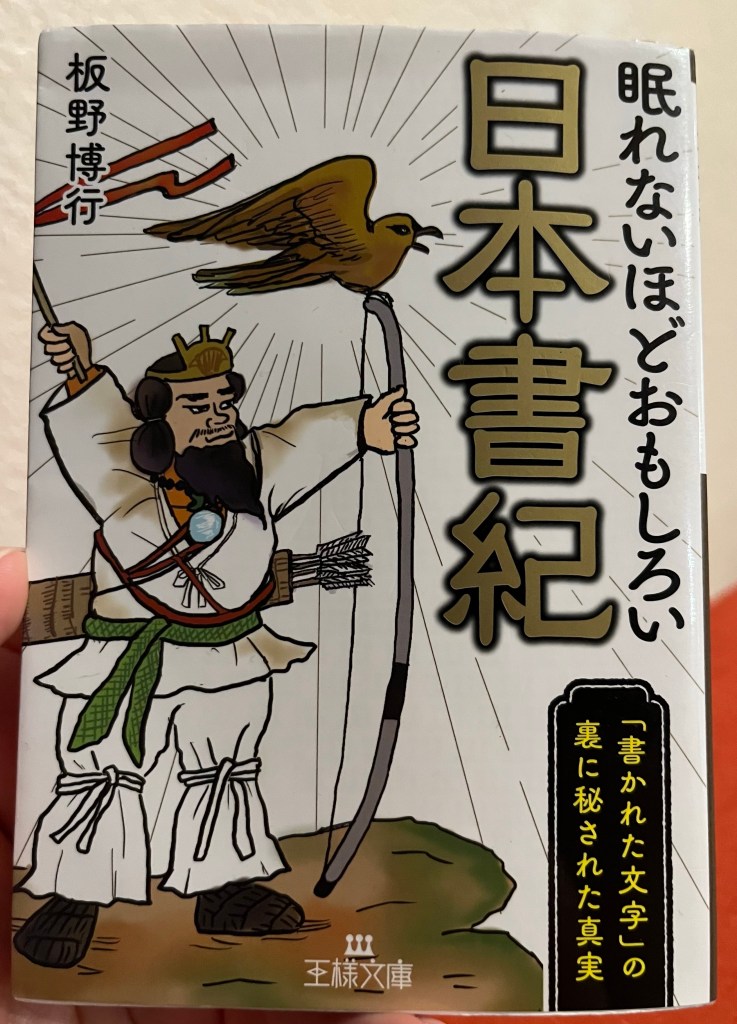
From here, Iware-biko sets out with his kin to the island of Honshu, the main island of Japan, and begins the invasion of the “Yamato” region, starting at the bay of Naniwa (later Osaka). It is here they come into conflict with the a local chieftain named Naga-sune-hiko. Sadly, Iware-biko’s older brother was killed, and the newcomers were forced to retreat. Iware-biko then reasoned that by fighting eastward, facing the rising sun, they lost the battle. Thus, he decides to sail south around the Kii Peninsula, and then attack from the east (i.e. westward). Upon reaching the region Kumano, they encountered a huge crow named the Yatagarasu (八咫烏) where “ata” 咫 means a hand-span from the thumb to the middle finger, about 18cm. So, the crow was 8 hand-spans long. The Yatagarasu was dispatched by the kami Amaterasu to help her descendant as a guide.
Once again, Iware-biko and his clan battled Nage-sune-hiko long and hard. Then, a golden-colored kite (as in bird), called the kinshi (金鵄), mounted on Iware-biko’s bow (hence the depiction above), and its blazing glare blinded their enemies. They were defeated at last.
From here, Iware-biko pacified the region, and assumed the throne as the first Emperor, Jimmu, and proclaimed that his line would “last 10,000 generations” (lit. mansei ikkei, 万世一系). Further, according to the Nihon Shoki, the first Emperor then proclaimed the phrase hakkō ichi-u (八紘一宇), or more elaborately “all under Heaven [lit. the eight corners of the world] under one roof”. The idea was basically one of universal brotherhood.
Allegedly, this unification of Japan, and its founding by Emperor Jimmu, all happened in the year 660 BCE.
Fast forward to the year 1940, as in 1940 CE.
This period was the height of Japanese militarism in the modern era, and the Youtube show Extra History has a brilliant miniseries on it:
I highly recommend viewing the miniseries if you are curious, but it helps explain a lot.
Anyhow, by 1940, this trend of nationalist fervor reached a crescendo, and it was coincidentally 2,600 years since the mythical founding of Japan. When the Greater East Asia Co-Prosperity Sphere was promulgated in 1940 by the Prime Minister at the time,3 Prince Konoe Fumimaro, he repeated an ancient phrase said to have been spoken by Emperror Jimmu: hakkō ichi-u (八紘一宇, “Eight corners of the world under one roof”). However, in Fumimaro’s modern interpretation, Asia would be united in a union of brotherhood, with Japan at the center (i.e. under one Japanese roof). This was repeated during war times as a rallying slogan as well, and questioning the historicity of the Nihon Shoki at that time was illegal.
There’s a small problem with the original historical narrative about Emperor Jimmu, though: it’s unlikely he ever existed, and it’s very doubtful that Japan was founded in 660 BC.
There is basically no archeological evidence that the early “Yamato” kingdom existed in Japan during this time. In fact, the earliest emperor that has any reliable archeological evidence is Sujin the 10th emperor, who is thought to have died around 30 BCE, 600 years later. Sovereigns weren’t even called “emperors” (tennō, 天皇) at the time, but “great kings” (dai-ō, 大王) instead. The term Emperor was reputedly used by Prince Shotoku centuries later.
So, why 660 BCE, and why the mythical lineage that probably didn’t exist?
Because the Nihon Shoki was not written for Japanese audiences. It was written for Chinese audiences in order to introduce Japan and its history. The Kojiki, conversely, was written for domestic audiences. Many of the early dates and lineages don’t line up properly, have insufficient historical evidence, or have imperial reigns that are unnaturally long. Yet as a narrative it seamlessly transitions between a divine kami ancestor and the current reigning family, and helped provide legitimacy in the eyes of the much larger and more powerful China. Even the date 660 BCE, 1260 years before the Nihon Shoki was completed, fit seamlessly with the Taoist 60-year calendar cycle to imply an auspicious beginning.
People did live in Japan back then, but we know from archaeological evidence that these were mostly hunter-gatherers, and rulers might be local chieftains at best.
What the Nihon Shoki does tell us though, through its legendary stories, heroes and such, is that pre-historical Japan was a place of many tribes, communities and confederations, and that over time the “Yamato” group came to increasingly dominate or incorporate them. For example, the ancestral kami, Ninigi, had a son in the Nihon Shoki named Yamasachi-hiko whose name includes “mountain”. Yamasachi-hiko married Toyotama-hime, who was a daughter of a sea deity. The fusion of mountains and sea ancestries is not lost on scholars.
Further, my book explaining the Nihon Shoki shows how some myths include subtle allusions to rival confederations who were defeated (or absorbed) by the early Yamato rulers. One noteworthy rival were the people of Izumo, for example. So, the Nihon Shoki can tell us a lot of interesting things about how Japan was founded, but not necessarily in the way we expect.
1 Many early figures in Japanese mythology had extremely long, grandiose names, by the way. My book on the Nihon Shoki likes to give amusing nicknames for ease of reading.
2 Thus, Emperor Jimmu was five generations removed from Amaterasu. The Nihon Shoki coveres stories and myths of each generation in between, but they are too numerous to list here. Needless to say, once Ninigi-no-Mikoto descends to the earth, things got wild.
3 Ostensibly to kick European Colonialism out of Asia, but it mostly ended up replacing European colonialism with Japanese colonialism. Not surprisingly, after WWII, many South East Asian countries fought for independence when the Europeans tried to reassert control. Enough was enough.
A few months ago, I touched on Japanese mythology and how it relates to the current Imperial family, but something I didn’t really cover were the three sacred treasures or Sanshu no Jingi (三種の神器).
These three treasures were said to be have been passed down to the first emperor of the Imperial family by their divine ancestor, Ninigi-no-mikoto. Some of these treasures are related to kami I mentioned in the mythology post and also represent ancient Japanese culture, even if their importance is more obscure now.
The three treasures are…
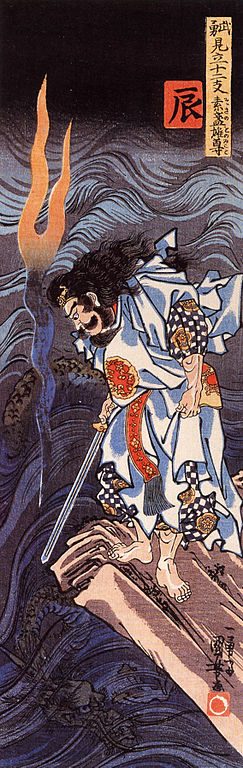
Kusanagi, the grass-cutting sword
Woodblock print by Utagawa Kuniyoshi depicting Susano-o-no-Mikoto
The sword, kusanagi no tsurugi (草薙の剣), or “grass cutting sword”, was reputedly discovered by the kami Susano-o-no-Mikoto after he slew the massive serpent, Yamata-no-Orochi, embedded inside the monster’s tail. As I mentioned in the mythology post, Susano-o-no-Mikoto, the god of storms, was banished from the heavens, and while roaming the world he came upon a family that was preyed upon by the eight-headed serpent Yamata-no-Orochi. Susano-o-no-Mikoto battled the serpent and cut it into pieces. He found the tail too tough to cut up, and inside he discovered the sword, which he kept for his own.
The sword has a particularly checkered history as it was thought to have been lost at sea during the climatic battle between the Heike and Genji clans, but then is mentioned in accounts by people who have seen the sword centuries later. It’s not clear if the sword truly was lost, and a replica was made, or the sword was never actually lost at sea. In any case, the sword as it currently exists is stored in the Atsuta Shrine in Nagoya, Japan, and never revealed to the public.
Another thing to note is that swords from that era are pretty different than the Japanese katana we normally think of. Swords in early Japanese history were thicker, straighter, similar to a Chinese jiàn sword.
Yata no Kagami, the Bronze Mirror
An array of polished bronze mirrors from Antiquity, taken by author at the Louvre in February 2024.
Mirrors in general are a sacred item in Japanese Shinto religion, and are often used in central altars, both at home (kamidana) and in major shrines, to represent the kami‘s presence. Originally, mirrors in Japan, China and beyond were made from polished bronze, but since have become replaced with polished silver, and/or glass.
The sacred mirror though is the bronze kind, and was said to be part of the legend surrounding the sun goddess Amaterasu-Ōkami, when she isolated herself. After a series of nasty arguments with her brother, Susano-o-no-mikoto (which later got him hockey out of Heaven, see above), she was fed up and retreated to a cave called the Ama-no-Iwayato (天岩屋戸). The world was plunged into darkness and all the other kami were distraught about what to do. They eventually hatched a plan to lure her out by pretending to have a party outside her cave as if nothing was wrong by her absence.
They hung a bronze mirror, the yata-no-kagami (八咫鏡), while the other kami engaged in wild song and dance. When the curious Amaterasu emerged, she was entranced by the mirror long enough that they grabbed her and sealed the cave, thus preventing her from hiding again.
During the aforementioned battle at sea between the Heike and Genji clans, the mirror was safely recovered.
Yasakani no Magatama
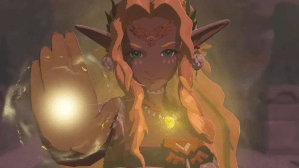
The final sacred treasure is an old magatama jewel called the yasakani no magatama (八尺瓊勾玉). Magatama jewels are something that were commonly used in very early Japanese history (later replaced by more Chinese style jewelry), so any such jewel tends to convey a sense of “primeval Japan”. Even in modern Japanese games, such as Zelda: Tears of the Kingdom, you see them prominently used to imply something of great power, but also great antiquity.
Queen Sonia wearing her magatama jewel around her neck. From Zelda: Tears of the Kingdom
Unlike the other two items, there is no particularly mythology associated with the jewel, instead it is a family heirloom, and is thought to have been passed down since the earliest days of the Imperial family. During the climactic battle between the Heike and Genji clans, the jewel and the sword were both thought lost, but later it is said the jewel was recovered.
P.S. featured photo shows the coronation of the previous emperor, the Heisei Emperor (Akihito), when the three sacred treasures were presented to him. The same ceremony was repeated by the current emperor. Photo by 首相官邸, CC BY 4.0, via Wikimedia Commons.
P.P.S. You probably noticed that kami names are quite long. These are often shortened for convenience in English, but this is somewhat inaccurate.
P.P.P.S. I started this post before my medical emergency, so it was nice to finally finish it. I have a few old drafts that are nearly done before I can move onto new content. 😏
My son is in grade school and loves world mythology, especially Greek and Norse mythology (I did too at his age 🥰). But we’ve also been introducing him to Japanese mythology since it’s part of his heritage.
The trouble is is that Japanese mythology feels “scattered” and, due to cultural differences, hard to translate into English without a lot of explanation. Further, some of it just isn’t very kid-friendly.
This post is meant to help make sense of Japanese mythology. I learned a lot about it after finding this book in Japanese about the Nihon Shoki (日本書紀), a legendary record of Japan’s foundation:
The Nihon Shoki is one of two records composed in the early 8th century about Japan’s history and origins. The other record is the Koijiki (古事記). Both were promulgated by Emperor Tenji, and both cover overlapping yet differing mythologies, so why are there two records?
The book above explains that the intended audiences were different.
The Nihon Shoki is a longer, more polished record of Japan’s foundation intended to impress Imperial China. It seamlessly transitions from mythology to the origins of the Japanese Imperial Family, legitimizing it in the eyes of their rivals in China, and even covers the life of Prince Shotoku. The Kojiki, by contrast, is shorter and includes more salacious details of some myths, and intended for domestic audiences only.
Even between the two records, some myths differ slightly, as we’ll see shortly.
In any case, much of what we know today about Japanese mythology derives from the Nihon Shoki and Kojiki, just as Greek mythology largely derives from only three sources: the Iliad and Odyssey attributed to Homer, and the Theogony by Hesiod.
The Founding Gods
The two gods credited with the founding of Japan are husband and wife Izanagi and Izanami. According to myth, they descended from the heaven realm, called Takama no Hara (高天原) and saw the primordial chaos of the world below. The Kojiki mentions 3 realms, by the way:
Takama no Hara (高天原) – the heaven realm
Ashihara no Nakatsukuni (葦原中国) – the earthly realm (e.g. Japan)
Yomi no Kuni (黄泉国) – the realm of the dead
According to my book above, the Nihon Shoki never mentions the second two, only the heaven realm. Also, if you’ve been playing Zelda: Tears of the Kingdom, you might notice some similarities….
Anyhow, Izanagi and Izanami stood over the primordial waters on a heavenly bridge called the Ama no Uki Hashi (天浮橋), dipped a spear or pike (literally hoko 矛 in Japanese, a kind of Chinese spear) into the water, and the salty water dripping from the spear tip encrusted and fell from the tip, forming the first island.
In the Nihon Shoki, they then fell in love with one another and wanted to have kids, but didn’t know how (being very new at this), and got advice from a Wagtail bird (lit. sekirei セキレイ in Japanese). Once they figured out how … the process works, they started giving birth to the “eight islands” of Japan (the Nihon Shoki and Kojiki differ slightly on what these islands are), as well as having many children, including some well-known kami :
Amaterasu Ōmikami (天照大神) – goddess (kami) of the sun, she was given dominion over the heavens. Her grandson, Ninigi-no-mikoto, is the progenitor of the Imperial family in Japan, according to the Nihon Shoki.
Susano-o-mikoto (須佐之男命) – god (kami) of storms, he was given dominion over the oceans. His son, Ōkuninushi, is a frequent figure in Japanese mythology especially relating to the founding of Japan.
Tsukuyomi-no-mikoto (月読命) – god or goddess (kami) of the moon, given dominion over the underworld. Their gender is unclear from the mythology.
However, in the Kojiki version, Izanami died when giving birth to the god of fire, and traveled to the underworld, leading to the myth shown below in the Youtube video.
The Nihon Shoki does not mention this myth, and simply states that they went on to create more gods and goddesses. In this Kojiki version, after Izanagi escaped the underworld, he purified himself under a waterfall, and from the droplets sprang more gods. In the Kojiki version, the three kami listed above were born from the water purifying Izanagi.
Sibling Rivalry
The rivalry between older sister Amaterasu Ōmikami (hereafter “Amaterasu”) and younger brother Susano-o-mikoto (hereafter “Susano-o”) drives a lot of the mythology found in the two records. Amaterasu did not like to lose, and Susano-o had a foul temper, so they often clashed.
In one story, they had a dare to see who had a pure heart (and who didn’t) by giving birth to more gods. In their minds, whoever gave birth to female goddesses had ulterior motives, while whomever gave birth to male gods did not.1 They sealed the agreement by exchanging items: Amaterasu gave her brother her jewels, and Susano-o exchanged his sword. Amaterasu gave birth to three female goddesses, and Susano-o gave birth to five male gods.
The Kojiki and Nihon Shoki differ on what happened next. In the Nihon Shoki, Susano-o cheered at first, but then Amaterasu pointed out that the male gods were born from her jewelry, thus she had the pure heart. In the Kojiki, Susano-o instead points out that the three goddesses were born from his sword, and being such sweet and kind goddesses, he obviously had the pure heart. Thus, depending on the source, different gods declared victory.
Side note: of the five male gods born, one of them, Ame-no-oshihomimi, is the reputed ancestor to the Imperial family. Of the female goddesses, they are still venerated a series of shrines in Fukuoka Prefecture (official homepage here).
In the Nihon Shoki version, Amaterasu won, but Susano-o had a huge tantrum and caused a ruckus, destroying many things, etc. Amaterasu was furious and hid herself in a cave, plunging the world into darkness. This famous myth is often depicted in Japanese artwork. The featured image above (source Wikipedia) depicts the efforts by the other kami to entice Amaterasu to leave her cave and thereby restore light to the world, including a risque dance by kamiAme-no-Uzume-no-Mikoto.
Descent to Earth
Fast-forwarding a bit for brevity, Susano-o, having been previously driven out of the heavens due to his behavior, undertakes some adventures, and rescues a maiden named Kushi-nada-himé from a massive serpent named Yamata-no-Orochi. From the serpents body came the mythical sword Kusanagi, one of the three sacred treasures (神器 jingi) of Japan by the way. The other two, the bronze mirror and jewel, were used in the aforementioned myth to draw Amaterasu out of her cave.
Susano-o and the maiden married, and their son, Ōkuninushi-no-kami (大国主神), who committed many great deeds that helped build and pacify Japan:
Interestingly, Ōkuninushi mostly only appears in the Kojiki.
Later, according to the Nihon Shoki, a kami named Takemikazuchi-no-kami (武甕槌神) was dispatched to inherit the country of Japan from Ōkuninushi who had been entrusted with its care. Interestingly, Takemikazuchi-no-kami is the patron god of the Fujiwara clan (originally the Nakatomi), and guess who helped compile the Nihon Shoki? Fujiwara no Fuhito.
Takemikazuchi demonstrated his power by sitting on a sword, point up, without losing his balance. Yes, that is as painful as that sounds. Needless to say Ōkuninushi was impressed. Ōkuninushi’s son, Takeminakata-no-kami (建御名方神) did not take this well and challenged Takemikazuchi-no-kami to a contest of strength, supposedly the first Sumo match ever, but Ōkuninushi’s son lost and fled elsewhere. Thus, Takemikazuchi-no-kami prevailed and inherited the country.
Later, Amaterasu’s grandson Ninigi2 descended from the heavens to the earthly realm with a retinue touching down at Mount Takachiho on the island of Kyushu.3 There are many versions of this myth. Sometimes Ninigi descends alone, in other versions he descends with various other kami who go on to found their own earthly clans. In some myths, he is obstructed by other kami, and in others he is bearing the aforementioned Three Sacred Treasures. In one myth, upon touching down, Ninigi jams a mythical spear, Ama-no-sakahoko (天の逆鉾) into the peak of the mountain, of which a replica exists today.
In any case, this is where the myths begin to transition to semi-legendary, semi-historical narrative, which is a tale for another day. It’s been fun to read about Japanese mythology in a more cohesive narrative, with humor and historical context thrown in, but I also read Japanese pretty slow, so it may take a little while to get to the next section.
Anyhow, I hope you enjoyed!
P.S. Thank you for your patience as I haven’t had much time to right articles lately. Outside of work and parenting, I have been working a lot on the other blog, plus enjoyingFire Emblem: Three Houses in what little spare time I have. I have more articles queued up and should hopefully get back on a regular cadence soon.
1 I wish I was making this up, but I am not. This kind of ritual to determine one’s heart was called Ukei (誓約) in Japanese, though in modern Japanese 誓約 is read as seiyaku and refers to oaths, vows or pledges in general.
2 More formally known as Amatsu-hikohikoho-no-ninigi-no-mikoto (天津彦彦火瓊瓊杵尊).
3 It’s interesting to note that many of the early myths, and older, more obscure kami in Shinto religion have some connection the island of Kyushu in particular, which is closest to mainland Asia.




 Gleanings in Buddha-Fields


You must be logged in to post a comment.