What Is A Shogun

With the conclusion of the hit mini-series Shogun,1 it seemed like good time to delve into what a Shogun was. I talked a lot about the first few Shoguns of the Kamakura Period, and the Shoguns of the late Edo Period, but there’s a lot more to the story.

In early Japanese history (a.k.a. Japanese antiquity), the government was modeled on a Chinese-style, Confucian-influenced bureaucracy. This is epitomized in the Ritsuryo Code which started in 645, under the Taika Reforms, and continued (nominally) in some form all the way until 1868.

This imperial bureaucracy elevated the Emperor of Japan to the first rank, and other officials and nobility were allocated ranks below this. The ranks dictated all kinds of things: salaries, colors to wear at the Court, other rights and responsibilities, etc. There were bureaucratic offices for all sorts of government functions: land management, taxes, religious functions, military and so on.

The imperial court did not rule all of Japan as we know it today. The north and eastern parts of Japan in particular were dominated by “barbarian” groups called Emishi whose origins are somewhat obscure but are probably ethnically different than early Japanese people.

To subdue these people, certain military commanders in the Imperial bureaucracy were granted a temporary title of sei-i taishōgun (征夷大将軍), or “Supreme Commander of Barbarian-suppressing Forces”. Since a military force needs a clear chain of command, someone had to be made the supreme commander, and this was what the Shogun was meant to do.

But everything changed after the Genpei War, and the fall of the Heike Clan.

After the Genji clan (a.k.a. the Minamoto) crushed the Heike clan, they assumed military control of Japan. The head of the Genji clan, Minamoto no Yoritomo, was granted the title of sei-i taishōgun by the Emperor permanently, and given the task pacifying the rest of Japan. The title became hereditary, not temporary, and thus created a new system of government in Japan.

The original Imperial Court, and its institutions, remained in place in Kyoto. However, practical control of Japan was managed through the new bakufu (幕府) government headquartered in the eastern city of Kamakura. This began a period of history called the Kamakura Period of 1185–1333.

From here, Japan’s history and its bakufu governments can be divided like so:

PeriodCapitolNotes
Kamakura Period (1185–1333)KamakuraAfter Minamoto no Yoritomo‘s death, plagued with infighting and power-plays by vassals. Minamoto line died with Sanetomo’s untimely death, further heirs drawn from obscure Hojo relatives.
Southern Court Insurrection
(1336 – 1392)
YoshinoEmperor Go-Daigo attempts to reassert authority of the Imperial line. Kamakura Bakufu dispatches Ashikaga Takauji to suppress rebellion, but is betrayed by Takauji.
Muromachi Period
(1336 to 1573)
KyotoFirst 3 shoguns were strong rulers, but quality of rulership slowly declines, culminating in 8th shogun Yoshimasa, and the disastrous Onin War. High point of Kyoto culture, ironically.
Warring States
Period
(1467 – 1615)
Kyoto
(barely)
After Onin War of 1467, Ashikaga Shoguns still nominally rule until 1573, but country descends into civil war. Almost no central authority.
Oda Nobunaga
(1573 – 1582)
KyotoAfter driving out last of Ashikaga Shoguns, Oda Nobunaga reaches deal with reigning Emperor and conferred titles of authority. Almost unifies Japan. Later betrayed and murdered by a vassal.
Azuchi-Momoyama Period
(1585 – 1598)
KyotoAfter unifying Japan after Oda Nobunaga’s demise, vassal Toyotomi Hideyoshi unifies, and then rules Japan as the Sesshō (摂政, “regent to Emperor”) then Kampaku (関白, “chief advisor”). Dies in 1598, and son is too young to rule. Country falls into civil war again.
Edo Period
(1600 – 1867)
Edo
(Tokyo)
Tokugawa Ieyasu, a former vassal of Oda Nobunaga, then unifies Japan for the final time, and moves capitol to a newly fortified town of Edo (modern Tokyo). Effective policies by Ieyasu and his early descendants avoids many problems of past Shogunates, and provides stable rule for 268 years until Meiji Restoration of 1868. Similar to Muromachi period, quality of rulership gradually declines, but effective policies help maintain stability far longer.2

The last shogun, Tokugawa Yoshinobu, relinquishes authority back to Emperor at Osaka Castle in 1867.

During this entire period of history, the Imperial line, and its Court of noble families in Kyoto never ended. The Southern Court vs. Northern Court briefly split the Imperial family into two competing thrones, but once they reunified, everything continued on as normal. The Emperors reigned, but the military governments ruled.

Once the Meiji Restoration of 1868 came, this changed, and with a new constitution borrowed from the Prussian model, the Emperor’s assumed direct control again until the modern constitution in 1947 when the Emperor returned to a mostly ceremonial role that we see today.

The series of Shogun takes place at the very end of the Azuchi-Momoyama Period to the very beginning of the Edo Period, but as you can see, Japan’s military history was far longer, and its many ruling families each faced different challenges. For the peasants on the ground, who they paid taxes to may have changed, but life overall probably remained somewhat the same.

1 I read the original book by James Clavell back in the day, including his other books: King Rat, Taipan, and so on. Great story-telling, especially King Rat (based on his personal experiences), but older me kind of facepalms now at the bad stereotypes, linguistic mistakes, and so on.

Abarembo Shogun” Television series set piece, Toei Uzumasa Studios Kyoto Japan. Photo by fg2, Public domain, via Wikimedia Commons

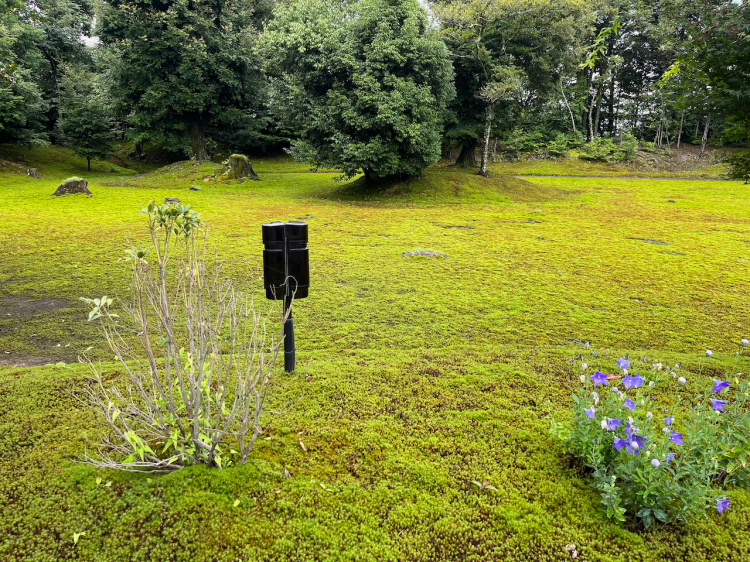
2 It’s also why, today, many historical dramas, comics and stories take place in the Edo Period. My father-in-law likes to watch one Japanese TV show called Abarenbo Shogun (暴れん坊将軍, “Unfettered Shogun”), which is a mostly fictional drama about the unusually talented 8th Shogun of the Edo Period, Tokugawa Yoshimune (1684 – 1751). In the drama Yoshimune, often traveling in disguise, solves mysteries and fights crime. It’s campy, but also a fun show to watch. The “Megumi” lantern shown on the right is a set piece from the show.
The Zen Temple of Tenryuji

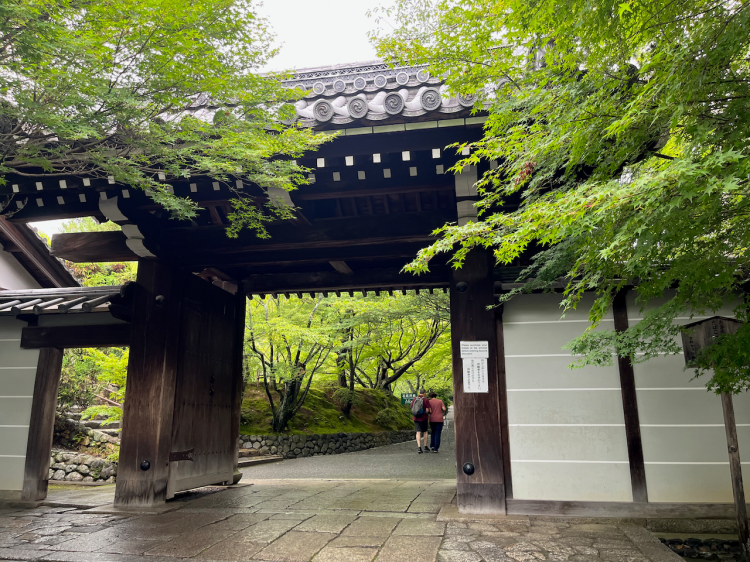
During a recent trip to Japan, we visited the city of Kyoto. Since antiquity, it was a trendy of the nobility to build villas in the hilly suburbs of Kyoto (presumably cooler there in the summer), which in turn became Buddhist temples generations later. Some of these temples grew to be very powerful during Muromachi Period of Japanese history, namely the Zen temples of the Five Mountains System.

We were lucky enough to visit two of the five temples of the Five Mountains System: Tenryuji and Kenninji. Tenryuji is located in the western area of Kyoto, in Arashiyama district. By contrast, Kenninji is in east Kyoto at Higashiyama. Both of these were apex temples in the Five Mountains System, centers of Rinzai-sect Zen, and greatly benefited from patronage by the Ashikaga shogun rulers, before they lost prestige again and essentially became museum pieces.

Both temples are quite large, and very tourist-friendly, but they each have their own character, so I am making a separate post for each temple.1

Tenryuji Temple

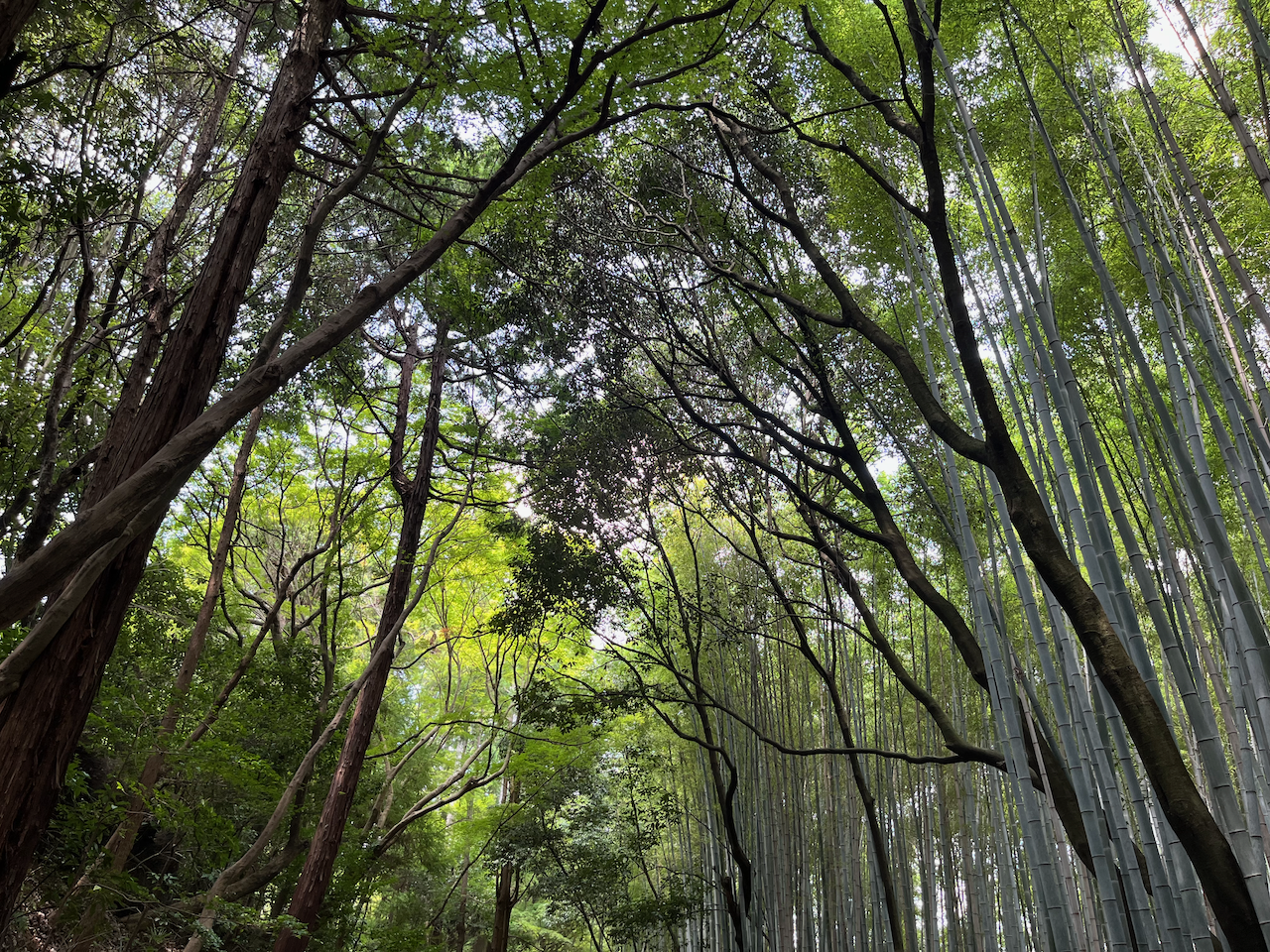
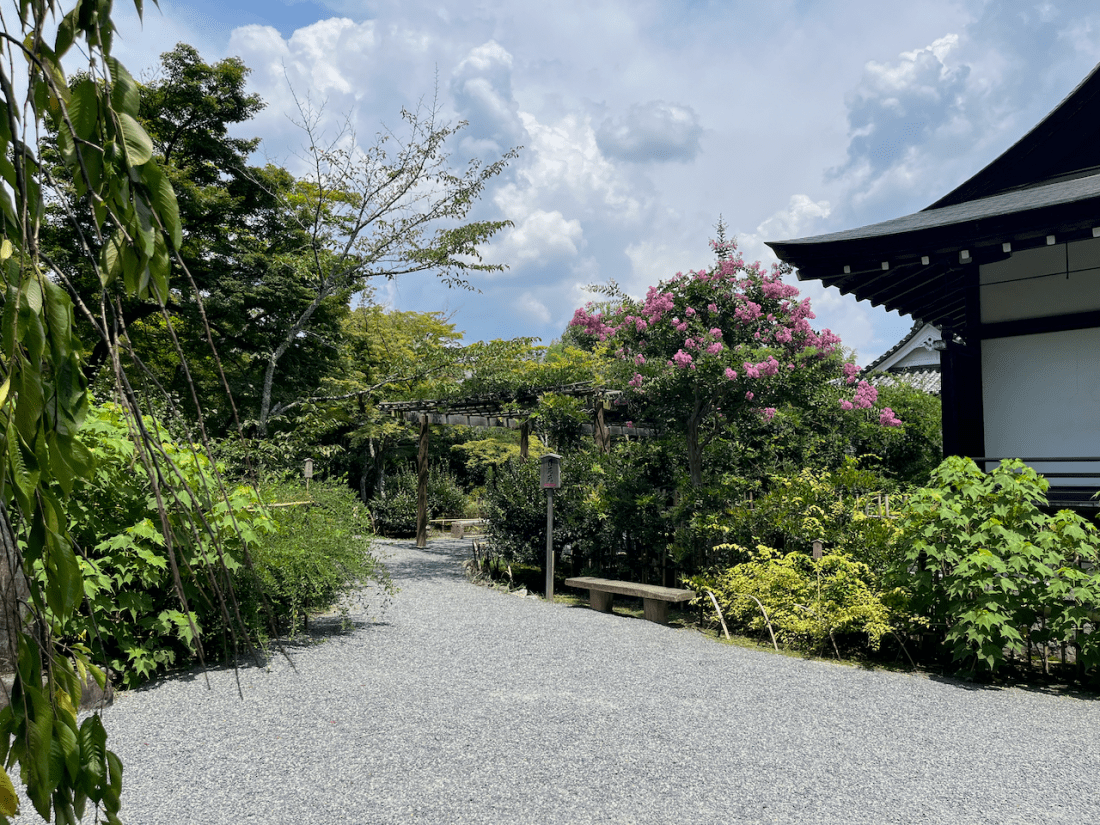
Tenryuji Temple, official website here, is a temple that has seen a lot historically. It was number two or three in the Five Mountains hierarchy, and was thus a very prestigious temple. It contains many terrific works of art, and a gorgeous pond created by Muso Soseki back in the day. Because it is right next to the famous bamboo forests of Arashiyama in western Kyoto, we were able to view both on the same hike, as well as the iconic Togetsu-kyo Bridge:

I should add that the temperature was 37C (98F) in Kyoto and extremely humid that day. The walk through bamboo forests was incredibly enchanting, but also grueling due to heat.

It’s not clear from the photos, but because of the shade and the high humidity, there was a constant mist between the trees, and an oppressive air. It was really cool, and would make a great setting for any Asian-style D&D campaign (not unlike the ones that I made previously … 😏).

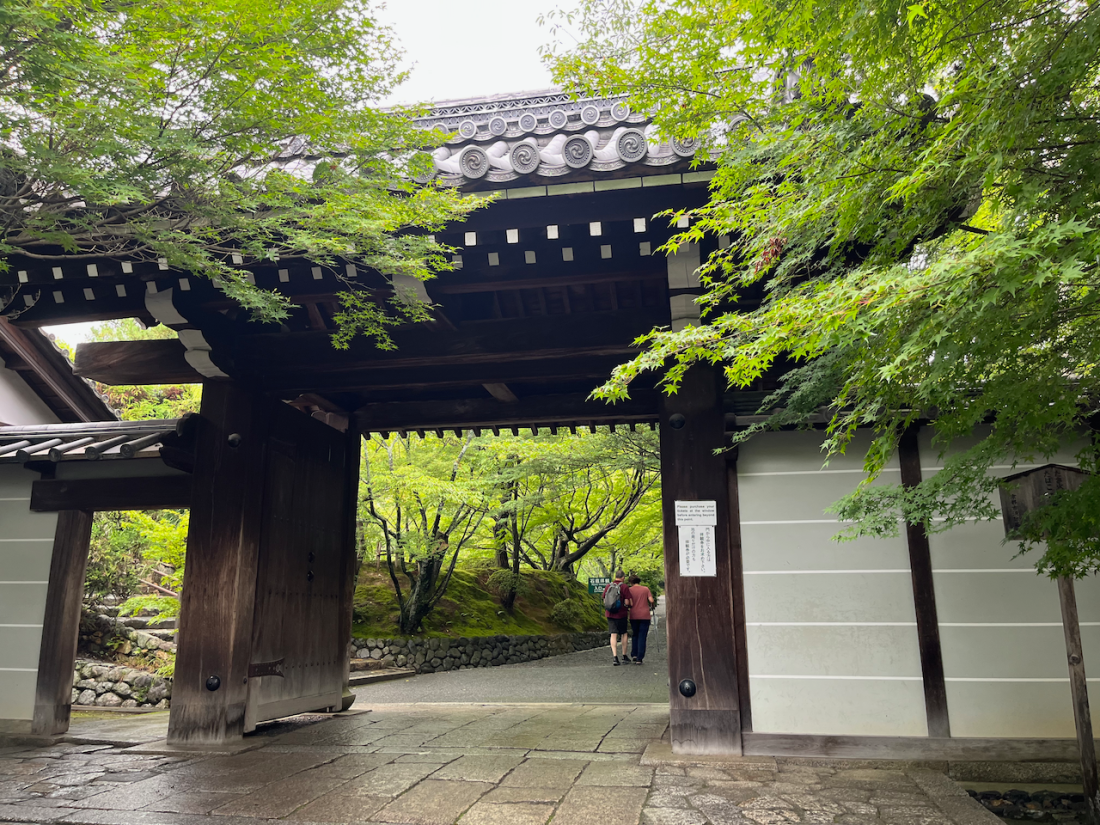
Once you emerge from the bamboo forest, you enter the back-entrance of Tenryuji Temple. The front entrance that’s very close to the Saga-Arashiyama train station as well, so you can also visit from that direction too. The signs are very obvious.

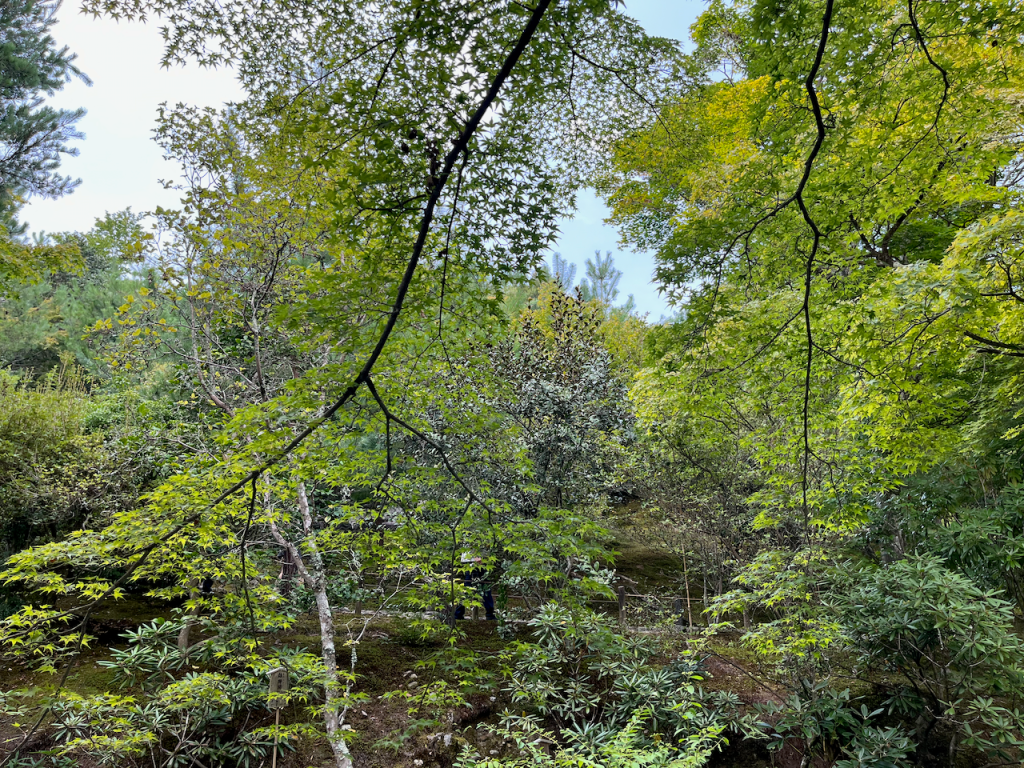
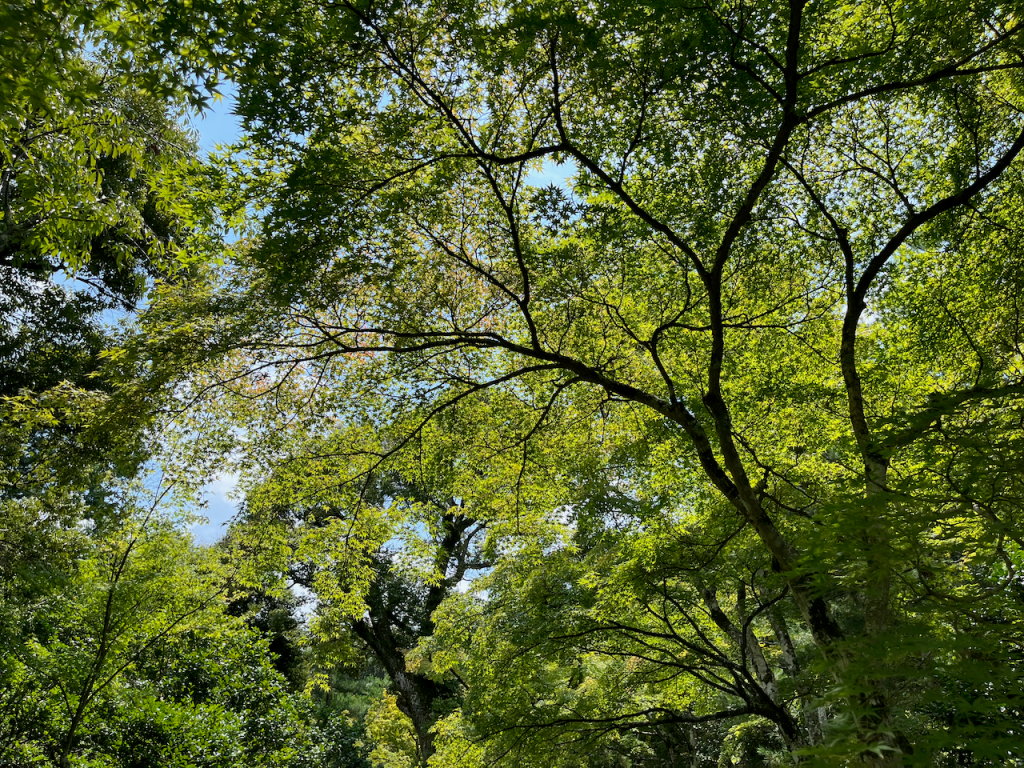
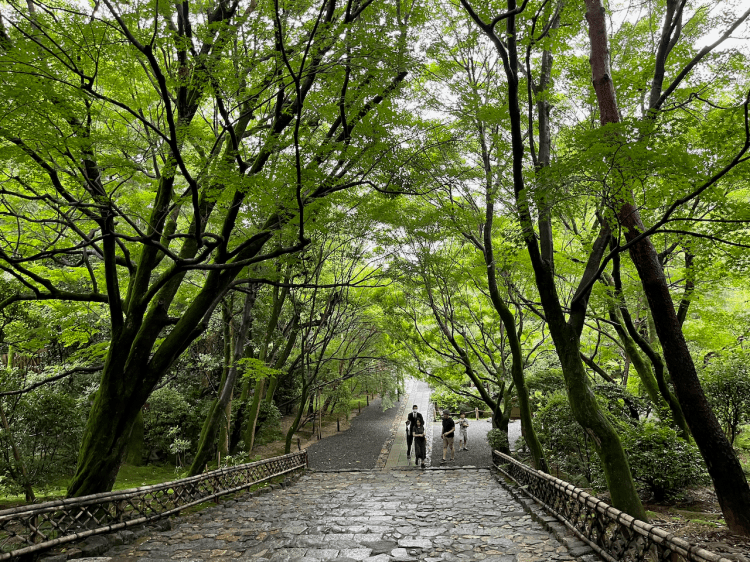
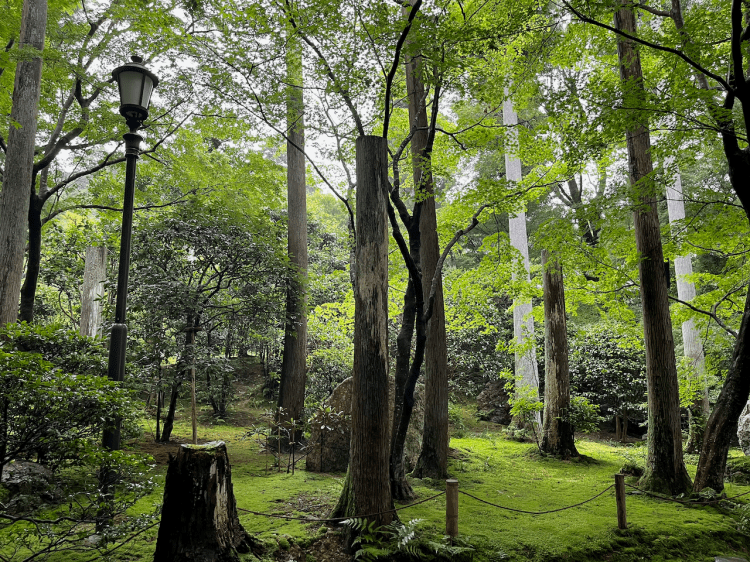
The main buildings were clustered together in the middle of the property, with a really nice garden walk surrounding it, including many lovely or rare plants. If I were a botanist, I’d probably have a field-day here. The signs are all multi-lingual too, which is really handy.

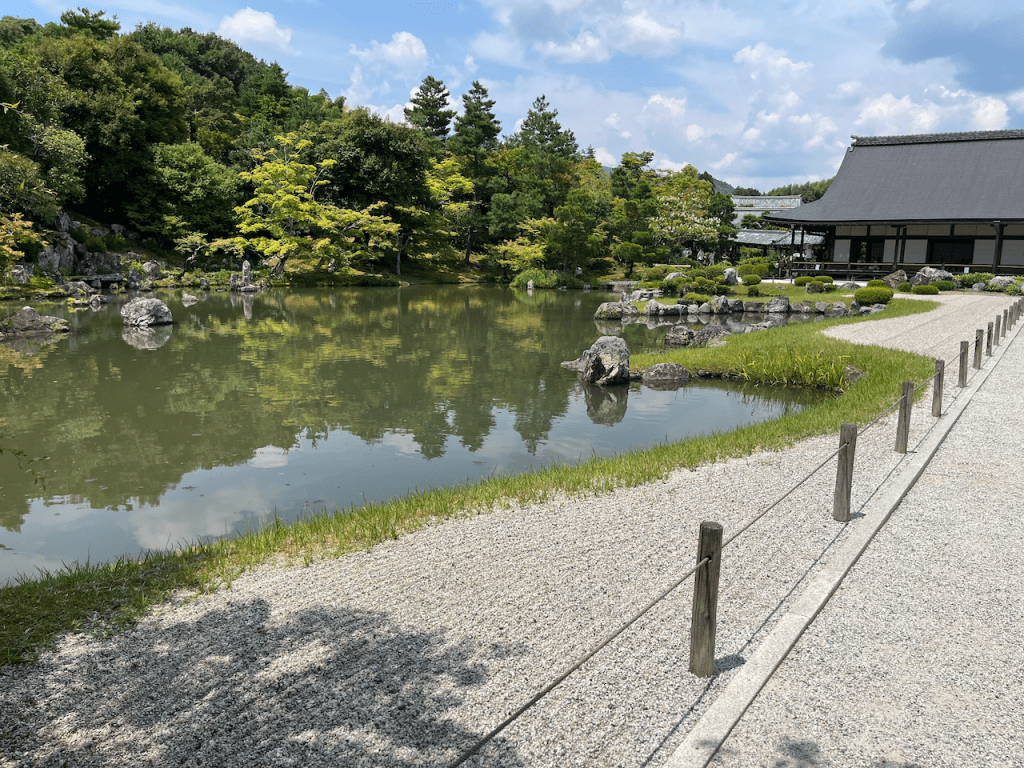
If you continue around the walk, you will come to the Sogenchi (曹源池) Pond, which according to the sign is modeled on Chinese architecture at the time (and a common feature of Japanese aesthetics during the Muromachi Period):

Similarly, you find a lovely sand garden (karesansui in Japanese, 枯山水 ) nearby too:

I wanted to take more photos of the interior of Tenryuji, but there were just too many tired, overheated tourists, and Instagram influencers. I chuckled as I saw a couple young ladies who were way over-dressed in fine, Chinese-style silk dresses and taking turns posing and photographing each other. The heat and humidity were so intense, I can’t imagine why they would do this to themselves. But I digress.

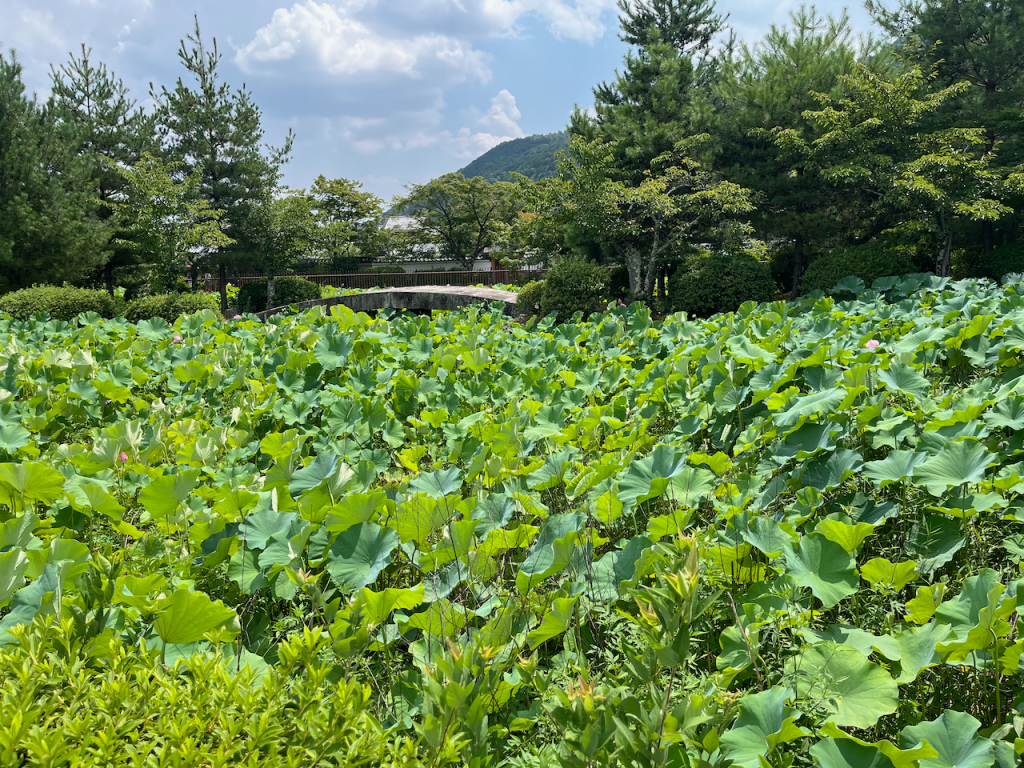
Finally, as exited Tenryuji toward the train station side we saw a very nice lotus pond:

Tenryuji Temple is, for historical reasons, a shadow of its former self, but even what remains is very scenic and embodies much of the beauty and prestige of Arashiyama. I didn’t enjoy it on the same level as another Zen temple, Ryoanji, but it is lovely. For poetry fans, the Arashiyama district is also the site where the Hyakunin Isshu anthology was compiled, which I covered on my other blog.

That said, Arashiyama is quite touristy and crowded. It’s pretty foreign friendly, and if you’re just passing through Kyoto for the first time, it’s a great place to stop. But, for me, if you have the time and want to really get to know Kyoto life and culture, there are other places I prefer.

Next time, we’ll talk about Kenninji, which was smaller than Tenryuji, but had some pretty mind-blowing artwork.

P.S. 欢迎中国游客,感谢您的阅读。

1 I tried to put both in a single post, but it quickly got too large. I am a victim of my own hubris…

The Onin War

After a couple recent posts, I realized that I had never covered a very weird, disastrous war in Japanese history: the Ōnin War (応仁の乱, Ōnin no Ran) from 1467 to 1477.

The Onin War is something most Westerners would not be familiar with, but it had a devastating impact to Japan that can still be felt today in Kyoto. The war spanned 10 years, but was almost entirely fought within and around the old capitol of Kyoto, rather than across the countryside. The war practically flattened Kyoto, and with it centuries of culture and history.

The war began as a succession dispute. After the current shogun of Japan, Ashikaga Yoshimasa (also arguably the worst shogun in Japanese history) adopted this younger brother to be his heir. Yoshimasa had no male heirs, and so this was a common practice. Unfortunately, his wife then gave birth to a son, which put Yoshimasa in a very awkward spot.

Two of the most powerful samurai families supporting Yoshimasa were divided about which person to support: Yoshimasa’s younger brother, or his infant son. The Hosokawa and Yamana clans were already feuding with one another, so this just gave them another axe to grind. The two main generals under Yoshimasa were:

  • Hosokawa Katsumoto (細川勝元) – He supported Yoshimasa’s younger brother’s claim to be the heir.
  • Yamana Sōzen (山名宗全) – He supported Yoshimasa’s infant son, intentionally to further oppose the Hosokawa.

Eventually, both sides secretly built up armies within the city of Kyoto to attack the other. Neither side had a clear advantage, and neither side could score a decisive victory. The Hosokawa had the support of the Shogunate, but the Yamana clan had 6 out of 7 gates to the city. Each side had 100,000+ soldiers in the city. Confusingly, the two opposing sides later switched the heir they supported, and as the war became increasingly pointless, the two sides fought simply because they didn’t want to lose to their rival.

As the war dragged on, both armies pulled in more allies and reinforcements from the provinces, fighting over and over again in the neighborhoods of Kyoto, destroying homes, temples, etc. Battles were fought street-by-street, neighborhood by neighborhood. They even fought at Buddhist temples just to gain some advantage over their opponent.

But after 10 years, both sides were exhausted, weakened and finally withdrew.

Old Kyoto was completely destroyed. When people in Kyoto talk about “the war” destroying Kyoto, they are not referring to World War II, but the Onin War. So much was lost in the destruction that Kyoto has never been quite the same. Many of the famous temples you see in Kyoto today were burned down during the Onin War (possibly other times too, buildings in Japan frequently suffer from fire).

According to Professor Donald Keene, the famous Zen master Ikkyū Sōjun described the destruction in a poem titled “On the Warfare of the Bunmei Era”:1

One burst of flame and the capital—gilt palaces and how many mansions— Turns before one’s eyes into a wasteland. The ruins, more desolate by the day, are autumnal. Spring breezes, peach and plum blossoms, soon become dark.

Part of the reason for such destruction was that old Kyoto was a city made almost entirely out of wood. Further, houses were very close to one another. Even the Yamana and Hosokawa compounds were within walking distance from one another. Also, as I’ve alluded to before, the countless dead and displaced were horrendous to behold, especially compared to the aristocracy of Kyoto that mostly made it out unscathed.

But where was the Shogun in all this?

Ashikaga Yoshimasa was, by hereditary right, the Shogun (将軍): the supreme military commander of Japan, and had authority over both the Hosokawa and Yamana clans. And yet, even after his poor decision making caused the war to begin with, when the conflict erupted, Yoshimasa shrugged and basically did nothing.

Yoshimasa had no force of personality to compel both sides to stop fighting, and although he came from long line of warriors, he was much more inclined toward the arts. Through the entire conflict, Yoshimasa did not take sides, nor lead troops into combat, though some of his relatives briefly did. Yoshimasa simply withdrew and, like an aristocrat, remained aloof to the conflict. Yoshimasa held lavish drinking parties and poetry contests even while fighting raged in the city and Kyoto was burning.

As a Shogun, Yoshimasa was absolutely the wrong man for the job, and yet, when he retired as a Shogun, he devoted all his time, money and efforts to culture and arts, and this helped start a new culture in Kyoto: the Higashiyama culture. The Higashiyama Culture was short-lived, and war resumed in Japan soon after, but many of the traditional arts that exist in Japan today were from this small period of time, promoted and elevated by Yoshimasa.

One can easily argue that few, if any, wars have any real value, but the Onin War is a spectacular example of a war that accomplished almost nothing, could have been prevented by competent leadership, and came at tremendous cost. Even stranger, the result of this tremendous death and destruction was a new flourishing culture that is at the heart of Japan today.

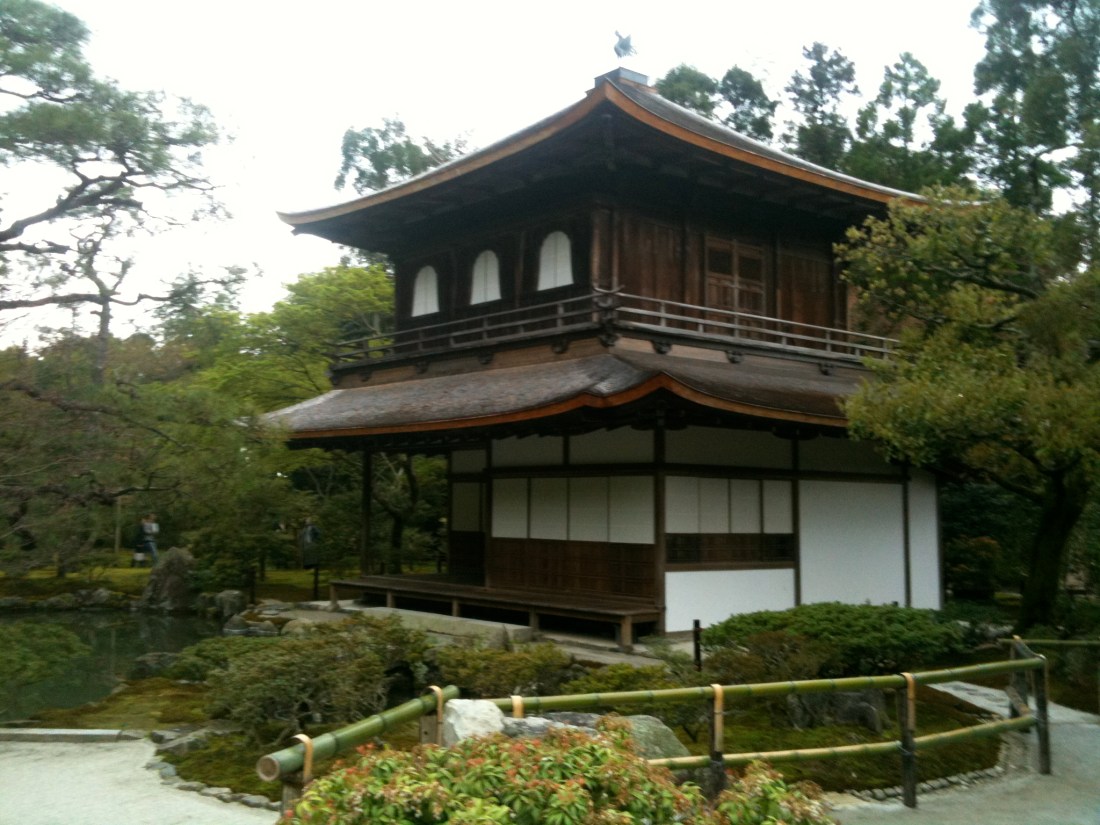
P.S. Featured photo is the Silver Pavilion of Ashikaga Yoshimasa, taken in 2010.

1 I tried finding this in Japanese, but I couldn’t. It was translated from a 1966 book called 五山文学集/江戸漢詩集 apparently.

The Five Mountains System in Medieval Japan

In a recent post I talked about how Zen imported from Song-Dynasty China found patronage with the elite samurai families of the city of Kamakura. Sometimes this was due to the cultural prestige of Zen among “country bumpkin samurai”, but also the new Zen monastic community drew sincere students as well, helping it take root. Zen still had a very small presence, compared to other Buddhist institutions in medieval Japan, but it was definitely the “up and coming” sect.

By the 14th century, and with the destruction of the Hojo Family (ending the Kamakura Period of history), the seat of government shifted back to Kyoto under the new Ashikaga Shogunate (a.k.a. the Muromachi Period of Japanese history). The Ashikaga Shoguns, many of whom were avid Sinophiles, further cultivated the Rinzai Zen institutions from China, and created a new hierarchy of temples called the Five Mountains System. The same system existed in China, where “mountain” was synonymous with “Buddhist monasteries”, but the Chinese version was a looser organization and not strictly related to Zen Buddhism.

The Japanese version organized Rinzai Zen temples (and some Soto Zen temples) across the country into one of three administrative “ranks” with the “five mountains” (gozan, 五山) at the very top. These temples, as we’ll see later, functioned less as Buddhist temples and increasingly as bureaucratic hubs for the rest of the temples in Japan. They enjoyed much patronage and prestige, but the monastic life greatly suffered.

The three ranks were:

  • Gozan (五山) temples, the top-tier
  • Middle-tier jissatsu (十刹) temples, and
  • Shozan (諸山) temples at the bottom.

Confusingly, many Rinzai Zen temples existed outside this temple structure, either by choice, or just lacked prestige, and were derisively called rinka (林下, “the forest below”) to distinguish from more prestigious temples “up on the mountain”. I briefly mentioned rinka temples in this old post.

Anyhow, let’s look more closely at each.

The Gozan Temples

The list of gozan temples varied over time, usually whichever temples the current Shogun patronized. Further, there were actually two sets of gozan temples, one for Kyoto and one for the former capitol of Kamakura. Which one was more important depending on who was in power.

For example, in 1341, under guidance from Tadayoshi, the ranks were as follows (homepages linked where possible):

RankKamakura TemplesKyoto Temples
1KenchōjiNanzenji
2EngakujiTenryuji
3Jufukuji
4Kenninji
5Tōfukuji
“associate”
temple
Jōchiji

For each rank, the Kamakura temples were elevated slightly higher than their Kyoto counterparts. By 1380 under the 3rd Shogun, Yoshimitsu:

RankKamakura TemplesKyoto Temples
1KenchōjiNanzenji
2EngakujiTenryuji
3JufukujiKenninji
4JōchijiTōfukuji
5JōmyōjiManjuji

And by 1386, also under Yoshimitsu, the rankings switch in favor of the Kyoto temples, but also Nanzenji gets elevated to a “superior gozan temple”. Plus, a new temple built on Yoshimitsu’s orders, Shōkokuji, was slotted into the Gozan temple ranks.

RankKyoto TemplesKamakura Temples
“superior”Nanzenji
1TenryujiKenchōji
2ShōkokujiEngakuji
3KenninjiJufukuji
4TōfukujiJōchiji
5ManjujiJōmyōji

The Gozan temples were the top of a large administrative bureaucracy that managed the many other Rinzai Zen temples, and as such enjoyed much patronage and influence. However, as we’ll see later, this came at a heavy cost.

Middle Rank Temples: Jissatsu

The ten temples of the middle rank, the jissatsu (十刹), were major temples in the provinces that served as middle-management. They managed other temples in the provinces and were subordinate to the gozan temples, but also held much influence too. Eventually, the jissatsu temples were also split up into 10 temples under the Kyoto gozan temples, and 10 more under the Kamakura gozan temples.

The list of temples moves around a lot, and sometimes temples were promoted to gozan temples, or downgraded.

Lower Rank Temples: Shozan

The shozan temples are the lowest-ranking, but also the largest group by far. At any time, up to 250 temples were ranked as shozan temples. As with the jissatsu temples, the shozan temples were usually provincial temples that simply didn’t have the prestige or political influence that the jissatsu had. However, they were still important in extending Shogunal control over the provinces, and thus still had ranking.

What Happened to the Gozan System?

As we saw in an old post, whenever the Buddhist establishment developed close ties with the ruling regime, this worked as long as the regime was powerful, but began to collapse easily when the regime was weak.

In the case of the Gozan system, the Zen temples never maintained huge standing armies that other, older temples such as Enryakuji (Tendai) or Kofukuji (Hossō sect) did, and so they relied on the Ashikaga shoguns for protection. As the Ashikaga shogunate started to weaken, local warlords in the provinces and the rival temple armies began to assert their power, and the Gozan temples suffered.

In fact, the disastrous Ōnin War in the 15th century practically destroyed many of these monasteries along with most of Kyoto city. Some of these temples never to rebuilt, or became greatly diminished. By this point, the Ashikaga “shoguns” had no real power outside of the Kyoto area, and thus couldn’t protect or influence other temples anyway.

However, probably the biggest reason for their decline was that spiritual practices at these temples declined and atrophied as they became more and more important politically. In the book Five Mountains: The Rinzai Zen Monastic Institution in Medieval Japan by Professor Martin Collcutt, Collcutt shows how records and journals at these temples showed that they had a very active social scene: banquets, religious functions, public rituals, and so on, but very little actual Zen practice as we know it. Monastic discipline greatly declined, and while they flourished culturally, the religious practices suffered. The famous Zen monk, Ikkyu, at the time lamented the decline in monastic discipline. Then again, he was a bit of an eccentric curmudgeon anyway.

Ironically, Rinzai Zen temples that existed outside the Gozan system, gained lasting prominence instead. The modern lineages in Rinzai derive from two temples that were not in the Gozan system: Daitokuji and Myōshinji. Both had reputations for maintaining austere Zen practices, and enjoyed patronage from wealthy merchants, and the increasingly powerful provincial warlords. Under Hakuin (mentioned here), the two temples became the basis for Rinzai Zen today.

Admittedly, both Daitokuji and Myoshinji suffered from corruption as well, as they gained social prominence, but Hakuin’s reforms later fixed this.

So, repeat after me: religion and politics should not mix.

P.S. happy Spring Ohigan! 🌸

A Not-So Brief History of Zen and Samurai

There is a persistent image in the West of samurai being adherents of Zen, that the “way of the warrior” (bushido)1 and Zen are somehow one and the same. One can imagine a samurai who has practiced swordsmanship to a finely honed skill, meditating under a waterfall, and writing Zen-like deathbed poetry before preparing to throw away their life in battle. In my first visit to Ryoanji temple (featured photo shown above), 28-year old me had a similar image in mind persisting all the way back when I was a naïve 16-year old white kid just reading about Zen for the first time. Looking back after almost 20 years of Buddhist-study and practice, I facepalm at myself a little, but it’s a very persistent image in media. (side note: Last Samurai is not my favorite movie)

So, did samurai really embrace Zen, and was Zen essentially a “samurai religion”? Turns out, it’s complicated, and most of the imagery was romanticized.

Recently, I dusted off an old book that I hadn’t read in years: Five Mountains: The Rinzai Zen Monastic Institution in Medieval Japan by Professor Martin Collcutt. As I am stuck home in Covid-isolation for a few days, I finally have time to both read and write about it.

Dr Collcut summarizes all this in the book:

Even at the height of its influence in the last fourteenth century, Zen–including the more widely diffused Sōtō Zen–probably had still not replaced devotion to Kannon, Jizō [Bodhisattva], the Lotus Sutra [e.g. Nichiren Buddhism], or the Pure Land of Amida in the hearts of most ordinary, and many high-ranking, Japanese samurai.

page 80

Further:

Zen in the Kamakura and Muromachi periods can be called “the religion of the samurai” only in the sense that most patrons of Zen were samurai, not in the sense that it was practiced assiduously or exclusive by all, or even perhaps the majority, of those who would be described as warriors.

page 80

So where did the image come from? Let’s take a brief look at the history of Zen, especially Rinzai Zen, in Japan.

The Two Lineages of Zen in Japan

Japan has historically two sects of Buddhism, both descended from Chinese lineages: Soto and Rinzai Zen. The differences between the two are too big to cover here, and there’s plenty of information on the web that explore the two. Suffice to say, the two lineages came to Japan in the 12th century, but took pretty different trajectories.

Soto Zen, founded by Dogen after journeying to China, did not sit well with existing powerful Buddhist sects in Japan, because of Dogen’s unwavering commitment to his ideal of ideal Zen practice, and was pushed out to the countryside. For centuries it was obscure, and enjoyed little patronage beyond certain local samurai families, primarily for the sake of prestige. Its popularity grew later through the efforts of a monk named Keizan, who developed increasing patronage from (mostly) provincial samurai rulers, and cultivated more community support. Professor Bodiford’s book, Sōtō Zen in Medieval Japan, is an excellent overview of its history. In any case, all Soto Zen traditions in Japan (and beyond) trace back to Dogen.

Rinzai Zen, founded by Eisai, has a much more complicated history. Eisai was willing to compromise more when he returned from China with the Buddhist establishment, so early Rinzai Zen was more like a hybrid Zen-Tendai Buddhist institution with a lot of esoteric practices. It enjoyed further popularity under Enni Ben’en (圓爾辯圓, 1202 – 1280) in the capitol of Kyoto, but remained a relatively small sect, often conflated with existing Buddhist institutions at the time.

Zen really didn’t take off until the second-half of the Kamakura Period under the Hojo Clan regency. After the death of Sanetomo, the 3rd shogun, the subsequent shoguns, distant offshoots of the family, were installed but increasingly powerless against their own regents, the Hojo Clan. Under talented Hojo leaders such as Hojo Tokiyori and Tokimune, power was consolidated, and they became the effective rulers of Japan.

But there was a persistent issue: the Hojo Clan, while militarily powerful and based in Kamakura was seen as inferior to the old aristocracy (e.g. the Fujiwara) in Kyoto who had centuries of refinement to rely upon compared to the upstarts. The old Buddhist establishment was still closely allied to the aristocracy, and thus hostile to the Hojo Clan.

Enter the Mongols

When the Mongols finally destroyed the Song Dynasty in China, establishing the new “Yuan” Dynasty, the upheaval affected many monastic institutions. Some monks, including ardent Song-loyalists, decided to leave China and make the journey to Japan either to get away from Mongol authority, or possibly in some cases, to work as spies for the Mongols who later tried to invade Japan.

Starting with a monk named Lanxi Daolong (蘭溪道隆, 1213-1278), who came to Japan in 1246 for reasons not entirely clear, followed by Wuan Puning (兀庵普寧, 1197 – 1276) in 1260, a steady stream of Rinzai-lineage monks came to Japan. For the Hojo leadership, this new source of Chinese education, culture and religious teachings practically fell into their lap, and they quickly adopted these new monks, establishing a series of monasteries in the new capital of Kamakura starting with Kenchōji (website here) in 1253, and expanding to other temples such as Engaku-ji in 1282. These new temples in Kamakura Zen temples were different than the ones that Eisai and Enni Ben’en’s temples had established in Kyoto, designed to match Song Dynasty practices, with Chinese monks frequently serving as abbots.

Thus, Rinzai Zen in Japan was essentially established as two separate lineages2 albeit with a common ancestry: the first lineage established by Eisai and popularized in Kyoto by Enni Ben’en that incorporated more native Japanese-Buddhist practices, and the second lineage which came later driven by Chinese Zen monks during the end of the Song Dynasty who established a more “pure” form of Zen based on the Chinese model. It should be noted that the Chinese monks mentioned above did journey to Kyoto as well to update existing monasteries of the older lineage to modern (e.g. Song Dynasty) standards as well, but the temple of Kenchōji was the premiere Zen temple for centuries in Japan. Further, by the 14th century, and especially later, much of Rinzai Zen was more homogenized than the early communities.

The arrival of the Chinese-Buddhist teachers to Japan in the 13th century is important to note, though, because this is the point in time where the samurai class really start to interact with Zen communities.

The Hojo Clan had finally found a way to one-up their rivals in Kyoto by raising their own cultural credentials with the new immigrants from China, but also some Hojo family members really did embrace Rinzai Zen teachings. Hojo Tokiyori (北条 時頼, 1227 – 1263) and his son, Tokimune (北条 時宗, 1251 – 1284) both became avid students under Chinese teachers, patronized the new monastic communities in Kamakura, and encouraged its practice among their samurai vassals. Other regents of the Hojo Clan never took much interest. But now, Zen finally had the patronage it needed to expand and grow in Japan, yet as Collcut’s book shows, it was still largely adopted for cultural prestige, and also oftentimes due to obligation towards Hojo Clan. Many of these vassal clans later rose to be major powers centuries later (cf. Hosokawa, Takeda, Uesugi, Tokugawa, etc) with their own patronage to Zen temples in their provinces.

Later, as the Hojo Clan finally declined in power, and gradually replaced by the Ashikaga Clan (e.g the Muromachi Period), the pattern continued. Both the emperors of the time such as Go-Daigo and Hanazono, and the Ashikaga Shoguns patronized Rinzai Zen temples, but often times for political expediency. The “Five Mountains” monastic system developed at this time, borrowed from Chinese cultural, is a big topic, and worthy of its own post.

The Golden Pavilion, built as a villa for Ashikaga Yoshimitsu, later converted to a Rinzai Zen temple.

The high-point of “Zen-Samurai” culture as we know it can probably be traced to the 8th shogun of the Ashikaga Clan, Yoshimasa (足利 義政, 1436 – 1490) who while being a dismal military commander, was a brilliant innovator of Zen aesthetics. Yoshimasa had a taste of artistic genius, and patronized Zen-influenced architecture, painting, poetry, and gardening, and so on, but also directly added his own spin. The “zen aesthetic” we all recognize is largely due to Yoshimasa who synthesized earlier Song-Dynasty culture through establishment of institutions by the Hojo Clan.

However, on a personal level, Yoshimasa recited the nembutsu and seldom meditated.

Conclusion

All this is not meant to detract from Zen teachings, or the contributions of Zen monks to Japanese culture, or to imply that there were no Zen-devotees among the samurai class, but as I alluded to in the beginning, the romanticized Zen-Samurai image mostly exists on paper or in the writings of its sincere devotees. It was the ideal at the time among enthusiasts, and this ideal has persisted into Western culture, including teachers and self-help gurus.

How samurai in Japan, or Japanese in general, interacted with Buddhism (including Zen) was complicated and very individual, and not always related to piety. When you look at other pre-modern cultures, you see similar patterns. The emperors of the Eastern Romans had a complex relationship with the Church, and usually were not interested in the deeper teachings, or various doctrinal conflicts of the Byzantine Orthodox church except when it interfered with political goals (cf. iconoclasm, schisms, etc), or were varying degrees of sincerity. Further, how they practiced religion would have been noticeably different than your typical Eastern Roman in the provinces or the streets of Byzantium.

Now, imagine the same in any other culture: Western medieval communities, people in the Islamic caliphate, Chinese Buddhists, etc.

In short, how people interact with religion, and how its romanticized, are two different things. The dynamic interaction of people, culture and religion is fascinating, but not very marketable. The romanticized form of religion is marketable, but is like a bag of potato chips: tastes good, but rarely provides anything meaningful.

1 Please, please, please: if you ever go visit Japan, do not wear a “bushido” shirt. It really pegs you as a tourist.

2 The third “Obaku” sect of Zen in Japan is in fact yet another Rinzai Zen lineage that came from China, this time from the Ming Dynasty. By this point, Pure Land Buddhism and Zen in China had largely reconciled, and Obaku Zen includes more elements of Pure Land than is found in other Rinzai lineages, while still retaining its core Zen element.

The Hymn of Zazen

Recently I stumbled upon a neat bit of Buddhist liturgy in the Rinzai Zen tradition called the Hakuin Zenji Zazen Go-Wasan (白隠禅師坐禅御和讃), or more simply the Zazen Wasan (坐禅和讃). This means “The Hymn of Zazen [of Zen Master Hakuin]”. In English it is sometimes called the “Song of Zazen”.1

Rinzai Zen is a somewhat unusual sect in Japanese Buddhism because although it was founded in the 12th century by Eisai (栄西, 1141 – 1215, alternatively called “Yosai”), and flourished for centuries alongside other Buddhist sects, the Rinzai Zen we know today is due in large part to the 18th century Zen master Hakuin (白隠, 1686 – 1769). We might think of Hakuin as a kind of reformer, or second founder.

The Hymn of Zazen is an exposition of Hakuin’s beliefs, the virtues of zazen meditation practice (especially compared to other Buddhist practices), and the nature of one’s own mind. It is regularly recited as part of Rinzai Buddhist liturgy as shown below:

Since I have a copy in Japanese, I decided to post here as a reference for others. I’ve posted the text in the original Japanese with Romanized (e.g. romaji) text. I am using the excellent translation by Robert Aitken Roshi as well, originally found here, and some proof-reading of the Japanese text using this site.

JapaneseRomanizationTranslation
衆生本来仏なり水と氷のごとくにてShujō honrai hotoké nari mizu to kōri no gotoku ni te
All beings by nature are Buddha, as ice by nature is water;
水を離れて氷なく衆生の外に仏なしMizu wo hanarete kōri naku shujō no hoka ni hotoké nashiApart from water there is no ice, apart from beings no Buddha.
衆生近きを不知らずして遠く求むるはかなさよShujō chikaki wo shirazu shite tōku motomu hakanasayo
How sad that people ignore the near and search for truth afar,
譬ば水の中に居て渇を叫ぶがごとくなりTatoeba mizu no naka ni ite katsu wo sakebu gotoku nariLike someone in the midst of water crying out in thirst,
長者の家の子となりて貧里に迷うに異ならずChōja no ié no ko to narite hinri ni mayō ni kotonarazuLike a child of a wealthy home wandering among the poor.
六趣輪廻の因縁は己が愚痴の闇路なりRokushū rinne no innen wa onore ga guchi no yamiji nariLost on dark paths of ignorance we wander through the six worlds,
闇路に闇路を踏そへていつか生死をはなるべきYamiji ni yamiji wo fumisoete itsuka shōji wo hanarubekiFrom dark path to dark path we wander, when shall we be freed from birth and death?
夫れ摩訶衍の禅定は称歎するに余りありSore maka-en no zenjō wa shōtan suru ni amari ariFor this the zazen of the Mahayana deserves the highest praise.
布施や持戒の諸波羅蜜念仏懺悔修行等Fuse ya jikai no sho haramitsu nenbutsu sange shugyō tōOfferings, precepts, paramitas, Nembutsu, atonement, practice—
其の品多き諸善行皆この中に帰するなりSono shinaōki sho zengyō mina kono naka ni kisuru narithe many other virtues—all rise within zazen.
一座の功をなす人も積し無量の罪ほろぶIchiza no kō wo nasu hito mo tsumishi muryō no tsumi horobuThose who try zazen even once wipe away immeasurable crimes—
悪趣何処にありぬべき浄土即ち遠からずAkushu izuku ni arinu beki
Jōdo sunawachi tōkarazu
where are all the dark paths then? The Pure Land itself is near.
辱なくも此の法を一たび耳にふるる時Katajikenaku mo kono nori wo hitotabi mimi ni fururu tokiThose who hear this truth even once and listen with a grateful heart,
讃歎随喜する人は福を得る事限りなしSantan zuiki suru hito wa
fuku wo uru koto kagiri nashi
treasuring it, revering it, gain blessings without end.
いはんや自ら回向して直に自性を証すればIwanya mizukara ekō shite
jiki ni jijō wo shō sureba
Much more, if you turn yourself about and confirm your own self-nature—
自性即ち無性にてすでに戯論を離れたりJijō sunawachi mushō ni te
sude ni keron wo hanaretari
that self-nature is no nature—you are far beyond mere argument.
因果一如の門ひらけ無二無三の道直しInga ichinyo no mon hiraké
muni musan no michi naoshi
The oneness of cause and effect is clear, not two, not three, the path is put right;
無相の相を相として行くも帰るも余所ならずMusō no sō wo sō toshite yuku mo kaeru mo yoso narazuwith form that is no form going and coming never astray,
無念の念を念として
謡うも舞ふも法の声
Munen no nen wo nen toshite utau mo mau mo nori no koéWith thought that is no thought singing and dancing are the voice of the Law.
三昧無碍の空ひろく
四智円明の月さえん
Zanmai muge no sora hiroku shichi enmyō no tsuki saenBoundless and free is the sky of samadhi! Bright the full moon of wisdom!
此時何をか求むべ寂滅現前するゆえにKono toki nani wo ka motomu beki jakumetsu genzen suru yue niTruly is anything missing now? Nirvana is here, before your eyes,
当所即ち蓮華国此身即ち仏なりTōsho sunawachi rengekoku
kono mi sunawachi hotoke nari
this very place is the Lotus Land, this very body the Buddha.

As Zen is not my forté, I admit I don’t fully understand the meaning of this hymn, and it’s interesting that Hakuin praises zazen in such a way that other Buddhist practices arise from it. This reminds me of Shinran’s teachings in Jodo Shinshu whereby the nembutsu encompasses all the virtues of other acts. To some degree, every Buddhist sects inevitably makes this assertion.

That said, I think it’s a very nice exposition of Rinzai Zen thought, and along with my experiences at Ryoanji Temple (a Rinzai temple) in Kyoto last year,2 it certainly inspires me to keep exploring Rinzai teachings further.

Namu Shakamuni Butsu

P.S. Featured photo is Hakuin Ekaku (self-portrait), Public domain, via Wikimedia Commons

1 I am quibbling here, but wasan (和讃) is better translated as a hymn in my opinion, not a song (uta 歌), even though a “hymn” means something different in Buddhism than it would in Christianity. You can find examples of wasan in Jodo Shinshu Buddhism, composed by its founder Shinran, as well.

2 Technically, the Golden Pavilion, which we also visited, is also a Rinzai Temple too. I will probably write about the Five Mountains system of the Ashikaga Period soon, but I am brushing up on some old books first for research. It’s not a small topic.

Revisiting Ryoanji

A while back, I talked about a famous Rinzai-sect Zen temple named Ryoanji that my wife and I had visited in 2005, shortly after we got married. During our latest trip to Kyoto (mentioned here and here), we got to see Ryoanji again, and this time, armed with a better camera, better weather, and more background knowledge, I was able to better appreciate the visit.

The temple was founded shortly before the disastrous Onin War, a grinding, destructive urban war that ravaged the city of Kyoto over a succession dispute, and ironically the founder of the temple was one of the major combatants, Hosokawa Katsumoto. The temple of Ryoanji was an active monastery for a long time, a second-tier temple in the Five Mountains system in the 14th century, a hierarchy of Rinzai-Zen temples patronized by the Shogunate at the time, but tourism has pushed out the original monastic training to other temples, or other parts of the complex.

Historically, like many Zen temples of the Five Mountains System, Ryoanji got tangled in politics and urban life at the time, for better or for worse,1 but even so, it was clear that over the generations, the temple community there cared about Zen and tried their best to put things into practice and that love and care showed even now.
Today, Ryoanji is best-known for its “Zen garden” or karé-sansui (枯山水) in Japanese. You might have seen pictures of it before, but seeing the real thing is pretty interesting. On the one hand, it’s surprisingly small, but on the other, there’s an ineffable feeling when you are there. There are plenty of theories about who designed the famous “garden”, but there’s no clear evidence one way or another. So, it’s design and history remain a mystery.
The temple itself is fairly small, but is part of a large, secluded area north of Kyoto. You can see a map of the complex here:

It was hot and muggy that day, and my gout, which thankfully only flares up rarely,2 was in full swing, so walking was quite painful. Nevertheless, we had already booked the tour, so we soldiered on. Ryoanji, after the chaos and traffic of other places, was a welcome respite. This is the main gate, which is shown on the map above at the bottom-right.

Ryoanji has a large garden area before you get to the temple itself:

From here, you come to the temple complex itself:

I vaguely recall that this was the “kitchen god”, a minor deity venerated to prevent fires in the kitchen. The first room of the temple, before you get to the garden, was formerly the kitchen, if I recall correctly.

And finally, the temple opens up to the famous sand garden:

More pictures here:

It seemed to be a fairly quiet day at Ryoanji, so we had a chance to sit down on the veranda and admire the view for a bit. The last time I came in 2005, the garden was snow-covered, so I didn’t really get to see much (but still a great experience in its own way):

Me, February 2005 at Ryoanji, with no idea what I was doing. 😅

Much has been discussed about the garden, the symbolism of the particular rocks, the use of the Golden Ratio in its proportions, etc., but for me, it was just neat to see in person. As I said earlier, there’s an ineffable feeling when you’re there. Amidst the chatter and people shuffling around, you

Just behind the veranda are also some black-ink murals:

From there you see the famous tsukubai, though since I didn’t have a photo this trip, here is the same thing from 2005:

The tsukubai has a square opening in the middle, and Chinese characters (kanji) on each side. The square, combined with each Chinese character form different Chinese characters, forming the sentence: 吾唯足知 or waré tada taru (wo) shiru, meaning something like “I only know contentment”, or rather more loosely, “Just as I am, I am sufficient”.

From there, visitors loop around through the garden again on the other side, which is very peaceful:

Here’s me and my teenage daughter being silly, imitating a funny Japanese comedy duo named EXIT (ポンポン!):

From here, we went to the gift shop near the exit, where I picked up a nice little incense holder,2 and of course some incense.

Ryoanji isn’t as big a tourist draw in Kyoto as some other temples, but to be honest it was a really nice experience. The quieter atmosphere, the slower pace, and the amazing art really made an impression on me more than the whirlwind experiences we had at other temples that day. Even as it hurt to walk constantly, I still felt a sense of calm and peace I hadn’t enjoyed in a while.

It reminded me of a similar experience I had back in Victoria BC, where I felt a sense of calm and clarity and a healthier perspective on things that stuck with me upon my return to the US. This might sound silly or New Age-y, but as a Buddhist for almost 20 years now, amidst the constant distractions of life and struggles with practice, the chance to stop and gain a different perspective for even a couple of hours, every so often is really valuable. Ryoanji was an unexpected highlight of the trip for me, and someday I hope to go there again.

P.S. I’ve been really heads down working on the other blog lately, plus also dealing with plenty of parental and work issues, so I am somewhat behind on blogging.

1 The famous monk, Ikkyu, grumbled about this quite a bit. Then again, Ikkyu wasn’t a saint himself. 😉 Like the Buddhist temples of the earlier Heian Period, the Zen temples of the Ashikaga Shogunate tended to be lax in monastic discipline, host parties with nobility, and get into all sorts of disreputable behavior. Besides Ikkyu, I am sure there were more serious-minded monks, but then again with any religion anywhere across history, given a sufficiently large community, you get a spectrum of saints and scallywags. Such is Humanity.

2 Rarely enough that I can avoid taking prescription medication, and focus on eating a healthier diet, plus lots of water daily. Weight loss has also helped.

3 I have some incense from Japan from previous trips, but my Western incense holders do not properly fit, so the incense tends to lean or fall over. Different holders for differently-sized incense.

The Golden Pavilion of Kyoto

Hello dear readers,

I am back from my trip to Japan, and while jet-lag is keeping me up at odd hours, I wanted to post some photos from certain places we visited. This year, we visited Kyoto and Nara for the first time since 2010. This was the first visit by my son, who was born after 2010, and his first chance to ride the Bullet Train (e.g. the Shinkansen in Japanese).

I’ve talked about the Golden Pavilion before, but this post uses more updated photos, and more detailed information.

The Golden Pavilion, known as Kinkaku-ji (金閣寺) in Japanese, is technically speaking a Buddhist temple called Roku-on-ji (鹿苑寺). The property of the Golden Pavilion has a long history, first as a villa for the nobleman Fujiwara no Kintsune (who wrote poem 96 in the Hyakunin Isshu, by the way), then centuries later purchased by the Shogun (military dictator) of the time, Ashikaga Yoshimitsu as a personal villa. More on that later. In any case, Yoshimitsu eventually retired and took tonsure as a monk, living at the villa. When he died, the villa was converted to a Rinzai-sect1 Zen Buddhist temple in his honor.

1 Why Rinzai Zen? This is a topic that’s too long to go into here (I should probably make a post about it someday), but during the Ashikaga Shogunate, Rinzai Zen enjoyed a booming popularity in Kyoto the capitol, but also it was organized in a network of temples called the Five Mountains system (modeled after Song-Dynasty China).

Anyhow, let’s take a look. When you first enter the pavilion grounds you see a plaque like so:

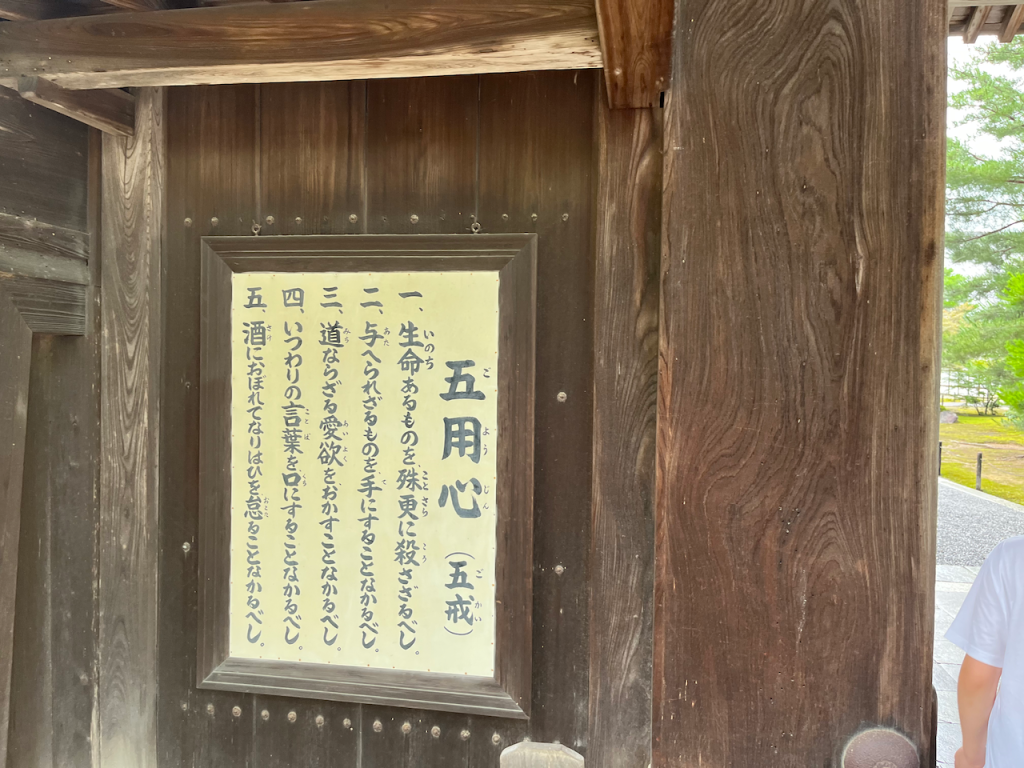
The Five Precepts (gokai 五戒)

This plaque shows the Five Precepts of Buddhism, which is something you don’t normally see in Japanese-Buddhist temples.

After this, you see a moss garden like so:

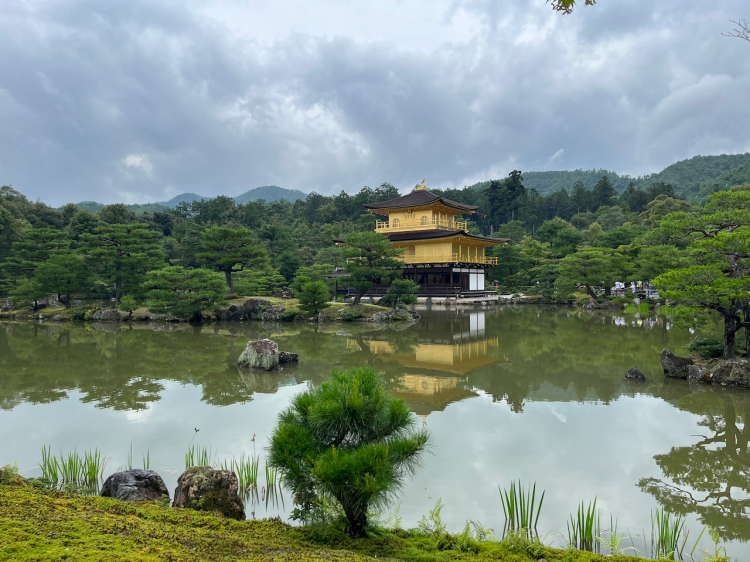
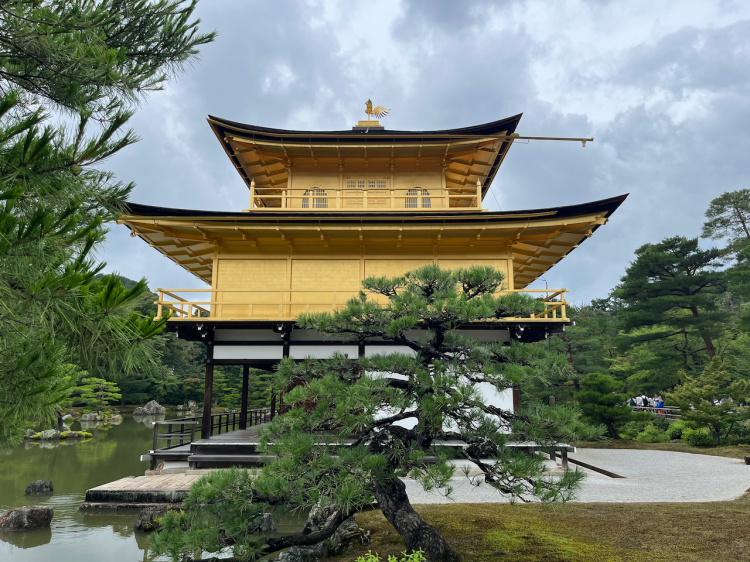
If you keep moving onward, you’ll see the pavilion itself to the right:

If you look up close…

The gold leaf on the temple has been reapplied since the past, as the original sheen peeled off over the centuries, and the pavilion itself was also damaged by an act of arson in 1949.

Our tour guide pointed out that the three levels of the pavilion use different architecture intentionally: demonstrated the Shogunate’s triumph over his political rivals (notice how the first floor is not covered in gold leaf). The bird at the very top is a Chinese phoenix bird, not to be confused with the Western version. The Shogun wasn’t being subtle.

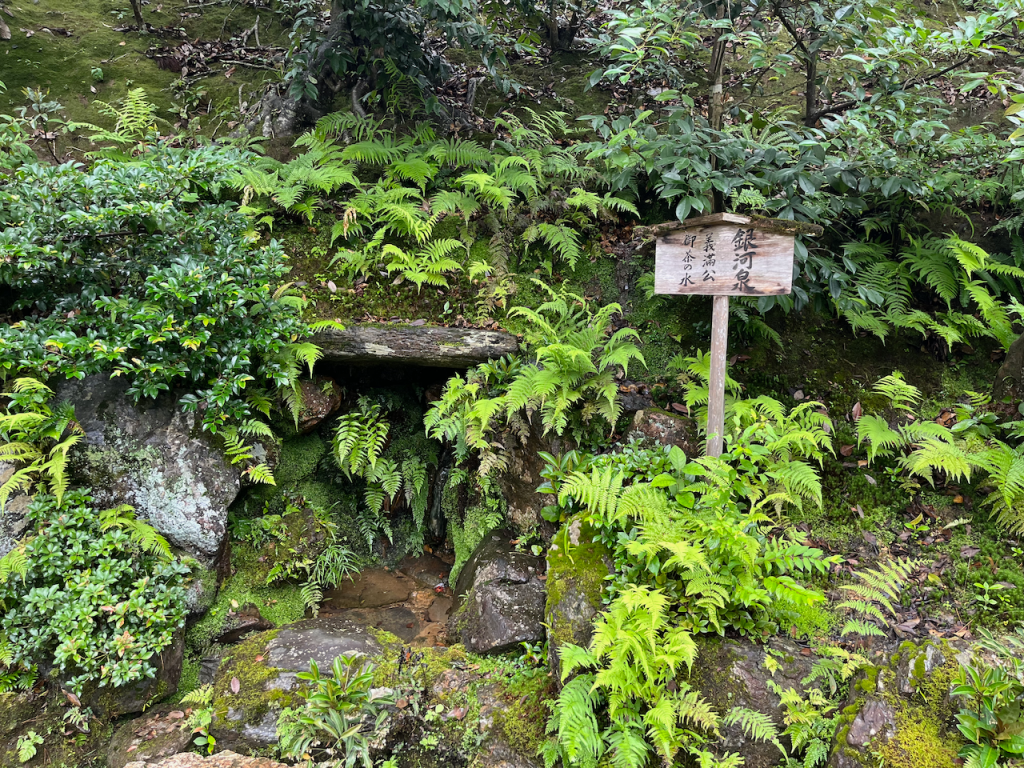
The back half of the pavilion grounds is a long garden walk with a waterfall among other things:

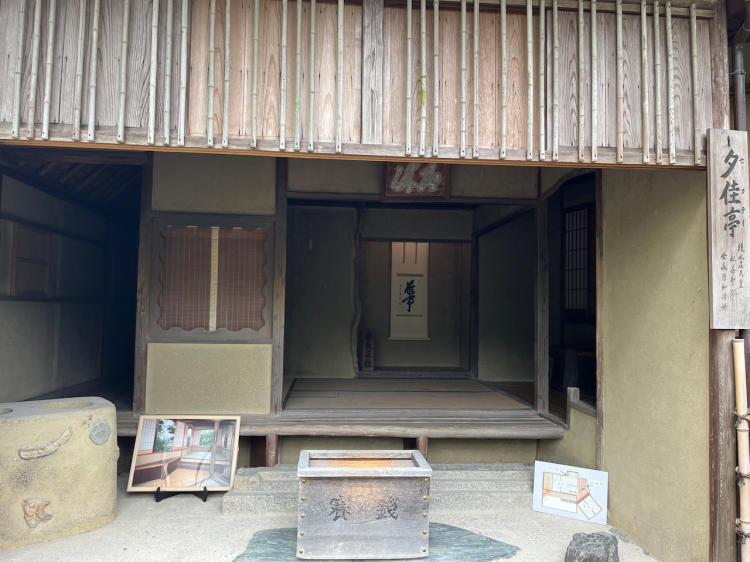
Culminating in the famous tea house:

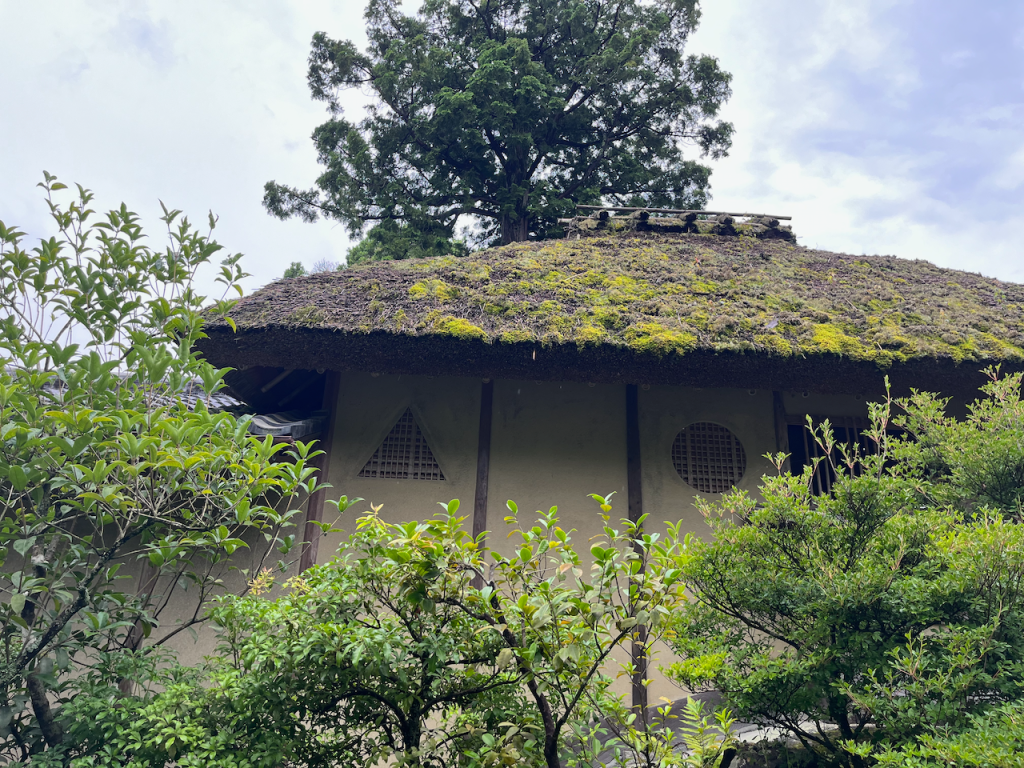
The tea room, called the sekka-tei (夕佳亭), was actually built centuries later when the temple was revived, and visited by the reigning emperor, Go-Mizu-no-o and indirectly inspired by the first tea house of the Silver Pavilion, ironically by Yoshimitsu’s grandson Yoshimasa.

The Sekka-tei includes some interesting architectural design choices as well:

All in all, the Golden Pavilion is an interesting mix of noble aesthetics, history, and Zen influence, and of course a monument to the Shogun Ashikaga Yoshimitsu.

1 Why Rinzai Zen in particular? During the Ashikaga Shogunate, the Rinzai Zen sect had a boom in popularity due in part from influence by Song-Dynasty China. This led to the Five Mountains system for organizing temples into a state-sponsored system. More on that in a future post.

Of Famine and Excess

Recently, I was re-reading an old book in my personal library about the life of the Shogun Ashikaga Yoshimasa (also mentioned here). The Ashikaga Shogunate, that is the military government in Japan from 14th to 16th centuries,1 started out fairly strong, but quickly ran into a series of succession crises and bad governance that culminated in a very disastrous Onin War. The Onin War was a 10-year urban battle in the heart of Kyoto over a succession crisis that basically flattened the city and caused unimaginable death and starvation there and in the provinces.

In Donald Keene’s book, he talks about the utterly ridiculous income disparity between the typical peasant and the aristocrats in Kyoto, as if they lived in two different worlds. Even as the war was raging, Shogun Ashikaga Yoshimasa’s exorbitant taxes to pay for this vanity projects further exacerbated this.

One chronicler at the time, a Zen priest residing in Kyoto named Unsen Taikyoku (雲泉大極, 1421 – ??), recounts in his personal diary:2

When the sun went down I set out for home, and as I was passing Rokujo I saw an old woman with a child in her arms. She called the child’s name repeatedly, then began to wail. I looked and saw that the child was already dead. The mother, still wailing, collapsed on the ground. People standing nearby asked her where she came from. She said, “I’ve come all the way from Kawachi. We’ve had a terrible drought for three years, and the rice plants didn’t so much as sprout. The district officials are cruel and greedy. They demand a lot of money in taxes and show no mercy. If you don’t pay, they kill you. That’s why I had to run away to another province. I was hoping to earn food by begging. But I couldn’t get anything to give my baby. I’m starving and I’m worn out, heart and soul. I can’t take any more.”

When she had finished speaking, she again choked with great sobs. I took from my wallet what spare money I had and gave it to her, saying, “Take this money and hire a man to bury the child. I’m going back to my cell where, with help from the Three Treasures [the Buddha, the Dharma and the Sangha] and the Five Commandments, I shall choose a Buddhist name for the child and offer prayers for his salvation.” The child’s mother was greatly comforted.

While I was still humbly mulling over her sad story, I encountered a group of noblemen out to admire the blossoms. They were escorted by several thousand mounted men, and servants and followers swarmed around them. These gentlemen acted as if they were so superior that nobody could compare with them. Some sneered at the people in the streets; others swore at the menials in the path of their horses; others laughingly stole blossoms; others, drunkenly singing, drew their swords; others still, having vomited food and drink and being unable to walk, lay on the roadside. There were many such sights, and whoever saw them was appalled. Anyone who happened to run into these people was terrified and ran away, intimidated by their high rank.

Yoshimasa and the Silver Pavilion: The Creation of the Soul of Japan, pages 51-52, translation by Donald Keene

It’s not hard to imagine such things happening in a place like Los Angeles, Silicon Valley, London, Paris and so on. It’s not a question of a particular political faction, it’s a tendency of any society to gradually concentrate wealth over time to a smaller and smaller group, further exacerbating the income disparity. Marx spoke of this in the context of capitalism…

But even as far back as the last days of the Roman Republic, we could see a similar pattern (jump to about 19:30 or so):

In any case, unless this trend is addressed in a sustainable way, it never portends anything good.

1 The Ashikaga military government is unrelated to the earlier Kamakura shogunate which I spoke about elsewhere. Since Japan had a succession of military-samurai governments after the Imperial aristocracy was sidelined, and you can think of them like Chinese imperial dynasties in a historical sense.

2 Criticizing such things openly would have incurred the wrath of the Shogunate of course.

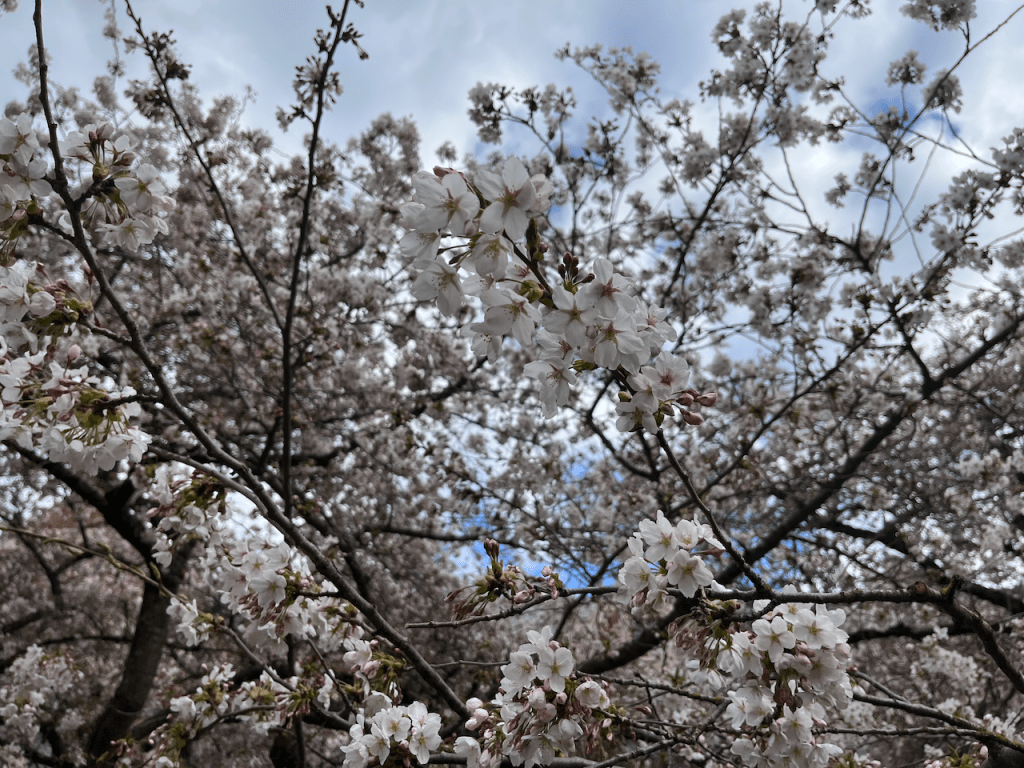
Cherry Blossoms at the UW

In Japan, the tradition of viewing cherry blossoms, or sakura (桜), is a very popular one. Every year, we take the kids to the University of Washington for cherry blossom viewing, called o-hanami (お花見) in Japanese.

It was a very lovely time with the family. Centuries ago, the brilliant, and yet failed Shogun Ashikaga Yoshimasa (also mentioned here), once composed a poetic verse:1

JapaneseRomanizationTranslation
咲き満ちてSakimichiteFlowers in full bloom —
花よりほかのHana yori hoka noBut apart from the blossoms,
色もなしIro mo nashiNo color anywhere.
Translation by Donald Keene in Yoshimasa and the Silver Pavilion: The Creation of the Soul of Japan

Centuries earlier, in the Hyakunin Isshu collection another poet composed some verses on cherry blossoms too:2

JapaneseRomanizationTranslation
もろともにMorotomo niLet us think of each
哀れと思へAware to omoeother fondly,
山桜Yama-zakuraO mountain cherries!
花より外にHana yori hoka niFor, outside of your blossoms,
知る人もなしShiru hito mo nashithere’s no one who knows my feelings.
Translation by Dr Joshua Mostow

We toured the cherry blossoms, took photos amidst other people, and then we headed to the library at the University of Washington, something I that brought back a lot fo memories for me:

… and finally we stopped nearby for some good ramen:3

It was a somewhat unplanned event, since we usually don’t go on a weekday, but we decided to chance it due to the weather, and like any unplanned event, we were pleasantly surprised.

As an o-hanami event, the kids had a wonderful time, and hopefully some good memories for the future.

1 According to Donald Keene, this was the hokku (発句), or opening verse, of a renga poem.

2 Poem 66, see here for more details.

3 I enjoy miso-flavored ramen in particular. Ramen courtesy of Hokkaido Ramen Santouka.