Ecumenism

I have been avidly playing the game Fire Emblem: Three Houses since fall of last year. Yes, the game is that good. But also the game makes you think about things too, including religion.

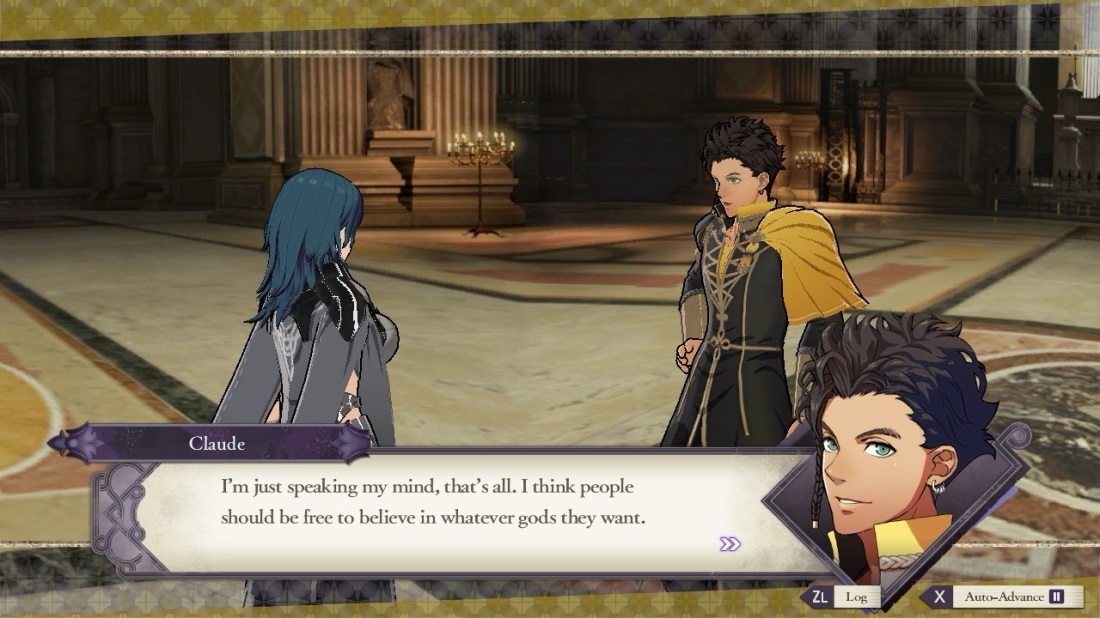
One of my favorite characters in the game, is the leader of the Golden Deer House, Claude von Riegan (also mentioned here and here), voiced in English by Joe Zieja. Claude’s background is unusual for the game’s cast, and he keeps his identity close to his vest, but needless to say he’s had a very worldly upbringing, and sees things different than the other students who mostly grew up in Fódlan. He is just as ambitious as Edelgard, but prefers to meet his goals in a more hands-off, less forceful way.1

Unlike most of his fellow students, who grew up within the Church of Seiros, Claude tends to be pretty cynical about Fódlan’s only religious organization, and regularly questions it (this is also important to certain elements of the plot, but that’s beside the point).
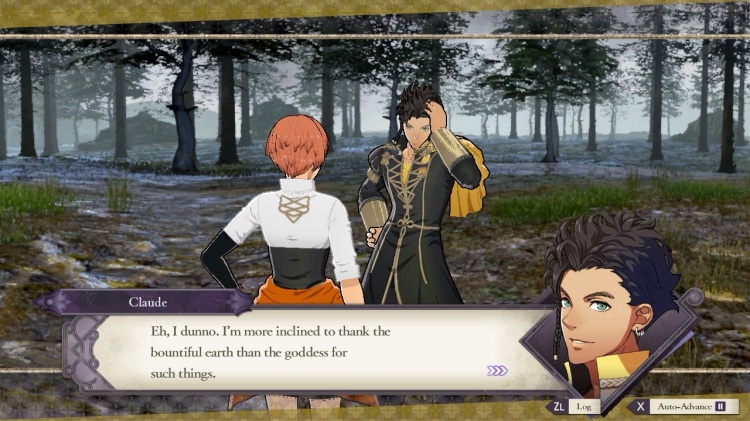
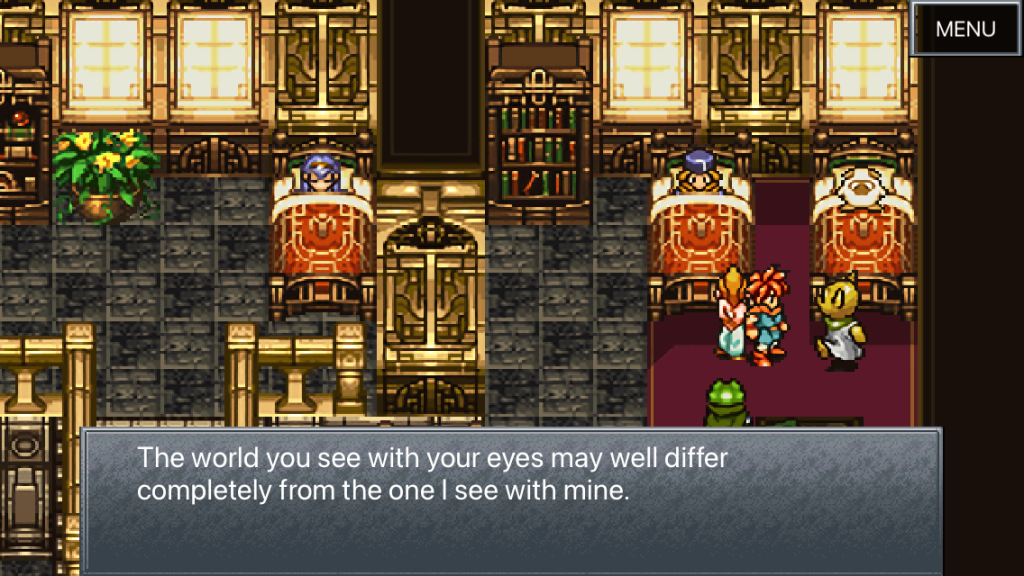
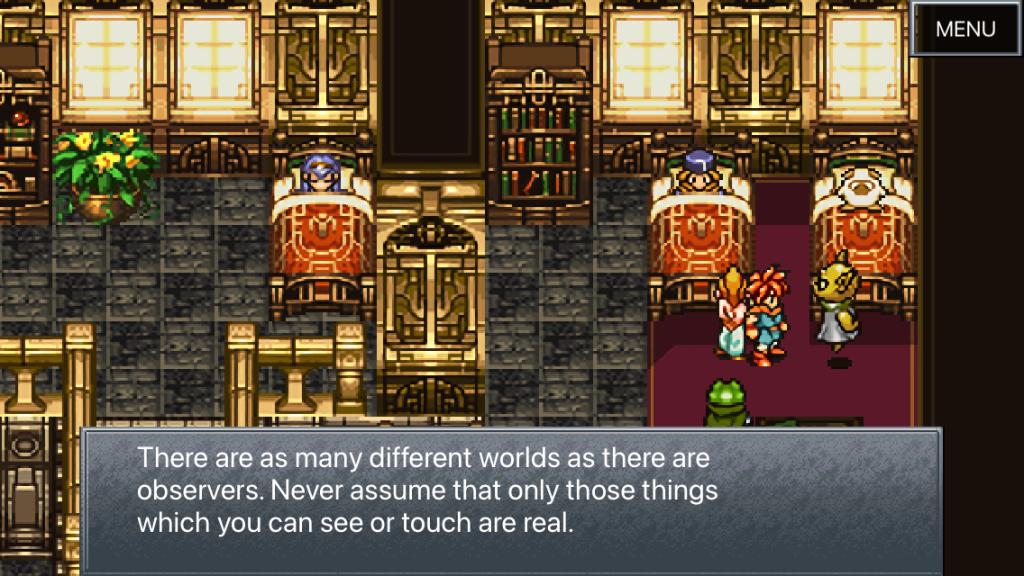
Anyhow, I wanted to share something he said that I think is worth considering (possibly out of order, I lost track of which is which):

Even though I tend to be an ardent Buddhist, I think what Claude is saying here is a healthy to look at the world and its religions. If you consider religions past and present, there have been countless gods and goddesses, rituals, liturgical languages, and so on. Even in in the same religions, practices and views diverge over time. This may offend purists, but it’s impossible to avoid, let alone manage.

Further, Buddhism has never been a particularly evangelical religion. It’s not in a race to win converts (minus a few cults), for a variety of reasons. First, this is in keeping with the Buddhist notion of metta (“goodwill”) that as long as other people have a belief system that helps them, not hinders or makes them feel bad, then that is fine. Second, the danger of imposing one’s beliefs on others is that it’s almost always fueled by ego and one’s own delusion anyway. A person’s religious beliefs, even Buddhist ones, are almost always a reflection of one’s own mind, and have to be taken with a grain of salt. Third, the Buddha clearly wanted people to take refuge in the Dharma of their own volition, and not by coercion. Even the Five Precepts are phrased as “I undertake” not as a command. Similarly with the practice of the nembutsu in Pure Land Buddhism. There’s nothing in the Buddhist canon that tells people to recite, or not recite it. It’s up to each individual to work with the tools offered in the Buddhist toolkit and apply them as best as they can. Like Claude says above, if you find a support system that works, great. This is no less true within Buddhism and its many traditions as well.

It’s generally better, and healthier for one’s own mental state, to let others be who they are, believe what they will, as long as its helpful, not harmful. The tighter one grasps, the more exhaustion and grief they inflict upon themselves, and others.

There are almost as many as variations on religious beliefs as there are people, so like the analogy of the Blind Men and the Elephant, each person is trying to feel their way through life using what resources, background and knowledge they have. Even within Buddhism, each person has their own “spin” on what the Buddha was, or what his teachings were.

It’s imperfect, but we all have to start from somewhere.

P.S. If you own a Switch, try Fire Emblem: Three Houses. 😋

1 Bit of a tangent, but of the three lords in Three Houses, I feel that Dmitri plays the role of the “conservative”, trying to restore his kingdom and the Church the way it was. Claude is the “liberal” trying to open things up and hoping it will change Fódlan, while Edelgard is the “revolutionary” who wants to change things directly (i.e. through force).
Tolerance

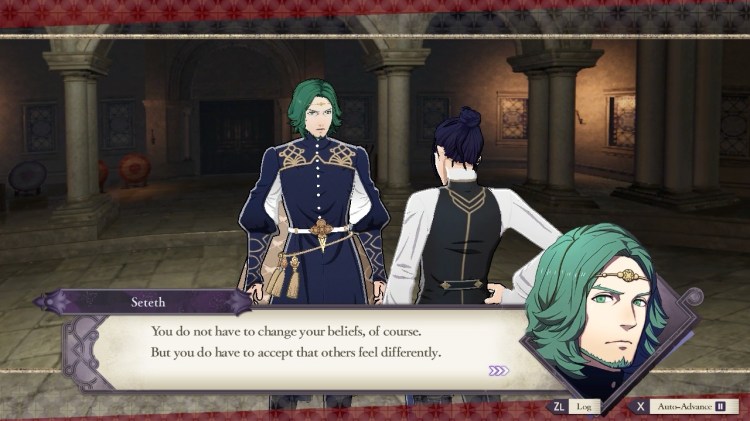
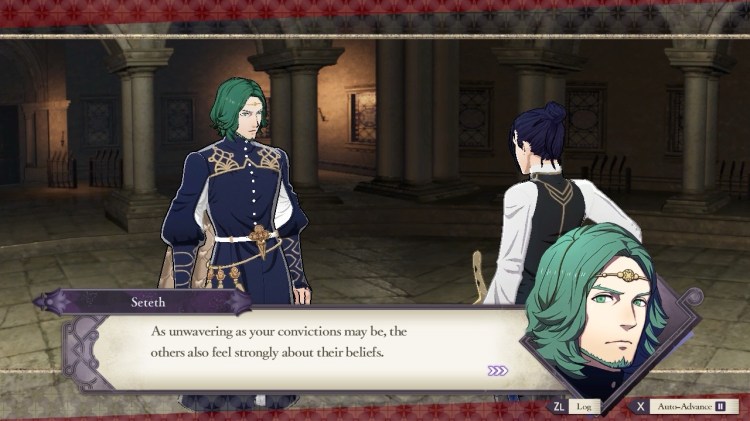
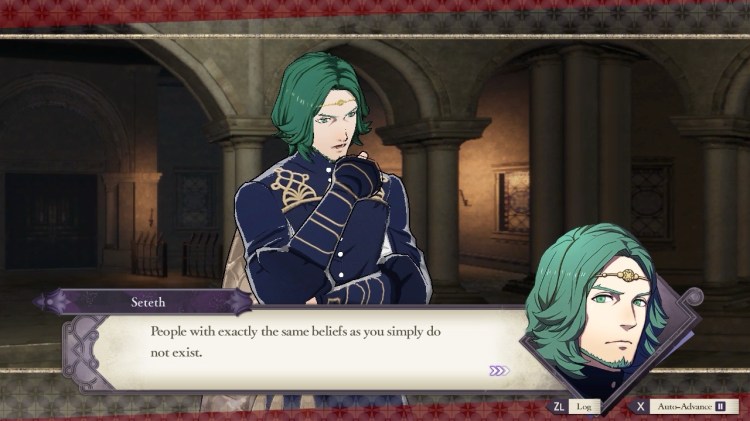
I thought this was a neat dialogue between two of the characters in the game Fire Emblem: Three Houses. The older Seteth (green hair) is offering some advice to the young and prickly Felix:

This might seem self-evident, but because we only see the world through our own viewpoint, our own thoughts and experiences, it’s easy to forget that other people have other viewpoints and other experiences, and come to their own conclusions, right or wrong.

Different game, but I hope the sentiment makes sense. 😆 It’s also why Buddhism emphasizes unconditional goodwill so much.

Namu Amida Butsu

Compassion

I grew up as a teenager watching the old TV show, Kung Fu, on syndicate. I was a big fan, and although the show hasn’t always aged well, it was my first naive introduction to Asian culture, Buddhism, etc, so it holds a special place in my heart.

I found this clip on Youtube recently and wanted to share. It really speaks to the Buddhist notion of metta or goodwill (which I talked about here):

This reminds me of the famous encounter by the Japanese Buddhist monk, Honen, and the prostitute, and his similar approach. I really like the flashback scene here (the one describing the lily in the desert), which reminds me of appreciating the value of all life. Even Gandalf makes this point in the Lord of the Rings:

Finally, I was happy to find another clip from Kung Fu here:

The first flashback scene here, between young Kwai-Chang Caine and Master Po sitting beside a statue of the Buddha, really resonated with me when I was a teenager and first watched Kung-Fu. In fact, this was probably my first encounter with Buddhism ever.

Shit’s Fucked, But What’re You Gonna Do?

I started writing this post weeks before this and this, but now it seems strangely relevant. Recently Eidolon posted a great article about Seneca’s philosophy vs. his tragedies.

I, Calidius / CC BY-SA

One of the many, great parts of this article is this one:

Once I started to confront my depression and anxiety, Seneca’s philosophy sounded even more like well-intentioned but bad advice: just don’t be sad. As a whole though, Seneca’s body of work shows a man split between the anxieties of his political position in Nero’s court, and the calm he sought from philosophy. I despised reading his philosophy because it portrayed what felt like an unattainable goal, but I think it was unattainable to him too.

Seneca was a major proponent of the Stoic school of philosophy, which advocates among other things, striving toward a sense of equanimity (ataraxia ἀταραξία) with regard to the changes in life, and maintaining one’s virtue in the process (eudaimonia εὐδαιμονία). The goal of equanimity resonates a lot with Buddhism too, such as in the Kakacupama Sutta (MN 21):

“Monks, even if bandits were to carve you up savagely, limb by limb, with a two-handled saw, he among you who let his heart get angered even at that would not be doing my bidding. Even then you should train yourselves: ‘Our minds will be unaffected and we will say no evil words. We will remain sympathetic, with a mind of good will, and with no inner hate. We will keep pervading these people with an awareness imbued with good will and, beginning with them, we will keep pervading the all-encompassing world with an awareness imbued with good will — abundant, expansive, immeasurable, free from hostility, free from ill will.’ That’s how you should train yourselves.

translated from the Pali by Thanissaro Bhikkhu

But at times like this, I find it hard to take such philosophy seriously. It’s not that I don’t discount the words of the Buddha, or the Stoics, but it’s kinda hard to pay bills with equanimity, and it’s hard to accept the nature of things when you’re worried about your kids and aging parents getting COVID-19. I am furious, frustrated, and sad at the same time. The author is right in expressing her frustration: these things aren’t just mental games, tools for philosophy; people lives and livelihood are at stake.

The author concludes:

Despair and dread are breathing, living things, following us around, and to get around the fear that things are hopeless is a hard enough task. We need to validate despair in order to get around it and act anyway.

That said, I have to remind myself that I am not the center of the Universe. It owes me nothing, and I can expect nothing from it either. I can hate life and complain it’s unfair all I want, but a lot of good that will do. I do have to accept that fact that my situation is far from stable for the coming months (Coronavirus notwithstanding) and that I will have to take things day by day, step up as a father and provider, and somehow get through this.

Towards a Reorientation of Metta

When you do something long enough, you tend learn a few things, have some highs and lows, etc.

2019, for me, was a low point in my Buddhist practice. The decline had started as far back as 2018, when I withdrew from certain communities I was affiliated with (for better or for worse) and my practice just started to peter out. My interest waned, and at one point I really felt I wasn’t a Buddhist anymore.

In earlier times (years in fact), I was a pretty devout Buddhist. I had a previous blog or two that covered a lot of my home research on Buddhist culture (particularly Japan), sutras I read, thoughts etc. It was something of a full-time hobby for me, bordering on obsession. The crux of this obsession, I think, was trying to make sense of all the different Buddhist teachings, schools, practices and so on. It was driven, subtly, by a need for belonging. I wanted to find that one Buddhist school with that one teaching that would make my life whole, and that one community that would provide the sense of belonging too.

Needless to say that despite my years of efforts I never found it.

The realization came on slowly, but it was something I was forced to accept. It made me question time and again why I was even a Buddhist. My practice as a Buddhist had been pretty hit or miss, and now my motivation in 2019 was even less than before. I deleted my old blog, and sort of pushed Buddhism (and related hobbies) away for a long time.

3kri7eThen, while exploring the subtleties of Greek philosophy, I came upon something called Hierocles’ Circle. Hierocles was a Greek Stoic philosopher who lived during the Roman imperial era and among other things wrote a nice treatise on ethics. His concept of a “circle”, nicely explained in this blog post by How To Be A Stoic, is actually a series of concentric circles. The central circle is of course oneself, the next immediate circle your close family and loved ones, the next circle extended family, etc. What Hierocles did that was amazing was to not just state the obvious (we are self-centered) but to suggest that an ethical life means pulling the outer circles more and more inward.

Compare this with the Karaniya Metta Sutta (Sn 1.8 of the Pali Canon) in Buddhism:

With good will for the entire cosmos,
cultivate a limitless heart:
Above, below, & all around,
unobstructed, without enmity or hate.

Buddhist metta or good-will radiates outward toward others, but otherwise is basically the same concept as Hierocles’ circle: it’s about goodwill towards others and being less of a dick-head.

Further, I thought about the famous Parable of the Burning House in chapter 3 of a very influential Buddhist text called the Lotus Sutra. The Parable is too long to post here, but in essence, the Buddha Shakyamuni describes to his followers a great house filled with many wonderful and terrible things but is also on fire and slowly burning toward a group of kids who are playing in one room. These kids are totally oblivious to their impending demise.

The father who has just returned from abroad sees what is happening and calls out to the kids repeatedly to get out of the house. The kids, too distracted by their toys, ignore their father until he promises them great gifts of all kinds. Finally, the kids leave the burning house, and the gifts that the father was going to bestow them turn out to be something even more grand (not to mention their lives are saved). Ostensibly, the Parable was meant to show how the different Buddhist practices were really just one path anyway, a fundamental concept in Mahayana Buddhism. But, I think the Parable is also powerful in conveying a sense of urgency and priority.

Consider the case of Malunkyaputta, one of the Buddha’s disciples. In one sutra, the Cula-Malunkyovada Sutta (MN 63 of the Pali Canon), he comes to the Buddha asking many deep metaphysical questions and insists that the Buddha clarify them before Malunkyaputta is willing to follow him. The Buddha uses the example of a man who’s been shot by a poison arrow, and as the man’s friends gather around to save his life, the man refuses treatment until they determine who shot the arrow, what kind of wood was used, the feather, etc. Malunkyaputta gets the hint and becomes the Buddha’s disciple.

Returning to the Parable of the Burning House in the Lotus Sutra, the Buddha says in verse (trans. by Senchu Murano):

All living beings are my children.
They are deeply attached
To the pleasures of the world.
They have no wisdom.

The triple world1 is not peaceful.
It is like the burning house.
It is full of sufferings.
It is dreadful.

There are always the sufferings
Of birth, old age, disease and death²
They are like flames
Raging endlessly.

I have already left
The burning house of the triple world.
I am tranquil and peaceful
In a bower in a forest.

Having left the proverbial “burning house”, the Buddha simply could have walked away content and at peace. But he didn’t.  He came back to lead others out of the house.

Between this and Hierocles’ Circle and the Metta Sutra, I asked myself: why am I practicing Buddhism?

Practicing Buddhist meditation for stress relief, as a form of rebellion against the religion of my upbringing, a sense of belonging or maybe due to family tradition are all valid reasons as a starting point, but I realized that the message behind Buddhism is that ultimately we’re all in this together, and that the Buddhist path works best when you’re working toward the benefit of others.  This is not a “bleeding heart” approach, but more about benefiting others by disciplining one’s conduct, cultivating goodwill, and seeing past one’s self-centeredness.  Having a sense of (calm) urgency also helps too.

This is easier said that done, and I have to remind myself from time to time, but I feel it has reoriented my Buddhist practice in a positive way, and breathed new life into something I felt had become moribund.

But, as they say, time will tell. 😎

1 A term frequently used in Buddhism to describe all possible realms of existence, including form and formlessness. The “whole shebang” in other words.

² And the continual repeating of these due to the cycle of rebirth.