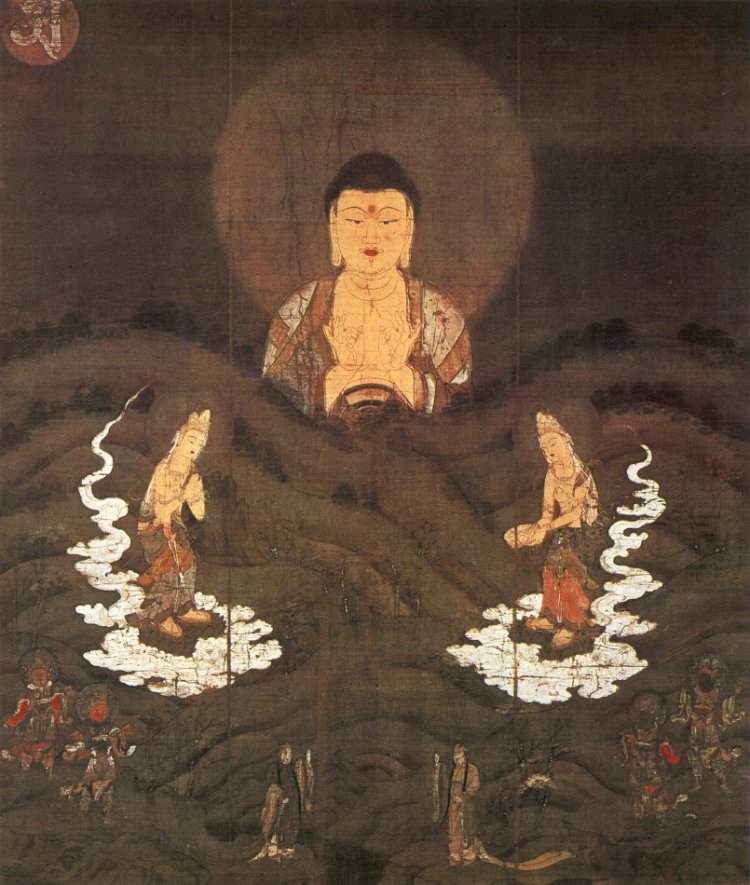
「山越えあの阿弥陀」, or “Amida crossing over the mountain”. Courtesy of Eikando Temple in Kyoto, Japan, and the Museum of Nara. Public domain, via Wikimedia Commons
On the same Japanese documentary as here, I saw a great segment on the famous Eikandō Temple, more formally known as Eikan-dō Zenrin-ji (永観堂禅林寺). Homepage here in Japanese and English. The temple is iconic for several reasons, including its very picturesque fall scenery, and also its vast collection of Buddhist artwork listed here. The most famous is the central figure of Amida Buddha looking back (more on that in a future post).
The picture above, called yamagoé amida-zu (山越阿弥陀図, “Amida Buddha Crossing Over the Mountain”) is a pretty famous work of art that I’ve seen even on English books related to Pure Land Buddhism and especially Jodo-Shu Buddhism.1
It also exemplifies how Amida Buddha was venerated in medieval Japanese culture.
The picture depicts Amida Buddha, a very popular figure in Mahayana Buddhism who vowed to lead all beings to his Pure Land after death so that they may escape the endless cycle of birth and death, and accelerate along the Buddhist path much more readily.2 Amida Buddha is frequently depicted in artwork flanked by two bodhisattvas: Kannon (観音, Avalokitesvara) and Seishi (勢至, Mahasthamaprapta).
As the figure was imported into early Japanese history, he gradually increased in popularity, and many medieval practices were used to help ensure that devout followers would be reborn in his Pure Land. As the situation in medieval Japan graduallyworsened, this became even more prominent. If you look carefully, Amida Buddha’s fingertips in each hand touch together in a mudra, a form of Buddhist iconography. What you don’t see is that traditionally, where the fingertips touch, there are usually five strings of different colors hanging down, and there was a common deathbed practice where the dying individual would hold on the other end of those strings as much as they could. This was believed to help ensure that the dying person would not fall through Amida Buddha’s grasp in being reborn to the Pure Land.
Another noteworthy thing about this painting is the Siddham (Sanskrit) syllable written on the upper-left: 𑖀 (“ah”). It is not the “seed syllable” for Amitabha, which is hrīḥ (𑖮𑖿𑖨𑖱𑖾), but is frequently used in esoteric Buddhism (e.g. Vajrayana). This shows that at this time, Amitabha Buddha was still closely associated with earlier esoteric practices found in both Tendai and Shingon-sect Buddhism. For some reason, English-language books on Japanese Pure Land Buddhism frequently seem to crop out the syllable when including this painting.
One rival practice to reciting the nembutsu at this time was reciting an esoteric mantra called the Mantra of Light, promulgated by Pure Land critic Myōe.3 You can see from this picture that pairing devotion to Amitabha Buddha with a popular esoteric mantra wasn’t such a leap either.
Many of these practices gradually faded as Buddhism in Japan evolved and replaced with other practices, but it’s interesting how this one painting can encapsulate so many things in the 11th-12th century Buddhist-Japanese culture.
P.S. I might have messed up the “hrih” siddham syllable. Unicode, Sanskrit and HTML are not easy. 😉
1 Eikando converted from a Shingon-sect temple to a Jodo Shu-sect temple in the late 12th century when it was administered by a disciple of Honen’s named Johen (1166-1224), and then more fully under Shoku. Interestingly, the “Amida Looking Back” statue was crafted a century earlier, in 1082, by Eikan (also known as Yōkan, 永観, 1033-1111) who saw Amida in a dream, and also later founded a hospital on the temple grounds.
2 The assumption that the Pure Land is the Buddhist version of “heaven” (i.e. in a western sense) will require a separate post to explain. TL;DR they have little in common.
3 I actually recite both in my home practice: the nembutsu and the mantra of light. First one, then the other. I first learned about it not from esoteric sources, but actually from Rinzai-Zen Buddhist liturgy, where it is often recited. It’s interesting how certain practices kind of persist in unexpected places.
This is a photo from a sutra book I frequently use for daily services. I bought this book years ago from the temple of Sensoji (a.k.a. Asakusa Temple) in Tokyo, Japan, a place that I have visited many times over the years.
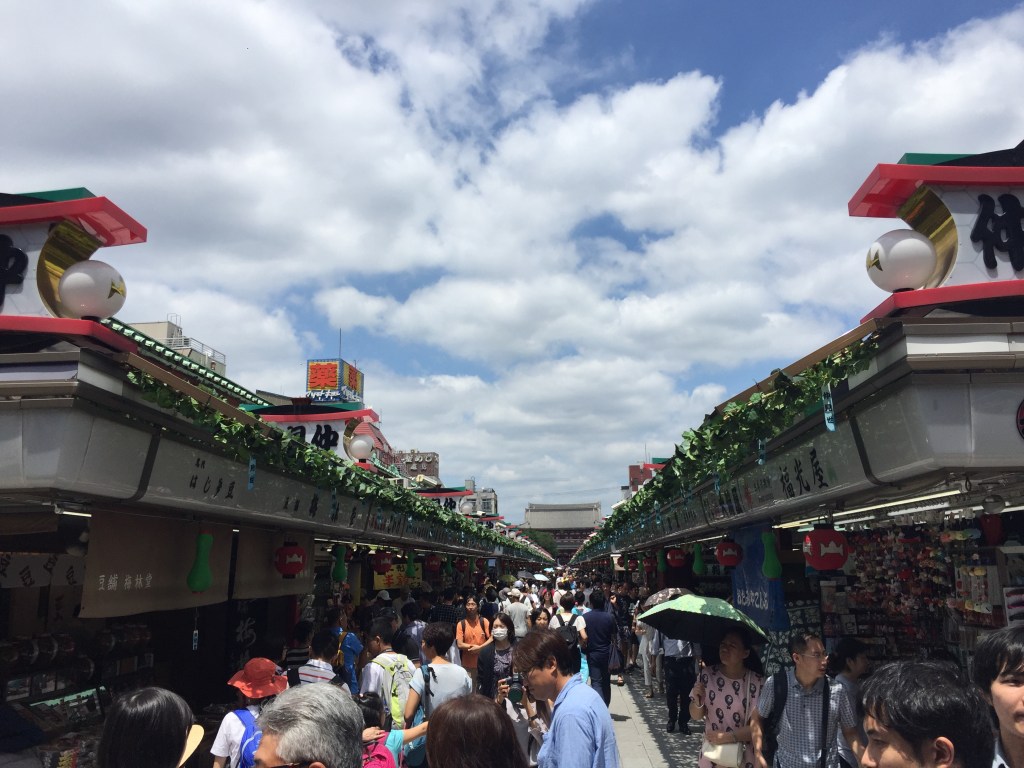
A photo I took in 2016 of the famous market of nakamise-dōri. The actual temple is way in the back.
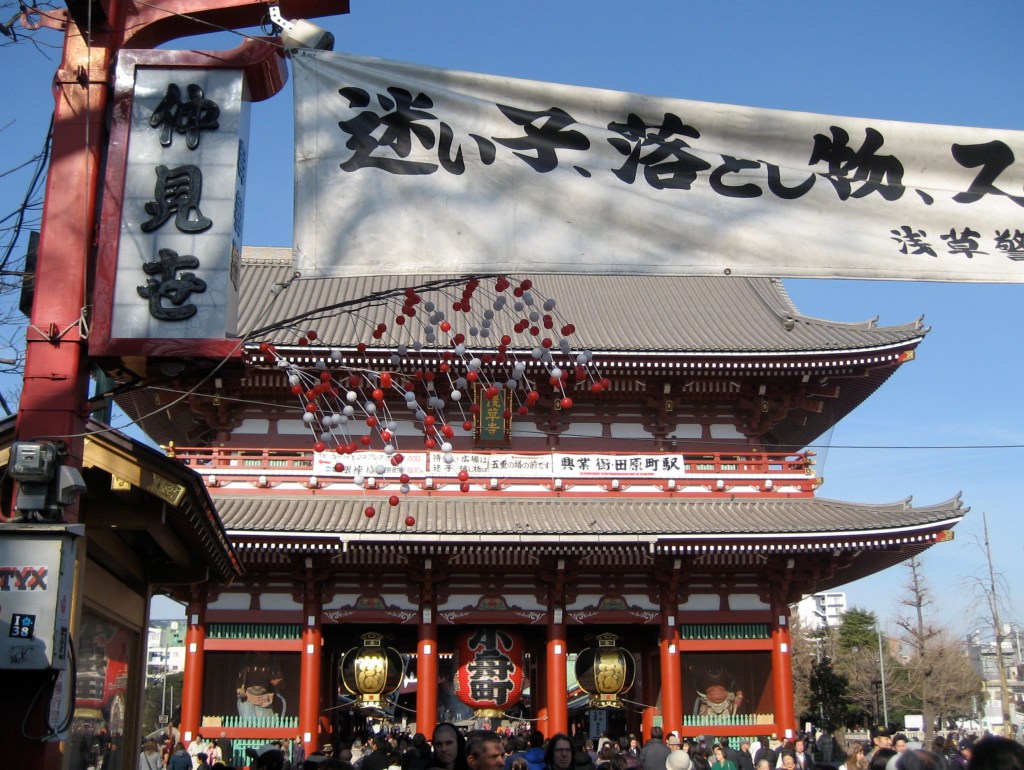
The temple just after New Year’s, taken in 2009.
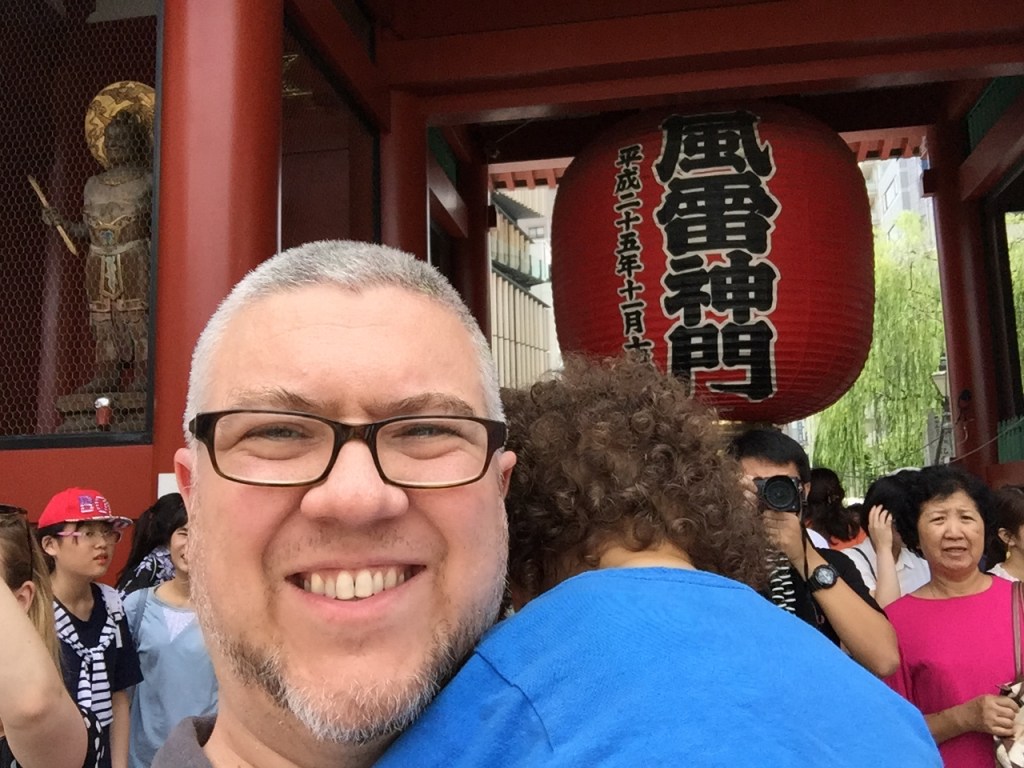
Me carrying one tired little boy at the iconic kaminari-mon gate in 2016. Note the giant red lantern in the back.
It is still one of my favorite temples, even if a bit touristy, and of the Buddhist sutra books I own this is still one of my favorite to use.1 This sutra book uses the traditional Classical Chinese with Japanese pronunciation guides (furigana), which is pretty typical of Japanese-Buddhist sutra books. As you can see, it’s not a long sutra to recite. It is probably the shortest sutra in the entire Buddhist canon.
Chanting the Heart Sutra is something many Buddhists in the Mahayana tradition (everything you see from Tibet to Japan, and overseas) do both in group services and in home services. People chant it in many languages and styles. Its simplicity, and general message about the nature of reality means that it tends to cut across sectarian lines and is popular in many sects and communities. Its cryptic and profound nature also means that for a one-page sutra it is the subject of intense study and research.
The sutra, for reference, is shown below. I used the standard Japanese liturgical form, recited in Zen temples, Tendai temples, Shingon temples, and so on, with only very minor differences per tradition. However, there are many ways and languages to recite the Heart Sutra.
kan ji zai bo satsu gyo jin han nya ha ra mi ta ji
When Avalokiteśvara Bodhisattva was practicing the profound Prajñāpāramitā,
照見五蘊皆空。
sho ken go un kai ku
he illuminated the Five Skandhas and saw that they were all empty,
度一切苦厄。
do is-sai ku yaku
and crossed over all suffering and affliction.
舎利子。色不異空。
sha ri shi shiki fu i ku
Śāriputra, form is not different from emptiness, and
空不異色。
ku fu i shiki
emptiness is not different from form.
色即是空。
shiki zoku ze ku
Form itself is emptiness, and
空即是色。
ku zoku ze shiki
emptiness itself is form.
受想行識亦復如是。
ju so gyo shiki yaku bu nyo ze
Sensation, conception, synthesis, and discrimination are also such as this.
舎利子。是諸法空相。
sha ri shi ze sho ho ku so
Śāriputra, all dharmas are empty:
不生不滅。
fu sho fu metsu
they are neither created nor destroyed,
不垢不浄。
fu ku fu jo
neither defiled nor pure,
不増不減。
fu zo fu gen
and they neither increase nor diminish.
是故空中。
ze ko ku chu
This is because in emptiness
無色無受想行識。
mu shiki mu ju so gyo shiki
there is no form, sensation, conception, synthesis, or discrimination.
無眼耳鼻舌身意。
mu gen-ni bi zes-shin i
There are no eyes, ears, nose, tongue, body, or thoughts.
無色声香味触法。
mu shiki sho ko mi soku ho
There are no forms, sounds, scents, tastes, sensations, or dharmas.
無眼界。
mu gen kai
There is no field of vision and
乃至無意識界。
nai shi mu i shiki kai
there is no realm of thoughts.
無無明。
mu mu myo
There is no ignorance
亦無無明尽。
yaku mu mu myo jin
nor elimination of ignorance,
乃至無老死。
nai shi mu ro shi
even up to and including no old age and death,
亦無老死尽。
yaku mu ro shi jin
nor elimination of old age and death.
無苦集滅道。
mu ku shu metsu do
There is no suffering, its accumulation, its elimination, or a path.
無智亦無得。
mu chi yaku mu toku
There is no understanding and no attaining.
以無所得故。
i mu sho tok-ko
Because there is no attainment,
菩提薩埵。依般若波羅蜜多故。
bo dai sat-ta e han nya ha ra mi ta ko
bodhisattvas rely on Prajñāpāramitā,
心無罜礙。
shin mu kei ge
and their minds have no obstructions.
無罜礙故。
mu kei ge ko
Since there are no obstructions,
無有恐怖。
mu u ku fu
they have no fears.
遠離一切顛倒夢想。
on ri is-sai ten do mu so
Because they are detached from backwards dream-thinking,
究竟涅槃。
ku gyo ne han
their final result is Nirvāṇa.
三世諸仏。
san ze sho butsu
Because all buddhas of the past, present, and future
依般若波羅蜜多故。
e han nya ha ra mi ta ko
rely on Prajñāpāramitā,
得阿耨多羅三藐三菩提。
toku a noku ta ra sam myaku san bo dai
they attain Anuttarā Samyaksaṃbodhi.
故知。般若波羅蜜多。
ko chi han nya ha ra mi ta
Therefore, know that Prajñāpāramitā
是大神呪。是大明呪。
ze dai jin shu ze dai myo shu
is a great spiritual mantra, a great brilliant mantra,
是無上呪。是無等等呪。
ze mu jo shu ze mu to do shu
an unsurpassed mantra, and an unequalled mantra.
能除一切苦。真実不虚故。説般若波羅蜜多呪。
no jo is-sai ku shin jitsu fu ko ko setsu han nya ha ra mi ta shu
The Prajñāpāramitā Mantra is spoken because it can truly remove all afflictions.
即説呪曰。
soku setsu shu watsu:
The mantra is spoken thusly:
羯諦羯諦波羅羯諦波羅僧羯諦菩提薩婆訶。
gya tei gya tei ha ra gya tei hara so gya tei bo ji so wa ka
gate gate pāragate pārasaṃgate bodhi svāhā3
般若心経
han nya shin gyo
The Heart Sutra
You can see a really nice example of this chanted here, courtesy of Koyasan Temple in Japan:
I have been reading Tanahashi’s book about the Heart Sutra and learning a lot about its various interpretations, how it’s conveyed in various languages, and various theories about its origin. I was fascinated to learn that there is a Mongolian version sometimes transcribed in Cyrillic. None of this is strictly necessary for the purposes of Buddhist practice, but it is fascinating. The example I showed above uses what’s called “Sino-Japanese”: Japanese pronunciation of the original Chinese characters it was composed with.2
As for chanting the sutra, I’ve been doing it for years, so I can more or less recite the Sino-Japanese version from memory, and am pretty comfortable doing it that way. I study the meaning of the sutra in English of course. I also have a PDF file for chanting in Sino-Japanese available for those interested.
I have also attended Zen centers on rare occasions (I tend to lean toward Pure Land Buddhism, to be honest) and seen the Heart Sutra recited using English. Learning the English meaning is very useful, but English chanting sounds a bit awkward to me. So, I prefer chanting in the original, and study the meaning separately.
But regardless of what language you use, the Heart Sutra, like all Buddhist sutras, has a funny tendency to gradually “sink in” over time. The meaning may not make much sense at first, but over the course of months and years, it takes on new meaning as you go through life, and see the sutra in a new light. I believe that’s the real value of Buddhist chanting: to internalize key Buddhist teachings in a way that you can carry with you throughout life.
As for me, these days, I tend to recite a Tendai-style home service,4 and as part of that I rotate between chanting this and a certain, small excerpt of the Immeasurable Life Sutra called the shiseige (四誓偈) or juseige (重誓偈) in Japanese Buddhism. When I finish one, I put it under the other sutra book, so I don’t forget which sutra to recite next time as I might go a week or two before reciting again. As a short, traditional liturgy, I am pretty content.
As with any Buddhist practice done over a long period of time, I believe that it gradually polishes the mind, and dispels one self-centered viewpoint. It’s super simple to do, but its benefits last a lifetime. To paraphrase Nichiren, when dying cloth in indigo, the more you do it, the deeper the color becomes.
Namu Amida Butsu Namu Kanzeon Bosatsu
Edit: I discovered in May 2025 some egregious mistakes in the formatting of the sutra above. This was not a problem with the translation, but with mistakes in how I copy-pasted into the blog post. I have since corrected these mistakes. Apologies to anyone who used the flawed copy of the sutra.
P.S. It’s tempting for some to look for an original “Sanskrit” version of the sutra, but alas, the best we know today is that the sutra was compiled originally in China, using excerpts from the much, much larger Prajña-paramita sutras. The story of how exactly that came to be is a much-discussed subject in Tanahashi’s book.
P.P.S. Fun fact: the version of the Heart Sutra used in Japan differs very slightly from the popular version attributed to Xuanzang. The Japanese version, popularized by the Shingon esoteric tradition, is called the rufubon (流布本) version. It has two extra Chinese characters (262 total) from Xuanzang’s 260, and uses slightly different characters for pronouncing the mantra at the end: 揭諦 instead of original 揭帝 for Sanskrit gaté.
1 Because it is devoted to Kannon Bodhisattva, this sutra book also includes (left in photo) a certain Japanese-Buddhist verse called the Jikku Kannon-gyō (十句観音経, “ten verse Kannon sutra”) popularized in the middle ages. I made a post here about it.
A nice explanation of the meaning and history of the ten-verse sutra can be found here.
2 It’s sometimes assumed that the sutra’s earliest composition was in a language like Sanskrit or something else from India, but research has long since proven that the Heart Sutra was a Chinese innovation, a summary of the much longer Perfection Wisdom Sutras, distilled into a very compact, chantable essence. The monk Xuan-zang later brought it back to India, where it later came to Tibet. Pretty clever actually.
3 I decided to leave the Sanskrit mantra untranslated, per esoteric-Buddhist tradition.
4 I like the Tendai approach to Buddhism because it encompasses all the things that are important to me, but avoiding a narrow, dogmatic approach that I found in the past and ultimately rejected.
Due to the confusion of the term “monk” in English, which has become overloaded with multiple, conflicting meanings, I wanted to take a moment and explore how to build a character in Dungeons and Dragons that mirrors a Buddhist monk. I have posted this in my Traveler’s Guide to the Hamato Islands adventure guide on DMS Guild, but wanted to explore the rationale here in more detail. This is similar to posts I did in the past for samurai, ninja and sohei (paladin).
Historical Origins for a Monk
Setting aside Hollywood and fantasy, a Buddhist monk or bhikkhu in the old Pali language of India, is a mendicant: someone who has renounced worldly life in full-time pursuit of the Buddhist path. This is in contrast to the lay follower who may have one foot in the worldly life and one foot on the Buddhist path. Medieval Christianity had a similar tradition: some followers wished to (or were compelled to) pursue a life devoted to God full time and thus give up worldly life.1
In both examples, the Buddhist bhikkhu or Christian monk would be involved in community affairs: leading religious services, providing aid to the poor, and guiding rulers on ecclesiastical (or diplomatic) matters if called upon.
In this regard, a Buddhist bhikkhu is clearly fulfilling the role of a cleric: a religious intermediary.
But, then why does 5th Edition have a separate class for “monk“, a martial arts expert, as opposed to “cleric“? This is where things get kind of confusing.
The notion of a “monk” as a martial-arts expert originates from China specifically. No such tradition existed in India where Buddhism originated. Buddhist bhikkhus in China suffered attacks from bandits or local warlords and needed a way to defend themselves, but without violating precepts on taking life. So, hand-to-hand combat was developed to strike a balance between the two. This is how temples like the famous Shaolin Temple came to be.
Further, confusion arises when you compare Buddhism as a religion to more familiar traditions in the West such as Christianity or pagan, polytheistic religion. Buddhism doesn’t neatly fit into either one and I don’t have time to explain in full detail why, but suffice to say that deities (devas in Indian culture) as we know them are not a prominent aspect of Buddhism. They exist more like background-dancers in a band. On the other hand, Buddhism does have a strong devotional element to the Buddha (i.e. the historical teacher), as well as other celestial Buddhas and Bodhisattvas,2 so it is not quite correct to say that Buddhism is atheistic either.
First and foremost, Buddhism is a religion of the mind, the rest is there to support that. Thus, despite the same social role as a Christian monk, the religious underpinnings are different. That, coupled with the proficiency in hand to hand combat unique to Chinese Buddhist bhikkhus, is probably how the “monk” ideal began in Dungeons and Dragons.
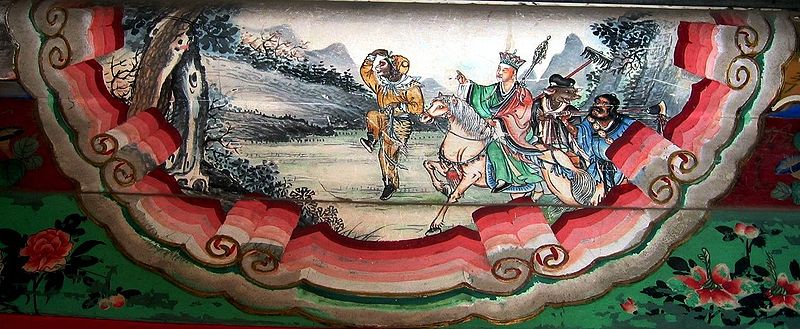
The character Tan Sanzang (pictured on a white horse), from the Chinese classic “Journey to the West” is a good archetypal example of a Buddhist monk adventuring. He in turn is based on the real-life Xuan-zang.
However, in writing the Hamato Islands series, and taking into account local Japanese-Buddhist history, I decided to keep the Buddhist monks firmly in the category of clerics, both for their social role, their lack of hand to hand combat training,3 and for the continued importance of religious devotion in Buddhism. A great literary example in Asian culture is that of the character Tan San-Zang from the classic novel Journey to the West. He journeys to distant lands with the monkey warrior Sun Wu-Zong and uses both powers and diplomacy to help his comrades. This is an excellent foundation for a D&D adventuring party, by the way (hint hint). 😉
Making a D&D Buddhist Monk Character
That’s all well and good, but with this in mind, how does one make a viable Buddhist cleric? I’ve had to play around with this a bit, but here is an example character named Genjo (玄奘. “Genjo” happens to be the Japanese pronunciation of Xuan-Zang the famous 7th-century Chinese monk. I even made an example character sheet in D&D Beyond:
For simplicity, I made this character pretty generic: 4th level, human cleric, but I used the Peace Domain from Tasha’s Cauldron of Everything. As with any cleric character, there’s quite a bit of variation on how you want to build it.
As for the deity, in the Hamato Islands series of adventures, I created a deity called the Great Sage, modeled after the Buddha. The Great Sage’s domains (written before Tasha’s was published) are Light, Life, Knowledge, and Grave. If your DM permits, you can also build a Buddhist monk using the Peace Domain instead.
Mechanically, since the Great Sage is an enlightened being, and not a magical deity, the spells and powers a cleric of the Great Sage receives are fueled not by divine power, but rather through the vast accumulated amounts of good karma that that Sage shares with others.4 But for the purposes of the game, the end-result would be the same: the cleric is entrusted with extraordinary powers to aid others, and to spread their deities teachings.
Update: for the 2024 ruleset, there are not too many changes to the Cleric class, though there are fewer domains offered in the Player’s Handbook. The default 2024 rules do allow you to play older domains not listed in the Handbook so long as you gain the abilities as level three, not level one.
For level one, you now have a simple choice of focusing on magic (thaumaturge) or combat (protector) as your Divine Order. See below for role playing suggestions.
Adding Flavor to Character
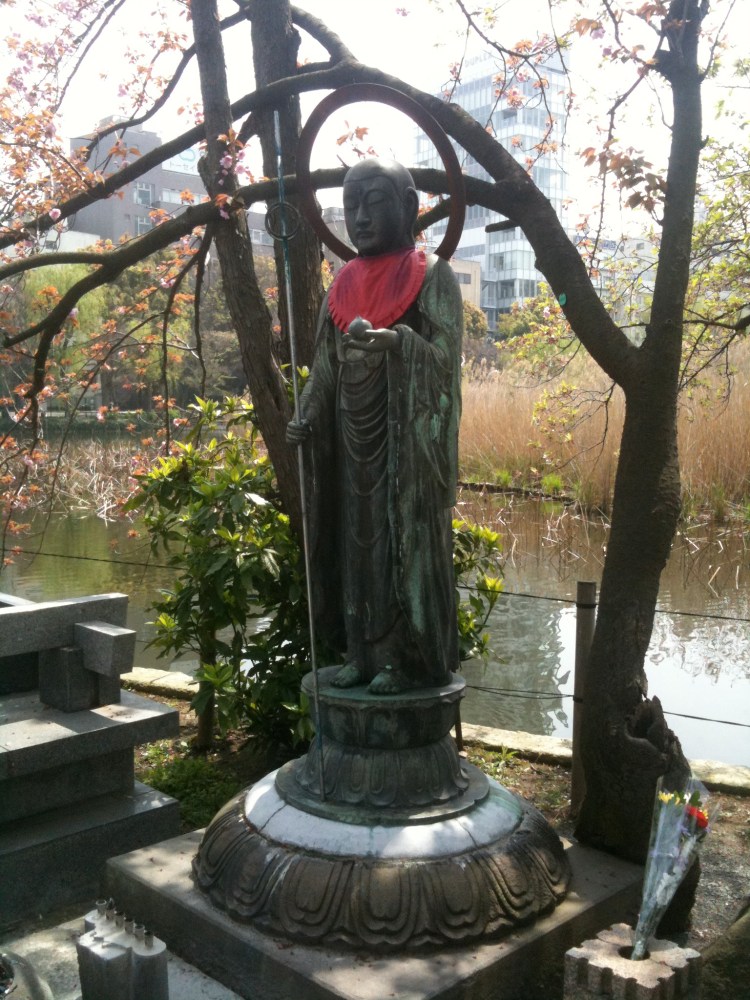
This is a photo of the Bodhisattva Jizo (Ksitigarbha) taken at Ueno Park, Shinobazu Pond. This statue is holding a shakujo staff.
Finally, let’s talk flavor. A generic cleric is OK, but let’s lean into the Buddhist archtype more. First, Buddhist monks in China, Japan and beyond frequently carried a special ringed quarterstaff. This is called a shakujō in Japanese or xīzhàng (pronounced shee-jong) in Chinese. Ostensibly, it was used to make noise and warn animals so that they would avoid being trampled on by a monk, but also came to have a sense of authority or power as well. One could even make a magical version of a shakujo staff:
Staff of the Sage
Staff, uncommon (requires attunement by a Cleric, or Druid)
This staff has 6 charges. While holding it, you can use an action to expend 1 or more of its charges to cast one of the following spells from it, using your spell save DC and spellcasting ability modifier: cure wounds (1 charge per spell level, up to 4th), lesser restoration (2 charges), or hold person (2 charges) or use the Destroy Undead cleric feature (4 charges).
The staff regains 1d4 + 2 expended charges daily at dawn. If you expend the last charge, roll a d20. On a 1, the staff vanishes in a flash of light, lost forever.
This is just one example where Buddhist iconography can be incorporated into Dungeons and Dragons. Another is the Necklace of Prayer Beads which can be modified more into a wrist-style Buddhist rosary (o-juzu in Japanese). The Traveler’s Guide that I published on DMS Guild has other such examples.
What about holy water? The western medieval notion of water blessed by a priest doesn’t really exist Buddhist cultures as much, but oftentimes salt does, as does sand blessed by a specific mantra. So, one can simply substitute holy water as a character item with blessed salt or sand. Mechanically, it works the same.
As for divine order in the 2024 ruleset, the historical Buddhist order is quite large and diverse, so some priests focused on esoteric magic an exorcism (i.e. a thaumaturge) while others might take up arms to protect their parish (i.e. protector). You can be a more fiery and incendiary cleric, or a pacifist, or a war-cleric, or a wandering healer. You get to decide which way your character leans. All of these archetypes did exist in medieval Japanese-Buddhist history.
Conclusion
These are just some examples of ways that one can adapt a Buddhist monk in a more traditional, clerical sense, rather than relying on the more martial-arts archetype, while drawing from traditional Asian-Buddhist culture. It’s a great way to learn more about the culture, and make a viable character for Dungeons and Dragons too.
Enjoy and happy adventuring!
1 Ideally, at least. In both Buddhism and Christianity, there are plenty of examples of monks and renunciants who still meddled in politics. People are people, afterall.
2 This presents a thorny issue for Westerners who are attracted to Buddhism for its non-theistic approach to things, but again it’s important not to conflate the two. The nature of Buddhas and Bodhisattvas, and veneration of them, has different underpinnings than the typical god or deity of worship. Again, it’s too long to explain but TL;DR it’s different.
3 Put another way: Japan and China are two different countries, two different (albeit neighboring) cultures with two different histories. The tendency to lump them together, along with other cultures such as Korea or Vietnam, is like lumping France, Spain and Germany together as “Europeans” without taking local cultural differences into account.
4 The precedent for this in Buddhism itself comes from such examples as Amitabha Buddha, the Buddha of Infinite Light, whose accumulated merit is so great that when one recites his name, Amitabha shares his good karma with others helping them to expunge their own negative karma from the past, and be reborn in his Pure Land someday.
Recently, I made a lengthy rant on Twitter about my frustrations with learning Sanskrit in order to read Buddhist texts. The issue is a surprisingly complicated one, and something I wanted to explore here a bit more.
When you look at religions of the world, Buddhism is somewhat unusual in that it is not rooted in a single, sacred text. No Bible, No Quran, etc. Buddhism has many sacred texts, or sutras, all purportedly the words of the Buddha. These teachings where then passed down by his disciples, yet nothing was actually written down until centuries later. This is not as bad as it sounds. By the Buddha’s time, India already had developed a sophisticated tradition around memorizing sacred texts and teaching them disciples. Non-Buddhist examples include the Vedas (the forerunners to the Hindu religion). People believed at the time that writing sacred teachings down would put them on the same level as mundane receipts and political documents, and was thus considered profane.
Attitudes changed by 1st century CE, but by now those sermons of the Buddha that had been carefully passed down were scattered in various collections, and different Buddhist schools had slightly different collections from one another. Worse, the languages used to transmit the teachings had diverged.
Which Language?
The Buddha, in his time, warned against using the priestly Sanskrit language to transmit his teachings, preferring instead local dialects, but even at that time, India had many, many dialects. Pāli was a very popular one, and remains so for some Buddhist traditions, but as Buddhism grew, keeping track of Buddhist sermons via local dialects probably became less and less practical.
Thus, in the end, Buddhist texts began to be recorded in Sanskrit. Every educated person in India probably knew at least some Sanskrit, just like educated medieval Europeans knew at least some Latin or Greek.
This conversion to Sanskrit wasn’t an overnight swap, however. Research into “Buddhist Hybrid Sanskrit” shows that the transformation was a gradual one: Buddhists would first write things down in a way that looked “Sanskrit-ey” (but not actual Sanskrit), then later generations would write something down that actually used Sanskrit, but still peppered with local colloquialisms. Eventually, even later texts were composed in “true Sanskrit”, at least something that Pāṇini would hopefully approve of.
So, what we see is a kind of gradual spectrum from early texts being composed in local dialects (primarily Pāli) and then gradually transforming into Sanskrit.
The difference, by the way, between Pāli and Sanskrit isn’t as dramatic as it sounds by the way. Pāli, like many Prakrits, was a local languages that derived from Sanskrit, and still had much in common with it. Just like Italian, Spanish, French, etc., all derived from Latin in some way.
To illustrate this, let’s look at a basic word like “king”. In Sanskrit, it is rājaḥ, and conjugates like so (not a complete chart):
Case
Singular
Dual
Plural (more than 2)
Nominative
rājaḥ (rājo)
rājau
rājāḥ
Accusative
rājam
rājau
rājān
Instrumental (e.g. “with” or “by means of”)
rājena
rājābhyām
rājaiḥ
Dative (e.g. “to” or “for”)
rājāya
rājābhyām
rājebhyaḥ
Note: due to Sandhi rules, rājaḥ frequently becomes rājo to smooth things out. Sanskrit also has Genitive, Ablative, Locative and Vocative cases too., but I’ve omitted them for brevity.
…and so on. Pali is a bit more streamlined by comparison being a more colloquial language by nature, so one word for king is rāja (i.e. without the visarga ḥ sound at the end):
Case
Singular
Plural
Nominative
rāja (rājo)
rājā
Accusative
rājaṃ
rāje
Instrumental (e.g. “with” or “by means of”)
rājena
rājebhi or rājehi
Dative (e.g. “to” or “for”)
rājāya or rājassa1
rājānaṃ
This form appears to be more commonly used according to this Pali textbook written by Ven. Nerada Thera
At first glance, Pali kind of reads like the kinder, gentler version of Sanskrit. The dual form is almost entirely non-existent,2 and the sounds are softer, and lacking the ḥ (visarga) at the end. However, you can see they share similar grammatical structures, pronunciation, etc.
So, the first challenge with Buddhist text is this gradual transition from local dialects to literary Sanskrit, spanning hundreds of years. If you picked a particular Buddhist sutra, it might be somewhere in the middle of this transition: is it Pali? is it Sanskrit? Sanskrit with Pali terms, or Pali with a Sanskrit “polish” to it?
How Is It Written?
The second issue is the written script.
Some languages are closely tied with their script: Greek language is written in the Greek alphabet (obviously), while Korean is written in Hangeul. Other writing systems are not: the Roman alphabet is used in many languages: English, French, Vietnamese, etc. In medieval times, Chinese characters were used by a wide variety of disparate languages: Chinese, Japanese, Vietnamese, Khitan, etc.
So, languages are not always tied to a particular writing system. Also. some writing systems are not tied to a particular language.
Sanskrit (and Pali) have been written down using a wide variety of scripts across the ages. Early writings were done using Brahmi script, and Brahmi itself evolved into newer and better writings systems over time leading to the most common example today: Devanagari.3 Many, many modern languages in India and beyond are written in some script derived from Brahmi.
This includes Buddhist texts, too!
Inscriptions by Emperor Ashoka might be written in old Brahmi script:
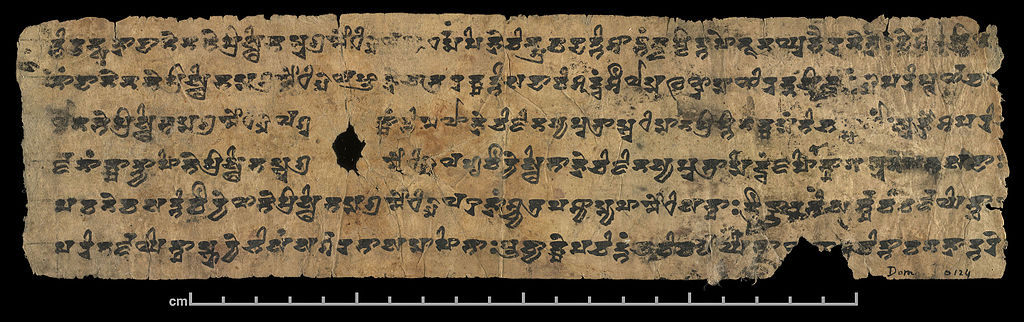
…while texts written in palm leaf might also be written in Sanskrit, but using a derivative script:
The Lotus Sutra written in Sanskrit in an early form of South Turkestan Brahmi script, courtesy of Wikipedia.
You can see that while both are Buddhist (or Buddhist-historical) subjects, they are not necessarily written in the same script. Further examples include later Siddham script, often used in mantras and other esoteric practices by some schools:
The Heart Sutra as written in Siddham script, courtesy of Wikipedia
Then there’s other one-off, but important scripts like Karoshthi and so on.
This is not that unusual by the way when dealing with widely-used languages from antiquity, by the way. Although Greek was always written in the Greek alphabet, the style of writing could be vastly different depending on regional variations, such as those found on Egyptian papyrus vs. modern textbooks. Latin wasn’t always written in big block letters; it had its own cursive form that was more frequently used, and is pretty obtuse to modern Westerners without some training first.
Does Any Of This Matter?
For the average day-to-day practice of Buddhism? Nope.
Buddhism has always been at heart a religion of practice, not dogma. The Buddhist tripod of wisdom, conduct and practice (i.e. chanting, meditation, etc) has two “legs” which involve day to day action. Wisdom is important too but differs from dogma in that it’s not something you believe, but something you learn.
So, you could follow the Buddhist path perfectly fine if you focus on these things, and never bother with ancient languages, relying on acceptable translations instead. Studying the sutras is a helpful practice in Buddhism, but there are already plenty of good translations.
However, if you get into a more professional position either as a teacher, scholar, monk, nun, or priest, etc., knowing some command of Pali, Sanskrit, Classical Chinese, or Tibetan is really helpful. It won’t necessarily make you a better Buddhist, but may help you be a better teacher to others.
Back in 2019, I tried my hand at learning Sanskrit, with the intention of reading Buddhist texts natively, partly for fun, partly for curiosity, partly because I was frustrated by shoddy, overly sectarian translations. What I found is that modern Sanskrit courses and texts overwhelmingly focus on Hindu content, and insist on teaching Devanagari script, which makes sense, but neither of which is appropriate for the study of Buddhism.
Thus, my efforts to learn Sanskrit have languished for a long time.
These days, I would like to try again, but I believe that to effectively learn Sanskrit for the purposes of studying Buddhist texts, the following caveats might be helpful:
Learning Devanagari is not required. Buddhist texts are written in a wide variety of scripts but usually not Devanagari. There are some excellent resources for Buddhists texts preserved in Sanskrit, but using the Roman alphabet. This may sound weird, but as we discussed above, Sanskrit has never been tied to one writing system. One script is as good as another. Seriously.
Much of Buddhism’s corpus of sutras and sacred texts aren’t even “pure” Sanskrit anyway. Just as one might learn ancient Greek starting with Homeric Greek before moving onto Koine, the study of Buddhist texts may benefit by starting with Pāli and then migrating to Sanskrit as needed. Even learning a bit of Pāli might be a nice way to get back in touch with early Buddhism and as close to the Buddha’s words as we might ever get.
Alternatively, rather than trying to use a “one size fits all solution”, find a Buddhist text you are interested in, and determine how it was written, what language, etc, and start from there. Again, there are parallels to ancient Greek. The New Testament isn’t written the same way as Euripides, nor Hesiod. You have to accept that Buddhist texts are similarly written at different times by different people.
One thing I haven’t really talked about so far is Classical Chinese. Much of the Buddhist canon, now lost in India, is preserved in Chinese and epitomized in the Taisho Tripitaka formalized in Japan in the 1920’s. If you want to study ancient Buddhist texts, studying them in Classical Chinese might just be as useful, if not more useful, in some cases. The Heart Sutra, for example, was first written in Chinese and then back-ported into Sanskrit later when Xuan-zang journeyed to India.
Anyhow, this is one amateur’s look at the situation, something I’ve learned the hard way. Your mileage may vary, but if you wish to study ancient Buddhist texts, I hope this helps.
2 According to this textbook, only two words in Pāli have a dual form: dve or duve (two), and ubho (both).
3 Southern Indian languages also use scripts adapted from Brahmi, but through different evolutionary course, hence they look quite different than northern Indian languages.
Having watched Netflix’s Castlevania series for probably the third time through, and as a way of “eating my own dog food” by applying my Dungeons and DragonsHamato Islands setting to other environments, I started a recent thought-experiment: suppose I made a Japanese-style character, and suppose that character got transported to the classic gothic horror setting of Barovia from the Demiplanes of Dread. How would that look like?
Gothic horror, particularly the classic literature, arose from a specific time and place, so it’s inevitably tied to certain religious trends, cultural assumptions, monsters, etc. Dropping a samurai from, say, the 16th century Warring States period, or a Buddhist monk from the late 12th century Heian period into a such a setting would risk being nothing more than a “fish out of water story”. Fans might scoff and say “that would never happen”.
However, if you think about it, the demiplane Barovia, by its nature, keeps pulling people through The Mists to be trapped and fed off of by the vampire Dark Lord, Strahd von Zarovich. Strahd depends on a steady supply of incoming people because as a dark lord who’s been in power for many centuries, the native Barovians are broken spirits anyway and the land is practically devoid of life. As long as he brings more people through the mists, he could care less where they’re from; he just needs fresh blood, both literally and figuratively.
Strahd is a dark and brooding kind of guy
So, imagine some itinerant monk (cleric, Way of the Sage, in my setting) or a sohei warrior (probably a paladin, Oath of Vengeance) is traveling at night deep in the woods of some remote mountain path. Heavy mists close around him, and before he or she knows it, the forests look different. The fauna is ominous and unfamiliar and everything feels somehow threatening. Next he or she stumbles onto the next village only to find that it looks totally unfamiliar. The homes are sagging, timbers are rotten, the colors are faded and bleached, and the architecture is unfamiliar. The strange people gawking at him or her with haunted eyes look different. Worse, they probably wouldn’t speak the same language.1
Quite the culture shock, no?
But it goes further. The local deities would be unfamiliar for example. Such a character would probably not know the Morninglord (Lathander in Barovia), and might rely on their own deities instead even though they mysteriously can’t communicate with them. Since the Morninglord is the only non-evil deity in Barovia, would my cleric/sohei character try to find common ground, or would they hide their religion to avoid antagonizing the locals?
Folk customs, like garlic for vampires and holy water, would also differ. A character from another realm, such as medieval Japan, would use salt, sand blessed with a mantra, or chanting holy sutras to repel evil spirits. Would these religious practices work in Barovia?
If the character managed to survive long enough, I imagine that they would gradually encounter others who stand out. Such people might also hail from disparate lands: maybe from the tropical lands of Chult, the Al-Qadim setting (based on fantasy Arabic culture), or from the wider Asian-inspired lands of Kara-tur. Maybe even a Warforged from Eberron?
In spite of the diverse backgrounds, they’re all united by their common problem: they’ve been brought to the Demiplanes of Dread against their will, and they have to take Strahd2 down. Thus, I imagine the final showdown against Strahd would be a party composing of classic gothic figures like a priest of Lathander, a Simon Belmont like character, maybe a wizard or two, but also diverse characters from other lands. A kind of global super team.
Anyhow, this scenario probably isn’t interesting to other players, but it was just a fun thought-experiment about the challenges of dropping D&D characters from one culture into another culture, especially in a hostile environment.
P.S. Title inspired by Mark Twain’s Connecticut Yankee in King Arthur’s Court. I hope Mr Twain is not rolling over in his grave. 😅
1 The idea of one “Common” language in D&D that all humanoids know might work for a single contintent, but once we start spanning different continents in the Forgotten Realms, the idea seems less and less plausible. For that reason, I made up “Kara-Tur Common” and “Faerun Common” to account for linguistic differences between continental settings, while still having a reasonably common lingua franca among locals.
2 Or, a different Dark Lord, of course. With the new D&D book Van Richten’s Guide to Ravenloft, the other demiplanes are getting much needed attention and detail.
Taken at Kawasaki Daishi temple (Shingon sect) in 2017. This is the Sutra Hall. Notice the Siddham script on the left plaque (with pronunciation guides) and Chinese characters on the right.
In the past, I have dabbled in learning Sanskrit, which is an ancient Indian language, and the foundation of many other modern languages. Sanskrit is to South Asia, what Latin is to western Europe.
Sanskrit is a tricky language though. Speaking from limited experience, it has many grammatical similarities to Latin and Greek (hence they’re all included in the Indo-European language family), but Sanskrit feels like an older language compared to the other two, which is saying a lot. The nouns have 8 declensions compared to 5 in Latin and 4 in Greek, plus it still uses dual-case which was obscure even in ancient Greek times. By the time Latin rolled around, much of this was “smoothed out” and simplified, and Latin in turn has been smoothed out and simplified across the centuries into what we know now as French, Spanish, Italian, Romanian, and so on. But that’s all a story for another day.
The other issue with Sanskrit is the writing system. Actually, systems. Greek and Latin both derive their writing system from the Phoenicians, and these largely did not change. Sanskrit, in a sense, has no native writing system. Instead, it has gone through multiple, separate writing systems, some also descended from the Phoenicians via Aramaic, and each one has its own complex history. Many of them are also gone now, lost to the ages.
Nowadays, Sanskrit is typically written in the beautiful Devanagari script, which is also used in Hindi and many other modern north-Indian languages to various degrees. Devanagari gradually replaced alternative Sanskrit writing systems centuries ago. This also happened roughly around this time that Buddhism died out in India,1 thus you practically never see authentic Buddhist texts composed in Devanagari. Instead, they appear in other, older scripts like Karoshthi based on Aramaic (as in what Jesus spoke natively!), Brahmi script (used by Emperor Asoka), and so on. But one such script still survives, not in India, but in Japan: Siddham script locally called bonji (梵字).
Siddham is preserved in Buddhist texts, but especially in esoteric Buddhist mantras and other practices, particularly in older Japanese Buddhist sects such as Tendai and Shingon. This was the time when esoteric Buddhism was all the rage in Tang Dynasty China, and contacts with India via the Silk Road were still alive and well, thus allowing teachers from Central Asia to come and teaching local students. Most other, later Buddhist sects in Japan use it sparingly or not at all because their approach is not really esoteric in nature (Pure Land Buddhism, Zen, and Nichiren).
But Siddham shows up in other places too. If you look carefully you can also see it in the Marvel movie Dr Strange:
The Book of Cagliostro
Here’s an example “stamp” from my pilgrimage book, which shows a mix of Japanese calligraphy and Siddham characters:
The stamp above is from the temple of Zojoji Temple in Tokyo, Japan, one of two head temples of the Jodo Shu (Pure Land) sect. Note the red stamp in the middle with the Siddham character hriḥ 𑖮𑖿𑖨𑖱𑖾 2 which I believe is symbolic of Amida Buddha (the primary devotion in Pure Land Buddhism).
Another example is a stamp I got at a Soto Zen temple named Toyokawa Inari:
This temple, which has an unusually esoteric flavor for a Soto Zen temple, uses Siddham letters in the stamp (red letters in the middle) in the form of a mandala or something similar.
Here’s a couple Youtube videos on how to write Siddham script. I like these videos because they show a simpler, more straightforward way of writing Siddham compared to the flowery, flowing calligraphy used in esoteric Buddhism. This makes it more suitable for writing on paper with a pen, not using an ink brush.
Siddham is something you’ll likely see in Japan, but it’s fascinating once you realize that this writing system from India for composing Sanskrit is now only preserved in far-flung places like Japan even after it has died out in its homeland. It’s a fascinating, often forgotten piece of religous-linguistic history.
1 For this reason, modern textbooks on Sanskrit are good for teachings the grammar of Sanskrit, but not how to read ancient Buddhist texts: the writing system doesn’t match, and culturally the books tend to focus on translating the vast corpus of Hindu literature, not Buddhist literature despite the common origin.
2 in HTML Unicode: & #x115ae;& #x115bf;& #x115a8;& #x115b1;& #x115be; with no spaces between the & and # … yes 5 characters required because it comprises of “ha”, followed by the virama mark which cuts off the subsequent “ra” to form an “r”, and finally the long “i” followed by the two dots (visarga marks). I didn’t say it was easy, but it’s totally doable if you take the time to learn HTML and Unicode and then just apply Siddham Unicode numbers to it.
Recently, I got into a debate online (that always ends well) about so-called “auxilliary” practices with some fellow Buddhists on an old, private discussion forum for Jodo Shu Buddhist teachings.
The debate started after someone on the forum asked about whether visualization of Amida Buddha was permitted in Jodo Shu, and I was not satisfied with the responses thus far which tended to strongly imply that it wasn’t worth doing, and that one should rely on the nembutsu only. I was somewhat annoyed by these replies, so I responded to the original poster like so (quoting almost verbatim here, minus some typographical editing):
In my experience, both Jodo Shu and the related Jodo Shinshu sects doctrinally focus on the spoken nembutsu only. I would argue though, that this “exclusive nembutsu teaching” is an idiosyncracy of Jodo Shu and does not always reflect the Pure Land tradition in general.
You are correct in that the Contemplation Sutra does teach an elaborate process for visualizing Amida Buddha, and this kind of visualization practice has been undertaken by monks, particularly in the Tiantai (Chinese) and Tendai (Japanese) sects among others. People tend to focus on a single passage toward the end of the sutra whereby reciting the name of Amida Buddha erases all karma, but in some monastic traditions, people have focused on visualization too.
It’s also true that there are parallel traditions for rebirth in the Pure Land that have nothing to do with the nembutsu, mostly in the esoteric tradition. Even today, Shingon Buddhism has visualization/chanting practices related to Amida Buddha that have little or anything to do with the nembutsu. Such parallel practices include such things as the Mantra of Light and various dharanis that sometimes appear in Zen traditions. Genshin, who was ironically a “patriarch” of the Jodo Shinshu tradition, listed many such methods in the Ojoyoshu, but in practice he recited the nembutsu like many other monks and nuns did during his time. Further, the 23rd chapter of the Lotus Sutra, clearly mentions rebirth in the Pure Land of Amitayus (Amida) Buddha through upholding the Lotus Sutra, not reciting the nembutsu.
I think most people would agree that the nembutsu tends to be the most simplest and straightforward, and thus people tend to treat it as the only viable solution in the so-called Latter Age of the Dharma. I think this is a bit of a leap, but if I were a priest and someone wanted to know more about the Pure Land, I would start by teaching the nembutsu too. It’s a great practice. On the other hand, I think it’s also important for people spiritually grow and if people want to branch out from the nembutsu, they should be able to do so without a sense of “guilt” caused by artificial, doctrinal orthodoxy. The reason, I think, is that the Pure Land tradition is more broad than the standard Jodo Shu/Shinshu narrative, and people who want to explore should feel free to do so.
Hope that makes sense,
Doug
Since my interest in Buddhism began in earnest in 2005, starting with Jodo Shu and Jodo Shinshu teachings, I have noticed a tendency for these two sects to dominate Pure Land Buddhist discussions among Western adherents. For a long time, I was also a fervent advocate, but I’ve since become wary of the exclusive approach taught by Jodo Shu/Jodo Shinshu Buddhism.
The heart of the issue, I believe, is the recitation of the nembutsu (念仏), the Buddha’s name, usually rendered as namu amida butsu (南無阿弥陀仏).
Jodo Shu and Jodo Shinshu sects treat this as the sole, exclusive practice and spend an inexhaustible amount of writing and research to assert this point. A cursory study of Jodo Shu/Shinshu literature will reveal that there isn’t much beyond this. The nembutsu is treated with an almost mystical reverence (which is especially amusing since such people are quick to reiterate that it’s not a mantra either). The “name” of Amida Buddha (myōgō 名号) is all-important and if you wish to reborn in the Pure Land of Amitabha Buddha, the only sure-fire method is to recite the nembutsu either as a practice (Jodo Shu) or as an expression of gratitude (Jodo Shinshu) for Amida Buddha’s grace already being extended to you. Beyond this, say adherents, nothing else really matters. Other practices in Buddhism may be conducive to you reciting the nembutsu, but have no merit or power beyond this. Even the Precepts aren’t particularly emphasized or important.
But, as I have learned from various sources, including my new book, this is a kind of revisionist history, and example of how prominent sects tend to dominate the conversation and cherry-pick only those things from the Buddhist sutras that bolster their view.
Further after some backlash, I explained further:
Within the context of Jodo Shu (and related sects), I agree that the position is that the nembutsu is the only essential practice. All other practices supplement it.
However, if you read the Three Pure Land sutras in their entirety, I believe that the authors suggested something slightly different. Take a look at this passage from the Larger Sutra (translation by Rev. Hisao Inagaki):
“For this reason, Ananda, sentient beings who wish to see Amitayus while in this world should awaken aspiration for the highest Enlightenment, do meritorious deeds, and aspire to be born in his land.”
and:
“Why do you not diligently practice good, reflect on the naturalness of the Way and realize that it is above all discriminations and is boundlessly pervasive? You should each make a great effort to attain it. Strive to escape from Samsara and be born in the Land of Peace and Provision. Then, the causes of the five evil realms having been destroyed, they will naturally cease to be, and so you will progress unhindered in your pursuit of the Way. The Pure Land is easy to reach, but very few actually go there. It rejects nobody, but naturally and unfailingly attracts beings. Why do you not abandon worldly matters and strive to enter the Way?”
I believe that the original authors of this sutra [were] advocating a more holistic approach toward rebirth in the Pure Land. It’s a similar message at the end of the Contemplation Sutra: spare no expense if you can.
The issue, I have observed, is that medieval Japanese monks had a tendency to read sutras literally and at face-value, because they were assumed to be the literal words of the Buddha (spoiler alert: they are not). It explains why they literally interpreted Dharma Decline as one of several 500-year periods, among other things. However, we’re living in the 21st century and have access to information they didn’t, so I believe it is beneficial to read the sutras critically, not literally.
Sure you can just recite the nembutsu, but why stop there? I believe that’s the message of both the Pure Land sutras and the Lotus Sutra ch. 2 when the Buddha says a person attains Buddhahood through a single nod to the Buddha or a single “hail Buddha”.
The intention of the Pure Land practices, I believe, isn’t just to get there; it’s part of the larger Mahayana-Buddhist theme of the potential of all beings to achieve Buddhahood and in turn help others still mired in Samsara. The Pure Land is one of many so-called “Dharma Gates” to accomplish this. The Pure Land “gate” just happens to be a particularly compelling one (full disclosure, I too recite the nembutsu).
But “the skies the limit” too, so don’t hesitate to adopt other practices if so inclined.
The danger of faithfully following a particular sect and its core beliefs is that you may well overlook obvious faults in logic, and may become complacent. You have to reassure yourself with “mental gymnastics” when faced by doubt or external criticism. My journey through Buddhism started as far back as 2005, and has taken plenty of twists and turns. At one point, I was even training for ordination as a lay priest in the Jodo Shinshu tradition. But in the end, I’ve become disillusioned by the narrow, sometimes dogmatic emphasis on the nembutsu to the exclusion of the larger Buddhist world and its array of practices and teachings. I can blame this doubt on my almost obsessive personal research at the time, but then again, changing your mind is the point of research. It’s OK to change your mind.
Looking back, I was kind of a fool in those days. I was so happy to have a Buddhist community around here like that, with a straightforward, accessible teaching, that I ignored the fact that it ran against the grain of my Buddhists beliefs. The desire to fit in was more important.
But it’s better to admit a sunk cost and move on, than to double-down. I left the community, somewhat abruptly, and floundered around for years (even deleted a blog or two at the time) until I eventually settled into the more holistic, Tendai-Buddhist practice I follow now, which includes the nembutsu, but a whole lot else too. I enjoy having a broader, not narrow, understanding of Mahayana Buddhism and its teachings, and the flexibility to practices various things in Buddhism without the guilt associated with “deviating” from the standard, orthodox teaching of the sect.
“Look, I already faced her once back when I believed in the throne, and it cost me everything. That’s what’s wrong with Asgard. The throne, the secrets, the whole golden sham.”
Valkyrie, “Thor: Ragnarok”
Much of the centuries of traditions, priesthoods, beautiful liturgy and the high quality books printed in English for budding Western communities are, if you scratch the surface and dig deeper, just a golden sham.1 That leaves any spiritual seeker with a dilemma: fall in line and find contentment, or learn what you can, apply what’s useful, and keep moving onward.
“Come, Kalamas. Do not go upon what has been acquired by repeated hearing; nor upon tradition; nor upon rumor; nor upon what is in a scripture; nor upon surmise; nor upon an axiom; nor upon specious reasoning; nor upon a bias towards a notion that has been pondered over; nor upon another’s seeming ability; nor upon the consideration, ‘The monk is our teacher.’ Kalamas, when you yourselves know: ‘These things are good; these things are not blamable; these things are praised by the wise; undertaken and observed, these things lead to benefit and happiness,’ enter on and abide in them.
trans by Soma Thera
The Kalama Sutta doesn’t mean you can just believe what you want, the Buddha is telling the Kalamas to think for themselves and weigh the teachings and traditions objectively against what they know to be good, right, beneficial and blameless. He is encouraging a kind of scientific observation.
So, if you ever feel pressure from your religious community to “toe the line” or that maybe you’re not a “good Buddhist (or whatever religion)”, stop and remember that the problem might not actually be you.
P. S. For the record, Jodo Shu Buddhism still holds a special place in my heart since it has been a long, and largely positive influence on my life. So I am grateful, but I’ve also moved on.
1 Of course, all of this could be just as easily said of many religious communities around the world.
Author’s note:This is what Samta Claus might look like in a Buddhist text, also known as a sutra... 😏
Thus have I heard. At one time the Buddha was staying in the Jeta Grove monastery of Anathapindaka’s Garden at Shravasti, together with a large assembly of twelve hundred and fifty monks, who were all great arhats, well-known to the people. Among them were great disciples such as the Elders Shariputra, Mahamaudgalyayana, Mahakashyapa, Mahakatyayana, Mahakausthila, Revata, Shuddhipanthaka, Nanda, Ananda, Rahula, Gavampati, Pindola-Bharadvaja, Kalodayin, Mahakapphina, Vakkula and Aniruddha. He was also accompanied by many bodhisattva-mahasattvas, such as the Dharma Prince Manjushri, the Bodhisattva Ajita, and the Bodhisattva Constant Endeavor. Also present were King Brahma, lord of the saha world, and his followers, twelve thousand sons of gods, the eight dragon kings, the four gandharva kings, the four asura kings, the four garuda kings, and King Ajatashatru, the son of Queen Vaidehi, with several hundreds of thousands of followers.
At that time, the Buddha said to the Elder Ananda:
If you travel northward from here, passing a hundred thousand asamkhyakotis of Buddha-lands, you will come to a workshop where dwells a Bodhisattva of the tenth-stage named Mahāsānthaklaṣvara (Santa Claus), who even now is in a state of deep samadhi.
Ananda, why is that Bodhisattva called Santa Claus? In the distant past — innumerable, incalculable and inconceivable kalpas ago there lived a Brahmin named Nikholáṣtra (Nicholas). At that time, Nicholas encountered a Buddha named Joy of Gift Giving, who expounded the Dharma. Nicholas was so deeply moved by the teachings he renounced the householder life and made a series of great vows:
To attain the samadhi of knowing who has been naughty and nice.
To attain the samadhi of being able to visit all houses in one night.
To attain the samadhi of being able to hear all gifts requested for.
To attain the samadhi of providing a joyous winter holiday to children everywhere.
Then the Buddha said to Ananda,
Having spoken these verses, Nicholas adopted the pure practices which led to the establishment of a splendid workshop in the North Pole. At that moment, the entire earth shook in six ways, and a rain of wonderful flowers fell from heaven, scattering everywhere. Spontaneous music was heard, and a voice in the sky said, ‘Surely you will attain the highest, perfect Enlightenment!’
Ananda then said to the Buddha,
Can you describe this workshop to us?
The Buddha said to Ananda,
Well said, Ananda. I am very pleased with your question. You have shown profound wisdom and subtle insight in asking me this question out of compassion for all sentient beings.
At Santa Claus’s workshop, there are seven-jeweled ponds, filled with water of the eight excellent qualities. The beds of the ponds are covered solely with gold sand, and from the four sides of each pond rise stairs of gold, silver, beryl and crystal. Above these stand workbenches adorned with gold, silver, beryl, crystal, sapphire, rosy pearls, and carnelian. Besides these ponds are Christmas Trees hundreds, thousands, millions of yojanas tall — the blue ones radiating a blue light, the yellow a yellow light, the red a red light and the white ones a white light. They are marvelous and beautiful, fragrant and pure.
At each workbench, bodhisattvas whose light emits for one hundred yojanas around their body, toil away day and night making toys and gifts for the children of the world. All the bodhisattvas in the land of Santa Claus will ultimately attain the Stage of Becoming a Buddha After One More Life.
Ananda, why is this sutra called the Maha Santa Claus Sutra?”
Ananda, sons and daughters of good families should, on the 24th night of the twelfth month, leave an offering of milk and cookies by the hearth, and recite this mantra:
Om, mahā-santa-klaṣ-varāya-ho-ho-ho hum!
Then even as they sleep, Santa Claus will fly to their house, as easily as one extends their arm, in a chariot pulled by his eight reindeer attendants, bearing the wish-fulfilling jewel, and leave behind a great cart of the seven treasures. Such a disciple will receive an inexhaustible quantity of goods to meet their material needs, thus enabling them to follow the Dharma more easily.
Ananda, just as I now praise the inconceivable virtue of Santa Claus Bodhisattva, the Buddhas of the Ten Directions also praise my inconceivable virtue, saying, ‘Shakyamuni Buddha, you have accomplished an extremely difficult and unprecedented task. In this Saha world, during the evil period of the five defilements you have attained the highest, perfect Enlightenment and, for the sake of sentient beings, have delivered this teaching, which is most difficult in the world to accept in faith.’
When the Buddha delivered this sutra, Ananda and all the monks, together with beings of the whole world, including devas, humans and asuras, rejoiced at what they had heard and reverently accepted it. Having worshiped him, they departed.










 Gleanings in Buddha-Fields


,_Unknown_Author,_Heian_period,_794-1185.jpg)
You must be logged in to post a comment.