185. Not despising, not harming, restraint according to the code of monastic discipline, moderation in food, dwelling in solitude, devotion to meditation — this is the teaching of the Buddhas.
Translation by Acharya Buddharakkhita
Plain and simple, Buddhism is about restraint, non-violence, and devotion to the training. This can come in many forms, but if it leads to moderation, dignity, self-mastery, and goodwill towards others, this is in accord with the Buddha’s teachings.
Recently, we had a holiday work party at a local Brazilian steakhouse. I have never been to one before but it had many finely cuts meats, and they were served in large quantities over and over.
I am not vegetarian yet (work in progress), but I have been gradually reducing my meat consumption since early 2025. I definitely do not eat steaks and sausages very much. But everyone else was consuming in large quantities. I had a few samples and soon quit because I knew I couldn’t digest so much meat (it was kind of gross). I am really glad I did because although I missed out on some good food, I saved myself from indigestion, nausea and “meat sweats”.
Indeed the Buddha famous said:
186-187. There is no satisfying sensual desires, even with the rain of gold coins. For sensual pleasures give little satisfaction and much pain. Having understood this, the wise man finds no delight even in heavenly pleasures. The disciple of the Supreme Buddha delights in the destruction of craving.
Translation by Acharya Buddharakkhita
Indulging in a ton of food seems like a refuge for us, it makes us happy, but it is not a reliable one. Overindulgence leads to future health problems and misery.
As the Buddha warns through the sutras, there is no safe, reliable refuge. We still dwell in the “burning house” of the Lotus Sutra: death, old age, and disease are things we have to face, amusing ourselves with our toys, but the house burns around us nonetheless.
If you are a high-rolling CEO or a pleb, it is the same problem, just a different scale.
But the Buddha by his accomplishments and his awakening, and thus letting go, has reached safety:
I have already left the burning house of the triple world.1 I am tranquil and peaceful In a bower in a forest.
translation by Rev. Senchu Murano, chapter three of the Lotus Sutra
Hence, the Buddha (like all buddhas) seeks to lead people out of the burning house too, to the safety of the forest.
The first step in the Buddhist path (i.e. leaving the burning house) is, in my opinion (amongothers), taking the small steps toward moderation and self-restraint. Such things pay dividends in the short-term through having fewer hassles, a balanced personal budget, and provide mental well-being both through increased self-confidence and also fewer regrets.
In the long-term it provides far more.
Namu Shakamuni Butsu
1 This is a Buddhist term that shows up in the sutras a lot. It just means the cosmos, the Universe, the “Whole Enchilada“, etc.
One thing that really annoys me as a long-time Buddhist is the tendency for self-help and spritual seminars to cost so much money. I saw this advertised locally in my area for weeks, and the starting price for a seat is $250 for a backrow seat, which to me is totally bonkers.
The Dharma, as taught by Shakyamuni Buddha was freely given, and required nothing.
Having said that, as a counter to pricey spiritual seminars, I wanted to promote a concept: the Art of Dying.
DYING?!
It is a simple concept: you are going to die. You cannot necessarily choose the hour or manner of your death. But it will occur inevitably occur.
You do not have to take my word for it. Here’s a Buddhist sutra (freely given I might add) from the words of the Buddha:
There is no bargaining with Mortality & his mighty horde.
Whoever lives thus ardently, relentlessly both day & night, has truly had an auspicious day:
But, to summarize the Parable, the Buddha Shakyamuni asks us, the reader, to imagine a great, big mansion that’s old, rickey, and so on. Then, imagine the house is burning. Deep inside, some kids are playing in a room, unaware the house is on fire. The father, having just returned from a trip, sees his kids in danger and calls out to them to leave the house at once. The kids, engrossed in their games, fail to see their situation. Finally, the father offers them great rewards if they leave (specifically carts of goods), and the kids finally come out.
The father, Shakyamuni Buddha, has left the burning house and stands outside. He calls to those in danger, namely the “kids”, to see their peril and to come out too.
What about the burning house itself? That is the world we live in, with strife, conflict, disease, chaos, aging, and death.
The late Thich Nhat Hanh wrote about this too:
“Imagine two hens about to be slaughtered, but they do not know it. One hen says to the other, “The rice is much tastier than the corn. The corn is slightly off.” She is talking about relative joy. She does not realize that the real joy of this moment is the joy of not being slaughtered, the joy of being alive.”
This gets to the heart of the Buddha’s teachings: do not squander the time you have on this Earth. It doesn’t mean you can’t enjoy life and your loved ones, but remember: Death will not wait for it to be convenient for you.
When you hear this, your instinct might be the “live, laugh, and love”, indulge in all the fun things in life before it’s too late. But that’s not what the Buddha intended. When you look back at the Parable of the Burning House, the father wasn’t asking the kids to play more, he was telling them to get out before it’s too late.
Further, in the Mahayana tradition, one can get themselves out of the burning house, but helping and guide others to get out of the burning house is even better. One can call such people bodhisattvas.
But you can’t help others (let alone yourself) until you :
Recognize the situation
Put down your own toys and find the way out before you can help others.
This is part of the progression of the Buddhist path: get your foundations in order, increasing confidence in the Dharma (which you can see in your own life), and turning outward to help other beings.
But starting at the beginning, how does one establish a foundation?
Everyone is different, but generally it starts with some simple things:
Taking the Buddha, Dharma and Sangha as one’s chosen refuge (you can do this by yourself or in a community). You can setup a small shrine too.
Taking up an ethical life, such as undertaking the Five Precepts
If all five are too hard, start with one, and work your way up over the months and years.
Say to yourself (yes, you): May I be well, may I be free from harm.
Now think of loved ones: may they be well, may they be free from harm.
Now think of all living beings (even the awful ones): may they be well, may they be free from harm.
Setup a reasonable daily practice. Think of it like exercise or stretching: if you start too aggressively, you’ll injure yourself and set yourself back. So start small, and build up.
What does a daily practice look like? Some examples here.
A small meditation practice can be beneficial too, but intention matters.
Study the sutras. Not self-help books, but the sutras. Commentaries on the sutras, such as those provided by Thich Nhat Hanh are quite good and easy to find in used and independent bookstores such as Powell’s City of Books.
Find worthy teachers and communities, not slick, overpriced seminars or cults. Caveat emptor.
Repeat. Buddhism is a long-term practice. “Play the long game“, but also remember you are on the clock. Time is short.
So, that’s your free teaching for today. Thanks for attending this seminar. Want to support the blog? Pay it forward or something. This is “Buddhism on a Budget”, and I strongly feel this is how Buddhism should be.
It’s been a while since I discussed anything that relates to Tendai Buddhism, but I was doing a bit of nerd-reading with my free time, and thought this was interesting to share.
As Buddhism spread from India via the Silk Road, transmitted by such peoples as the Kushans, Sogdians, and Parthians (the same Parthians who contended with Rome from to time), the vast wealth of Buddhist texts, teachings and information flooded into China in waves.
This import of information was kind of haphazard at first, but as translations improved and information continued to come, China developed its own schools of thought to help make sense of it all.
One of the first successful efforts was by a Chinese monk named Zhi-yi (智顗, 538–597 CE)1 who founded the Tiantai school. He, or possibly by later patriarch Zhan-ran (湛然, c. 711-782 CE),2 analyzed the various teachings and Buddhist texts and developed a chronology called the Five Time Periods and Eight Teachings (五時八教, wǔshí bājiào).3 This chronology looks like so:
The Buddha (Shakyamuni) taught the Flower Garland Sutra first, but it was incomprehensible to disciples.
The Buddha stepped back and taught Agama sutras next. The Agamas are equivalent to the Pali Canon in the Theravada tradition, and nearly the same in terms of content. The Agama sutras were more grounded and practical and thus easier for his community to understand.
Next, the Buddha taught sutras such as the Vimalakirti Sutra as an introduction to Mahayana teachings, and thus higher than the Agamas.
Next, the Buddha taught the Perfection of Wisdom sutras, such as the Heart Sutra, as a more complete teachings.
Finally, the Buddha taughy his ultimate teachings: the Lotus Sutra and Nirvana Sutra because the disciples were now ready.
Thus, out of all the Buddhist texts, Zhi-yi argued that the Lotus Sutra was the complete and ultimate teaching (円教). In Japanese Tendai Buddhism, 円教 is pronounced as engyō, or is sometimes more formally called hokke engyō (法華円教, “the complete teaching that is the Lotus Sutra”). Much of Tendai Buddhism is thus about putting the Lotus Sutra teachings into practice. From the Tendai perspective, things like meditation, venerating Amida Buddha, esoteric practices like mantras, and upholding the precepts are all ways to put the Lotus Sutra into practice, and Zhi-yi wrote quite a bit about this subject.4 The idea, expressed through the phrase shi-shū-yū-gō (四宗融合) or “Four Integrated Schools”.
The historicity of Zhi-yi’s textual analysis is unfortunately pretty dubious. Modern archeology and Buddhology show that the very earliest texts, historically, were the Agamas / Pali Canon (the Dhammapada and Jataka Tales probably came even earlier), but even those were not recorded in writing until three to four centuries after the Buddha. So, even with the earliest texts, we have a gap from when the early disciples passed everything down orally before committing to writing generations later. Granted, Indian oral tradition was quite sophisticated and designed to minimize errors and corruptions in recitation, but the Agamas and Pali Canon do slightly diverge from one another, mostly in ways that are interesting to scholars only.
The Mahayana Sutras such as the Vimalakirti Sutra, Lotus Sutra and Perfection of Wisdom sutras were written down even later. One could argue that they were passed down orally5 and just recorded later for some reason, but textual analysis casts this into doubt. The Mahayana sutras are more like “reboots” or compilations of earlier teachings, more polished and such.
Which is where the Lotus Sutra comes in, I think.
This is personal bias, admittedly, but I do believe that the Lotus Sutra is a capstone of the Buddhist tradition, not because the Buddha saved it for last. Instead, the authors of the sutra did a really nice job of synthesizing earlier teachings into a single narrative, and devised clever parables to bring the teachings to readers in a fresh, new way. The Lotus Sutra doesn’t necessarily introduce a lot of new teachings so much as it brings it all together. Like a capstone or keystone. There’s something in there for everyone, in other words.
So, to me the Five Time Periods and Eight Teachings isn’t very useful in a literal, historical sense, but it is useful for showing how some sutras synthesize other sutras into increasing comprehensive narratives.
P.S. featured photo is the capstone of the main entrance of Giusti’s Palace, photo by Paolo Villa, CC BY-SA 4.0, via Wikimedia Commons
1 Pronounced like “Jer-yee” in English. The “zhi” in pinyin sounds like English “jerk” without the “k” at the end. His name in Japanese is read as Chigi, by the way.
2 Pronounced like “John-ron” in English. In Japanese, his name is read as Tannen.
3 This is read in Japanese language as gojihakkõ.
4 Pure Land practices as we recognize them do not seem to be prominent in Zhiyi’s time and were adopted into Tiantai later, and thus Japanese Tendai even later through such figures as Genshin.
5 The Lotus Sutra, for example is a mix of verse sections with narrative text around them. It’s argued that the verse sections came first, and then authors composed the narrative sections around them. When the verse sections were first composed is anyone’s guess.
True story, I had some spare time one day recently to sit and meditate,1 first time in a while. I set the app to 10 minutes, and sat on the ol’ cushion. About five minutes into this, my youngest child walked in and asked me to unlock the parental control on his tablet.
Concentration broken, oh well.
This is a frequent issue with being a parent and being a Buddhist, but it’s not a new one.
In the Buddha’s time, he distinguished the “householder” followers with the “renunciant” ones. This wasn’t meant to denigrate one versus the other, but it was intended to differentiate those who fully could devote themselves to the Dharma (the “renunciants”), to those who had other, competing obligations (the “householders”). Because the renunciants could, in theory, devote themselves full time to practice, and had cut loose any personal obligations and bonds, they could progress a lot further along the Buddhist path. The lay followers (householders) could still progress, but they would be hampered by their mundane obligations, social “entanglements”, and such.
However, because the Buddhist path was intended to help all, the renunciants would set aside certain days of the lunar month for outreach, helping lay followers through teaching and shared practice. This is known as Uposattha in the earliest Buddhist communities.
In later centuries, especially through the Mahayana tradition, Buddhist thinkers and communities sought to expand Buddhist practice to be more engaging toward lay Buddhist followers. The goal of such practices was not intended to replace the traditional monastic establishment, but (I believe) to help fill in the gaps. By expanding the available gates of Buddhist practice, people from all walks of life could find a place to start, and progress. In other words, an even more inclusive Buddhism.
Which comes back to my situation.
If we think of daily life as a box, there are only so many Lego bricks we can fit in there. Most of those Lego bricks, as a parent, are already spoken for, so that leaves only a bit of space left for “me time”. Within that spare time, self-help can be time-consuming, impractical. Or, one is just too mentally exhausted to do anything else but space out. In some ways, life as a “householder” hasn’t changed all that much since the Buddha’s time. We suffer less from hazards like dysentery and Viking raids, but the distractions and obligations are still there.
In any case, until the kids leave the nest, and especially after retirement, I have to be realistic in my own expectations. Simple practices such as the nembutsu, the odaimoku (a la Nichiren Buddhism), the Mantra of Light, or the Heart Sutra, combined with upholding the Five Precepts amidst daily life, are a helpful way to keep up one’s training while being realistic about time and energy. Even reciting something as simple as the nembutsu deepens the karmic bond with the Buddha and hopefully makes the world a slightly better place.
Also even a bit of forward momentum is better than to squander one’s life staring at a screen. 😉
1 my meditation routine has always been very … inconsistent.
I finished watching the Netflix spinoff series Castlevania: Nocturne, season 2 last week, and I wanted to share this great quote:
Alucard: Your mother and I never met. But when you’ve lived as long as I have, you start to understand. We’re all part of the same story somehow. And these connections run very deep.
Castlevania: Nocturne, season 2, episode 6, “Ancestors”
This inter-connectivity of all beings, all being part of the same story, is a very Buddhist notion.
In Buddhism, especially the Mahanaya tradition (i.e. pretty much all of east Asia, and beyond), there is a famous analogy of the Jeweled Net of Indra (sometimes Brahma). The idea is that within the celestial palace of Indra (or Brahma), there is treasure room, and within that room is a great net woven with jewels at each node.
Now, imagine this great net of jewels, and how each jewel reflects the light of every other jewel. That’s how interdependence works. Shatter, remove, or replace one jewel and the light from the others diminishes as well. So it is with all sentient beings. The effect may not be noticeable, but it does happen.
The entire series of Perfection of Wisdom sutras, including the Heart Sutra, covers this in great detail. The Buddha Vairocana also embodies this truth (especially as described in the massive Flower Garland Sutra); alternatively Amida Buddha does too in some interpretations.
P.S. Castlevania: Nocturne is great. It covers a lot of characters from later Castlevania games that I didn’t play (Richter, Juste, Maria, etc), which confused me at first, but season 2 builds really nicely on season 1. Great series and worthy spinoff to the original.
The Buddha told Ananda, “You constantly hear me explain in the Vinaya that there are three unalterable aspects to cultivation. That is, collecting one’s thoughts constitutes the precepts; from the precepts comes Samadhi; and out of Samadhi arises wisdom. Samadhi arises from precepts, and wisdom is revealed out of Samadhi….”
The Shurangama Sutra, translation by the Buddhist Text Translation Society USA
Recently, I was watching another video by the Nichiren-Buddhist priest about weird ghost stories and experiences, and he told another story about a man who used to hit his wife regularly which I linked here. The closed captions are available in multiple languages.
The thing that really stood out to me about this video, was when the abusive husband, realizing he should change, begged the priest to recite some sutras for him, believing that this would cure him. The priest pointed out that the man’s problem wasn’t going to be solved by reciting sutras (even the venerated Lotus Sutra), but self-discipline and a genuine change of heart. The priest also says that he gets this kind of request often.
In the much older text, the Dhammapada, there is a related passage too:
19. Much though he recites the sacred texts, but acts not accordingly, that heedless man is like a cowherd who only counts the cows of others — he does not partake of the blessings of the holy life.
20. Little though he recites the sacred texts, but puts the Teaching into practice, forsaking lust, hatred, and delusion, with true wisdom and emancipated mind, clinging to nothing of this or any other world — he indeed partakes of the blessings of a holy life.
Translation by Acharya Buddharakkhita
The quote from the Shurangama Sutra, an influential Mahayana-Buddhist text, shows that there is a causal relationship in Buddhist practice starting with personal conduct first, such as taking up the Five Precepts, leading to samadhi, samadhi to wisdom and so on. This is not even a Mahayana-only concept, you can find similar teachings in Theravada Buddhism as well.
In my own head, I sometimes recite to myself “discipline the body, discipline the mind”. By this, I mean that by controlling my conduct in a basic, mundane sense: the five precepts, living a life of moderation,1 etc., I can then provide a firm foundation for deeper wisdom. In another sense, you have to get your personal house in order before you take on a big venture.
It’s counterintuitive, and people often want to jump into things like meditation and chanting, but as the Buddha taught, if you don’t prioritize conduct, the rest won’t amount to a hill of beans.
Having travelled in a westerly direction for a long time, and finally turning south at Samarkand, the 8th century Buddhist monk Xuan-zang is finally approaches the hinterlands of India, birthplace of the Buddha.
A map of northern India including the Gandhara region in the northwest (modern Pakistan and Afghanistan). Created using Inkarnate, apologies for any mistakes.
In our last episode, Xuan-zang had gone as far as the city of Balkh (modern Afghanistan) and was deep in “Buddhist country” northwest of India. Times are very different now, but it was a major bastion of Buddhist learning at the time. From here, Xuan-zang moves to Bamiyan and the famous statues there.
Journey to Bamiyan
While staying in Balkh (part 4), Xuan-zang befriended a local monk named Prajñakara. Prajñakara was, according to Xuan-zang, a follower of Hinayana Buddhism (instead of Mayahana Buddhism), and yet Xuan-zang respected him so much they decided to journey the next leg together to India: Bamiyan.
These two besties, along with their caravan, had to traverse the Hindu Kush mountains to reach Bamiyan.
Not unlike the crossing of the Tian Shan mountains (part 2), the overload route was extremely dangerous. Xuan-zang reported snow drifts up to 20-30 feet tall, and the weather was a constant blizzard:
These mountains are lofty and their defiles deep, with peaks and precipices fraught with peril. Wind and snow alternate incessantly and at midsummer it is still cold. Piled up snow fils the valleys and the mountain tracks are hard to follow. There are gods of the mountains and impish sprites which in their anger send forth monstrous apparitions, and the mountains are infested by troops of robbers who make murder their occupation.
page 45, The Silk Road Journey with Xuanzang by Sally Hovey Wriggins
Thankfully the more experienced Xuan-zang and his team crossed safely and with fewer casualties than past mountain crossings. In time they reached Bamiyan (بامیان in Dari language).
Bamiyan and the Great Buddhas
Bamiyan, since antiquity, has been an oasis town residing where the Hindu Kush and Koh-i-Baba mountain ranges meet, and is a high-altitude, cold-desert climate. Nonetheless, Xuan-zang described Bamiyan as producing wheat, fruit and flowers, as well as pasturage for cattle and such. Due to the climate, Xuan-zang stated that people wore fur and coarse wool, and their personality was similarly coarse and uncultivated. Yet he praised their sincere religious faith.
Up until 2001, the town of Bamiyan was dominated by several sites, including two massive Buddha statues which were built during the reign of the so-called “White Huns” or Hephathalites. The Huns themselves were not Buddhist, but allowed Buddhist worship to continue and devout local patrons helped fund the statues perhaps as an act of piety. Interspersed between the statues were monasteries and grottoes carved into the cliffside.
Of the two “great Buddha” statues, the “eastern” statue depicts Shakyamuni Buddha, the historical founder, measuring 38-meters, while the western statue depicts Vairocana Buddha1 measuring 55-meters. Sadly these no longer exist, as they were destroyed by the Taliban in 2001. In Xuanzang’s time, the status were painted and decorated. The western statue was painted red, while the eastern was white. Both had blue-orange robes, and adorned with gold. This coloration lasted at least until the 12th century.
Interestingly, Xuan-zang described a third, reclining statue of the Buddha at Bamiyan, but no evidence has been found yet of this statue.
In any case, Xuan-zang was greeted by the king of Bamiyan and the local monks, adherents to an obscure sect of “Hinayana Buddhism” that taught that the Buddhas transcended “earthly laws”, took Xuan-zang and his party on a tour of the monastery and valley. My book and online research doesn’t clarify which sect or what this means.
Despite the warm reception, it doesn’t appear that Xuan-zang stayed all that long, and eventually moved on through the Hindu-Kush mountains to Kapisi next.
Kapisi and the Chinese Prince
Next through the Hindu Kush mountains was the city of Kapisi (also known as Kapisa, Chinese: 迦畢試 Jiapishi), which was the capitol of the local Kapisi Kingdom near the modern city of Bagram. Xuan-zang reports that once again, the weather was very difficult, and they even got lost at one point, but some locals helped guide them safely to Kapisi.
Storm clouds part, offering a rare glimpse through the crisp air at Bagram Air Field, Afghanistan, Dec. 18, 2008. The high altitude of the Hindu Kush mountain range creates a harsh climate ranging from more than 100 degrees Fahrenheit in the summer to below-freezing temperatures in the winter. Photo by U.S. Air Force photo by Staff Sgt. Samuel Morse (Released), Public domain, via Wikimedia Commons
As with Bamiyan, Xuan-zang received a cold reception from the people, but was greeted by the local king whom he described as “intelligent and courageous”, and ruled over the neighboring areas.
Bamiyan and Kapisi are both places that have seen countless historical events. Alexander the Greats army marched through Kapisi in the spring of 329 BCE, and the Kushan Empire established Kapisi at its first capital in the first century CE. It was the Kushans in particular who were instrumental in helping Buddhism spread to East Asia (and now the world) especially under the great Emperor Kanishka (reigned 127 – 150 CE).
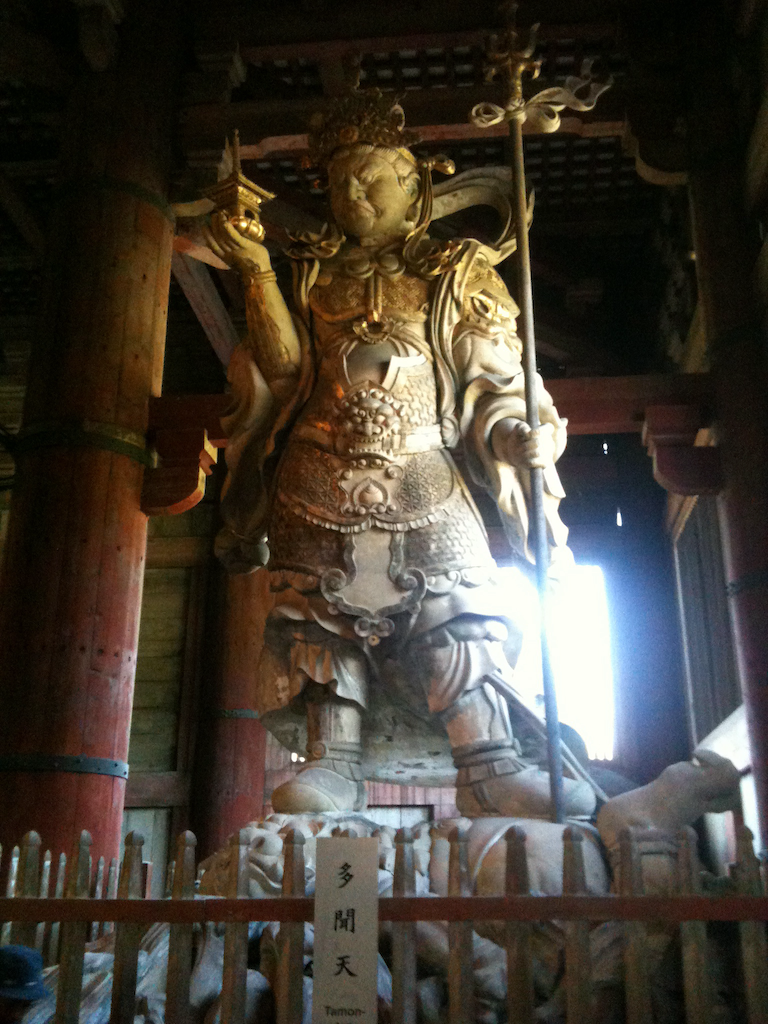
During the reign of Kanishka, a Chinese prince had resided in a monastery in Kapisi as a political hostage. When the prince returned home, he sent gifts and offerings to the monastery in gratitude. Centuries later during the 7th century CE, Xuan-zang paid homage to this prince at the monastery (called the “Hostage Monastery”), where it as thought that the prince’s treasure was buried. According to Xuan-zang’s account, he suggested they dig under a statue of the Buddhist deity Vaiśravaṇa,2 and after a time, the treasure was discovered. Because Xuan-zang was also Chinese, like the prince, it was assumed that his fellow countrymen from the past helped guide them to the treasure.
Later, Xuan-zang was invited by the king of Kapisi to preside over a religious debate amongst the Buddhist clergy, and (again based on Xuan-zang’s account) he was well-versed in the Buddhist doctrines and won, while his opponents only knew their own limited doctrine. One cannot help but roll their eyes slightly. 🙄
Finally, Xuan-zang ran into Hindu ascetics for the first time. Hinduism as we know it, arose roughly the same time as Buddhism and developed in parallel, not one from the other. A common and incorrect statement is that Buddhism descended from Hinduism; they drew from the same cultural and religious well, but arrived at different conclusions. At this time in history, Hinduism was on the rise as Buddhism began a slow decline. Since Hinduism had never reached China, Xuan-zang was not aware of it and spoke ill of the ascetics he encountered, describing them as decadent, untrustworthy, and selfish. It’s unclear why he had such a negative first impression though. Later, in India, he would invest much time debating against them in philosophical contests.
However, Xuan-zang’s joruney was not done. He needed to reach the next destination before crossing into India: Jalalabad.
…. which we’ll talk about in our next post. Thanks for reading!
1 Vairocana is a “cosmic Buddha” that first appears in a Mahayana version of the “Brahma Net Sutra” (the Pali Canon/Theravada version is unrelated). Vairocana, the “Buddha of the Sun” is also the great Buddha statue at Nara, Japan, and is particularly important in the esoteric Buddhist tradition where it is called Maha-Vairocana.
A photo taken by me in 2010 of the central image of the great hall at Todaiji Temple in Nara, Japan: Vairocana Buddha.
2 Vaiśravaṇa, known in Japanese Buddhism as Bishamonten (毘沙門天), can be seen at the famous temple of Todaiji in Nara. I took this photo back in 2010 when visiting there.
A photo of a statue of the Buddhist deity Vaiśravaṇa, known as either Bishamonten, or Tamonten, in Japanese Buddhism. Photo taken at main hall at Todaiji Temple in Nara, Japan.
Indeed, what we see today of Buddhism in Japan and beyond is directly related to the things that Xuan-zang saw along the Silk Road, even if the connection is not obvious at first sight.
Recently, I wrote a brief introduction to the Buddhist canon, the sutras. Sutras come in many shapes and forms, but I want to focus on one of the most famous, and most popular to recite: The Heart Sutra.
A sutra book from Japan showing the Heart Sutra, preserved in old Chinese, but with Japanese pronunciation guides.
The full name of this sutra is the Heart of the Perfection of Wisdom Sutra (般若波羅蜜多心經), and was one in a series of “perfection of wisdom sutras” that were published starting around 2nd century BCE. Starting with the “Perfection of Wisdom in 8,000 Verses Sutra“, the authors made longer and longer versions, culminating to a 25,000 verse version of hte same sutra. Then, they started making shorter versions, getting down to the Diamond Sutra, and finally the Heart Sutra.
Or, so the theory goes.
The Heart Sutra is believed to distill the essence or “heart” of the Perfection of Wisdom teachings to its smallest, most essential version. More on that soon. This version is very short, can be read in 1-2 minutes, and is pretty cryptic. Because it is so short, it is easy to learn and memorize, and thus easy to recite. Its utility for everyday Buddhists is among the reasons it has such lasting popularity. I have a copy of a translation of the 8,000 verse sutra,1 and while it is interesting, it is a tome. It is not practical for most Buddhists to read such a tome, so you can imagine why the Heart Sutra was composed, and why it is so much more popular.
But that gets to an interesting question: who composed it? This is a surprisingly difficult question to answer.
The traditional assumption was that it was composed in India, using Sanskrit language, and then brought to China like most other Buddhist sutras. And yet, a scholar named Dr. Jan Nattier proposed an interesting theory that the Heart Sutra in particular was composed in China, not India, and that it was translated back to Sanskrit, not from it, by our favorite wandering monk Xuan-zang when he visited India. There is considerable debate about this, and valid arguments for one or the other, but it’s an interesting idea that some plucky Chinese monk found a clever way to distill the Perfection of Wisdom teachings into a more bite-sized form.
That said, one of the interesting features of the Heart Sutra is that it does contain a genuine Sanskrit mantra at the end (a trend that continues with later Buddhist texts) in the Siddham script:
𑖐𑖝𑖸 𑖐𑖝𑖸 𑖢𑖯𑖨𑖐𑖝𑖸 𑖢𑖯𑖨𑖭𑖽𑖐𑖝𑖸 𑖤𑖺𑖠𑖰𑖭𑖿𑖪𑖯𑖮𑖯 ga te ga te pā ra ga te pā ra saṃ ga te bo dhi svā hā
For various reasons, this mantra was written in Chinese characters that approximated the pronunciation of the Sanskrit:
As I eluded to earlier, the Heart Sutra is the most condensed version of the Perfection of Wisdom teachings, or prajñā-pāramitā in Sanskrit. This was a teaching that provided an important foundation for Mahayana Buddhism (everything from Tibet to Japan). “Perfection of Wisdom” is hard to explain. But, roughly speaking you can think of it as the fundamental understanding of existence, which is sitting right in front of your face, but not obvious until you see it. Like the first time you noticed a small crack in the wall. Once you see it, you don’t “unsee” it.
But instead, the Perfection of Wisdom is about undoing the filters in one’s own mind, so you can see the world unvarnished. That’s easy to say, but extremely tricky to sincerely accomplish. Hence the extraordinary accomplishments of the Buddhas and Bodhisattvas.
The Heart Sutra talks a lot about “not this”, and “not that”, and like other similar sutras (e.g. the Diamond Sutra, another of the series), this is to try and undo the filters of one’s own mind. But, on its surface, the Heart Sutra is cryptic and vague. Yet, because it is so pithy, and so over time bits of it start to sink in, or something that didn’t make sense in the past finally clicks.
So, if you do pick up a copy of the Heart Sutra, don’t worry if it doesn’t really make sense. Recite it from time to time,2 study it with help sutras guides (there are many) and make it a part of your Buddhist life, regardless of what tradition you follow.
For a such tiny, little composition, it’s a pretty neat contribution to Buddhism.
1 Purchased years ago at Powell’s City of Books in Portland, OR. One of the best bookstores, and well worth a visit if you go there.
2 Some people recite in their native language, others recite in one or more “liturgical” languages. It doesn’t really matter. Pick something you can stick with. You can change it later.
The joke here is a Japanese-Buddhist monk looking at a receipt from Muji (a Japanese home goods store), and commenting that this “sacred text” shows they purchased a lot.1 This happens to us too.
Anyhow, what is a sacret text in Buddhism?
Buddhist sacred texts are called sutras (sometimes suttas), from the old Indian Sanskrit word.2
Buddhism doesn’t have one sacred text like you would associate with the Bible, Q’uran, etc. Instead, it has layers and layers of sacred texts.3
I won’t get into why there are so many layers, but suffice to say that the Buddhist tradition holds the sutras as genuine sermons of the Buddha (a.k.a. Shakyamuni Buddha) which have been passed down generation after generation until today.
Sometimes sutras, or teachings contained therein, are repackaged into newer sutras, especially in the Mahayana Tradition, but the underlying teachings, the Dharma, are believed to be just as important. Think of Spiderman: every few years there’s another Spiderman movie, some more popular than others, but the underlying lore of Spiderman is always the same.4 The history of Buddhist sutras is awfully similar in this respect.
What’s important isn’t so much the specific text of a specific sutra, but the Dharma. In the same way, although Shakyamuni Buddha is very important, the Dharma he taught is even more so.
Because there are so many sutras, this also leads to many sects, schools, and traditions within Buddhism. Each sect or school strives to apply the Dharma as best they can, based on whatever sutra is considered most appropriate.
So how do we know if the Dharma is true? Because it can be applied in one’s own life, through good conduct, meditation, lifestyle choices and so on. If your doctor tells you to lose weight and exercise more, the results speak for themselves. Buddhism is a lot like this.
Should a Buddhist read all the sutras? No, there are simply too many. Some ate huge. It’s often best to start with one or two that are already part of the tradition you are interested in. From there, you can branch out as you see fit. Ask your local community if you need recommendations.
Also, an important tradition across all of Buddhism is reciting sutras. Some sutras are very short and can be recited as a whole. Other sutras are much too long, so people recite key passages only.
This tradition of reciting sutras not only helps internalize the teachings (make them a part of you), but also helps connect to the Buddhist tradition at large. People have been reciting the Buddha’s teachings from the very beginning, 2,500 years ago. When we recite and put the teachings into practice, we are another link in the chain.
Buddhism has no “holy” language, so you can recite them in your local translation, or use a liturgical format that fits your preferred tradition. Or switch between one and the other.
A booklet with the Heart Sutra used in Japanese Buddhism, which I posted about here.
What’s important is that followers make the teachings a part of their lives somehow. This helps them apply the Dharma and also generate good merit to help others. The Buddhist path is not a solitary path: we are all in this together.
Namu Shakamuni Butsu
Namu Amida Butsu
1 Muji is a great store, and there are a few oversea outside of Japan. You can find clothes, household items, stationary and so on. We shop at Muji in Japan whenever we visit there, but also have visited Muji stores along the West Coast as well.
2 Related distantly to the English word suture as in a thread. Old sutras were often palm leaves or tree bark threaded together to form a kind of book.
3 HInduism too, iirc.
4 Even when it’s Miles Morales vs. Peter Parker (or Gwen, or other Spider people), the lore is the basically the same.
In our last episode (… a few months ago 😓) Xuan-zang met the Qaghan of the Western Turkic Khaganate, and made a good impression, allowing him to travel safely further south and westward toward the city of Samarkand.
Map of Xuan-zang’s journeys from Tashkent to Balkh. Inkarnate put out a new version of its software while I was on break, so some things may look different than past maps. As always, this is an amateur map, and may contain geographic mistakes.
If you need to brush up on earlier episodes, click below:
Samarkand is a fascinating place: a fabulously old city, and a major hub on the Silk Road. All the way back in the time of Alexander the Great’s conquests in 329 BCE, 1,000 years before Xuan-Zang, the city was called Marakanda (Μαράκανδα) in Greek and was part of the Achaemenid Persian Empire before that. By Xuan-zang’s time the city was part of the Sassanian Persian empire, and still a major trading hub, known even to the Chinese, but I was unable to find a reliable source on the Chinese name at the time. Modern term is 撒马尔干 (sǎ mǎ ěr gàn ?). The city at this time was almost entirely populated by Sogdian Iranian people, whom we’ve also seen in past episodes. This far west from China, Xuan-Zang probably saw very few if any Chinese people, and instead encountered many people from other cultures and parts of the world. He was very much a “stranger in a strange land”.1
However, because this city was part of the Sassanian Empire, the official religion was Zoroastrianism, not Buddhism, and as Xuan-zang came to the city, he noticed that the Buddhist monasteries there were abandoned and neglected. Some of Xuan-zang’s followers went to pay their respects at these monasteries, but they were chased off by a mob of Zoroastrian followers with flaming brands. Later, the king heard what happened and arrested the mob leaders and was going to pass sentence to mutilate them. Xuan-zang begged for leniency, and so they were flogged and expelled from the city.
The king of Samarkand wasn’t particularly friendly to Xuan-zang, but their relations did improve. Further, it seems that later the king of Samarkand made friendly, diplomatic overtures to Tang-Dynasty China as a foil to the Western Turkic Khaganate, but these did not go very far. Decades later, Great Tang’s expansion reached all the way to Samarkand and they briefly ruled for a few decades until the Battle of Talas later. All this happened decades after Xuan-zang visited the city though.
In any case, Xuan-zang wisely did not stay long in the city and turned at least to towards the south.
Heading South
Up until now, Xuan-zang’s journey from the Yumen Pass in China to Samarkand, over the Tian Shan mountains and across two deserts, has mostly been a westerly journey. But this was as far west as Xuan-zang would go. The road to India was now in a south-southeasterly direction passing through places like modern Afghanistan, Pakistan, and Uzbekistan. These areas were not part of Sassanian Empire, and instead were local princes and minor rulers with complicated relations with regional powers. These areas were more Buddhist-friendly as well due to the legacy of Bactrian Greeks,2 but more importantly due to the Kushans who came later. Much of these lands were former Kushan territory, and their good governance and patronage of Buddhism at the time allowed things to flourish on the Silk Road.
The first obstacle Xuan-Zang and his party ran into was the famous “Iron Gates“.
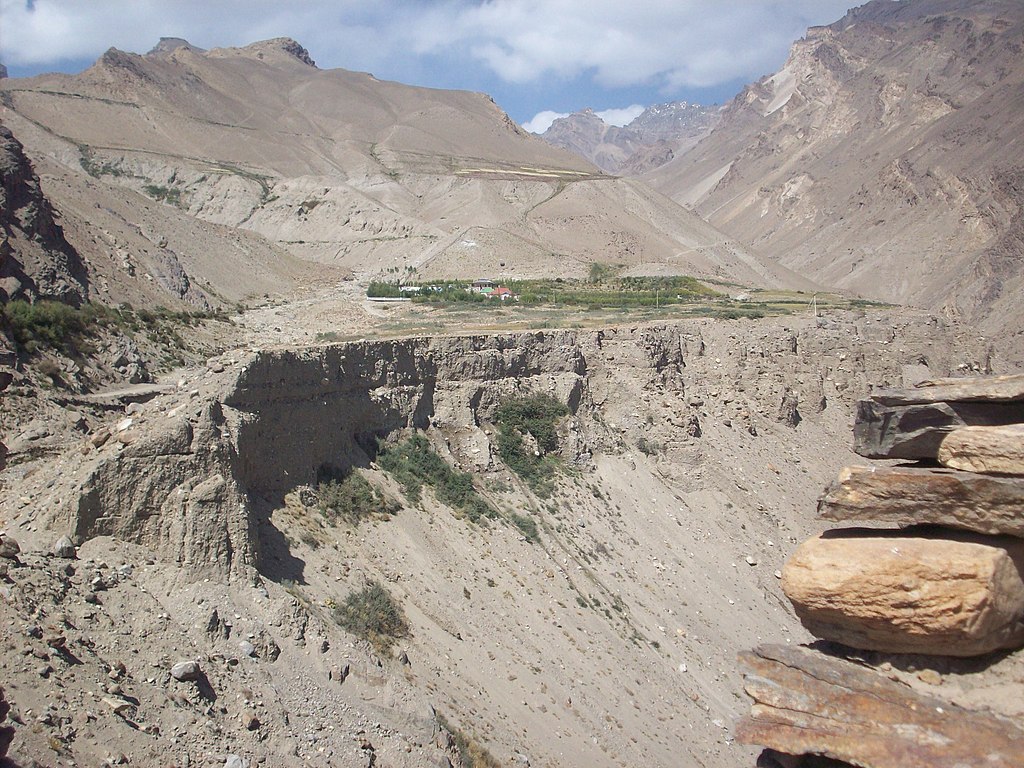
A valley in the Badakshan Province in Afghanistan, close to the where the Iron Gates would be. Photo by Zack Knowles, CC BY-SA 3.0, via Wikimedia Commons
Because this area was a choke-point for travel, it was often garrisoned, and he described “double wooden doors, strengthened with iron and furnished with bells”. In any case, Xuan-zang seemed able to pass through without much issue.
After crossing the Oxus River (now the Amu Darya), he returned to regions where Buddhism was still flourishing namely in the small city of Termez. Termez was once a major city of the Kushan Empire, but was much more diminished by the time Xuan-zang arrived. The Buddhist community here numbered about 1,000 monks. It was here that he saw the Ajina Tepe monastery and its excellent works of art.
In fact, from here Xuan-zang would behold some pretty amazing spectacles. Many people may not realize that the lands we now call Afghanistan were once bastions of Buddhism along the Silk Road, and boasted many treasures, monasteries, and a very eclectic culture.
But first, Xuan-zang had to deal with a series of problems in the city of Kunduz.
Xuan-zang’s visit to the city of Kunduz was no accident. After meeting the king of Turfan way back in episode one, and the Qaghan of the Western Turks in episode three, he had many letters of introduction to the Prince of Kunduz named Tardu. As rulers on the Silk Road, they were all related by family or marriage, so Xuan-zang had little trouble getting an audience with Prince Tardu.
Except for one problem: the Prince’s wife had recently died, and he was in mourning. Later, Tardu abruptly married another daughter of the king of Turfan (episode one), and she in turn plotted with his son from the first marriage. This is starting to sound like the plot of a historical K-drama, doesn’t it?
Before long, Prince Tardu was poisoned and died. The new queen married the prince, and ruled Kunduz thereafter.
Xuan-zang did his best to lay low, and stay out of the issue. His delays at Kunduz meant that he had time to get to know another Buddhist monk named Dharmasimha. Dharmasimha and Xuan-zang debated Buddhist thought and treatises for some time, but Xuan-zang felt Dharmasimha didn’t know as much as he was hyped up to. Dharmasimha for his part, acknowledged his shortcomings, and tried to stay humble about it.
Moving On
Before Prince Tardu’s death, he had encouraged Xuan-zang to visit another city named Balkh, also in modern Afghanistan. Balkh had quite a few sites to see, and since some Buddhist monks were already planning to head back there, Xuan-zang accompanied them. After passing through a city named Tashkurghan (modern Kholm, not related to a similar city in China), they reached the verdant lands of Balkh.
The city of Balkh, known to the Greeks of Alexander the Great as Baktra (Βάκτρα) and Baítíguó (白題國) in Chinese to Tang-dynasty China, was important since very far back in antiquity. Balkh was the traditional birthplace of the Zoroastrian religion, and an important cultural center to Persian people since very ancient times, rivaling cities further to the west such as Babylon and Ecbatana in importance. According to Buddhist tradition, the first two of the Buddha’s disciples also hailed from Balkh, and made the first stupa. Centuries later, it was here that Alexander had married a bride named Roxana, seeking to unify western Greek culture with the eastern Persian culture. Later in the Hellenstic Age, it was an important center of the Greco-Bactrian kingdom.
Needless to say, while few people have heard of Balkh today, it was a very important city across many centuries.
During Xuan-zang’s time, the lands around Balkh were still very fertile (desertification happened gradually later). Even with the widespread destruction the Hephthalities (a.k.a. “white huns”), the lands were still prosperous, if somewhat depopulated. There were two major monasteries in the area collectively known as the Nava Vihara, that belonged to the Sarvastivadin tradition of “Hinayana” (early Indian) Buddhism.3 There were tens of thousands of monks in attendance, and Balkh was one fo the remaining places where teachers were regularly installed from India. Similar to Bamiyan, the Naha Vihara boasted massive statues of the Buddha as well. Interestingly, even as far as the 8th century, long after Xuan-zang was dead, an Arab historian named Umar ibn al-Azraq al-Kermani recorded a place of worship here similar to the Kabaa in Mecca. But instead a Buddhist stupa was enshrined inside, with a cloth draped over it, in accordance with Persian custom of showing veneration.
Xuan-zang stayed at the Nava Vihara for a month, and became good friends with a monk there named Prajnakara. Xuan-zang seemed to finally find a monk of high-caliber, who had a good depth of understanding of Buddhist doctrine, even if he was a “Hinayana”, not Mahayana Buddhist. The two journeyed together further south to Bamiyan.
In our next episode, we’ll explore Xuan-zang’s visit to the great Buddha status of Bamiyan, and Xuan-zang is reaching the borders of India. But first, he has to cross the Himalayas…
3 Although the Sarvastivada school was not Mahayana Buddhism, Mahayana Buddhism inherited a lot from it anyway: canon of texts, certain viewpoints, etc. Another important early school that influence Mahayana were the Dharmaguptaka, who mostly gave their monastic traditions and rules to the Mahayana.










 Gleanings in Buddha-Fields
-testo_e_photo_Paolo_Villa-nA2-tesi_Accademia_Belle_Arti_Bologna-portone_di_Palazzo_Giusti.jpg)
.jpg)


You must be logged in to post a comment.