Here is another wonderful poem (previous posts here and here) by the 11th century Japanese poetess, Lady Izumi (izumi shikibu 和泉式部 in Japanese), that I found in The Ink Dark Moon by Jane Hirshfield and Mariko Aratani:
Original Japanese
Romanization
Translation*
ものをのみ
Mono o nomi
Should I leave this burning house
思ひの家を
Omoi no ie o
of ceaseless thoughts
出でてふる
Idete furu
and taste the pure rain’s
一味の雨に
Ichimi no ame ni
single truth
ぬれやしなまし
Nure ya shina mashi
failing upon my skin?
* Translation by by Jane Hirshfield and Mariko Aratani
The headline for this poem reads:
On the night of the sixth, the sound of the night monk’s voice reciting the Sutras mingled with the sound of incessant rain, and truly this seemed to be a world of dreams…
Lady Izumi cleverly makes not one, not two, but THREE separate allusions to the famous Lotus Sutra, in this poem. I’ve talked about the Lotus Sutra before. It’s a very influential Buddhist text in the Mahayana tradition, and contains many parables and dramatic allusions, compared to some of the drier, more textbook style Buddhist sutras. Thus, allusions to the Lotus Sutra are found throughout literature in East Asia. In my opinion, understanding the Lotus Sutra is key to understanding Buddhism in East Asia: Zen, Pure Land, Tiantai, Nichiren and Vajrayana, etc.
The “burning house” here alludes to the Parable of the Burning House of third chapter of the Lotus Sutra. I’ve talked about it here, among otherplaces. This is pretty straightforward to understand in the poem: the Burning House here is symbolic of the world we live in, burning with passions, craving, anger, delusion, old age, disease, and so on. We can step out of the burning house if we choose to, but we are often distracted by things in the house, and thus unaware that the timbers all around us are on fire, putting us in mortal danger.
The second allusion is that of rain. In the fifth chapter of the Lotus Sutra, there is a parable describing rain on plants, the so-called The Parable of the Medicinal Herbs:
What falls from the cloud is water of a single flavor, but the plants and trees, thickets and groves, each accept the moisture that is appropriate to its portion. All the various trees, whether superior, middling or inferior, take that is fitting for large or small and each is enabled to sprout and grow. Root, stem, limb, leaf, the glow and hue of flower and fruit— one rain extends to them and all are able to become fresh and glossy, whether their allotment of substance, form and nature is large or small, the moistening they receive is one, but each grows and flourishes in its own way.
The Buddha is like this when he appears in the world, comparable to a great cloud that covers all things everywhere, Having appeared in the world, for the sake of living beings he makes distinctions in expounding the truth regarding phenomena.
This is, for me, one of my most favorite parts of the Lotus Sutra. As a sutra, it’s very inclusive (cf. the Parable of the Dragon Princess), but it also acknowledges that there is a huge variety of people in the world. Some people are just different than others, but they can all benefit from the Dharma in their own way, just like the various plants in world drinking from the rain.
Finally, the third allusion in Lady Izumi’s poem is that of a single “taste”. Both the Parable of the Burning House and the Parable of the Medicinal Herbs make a single point: the Dharma of the Buddha appears in a variety of ways, or “gates” for one to enter, but in the end the Dharma tastes the same equally, and is but one truth. So, whichever gate one enters, the rain will ultimately taste the same. For the Burning House, when the children come outside, their father offers, in the end, a single magnificent cart (not many) to offer them as an incentive.
Turning back to Lady Izumi, it’s obvious that she was very thoughtful of these things, even if she struggled to practice them amidst her life. Even when she was surrounded by scandal, and lost both her lovers and her daughter to illness, she could see past it and look at the greater picture.
Recently while taking my personal retreat, I spent some time catching up on Buddhist reading, and finished a book titled Introduction to the Lotus Sutra by Yoshiro Tamura, and translated to English. I had high hopes for the book, but came away pretty disappointed as it was a pretty thinly veiled promotion of a Nichiren-Buddhist interpretation of the Lotus Sutra, and of Nichiren Buddhism in general.1
One passage makes some interesting comments worth noting though (Wikipedia links added):
Shinran (1173-1262), Dogen (1200-1253), and Nichiren (1222-1282) also came into reality of out Mt. Hiei’s hall of truth [same as Honen a generation earlier]. Yet their attitudes toward the actual world were quite different from Honen’s. While Honen was mostly devoted to giving up on life and longed for the pure land of the next life, Shinran, Dogen, and Nichiren struggled positively within the actual world. Their activities and writings came right after the Jokyu turbulence of 1221 and were related to it.
Page 123, translation by Michio Shinozaki, edited by Gene Reeves
Mr Tamura is comparing several different Buddhist monks who all left the Tendai sect around the same time, and each founded their own sects. The first, was Honen, who founded the Jodo Shu sect and greatly popularized Pure Land Buddhism in Japan. This is a fascinating historical phenomenon that started in the last 12th century with Honen, and persisted with a couple more generations of Buddhist monks all trained from the same Tendai sect, and apart from Nichiren, its great temple complex on Mt Hiei.
As Nichiren was the last of these great reformers, he had the benefit of hindsight, and tended to be rather harsh toward Honen’s Pure Land movement as degenerate, and further obscuring the true Buddhist teachings (as enshrined in the Lotus Sutra and the Tendai sect). Thus, ever since, Nichiren authors and followers have had particular animus toward Honen. The book doesn’t pull punches either.
But it’s an interesting comment to make, and not without merit. The Jodo Shu Buddhist sect has always been focused on a singular goal within the larger Buddhist religion: to enable followers to be reborn in the Pure Land of Amitabha (Amida) Buddha and thus provide as a refuge, but also to enable them to accelerate on the traditional Buddhist path faster. A lot of this hinges on a medieval-Buddhist interpretation of the “end days” or Dharma Decline, which looks a bit silly knowing what we know now.
In any case, Jodo Shu sect Buddhism, at least on paper, definitely focuses on the life to come. From what I hear on the ground, the reality is a lot more nuanced, and many communities still practice some manner “traditional Buddhism”, but the primary focus still remains rebirth in the Pure Land to come.
So, what Mr Tamura says makes sense.
Mr Tamura is also correct in that Dogen, who founded the Soto Zen sect, and Nichiren approached the same medieval concern with Dharma Decline, but in different ways: Dogen focused on the classic Buddhist approach to mindfulness, meditation, focus on the now, etc. Nichiren took the logical conclusion of the Lotus Sutra’s egalitarian teachings in the form of social reform, nominally as a reform of the Tendai sect, especially in the face of the crooked administration by the new Hojo clan’s military government.2
But I have to disagree with Mr Tamura’s hidden conclusion that by focusing on this-worldly practice that certain sects of Buddhism are superior to others. I feel that this hopelessly generalizes things.
One of the things that always attracted me to Honen’s teachings was his overt rejection of petty, secular life while keeping his focus on the future, namely the Buddha’s Pure Land. It may seem counterintuitive, but by focusing on the “world to come” and thus rejecting the world as it is, i think this fosters a renunciant’s mindset, even as one continues to live in this world. The historical Buddha, Shakyamuni, definitely advocatedthisapproach.
This may seems like not a big deal, especially given other Buddhist sects also have some form of monastic practice, or similar rejection of secular life, but consider that the other aforementioned reformers were all Buddhist monks of hte same Tendai sect, and Tendai at the time had a controversial teaching called hongaku (本覚) or original enlightenment. The idea is that one is already enlightened but unaware of this due to ignorance or skewed viewpoints. This leads to all sorts of thorny issues with Buddhism and Buddhist practice, and gave some scallywags in the Buddhist monastic community an excuse to “loosen the reins a bit” in terms of discipline.
Honen seeing the state of affairs of the community at his time, overtly rejected this concept. Other reformers embraced the concept to some degree or another, sometimes leading to some behavior that in the wider Buddhist world would raise eyebrows.
On the other hand, the historical Buddha definitely advocated practice and mindfulness here and now too. In fact, it’s pretty much central to Buddhist practice, at least for monastic followers. So, Mr Tamura, Dogen, Nichiren and others aren’t wrong.
As a modern 21st-century Buddhist speaking 800 years later (and from another culture), with plenty of personal biases of my own, I think you need a bit of both. On the one hand, whether you are a Buddhist layperson or a monastic, it’s healthy to maintain a renunciant’s mindset. The world is a series of endless transitions, both on a macro level and a personal level, so there’s no lastingrefuge or rest. Further, it doesn’t make sense to just throw up your hands and bank on the future through prayer and good merit, because there’s plenty of things you can do in the hereandnow to make life better for others, and also for yourself. Even if you engage in a little bit of Buddhist practice,3 that’s still a step in the right direction. Even if you meditate even only occasionally, that’s still better than nothing.
So, in a sense, all of the Buddhist reformers in 12th-13th century Japan had something positive to contribute, and each was approaching the same issues with novel approaches. It’s somewhat stupid to try to and hold up one sect as superior to others based on an artificial criteria.
So, anyhow, the book was disappointing, but it does help remind me of what matters.
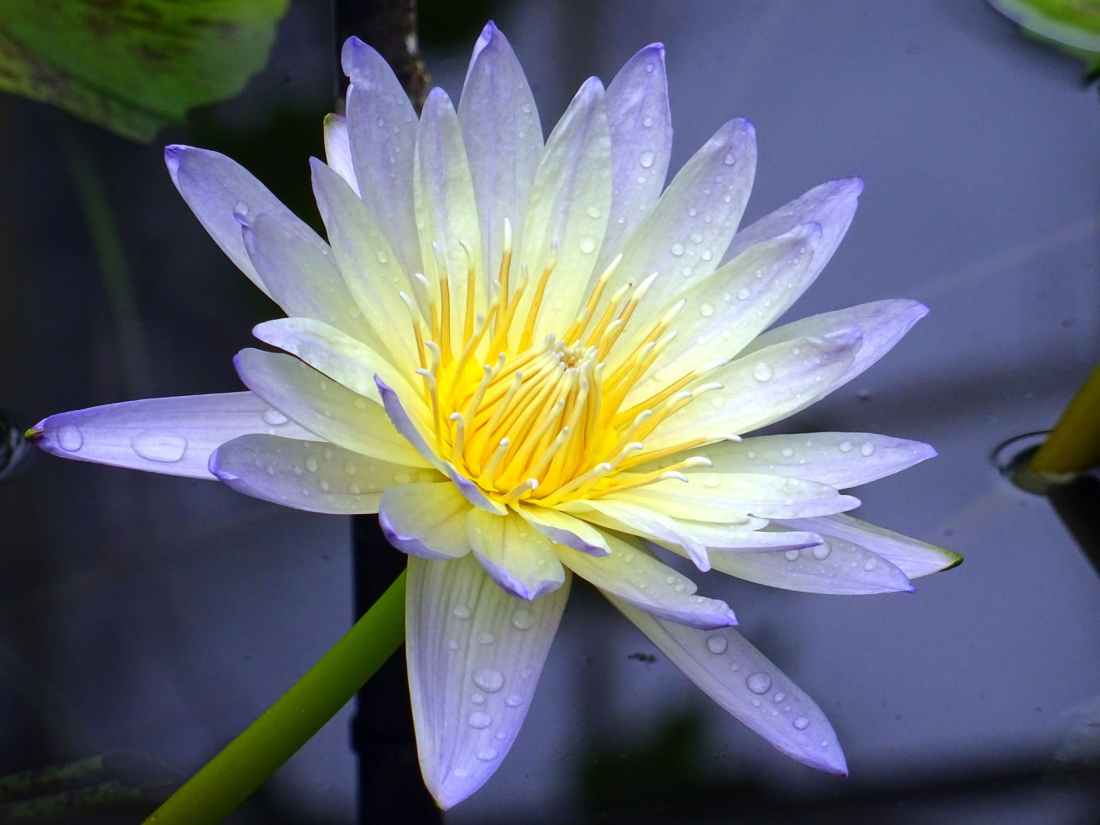
P.S. Photo taken at the Butchart Gardens in Victoria BC last week.
1 The book started out reasonably well, but the last third of the book was unabashedly promotion of Nichiren Buddhism. Bear in mind that the Lotus Sutra has been revered and influential in many Buddhist communities outside of 13th century Japanese-Buddhist thought, so this tendency to focus on a single sect’s teachings to the exclusion of others. The book’s not-so-subtle tendencies to belittle continental Buddhist culture while promoting Japanese thought didn’t help either. People sure do love to inject culture into their religion.
2 Shinran, who was a follower of Honen, took a more nuanced approach that tends to incorporate some elements of Honen’s view, while focusing on a radically lay-oriented religious community (similar to Nichiren). There’s already plenty of books about Jodo Shinshu (Shinran’s sect), and Shinran, so no need to belabor it here.
Recently, I posted an example of Buddhist liturgy as found in the Japanese Tendai tradition, but I wanted to call out one aspect of that liturgy called the Four Bodhisattva Vows or shiguseigan (四弘誓願) among other names. According to my book on Genshin, the Four Bodhisattva Vows were formulated by the original founder of Tiantai (Tendai) Buddhism in China: Zhiyi. Zhiyi formulated these vows based on an earlier gatha verse from the fifth chapter of the Lotus Sutra:
Those who have not yet crossed over I will cause to cross over,
those not yet freed I will free,
those not yet at rest I will put to rest,
those not yet in nirvana I will cause to attain nirvana.
Translation by Burton Watson
The vows have since promulgated to other Buddhist cultures and sects. The liturgy text will vary slightly from Buddhist tradition to tradition, but like the dedication of merit, is remarkably consistent overall.
In the aforementioned Tendai tradition, one version of the vows is as follows:
Sino-Japanese1
Pronunciation
Translation by me (other, better translations exist 😉)
衆生無辺誓願度
Shu jo mu hen sei gan do
Sentient beings are innumerable, and yet I vow to save them all.
煩悩無尽誓願断
Bon no mu hen sei gan dan
My mental defilements (lit. bonnō) are innumerable, I vow to extinguish them all.
The path to Buddhahood is peerless, I vow to fulfill it.
1 Chinese liturgy with Japanese phonetic pronunciation 2 I’ve also seen the last character as 知 (chi), but more or less means the same thing
These vows cover something that we saw in previousarticles about the Mahayana-Buddhist notion of the Bodhisattva: that we’re all in this together, and so the Buddhist path is not truly fulfilled until one completes their vows to aid all beings no matter how long it takes. The Mahayana path of the Bodhisattva is lofty, heroic even, but as the last verse says, nothing less is enough.
On the other hand, the path of the bodhisattva begins with a single good act, or a good thought towards others. It’s about piling up grains of sand or pebbles time and time again. With enough time and dedication, one can move mountains. Don’t be afraid to think big, even if you come up short in this life. Even if you acted like a dickhead today, that doesn’t mean tomorrow you will be one. Every day is a rehearsal. The very notion of “buddha nature” means that each one of you has the capability for great things, even if you don’t think you can. That’s why in the 20th chapter of the Lotus Sutra, the Bodhisattva Never Disparaging bows to each person, even when they’re a total jerk: given the right conditions, any sentient being can become a bodhisattva or a fully-awakened buddha. Given enough time all of them will.
My best wishes to you all, dear readers. May all you be well, free from harm, and find what you are looking for.
P.S. Featured image from the story of Chujo-hime in the Taima Mandala Engi (当麻曼荼羅縁起)
Greetings readers! I have had a bit of extra time this week due to much-needed time off from work, and have been going through old projects, half-finished blog posts and such. One project I found today, which I decided to finish, was post a romaji (Romanized Japanese) version of the Tendai Buddhist home liturgy for anyone who needs it.
The Tendai sect in Japan has a nice homepage (Google Translated page), but almost nothing in English for doing the home service. Tendai information in English is pretty scattered (though there are some great websites),1 so I decided to go back to the source, and just translate it directly using romaji (romanized Japanese) for easy pronunciation.
Some quick notes:
I chose the shortest, simplest elements of the service, based on Tendai’s recommendation in the link above, and also through the book うちのお寺は天台宗 (双葉文庫) which I picked up some years ago. There’s a more extended version of the home service, but both the book and website explain that the essentials are the following elements that I am posting below.
Where possible, I chose to use the Sino-Japanese pronunciation. The website above lists both, and either option is fine (obviously English is fine too). The Sino-Japanese version, in my opinion, is the easiest to pronounce and chant, and ties back to the larger Buddhist tradition, so that’s my personal preference. The YouTube videos on the Tendai site sometimes provide an alternate native, liturgical Japanese version, and it’s perfectly fine to use this too.
Finally, traditions and liturgical styles vary, so don’t be surprised if another Tendai community does it differently. If in doubt, just do it like your local community does.
The webpage also lists some tips (roughly translated below):
First, before you begin, double-check the offerings at your home altar make sure everything is in order: flowers, water, a candle,2 and any other offerings you wanted to make.
Before the service, take a moment to freshen up, rinse your mouth and hands with water, etc. That way, you can sit before the altar in a more purified state.
Drape any rosary you have over your left hand, and if you are holding a sutra book, lift it up gently and bow ever so slightly.3
When you do gassho, put your hands together in front of your chest at a natural angle (45 degrees is common based on personal experience).
When chanting, use a mild, even chanting voice, enunciating each word equally. (If you feel like you don’t chant as well as the video links, don’t feel bad: these are professional monks chanting.)
If you have a bell, there are certain times to ring it: twice at the beginning, once after reading each part, and three times at the end. (I’ve added prompts to the liturgy below.)
When done, close the Buddhist altar (if possible), and place the sutra book back on its stand.
Lastly, the book in particular mentions that any Buddhist sutra is OK to recite. The most common one is obviously the Heart Sutra, but any other Buddhist sutra, or an excerpt of a sutra, is fine too. Find what you like, and feel free to recite that.
Minimal Tendai Buddhist Home Liturgy
The service provided below is given as an example home service, but my book on Tendai Buddhism also states that among these different bits of liturgy, you can add or reduce as many as you see fit. Even if you only recite one bit of liturgy per day, that’s enough. The important thing is to make it sustainable. You can always adjust later if it’s too simple or too difficult.
Sanrai: Gratitude Toward the Three Treasures
(ring twice)
Ish-shin cho rai jip-po ho kai jo ju san bo
(repeat 3 times, ring once)
“I reverently praise the Buddha, Dharma and Sangha, which permeate the cosmos”
Thanks everyone and I hope you find it useful. I will likely post updates and corrections as time goes on.
Namu amida butsu Namu kanzeon bosatsu
1 There are, from what I can see from a cursory search, a number of Tendai communities in both the US and the UK. If you’d like to know more, I encourage you to contact such communities. I have no affiliation with any of these groups, however. I am just DIY.
2 Japan also sells LED Buddhist altar candles. Halloween goods also offer LED candles. Great for avoiding fire hazards.
3 This custom is also found in other Japanese-Buddhist sects as a gesture of humility.
Author’s note: this is a post from the old blog that I am reposting as a handy reference, with some extra updates and polish. Enjoy! 😄
One concept that often frustrated me in my early years as a Buddhist was the bodhisattva. Bodhisattvas are central to Mahayana Buddhism, that is all Buddhism from Tibet to Japan (and now overseas), and it seems like everyone had a different idea what a bodhisattva is.
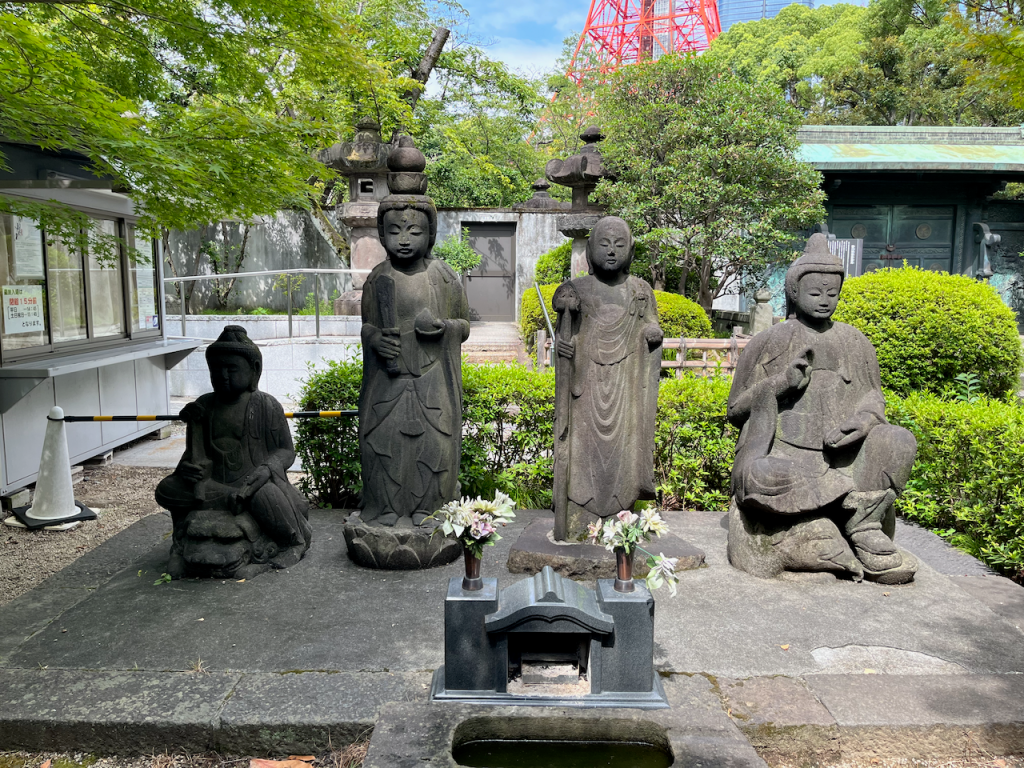
A series of statues at Zojoji Temple in Tokyo, Japan depicting four famous bodhisattvas in the Mahayana tradition. From left to right Manjushri (Monju), Avalokitesvara (Kannon), Ksitigarbha (Jizo), and Samanthabhadra (Fugen).
So, one time I decided to research this and hopefully provide a more comprehensive answer. This is still one man’s explanation, so take it with a grain of salt, but I did use the following sources:
Edward Conze – Buddhist Thought in India (ISBN 0472061291)
Robert E. Buswell Jr., Donald S. Lopez Jr. – Princeton Dictionary of Buddhism (ISBN: 0691157863)
Access to Insight – one of the best sources on Theravada Buddhism, and a great Buddhist resource in general.
Tagawa Shun’ei, translation by Charles Muller – Living Yogacara: An Introduction to Consciousness-Only Buddhism (ISBN: 0861715896)
Asvaghosha, translation by Yoshito S. Hakeda – The Awakening of Faith (In the Mahayana) (ISBN: 0231030258)
And the following sutras (or collections of sutras) were used:
In simplest terms a bodhisattva in Sanskrit, or bodhisatta in Pāli, means a “seeker of enlightnment”. In the earliest scriptures, the Buddha would talk to his disciples about his own past lives as a bodhisattva, such as this sutra in the Pali Canon:
“Bhikkhus [monks], before my enlightenment, when I was still only an unenlightened Bodhisatta, I too, being myself subject to birth, sought what was also subject to birth; being myself subject to aging, sickness, death, sorrow, and defilement, I sought what was also subject to aging, sickness, death, sorrow and defilement….”
In this context, the term bodhisattva mainly referred to the past lives of the historical Buddha, Shakyamuni. In his past lives, when he dwelt in the heavenly realm called Tuṣita (Tushita) and then was born as a prince in India, he was on the cusp of Enlightenment, and only needed that final push. Further, early texts, such as the Jatakas Tales, also imply that this Enlightenment was actually the culmination of many previous lifetimes of searching, effort, and noble deeds. Thus the path of the Bodhisatta who became the historical Buddha was thought to imply an extraordinary, lengthy journey across many lives culminating in final enlightenment.
Later Teachings
In later generations, the role of the Bodhisattva expanded beyond the historical Buddha, and appears more and more often in Buddhist literature. However, it is not the case though that Bodhisattvas are found in Mahayana Buddhism only though. For an excellent treatment of the subject, I highly recommend reading this article by Bhikkhu Bodhi.1 It was just that the path seemed too remote and arduous for most disciples, especially since the presence of a living Buddha allowed them to reach enlightenment much more quickly as Śrāvaka (shravaka) or “hearer-disciple”.
Anyway, in the classic Buddhist model, the historical Buddha was something like a “first among equals”, in that the quality of enlightenment experienced by Arhats (e.g. “noble ones”) was the same as the Buddha. However, Buddhas were distinguished from Arhats by additional qualities that made them almost suprahuman. A Buddha is one who, among other things, gains insight into the truth at a time when the Dharma is unknown (i.e. no other Buddha to teach them), which requires extraordinary spiritual insights and qualities, not to mention their capacity to teach others in such a way that they become enlightened too, and can carry the Dharma onward for generations. This was the contrast between a Buddha and an Arhat.
Over time, the Buddhist community began to explore more and more the notion of becoming a Buddha too (e.g. Buddhahood), and thus the role of the Bodhisattva became increasingly important. As a result, the status of a bodhisattva was elevated over arhats, such that arhats were considered noble, but somewhat inferior to Buddhas and Bodhisattvas.
How Do Arhats, Bodhisattvas and Buddhas relate?
A number of models to explain the relationship between buddhas, bodhisattvas and arhats developed over the course of Buddhist history. As we saw earlier, the original model really only included arhats and buddhas. However, the influential Yogacara school of Mahayana Buddhism (of which the Hossō school in Japan is one of the few independent remnants) taught that different beings had different, inherent natures that would incline them toward the Buddhist path of an arhat, bodhisattva (and thus a Buddha), indeterminate or even those whom enlightenment was impossible.
However, the most popular model in Mahayana Buddhism became the Ekayāna or “One-Vehicle” model. This was popularized by the Lotus Sutra which taught that all disciples would inevitably follow the same path, even if they appeared different at first. Each path (arhat, bodhisattva, etc) were part of the same natural progression and would ultimately converge. In the famous “Parable of the Burning House” in Chapter Three, the father says to his children in the burning house:
“Such a variety of goat carts, deer carts, and bullock carts is now outside the gate to play with. All of you must come quickly out of this burning house, and I will give you whatever you want.”
This parable, the Buddha explains, is meant to show that all followers seem to be following different trajectories, yet ultimately they all converge on the (Mahayana) Buddhist path and become bodhisattvas and then ultimately Buddhas.
Later, starting in the sixth chapter, the Buddha then predicts that his senior monks and nuns, all presumed to be arhats, will eventually become Buddhas. This again emphasizes that the arhat stage is not separate, but a kind of prepartory stage before the “real” Buddhist path begins. Again though, we see that arhat is considered a noble but somewhat inferior status to the bodhisattva, and that their enlightenment is somehow incomplete when compared to the enlightenment of a Buddha. Nevertheless, the arhat is still revered and respected in Mahayana Buddhism. For example, in the Amitabha Sutra, the historical Buddha describes the Pure Land of Amitabha Buddha like so:
Moreover, Śāriputra, he [the Buddha Amitabha] has an innumerable and unlimited number of śrāvaka disciples, all of them arhats, whose number cannot be reckoned by any means. His assembly of bodhisattvas is similarly vast …. Śāriputra, those sentient beings who hear of that land should aspire to be born there. Why? Because they will be able to meet such sages of supreme virtue.
Translation by Rev. Hisao Inagaki
Anyhow, we have talked quite a bit about the history of the bodhisattva, but in part two we’ll discuss how the sutras describe and define a bodhisattva, and how they relate to the buddhas. Stay tuned!
1 Please repeat after me: Bodhisattvas are not found in Mahayana Buddhism only. Many elements of the bodhisattva that we do see in Mahayana Buddhism have their roots in the earlier Mahāsāṃghika school of early Buddhism, which Mahayana drew many ideas and inspirations from. However, the Mahayana also drew from other schools such as Sarvastivada and Dharmagupta among others. The ideas were already there, the early Mahayana Buddhists simply synthesized them.
Japanese Tendai Buddhism, that is the Buddhist sect descended from the venerable Chinese Tiantai (天台) tradition started by Zhiyi (智顗, 538–597), has a number of interesting, not to mention pithy, teachings and phrases. Lately, I’ve been thinking about a particular phrase called asa daimoku ni yū nenbutsu (朝題目に夕念仏). In its most literal sense, it means “Odaimoku in the morning; Nenbutsu in the evening”.
This phrase is fascinating to me, because it summarizes two important facets of Tendai Buddhism.
First, the “odaimoku”. Tiantai Buddhism in China was the first serious effort at taking the vast corpus of teachings imported from India and the Silk Road and synthesizing them into a native school of thought, not just something lifted-and-shipped from abroad. In order to do this, Zhiyi analyzed the vast number of Buddhist sutras, shastras (essays) and commentaries and arranged them into a kind of hierarchy. At the very top, he felt the Lotus Sutra was the most important teaching, the summation of everything else. For this reason, the Tiantai/Tendai schools treat the Lotus Sutra as the core teaching. In devotional practices, this was expressed in something called the o-daimoku (お題目) attributed to famous Tendai monks such as Genshin, but popularized to a greater degree by Nichiren in the 13th century. The most common form of the o-daimoku chant is namu myoho renge kyo (南無妙法蓮華経)1 which means something like “Praise to the Wondrous (alternatively “Mystic”) Law of the Lotus [Sutra]”. This is also the central practice of the Nichiren Buddhist sets you see today: Nichiren-shu, etc.
However, over time, Japanese Tendai Buddhism began to strongly adopt Pure Land Buddhist teachings from mainland China as well.2 Zhiyi, when he synthesized the various Buddhist teachings and practices paid special attention to meditations on Amitabha Buddha, the Buddha of Infinite Light, in his magnum opus, the Great treatise on Concentration and Insight (摩訶止観, Móhē Zhǐguān), but these meditations were intended for serious monastic disciples only, and could be very physically demanding. While Tendai monks sometimes did undertake these practices, the popular practices related to Pure Land Buddhism gradually evolved into chanting practices (again, due to Genshin) similar to the odaimoku. This chanting, is called the nenbutsu (念仏) or “mindfulness of the Buddha [Amitabha]”. The most common form of the nenbutsu is namu amida butsu, and this is overwhelmingly what you find in Pure Land Buddhist schools in Japan today such as Jodo Shu and Jodo Shinshu. Since the 12th century, many Buddhists in Japan have focused on reciting the nenbutsu and aspiring to be born in the Pure Land of Amitabha Buddha as a refuge, but also as a means of progressing on the Buddhist path much faster: like taking the highway to get to your destination vs. taking the back roads.
A verse from the second chapter of the Lotus Sutra, Murano translation.
These two things may sound contradictory, but they’re not. The second chapter of the Lotus Sutra introduces a couple important concepts to Mahayana Buddhism (that is Buddhism across all of East Asia): the One Vehicle and Expedient Means. The One Vehicle was a way of reconciling all the rival Buddhist schools in India by teaching that all of them were really just the same thing, and that sincere practioners were all heading in the same direction, towards Buddhahood, in the end. No need to argue over minutia. The Expedient Means teaching just recognizes that the various meditations, devotional chants, sutras, Buddhist schools, etc, were all just tools to get us there. The Buddha in the Lotus Sutra hammers his point over and over again in subsequent chapters: the various teachings and practices are all just temporary tools to suit a time, place, or need. All of them point to the truth, but must be put down when they are no longer needed.
In this sense, the Pure Land teachings, the chanting of the nenbutsu and so on is just another expedient means, albeit an especially popular and efficacious one. One could also lump Zen meditation, esoteric Vajrayana teachings and such under the same umbrella, and Tendai Buddhism pretty much does this. Unlike later Buddhist schools in Japan that center around “one practice, one teaching”, Tendai maintains the basic structure imported from China where all teachings and practices are kept under the same basic umbrella.
However, there’s more.
The whole asa daimoku ni yū nenbutsu phrase isn’t just limited to reciting the odaimoku in the morning, and the nembutsu at night. It also expresses a mindset, summarized by two other key concepts in Japanese Tendai Buddhism: hokke senpō and reiji sahõ.
In a Japanese book I own on basic Tendai Buddhist teachings, these are summed up as follows:
法華懺法は、すべての人を救う究極の教えである「法華経」に感謝して読経し、自らの罪を懺悔するのです。
“Hokke Senpo” means to show appreciation toward the Lotus Sutra, which contains the ultimate teaching of helping all beings, through reading of the sutras, and to reflect on one’s own faults.
例時作法は、念仏し、自身の心のなかに備わる仏性を呼び起こすものです。
“Reiji Saho” means to recite the nembutsu, and to awaken the Buddha nature within oneself.
Let’s discuss in more detail…
Hokke senpō (法華懺法) means to reflect on one’s actions in light of the Dharma, the teachings of the Buddha. This is a very time-honored practice across the entire Buddhist religion, and is why (in my opinion) Buddhism is so effective as a form of mental discipline and training. Unlike the Christian notion of “guilt”, the idea behind self-reflection is a kind of objective, scientific review of one’s actions and whether they have been wholesome or unwholesome. Here, the Dharma is used as a kind of yardstick to measure one’s actions, and in the case of Tendai Buddhism, the Lotus Sutra in particular. Upon reflection, many Buddhists will recite some kind of verse to acknowledge (not punish oneself) and resolve not to do it again. You’re giving yourself a fresh start and resolving to try again. Like rehearsing for a play: you’ll have good days and bad, but you just keep at it until it becomes second nature.
While hokke senpō reflects on the past, reiji sahõ (例時作法) is forward thinking, and expresses the desire to make the Pure Land of the Buddha not just a reality in the future, but here and now starting with oneself. The sixteenth chapter of the Lotus Sutra is meant to be a kind of bombshell teaching as the Buddha explains that, among other things, not only is the Dharma eternal (and thus the Buddha has always existed), but that his Pure Land has always existed on Vulture Peak (an important site in India), even if people can’t see it. This may sound strange, but what the Buddha is saying in chapter sixteen in my view is that the mind is the most important thing, and even when “living beings witness the end of a kalpa [an eon] and all is consumed in a great fire”, those whose minds are honest and sincere will see that the Pure Land of Buddha is still right there and available to anyone who seeks refuge. One need not pine for a glorious past, or a particular holy site, it’s all there when you need it. Further, the Pure Land isn’t just a place, it’s the embodiment of the Dharma, the Buddha’s teachings, at its finest, and through our actions, words and thoughts, we gradually make this world the Pure Land for others as well.
All this is to say that the pithy phrase asa daimoku ni yū nenbutsu expresses a lot of stuff, at a lot of levels. In my opinion, if one just adopts this phrase as a simple, daily practice guide (recite namu-myoho-renge-kyo in the morning, even a few times, then recite namu-amida-butsu in the evening, even a few times), then that’s more than enough. As I’ve saidbefore, better to do a small, sustainable Buddhist practice often than a big, elaborate one only occasionally. If you even chant one of these things as part of a small, sustainable practice, you’re doing great.
However, what’s interesting to me is that there is a whole lot more under the surface. As one explores this practice more, they realize that there’s a lot of meaning behind a few simple chants, enough for a lifetime of practice. ☺️
P.S. This article on the Tendai Buddhism homepage (Japanese language only) was a good source for this post. The article also points out that the two sides of Tendai Buddhism: exoteric teachings and esoteric (taimitsu or vajrayana) teachings are two separate things within Tendai. This entire blog post has been focused on the exoteric teachings, as I have no experience with the esoteric side and being esoteric, you would need to find a proper teacher anyway. 😉
1 Sometimes you see it pronounced as nam-myoho renge kyo (dropping the “u” in “mu”), but that gets into doctrinal differences among Nichiren Buddhist sects that I personally don’t want to get involved in.
2 This was, needless to say, a strong point of contention by Nichiren, who sought to restore the Tendai teachings to a more pristine form (with the Lotus Sutra as the essential teaching), but also to make it more accessible to people as well.
Hi folks, as Ohigan season has arrived once more, I revisited an old post I made ages ago in a past incarnation1 of this blog, now updated and expanded from the original. So old it’s new again! 😄
A long time ago, while walking to work one day, I got to thinking about a certain, Buddhist text, called the Lotus Sutra, or hokkekyō (法華経) in Japanese. The Lotus Sutra is probably the most important Buddhist text in all of Mahayana Buddhism, that is Buddhism across east Asia including China, Japan, Korea, Vietnam and so on. The Lotus Sutra is so important that it pretty much defines what Mahayana Buddhism is. Even though the Lotus Sutra is nearly 2,000 years old, composed in waves starting in the 1st century CE, it is still actively studied, chanted, and revered by countless Buddhists.
In spite of its importance, the Lotus Sutra is a tough sutra to read, especially for new Buddhists who aren’t used to “sutra language” and style. An old Buddhist friend of mine described it as the “prologue without a story”. At other times, its powerful imagery and use of (sometimes) convoluted parables can bewilder, confuse or turn some people off.2
But that particular day, I got to thinking what the entire sutra means, given its length, and how this applies to life now. Once you get used to its archaic style and language,3 I believe it is still very relevant today to Buddhists and non-Buddhists because it introduces many ideas that have since become a part of mainstream Buddhism tradition:
In spite of the various schools, practices and regional/cultural differences, there is only one Buddhism, and all of them are included. (chapter 2)
No effort is wasted. If kids offer a pile of sand to the Buddha, or a person says “Hail Buddha” even once, they are on the Buddhist path and will someday reach Enlightenment. (chapter 2)
There is only one truth, but each person understands it as best they can. (chapter 5)
In true Buddhism, there is no discrimination between men and women, young and old. All can attain Buddhahood if they have the noble intention of doing so. (chapter 6, 8, 9, 10).
Also intention, not form or background, is what matters. (chapter 12’s story of the Dragon Princess)
The Buddhist lifestyle is one of peace, goodwill, and wholesome restraint. A person should refrain from criticizing other people’s beliefs, nor withhold teachings either when asked. (chapter 14)
Anyone who upholds these truths can be a “Bodhisattva of the Earth”, a guardian of the Buddhist teachings. (chapter 15).
The Buddha is more than just a physical/historical person. In other words the Dharma embodies the Buddha, the Buddha embodies the Dharma. (chapter 16)
Delighting in the truth, in the Dharma, changes one for the better (ch. 18)
The epitome of Buddhist character is patience (ch. 20), commitment (ch. 23), humility (ch. 24) and compassion (ch. 25)
Friends and good companions are important on the Buddhist path. (ch. 27)
Never give up. (ch. 28)
All of these teachings can be found scattered here and there in earlier Buddhist texts, but the Lotus Sutra functions as a kind of “reboot” or “capstone” text that synthesizes all these ideas and presents them in a more cohesive narrative.
So, happy and peaceful Ohigan to readers, party on Wayne, and Nam-myoho Renge Kyo!
1 See what I did there? Huh? Huh? I’ll see myself out.
2 The first time I read it, it made little sense, and I put it down and forgot about it for years. Later, I found Thich Nhat Hanh’s excellent commentaries on the Lotus Sutra, titled Opening the Heart of the Cosmos. Reading that side-by-side with a copy of the Lotus Sutra helped me appreciate it a lot more.
3 To be fair, the Lotus is roughly contemporaneous to the New Testament, and both have to be read through translations, and the quality of the translations can vary. However, by comparison the New Testament is significantly shorter than the Lotus Sutra, and is mostly in the form of letters by Paul, while the Lotus Sutra is a series of sermons by the Buddha, heavy with symbolism and parable. Based on my limited (not to mention biased) personal experience I find the New Testament more approachable at first (Revelations notwithstanding), but I find the Lotus Sutra more profound. Since they were both composed at very different parts of the world, with different cultures, and religions traditions, it’s probably not a fair comparison. Still, having grown up in US going to Sunday School every week, that’s my thoughts on the two texts.
Page 56 of my new book highlights a common theme in early-medieval Japanese Buddhism (e.g. the Heian Period, 8th-12th c.) expressed in the writings of one Yoshihige no Yasutane (慶滋保胤, 931-1002):
“Truly now, nothing takes precedence over the Lotus Sutra in making all sentient beings enter into the buddha’s insight and wisdom. For this reason, I arouse the aspiration (for enlightenment), place the palms of my hands together in prayer, and (hear) the lecture on on the verses (of the Lotus Sutra). Nothing surpasses (the recitation of the name of) Amida Buddha in eradicating innumerable obstructions (to enlightenment created by my past) transgressions and (in leading me) to birth in the land of Supreme Bliss. Therefore I open my mouth, raise my voice, and recite his name.
translation by Robert F. Rhodes
Interestingly, both the Lotus Sutra and the Pure Land remain central to Tendai Buddhism today even among its various teachings and practices.1 Sometimes in Tendai Buddhism you hear the phrase: asa daimoku, yū nembutsu (朝題目夕念仏) which means “In the morning, the daimoku, in the evening the nembutsu“. This doesn’t necessarily mean that Tendai followers literally recite the Lotus Sutra and odaimoku in the morning, and the nembutsu at night, but it does get to the heart of the relationship between the two.
Another way of explaining it is with the following phrases used in Tendai Buddhism:
法華懺法 (hokke-senpō)
例時作法 (reiji-sahō)
According to the book うちのお寺は天台宗 (uchi no tera wa tendaishū, “my temple is Tendai-sect”), the phrase hokke-senpō means devotion to the Lotus Sutra, the promise of eventual Buddhahood and a spirit of repentance (sangé懺悔) for past actions, which is a common-practice across all Mahayana Buddhist sects. Meanwhile, reiji-sahō means to deepen one’s connection to Amitabha Buddha in hopes of being reborn in the Pure Land so one can advance toward Buddha-hood much more readily. One aspect is reflection of one’s past and one’s innate potential for Enlightenment. The other aspect looks toward the future and how to accomplish it.
1 I like this more holistic approach to Buddhism more than what you tend to see in some communities, who focus on a single practice or teaching to the exclusion of the rest.







 Gleanings in Buddha-Fields
You must be logged in to post a comment.