The joke here is a Japanese-Buddhist monk looking at a receipt from Muji (a Japanese home goods store), and commenting that this “sacred text” shows they purchased a lot.1 This happens to us too.
Anyhow, what is a sacret text in Buddhism?
Buddhist sacred texts are called sutras (sometimes suttas), from the old Indian Sanskrit word.2
Buddhism doesn’t have one sacred text like you would associate with the Bible, Q’uran, etc. Instead, it has layers and layers of sacred texts.3
I won’t get into why there are so many layers, but suffice to say that the Buddhist tradition holds the sutras as genuine sermons of the Buddha (a.k.a. Shakyamuni Buddha) which have been passed down generation after generation until today.
Sometimes sutras, or teachings contained therein, are repackaged into newer sutras, especially in the Mahayana Tradition, but the underlying teachings, the Dharma, are believed to be just as important. Think of Spiderman: every few years there’s another Spiderman movie, some more popular than others, but the underlying lore of Spiderman is always the same.4 The history of Buddhist sutras is awfully similar in this respect.
What’s important isn’t so much the specific text of a specific sutra, but the Dharma. In the same way, although Shakyamuni Buddha is very important, the Dharma he taught is even more so.
Because there are so many sutras, this also leads to many sects, schools, and traditions within Buddhism. Each sect or school strives to apply the Dharma as best they can, based on whatever sutra is considered most appropriate.
So how do we know if the Dharma is true? Because it can be applied in one’s own life, through good conduct, meditation, lifestyle choices and so on. If your doctor tells you to lose weight and exercise more, the results speak for themselves. Buddhism is a lot like this.
Should a Buddhist read all the sutras? No, there are simply too many. Some ate huge. It’s often best to start with one or two that are already part of the tradition you are interested in. From there, you can branch out as you see fit. Ask your local community if you need recommendations.
Also, an important tradition across all of Buddhism is reciting sutras. Some sutras are very short and can be recited as a whole. Other sutras are much too long, so people recite key passages only.
This tradition of reciting sutras not only helps internalize the teachings (make them a part of you), but also helps connect to the Buddhist tradition at large. People have been reciting the Buddha’s teachings from the very beginning, 2,500 years ago. When we recite and put the teachings into practice, we are another link in the chain.
Buddhism has no “holy” language, so you can recite them in your local translation, or use a liturgical format that fits your preferred tradition. Or switch between one and the other.
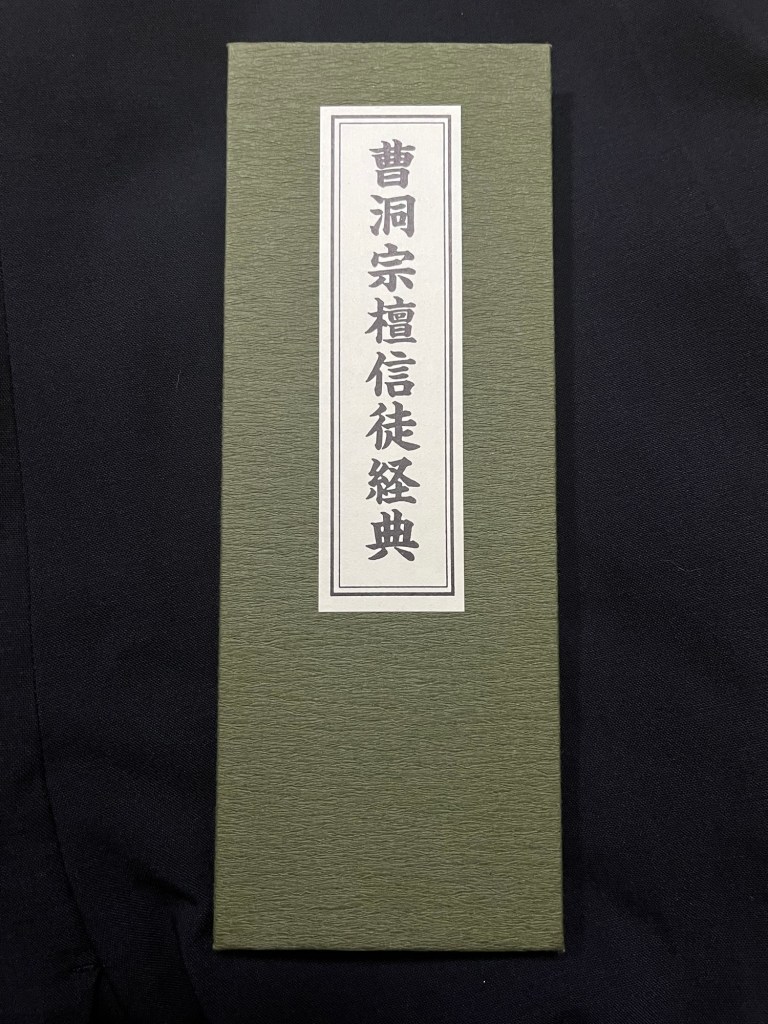
A booklet with the Heart Sutra used in Japanese Buddhism, which I posted about here.
What’s important is that followers make the teachings a part of their lives somehow. This helps them apply the Dharma and also generate good merit to help others. The Buddhist path is not a solitary path: we are all in this together.
Namu Shakamuni Butsu
Namu Amida Butsu
1 Muji is a great store, and there are a few oversea outside of Japan. You can find clothes, household items, stationary and so on. We shop at Muji in Japan whenever we visit there, but also have visited Muji stores along the West Coast as well.
2 Related distantly to the English word suture as in a thread. Old sutras were often palm leaves or tree bark threaded together to form a kind of book.
3 HInduism too, iirc.
4 Even when it’s Miles Morales vs. Peter Parker (or Gwen, or other Spider people), the lore is the basically the same.
I used to be an avid Dune reader in my younger years, and posted quotes from it all the time in earlier iterations of the blog. Anyhow, I found this quote from the third book:
The universe is just there; that’s the only way a Fedaykin can view it and remain the master of his senses. The universe neither threatens nor promises. It holds things beyond our sway: the fall of a meteor, the eruption of a spiceblow, growing old and dying. These are the realities of this universe and they must be faced regardless of how you feel about them. You cannot fend off such realities with words. They will come at you in their own wordless way and then, then you will understand what is meant by “life and death.” Understanding this, you will be filled with joy.
Muad’Dib to his Fedaykin, from Frank Herbert’s “Children of Dune”
I have probably said this a few times recently, but like it or not wearenotthecenter of the Universe, no matter how much we like to think we are. The universe will carry on without or without us, and sometimes it’s capable of really wondrous moments, and sometimes it will unleash some really shitty realities on us. And there’s only so much we can do to control that. Like a raft navigating treacherous waters, we have to carefully row and pay attention to the currents.
In spite of all this, though, it doesn’t mean we have to sit and be passive either.
Speaking of old science-fiction quotes…I am an avid Roger Zelazny reader, and Isle of the Dead is among my favorite books ever. I always like this quote because of its cosmic feel, but also its unintentional Buddhist message which resembles Saicho’s famous quote about “lighting one corner of the world”:
“Earth-son, I greet you by the twenty-seven Names that still remain, praying the while that you have cast more jewels into the darkness and given them to glow with the colors of life.”
My pure land is not destroyed, yet the multitude see it as consumed in fire, with anxiety, fear and other sufferings filling it everywhere….But those who practice meritorious ways, who are gentle, peaceful, honest and upright, all of them will see me here in person, preaching the Law [a.k.a. The Dharma]
Thus, even in the midst of crisis, or madness, or despair the light of the Dharma still shines even when it seems obfuscated. It is always there for those willing to look, and for those willing to cast a few jewels into the darkness.
Writing my recent post about Ikkyu and Rennyo brought back a lot of old memories for me.1 I was also overjoyed when I was recently contacted by another member of my old Jodo Shinshu community. So, I started leafing through the old material I saved, much of it out of print now, and remembered this old quote from the Tannisho (歎異抄), a collection of sayings attributed to the founder, Shinran (1173 – 1263):
10) 念仏には無義をもって義とす。不可称不可説不可思議のゆゑにと仰せ候ひき。
“In the nembutsu no selfworking is true-working; it is beyond description, explanation, and conception.”
translation by Dr Taitetsu Unno
This cryptic saying is probably the most emblematic of Shinran’s thinking, and what distinguishes Jodo Shinshu from the rest of the vast Pure Land Buddhist tradition.
Since the days of the early Chinese Buddhist Pure Land teachers such as Dao-chuo (道綽, 562–645) and Shan-dao (善導, 613–681), there has been this notion that Buddhism has two general paths:
The path of the Sages (i.e. the classic, monastic path), and
The path of the Pure Land
This morphed over time into the concepts of Self-Power and Other-Power. In other words, when following the Buddhist path does one rely on one’s own efforts, or fall back and rely on the grace of the Buddhist deities, primarily Amida Buddha? Every Pure Land Buddhist tradition and teacher that has arisen across history has wrestled with these competing approaches, how to find a balance, or where they might overlap. Charles B Jones’s book really explores this in far greater detail and well worth the read.
In any case, on the Self-Power vs. Other-Power spectrum, Jodo Shinshu Buddhism, as taught by Shinran and later Rennyo, really tipped the scales toward Other Power only. It’s not just 95% Other Power, 5% Self-Power; it’s entirely 100% Other Power. The idea arose through a combination of both Dharma Decline: that people were so far removed from the time of the historical Buddha Shakyamuni that any efforts towards one’s own emancipation were no longer possible, and the aforementioned tension between the Pure Land Path vs. Path of the Sages.
Thus, Shinran is saying that regardless of what one does or doesn’t do, the salvation provided by Amida Buddha is entirely due to Amida Buddha. One cannot add or detract from this grace. Once one experiences such grace, they spontaneously recite the nembutsu, rather than as a Buddhist practice.
Astute readers may find that this sounds an awful lot like Calvanism, and Charles B Jones points this out too. He also points out that the while this can provide great comfort to those who sincerely follow yet doubt their abilities, the challenge of Calvinist-type thinking is that it can leave the believer in doubt about whether they ever will be selected. It almost feels like a religious lottery. A person can be a genuine follower all their life, and yet grace might not come. Not every Jodo Shinshu follower experiences shinjin. And if they did, how would they know?
Back then, I wrestled with this issue quite a bit as a Jodo Shinshu follower. Shinshu teachings have a certain internal logic and beauty to them, but I always had this this nagging feeling that there was some “philosophical gymnastics” involved. And, to be frank, I am no longer convinced that this is what the Buddha taught. Even if you read the Larger Sutra of Immeasurable Life, the most important Pure Land Sutra and the source of the Juseige, it’s pretty clear that Shakyamuni intended for people to bend their efforts toward rebirth in the Pure Land, rather than let go and let Amida Buddha handle everything. The sutra is a bit long, and takes about 1-2 hours to finish reading, but if you’re learning about the Pure Land tradition, it’s worth the read.
I already critiqued Dharma Decline in another post so I won’t belabor that here. Suffice to say, it’s too formulaic to be a realistic assessment of human history.
But what about Other Power versus Self Power? In my humble opinion it’s a false dichotomy. You’re not actually forced in Buddhism to choose one or the other. It is possible, and very common, to find a balance of both in one’s practice. If a Buddhist deity inspires you to keep going, great! And since there many deities in Buddhism, it is possible to find someone who inspires you even if it is the historical Buddha himself. It doesn’t have to be a “cosmic” deity and will still be just as Buddhist.
I don’t want to trash on Shinran though, because a spiritual crisis like the one he had can be a very difficult to resolve even after years. Shinran was an accomplished and fascinating figure, and the Tannisho as a document is a valuable insight into his thinking process.
It’s just that I had my own “mini-crisis” in my younger years as a Buddhist and I came to a different conclusion even as a nembutsu devotee. These days I am pretty happy with my practice, small as it is, plus everything I’ve learned along the way.
Maybe I am totally wrong, but the way I figure it:
Slow and steady wins the race.
With the breadth of teachings and practices Buddhism has to offer there’s something for everyone and there’s nowhere to go but up.
Never be complacent. There’s always more to learn, more to try, and more to experience.
Good luck and happy practicing!
1 This is an old selfie I took of myself in 2015, wearing the robes of a minister’s assistant with the Buddhist Churches of America:
I was still in training (certified later in 2016), but I was very proud to wear it nonetheless. My chanting voice was terrible (still is), but I really tried to take my role seriously. I have a lot of happy memories from that time and am always grateful.
P.S. it’s hard to find a good translation of the Tannisho these days, but you find Dr Taitetsu Unno’s translation here on Web Archive.
Author’s note: I reposted this from the other blog. There’s a lot of overlap here, and it just made sense to post in both blogs (probably the first I’ve ever done that in 11+ years!). If you’ve already read the other post, apologies for posting again.
In a lesser-known Imperial poetry anthology called the Shui Wakashu (拾遺和歌集), poem 1342, is recorded what is believed to be Lady Izumi’s1 final poem:
Japanese
Romanization
Translation
暗きより
Kuraki yori
The way I must enter
暗き道にぞ
Kuraki michi ni zo
leads through darkness to darkness —
入りぬべき
Irinu beki
O moon above the mountains’ rim
はるかに照らせ
Haruka ni terase
please shine a little further
山の端の月
Yama no wa no tsuki
on my path.
Translation by Jane Hirshfield and Mariko Aratani in The Ink Dark Moon.
This poem was addressed to a Buddhist monk named “Shoku” and includes several Buddhist allusions. The most important is the phrase “darkness to darkness”, which comes from chapter seven of the Lotus Sutra:
….from darkness they [living beings] enter into darkness, to the end never hearing the Buddha’s name [hear the Dharma].
This refers to the Buddhist notion of Samsara, the near-infinite, aimless wandering that living beings undergo lifetime after lifetime, like a cosmicrat race. Such beings, who have yet to hear the Dharma [the teachings] of the Buddha, will continue to wander lifetime after lifetime without rest.
Thus, Lady Izumi is asking Shoku to help shine a light in the darkness for her, so that she may find the way [follow the Buddhist path].
I had trouble deciding which blog to put this in, since it covers both themes, but I decided to originally post in the other blog since the poem was introduced in the new historical drama about Lady Murasaki, Izumi’s contemporary.
Lady Izumi was, to put it mildly, a complex woman. She had incredible talent, and found herself in one scandal3 after another as powerful men fell at her feet, plus she earned scorn from other women such as Lady Murasaki. And yet, she was also very kind, devout and struggled to balance both the religious and worldly aspects of her life, while raising her orphaned granddaughter.
Hirshfield and Aratani note that if this poem is indeed her last, the final word she ever wrote was tsuki (月), “moon”.
2 alternate translation by Murano reads: …they go from darkness to darkness, and do not hear of the names of the Buddhas.
3 this was a conservative, narrow, aristocratic society where men frequently had affairs, but it was much more scandalous if women did. The idea that women could want, and enjoy sex, was not something people really accepted at the time.
One of the most influential sacred texts in Buddhism is the Lotus Sutra.
The Lotus Sutra has had a tremendous influence on Buddhism as we know it today. Much of Buddhist culture as we know it either came from the Lotus Sutra, or was influenced by its ideas and teachings. Not everything, of course. But the influence is hard to ignore. If you know the Lotus Sutra, a lot of things about Buddhist culture make more sense.
A copy of the Lotus Sutra enshrined at a Vietnamese Buddhist temple. Taken at Ksitigarbha Temple in Lynnwood, WA in 2013.
Because the Lotus Sutra has been translated to many different cultures at different times, it has had many names:
Original language
Title
Romanization
Sanskrit
Saddharma Puṇḍarīka Sūtra
n/a
Chinese
妙法蓮華經
Miàofǎ Liánhuā Jīng
Vietnamese
妙法蓮華經 (Han Nom) Diệu Pháp Liên Hoa Kinh (modern)
n/a
Korean
妙法蓮華經 (Hanja) 묘법연화경 (Hangeul)
Myobeop Yeonhwa gyeong
Japanese
妙法蓮華経
Myōhō Renge Kyō
Tibetan
དམ་ཆོས་པད་མ་དཀར་པོའི་མདོ
Damchö Pema Karpo’i do
The full title in English is the Sutra on the White Lotus of the True Dharma, but usually we just call it the “Lotus Sutra”. Similarly, in other languages, the full title of the Lotus Sutra is shortened as well. For example, in Japanese, Myōhō Renge Kyō is shortened to Hokekyō.
But I digress.
The Lotus Sutra is not short, and for new Buddhists it is not easy to read. Composed in India in the first century CE, it is divided into 28 chapters, so it reads like a full book. Many of these chapters have a prose section, then repeats itself in one or more verse sections.1
Like all Buddhist texts, or sutras, it presents its teachings in the form of a sermon by the historical founder of Buddhism, Shakyamuni Buddha (“Shakyamuni” for short). Could the Buddha have given such a long, long sermon all in the span of one sitting? Probably not. But that’s how Buddhist sutras are usually presented.
Through the Buddha, the Lotus Sutra teaches many parables and similes to get its point across. Many of these parables took on a life of their own and frequently appear in Buddhist art or literature. Others are strange and obscure to modern readers. In fact, if you’re just reading the sutra for the first time, it really helps to have some kind of side-by-side guide to help make sense of it because if you tried to read it literally, you will get a headache. Thich Nhat Hanh’s book Opening the Heart of the Cosmos really helped me a lot.
For example, the chapter with the Sermon in the Sky, where a second Buddha named Prabhutaratna appears, and everyone flies up impossibly high to hear their sermon, and the Buddha projects himself across many worlds, is a difficult read. If you try to read at face-value, it reads like a fever dream.
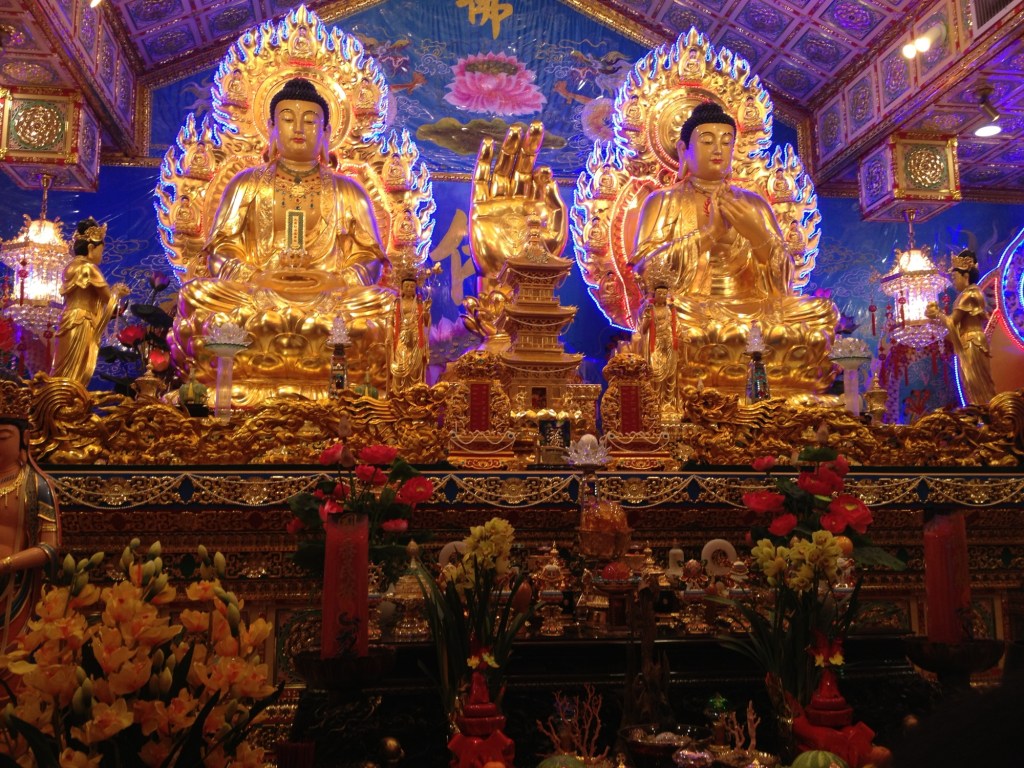
A mural from the Yulin Grotto in China. See page for author, Public domain, via Wikimedia CommonsAn altar revering the two buddhas, Shakyamuni and Prabhūtaratna, from the eleventh chapter of the Lotus Sutra, enshrined at a Vietnamese temple. Taken at Ksitigarbha Temple in Lynnwood, WA in 2013.
But the style of the Lotus Sutra isn’t to appeal to the head, it tries to appeal to the imagination. It is one thing to say that life is impermanent, it is another to describe the world as a great burning house, with people inside too distracted to notice. When the Buddha is shown projecting himself to countless worlds, it is just a colorful way of saying that the Dharma is everywhere, and there are countless buddhas across many worlds each preaching according to the environment. When the Buddha describes archetypal bodhisattvas in the later chapters, each one is meant to convey a different Buddhist virtue.
Deep stuff.
The Lotus Sutra was pretty radical for its time, and a core part of the larger Mayahana-Buddhist reform movement. The parable of the Dragon Princess, attaining enlightenment faster than any was obviously meant to blow the minds of the establishment, and challenge certain cultural prejudices about women, and so on.
A 12th century Japanese mural from the Heike Nokyo, depicting the Dragon Princess offering a jewel to the Buddha before transforming. Public domain, via Wikimedia Commons
Similarly, the chapter where countless streams of “bodhisattvas of the earth” emerge from the ground was meant to show how we didn’t need to rely on elite gurus, but that everyone had the capacity for being a bodhisattva too, if they just had the confidence.
I’ve talked about the main themes of the Lotus Sutra in an older post, but I wanted to cover two really important ones.
First, the most important teaching of the Lotus Sutra is probably the “One Vehicle” (Ekayāna) teaching. Previously, the reform Mahayana, or “great vehicle” Buddhists, bickered with the traditional Buddhist establishment (called Hinayana, or “small vehicle”), and traded barbs witih one another. You can see this is in some of the really early sutras composed by Mahayana Buddhists.
But then the Lotus Sutra took a step back and looked at the big picture, and taught that it was all just Buddhism (e.g. “one vehicle”) anyway. There were many places to start, and ways to move forward, but in time they would all converge, and the quality of one buddha was no different than another. What worked for one person didn’t necessarily work for another. There was no use bickering, any effort great or small was worth it.
Second, the other major teaching of the Lotus Sutra is that the Buddha was far, far older than history would tell us. The sutra implies that the Buddha would appear in some time and place, restart the Buddhist community, grow old and die, but that was just trick to keep people getting attached to the Buddha. This seems pretty disingenuous.
But what the sutra is trying to tell us is that the Buddha just personifies the Dharma (the teachings), and that the Dharma is the Buddha. Since the Dharma, the principle of existence, has always been around, in the same way one can see the Buddha also being around in one form or another, even in the darkest of times. Where does one begin, and the other end? I think the Mahayana Buddhists who composed it wanted people to stop getting hung up on the physical/historical Buddha, avoid a “cult of the Buddha”, and focus on the Dharma.
As a side note, the Lotus Sutra frequently promotes itself. It says that anyone who sincerely hears the Lotus Sutra, and praises it gets all kinds of benefits. But is not the Lotus Sutra as the written text from 1st century India. Like the “eternal Buddha”, this is the Lotus Sutra as the ultimate teaching (e.g. the Dharma) in its unvarnished form.
Thus, the Lotus Sutra is in some ways a very strange text because it is so dense with metaphor, simile and parables to get things across. But when you look at all the artwork and culture influenced by it, you can see that it gets something right. Rather than appealing to intellect, it conveys its messages through more impactful means. It is one of those texts that you keep referring back to over the years because it stands out so much.
Speaking from experience, it helps not to read it from cover to cover. Instead, focus on one chapter, try to suss out the meaning. Some chapters are, in my experience, a little bland, others are really moving. Sometimes a chapter won’t make any sense, then years later you will have an “ah ha” moment and you see it in a new light.
Speaking from experience. 😏
P.S. I probably own 3-4 translations of the Lotus Sutra, the Gene Reeves translation is probably the easiest for beginners in my opinion, but I like them all in their own way.
1 Researchers believe that the verses actually came first, and then the authors composed narrative around them.
I have never tried using these WordPress writing prompts, but I thought I’d try as a fun exercise today.
Life is stressful. That’s the First Noble Truth of Buddhism. More precisely life is marked with stress, unease, discontent, and so on, collectively called dukkha in Sanskrit. Put more succinctly, shit happens sooner or later. It is impossible to avoid, but at the same time, a well-trained even-keel mind can weather the storm and thereby help ease one’s life, but also make life better for those around you too.
Buddhism as a 2,500 year old religion comes with a really large toolkit of methods, practices, and liturgy that can help bring peace of mind.
Most people think of meditation first, but this is simply not always practical, especially if you are a working parent, busy college student, and so on. There are other practices available that can more easily be fit into a busy lifestyle, and are not difficult to learn.
The first is to take up the Five Precepts as a baseline for one’s conduct. This is a passive practice, but helps provide some guideposts to life, gradually smooths out our rough edges, and builds self-confidence as well.
The second is Buddhist chanting.
There are many, many things one can chant in Buddhism: mantras, excerpts of Buddhist texts (sutras), full Buddhist texts, or devotional phrases as well.
Mantras are very short, but esoteric phrases often used for chanting, recited originally in Sanskrit language, but filtered over time in other languages. One of the best known is the Mantra of Light, but you can find many mantras. People often recite these 3 or 7 or even 21 times, but traditions vary. Consult your preferred tradition if you are unsure. Keep in mind that many traditions within Buddhism simply don’t use mantras, or use very sparingly.
Buddhist texts (sutras), or even excerpts of Buddhist texts, are an almost universal chanting practice. They are longer than mantras, but also more commonly practiced, and have a nice habit of reinforcing important teachings within yourself. You can recite them in the old, liturgical language, or recite in your own language. It does not really matter.
By far the most popular Buddhist text to recite is the Heart Sutra. The Heart Sutra is somewhat unusual because you can recite the entire text, from start to finish, in about 1-2 minutes. It is profound, but also really pithy. Another common chanting text you can do from start to finish is the Metta Sutta in the Theravada tradition. Most other Buddhist sutras are a challenge to recite in one sitting (some are extremely long), so instead people traditionally recite key excerpts only. The Lotus Sutra is particularly quote-worthy; it has many verses and quotations that are chanted by themselves without chanting the entire chapter. There are other good quote-worthy Buddhist sutras as well.
When chanting Buddhists sutras (or excerpts), you can either do it in a chanting voice, or simply recite the same way you might read a poem aloud, or something like reciting the “Litany of Fear” in Dune. Personally, I find chanting in English sounds silly, so I recite with an even voice instead.
Finally, we have devotional phrases. Because Buddhist deities are many and varied, each embodying some essential truth or concept in Buddhism, people tend to gravitate toward one or another. This is fine, and perfectly normal in Buddhism. One might gravitate toward the historical Buddha, Shakyamuni. One might gravitate toward Guan-yin (aka Avalokiteshvara, Chenrezig, Kannon, etc). One might gravitate toward the Buddha of Infinite Light (aka Amitabha, Amida, etc). Over time, you might shift as well. Again, perfectly normal.
In any case, many of these deities will have some simple devotional phrase: “Hail to X”, or “Praise to Y”, and so on. These might overlap with mantras, but aren’t necessarily mantras. They are often exoteric (no subtle, hidden meaning), not esoteric. Sometimes mantras are used as devotional phrases too. It’s also common in some traditions to praise the Lotus Sutra itself, not as a deity, but as the embodiment of the highest and best Buddhist teachings.
All of these devotional phrases are short, simple, and easy to recite. People often recite in groups of three, but you can recite as little or as much as you like. Consult your preferred tradition if you are unsure.
When should one do Buddhist chanting?
Whenever appropriate. If you get up first thing in the morning and recite your chosen sutra, mantra or devotional phrase, that’s great. If you do it before going to bed, that’s great. If you are stressed out at work, and need a moment, go in a quiet spot, and recite something Buddhist. If you are moved by something spiritual, you can also recite something in the form of gratitude. There are many times and places to do Buddhist chanting. Find what works, experiment if needed, see what sticks in your life.
One thing to keep in mind though: always do it respectfully, solemnly, and without showing off. Intention and sincerity are important.
Why should one do Buddhist chanting?
There are many reasons why one takes up the practice. For some, it helps settle the mind, especially when stressed or worried about something. It tends to reinforce positive habits too. Sometimes it can also bring a flash of insight because one’s mind is settled and they meaning of the texts finally makes sense. It also helps generate good karma for the future, like planting seeds for later harvest. By settling the mind, it also helps disengage negative habits and avoid negative consequences later.
Coupled with the Five Precepts I mentioned above, the long-term effects are both peace of mind for yourself, but also others around you as the wholesome effects “rub off”.
The Five Precepts and Buddhist chanting are two practices that almost anyone can do almost anywhere under any circumstances. You might have to tailor things to make it sustainable in your life, but there’s plenty of wiggle-room to make it work. Also, don’t be afraid to make adjustments.
This troubled planet is a place of the most violent contrasts. Those who receive the rewards are totally separated from those who shoulder the burdens. It is not a wise leadership….
Star Trek: The Original Series, “The Cloud Minders” (s3ep21)
The classic Star Trek episode, “The Cloud Minders”, is a fun episode late in the third season that explores a society that is separated into two social classes: the intellectual class living in the clouds and a working-class that lives below in the mines.
Years later, in the Japanese game Chrono Trigger, a similar theme was explored with a society that lived around 12,000 BC that had an elite intellectual class living in the clouds, and a worker class that lived in the icy wastes below.
It’s fascinating, if not somewhat disturbing to see real-life examples of this too. As much as I admire the Heian Period of Japanese culture, it’s not hard to see parallels: an elite literati that sits around and writes poetry all day, and a much larger illiterate peasant class that toils in the fields for their benefit. The inequality is disturbing.
Indeed, this pattern repeats over and over again in human history, regardless of time or place. There is even a political theory toward this end call the Iron Law of Oligarchy. Are we not also living under some form of oligarchy even today?
Further, the more that people “in the clouds” become cut off, the harder it is to develop empathy for those who toil, and easier to just blame them for their own predicament. This is the very antipathy of metta in Buddhism, the goodwill towards all beings, big or small, smart or foolish.
In some ways, the early Mahayana-Buddhist texts such as the Lotus Sutra or Three Pure Land Sutras1 were pretty revolutionary texts. The famous 12th chapter of the Lotus Sutra, and its story of the Dragon Princess deserves a look. In this story, the daughter of the Dragon King under the sea is introduced as a being of great wisdom despite only being 8 years old. The Buddha’s disciple Shariputra, representing the conservative faction of the Buddhist community scoffs at this:
At that time Shariputra said to the dragon girl, “You suppose that in this short time you have been able to attain the unsurpassed way. But this is difficult to believe. Why? Because a woman’s body is soiled and defiled, not a vessel for the Law [the Buddha-Dharma]. How could you attain the unsurpassed bodhi [awakening]? The road to Buddhahood is long and far-reaching. Only after one has spent immeasurable kalpas [eons] pursuing austerities, accumulating deeds, practicing all kinds of paramitas [self-perfections], can one finally achieve success. Moreover, a woman is subject to the five obstacles….”
The Dragon King’s daughter rebuffs Shariputra’s criticism and wows them all:
At that time the members of the assembly all saw the dragon girl in the space of an instant change into a man and carry out all the practices of a bodhisattva, immediately proceeding to the Spotless World of the south, taking a seat on a jeweled lotus, and attaining impartial and correct enlightenment. With the thirty-two features and the eighty characteristics [signs of a Buddha], he expounded the wonderful Law for all living beings everywhere in the ten directions.
The intended message here may seem a little strange to modern audiences. This was written for a patriarchal society in antiquity, but it’s clear the Lotus Sutra taught all beings, regardless of gender, age, or even human vs. non-human status, are equally capable of Buddhahood (full enlightenment) if given the chance. When they are not, society is stifled and suffers.
In the same way, when society maintains inequality for the sake of a few, or for the sake of tradition, it degrades society by robbing it of vitality and well-being for all.
Home services in Japanese Buddhism, known as otsutomé (お勤め) or more formally gongyō (勤行), have many different approaches. It often depends on sect, particular communities, and personal preference. Trouble is, English sources are often confusing or insufficient. So, I try to look up information in Japanese, which is sometimes harder than you might think.
Anyhow, something I’ve learned recently about Tendai Buddhism, is that at least in some Tendai traditions, home practice might be divided between a morning service and a night service. This is in keeping with the two concepts in Tendai (more on that here):
Hokké Senpō (法華懺法) – reverence for the Lotus Sutra, the foundation for Tendai Buddhism, and for much of Mahayana Buddhism.
Reiji Sahō (例時作法) – reliance on Amida Buddha to help deliver oneself (and others) from this world of frustration and fear.
Thus, in lay-Buddhist home services for Tendai Buddhism, some communities tend to divide the morning versus evening services to reflect these two concepts.
This page from the Jimon-branch of Tendai Buddhism, based in the famous Mii-dera Temple (as opposed to the Sanmon-branch based in Enryakuji atop Mount Hiei) shows example services for both morning and evening. I can’t translate everything word for word from the site, but let me try to summarize the basic format.
Morning Service
For the morning service, one pays homage to the Buddhas and Bodhisattvas “of the ten directions”1 and takes the Lotus Sutra as their basis. The morning service cited in the Jimon-sect page is based on a treatise by founder Saicho called the Hokke Sanmai Gyōhō (法華三昧行法), and for some reason is much shorter than the evening service.
The morning service is comparatively short, but includes liturgy such as:
I left out some of the liturgy from this list because I could not find details, or they were very specific to the Jimon sect (e.g. praises of Saicho’s disciple Enchin, who is the source of the Jimon branch), but hopefully you get the idea. This emphasizes the here and now, and seems rooted in the hokke senpo side of Tendai Buddhism to me.
Evening Service
The evening service by comparison uses the Amitabha Sutra as its basis and includes somewhat different liturgy.
Dedication of Merit for Rebirth in the Pure Land (this differs slightly from the morning service version).
It’s interesting to note that the evening service still includes verses from the Lotus Sutra, but also mixes the Nembutsu and Mantra of Light as well and definitely emphasizes the reiji saho side of Tendai.
Conclusion
As these are services associated with just one sub-sect of Tendai, and since people often add, subtract or adapt services to meet their needs, it’s perfectly fine to adjust this to whatever works in your situation. You could potentially reduce this all the way down to reciting the Heart Sutra in the morning, and the nembutsu at night. Or something similar. As long as it is sustainable, and captures the spirit of Hokke Senpo and Reiji Saho.
The themes of morning services expressing hokke senpo, and evening services expressing reiji saho, are a great way to apply Tendai teachings in one’s own life, or just Mahayana Buddhism in general.
P.S. features the gardens of Mii-dera temple, photo by E5894, CC BY-SA 3.0, via Wikimedia Commons
1 The eight cardinal directions, plus up and down.
June 4th is the yearly memorial service in Japan’s Tendai sect of Buddhism called Sangé-é (山家会) for its founder, Saichō (最澄, 767 – 822). I am writing this post a bit late this year, but I wanted to explore the life of Saicho a little bit and why he matters.
Saicho as depicted in a Heian-Period painting.
If you look at the history of Japanese Buddhism, Saicho doesn’t elicit much historical attention and discussion, even compared to contemporary rivals at the time like Kūkai, founder of Shingon-sect Buddhism. Yet, the sect he founded in Japan was overwhelmingly the largest and most influential for centuries (probably too much so), until it finally faded into the background in the late medieval period. This is why you rarely see mention of Saicho or Tendai these days: it’s far smaller now than it was in the past.
Also, to confuse matters further, Saicho is only the founder of the Japanese branch of Tendai. It was the Buddhist monk Zhi-yi (智顗, 538 – 597), who originally started the Tian-tai (天台) sect in China in the 7th century and it remains a very influential sect across many areas of mainland-Buddhist Asia (Korea, Vietnam, etc). Tian-tai in Japan (pronounced as Tendai) reveres Zhiyi as well.
Anyhow, Saicho was a monk at a time when Buddhism had already been established in Japan, primarily around the old capitol of Nara, yet was limited to a very tightly regulated number of schools and monks per school. Besides the Yogacara (Hossō) and Huayan (Kegon) schools, the rest are very obscure today. These schools had all been imported from Tang-Dynasty China, and represent “branch” schools to the mother temples there. The existing schools at that time were obligated to perform rituals on behalf of the Emperor to prevent calamities, cure diseases, bring prosperity to the nation and other political needs. In turn, the government allocated new acolyte monks every year, and allowed them to continue. However, beyond that, Buddhism had very little reach in the rest of Japanese society. This is very different than the bottom-up approach in China.
Saicho was ordained as an official monk, but soon left and retreated to Mount Hiei where he underwent ascetic practices, rather than stay in the urban temple complexes. In time, he attracted other like-minded disciples, and a small, informal monastic community developed there on the mountain. Further, he carved an image of the Medicine Buddha, and later lit an oil lamp in reverence to the Buddha, praying that the light would never be extinguished. This lamp, the Fumetsu no Hōtō (不滅の法灯) was the subject of a previous post. By this point, the foundations of the temple of Enryakuji were laid.
Later, by a lucky coincidence, the capitol of Japan was moved away from Nara to Kyoto (back then Heian-kyō) in 795. Since Mount Hiei happened to be to the northeast of Kyoto, and since the northeast was considered an inauspicious direction in classic Chinese geomancy, the presence of a Buddhist temple there (namely Enryakuji) helped protect the new capital from negative influences. The Emperor, for his part, saw this new Buddhist sect has a counterbalance to the old guard sects in Nara. Thus, Saicho’s star quickly rose.
The Eastern Pagoda (Buddhist stupa), of Enryakuji Temple, 663highland, CC BY-SA 3.0, via Wikimedia Commons
Now with sponsorship from the new Imperial court, Saicho was dispatched to sail back to China in 804, gather more resources and help bring Buddhism to a wider audience. On the same diplomatic mission, another promising young monk named Kūkai was also dispatched. More on him later. Of the four ships that sailed out to sea, only 2 survived a storm at sea (Saicho and Kukai were each aboard one of the surviving ships).
Saicho’s had mixed success in China. He did not speak Chinese (he could only read it), but was able to get official permission from the Chinese government to travel to Mount Tiantai. There he stayed for 135 days. Saicho later received limited training in esoteric Buddhism, which was all the rage in Tang-Dynasty China (and Japan at this time). It wasn’t until the second generation of Tendai monks who went to China (Ennin for example) that esoteric training really developed in the Tendai sect in Japan. Saicho also copied many sutras and texts in order to provide fresh copies back in Japan (printing did not come until much later, despite flourishing in China).
Guoqing Temple (guó qīng sì, 国清寺) on Mount Tiantai, head of the Tiantai Order. Photo by Joshtinho, courtesy of Wikimedia Commons.
Nonetheless, when Saicho returned to Japan 8 months later, he was feted for his accomplishments. He got to work using his newfound training, and his collection of sutras brought back from China to petition the Emperor to start a new sect derived from the Chinese Tiantai Buddhism he trained under. Saicho’s vision was slightly different than Tiantai Buddhism, particularly because he envisioned a purely “Mahayana” sect, not just a sect with Mahayana Buddhism on top of earlier Buddhist tradition. This meant different ordination platforms, different training, etc. It was a big controversy at the time, and the powerful Yogacara (Hossō in Japanese) school based in Nara really gave him grief over it.2
In Dr Paul Groner’s book on Saicho, he explains Saicho’s vision further:
In his works directed against Tokuitsu and the Hossō [Yogacara] School, Saichō argued that all people had the Buddha-nature [capacity for Enlightenment] and could attain Buddhahood. Receiving the Fan wang [Bodhisattva precepts] ordination and adhering to the precepts were religious practices open to anyone. Anyone could receive a Fan wang ordination and anyone who had been correctly ordained could in turn confer the Fan wang precepts on others….
Saichō envisaged a system in which Tendai monks would be trained for twelve years on Mount Hiei and then go to live in the princes in order to perform good works, to preach, and to confer Fan wang ordinations.
Page 179
Further, Saicho really took the idea of unifying different Buddhist practices and traditions into an “umbrella tradition” to a new level. It wasn’t enough that the Lotus Sutra was the highest teaching (per Tiantai tradition), he wanted to really absorb other practices and traditions toward that end, and diffuse them across the country in a religious community that blurred the traditional lines between monks and laity.
Saicho’s zeal, his rising status in the new Imperial court at Kyoto, and his fresh training gave him a lot of leeway, and the Emperor granted his request. Thus, Tendai Buddhism (the Japanese branch of Tiantai) was born. It has a deep connection with the mother sect in China, but Saicho also added some innovations to it as well.
Saicho’s star was soon eclipsed after the other monk from the same diplomatic mission, Kūkai, who returned some time later and brought an extensive training program in esoteric Buddhism (something Saicho had only a partial training of). Because esoteric Buddhism was all the rage (until the Purge of 845), Kukai’s training and religious material he imported outshone Saicho. Kukai and Saicho tried to maintain a cordial relationship, but Saicho wasn’t willing to train under Kukai, and Kukai kept poaching disciples of Saicho’s so the two groups became somewhat acrimonious over time.
Saicho proved throughout his life that he was dedicated to the Lotus Sutra and the Buddhist path. He was a sincere ascetic in his youth, rather than a “career monk” like many others of his time, and held himself to high standards. The fact that attracted like-minded people around him, shows that he “walked the talk” too. In China, he underwent many trainings, copied many sutras, and didn’t stop learning and improving. It should be noted that Kukai and Saicho were both pioneers for journeying to China to bring back more Buddhist teachings, rather than past schools that relied on foreign monks to make the journey to remote Japan.
If Saicho had any virtue, it was zeal.
If Saicho had any fault, it was that he was perhaps stubborn.
Personally, I like Saicho, flaws and all. Like, I would have loved to sit with him on those early days on Mount Hiei, swap practice tips, get his advice, etc. I really like his enthusiasm and positivity. Much like Honen centuries later, Saicho was bold and motivated by sincere conviction. The Tendai sect morphed into something that I don’t think he anticipated but personally I blame politics more than the founder.
But anyway, this is all just my opinion.
As for me, I did an extra long home service for Saicho this week in his honor.
1 Devout Buddhists in early Japanese history, such as Prince Shotoku, were devotees of the Lotus Sutra as well, but I don’t think there was any effort in those days to elevate it to the highest teachings, let alone make a new sect out of it. It was just there as part of the larger tradition.
2 Acrimony between Tendai and Hosso schools of Buddhism continued for centuries, starting with Saicho’s disagreements with one Tokuitsu of Hossō. Both sects frequently faced off during official Buddhist debates at the Imperial court as well.
For today, we are looking at the Chapter Twenty. This chapter features a bodhisattva named Sadāparibhūta, who in Chinese was named 常不輕菩薩 (cháng bù qīng púsà), which in turn became jōfukyōbosatsu in Japanese. In English, we translate this as the Never-Disparaging Bodhisattva.
The story of Chapter Twenty is that Never-Disparaging Bodhisattva previously lived as a simple, unlettered monk during a past aeon where the Buddhist monastic community was arrogant and domineering. Nonetheless, this humble monk always bowed to other monks, nuns and laity stating that they would one day become Buddhas themselves.
As an uneducated monk making such bold statements, the other monks and nuns found him presumptuousness (I would have appreciated the compliment, personally), and assaulted him. Rather than fighting back, he would retreat and then bow toward them from a distance, still acknowledging their inherent Buddha-nature (e.g. they had the capacity to become Buddhas someday).
This continued on for years, yet the monk never got angry and continued venerating those around him. When he was finally on his deathbed though…
…he heard up in the sky fully twenty thousand, ten thousand, a million verses of the Lotus Sutra….and he was able to accept and uphold them all. Immediately he gained the kind of purity of vision and purity of the faculties of the ear, nose, tongue, body and mind….Having gained this purity of the six faculties, his life span was increased by two hundred ten million nayutas of years, and he went about widely preaching the Lotus Sutra for people.
Translation by Dr Burton Watson
The monks, nuns, and laity were astounded by the transformation reformed their ways, becoming sincere disciples. The chapter then ends in a lengthy series of “plot twists” where such and such person in that past aeon was now a disciple in Shakyamuni’s retinue, while Shakyamuni himself was originally Bodhisattva Never-Disparaging.
I say this a bit tongue-in-cheek because the narrative style of the Lotus Sutra can feel a bit forced at times to modern audiences. However, the underlying message is really profound and something I think about regularly, especially when someone really annoys me.
Chapter Twenty is all about forbearance.
This isn’t a new teaching within Buddhism. You can find many similar teachings on forbearance in older texts such as Pali Canon (example here), the Dhammapada, and also one of the SixPerfections. From the very beginning, Buddhism elevated forbearance as a crucial teaching. It is central to the concept of goodwill in Buddhism.
3. “He abused me, he struck me, he overpowered me, he robbed me.” Those who harbor such thoughts do not still their hatred.
4. “He abused me, he struck me, he overpowered me, he robbed me.” Those who do not harbor such thoughts still their hatred.
The Dhammapada, translation by Ven. Acharya Buddharakkhita
What makes the Lotus Sutra approach interesting is the use of simile and archetypal characters. Nonetheless, even in a later text like the Lotus Sutra, the message remains the same: a disciple must always practice forebearance and avoid ill-will towards others if they intend to attain a state of peace.
This is harder than it sounds, believe me.
A scene from Fire Emblem: Three Hopes… Mercedes is a great character
Not too long ago, I was yelled at by a neighbor for something me (and my dog) didn’t do. It was frustrating. I tried to explain, but they didn’t listen and cursed and yelled at me. I was pretty angry, but I managed to hold my tongue and just walk away. Even now, weeks later, I am still a bit raw about it, and every time I walk past that house (which is almost daily, unfortunately), I still am a little bitter about it.
But then I have to remind myself the opening words of the Dhammapada, or the example of the Bodhisattva Never-Disparaging. Because ill-will is one of the Five Hindrances, it must be counteracted with goodwill (or at least wisdom to see why ill-will is self-destructive).
Further, because the Never-Disparaging Bodhisattva was able to practice the Buddhist path to fruition, there’s a second, related teaching that the Lotus Sutra emphasizes.
The start of the chapter talks about how those who uphold the Lotus Sutra purify their senses, and the Bodhisattva Never-Disparaging has his senses purified before his death. This “Lotus Sutra” isn’t the historical Lotus Sutra as a text, it is the deep, fundamental teaching of Buddhism that the text represents. The Bodhisattava’s unwavering conduct in the face of adversity led to his awakening to (i.e. he “heard” the teachings of) the Lotus Sutra and his senses were purified. He saw world with clarity and purity, and was this capable of teachings others.
Further, the other disciples picked up on his change. It’s not clear how or why, but there was just something “different” about him, and this metaphorical (not literal) aura was something that others around him picked up on.
You can find similar teachings in Yogacara school of Buddhism, even when it’s phrased differently. In Yogacara Buddhism, they talk about the mental feedback loop or “seeds” of the mind planting and replanting themselves through our thoughts, choices and habits. Like a pair of jeans, these seeds also give off a “scent” or “perfume” in Yogacara terms. If you wear a pair of jeans to a bar, it smells like tobacco and alcohol. If you wear a pair of jeans at a bbq, it will smell like bbq. If you wear a pair of jeans to a Buddhist temple, it will smell like incense. In the same way, one’s environment and conduct does “perfume” a person, and if one chooses the wholesome, noble path, people will eventually pick up on it. But it does require patience (shall we say _forbearance_ 😉).
Forbearance, like the other Six Perfections, is a very long-term virtue to perfect, with many setbacks, but as the Lotus Sutra shows, if carried to fruition, it is a great benefit to oneself, but also those around you.
P.S. The featured image is from Fire Emblem: Three Hopes, the successor to Three Houses. I have been enjoying this game too. The character here, Mercedes, is one of the nicest and most positive characters of the game. Also shout-out to Dorothy Elias-Fahn for her excellent voice-acting.
You must be logged in to post a comment.