The Many Names of The Nianfo

The nianfo (念佛) is widely recited across many cultures and languages by people who follow the Pure Land Buddhist tradition. In Japanese it is called the nembutsu (念仏), and that is the name I most often use on this blog. In Korean it is the yeombul (염불), and in Vietnamese it is the niệm phật. Just as the name differs by language, the phrase itself has changed pronunciation as it is adopted in other cultures and languages, just like the sutras did.

Let’s look at examples.

The original form of the nianfo (as far as I can tell) comes from Sanskrit language in India. In Sanskrit, “nianfo” was buddhānusmṛti (buddhānussati in Pāli language). The venerable site Visible Mantra states that it was recited like so:1

namo’mitābhāyabuddhāya

In the Siddham script, still used in some esoteric practices, this is written as:

𑖡𑖦𑖺𑖦𑖰𑖝𑖯𑖥𑖯𑖧𑖤𑖲𑖟𑖿𑖠𑖯𑖧

From here, Buddhism was gradually imported into China from India (a fascinating story in and of itself), and because Chinese language and Sanskrit are so different, this was no easy task. Nevertheless, the buddhānusmṛti was translated as nianfo (念佛) and written as:

南無阿彌陀佛

This was how the Chinese at the time approximated the sound of the Sanskrit phrase. In modern, Simplified Chinese characters this looks like:

南无阿弥陀佛

But how does one read these characteres? That’s a fun question to answer.

You see, Chinese has many dialects because of geography, regional differences, and migration of people. Thus, even though Chinese characters are written the same (with only modest regional differences), the way they are read and pronounced varies. Thanks to Wiktionary, I found a helpful list to illustrate:

Dialect or writing systemPronunciation
Mandarin, Pinyin systemNāmó Ēmítuófó or
Námó Ēmítuófó
Mandarin, Zhuyin (Bopomofo) systemㄋㄚ ㄇㄛˊ ㄜ ㄇㄧˊ ㄊㄨㄛˊ ㄈㄛˊ, or
ㄋㄚˊ ㄇㄛˊ ㄜ ㄇㄧˊ ㄊㄨㄛˊ ㄈㄛˊ
Cantonese, Jyutping systemnaam4 mo4 o1 mei4 to4 fat6
naam4 mo4 o1 nei4-1 to4 fat6
naa1 mo4 o1 mei4 to4 fat6, or
naa1 mo4 o1 nei4-1 to4 fat6
Hakka, Sixian or Phak-fa-su systemNà-mò Ô-mì-thò-fu̍t
Nà-mò Ô-nî-thò-fu̍t
Nà-mò Â-mì-thò-fu̍t
Eastern Min, BUC system
Nàng-mò̤-ŏ̤-mì-tò̤-hŭk
Puxian Min, Pouseng Ping’ing systemna2 mo2 or1 bi2 tor2 hoh7, or
na2 mo2 or1 bi2 tor2 huoh7
Southern Min (a.k.a. Hokkien), Peh-oe-ji systemLâm-bû O-bí-tô-hu̍t
Lâm-bû-oo-mì-tôo-hu̍t

Of these dialects, I am only familiar with Mandarin and (to a much lesser extent) Hokkien, so I can only trust the others based on Wikipedia.

Anyhow, China was a powerful, dynamic culture at the time, and it had a profound influence on its smaller neighbors such as the Korean peninsula, Japan, and northern Vietnam (a.k.a. Dai Viet). Just as the neighbors of the Romans (including the Byzantines) absorbed Roman culture, the neighbors of China did the same even though the languages were very different.

Thus, the nembutsu in these languages became:

LanguageHow to Recite
JapaneseKanji: 南無阿弥陀仏
Romaji: Namu Amida Butsu
KoreanHanja: 南無阿彌陀佛
Hangul: 나무아미타불
Romanization: Namu Amita Bul
VietnameseChữ Hán: 南無阿彌陀佛
Quốc ngữNam mô A-di-đà Phật2

What about Tibetan Buddhism? I am really unfamiliar with that tradition, so I might be wrong here, but my understanding is that Tibetan veneration of Amida Buddha stems from a different tradition, so instead of the nianfo, they recite appropriate mantras instead. Beyond that, I don’t know.

Anyhow, this is a brief look at how a simple Sanskrit phrase has evolved into so many traditions and ways to express veneration to the Buddha of Infinite Light. Thanks for reading!

𑖡𑖦𑖺𑖦𑖰𑖝𑖯𑖥𑖯𑖧𑖤𑖲𑖟𑖿𑖠𑖯𑖧
南無阿彌陀佛
Namu Amida Butsu

P.S. Another post despite my intended rest. The time off really has helped, so it’s been well worth it, but now I am eager to write again. 😌

1 As I’ve written before, writing Sanskrit in the more modern Devanagari script is kind of pointless since Sanskrit was never written in that until late in history, long after Buddhism in India was gone. Sanskrit does not have a native script either, so the Roman Alphabet is as god as any.

2 Brushing off my college Vietnamese, this is pronounced as “Nam-moe Ah-zee-dah-fut”.

Taiwanese and the Roman Alphabet

Lately, my exploration of the Hokkien language of Chinese, in particular as it is spoken in Taiwan, continues. The amount of educational resources for Taiwanese Hokkien is far less than Mandarin since it is more of a “street language” than an official language, but I have been able to find some excellent material thanks to my Taiwanese-speaking friend.

One of the first challenges of learning Taiwanese Hokkien is how to read it. Taiwanese Chinese uses traditional Chinese characters compared to mainland China which uses a simplified character set.1 So the word for “doctor” in mainland, simplified Chinese is 医生, while in Taiwan it’s 醫生.

But even the Romanized form of Taiwanese, meaning Taiwanese expressed using the Roman alphabet, is complicated and has some history.

The original Romanization system and still popular today is Pe̍h-ōe-jī (白話字, “pay-way-jee”) which is also “church Romanization” because it was developed by Christian missionaries in the 19th century. Having studied Vietnamese in college for two years, another writing system that was originally developed by Western missionaries, Peh-oe-ji and Vietnamese script look pretty similar to me. You can see how the missionaries were thinking at the time, and how their own language influenced their Romanization efforts.

Anyhow, Peh-oe-ji is still widely used, and many text books still use it. However, it also shows its age, and can be hard for modern 21st century English speakers to learn. Plus, has some obvious cultural baggage, so the government of Taiwan has tried to develop a different Romanization system.

The first effort, Taiwanese Language Phonetic Alphabet (TLPA) tried to modernize the system and replace some of the complicated diacritics and spellings to something easier. This made TLPA far easier to type, but it never quite caught on. People were so used to Peh-oe-ji that they stuck with it.

A second effort, called Tâi-lô (臺羅, “dye-luh”) represents a compromise between the two: streamlined like TLPA, but retains some older spellings like Peh-oe-ji.

For example, let’s look at the character meaning “flat”. In Peh-oe-ji, it’s written as pên while in Tai-lo it’s pênn. The first one, with the tiny “n” superscript, means that it’s a nasal vowel sound. So, it sounds like English word “buh”, but more nasally. In the Tai-lo system, it’s expressed with a double-n.

Another example is meaning “money”. In Peh-oe-ji, it’s written as chîn while in Tai-lo it’s written as tsînn. The second one feels more “what you see is what you get” to me, even if the nasal ending takes some getting used to.

Plus, there are eight different tones used in Taiwanese Hokkien compared to four in Mandarin (or five in Vietnamese). Thus, you can get different words from just saying “i” differently:

  • 醫 i
  • 與 í
  • 衣 ì
  • 台 î
  • 易 ī

To help illustrate this more, let’s compare the first 10 numbers in Taiwanese and how they’re romanized in one system or another. If you want to hear how they are pronounced, check out this podcast episode. I also included Mandarin Chinese and Japanese for fun comparison.

NumberChinesePeh-oe-jiTai-loMandarinJapanese
1chi̍ttsi̍tichi
2nn̄gnn̄gèrni
3sansannsānsan
4shi
5gō’gōogo
6la̍kla̍kliùroku
7cchittshitshichi
8pehpehhachi
9káukáujiǔkyu
10cha̍ptsa̍pshíju

Interestingly, the podcast I listen to uses Tai-lo, but the textbook I bought uses Peh-oe-ji, so there really is no clear-cut consensus for Romanizing Taiwanese.

What’s really interesting is how native Taiwan people manage all this. Taiwanese people natively use Chinese characters of course, but they juggle the Mandarin reads of those characters with other dialects (Hokkien, Hakka, etc). To help with this, Taiwan developed its own syllabary system called Bopomofo to help young students learn how to pronounce Chinese characters. Additionally, Romanized words are often used alongside this in a system called Hàn-lô (漢羅, lit. “Chinese-Roman”). My textbook explains that it’s not unusual to see a sentence like so:

聽–leh! 我 kā 你 ê 錢 khǹg tī hia.

Listen! I put the money over there.

Page 29, “Taiwense Grammar” by Phillip T. Lin

According to the book this is often used in situations where certain Chinese characters are used by Taiwanese (not Mandarin) and might be a hassle to look up or type.

Anyhow that’s a brief look at Taiwanese and how people have tried to express Taiwanese language using the Roman Alphabet. Thanks for reading!

P.S. featured photo for this post is the skyline of Taipei, capital of Taiwan. Photo by 毛貓大少爺, CC BY-SA 2.0, via Wikimedia Commons.

P.P.S. Today will also be a double-post. Hope you enjoy!

1 Modern Japanese kanji is somewhere in the middle: some characters are simplified, some not. I am unclear why it developed this way.

Hokkien: the Forgotten Chinese Dialect

This is not something I usually post about, but after my recent post about Ando Momofuku, I learned some fascinating things about Chinese language and wanted to share with a wider audience. In high school, I took two years of Chinese language and was an enthusiastic student. We learned the Mandarin dialect, though our teacher was from Taiwan, and we never really explored other dialetcs.

However, over the years, I’ve met various overseas Chinese who don’t speak Mandarin-dialect Chinese as a first language, and instead know Cantonese, Toisan, Taiwanese and so on. The history of Chinese languages and its various dialects is complicated. Fascinating, but far too much to cover here and I am not expert. In fact, it’s fair to say that all these dialects aren’t really dialects, but more like a language family, in the same was as Latin to French, Italian and Spanish, or Sanskrit to Hindi, Bengali, and Marathi, etc.

But I did want to cover a particular dialect that’s actually pretty widespread and influential, but not well-known: Hokkien (福建話, hoh-kee-en), sometimes also called Minnan or Bân-lâm (閩南) among other names. In Mandarin, this dialect is called Fújiànhuà (“Fujian speech”). So, we might think of Hokkien as Fujian-dialect Chinese, although as this video explains, that’s not 100% accurate:

It helps to think of Hokkien as one form of “Southern Chinese” vs. Mandarin “Northern Chinese”. This is a very rough comparison, but helps illustrate the history behind the two dialects. Hokkien is one of many, many dialects in southern China, where mountainous geography kept many communities isolated from one another over time. Meanwhile, Mandarin has its origins in northern plains of China, which also happens to be where most Imperial capitals resided in Chinese history, hence it had more influence and prestige.

Another thing to note is that the vast majority of the Chinese characters used are the same regardless of dialect, but they are read and pronounced differently depending on the dialect:

But out of all the fascinating dialects in Southern China, why am I writing about Hokkien? Two reasons.

The first reason is that the influence of Hokkien is surprisingly wide. It’s a very common dialect spoken across Southeast Asia. One of my long-time friends is Indonesian Chinese, and he told me that many people use it in Indonesia, and explained how Hokkien terms often get mixed in Indonesian conversational speech (which is natively Malay, not Chinese). This video below is a fascinating explanation of how Hokkien spread, and has continued to thrive across Southeast Asia.

Hokkien is also an important language in Taiwan. Mandarin became one of the national languages after the Nationalists fled there after 1950, but Hokkien (via Taiwanese) is very widespread too. I have a childhood friend who’s a second-generation Taiwanese-American, and he grew up learning both Mandarin (for practical reasons, every Chinese person knows at least some Mandarin), but also Taiwanese language. When his father passed away last year, I attended the funeral,1 and it was the first time I ever heard Hokkien spoken since most of the attendees were fellow Taiwanese people, and the eulogy was spoken in Taiwanese. Taiwanese is a form of Hokkien, probably the most widely spoken.

So, it’s used far more often than one might expect. But if you didn’t know how to distinguish Hokkien from Mandarain from Cantonese, you might easily miss it.

The second reason I am talking about this might surprise you.

Hokkien has a big influence on Japanese language, because that’s where all the on-yomi (“Chinese readings”) of Kanji come from, not Mandarin.

It’s easier to see when you actually compare words in Japanese, Hokkien, and Mandarin.

A common word in Japanese is 感謝 (かんしゃ, kansha) meaning “gratitude” or to be thankful. In Mandarin this is pronounced as gǎn xiè. That sounds fairly close. But in Hokkien it’s gam sia, (“gum shyah”) which sounds even closer.

Another example is the character 我 (“wa” or “ga”) in Japanese and is used for things like “self”, “mine”, “our”, etc. In Mandarin this is pronounced as , but in Hokkien it’s wa or gwá. Again, this sounds closer to Japanese than Mandarin does.

If you are curious to learn some basic Hokkien words, this is a nice video below, though it does not include Chinese characters (Romanization only):

This video is a fun, light-hearted comparison between Hokkien and other dialects by someone trying to learn Hokkien but who grew up learning Cantonese instead.

Side note, I asked my Taiwanese friend about how well he could understand other southern dialects. To him, Teochew was fairly easy to follow, but Cantonese was 50-50 for him: sometimes he could pick up what was being said, other times he could not.

Anyhow, that’s a very brief look at Hokkien by someone who’s obviously not Chinese, but fascinating by its influence across Asia. I hope to write more about Hokkien as I learn more, but I am quickly discovering how limited resources are. The only dictionary I could find was from 1922 and used for missionary work. Clearly, more research needs to be done, but I am happy to see younger generation Chinese making all these helpful Youtube videos to share information rather than Westerners doing it.

P.S. Featured photo is the city of Quanzhou (“chwan-joe”, 泉州), birthplace of Hokkien.

1 His parents had always been kind to me in school, and patient when I practiced my Chinese language skills with them.

Zen Verses for Mealtime

As I write this post, I am in Dublin, Ireland on a short trip (business, not pleasure), helping my daughter get settled in for college. Thanks to timezone differences my daughter and I were awake at 11:30pm on a Friday and starving.

Taken near Trinity College and the main Bank of Ireland building (right).

Since a lot of pubs close their kitchens early, we went over to the local Supermac’s1 :

My daughter took this photo of her food. Mine is at the far end of the table (upper right corner).

It’s Friday night, so as we’re seated, people are stumbling in drunk looking for some cheap food, and there’s a steady stream of food delivery guys picking up orders. Still, even here, as I open my bag and eat my food, I try to still take a moment and appreciate the food, so I discreetly did gassho.

In Japanese culture, people will usually say itadakimasu before eating food, and gochisōsama deshita after finishing. The word itadakimasu is just the humble form of the verb “I receive”, and gochisōsama deshita means “It was a wonderful meal”.

But there’s also a set of verses that in the Zen tradition are recited before meals called the Shokuji Gokan (食事五観, “five observations at mealtime”). When I was watching a documentary recently, during mealtime, one of the Eiheiji monks walked the documentary host through the five verses. The five verses in Japanese for the Rinzai tradition are:

  1. 一つには、功の多少を計り、彼の来処を量る。
    hitotsu ni wa, kō no tashō wo hakari, kano raisho wo hakaru
  2. 二つには、己が徳行の全闕を忖って供に応ず。
    futatsu ni wa, onore ga tokugyō no zenketsu wo hakatte, ku ni ōzu
  3. 三つには、心を防ぎ、過貪等を離るるを宗とす。
    mitsu ni wa, shin wo fusegi, togatontō wo hanaruru wo shū to su
  4. 四つには、正に良薬を事とするは形枯を療ぜんが為なり。
    yotsu ni wa, masa ni ryōyaku wo koto to suru wa gyōko wo ryōzen ga tame nari
  5. 五つには、道業を成ぜんが為に、応にこの食を受くべし。
    Itsutsu ni wa, dōgyō wo jōzen ga tame ni, ō ni kono jiki wo uku beshi.

The verses in Soto Zen appear to be slightly different. I am fairly certain, these are descended from Chinese Chan Buddhism, but I wasn’t able to find much information.

There are a lot of fine English translations available, though for now I am using the one from Sotozen.net:

  1. We reflect on the effort that brought us this food and consider how it comes to us.
  2. We reflect on our virtue and practice, and whether we are worthy of this offering.
  3. We regard it as essential to free ourselves of excesses such as greed.
  4. We regard this food as good medicine to sustain our life.
  5. For the sake of enlightenment, we now receive this food.

In either case, the meaning is the same: before we take in the food, we should first reflect where it came from (and the countless people who made it possible),2 and whether we are living up to the practice or not. Finally, the verses remind us that food is essentially medicine (hence don’t be a pig), and that it helps us along the path toward Enlightenment. Even some chips (fries) at Supermac’s is something to be grateful for.

So, hello from Ireland, and will post more soon! 🇮🇪🖖🏼

1 The local version of McDonald’s, but ten times better.

2 The Jodo Shinshu tradition focuses on the concept of “gratitude“, so there’s a lot of overlap here.

Obaku Zen Morning Service

This is just another small, bonus post. A little while back, I was looking into the Obaku school of Zen, but even in Japanese information is pretty hard to find. However, I was able to find this sound clip from the NHK. This is a sound clip of a morning service at Manpuku-ji Temple, the head temple of the sect.

What distinguishes Obaku Zen (ōbaku-shū, 黄檗宗) from other Zen sects, and Japanese Buddhism in general is how late it was imported into Japan from China. Most sects imported during the Tang or Song dynasties, namely 8th or 11th centuries. But Obaku Zen came to Japan during the Ming Dynasty (14th century). It shares the same common lineage as Japanese Rinzai Zen, so they’re sibling sects. Yet, across centuries some things had diverged, and Obaku imports a lot more Ming-era Buddhist aspects, such as a fusion of Pure Land and Zen teachings (which came later in Chinese-Buddhist history), and changes to liturgy and pronunciation.1

So, if you ever see Obaku Zen liturgy (I’ve only seen a few screenshots), it sounds somewhat different even when it’s the same liturgy, because pronunciation changed over time in China.

Anyhow, just a minor nerd moment. Please enjoy!

1 Languages change and shift, including Chinese. Chinese-Buddhist liturgy imported to Japan from the Tang Dynasty would sound different than the same imported into Japan during the Ming. If that seems far-fetched, look at English language.

Japanese Learning: Going Back to School

I have been studying Japanese language, off and on, for many years, first for curiosity, then to converse with my in-laws, and later because it unlocked aspects of Japanese culture I couldn’t find in English. In the past, I took and passed the JLPT exam, level N2 (failed the N1 twice). And yet despite that certification, I still struggle with conversation, compared to my kids who are pretty bilingual. Of course kids pick up language more easily than adults, but after so many years it is sometimes disheartening to see that my Japanese is functional yet clunky.

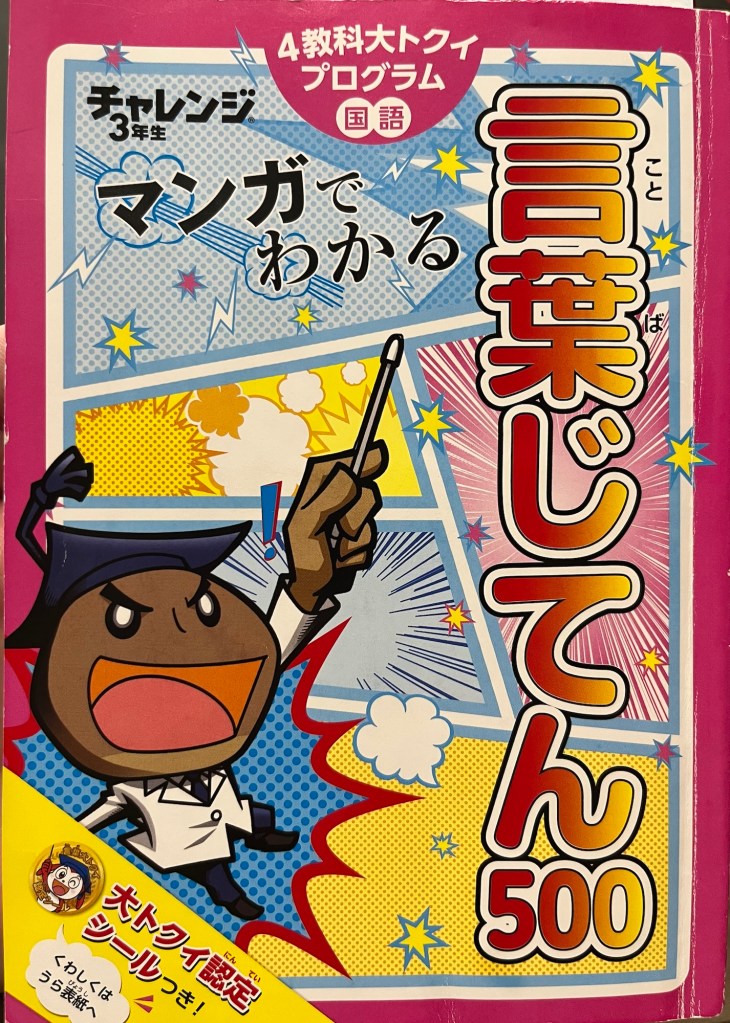
Recently though, I stumbled upon one of my son’s old textbooks from Benesse. Benesse is a company in Japan that provides teaching aides for kids (including Japanese kids overseas), through a monthly subscription service. Kids get study materials appropriate for their grade, and submit work monthly by mail, earning special prizes and such. The teaching staff at Benesse grade the work, send friendly feedback, etc. Our kids both subscribed to the service until about the third grade when they got too busy to keep going.

The cover of a textbook with Japanese written on it, where kids can learn 500 words using fun manga illustrations. The front cover features a cartoon character with a professor hat.
The cover of a textbook by Benesse featuring 500 words in Japanese for a 3rd grader to learn, using Manga.

Because of this, we have lots of old Benesse educational material lying around the house that the kids no longer need, and it turns out that even for an adult foreigner like myself, it’s really useful.

A while back, my kids’ local Japanese language teacher once remarked that if you are able to learn 3rd grade level Japanese, then you have a solid foundation. Forget college level or even high school level; just getting conversant at a third grade level is surprisingly useful.

Having seen the contents of the third-grade materials above I now believe it. I was surprised how many vocabulary words in the book were also in my JLPT study materials for the N2 and N1. Not only that, but they were presented in a fun, more engaging way for native speakers (kids). The explanations and examples were more natural and easier to grasp than my pricey JLPT study guides.

Even now, after years of study, I can pick up an old Doraemon comic and mostly be able to read it. And yet, I find I still have to look up words, and sometimes I learn new expressions and phrases in everyday Japanese. It’s not just learning the words, it’s learning in how people just say things. There’s more than one way to say “I’m impressed by something”, but they have slight nuances or differences in grammatical construction that just can’t be easily explained without context.

Doraemon is an old-timey comic for grade school kids and yet it’s clear that it still presents a good challenge for a language student.

All this is to say that if you are learning Japanese, or any language, jumping into adult material and concepts is somewhat counter-productive. It seems like the right thing to do, speaking as an adult, but grade school level language and material is surprisingly important and shouldn’t be overlooked. Everything beyond grade-school level is mostly just specialization in topics. If you focus on advanced materials too much you’ll be familiar with that topic but not much else. In others, you’ll have glaring gaps in your language skills. This essentially what happened to me, and only now am I starting to correct it.

But how does one approach this as a language student? Most students don’t have access to Benesse materials since it’s intended for Japanese audiences. You may have to get creative, but you can find children’s books, manga (including Doraemon), and study guides for Japanese kids online or in a Japanese bookstore. It doesn’t hurt to pick up such materials, and you may find them more challenging than you expected.

Remember: focus on getting to the third grade. However, you may have to start even lower level, first grade Japanese, second grade Japanese, etc.

It’s less about finding specific materials, and more about setting a realistic level of challenge, and then obtaining enough material (not just one book or two) until it becomes easy, innate. You can think of this as starting a new exercise routine, and setting realistic expectations. Just as kids starting learning basic language, and gradually increase in difficulty, language students should do the same. It’s seemingly slower at first, but builds a better foundation and avoids the painful need to go back and correct your Japanese later.

In any case, simply getting to a grade-school level will be surprisingly useful both in day to day interactions with Japanese people, and in passing the JLPT exams.

Making English Spelling Sensible: A Thought Experiment

This is an idea I’ve been noodling in my head for a long time, years even: how to make English Language more sensible. By “sensible” I mean more consistent, intuitive, and easier for people to learn.

The English Language suffers from a few challenges, not in how it’s spoken, but how it’s written:

  • Silent letters: knight, for example, only pronounces 3 letters (n i and t). The “l” in would is not pronounced either, nor is the “h” in ghost. Also, many words have a silent “e” at the end.
  • Sight Words: sight words are words that are core to the English language, but are spelled very differently than how they are pronounced: one, caught, could, use, and so on. These are high-frequency words, and crucial for basic English literacy, but as a former volunteer tutor for grade-school kids, they also cause lots of friction and considerable effort for children to learn. It shouldn’t be this hard.
  • Overloaded vowels: the letter “a” can be pronounced like “a” in father, “a” in cat, or “a” in rate (with a silent “e”). The letter “o” too: “o” as in hot or gone (the silent “e” is somehow ignored), “o” as in fork, or the “o” in sought.
  • Inconsistent consonant sounds: sometimes “c” is pronounced like an “s”, other times like a “k”: center vs. cat. Also “hard” g versus “soft” g.
  • Implicit sound combinations: that “ph” sounds like an “f” is , but where did “tion” (as in “shun”) come from? We don’t pronounce the “e” in -ed endings either.

There are great articles on the Internet that help to explain why English spelling has evolved the way it did, but I haven’t really found an ideas online about how to make the spelling more consistent and intuitive. People know that spellings and pronunciation have diverged over centuries, but how to make the spellings match the pronunciation again is a tough nut to crack.

In fact, if you look at Internet slang, some of these changes are already happening, using spellings like “wut”, “nao”, and “gurl”. They may seem frivilous at first glance, but it’s a sign that people are already developing more efficient and effective ways of communicating. A kind of “ground-up” reform.

The purpose of this post is to propose ways to reform the spelling of the English with the following self-imposed guidelines:

  1. No new writing systems: The Roman alphabet works fine, and many European languages have tailored it to meet their needs, reforming it over time as things change and evolve. English can do the same. No need to invent a whole new script.
  2. Intuitive for native speakers: if a writing system isn’t useful and intuitive for the people who need to use it, it’s not worth learning. So, spelling reforms have to be something that native speakers would naturally pick up.
  3. Minimize rules and exceptions: some cannot be avoided, but many others are just relics that can be simply dropped.
    • For example, I don’t believe it’s possible to change the first-person pronoun “I” to anything simpler (why is it even a capital letter?) even though its spelling is a bit non-standard.
  4. Make spelling consistent: in other words, make the writing system as WYSIWYG (what you see is what you get) as possible.

To that end, I have been playing around with different solutions for making English more intuitive and straightforward while trying to keep its essence as much as possible. This is a tricky balance, and for me it’s still an ongoing work. Some changes such as dropping silent letters are fairly easy to implement, others such as untangling vowel sounds, are much harder. Readers who find this page are welcome to adopt or reject these proposals as appropriate. Also, since the pronunciations are biased toward North American English, speakers of other English dialects would have to adjust as needed.

Disclaimer

This is just a thought-experiment, and not meant as serious academic endeavor. This is just a language nerd playing around with English. The ideas below probably are flawed, and would need further refinement before they became serious proposals for English spelling reform.

Consonants

Some easy fixes here, some a bit more difficult.

  • No silent E – we can use other ways to convey long vowel sounds (see below)
  • Replace final Y with other appropriate endings – Y only makes sense at the beginning or middle of a word.
  • Break up the letter C:
    • “Soft C” becomes S. This one feels pretty intuitive.
    • “Hard C” becomes K (or Latin C?) – The “K” spelling is more Germanic looking, while hard “C” is more like Latin spelling. Either choice can work. However, either choice will become awkward with some words: Kat versus cat. King versus cing. Killer vs. ciller, or komputer vs. computer. The “K” sound feels a bit more intuitive to me, but I admit I still like the Latin C for sentimental reasons.
  • Soft G becomes J – voyaj instead of voyage,
  • PH becomes F – Rafael instead of Raphael
  • KN becomes N – nife instead of knife
  • GHT just becomes T – weit instead of weight, thot instead of thought

More Consonant Changes

As above, some of these are fairly easy and sensible, some are a bit less intuitive.

  • TU becomes CHU – virchu instead of virtue
  • TURE becomes CHUR – overchur instead overture
  • Final S becomes Z – goez instead of goes
  • Final CE becomes S – chans instead of chance
  • Final LE becomes UL – incredibul instead of incredible
  • Final ED becomes D or T – fixt instead of fixed, calld instead of called
  • Final CK becomes K, or C – quic or quik instead of quick.
  • Final TION becomes SHUN – informashun instead of information

Short Vowels

I decided to keep the short vowels mostly unchanged. They are pretty intuitive already.

  • A as in “fat”, except AR as in “far”
  • E as in “get”
  • I as in “fish”
  • O as in “father”, except OR as in “or”
  • U as in “fun”, except UR as in “fur”

Long Vowels

As if things weren’t complicated already, trying to find a way to express long vowels without using a silent e or other tricks is one of the harder things to fix. We have five vowels in the English alphabet, but we have a lot more vowel sounds than we can fit onto 5 letters.

There are a few ways to approach this:

  • Latin-style diacritics: a is short, ā is long (as in rān for rain). Not all English-language software is equipped to handle diacritics, plus other challenges. This is the most WYSIWYG method, but also requires the most effort to re-learn.
  • Diphthongs: using two vowel-letter combinations to make each sound distinct. This doesn’t require substantial changes to software, and we already do this for some words (float, boat, through, avoid, etc). These are pretty distinct and visually look pretty good, but some diphthongs work better than others.
  • Vowel-Consonant combinations: instead of two vowels put together, maybe a vowel and a consonant? For example, day uses a + y, so we can apply that consistently to words like rayn, payn, informaytion and so on. Or the o+h combination for boht, goht and so on. Sometimes this work, but in practice I found this to be more awkward than expected.
  • A mixed solution: it might be best to simply use diphthongs where it seems intuitive, and vowel + consonant where it seems intuitive, as long as each combination is unique and sensible to native speakers.

I tested out all three options on my own, and I felt that diphthongs were the most intuitive and least effort to re-learn. For example:

  • AI as in “night”: nait, fait.
  • AE as in “day” or “rain”: dae, raen (alternatively, EI).
  • AO as in “now”: nao, paower, flaower
    • alternatively, “OW” might be sufficient here.
  • AU as in “law”: lau, rau
    • alternatively, Irish style “EA” (as in Sean) might work, or stick with “AW” instead.
  • EE as in “feed”: feed, same as before.
  • EI as in “weight” (alternatively, use AE): weit, dei
  • EU as in “few”: feu, geus, leus
  • OA as in “boat”: boat, soap, soap
  • OI as in “avoid”: avoid, boi
  • OO as in “good”: good, hood
  • OU as in “loose”: lous, foud

Conclusion

Theez ar just sum aideeuz I’v bounsd uraond, soa feel free tou trai them aot, see wut wurks, wut duzn’t, and drop a noat.

Chinese versus Japanese Character Readings

Way back in high school, like most American kids, I had to study things like Spanish, French, etc. I took German for two years in high school, but I didn’t find it very interesting, and I didn’t like my teacher very much. So, I never put in much effort. Later, one of my friends told me that we offered Mandarin Chinese at my high school, and I was just beginning my “teenage weeb phase”, so I was definitely curious.1

Our teacher, Mrs. Wu, was a very nice elderly teacher, even though she was in over her head dealing with a bunch of teenagers. Still, exploring something exotic like Chinese language really interested 16-year old me, and I was a pretty motivated student. I tried to learn both Traditional Chinese characters (used in Taiwan) and Simplified characters (Chinese mainland). My best friend at the time was Taiwanese-American, and I used to practice with his immigrant parents.

Anyhow, long story short, once I got into college, I focused on other priorities, and gradually, I forgot my Chinese studies.

Lately, I have been dabbling in Duolingo and learning Chinese again. I forget why, but I guess it’s partly fueled by nostalgia, but also because I already know how to read many Chinese characters through my studies of Japanese.

It’s been fascinating to see how Japanese kanji (Japanese-imported Chinese characters), and modern Chinese characters overlap and yet differ. The important thing to bear in mind is that Japan (like other neighboring countries), imported Chinese characters at an earlier stage in history, and over centuries the usage, pronuncaition and such have all diverged.

Take this easy sentence in Chinese:

All of these Chinese characters are used in Japanese, and without any prompts, I can read this and get the gist of what its saying, but there’s some notable divergences.

These Chinese sentence above is:

日本菜和中国菜
rì běn caì hé zhōng guó caì

A Japanese equivalent might be:

日本料理と中国料理
nihon ryōri to chūgoku ryōri

A few interesting things to note.

  • The character 菜 is used in modern Chinese to mean food in general, but in Japanese it means vegetables. So the usage has diverged. I noticed that Chinese
  • The country names, 中国 and 日本 are used by both languages, but the pronunciation has also diverged considerably. 中国 is pronounced zhōng guó in Chinese, and chūgoku in Japanese. You can kind of hear the similarities, but also the pronunciation has diverged for centuries.
  • The character 和 () is used in Chinese to mean “and”, but in Japanese a system of particles is used instead. Interestingly, 和 is used in Japanese, for example the old name of Japan was Yamato (大和) or modern words like heiwa (平和, “peace”). The pronunciation is wa, so it has diverged as well.

On thing I haven’t really delved into is the native Japanese readings for Chinese characters. Chinese characters are a foreign, imported writing system to Japan, so native words sound completely different even when written with Chinese characters. The word for 中国 (chūgoku) derives from Chinese, but 中 by itself is pronounced as naka (“middle”) which is a native Japanese word (not imported).

Anyhow, this is just a quick overview of how two entirely different languages both adopted the same writing system, but have diverged over time. If you add in languages like Vietnamese and Korean that also adopted Chinese characters, the picture is even more fascinating.

P.S. Through Duolingo, I learned that the Chinese word for hamburger is hàn-bǎo-bāo.

Chinese has to import foreign words using Chinese characters that at least kind of sound like the original. Japanese uses a second syllabary system, katakana, to approximate the same thing, although in the past Chinese characters were used as well. Hence, America is usually written as amerika アメリカ, but in more formal settings it is called beikoku 米国 (compare the pronunciation with Chinese měi guó).

1 The fact that my high school even offered Chinese language at that time (1990’s America) is pretty unusual, but I am grateful for the option. Also, thank you Mrs Wu if you ever happen to read this.

My JLPT N1 Test Results for 2023

I finally got my results back from the JPLT N1 exam I took in December 2023, and the results were not surprising.

I failed, as expected.

However, the results were not what I expected:

CategoryResults
Vocab / grammar28 / 60 (pass)
Reading7 / 60 (not pass)
Listening26 / 60 (pass)
Total Score61 / 180 (100 needed to pass)

I had expected to fail listening more so than reading, the listening section was very stressful, and yet the reading section felt somewhat easy. Clearly, I underestimated things. After reading about people online who passed or failed the JLPT N1, it’s clear that the N1 assumes full adult literacy. If you can’t read a novel or two in Japanese, you will not pass the reading section. I haven’t reached that level yet, and the results aren’t that surprising then.

That said, the total score to pass has to be 100 out of 180, so even if I passed the reading section, my overall score was still pretty low, and probably not enough to pass.

Needless to say, it was a good effort, but my preparations all around were insufficient.

Will I take it again? This took considerable time, effort and willingness to go the distance, and so I have to think about whether I want to try again. Since I don’t need the JLPT N1 for work, it’s more of a personal project, and may or may not be worth the cost.

Going to think about this for a while. 🤔

Kyoto and Nara Dialects

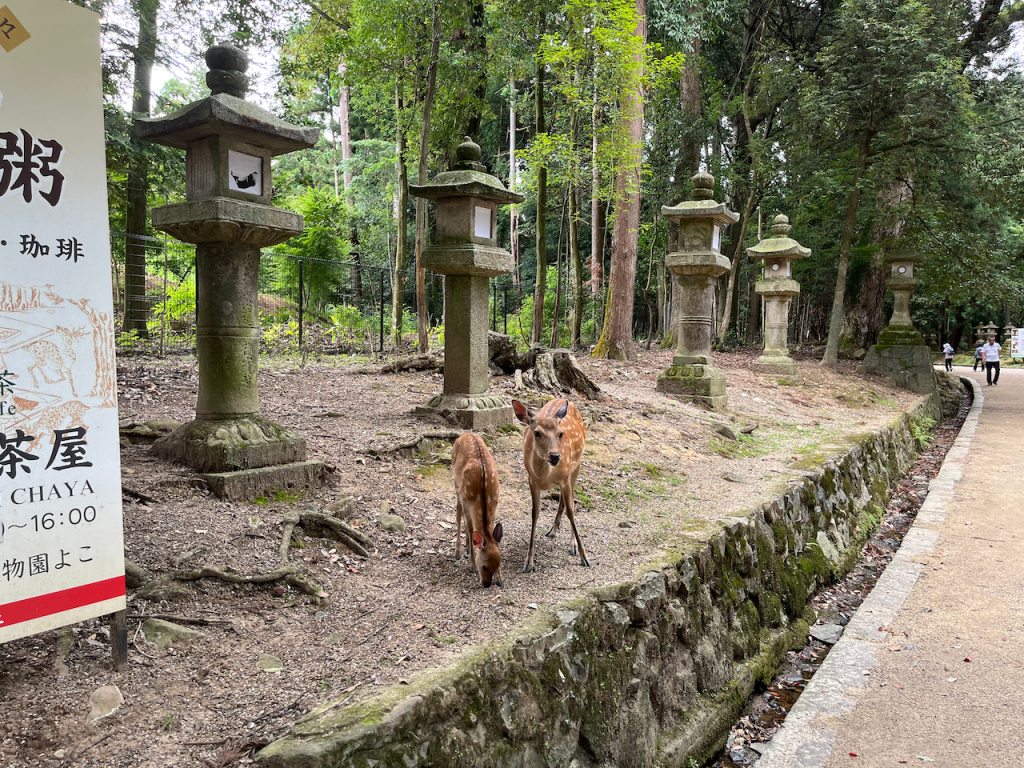
A pair of Nara Deer hanging around near Kasuga Grand Shrine in Nara. Taken in July 2023.

While visiting Kyoto and Nara recently, I started to pick up on some differences in Japanese language that took me a bit off-guard. I am not fluent in Japanese, but I consider myself functional (i.e. “good enough”), and since my wife is from the Kanto region around Tokyo, I’ve gotten used to Tokyo-style Japanese.

I know about Kansai-dialect since it’s often used on TV and comedy, but what I didn’t know is that places like Kyoto and Nara have their own sub-dialects, too within the Kansai dialect.

Kyoto Dialect

At Kyoto Station I often saw signs read おこしやす (okoshiyasu) which is the Kyoto way of saying welcome!

Other phrases often used include:

  • Okini – a Kansai-dialect way of saying arigato! (Thanks!)
  • Oideyasu – similar to the Tokyo-area phrase irasshaimasé this is how shops welcome customers when they first step in.
  • Dosu – this is another famous Kyoto-ism that replaces the standard Japanese desu.
  • Agaru / Sagaru – the verbs for “going up” (agaru) and “going down” (sagaru) can also mean going north and south respectively in Kyoto dialect.
  • Verb + よし – similar to standard Japanese command -なさい, this is an informal way of telling someone to do something.
  • Omaku – a colloquialism for a pillow (compare with standard makura).
  • Ohana ni iku – a phrase used when someone is heading for a tea party, a banquet, or other similar social functions.
  • Aisa ni – similar to standard Japanese phrase tokidoki (“sometimes”, “occasionally”).
  • Yasukenai – something unrefined or in poor taste. Similar to standard Japanese shina ga nai.
  • Yayako – a Kyoto word for “baby”.
  • Hona – a phrase for “goodbye”.
  • Kibaru – same as Japanese ganbaru, which is a key phrase to learn in Japanese.

Nara Dialect

I found, as a foreigner, Nara dialect a little hard to pick up in my experience. While Nara was once the capital of Japan a long, long time ago it is a pretty rural part of Japan now. Japanese spoken there differed somewhat from the “standard” Kansai dialect most people know. It is often described by other native Japanese speakers as a “cuter version” of Kansai-dialect.

One interesting aspect of Nara dialect is that “z” sounds are replaced with “d” sounds. For example the word for elephant, zōsan, becomes dōsan.

Another example is the colloquial ending yayo which replaces Tokyo-style dayo. Endings like yasu and mi are also used too, in place of standard ending ne.

Information in English about the Nara dialect is pretty slim, so I don’t have a good list of specific phrases, unlike Kyoto dialect.