Sometimes when you travel in Japan, especially outside of Tokyo, you may come across like this:
A large sacred tree at Kasuga shrine in Nara, Japan. Taken by me in July 2023.
This is a large tree that has been growing for centuries within the precincts of Kasuga Grand Shrine in Nara, Japan. The tree, as you can see, has a large rope tied around it with small paper streamers. If you ever saw the Studio Gibhli movie Totoro, you can see a big camphor tree with a similar rope around it.
Sometimes you also find rocks and other natural things with ropes around them too.
A “shimenawa” around an “iwakura” (sacred rock) at Meigetsuin, Buddhist temple in Kamakura, Japan, courtesy of Wikipedia.
This is a Shinto-religious custom using a special sacred, hempen rope called Shimenawa (注連縄). The little paper streamers called called Shidé (紙垂).
Shimenawa are sometimes used to section off a sacred space, but they’re also used to enshrine places thought to house a local kami, such as a tree or rock thought to be sacred. Sometimes you also see them hanging over home Shinto shrines (kamidana, 神棚). The idea is the same: the paper streamers help deliniate a sacred space (the inner sanctum of your home shrine in this case).
Interestingly, I discovered that a separate, but parallel tradition exists in Korea too. This blog shows that in Korean traditional culture, people would enshrine local guardian spirits by tying a rope (금줄, Geumjul) around them, and decorating with colored cloths (오색천, Osaekcheon) or white strips of paper. Such sacred trees (당산나무, Dangsan-namu) and sacred rocks (누석단, Nuseokdan), are collectively called Seonangdang. They are very similar in appearance to the ones in Japan, so it’s not hard to guess that there’s some common religious tradition between both cultures, though the Wikipedia article linked above also suggests a potential link to Mongol culture too.
Shinto as a religion exists only in Japan1 but it’s not hard to imagine that Shinto tradition drew from something much older that was shared across the Korean peninsula and Japan. Further, since it’s known that in early Japanese history that many Korean families migrated to Japan (the Imperial court sought their skills and technology), it’s quite possible the tradition was imported from Korea to Japan. Further, as this early Yamato court actively allied with the Korean kingdom of Baekche, it’s possible the cultural exchange went in that direction too.
Anyhow, it’s a fascinating example of how the two (or more) cultures have shared religious traditions for millenia, but few would notice.
1 Barring colonial efforts in the early 20th century to introduce it to other Asian countries, but these did not have a lasting impact culturally.
Recently, I found myself stuck in one of my usual nerd “rabbit holes” of trying to make sense of Zen lineages in Japanese Buddhism, but this led to a more complicated rabbit hole of making sense of the source “Chan” (Zen) lineages in China. This started after reading my new book on Rinzai Zen, which included a nice chart. At first, I tried to emulate and translate that chart in Canva, but then I realized it was missing some critical details, so I kept adding more. This is the result (click on the image for more detail):
Let’s go over this a bit so it makes more sense.
The premise behind all Zen sects regardless of country and lineage is that Zen started when the historical Buddha, Shakyamuni, supposedly held a flower up to his disciples and said nothing. Everyone was confused except his disciple Maha-Kashyapa who smiled in understanding. From here, according to tradition, the teachings were passed down from teacher to disciples for 28 generations in India, culminating in a monk named Bodhidharma who came to China.
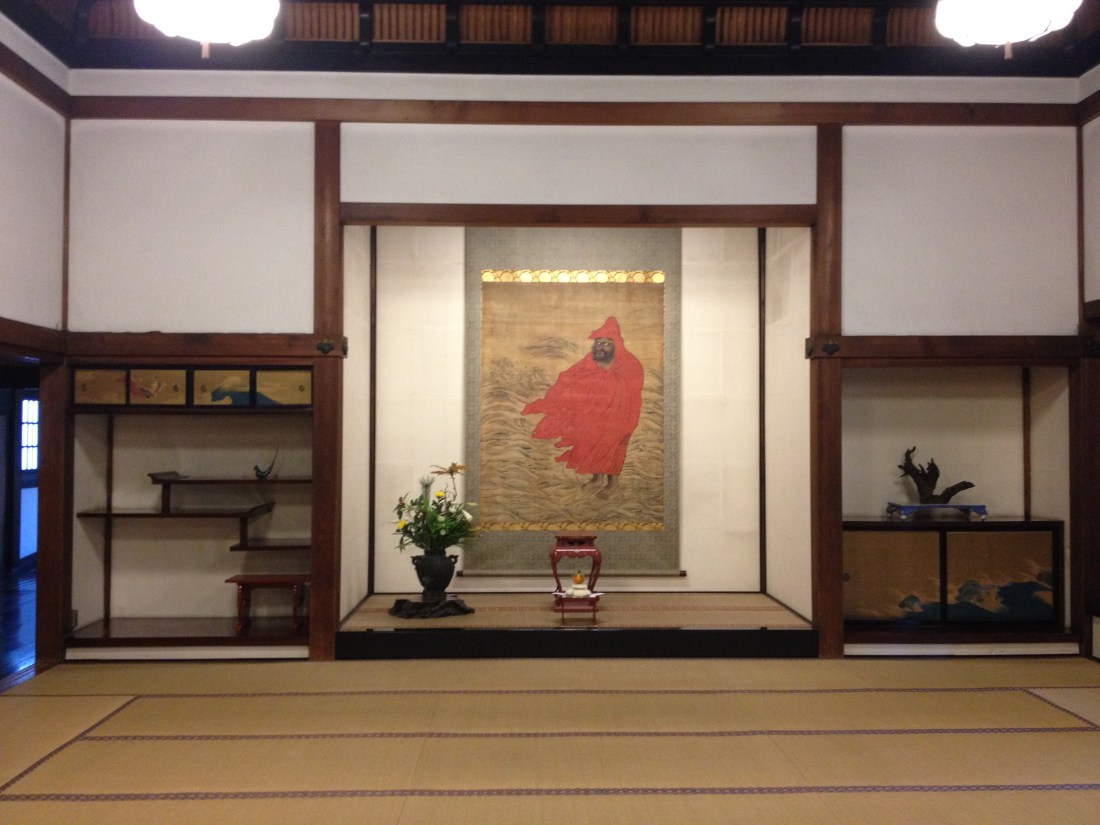
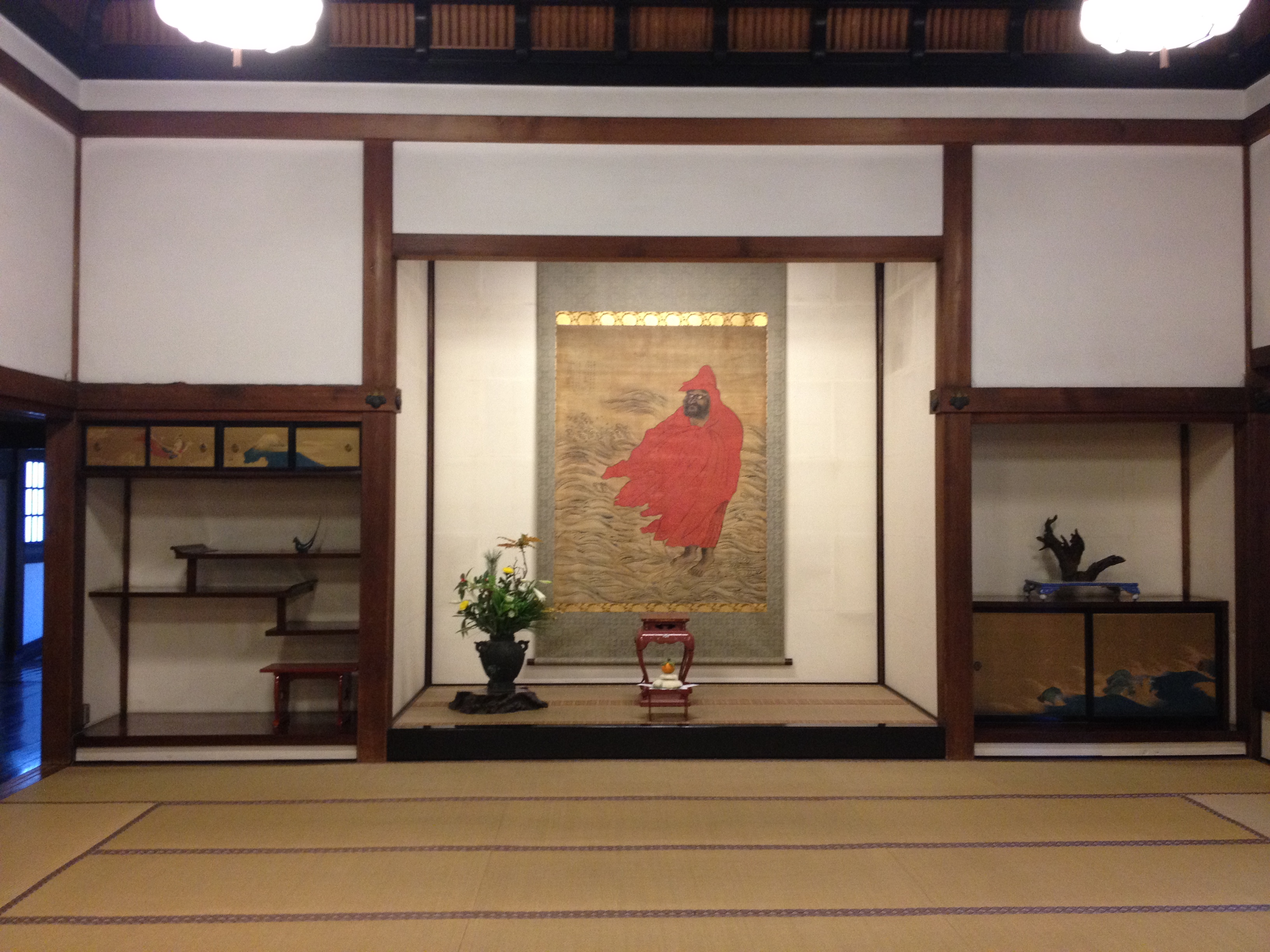
A painting of Bodhidharma at Sojiji temple (head of Soto Zen sect) in Kawasaki, Japan. Taken by me in 2010 (?).
The history up to this point is somewhat vague, and possibly apochryphal, but easy to follow.
This continues for a few more generations in China, until you get to a monk named Hui-Neng (Enō in Japanese)1 who is the supposed author of the Platform Sutra, a Chinese text. As the 6th “patriarch” of the lineage in China, he establishes what we know today as “Chan Buddhism” or Chinese Zen.
Things become more complicated a couple generations later as two descendants: Mazu Daoyi2 and Shitou Xiqian3 directly or indirectly found different schools of Chan Buddhism. This is known as the Five Houses of Chan period during the Tang Dynasty. Thus, the entire Chan/Zen tradition as we know it today is derived from Hui-neng and transmitted through these two men.
Out of the five houses, the Hongzhou,4Lin-ji and Cao-dong5 all survive in some form. The others are gradually absorbed into the Lin-ji school, which in the long-run is what becomes the most widespread form of Chan Buddhism in China. The Cao-dong school is the one exception, while the Hongzhou school’s success in Korea helps establish 8 out of 9 of the “Nine Schools of Seon (Chan)”6 in Korea. It through Bojo Jinul’s efforts in Korea that these nine schools are unified into the Jogye Order (homepage) which absorbed other Buddhist traditions in Korea into a single, cohesive one.
Meanwhile, in Japan, the Lin-ji and Cao-dong schools find their way to Japan where the names are preserved, but pronounced different: Rinzai and Soto respectively. Rinzai’s history is particularly complicated because they were multiple, unrelated transmissions to Japan often spurred by the Mongol conquest of China. Of these various Rinzai lineages, the two that survive are the “Otokan” Rinzai lineage through Hakuin, and the “Obaku” lineage through Ingen, but eventually the Otokan lineage absorbed the Obaku lineage. Today, Rinzai Zen is more formally called Rinzai-Obaku, or Rinnou (臨黄) for short. This is a bit confusing because Rinzai came to Japan under a monk named Eisai, and his lineage did continue for a while in Japan especially in Kyoto, but the lineage from the rival city of Kamakura ultimately prevailed and absorbed other Rinzai lineages. Obaku Zen arrived pretty late in Japanese-Buddhist history, and as you can see from the chart has some common ancestry with Rinzai, but also some differences due to cultural divergence and history.
Soto Zen’s history is quite a bit more streamlined as it had only one founder (Dogen), and although it did grow to have rival sects for a time, Keizan was credited for ultimately unifying these though not without some controversy even into the 19th century.
Anyhow, to summarize, the entire tradition started from a legendary sermon by the Buddha to Maha-Kashyapa, and was passed on over successive generations in India to a legendary figure who came to China and starting with Hui-neng became a tree with many branches. Yet, the roots are all the same. Speaking as someone who’s relatively new to the tradition, I realize while specific liturgy and practices differ, the general teachings and intent remain the surprisingly consistent regardless of culture or label.
Hope this information helps!
P.S. I had trouble deciding which term to use here: Zen or Chan or Seon since they all literally mean the same thing, but are oriented toward one culture or another. If this all seems confusing, the key to remember is that the entire tradition of Zen/Chan/Seon (and Thien in Vietnam) is all one and the same tree.
P.P.S. I realized that I never covered the Vietnamese (Thien, “tee-ehn”) tradition, but there’s so little information on it in English (and I cannot read Vietnamese), that I will have to differ that to another day.
1 Pronounced like “hwey-nung” in English.
2 Pronounced like “ma-tsoo dow-ee” in English.
3 Pronounced like “shih-tow shee-chee-yen” in English.
4 Pronounced like “hohng-joe” in English.
5 Pronounced like “tsow-dohng” in English.7
6 The Korean word “Seon” is pronounced like “sawn” in English. It is how the Chinese character for Chan/Zen () is pronounced in Korean Language.
7 If you made it this far in the post, congrats! I had to put so many footnotes in here because the Pinyin system of Romanizing Chinese words is a little less intuitive than the old Wade-Giles system. Pinyin is not hard to learn. In fact, I think Pinyin is better than the old Wade-Giles system (more “what you see is what you get”), but if you don’t learn Pinyin it can be confusing.better This is always a challenge with a writing system that strictly uses ideograms (e.g. Chinese characters). How do you write 慧能 into an alphabetic system that foreigners can intuitively understand. Also, which foreigners? (English-speaking, French-speaking, Spanish-speaking, etc). Anyhow, if you are interested in learning Chinese, I highly recommend learning Pinyin anyway because it’s quick and easy to pick up. BTW, since I posted about Hokkien recently it also has two different Rominzation systems: Pe̍h-ōe-jī (old, but widespread) and Tâi-lô (Taiwan’s official revised system).
This pagoda (Buddhist stupa) we saw in Kyoto near Kiyomizudera is among others attributed to Prince Shotoku.
The 6th century Prince Shotoku (Shōtoku Taishi, 聖徳太子) holds a revered place in Japanese culture not unlike Constantine the Great, Emperor Ashoka, or Good King Wenceslas. Even today, kids in Japan learn about Prince Shotoku through comic books, art and even the two-thousand yen bill. Even my son, who’s grown up in both Japanese and American culture has learned about the famous prince who was so smart that he could listen to ten conversations at once and recall each individually.
On a historical note, several famous Buddhist temples and pagoda (Buddhist stupa) are attributed to Prince Shotoku, including Horyuji. Further, he reorganized the Yamato court in a Confucian-style bureaucracy and is said to have composed an early Buddhist constitution.
But who was Prince Shotoku?
Prince Shotoku was part of a powerful triad at the time, consisting of Empress Suiko, a rare example of a powerful empress in Japanese history, Prince Shotoku as regent and advisor, and Soga no Umako, head of the powerful and reformist Soga Clan with strong connections to Korean and Chinese communities.
Japan at this time was emerging from geographic isolation and increasingly establishing cultural contacts with the Korean Peninsula, and with Tang-Dynasty China. This led to a power struggle between more conservative, nativist clans such as the Mononobé and Nakatomi, and reformist groups such as the Soga. The triad above were definitely reformist, and clashed with the conservative faction eventually leading to war.
According to the Nihon Shoki, on the eve of battle, Prince Shotoku prayed to the Four Heavenly Kings (a group of Buddhist guardian deities) for success. Upon crushing the Mononobe and their allies, Prince Shotoku built and dedicated the temple of Shitennnoji to the victory. The rest, as they say, is history.
Let’s talk about some of the things attributed to Prince Shotoku…
Buddhist Constitution
In 604, Prince Shotoku supposedly promulgated a seventeen article constitution based on Buddhist and Confucian principles: the jūshichijō kenpō (十七条憲法). Unlike a modern constitution, it was not legally binding, but more of a vague statement of governance, and was later replaced by the Ritsuryo System in the 8th century.
Translations of the 17 Article Constitution are hard to find, but you can see examples of it here and here.
Japan’s New Name
Names for Japan in early, early history varied and inconsistent. Chinese officials called it the land of Wa (倭), and Japan often called itself Wakoku (倭国) or Yamato (大和). However, the modern Japanese name for Japan, Nihon (日本) is attributed to a letter that Prince Shotoku wrote introducing his sovereign to the Sui Dynasty in China:
“From the sovereign of the land of the rising sun (hi izuru tokoro) to the sovereign of the land of the setting sun.”
The “land of the rising sun” evolved into Nihon (日本, lit. “where the sun comes from”).
Further, by putting the Emperor of Japan on equal footing as the Emperor of China, Prince Shotoku was not so subtly rejecting the Chinese-centric world view.
The Cap and Rank System
Prince Shotoku is also credited with establishing the first meritocracy in Japan in 603, inspired by Chinese Confucianism called the Kan’i Jūnikai (冠位十二階, “Twelve Cap and Rank System). The idea was to get out of hereditary government appointments, and promote ministers based on skill and talent, using a series of colored caps to correspond with rank (instead of lineage).
Promulgation of Buddhism
A copy of the Lotus Sutra said to be composed by Prince Shotoku. 日本語: 尾上八郎English: Hachiro Onoue, Public domain, via Wikimedia Commons
Prince Shotoku was said to be a great promoter of the Buddhist faith in Japan. We talked about the conflict with the nativist Mononobé clan earlier, who held to the Shinto faith, but after Shotoku’s victory, he continued to build temples such as Horyu-ji and stupas (like the one shown above), copy sutras, and so on.
Further, later generations of Buddhist teachers in Japan revered Prince Shotoku almost as a cult figure, often conflated with Bodhisattva Kannon. Even today, if you go to many Jodo Shinshu Buddhist temples, you will often see a scroll of Prince Shotoku to the side of the central altar due to the founder Shinran’s devotion to Shotoku.
Historicity
The historicity of Prince Shotoku is interesting though. While a historical figure named Prince Umayado (厩戸皇子) is thought to have really existed, and is thought to be the origin of Prince Shotoku, many of the stories and accomplishments attributed to him may have come from other sources.
Early Japan at this time was importing much mainland culture through the Korean kingdoms of Baekje and Silla, as well as China, and this often meant that immigrant families migrated to serve the early Japanese court. The Hata clan, for example, came from Silla.
The book Shotoku shows how certain subtle aspects of the Shotoku myth stories reflect cultural sources from Silla, via immigrant groups such as the Hata clan. This is through specific imagery used, coupled with archeological evidence from known sites in early Japan where immigrant groups habited, and their influence on local Shinto shrine practices.
For example, a famous story in the Nihon Shoki about Prince Shotoku and the Beggar of Kataoka reads as follows, with [my additions] and (additions from original author):
21st year, 12th month, 1st day.
The crown prince [Shotoku] made a journey to Kataoka. At that time there was a starving man who was lying at the side of the road. He asked for (the beggar’s) name, but he said nothing. The crown prince seeing this, gave him food and drink. He then took off his cloak, and covered the beggar with it, saying “lie there in peace.” He then made a song.
12th month, second day.
The crown prince sent a messenger to see the starving man. The messenger returned and said “The serving man is already dead.” The crown prince was greatly saddened by this and he therefore had them bury the man at that spot in a tomb that was firmly shut. Several days later [trimmed for brevity] he sent (another) messenger to look (at the tomb). The messenger returned and said “When I arrived at the tomb, (the earth) was firm and had not moved. (Yet) when I opened it and looked inside the corpse had already disappeared. There was only the clothing folded above the casket.”
At this the crown prince once again sent the messenger back to retrieve the clothing. He then wore it as he always had done. The people then all marveled at this and said “It is true that a sage knows a sage!”…
Shotoku, by Michael I Como, page 102
The story is hard for Western audiences, and even modern Japanese ones, to understand without additional context. Elements such as the dead resurrecting were motifs used by an immigrant community called the Wani clan from the Korean peninsula in their origin stories, and the notion of a “sage prince” was an idea imported from Chinese-Buddhist culture.
The book takes a very detailed an exhaustive look at the legends and stories of the time, but this example shows how the legend of Prince Shotoku was gradually constructed from obscure cultural trends and symbolism popular in antiquity, and conflated over generations. In later versions, for example, the beggar is the Indian monk Bodhidharma.
If political gridlock, government shutdowns due to budget fights, and rabid factionalism get you down, consider the case of the Joseon Dynasty of Korea (1392–1894). The Joseon Dynasty, also known as Joseon-guk in Korean (朝鮮國, 조선국) was the last and longest of royal dynasties of Korea. At 502 years long, it is also among the longest dynasties in world history.
After the rise of Buddhism in East Asia, Confucian teachings took a backseat for a time, until it re-emerged centuries later under a doctrine called Neo-Confucianism. Neo-Confucianism is a fascinating subject all by itself, but it’s a hard one to describe to Western audiences. It’s enough to know that it was an effort to reinforce early Confucian ethics with more philosophy and metaphysics, while avoiding mysticism.
This is important because Neo-Confucianism became the official state doctrine early the foundation the Joseon Dynasty, just as it had become Ming-Dynasty China and Tokugawa-era Japan. Schools of Confucian scholars would staff the elaborate bureaucracies used by each sovereign, and provide advice on policies, or criticism if the sovereign’s conduct was deemed inappropriate or immoral. As the beacon of a rational and orderly society, the sovereign was held to a very high standard, but also (in theory) commanded unwavering loyalty from his subjects. Because orderly and rational societies were valued by Confucian thinking, there was heavy emphasis on ritual, etc. Everyone had their place, and everyone was expected to carry out their moral obligations, putting the needs of society over their own profit.
On paper, this was how it all worked.
In reality, the Confucian bureaucracy (the yangban) of Korea grew very powerful, and different schools of Confucian thought began to compete with one another for dominance in the Joseon bureaucracy. Over generations, these rivalries grew very cutthroat, and worse they splintered into sub-factions, and sub-sub-factions, all vying with one another. Further, sons of bureaucrats had the wealth and resources necessary to ensure they’d pass the civil service exams and become bureaucrats themselves. The Iron Law of Oligarchy comes to mind.
This might seem kind of silly at first glance, since it obviously contradicted basic Confucian ethics.
However, this all began when bureaucrats in the court would debate how to address policy issues at the time, or question certain political appointments. Inevitably reform and conservative wings developed with different views of how to address such issues, and the leading figures of each wing would try to then pack the bureaucracy with their own men.
Is this starting to sound familiar?
The back and forth by factions, starting with the Easterners (dong-in, 동인 or 東人) and Westerners (seo-in, 서인 or 西人) began over subtle ideological disagreements. Then, each of these factions broke up into different factions. The Westerns faction alone broke up into the Noron (노론, 老論) and Soron (소론, 少論) depending on whether you supported Confucian scholar Song Si-yeol‘s reformist policies (the Noron) or not (the Soron). The Easterner faction similarly split up into Buk-in (“northerners”, 북인, 北人) and Nam-in (“southerners”, 남인, 南人) factions.
The king’s response to each of these factions varied by sovereign. In some cases, a king would support one faction over another. But if that faction got too powerful or out of line, the losing faction could sometimes convince the king to purge them from the bureaucracy. Sometimes the purges became extremely violent, with many faction members executed such as the one in 1589.
Inevitably, once a faction was crushed or purged, another would take its place in the court and consoldiate power, requiring yet another purge. By 1545 there had already been four blood purges.
By the time of King Yeongjo (1694 – 1776, 영종, 英宗) the fighting between factions and the bloody purges had gotten so out of hand, that Yeongjo survived an assassination attempt in his youth.
Yeongjo tried to take the high-ground in the conflict, implementing a policy of Tangpyeong (탕평, 蕩平) or “great harmony”. Yeongjo tried to stay above the fray and remained somewhat successful. Barely. By the reign of the next king, his grandson Jeongjo, the bureaucrats were at it again and King Jeongjo fought off a coup by the Noron faction.
In spite of the coup, the Noron dominates the court after Jeongjo’s later (and mysterious) death until they were ousted for good, but by this time the functions of government were locked in by certain powerful families and from the 1800’s onward the Joseon became isolationist and dysfunctional at a time when Western and Japanese powers grew in strength and aggression. The reforms of 1895 were simply too little too late to save the Dynasty and Korea was annexed by Iapan in 1905.
Much like the Eastern Roman Empire (i.e. the Byzantines), the Joseon Dynasty survived and thrived at times when there was a powerful ruler who could push for reforms, and keep interests in check. But there were always sharks circling the water, and as soon as they smelled weakness there would be bloody infighting and this would reset the clock on any meaningful reforms. Paralyzed by internal strife, other more dynamic, external powers eventually pulled ahead and defeated them.
It also should be noted that were plenty of good, sincere Confucian scholars who made a genuine effort at good governance, such as Kim Yuk, but in the end, powerful men always felt they could do it better when they sensed an opportunity.
P.S. astute readers may have noticed that I keep posting the names using both Hangeul script and Chinese characters (Hanja). Until the modern era, both were used together in a kind of mixed fashion, especially when a person wanted to avoid ambiguity (the Chinese characters are more distinct). Compared to neighbors like Japan or China, Chinese characters were used comparatively less (Hangeul was usually sufficient and simpler), but remain an important part of the language and culture.








 Gleanings in Buddha-Fields


_Cho_Seok-jin_(%E8%B6%99%E9%8C%AB%E6%99%89_1853-1920)_et_(cropped).jpg)

You must be logged in to post a comment.