Soto Zen Yearly Liturgical Calendar

Hello,

Recently, I alluded to joining a local Soto Zen group and deepening my practice there. I am happy to report that after several weeks, I finally decided to formally join the community as a member. Thus, I guess I am now a student of Soto Zen.1 It is kind of exciting to be part of a Buddhist community again after years of isolation, but also a bit of an adjustment since I’ve been doing things a different way for a very, very long time.

As part of this I wanted to get familiar with the yearly liturgy of the Soto Zen tradition. To my surprise, the local community seemed to not follow this yearly calendar, but I guess it’s up to each follower, and each community to apply this calendar as much possible.2
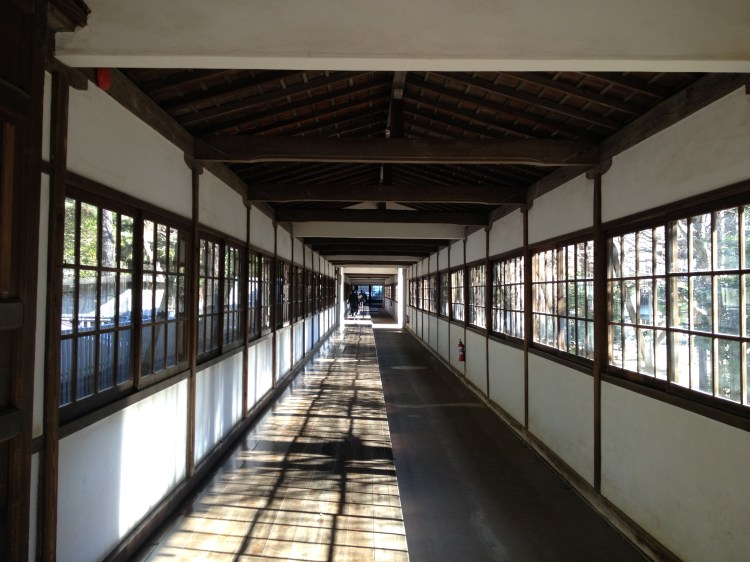
This was taken near the famous Chujakumon (中雀門) Gate at Sojiji Temple, looking westward. Photo from 2012.

Anyhow, I think it’s helpful to get familiar with the calendar of events not just to have a foundation in one’s life and practice, but also to stay connected with the much larger community. So, for that reason I’m posting the yearly event calendar here for readers. Many of these holidays line up with other Buddhist traditions in Japan, and I’ve already talked about them in other blog posts, while a few are exclusive to Soto Zen only.

DateJapaneseEvent
January 3rd転読大般若
Tendoku Dai-hannya
Reading of the Great Perfection of Wisdom Sutra
February 15th涅槃会
Nehan-e
The Death of the Historical Buddha, Shakyamuni
Late March彼岸会
Higan-e
Spring Equinox
April 8th花まつり
Hanamatsuri
The Birth of the Historical Buddha, Shakyamuni
Late July / Late August盂蘭盆会
Urabon-e
Obon Season
Late September彼岸会
Higan-e
Fall Equinox
September 29th両祖忌
Ryoso-ki
Memorial for both founders of Soto Zen: Dogen and Keizan
October 5th達磨忌
Daruma-ki
Memorial for Bodhidharma, the Indian monk who brought the Zen tradition to China.
December 8th成道会
Jodo-e
The Enlightenment of the Historical Buddha, Shakyamuni
December 31st除夜
Joya
End of the year temple bell ringing
Source: https://www.sotozen-net.or.jp/ceremony/annual

Let’s talk about some of these events below.

Reading of the Great Perfection of Wisdom Sutra

The Great Perfection of Wisdom Sutra requires some explanation. The Sutra is not one Buddhist text, but a collection of sutras that appeared in India starting in the 1st century CE. Each of these “great perfection of wisdom” sutras (a.k.a. prajña-paramita in Sanskrit) basically teaches the same message, but each version was composed in varying sizes: 8,000 verses, 15,000 verses, 25,000 verses, etc. The trend happens in reverse too: some versions get shorter and shorter until you get to the famous Diamond Sutra and Heart Sutra. Due to their slimmer size and easier recitation, these two sutras have retained more popularity over time.

Nevertheless, regardless of which version we’re talking about, the Great Perfection of Wisdom Sutra is a powerful foundation for Mahayana Buddhist traditions everywhere, including the Zen tradition. Thus, many traditions have some kind of “sutra reading” ceremony.

Because the Perfection of Wisdom Sutra is so large, it’s impractical to read/recite the entire sutra in a single session, so the ceremony usually involves Buddhist monks opening each fascicle and fanning through the pages to symbolize reading it. It’s a very formal ceremony. You can see an example of this below, though I am unclear which Buddhist sect this is:

If you want to the ceremony itself, skip to 11:30 or later, until about 16:00

English-language copies of the Great Perfection of Wisdom Sutra are very hard to find, by the way. I consider myself very lucky to find a copy of the 8,000-verse sutra at Powell’s City of Books some years back (that bookstore is amazing by the way):

Most Zen communities in the West can’t be expected to have such a copy. In any case, since the Heart Sutra is a summation of the Great Perfection of Wisdom Sutra anyway, it makes sense for most Zen practitioners to simply recite the Heart Sutra as appropriate. In the Youtube video above, the monks even recite the Heart Sutra at one point too.

Dual Founders Memorial

Soto Zen is somewhat unusual in Japan for having two founders, not one. The sect-founder-practice dynamic is something unique to Japanese Buddhism,3 usually each recognized Buddhist sect in Japan has one founder, not two.

Normally, when Westerners think of Soto Zen in Japan, they think of Dogen as the founder since he was the one who traveled to Song-Dynasty China, studied Caodong-sect Zen teachings, and brought those back to Japan.4 The challenge is that during this time, Soto Zen was a strictly monastic institution that had minimal appeal to the wider Japanese society.

Keizan, who came a few generations later, reformed Soto Zen as an institution that had more broad appeal. It was still centered around the monastic institution, but also included more community connections to the warrior samurai class and the peasantry as well. Soto Zen flourished in a way that other Zen sects in Japan simply never did. For this reason, Keizan is considered the second founder.

Thus, during formal ceremonies, a Soto Zen text, the ryōsokisho (両祖忌疏) is read aloud, which describes the virtuous life of both founders through the use of Chinese-style poetry.

Bodhidharma Memorial

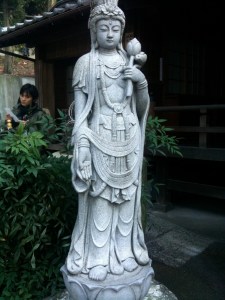
Bodhidharma, unusually depicted standing. Taken at Sojiji Temple in 2012.

Within the world of Zen, Bodhidharma is a guy who needs no introduction. This semi-legendary monk from India supposedly came to China in the 4th century, and helped establish the lineage there, and subsequently all such lineages through East Asia.

The historicity of Bodhidharma though is pretty suspect, and some historians contend that he was made up in order to refute criticism that Zen had no prior connection to Buddhism in India. I don’t know which is true.

Regardless of whether Bodhidharma was real or not, he is the embodiment of Buddhism (particularly Zen) passing the torch from the community in India to the community in China and beyond.

End Of Year Temple Bell Ringing

The “joya” tradition is found across all Buddhist sects in Japan, and is a way of ringing in the new year. I took part in it once myself at a local Jodo Shu temple thanks to my father-in-laws connections.

The temple bell, or bonshō (梵鐘), is run 108 times, to signify the 108 forms of mental delusions (kleshas in Sanskrit, bonnō in Japanese) that all sentient beings carry with them. Things like anger, jealousy, covetousness, envy, ill-will, etc. In other words, the stupid petty shit we all do.

When I participated ages ago, this particular temple lined 108 volunteers up, and one by one we proceeded to the temple bell and rang it. As the temple bell is very large, and the striker is a large wooden log suspended by rope, this wasn’t easy, but it was cool.

Obviously, many communities in the West don’t have huge temple bells, and only tiny ones at home at their home altar. Still, one can relive the experience using a small bell, such as one found on your Buddhist altar, and ringing it 108 times (Buddhist rosaries can help keep count, by the way; that’s literally what they’re for), or some division of 108 if that’s not easy: 54, 27, etc.

Conclusion

The liturgical calendar of Soto Zen, as promulgated by the home temples in Japan, includes a lot of holidays that are practiced by the wider Mahayana Buddhist tradition anyway, plus a few novelties found only in Japan, or even just in Soto Zen itself.

Outside of Japan, how one incorporates this into one’s own community, or just in one’s personal life is entirely up to them. Personally, I like having some structure, including a set calendar like this to keep me from getting too idle, but also as a way to tie in to the larger Buddhist community as a whole. However, other people may differ.

Good luck and happy practicing!

Namu Amida Butsu

1 I should clarify that I haven’t stopped reciting the nembutsu and such, I just feel I moved onto the next phase of my Buddhist practice.

2 I have noticed over the years that communities here in the West are more or less connected to the home temple overseas. Some strive to stay in lock-step, some go the opposite route. I have mixed feelings on the subject.

3 TL;DR – The Edo Period government decided to divide-and-conquer previously militarized Buddhist establishments into distinct sects, where each one required to define their founder, their particular practice, and key sutras they base their teachings around. This led to the parochial style Buddhist institutions that still exist today, but also bucked the trend in continental East Asia where Buddhist sects tended to synthesize into a single “super-Buddhist” tradition.

4 Fun fact: the “Soto” is just the Japanese-style reading of Cao-dong: 曹洞. For a look at how Japan imported Chinese characters, and why they sound so different, you can watch this Youtube video. I have personal quibbles about some details, but it’s otherwise a great historical overview.

The Amitabha Root Dharani

The Amida Nyorai Konpon Dharani (阿弥陀如来根本陀羅尼) or “Amitabha Root Dharani” is a dharani used in some Japanese Buddhist sects, typically only on the Segaki ritual used to feed the hungry ghosts in Buddhism, or possibly funerals and other similar services. It is typically only found in esoteric rituals in Shingon and Tendai Buddhism, but can be found in Jodo Shu and Zen as well. The dharani is typically of very, very limited use, and not part of normal liturgy.

This page is intended to post the dharani for reference purposes only. Esoteric practices such as mantras and dharani should only be used as recommended by one’s teacher, under a guided training program. I found reference material on this dharani to be almost non-existent in English, hence my decision to post it here.

This page will provide both the Sino-Japanese reading follow by the Sanskrit reading. There are multiple versions of the dharani in Japanese, so pronunciation may vary slightly between them, so for this reason the Sanskrit is provided as well. No translation will be provided as this is part of the esoteric training one should undergo when learning the dharani. Any translation you see online of this, or any mantra/dharani, should be treated as suspect.

Can’t read the characters?

If you’re having trouble reading the Kanji characters, you might have one or two problems with your computer:

  • Your computer may not have Asian fonts installed. In Windows you have to enable UTF8 and East Asian fonts under the Control Panel. Modern Mac computers are fully compatible already.
  • Your browser may be assuming the wrong character set. If you use a relatively modern browser and use UTF8 as character set, you should be able to read fine. IE, Firefox and Safari all read this fine as far as I can tell.

Even if not, then you can still use the romanized characters, and the (terrible) English translation.

Disclaimer and Legal Info

I hereby release this into the public domain. Please use it as you see fit, but if you attribute it to this site, greatly appreciated. Also, please bear in mind this is an amateur work, and should not be taken too seriously.

Dedication

I dedicate this effort to all sentient beings everywhere. May all beings be well, and may they all attain perfect peace.

Namu Amida Butsu

The Amitabha Root Dharani

Japanese Kana

ノウボウ アラタンノウ タラヤ-ヤ-ノウマク アリヤ-ミタバ-ヤ- タタギャ タヤ-アラカテイ サンミャクサンボダヤ-タニャタ オン アミリテイ アミリトドバンベイ アミリタサンバンベイアミリタギャラベイ アミリタシッデイ アミリタテイゼイ アミリタビキランテイアミリタビキランタ ギャミネイ アミリタギャギャノウ キチキャレイアミリタドンドビソバレイ サラバアラタ サダネイサラバキャラマキレイシャ キャシャヨウキャレイソワカ

Japanese Romanization

nōbō aratannō tarayāyānōmaku ariyāmitabāyā tatagyatayāarakatei sanmyakusanbodayātanyata on amiritei amiritodobanbei amiritasanbanbeiamiritagyarabei amiritashiddei amiritateizei amiritabikiranteiamirita bikiranta gyaminei amirita gyagyasō kichikyareiamirita dondobi sobarei sarabārata sadaneisaraba kyarama kireisha kyashayō kyarei sowaka

Original Sanskrit

Namo ratna-trayāyanamaḥ āryāmitābhāya tathāgatāyārhatesamyak-saṃbuddhāya.Tadyathā oṃ amṛte amṛtodbhave amṛta-saṃbhaveamṛta-garbhe amṛta-siddhe amṛta-teje amṛta-vikrānteamṛta-vikrānta-gāmine amṛta-gagana kīrtikareamṛta-dundubhi-svare sarvārtha sādhanesarva-karma-kleśa-kṣayaṃ-kare svāhā!

Additional Links

All in Japanese, and used for reference.

Example Chant in a Japanese Buddhist Service

An example of this can be seen on Youtube:

P.S. This is an old post from my former blog that I thought I had lost, but recently recovered. Reposting here with better blog formatting. Otherwise, I haven’t changed the contents.

The Ultimate Japanese Winter Food: Oden

Usually when people think of Japanese food, they think of sushi, or ramen, but these are luxury foods that aren’t normally eaten at home. There is one food though that’s very popular in Japan, eaten on special occasions at home, and truly a wonderful food for winter: Oden (おでん).1

Oden is hard to explain, but it’s basically a kind of hot pot or stew where you cook various foods in there, and the family eats out of the same pot. We only cook 2-3 times a year, usually winter, since it requires a fair amount of preparation to make. I’ve also had it with my wife’s relatives in Japan during cold months.

Here’s my wife’s pot, with the oden having stewed for hours:

Inside, you can see may different foods, some skewered with bamboo sticks, others just cooking in the pot.

Oden always has a strongly brownish color due to the soy sauce and fish broth (dashi) based that’s used, similar to Udon and other foods. The items in our pot include Japanese radish (daikon), boiled and peeled eggs (yudé-tamago), fried tofu, Korean fish cakes (odeng-tang), Japanese fish cakes, noodles (harusamé) among many other things.

What’s fun is that there’s a large variety of things you can put into the pot and cook up. When you go to a convenience store in Japan, especially in Winter, they often have take-home oden, where you pick the foods you want to put in, they provide the broth, and you just carry it home. Alternatively, if you manage to find a traditional yatai food-cart,2 you can also enjoy oden there. As with the convenience store, just pick your ingredients, and enjoy. You can also mix in some Chinese hot mustard (karashii), too, but like wasabi that stuff can hurt if you add too much.

Oden sets are also available, both overseas and in Japan. These are usually frozen, and come with all basic items, but my wife likes to further embellish with boiled eggs, daikon radish. My wife doesn’t make from scratch (it would be too difficult), so using the frozen sets as a base works well for her.

Oden is a heavy comfort food, but is great on a cold winter’s evening, and well worth the opportunity if you can get it.

P.S. The Korean word odeng for the equivalent dish may be a loanword from Japan, probably during the colonial era (1910-1945), but beyond that, I am not sure.

1 I’ve never seen “oden” written in Kanji (Chinese Characters). If there’s kanji for it, it’s definitely not widely used. Shops that serve oden also write using hiragana script, not kanji.

2 I’ve been to Japan many times, but have never see one. They definitely seem to be a dwindling tradition / business model.

Japanese and Homophones

Japanese, as a language, is somewhat unusual in that it has many, many homophones. Many of these are originally Chinese-compound words that were imported into Japanese, and subsequently lost their kind of intonation found in modern Chinese languages that would help to distinguish them. Their sound became flat and mostly indistinguishable from other similar words. Yet their Chinese characters (kanji) are different, and they still convey different meanings:

I don’t entirely agree with the rant in this video, plus his lack of understanding of the Heart Sutra, but it’s still a good explanation for how kanji were gradually imported into Japanese from a great Youtube channel.

For example, there are three different words are all pronounced igi:

  • 意義 – Meaning, significance of something.
  • 異議 – Objection, dissent
  • 異義 – A homonym (ironically)

However, many native Japanese words also tend to sound like one another, and their meanings can be similarly hair-splitting. A classic example is the verb ageru:

  • 上げる – To raise something up
  • 揚げる – To deep fry something
  • 挙げる- To use something as an example (e.g. to praise it)

With the verbs, you can see that stem of the verb, which doesn’t change in conjugation, will be represented by the appropriate kanji, and help you distinguish which ageru in written form you’re talking about. But even that isn’t always the case.

The verb awaseru can be written as:

  • 合わせる – To match (or to synchronize)
  • 併せる – To merge, or put disparate things together.

The example above gets pretty different, even for native Japanese speakers, hence there are books that help explain when to use one kanji versus another.

The good news is that for a language student, with plenty of reading practice, and the patience to build vocabulary rather than wasting time memorizing kanji, one gradually picks up these nuances and eventually gets an intuitive sense. The organic growth of the writing system, with waves of imported Chinese characters makes Japanese a difficult written system. On the other hand, despite what some Westerners assert, it is logical, definitely not impossible, and simply requires patience and practice.

The Ten Verse Kannon Sutra

A photo of the Ten Verse Kannon sutra, showing Chinese characters vertically, with Japanese pronunciation to the right of each individual character.
A photo of the Ten Verse Kannon Sutra from my sutra book, purchased as Asakusa Temple (a.k.a. Sensoji) in Tokyo Japan

In medieval Japanese Buddhism, you can find many interesting little innovations. One example is a popular liturgy called the jikku kan’on gyō (十句觀音經), or the “10 Verse Kannon Sutra”.

It is a popular, devotional chant in Japanese Buddhism toward Kannon Bodhisattva. You can find it in various Buddhist sects, Zen, Tendai, etc. My sutra book from Asakusa Temple (a.k.a. Sensoji) includes it since the temple’s deity is Kannon. The origin of the text is not entirely known, though it’s speculated that is was composed by a Tendai priest as a summation of the 25th chapter of the Lotus Sutra. The 25th chapter is sometimes chanted or recited in devotional services because it is dedicated entirely to Kannon Bodhisattva. However, it is challenging to recite due to its length, even if you just recite the verse section.

Assuming this is really was formulated as a summary, a lay person could recite this with the same intention as reciting the full chapter, but this would be a lot easier for someone of humble background who maybe cannot read all the complex Chinese characters in the original, let alone someone who has to work the fields all day. It is also short enough for someone to easily memorize and chant in its entirety.

It’s not technically a sutra in the sense that it does not purport to speak on behalf of the Buddha, but there are other examples in of sutras (such as the Platform Sutra in Zen) that fit this awkward category as well.

So, for those interested, I present the Ten Verse Kannon Sutra, with translation below:

Can’t read the characters?

If you’re having trouble reading the Kanji characters, you might have one or two problems with your computer:

  • Your computer may not have Asian fonts installed. In Windows you have to enable UTF8 and East Asian fonts under the Control Panel. Modern Mac computers are fully compatible already.
  • Your browser may be assuming the wrong character set. If you use a relatively modern browser and use UTF8 as character set, you should be able to read fine. IE, Firefox and Safari all read this fine as far as I can tell.

Even if not, then you can still use the romanized characters, and the (terrible) English translation.

Disclaimer and Legal Info

I hereby release this into the public domain. Please use it as you see fit, but if you attribute it to this site, greatly appreciated. Also, please bear in mind this is an amateur translation, and should not be taken too seriously, nor is it of academic quality.

Dedication

Kannon Bodhisattva. Taken at Daienji Temple in Meguro Ward, Tokyo, Japan in 2010

I dedicate this effort to all sentient beings everywhere. May all beings be well, and may they all attain perfect peace.

Namu Kanzeon Bosatsu

The 10 Verse Kannon Sutra

Japanese TextRomanizationКирилицею (in Cyrillic)
觀世音Kan ze onкан дзе он
南無佛namu butsuнаму буцу
與佛有因yo butsu u inйо вуцу у ін
與佛有縁yo butsu u enйо вуцу у ен
佛法相縁bup po so enвуппо со ен
常樂我淨jo raku ga joджьо раку ґа джьо
朝念觀世音cho nen kan ze onшьо нен кан дзе он
暮念觀世音bo nen kan ze onбо нен кан дзе он
念念從心起nen nen ju shin kiнен нен джю шін кі
念念不離心nen nen fu ri shinнен нен фу рі шін

Chanting Example

You can find examples of chanting of the Ten Verse Kannon Sutra on Youtube such as this one:

My Translation

At its heart, the Ten Verse Kannon Sutra is both a praise of Kannon Bodhsattva, but also gratitude for the karmic bond between oneself and Kannon (explanation here, albeit different Buddhist deity).

This translation below is something I made a while back, and is a rough translation only. Other translations is here and here. Big thanks to Reverend “E” for his excellent scholarship and assistance in this endeavor.

Kanzeon [Bodhisattva]!

Praise to the Buddha!

With the Buddha as cause,

With the Buddha as condition,

Through the Buddha, the Dharma and the Sangha

I attain eternal, blissful, self, purified of all defilements [nirvana].

In the morning, I recite “Kanzeon”.

In the evening, I recite “Kanzeon”.

Reciting and reciting arises from the awakened mind.

Reciting and reciting is not separate from [awakened] mind.

Enjoy and happy reciting!

P.S. The “Buddha” here I believe is the eternal Buddha, the Dharmakaya, not the historical Buddha, Shakyamuni

JLPT Exam and Rethinking Flashcards

Recently, I wrote about my frustrations with using Anki to bulk-learn vocabularly for the JLPT, and my decision to focus more on reading. Since then, my thought has changed a bit.

Ultimately, your success in the JLPT lies in two basic skills: reading Japanese, and listening to Japanese conversation. The vocabulary helps to read, but I found that with my Anki flashcards, it tended to focus a lot on recall (e.g. “do you remember how to say a word in Japanese?”), not recognition (e.g. “do I remember what this means when I see it?”). This first one doesn’t help with reading very much, the second one does. Since Japanese uses so much kanji, you’re ability to recognize words smoothly makes the process of reading so much easier. The issue with recall I found was that there were many different, overlapping words for the same thing, and trying to remember which word was which wasn’t worth the effort. I just want to be able to read well. Further, recall didn’t help me know the context words are often used in.

But while focusing on reading Japanese manga lately, including the various books my kids and I have, I realized that I still need to learn some words, especially if they appear over and over again. Brute-force reading wasn’t quite enough. So, I still need some way of learning words through repetition, but I want to focus on recognition only.

So, I realized that if you want to use Anki flashcards for improving reading, and focus on recognizing words, and with the correct context I needed to revisit the MCD approach for making cards. In other words, make flashcards not with words, but with sentences.

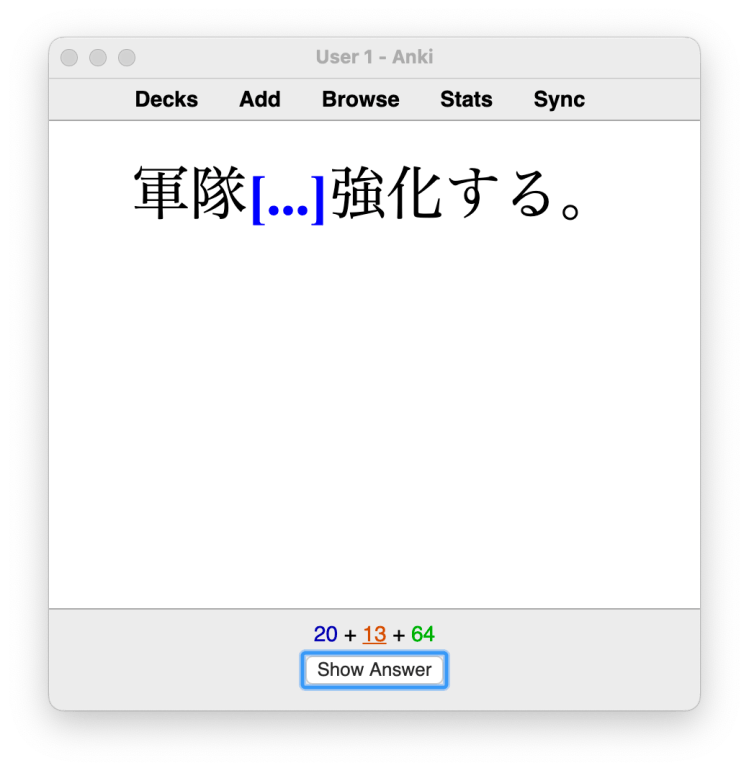
Here’s an example:

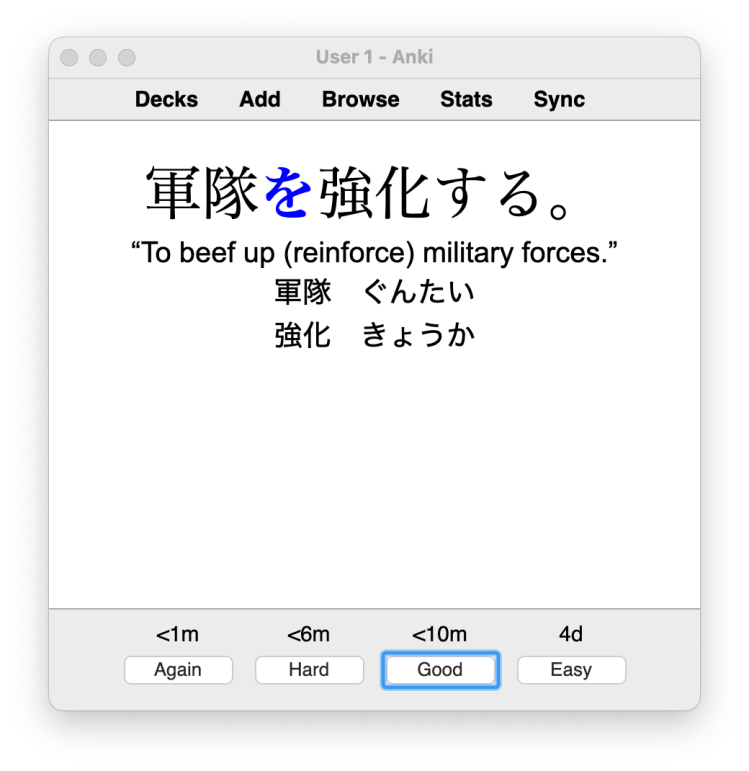
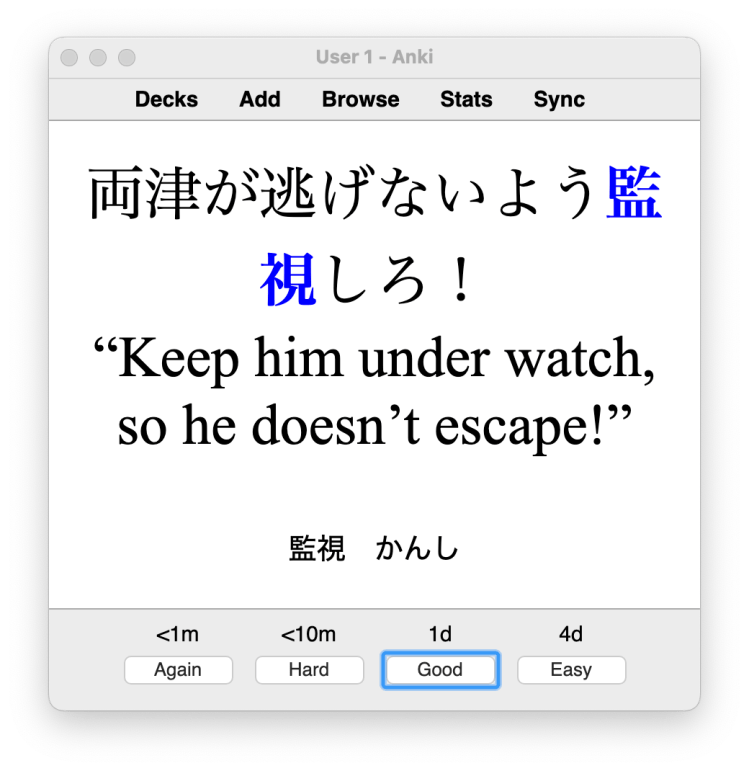
The word I wanted to focus on learning was the verb 強化する (kyōka suru) meaning to intensify or strengthen. So, rather than just throwing it in my flashcard deck, I looked it up on my favorite Japanese online dictionary and found an example sentence I liked. From there, I found an example sentenced I liked and put that in. Notice that I did not hide the word 強化する. I wanted to be able to read the word, not necessarily recall it, but I do need to be able to recall what particle it uses. In this case を, the direct-object marker. So, I hid that.

Under the notes section, I put in readings for each kanji word in there, in case I need a hint later. I also put the English translation under notes, not in the flashcard since I wanted to be able to suss out what the sentence meant without the English translation. However, it helps to sometimes put the English translation in the flashcard too if the helps:

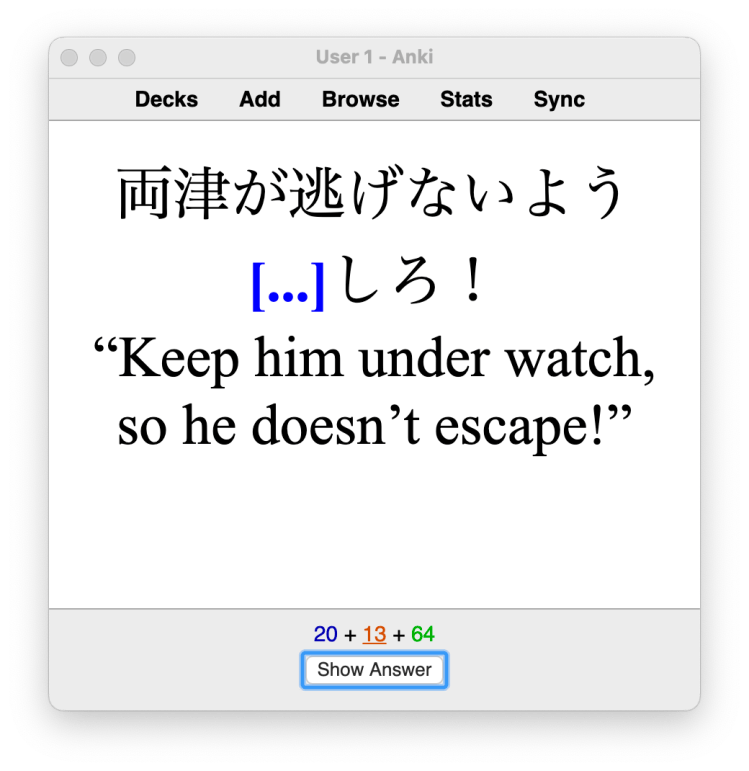
Here, I needed to learn the word 監視する (kanshi suru) meaning to observe or keep under watch. But the sentence I got from one of my manga was a bit awkward, yet useful in providing context. So I had to keep the English sentence in the flashcard.

The point here was: be flexible on a per card basis, and use what works, but doesn’t overburden you by making the card too difficult, or have too much guesswork. Your focus should be on reading, not recall.

Anyhow, does this work?

So, far, I’ve found the Anki flashcard experience a lot less painful than it was before, plus it incentives reading by finding more good sentences to put in.

I still need to be mindful about making too many flashcards, plus each flashcard takes more effort to make than it used to, but as long as I keep it flexible and lightweight, it’s easier to maintain and keep up.

Good luck and happy studying!

New Mug!

This came in the mail this morning;

This happy little mug comes from Language Mugs and includes a basic breakdown of Ukrainian conjugations and grammar. I got different mugs for my kids: French for my daughter who’s studying in school, and Japanese kanji for my son who loves learning it.

For your language nuts out there, I’ve learned a few things already from the mug;

  • Ukrainian nouns have seven declensions which is kind of a lot. Some repeat though, such as accusative and nominative.
  • Ukrainian adjectives conjugate based on grammatical gender, but are the same in plural (like German, for example).

I will be poring over its contents over the coming weeks just as I continue to pour homemade cold brew coffee.

Check out Language Mugs if you can. The mugs are great, and delivery was pretty fast.

The Rise and Fall of the Heike

Woodblock print of Taira no Kiyomori, by Yoshitoshi, published in the One Hundred Aspects of the Moon. 月岡芳年, Public domain, via Wikimedia Commons

Near the end of the twelfth century in Japan, amidst decades of political meddling by the Fujiwara clan in Imperial court politics, an upstart samurai warlord named Taira no Kiyomori took control of his own clan, the Heike (平家) clan,1 in 1159. The Heike were one of several offshoots of Imperial offspring in last generation and hung around the Imperial Court as minor aristocrats, lowly samurai, etc.

By 1179 Kiyomori seized control of the capitol in a coup. The head of his hated rivals, the Genji (源氏) clan,2 was executed and his sons forced to live in separate provinces. The capitol was effectively under a military dictatorship under the guise of maintaining the Imperial Court, with Taira no Kiyomori pressuring the Emperor to award him the court rank of 1st rank junior (just under the Emperor). Kiyomori was said to wear brash clothing and flaunt Court etiquette. As he held onto power at the expense of the Emperor he could do what he wanted.

The Genji were now scattered, but not defeated. In time, starting with Minamoto no Yoritomo, they were able to gather allies, including a Heike-offshoot: the Hojo Clan. Further, the brothers of the Genji clan gradually reunited under Yoritomo, including the famous warrior Minamoto no Yoshitsune, and push back the Heike. This “Genpei War” culminated with the navel battle of Dan-no-ura, when the Heike were almost totally wiped out and a couple of the Imperial sacred treasures were reportedly lost.

But by the time of Dan-no-ura, Taira no Kiyomori was already dead. Taira no Kiyomori has become something of a power-hungry villain in Japanese lore since the Tales of the Heike, and subsequent media. His death is dramatized as coming from a terrible illness with a fever so hot that no one could approach him, while in his fever dream he was said to have seen the denizens of hell waiting for him including Enma the Judge of the Underworld.

Another woodblock print by Yoshitoshi dramatizing the illness and death of Taira no Kiyomori. Yoshitoshi, Public domain, via Wikimedia Commons

As the opening lines of the Tales of the Heike eloquently state, the powerful do not last long, and ultimately self-destruct. So it was with Kiyomori and the Heike.

P.S. The larger Heike clan persisted long after the Genpei War, mostly through off-shoots such as the Hojo, Miura, and so on. But Taira no Kiyomori’s ambitions were crushed and his immediately family and forces destroyed at Dan-no-ura. Minamoto no Yoritomo, for his part, wasn’t exactly a saintly figure either. Yoritomo’s own family and sons were hemmed in by the Hojo Clan who managed all the actual affairs of the new Kamakura Shogunate, relegating these new “warlords” to figurehead positions. Ah, politics. 🤦🏻‍♂️

1 Also called the Taira clan. The Chinese character 平 can be read as either hei or taira. Welcome to the world of Japanese kanji.

2 Same situation: 源 can be read as gen or as minamoto. They were another imperial offshoot clan with similar status to the Heike.

Getting Reacquainted With Shogi: Japanese Chess

Happy 2022, dear readers!! 🥳

Ages ago, I got into playing a Japanese chess-variant called Shogi (将棋). Shogi as we know it has been played in Japan since the 16th century, but is based on older versions of the game, which in turn derived from continental Asian chess games. Back then, there weren’t that many books on the subject in English. Fortunately, the Wikipedia article was very thorough, so my co-workers and I learned from that, and started playing together during our down time. None of us were particularly good, but being a bunch of nerds, that also meant we could learn together.

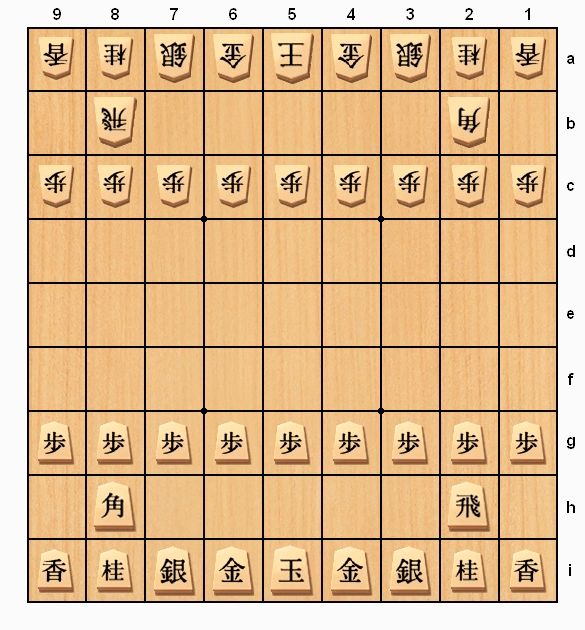
Shogi is similar to Chess in many respects, except for one important aspect: pieces you capture can be replayed on your side. It’s thought that this rule, introduced in the 16th century, reflected the fluid nature of Japanese warfare at the time, and the switching allegiances of warlords, mercenaries and so on.

This rule adds some interesting complications as one closes in to defeat the enemy king, and drops key pieces in the right place to cut off his escape.

Sadly, after I moved on to another job, I never really played Shogi again. I tried playing online but it was fierce competition and I just wasn’t motivated enough to invest the time, grinding one loss after another, to improve. I just kind of forgot about over time.

Another challenge for Westerners in particular, is learning how to read the pieces, since they’re written with Chinese characters (kanji). My bi-racial son is learning Japanese anyway, but isn’t old enough to read most kanji yet. Fortunately, we had a solution.

Then, last month, my eight-year old son took a sudden interest in Shogi. This happened after he uncovered an old Shogi set from the closet and asked me to teach him.

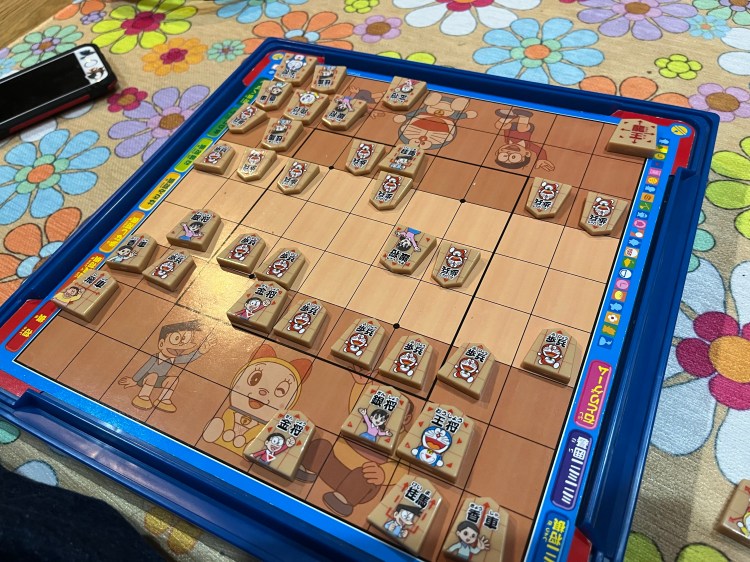
I bought this set years ago, when my daughter was a little girl, and briefly interested in Shogi. During our yearly trip to Japan, I bought her this great introductory set to Shogi and Go, featuring the famous character Doraemon:

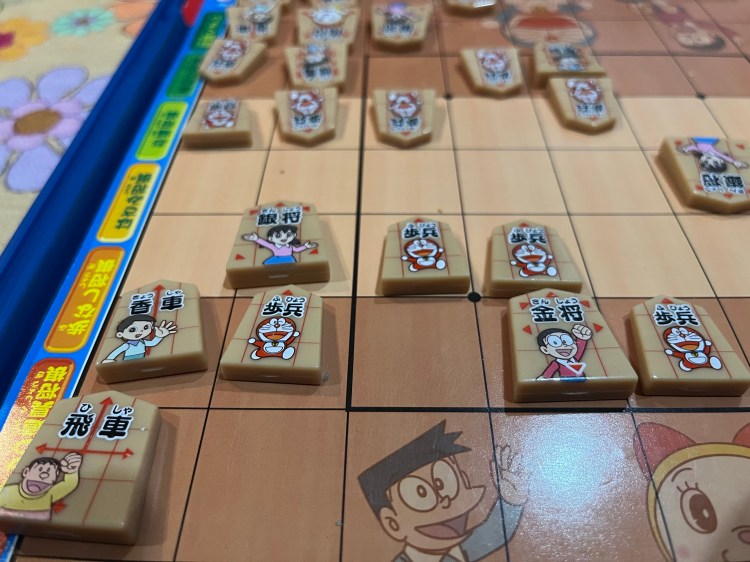
This set is great because each piece has arrows to remind players which direction that piece can move, and furigana letters over the Chinese characters to help young Japanese kids, and so on. It also includes some optional beginner games for younger kids in order to ease them into Shogi and Go, including “mini Shogi” and “mini Go”.

My daughter enjoyed the intro games with me, but never really took Shogi after that. My son also played the mini games, but soon moved onto playing Shogi.

I would love to see a similar introductory set for Western audiences. Shogi is a really fun game, and really not that hard to learn, but getting over the language barrier can be intimidating at first.

In any case, playing Shogi with my son has forced me to dust off my old skills and give my son a good challenge, while also teaching him basic strategy and such. I don’t know if he’ll keep it up, but I am happy to see him take an interest anyway. It’s a good father-and-son moment. 😄

P.S. I may post a few other “learnings” from Shogi as time goes on. Stay tuned!

The Seven Luck Gods

As 2021 draws to a close, this is a nice opportunity to review a fascinating aspect of Japanese spirituality: the Seven Luck Gods!

The Seven Luck Gods or shichi-fukujin (七福神) exemplify the syncretic nature of Japanese religion, because the seven gods have different origins including some native Shinto kami to Hindu gods who have undergone a long transformation from their original forms in India in antiquity.

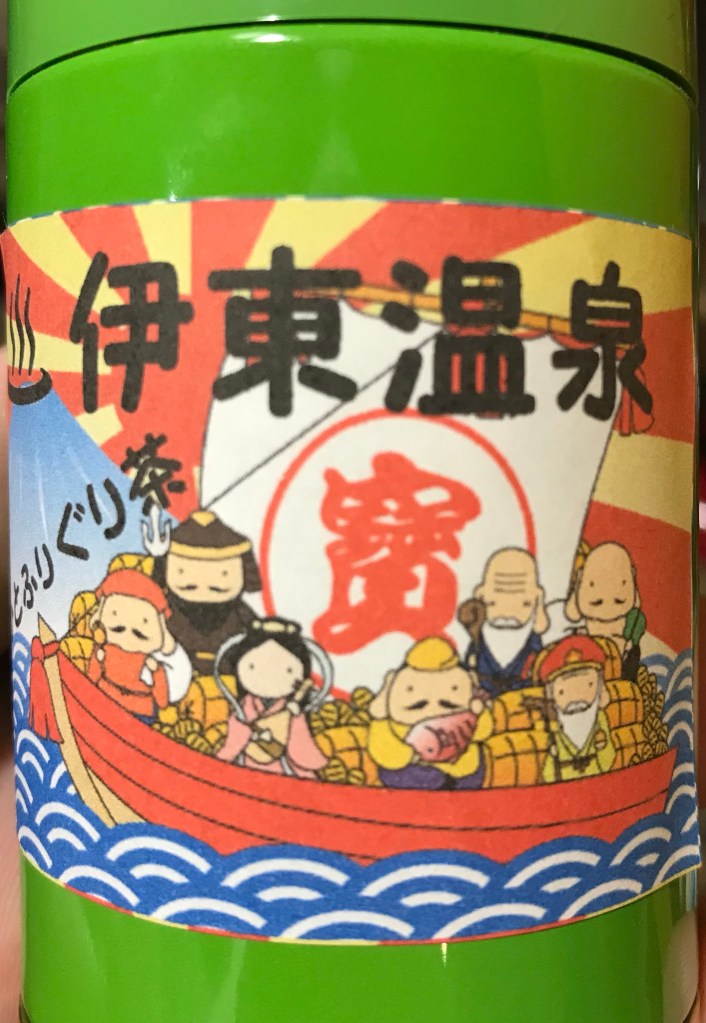
Here are the seven gods as depicted on my wife’s tea tin from left to right:

Name + KanjiAspectPossible Origin
Daikokuten
(大黒天)
Commerce, prosperity, agriculture (hence he is depicted with rice bales)Daikokuten is likely a blending of the native kami Ōkuninushi and (very indirectly) the Indian god Shiva through a Buddhist deity named Mahākāla.
Bishamonten (毘沙門天)Victory, authorityBishamonten has been a guardian deity in Buddhism for a long time, but is descended from the Indian deity Kubera.
Benzaiten
(弁財天)
Patron goddess of the artsDescended from the Indian goddess Saraswati, imported via Buddhism
Ebisu
(恵比寿)
Prosperity, wealthEbisu is a native Japanese kami that has been imported into the Seven Luck Gods.
Fukurokuju
(福禄寿)
LongevityJurōjin is a Chinese-Taoist deity who symbolized the southern pole star, and now for his pronounced skull.
Jurōjin
(寿老人)
Longevity, happiness, wealthAnother Chinese-imported Taoist figure, Fukurokuju overlaps with Jurōjin in some ways, but is distinguished by the animals that accompany him.
Hotei
(布袋)
Luck, guardian of childrenHotei is the so-called “fat buddha” in Asian tradition, but is in fact has a complicated history. TL;DR he is not a buddha, but kind of a saintly figure in Chinese-Buddhist tradition.
source: Wikipedia
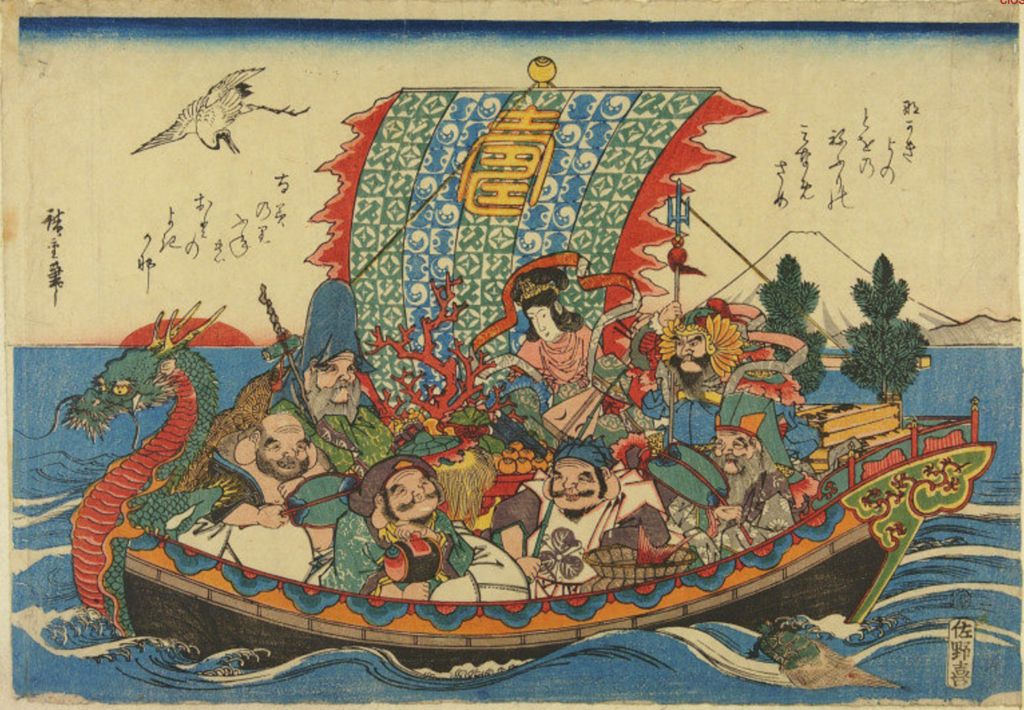
The Treasure Ship by Utagawa Hiroshige, Public domain, via Wikimedia Commons

As with the picture above, you’ll often see the seven deities riding a “treasure ship” (takarabuné 宝船) and/or smiling, laughing and playing games in a carefree manner. In times like this, such images are particularly comforting and something to hope for in the year ahead.

From a cultural standpoint, it’s fascinating to see how Japanese religious tradition has imported various deities and traditions from Chinese Taoism, but also from India via imported Buddhist religion, and how it all blends with native Shinto religion to form what we see today.

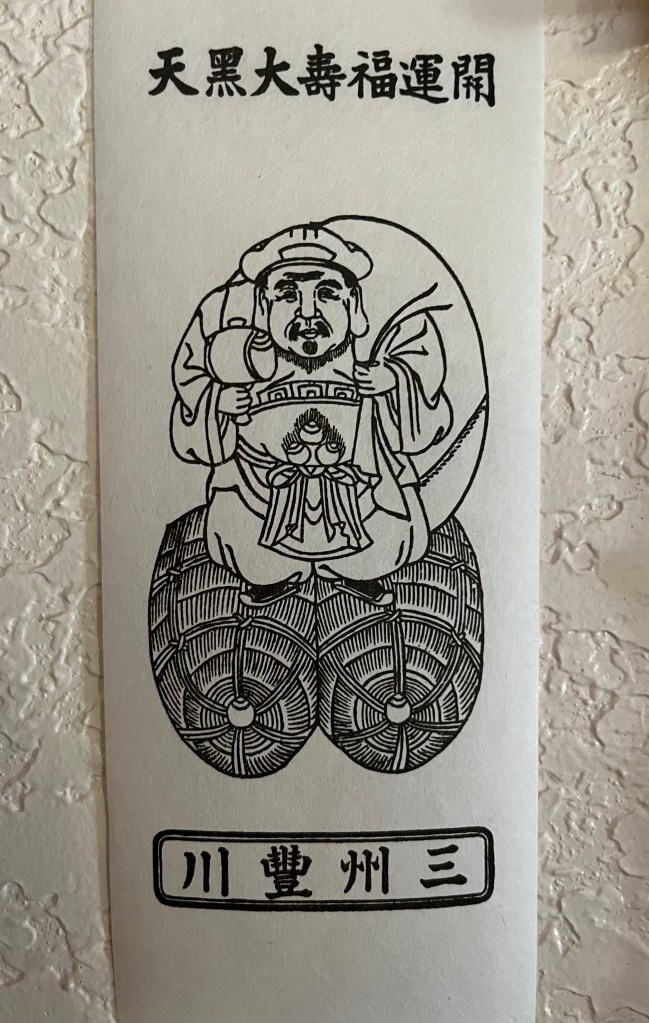
Here’s an example ofuda (お札) of Daikokuten we have in our home:

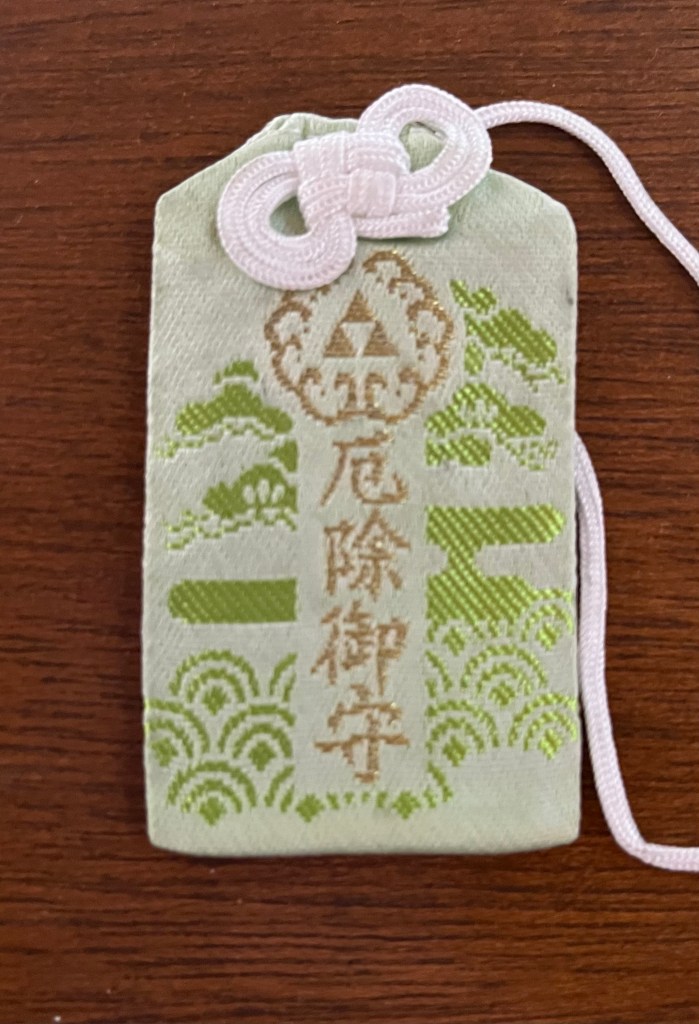
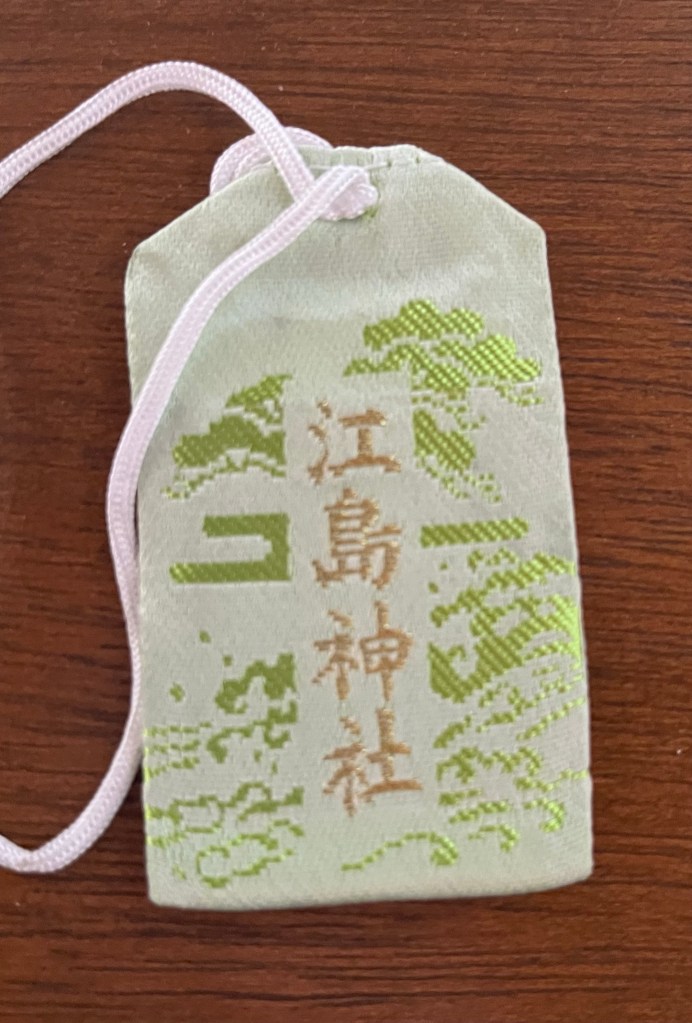
And I have an omamori charm from Enoshima Shrine from 2019 of Benzaiten I keep in my wallet;

These are just some of the examples of the Seven Luck Gods you’ll see in contemporary Japanese religious tradition.